2026年中国家电及消费电子博览会(AWE2026)于312日至15日在上海双区同步举行,以“AI科技,慧享未来为主题,首次采用一展双区模式,全面呈现AI原生产品的加速落地。主展区聚焦AI+生态,涵盖智能家电、健康个护、家庭机器人等核心品类;新设的“消费电子先进科技展区”则集中展示消费电子产业的前沿技术突破,成为全球科技首发的关键平台。本届AWE无疑是历届以来AI含量最高、场景融合最深的一届。

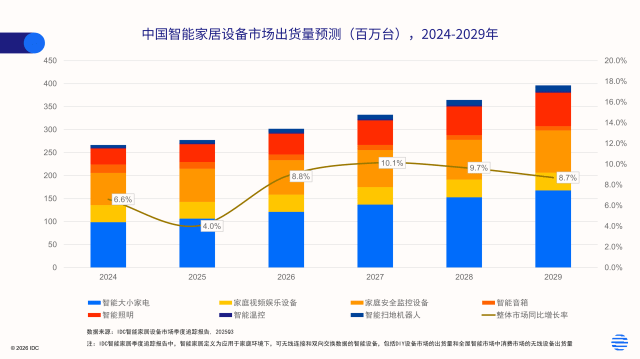
据《IDC中国智能家居市场跟踪报告预测数据,2025年第四季度》预测,2026年中国智能家居设备市场预计出货达3亿台,同比增长8.8%。其中智能扫地机器人及智能照明设备市场引领增长。

四大关键词:AI重塑家庭场景的核心逻辑

  • 主动感知:从“被动响应”走向“主动服务”

全屋智能系统突破传统语音指令局限,搭载主动感知、智能预判能力,实现多设备无缝联动协同,让家居智能从 “被动响应” 迈向 “主动服务”。

  • 适老升级:居家康养成智能设备新刚需

紧扣老龄化社会刚需,居家康养成为家庭设备升级核心方向。智能看护设备、家庭服务机器人纷纷聚焦适老化场景,成为品牌技术与服务能力的重要展示窗口。

  • 跨界融合:打通“人、车、家”多元生活场景

AWE 持续以场景化体验为核心,打通人、车、家多元生活场景,各品类家电互为生态链接枢纽,重构未来品质生活图景,打造一体化智慧生活新愿景。

AI原生落地:从技术概念到生活实景

创新科技展区成为 AI 技术家庭落地的实践窗口,头部品牌将大模型、深度学习、感知交互等核心技术深度融入产品,AI 原生手机、AI 眼镜、AI 会议耳机等前沿终端悉数亮相,推动 AI 原生时代全面到来。AI Agent能力成为决胜厂商竞争力的关键。

五大市场洞察:从功能叠加到系统智能的跃迁

  1. 未来厨房加速演进,数据能力成厂商新护城河

未来厨房概念在本届AWE吸引关注。当前新设备整合油烟、燃气、温湿度、视觉、用户行为、菜谱等多类型数据,形成统一场景决策,同时需要基于烹饪习惯、设备使用数据,提供精准菜谱、场景模式与主动服务。从网络接入看,需采用本地边缘计算与云端协同架构,支持 Wi‑Fi 6/7、Thread 等多模连接,满足低时延、高可靠与多设备并发需求。数据层面,传感器、控制及多媒体数据爆发式增长,要求边缘实时处理、本地存储与云端分析结合,兼顾数据安全与隐私合规。厂商从卖单品转向打造厨房全链路智能方案,并有机会围绕适老等热点以安全便捷为核心推出新的细分赛道爆品。

  • 情感化AI崛起,陪伴式服务成差异化突破口

海尔、TCL、珞博智能、灵童机器人、宇树科技、魔法原子等集中展出陪伴式服务产品,涵盖情感陪伴机器人、家庭服务机器人等。智能家电需从指令执行转向主动关怀,聚焦适老、育儿、独居等更符合当前中国家庭的真实场景。当前,厂商可通过融合语音、表情、肢体、语气等多模态交互弱化机械感,同时依托经典 IP 或打造原生机器人 IP,构建更具辨识度、难以替代的陪伴体验。

  • 细分场景迈向品质化,清洁设备更具人性

用户对细分场景的需求,已不再满足于基础功能的实现,而是全面迈向品质化、精细化、个性化的高阶体验。随着居家场景不断细分与多元,消费者诉求也愈发具体、私密与专属。无论是健康护理、居家清洁、智慧厨房还是睡眠起居等垂直领域,参展企业均以高端材质、人性化设计、原生 AI 主动服务及系统化解决方案,提升场景体验的舒适度、专业性与高级感,充分彰显家居消费升级下品质优先的核心趋势。作为家居生活的核心场景之一,本届 AWE 清洁类新品更具温度与人性,从被动执行转向主动理解、贴心适配。依托 AI 大模型实现环境感知、行为预判与个性化清洁方案,搭配高温蒸汽除菌、仿生机械臂贴边、轮足跨层越障等前沿技术,让家庭清洁场景的迭代始终围绕人的真实需求展开,真正做到科技为人服务、清洁以人为本。

  • AI智能体时代:竞争从“单点”走向“系统”

在家庭场景中,智能产品的竞争维度正加速拓宽。竞争焦点已从单一的性能参数,延伸至多智能体协同、具身智能落地、垂直场景深度适配、全链路数据与隐私保护等综合能力层面。同时,硬件自研、系统级调度与开放生态建设也成为关键竞争力。展会现场的实际案例进一步表明,行业已从早期的“单点智能”竞争,演进为以“系统智能”为核心的价值创造阶段。竞争格局日趋立体,呈现“功能叠加”向“体验整合”跃迁的明显趋势。

  • 中国厂商领跑新品类,从参与者变定义者

本届AWE有一百多家企业首次参展。全新的机器人、拍摄眼镜、感知戒指、电动滑板车、老人AI敲击呼叫器等等新品类层出不穷,国内企业已从市场参与者,升级为技术、产品与场景的定义者和引领者。在核心技术自研、产品形态创新、场景深度适配、生态协同构建等方面实现系统突破。凭借快速工程化能力、本地化场景理解与全产业链协同优势,中国品牌正不断拓展产业边界,成为全球家电与消费电子领域新质生产力的关键载体,在新品类的竞争格局中日益占据主导地位。

IDC中国高级分析师赵思泉认为,本届AWE以家电为主要切入口,实际上是消费电子企业展示AI能力的集中亮相,更是在家庭框架下对未来生活方式的一轮预演。以家电 AI 化 为核心,通过深度语义理解、用户行为自主学习及长期记忆能力,新一代智能家居系统能够持续沉淀用户操作、场景偏好与使用习惯数据,并不断迭代形成专属用户模型。在此基础上,家庭设备可突破单一指令响应模式,实现跨场景、多设备的智能协同与需求预判,提供更贴合生活节奏的个性化自动化服务,推动家电从被动执行工具升级为具备理解、学习与适配能力的智慧家庭中枢。

延伸阅读与沟通:

如需了解更多IDC相关研究或进一步与我们沟通,欢迎识别二维码与 IDC 联系,我们将安排专人与您对接,为您提供定制化的市场洞察与咨询服务。


如需了解IDC在智能终端领域的最新研究报告、数据产品及行业分析,请扫描二维码,在线获取完整研究目录与内容简介,助您精准把握市场脉动。

Claire Zhao - Senior Market Analyst - IDC

Claire Zhao is senior market analyst for Client System Research of IDC China. She is responsible for conducting research on the augmented reality (AR)/virtual reality (VR) market, and vertical analysis for the PC market. She started working for IDC China as a summer intern in 2019 as part of the Telecommunication group. Prior to joining IDC, Claire did some internships in the banking and insurance industries, and had some research experiences related to risk management, financial market, and data analytics. Claire graduated from Rensselaer Polytechnic Institute with a master’s degree in Financial Mathematics.

OpenClaw的应用迈向规模化部署阶段,安全不再是可选附加,而是支撑其全域落地与长效运行的先决条件。

OpenClaw龙虾爆火全球,区别于以往的AI助手、聊天机器人或智能体,OpenClaw具备长期记忆能力,在本地运行,可以主动通过用户偏好的现有消息应用向用户发送消息并在后台持续运行,受到了全球用户的广泛关注并引发安装潮。对于企业来说,OpenClaw的潜力更大。理论上,OpenClaw可以查看用户的日历、阅读会议记录,并持续关注正在进行的项目。与传统需要用户主动提问或提示的方式不同,OpenClaw会主动通过消息应用如Microsoft Teams、微信、飞书、钉钉等联系用户,它还可以执行诸如浏览网页、撰写和发送邮件、编写代码、创建新agent以实现目标等操作。用户可以通过包括手机和笔记本电脑在内的多种设备与其交互。这类持续在后台运行、能够检测趋势、异常和机会的环境型agent,对知识型员工来说极具价值。它代表了一种新层次智能助手理念——不再需要人类先设想可能性并指示助手执行,而是助手能够主动确定下一步行动并识别新机会。这类能力与高度自主性息息相关,意味着助手在实现目标时可能表现出异常强大的资源整合能力,这既带来了益处,也会大幅扩大威胁暴露面,“裸奔”的小龙虾会造成巨大的安全风险,给个人、企业带来难以挽回的巨大损失。

具体来说,OpenClaw可以执行Shell/Python、访问本地文件、调用API、安装社区Skills等,这些能力会带来巨大的安全风险,IDC总结了其存在的一些安全:

  • 公网暴露+弱认证风险:OpenClaw默认端口(18789/19890)常被设为 0.0.0.0 全网监听,全球超23万个实力裸奔,攻击者不需要密码、不需要权限、不需要确认即可连接OpenClaw服务,获得权限,进行未授权访问和远程代码执行,对主机进行完全控制,是超高危风险。
  • Skill供应链风险:ClawGuard发现36.8%的ClawHub Skills存在安全问题,至少76个Skills含恶意代码,攻击者可以一次发布多个恶意Skills,用户在安装Skills时面临重大安全风险。2026年2月,ClawHacvoc大规模恶意Skills投毒,一旦用户执行恶意安装步骤,攻击者便可获取 SSH 密钥、浏览器密码、加密货币钱包私钥、云服务 API 密钥等敏感数据,或在用户设备上植入远程控制程序(RAT),实现完全系统接管。
  • Agent权限失控风险:OpenClaw 可以做Shell执行、文件访问等高权限动作,可以读写全盘、执行任意命令。当Agent做出如删文件、格式化的高危动作时,无二次确认将带来不可挽回的损失。2026 年 2 月,Meta 安全专家在测试OpenClaw 时,因 AI 处理大量邮件时遗忘 “未经确认不得操作” 的安全约束,批量删除其 200 多封工作邮件,专家只能通过强制关机物理止损。
  • 提示注入风险:攻击者可以在skills、网页、邮件、工具中嵌入恶意指令,诱导Agent执行高危操作。
  • 敏感信息明文存储:OpenClaw 将 API Key、账号凭证及会话数据明文保存在本地目录,已被主流窃密木马列为重点窃取目标,存在高风险的数据泄露隐患。
  • 高危漏洞频发:OpenClaw持续暴露高危安全漏洞,攻击者可利用这些漏洞实现远程控制或系统接管,严重威胁运行环境安全。国家信息安全漏洞库(CNNVD)发布通报,2026年1月到3月9日,共采集到82个OpenClaw漏洞,存在极大的安全隐患。

无论是个人还是企业部署类似OpenClaw的工具时,需要采取严格的安全和治理措施,IDC建议组织可以从以下几点入手进行检测和防护:

  • 网络隔离:网关绑定 127.0.0.1 ,关闭默认端口,禁止公网暴露;远程用SSH隧道/VPN/零信任,配IP白名单+强密码+MFA;防火墙阻断外部入站,仅内网/堡垒机访问。
  • 最小化权限:用普通用户启动,禁用root/管理员权限;仅开放必要文件路径,禁用删除/格式化等高危命令;关键操作强制二次确认等。
  • Skills供应链安全管控:Skills供应链扫描、安装前代码审计等。
  • 数据与凭证安全:开启数据加密,禁止明文存密钥/密码;定期更换API密钥,用密钥管理服务/环境变量注入;清理本地缓存与日志,避免敏感信息残留等;
  • 漏洞与监控:开启自动更新;开启操作日志,异常实时告警;定期用官方工具自查绑定地址、认证状态。

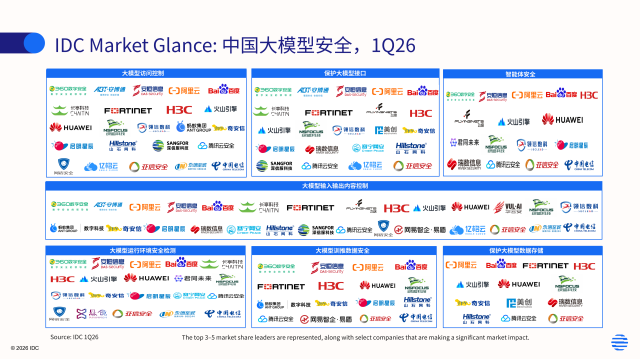
目前,中国众多大模型厂商陆续推出了免费版类OpenClaw智能体,积极抢占新的用户端入口。伴随类OpenClaw智能体部署节奏的加快,AI云厂、网络安全厂商以及AI安全创新型企业快速推出了OpenClaw安全风险分析与防护解决方案和 “安全小龙虾” ,帮助用户安全地使用OpenClaw。为了更好地帮助用户了解大模型安全、智能体安全的市场格局并帮助其做技术选型,IDC正式发布《IDC MarketGlance:中国大模型安全,2026Q1》(Doc#CHC53617026),市场格局详见下图:

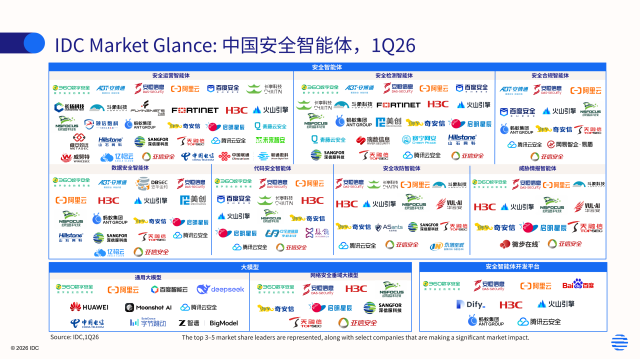
与此同时,大模型、智能体的安全检测与防护也少不了AI的赋能即安全智能体的加持。当前众多技术服务提供商已经将安全智能体和智能体集群的能力集成到其安全解决方案中,帮助用户提质增效,用AI对抗AI、AI防护AI将成为未来大模型安全、智能体安全防护的一个重要思路与能力。IDC同期发布《IDC MarketGlance:中国安全智能体,2026Q1》(Doc#CHC53597826),希望通过IDC对于中国市场中安全智能体产品的调研来帮助用户充分地了解安全智能体相关技术的发展和市场格局,详见下图:

IDC《全球CIO议程2026年预测——中国启示》报告预测,到2030年,中国500强企业中15%的组织将因对AI智能体的管控与治理不足,引发高关注度的运营中断,进而面临诉讼、高额罚款及CIO被解雇的情况。企业管理者亟需构建一套智能体安全和治理体系来帮助企业安全地用好智能体,规避安全风险。

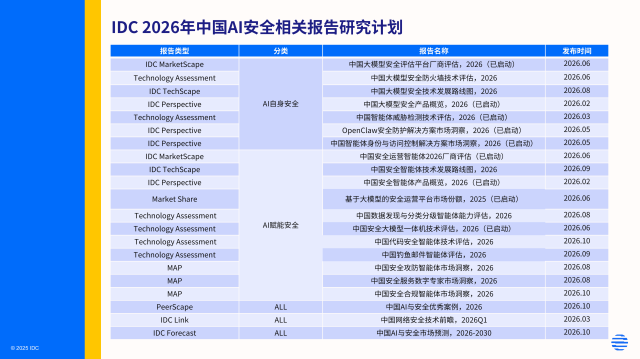
为了更好地帮助用户了解智能体安全检测和防护如何入手,IDC正式启动《IDC PerspectiveOpenClaw安全防护解决方案市场洞察,2026》报告、《IDC Perspective:中国智能体身份与访问控制解决方案市场洞察,2026》报告研究,欢迎大家与我们保持沟通交流,与IDC共同开展更多前瞻性与实践性研究。

IDC更多相关研究

IDC已于2026年启动AI安全技术系列研究,围绕AI原生安全架构、安全智能体成熟度评估、AI驱动DevSecOps实践路径及企业级AI治理框架展开深入分析。

如需进一步了解与研究相关内容或咨询 IDC其他相关研究,请点击此处与我们联系。

Sophia Wang - Research Manager - IDC

Sophia Wang is a Research Manager in IDC China. She is responsible for the analysis and research of China's cybersecurity market. Her primary focus is on China's cybersecurity appliance and services market and operational technology (OT) security market. Additionally, she provides related research and consulting services for regional and global IT customers and supports their business development. Prior to joining IDC, Sophia worked in several consulting companies. She was independently responsible for consulting projects in fast-moving consumer goods (FMCG), internet, and other industries. Through market analysis and benchmarking analysis, she helped many clients solve problems in the different stages of their development. Sophia graduated from the University of Southern California with a master's degree in econometrics. She also majored in human resource management and journalism for her bachelor's degree.

AI-driven infrastructure demand is accelerating investment in datacenter networking, reshaping the Ethernet switch market.

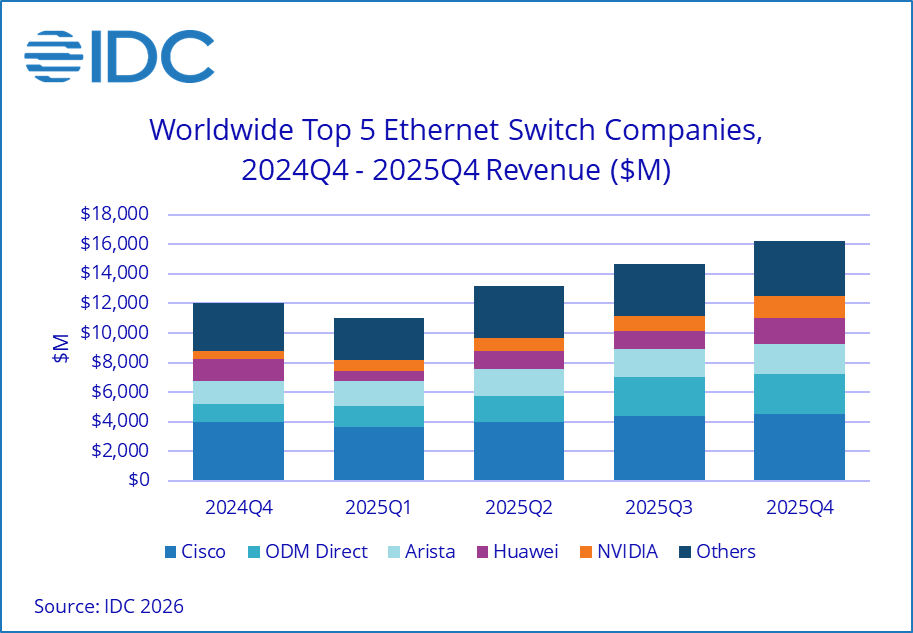
The datacenter portion of the Ethernet switch market continued its strong growth in the fourth quarter of 2025 (4Q25), rising 63.0% year over year (YoY) to reach $9.9 billion, driven by the build-out of datacenter network infrastructure to support AI workloads.

The total Ethernet switch market, inclusive of both datacenter and non-datacenter segments, grew 35.1% YoY to reach $16.2B in 4Q25. For the full year, revenue totaled $55.1 billion, up 31.5% YoY.

Ethernet switch market highlights

  • Datacenter segment: The datacenter portion of the Ethernet switch market saw exceptional growth in 2025, with full-year growth of 53.5% YoY to reach $32.5B. High-speed datacenter switches (800G) accounted for 25.8% of 4Q25 revenues and 16.4% of full-year revenues, while 200Gb/400Gb speeds represented 43.9% of yearly revenue—reflecting rapid adoption of higher-speed networking to support AI workloads.
  • Non-datacenter segment: Ethernet switches used in enterprise campus and branch networks grew 6.4% YoY in 4Q25 and 9.1% for the full year, reflecting steady investment in enterprise infrastructure.
  • Regional performance: Ethernet switch revenues grew in all regions of the world in both 4Q25 and the full year. The Americas led with 45.4% YoY growth in 4Q25 and 40.2% for the year. EMEA posted 28.3% growth in 4Q25 and 23.1% for the year, while Asia Pacific saw 23.3% growth in 4Q25 and 23.5% for the year.

Router market highlights

The total router market, inclusive of both service provider and enterprise segments, rose 11.5% YoY in 4Q25 and increased 11.2% for the full year 2025 to reach $15.0B.

  • Service provider segment: The service provider segment (including communications and cloud SPs) made up 74.4% of total router market revenues in 4Q25 and increased 12.8% YoY.
  • Enterprise segment: The enterprise router market makes up the balance of revenues and grew 7.5% YoY in 4Q25, reflecting ongoing investment in enterprise wide area networking (WAN) connectivity.
  • Regional performance: In 4Q25, the Americas router market rose 15.9% YoY, EMEA increased 16.2%, and APJ grew 3.8%.

Vendor highlights

Vendor performance reflects the shift toward AI-driven datacenter demand.

  • Cisco: Cisco’s total Ethernet switch revenues increased 13.5% YoY in 4Q25 to $4.5 billion, capturing 27.6% market share. Non-datacenter segment revenues (63.9% of Cisco’s total) grew 7.5% YoY, while datacenter segment revenues rose 26.0% YoY. Cisco’s total router revenue increased 22.5% YoY, giving the company a 30.6% market share.
  • Arista Networks: With 92.6% of its Ethernet switch revenues in the datacenter segment, Arista’s revenues grew 31.4% YoY in 4Q25 to $2.0 billion. Arista holds a 12.6% share of the total Ethernet switch market and 19% in the datacenter segment.
  • Huawei: Huawei’s total Ethernet switch revenue increased 14.0% YoY in 4Q25 to $1.7 billion, giving the company a market share of 10.6%. Huawei’s router revenue increased 6.5% in 4Q25, giving the company a 30.2% market share.
  • NVIDIA: NVIDIA’s Ethernet switch revenues, entirely from the datacenter segment, surged 192.6% YoY to $1.5 billion in 4Q25, giving it a 15.2% share of the datacenter segment.
  • HPE: HPE’s total Ethernet switch revenue (66.8% from non-datacenter) increased 11.7% YoY in 4Q25, reaching a 6.7% market share. Following the July 2025 acquisition, HPE revenues now also include Juniper.

Market dynamics

  • Demand for speed and low latency: Organizations are investing in higher-speed switches to support AI-driven and other demanding workloads, fueling growth in datacenter and high-speed segments.
  • AI workloads: The proliferation of AI applications is pushing enterprises to upgrade their networks for both bandwidth and latency improvements.
  • Global uncertainty (constraint): While macroeconomic and geopolitical uncertainty persists, it has not significantly dampened investment in critical network infrastructure.

Why it maters

  • Who should care? CIOs, network architects, IT buyers, and technology vendors should note this acceleration, as it signals a renewed investment cycle in network infrastructure.
  • Business impact: Upgrading to more reliable and faster networks enables more responsive applications, enhances employee and customer experiences, and supports faster decision-making platforms.
  • Ecosystem signal: The market’s robust growth highlights the strategic importance of network modernization, especially as organizations deploy AI and data-intensive applications.

What’s next for the Ethernet switch market

IDC expects continued momentum in the Ethernet switch market as enterprises prioritize network modernization to support AI, cloud, and real-time applications. Growth could accelerate further as AI investments increase, particularly in datacenter AI factories and as more inferencing use cases emerge. However, new supply chain concerns around memory and persistent global uncertainty are headwinds. Watch for ongoing investments in datacenter upgrades and higher-speed switch deployments in the coming quarters.

Brandon Butler - Sr. Research Manager - IDC

Brandon Butler is a Senior Research Manager with IDC's Network Infrastructure group covering Enterprise Networks. His research focuses on market and technology trends, forecasts and competitive analysis in enterprise campus and branch networks. His coverage includes technologies used in local and wide area networking such as Ethernet switching, routing/SD-WAN, wireless LAN, and enterprise network management platforms. While contributing to ongoing forecast and market share updates, he also assists in end-user surveys, interviews and advisory services and contributes to custom projects for IDC's Consulting and Go-To-Market Services practices.

Petr Jirovsky - Senior Research Director, Network Infrastructure and Services - IDC

Petr Jirovsky is a Senior Research Director within IDC's Enterprise Infrastructure global research domain. He provides quantitative insights on network infrastructure for the datacenter, cloud, and campus/branch environments as part of the Network Infrastructure and Services subdomain. Petr serves as the global lead for IDC's Network Infrastructure Trackers, which track Ethernet switches, routers, wireless equipment, and application delivery appliances and services. He also contributes to numerous custom data projects and supports the publication of market share and forecast documents for the subdomain.

Diego Anesini - VP D&A, LatAm & Director Enterprise and Telecom - IDC

Diego Anesini serves as Research Vice-President, Data & Analytics for IDC Latin America, overseeing all the Information and Communications Technologies. Prior to this position, Diego held various roles in the company. The most recent was Enterprise Infrastructure and Telecom Director for Latin America. He has extensive experience in the Telecom and IT markets, due to his more than 25 years in the industry.

企業でのAIを利用したITシステム投資はもはや必然の状況になっています。特に2026年は、AIエージェントの実ビジネス適用の元年となるとIDCでは予測しており、従来のAI利用方法であった「仕事のアシスタント」からAIエージェントを実利用し、ワークフローへの組み込みによる「業務遂行のバディ(相棒)」への構造的変化の年になるとみています。

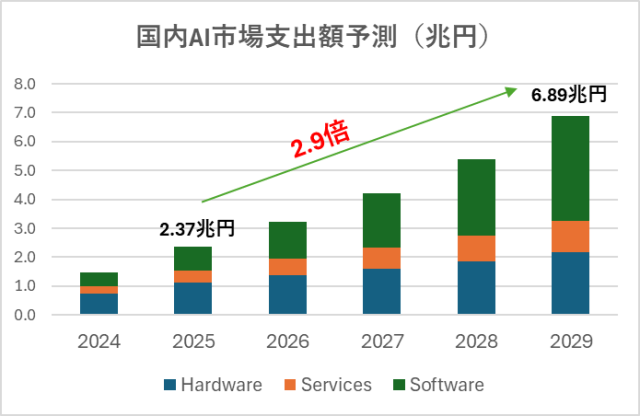
IDCが2026年3月に発表した「Worldwide AI and Generative AI Spending Guide 2026V1」では、国内AI市場支出額は2025年に2兆3,725億円から、2029年に2.9倍の6兆8,897億円に急成長し、2024年~2029年の年間平均成長率(CAGR)は36.0%に達すると予測しています。このことは、AI市場が国内IT市場の重要な一画を占めるまでになることを意味しており、2029年にはIT市場全体の20%を占めるまでになります。これらのデータからも、企業でのAI投資は必然になっていると言えるでしょう。

今回IDCが発表した「Worldwide AI and Generative AI Spending Guide 2026V1」では、
以下の重要なAIシステム導入/活用のポイントを示しています。

1.AIエージェントの急成長によるAIソフトウェア市場の成長

国内では、企業での生成AIは2025年末に5割以上の企業が実利用しているものの、その利用方法(ユースケース)が例えば翻訳、要約などの一般オフィス業務の補助的役割に留まるケースが多く、十分な価値創出が得られずに試験的導入(PoC)が失敗するケースが多く見られることが判明しています。IDCの企業ユーザー調査においても、PoCにおいて期待する効果が得られなかった経験のある企業が6割に上ることが測定されています。このような背景で、導入効果が得られやすいユースケースとして、補助的な役割のAI利用から業務ワークフローの自動化/自律化へのユースケースの移行が求められます。これを実現する手段として提供が始められたAIエージェントは市場の期待を集めており、ソフトウェアベンダーによるAIエージェント向けプラットフォーム提供やアプリケーションへの組み込みが2025年から始まり、2026年から実ビジネスへの適用が急成長するとみられます。これらのAIエージェントの急成長を加味し、AIソフトウェア市場のCAGRは48.9%と予測し、AI市場全体のCAGR 36.0%と比較して成長率が大きくなると予測しています。

2.AIユースケースのCX適用拡大

AI/AIエージェントを実ビジネスに適用するためには、どの業務のどの部分に適用するかが成功のキーポイントになります。IDCが今回発表した「Worldwide AI and Generative AI Spending Guide 2026V1」では、ハードウェア/ソフトウェア/サービスのAIテクノロジー市場分類だけではなく、ユースケース別の情報も提供しています。これによると、IT運用の自動化、ソフトウェア開発へのAI適用などが成長率の高いユースケースとして予測されていますが、特に成長率の高いユースケースとして「セールス(CAGR 46.2%)」「カスタマーサービス(CAGR 42.0%)」などのCX(顧客エクスペリエンス)への適用拡大が見込まれています。これは、AI/AIエージェントが社内業務の自動化のみならず、人間とAIが協働することによって顧客やパートナーなどの対外的なリレーションを提供する「バディ」として位置づけられるようになることを意味しています。このことは、企業がAIを活用した自動化によるコスト削減ばかりではなく、顧客対応力や市場変化への対応力を強化する活用方法にユースケースを拡大していくことを示唆しています。

まとめ

2026年の国内AI市場はAI活用の変革が起こり、AIがアシスタントからバディへの変化を起こすキックオフの年と位置付けることができるでしょう。このことは、人間とAIが協働する企業運営の再定義をもたらし、AI市場加速の引き金となり、国内IT市場の主要な一画を占めることになるでしょう。

IDCが提供するデータのご紹介

IDCはAI市場に関して、継続的かつ多層的な情報を提供し、分析を行っています。

これらのデータセットを活用することで、国内およびグローバルなAI市場の加速を可視化することが可能となります。

関連する調査やご相談について

より詳細なインサイトや市場動向については、当社アナリストへお気軽にご相談ください

Takashi Manabe - Senior Research Director, AI and Automation, IDC Japan - IDC Japan

Takashi Manabe is the Senior Research Director of AI and Automation groups in IDC Japan. Mr. Manabe's primary responsibility includes the analysis of the dynamics and trends, vendor strategies, and market sizing/modeling of Japan’s enterprise AI related market including Software, Services and Infrastructure. He also covers Security, Data Management/ Bigdata Analytics, Customer Experience and Digital Transformation market related to AI. Before joining IDC, Mr. Manabe worked at Toshiba Corporation, Toshiba America Information Systems, Inc., and Toshiba TEC Corporation. 20 over years his experience in the communications and software market, Mr. Manabe started his business as a system engineer for PBX/enterprise data communications equipment in Toshiba Corporation. He was also act as product planning and marketing manager for communication equipment/ software. He also acted as business planning, business management in Toshiba America's age for cable TV Internet business in the enterprise, security software and consumer communication market. Just prior to join IDC, Mr. Manabe worked at Toshiba TEC Corporation, for document solution such like MFP remote management system, scan OCR solution as product planning manager. Mr. Manabe graduate of Muroran Institute of Technology, Japan, holds a Master Degree of Computer Science and Engineering. He also holds a Bachelor degree in Computer Managed Machinery Systems from Muroran Institute of Technology.

While AI-powered tools proliferate across the advertising (and every other) industry, most deployments remain isolated, unable to deliver the unified, cross-channel customer experiences that brands demand. IDC sees a critical gap in the market—fragmented AI products are failing to orchestrate branding and performance across the entire customer journey.

The solution lies in agentic mesh architectures for CX, where interconnected AI agents collaborate seamlessly, breaking down silos and enabling real-time, authentic engagement at scale. This shift is not just evolutionary; it is foundational for advertisers seeking to lead in the AI age.

Advertising’s agentic revolution

Let’s face it: Traditional adtech often feels fragmented, making campaign orchestration and audience targeting a challenge. This is only exacerbated by current AI deployments which often focus on single tasks and fail to capture the cross-functional nature of a client journey.

The agentic mesh for CX changes the game, deploying semiautonomous and autonomous AI agents that collaborate across departments and systems. For advertising professionals, this means:

  • Real-time, cross-channel campaign management
  • Privacy-compliant personalization
  • Unified brand messaging at scale

Best practices for AI-driven advertising

Brands need to address the agentic mesh for CX framework as they look to effectively enable AI across their Ad-tech stack. In this regard several best practices emerge:

  • Unified aata infrastructure: Build a standardized data foundation that integrates DMPs, CDPs, CRMs, and analytics platforms. This empowers agents to access real-time audience profiles, fueling dynamic creative optimization and attribution.
  • Interoperability and standards: Design advertising agents for seamless workflow handoffs and data exchange using protocols like AdCP, OpenRTB, and IAB frameworks. This ensures compliance, scalability, and consistent campaign execution.Rapid adoption and risk management: Deploy agents for critical use cases—cross-channel attribution, creative optimization, and commerce integration. Regular risk assessments help mitigate errors, ad fraud, and ensure quality AI outputs.
  • Upskilling and governance: Equip your teams for agentic AI by upskilling in programmatic buying, campaign optimization, and creative management. Clear governance and supervisory controls are essential for brand safety and regulatory compliance.

The agentic mesh advantage

Agentic AI isn’t just a buzzword—it’s transforming advertising operations by automating complex workflows, breaking down data silos, and enabling proactive, outcome-driven marketing. Industry leaders like Amazon Ads, Oracle, Adobe, and Salesforce are already embedding agentic mesh principles, even if under different monikers, to drive cross-functional collaboration and supervisory control.

The true test for brands in the AI era is not simply adopting new tools, but evolving from fragmented, siloed adtech to a fully autonomous, agentic ecosystem. This transformation requires real-time data integration, robust infrastructure, and clear protocols for agent interoperability—each a pillar of the agentic mesh advantage.

Brands that unify their advertising investments with cross-functional CX goals and KPIs, leverage no/low-code tools and agent cloning, and prioritize closed-loop measurement will accelerate their journey toward autonomous operations. Selecting partners committed to outcome-driven, agentic innovation is equally critical.

Ultimately, competitive advantage hinges on your ability to break down silos, upskill teams, and implement strong governance. Early adopters of agentic mesh principles will not only deliver consistent, brand-safe customer experiences at scale—they will define leadership in the AI age.

For more information on the Agentic Mesh for CX and how brands can apply it in the advertising context, check out:  Applying the Agentic Mesh for CX to Advertising: Orchestrating Branding and Performance Across the Entire Customer Experience in an AI Age.

Roger Beharry Lall - Research Director, Marketing Applications for Growth Companies - IDC

With over 25 years' experience leading technology driven marketing programs, Mr. Beharry Lall is now a Research Director with IDC covering Advertising Technologies and SMB Marketing Applications. He brings a unique multidisciplinary perspective, evangelizing the innovative and pragmatic use of both martech and adtech solutions for companies of all sizes. Early in his career Rog worked with an IBM subsidiary expanding into the Asian Market and subsequently, he spent over a decade at RIM (BlackBerry) building marketing leadership across new industry segments, geographies, and product categories. This background fuels his perspective as he researches enterprise customers engagement tools and tactics across the unified omnichannel.

Japan’s IT market is evolving beyond its traditional reliance on large enterprises, including public sector modernization, as a primary growth driver.

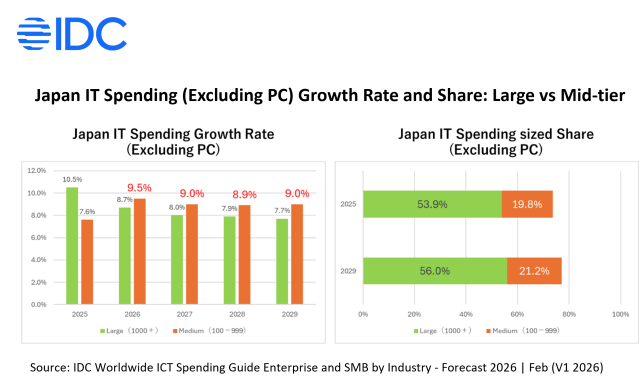
In 2026, IDC forecasts the market will reach ¥28,418.9 billion, growing 3.3% year on year, with a 6.4% CAGR through 2029. Large enterprises remain dominant, increasing their share from 53.9% (2025) to 56.0% (2029).

Japan IT market growth accelerates as mid-sized firms drive 9.5% spending surge, reshaping vendor strategy and digital transformation demand.

However, the key shift is in the rise of mid-sized companies.

  • Mid-sized firms (100–999 employees) will expand IT spending share from 19.8% in 2025 to 21.2% by 2029
  • In 2026, IT spending (excluding PC) will grow 9.5% YoY, outpacing large enterprises (8.7%)

Japan’s IT market is entering a dual-engine growth phase, combining enterprise modernization with accelerating mid-market digital transformation.

Why Are Mid-Sized Companies Accelerating IT Investment?

1. Is labor shortage forcing mid-sized firms to digitalize?

Yes, and it’s becoming urgent.

Labor shortages in Japan aren’t just a macro trend anymore. They’re showing up in day-to-day operations, especially for mid-sized companies.

Large enterprises have advantages: stronger employer brands, deeper recruiting pipelines, and more mature digital platforms. Many have already invested heavily in automation, workflow integration, and data infrastructure.

Mid-sized companies often lack both talent depth and digital maturity. They cannot compete on compensation scale or recruitment visibility. As labor shortages intensify in 2026, digitalization becomes essential for business continuity rather than a discretionary initiative.

In addition, digitalization mandates from large business partners and public sector procurement processes are cascading downstream. Mid-sized firms that fail to digitize risk exclusion from supply chains and ecosystem participation.

Bottom line: From 2026 onward, digitalization is no longer optional, it’s how mid-sized companies will stay operational and competitive.

2. Why will mid-sized firms rely more heavily on IT vendors and system integrators?

Because they don’t have the in-house capacity.

Large enterprises are increasingly building in-house digital capabilities or partnering directly with hyperscalers and advanced technology firms. Their internal IT maturity has advanced significantly.

Mid-sized companies usually can’t. Most have small IT teams, limited internal expertise, and constraints in executing complex modernization programs. So as digital transformation moves from planning to execution in 2026, they’ll depend more on vendors.

Mid-sized companies typically require:

  • End-to-end implementation support
  • Packaged, use-case-driven solutions
  • Operational scalability
  • External expertise in AI and cloud adoption

What this means for vendors: Serving this segment requires structural adaptation. Projects are smaller. Budgets are tighter. Engagement models must be leaner and outcome oriented.

3. Do mid-tier vendors have a structural advantage?

In many cases, yes.

While Tier 1 and Tier 2 vendors remain essential for large-scale enterprise transformation, mid-sized companies often require a different delivery model. Engagements are more operational, localized, and execution focused.

Mid-tier system integrators and regional IT vendors may hold an inherent structural advantage in this environment.

Their scale, cost base, and organizational focus are often better aligned with the needs of mid-sized enterprises. They’re often closer to the customer, more hands-on, and are better structured standardized delivery of outcome-driven solutions without the overhead associated with mega-enterprise programs.

Meanwhile, Tier 1 vendors are optimized for complex, multi-year transformation programs. Mid-tier vendors are often optimized for speed, proximity, and practical execution, attributes that align naturally with mid-sized companies entering digitalization at scale.

So, the fit matters. As mid-sized companies increase IT investment from 2026 onward, vendors whose size, service intensity, and geographic reach match this segment are likely to capture disproportionate growth.

4. How does cloud adoption lower transformation barriers?

Large enterprises frequently face modernization bottlenecks due to deeply embedded legacy systems and customized architectures. Transformation often requires extensive integration and long transition timelines.

Mid-sized companies face fewer structural constraints.

While legacy platforms may exist, system environments are typically less complex. As infrastructure-as-a-service (IaaS) and cloud-native platforms expand in Japan, cloud adoption reduces both cost and complexity barriers.

Cloud changes the equation by enabling:

  • Faster deployment
  • Lower upfront costs
  • Scalable digital infrastructure
  • Easier integration of AI-related capabilities

And that last point is important. In 2026, spending on AI (models, data, agents) is expected to expand rapidly. Cloud environments allow mid-sized companies to adopt these capabilities without large-scale architectural overhauls.

In simple terms: Cloud reduces friction and that speeds everything up.

What Does This Dual-Engine Growth Mean?

Japan’s IT market is not fragmenting, it’s expanding from two different directions at once. Large enterprises continue invest and modernize. Mid-size companies are stepping up as a real growth driver.

Going forward, growth will be shaped by:

  • Sustained large-enterprise modernization
  • Accelerating mid-sized digital transformation
  • Expanded AI adoption across both segments
  • Increased reliance on scalable cloud platforms

What Should IT Vendors Do Next?

Focus more seriously on the mid-market.

Growth won’t come only from large enterprise deals anymore.

It will increasingly come from:

  • Reaching more mid-sized customers
  • Delivering repeatable, outcome-driven solutions and
  • Aligning pricing and delivery to smaller-scale projects.

The takeaway:

Vendors that adjust early to this dual-engine reality will be in the strongest position to capture the next phase of growth in Japan’s IT market.

Contact IDC for deeper insights, or connect with our analysts to discuss what this means for your business.

Hitoshi Ichimura - Senior Research Manager, Software, Services, and IT Spending, IDC Japan - IDC Japan

Hitoshi Ichimura is responsible for the market analysis of overall Japan IT spending, based in Tokyo. In this role, he is responsible for the market analysis of IT Spending research by vertical, company size and region. His main area of research involves IT Spending market forecast and trends for the Japan financial industry local area and SMB segment. Ichimura is also involved in various custom research projects in the area.
Key takeaways from IDC’s Telco Forum 2026 Barcelona

On March 1, 2026, IDC brought together senior telecom leaders, vendors, system integrators, cloud leaders, partners, and media in Barcelona to examine how the industry is evolving in an AI-driven world. The discussions reinforced a clear message: telecom transformation is no longer theoretical. It is structural, financial, operational and increasingly sovereign. Drawing on insights shared across the event; this blog captures the major themes shaping telecom strategy through 2030.

The four megatrends shaping telecoms through 2030

There are 4 compounding megatrends that have been reshaping the sector since 2022. Looking back, the telco industry has moved through a rapid succession of technological focal points: Network APIs as foundational enablers for exposing network capabilities; Generative AI as the entry point for process automation; and Agentic AI in 2025, which introduced autonomous decision-making into customer experience, network management, and enterprise solutions. In 2026, the critical new frontier for AI is inferencing, the shift from model training to real-time, distributed AI workload execution, and it is this transition that is forcing telcos to fundamentally rethink their infrastructure architecture and competitive positioning. Underpinning all of this are the four defining themes of 2026:

  • Structural transformation is intensifying. Business model reinvention is not new for telcos, but the pace has accelerated. Four distinct strategic paths are now in play simultaneously: the TechCo transition (embracing network-as-a-platform models), Delayering (separating ServCo, NetCo, and InfraCo entities to optimize asset utilization), Consolidation, and a redefined form of Convergence, that focuses on bundling fixed-mobile-satellite services and designed to lock in ARPU and reduce churn.
  • Network investment is tapering. The cyclical CAPEX peak from 5G non-standalone rollout has passed in high and middle-income markets. IDC forecasts a 1.5% decline in global telecom CAPEX in 2026, bringing the total to $320 billion, with CAPEX intensity projected to fall from 22% in 2024 toward 18% by the end of the decade. The drivers are multiple: the one-off FTTP spending peak is fading, satellite partnerships are smoothing access and transport investment, and a structural CAPEX -to-OPEX shift is underway as telcos increasingly rely on ISVs and cloud providers for virtualization and AI. The freed-up cash is flowing into shareholder returns, strategic investments, and targeted digital infrastructure plays.
  • AI adoption is crystallizing around inferencing and sovereign AI. In 2025, the buzzword was agentic AI. In 2026, it is inferencing, and the telcos have a genuine structural advantage to capitalize on it. With distributed infrastructure, low latency, and deep regulatory trust in their home markets, telcos are positioned to become national AI factories, delivering sovereign AI solutions to governments, healthcare systems, and regional enterprises. IDC’s survey data shows that AI compute spending is approaching a pivot point in 2027, when inferencing will overtake training as the dominant driver of AI infrastructure investment. Telcos that expand their data center footprint and deepen relationships with co-location providers now are positioning ahead of that curve.
  • LEO satellite partnerships are becoming strategic. Starlink has established an early lead as the preferred satellite partner for telcos globally. Use cases vary significantly by geography – D2D and satellite broadband in the US and Canada’s large, underserved coverage areas, disaster recovery in Europe’s dense markets, and transport and backhaul across Asia Pacific and Australia. What is clear across all regions is that the satellite-terrestrial boundary is dissolving into a hybrid connectivity model, and the telcos that forge the right partnerships now will have a differentiated coverage story that competitors simply cannot replicate terrestrially.

Balance, pivot, revolt: the transformation imperative

Telcos’ internal transformation focus for 2026 can be framed with three sharp words: balance, pivot and revolt.

Balance is the defining tension of 2026. According to IDC’s C-Suite Tech Survey (September 2025, n=45 telecom respondents), 52% of telco C-suite leaders have AI implementation as a top three priority, but 50% simultaneously have technology modernization as a top three priority. These can be complementary investments as telcos cannot get full value from AI if they have not addressed legacy system complexity, data governance gaps, and architectural debt; but they also compete as telcos must decide between investing in new capabilities that promise significant gains vs. unglamourous IT modernization initiatives which have often been neglected for years. This is at a time with funds for transformations are finely balanced: Telecom CAPEX is declining, though IDC forecasts a modest 5.2% growth in spend on operations and monetization systems in 2026, reaching $54 billion, as telcos invest in IT systems to monetize the billions in CAPEX invested in rolling out new wireless and fixed networks. 5.2% growth is far from a blank cheque, every dollar deployed in IT must demonstrably either cut cost or support new revenue.

The autonomous networks aspiration illustrates this balancing act with particular clarity. TM Forum data from 2025 shows that only 4% of operators self-reported achieving Level 4 autonomous network status, yet 85% aspire to reach that level by 2030. That is an extraordinary gap. According to IDC’s EMEA Telco Transformation Survey (July 2025, n=150), the barriers are familiar: interoperability failures and the persistent lack of a single source of truth in network data. Notably, these are precisely the same barriers that have constrained AI adoption more broadly.

Pivot means making deliberate choices about where to invest and what to sequence. Data quality, accessibility, security are all in focus in 2026. This is represented in telcos making positive investments to overhaul their network inventory systems and updating their data governance policies and infrastructure from customer data down to the network. For autonomous networks, IDC’s research points to a more granular, domain-specific approach gaining traction: telcos are identifying specific use cases, service assurance and fault management are the top automation priorities for EMEA telcos in 2026, and targeting specific domains (IP access, RAN, and core) for Level 4 capability. This is far more tractable than a blanket push to full autonomy. On the people side, 97% of telcos recognize gaps in their talent base for developing and using AI at scale. Sixty-five percent are investing in AI-enabled learning tools, and 58% are expanding internal upskilling programs, but with only 42% currently offering skills training, there is still a meaningful gap between recognition and action.

Revolt is the urgent call to fix customer commercialization before AI finally demolishes the buying behaviour telcos have relied on for decades. For example, a UK mobile subscriber paying £15 per month for 10GB, regularly consuming just 6GB, with known Disney+ and international roaming usage, was on renewal offered to take a device upgrade, to increase their data rate to 30GB for £18 or unlimited data for £24. There was no demand signal for a device, no upsell of complementary services, and no personalization of any kind. The customer found a 40GB plan with the same mobile provider on a comparison site for £7.50, a 50% ARPU reduction and 400% value giveaway. Comparison sites have been established for well over a decade empowering consumer to find the best deal with some manual effort. Today’s consumers and enterprises, however, are already beginning to use AI to undertake similar comparisons with far less manual effort.

The point is not just that this particular offer was poorly designed. The point is that the entire commercial model relies on customer inertia, and AI is systematically dismantling that inertia. As AI agents increasingly make purchasing decisions on behalf of consumers and enterprises, operators that cannot demonstrate differentiated, personalized value in real time will find their customer bases eroding with a speed and scale unlike anything seen before.

5G: from product to platform, and the 6G horizon

The back half of the 5G lifecycle represents an inflection point, but only if operators change their frame of reference. Core mobile remains solid: IDC projects a 2.0% CAGR in global mobile connections through 2029. The world will exceed 9 billion mobile connections within the next two years, surpassing the current global population of 8.3 billion. In saturated markets, however, the growth lever has shifted decisively from subscriber acquisition to retention and value extraction — which brings the customer experience and commercialization issues directly back into focus.

The bigger opportunity lies in the shift from 5G as a product to 5G as a platform. For the first five years of 5G, operators sold speed, latency, and connection density. The next phase is less about branding a connection as 5G and more about 5G as the underlying infrastructure that enables XR, drones, V2X, private 5G, and RedCap solutions to be viable, scalable, and mobile. The challenge is that these use cases do not scale in the millions the way mobility or FWA does, they scale in tens of thousands. That requires a fundamentally different approach to network architecture, back-end systems, and, critically, business models.

Integration complexity remains the most significant brake on enterprise 5G adoption. 46% percent of enterprises cite it as the primary adoption barrier. The solution is less ego and more ecosystem: operators need to be willing to play a back-end role in partner-led solutions rather than insisting on front-facing primacy. 74% of enterprises express interest in network slicing; 49% plan to increase fixed wireless access investment; 58% say they are interested in satellite connectivity, but many still have significant misconceptions about what satellite-to-device actually delivers today. Expectation management is part of the product.

On 6G, If the industry maintains the ten-year generational cycle, 6G commercial launches would begin around 2029. Technical specifications are still in the study phase at 3GPP. The defining features of 6G, AI-native architecture enabling autonomous self-optimization, integrated sensing that turns every cell tower into a radar station, quantum-resistant security, and new terahertz spectrum, collectively point toward a network that moves AI out of the data center and into the physical world. The concept of “physical AI,” or what one operator CTO termed “kinetic tokens,” suggests that 6G will not merely support AI-driven applications but will provide the real-time connectivity substrate that makes physical AI, autonomous robots, connected vehicles, intelligent infrastructure, a viable commercial reality.

The enterprise connectivity opportunity: vast, varied, and underserved

Enterprise connectivity budgets are growing. IDC’s Future Enterprise Connectivity Infrastructure and Services Survey (August 2025, n=758) shows that 37.5% of enterprises increased their connectivity budget by more than 10% over the last two years. For 2026, that proportion rises to 44%. The primary drivers are cloud migration, SaaS usage, AI, video, IoT and device density are driving up bandwidth requirements. Four in ten enterprises saw bandwidth demands increase by more than 50% over the past year. Among organizations with over 10,000 employees, 17% saw their bandwidth demands double. Retail and financial services lead in cumulative bandwidth growth, but the opportunity is sector-wide: only 40-46% of enterprises are at an advanced or market-leading stage of connectivity maturity. The majority are still on the journey and actively looking for guidance.

The question of who captures this opportunity, however, is not straightforward for network service providers. When IDC asked enterprises which provider types they see as best and worst placed to address their future WAN requirements, cloud providers ranked first at 29%, followed by IT partners at 28%, with network service providers third at 23%. More pointedly, in the “worst placed” ranking, network service providers came second. The reasons cited: not treating customers well 35%, limited IT and network capability 28%, and difficult to work with 26%.

This is a reputational and structural challenge, not just a product one. Cloud providers are perceived as having broad network capability, even though they fundamentally depend on telco partners for last-mile delivery. IT partners are perceived as having deep industry expertise, expertise that telcos themselves possess but has not been to communicate or commercialize effectively. The gap is therefore not simply about capability. It is about perception. Perception shapes purchasing decisions, which in turn shape market reality.

Encouragingly, telcos’ “best placed” positioning has improved in recent years as operators have prioritized customer experience and simplified portfolios to deliver more flexible, scalable, and accessible services aligned with enterprise demand. Network as a Service, or NaaS, is central to this shift. NaaS is a cloud-based delivery model in which connectivity, bandwidth, security, and routing are provisioned and consumed on demand via APIs or self-service portals. It abstracts the underlying physical infrastructure and allows enterprises to scale, configure, and optimize network resources without directly owning or managing hardware. Enterprise sentiment toward NaaS remains mixed, 32% said they could make it easier or cheaper for a service provider to manage their networks and security, and 26% said they could simplify self-managed network operations. But 19% said they would not want to be locked into one service provider’s platform regardless of the benefits, and 10% remain unfamiliar with NaaS entirely. The education gap is significant and closing it will require more than technical refinement. It demands commercial clarity, stronger communication, and deeper customer relationships. Ultimately, this is not just a transformation in network architecture. It is a transformation in trust, positioning, and perceived value.

The bottom line

The IDC Telco Forum 2026 in Barcelona surfaced a market that is, in many respects, more coherent in its direction than at any point in recent years, but also more demanding of execution discipline than most operators have yet demonstrated.

The opportunity in AI inferencing and sovereign infrastructure is real and structurally aligned with telcos’ natural positioning. The satellite-terrestrial convergence is creating a coverage differentiation story that was not available five years ago. The enterprise connectivity market is expanding, budget-rich, and hungry for strategic guidance. And 5G, finally maturing beyond its early-product phase, is approaching its platform moment.

But against each of these opportunities sits a structural challenge that must be addressed in parallel: legacy system complexity is limiting AI value extraction; autonomous network ambitions are outpacing organizational readiness; commercial and CX systems are still leaving significant value on the table; and enterprise perception of telcos’ breadth and quality of service lags behind the reality.

The telcos that will win this decade are those that treat these not as separate workstreams but as a single integrated transformation, one where the investment in networks, IT modernization, talent, customer experience, and ecosystem partnerships compounds into a durable competitive position. The window is open. The question, as always, is execution.

For more information on IDC’s telecom research, including the newly launched Satellite and NTN research program, contact your IDC account manager or drop your details in here.

Download a copy of the State of the Telco Market ebook here.

Masarra Mohamad - Senior Research Analyst, European 5G Enterprise Strategies - IDC

Masarra Mohamed is a senior research analyst specializing in analysing the connectivity and communications services markets, focusing on the changing networking requirements, trends, and competitive dynamics that support enterprises in their digital transformation. She explores how enterprise network strategies evolve to enable cloud, AI, and security.

最新の関税動向は、世界のテクノロジー・サプライチェーン全体にコスト圧力と不確実性をもたらしています。日本企業にとっても、部材調達・生産・組立・物流が複数国を跨ぐことが多い中、関税変更は価格戦略やサプライチェーン設計の見直しを迫る要因になり得ます。

IDCでは、Simon Ellis(製造・サプライチェーン担当 グループバイスプレジデント)と、Phil Solis(コネクティビティ/スマートフォン向け半導体担当 リサーチディレクター)が、最新の関税動向がテクノロジー・エコシステム全体の価格、製造戦略、長期投資判断に与える影響を以下のように議論しています。

原文:2026年2月25日公開(英語)|日本語版監修: 寄藤 幸治

直近の最大課題は「不確実性」

最高裁判所が過去の一部関税を「適法ではない」と判断する一方で、新たな関税が導入されつつあります。その結果、コストへの影響(エクスポージャー)は残り、より大きな課題として浮上しているのが予測不能性です。

「こうした事柄について、明確さがほとんどありません。月曜日に真実だったことが火曜日には真実ではなくなる。企業が取り組むべき構造的な対応は、数分、数時間、数日、数週間で終わるものではなく、数か月、場合によっては数年かかります。だからこそ、何が正しい判断なのかが見えにくいのです」
– Simon Ellis(IDC)

製造業やサプライチェーンのリーダーにとって、設備投資、調達先変更や地域的な分散といった構造的な意思決定は複数年単位の時間軸で行われます。政策の方向性が短期間で変わる環境では、企業は「進める/延期する/追加リスクを受け入れる」といった選択の中で、難しい判断を迫られます

変動局面で問われる「価格設定の慎重さ」

関税によるコスト影響は、スマートフォン、PC、サーバーに影響するメモリ価格の上昇など、他のコスト圧力の上に重なります。

「これらの関税が当面続くと考えるなら、その分を織り込んで価格は高くなるでしょう。価格を下げてから、また上げ直すのは難しい。あまりに混乱が大きすぎます」
– Phil Solis(IDC)

価格の意思決定は容易ではありません。コストが上がれば、通常は価格にも反映されます。一方で、コストが下がったとしても、価格が同じペースで下がるとは限りません。追加関税が継続する可能性がある環境では、企業は「いったん値下げして後で値上げに転じる」ことを避け、価格対応に慎重になりがちです。

国境を跨ぐ複雑性と「関税の積み上げ(Tariff Stacking)」

現代のテクノロジー製品は、最終製品になるまでに複数回国境を跨ぐことが一般的です。たとえば半導体が輸入され、モジュールに組み込まれ、サブシステムに統合され、最終製品として組み立てられる―という具合です。

各段階で追加のコスト影響が発生し得るため、関税は「積み上げ」の形でバリューチェーン全体の価格圧力を増幅させます。複雑なグローバル供給網を運用する企業にとっては、コスト管理とコンプライアンスの両面で、部材・製品がどの法域を通過したかを追跡・トレースする重要性が高まります。

効率とレジリエンスのバランス

パンデミック以降、企業はサプライチェーンの効率性とレジリエンスの間で、継続的な緊張関係に直面してきました。関税は、そのバランスに加わる新たな混乱要因です。

マルチソーシングや余剰能力の確保によってレジリエンスを高めれば、リスクは下がる一方で追加コストが生じます。テクノロジー領域の意思決定者は、「どこに柔軟性が不可欠で、どこは効率を優先できるのか」を見極める必要があります。

次の一手をどう選ぶか

主要な製造・インフラ投資は、10年、20年といった長期の時間軸で決まることが少なくありません。短期的に政策が揺れ動く環境では、長期計画は一段と複雑になります。

テクノロジーベンダー、製造業者、そしてテクノロジーバイヤーに共通する中心課題は、不確実性が続く中でも、規律ある意思決定を維持することです。

最新の関税動向が今後数か月のテクノロジー市場に与え得る影響について、IDCのより詳しい見解は、記事内の対談(動画)をご覧ください。

原文:2026年2月25日公開(英語)|日本語版監修:寄藤 幸治

関連する調査やご相談について

より詳細なインサイトや市場動向については、当社アナリストへお気軽にご相談ください

Let me share a conversation I had with the CIO of a reasonably large manufacturing company. The company has implemented the typical commercial software (ERP, CRM, HRIS, etc.) and has a team of 24 software engineers to design, build, deploy, and support the organization’s niche application needs. Under the direction of the CIO, the software engineering team has adopted a Vibe programming platform that has dramatically reduced the time and effort to create these niche applications. The CIO told me that it now takes about one-sixth of the time and effort to create an application than it did in the past.

This reduced time and effort to build an application has created a challenge for the CIO. The CEO of the company has reacted to this increased productivity by suggesting that the CIO can now get rid of five-sixths of the software engineering team. This is not something the CIO wants to do but he is struggling with how to rationalize leaving the software engineering team intact.

The CIO’s challenge is the same challenge that any organization faces when technology and process improvements increase the productivity of the people in the organization. What should the organization do with the time and effort capacity that the productivity creates?

In general, there are two ways to handle excess capacity that improved productivity creates. The correct way is to use that newly created capacity to improve growth. The incorrect way is to eliminate the newly found capacity by getting rid of the people whose productivity just increased. I’ll explain using a manufacturing example.

A manufacturing lesson in capacity and profit

The example organization makes concrete block. An analysis shows that the daily production of concrete block is heavily affected by the number of times each production line must be shut down to change over the block making machine. If the changeover involves both a mold and color change, the typical shutdown time is 45 minutes. If only a mold change is required, the shutdown time is 20 minutes. By analyzing and improving the changeover process, it now takes only 15 minutes for a color and mold change and 8 minutes for a mold change. The net result is, on average, a 2-hour increase in the daily production time for each manufacturing line. Improving the changeover process has created 2 hours of additional capacity for each line.

What should the company do with these hours? One choice (the incorrect choice) would be to reduce the hours of the staff. The organization could do this by consolidating production lines and laying off a percentage of the workforce. If the company does this, it will have reduced its costs by some percentage and increased its profits by a similar percentage.

Why is this the incorrect choice? Because the company is much better off using the newly found capacity to grow both revenue and profits by building more block — and continuing to operate the manufacturing line for the same amount of time as before. What does it cost the company to build an additional 2 hours’ worth of block per day on each production line? Just the cost of the raw materials used in the additional block. There is no increased labor cost because the staff is already “paid for” and now using the same amount of time to produce more block. As long as there is a demand in the market for more block, the additional 2 hours of produced block per line are the most profitable blocks the company creates. Even better, this lower-cost block grows revenue at a lower cost.

Clearing the backlog instead of cutting the team

Let me return to my conversation with the CIO of the manufacturing company. I asked him how many projects the company had on its niche application request list. He told me it was a backlog of two to three years. I next asked him how many projects had never been requested because the existing request list was so long or because the projects did not have sufficient value cases. How much longer would the application request list be if it did not take so much time or effort to build a niche application? He guessed the list would approximately double in size.

I recommended that he approach the CEO with the following reasoning about what to do with his 24 software engineers:

  • “By now being able to build and deploy applications with one-sixth of the time and effort than in the past, we should keep every member of the team and accelerate the building and deploying of every application currently on the list and gather every meaningful idea for other projects to add to the list.”
  • “If every project on the list creates value, then shortening the time to value delivers that value sooner and improves the profits and performance of the organization much more than cutting the newly found application delivery capacity would.”
  • “Without increasing costs (the company is already paying for its team of software engineers), the company can accelerate its growth and do it more profitably.”
  • “In fact, since it takes less time and effort to build and deliver an application, the threshold for what delivers value has also changed, and so projects that might not have been included on the backlog in the past might now belong on the backlog.”

The broader AI productivity question

And this thinking extends well beyond the use of Vibe programming.

Let’s suppose that a marketing team, using AI, can now create marketing campaigns and content in half the time it took pre-AI. The incorrect way to treat this newly found marketing team capacity is to cut the capacity by laying off 50% of the marketing team. What is an alternative that benefits the company more than cutting the marketing team? What would drive improved growth? What specific types of marketing campaigns and content? What could the marketing team do with its additional 50% capacity that it could not do before? How about campaigns and content targeting specific customer personas? Or, even better, specific customers? The team now has time to do things it never had before. With this capacity, what could it do to improve the growth of the organization? And remember that whatever the team does to improve the growth of the company comes at a much lower cost (the company has not increased the marketing team’s cost — just achieved improved results for that cost).

Lead with growth, not fear

There are certainly cases when cutting the capacity that comes from AI will make sense, but the initial reaction to improved productivity should be to identify ways to use the productivity to increase growth (at a similar cost). This might take some innovation cycles to realize what we could never do that we can now. But this seems to be worth the effort — in my experience, profitable growth is always a good thing.

Niel Nickolaisen - Adjunct Research Advisor, IT Executive Program - IDC

Niel Nickolaisen is an adjunct research advisor for IDC’s IT Executive Programs (IEP). He is considered a thought leader in the use of Agile principles to improve IT delivery. And he has a passion for helping others deliver on what he considers to be the three roles of IT leadership: enabling strategy, achieving operational excellence, and creating a culture of trust and ownership.

AI-powered cyberattacks are accelerating in speed and sophistication, forcing organizations to rethink how they approach security, data governance, and risk. As enterprises embed generative AI into everyday workflows, they are introducing new architectural complexity and new exposure points.

In this conversation, Grace Trinidad, Research Director for AI Security and Trust at IDC, explains why this moment in cybersecurity feels different, why many AI-driven attacks are still a people problem, and why data and identity management must come first in any AI strategy.

What makes this moment in cybersecurity so different?

What makes this time in cybersecurity so difficult and painful to navigate is the speed. Cyberattacks are happening at orders of magnitude greater scale. We are seeing more threats and more vulnerabilities.

At the same time, organizations are embedding AI and generative AI into their workflows. Those technologies introduce their own vulnerabilities that enterprises have not previously had to face. It creates an entirely different architecture layered on top of what organizations have already invested in to secure their environments.

A lot of organizations are trying to figure out what the right approach looks like right now.

How is generative AI changing the threat landscape?

Generative AI has changed the threat landscape primarily because of the speed at which attackers can deploy and automate attacks.

Phishing attempts look more professional. They are no longer filled with obvious grammatical errors or typographical tells. Generative AI has accelerated the speed of deployment and automated many aspects of attack creation.

Criminals are using the same technologies that enterprises are using. They can iterate on attacks and make them more sophisticated each time. It creates an ongoing arms race. As enterprises ramp up their defenses, attackers ramp up their sophistication. That dynamic is going to continue for the foreseeable future.

Is this primarily a technology problem or a people problem?

It is still largely a people problem.

Many generative AI-enabled attacks today are still phishing and social engineering attempts. The technology has improved, but the entry point is often human behavior and workflow gaps.

For example, in the 2024 Hong Kong deepfake incident, funds were transferred after a highly convincing voice and video deepfake impersonated a senior executive. The employee sensed a red flag, but there was no verification workflow in place for confirming high-level requests.

The recommendations in cases like this are often low-tech. Organizations should implement verification processes for high-value transactions. That might mean two real people must sign off. It could involve authentication codes or additional confirmation pathways.

Redundancy is the name of the game in AI. Clear verification workflows are critical.

What blind spots are organizations facing right now?

Many organizations believe it will not happen to them because they have not yet been targeted. It is still early days. We have not seen widespread, devastating breaches directly tied to generative AI adoption. But that does not mean the risk is not real.

At IDC, we focus on two pillars to improve AI security posture: data controls and identity management.

Organizations need to know where their data resides, how it is secured, and how it will be used in AI systems. Identity is foundational. AI security begins by identifying who is using a particular AI technology, which technology they are using, and what they are using it for.

Identity and access management is the foundation of AI security.

Does AI security replace traditional cybersecurity?

No. AI security does not replace traditional security. It is a layer on top of traditional security.

Organizations still need networking security, identity and access management, and all core cybersecurity components. AI security builds on that existing foundation.

This space will continue to evolve quickly. We are seeing acquisitions, buying activity, and rapid innovation. The trajectory will likely mirror what we saw with cloud adoption. What cloud security looked like in its early years is very different from what it looks like today. AI security will mature in a similar way.

Where should organizations focus right now?

Start with data.

Many early adopters are encountering roadblocks because their data was not ready. It was not properly tagged, secured, or governed. Early data decisions are incredibly important.

Organizations should clean and organize their data, eliminate data that does not provide value, and ensure it is properly protected before integrating it into AI systems.

At the same time, they should modernize identity and access management. Many AI security technologies require a robust identity framework to function effectively. Data and identity are the two pillars organizations should prioritize now.

How should leaders balance AI innovation with resilience?

There is growing tension between digital sovereignty and AI innovation.

Organizations want to enable AI and generative AI workloads, but they also want to be resilient and less dependent on external vendors. Cloud outages and infrastructure disruptions have made downtime extremely costly. Tolerance for outages is near zero.

At the same time, AI innovation and AI security rely heavily on platforms and vendors. Few organizations have all the components, talent, and infrastructure required to secure AI workloads entirely on their own.

This creates a risk conversation. Enterprises must determine what level of risk they are willing to tolerate. We are moving away from a philosophy of securing everything at any cost toward a more tailored, risk-centered approach.

That means cybersecurity strategies will look different depending on an organization’s risk appetite and operational priorities. Finding the right balance between innovation, security, and resilience is one of the defining tensions organizations face this year.

For more insights on this topic, check out BizTech’s recent interview with Grace Trinidad.

Christina Cardoza - Content Marketing Manager - IDC

Christina Cardoza is a Content Marketing Manager at IDC, where she specializes in brand content and social media strategy. With a background in journalism and editorial leadership, she has a proven ability to transform complex technology topics into clear, actionable insights.