
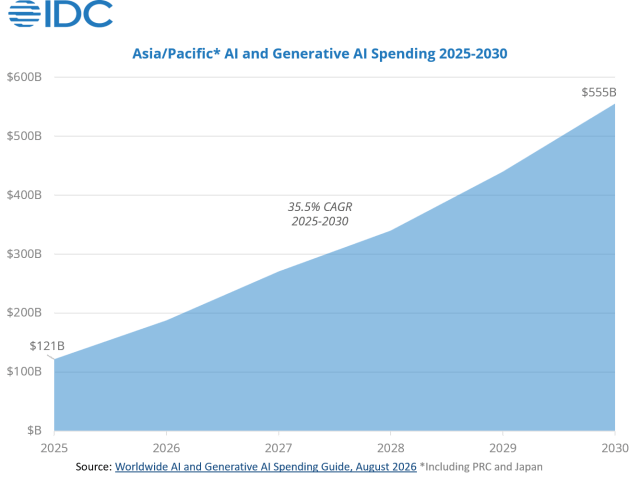
SINGAPORE, September 17, 2026 – According to IDC’s Worldwide AI and Generative AI Spending Guide, V2 2026, August, Asia/Pacific AI and GenAI investment, including China and Japan, is set to grow from $121.5 billion in 2025 to $555.2 billion by 2030, a compound annual growth rate (CAGR) of 35.5%. This growth reflects enterprises moving generative AI and Agents beyond isolated pilots and into core, enterprise-wide operations. Agentic AI and orchestration platforms emerge as key catalysts, enabling enterprises to unify predictive, generative, and prescriptive capabilities within a single governance framework rather than managing them as separate initiatives.
Underlying this regional growth, investment patterns are diverging across markets. China remains the region’s single largest market by a wide margin, with spending projected to grow from $63.7 billion in 2025 to $303.4 billion by 2030, representing a CAGR of 36.6%. Japan follows closely in terms of growth rate, with spending expected to increase from $16.7 billion to $88.9 billion over the same period, representing a CAGR of 39.8%, the fastest pace among the markets in the region. Meanwhile, Asia/Pacific excluding China and Japan spending is projected to grow from $41 billion in 2025 to $162 billion by 2030, representing a CAGR of 31.7%.
“The next phase of AI adoption in Asia/Pacific will be defined by how effectively organizations can move from experimentation to scaled, operational deployments,” said Vinayaka Venkatesh, senior market analyst, Data and Analytics, IDC Asia/Pacific. ” Agentic AI is moving from pilot to production faster than most organizations anticipated, while governments are taking a more proactive approach to establishing AI governance frameworks. At the same time, enterprises and hyperscale’s are accelerating investments in data center capacity to support growing AI workloads. As adoption scales, infrastructure availability emerges as a critical constraint, making scalability, resilience, and operational readiness increasingly important to enterprise AI strategies.” he further noted.
Software and Information Services remains the largest industry contributor to AI and GenAI spending across the region, accounting for 42.7% of total spending in 2026. This continued dominance highlights the importance of software platforms and supporting technologies in the region’s expanding AI adoption. Financial Services ranks second, accounting for 9.8% of regional spending, as banks and insurers expand AI beyond fraud detection into broader operational and customer-facing applications. Government, at 7.7%, and Telecommunications, at 6.2%, round out the top four industries. Together, these four industries are expected to account for roughly two-thirds of total AI and GenAI spending across Asia/Pacific throughout the forecast period.
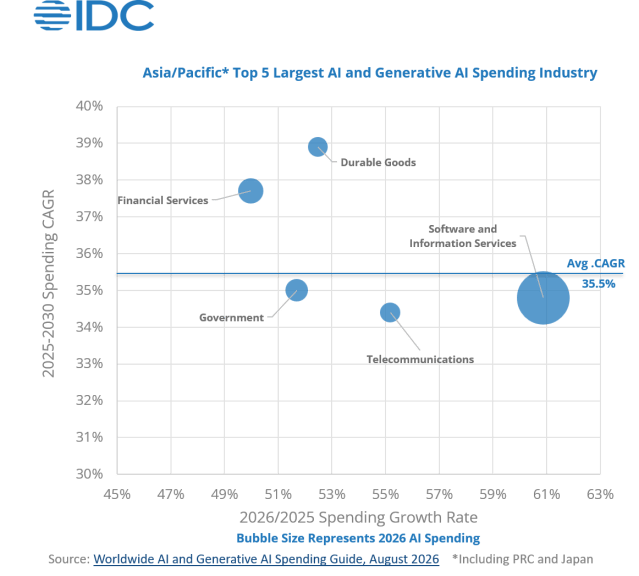
The pace of AI investment varies across markets, reflecting differences in enterprise AI governance maturity, local and sovereign compute capacity, financial services and public sector demand, and the ability of enterprises to scale AI across existing technology environments. These factors are shaping both the pace and composition of AI investment across the region, even as Software and Information Services continues to account for the largest share of spending.
At the use-case level, enterprise deployments are now a leading driver of AI and GenAI investment across the region. AI infrastructure provisioning remains the largest use case, accounting for approximately 32% of total AI spending, as organizations continue to invest in the compute, cloud-native services, and data center capacity required to support growing demand for AI applications.
Three use-case areas are expanding as priorities as enterprises put more of their AI investment in live revenue-facing workflows: customer engagement, as organizations expand AI-enabled customer service and guided selling to improve conversion and retention; AI governance and risk, as enterprises strengthen oversight across fraud analysis, threat intelligence, and compliance ahead of broader agentic AI adoption; and operational efficiency, where AI is applied to planning, logistics, and IT optimization to reduce costs and improve resilience.
The Worldwide AI and Generative AI Spending Guide sizes enterprise spending across the technology stack—including software, services, and infrastructure—that enables organizations to build, deploy, and scale AI and GenAI systems. The Spending Guide quantifies the AI opportunity across 42 use cases and 27 industries, covering nine regions and 31 countries. It also provides spending data across the related hardware, software, and services categories, offering a comprehensive view of enterprise AI and GenAI investment.
About IDC
International Data Corporation (IDC) is the technology intelligence layer of the AI economy. A global leader in research and data for more than 60 years, IDC’s expert analysts, proprietary datasets, and rigorous methodologies are trusted by business and IT leaders to guide critical business strategies and IT investments. Today, that intelligence is built into the tools and workflows where work gets done with IDC Quanta, making work sharper, teams faster, and businesses harder to beat.
Visit www.idc.com, subscribe to the IDC blog, or follow IDC on X and LinkedIn for the latest industry insights.