7月以来,2026年中国上半年宏观经济数据陆续发布。根据中国国家统计局数据,中国软件和信息技术服务业保持了两位数的平稳增长,展现出信息产业的行业韧性。在宏观数据和企业技术投入上升的背后,国内部分ICT市场已从快速增量期进入存量优化期,拓展海外市场、布局全球化成为中国企业寻找新增长点的关键选择。

对于寻求增量空间的企业而言,出海已从可选项变为必选项

然而,面对全球9个地区、53个国家、28个行业的复杂格局,企业最常陷入三个决策困境:该优先去哪片市场?该带什么产品去卖?该主攻哪些行业客户?

本文基于国际数据公司(IDC)最新发布的《全球ICT支出指南:行业与企业规模》(2026V2版),用一组对比数据和三个核心判断,为中国企业的全球化布局提供量化参照系。核心结论浓缩为一句话:逐步降低硬件规模化的优先级,拥抱新兴市场的云化与软件红利,优先在金融与政务两大高预算领域建立标杆

坐标一:将目光从存量红海转向增量蓝海

(核心问题:去哪儿?)

从全球大盘来看,企业级数字化转型与智能化投入仍在加速。IDC数据显示,全球整体ICT市场预计到2030年将增长至9.67万亿美元,五年复合年增长率(CAGR)为9.6%;其中企业级ICT市场到2030年规模将达7.44万亿美元,增速达12.4%,是驱动整个市场增长的核心引擎。
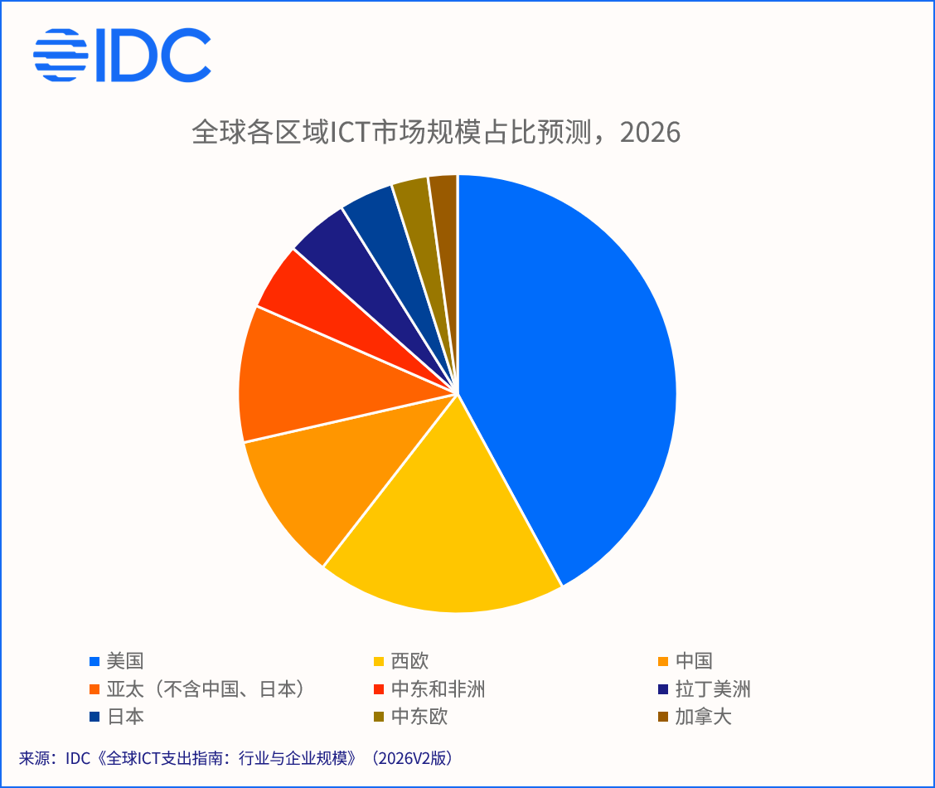
在进行全球化选址时,中国IT厂商需要将视角从“只看绝对规模”转向“寻找高增长增量”:

  • 成熟市场规模巨大,但增速分化:2026年美国在全球企业级支出中占比近五成,五年复合增长率达14.8%,这主要由其高科技与算力投入拉动;西欧以约两成份额位列全球第二,但受到合规与政策监管影响,其企业级增速相对温和。
  • 新兴市场份额有限,但韧性极强:2026年亚太(不含中日)在全球企业级ICT支出中占比8.1%,份额位列全球第三;拉丁美洲在全球企业级支出中占比为3.5%,但其五年复合增长率达10.4%,是理想的业务落地突破口。从细分国家看,巴西占拉美大盘的三成以上,且拉美的阿根廷、巴西、智利均展现出两位数的企业级增长;中东的土耳其、沙特和阿联酋的五年企业级增速也分别高达12.5%、11.1%和10.9%。

针对出海企业的行动建议:中国企业应采取区域分轨战略。对于美欧等高壁垒成熟市场,可将其作为技术对标;对于东南亚、中东及拉美等高成长区域,则应作为规模化扩张的主战场。企业应当结合自身优势,优先深耕土耳其、沙特、智利、巴西等政策红利持续释放、企业级投入跨过两位数增长的核心国家。

坐标二:跳出硬件主导惯性,顺应海外云化轻装趋势

(核心问题:卖什么?)

选定了区域,接下来必须厘清:在这些市场上,中国企业的产品形态应该如何调整?一个关键的结构性差异值得高度关注。

拆解硬件、软件、IT服务等技术板块可以发现,海外新兴市场与中国本土存在本质的技术结构差异:

  • 新兴市场以软件与云服务为主导:IDC数据显示,中国市场呈现显著的“硬件主导”特征(占比达54%)。然而在海外,亚太(不含中日)的软件占比已达30%,超过其硬件;拉丁美洲与中东和非洲的硬件占比仅为18%和23%,软件和服务则占据了核心份额。这表明海外新兴市场正跳过传统的重资产硬件堆叠,直接进入以软件驱动和云服务为主的轻资产模式。
  • 软件增速全面领跑:未来五年,全球九大区域中只有中国和美国呈现硬件增速高于软件的特征。而在亚太(不含中日)、拉美、中东和非洲,软件的增长速度都在16%以上,远超其硬件增速。其中,位于应用开发与部署市场中的人工智能核心软件在各个新兴区域均实现了超过50%的爆发式五年增速。同时,中东和非洲的硬件需求大量以“云服务”形式重塑,其基础设施即服务(IaaS)市场的五年CAGR高达21.1%。

针对出海企业的行动建议:中国企业出海应顺应海外的云化与轻资产趋势。硬件及基础设施厂商应考虑将产品与海外本地的云平台深度集成,提供“硬件+本地化运维”的打包服务。软件与方案商则应顺应当地软件高增速红利,将国内沉淀的成熟应用方案进行云化移植,把海外企业级市场对前沿软件的刚性需求作为业务突破口。

坐标三:聚焦金融与政务两大预算高地,兼顾零售增长红利

(核心问题:卖给谁?)

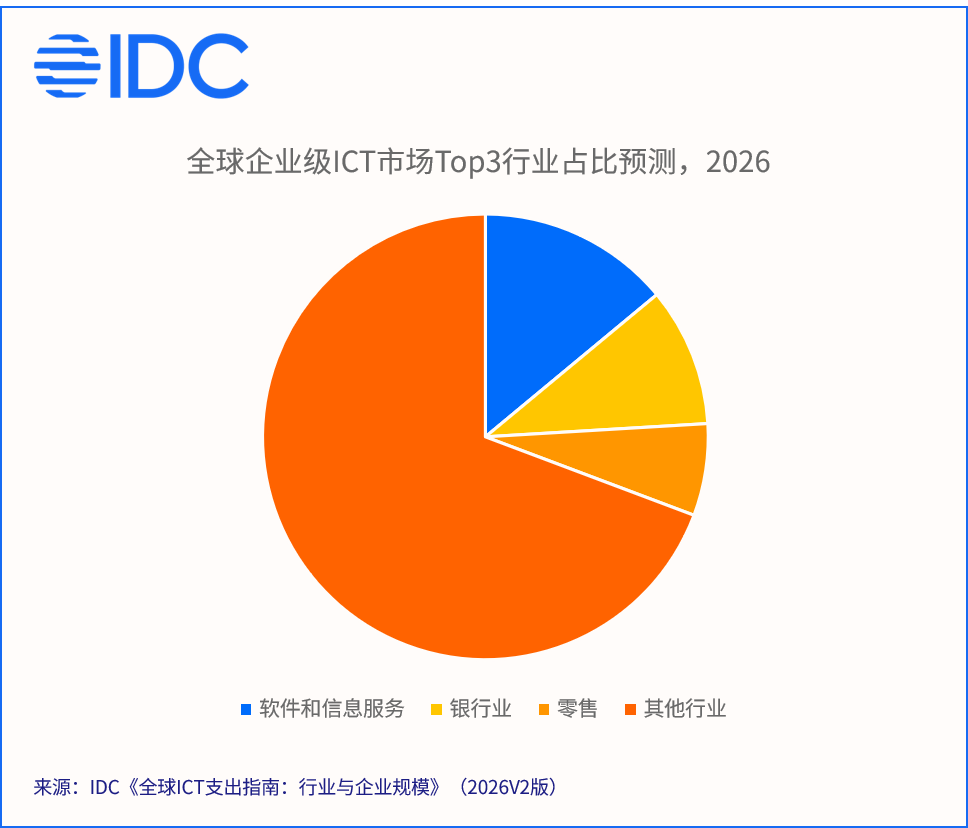
企业全球化布局落地的关键在于“卖给谁”。对比全球与中国市场,虽然软件和信息服务行业都是绝对的支出主力,但当视线转向新兴市场时,海外传统实体行业与公共服务部门的IT预算体量表现出更强的确定性。

  • 金融与政务构成海外核心预算支柱:在亚太(不含中日),银行业和中央/联邦政府的IT支出紧随软件与信息服务行业之后;零售业五年增速达11.7%。在拉丁美洲,银行业以15.1%的份额成为企业级ICT投资的龙头行业,专业和个人服务行业增速领先。在中东细分市场,银行业和中央/联邦政府合计占据了近四分之一的市场份额,且中东银行业在保持高体量的同时,仍拥有11.1%的强劲增速。

针对出海企业的行动建议:中国IT厂商应应兼顾体量与增长潜力筛选目标行业。在国内具备成熟“智慧银行”或“数字政务”解决方案的厂商,应优先聚焦亚太和中东的头部传统行业,尤其是数字化预算密集投入的中东金融业。面向拉美市场,IT厂商则应紧扣其银行业的Top级体量,顺应当地专业及个人服务行业的增长红利,输出相应领域的轻量化软件与服务方案。

IDC分析师展望与观点】

展望2025-2030年,随着全球AI技术的行业渗透与数字化转型的深化,全球IT支出的边界将进一步模糊,跨国界、跨行业的数字化协同将成为常态。

在这一进程中,中国企业需要回答的已不仅是“要不要出海”,更重要的是“以怎样的数字化能力出海”。全球化的下半场,核心竞争力不再是成本优势或产品交付能力,而是企业对海外客户业务痛点的深度理解、对当地数据合规与生态规则的敏捷适应,以及对全球技术趋势的前瞻性卡位。

在全球化新阶段,出海已不是简单的地理位置转移,而是企业综合数字化生存能力的全球化延伸。值得注意的是,AI正在成为重构全球IT支出结构的最强变量。那些率先将AI能力嵌入行业解决方案(如智能风控、自动化运维、精准营销)的企业,将在新兴市场获得远超平均水平的议价能力和客户粘性。换言之,出海不是产品的语言转换,而是用全球化的技术能力适应海外市场,提升对客户的价值回报

数据是这一切决策的底层支撑。利用量化的支出指南,企业可以不再仅凭历史经验或行业热潮做判断,而是在复杂的全球市场中锚定属于自己的确定性增长路径。

IDC《支出指南》致力于为IT厂商、行业用户和投资/金融机构在战略规划、产品研发、IT支出及投资规划等方面提供数据支撑。《支出指南》系列产品聚焦IT热门领域,从多个维度预测市场规模和增速,助力厂商发掘市场潜力;引导行业用户根据热点技术及应用场景进行IT规划;通过分析特定市场的发展前景,帮助投资和金融机构更好地做出决策。

IDC《支出指南》相关研究:

China Provincial Cloud Solutions Spending Guide

Worldwide ICT Spending Guide Enterprise and SMB by Industry

Worldwide AI and Generative AI Spending Guide

Worldwide Software and Public Cloud Services Spending Guide

进一步交流:

如您希望进一步了解中国省级及云解决方案支出、全球AI及生成式AI支出、企业级ICT支出等行业细分数据,或需要针对贵公司目标市场进行定制化数据解读,欢迎联系IDC中国分析师团队。
Wendy Zhang

Wendy Zhang - Research Analyst

Wendy Zhang is a research analyst in the Data and Analytics group at IDC China. She is responsible for business operations and spending guide in China Enterprise Team. She provides dynamic forecasts of future China and global ICT market development.…

随着WAIC 2026上物理AIPhysical AI)成为产业关注焦点,工业作为物理世界中数据密集、任务复杂且商业价值明确的应用领域,正在成为Physical AI率先落地的重要场景。工业具身智能机器人作为Physical AI在制造领域的重要应用形态。国际数据公司(IDC)数据显示,2025年中国工业具身智能机器人市场规模约为57.4亿元,其中以工业机器人为载体的具身智能应用市场规模约36.2亿元,成为当前产业商业化落地的主要方向。随着产业竞争从机器人本体性能逐步转向模型、数据、工程化和场景落地能力的综合竞争,工业具身智能机器人正在成为智能制造发展的重要方向。

基于这一产业发展趋势,国际数据公司(IDC)于近期发布了《中国工业具身智能机器人市场份额,2025》与《中国工业具身智能机器人技术评估,2025》两项研究报告,从市场格局、技术能力及产业发展趋势等维度,对中国工业具身智能机器人产业进行系统分析。本文结合两项研究的核心观点,以对工业具身智能机器人的定义、市场发展、竞争格局及未来趋势进行解读。

工业具身智能机器人定义

工业具身智能机器人是指面向工业生产环境,通过融合人工智能模型、多模态感知系统、机器人控制系统与机器人本体,使机器人具备感知、学习、决策与执行等能力闭环,并能够在真实工业场景中完成自主作业任务、与人员及生产设备进行交互的智能机器人系统。

工业具身智能机器人是物理 AI在制造领域的重要应用形态,相比传统工业机器人主要依赖预设程序,在结构化环境中执行重复性任务,能够基于环境感知和任务理解动态调整作业策略,并通过真实生产数据反馈持续优化任务执行能力。

市场进入规模化导入阶段,工业机器人是主要落地载体

IDC数据显示,2025年,中国工业具身智能机器人市场进入商业化加速阶段,整体市场规模约为 57.4亿元。当前市场主要以多形态机器人为载体,通过对工业生产线和制造工位进行智能化升级,实现感知、学习、决策和执行能力融合,推动制造场景向更加柔性化、自主化方向发展。

IDC数据显示,2025年以工业机器人为载体的具身智能应用市场规模约为36.2亿元,占据当前市场主体地位。主要包括协作机器人、复合(移动操作)机器人、多关节机器人等。该类机器人依托成熟工业基础,通过融合视觉感知、力控技术、环境理解以及具身智能模型能力,实现“机器人硬件+智能软件+行业服务”的一体化交付,已应用于上下料、质量检测、打磨修复、柔性装配、物料搬运等工业场景。

上述市场结构清晰地表明,当前工业具身智能机器人的商业化主力仍依托于成熟的工业机器人品类,它们以“硬件+软件+服务”的整包模式快速渗透进各类制造工位。然而,市场格局并非一成不变——随着AI模型能力跃升和硬件成本下降,不同背景的玩家正从各自优势领域切入,竞争焦点也在从单一产品性能向系统级综合能力转移。下面我们将从竞争主体和出海动态两个维度,进一步剖析当前市场的主要力量。 

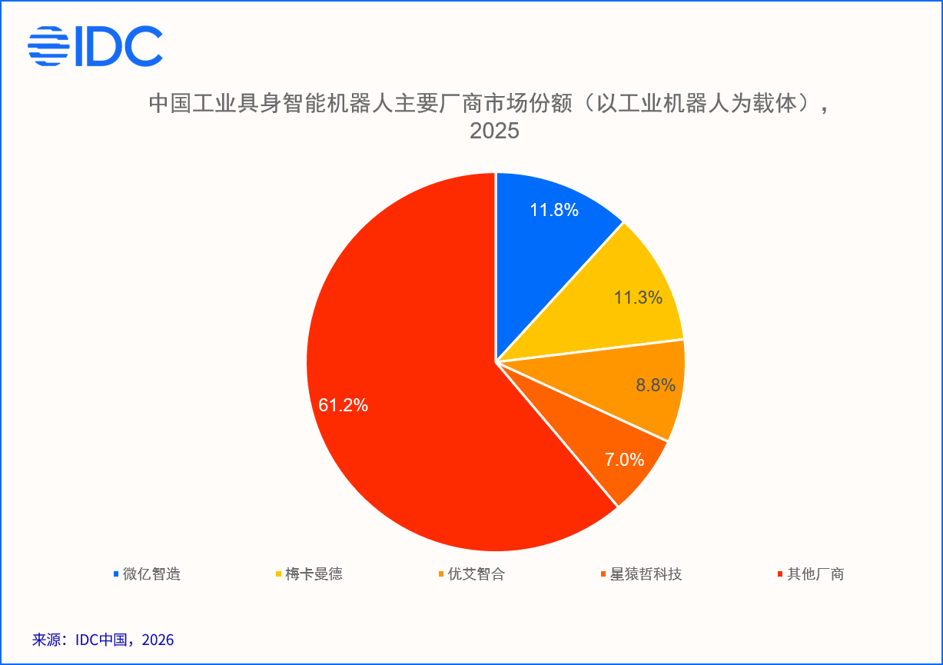
  • 工业AI厂商率先建立竞争优势。 当前市场竞争优势主要来自工业视觉、感知决策以及场景数据积累能力。以微亿智造、梅卡曼德等为代表的企业,依托工业AI技术和数据闭环能力,将具身智能能力应用于质检、打磨、修复、上下料等标准化工业场景,并推动跨行业复制。
  • 同时,大量机器人本体、工业自动化及AI厂商正加速布局工业具身智能赛道,依托各自在硬件、算法、软件平台及行业资源等方面的积累,探索差异化产品定位和商业化路径,市场竞争持续加剧。
  • 中国厂商加速全球化布局。 2025年,工业具身智能机器人厂商出海模式由单机产品输出逐步转向软硬一体化解决方案输出,产品开始进入欧洲汽车、东南亚电子、北美制造等海外市场。本地化部署、模型优化和运维服务能力成为企业拓展海外市场的重要支撑。

2025年,以人形机器人为代表的新型具身智能载体正在进入工业场景探索阶段,市场规模约为 21.1亿元。当前应用主要集中于示范产线部署、场景验证及POC测试。人形机器人具备更强的形态通用性和复杂环境适应潜力,但当前处于技术能力完善与商业化模式探索阶段,产品成本、可靠性、工程化成熟度以及实际生产效率等因素正在进一步验证。关于人形机器人工业应用的相关数据,可参考IDC《Worldwide Annual Humanoid Robotics Tracker》。

从技术能力到商业价值:工业具身智能机器人竞争进入综合能力阶段

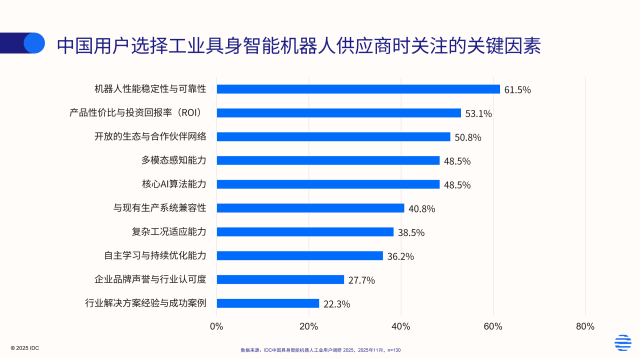
随着工业具身智能机器人从技术验证逐步走向商业化应用,工业用户对于机器人的评价标准正在发生变化。IDC用户调研显示,制造企业用户关注厂商的“技术能力+工程化能力+商业价值”的综合表现。

基于工业用户需求变化,IDC构建覆盖工业智能决策、多模态感知与理解、自主操作与任务执行、复杂场景适配与持续优化、工业级可靠性与工程化、工业系统融合与生态、行业实践与规模化落地、商业价值与ROI验证等8个维度的技术评估框架,对具备产品能力并已在汽车制造、新能源、半导体、3C电子等场景开展商业化探索的中国典型供应商进行综合评估。未来企业竞争优势将来自工业知识、数据、模型与制造体系的深度融合。

锚定未来三年:从场景试点到系统重构的关键跃迁

未来三至五年,中国工业具身智能机器人市场将进入由单点场景验证向生产流程级应用扩展的重要阶段。IDC认为,行业将呈现以下发展趋势:

  • 从单工位智能走向生产流程智能。机器人将突破单一任务限制,与MES、WMS、ERP、PLC以及工业互联网平台深度融合,从执行单一任务的设备,逐步演进为生产系统中的智能节点。
  • 工业知识成为模型能力的重要组成。工业具身智能模型需要进一步融合工艺规则、设备机理和生产经验,实现从“完成任务”向“理解生产过程”演进。未来模型竞争不仅取决于数据规模,也取决于工业知识融合能力。
  • 多形态机器人长期共存。未来工业场景将形成多机器人协同格局:人形机器人适用于高柔性、非结构化任务;移动操作机器人适用于跨空间任务;协作机器人适用于人机协作场景;专用工业机器人适用于高精度、高稳定任务。未来竞争重点不是机器人形态,而是谁能够真正解决工业问题。
  • 数据闭环与工程化能力决定规模化落地。随着市场进入批量部署阶段,真实工业数据积累、模型迭代效率以及规模化交付能力将成为关键竞争因素。能够建立:数据采集 → 模型训练 → 工业部署 → 反馈优化闭环体系的企业,将获得长期竞争优势。
  • ROI成为商业落地核心指标。IDC用户调研显示,超过80%的制造企业希望工业具身智能机器人项目能够在两年内实现投资回收。未来,能够实现快速部署、稳定运行并产生明确经济价值的解决方案,将优先获得市场认可。

IDC中国机器人与具身智能领域研究经理李君兰,工业具身智能机器人的竞争正从单点AI能力转向软硬协同、行业Know-how与数据闭环能力的综合竞争。头部厂商持续加大研发投入,推动具身智能大模型、工业AI与机器人本体深度融合;在政策支持、制造业智能化升级及海外市场拓展的共同驱动下,中国厂商有望进一步提升全球竞争力。

进一步交流

工业具身智能正从概念验证走向产线价值交付,如何选择适配的技术路径、评估投资回报、并构建可持续的数据闭环,已成为制造企业面临的实际课题。IDC基于对市场格局、技术评估及用户需求的深度研究,可为您提供定制化的行业洞察与战略建议。如需获取完整版《中国工业具身智能机器人市场份额,2025》及技术评估报告,或就具体场景应用进行探讨,欢迎联系IDC中国机器人与具身智能研究团队,我们将为您提供专业的数据支撑与决策参考。

Lily Li

Lily Li - Research Manager

Lily is the Research Manager for China Robotics and Embodied Intelligence, specializing in market research on embodied intelligent robots. She has long focused on the development trends of China’s embodied intelligence robotics industry, systematically studying the evolution of robot hardware,…

As the Middle East war persists, we wanted to provide an update on what this means for the business. It was our original thinking that it would wind down by the second half of 2026, but instead a ceasefire was announced and then broke down, military activity has picked back up, and oil prices are back near $100 a barrel. We sat down with Stephen Minton, Group Vice President, IDC’s Data and Analytics Group, to get an updated read on where things stand and what it means for technology spending.

Q: Last time we spoke, we were hoping this war would wind down heading into the second half of the year. Instead, it looks like a stalemate. What’s the latest, and how are things looking?

It’s kind of been a moving target since March. Initially we assumed things would start slowing down by the end of June, and now it’s the end of July. We had a peace agreement announced and then broken, with escalating military activity since. Just when we thought we were getting to the end of this war, things got worse again, and it’s becoming harder to see exactly how and when this ends.

What’s important is that it’s not just about when the war ends. It’s about what comes after: specifically, where that leaves oil prices and how long it takes supply chains to normalize. We’re not in the business of predicting government decisions or military outcomes, but we do need assumptions that drive our forecasts and, in turn, our clients’ business planning. Those assumptions now have to account for a scenario where the war continues, in some form, for longer than we expected.

The one thing that hasn’t changed is the uncertainty itself. This could end tomorrow, or it could drag on for the rest of the year, and that uncertainty has become a defining feature of this war in its own right. We’re also starting to see signs that could have real consequences: the economy has been resilient for the past year and a half, but that resilience is showing cracks. Q2 GDP growth in the U.S. came in at 1.5%, well below the forecast of over 2% and down from 2% growth in Q1. Government spending and exports were both down, likely the first real sign the war is starting to drag on the economy. China’s Q2 GDP was soft as well.

We’re moving from the initial risk of a short, sharp shock to the global economy into something more gradual: inflation dragging on activity, but over a longer period.

Q: With all this uncertainty, how should organizations plan their budgets? What are you seeing with clients?

We’re now in a period of volatility that’s increasingly about inflation uncertainty. So far, this has hit other sectors of the economy harder than IT. Underlying demand for technology and AI in particular is still very strong. But the longer this goes on, the greater the risk that inflation becomes entrenched and spills over into more sectors. It starts with oil prices and ripples outward, and once those effects take hold, they’re harder to reverse. We saw the same pattern with COVID: six years later, we still have elevated inflation in areas like services and labor costs.

Entrenched inflation also affects interest rates, which directly affects financing, and a lot of AI deals require financing. If rates rise again by year-end, that has a direct impact on spending.

This is compounding price pressures that were already in place before the war started. Back in January, we already expected AI demand and constrained manufacturing capacity to push up prices on PCs, phones, and AI infrastructure, and that’s exactly what’s happening. Average notebook prices are back above $1,000 for the first time in years, and most IT vendors have implemented significant price increases.

That’s going to weigh on demand in the second half of the year. Right now it’s not obvious in the data. Earnings are up, and our IT spending forecast has actually increased over the last couple of months, but that’s largely inflation, especially on hardware. We’re forecasting a decline in unit shipments even as spending rises, because buyers pulled purchases forward into Q1 and Q2 to get ahead of prices that are expected to climb even higher by year-end.

Prices aren’t going to moderate or reverse anytime soon, and the longer the war goes on, the worse this could get. It’s also piling on top of existing supply chain pressure. Components like helium and other semiconductor manufacturing inputs sourced from the Middle East are in short supply, adding more pressure to ICT inflation. So the war isn’t the root cause of IT inflation, but it’s exacerbating and complicating it. The more that inflation spills over into the broader economy through higher energy costs, the harder it becomes for businesses to keep stretching their IT budgets to cover it.

We’ve seen amazing elasticity in IT budgets over the past year, with buyers stretching to pay more just to keep pushing forward with AI deployments, but that can’t go on forever. At some point those budget conversations get harder, and how quickly AI is generating ROI and efficiency gains versus revenue becomes a bigger factor in that math.

Q: What advice are you giving clients on how to prepare, especially with 2027 planning already starting?

Three things.

First, prices are likely to keep rising through the rest of this year. 2027 is a more open question, but if you have budget to spend before year-end, you’re unlikely to regret spending it now. Waiting for a Q4 price drop is a risky bet, and that risk grows the longer the war continues. There’s also a case for pulling forward some spending planned for the first half of next year, though that’s a tougher call since prices are more likely to moderate by the end of 2027 than by the end of this year. Either way, don’t leave all your spending exposed to price increases; diversify the timing of your investments.

Second, look for ways to protect against near-term inflation exposure, for example, shifting from CapEx to OpEx. There are strong “IT spending as a service” offerings from vendors now that build more predictability into budgeting and help offset some of that uncertainty. Depending on your industry, diversifying supply chains and suppliers also reduces exposure if the war worsens rather than improves.

Third, get serious about measuring AI ROI. You need to prove your AI investments are generating returns that offset the broader inflation and uncertainty. Everybody has to prove it to someone: the CFO to the CEO, the CEO to the board and shareholders. AI maturity varies widely right now, and not every company is generating returns at the same pace. This isn’t the time to keep funding investments that aren’t working. Put better gating in place so you can reallocate spend quickly. There’s a lot of talk about capping token usage, but the more important question is whether your tokens are generating returns. If they are, why limit them? The real challenge is targeting spend in the right places, not deciding in advance that AI spending needs to go up or down by some fixed percentage.

So: spend early where it makes sense, hedge your exposure, and get better at measuring where AI spend is actually paying off.

Q: What’s one thing clients should watch, and how can they rely on IDC to navigate this?

It’s all about data. Data is the light in the coal mine. It’s the only way to understand what’s actually happening beneath all this uncertainty, and we need to stay close to it. Uncertainty is high enough right now that it’s not viable to plant a flag on a second-half forecast, walk away, and expect it to still be accurate in September. The tide is coming in, and that flag is going to get washed away.

That’s where we can help. We update our IT spending forecasts every month in our Black Book, and our quarterly trackers give granular, current numbers on how the market is actually performing. That rapid iteration matters, and the same discipline should apply internally to how organizations measure their own AI performance metrics as they build next year’s budgets.

But data needs context. That’s why having people with the experience to interpret the numbers and turn them into decisions is just as critical as the data itself. AI can help with that, but the judgment still matters. Downturns are often marked by companies losing that kind of expertise from their workforce. There’s a real opportunity right now to equip people with both the AI tools and the data to interpret them well, and hopefully navigate this period of volatility more successfully than in past cycles.

Christina Cardoza - Content Marketing Manager - IDC

Christina Cardoza is a Content Marketing Manager at IDC, where she specializes in brand content and social media strategy. With a background in journalism and editorial leadership, she has a proven ability to transform complex technology topics into clear, actionable insights.

A few months ago, I sat with a client who had eight weeks until contract renewal. He knew the pricing was wrong and had a rough sense of what he was overpaying, but he did not have the data to prove it, and his supplier knew it.

We got him most of the way there in time, but I would not want to do that again.

Ninety days is not long, especially when you consider that most managed service deals run three to five years. But it is enough, if you start at 90 days rather than eight weeks. This article is a practical framework for how to use that time, and it builds on the previous two in this series: The first on building a cost-enriched CMDB as a foundation for commercial control, and the second on what AI is actually doing to MSP delivery costs at renewal.

The clock is already running

Your MSP has been preparing for this renewal for months. They know the contract end date, the margin they want to protect, and what it would cost you to switch. Their account team has a position. In most cases, yours does not.

Ninety days gives you time to build a real position. Wait until 60 or less, and you’re negotiating on their clock, not yours.

Three years ago, this was a simpler conversation. Now AI is running across your MSP’s delivery operations, automating service desks, monitoring infrastructure, and managing incidents before they escalate. Their costs are falling. Those savings rarely show up in what you pay. Knowing that, and being able to prove it, is worth more than almost anything else you bring to renewal.

Days 1 to 30: Start with what you know

Start internally, before you look at anything external. You cannot compare your contract against the market without first knowing what you are consuming and what you are being charged for it.

A cost-enriched configuration management database, one that is accurate, continuously updated, and linked to actual consumption, lets you cross-reference MSP billing against real usage. Most organizations find the gap is larger than expected. The consumption audit almost always delivers more savings than the price negotiation. The €48,000 I described in my first article came entirely from removing unused infrastructure before any rate conversation had started.

Pull the rate card history, the last 12 months of true-up invoices, and the actual consumption volume reports by tower. These three documents will tell you more about where you actually stand than any conversation with your account manager.

Break the contract into service towers: e.g., Workplace, Service Desk, Server, Storage, Cloud Operations, Network, Security, SIAM (Service Integration and Management). For each one, record the unit pricing. Cost per device, cost per user, cost per ticket. Without this, any external comparison is matching your actual costs against someone else’s estimates.

Days 31 to 60: Find out what the market actually charges

Your finance and procurement teams almost certainly do not have live pricing data across multiple service towers and geographies. Your MSP does. That gap only closes one way.

I’ve seen buyers spend the full 90 days polishing the internal audit and never get to this step. That’s a mistake too. The audit tells you what you’re paying. It doesn’t tell you what you should be paying.

An independent benchmarking advisor like IDC, who works across many similar engagements, has that data. The benchmark needs to be honest and accurate, using peer contract pricing from contracts signed in the last 12-18 months. A large multinational contract prices differently from a regional one, even for identical services. Scale, geography, scope, and contract length all matter. Any comparison that skips those variables is not a benchmark. You have a guess dressed up as one.

Where is AI showing up in the price? Most buyers have not asked. Across Service Desk, incident monitoring, and routine infrastructure management, it is driving down MSP delivery costs. The service desk is almost always the most negotiable tower, and it is also where AI has the greatest impact on delivery costs. Your MSP is not likely to point that overlap out to you.

Days 61 to 90: Build the case

Not every finding is worth pursuing. Focus on the towers where your price is furthest above market and your spend is highest. A 20% gap on a small tower matters far less than a 10% gap on your largest.

Evidence moves suppliers. A vague ask for a better rate does not.

A concise summary of where your pricing sits against the market, supported by independent benchmarking data, opens a different kind of conversation. And while you have that conversation, push on contract structure too.

When AI agents handle the delivery, pricing per input, per ticket, or per device starts to misrepresent both the cost and the value of what you are buying. Outcome-based models price on what the service actually delivers: resolution rates, uptime, incident reduction. Renewal is the right time to push for this on at least one or two towers. But define the outcomes carefully. A poorly written outcome-based clause can end up working in the MSP’s favor just as easily as yours.

Your MSP arrived ready. Did you?

Your MSP has a position, prepared in advance, supported by data, and reviewed by their account team. Most buyers arrive with goodwill and a vague expectation that a long-standing relationship will deliver a fair price, but it often does not. The clients that consistently walk away with fair contracts have two things most buyers don’t: an independent market price benchmark, and a consumption audit that’s actually current. Everything else in this article, the AI economics, the outcome-based pricing, the tower-by-tower comparison, only works once those two are in place.

Ninety days is not a strategy. It is the minimum. Start before your MSP has already decided what you are going to pay.

Tom Collins - Senior Consultant, Global IT Sourcing & Benchmarking Practice - IDC

Tom Collins is a Senior Consultant in IDC's Global IT Sourcing and Benchmarking practice, advising organizations on IT cost management, sourcing strategy, and technology procurement.

生成AIへの投資は、国内市場でも急速に広がっています。IDCの「Worldwide AI and Generative AI Spending Guide 2026V1(2026年2月発行)」によれば、国内の生成AI市場は2025年の約4,745億円から2029年には約3兆2,739億円へと、4年間で約6.9倍、年平均(CAGR)約62%のペースで急拡大する見通しです。そして生成AIが成熟するにつれて、その使われ方も変わっていきます。汎用的なチャット用途にとどまらず、業務の一つひとつの場面に合わせて個別に最適化され、現場に溶け込む形で活用されるようになります。

用途が広がるなかで、生成AIをパブリッククラウドではなく、自社が管理する環境で動かす——いわゆる「プライベートAI」で運用するケースも増加し、生成AIの市場においても無視できない領域となることが強く見込まれます。

なぜプライベートAIなのか? 企業が「コントロール」を選ぶ5つの理由

というのも、プライベートAIには、パブリッククラウド上の生成AIにはない強みがあるからです。すなわち、

  • 機密性:競争力の源泉であるデータを社外に出さずに済むこと
  • データソブリン:データの所在地が自社の管理下にあるためコンプライアンス対応が容易であること
  • カスタマイズ性:自社のデータに深く最適化できること
  • 規制適合性:AIの運用が業種ごとの規制に対応しやすいこと
  • コストコントロール:運用量やトークン量の爆発的増大によって懸念されるコストを自らコントロールしやすいこと

などが挙げられます。本稿では、この「プライベートAI」がなぜいま注目されるのかをIDCのデータを基に解説し、そして国内市場にどのような機会を生むのかを紐解いていきます。

ユーザーのIT支出が向かう先:産業・ユースケース別市場機会

IDCは、生成AIによる価値創出が、汎用的なアシスタント用途から、各業界固有のデータDNAに深く根差した業界特化型ユースケースへとシフトしていくと見ています。共通するテーマは、単なる補助にとどまらず自律的に行動するAIエージェントが、業界固有のデータと密接に統合されることで、単純な効率化を大きく超える価値を生み出すという点です。そこで、産業別のユースケースの今後について展望してみましょう。

製造業:設計図が経営リスクになるとき

製造業は、設計図・製造プロセス・規制対応情報といった膨大な非構造化データの宝庫です。たとえば、3D設計から部品表作成、サプライヤー交渉、発注までを複数のAIエージェントが連携実行する「設計・調達の自律ワークフロー」は3D設計、部品表(BOM)作成、サプライヤーとの交渉、発注を連鎖的に処理することで、リードタイムの劇的な短縮につながります。さらに、競争力の源泉である設計データは、社外のネットワークに乗せること自体がリスクとなり得ます。また、生産工程で得られる各種データも、内容によってはレイテンシの観点からは遠くのAIデータセンターでの処理では間に合わないケースが多く存在し、この点だけでもパブリッククラウドについてマイナスの評価を下さざるを得ない理由となります。

金融・保険:ハルシネーションが許されない領域

金融・保険は、業務の性格上正確性が絶対条件として要求されるうえ、厳格な規制下で正確性が問われるにもかかわらず、汎用AIではハルシネーション等の懸念が払拭しきれない領域です。実際、取引・市場・ニュースを並列監視する複数のエージェント群がリスクを即時に遮断するリアルタイム不正検知、AI投資顧問エージェントによる資産運用の高度化など、ユースケースは多岐にわたります。これらはいずれも「最も外に出せないリアルタイムの取引データ」を扱うものであり、プライベートAIの必然性が高い領域です。監視システムでは高い即応性が求められることや、機微な情報を保護するケースも多いのが特徴です。

医療:あらゆる中で最も機微なデータ

医療・ヘルスケアでは、症状・既往歴を対話形式で収集し、診療科の振り分けと緊急度の判定を自律実行するトリアージエージェント、ウェアラブルデバイス・遺伝子・生活習慣データから個別の医療プランを継続的に生成するパーソナル予防医療などが期待されます。いずれも患者の診療情報や遺伝子情報という極めて機微なデータを扱ううえ、医療情報の取り扱いに関する規制も厳格であることから、データを自社の管理下で完結させられるプライベートAIとの親和性は際立って高いと言えます。

政府・公共機関:義務としての主権

官公庁・パブリックセクターでは、行政文書や規定・ガイドラインをRAGで検索・応答させ、業務効率化と住民対応力の強化を狙う動きが目立ちます。『IDC FutureScape: Worldwide Security and Trust 2026 Predictions — Japan Implications』(IDC #JPJ53026425、2025年12月)での2029年までに政府の3分の1がソブリンAIを求めるという予測とも重なり、国内完結を前提とした案件が積み上がっていくものとみられます。また、市場規模は限定的であるものの、データの秘匿性や実運用時のネットワークからの独立性が最高レベルで求められる防衛領域においても、プライベートAIのユースケース拡大が見込まれます。

その他:あらゆる分野で高まるプライベートAIのユースケース

このほか、以下の業種などでもプライベートAIのユースケースが広がると考えられます。すなわち、

  • 物流・輸送:リアルタイムの交通・荷量・天候を統合した配車エージェントによる完全自律ルート最適化や、需要・コスト・人口動態を自律分析して新たな配送モデルを編成するラストワンマイル新サービス
  • 小売・EC:購買体験のパーソナライズや需要予測と連動した自動発注、価格・プロモーション戦略の自律最適化
  • 教育:AIチューターによる個別学習設計や採点・フィードバックの自動化など

などが挙げられ、いずれも産業特化型のユースケースとして立ち上がりつつあります。

これらは扱うデータの機微性・要求される保護レベルに応じてパブリックとの使い分けが進むと見られますが、企業固有のデータを競争力の源泉とする度合いが高まるほど、プライベートAIを選ぶ合理性も増していきます。

いずれにも共通するのは、これらの分野・ユースケースがIDCの言う「産業ユースケース」、すなわち産業の特性に由来する独自データと深く結び付いているという点です。汎用的な生産性向上タスクならパブリックで十分であるとしても、上記のように産業分野それぞれに最適化されたAIが日常業務の現場に展開されてゆく状況にあっては、自社データの利活用が今後のAI導入の決定的要因となると言っても過言ではないでしょう。そして、これは企業・組織が扱うデータについて主体的な権利と行動をとることの上に成立します。このデータへの主体的権利と行動はデータソブリンの確立と言い換えることができます。だからこそ、データソブリンに基づいて行動することが、AIをより業務に即した場面に導入し、成功と成長を実現するための必要条件となってくるのです。

データ主権は単なるコンプライアンスではなく、それ自体が需要を生み出す

そして、このデータソブリンの領域については、具体的業務へのAIの導入という観点から捉えなおすと、国内でのビジネスに強みと豊富な経験を持ち、素早い対応が可能なベンダーに市場機会が期待されることが展望できるでしょう。というのも、データソブリンを要請する理由は業務上の必然性はもちろんのこと、IT主権・運用主権・規制対応・地政学リスクといった、個別のビジネスとは別の力学で動く要素にも由来しており、この点については国内での顧客との長きにわたる関係が経験知として蓄積されていることが大きな意味を持つからです。

そして、IDCでは、2027年までに日本のトップ1000企業の60%がAI主権の確保を追求し、非パブリックのホスティング、オープン技術、地域パートナーを組み合わせると予測しています。『2026年 国内AIテクノロジー利用動向調査』(IDC #JPJ53497126、2026年4月)でも、(データソブリンに立脚する)ソブリンAIを重要課題/検討課題とする企業においては、最大の関心事は「データ所有権の担保」であることが分かっています。また、前述の通り、2029年までに政府の3分の1が機密分野でソブリンAIを求めるとも見ています。このようなことから、ソブリンAIを前提とし、国内完結が要件になる業種・ユースケースという観点からも、業種ごとの知識や規制動向に関して現場に由来する知識とノウハウを多く有する、すなわち国内市場に強みを持つベンダーに市場機会があると言えます。

自社の強みを認識した上でのスコープ設定を

その意味では、自社の強みと弱みを整理し、強みの分野で収益性を高める判断も必要です。しかしながら、不都合な現実から目を背けるわけにはいきません。生成AIのモデルそのものの開発力あるいは性能やGPUの調達力では、現在世界で高いシェアを有しているハイパースケーラーやプラットフォーマーとの正面からの競争は、「規模の戦い」に陥るため、好ましい結果をもたらすとは言えないでしょう。

だからこそ、戦い方を変え、オープンウェイトモデルを土台に据えることも視野に入れ、日本語処理という自国の強みを乗せ、パートナーと共にデータソブリンが最大の価値を発揮する領域を固めることが求められます。また、RAGの構築、日本語特化モデルの実装、国内のビジネスに即したガバナンスやオブザーバビリティの運用、液冷対応のマネージドサービス——これらはいずれも、プライベートAIならではの市場機会であり、ユーザーの個別の現実に沿った価値提供が可能な領域であると言えるでしょう。

当然ながら、ハイパースケーラーやOEMのエコシステムに乗るほど、ベンダーロックインのリスクも高まるという事実=落とし穴もあります。自らの強みを認識して、どのレイヤーを自社で握り、どこは割り切って組むのか。その線引きの巧拙が、そのまま競争優位に直結し、勝者とその他のグループを分ける分岐点となることは言うまでもないでしょう。

規模のパブリッククラウド、鋭さのプライベートAI

プライベートAIは確かに魅力的な市場です。ただし、それは広大なAI市場の一部でしかないことを意識する必要があり、この市場の成長性とユースケースの拡大のみを見ていると理解を誤りかねません。すなわち、当面の間はパブリックAIが主流であることをわすれてはならないのです。

ここで、生成AI市場の支出が実際にどこで発生しているのか、IDCのWorldwide AI and Generative AI Spending Guideに基づき、その構図を整理しておきましょう。

国内の生成AI支出について、ソフトウェア関連の支出をデプロイ先で分けると、プライベートAIのインフラとして重要なオンプレミス(専有環境を含む)が占める比率は2024年でおよそ27%、残りの約73%はパブリッククラウドです。しかも予測期間の終盤(2029年)に向けて、オンプレミスの比率はむしろ22%へと微減し、パブリッククラウドは78%まで高まります。

もちろん、シェアがすべてではありませんし、オンプレミスの伸びが鈍いわけではありません。推定支出額自体は5年で約27倍という猛烈な成長です。これは成熟化が進むIT市場の中でも桁外れの成長性を持つ分野です。言い換えれば、プライベートAIはパブリッククラウドを追い抜く必要はなく、この成長率で複利的に拡大を続けさえすれば、それ自体で非常に大きく、収益性の期待できる市場となることが見込まれるのです。そして、この高成長を後押しする要因――ソブリンAIの必須要件化、データ所有権要件、規制圧力――は、循環的でも選択的でもなく、構造的なものである。だからこそ、プライベートAIはベンダーがそのシェアのゆえに退けるべきではない重要なセグメントであると言えます

追い風の中、逆風を理解してこその戦略

AIユースケースの適用範囲が拡大し、それに加えて政府や規制産業全体でソブリンAIの必須要件が進みつつあることが、プライベートAIを本格的な規模の市場へと押し上げる真の原動力となっています。そして、この追い風は強く、かつ構造的なものでもあります。しかし同時に、逆風も直視しておく必要もあります。『IDC FutureScape: Worldwide AI-Fueled Business Strategies 2026 Predictions — Japan Implications』(IDC #JPJ53025425、2025年12月)では、2028年までに国内多国籍企業の70%が地域ごとにAIスタックを分割し、統合コストが3倍に膨らむと予測しています。また、メモリの国際的な需給逼迫や、AI対応データセンターのキャパシティ不足も足かせになります。

では、この機会を掴むベンダーと掴めないベンダーを分けるものは何か。それは、次の4つの要素が揃っているかどうかであると考えられます。すなわち、

  • 実戦で鍛えられたソブリンAIの専門知識と運用ノウハウ
  • 包括的なポートフォリオ
  • 新たなパートナーエコシステム
  • AIをパイロットから本番運用へと導く、実効性のある本番実装を支える変革支援力

この4つをプライベートAIの市場で兼ね備えたベンダーが、次の成長局面でも成長の果実を手にすることができるでしょう。

これまで見てきたように、プライベートAIの市場では、国内市場に強みを持つベンダーが確信を持って次の一手を打てる立場にあります。残るは、市場全体を展望したうえでどれだけ速く動けるか。特に技術の進化が速いAIの領域において、勝負を決する最大の要素の一つは、この速度であることも忘れてはならないでしょう。

関連する調査やご相談について

より詳細なインサイトや市場動向については、当社アナリストへお気軽にご相談ください。

出典(すべてIDC)

  • 『2026年 国内AIテクノロジー利用動向調査』(IDC #JPJ53497126、2026年4月)
  • 『2026年 国内AIインフラおよびAI向けITインフラサービス市場動向分析:推論が主導する競争軸の転換』(IDC #JPJ54233926、2026年3月)
  • 『2025年 国内クラウド市場 テクノロジー動向分析:エージェンティックAI時代のテクノロジースタック』(IDC #JPJ53018625、2025年10月)
  • 『IDC FutureScape: Worldwide AI and Automation 2026 Predictions — Japan Implications』(IDC #JPJ53019825、2025年12月)
  • 『IDC FutureScape: Worldwide AI-Fueled Business Strategies 2026 Predictions — Japan Implications』(IDC #JPJ53025425、2025年12月)
  • 『IDC FutureScape: Worldwide Security and Trust 2026 Predictions — Japan Implications』(IDC #JPJ53026425、2025年12月)
  • 『2025年 国内ユーザー企業調査:産業分野別デジタルビジネス展開動向と課題』(IDC #JPJ53025825、2025年7月)
  • 『2025年 国内金融IT市場動向調査:「モダナイゼーション」後の金融IT市場の展望』(IDC #JPJ53860825、2025年12月)
  • 『国内AI市場予測、2026年~2030年』(IDC #JPJ53498426、2026年6月)

参考データ(IDC)

  • Worldwide AI and Generative AI Spending Guide(IDC #IDC_P33198)
  • Worldwide Quarterly AI Infrastructure Tracker(IDC #IDC_P37251)

菅原 啓 (Akira Sugawara) - Research Manager, AI and Automation - IDC Japan

一貫してテック系リサーチ業界を歩み、20年以上にわたり技術動向からブランド分析まで幅広い領域をカバー。実務と調査の両面に基づく知見を強みとする。 2016年から2021年までIDC Japanに在籍し、スマートフォンやAR/VRなどのクライアントデバイス分野を担当。業界内におけるIDCのプレゼンス向上に貢献するとともに、新聞や雑誌など外部メディアへ市場データを提供。2021年から2025年にかけては日系大手ITベンダーにてマーケットインテリジェンス業務を主導し、AIや量子コンピューティングといった先進分野を中心に、ITサービス市場データの整備、新規プロダクトの市場性予測、競争・市場分析を行った。 2025年からは再びIDC JapanにてAI(生成AIを含む)および関連技術、およびそれらを活用したソリューションの市場動向を、ベンダーとユーザー双方の視点から分析を担当している。 【専門の分野/テーマ】 AI全般 ITサービス DX

2026年7月16日,2026世界人工智能大会暨人工智能全球治理高级别会议开幕前夕,来自29个国家的代表在上海签署《关于成立世界人工智能合作组织的协定》,成为该组织的创始成员国。协定明确,世界人工智能合作组织是独立的政府间国际组织,总部设在上海。

7月17日,大会发布了《2026世界人工智能大会暨人工智能全球治理高级别会议主席声明》《人工智能合作发展行动计划》《国际人工智能伦理治理行动计划》

距离2025年WAIC发布《人工智能全球治理行动计划》并倡议成立世界人工智能合作组织,仅短短一年时间,人工智能全球治理便已落地到组织建设、能力合作、标准协调和运行机制等具体层面。

Agent治理决定企业能够开放多少业务权限

Agent治理已经进入企业风险和投资决策。IDC在2025年10月发布的全球预测中提到,到2030年,多达20%的G1000组织可能因AI Agent控制与治理不足引发高影响力业务事故或中断,面临诉讼、巨额罚款和CIO被解职IDC最新全球调研数据也显示,全球企业计划中的AI投资平均有16.7%用于AI及Agent安全与治理,投入比例已经接近AI技术栈中的其他主要部分(Future Enterprise Resiliency and Spending Survey, Wave 10)。

这些治理要求并非是对Agent的限制,而是真正决定Agent是否能够深入的业务流程的前提。

  • 身份与授权不清晰,企业就难以将核心系统开放给Agent;
  • 缺少链路观测和行为日志,企业就无法还原Agent的判断与执行过程;
  • 缺少流程暂停、任务回退和人工接管机制,企业也难以在Agent出现异常时控制其连锁影响。

只有当Agent的身份、权限、行动过程和异常处置都处于可验证、可追溯、可控的范围内,企业才可能放心地让它进入核心业务,读取真实数据并执行具体操作。

全球AI经济需要共同的信任基础

Agent开展跨组织、跨平台协作时,企业内部的治理机制还要与外部规则连接。身份标识和协作互认帮助不同主体识别彼此,接口协议负责建立连接,语义与流程兼容支持任务理解和协同,行为验证与追溯则为信任和责任提供依据。

一个Agent要接入另一套系统,需要确认其身份、授权来源、能力范围和风险等级。系统还要判断它能否读取某类数据、调用某个工具、修改某项状态,以及哪些操作必须等待人工确认。

不同的身份体系、协议和评测标准会增加Agent经济的交易成本。如果每个平台都使用独立的身份体系、协议和评测方法,跨平台协作就需要反复进行技术适配、安全验证和风险评估。共同的Agent身份标识、安全基线和互操作协议可以减少重复工作,降低不同组织之间Agent交互的成本。

全球Agent经济要实现规模化运行,各方需要围绕Agent身份认证、安全基线和互操作规则形成基本共识,并建立相对统一的标准。在此基础上,Agent才能跨越平台、组织和市场执行任务,不同组织也才愿意开放数据、工具和业务能力,让Agent之间的协作形成可验证、可复制、可持续的生产与交易关系。

全球AI经济需要共同的信任基础

全球治理提出的身份互认、行为追溯和风险分级,最终会体现在企业Agent的系统建设和任务执行中。

  • 身份互认进入企业,会形成Agent账号、授权主体和凭证管理机制;
  • 行为可追溯进入业务流程,会形成任务日志、工具调用记录和责任归属;
  • 风险分类分级则决定Agent可以访问哪些数据、执行哪些操作,以及哪些节点需要人工确认。

以一份企业报价为例,Agent需要读取客户信息、产品配置、库存情况和折扣规则,还要识别销售人员的权限、判断报价是否超过审批额度,并把结果写回业务系统。如果客户信息涉及敏感数据,系统需要限制读取范围;如果折扣超过阈值,任务需要转入人工审批;如果写回失败,Agent还要保存当前状态,避免重复提交或生成两份相互冲突的报价。

这样的治理需求也会逐渐改变企业评估Agent的方法,未来企业除了关注Agent完成任务的成本和准确率,还需要重点关注Agent能否遵守权限约束,能否在任务执行失败时可控回退,以及能否在关键节点及时转交人工审查。


WAIC 2026全球治理议程关注的一个核心问题,是如何管理能够代表人和组织执行任务的AI。AI 及Agent 应用能进入多深的业务流程,取决于治理能力能否跟上。企业内部的身份、权限和行为记录,平台之间的互操作与验证,国家之间的规则协调与能力建设,共同构成AI经济的信任基础。规则越清楚,企业越有可能向Agent开放真实数据、业务工具和核心流程;共同基线和互认机制越完善,Agent跨组织、跨平台和跨市场协作的成本也会越低。治理既约束风险,也为AI能力的大规模应用提供通行条件。

给企业和技术厂商的行动倡议

1. 为Agent建立独立身份与账号

Agent身份需要明确授权主体、数据范围、工具权限和人工确认节点。不同风险等级的任务需要配置不同的执行边界。低风险操作可以自动完成,涉及敏感数据、资金、合同和生产状态的操作,应保留审批、暂停和人工接管机制。

2. 让Agent的执行过程可观测、可回退、可追溯

企业需要记录Agent的任务输入、数据读取、工具调用、业务状态修改和人工介入,形成完整的行动链路。

出现异常时,系统应能暂停任务、保存当前状态、回退相关操作,并定位异常发生的环节及其影响范围。

3. 用可验证的评测说明Agent的能力边界

技术厂商需要说明Agent在不同权限、异常和跨系统环境中的表现。除了任务成功率,还应提供越权拦截、失败恢复、人工介入逻辑和风险控制机制等评测结果,便于企业判断Agent适合进入哪些业务流程,以及可以获得多大的权限范围。

4. 为Agent跨系统、跨组织协作做好准备

Agent连接外部平台时,应能够提供可验证的身份、授权来源、能力范围和任务目的。企业也需要根据Agent的身份、授权来源和风险等级,明确可以向其开放哪些数据和工具、授权持续多长时间,以及哪些操作需要再次确认。

技术厂商则需要支持身份凭证传递、权限委托与撤销、标准化能力描述和互操作协议,让不同平台上的Agent能够在清楚的授权边界内协作。

进一步交流

如果您希望了解人工智能相关的研究或开展进一步交流,欢迎点击这里与我们联系!

Zhenya Sun - Research Manager - IDC

Zhenya Sun is a research manager for the IDC team focused on exploring the application of technology and industrial development of AI and AI agents. He is also responsible for providing clients with consulting services on technologies, products, and markets related to large language models (LLMs) and AI agents, as well as delivering speeches at industry conferences and internal seminars. Before joining IDC, Zhenya served as a project management officer (PMO), responsible for internal and external strategic consulting, AI application research and advisory services, AI project framework standardization, management system construction, and technical training on AI applications. Prior to that, he also led initiatives in product development process optimization and user market analysis. Zhenya holds a Master's Degree in Engineering Management with a specialization in Information Systems Engineering from the University of the Chinese Academy of Sciences.

This is the final post in Meet IDC Quanta, a short series showing what the product actually does, starting with the portal, then your inbox, and now when you’re already working in Claude.


Imagine you’re the account executive on a procurement software deal, and leadership on the buyer’s side just reached out: they want twenty minutes before the broader vendor review starts. Real conversation. No marketing slide deck, no long product tour. They’ll expect you to know their IT spending trajectory, where the competitive field is moving, and why now is the moment to act.

A fast reply won’t cut it here. You need an actual plan, reports pulled, trackers cross-referenced, findings stitched together. You could do that by hand, or you could open the AI tool sitting in front of you and ask it to build the whole thing.

One tool, every surface you’re already in

Most people assume IDC Quanta is a portal you visit. It’s actually a fabric: the same IDC intelligence, methodology, and research base, running everywhere you work. That’s Claude Chat, Cowork, and Code. It’s Claude for Chrome and the Microsoft Office add-ins, too. The deepest workflow integration lives in Cowork, which is where both scenarios below happen. One connection, live through Claude’s MCP integration (the open standard that lets Claude connect directly to outside data sources), with an IDC skill built in to handle the jobs sellers and buyers actually run.

You don’t switch tools to get IDC data into your work. You just ask.

Ask for the plan

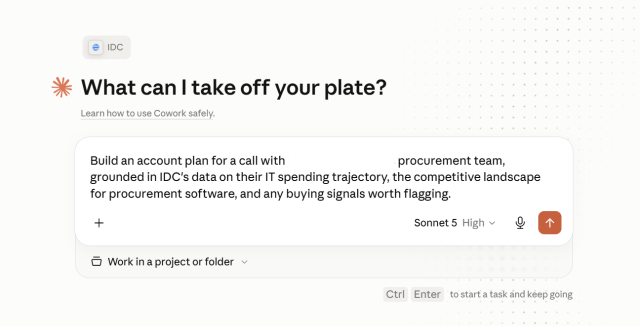
Open Cowork and type it straight to Claude:

Build an account plan for a call with <your target account’s> procurement team, grounded in IDC’s data on their IT spending trajectory, the competitive landscape for procurement software, and any buying signals worth flagging.

Claude Cowork meets IDC Quanta MCP connector 1

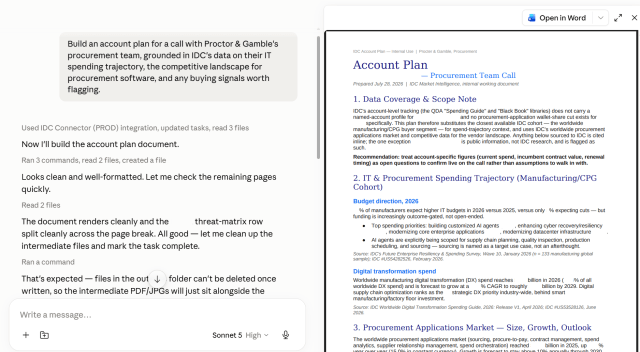
Claude comes back with a couple of quick multiple-choice questions, like which vertical cut or which time horizon. Pick your answers, and it gets to work. A few minutes later, a fully structured account plan is sitting in a Word document. Spending trends are mapped out. Competitive positioning gets a clear read. Buying signals surface where they matter. The kind of document that used to take an analyst half a day now takes the length of your coffee.

Claude Cowork results from IDC Quanta Query

Watch it show its work

Here’s the part that actually matters. Open the document and you’ll notice something most AI tools never bother to do: it tells you which parts came from where. IDC-sourced data sits clearly apart from what Claude reasoned on top of it. Nothing blends together into an unlabeled wall of confident-sounding text.

That distinction is the whole point. When your VP asks where a number came from, you’re not guessing. You can point to the line and say exactly what it is: IDC research, or Claude’s synthesis. The document already told you.

Same intelligence, the other side of the table

Now flip seats. You’re the buyer, evaluating procurement software vendors, and you need an independent shortlist, not a vendor’s pitch deck dressed up as analysis.

Same tool, same Cowork window. Ask Claude:

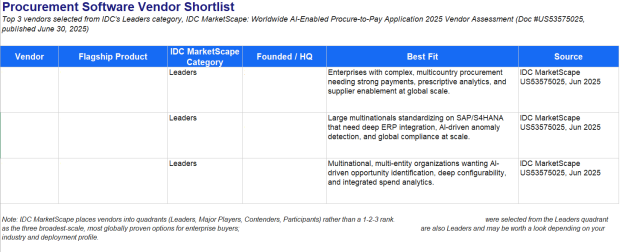
Give me a shortlist of the top three options based on IDC’s worldwide procurement applications research, and generate an Excel evaluation scorecard I can share with my team.

Claude builds the scorecard from the same shortlist of the three vendors actually leading the field, sourced from IDC’s Worldwide Procurement Applications Market Shares, 2025 (IDC #US53723426, June 2026). The IDC-grounded data and Claude’s analysis are labeled separately again. Your team sees exactly what’s evidence and what’s reasoning, no matter which side of the deal they’re sitting on.

Everything You Need, in the Tab You’re Already In

Our first blog showed you a portal built for hard questions with real citations. Our second blog put that same intelligence in your inbox. This closes the series on the biggest move yet: IDC Quanta living inside the tools you use, Claude included, where the work happens. A seller and a buyer can each walk into the same negotiation better prepared, neither one leaving the screen in front of them.

If you’re already using Claude, the IDC Quanta connector is one prompt away. If you’re not yet a customer, book a demo and bring the account you’re working right now.

Ryan Smith - Content Marketing Director - IDC

Ryan Smith is the Director of Content Marketing at IDC, where he leads brand-level content and social media strategy, aligning research insights with compelling storytelling to engage technology decision-makers. With a background in both IT and marketing, Ryan brings a unique blend of technical understanding and creative strategy to his work. He’s also a seasoned storyteller, speaker, and podcast host who believes the right message, told the right way, can drive both trust and transformation.

Governance is no longer an afterthought for agentic AI. According to IDC’s Future Enterprise Resiliency and Spending Survey, Wave 10, enterprises now allocate an average of 16.7% of their total planned AI spending to AI and Agent security and governance, a share on par with investment in other core layers of the AI tech stack. The takeaway for CIOs and vendors: governance has moved from a compliance checkbox to a strategic budget priority.

That institutional shift was visible at WAIC 2026 in Shanghai. On July 16, representatives from 29 countries signed the Agreement on Establishing the World Artificial Intelligence Cooperation Organization and became its founding members. The following day, the conference issued a chair’s statement and two governance action plans, while also proposing a global initiative on trusted Agent connectivity and interoperability. A year after China proposed the creation of WAICO at WAIC 2025, the signing of the agreement represents institutional follow-through worth watching. Its practical impact will depend on how these commitments are translated into common standards, coordination mechanisms and implementation programs.

Why Governance Is the Gatekeeper, Not the Brake

IDC’s October 2025 FutureScape: Worldwide Agentic Artificial Intelligence 2026 Predictions forecasts that by 2030, up to 20% of G1000 organizations will have faced lawsuits, substantial fines, and CIO dismissals due to high-profile disruptions stemming from inadequate controls and governance of AI agents. Far from restricting what Agents can do, governance is what makes deeper integration possible in the first place. Without clear identity and authorization rules, companies won’t grant Agents access to core systems. Without full observability and immutable logs, teams can’t reconstruct what happened after an incident. Without built-in suspension, rollback and human-override controls, businesses can’t contain the damage when an Agent misbehaves. Trust scales with control and not the other way around.

Three Layers of Trust

Enterprise confidence in Agents builds across three interconnected layers:

1. Internal controls — Agent identity, permissions and audit trails

2. Cross-platform interoperability — standardized verification mechanisms

3. Cross-border alignment — regulatory frameworks and capacity-building

As Agents increasingly need to work across organizational and platform boundaries, the second layer matters as much as the first. Shared identity credentials, common connectivity standards, and audit-ready activity trails keep accountability clear even across company lines. Without them, every cross-platform integration means redundant security validation and custom risk assessment — a tax on the whole Agent economy.

Translating Global Governance Rules into Enterprise Agent Design

The three trust layers above aren’t abstract, they dictate real architecture choices. Identity and permissions become credential and account governance. Audit-ready activity trails become tool-invocation logs and accountability records. Risk tiers become access scopes and human-review checkpoints for high-stakes actions — the same logic enterprises already apply to a routine quotation-approval workflow, now extended to Agents.

What This Means for Enterprises and Vendors

This reshapes how enterprises should design and evaluate Agent systems in practice:

  • Assign every Agent a unique identity — with defined authorizing stakeholders and bounded permissions, calibrated to risk. Routine tasks can run autonomously; anything touching sensitive data, capital transactions or production systems needs human-override capability.
  • Build fully observable, rollback-enabled pipelines — with complete audit trails covering every input, tool call and state change.
  • Push vendors for verifiable evaluation results — beyond task completion rates, including how well an Agent respects privilege boundaries, recovers from failure and escalates to humans.
  • Architect for cross-organization collaboration — Agents should present verifiable credentials, and receiving platforms should enforce granular, risk-based access policies.

Need to know how AI governance will impact your business? Explore the latest research, AI Governance: The Trust Layer — Governance Is Not Glamorous, But It Is About AI Trust and 中国智能体开发平台市场份额, 2025 to learn more. Fill out this form to Contact Us.

This blog is an extract of the original blog WAIC2026现场观察| 聚焦可行动AI,探索适配产业的治理规范 by Zhenya Sun, published in WeChat.

Zhenya Sun - Research Manager - IDC

Zhenya Sun is a research manager for the IDC team focused on exploring the application of technology and industrial development of AI and AI agents. He is also responsible for providing clients with consulting services on technologies, products, and markets related to large language models (LLMs) and AI agents, as well as delivering speeches at industry conferences and internal seminars. Before joining IDC, Zhenya served as a project management officer (PMO), responsible for internal and external strategic consulting, AI application research and advisory services, AI project framework standardization, management system construction, and technical training on AI applications. Prior to that, he also led initiatives in product development process optimization and user market analysis. Zhenya holds a Master's Degree in Engineering Management with a specialization in Information Systems Engineering from the University of the Chinese Academy of Sciences.

Moonshot AI’s release of Kimi K3 has intensified the debate over open models and frontier AI regulation, prompting renewed scrutiny of reported requests by OpenAI and Anthropic for the U.S. government to restrict open model releases associated with unauthorized distillation. The possibility that the U.S. government might restrict or ban such models catalyzed a forceful industry response. A coalition that included NVIDIA, Microsoft, Meta, IBM, Dell Technologies, Palantir, Hugging Face, Mistral, Mozilla, and other technology companies signed a letter urging policymakers to avoid premature restrictions on open-weight models and to distinguish legitimate distillation from misappropriation. The decision about whether to ban open models such as Kimi K3 will determine whether advanced AI development remains concentrated within a small number of laboratories or becomes accessible to a broader ecosystem of builders.

The larger opportunity is to create a future in which AI capability becomes bountiful, cheap, multivalent, and heterogeneous. That future depends on broadening participation beyond a small number of frontier laboratories and giving more organizations the means to develop intelligence on their own terms. Open weights provide the foundation, but open post-training infrastructure provides the path from access to invention. Restrictions on open releases would preserve scarcity just as the technical foundations for a broader and more generative ecosystem are beginning to emerge.

Restrictions on open models would protect incumbents from competition

The requests from OpenAI and Anthropic frame distillation as a problem requiring federal intervention to limit the distribution of models developed by other organizations. Distillation is the practice of using the outputs of a stronger model to train or improve a weaker one. An actor who queries a frontier model extensively across many sessions can use those interactions to produce a second model that approximates some of the original system’s capabilities. That second model then operates outside the original provider’s visibility, access controls, and safety infrastructure. OpenAI and Anthropic contend that unauthorized distillation of their systems constitutes intellectual-property theft and that open models built through that process should be restricted.

Closed-model providers, however, already control access to the systems from which the alleged distillation occurs. They determine who can use their models, how much access users receive, which interfaces are available, what contractual terms apply, and what patterns of automated activity trigger enforcement. Providers that consider distillation a material threat can strengthen authentication, impose rate limits, identify unusual query patterns, suspend accounts, restrict automated extraction, and redesign interfaces that expose unusually valuable training signals. They can also enforce contractual rights against users who violate clearly defined terms of service. The question of why these companies seek regulatory protection for a problem they are positioned to address through their own infrastructure deserves scrutiny.

OpenAI and Anthropic are seeking regulatory intervention as the general-purpose model layer begins to commoditize. Capability gaps between frontier and open models appear to be narrowing across a growing range of workloads, and substituting one system for another is becoming easier for enterprises. Open models give enterprises something to host and adapt on their own terms, and eventually to specialize for tasks a closed provider never built for. A closed provider holds greater pricing authority when few other systems can deliver comparable results. That authority declines when enterprises can choose among several proprietary services or adopt an open model that they can modify and operate on their own infrastructure. Even when an organization never deploys one, an open model exerts competitive pressure: its existence alone gives customers an alternative to permanent dependence on a single provider.

An open model should not be presumed to result from unauthorized distillation simply because it is open. A capable open model may reflect public research, independent experimentation, synthetic data, open datasets, improved training efficiency, or the cumulative work of a broader technical community. Similar model behavior does not by itself prove improper extraction. A policy regime that treats capability similarity as evidence of theft would allow incumbent providers to claim a proprietary interest in broad forms of model behavior and general technical progress. The federal government should not convert the private access-control concerns of closed providers into restrictions on open competition.

Open models preserve competition and the ability to build

Open models give organizations direct access to inspect and adapt AI systems, then run them wherever they choose. When an organization holds model weights, it can evaluate model behavior directly rather than rely on access mediated by a small number of private laboratories. That direct access supports customization, local deployment, reproducibility, independent safety validation, and organizational control over data and governance. Participation in AI development expands when more organizations can build and test systems, then improve them according to their own requirements rather than within boundaries defined by a provider.

No managed service can replicate the forms of control open models provide. Governments and regulated enterprises gain the ability to retain control over deployment conditions, data boundaries, and compliance requirements within the infrastructure they operate. Researchers gain the ability to study model behavior, test safety properties, and publish findings without requiring permission from the system’s developer. Independent developers gain room to pursue technical directions that hold substantial value within a specific domain or community, even when those directions hold little commercial interest for a frontier laboratory. These capabilities depend on holding the weights rather than on accessing a provider’s interface.

A frontier API gives an organization access to capability under conditions defined by the provider: the available model, permitted forms of use, pricing, rate limits, retention policies, safety controls, and the timing of future changes. Open weights transfer a different kind of authority. They allow an organization to inspect the model, operate it within the infrastructure it controls, alter its training process, construct its own evaluations, and pursue development directions the original provider did not anticipate. The distinction is between consuming capability and possessing the means to develop it further. Open models convert consumers of intelligence into builders of it.

Open weights alone are not enough: Post-training must be open too

Post-training is where frontier laboratories establish much of their practical advantage. Without open post-training infrastructure, open weights remain static artifacts. An organization that downloads an open model but lacks the tools, environments, evaluations, and reproducible practices required to post-train it can use the model as released, but cannot reshape what the model can do. In practice, OpenAI, Anthropic, and Google appear to maintain their position less through pretraining scale or model weights than through what comes after: reinforcement learning at scale, tool-use conditioning, failure recovery across multistep workflows, reward modeling, and the accumulated judgment required to turn a base model into a system that executes reliably in production. What separates the frontier laboratories is the full development apparatus surrounding those published methods: the quality of training data, the design of task environments, the precision of evaluations, the construction of reward signals, and the decisions of teams that have run thousands of experiments and learned from each failure.

An open model ecosystem should therefore include more than downloadable checkpoints. It should include the tools, environments, evaluations, and reproducible practices required to conduct meaningful post-training. Without these components, the gap between holding a model and developing specialized capability from it remains prohibitively wide for most organizations. This infrastructure is beginning to take shape.

NVIDIA’s open-source NeMo RL provides scalable reinforcement-learning and post-training infrastructure, while NeMo Gym provides environments that combine datasets, agent harnesses, verifiers, and state for training and evaluation. Hugging Face’s TRL supports supervised fine-tuning, reinforcement learning, preference optimization, and reward modeling. OpenEnv provides standardized execution environments for agentic tasks. Open-R1 contributes shared training scripts, datasets, evaluations, synthetic-data pipelines, and development recipes that other teams can reproduce and adapt. Taken together, these projects show that open post-training is no longer merely an aspiration. Many of its constituent layers now exist, although they have yet to cohere into a broadly adopted and reproducible development stack.

The priority now is to expand the availability of complete post-training projects that connect models, datasets, environments, reward functions, evaluations, and experimental records in reproducible form. Such projects allow other teams to study the development process, replicate its results, and adapt its methods to another model or domain. Open-source software became foundational infrastructure through precisely this kind of cumulative contribution. Open post-training will not make advanced model development effortless. Organizations will still require substantial compute, high-quality data, expert evaluators, domain-specific environments, and the technical judgment to diagnose failed training runs. Its significance is that it can break the closed loop that has concentrated the knowledge required to build advanced AI within a small number of laboratories.

An open model ecosystem allows multiple intelligences to flourish

Open models and open post-training expose a larger truth that the current market structure often obscures: intelligence does not have a single frontier. Frontier models from OpenAI, Anthropic, and Google represent a specific and commercially valuable conception of intelligence that emphasizes coding, mathematical and scientific reasoning, wide knowledge coverage, and flexible performance across many domains. That conception occupies an important place within a broader field of intelligence. The capabilities prioritized by a small number of frontier laboratories should not become the universal standard against which all intelligent performance is measured.

Multiple intelligences are distinct configurations of knowledge, perception, judgment, and practical competence that succeed against different standards of excellence. Scientific intelligence reveals patterns in protein structures or identifies promising paths through a complex field of research. Engineering intelligence reconciles physical constraints, safety requirements, efficiency, and manufacturability. Other forms of intelligence place greater weight on aesthetic judgment, care, cultural fluency, pedagogy, taste, or practical wisdom. Design intelligence creates a home that reflects the memories, needs, and daily rhythms of the people who live there. Cultural intelligence organizes a bookstore display that creates unexpected associations and invites discovery. Developmental intelligence helps a family select media appropriate for a particular child. Practical or relational intelligence shapes a family vacation that balances cost, energy, accessibility, competing interests, and the experiences different people will remember.

Each of these intelligences involves a different combination of factual knowledge, perception, empathy, contextual awareness, technical competence, and judgment. Some forms of intelligence privilege mathematical correctness, scientific validity, or engineering precision. Others privilege beauty, coherence, care, fit, trust, delight, or an understanding of what will work for particular people under particular conditions. A system can excel against one set of standards and remain unremarkable against another, even when it performs strongly on broad benchmarks.

Respect for multiple intelligences remains compatible with rigorous standards of truth, evidence, competence, consistency, and excellence. Different perspectives do not erase the distinction between truth and falsehood. Every form of intelligence must prove itself against standards appropriate to its claims and purposes. Valid intelligence can take different forms, serve different ends, and resist reduction to a single hierarchy defined by general-purpose model performance.

A multivalent AI market would therefore contain many scientific, technical, cultural, commercial, and practical frontiers. General-purpose providers would continue to compete on broad reasoning, reliability, and managed-service quality. Specialized developers, institutions, and communities could build capabilities grounded in domain expertise, aesthetic judgment, cultural knowledge, practical experience, and different conceptions of successful performance. An open model ecosystem gives these forms of intelligence room to emerge, get tested, and prove their value — flourishing or not, on their own terms.

Choosing between scarcity and abundance

As the model layer commoditizes and capability gaps narrow, frontier providers will increasingly differentiate on the operational qualities that enterprises require: predictability, latency, uptime, regional availability, security, and compliance — capped by the kind of managed governance only a well-resourced provider can sustain. These characteristics justify enterprise procurement at scale, and they depend on the capital depth, compute access, and infrastructure investments that frontier laboratories are uniquely positioned to sustain. Open models and multivalent forms of intelligence broaden the market by distributing the ability to develop differentiated capability across a wider set of organizations, while frontier providers compete to deliver reliable, managed, general-purpose systems at enterprise scale. The result is an AI economy with more builders, more forms of intelligence, and more competitive pressure at every level.

The debate over open models is larger than a dispute about distillation or a disagreement about access policy. It concerns whether the ability to develop advanced AI stays scarce and concentrated within a small number of providers, or grows more abundant, cheaper, and responsive to the full range of domains and institutions that need it. Restrictions on open releases would preserve scarcity at the moment when the conditions for abundance are beginning to emerge. Open weights preserve the foundation. Open post-training provides the development path. The policy choices being made now will determine which future prevails.

Arnal Dayaratna

Arnal Dayaratna - Research Vice President, Software Development

Dr. Arnal Dayaratna is Research Vice President, Software Development at IDC. Arnal focuses on software developer demographics, trends in programming languages and other application development tools, and the intersection of these development environments and the many emerging technologies that are enabling…

At the IDC Quanta launch webinar, Joe Bradley, CTO at IDC, made the case for why trusting an AI-powered answer shouldn’t require faith; it should require an architecture you can actually inspect. You’ve heard “AI-powered” enough times this year that a healthy dose of skepticism is the right response. Fair. So instead of asking you to trust that IDC Quanta gets its answers right, here’s what Bradley says is actually happening under the hood when it does.

Bradley breaks it down into two layers. The first is an MCP server: essentially a pipe that gives Claude direct access to IDC’s data, the trackers, the forecasts, the market figures. It also carries instructions for how that data is structured and how to use it. The second is IDC’s own Claude plugin, which goes further, Bradley explains. It shapes how the AI reasons about that data, tells it what’s relevant for what purpose, and requires it to surface a source before handing over any answer. Put together, when someone asks a question, Claude isn’t searching a phrase in a database, Bradley says. It’s reasoning with IDC’s own methodology built into the process.

That’s the theory. Here’s what it looks like in practice.

The Moment It Earned Trust

In the product demo, Bradley walked through a fictional scenario: Marcus Chen, a Senior FP&A analyst at Vantix Security, is building a market forecast ahead of a CFO review. He is projecting 16% growth in a segment his company competes in. He asked IDC Quanta to check that number against an external benchmark, right inside Excel.

In under a minute, Quanta surfaced IDC’s actual forecast for that market: 12.1% growth through 2029, with the category decelerating to single digits in the later years. His model hadn’t caught up to where the market was actually headed. That’s the payoff of the architecture above. The answer arrived with its source attached.

Why Even Build an App

Technical buyers reasonably ask why IDC needs its own app when Claude and ChatGPT already exist. IDC isn’t positioning itself as a competitor to the assistants people already use daily. It’s building something with a narrower job.

The case for IDC Quanta comes down to control over how IDC’s own data gets handled and delivered. It exists because of what only a dedicated app can guarantee: a single place that collects everything relevant across an IDC relationship, a direct line to a live analyst when the automated answer isn’t enough, and data handling built on tenant isolation, enforced access controls, and audit logs that capture every user action. Which raises the next question technical buyers ask first.

Provenance You Can Check Yourself

Bradley’s last test for anyone skeptical of AI-generated answers is provenance. Can you verify where it actually came from? In a second demo, he showed IDC Quanta processing a strategy document sent over email, then breaking its answer down into cited data cuts, each one tied explicitly to the filters and definitions behind it.

Nothing here is asserted without a source attached, and nothing requires trusting the AI’s summary over the underlying data itself. That’s the actual answer to “how do you know it’s not confidently wrong”: you don’t have to take Quanta’s word for it. You can check.

See It Yourself

The architecture, the demo, and the sourcing are easier to evaluate firsthand than to take on faith. Request a demo, or talk to your IDC account team if you already have one.

Ryan Smith - Content Marketing Director - IDC

Ryan Smith is the Director of Content Marketing at IDC, where he leads brand-level content and social media strategy, aligning research insights with compelling storytelling to engage technology decision-makers. With a background in both IT and marketing, Ryan brings a unique blend of technical understanding and creative strategy to his work. He’s also a seasoned storyteller, speaker, and podcast host who believes the right message, told the right way, can drive both trust and transformation.