Every industry conversation about AI right now seems to circle the same warning: it will do most of the routine work, services revenue will compress, and headcount-based business models must change to stay competitive. That warning isn’t wrong. It’s just half the story. It only describes what AI may take away from the market as businesses transform. Almost nobody is talking about what AI is creating at the same time: a large, durable, currently unclaimed demand for the specific skill of checking whether AI did the job correctly.

There’s a 40-year-old piece of research that predicts exactly what’s happening now, from a field that has nothing to do with software. In 1983, cognitive psychologist Lisanne Bainbridge published a short paper called “Ironies of Automation,” based on years of studying industrial process control rooms. Her finding was this: the more comprehensively you automate a system, the more demanding, not less, the remaining human role becomes. Why? Because humans are left holding exactly the tasks nobody could figure out how to automate, plus a brand-new job nobody trained them for: supervising a system whose failure modes they no longer see often enough to recognize. Skills that go unpracticed deteriorate. An experienced operator who spends their days watching automation work, instead of doing the work themselves, quietly becomes an inexperienced operator without ever noticing the transition. The automation is usually right, until the day it isn’t.

Aviation gave this idea real stakes. In 1987, a Northwest Airlines flight crashed on takeoff from Detroit, killing 154 of the 155 people on board. The crew had grown accustomed to an automated system that checked whether the flaps and slats were correctly configured for takeoff. That day, the automated check had been silenced by a tripped circuit breaker. The crew, used to the machine catching that error, didn’t manually verify it themselves. The plane took off unconfigured and didn’t make it. Nothing exotic went wrong that day: just a very ordinary, very human failure to keep practicing a check that automation had quietly made feel unnecessary.

That’s the pattern. And it’s showing up again, right now, in every field that has adopted AI assistants at scale, and people are already living through it. Junior lawyers are offloading legal research and first drafts to AI, the exact repetitions that used to build legal judgment, and firms are openly worried their new hires aren’t developing the ability to evaluate AI output at all. Several 2026 industry surveys on software engineering point to a similar problem from a different angle: junior developers who lack grounding in architecture and security can’t reliably judge whether AI-written code is good, and default to trusting the AI over their own instincts, precisely because they never built the instincts to trust instead. It’s been put more bluntly at industry security events: junior engineers raised on AI-assisted coding increasingly lack basic grounding in networking and protocols, to the point where teams struggle to even explain a security risk internally, let alone catch one.

So, the question people are asking but very few are providing an answer: yes, the mundane, repetitive tasks are going to get automated, that part of the story is true and it’s not really in dispute. But who is going to have the skill to validate what AI produced? Who’s going to be able to look at an autonomous system’s output and know, from real hands-on grounding, whether it’s right? And when something goes wrong, when the AI needs to be stopped, corrected, or restarted mid-task, who still has the muscle memory to do that? Everyone is racing to build automation. Who’s building the capacity to check it?

The cybersecurity version of this problem

Cybersecurity is the sharpest version of this problem right now because the automation in cyber security disciplines isn’t coming, it’s already here, running unsupervised, in production.

Every major SOC platform is moving from “copilot” (AI answers questions, a human acts) to “agentic” (AI acts, a human is notified afterward). Autonomous triage agents are now closing low-risk alerts and triggering containment actions on their own, at high self-reported accuracy, measured, naturally, by the vendor who built the system, against that vendor’s own labeled data. There’s no independent party currently checking that number. And practitioners are visibly split on how much to trust it: it’s now common to hear security teams admit they override AI-generated recommendations rather than act on them, because the output sounds confident even when it’s occasionally wrong. Busy teams get complacent, and AI has been trained on academic papers, so there is inherent bias towards confidence.

The same pattern is playing out on the offensive side. Autonomous AI pentesting agents are now finding, and reporting, real vulnerabilities faster than any human team could. That’s a real achievement. But it has already broken the pipeline downstream of discovery: at least one major bug-bounty platform has paused a long-running program and cut payouts after AI-assisted research pushed submission volume far beyond what maintainers could triage, and multiple open-source projects have suspended their bounty programs entirely over a flood of plausible-sounding, low-quality AI-generated reports. The constraint in offensive security has visibly shifted from finding problems to verifying them, and almost nobody is selling the verification.

This is, very precisely, a validation gap, and cybersecurity doesn’t have a name for it yet. So, let’s give it two.

AVaaS: AI Validation-as-a-Service. It borrows the naming convention security buyers already understand from PTaaS (Pentest-as-a-Service) and MDR (Managed Detection and Response), applied to a category that doesn’t have a name yet. An independent party’s entire job is to check what your AI actually decided against what it claims to have decided. That means sampling autonomous SOC actions against ground truth the AI didn’t design. It means reviewing autonomous pentest findings the way a skeptical senior tester reviews a junior’s report: not just whether it hit the target, but whether the path to get there was sound. This is not an eval, and it is not an LLM-as-judge setup wearing a new name. AVaaS is a human, independent, and accountable check — the specific thing a regulator, a board, or a client needs signed off, and the specific thing an eval was never designed to provide.

AJQ: AI Judgment Quotient. The individual-level version of the same idea: a way of naming the specific, trainable skill of knowing when to trust an AI’s output and when to push back on it, separate from knowing how to prompt an AI well, which is the skill everyone’s currently obsessed with. Prompting gets you a better answer, faster, just like it you ask a human a question. AJQ is what tells you whether the answer is right. Nobody is hiring for it by name yet. That won’t last.

The compliance tailwind almost nobody’s pricing in

There’s a regulatory hook here too, and it’s worth being precise about it, because the generic version of this argument overstates it. Most everyday cybersecurity AI, a SOC copilot triaging phishing, a pentesting agent scanning a SaaS app, isn’t automatically caught by the EU AI Act’s high-risk rules. But one category inside the Act lands directly on cybersecurity: AI systems used as a safety component in the management and operation of critical digital infrastructure: the utilities, OT, and ICS environments where a security or anomaly-detection system’s failure could have physical consequences. Those are high-risk by default, and the Act requires genuine, working human oversight: a person who can monitor, understand, override, and halt the system in practice, with that capability demonstrated rather than assumed.

Regulators aren’t going to be satisfied by a policy that says a kill switch exists. They’re going to ask whether anyone has tried to pull it under pressure and confirmed it works. That’s a specific, testable claim, and one that’s easy to sell. The deadline for it just moved later, to December 2027. That later date buys a multi-year runway to become the obvious, credible, evidenced vendor for this before every advisory firm on earth starts pitching the same slide.

That’s the tangible space. A genuine market category, with no incumbent, built where three things come together, all independently, verifiably true right now: AI is already making unsupervised security decisions in production; the people who could historically catch its mistakes are the same people whose foundational skills are quietly eroding from disuse; and a regulator is about to start asking, in writing, whether anyone actually checked. So, let’s see who builds it first.
Shilpi Handa

Shilpi Handa - Associate Research Director (META), IDC

Shilpi Handa is an associate research director at IDC, with responsibility for the Middle East, Turkey, and Africa cybersecurity practice. Her core research coverage revolves around cybersecurity, with a focus on network security, cloud security, application security, and security operations.…
Shari Lava

Shari Lava - Group Vice-President, AI, Data, and Automation

Shari Lava is Group Vice-President, AI, Data, and Automation. Ms. Lava’s core research coverage includes the fast-evolving AI software market, as well as the Automation and Data foundations essential for deploying AI at enterprise scale. This includes deep analysis of…

过去几年,大语言模型和生成式AI率先改变知识处理、内容生产和软件流程。随着多模态模型、世界模型、VLA模型和边缘AI持续发展,AI正在进入车辆、机器人、无人机、工业设备和城市设施,能力范围也从生成内容、调用软件,扩展到感知环境、规划任务和控制设备。

物理AI面对持续变化的真实环境,需要处理设备状态、空间关系、环境变化、物理规律和安全要求。系统既要形成“感知—决策—执行—反馈”的实时运行闭环,也要形成“真实运行—数据回流—模型训练—仿真验证—重新部署”的研发迭代闭环。前一类闭环影响任务能否稳定完成,后一类闭环影响产品能否持续改进并扩大应用范围。

IDC 2026年全球CEO调查显示,35.2%的受访CEO将物理AI列为未来12—24个月重点关注的新技术投资方向。资源行业的比例达到50%,制造和零售均为46%,医疗为38%。当前市场已经进入投入和生产验证并行阶段,企业普遍从任务清晰、数据可获得、收益可衡量的场景切入。

IDC认为,硬件决定系统能否稳定进入现场,软件影响学习速度、验证效率和复制能力,数据闭环负责把应用需求、软件工具和硬件执行连接起来。物理AI未来的差距,会越来越多地体现在运行数据能否沉淀为场景资产、验证用例和模型更新。

数据闭环贯穿三层产业架构

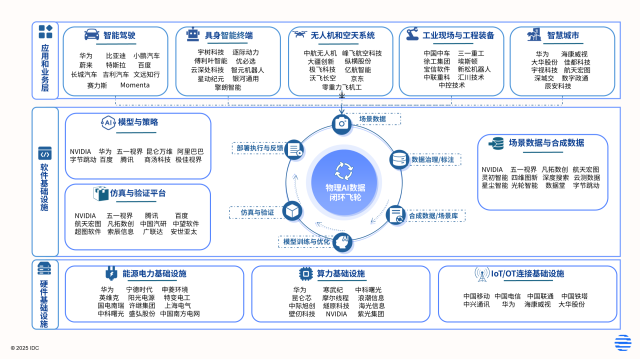
为了更系统地拆解数据闭环如何落地,IDC将中国物理AI产业划分为三层相互咬合的结构。 应用和业务层定义真实任务、运行流程和商业价值;软件基础设施层组织模型与策略、仿真验证和场景数据;硬件基础设施层提供计算、连接、供能、感知和物理执行条件。

三层围绕真实运行形成循环:应用产生任务和现场问题,硬件完成感知与执行,软件把运行数据转化为训练数据、仿真场景和验证用例,更新后的模型再进入设备和业务系统。下面逐层展开,看每一层在闭环中具体承担什么角色、当前进展到哪一步。

应用和业务层:闭环质量影响商业化节奏

任务边界、数据反馈、安全责任和投入产出,是判断场景成熟度的四项重要条件。运行问题能够被记录、复现和验证的场景,更容易进入规模部署。

智能驾驶已经形成较完整的数据采集、场景挖掘、仿真测试和版本回归流程,是当前数据闭环较成熟的物理AI场景。

具身智能终端正在从动作演示进入连续任务执行阶段。任务成功率、人工接管频率、异常恢复能力和跨环境适应能力,将逐步成为主要评价指标。

无人机和空天系统需要把飞行状态、空间环境、通信链路、任务调度、运行监管和异常处置纳入统一的运行与验证体系。

工业现场与工程装备拥有清晰的工艺、安全和成本目标。质量检测、预测维护、物料搬运、巡检、精密操作和无人作业等任务,已经开始产生可量化的效率、质量和安全收益。制造业具备流程明确、数据基础较好和指标体系成熟等条件,将继续成为物理AI的重要验证场。

智慧城市相关应用需要打通感知、分析、调度和执行。AI进入交通、设施、低空和应急等物理系统的实际运行后,才会形成更完整的物理AI能力。

无论哪个场景,应用层产生的海量运行反馈,都需要经由软件层转化为可复用的能力——这正是下一层的核心使命。

软件基础设施层:把运行反馈转化为可复用能力

软件基础设施层包括模型与策略、仿真与验证、场景数据与合成数据。三类能力通过数据闭环持续协同,决定物理AI的进化速度和规模复制能力。

模型与策略方面,世界模型仍处于多条技术路线并行发展阶段,可用于交互环境生成、状态变化预测和行动结果推演;VLA模型连接视觉、语言和动作,为机器人及自主设备生成任务策略。未来系统将更多采用分层架构,由高层模型理解任务与环境,中间层完成预测和规划,底层控制系统负责实时、稳定和安全执行。

仿真与验证方面,数字孪生、空间智能和仿真平台之间的协同正在加强。数字孪生提供设备结构、空间关系、物理参数、工艺规则和实时状态;空间智能帮助模型理解三维环境和对象关系;世界模型扩展场景生成、状态预测和策略探索;仿真平台承担测试、回归和安全验证。虚拟环境由此可以覆盖训练、方案推演、系统测试和运行优化。

场景数据与合成数据方面,物理AI需要的数据已经从单帧图像和单点记录,扩展到包含时间、空间、设备状态、动作过程和执行结果的连续场景数据。真实运行中的故障、接管、任务失败和高风险事件,需要经过筛选、标注和结构化处理,沉淀为可检索、可复现和可重复使用的场景资产。

数据闭环将分散的模型、数据和仿真工具连接成持续研发体系。任务覆盖度、异常覆盖度、问题复现率、回归关闭率和跨版本一致性,将逐渐成为物理AI软件平台的重要评价指标。物理AI软件平台商业模式也会从单次工具采购,延伸到场景资产管理、模型生命周期管理、持续验证和安全证据链服务。

软件层的一切优化最终都要回到物理世界中验证,而硬件层正是这个闭环的起止点。

硬件基础设施层:连接真实数据与物理执行

硬件层包括能源电力、算力和IoT/OT连接基础设施。云端承担模型训练、批量仿真和数据处理,边缘节点负责现场协同与模型管理,设备端完成实时感知、推理和控制。

传感器、摄像头、雷达和设备运行系统提供真实环境数据,控制器和执行器负责把模型判断转化为物理动作。硬件层既是数据闭环的起点,也是系统执行结果的出口。

涉及车辆制动、机器人避碰和工业安全的关键任务,还需要保留本地执行、故障降级、冗余控制和人工接管能力。

中国在设备制造、通信网络、能源系统和工程实施方面具备较好基础,高端AI芯片、工业级传感器、核心零部件和复杂环境可靠性仍需持续提升。

三层架构完整就位之后,真正的挑战不在于单点突破,而在于如何让闭环从技术层面延伸到行业应用层面。

展望:从技术闭环走向行业闭环

未来几年,世界模型仍将保持多条技术路线并行,数字孪生、空间智能、仿真平台、合成数据和真实运行数据之间的连接会继续加强。模型能力的提升将扩大系统可以完成的任务范围,验证体系则负责控制进入真实环境的速度和风险。

中国拥有丰富的制造、城市运行和机器人应用场景。下一阶段需要提高软件平台的产品化水平,推动场景数据跨项目复用,加强设备接口协同,并建立覆盖模型、硬件和运行过程的评测与验证体系。

物理AI的市场差距将更多体现在系统学习效率、验证可信度、长期运行能力和跨场景复制能力。企业能否把现场问题快速转化为场景资产、验证用例和模型更新,将影响其产品迭代速度和规模化能力。

IDC将持续跟踪物理AI技术、市场和生态变化,并通过“物理AI+行业场景”的研究方式,重点关注制造业、城市物理系统和具身智能等方向,进一步分析技术架构、市场机会、厂商格局和产业化路径,为技术供应商和行业用户提供持续参考。

进一步交流

如需了解物理AI架构评估、场景落地路径或数据闭环能力诊断等研究方向,欢迎联系IDC中国物理AI与行业智能化研究团队。我们将安排对应行业分析师与您深入沟通,提供定制化决策参考。

Lily Li

Lily Li - Research Manager

Lily is the Research Manager for China Robotics and Embodied Intelligence, specializing in market research on embodied intelligent robots. She has long focused on the development trends of China’s embodied intelligence robotics industry, systematically studying the evolution of robot hardware,…

The Q1 2026 results confirm that AI infrastructure investment has moved well beyond initial proof-of-concept phases into a sustained, multi-year capital commitment cycle while the competitive battle has shifted from how much compute gets bought to which platform wins it. Enterprise technology buyers, cloud service providers, and national governments are making long term decisions about where to build, how much to spend, and which AI workloads to prioritize.

For vendors, this means a prolonged period of elevated demand across accelerated compute, high-performance storage, and supporting network infrastructure, but also a fast-moving contest for architecture leadership, as ARM rackscale platforms displace x86 in the accelerated server market. For enterprises, the data signals that AI capacity is becoming a structural cost of doing business at scale, that storage refresh deferred during the initial AI buildout can no longer be postponed, and that late movers risk falling behind on both performance and cost efficiency.

Market dynamics

  • Regional performance was mixed. The United States remained dominant at $67.9 billion (75.7% of global spend, +30.3% YoY), though growth continues to moderate. China (PRC) returned to growth at $7.8 billion (8.7% share, +9.3% YoY). The Middle East & Africa remained the fastest-growing region (+233% YoY to $1.1 billion), followed by APeJC (+62% to $5.8 billion) and Western Europe (up to $5.1 billion).
  • Accelerated compute remains the structural backbone, alongside a growing non-GPU AI-centric layer. Server spending represented 97.6% of total AI infrastructure value in Q1 2026, and within that, a growing share of AI-centric demand is landing on infrastructure that isn’t GPU-accelerated at all. AI orchestration tooling, data-pipeline workloads, and CPU-only inference clusters that hyperscalers are running as a cost-mitigation strategy alongside their GPU buildouts.
  • Deferred storage investment is catching up. After redirecting budget toward GPU and AI server spend for the past one to two years and treating storage refresh as postponable, enterprises can no longer put those purchases off. Pent-up storage refresh is now landing on top of genuine AI-driven demand, reinforcing the urgency behind external storage strategy even as AI-centric storage remains a small share (2.4%) of total AI infrastructure value.

Data callout: Q1 2026 key metrics

Total AI Infrastructure Spending (Q1 2026)$89.7 billion
Year-over-Year Growth (Q1 2026 vs. Q1 2025)+33.1%
Full-Year 2025 AI Infrastructure Spending$318 billion
Full-Year 2024 AI Infrastructure Spending$153 billion (YoY +107.6%)
Server Share of Q1 2026 AI Spending$87.6 billion (97.6%)
Storage Share of Q1 2026 AI Spending$2.2 billion (2.4%)
2029 Forecast — AI Infrastructure$1.08 trillion
Accelerated Server Platform Mix (Q1 2026)Non-x86 (ARM) $53.0B vs. x86 $34.6B
2030 Forecast — AI Infrastructure$1.21 trillion

“The Q1 2026 results make clear that AI infrastructure investment has entered a new phase where it’s not just about how much compute gets bought anymore, it’s about which platform wins it. We watched x86 accelerated servers fall from $52 billion to $35 billion in just two quarters while ARM rack-scale platforms nearly doubled, and that’s not demand destruction, that’s an architecture shift that is yet to be definitive as new x86 platforms are on the horizon as well. At the same time, we’re seeing genuine AI-driven demand show up in CPU-only inference clusters, AI orchestration tooling, and a storage refresh with a more AI-related flavor. While global economy and geopolitical tensions seem to slow down other markets, the AI investment pace continues showing an extraordinary resilience to the environment.”Juan Seminara, Research Director, Worldwide Infrastructure Trackers, IDC

Outlook

IDC projects AI infrastructure spending will reach $497 billion in 2026, representing approximately 56% year-over-year growth; an acceleration, not a moderation, from the roughly 53% pace estimated as recently as last quarter, and still one of the largest absolute-dollar expansions ever recorded in a single IT market segment. The market is now forecast to surpass $1 trillion in 2029, reaching $1.08 trillion, before climbing to $1.21 trillion in 2030, a five-year compound annual growth rate (CAGR) of approximately 30% from 2025.

What could accelerate this trajectory:

  • Faster-than-expected scaling of inference workloads as enterprise AI application deployment broadens
  • Sovereign AI program expansion in the Middle East, Southeast Asia, and Europe, driving incremental greenfield investment
  • New model architectures and AI agent frameworks require deeper, more distributed compute infrastructure
  • Emergence of non-GPU AI-centric demand (AI orchestration tooling, data-pipeline workloads, and physical AI use cases such as robotics and autonomous vehicles) extending the addressable market beyond GPU-based training and inference

What could constrain growth:

  • Power generation and grid capacity constraints, which remain the primary operational bottleneck for new data center commissioning in major markets
  • Memory and storage component scarcity, which can lift server BOMs and slow procurement cycles, now compounded by enterprises simultaneously catching up on deferred storage refresh
  • Expanded export controls and data-sovereignty regulations, which could reshape where AI workloads are deployed and which vendors win enterprise deals
  • Geopolitical instability in the Middle East, where growth is concentrated in a small number of large, government-backed Gulf deals; escalation of regional tensions, including the ongoing conflict involving Iran, could delay procurement decisions, complicate data center siting and security planning, or shift government priorities away from AI infrastructure investment, introducing volatility to what is currently the fastest-growing region

Investors and technology buyers should monitor Q2 2026 capital expenditure guidance from leading hyperscalers and AI platform providers, as these forward signals remain the most reliable leading indicator of near-term infrastructure demand.

Frequently Asked Questions

Why did AI infrastructure growth moderate from earlier 2025 peaks?

Earlier quarters benefited from a step-change in capital deployment as hyperscalers accelerated training infrastructure buildouts, then a second step-change as ARM rack-scale platforms began displacing x86 in Q4 2025. Q1 2026’s 33% year-over-year growth reflects a much higher base, not a slowdown in demand. Sequential spending was essentially flat with Q4 2025’s record quarter. The long-term expansion cycle remains firmly intact, and IDC’s full-year 2026 forecast was revised upward, not downward, this quarter.

Which regions are emerging as new AI infrastructure centers?

The Middle East, particularly Saudi Arabia and the UAE, again posted the strongest year-over-year growth globally in Q1 2026, driven by government-backed sovereign AI initiatives and partnerships with leading hyperscalers, even as sequential spending pulled back from Q4 2025’s record deal flow. China returned to growth after a Q4 2025 decline. Western Europe and Asia/Pacific also grew sharply, supported by national AI strategies and localized cloud service provider expansion.

What risks should buyers and vendors watch in 2026?

Power availability is the single most important operational constraint heading into 2026. Data center commissioning timelines are increasingly driven by utility capacity rather than hardware lead times. In parallel, evolving trade policy, particularly around advanced GPU exports, will continue to reshape competitive dynamics across China, the Middle East, and other emerging markets. The rapid ARM/x86 platform shift also raises execution risk for x86-focused OEMs and ODMs that have not yet diversified their rack-scale roadmaps.

Have ARM servers overtaken x86 in the accelerated server market, and what’s the outlook going forward?

 Yes, Non-x86 (ARM) accelerated server value climbed to $53.0 billion in Q1 2026, up from $47.5 billion in Q4 2025 and $29.8 billion in Q3 2025, while x86 accelerated value fell to $34.6 billion from $42.7 billion and $51.9 billion over the same span. The crossover, which began in Q4 2025, reflects large buyers consolidating around NVL72/GB200-class rack-scale platforms and redistributing volume away from custom x86 rack designs. Projections will depend on how offerings evolve. Which platform ultimately prevails remains to be seen, as supply challenges across the industry persist.

For comprehensive vendor share, forecast data, and taxonomy detail, see: IDC Worldwide Quarterly AI Infrastructure Tracker. For taxonomy and methodology definitions, see: Worldwide Artificial Intelligence Infrastructure Tracker Taxonomy, 2025.

Juan Pablo Seminara

Juan Pablo Seminara - Research Director, Worldwide Enterprise Infrastructure Trackers

Juan Pablo Seminara is the Research Director for IDC's Worldwide Enterprise Infrastructure Trackers within the Data & Analytics organization. Mr. Seminara is responsible for leading a team of analysts in charge of the product concept, roadmap, implementation, execution, and client…

This is the second post in Meet IDC Quanta, a short series showing what the product actually does, starting with the portal, then your inbox, then wherever you’re already working in Claude.


It’s 4:47 PM. You’re prepping for tomorrow’s board meeting, and a question just landed that wasn’t on your list: how does your cloud infrastructure position compare to what’s shifted in the market over the last two quarters. You could open a portal, log in, run a search, filter by date, read three reports, and synthesize an answer. Or you could pull up your phone in the elevator.

Most executives don’t have a research workflow. They have an inbox. IDC Quanta was built on that premise: the fastest tool for a time-pressed leader is the one they never have to open, because it’s already open.

What it actually does

IDC Quanta in email lets you ask a question and get a sourced IDC answer back in about 60 seconds. It works the way you’d already expect email to work, which is exactly the point.

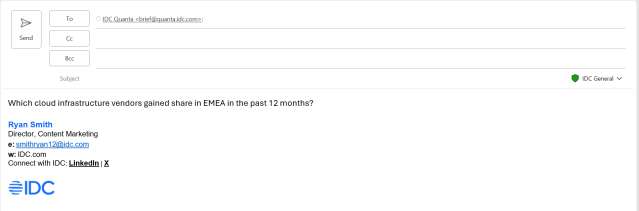
  1. Compose an email to brief@quanta.idc.com, from your phone, your laptop, whatever’s in front of you.

  2. Ask the question in plain language. No query syntax, no keyword tricks. “Which cloud infrastructure vendors gained share in EMEA in the past 12 months?” is a complete request.

  3. Send it, and keep moving. A structured, sourced answer arrives in about 60 seconds, fast enough that you can send the question walking into a meeting and have the answer before you sit down.

  4. The reply carries its own receipts. Every claim in the answer traces to a specific IDC source. If you want to go deeper, “View in IDC Quanta” drops you straight into the full portal conversation, context intact.

No login screen to remember, no new app for IT to vet. And no tab-switching mid-meeting. The intelligence comes to the inbox. The inbox doesn’t change to accommodate it.

Where this earns its keep

The mechanic is simple. What makes it valuable is what it replaces across a week of an executive’s actual work:

  • Before the call.
    A prospect meeting is in twenty minutes and you need a current read on their competitive positioning. Email the question on your way to the conference room. The answer’s there before you sit down, cited and ready to use.

  • Benchmarking your own thinking.
    Attach a competitive deck or account plan to your email along with your question. IDC Quanta reads it alongside its own research base and flags where your internal view and IDC’s tracked data disagree. You’re getting your own analysis checked against the numbers.

  • The follow-up nobody has time to chase.
    Someone asks a sharp question in a meeting and the honest answer is “let me get back to you.” Now that follow-up takes one email and about a minute. Who else on your team wishes they had that?

  • Board and investor prep, compressed.
    The night-before scramble for one more data point doesn’t need the whole deck reopened. One email, one sourced answer, dropped straight into the slide.

Why this isn’t just a fast AI reply

A lot of tools will answer an email question with confidence. Confidence isn’t the same as being right, and it isn’t the same as being defensible in a room full of people who will ask where the number came from. Every IDC Quanta answer draws on IDC’s research base: 1,000+ analysts across 100+ countries, tracking 15B+ data points and 800K+ companies annually. That’s the citation trail behind every answer. It’s what makes an answer dropped in your inbox worth repeating in the room.

Get it in your inbox

If you’re already an IDC Quanta customer, brief@quanta.idc.com is live. Send the question you didn’t have time to research properly and see how fast a sourced answer actually moves.

If you’re not yet a customer, request a demo, and we’ll show you what it looks like when your inbox starts acting like a research team.

Ryan Smith - Content Marketing Director - IDC

Ryan Smith is the Director of Content Marketing at IDC, where he leads brand-level content and social media strategy, aligning research insights with compelling storytelling to engage technology decision-makers. With a background in both IT and marketing, Ryan brings a unique blend of technical understanding and creative strategy to his work. He’s also a seasoned storyteller, speaker, and podcast host who believes the right message, told the right way, can drive both trust and transformation.

Industrial data: from visibility to business value

For more than a decade, industrial digital transformation centered on visibility. Manufacturers invested heavily in connected assets, historians, dashboards, sensors, and IIoT platforms to gain greater operational insight.

Today, visibility is no longer the primary bottleneck.

Walk any major industrial event, from Hannover Messe to Smart Manufacturing Week, and you will see it: nobody’s pitching “we’ll help you see your data” anymore. Most industrial organizations I talk to aren’t short on data. If anything, they are drowning in it. The real challenge has moved from collecting data to actually getting value out of it.

The challenge has shifted from collecting data to converting data into decisions, and decisions into measurable business outcomes. That shift is where AI and industrial operations begin to intersect in genuinely transformative ways.

The market’s biggest bet: industrial context layers

As AI matures, industrial systems are shifting from reporting what happened, to recommending what should happen next, to (increasingly) executing approved actions on their own. We are witnessing a gradual progression from automation toward autonomy.

My view, and one I continue to test in conversations across the market, is that much of the industry’s AI discussion remains overly focused on models themselves. Foundation models are becoming commoditized fast. What’s actually scarce is industrial context, the thing that lets those models do something useful.

An AI model can detect an anomaly, generate a recommendation, optimize a schedule. Fine. But without understanding asset relationships, maintenance history, engineering constraints, production targets, safety requirements, business objectives, that recommendation isn’t worth much on the shop floor. I saw this firsthand during a recent visit to Schneider Electric’s Le Vaudreuil plant in Normandy: the AI itself wasn’t the impressive part; it was the decades of engineering knowledge, process understanding, and operational context underpinning the system. Context is what turns raw data into intelligence, and intelligence into action.

Why AI context requires ongoing maintenance, not just setup

Context also needs upkeep. Let me share an instance I recently came across: a manufacturer brought in a consulting team to build an AI model that controlled fan sequencing inside a set of curing ovens, fixing a temperature gradient that had been causing product defects for years. It worked, and the consultants moved on. About three months later, the problem came back, worse than before. The model had drifted, and nobody was monitoring it closely enough to catch it.

The actual cause turned out to be almost trivial: in the summer, operators would prop open a back door to cool the plant, and the draft created a cold spot the model was never designed to account for. The people on the floor had always known to compensate for this manually, but once the AI model took over, that tacit knowledge quietly stopped being used, and nobody thought to feed it back in.

It’s a reminder that context isn’t a one-time input, it has to be actively maintained, or a model will keep confidently executing on a picture of the world that’s gone stale. Treat AI models like any quality system: audit them on a regular cadence, rerun the same inputs, and catch drift before it becomes a failure.

How industrial vendors are building AI context layers

The more conversations I have across the industrial software market, the more it feels like vendors are arriving at a similar conclusion. Whether through acquisitions, digital twin initiatives, semantic models, knowledge graphs, or industrial data fabrics, vendors are racing to build operational knowledge layers that sit beneath AI capabilities.

Schneider’s acquisition of Cognite. Siemens pursuing its vision through Intelligence Center X, which surfaced repeatedly in conversations at Realize LIVE as part of Siemens’ effort to connect industrial data, engineering knowledge, and AI into a unified operational intelligence layer. Bosch’s Manufacturing Co-Intelligence push, which Norbert Jung was framing to me in Berlin as a “third layer of intelligence” sitting above the shop floor. Autodesk buying MaintainX. Velotic forming. Different roads, same destination: everyone’s racing to build the contextualized data foundation, the semantic layer, the knowledge model, the digital twin underneath the AI.

The emerging battle is no longer simply about delivering AI capabilities. It is about owning the context layer that makes those capabilities useful.

AI assistants vs. AI agents in industrial software

One data point which is relevant here: AI assistants are already everywhere in enterprise software, IDC estimates over 60% of enterprise apps now have some assistant or advisory capability baked in, while roughly 20% are pushing further into actual agent territory, systems that can independently perceive, evaluate, and act. That difference is not small. Assistants help people do the work. Agents start doing the work themselves.

And that has real implications for how enterprise software gets built. For decades, applications were designed around humans: log in, navigate a workflow, move data from one system to another. In an agentic world, that whole model starts to break down.

Why orchestration, not automation, is the real disruption

Instead of opening five dashboards, a user might just say: “optimize tomorrow’s production schedule while minimizing energy costs and avoiding maintenance conflicts.” An orchestration layer then pulls together specialized agents across scheduling, asset management, supply chain, and energy to actually get it done. It’s roughly the vision I kept hearing sketched out on the show floor at Smart Manufacturing Week and other industry events, just from different vendors, each convinced they’d own the orchestration layer.

So no, I don’t think the disruption here is automation. Industry has automated processes for decades already. The disruption is orchestration. Agents are becoming the connective tissue between applications, processes, and outcomes.

That doesn’t mean SaaS is going away, not even close. ERP, MES, EAM, APM, historians, supply chain systems, these stay critical because they are what agents read from and act through. But the value is migrating upward, away from the application itself and toward the orchestration and context layers sitting above it.

This is basically why I don’t buy the “SaaSpocalypse” narrative that’s been making the rounds. What’s actually happening looks less like the death of software and more like software evolving from a system of record into a system of intelligence.

For industrial software vendors, that raises an uncomfortable strategic question: if everyone can plug into the same foundation models, where’s the differentiation going to come from?

My take: Domain intelligence. Process models. Engineering expertise. Decades of operational history. Digital twins. Openness and interoperability. Contextualized industrial knowledge that’s been built up over years, not scraped off the internet.

Key questions for the future of industrial AI

The last decade was about digitizing operations. The next one is likely going to be about operationalizing intelligence. The data already exists. The models are becoming available to everyone. Context is emerging as the industry’s most defensible and strategically valuable asset.

Which leaves me with a few open questions I’d genuinely love to hear other views on:

  • Will the next generation of industrial platform leaders be the ones with the best AI, or the ones with the richest operational context?
  • Does the real control point end up living inside the application, or in the orchestration layer above it?
  • As agents become the primary “users” of software, how should vendors be rethinking product design and pricing?
  • Will industrial organizations trust a single vendor’s context layer, or will neutral data foundations end up winning out?
  • And perhaps the biggest one: as we move from automation to autonomy, who actually owns the decision?

Got a question? Drop it in here.

Gunjan Bassi

Gunjan Bassi - Research Manager

Gunjan Bassi has more than 14 years' experience working in the logistics and transportation sector. Before joining IDC, she worked with Transport Intelligence (Ti), a transportation and logistics research firm based in Bath, England, where she was responsible for vertical…

Physical AI时代开启:具身智能机器人重构新一代生产力

7月20日,2026世界人工智能大会迎来收官之日。值此大会尾声,IDC同期举办了“Physical AI时代开启:具身智能机器人重构新一代生产力”线上专场会议,IDC中国分析师团队基于全球追踪数据及工业用户调研,系统分享了具身智能机器人的技术演进、市场格局与商业化路径。本文为会议核心内容纪要。

本届WAIC特设具身智能专属展区,汇聚众多机器人整机、核心零部件及具身智能大模型企业,集中展示量产人形机器人、四足机器人、轮臂复合机器人以及具身智能大模型的最新进展。展馆内,人形机器人在展台前挥手致意、四足机器人在人群中灵活穿行、机械臂在模拟产线上精准操作——围观的人群里,既有举起手机拍照的普通观众,也有拿着笔记本仔细记录参数的工程师和采购决策者。

热闹背后,一个更值得关注的信号正在浮现:今年的展品不再只是“能动的演示”,而是围绕3C电子、汽车制造、仓储物流、商用服务、家庭陪伴等真实场景展开应用展示,反映出中国具身智能机器人正由技术验证迈向商业化落地,产业实用价值持续释放。

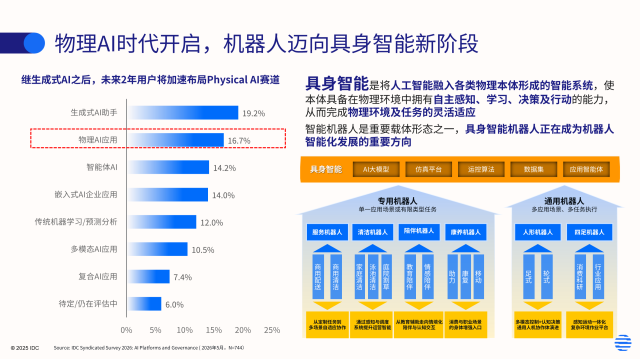
这一变化背后,是AI产业正由生成式AI迈向Physical AI。生成式AI赋予机器认知能力,Physical AI进一步赋予机器在物理世界中自主感知、规划和行动的能力。国际数据(IDC)最新用户调研结果显示,继生成式AI之后,Physical AI将成为未来两年企业AI布局的重点方向。

具身智能机器人是Physical AI最重要的产业载体。IDC预计,未来五年中国具身智能支出将由14亿美元增长至770亿美元,年复合增长率达94%,中国有望持续引领全球具身智能机器人产业发展。

机器人原生智能的三大技术底座

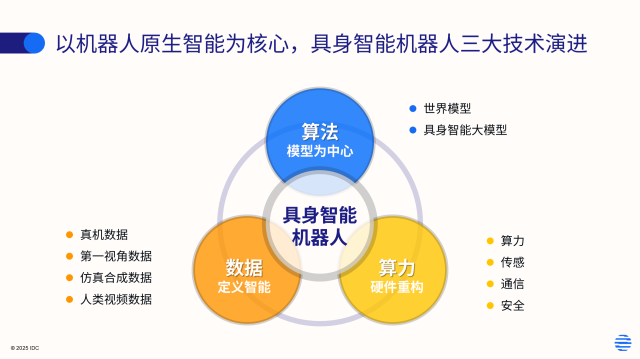
围绕机器人原生智能的持续提升,正在推动模型、数据和算力三大技术底座加速演进。这三者环环相扣,共同决定了机器人的智能化上限。

模型层面,世界模型与VLA(视觉-语言-行动)的协同正成为核心架构。世界模型负责物理世界建模、任务规划及仿真数据生成,VLA模型负责感知、理解与动作生成,两者协同推动具身智能机器人迈向理解、预测、规划、执行的全面能力。

数据层面,“仿真优先、虚实融合”已成为行业共识。互联网视频、第一视角数据、仿真数据和真实机器人运行数据共同构建数据飞轮,持续驱动机器人能力迭代。数据飞轮转得越快,机器人的进化效率就越高。

算力层面,AI原生计算正驱动机器人架构全面升级。随着模型规模持续扩大,推理算力需求快速增长——IDC预测,到2027年推理将占智能算力需求的70%以上。云边协同带动计算平台、感知系统、运动控制及机器人操作系统全面升级,为规模化部署提供支撑。

从关注热度走向落地探索,多形态具身机器人需求形成

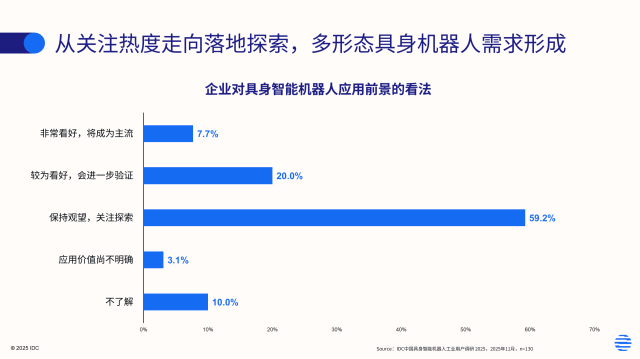
技术突破之外,市场的反应同样关键。IDC用户调研显示,超过80%的企业已开始关注并评估具身智能技术,部分企业已进入试点验证阶段。不同应用需求正在推动机器人向多形态发展,各品类的商业化节奏也呈现出明显差异。

人形机器人是增长最快的品类。2025年全球出货量接近1.8万台,同比增长800%,正由展示验证走向工业应用。中国厂商保持领先,中尺寸机型贡献主要出货量,全尺寸机型支撑高价值市场。IDC预计,2030年全球出货量将突破51万台。

四足机器人形成“消费驱动规模、商用驱动价值”的发展格局。2025年全球出货量预计约6万台,工业巡检、应急救援等行业应用持续扩大,情绪陪伴与专业作业需求共同推动市场增长。

商用服务机器人进入全球化扩张阶段。2025年全球出货量超过15.5万台,配送、清洁等应用持续向室外、多功能及多机器人协同方向发展,中国厂商继续保持全球领先。

外骨骼机器人加速向医疗康复、消费助力和工业辅助等多场景拓展。2025年中国市场出货量约2.6万台,多模态感知、轻量化设计及AI算法持续提升产品能力,医疗康复场景已形成成熟商业模式,消费与工业场景正处在从0到1的突破期。

家庭清洁机器人:家庭具身智能发展的最佳入口

相比通用家庭机器人仍处于早期探索阶段,家庭清洁机器人已率先实现规模化商业落地,成为家庭具身智能发展的最佳入口。

2025年全球家庭清洁机器人出货量达到3273万台,同比增长20.1%,市场正由单一室内清洁迈向覆盖扫地、割草、擦窗、泳池等场景的全场景智能清洁。其中,扫地机器人仍是最大的细分市场,2025年全球出货量达到2412万台;割草机器人和擦窗机器人保持高速增长,增速分别达到64%和70.4%,无线化、智能化成为产品升级的重要方向。

随着AI能力持续提升,行业竞争正由清洁能力转向智能能力。空间理解、自主导航、多模态感知、智能决策以及家庭IoT生态协同,正在成为产品差异化的核心竞争力。依托AI算法、供应链和全球化布局优势,中国厂商持续扩大在全球家庭清洁机器人市场的领先地位。

展望未来,家庭清洁机器人将逐步由单一功能设备演进为家庭具身智能体,并进一步融合家庭大模型、智能家居和IoT生态,成为未来家庭服务的重要智能终端。

商业化进入规模复制阶段

当技术逐步成熟,产业竞争的核心正由单点技术突破转向规模化落地能力。谁能在真实场景中跑通闭环、实现复制,谁就能在下一阶段占据主动。

应用场景来看,分层演进的节奏已逐步清晰。服务场景率先完成市场培育;工业场景进入规模化导入阶段,码垛、搬运、拾取、检测等应用持续落地;家庭场景则处于技术迭代和应用培育阶段,蓄势待发。

工程化能力来看,落地周期持续缩短。机器人正从单一产品走向工程化交付,模块化软硬件提升了场景适配能力,全栈解决方案与云边端协同架构加快应用部署,多品类机器人协同作业持续拓展应用边界,推动具身智能从单机智能迈向系统智能。

商业模式来看,行业正由卖产品走向卖服务。“硬件+软件+服务+AI”的融合模式正在成为主流,一次性销售、RaaS租赁/订阅、服务增值、本体与模型协同等模式并行发展。其中RaaS有效降低了用户使用门槛,加速了机器人的普及推广。

IDC四个判断:未来五年的竞争焦点

基于持续的全球市场跟踪,IDC对具身智能机器人产业提出四点判断:

  • 技术竞争进入系统能力竞争阶段。 模型、数据和算力将持续协同演进,世界模型、VLA和数据飞轮将成为机器人智能能力提升的核心驱动力。单点技术的领先不再足以构建壁垒,系统能力才是决胜关键。
  • 商业价值将由场景验证走向规模复制。 未来竞争重点将由技术突破转向场景适配、工程化交付和商业模式创新,机器人将进入规模化部署阶段。谁能率先跑通场景闭环,谁就能占据先机。
  • 生态能力将成为产业竞争的分水岭。 平台能力、开源生态、数据闭环和产业协同,将决定企业能否在五年后依然留在牌桌上。生态建设不再是可选项,而是必答题。
  • 中国厂商有望持续引领全球产业化。 依托完善的制造体系、丰富的应用场景、完整的供应链和数据规模优势,中国企业有望继续引领全球具身智能机器人产业的发展。

进一步交流

具身智能机器人产业正处在从技术验证走向规模化落地的关键转折期。IDC持续追踪全球机器人市场动态,覆盖人形、四足、商用服务、家庭清洁、外骨骼等全品类,为企业提供数据驱动的市场洞察与战略决策支持。如需获取完整报告、行业数据或与分析师团队深入交流,欢迎联系IDC中国

Lily Li

Lily Li - Research Manager

Lily is the Research Manager for China Robotics and Embodied Intelligence, specializing in market research on embodied intelligent robots. She has long focused on the development trends of China’s embodied intelligence robotics industry, systematically studying the evolution of robot hardware,…

2026年7月17日,上海世界人工智能大会(WAIC)现场,全球首款 AI 智能体手机、23 克轻量化 AI 眼镜集中首发,人形机器人走出演示场景落地工业、服务一线。

这些现场实景与IDC最新终端市场数据形成双向印证:全球智能终端产业已正式告别概念化技术叙事,AI从附加功能升级为重构硬件、交互与产业格局的底层核心。对于不同角色的参与者而言,这场变化的含义与应对路径各不相同。

数据层面:AI终端全线增长,分化格局已现

IDC研究数据显示,在国内整体终端市场承压背景下,AI硬件成为唯一增长主线,各细分赛道呈现差异化扩张态势:

  • 手机:2026年国内生成式AI手机渗透率突破50%,正式进入普及周期。端边云协同算力、原生智能体系统、全场景生态是行业突围核心方向。
  • 具身智能机器人:中国持续引领全球发展,预计2026年市场规模接近50亿美元。其中人形机器人作为高阶载体,全球出货同比增长超过150%,工业场景为重点突破领域。
  • 家用大清洁机器人:家用机器人仍是出货量最大的机器人品类,2026年第一季度全球出货893万台,同比增长36.7%。扫地机器人出货656.3万台,同比增长29.4%,头部厂商在欧洲市场布局力度持续加大。
  • PC/平板:2026年中国Gen AI PC出货587万台,市场占比11.9%,销量同比提升166.4%;Gen AI平板出货112万台,占比35.6%,销量同比提升68.4%。AI已成为平板摆脱低价同质化竞争的核心抓手之一。
  • 可穿戴/智能眼镜:轻量化硬件与AI大模型融合已成新品标配,1500-3000元价位为核心竞争区间,AI集成与多元场景生态是增长核心驱动力。

产业增长驱动力源于大模型成熟、国产零部件配套升级、实景需求持续释放。同时,跨应用权限互通、智能体长效记忆、数据隐私合规仍是当前三大核心瓶颈。

趋势层面:WAIC实景揭示的四重变革

本届WAIC集中呈现了四个方向的结构性变化,这些变化正在重新定义终端产品的竞争逻辑:

趋势一:AI原生软硬件闭环成为行业硬性标准

阶跃星辰STEPX Neo搭载自研Step AOS智能体原生系统,在安卓底层增设智能体调度层,搭建”大模型-原生系统-硬件”一体化架构;努比亚量产AI手机依托MCP/A2A协议实现跨应用自主执行;Rokid原生操作系统YodaOS落地消费级智能眼镜。行业竞争重心已从硬件参数比拼转向软硬一体生态建设。

趋势二:交互逻辑从“人操控设备”向”机器理解意图”跃迁

传统触控、语音交互正向意图感知交互迭代:STEPX Neo依靠双域长效记忆简化重复指令;智能眼镜打造”被动感知、主动服务”模式,依托视听感知自动识别需求并后台响应,实现无操作主动服务。交互效率的提升,直接决定了终端设备在真实场景中的可用性。

趋势三:端云协同架构标准化,具身智能搭建数据闭环

主流智能眼镜统一采用”端侧轻量化模型+云端大模型”分层算力架构,空间计算芯片与自研光学引擎成为头部厂商高端产品趋势标配。人形机器人赛道重点布局世界模型、数字孪生、合成数据体系,具备”模型训练-数据采集-落地反馈”完整闭环的企业,竞争优势已显著拉开。

趋势四:单品智能向多设备场景协同升级

大会首发的”HGR人·镜·犬混合智能协同系统”,依托智能眼镜联动机器狗完成现实服务任务;工业、仓储、商用、家庭多场景同步落地多机器人联动方案。行业发展方向已从单一设备智能化,转向全域场景协同智能。

综合以上趋势,IDC得出三个核心判断:

判断一行业已跨越尝鲜期,进入普及阶段。AI手机渗透率过半、机器人市场增速翻倍,叠加量产机型集中发布,表明消费者需求已从猎奇尝鲜转向实用刚需,市场增长由厂商单向教育驱动转为用户主动采购拉动。

判断二场景落地能力正在成为企业核心分水岭。厂商宣传逻辑从”硬件功能堆砌”转向”垂直场景解决方案”——人形机器人深耕制造、物流商用场景;智能眼镜差异化布局本地生活、通用办公、个性化服务。真实场景的落地深度,是拉开企业差距的关键指标。

判断三国产产业链完成从跟跑到自主协同的转型。本届WAIC集中亮相的国产底层技术底座——自研智能体操作系统、本土端侧芯片加速渗透、机器人核心零部件国产化持续提升——表明硬件、系统、大模型、生态四位一体已成为AI终端规模化落地的必要条件。

未来12-18个月产业核心变量预判

基于当前数据趋势与技术实景,以下变量值得持续关注:

  • 技术端:终端专用NPU、轻量化端侧大模型、智能体原生OS将成为旗舰标配;无底层重构的浅层AI设备将逐步被市场淘汰;国产眼镜芯片加速渗透以高通AR1为主的市场格局。
  • 市场端:AI智能体手机价格将持续下探覆盖全价位;1500-3000元智能眼镜将开启价格战;内容电商线上种草加速眼镜消费转化,线下专业验配渠道潜力待释放。
  • 政策生态端:AI终端安全、隐私合规规范持续收紧,合规能力不足的中小品牌将加速出清;政企、办公、出行垂直场景成为智能体商业化核心赛道,产业扶持政策持续降低消费门槛。

不同角色的行动参考

以上数据与判断,对不同类型参与者的含义各有侧重:

终端厂商及产业链企业:竞争逻辑已从参数比拼转向软硬一体生态建设。需重点关注:是否具备完整的”模型训练-数据采集-落地反馈”迭代闭环;在垂直场景中是否形成了可验证的解决方案;端侧芯片、操作系统等底层能力是否自主可控。

行业投资者:赛道分化趋势已明确。需关注具身智能机器人、智能眼镜等增速领先品类的结构性机会;同时留意合规收紧带来的行业洗牌,具备生态壁垒的头部企业抗风险能力更优。

应用开发者与场景方案商:多设备协同与场景智能方向正在打开增量空间。HGR人·镜·犬等混合协同方案的落地,预示着设备联动与服务闭环的想象空间远大于单品智能化。

与IDC进一步交流

以上洞察基于IDC覆盖全球终端市场的持续数据追踪与WAIC现场实景调研。当前时间窗口的关键特征在于:当前时间窗口的特殊性在于:数据转向已经发生,但市场共识尚未完全形成。对于正在进行AI终端战略规划、产品定义或市场进入决策的机构而言,这意味着一个关键的时间窗口。

如您希望就具体赛道数据进行深度探讨,或针对您的业务场景获取定制化的数据与分析支持,欢迎联系我们(请点击此处)进一步交流。

Fiona Wu

Fiona Wu - Associate Vice President, Client System Research and IPDS, IDC China

Fiona Wu, associate vice president for IDC China's Client System Research, has 10 years of experience working in the IT industry and is focused on research and analysis of the China IT hardware market. She leads the team to provide…

Technology markets rarely fit into a single bucket and neither should your intelligence. 

IDC’s experts take a rigorous, specialized approach to every market they cover. For example, our Security Technologies team doesn’t take a blanket approach to enterprise security. They oversee nine core market groupings: cybersecurity technologies, cyberresilience and risk management, security services, trust and AI governance, AI security, compliance & regulatory insights, cloud and application security, privacy & data governance, and sustainability-related technologies. The result is highly granular data sets and deep qualitative analysis for the full range of security and trust markets, backed by experts who specialize in the details. The same is true across every domain IDC covers. 

For years, our products were organized according to how our analysts specialized as well. We had hundreds of individual SKUs for research and data products. If clients wanted comprehensive coverage of a market, it meant buying multiple research and data products, creating gaps between what our clients had access to and what they needed. It reflected how we did the work, but not how they needed to use it.  

Clients weren’t shy about telling us that. We heard many times that narrowly defined product access made it difficult to see the full ecosystem and even harder to move fast. And with AI driving exponential change, those are necessities. 

What’s new: From thousands of SKUs to outcome-driven coverage areas 

IDC continues to provide extensive coverage of hundreds of detailed technology markets and industries. However, we redesigned how we package our coverage around two core improvements: 

  1. From individual SKUs to complete packages: Coverage areas built around core technology markets and business decisions, from AI infrastructure to cybersecurity, now offer broader, outcome-oriented intelligence sets. 
  2. Research and data, together: Clients no longer need to purchase research and data products separately. Each coverage area now includes both qualitative (e.g. written analysis, MarketScapes, expert points of view) and quantitative intelligence (e.g. forecasts, market share). The evidence and narrative sit side by side for a complete view of the market. 

We also made sure every package includes the expert engagement opportunities clients have told us they love:  

  1. Analyst access: Direct advisory from IDC’s leading subject matter experts. 
  2. Event access: Invitations to IDC events for select packages and tiers. 

IDC Quanta: Included in every subscription  

Intelligence is only useful if you use it.    

IDC Quanta, our AI-powered research platform, synthesizes insights across coverage areas and against each client’s own data, providing a more personalized and useful intelligence experience. IDC Quanta also brings IDC content directly into the tools clients are already using, providing the option to bypass portals of the past. 

The power of IDC Quanta is a primary reason why many of our 175+ beta customers told us they wanted IDC Quanta bundled with their core intelligence services, citing it as an enhancement to their current service rather than a separate product. 

That’s why IDC Quanta is included in every subscription. It’s not sold as a standalone product or an add-on. It’s built into our packaging because every IDC client deserves to move as fast as the market demands.   

Why this matters: Built for how our clients work 

Fewer, broader coverage areas are simpler to use and buy. When paired with IDC Quanta’s powerful AI capabilities, clients benefit from fast, well-rounded responses that support how their business actually works.  

Take an example of building a business case for entering a new market. Having worked with our clients over the years, we know they need the evidence – market forecast, share, channel partners, competitive positioning and pricing, and timeline –  as well as the narrative for how they will execute the plan – product roadmaps, go-to-market strategy, risks, and success metrics. IDC’s new packaging model provides the data and research clients need so they spend less time understanding and more time executing.  

Let’s also consider a specific market situation for further illustration:  

Example: Data & Storage Infrastructure

Imagine a company that provides cloud storage and enterprise arrays is looking to capitalize on the rapidly expanding opportunities driven by AI.

BEFORE

Client purchases a data Tracker and separate research bundles, each of which includes dozens of PDF research reports.

TODAY

 Client subscribes to their core coverage areas for Data & Storage Infrastructure which includes a 10x increase in research intelligence and multiple data Trackers, plus IDC Quanta to access, synthesize, and activate that intelligence.  

The new packaging also recognizes that one size doesn’t fit anyone. We created distinct packages mapped by breadth of coverage and depth of engagement. Whether a client is a startup focused on a single market or a large enterprise spanning multiple geographies and technology domains, there’s an option to support their needs. 

What our clients are saying 

As an intelligence firm, we did our research before making this shift. We surveyed existing clients and used their feedback to shape the final approach. Clients shared comments like: 

“Our needs change over time. The research we need in Q1 might be different than Q3. Broader access would prevent us from having to go through a new contract or purchase process for every shift.”  

“As we embed AI in our workflows, these capabilities allow us to remain relevant. We see value in the new model, including more data, MCP integrations, and the ability to upload our own data.” 

The data backed this up. When asked to quantify the value addition, the average response from clients interviewed was that they saw more than 50% increase in value in the new packaging compared to their current service mix.  

What happens next 

This is what listening looks like in practice. Clients asked for broader access to our coverage to help them make better decisions, not coverage that mirrors our org chart. Clients asked for a more complete view of the market and the speed to act on it. We built it. Now it is ready for you. 

Ready to explore which package fits your strategy? The IDC sales team is here to help create the best IDC experience for your team.   

Interested in exploring how IDC Quanta can accelerate your workflow?
Book a demo today.

Kate Bae - Head of Product and Partnerships - IDC

Kate Bae is Head of Product and Partnerships at IDC, where she leads the shift to embedded, AI-fueled experiences that turn IDC's intelligence into a real-time advantage for customers. She brings over a decade of product leadership from NCR Voyix, NielsenIQ, and Nielsen to the role.

Anand Singhania - Vice President, Pricing Strategy - IDC

Anand Singhania is VP, Pricing & Monetization Strategy at IDC, where he develops and executes pricing strategies to drive commercial growth. He brings 15+ years of pricing and commercial strategy leadership across Life Sciences, Industrials, Technology, and Healthcare, including senior roles at EY and Simon-Kucher & Partners.

At the IDC Quanta launch webinar, Jamie Fiorda, SVP of Product Marketing at IDC, laid out why the gap between how fast markets move and how fast organizations understand them is becoming the defining challenge for companies trying to act before conditions shift again. He also laid out where AI-powered intelligence tools fit into closing it.

Fiorda’s starting point was access: who actually gets to use the intelligence a company already has. In most organizations, the market intelligence a company already invests in tends to serve a narrow slice of the business (a research team, maybe a strategy analyst or two), while the insights that could sharpen decisions elsewhere in the company never reach the people making them.

That’s the pattern Fiorda described: intelligence that exists, but sits in a portal most of the organization has no reason to open. The problem isn’t the quality of the research. It’s that the value of it is being rationed by who has access, right as every function in the business is under pressure to move faster on planning that used to have more runway.

Positioning AI as an Intelligence Layer, Not Another Tool

Fiorda’s case for IDC Quanta wasn’t framed as a new subscription or a new dashboard to learn. It was framed as infrastructure: a layer that sits beneath the tools an organization already uses, making the intelligence within them actionable and defensible.

Organizations already have plenty of AI tools. What most of them can’t do is prove their answers are trustworthy. That gap shows up largest in finance: nearly a third of global enterprises still run their finance analytics function with no formal structure at all, department by department, which is exactly where an M&A assumption or a market-sizing input gets challenged first by a board, an investor, or an auditor. Fiorda’s argument centers on embedding intelligence directly into the workflows where strategy is developed, backed by a source a leadership team can point to when that challenge arises.

What This Looks Like Across a Business

Fiorda walked through what that shift means function by function, not as a feature list, but as a picture of how fast an organization can move when intelligence isn’t gated to one team.

A market intelligence team doesn’t change what it does, just how quickly it does it: sizing markets and benchmarking with intelligence flowing directly into the tools they already use.

Finance picks up a use case that’s often entirely new: market sizing inside their own models, risk analysis, revenue validation, all backed by third-party data at the point of decision. IDC research points to real upside here: cognitive technologies applied across due diligence and predictive analytics are projected to drive a 25% increase in M&A returns by 2027, largely because AI-enabled screening surfaces viable targets faster than traditional methods can.

Product gains competitive benchmarking and roadmap validation the same way. Marketing builds segmentation and messaging grounded in actual demand trends instead of assumptions a real shift for CMOs navigating today’s pressure to justify every dollar: IDC research found 52% are already leaning harder into scenario-based planning and 41% report increased pressure to justify marketing ROI, both signs that assumption-driven messaging is no longer good enough. And sales walks into a room with validated, current talking points instead of a battlecard built last quarter.

The strategic point is that all five are pulling from the same source of truth, at the same time, without waiting on each other.

The Question Leaders Must Consider

Fiorda’s close reframed the pitch as a single question for leadership to sit with: if the intelligence an organization already values could reach five functions instead of one, what would that be worth? It’s worth sitting with the scale of that gap: IDC research shows nearly 60% of Chief Data Officers say their organizations need to rethink how they use analytics in decision-making, and only about a third of executives are active users of the intelligence tools already in place. That’s not just a research quality problem. It’s strategic value sitting untouched, simply because of where information lives.

In a landscape changing this quickly, the organizations that move fastest will be the ones where that research actually reaches every team that needs it.

Learn More

Organizations already working with IDC can talk to their account team about which teams could get access next. Those exploring IDC Quanta for the first time can request a demo at idc.com/quanta to see where this fits for your team.

Ryan Smith - Content Marketing Director - IDC

Ryan Smith is the Director of Content Marketing at IDC, where he leads brand-level content and social media strategy, aligning research insights with compelling storytelling to engage technology decision-makers. With a background in both IT and marketing, Ryan brings a unique blend of technical understanding and creative strategy to his work. He’s also a seasoned storyteller, speaker, and podcast host who believes the right message, told the right way, can drive both trust and transformation.

The word “cloud” carries an aura of weightlessness and a borderless ether that is beyond geography or gravity. However, in the world of technology, cloud runs on physical concrete, undersea fiber-optic cables, complex power grids, and real people who keep it running.

How the Middle East War has redefined enterprise resilience

The geopolitical conflict across the Middle East in early 2026 has stress-tested cloud adoption and digital transformation road maps like never before. However, the defining narrative is not collapse; it is resilience. What has emerged is a region doubling down on its cloud and AI ambitions, even as the ground beneath it shifts.

For years, CIOs managed risk through a digital-first lens: ransomware defenses, data breach protocols, and distributed denial-of-service (DDoS) mitigation. This baseline changed with the Middle East War. What makes this conflict unusually disruptive to enterprise IT is that datacenters and cloud regions are not collateral damage; they are direct targets.

The issue is bigger than any single provider, facility, or location. Even when infrastructure remains physically intact, enterprises face fragile connectivity, dangerous concentration risk, vendor lock-in, and energy price volatility. Critical workloads still depend on a narrow set of providers, transit paths, and subsea and cross-border cable routes.

The real risk, then, is not whether a single site goes dark. It is whether a geographic cluster, supply route, carrier path, or a set of interdependent providers is simultaneously disrupted. For enterprise leaders, this was a stark, irreversible realization: the risk profile has shifted from cyber resilience to infrastructure resilience.

Round-the-clock continuity

IDC spoke with senior leaders from end-user organizations, hyperscalers, regional cloud providers, and partners across the Middle East. In the first weeks of the disruptions, one goal dominated everything: keeping the lights on for financial institutions, public sector bodies, and private enterprises.

The work happening behind the scenes was extraordinary. Engineering, operations, and management teams ran 24/7 shifts with a mandate to prevent data loss, stabilize systems, and migrate business-critical workloads to secure alternative regions as quickly as possible. Cloud providers and partners collaborated directly with key customers to execute rapid migrations, moving workloads out of conflict zones to global landing zones in Europe and Asia.

This all unfolded under severe physical constraints, such as closed airspace and a supply chain that halted the movement of critical tech talent and replacement hardware. Teams operated under intense mental strain and operational uncertainty, making high-stakes decisions with incomplete information.

Despite these conditions, the results were striking. Enterprises with structured multiregional failover architectures recovered rapidly, preserving database integrity and minimizing service interruptions. The organizations that fared the worst were those still operating inside single-region designs, adding a vulnerability that will take years to fully address across the region.

A resilient region, despite challenges

The severity of the conflict has not derailed broader cloud adoption. IDC’s ICT Spending Black Book (May 2026) reveals that the Middle East and Africa’s (MEA) digital economy has hit a speed bump, but it is not stopping:

  • Sustained growth: MEA IT spending is projected to grow by approximately 5% year over year (YoY).
  • Resilient floor: Even in an extended downside scenario, in which prolonged regional conflict dampens consumer and enterprise confidence, MEA IT spending is expected to hold at 3–4% growth.

These are not figures from a region in retreat. They are figures from a region that is recalibrating.

The AI-cloud mandate

The structural demand for cloud and AI infrastructure remains fundamentally intact. As per IDC’s March 2026 Tech Buyer Survey, infrastructure and IT operations, alongside AI, are the two investment areas most shielded from budget cuts in the current environment.

Enterprises are not abandoning cloud migrations; they are redesigning their architectures to build greater resilience. Four strategic shifts now define how regional technology buyers approach cloud:

  • Multiregional and distributed architectures are the new baseline. Cloud security and multiregional backup (56%) is the fastest-accelerating strategy across the Middle East, Turkey, and Africa (META). Multipath connectivity (38%) and multiregional, multi-availability zone design (30%) are close behind.
  • Energy resilience has moved to the core of cloud decisions. Energy-resilient infrastructure (44%) now ranks among the highest-priority investments, a direct response to the power grid volatility exposed during the conflict.
  • Workload portability and provider diversification are nonnegotiable. Enterprises are actively designing architectures that span multiple providers and environments to reduce lock-in (37%).
  • Sovereign cloud has become a boardroom priority. Deploying workloads in local sovereign datacenters has risen to a top-tier spending priority (31%), driven by both regulatory pressure and a deeper understanding of geopolitical risk.

The long-term play: Strategic investments in the Gulf

The turbulence of 2026 has not altered the long-term economic transformation ambitions of Gulf nations. UAE Vision 2031, Saudi Vision 2030, Qatar National Vision 2030, and similar national agendas remain firmly on course. Global and regional technology providers are matching this resolve with capital at scale.

Table 1: Strategic Investments by Cloud Providers in the GCC

ProviderInvestments
Amazon Web Services (AWS)US$5.3 billion for a Saudi Arabia region; US$5 billion for its United Arab Emirates (UAE) region through 2036; US$5 billion for the AI Zone with HUMAIN in Saudi Arabia
MicrosoftUS$15 billion in the UAE across 2023–2029, including the US$1.5 billion G42 investment; new Saudi Arabia datacenter region
GoogleA US$10 billion AI hub with Saudi Arabia’s Public Investment Fund (PIF), connected to the Dammam region; a US$2 billion, 10-year commitment in Turkey
OracleUS$14 billion in Saudi Arabia over 10 years, building on existing regions in Riyadh and Jeddah, with further expansion plans, including with NEOM and Dammam.

Note: Selected investments; not a comprehensive list. Source: IDC, 2026

These investments focus on common themes such as cloud regions, AI infrastructure, sovereign cloud, partner enablement, and skills development. These commitments carry a clear signal. Providers do not make multibillion-dollar, decade-long bets on unstable ground. The Gulf is being built as a tier-1 pillar of global digital infrastructure, not a regional afterthought.

Building the skill pipeline

Physical datacenters are only half the equation. A genuinely resilient digital economy requires a skilled local workforce, one that can build, maintain, and protect critical systems without depending on international talent flows that a closed airspace can instantly sever.

Major cloud providers have responded by investing heavily in grassroots workforce development across the UAE, Saudi Arabia, Qatar, and other Gulf states. Rather than waiting for talent to emerge through traditional pathways, they are reaching university students and young graduates early, putting them through intensive cloud and AI bootcamps and ensuring they hold recognized certifications before entering the workforce.

The urgency is real. The skills gap ranks as the region’s third-largest technology risk, cited by 56% of tech buyers, according to IDC’s study. Closing this gap is not only a workforce development challenge but also a national security imperative.

What comes next for regional cloud strategy

The Middle East War has fundamentally changed how enterprise leaders think about cloud architecture. High-availability models confined to a single region are no longer sufficient. Going forward, cloud strategy will demand cross-border diversification, automated cross-continental failover, and a genuine commitment to shared regional resilience.

What the past months have demonstrated is that the region’s digital infrastructure, when built with a multiregional design, local talent, and committed provider partnerships, can withstand extraordinary pressure and continue operating. The regional cloud is not going anywhere. It is simply learning how to survive the sandstorm.

Jebin George

Jebin George - Senior Research Manager, Cloud and Datacenters, Enterprise Infrastructure

Jebin is a Senior Research Manager within IDC’s enterprise infrastructure global research domain and part of the cloud and datacenters subdomain. He focuses on cloud infrastructure and software adoption trends across the Middle East, Türkiye, and Africa, with particular emphasis…