We recently had our Advisory Board meeting, comprised of senior executives from European manufacturing organisations, with an objective to understand the latest topics or challenges they are dealing with. The two main challenges that were on their lists were energy prices and cybersecurity, how these two converge, and the role that technology can play to overcome the obstacles created by these threats.

Exploding Energy Prices

Unsurprisingly, the first challenge is exploding energy prices and how most manufacturers are struggling to cope with the ongoing situation here in Europe. They are in firefighting mode and find it extremely challenging to make profits from their operations.

Many companies have had to completely stop production for a few weeks, and this will continue even more in the coming months as prices rise exponentially. Some European manufacturers that have recently announced shutdowns are Arcelor Mittal (Germany), Aperam (Belgium), and CF Industries (United Kingdom).

Manufacturers tend to get energy price visibility only a week ahead and are therefore unable to plan for longer. Unless these costs can be passed on to customers, they have an impact on everything else and are pushing manufacturers beyond limits.

The cost uncertainty significantly complicates the S&OP process. For instance, frozen food requires storage in cold conditions and soaring energy prices lead to planning constraints. The bigger challenge is that this doesn’t seem to be going to stabilise anytime soon.

Are such high prices now the new normal? It is getting complex, since absorbing the costs or keeping high safety stock is making it difficult for manufacturers to even stay afloat.

Cybersecurity

There has been a shift from traditional closed systems to interconnected and open ones as part of digital transformation in manufacturing. This has made the industrial internet environment extremely complex, leaving the internet with many weaknesses and attracting more and more criminal attacks.

These cyberattacks have risen massively in the past six months. The manufacturing industry is only now waking up to the need for and importance of cyber security.

Most manufacturing organisations are increasing their investments in cybersecurity, but this is also leading to limitations in their operational technology (OT). They have mentioned how some of these cybersecurity measures had to be disabled because they impacted the performance of their equipment.

The desired output wasn’t being achieved, which required decision-making between a secure environment and the performance of the equipment.

When cyberattacks are successfully made on the systems or equipment that produce gas, it leads to a production shutdown causing an energy war. Unfortunately, this is the current reality that manufacturers are dealing with.

Producers acknowledge supply chain struggles caused by the pandemic, but these attacks on energy-producing equipment are hitting them at their core. The situation is making them rethink their IT capabilities — what to continue to do in-house vs. what to outsource/partner with and with whom.

The most important thing in such times is to be resilient, but the question is how? How to have safe energy, smarter supply chains, optimised and secure systems, visibility into what is happening and what needs to be done?

This is where technology can play a key role and manufacturers are looking for technology partners, not just to help them solve these challenges but also to build long-term resilience, especially around energy and materials. These challenges also provide an opportunity to think differently, innovate, and explore different business models, and only those manufacturers that can sail through this challenging phase will stay relevant in the market.

IDC the European Manufacturing Summit

Join us on November 15 at IDC’s European Manufacturing Digital Summit as it will be a perfect opportunity for manufacturing executives to discuss further on these challenges, share lessons learned, and network with the peer group.

Our advisory board members are keen to hear from technology providers during our summit about how they are helping solve these challenges. A summary of previous discussions with our Advisory Board can be found here. The summit also provides an opportunity for manufacturing organisations and technology providers to discuss how they can thrive in an increasingly digital and sustainable but also uncertain, volatile, and complex economy.

IT executives and senior decision makers can register here for the summit.

For more information about the summit, please contact Stefanie Naujoks or Gunjan Bassi, or head over to https://www.idc.com/eu

Gunjan Bassi - Research Manager - IDC

Gunjan Bassi has more than 14 years' experience working in the logistics and transportation sector. Before joining IDC, she worked with Transport Intelligence (Ti), a transportation and logistics research firm based in Bath, England, where she was responsible for vertical sector research covering qualitative and quantitative reports. She was also actively involved in the development of new research capabilities and product features of Ti's flagship market intelligence portal. Previously, based in India, she was leading the global logistics research team at Evalueserve where she was responsible for running custom research projects commissioned by leading logistics service providers (LSPs) and focussed on strategy/GTM, sales enablement, and market and competitive intelligence. Bassi holds a bachelor's degree from Shri Ram College of Commerce (SRCC), Delhi University, and post-grad studies in management.

Agile development promises faster, more responsive development. This aligns better with the transformation of organizations, as they face heightened, more competitive environments. Driven by market and technology changes, organizations are re-structuring themselves and their products and services to be more Agile and opportunistic to market changes. Agile should be suited to delivering this responsiveness when building and supplying technology capabilities to transforming organizations. 

But, frequently, it isn’t. 

By its nature, Agile can and should be a major enabler supporting these changes, but many organizations find it difficult to manage and extract this value. This is due to the challenges in measuring productivity, quality, performance, and forecasting delivery. It’s hard to manage what can’t easily be measured. 

Why is Agile Hard to Measure and Harvest Value From? 

Waterfall and other goal- or milestone-focused development methodologies are structured with clear definitions of project phases (requirements gathering, sequential development, codified dev-test-QA-production flows) and milestones. Agile is more fluid. Agile measures productivity in terms of qualitative measurement, Story Points, that make cross-team productivity comparisons difficult. Agile value is based on individuals and interactions getting it done over process. It drives to create working code (moving quickly) while back-seating documentation. By working closely with the customer in the development process, it is more responsive and adaptable at the risk of increasing backlog, and expanding scope and requirements. 

While Agile is well suited for delivering capabilities in a modern, competitive landscape, getting that value is hard, but not impossible. Typically, organizations struggle in three areas of Agile value:

  • Predictable delivery of capabilities (reliable productivity)
  • Quality
  • Cost to performance, including with service providers

IDC Metri’s Agile Value Management product addresses these management challenges by assessing agile development efforts across team and product performance categories. Key team factors assessed are productivity, cost efficiency, delivery speed, and quality. For product quality, we evaluate robustness, efficiency, security, changeability, transferability, and technical debt. Future, it allows for benchmarking team performance against other teams within an organization and against market peers. These assessments filter up into management dashboards, to help identify trends, and engineering dashboards that drill into specific recommendations and remediation. 

Predictable Delivery of Capabilities

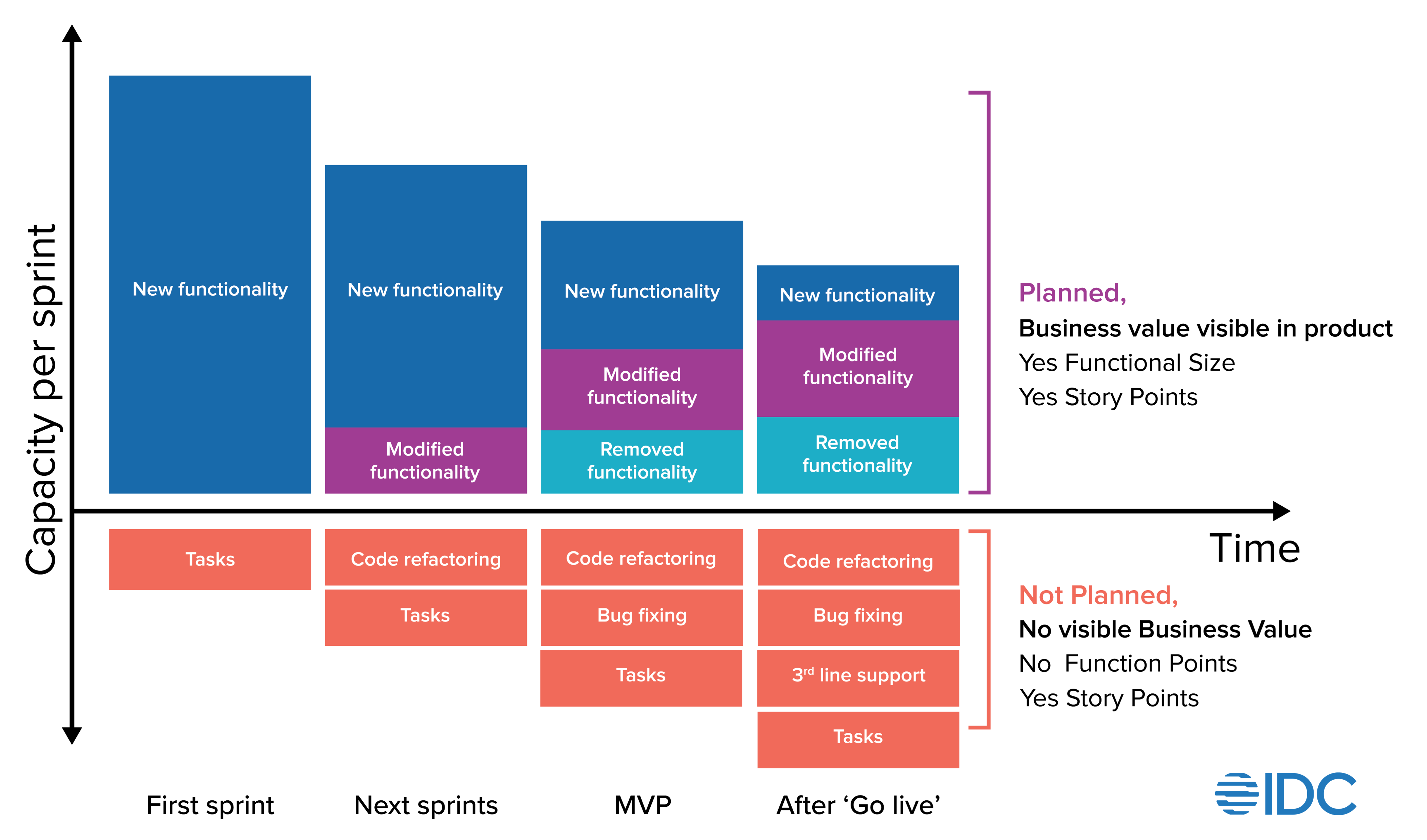
With the Agile framework being structured around sprints (typically two-week cycles of refactoring, back-log attack, development, and just-in-time requirements gathering), Story Points for goals, and velocity (Story Point clearing) for progress, it’s hard for organizations to translate these measures to more traditional measures of progress. A lot of motion and momentum is demonstrated, but how this leads to predictable delivery of capabilities is elusive. To address this, IDC Metri uses a proven methodology for assessing progress and ensuring predictability—automated and enhanced function point analysis (FPA).  

The IDC Metri Agile Value Management (AVM) solution assess a development team’s progress using both enhance and automated function point analysis. FPA delivers a concrete assessment of size delivered (value) and enables comparison of productivity across teams and benchmarking against industry peers. AVM provides management with the progress measurement dashboards for productivity and delivery speed. To measure and assess these, IDC Metri uses the functional output a team has delivered in a certain timeframe, leveraging the NESMA standard of functional size added + changed + deleted. In the case of automatic measurement of functional size, IDC Metri measures according to the ISO 19515 standards of Automated Function Points (AFP), and Enhancement Function Points (EFP). This data is presented in a fashion that allows managers to understand progress to goals and transparency to understand and predict capability delivery.

Quality

Ensuring predictable, or efficient development, only matters if the product being produced is of the quality (stability, security, efficiency, etc.) necessary to meet the business goals. For this reason, it is important to balance performance measures of the team with quality measures of the code. We don’t want measures and goals for performance to have the unintended consequence of driving down quality. 

AVM provides source code analysis. This analysis provides ongoing assessment and trends in team quality over time and highlighting key areas of deficit. With this analysis, an Engineering dashboard is created showing the (critical) violations found, why these are violations, where they are found and how to solve them. The most critical ones are put on an action plan. This data is also presented in easily digestible fashion for managers responsible for managing and ensuring product quality. 

The Engineering dashboards clearly identifies poor code and critical violations (CVEs) allowing the development team to better, and more rapidly, address quality issues. When adopting the guidance from the Engineering dashboard, overall development team practices improve. Quality and performance enhances, due to lower testing efforts, resulting from enhanced coding practices. Also, improving practices and identifying better practices reduces team stress and enables recently onboarded team members to become more rapidly productive.

Cost to Performance

Sourced Agile development projects are typically time and materials (T&M), which shifts budget risk from the sourcing vendor to the buyer. Previously, development projects were typically fixed prices where risk (especially financial) was weighted towards the sourcing vendor. Similarly, even with internal projects, budgeting and cost were more predictable, due to the structure and predictable nature of methodologies like Waterfall. 

AVM, by putting measurable, traceable and consistent metrics around development, helps make cost management and cost efficiency easier and transparent. Also, by providing benchmarking within an organization and against peers, a client has the context to understand the competitive meaning of these assessments (i.e., is my team underperforming in my industry in the cost/performance ratio for development?). Further, by assessing sourcing vendor current performance versus cost, goals can be set and measured consistently, over time, for assessment. AVM, with its combination of market benchmarking for services and concrete performance metrics, benchmarks the sourcing vendor performance against market peers. This enables buyers to determine whether the service capabilities they procured are delivered competitively to other vendors in the market. Furthermore, it gives leverage to the buyer in ensuring that a T&M development contract is performing at a minimum to market peers, i.e., that the buyer is not over-paying for the quality and productivity of the development they receive. 

Supplier Improvement Actions

A client example illustrates this. The client company nearshored application development and maintenance. They were concerned they were paying more than the value they received. IDC Metri performed an AVM assessment demonstrating gaps in value based on the hours (cost) put into the sprints. Productivity was 30% lower and cost 22% higher than market average. Maintenance cost four times the market average. This assessment culminated in supplier improvement actions to comply with performance and product health metrics (with ongoing verification by IDC Metri). 

To rephrase an earlier observation: if you can’t easily measure something, you can’t easily manage it. AVM allows organizations to clearly understand how their Agile development teams (staff or sourced or hybrid) perform and deliver value. It cleanly addresses three key organization struggles around Agile: predictability, quality, and cost. It makes it easy to measure and assess Agile development, which means it enables easier and effective management of Agile. 

Interested in learning more about IDC Metri? Let’s schedule an appointment for an introductory meeting.

The buzzwords frequently used to depict today’s turbulent business landscape—inflation, supply chain woes, recession, rising energy costs and political unrest—paint a cautionary picture for all businesses around the world.  But for small and medium-sized companies, today’s rocky business terrain is particularly concerning.  

Many SMBs do not have a deep well of reserves to sustain their businesses for years during tough economic times. And that makes it critical for them to apply technology smartly and zero in on efficiency, cost savings, productivity and automation—and fast—to weather today’s economic storms.

But what are SMBs grappling with, specifically, from the long list macroeconomic woes circling the globe today? The answer, IDC finds, depends on where an SMB resides. New IDC research into the macroeconomic challenges of SMBs across the globe, unveiled through our BuyerView Cloud Pulse program, illustrates that while SMBs worldwide are dealing with intensified macroeconomic issues, the specific concerns vary greatly by region.

The research is based on a May survey of IT decision makers, developers and line of business cloud influencers at companies that had already, or are planning in the near future, to adopt cloud technologies. Respondents had to prove familiarity of cloud infrastructure and applications and be familiar with their organization’s cloud strategy.  More than half of all respondents—742—were small- to medium-sized businesses with 1-999 employees.

The survey findings show that APAC SMBs are highly concerned about economics such as inflation, exchange rates and low economic growth. North American and European SMBs, meanwhile, rank energy costs as top concerns. Supply chain concerns rank high in North America. While SMBs in Europe and APAC note that the conflict in Ukraine is causing more business and IT supply chain disruptions. And, SMBs in the U.S. and APAC are more likely to be impacted by their customers losing business/sales than SMBs in Western Europe.

Our study also evaluated the impact of COVID-19 across global SMBs and found that while COVID is still impacting SMBs worldwide, the COVID impact is 20 percentage points greater in APAC than other regions as lock-downs prompted APAC SMBs to consider new ways of reaching customers and carrying out work.

By size, smaller SMBs say supply chain issues are leading to a lack of IT equipment/materials. This is likely because the smallest SMBs use fewer cloud technologies and rely on more basic and physical IT, such as laptops, mobile devices, printers and servers. Therefore, the material and hardware shortages are impacting them directly.

SMBs on the larger end report that supply chain disruptions are extending the time it takes to complete IT projects. Larger SMBs are likely using a mix of cloud and on-premise/in-house IT and are suffering directly from supply chain issues, including higher costs and longer delivery times for hardware. But many are also impacted indirectly as major cloud suppliers pass on increased data center energy, hardware component and employee costs to them. A common global thread across all SMBs is inflation. Two-thirds of global SMBs report that they are currently impacted in some way by inflation.

When we asked about the technology improvements and enhancements SMBs made in the 12 months leading up to Q1 of 2022 to boost resiliency, the results showed SMBs lag behind their enterprise counterparts. SMBs ranked behind enterprise businesses in eight of 12 areas where we asked about investments to improve business resiliency. One caveat: a greater percentage of SMBs invested in ecommerce capabilities than enterprise companies, suggesting SMBs are working to meet the wants and needs of today’s more digitally savvy consumers—a trend induced by COVID, and one that we believe is here to stay.

So how can tech suppliers connect with and sell to leery SMBs hamstrung by a range of macroeconomic challenges? They must communicate that now is the time — a time when many SMBs aren’t clamoring for air to keep up with staggering growth — for them to stop and rethink their approach to technologies and boost business resiliency. SMBs should take this unique time to pause and investigate the wide array of technology offerings on the market that can help them be more efficient and productive.

SMBs need to boost resiliency and to move to technologies that will power their businesses for growth — before they get so large that change becomes highly complex, and before they become entrenched with legacy systems and processes that are difficult to replace. The SMBs that take these steps now will weather today’s economic storms—and continue to grow once they pass.

I encourage you to read our research covering macroeconomic challenges at global SMBs. It’s a topic we will monitor closely as the business landscape and headwinds continue to evolve. 

Katie Evans - Sr. Director, Research - IDC

Katie Evans, Senior Director, Worldwide Small Medium Business (SMB) Research Program within the Digital Transformation space. Katie's core research coverage includes identifying and supporting the unique, evolving needs of the Very Small, Small and Medium Business technology buyer. Katie has a strong, SMB-focused research and writing background, having covered SMBs in the retail and ecommerce space for over 12 years. Most recently, her primary coverage area was researching the technology needs of SMB retailers and analyzing the vendor offerings on the market to meet those evolving needs. Katie has also conducted extensive writing and research on mobile and international ecommerce and has authored several custom reports for vendors serving SMBs.

Connectivity is a defining feature of the modern digital economy. The increasing ubiquity of mobile and fixed connectivity has enabled new digital economic models and these had already become part of people’s daily lives before the COVID-19 pandemic made digital interactions unavoidable.

Ubiquity and regular use have turned connectivity into a vital commodity which, paradoxically, telcos find difficult to grow revenues from. This commoditisation has steadily shrunk the value of telco shares over the past five years.

This is driving an industrywide imperative to change as Europe’s multibillion-dollar telecoms market seeks to embrace new technologies (cloud, AI, 5G), new ways of working (agile and DevOps) and new revenue opportunities (B2B and B2B2C). These trends play out against a backdrop of war in Ukraine, high inflation, a race for talent and an increasing need to show a strong commitment to climate change and social issues.

Technology, Services and Customers

Telcos are eager to reinvent themselves as technology companies that can continue to play a vital role in business and consumer communications. This transformation will need to be deep and will need to be made across dimensions such as technology, services and customers.

Technology

  • Between 2021 and 2026 the amount of data created, captured, replicated or consumed in Europe will increase by over 126%, according to IDC’s latest Global Datasphere forecast. Coupled with regulatory obligations, this piles the pressure on European telcos to continue investing heavily in network capacity upgrades throughout the decade to maintain the performance of their core products.
  • This includes the rollout of 5G access networks and increasing their fibre broadband footprints.
  • Investing in capacity alone will only enable telcos to stand still. To improve the management, creation and experience of their services they must also invest in their core network architecture and supporting IT systems.
  • In IDC’s 2022 digital transformation survey of European telcos, 58% cited BSS investment as the most impactful transformation investment to grow revenues. Other investments include modernising systems to be cloud native, converging core networks to support fixed and mobile services, and developing OSS/BSS platforms that support deeper network monetisation and better customer outcomes.

Services

  • We expect FTTP to account for the majority of broadband lines by 2024 and to represent 58% of total lines by the end of 2025. On the mobile side, European operators are currently rolling out coverage of 5G, which will also require heavy investment.
  • We expect 5G to account for the majority of mobile network connections by 2025, reaching 57% of all mobile connections by the end of that year.
  • As telcos’ core networks and IT systems evolve, operators are also keen to explore new business models that expand their role in consumer and business value chains beyond connectivity. Many of these new business models, from private networks to 5G gaming bundles to network as a service, will require partner-driven ecosystems to supercharge and build extensive value multipliers.
  • As such, 40% of large European operators identified integrating partner services into their ecosystem as a crucial impact of an API-driven strategy in IDC’s European Telco Digital Transformation Survey 2022. For these investments to pay off, telcos need to ensure that the APIs they provide are simple enough for developer partners to use and are supported across heterogenous network infrastructures.

Customers

  • While the bulk of telco revenues has traditionally come from consumer services, the commoditisation of connectivity has made it harder to grow revenues by just selling minutes, texts and data volumes. In 5G, operators are looking to grow their place in the enterprise value chain.
  • This means chasing opportunities such as the 83% of European enterprises that use or plan to use IoT technologies in their operations within the next two years. This shift in customer target cannot be successful without fundamental shifts in how telcos operate and strong insights from trusted partners that understand the B2B and B2B2C customer bases operators intend to create value for.
  • As operators look to acquire new segments, they are also fighting across the board to retain the customers they do have. Over 95% of European telcos are investing in AI/ML, and their main use case is improving customer insight.
  • Building deeper customer insights has a dual purpose — keeping customers happier for longer and helping telcos to identify, develop and productise the new value they offer. Those telcos with the deepest insights will be the most successful in the long term.

What’s Next for European Telcos

Success across all aspects of technology, services and customers requires careful balancing of many transformation initiatives. The competition for the financial and talent investment to succeed across the breadth of initiatives is further complicated by the macroeconomic and geopolitical headwinds blowing through Europe.

The underlying message is that Europe’s telcos can no longer afford to stand still. They must invest and improve across all aspects of their network, operations and organisation if they are to revitalise their space in the broader technology landscape.

IDC’s Telco Digital Summit, on November 22, will look at these themes in more detail. The summit will feature Europe’s leading telco analysts and senior telco executives, and will include keynotes from industry leaders to help attendees chart a path through the storms in the European telco market.

Chris Silberberg - Research Manager, Communication Service Provider Operations and Monetization - IDC

Chris Silberberg is Research Manager for IDC's global Communication Service Provider Operations and Monetization research. Chris' core research coverage includes the evolution of telco monetization, customer experience, orchestration, and assurance capabilities. Telcos are at a crossroads, double down as utility providers or become digital service power houses. Both strategies demand communication service providers fundamentally transform their IT capabilities to enable customer first experiences, autonomous operations, and the capacity to innovate monetization models at scale.

Enterprise medical imaging (EMI) is not just a technology. It’s a set of strategies, initiatives, workflows and solutions implemented enterprisewide to consistently and optimally capture, index, manage, store, distribute, view, exchange, analyse and govern all medical imaging data and content across different settings. It’s there to eliminate traditional imaging silos by aligning imaging technology and infrastructure essentials with universal image availability (without silos).

According to an IDC Health Insights survey in February 2022, 38% of European healthcare providers will invest in a new EMI solution in the next two years and 57% will enhance their current solution. These solutions are likely to be:

  • Cloud based. To support enterprise imaging, healthcare systems are opting for secure, always-on cloud storage to improve the continuum of care and respond to patients’ needs:
    • Easier integration with large hospital electronic healthcare records (EHRs)
    • Faster access to images, reports, results and other vital patient information; a cloud-native image management system can be accessible via a web browser or zero footprint viewer, enabling a single source of patient information; clinicians can also follow patient progress regardless of their location
    • Disaster recovery, with cloud solutions automatically replicating data and enabling complete redundancy and access to information 24 x 7
    • High level of security with data encrypted end-to-end to address patient privacy concerns and limit access to personally identifiable information
  • Supported by intelligent automation technologies. Leaders in the EMI space are focusing on scaling and deepening the use of advanced analytics and AI to support new diagnostic imaging techniques, workflow orchestration, pathway management, rule-based automation of repetitive tasks, reporting, etc., to cater to the specific needs of different clinical use cases, driving evidence-based and precision medicine.
  • Paired with fully managed services. Vendors that provide strategic advice, implementation and support services, tailored to customers and to their business and clinical strategic objectives, are more successful and have better customer retention and customer share. EMI platforms provide a unified environment for data and diagnostic capabilities, but to effectively deploy it, healthcare organisations need to partner with vendors that understand how their medical imaging capabilities are maturing within the organisation’s broader digital strategy. Healthcare providers are also looking for vendors to provide predictive support services to ensure business continuity and dynamically optimise systems.

What’s Driving the EMI Market?

Simply put, it’s the need to navigate away from siloed care and move towards a more integrated care delivery model. In the past few years, healthcare organisations have increasingly relied on their ability to gather, store and analyse massive amounts of data to provide better quality care and operational efficiency. The pandemic has increased the need for imaging and, more importantly, shown that managing complex on-premises infrastructures drastically reduces the agility of already strained IT departments.

As value-based care becomes the norm, healthcare providers are focusing on a data integration strategy to take full advantage of their data. However, this happens only when data, including images, follows the patient throughout the care journey and is easily consumed at the point of care. As healthcare imaging data continues to expand, organisations need technologies that connect data silos and support the entire enterprise.

The Way Forward

To maximise the value of their investments in enterprise imaging, healthcare providers should:

  • Develop an imaging strategy that fits with a “care anywhere” model to ensure the continuum of care to patients
  • Involve healthcare professionals early on and continue to keep them engaged in the implementation and governance of the platform
  • Select an imaging IT vendor that works as a partner to align its value proposition to customers’ goals, as well as constraints, with products and services that offer value for money

To learn more about the EMI market in Europe, please read IDC MarketScape: European Enterprise Medical Imaging 2022 Vendor Assessment or contact Adriana Allocato and Silvia Piai at IDC Health Insights.

Key Takeaways for IT Vendors

Globally, the risk of a consumer-led recession is increasing as central banks increase interest rates to control inflation. Most economists are coalescing around an expected slowdown in 2023, and a lot will depend upon monitory policy and wildcard events. IDC’s recent poll of 100 CIOs globally indicated that 79% expected a recession[VG1]  in their countries or in important buyer countries next year. The majority of them expect it to be a mild or moderate one and not a deep recession.

Inflationary pressure, geopolitical tensions, supply chain disruptions, increasing IT skills shortages, and weakening local currencies all contribute to what IDC refers to as “Storms of Disruption”. Inflation is a significant pain point for Asia Pacific excluding Japan and China (APeJC) economies. Central banks of all major regional economies, namely South Korea, Philippines, Malaysia, Thailand, India, New Zealand, and Australia have increased interest rates in July and August 2022.

Emerging markets face a more pessimistic economic outlook with currency devaluations against the US dollar, making imports costlier. This is a double whammy for countries that import oil and food as weakened local currency means higher imported inflation.

Many APeJC economies were hit due to lockdowns in China, their largest trading partner. Hope is that the Chinese government stimulus will help enterprises, and thus the economy, recover. IDC assumes that the Chinese economy will stabilize and return to growth in 2023. However, the pace of recovery is doubtful with the global economy cooling.

Japan is an interesting case as it is doing the opposite of what the world is doing. The Bank of Japan (BoJ) is not increasing interest rates like other developed economies, thus resulting in a weak Yen, which will impact corporate earnings. Inflation has increased, primarily driven by energy and fresh food prices. The underlying inflation pressures are much softer than in other developed economies, and BoJ predicts inflation to moderate in 2023. There is also an increased risk of rising covid cases.

IDC’s latest survey, Future Enterprise Resiliency & Spending 22 Survey, Wave 3, reveals that IT leaders in APeJC are concerned about inflation (45%) and timely access to products/services due to supply chain disruptions (47%). Chinese IT leaders are increasingly worried about staffing and labor shortages (56%), whereas IT cost increases stemming from inflation (48%) and COVID-related restrictions (46%) are leading concerns of Japanese IT leaders.

IT leaders have started reporting increasing difficulties in filling up vacancies both in line of business and in IT. They have either upskilled existing IT staff or engaged a third-party service provider to resource for the most important technology initiatives. Most IT leaders in the region report extreme difficulty in filling up positions for data management professionals, data scientists/data analysts, followed by software developers and networking engineers.

While the US is “technically” in a recession with a second straight quarterly contraction, Europe is forecasting it to happen in the next six months. APeJC GDP continues to grow in 2022 but at lower levels than predicted earlier. Interestingly, APeJC IT spending growth is holding up well in 2022, with a dip expected in 2023.

Consumer IT spending (related to consumer purchase of mobiles, tablets, PC’s, wearables, and peripherals) slowed in the first half of 2022 because many device purchases have already happened in the last two years to enable WFH or online classes. We expect this to decline further this year and next year.

Enterprise IT spending has been stable  as businesses continue to protect IT budgets in the short term. Operational budgets account for a larger share of overall spending (cloud, subscription, as a service) and are difficult to pull back at short notice. Cloud spends are still expected to grow strong due to a marked shift from capex to opex operating model.

Expectations are that some capital spending and investments in new projects are vulnerable because the focus will shift to keeping the lights on rather than putting money on new initiatives. Again, the willingness and ability to increase IT budgets in line with rising prices, either due to inflation or currency devaluations, is more uncertain today.

IDC’s survey, Future Enterprise Resiliency & Spending 22 Survey Wave 6, indicates that there are no signs of significant cuts to IT budgets or strategies yet. Instead, businesses are exploring ways of maintaining projects within constraints of existing budgets, which already include planned increases driven by digital transformation and cloud deployments. Enterprises in China have seen their budgets drop due to a decline in economic activity.

However, in this story, regional enterprises are still focused on bringing operational efficiency and business resiliency. Investments in digital infrastructure resiliency programs appear at the top of their priority list. This will involve investments in computing, storage, and network infrastructure and automation across data centers, public clouds, and edge locations to create more responsive, scalable, and resilient platforms for enabling digital business.

To sum up, below are the key takeaways:

  1. Consumer technology spending hit, expect further declines, followed by reductions in early-stage speculative enterprise projects and capital spending.
  2. Cloud spends to stay strong as businesses focus on achieving increased business agility and cost optimization post-COVID. However, some spending still correlates with employment so job cuts may negatively impact cloud spending. Employment statistics of enterprises will be an early indicator of any future impact on cloud spending.
  3. Expect greater scrutiny on technology investments, especially as technology begins to represent a growing portion of spend. Technology investment will increasingly be to support sustainable business growth, and vendor messaging must give it due importance. In short, technology spending will be more strategic.
  4. Local currency devaluations will negatively impact enterprises’ IT budgets, with imports becoming costly.
  5. Increasing IT skill availability gap, enterprises turn to third-party service providers to bridge the talent gap.

Understanding the impact of a global recession is essential for market intelligence, strategy, and marketing teams to understand evolving market size, competitor strengths and weaknesses, and optimal pricing approaches. The Black Book Live program serves as the essential tool for these tech supplier teams seeking to map demand for global, regional, and local markets around the world. The Live edition of the Black Book is published monthly and reflects the current optimistic scenario for tech markets. An alternate global IT market view reflecting the latest economic assumptions and indicators across 89 countries, alongside country-level analysis of impact on ICT pricing and demand is also available on request.

For more insights, watch our on-demand webinar: State of the Market – IT Spending & Recession Impact by Industry, click here.


FUTURE ENTERPRISE RESILENCY & SPENDING 22 Survey wave 3: Q5. Overall Impact – Which of the following do you expect will have the greatest impact on your IT spending plans for the rest of 2022?

FUTURE ENTERPRISE RESILENCY & SPENDING 22 Survey wave 6: Q6C. Compared to your organization’s originally budgeted IT spending levels for 2022, how will current disruptions affect your organization’s most likely final IT spending levels for all of 2022?

Vinay Gupta - Senior Research Director - IDC

Vinay Gupta is a Research Director for IT Spending Guides in Customer Insights & Analysis group. Based out of Bangalore, he is responsible for supporting the growth of spending guides across Asia Pacific excluding Japan and China, leading the spending guide team, working with country teams, sales teams and tracker teams. Vinay has close to fifteen years of industry experience where he has helped enterprises and IT vendors with actionable insights through his research focused on analyzing the ICT market in areas of market sizing, market trends and forecasts, and IT vendor rankings. In his role at Ovum, his focus was on building tools that IT vendors use to target accounts, identify customers and prospects, understand accounts in granular detail, and focus sales budgets on the correct prospect thereby improving bottom-line of vendors. He started his career working with Mahindra & Mahindra moving on to 3dPLM Software Solutions (a JV of Dassault Systemes) where his focus area was vehicle integration and later product life-cycle management. During his tenure there he also interacted with end users to identify their needs and help design better processes which would adapt changing customer needs.

As more healthcare providers, systems and supporting organizations embrace the ever-evolving healthcare landscape and recognize that value-based care is the cornerstone for higher quality and lower cost care, the discrepancies in infrastructure and technology needs versus current state are becoming more apparent.

With a multitude of stakeholders, lack of interoperability and data transparency, increases in administrative burden on providers and the challenge of delivering individualized care to all patients, knowing where to start is often the most daunting challenge. Add to this, Centers for Medicare and Medicaid Services (CMS) regulations including price transparency and interoperability standards, which are the foundations and minimal necessary requirements for a value-based care infrastructure, and the evolving landscape becomes disjointed and complex.

As you peel back the layers of the variables influencing success in a value-based care model, all roads eventually lead back to data. IDC report Healthcare Industry Journey Toward the Intelligent Enterprise (#US48354021, Nov 2021) shared that 70% of healthcare organizations aspire to be a data driven organization yet only 18% of providers are using data to drive decisions.

Making Data Meaningful: Quality over Quantity

Being data-driven is not a new concept in healthcare. However, never have healthcare organizations had so many success metrics (i.e., accurate patient risk scoring, emergency room and inpatient admission reductions, enhanced chronic disease management) tied directly to the ability to access comprehensive, dependable, and actionable data.

What does this opportunity mean? It means that to accomplish the goal of high-quality, low-cost care delivery, we must be honest about limitations in the current environment and be realistic when exploring solutions.

The creation of meaningful data is the tipping point for many. However, to fully leverage and optimize this strategy, analyzing the end-to-end process is also vital. Recognizing data driven opportunities is the first step. Understanding how to engage stakeholders, operationalize sustainable change and create a new normal will eventually separate the good from the great.

As we noted in Data Disparity: The First of Many Challenges in the Value-Based Healthcare Environment” (IDC #US49572922, publishing forthcoming), success in a value-based care model is heavily influenced by the ability of the organization to support ongoing, comprehensive data analytics that drive performance vulnerabilities and areas of opportunity. Without sufficient resources and tools, organizational financial health and quality of healthcare delivery are at risk.

To face this challenge, organizations must be aware of current internal limitations, drivers of past successes and failures and the potential gains associated with investment in a technology solution and infrastructure design that facilities the evolution of disparate data into actionable, meaningful insights.

Advice for the Technology Buyer

  • Create data confidence throughout the ingestion, curation and cleansing processes needed for a longitudinal, 360 patient view
  • Understand retrospective versus real-time data use cases that are imperative to success strategies
  • Ensure scalability to match needs
  • Prioritize end user(s) experience
  • Assess use/availability of benchmarks and KPIs
  • Ensure expertise for all stages of technology adoption/use

Organizations ready to strategically plan and execute value-based care initiatives will find themselves at the center of this new healthcare ecosystem and ready to address the evolving needs and wants of healthcare providers and consumers.  Don’t let data disparity challenges stand in the way of creating a data driven and successful pathway for patients, providers and healthcare organizations.

Infographic-Health-Insight

Jennifer Eaton - Research Director - IDC

Jennifer Eaton RN, MSN, CCDS, CRCR Research Director, Value Based Healthcare IT Transformation Strategies. Jennifer Eaton is Research Director for Value Based Healthcare IT Transformation Strategies. Her core research coverage includes the use of cognitive/AI technologies to advance digital transformation in healthcare, particularly relate to value-based health, the intelligent healthcare enterprise and industry ecosystem. Previously, Jennifer served as Executive Director of Advisory services for a physician lead company with an emphasis on value-based healthcare initiatives such as provider/patient collaboration, optimization of technology, infrastructure to support scale, risk mitigation and reimbursement accuracy. Prior to this role, she had the pleasure of starting her professional career 20 years ago at Ochsner Health System in LA as an RN in the PICU and later as a member of the HIM/CDI leadership team.

As an emerging tech vendor, you know that it can be a struggle to use content marketing to create brand awareness. Researching and creating a compelling piece that will get the attention of your target audience takes a lot of research and time. Fortunately, there is an easy way to satisfy the need for content your audience craves: third-party content.

Third-party content is a form of content creation that exists in working with a credible, external source that will prepare a piece of thought-leadership for you. Let’s have a look at the advantages of third-party content and how to best use it.

Build Trust with Third-Party Content

Working with a well-known, established partner will not only give you ready-made content, but will also help build trust in your brand’s expertise, expand your reach, and raise awareness in a noisy market.

Did you know that on average, tech buyers download six pieces of content throughout the tech purchase process? With an increasing number of content and channels to choose from, they naturally prefer content from a trusted, well-known source. In fact, as many as 95% of tech buyers recommend vendors add more insight from industry thought leaders and analysts to improve their content.

Working with an established source like an analyst can create a piece of thought-leadership that elevates your brand’s position in the market and builds a foundation of trust and credibility.

Prepare, Prepare, Prepare

Third-party partners will work with you to create content that is closely aligned with your marketing objectives. To get the best out of your new content piece, you must do your homework before briefing your partner.

  • Which topic and keywords resonate most with your audience?
  • Which style of research will best serve you?
  • What’s the most compelling visualization that should accompany the piece of content?

Remember that you should keep in touch with your third-party representative during the creation of the piece. If your external partner has dedicated Success Managers, they will ensure you will have guidance from preparation to implementation.

Share

You might be tempted to take your new piece of content and publish it on all your marketing channels. This could lead to a spike in interest for your company. But it could also be the wrong channel for the message you are sending or even the wrong time (holiday season, anyone?).

We recommend you keep these tips in mind when marketing your third-party piece:

Strategy: don’t use your content at the same time on every channel. You could start by publishing it on your website and social media, use it in a blog post in the following months, then refer to it in a digital discussion on LinkedIn. The possibilities are endless. Our new eBook includes a handy checklist for your next marketing campaign.

Be Insightful

When you share your third-party content, you don’t want to simply post the content and add a generic message like “Good read!”.

Instead, you want to personalize your message to your audience and tell them why this is compelling information for them, and what the net gains from reading are. We are all busy and suffering from content overload and adding this bit of information makes you stand out from the crowd.

Avoid Marketing Pitfalls

With a little bit of savvy marketing, a great piece of third-party content will create awareness and credibility. But failing to establish some details before the launch of your campaign will quickly lead to a loss of ROI.

Make sure you

  • Are clear about your KPIs. What does success look like for this campaign? And for your company?
  • Be clear about your digital strategy and develop a concise marketing plan.
  • Track your success and refine constantly.

If you find these insights helpful and are looking for a partner, we might have the solution. IDC’s Thought Leadership Analyst Brief provides leading-edge third-party quality content that elevates your brand image and associates your company with emerging technology trends, driving your global media coverage and market awareness, and re-defining your client dialogue.

This year, the UNHCR announced that the number of people forcibly displaced exceeded 100 million globally for the first time on record. This means 1 in every 78 people has been forced to flee their homes. The number of people displaced, internally or externally, from weather-related disasters, famine and unemployment is also rising. The Institute for Economics and Peace (IEP) estimates that there could be 1.2 billion climate refugees by 2050.

A proactive approach is needed to help manage this perennial challenge and to improve the lives of refugees. Or, in the words of the Mayor of Warsaw, Poland, “it is time we phased out improvisation and instead created a strategy for coping and appropriate systems for helping refugees.”

To create more effective and empathetic systems for refugees, governments and their partners should consider taking a life-event approach. The life-event approach to digital service delivery includes bringing a range of services together to coincide with a particular event, such as a birth, marriage, and death. Rather than people having to reach out to a variety of agencies to access different services, governments can integrate information and resources to provide these services in a more seamless way.

More mature approaches also include service coordination and data exchange across agencies as well as with private sector and civil society organisations.

Some governments, including the US Federal Government, have started to take a life event approach to disaster response, from floods to wildfires. These sudden and unplanned life events require citizens and residents to access services from several agencies and require a more empathetic and personalised approach.

The same can be applied to the arrival of a refugee. When refugees arrive in a new country, they generally need to register for residency and digital identity, whether through the government or an NGO, and need immediate access to food, cash programs, and shelter. These short-term needs then morph into longer terms needs, including accessing healthcare services, education, and the labour market.

Taking a life event approach and bundling these services together can help to make often bureaucratic systems and services easier to navigate. This is even more important for vulnerable populations in a time of need and uncertainty. It can also improve efficiency, save time, and reduce costs for government agencies.

For example, in New Zealand, the government created SmartStart, a cross-agency online service to help parents navigate government services around the birth of a child. In its first year, the service resulted in 6,000 fewer visits to the Ministry of Social Development and has been well received by parents, midwives, and NGOs.

However, this should not be seen as a replacement for face-face support when needed. Some groups of refugees, such as unaccompanied minors or people with cognitive or physical disabilities, may require additional specialised and hands-on support from governments and NGOs

Source: IDC 2022

The Government of Portugal is leading the way in providing joined-up services for refugees. The Borders and Immigration Service has set up the Temporary Protection Regime for Ukrainian refugees. When Ukrainian refugees register through the online portal or in person, they receive identity numbers from key agencies including a tax identification number, social security identification number, and a national health service user number so that they can access key services.

Providing integrated services organised around planned or sudden lifetime events comes with its own challenges. It requires governments to set up the right governance mechanisms to collaborate across departments, share data in a secure and trusted way, and share budgets to enable integrated service delivery.

This is no small feat and requires a strategic approach and strong leadership, but there are examples of governments successfully overcoming these barriers.
National and local governments and international institutions looking to improve the lives and livelihoods of refugees should embrace this approach.

Leveraging technology for humanitarian purposes — HumTech — will require the right political motivation and leadership to turn refugee management from an ad hoc response to a crisis to a more systematic response to a perennial challenge.

For more information about technology and it’s impact on refugees:

To explore more of our coverage, please visit our Government Insights page.

Get in touch:

To learn more about Blockchain, Cryptocurrencies, NFTs and Web 3, how they are intertwined, and strategies to utilize these technologies for opportunities, read IDC’s new eBook, Blockchain, Crypto, NFTs, and Web3.

Web3 is no longer a hypothetical evolution of the current Web2.0, it is already taking shape and becoming reality as you read this. IDC defines Web3 as a collection of open technologies and protocols, including Blockchain (as Crypto and NFTs), that support the natively trusted use of decentralized data, knowledge, and value. In other words: Web3 will be built on a foundation of Crypto and NFTs, to equitably exchange value—both as currency and as content—between the creators of that content, the platforms which will host that content, and the end consumers of that content.

But what do we mean by “content”? Today, “content” is more than just someone’s cat pictures and cooking videos. In IDC’s definition, content is any and all data being shared from one entity to another: this can include cat pictures (which as we all know is the bedrock of social media), third party apps (such as games, i.e., what the original FarmVille had been), videos, music, stories, update posts, and similar. But it is also much, much more: data which is captured by content platforms every time a user watches a video, or “likes” a post, or spends a few seconds longer lingering on particular images, can be classified as content, as that user’s input, however minute, directly impacts the algorithms which determine what content will be shown more (or less) to other users with similar profiles.

All of this data has value from a business intelligence perspective, and therefore also monetary value, as this data, in Web3, will be more easily captured, stored, sorted, and repackaged as a marketable product, by utilizing NFTs (Non-Fungible Token). A single user’s entire Web history can be captured and stored, securely, on an NFT—a sort of long-term file of every uploaded picture, video, message, comment, click, like, view, and more—while on various pages and content platforms on the Web. In the ideal, utopian vision of Web3, that individual user would have total command and control over that data, stored in their NFT.

What is revolutionary is that through the use of NFTs, all this data and content can now be accurately and equitably tracked. The user actually creating content—whether it is a single person “liking” an image or a third-party app developer creating a game—can track and own their content, on an NFT. Now, if that content can be tracked, it means it can be purposefully exchanged for value. That value can range from a monetary renumeration (i.e., pay $4.99 a month to play the game, or pay $0.0001 for every “click” on social media platform) or access to benefits or perks (i.e., receive permission to access some of the user data from users playing your game, or gain access to VIP social media groups if you spend enough time engaging with posts, etc.). The critical factor is that by tracking all this in a secure, immutable, traceable, and unique record—an NFT—businesses can now offer to exchange value for that content and data.

THE DATA MARKETPLACE

Now that a business, such as a social media/content platform, can offer users monetary compensation (or special rights or access) in exchange for the right to use some, or all, of their content and data, it becomes much more appealing for users to willingly share their content and data. With an increase in user data, willingly shared by users, social media/content platforms can now repackage that data, and sell it on data marketplaces.

For example: A large fashion designer (i.e., LVMH) is planning their Spring catalogue for next year. They would like to know what are the hot trends that their target demographic are talking about or looking at this summer. So they go to a data marketplace, and place an open offer to buy a data set outlining what images or videos their target demographic have viewed. Let us say: people between the age of 22-30, living in major metropolitan areas (10+ million urban population), in the countries in which this fashion designer has stores, who viewed videos or pictures of clothing, during the summer months. The data, being packaged and sold (with permission of the users creating that data) in the data marketplace by either a social media platform (i.e., Facebook/Meta), a video content platform (i.e., TikTok or YouTube), or picture content platform (i.e., Instagram), can be priced fairly (with bid / ask pricing) and purchased by the fashion designer. Now, the data may bear out that videos and images featuring purple polka-dots get the most likes and views, and is trending higher and higher through the summer—leading them design a new product line for their spring catalogue with the soon to be hottest fashion of purple polka-dots.

CHANGING THE WAY BUSINESSES DO BUSINESS

In the above scenario, every participant is equitably compensated for their contribution, however small it may be (i.e., a “click” or “like” on an image), through the entire value creation process. The user has retained the right to sell their data/content, the platform company is being compensated for providing the content hosting platform and gathering and packaging the data, and the buyer of the data set (here, the fashion designer) is gaining value from having the most accurate and insightful data available to plan their business strategy. The foundational technology that allows for this accurate, secure, immutable, traceable, and unique record—and the ability to assign equitable value and compensation—is the NFT, and the underlying technology of the blockchain. Additionally, the rise in use of NFTs will coincide with the rise in use of cryptocurrencies. Forgive the pun, but NFTs are essentially the “other side of the coin” of cryptocurrencies. Cryptocurrencies permit the decentralized and secure exchange of digital value, whereas NFTs permit the decentralized and secure exchange of digital content.

Expect to see a rapid rise in the use of NFTs (beyond the hype of NFT art, which is an interesting proof of concept use case for NFTs), as businesses realize that any digital information—from cat pictures to music to pharmaceutical drug formulations—can be securely recorded and exchanged on an NFT. As NFTs rise, thus will cryptocurrencies, as the logical (and easier to use) exchange of digital value for digital content. To learn more about Blockchain, Cryptocurrencies, NFTs and Web 3, how they are intertwined, and strategies to utilize these technologies for opportunities, read IDC’s new eBook, Blockchain, Crypto, NFTs, and Web3. Click the button below to download the free eBook.