“We’d rather disrupt ourselves first before we get disrupted.” –Gayatri Narayan, Senior Vice President, Digital Products and Services, PepsiCo.

While some enterprises, such as PepsiCo, recognize the competitive imperative when it comes to digital innovation – the ability to develop innovative products and services that differentiate their business, create competitive advantage, or disrupt the market – many are falling short.

Why should organizations care about digital innovation? Revenue, for one thing. Digital represents a major source of revenue for organizations, as illustrated below.

However, there’s a difference between digital products and services and innovative digital products and services (for more, see IDC’s blog, There’s Digital… And Then There’s Digital Innovation). In fact, IDC is predicting that by 2026, enterprises that successfully deliver on digital innovation initiatives will derive a quarter or more of their revenue from digital products and services.

We asked organizations about their investment in innovation and their spending on maintenance during the pandemic period (2020 and 2021), currently (2022), as well as their planned investment in the next two years. What we found is that we’ve already reached a tipping point in North America. During the pandemic investment tipped towards innovation, with enterprises telling us that they were already spending more of their technology spend on innovation versus maintenance. That will continue to tick up in the next couple of years.

If the revenue potential is so great, and enterprises are already investing, why isn’t everyone successful? Well, because it’s hard. As IDC’s research has identified, there are several areas where enterprises are struggling, and areas where they can learn from the examples set by digital-native companies – younger organizations founded around digital products or services that typically don’t have technical or organizational debt and are more comfortable accepting risk.

What makes Ms. Narayan’s quote so powerful is that it reflects a recognition of – and willingness to accept – risk, which is typically a prerequisite to developing and delivering digital innovation. Many organizations are not willing to accept that risk, or don’t have the expertise to help mitigate it. For technology suppliers, this presents a real opportunity to help their customers recognize that, like it or not, disruption is coming and then provide the tools and expertise necessary to reduce the risks involved with being the disruptor rather than the disrupted.

Enterprises Need to be More Deliberate About Digital Innovation

Most organizations are used to buying and customizing software. Delivering innovative digital products and services, however, requires expertise in generating innovative ideas, developing software, scaling that software and continually iterating on it. When we asked both enterprises and digital natives about their innovation programs or initiatives, we found that, almost across the board, digital native companies are much more likely to adopt various types of programs and initiatives designed to spur and maintain innovation.

What is particularly telling is that 41% of the enterprises said that they were not adopting any of the innovation programs we asked about. In stark contrast, only 1% of the digital natives answered the same way. And, while there is no standard set of activities that enterprises should adopt, doing nothing will certainly not generate innovative digital products or services.

What are digital native organizations doing differently? Well, at a basic level, things like entrepreneurship programs, beta programs, and hackathons are indicative of cultures that foster innovation. These are things that digital natives are doing much more commonly than enterprises.

Enterprises Must Reduce Dependence on One or Two Technologies. According to our survey data, digital natives are nearly twice as likely as enterprises to use platform services and buy from cloud marketplaces.

Enterprises concentrate on just a couple of approaches for acquiring software to support software innovation projects – buying commercial software and customizing it or just building custom software. Digital native companies, on the other hand, employ a variety of technologies, which suggests that they are good at matching the technology with the job. And, they’re willing to accept the risk of adopting new technologies, recognizing that it may increase complexity, but that there are also ways to mitigate that complexity.

When we asked enterprises and digital natives to look ahead to the next two years, we found convergence between the two groups. Enterprises expect to move away from their dependance on one or two things and source their software from many different places and many different types of technologies.

Perhaps most interestingly, the top response (buying software or services from a cloud marketplace) and the bottom response (developing software internally) are the same for the two groups. It’s not that either type of organization is less interested in developing custom software; it’s more a recognition of some of the challenges of increasing development of custom software, such as skills shortages.

Again, there are take-aways for technology vendors:

  • Make sure you are available where your enterprise customers are going to want to buy your products and services. For instance, make your offering available in cloud marketplaces because enterprises expect to buy a lot more from cloud marketplaces.
  • As enterprises change their approaches to support digital innovation, they will inevitably face more complexity. Vendors should consider how they can help customers manage that complexity.

Enterprises Must Evolve their Sourcing Strategies

When asked to describe their sourcing strategies, enterprises identified senior leadership mandates as their top answer. Digital natives, on the other hand, said that engineering management makes sourcing decisions on case-by-case bases.

Neither answer is great. Ultimately, organizations should develop sourcing strategies through collaboration between technology and business leaders, and those strategies should be strategic rather than tactical.

Technology vendors should think about how they can guide enterprises toward more mature sourcing strategies.

Enterprises Need Help Making Data-Driven Decisions

We found that the cloud native organizations are much more likely to track KPIs closely. Why? It has much to do with the kinds of tools they are using to track software projects against business KPIs. Digital natives are far more likely to be employing these tools to track KPIs. In contrast, nearly 80% of the enterprises that we surveyed indicated that they were not using any of the tools we asked about to track KPIs.

It’s not that enterprise aren’t tracking KPIs – they are – but they’re doing it manually (using spreadsheets, for instance) and that’s not a recipe for accuracy or success. Technology suppliers that can step in with tools to help track important KPIs related to digital initiatives can capitalize on the opportunity.

Evolving the Business Model to Outcomes as a Service

What is an outcomes-as-a-service model? It’s a focus on selling a desired outcome (improved performance, reduced costs, etc.) not just a product or service. This is a bit forward looking… but, it is worth thinking about, particularly as more digital native companies pivot to this model.

A good example of this approach is Jotun, a company that sells paint that inhibits growth of barnacles and other substances on the hulls of ships, slowing down the vessels. Shifting the focus from the product (paint) to the outcome (improved efficiency), the paint manufacturer uses data analytics to illustrate how the improved condition of the hull reduces fuel costs and mitigates environmental impact. It now offers a guarantee – if its paint doesn’t produce the expected outcome in terms of reduced fuel costs and environmental impact, the customer receives a refund.

Even for digital natives, this is new – only 4% said that they have already sold an outcome, but 39% indicated that they are working on it… and that is significant.

Learn more about IDC’s Future of Digital Innovation research in our upcoming webinar, Digital Innovation: The Enterprise Journey to Maturity, on May 12.

Nancy Gohring - Senior Research Director, AI - IDC

Nancy Gohring is a senior research director, co-leading IDC's GenAI and Agentic AI Strategies program. Nancy covers big picture trends related to enterprise adoption of AI, including GenAI and agentic AI. Key research themes include business, organizational, and technology architecture transformation, in the context of AI and GenAI. As part of the Worldwide AI, Automation, Data & Analytics Research practice, Nancy supports a range of clients across the technology stack including hyperscalers, developer tool providers, enterprise application vendors, professional services organizations, automation frameworks providers, and infrastructure suppliers.

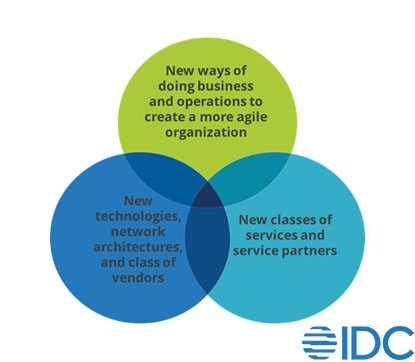
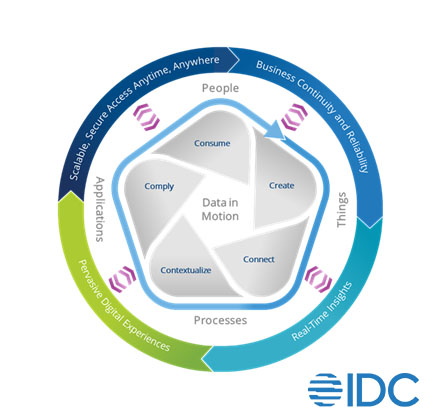
Over the last 12-plus months, one of the major topics here at IDC has been the future of connectivity. IDC’s Future of Connectedness is an evolving framework of technologies, operational goals and business outcomes that transform the way enterprises use connectivity to improve business agility.  Investment in connectivity accelerated partially from business continuity requirements during Covid-19 and partially driven by businesses’ desires to take advantage of new digital tools that could improve their operations and increase revenues and profitability. Here at IDC, we look at the elements of the future of connectivity as illustrated below.

Telecommunication service providers, where I spend most of my time doing research, are at an interesting place when it comes to the future of connectivity. Telco transformation, as I covered in a recent report The Future of Connectedness: How Telecom Operators Need to Transform to Remain Relevant, is very similar to that of the broader business segment’s digital transformation.

Telco service providers are enterprises, consuming communication services and technologies internally while supplying communication services and technologies externally. The issues and drivers of future connectivity impact telco’s internal communications and processes and guide telco decisions on the future of their external communication networks. The figure below shows the three areas telcos are transforming themselves in their quest for relevance.

  • New ways of doing business: Telco service providers need to change their internal processes to deal with increased network and service complexities, while also improving their customer relationship tools. This includes the adoption of collaboration and data intelligence tools that help connect employees, customers-and-partners; increase productivity and data sharing; and help eliminate LOB silos (in particular, between the business/marketing and IT). Also, the adoption of artificial intelligence/machine learning (AI/ML) technologies will help providers better predict outcomes and accelerate decision making around streamlining operations and limiting the possibilities of human errors.
  • New technologies, network architectures, and class of vendors: Telecom service providers are deploying new networks like 5G or trialing new architectures, such as OpenRAN, implementing the principles of software-defined networks, and migrating network functions to cloud providers to lower the operational costs and create network platforms to support new types of services. A large portion of this transformation has taken traditional purpose-built network appliances and moved them into virtualized and cloud-native environments. Essentially, this is turning network hardware into software. This network evolution gives telco service providers increased service agility and has opened the way for new vendor partnerships.
  • New classes of services and service partners: Ultimately, telco transformation is about remaining relevant to the business end user. This requires the ability to offer new services that increase the value of the telco’s underlying connectivity service and enhance the telco’s role as a transformation partner to the business community. Not all of this can be achieved solely by the telco operator. This requires new partnerships with companies that have different industry vertical and technology expertise to deliver new services. Of three areas of changes, offering new services can be the most difficult and the longest to achieve.

These three areas are interdependent. Delivering new services that will help keep telcos relevant to their customers requires coordinated effort. Telcos cannot not offer new digital services without the proper investments in their networks and their internal business processes. IDC just published its first forecast on 5G network slicing which provides an example of the challenges facing telcos when it comes to transforming themselves to offer new types of connectivity services.

5G network slicing, part of the 3GPP standards developed for 5G, allows for the creation of multiple virtual networks across a single network infrastructure, allowing enterprises to connect with guaranteed low latency. Using principles behind software-defined network and network virtualization, slicing allows the mobile operator to provide differentiated network experience for different sets of end users. For example, one network slice could be configured to support low latency, while another slice is configured for high download speeds. Both slices would run across the same underlying network infrastructure, including base stations, transport network, and core network.

Network slicing differs from private mobile networks, in that network slicing runs on the public wide area network. Private mobile networks, even when offered by the mobile operator, use infrastructure and spectrum dedicated to the end user to isolate the customer’s traffic from other users.

5G network slicing is a perfect candidate for future business connectivity needs. Slicing provides a differentiated network experience that can better match the customers performance requirements than traditional mobile broadband. Until now, there has been limited mobile network performance customization outside of speeds. 5G network slicing is a good example of telco service offerings that meet future of connectivity requirements. However, 5G network slicing also highlights the challenges mobile operators face with transformation in their pursuit of remaining relevant.

For 5G slicing to have broad commercial availability, and to provide a variety of performance options, several things need to happen first.

  • Operators need to deploy 5G Standalone (SA) using the new 5G mobile core network. Currently most operators use the 5G non-standalone (NSA) architecture that relies on the LTE mobile core. It might be the end of 2023 before the majority of commercial 5G networks are using the SA mode.
  • Spectrum is another hurdle that must be overcome. Operators still make most of their revenue from consumers, and do not want to compromise the consumer experience when they start offering network slicing. This means operators need more spectrum. In the U.S., among the three major mobile operators, only T-Mobile currently has a nationwide 5G mid-band spectrum deployment. AT&T and Verizon are currently deploying in mid-band, but that will not be completed until 2023.
  • 5G slicing also requires changes to the operator’s business and operational support systems (BSS/OSS). Current BSS/OSS solutions were not designed to support the increased parameters those systems were designed to support.
  • And finally, mobile operators still need to create the business propositions around commercial slicing services. Mobile operators need to educate businesses on the benefits of slicing and how slicing supports their different connectivity requirements. This could involve mobile operators developing industry specific partnerships to reach different business segments. All these things take time to be put into place.

Because of the enormity of the tasks needed to make 5G network slicing a commercial success, IDC currently has a very conservative outlook for this service through 2026. IDC believes it will be 2023 until there is general commercial availability of 5G network slicing. The exception is China, which is expected to have some commercial offerings in 2022 as it has the most mature 5G market. Even then, it will take until 2025 before global revenues from slicing exceeds a billion U.S. dollars. In 2026 IDC forecasts slicing revenues will be approximately $3.2 billion. However, over 80% of those revenues will come out of China.

Now this should not discourage mobile operators from investing in 5G network slicing. It can still play a role in helping businesses meet their future connectivity and digital transformation goals. It will, however, take several years for the slicing to mature and become a significant source of revenues for mobile operators.

Visit idc.com/FoX to learn more about IDC’s Future of Connectedness research.

Today’s experience economy is largely focused on utilitarian dimensions of customer experience – factors like simplicity, speed, and convenience. However, this is table stakes, and customers have come to expect these as a necessity to even do business. In the digital-first world, attracting, and crucially holding the attention of the future customer will require brands to differentiate on the human element of customer experience.

Shifts caused by Industry 4.0 have vastly altered customer expectations throughout the last few years which was greatly accelerated by the pandemic. The three areas that will impact customers’ perception of experience are:

  1. The rise of intelligent context. With an explosion of data, customer expectations are experiences that are specific and contextual to their needs.
  2. The age of experiences. Every element of customer engagement from the content or frequency to the choice of channel informs the whole experience; dissolution of channel boundaries requires organizations to bring fluidity to experiences.
  3. Social Accountability. Trust and privacy are paramount to a customer’s choice in brand. Brands are being held accountable by customers for their ethics and values, both, toward customers and the broader society/community.

This new age of experiences requires enterprises to recognize and act on the following four tenets:

  • Focus should be on digital-first and digital at the core, but not digital-only.
  • Engage intelligently and differentiate from other brands by honoring the emotional dimension of the customer experience.
  • The winning combination of a differentiated experience is excelling in the micro-moments as well as whole journey experiences with a focus on customer outcomes.
  • To be perceived as an organization that delivers empathy at scale, brands must act as a steward of the customer and their data.

The following four themes illustrates IDC’s thinking of a human-centered digital-first experience:

First, is about experiences becoming Immersive. Customers should perceive experiences as intuitive, positive, and memorable. The convergence of physical-digital with augmented reality, Zero UI, or machine learning/AI and IoT can deliver desired customer outcomes while customers navigate their journeys on “auto-pilot”.

Second, Customer Value Parity will become essential. Organizations will need to shift their thinking and success measures from value obtained from the customer to value delivered to customers. For example, with the rise of decentralization, customers have more control of their information and how they allow brands to use that information. By tapping into technologies such as journey analytics, social listening, and customer sentiment analytics, brands can determine the next best value centric customer outcome to offer customers.

The third theme is Empathy. Organizations will need to elevate personalization to create individual and intimate experiences through a continuous understanding of customer context. Technologies such as affective computing, socially aware/ethical AI enables an organization to actively learn about a customer to progress from predictive engagement to prescriptive action.

The fourth is about Engendering Trust with customers. With pervasive digitalization, how will a customer trust a brand if their data isn’t secure, or if customers constantly perceive bias in terms of how systems/technologies employed by organizations make customer decisions? Being transparent on data privacy and usage goes a long way in creating greater customer loyalty and trust.

IDC is seeing examples of organizations that are already pursuing a vision of a reimagined future digital-first experience. These companies are focusing on the fundamentals of understanding wholistic customer data and insights, applying this intelligence in the right contexts, and focusing on delivering customer outcomes that deliver value and empathy at scale to their customers.

Further, not only do these organizations offer a stellar digital-first, customer facing experience, but they extend that across the mid- and back-office functions. The more mature organizations extend the customer-centric mindset further with a cross-ecosystem approach with partners and suppliers as well.  

For details about the organizations who are pursuing a vision for a reimagined digital-first experience and more information about the Future of Customer Experience, watch our March 2022 Directions presentation on “Rethinking the Digital First Experience”.

Sudhir Rajagopal - Research Director, Future of Customers and Consumers - IDC

Sudhir is Research Director for the CMO Advisory Service, focused on creating and executing programs and research to help companies make data-informed decisions about marketing. Sudhir's research and advisory focuses on how organizations must consider transforming their marketing function with AI at the center. In his role, Sudhir monitors the continual innovation of technologies, business strategy, and customer experiences to empower marketing leaders to make decisions on marketing strategy and operationalization.

It is not surprising that the geopolitical conflict between Russia and Ukraine is having an impact worldwide. Factors like sanctions and cyber security are particularly of interest in terms of their potential to have adverse effects on talent and expatriation plans as well as digital investments and currency reserves. With research experts around the globe, IDC is analyzing the effects of the Russia-Ukraine conflict on global markets and we answer eight questions from prominent business leaders worldwide.

The manufacturing industry is no stranger to disruption or transformation. New entrants, shifts in customer buying behavior, supply chain constraints, regulations, geopolitics all have provided varying degrees of strife for discrete and process manufacturers throughout history, and all seem to have had a sometimes-crippling effect over the past 12-24 months. As much as things change, they stay the same. The manufacturing industry however has had to confront the need to think differently even as the challenges seem like those of the past.

As manufacturers navigated the turbulent waters of the past 24 months and look out to the coming years, innovative technologies will be critical to their growth and sustained success. Digital transformation can sometimes be viewed as a buzzword or marketing term to be discounted. However, IDC research highlighted that organizations able to close the digital gap returned to growth faster and were nimbler than their peers who did not embrace digital transformation. Furthermore, in IDC’s Future Enterprise Resiliency & Spending Survey Wave 7 (August 2021), only 14.6% of manufacturers sampled planned to spend less budget on IT year-over-year from 2020 to 2021. But this investment isn’t just on cool technology or pilot projects. To succeed organizations are leaning on transformative technologies like cloud, artificial intelligence (AI), mobility, augmented and mixed reality, the internet of things (IoT), and machine learning (ML) to grow profits, increase innovation, enable employee productivity, drive operational efficiency, and improve the customer experience.

Along this journey of digital transformation, manufacturers are establishing a broader set of offerings which now include more value-add services for customers. Historically, manufacturers or their dealers focused primarily on consumable sales or standard service contracts to ensure equipment uptime and customer productivity. However, as commoditization of products and rising customer expectations for experiences grew, the ability for a manufacturer to deliver a new set of outcomes has now become table stakes.

The era of service as an aftermarket activity solely resulting from the sales of equipment is becoming a relic of the past. Leading manufacturers and service providers recognize the importance and impact of the service experience in building customer loyalty, retention, and satisfaction. However, though the concept of service is apparent for many, the ability to execute on this promise of quality service experiences is no easy task. Customer expectations evolve quickly, competition looms to take back wallet share, and the front-line service team often lacks the tools to deliver more enhanced experiences while trying to efficiently close the work order at hand.

In IDC’s Product and Service Innovation Survey (May 2021, n=808), manufacturers stated a need for faster response to product quality & service issues, the desire to improve key customer metrics, and to establish more capabilities around remote service, collaboration, and resolution as top drivers for their respective service lifecycle management efforts. As manufacturers decide to address these drivers and others, I recommend these companies consider confronting the following questions:

  • What do your customers or customer’s customers value?
  • Does your organization have the digital capabilities to address business model shifts quickly at scale?
  • Does line-of-business work with IT to identify, select, and deploy new technologies?
  • Do your dealers, distributors, suppliers, and partners have a shared set of insights to act upon?
  • Do you have the leadership in place across the enterprise to weather future disruptions with both a short- and long-term strategic vision?

To learn more on Service Business Model Transformation you are invited to join Aly Pinder at the Digital Manufacturing Summit being held May 19th in Chicago. 

Aly Pinder - Research Vice President - IDC

As Research Vice President, Aftermarket Services Strategies, Aly Pinder Jr leads IDC research and analysis of the service and customer support market for the manufacturer, which includes topics such as field service, warranty operations, service parts management, and how these service areas impact the overall customer experience. Mr. Pinder Jr. establishes a roadmap for organizations to better understand how technology can transform service and support functions to drive exceptional customer experiences and customer value, profitable revenue growth, and improved efficiency in the field.

IDC’s Future Enterprise Podcast

Future Enterprise brings you thought-provoking and in-depth conversations on the leading edge of technology. Expert-led discussions are focused on how data and technology are reshaping the workplace, applied technology and software. They involve envisioning what the future of remote working will be like, or how organizations need to reshape their industries with digitally-enhanced products and services, or leveraging data for competitive advantages. Our podcast is for business and technology executives and offers applied examples from the field, showing technology trends in action.

Speakers in this Episode

Joseph Pucciarelli, IDC

“One of the biggest challenges in undertaking any kind of bold organizational transformation is forging a consensus with your leadership team and convincing everyone of the need to invest strategically.”

Joseph Pucciarelli, Group Vice President & IT Executive Advisor, IDC

Host of Future Enterprise Podcast

Richard Villars, IDC

“The expectations about what the role of the partner is, what the engagements are, what the timing on responses should be, are changing…”

Rick Villars, Group Vice President of Worldwide Research, IDC

“IT was becoming a bottleneck. We looked to digital transformation to change that mentality [right or wrong, the mentality of “keeping the lights on”]. And now we are back to innovating with the speed of business.” 

Bob Bender, Chief Technology Officer at Founders Federal Credit Union 

“[When looking at modelling for our digital core transformation]… we were looking at not only how do we engage with the customer, but enabling better decisions…” 

Jim Diorio, Senior Vice-President of Global Technical Services at Tapestry Inc. 

“We have to think about the different types of transactions that will be involved in our future…a myriad of products that go beyond previously just an auto segment.”  

Steve Samarge, Chief Technology Officer, Information and Digital Systems at Toyota Financial Services 

What is this Podcast episode about? 

On this episode of Future Enterprise, you’ll meet three companies that have successfully leveraged digital technologies to dramatically improve the way they do business. Their stories will inform, entertain, and even inspire anyone who may be thinking about undertaking a similar transformation for their business. 

The Future of Digital Infrastructure Award 

It’s one of the most ambitious and important projects an organization can undertake, to future-proof its operations. It’s also a key differentiator in which companies will merely survive or thrive in the years ahead. We’re talking about a “digital core transformation,” and it is a truly massive undertaking. That’s why IDC created the Best in Future of Digital Infrastructure Awards. These awards are a way of recognizing organizations that have demonstrated innovation and excellence in preparing for the “next normal”. 

Our award winners embarked on digital transformation to enable better decision making to improve service delivery and align with customer expectations. They introduced new concepts and frameworks that enable IT and the business to work better together to fuel quicker and more efficient decision making.  

The “New Normal”:  Why Digital Transformation Matters  

The concept of digital transformation has changed. Your task as a business is to use digital capabilities to improve your customers’ experience and your ability to use data. To accomplish this, you need a digital infrastructure that is scalable, can be deployed everywhere and that you can operate effectively and efficiently and becomes a platform that enables you to operate successfully in a digital-first world. In our podcast episode, you’ll hear from some of today’s industry leaders about how it’s no longer competitive to make decisions based on the old adage of “keeping the lights on”. Listen to our podcast and learn why and who is “innovating at the speed of business”.  

What needs to be accomplished with a digital infrastructure transformation: 

  1. A need for organizational education  
  1. Changing a capital-centric business model to an operational experience focus 
  1. Keep everyone focused on the big picture as the organization moves through the process 

Key insights for CIOs  

IDC Future Enterprise Podcast famously introduces a “lightning round” at the end of each episode, where you’ll hear from guest speakers at top global brands about a key takeaway. In this podcast, you’ll hear from Jim Diorio, Senior Vice-President of Global Technical Services at Tapestry Inc; Steve Samarge, Chief Technology Officer, Information and Digital Systems at Toyota Financial Services; and Bob Bender, Chief Technology Officer at Founders Federal Credit Union. Here are a few takeaways you can expect to learn from this group: 

  • A recognition that technical innovation must be a core part of the company now, and not just the IT organization 
  • While automation is a key component, people still matter. Teams must apply the discipline, and provide the insights into how automation and technology can be translated into value 
  • Experience matters, but in a way that translates into value, improved knowledge, and visibility throughout the organization 
  • You must prioritize change management as well as invest in up front planning before execution 
  • Don’t try to do everything all at once. Small, incremental changes are important. Focus on those small changes that can be implemented quickly 

Learn about our award winners and listen to the Future of Digital Infrastructure Awards podcast episode.  

How should you embark on a digital infrastructure transformation?

Rick Villars - Group VP, Worldwide Research - IDC

Rick is IDC's chief analyst guiding research on the future of the IT Industry. He coordinates all IDC research related to the impact of Cloud and the shift to digital business models across infrastructure, platforms, software, and services. He helps enterprises develop effective strategies for using their diverse portfolio of cloud investments and applications. He supplies early guidance on implications of critical innovations such as the shift to cloud-based control platforms for deploying/managing infrastructure, data, and code delivery as well as the emergence of AI as a critical IT workload and part of all IT products/services.

Business leaders are increasingly focused on technology to thrive, so much so that “technology” is the word of the year for CEOs in 2022. But beyond words, we’re seeing deliberate action being taken by CEOs to create a vision and strategy for the digital business era and to create new value. Insights from IDC’s 2022 Worldwide CEO Survey, a flagship study of 389 top executives from around the globe, will help tech vendors understand the priorities, investments and key success factors of CEOs in 2022, and will be discussed in an upcoming webinar.

The study reveals that CEOs have 5 key priorities in the context of the digital-first world.

1. Building New Skills to Lead Digital-First: Every CEO Must Become a “Tech CEO”

As CEOs look ahead to build the sustainable digital business, a new set of skills will need to be developed. Our global survey revealed that CEOs have a juggling act in terms of skills needed to lead the organization going forward. Traditional CEO skillsets are being displaced because of changing market dynamics and internal organizational needs. When asked about skills critical to CEO success, “digital know-how” topped the overall list, just ahead of business strategy acumen and people leadership. This reflects the recognition in the c-suite of technology as a way to compete. However, in the CEO role, the “know-how” is not about the bits and bytes, rather it’s about developing the digital vision and strategy, and executing on that strategy, in an informed way, with the right teams and technologies in place.

2. Balancing Technology Spending to Thrive… with Cost Management

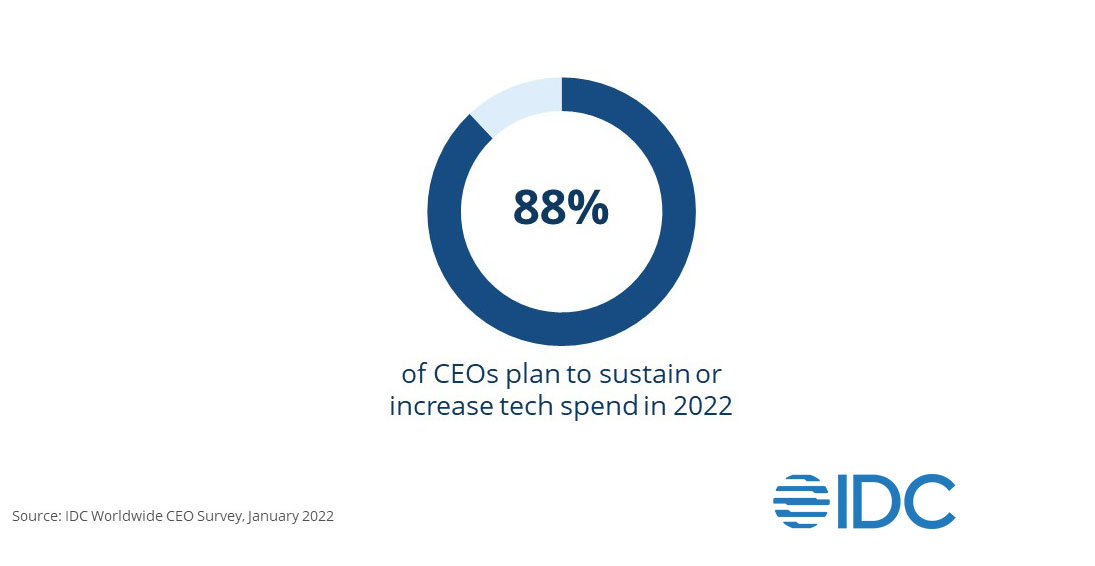
CEOs told us loud and clear that technology spending continues: 88% of CEOs are planning to sustain or increase tech spend according to our global survey.

graph depicting 88 percent of CEOs planning to increase tech spend

The investment in new technology has ramped up to meet the accelerated demand for digital capabilities, particularly over the past two years. And CEOs are optimistic about future digital revenue streams, as the average proportion of revenue from digital products, services and experiences is projected to increase 11 percentage points from 2022 to 2027.

Digital is a major part of our strategy. We are going to be investing approximately €1 billion over the next five years, approximately 200 million per year in digital.

Miguel Stilwell D’ Andrade, Chief Executive Officer, EDP

With the big bets being placed now on digital, the focus on financial returns will intensify particularly with inflation clouding the picture. This is putting increased pressure on cost management. One line item getting attention is workplace technology enhancements, as 47% of CEOs indicated they are planning to reduce spending in this area.

3. Managing an Ever-Evolving Set of Risks

What keeps CEOs up at night? When asked what political, social, and economic risks CEOs expected would have the greatest impact on their business in 2022 and in 2024, topping the list for both years was cybersecurity threats & regulations. This comes as no surprise given the rising threat levels and frequency of attacks experienced by businesses over the past couple of years. What’s more concerning to all businesses and governments is the increasing degree and frequency of cyber threats arising since the beginning of the Russia-Ukraine conflict. That was emphasized on March 21st, when The White House Briefing Room of the U.S. Government released to the business community an urgently worded fact sheet entitled “Act Now to Protect Against Potential Cyberattacks”. This came on the same day that the European Commission proposed new rules to boost cybersecurity and information security in EU institutions, bodies, offices and agencies. Despite concerns about high levels of spend, our survey showed that CEOs are not likely to reduce expenditures on security. An issue adjacent to cybersecurity is digital sovereignty, which tied for top spot with cybersecurity threats when IDC asked CEOs about board priorities. Moreover, addressing new data sharing and compliance regimes was also a rising risk for CEOs looking ahead to 2024. The viewpoints on risk, particularly digital sovereignty, varied by region around the globe. It’s clear that balancing revenue generation and risk linked to tech investments is top of mind for CEO… and will have implications for tech suppliers. This balancing act needs to be managed very carefully.

4. Developing the Technology Leadership Function

It is the time for technology leadership – and more specifically the CIO – to shine. CEOs are increasingly seeing the importance of having the right technology leadership to succeed in a digital-first world. In fact, 89% see it as ‘absolutely critical’ or ‘very important’ to have the right technology leader in place to drive digital transformation in 2022. The CEO needs to develop a more direct relationship with the technology leader. IDC believes this role should have a seat at the leadership table. Although there is a current leaning towards having the CIO focus on risk management to deliver digital resiliency, over the next two years CEOs are expecting that CIOs will focus more business outcomes, agility and delivering new revenue streams.

55% of CEOs believe that it’s very important or critical to restructure their IT organizations in 2022.

IDC 2022 Worldwide CEO Survey

With that change, technology architectures need to evolve from focusing on managing IT, to building tech capabilities with a more external focus, that drives new value for the enterprise. IDC’s view is that CIO metrics should be updated accordingly.

5. Establishing New Engagement Models with Tech Vendors

As CEOs within enterprises develop new mandates, new skills and new teams, this will have a corresponding effect on their technology vendor relationships. CEOs will need to complement the skills of the CIO and team and look outward for guidance, resources, experience – and the ability to scale – in the digital-first world. This becomes an opportunity for vendors to play a trusted advisor role as nearly 1 in 2 CEOs need help building out a digital-first strategy. For vendors, this is the time to capture mindshare with CEOs. They are mapping out their new digital business strategies in a post-pandemic world – new ideas and insights are likely to be welcome today. Business outcomes and value will be the differentiators as technology vendors look to drive visibility and relevance with the CEO.

Learn More: Attend IDC’s Webinar on April 28th

Join IDC’s Phil Carter and Tony Olvet as they dig deeper into IDC’s Worldwide CEO Survey findings and share highlights of innovative digital-first case studies from around the globe.

Tony Olvet - GVP, Worldwide C-Suite & Digital Business Research - IDC

Tony Olvet is Group Vice President, Worldwide C-suite and Digital Business Research at IDC. His team's global research focuses on the connection between business transformation and digital investments across enterprises. Tony's analysis and insights help vendors, IT professionals, and business executives make fact-based decisions on technology strategy and digital business. Tony has worked with clients across a variety of organizations including global IT manufacturers, enterprise software vendors, telecom service providers, financial institutions and public sector organizations. He has been quoted in major business and industry media including CIO Magazine, The Globe and Mail, CBC and The Financial Post.

The Russia-Ukraine war has dramatically shifted the global geopolitical landscape. Countries and companies around the world are struggling to respond. While not as exposed as European nations, Asian nations, will undoubtedly feel the spillover effects of the economic sanctions on Russia, as will the ICT industry in Asia/Pacific. IDC expects that sanctions, commodity shortages, and higher prices for oil and gas as well as other essential goods will further fuel inflationary pressures and damage ICT supply chains that support the regional consumer electronics/semiconductor manufacturing as well as distribution industries.

The situation is highly dynamic. Just one week prior to the invasion, we surveyed 370 Asia/Pacific (including Japan) organizations about their IT spending. 56% of respondents expected 2022 GDP to be same or higher than expected, and 49% indicated their IT spending in 2022 would increase from 2021 (Source: IDC FERS Wave 1 Survey conducted mid-February 2022). These generally positive views have no doubt darkened somewhat over recent weeks.

“Given the fluid nature of the war, IDC recommends that companies create action plans that enable them to anticipate and react to potential disruptions resulting from it, such as supply chain disruptions, chip shortages, increased inflation and cybersecurity threats. The impact of events can change quickly and so must your plans. Leveraging technology for resiliency should be top of the agenda.”

Sandra Ng, Group Vice President and General Manager, IDC Asia/Pacific

IDC carefully evaluated the geopolitical situation and its impact on Asia/Pacific ICT markets, through its broad network of regional, and local analysts and will continue to do so. 

Asia/Pacific IT Vendors will be impacted by:

  • IT Supply Chain Disruptions for Asia/Pacific IT Vendors: Asian exports to Russia, while small, are sometimes significant, and will be hit by U.S. and EU sanctions. Prominent examples include Taiwan-based TSMC, which manufactures the Russian-designed CPU alternative to Intel/AMD, which has announced that it will no longer ship to Russia. By contrast, Russian exports to Asia/Pacific are much larger. These include industrial gases like neon and C4F6, and metals like copper, palladium, nickel, titanium, tungsten, and vanadium, used in IT products from chips to mobile phones and batteries. While most vendors have large inventories of these raw materials, raw material costs look set to increase. Ukraine and Russia’s supplies to semiconductor manufacturing of commodities are especially critical for Asia/Pacific, as the ICT industry has already been struggling with chip shortages with the pandemic and an extended Russia-Ukraine war will exacerbate this. While larger vendors have large stockpiles, supplies to downstream industries such as phones, laptops, and autos are likely to be delayed.
  • Logistics and Transportation for Asia/Pacific IT Vendors: The war impacts the oil and gas industry and therefore has tremendous impact on logistics and transportation costs. Asia, as a net oil importer, is especially vulnerable, and transportation prices will increase. Asian ICT manufacturers and distributors, pressured by higher input costs, may struggle to pass on price increases to consumers.
  • Inflationary and FX Impacts for Asia/Pacific IT Vendors: Inflation remains mild across the Asia/Pacific region, but with COVID-19 related spending, and now the Russia-Ukraine war, inflation has re-emerged as a concern. This makes planning harder for Asian exporters, especially in industries like semiconductors and computer hardware whose supply chains span continents. Inflation encourages vendors to lock in pricing for raw materials, while riding market increases (where they can) for output products. Inflation may impact the nature of ICT demand in Asia; for example, increasing the use of as-a-Service platforms, especially public cloud services from hyperscale providers operating regionally, as these allow buyers to reallocate capital spending from IT to increase enterprise resiliency.

Asia/Pacific Technology Buyers will be impacted less in the short term, as they will continue their investments in transformational IT. But if the war is protracted, they too will face issues such as:

  • Inflationary Impacts for Asia/Pacific Technology Buyers: While inflation may cause some buyers to delay IT investments, IDC surveys suggest inflation is not likely to reduce investments. This varies by country, with Singapore and Japan more likely to report possible delays compared to China and Indonesia. Inflationary impacts also vary by technology— APJ respondents report that investments in telco/networks, SaaS, and IaaS are more likely to have budget increases because of inflationary pressures. Some well-placed IT buyers, say, those with U.S. dollar revenues may be able to lock in favorable discounts and rates with weaker vendors before any price increases.
  • Supply Chain Implications for Asia/Pacific Technology Buyers: Asia/Pacific companies will need to increase logistics and supply chain transparency, beyond tier 1 suppliers. We expect to see greater monitoring and know-your-supplier practices using technologies like integrated ERP, supplier monitoring, blockchain for increased traceability, and environmental monitoring.
  • Impacts on Asia/Pacific Technology Buyers’ Russian IT Suppliers and Operations: Many buyers will temporarily pause any Russian operations and suppliers to limit financial, legal, and brand reputation risks. This will probably lead to shift in IT vendor mix for these buyers.
  • Cybersecurity Impacts for Asia/Pacific Technology Buyers: Cybersecurity and resiliency top IT spending priorities, and this will continue. Cyberwarfare may spill over beyond the conflict combatants and into Asia/Pacific.

An Open Question? China’s responses to E.U. and U.S. sanctions remain an open question, but these will have political, and economic impacts in Asia/Pacific as well as for ICT markets. For example, will Chinese (and potentially Indian) technology vendors step up to support Russian markets and fill the void left by Western technology suppliers? What will be impact on Chinese ICT vendors should they decide to increase their market presence in Russia? How will it impact their market positioning and ability to sell in other markets around the globe?

IDC will continue to monitor developments closely and provide guidance as necessary moving forward.

Further Reading:

This IDC Market Note summarizes the views of IDC’s regional analysts to provide a first take on the Russia-Ukraine war’s impact for Asia/Pacific ICT vendors and technology buyers to help them adapt and react to fast-moving market conditions.

Subscribe to Blog

Dr. Chris Marshall - Vice President - IDC

Chris Marshall is a Vice President responsible for several areas of research at IDC. Chris leads the Asia/Pacific regional industry research teams, which includes coverage of healthcare, government, retail, energy, manufacturing, and financial services. Additionally, Chris leads our regional teams in data, analytics, artificial intelligence (AI), future of work, and sustainability. Previously, Chris was a senior executive in IBM Watson Financial Services where he led their AI-enabled risk and analytics practice in Asia. Before joining IBM, he held partner and executive roles in big data and analytics at KPMG, Oracle, and UBS. He is also a former Professor of Computer Science at National University of Singapore where he was co-founder and director of their programs in Intelligent Systems, and Financial Engineering.

Our findings will be presented in greater detail in an IDC Webinar scheduled for March 17th at 11:00 A.M. U.S. Eastern time (16:00 GMT).

The current conflict between Russia and Ukraine has created a critical geopolitical turning point for Europe and the world, and the ITC market is not immune to its initial shock. While there is still uncertainty about the duration of the war, unforeseen development and new sanctions, the tech community must react to this evolving situation with short- and long-term planning, to minimize the spillover effects on their economies and digital markets.

The evolving geopolitical situation will affect global ICT demand in the coming months and years. According to our new IDC Global CIO Quick Pulse Survey, involving more than 60 technology leaders across the globe, 57% of respondents say they are reassessing their tech spending plans for 2022 in the aftermath of the uncertain geopolitical environment, with 10% expecting to make strong adjustments to their ICT investment plans.

“Given the fluid nature of the conflict, IDC recommends that companies identify weak links in their value chain ecosystem, develop agile supply chain strategies, and create action plans that enable them to anticipate and react to a range of disruptive market movements.”

Philip Carter, Group Vice President, Worldwide Thought Leadership Research

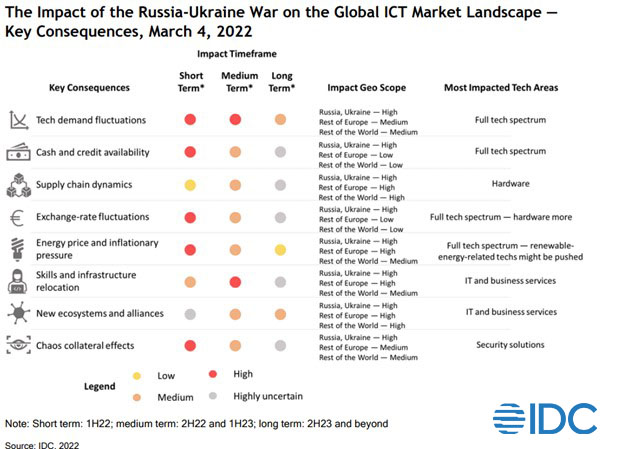
IDC is carefully evaluating the geopolitical situation and its impact on the ICT market, through its broad network of global, regional, and local analysts.  Given the characteristics of the conflict and the sanctions currently in place, we have identified the following key consequences for the global ICT market:

Chart showing short term, medium term and long term impact of Russia-Ukraine conflict on Global ICT market

Tech Demand Fluctuation: The conflict has halted business operations in Ukraine while the Russian economy is feeling the early impact of Western sanctions. This will strongly affect tech spending in both countries with double-digit contraction of local market demand expected in 2022. Meanwhile, tech spending among Western European countries may increase in part due to expanded defense and security allocations.

Energy Prices and Inflationary Pressure: Tensions over the conflict in Ukraine will have wide ranging consequences on both energy prices and security of supply, particularly for certain European countries where cascading effects on price indices are already being felt. Most countries will need to quickly reassess their near-term energy plans while accelerating efforts to reduce their dependence on carbon-based energy sources.

Skills and Infrastructure Relocation: More than 100 global companies have established subsidiaries in Ukraine and many more have operations in Russia. The conflict has already displaced tens of thousands of developers in Ukraine and led to the relocation of some services in both countries. These relationships, along with the physical assets and personnel associated with them as well as any future expansion plans, will need to be reevaluated in light of the conflict.

Cash & Credit Availability: The financial sanctions imposed to date are presenting serious challenges to foreign credit availability in Russia, while creating potential losses on loans issued by EU countries to Russia. Without access to credit, most organizations will be forced to suspend new technology investments in the near term. The country is also suffering from a severe shortage of cash, which is significantly impacting consumer spending.

Supply Chain Dynamics: Exports of finished products and technology components to Russia will be significantly affected by the sanctions, but the impact to Western companies will relatively small given the size of the market. Imports of tech materials from Russia and Ukraine will also be affected, particularly in the semiconductor sector where supplies of neon gas, palladium, and C4F6 used in chip manufacturing will be greatly reduced. The conflict is also expected to further disrupt global supply chains as cargo is rerouted around the two countries and costs increase.

Exchange Rate Fluctuations: Russia’s currency plunged in value in response to the initial sanctions, making imports of IT equipment and services significantly more expensive. As a result, many companies are refusing to ship orders to Russia even if payment is possible. This also means that Russia’s own manufacturers of PCs, servers, and communications equipment will be unable to operate. Geopolitical tensions are also impacting other currencies throughout the region, including the Euro.

Russia’s invasion of Ukraine on February 24, 2022, and the ensuing escalation of events, is evolving daily. IDC Market Perspective provides a first take on the war’s impact on and implications for the global ICT industry, while providing recommendations to tech providers and buyers to help them rapidly adapt and react to fast-changing market conditions.

“While Ukrainian and Russian ICT markets will be the most affected by the war in the short term, with considerable declines expected in the short term and likely slow future recovery, few countries will be spared. IDC expects other European countries to be hit first and other geographies around the globe to face spillover effects on their economies and digital markets, particularly given the war’s likely impact on trade, supply chains, capital flows, and energy prices.”

Andrea Siviero, Associate Research Director, IDC EMEA

The report’s findings will be presented in greater detail in an IDC Webinar scheduled for March 17th at 11:00 am U.S. Eastern time (16:00 GMT).

Further Reading:

This IDC report provides an initial assessment of the implications the crisis presents for the worldwide ICT market, while providing recommendations to tech providers and buyers to rapidly adapt and react to fast-changing market conditions.

Philip Carter - Group Vice President, General Manager, Research AI - IDC

Philip Carter is General Manager and Group Vice President for AI, Data, and Automation research at IDC. In this role, he leads a global team of analysts focused on delivering IDC's research and insights at the intersection of AI, data platforms, and intelligent automation - three foundational areas shaping the future of technology and business. His work is centered on helping C-Suite executives make sense of the rapid innovation in the AI space, and drive meaningful transformation through data- and intelligence-led strategies. BACKGROUND Carter has held multiple senior roles at IDC across regions. Prior to his current position, he served as GVP and GM of IDC TechMatch, where he led a global team tasked to build and commercialize IDC's first AI-powered digital platform - focused on helping CIOs and procurement executives evaluate and source technology vendors leveraging IDC trusted intelligence. Earlier in his IDC career, Carter was the lead for IDC's Global Thought Leadership research function and was also Chief Analyst for IDC Europe, where he drove innovation in research related to digital transformation, emerging business models, and technology strategy at the C-suite level. Before that, he worked in IDC's Asia/Pacific region, covering software, services, and sustainability. Prior to joining IDC, he held various leadership roles at SAS Institute across EMEA and APAC in marketing strategy, product management, and business development. He is a recognized industry voice, regularly featured on platforms such as CNBC and Bloomberg, and quoted in leading publications including the New York Times. EDUCATION/INDUSTRY ACCOMPLISHMENTS: - Honors degree in Business Science, majoring in Economics and Law, University of Cape Town, South Africa.

B2B marketers have been striving to become “modern marketers” for some time. At it’s core, however, modernization is continuously occurring. It doesn’t have an end. It isn’t a checkbox. Today’s marketing mindset embraces continual change as the new normal.

We are at an important inflection point in B2B marketing. The new playbook is predominately digital, customer centric, and data science driven. But, there are technical challenges posed by disconnected data and lack of marketing’s technical expertise in everything from sophisticated marketing automation to emerging technologies, such as artificial intelligence (AI). To create the ultimate marketing machine, a paradigm shift needs to occur. 

55% of marketing organizations are not ready yet for the future of marketing.

IDC’s 2021 Future of Marketing Barometer Survey

Marketing’s role is changing. Historically, marketing supported business strategy handed down from the C-suite, most commonly pursuing brand goals. Moving forward, high-performing marketing leaders will align their organizations’ activities to overall business strategy, and they will have a seat at the table to create it. Out of the marketing leaders surveyed, 88% stated the primary future responsibility of marketing is driving business growth. While marketing will still have accountability for generating demand, brand value, and pipeline health, the strategic focus on business growth is the most critical role that marketing will hold moving forward. How does marketing step up to the task?

A New Mindset

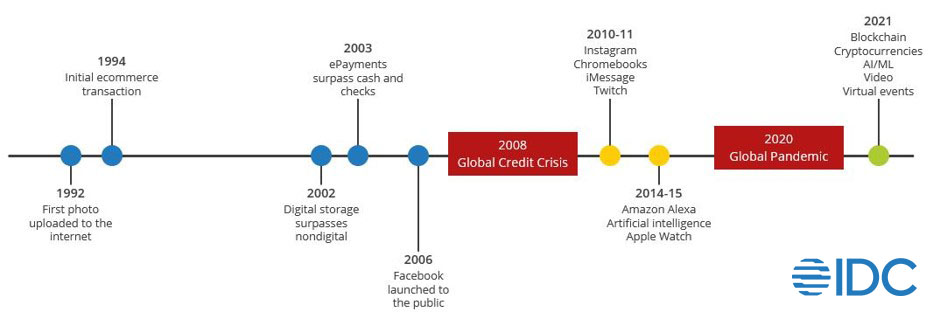
When the global credit crisis hit in 2008, the chaos spurred innovation in digital consumer experiences (see Figure 3). Since then, marketing’s digital program investment has gradually been increasing. The global pandemic spurred an even greater acceleration of digital transformation, and as of 2020, digital program investment has surpassed non-digital program spend. Buying behavior has also changed. Today, leading marketers are rethinking traditional digital marketing teams, instead choosing to form teams focused on audience-based experiences, of which digital is a part of.

74% of buyers are comfortable purchasing through ecommerce versus engaging with a human salesperson.

IDC’s 2020 Tech Buyer Survey

When the experience economy started to take off in 2008, marketers used a “digital first” mantra to ensure that digital aspects were considered in the marketing mix. Today, digitalization of engagement and experiences is no longer an option, nor a small percentage of marketing programming. According to IDC’s 2020 Tech Marketing Benchmark Survey, 65% of advertising and 57% of content marketing is digital. Marketing leaders are shifting their organizations’ paradigm into a new mantra for marketers — “digital always, digital everywhere.” Digital marketing is now what marketing just is.

Figure 3: Short History of Digital Acceleration

The shift from brand first to customer first requires a cultural shift. To be truly customer centric is to design marketing’s strategy and actions around the customer’s interests and needs. The mindset goes from an internal focus of establishing brand awareness or generating new leads to an external focus of correlating brand value creation with customer value creation.

IDC defines customer experience as a “customer’s perception and emotional response to the sum of the interactions and engagement with an enterprise.” In IDC’s 2020 Tech Buyer Survey, customer experience was the number 1 factor impacting buyers’ future purchasing. This is a glaring disconnect between what buyers expect and marketing’s accountability. A product marketing focus will not achieve marketing’s objectives moving forward. In fact, IDC’s 2020 Tech Buyer Survey found that 90% of tech buyers are willing to switch vendors if they are dissatisfied with marketing and sales.

The Funnel Is a Mirage — New Organizational Approach for Today’s Marketer

Buyers do not go through their buying journey in a linear fashion. In the era of digitalization, the funnel is merely a mirage. B2B marketing recognizes that the number of buyers continues to grow, currently at 14 different people in a buying cohort (source: IDC’s 2020 Tech Buyer Survey). Marketing’s role is extending beyond traditional boundaries, with marketing gradually increasing investment in post-sales programming to 18%. Buyers in IDC’s 2020 Tech Buyer Survey overwhelmingly identified marketing-led information sources as the top information source across the full buying journey.

B2B marketing in today’s constantly changing world requires a new framework to not only survive but thrive.

Laurie Buczek, Vice President, CMO Advisory Practice, IDC

It is now critical that marketers fully embrace their role as the orchestrator, working across organizational boundaries and supporting the buyers as they bounce around. To facilitate the orchestrator role, organizational silos must come down. Collaborating within the marketing organization has been challenging enough, let alone working outside of marketing teams. New departments created will focus on emerging capabilities such as digital, data, and new marketing technology (e.g., artificial intelligence, machine learning, sophisticated marketing automation).

Future marketing organizations will introduce science to art, with 87.5% of marketing leaders surveyed in IDC’s 2021 Future of Marketing Barometer Survey building at least a quarter of their organization with experts skilled at producing digital engagement and experiences. 72.5% plan to have 25% or more of their organization well versed in how to use data and enable marketing automation. Establishing a data operations team is imperative to properly address closing the looming challenges with disconnected customer data, however, data science skill sets are the most critical gap in marketing organizations today. Marketing leaders are also struggling to find marketing technologists, especially those skilled at sophisticated marketing automation and emerging technologies, along with content, digital, and audience marketing strategy.

Growth Marketing for The Win

For more than a decade, B2B marketing has been managing the funnel with product-led strategies. Marketers are now orchestrating whole journey marketing tactics to digitally serve the buyer, no matter where they are in the journey. As B2B buyers have grown more empowered and their desired experience mirrors consumers, they expect a mentor-marketing approach from brands. Buyers are looking for personalized storytelling about solutions that meet their objectives. Buyers want to easily digest and quickly consume information with less reliance on a human salesperson. Enter the importance of growth marketing, to focus on relationships and building loyalty with buyers. Marketing strategy is shifting toward emotive tactics and content marketing that grabs buyers’ attention in an attention-deficit economy. New digital formats are being tested and embraced to personalize the customer engagement and capture a rich set of customer behavioral and intent analytics.

On The Topic of Growth Marketing and Content Marketing Services

You may also find these links helpful:

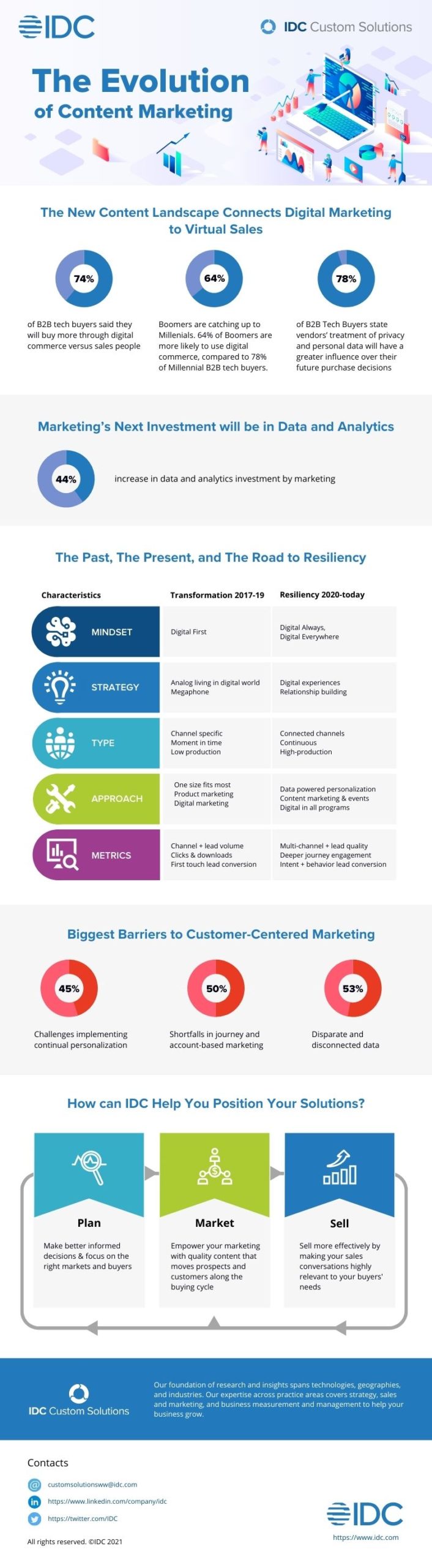
An in-depth analysis on the evolution of content marketing; where it started, where it’s going and what Marketing’s new role will be.

How we help you create quality, engaging content that is research-driven, personalized and beneficial to your buyers.

Research that focuses on the transforming marketing function and helping companies achieve their business goals through better connection with today’s customer.

Male in wool coat reading on his mobile phone

Laurie Buczek - GVP, Research - IDC

Laurie Buczek is the Group Vice President of Executive Insights at IDC, where she spearheads the global research initiatives that shape the industry's understanding of digital business transformation, evolving buying behaviors, and technology investments. She leads IDC's premier research practices, including the CMO Advisory Practice, C-Suite Tech Agenda, and Digital to AI Business Transformation. As the principal analyst for the CMO Advisory Practice, Laurie advises senior marketing leaders on driving business growth through deeper customer connections and the strategic evolution of the marketing function, with a keen focus on AI's transformative impact. Her expertise and thought leadership empower executives to navigate the intersection of technology, business strategy, and customer engagement in today's dynamic digital landscape.