随着大语言模型、多模态交互及端云协同架构不断成熟,智能语音、AI助手、导航问答、内容生成和个性化推荐等AI原生应用正加速上车。座舱交互体验也由此成为车企构建差异化竞争力的关键变量。AI座舱正从“功能集成”迈向“体验重构”,这一趋势首次有了可量化的市场刻度。国际数据公司(IDC)在《中国汽车云市场跟踪》报告中,首次将AI座舱解决方案作为独立附加(Add-on)市场开展系统跟踪,并从市场规模、竞争格局、技术路线和商业模式等维度发布首期研究成果。

IDC定义的AI座舱解决方案市场涵盖四个层面:AI开发平台/软件(模型开发、Agent编排、部署管理等)、模型服务MaaS(大语言模型、多模态模型及语音模型的云端、车端与端云协同调用)、AI应用(智能语音、AI助手、导航问答、内容生成等),以及AI运营服务(模型更新、知识库管理、运营监控与持续优化)。

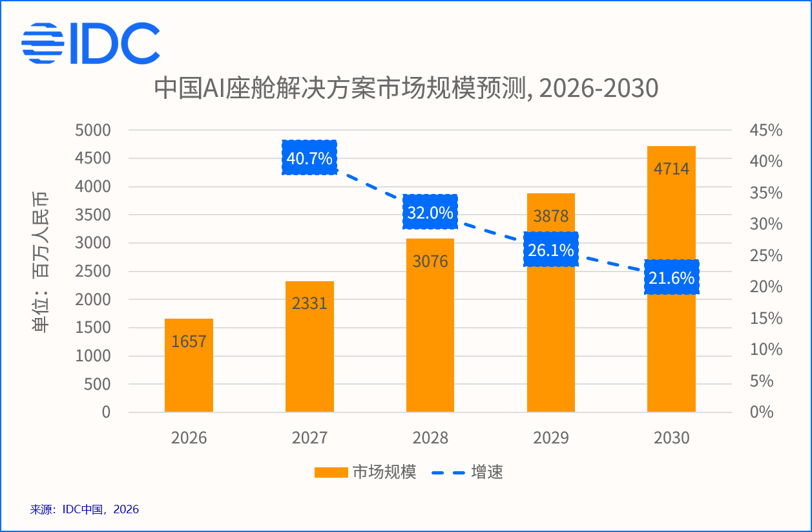
IDC数据显示,2026年上半年,中国AI座舱解决方案市场规模达到7.1亿元人民币。这一规模表明,AI座舱已进入规模起量阶段,市场需求与商业化进程同步提速,市场正由早期探索转向规模化量产与持续运营。IDC预计,2026年全年中国AI座舱解决方案市场规模将达到16.6亿元人民币,到2030年有望进一步增长至47.1亿元人民币,年复合增长率接近30%。

竞争格局浮出水面:第一名份额超四成,市场早期就呈现出高集中的特征

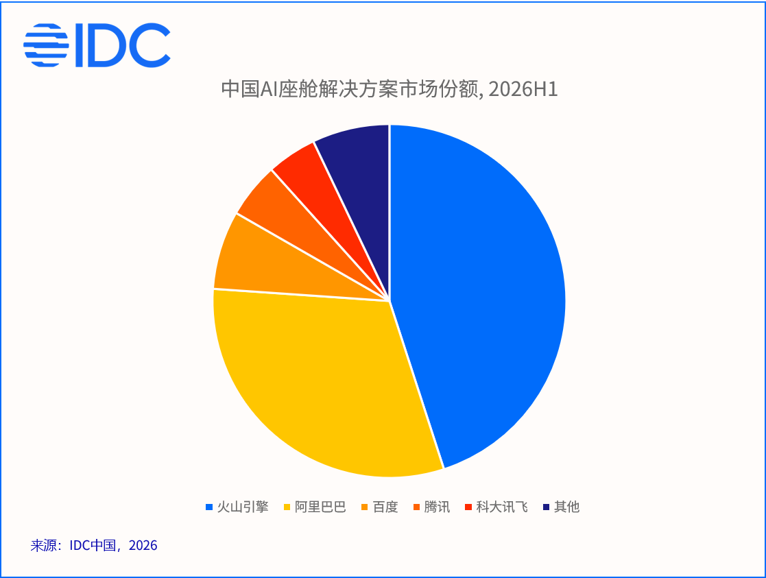
从竞争格局来看,市场头部聚集效应显著:2026年上半年,火山引擎以45%的市场份额位列第一,阿里巴巴份额位居第二。从优势来源看,头部厂商的领先主要建立在量产车型覆盖规模与头部客户项目经验之上,属于现阶段的市场身位,格局远未固化。第二梯队中,百度依托座舱业务存量与地图等既有能力保持市场参与;科大讯飞依托座舱域软硬件方案与既有客户基础,稳步推进AI能力升级;此外,阶跃星辰等模型创业公司也通过与车企及产业链伙伴的深度绑定切入市场,部分技术已实现上车。整体而言,市场格局仍处于动态演化阶段,量产项目经验、生态协同能力与C端品牌认知正在成为厂商竞争的关键筹码。

License授权与按量付费并行,商业模式向价值导向演进

从商业模式来看,当前AI座舱市场的计费方式呈现多元化特征:面向功能套件组合的License授权仍是主流模式,车企因选型范围不同,定价差异较为明显;针对自研能力较强、仅需基础模型能力的客户,按Token或调用量计费的公有云模式成为重要补充;端侧部署则普遍采用一次性激活计费并辅以年度技术支持与模型迭代维护费。

值得注意的是,车企对AI投入产出比的关注度显著提升,定价谈判愈发围绕实际使用效果与价值密度展开,深度赋能项目与基础功能授权之间的价值差异正在拉大。与此同时,部分厂商开始以标杆项目为抓手,探索从车企买单向C端用户订阅付费过渡的路径,为市场打开新的收入想象空间。

端云协同成为主流架构,交互体验竞争走向纵深

从技术演进来看,端云协同已成为行业共识:端侧模型承担高频简单指令的快速响应,云端大模型处理复杂推理与多模态交互,在体验、时延与成本之间取得平衡。端侧模型参数量持续提升,对高算力车载芯片的配套能力提出更高要求;在产业分工上,云与模型厂商普遍与Tier 1供应商合作,将软件能力集成至域控制器,实体多模态交互硬件亦已在部分车型开展试点。此外,跟随中国车企出海步伐,座舱AI能力的海外落地正在成为新的增长方向;具身智能等前沿领域的探索,也为座舱交互形态的中长期演进带来更多可能。

从被动应答到主动服务,Agentic AI重塑座舱交互范式

从交互范式来看,AI座舱正在经历从“被动应答”向“主动服务”的关键跃迁。上一代座舱语音助手普遍采用“意图分域+多Agent协同”的回合制架构,交互割裂、使用频次受限;2026年以来,多家头部厂商相继发布基于Agentic AI(代理式人工智能)架构的新一代座舱方案,技术路线的共同点在于以统一的AI中枢联动车控、导航、智驾等功能域,推动座舱交互从回合制问答向任务驱动的自主执行演进。

从厂商公开披露的信息看,头部厂商的大模型车型搭载量已达到数百万辆量级,日均座舱交互达到数千万次量级;尽管各家统计口径不尽相同,但座舱AI从低频的“尝鲜配置”逐步转变为用户高频使用的日常服务,已成为可观察的行业趋势。IDC认为,这一跃迁的商业含义同样深远:只有当座舱AI从低频功能进化为高频服务,围绕服务闭环的付费逻辑才能真正成立,车企与供应商才有基础探索从B端授权向C端订阅的收费模式迁移。交互范式升级与商业模式演进的叠加,将共同决定AI座舱市场未来五年的增长斜率。

IDC中国云计算产品高级分析师陈启今表示,AI座舱是汽车云市场中增长确定性较高的新兴板块。当前市场仍处于早期阶段,商业模式、技术架构与竞争格局均未完全定型,头部厂商的量产车型覆盖与标杆项目经验构成先发优势,而车企对成本与体验的平衡诉求、以及C端付费模式的成熟度,将在很大程度上决定市场从”配置竞争”走向”价值竞争”的速度。对于供应商而言,围绕真实用车场景打磨交互体验、构建端云协同的工程化能力、建立可持续的计费模式,是把握这一市场机遇的关键。

IDC 相关研究

围绕AI时代行业云市场的发展趋势、客户需求、技术应用与竞争格局,IDC将持续开展系统性研究,覆盖汽车、具身智能、金融、游戏、零售等重点行业,包括但不限于:

  • Market Analysis Perspective: 中国AI游戏云市场洞察,2025(已发布)
  • 中国具身智能云市场份额,2025(已发布)
  • 中国汽车云市场跟踪,2026H1(已发布)
  • 中国金融云市场跟踪,2026H1(即将发布)
  • 中国游戏云市场跟踪,2026H1(即将发布)

进一步交流
AI座舱的格局远未固化,价值竞争才刚刚开始。如果您对这份IDC首发的市场数据有进一步了解的需求,或希望就AI座舱的商业模式、技术演进与分析师团队展开探讨,欢迎随时与我们联系。请点击此处与我们联系。

IDC Quanta has been available in Claude since July, and IDC’s teams use Claude every day to drive speed and agility throughout the organization.

Recently, IDC and Anthropic shared a case study on how IDC is using Claude to extend IDC Quanta to customers and to change how the company works. This post adds detail on both.

IDC worked with Anthropic to connect IDC Quanta to Claude, allowing customers to describe the market, strategy, or purchase they are working on, and Claude draws on IDC’s forecasts and market data to answer. Each answer cites the IDC document or dataset it came from.

“We brought IDC Quanta into Claude because that’s where many of our customers already work,” said Meredith Whalen, IDC’s Chief Research and Data Intelligence Officer.

What customers can do with IDC Quanta in Claude

The IDC Quanta connector lets Claude reach IDC Quanta from the Claude app on desktop and mobile, and the Microsoft Office add-ins. The research stays with IDC. Claude connects when a customer asks a question, and the answer uses the same data and definitions an IDC analyst uses, so market share or growth rates match what IDC would publish.

Customers use it for questions like these:

  • Competitive briefs. They can do a day’s worth of research in minutes. A corporate strategy lead asks for a competitor brief and gets positioning, market share, product capabilities, and recent acquisitions, cited to IDC research.

  • Vendor shortlists. A CIO evaluating procurement software describes her architecture and business requirements. Claude returns the top three vendors from IDC’s procurement database and MarketScape research as an Excel scorecard for the evaluation team.

  • Analysis of their own numbers. A CFO uploads next year’s IT budget and asks how it compares to IDC’s forecast. Claude shows where the two differ and by how much, and the CFO’s data stays private to the customer.

The case study shows more of what customers can do with IDC Quanta and Claude.

How IDC uses Claude across the company

IDC’s own teams use Claude daily. Engineering adopted it first, and the rest of the company followed.

Engineers rebuilt the internal data repository analysts use for research in three weeks, down from an estimated three months. A code review that once filled five days now takes about 30 minutes.

Sales uses a tool built with Claude that reads a CRM export and shows each rep which deals have stalled, and which are worth following up.

The case study also covers how product, planning, and marketing teams use Claude.

Read the full case study to learn more about how IDC leverages Claude.

Getting started

IDC Quanta customers using Claude can add the IDC Quanta connector within Claude.

If you want to see IDC Quanta and Claude in action, contact IDC or book a demo.

Ryan Smith - Content Marketing Director - IDC

Ryan Smith is the Director of Content Marketing at IDC, where he leads brand-level content and social media strategy, aligning research insights with compelling storytelling to engage technology decision-makers. With a background in both IT and marketing, Ryan brings a unique blend of technical understanding and creative strategy to his work. He’s also a seasoned storyteller, speaker, and podcast host who believes the right message, told the right way, can drive both trust and transformation.

The logic is solid. Invest more in security, and you’ll reduce your risk.

IDC data suggests otherwise. IDC’s 2026 Worldwide Security Spending Guide (V2 release) forecasts that organizations will spend $310.42 billion on security this year, up 13.2% from 2025. Yet in IDC’s February 2026 CEO Survey of 492 CEOs, cybersecurity is still the highest-ranked anticipated technology risk, ahead of AI itself.

In the same survey, organizations have funded security and put governance around it, yet they still do not feel safer.

So why the mismatch between rising budgets and heightened concern?

Two IDC surveys, one of CEOs and one of security buyers, point to the same evidence gap: security spending isn’t following the risk data meant to justify it.

To meet CEO expectations for security, tech leaders need to find where the gap sits in their own organization. Start with these three questions.

1. Is your next AppSec purchase justified by a finding or by a feature?

At the buyer level, the top reason security buyers gave for their most recent application security (AppSec) tool purchase was adopting AI features (31%), followed by better integration (28%). Neither reason is about risk findings. Both figures come from IDC’s 2025 DevSecOps and Software Supply Chain Security Survey (n=511, fielded July 2025).

The same survey, of US-based organizations with more than 500 employees, puts the average 2024 AppSec budget at $2.3 million, and 61% of organizations raised it in 2025, with an average change of about +5% across all organizations.

2. How does your spend compare to organizations your size?

Endpoint security funding isn’t reaching every organization equally. Large organizations are raising budgets faster, while small organizations lag.

IDC’s 2026 Worldwide Modern Endpoint Security Survey (n=846, fielded March 2026) found that more than 60% of organizations raised their 2026 endpoint security budgets. More than 25% of large organizations (500–999 employees) raised them by 10% or more, versus only 12.9% of small organizations (1–99 employees).

The gap isn’t evenly distributed. Small organizations are often the ones with the least room to absorb a miss, so knowing how your spend compares with organizations your size is a useful first reference point.

3. Is security part of your AI funding conversation?

In IDC’s February 2026 CEO Survey, 50% of CEOs named advanced cybersecurity, and 52% named agentic and generative AI at scale, as a top-three investment area for the next 12 to 24 months. The two sit two points apart, which suggests CEOs weigh AI and security funding together.

CEOs link the two on risk as well. Asked what concerns them most about AI, they name data privacy (46%) and security (35%) as their top two risks.

How to close the evidence gap

If one or more of these questions hit close to home, you may be facing an evidence gap. The same question applies to AI. In IDC’s MaturityScape Benchmark: AI-Fueled Organization Worldwide, 2026 (n=1,900), 61.3% of organizations are still in the two earliest stages of AI maturity. Where do you stand?

The first step to closing the gap is knowing where you stand against your peers. IDC Quanta for Tech Leaders delivers sourced IDC research and peer benchmarks directly into the tools your teams already use, with no separate portal or login.

Christina Cardoza - Content Marketing Manager - IDC

Christina Cardoza is a Content Marketing Manager at IDC, where she specializes in brand content and social media strategy. With a background in journalism and editorial leadership, she has a proven ability to transform complex technology topics into clear, actionable insights.

When your board asks how you compare with peers, expect questions on AI transformation, IT spend, and governance maturity. IDC’s MaturityScape Benchmark covers the AI side of that comparison. 61.3% of organizations sit in the two earliest stages of AI maturity, and only 3.1% have reached the most mature stage (IDC MaturityScape Benchmark: AI-Fueled Organization, 2026, worldwide, n = 1,900).

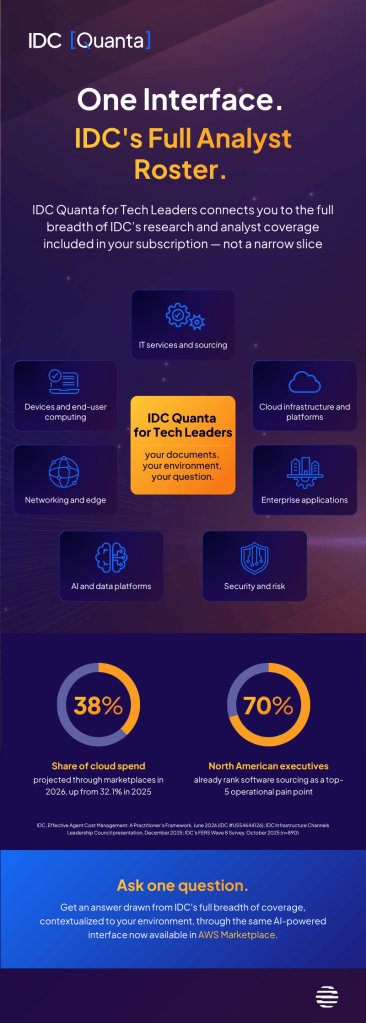
Which stage are we in, and what moves us to the next one? IDC Quanta for Tech Leaders connects you to IDC’s research across the seven areas below, including cloud, enterprise applications, and networking and edge, plus security and risk. Ask in your own terms and add your own documents, and the answer comes back set against your environment, inside the tools you already use. It is also available in AWS Marketplace, so you can buy it against existing AWS commitments.

Which stage are you in?

Christina Cardoza - Content Marketing Manager - IDC

Christina Cardoza is a Content Marketing Manager at IDC, where she specializes in brand content and social media strategy. With a background in journalism and editorial leadership, she has a proven ability to transform complex technology topics into clear, actionable insights.

On October 21, two critical flaws in PHP left organizations with a choice that cybersecurity authorities stated plainly: update affected systems immediately or take them offline. Known together as PHP2Shell, the flaws (CVE-2026-109618 and CVE-2026-109619) can allow attackers to run code on affected servers without logging in.

PHP runs websites and applications, including platforms such as WordPress and Drupal. But knowing that a company uses PHP is different from knowing every place it runs. A patch only helps once an organization knows where it is needed, who can apply it, and how to make the change safely. Those decisions are harder to make for the first time during an emergency.

IDC’s DevSecOps and Software Supply Chain Security Survey of U.S. enterprises illustrates the challenge. Asked to name their two hardest challenges if vulnerability discoveries rose sharply, respondents most often chose knowing where vulnerable software runs (30.7%) and deciding what to fix first (28.8%), ahead of fixing vulnerabilities quickly enough (23.6%). These findings suggest that faster remediation depends on work that begins well before a vulnerability is disclosed.

Inventory must connect software, ownership, and exposure

PHP can run inside vendor products, administrative tools, older internal systems, and websites managed by hosting providers. An application inventory may identify the website without recording the PHP version beneath it or who controls its updates.

Updating a website or its plugins is not enough unless the update also replaces the vulnerable PHP software. The fix may require action from an internal infrastructure team, a hosting provider, or a product vendor.

Log4Shell exposed the same gap in 2021, when Log4j turned up in applications whose owners did not know they contained it. The U.S. Cyber Safety Review Board found that the organizations that responded most effectively already knew where they used Log4j and had mature processes for managing assets.

No single inventory source should be assumed complete. Attack surface management and vulnerability management tools can help discover exposed services and identify affected software, while cloud security platforms can connect findings to deployed workloads and their exposure. Software bills of materials and provider confirmation can add component information. Organizations should verify that these capabilities also connect findings to accountable owners and business services.

An inventory must therefore answer more than “What applications do we have?” It must also show the software they depend on, its version, and the team or provider responsible for updating it.

AI adds urgency to a familiar problem

The researchers who reported PHP2Shell used frontier AI models to uncover flaws in PHP’s core that had been there for more than a decade. Models can read large codebases, follow how memory and errors are handled across many files, and, once they find one flaw, search for others that follow the same pattern. PHP’s security team now receives far more reports than it did before.

AI can also help attackers with the slower step that follows: turning a flaw into an attack that works against a particular system. That step has historically required skill and repeated testing; AI models can now compare a patch with the code it replaced, draft an exploit, test it, and adjust it after each failure. PHP developers spotted one of the PHP2Shell flaws in 2024 but found no concrete way to exploit it; with AI models, the reporting researchers built attacks that worked against several widely used applications.

More disclosures and a shorter path to attack leave organizations less time to act on each advisory, and PHP2Shell showed how little time that can be. The earliest reported exploitation attempt came four days before disclosure, and PHP moved its release up a day after news of the flaws leaked.

Confidence in the change sets the pace of the fix

Finding an affected system does not mean an organization can immediately change it. Operations teams need confidence that an urgent update will not cause an outage, but testing, scheduling, and approval can introduce delays when multiple teams or providers are involved. In the same survey, 20.4% chose coordinating fixes across application, infrastructure, and open source teams as one of their two hardest challenges.

Organizations can reduce avoidable delays by agreeing on emergency change procedures in advance. Those procedures should specify which updates qualify for a preapproved process, what testing is required, how a failed change will be reversed, and who coordinates the response. Providers of maintained software packages and container images can help by supplying updated components when vulnerabilities are disclosed, while patch management and deployment tools can support the rollout and verification of patches. Both work best when the path from provider to production is set before an emergency.

Compensating controls buy time but need an end date

When an update cannot be applied immediately, temporary protections such as restricting network access, changing vulnerable configurations, or blocking known attack patterns can reduce exposure, depending on the vulnerability and deployment.

For PHP2Shell, PHP’s maintainers state, “There are no complete mitigations, updating is the only safe choice.” Organizations need to verify what a control covers and take a system offline when the remaining risk is unacceptable.

That decision requires the same visibility and ownership needed for patching. Each temporary measure needs a named owner, a scheduled fix, and a review date.

Turn this response into preparation

Organizations responding to PHP2Shell should use the work to strengthen four practices:

  • Inventory: Find affected PHP installations, starting with internet-facing systems. Record each installation’s version and its source, such as an operating system package or a container image, because distributions can apply fixes to older versions without changing the version number.
  • Ownership: Identify who can authorize and perform each update, including external providers.
  • Patching: Follow current PHP and vendor guidance, verify that the fixed software is running, and investigate signs of compromise. Patching does not remove an attacker already inside.
  • Compensating controls: Verify the coverage of interim controls, isolate systems where necessary, and assign responsibility and a review date for every unresolved exposure.

No organization can control when the next critical flaw is disclosed. Each can control what the first hours look like: whether teams start patching systems they already know about, with owners and change procedures in place, or start searching for systems they did not know they had.

Michelle Abraham

Michelle Abraham - Research Vice President , Security and Trust

Michelle Abraham is a Research Vice President in IDC’s Security and Trust Group, responsible for the Security Information and Event Management (SIEM), Exposure Management, and Related Artificial Intelligence Technologies practice. Ms. Abraham’s core research coverage includes SIEM platforms, exposure management…
Katie Norton

Katie Norton - Research Director, Cloud Security

Katie Norton is a Research Director for IDC's Cloud Security research practice, covering the Cloud-Native Application Protection Platform (CNAPP) market and its adjacent technologies. She is responsible for researching, writing, and advising clients on market sizing, vendor positioning, competitive dynamics,…
Bobby Kuzma

Bobby Kuzma - Sr. Research Manager DevSecOps

Bobby Kuzma is a Senior Research Manager at IDC, where he runs the DevSecOps and Agentic Development Security program. He covers how teams build security into the software development life cycle: application security testing, software supply chain security, runtime protection,…

AI agents now act on behalf of organizations, and the work, the money, and the technology around them are being rebuilt to match. FutureScape 2027 calls this the Great Rewrite and sorts what is changing into three windows: closing, open, and emerging. IDC FutureScape 2027 begins rolling out today, with all 25 reports publishing October 27-29. Each report includes 10 predictions looking ahead up to five years across a wide range of industries and topics.

The windows show how much time is left to act on each shift, which changes which decisions come first.

What is IDC FutureScape, and who uses it?

IDC FutureScape is IDC’s annual set of predictions, written by the analysts who cover each market. Every prediction carries a time frame, so you can see what is likely to happen and roughly when. Two audiences put that to work in different ways.

Tech leaders use FutureScape to navigate the market they operate in. They look for which forces are building, how fast, and what the next budget cycle needs to account for. Tech suppliers use it to see where their customers are headed. That shows them where to develop solutions that help those customers find an advantage as markets shift.

See the IDC FutureScape top 10 worldwide predictions webinar hosted by Rick Villars, Group Vice President, Worldwide Research. 

What is the Great Rewrite?

Across FutureScape 2027, dozens of predictions from different practice areas reach the same conclusion. AI isn’t being added on top of how organizations work. It’s rewriting what sits underneath: the compute layer, the org chart, the balance sheet. The Great Rewrite is that shift, and it is reaching every organization whether or not that organization has planned for it.

The Agentic Economy is the operating environment the rewrite produces, and it is where winning and losing get decided. Pace is part of the story. IDC’s Future Enterprise Resiliency and Spending Survey (Wave 2, March to April 2026, n=1,009) shows the scale. Enterprises expect to nearly double the types of AI agents they run in production, from an average of 23.5 in April 2026 to 43.2 by year-end1. The deciding factor is the distance between how fast agents can act and how well organizations can govern what they do. That distance compounds with every agent type that goes into production.

Want more information about this year’s predictions? Visit our IDC FutureScape 2027 site.

What do the closing, open, and emerging windows mean?

The forces in the Great Rewrite do not move at the same speed. Each prediction lands in a window based on how settled the decision is: nearly made, still yours to shape, or only now taking form. Each window asks for a different kind of decision.

  • Closing: an opportunity is about to become a disadvantage. The big decisions are nearly made, and waiting means inheriting the outcome of choices others have already set.

  • Open: decisions you need to make today. These are still yours to shape, but the room to shape them is narrowing.

  • Emerging: advantages you can still influence. Nobody has captured these yet, so early moves can still change how the advantage gets built.

For tech leaders, the windows answer a practical question: which decisions belong in this planning cycle, and which can wait and be watched? Settle the closing decisions now, and use the open window to shape what is still undecided.

For tech suppliers, the windows show where buyers have already chosen, where they are still deciding, and where no direction is set yet. That is where new solutions can still change the outcome.

Hear Rick Villars sort the Top 10 Worldwide Predictions into these windows live on October 28: watch the webinar.

How can you hear the Top 10 Worldwide Predictions?

IDC’s FutureScape Top 10 Worldwide Predictions name the ten most notable ways the world is being rewritten. On October 28, Rick Villars, Group Vice President, Worldwide Research, walks through them live in the webinar The Great Rewrite: Winning in the Agentic Economy. He sorts each prediction into closing, open, or emerging. Then he shows how the ten play out across three threads that run through all of them:

  • Redefining Resilience: AI is redefining it, with real benefits, real pain, and consequences that reach the architecture you are planning today.

  • Creating Trust in Agents: Agents are already taking actions in your business, and trusting what they do is a long, complex, and uncertain journey.

  • Establishing New Leadership: Placing bets on independence comes with risks and rewards, and the harder call is where to play.

You will leave with the ten predictions ordered by how long you have to decide, ready for your next leadership or budget conversation. The session runs sixty minutes, with time for your questions, at 8 AM Pacific and 3 PM in London. Joining from the Gulf, live is 7 PM in Dubai. In Asia Pacific, live is 11 PM in Singapore, midnight Thursday in Tokyo, and 2 AM Thursday in Sydney, so the replay is the better fit.

If you set 2027 technology priorities or control the budgets behind them (CIOs, CTOs, CFOs, and heads of AI), or you build the solutions they buy, this one is for you.

Explore the FutureScape 2027 reports as they publish through October 29 at idc.com/futurescape.

Sources

  1. IDC Survey Spotlight: From Pilot to Production — How Rapidly Is AI Agent Adoption Maturing? (IDC #AP54627726, June 2026). IDC’s Future Enterprise Resiliency and Spending Survey, Wave 1 (February 2026, n=903) and Wave 2 (March to April 2026, n=1,009).

Ryan Smith - Content Marketing Director - IDC

Ryan Smith is the Director of Content Marketing at IDC, where he leads brand-level content and social media strategy, aligning research insights with compelling storytelling to engage technology decision-makers. With a background in both IT and marketing, Ryan brings a unique blend of technical understanding and creative strategy to his work. He’s also a seasoned storyteller, speaker, and podcast host who believes the right message, told the right way, can drive both trust and transformation.

In IDC’s Future Enterprise Resiliency and Spending (FERS) Survey 2026, Wave 5, 76% of tech leaders ran AI agent spend over forecast. The video below opens on that number, and it leads to a larger question: who sets the pace in the AI economy once promotional pricing ends?

IDC research points to five priorities that sit on nearly every tech leader’s desk right now: Budgeting and cost control, Rethinking sourcing and vendor ecosystems, Proving value, AI governance and ownership, and IT benchmarking. The video covers each one. This post adds the research behind it and the question to bring to your next budget review.

Every priority comes down to a peer comparison, which is where IDC Quanta for Tech Leaders comes in. It puts IDC research, price benchmarks, and peer positioning inside the AI tools you already use.

1. Budgeting and cost control

AI agent spend is running ahead of forecast, and the promotional pricing that softens the bill expires in early 2027. The FERS 2026, Wave 5 numbers show how widespread that is: 76% of tech leaders ran AI agent spend over forecast, and 63% have a quarter or more of that budget on credits that expire by early 2027.

A bill held down by credits has a step-up scheduled into it, so a plan built on today’s invoice will miss. That puts one question at the top of your next budget review: how much of our AI budget sits on credits that expire, and when?

IDC FERS 2026 tracks the overrun and the share of budget on expiring credits. IDC MaturityScape: AI Cost Management 1.0 shows where your cost management practice sits on a maturity scale. IDC Quanta for Tech Leaders adds price benchmarking and peer comparison. 76% are over budget. Are you?

2. Rethinking sourcing and vendor ecosystems

Prices are up in nearly every category, and many leaders are renegotiating without knowing what a good deal looks like. In FERS 2026, Wave 5 (worldwide, n = 1,585), 41% of tech leaders are renegotiating contracts aggressively in response to price increases in software and services. IDC deal guides show negotiated discounts on the same product ranging from 0 to 70%. One in three worry about lock-in and the inability to move workloads, according to IDC research.

A spread that wide on one product means the benchmark matters at the negotiating table. The question to ask: where does our discount sit against peers on the same product? IDC deal guides answer it with negotiated discount data. IDC Quanta for Tech Leaders delivers price benchmarking inside the tools you use, backed by research that covers 5,000+ technology vendors (IDC press release, October 6, 2026). Discounts on the same product span 0 to 70%. Which end are you on?

IDC Quanta for Tech Leaders helps you understand how your AI costs compare to other organizations like yours. Visit IDC Quanta to learn more.

3. Proving value

Departments report savings while the company loses money. IDC AI Economics research finds that 66% of organizations fund AI in ways that let a department show savings while the company loses money on the same work. Visibility is thin. In the IDC AI Economics survey (August 2026, n = 1,184), 35% of organizations see AI spend appear outside IT or procurement, and 19% have no formal way to see or manage AI costs. Only 9% rate their AI FinOps practice, meaning the practice of tracking and managing what AI costs, as fully mature.

This is where the CFO joins the conversation as the economic buyer, and it helps to answer the CFO’s question first: does our business case hold at post-promotion pricing? The IDC AI Economics and Cost of Ownership Survey and IDC MaturityScape: AI Cost Management 1.0 quantify where AI spend sits and how mature the practice is. IDC Quanta for Tech Leaders brings cost benchmarks and peer positioning into your own workflow, so you can build an enterprise-level view of AI cost that a CFO can verify. Only 9% have a fully mature AI FinOps practice. Where do you stand?

4. AI governance and ownership

AI buying is now a committee decision with split decision rights, according to FERS 2026, Wave 5. When decision rights split, no single leader sees the whole AI cost, and the self-assessments show it: 61% of tech leaders rate their AI cost governance as mature while running over budget (FERS 2026, Wave 5). Self-rated maturity and actual results sit far apart, which is why leaders need an outside reference point for what good governance looks like.

In North America, Chief AI Officers report to the CIO or CTO in most organizations, according to IDC research, so the conversation starts with you. Two questions follow. Who owns AI cost end to end? And mature against whom? IDC MaturityScape Benchmark: AI-Fueled Organization benchmarks governance alongside strategy, people, and technology. IDC Quanta for Tech Leaders gives the CIO, CTO, and Chief AI Officer one shared reference point for peer practice, across the governance themes of ownership, sovereignty, and portability. 61% say mature while running over budget. How would you measure it?

5. IT benchmarking

Every leader is being compared with peers on AI transformation, IT spend, and governance maturity, and most do not know where they stand. IDC MaturityScape Benchmark: AI-Fueled Organization Worldwide, 2026 (n = 1,900) places organizations on a five-stage maturity scale across four dimensions: strategy, people, technology, and governance. 61.3% of organizations are in the two earliest stages, ad hoc and opportunistic. 35.6% sit in the middle stages, repeatable and managed, and 3.1% are optimized.

Each priority above is a peer comparison in disguise. A discount, a governance rating, and a maturity stage mean something only next to the same number at an organization like yours. IDC Quanta for Tech Leaders delivers peer positioning on AI transformation, IT spend, and governance inside the tools you already use. Which stage is your organization in, and which dimension is holding it back? 61.3% are still near the start. Where do you stand?

Which of these five is on your desk this quarter?

PriorityThe numberThe question to ask
Budgeting and cost control76% ran AI agent spend over forecast (FERS 2026, Wave 5)How much of our AI budget sits on credits that expire, and when?
Rethinking sourcing and vendor ecosystemsDiscounts on the same product run 0 to 70% (IDC deal guides)Where does our discount sit against peers on the same product?
Proving value66% fund AI so a department shows savings while the company loses money (IDC AI Economics research)Does our business case hold at post-promotion pricing?
AI governance and ownership61% rate AI cost governance mature while running over budget (FERS 2026, Wave 5)Who owns AI cost end to end, and mature against whom?
IT benchmarking61.3% are in the two earliest AI maturity stages (IDC MaturityScape Benchmark, 2026)Where do we stand against peers on AI maturity, spend, and governance?

Start with the priority whose number looks most like your own, and take its question to your next review. Watch the video, then see where your organization stands against peers in IDC Quanta for Tech Leaders.

Your growth plan has a reader you may never meet: the buyer’s CFO. CFOs or their delegates approve 78% of technology purchases, and they want evidence that is independent of the vendor.

That scrutiny arrives alongside pressure from the top. 64% of CEOs rank growth as their number one priority, according to IDC’s 2026 Worldwide CEO Survey.

Even with strategy, campaigns and messaging in place, growth plans stall at two checkpoints IDC’s analysis points to: a buyer’s CFO, who wants defensible evidence that doesn’t come from the vendor, and a buyer who increasingly trusts peers and industry experts over vendor content.

Same 12 months, different growth stories

A rising market doesn’t lift every company equally. In IDC’s Worldwide Semiannual Software Tracker, vendors measured across the first and second halves of 2025 show very different trajectories in individual software markets: an enterprise workflow platform speeding up, an enterprise-service platform slowing from an unusually high base, and a customer-engagement vendor whose two product lines moved in opposite directions.

Aggregate market figures can hide that spread, because they describe the market’s direction and say little about which companies are gaining. The full comparison is in the report.

The buyer you can’t see: Earning trust earlier

Growth plans also depend on reaching buyers who are harder to see and harder to persuade. A recent survey found that 51% say buyers place more weight on peer reviews and industry experts than on vendor content. Buyers also increasingly use AI tools before they visit a vendor’s website, and organizations report that more of the buying journey is invisible to them than it used to be.

Two challenges follow. The first is credibility. A persuasive campaign can generate interest, but buyers want outside perspectives to confirm what they’re hearing. The second is visibility. AI-powered research tools are changing how buyers discover and evaluate technology, and by the time someone visits your website, they may already have compared the alternatives. Much of that research happens outside the channels marketers use to monitor and reach prospects.

Your website, advertising and sales materials still matter. They work harder when third-party evidence supports them, evidence buyers can find and weigh on their own terms.

The CFO gate: Does your business case pass the test?

Picture the deal moving well. Your campaign captured attention, sales conversations are going well, and everything points toward a close, until the proposal reaches the buyer’s CFO.

At that point the conversation turns to whether the investment makes financial sense. A CFO wants evidence that stands on its own, and a business case that can’t withstand scrutiny loses momentum.

For marketing leaders, the CFO review works as a test of the messaging: every claim has to be one that someone else can defend. Third-party research, like the intelligence IDC provides, can back claims about business value and give sales teams reliable information to use with customers. It also gives buyers something to reference when they explain a recommendation to their own financial stakeholders.

What closes the gap?

IDC Multiplier brings together three connected capabilities: Understand, which uses IDC research and analyst expertise to validate where you can win; Activate, which turns that position into content backed by IDC data and analyst expertise; and Grow, which connects you with senior technology decision-makers through events and IDC-moderated roundtables.

Is your growth plan ready to move forward?

Start by finding where your plan is losing momentum. List the claims at the center of your growth story and ask whether each one has evidence a CFO and a skeptical buyer could check without taking the vendor’s word for it. Where the answer is no, that is the gap to close first.

Christina Cardoza - Content Marketing Manager - IDC

Christina Cardoza is a Content Marketing Manager at IDC, where she specializes in brand content and social media strategy. With a background in journalism and editorial leadership, she has a proven ability to transform complex technology topics into clear, actionable insights.

Organizations that fully use cloud marketplace capabilities save more than $1 million a year on average, according to IDC research. Capturing that opportunity starts with deciding earlier which technology decisions deserve your committed cloud spend. 

IDC Quanta for Tech Leaders, now available in AWS Marketplace, is built to support those decisions. It gives technology leaders a new way to put IDC intelligence to work. Ask a question and get a sourced, decision-ready answer. Compare vendors, benchmark pricing and deal terms, and pressure-test AI strategies. Build the evidence for a board recommendation. If your organization holds committed AWS spend and you are weighing vendor selections, renewals, or AI purchases as you plan 2027, this post is for you.

The decisions waiting on that budget are getting harder 

In IDC’s July 2026 Future Enterprise Resiliency and Spending Survey, 67% of organizations went over budget on agent spend at some point in the past 12 months, and 24% ran significantly or extremely over forecast. At the same time, more than 40% of CIOs and CTOs measure vendor performance without enterprise-wide consistency, which leaves negotiators comparing against whatever numbers each team happens to have. 

The implication: whatever budget you hold, your leverage in a vendor negotiation depends on whether you can show what a fair price looks like. 

Getting to yes with finance takes evidence both sides trust 

If you are a CIO or CTO, you carry the technology decision while Finance carries the commitment, and you are expected to bring the two into agreement. IDC understands how demanding that is. In IDC’s May 2026 Worldwide CIO Sentiment Survey, quantifying efficiency gains and demonstrating ROI to executives is tied as the hardest part of measuring technology benefits. Finance faces its own pressure. IDC research shows that CFOs or their delegates approve 78% of technology purchases, and they look for transparent costs, defensible ROI, and visible risk before they say yes. 

The same CIO survey shows what helps. A lack of transparency is the leading frustration with AI vendors, and client reviews and testimonials rank near the bottom of the criteria CIOs and CTOs use to select vendors. The appetite is for first party evidence. 

Alignment grows from shared evidence: trusted, credible, and verified intelligence, together with access to the experts who developed it. When your CFO can see where a recommendation came from, and an IDC analyst is available to pressure test it with you, the conversation can focus on how best to spend. That is what IDC Quanta for Tech Leaders is built to provide. 

Alignment grows from shared evidence: trusted, credible, and verified intelligence, together with access to the experts who developed it. When your CFO can see where a recommendation came from, and an IDC analyst is available to pressure test it with you, the conversation can focus on how best to spend. That is what IDC Quanta for Tech Leaders is built to provide. 

From marketplace discovery to the right vendor at the right price 

AWS Marketplace makes vendors easy to find. Describe what you need, and it returns recommended products built from vendor supplied listings and customer ratings. But choosing among them calls for objective depth, and that is the role of IDC Quanta for Tech Leaders. 

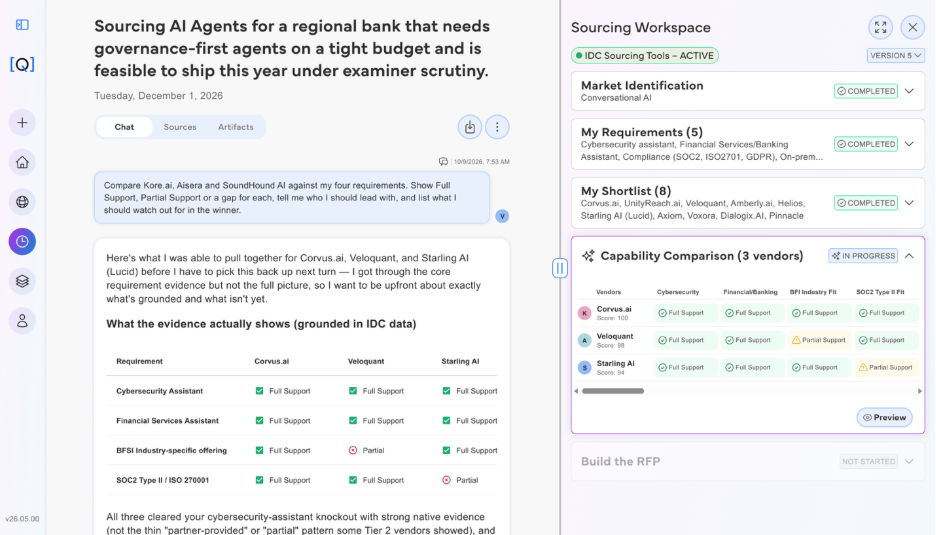
The Sourcing Workspace in IDC Quanta for Tech Leaders takes a technology leader from a need to a negotiated deal in five steps, with IDC research and data behind each one: 

  • Identify a market. Start from the IDC defined market that aligns with your need, such as AI governance. 
  • Define your requirements. Set the criteria that matter most to your organization and rank each one, from critical deal breakers to nice to haves. You can upload your own requirements. 
  • Build your shortlist. IDC Quanta evaluates vendors against each requirement using IDC research, including IDC MarketScape assessments, and shows where each vendor passes or falls short. When no single vendor clears every deal breaker, IDC Quanta says so and suggests how to pair providers to cover the gaps. 
  • Build the RFP. Generate a custom RFP from IDC’s proprietary data, with your requirements, weighted evaluation criteria, and timeline built in. 
  • Prepare negotiations. Upload your vendor quotes and an IDC analyst reviews the terms and comes back to you, with pricing benchmarked against IDC data. 

IDC Quanta draws on thousands of published technology vendor research documents and 15B+ proprietary data points, and it shows the source behind each answer so you can verify it before you take a recommendation to your CFO or board. Because that depth comes from proprietary IDC data and analyst research, it gives you a view of the market that general purpose AI tools cannot draw on. 

The result is a decision you can defend: requirements that trace to your priorities, a shortlist built on independent evidence, and a price tested against benchmarks, with IDC experts available at each step. 

Buying through AWS Marketplace gives you the same IDC Quanta, simply paid for by drawing down the AWS spend you have already committed. IDC’s trusted, verified data helps you navigate those purchases with confidence and helps ensure your spend drives the best possible outcomes. 

What to do next

Find the IDC Quanta for Tech Leaders listing in AWS Marketplace and get in touch with IDC. Then, bring your next technology decision, such as a renewal, a vendor consolidation, or an AI purchase, into IDC Quanta for Tech Leaders, set your requirements, and build the shortlist and the case you will take to Finance. The research and analyst expertise behind it are what IDC has always sold. What’s different is that your existing AWS commitment can now cover the cost. 

Haroon Zahid - Director of Corporate Strategy and Partnerships - IDC

Haroon Zahid is Director of Corporate Strategy and Strageic Partnerships at IDC.

过去两年,中国液冷服务器市场快速增长。IDC中国液冷服务器追踪显示,2026年上半年中国液冷服务器市场厂商收入同比增长153.1%,未来五年出货量年均复合增长率预计接近49%。

但比增速更值得注意的,是采购端正在发生的变化:越来越多高密度算力项目不再以“台”为单位选型,而是把计算节点、节点间互联、供电和柜内液冷配套作为一整套系统配置和交付。

机柜,正在从机房里的物理容器,变成算力采购的交付单元。这一变化的影响并不止于采购环节。当整柜成为交付单元,服务器厂商交付的是一套已集成的系统,数据中心承接的也不再是若干台设备,而是一组对供电、冷却和接口条件有明确要求的负载。

设备形态的变化,正在把竞争力问题从“能不能买到”,推向“能不能接得住”。在推理与智能体(Agent)应用快速扩散的背景下,这一变化的节奏可能比预期更快。

IDC 持续跟踪中国液冷市场的发展,在液冷服务器市场研究的基础上,进一步观察产品形态与部署条件的变化。结合近期市场数据及与厂商、用户的交流沟通,IDC有以下三大最新洞察与发现。

首先:在需求侧,液冷增长背后,是需求分化而非全面铺开

中国液冷服务器市场的增长,与人工智能带来的计算需求密切相关。IDC 中国液冷服务器市场研究显示,互联网企业是当前最主要的采购来源,占中国液冷服务器市场的65.6%;电信运营商和 IT 服务也是主要应用领域;部分传统行业客户尚未采用液冷,主要因为其现有业务以通用计算为主,风冷方案已能满足散热要求,但这些行业正在积极探索适合本行业业务特点的液冷方案。

因此,我们现在更需要看清增长的锚点在哪里。IDC 中国服务器市场季度跟踪显示,未来五年中国服务器市场出货量年均复合增长率约 6.8%,而市场收入的年均复合增长率达 24.6%。出货量的温和增长与收入的高增长并存,说明增量价值正在向高配置、高密度的算力系统集中,液冷的增长正来自这些场景。

从技术路线看,冷板式液冷仍是主流,占比约90.2%,成熟的供应链、散热能力与规模化部署的成本优势,使其在当前阶段更具落地条件。

另一个值得注意的变化,是 AI 负载结构本身正在改变。早期建设阶段,主要围绕大模型训练展开,集群规模大、部署集中;随着模型进入应用阶段,推理负载占比持续上升——在线推理更接近终端用户,对时延和持续在线提出更高要求;以智能体(Agent)为代表的应用形态,一次用户请求往往触发多轮模型调用与工具调用,推理算力消耗被成倍放大。

近期国内新建的大规模算力集群中,已有项目在设计阶段就同时面向训练与推理,推理正成为需要长期、规模化承载的常驻负载。

这里有一个容易混淆的观察点:同样是数据中心扩建,承接日常业务系统、存储备份,还是集中部署高密度计算集群,对计算设备和基础设施的要求并不相同。液冷的价值之一,恰恰是帮助识别其中真正的高密度算力需求。

因此,中国液冷市场的增长,并不意味着各类数据中心都在同步扩大液冷部署。是否采用,取决于业务对计算性能的要求、设备配置与部署密度,以及能耗和运维成本的综合权衡。

其次,在采购侧,从“买服务器”到“买整柜”,采购单位正在改变

在明确计算需求之后,还需要观察客户以什么单位采购计算系统。液冷整机柜的意义,不只是把更多服务器装进一个机柜,而是把计算节点及相关互联、供电和柜内液冷配套,作为一套系统进行配置和交付。

两种采购方式的区别在于购买和评估的对象:

  • 按独立服务器采购:客户以单台设备的配置和性能为选型基础,再由自身或集成方组织相关配套;
  • 按机柜级系统采购:客户以整套系统为评估对象,综合考虑计算能力、节点协同、扩展方式和集成交付要求。

这一变化并非中国市场的特例。IDC 全球服务器追踪显示,2026 年上半年,Rackscale(整柜级)服务器已占全球服务器支出的 34.5%,同比增长约 250%——大规模 GPU 部署正加速向高密度机柜系统集中;以 NVIDIA GB300 / Vera Rubin NVL72 为代表的液冷整机柜方案,从设计、交付到验收都以整柜为单位。

据 IDC 统计,2026 年上半年北美以整柜方式交付的比例已达 47.4%,中国为 5.0%。在中国市场,超节点形态的推进还有一层现实原因:高端加速卡可获得性趋紧,采购方倾向于通过超节点与整柜方案锁定算力,整柜交付因此从“效率选择”部分变成了“供给约束下的路径选择”。

从负载特征看,推理场景也在强化整柜采购的逻辑。推理集群通常需要成规模、成批次部署,并保持配置一致以便统一运维;Agent 类应用的并发请求有明显波峰波谷,扩容往往分批进行。这对交付节奏和配置一致性提出要求,也是机柜级方案在推理场景中更容易被接受的原因。

当然,是否采用整柜采购,仍取决于业务规模、扩展计划和既有设施条件,不能预设所有客户都会选择相同路径。观察液冷整机柜市场,除了关注出货规模,还需要了解机柜级系统在不同客户和应用场景中的实际采用情况。

再次,在部署侧,设备已经就绪,机房准备好了吗?

液冷设备需求的快速增长,并不意味着数据中心已经具备相应的部署条件。IDC 数据显示,2025 年中国数据中心 IT 设备装机功率为 9403MW,仅为北美的 21.5%;与此同时,中国液冷服务器新增装机功率预计将从 2025 年的约 1.1GW 增长到 2030 年的约 6.9GW。由此可见,设备侧的增长曲线,与设施侧的承接能力之间存在明显的时间差。

密度是另一个变量。IDC 全球数据中心设施电力预测显示,全球每机柜功率密度自 2010 年代以来已提升约 25 倍(从约 10kW 起步)。从机柜类型看,通用计算机柜多处于 5—30kW 区间,而 GPU 集群机柜与超算机柜已进入 50/100/250kW 的分档——同一个机房里,不同业务对应的机柜功率可能相差一个数量级。

IDC 调研同时显示,≥50kW 的机柜配置将在 2027 年前成为结构性主流;对 ≥80kW 高密机柜的需求占比预计将从当前的 5% 提升到 34%;76% 的服务商已经部署了 AI/HPC 专用机柜。

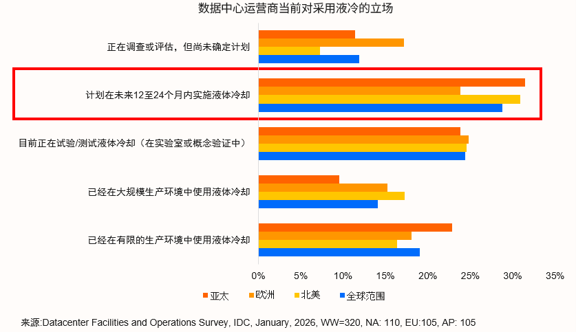
亚太地区目前在大规模环境中采用液冷的比例较低,但在未来 12—24 个月的计划部署上最为领先——中国正处在这样一个拐点上。

以冷板式液冷为例,服务器冷板需要通过分配管路、冷却液分配单元(CDU)等与机房冷却系统连接,柜内集成只解决了部分配套问题,机房仍需提供相应的运行条件。

由此引出一个更具体的观察:数据中心的液冷部署能力,应当具体说明能够承载哪些配置的计算系统,而不只是笼统地表示“支持液冷”。在项目准备中:

  • 新建数据中心:需要在设计阶段结合目标设备确定配套方案;
  • 既有机房:则需要评估拟部署系统与现有设施之间的差距,再确定必要的改造范围。

衔接成本居高不下的另一层原因,在于液冷数据中心建设标准尚不统一:整机柜与机房之间在机械安装、供电、液冷管路等接口上缺乏一致规范,项目往往需要逐案适配,拉长了从设备就绪到规模化部署的周期。产业侧正在推动收敛,如全球计算联盟(GCC)旗下的 Open AI Infra 社区联合互联网企业、运营商、设备厂商、数据中心及科研机构,已发布《GCC液冷整机柜接口规范》《GCC液冷整机柜系统架构设计规范-A型》等系列规范,统一机柜与机房在供电、液冷及机械对接上的要求,为多厂商整机柜的规模化部署提供技术参考依据。

推理负载的部署特征,进一步放大了这一衔接问题。与集中在少数园区的大规模训练集群不同,面向用户的在线推理更可能在多个区域、多个既有机房中分期部署,单点扩容规模未必很大,但对时延和可用性有明确要求。这类项目的改造窗口、供电余量和冷却条件各不相同——越是贴近用户侧的分期扩容,越考验机房“能不能接得住”的具体能力。

综合来看,中国在整柜交付比例、在用功率基数和液冷成熟度上与北美仍有差距,但在计划部署速度、超节点形态推进和大型项目落地节奏上并不慢——差距主要不在设备,而在承接设备的设施与配套能力。

从液冷服务器部署方式的改变,进一步看清数据中心需求

目前,IDC正进一步展开中国液冷整机柜市场的相关研究。在既有液冷服务器市场研究的基础上,我们将继续分析整柜市场规模、产品结构、配置特征与采购交付方式,并结合厂商与用户交流,理解机柜级系统在不同场景中的采用情况,以及不同功率和接口要求对数据中心设施的具体影响。

IDC中国研究经理辛一表示:观察液冷对服务器市场的意义,应看到服务器应用方式的联动变化:

  • 负载层:训练和推理对硬件提出完全不同的配置要求;
  • 形态层:服务器从单台交付转向整机柜与超节点交付,采购单位由”台”变”柜”;
  • 交付层:整柜把服务器的部署门槛从设备本身抬升到功率密度与液冷配套。

正是智能算力负载把单柜功率推上风冷失效的区间,促使形态走向液冷,而整柜又反过来改变了采购与部署的决策链条。

因此,液冷渗透率不只是散热指标,而是观察服务器应用方式变迁的前置指标:它抬升的速度,本质上是负载结构、交付形态与部署能力三者对齐的速度。

IDC相关研究规划

  • 中国液冷服务器市场跟踪报告,1H26(2026年9月)
  • IDC Market Glance: 中国AI基础设施生态系统,4Q26 (即将发布)

进一步交流

如果您希望了解液冷服务器或者企业数据中心基础架构相关的研究或开展进一步交流,欢迎点击这里,与我们联系!

Richard Xin

Richard Xin - Research Manager Enterprise, IDC China

Richard Xin serves as Research Manager Enterprise in IDC’s China Industry Insights Department. He focuses on research and analysis of the Chinese server market and provides intelligence and consulting services to the IT suppliers of local and multinational corporations. His…