If your most critical systems went down tomorrow because of a cyber attack, how long would it take to get running again? And when did you last test that?

Michelle Abraham, Research Vice President on IDC’s Security and Trust team, says leadership should know both answers. In a recent conversation, she explains what that takes: cybersecurity fundamentals that rarely make headlines, such as knowing what you own and who owns it, and tracking whether risk is going down.

What cybersecurity fundamentals do organizations still get wrong?

Abraham’s answer starts with what hasn’t changed. “Foundational items like asset visibility and making sure you have the data collected are as important as they always have been,” she says. Knowing what you have comes first. Identity and access controls follow: least privilege, strong authentication such as MFA, credential hygiene, and regular reviews of who has access. Then come the logs and the right detections, plus tested processes for when an incident does pop up.

She notes these topics get less airtime than newer technology, and she doubts that a tool for every threat category makes an organization secure.

Does buying more security tools make an organization safer?

Not on its own. “More tools can just mean more noise,” Abraham says. If a team can’t act on the alerts from the tools it already has, another one adds to the pile. Fragmentation adds complexity, and “complexity can be the enemy of security.” Each tool tends to see only part of the attack surface, so the data has to be connected or attackers will find the gaps between tools.

Abraham ranks backup and recovery systems above most detection tools. Before the next purchase, ask what your team can’t act on today.

How should leaders measure whether security is improving?

If tools don’t show whether security is working, something else has to. Reports that count scans run or issues found measure effort. Counting activity, in her words, “just tells you how busy your security team is, but not whether you are any harder for attackers to breach.” She adds that a count doesn’t say whether critical issues were fixed or how long they sat open.

Her alternative starts with the business: which threats matter most, how much risk the organization will accept, and whether current risk sits within that level. Useful measures include how complete your asset inventory is and how much of it controls like MFA and endpoint protection cover. Third parties belong on the list: she sees organizations attacked through vendor systems, including data warehouse and backup systems. The goal is “looking at the trends more than the counts,” with risk moving down over time.

Why do security fixes stall between teams?

In the handoffs, Abraham says. Discovery tools can count the same asset more than once, so teams need a way to deduplicate. The bigger sticking point is ownership. When a vulnerable asset turns up, the security team usually isn’t the one who fixes it. One person may own the asset and someone else the application running on it. Without a clear record, the issue ping-pongs around and the fix waits. Automated asset tagging helps, along with ownership information that matches across every system.

Prioritization matters here too. A lower-severity issue that is reachable, sits on a critical asset, and is being exploited should move to the front of the queue. A high CVSS score can send a team after an exposure that doesn’t matter in its environment. Even a well-ranked list stalls, though, if the people who own the fix don’t treat it as their job.

How do you get the whole organization to own security?

The people who fix a problem often sit outside the security team, so Abraham recommends making the work easy for them. Give fixing teams a ranked list of validated exposures, with patch information or recommended mitigations attached so nobody starts from scratch. Set deadlines by asset criticality, such as three days for one class of asset and a week or two for another, and define an exception process. “If the remediation process isn’t tracked, oftentimes it doesn’t happen.”

Then make risk visible by department in front of the management team. Organizations have told her this creates enough competition that departments want to look better in the dashboards. She has also heard of it applied to asset tagging: who has the most assets with complete tags.

What one question should every leader ask?

Abraham leaves leaders with one question to ask their security teams:

“

If our most critical systems went down tomorrow due to a cyber attack, how long is it going to be till we’re operating again?

— Michelle Abraham, Research Vice President, Security and Trust, IDC

Compare the answer with how long the business can survive without that system. A mismatch puts decisions in leadership’s hands: a change to process or IT architecture, or more funding.

Abraham also urges testing, and mapping the dependencies between systems. If your identity system is down, you may not be able to bring up the others. Start there: find out what has to be running before anything else can.


Christina Cardoza - Content Marketing Manager - IDC

Christina Cardoza is a Content Marketing Manager at IDC, where she specializes in brand content and social media strategy. With a background in journalism and editorial leadership, she has a proven ability to transform complex technology topics into clear, actionable insights.

For years, enterprise technology leaders across industries have operated under a flawed assumption: fast decision-making and rigorous compliance exist on opposite sides of a zero-sum game.

But in today’s rapidly changing tech landscape where AI is accelerating everything we do, the math no longer adds up. According to IDC research, AI agents are projected to grow 78x between 2025 and 2029. That’s a clear sign of the velocity of today’s market, and it isn’t slowing down. Yet many organizations report seeing no return on their generative AI investments, and IDC expects 40% to miss their 2026 AI goals.

Scale and speed of delivery are outpacing organizational confidence. Yet, tech leaders are attempting to address two fundamentally different challenges with the same default instincts: staying in control of risk while growing and having confidence that investments will pay off.

The underlying challenge: Speed vs. control

As a dual CIO and CISO, I’m responsible for driving our organization’s innovation initiatives, while ensuring we’re not exposed to risk as we grow.

When I talk to fellow executives in tech-centric roles, they express a variation on the same tension: business partners want AI adoption now, but compliance teams need to feel confident that the security and compliance measures exist. Both instincts are correct, but closing that gap with instincts instead of evidence exposes the enterprise to risks:

  • Rising threats: Insider-driven compromise is up 2x year over year.

  • Costly lapses: 38% of breached organizations ultimately paid a ransom.

These lapses occur when the rate of technology adoption outpaces an IT and security team’s ability to verify who has access to what and why.

Protecting the bottom line is part of the job description

Execution friction extends directly into spending. In fact, research shows that 67% of organizations are overspending on their AI agent budgets by more than 10%. Meanwhile, more than half of us are negotiating vendor deals without proper pricing benchmarks for this rapidly developing category.

There’s no doubt that advanced AI capabilities can accelerate innovation and productivity. But, as leaders and executives, we also have a responsibility to protect the bottom line. Balancing the two means bringing rigorous evidence to both sides of the equation: balancing speed and innovation with defensible risk and cost modeling.

Verified data is crucial

Navigating these enterprise shifts requires unlearning old habits, as we stop treating speed and control as sequential steps and start grounding both in verified data.

Historically, architecture and investment decisions relied heavily on vendor-provided materials. While any good leader carefully vets those inputs, that dynamic has the same limitations as a student grading their own test: the data has blind spots.

By embedding an independent, external view directly into everyday workflows to validate vendors and calculate ROI in real time, leadership can eliminate guesswork across both execution speed and risk mitigation.

Putting verified data to work with IDC Quanta

IDC Quanta for Tech Leaders solves the equation. A new AI-powered technology intelligence platform built specifically for CIOs, CTOs, Heads of AI, and other leaders driving critical technology transformation, IDC Quanta for Tech Leaders combines decision-grade answers, technology vendor selection capabilities, and price benchmarking, delivered inside tools your teams already use like email, Claude, and more.

Every response, vendor shortlist and pricing analysis is sourced and verified, drawing on thousands of published technology leader research documents, $500B in tracked tech market spend, and 15B+ proprietary IDC data points tracked annually. Its intelligence backed by experts that not only allows your teams to move faster on architecture decisions, vendor evaluations, and deal terms; it’s a foundation that will hold up under scrutiny.

As “client zero,” I look at a product like this twice: once as a CIO asking whether it helps my team move faster to support innovation, and once as a CISO asking whether I would approve it. Four things stand out:

  • Evidence I can trace -Every response and recommendation in IDC Quanta is fully cited, so each data point leads back to the research behind it. That gives me numbers I can defend in front of the board.

  • Context that stays mine -IDC Quanta securely cross-references internal context, such as my IT roadmaps, vendor contracts, and data sets, with IDC’s independent global market research. That means my teams spend less time synthesizing information and more time delivering for our partners across the business.

  • Security I can sign off on -IDC Quanta runs in isolated private workspaces with AES-256 encryption, 90-day automatic deletion, and a strict zero-model-training policy. Those are the controls my security review looks for first.

  • Intelligence embedded in my workflows -IDC intelligence is available inside tools teams already use, including email, AI assistants like Anthropic’s Claude, and more, so information sourcing and validation happens at the moment of the decision.

The next evolution of enterprise intelligence

Every organization faces the mandate to do more, in less time. The leaders pulling ahead have made verification part of how they move, with evidence behind each vendor decision and budget request before it reaches the board.

If that is a conversation you want to have, I’m glad to talk it over. You can also see how IDC Quanta for Tech Leaders works at idc.com/quanta/tech-leader/ or schedule a personalized demonstration.

Dave McKenna - Chief Information Officer & CISO - IDC

As Chief Information Officer for IDC, Dave McKenna oversees IT operations, cybersecurity, and the company’s enterprise AI automation and modernization initiatives. Leveraging deep expertise in data architecture, risk management, and strategic technology roadmaps, Dave plays a central role in aligning IDC’s technology capabilities with its broader business objectives.

If part of your job is staying ahead of where the market is headed, the stack you built your 2026 plan around won’t survive to 2028. IDC predicts today’s enterprise stack won’t exist in its current form by 2030, and by 2028, 42% of the world’s largest companies will have already rationalized their entire agent and apps portfolio just to keep pace.

That’s not an IT problem. It’s a shift in where value gets created, how deals get won, and what your go-to-market story needs to say next, and it belongs at the leadership table, alongside your P&L and risk register.

That’s the premise behind IDC FutureScape 2027: The Great Rewrite, IDC’s annual technology predictions event for Asia/Pacific, taking place live on 13 November 2026, 8:00 AM–12:00 PM SGT, at the Conrad Singapore Orchard.

The theme: The Great Rewrite

Intelligence is leaving the cloud for the device. AI factories run large-scale inferencing, agents work the network edge, and hardware is being rebuilt to carry it. Robots have moved off the roadmap and onto the factory floor. Quantum computing is out of the lab and into five-year plans, with real use cases beyond cryptography. Connectivity is heading into orbit and under the ocean floor, redefining what “always-on” means. Work is being redivided between people and agents, creating job titles, like Agent Supervisor, that didn’t exist a year ago.

Even the money is being rewritten. Knowing matters less than acting fast, and that shift is forcing CFOs to build an entirely new financial discipline just to keep up with what AI actually costs.

Dozens of evidence-backed forecasts, across every layer of the stack and every industry, converge on one conclusion: AI isn’t being added on top of the technology industry. It’s rewriting it from underneath, from the compute layer to the org chart.

The morning is packed with evidence. Agenda highlights include:

  • Keynote: The Great Rewrite
  • AI’s Reckoning: The Race, the Bill and the Ground It Stands On
  • AI Infrastructure Race: The Compute, Power and Trust Stack Reshaping Asia Pacific
  • Industry Panel: From AI Deployment in Practice to Emerging Capabilities
  • Winning in the Reimagined Technology Leader Landscape
  • Live Q&A and closing remarks

The full agenda, with timings and speaker bios, is available to download from the event page.

As Sandra Ng, senior vice president, Research and Data Intelligence at IDC, puts it, “The technology stack isn’t just evolving, it’s being rewritten from the compute layer up. Every leader in this room has a stake in that rewrite, whether they’re setting strategy, building the roadmap, or telling the story to the market. FutureScape 2027 gives you the evidence to make your next move with confidence, instead of waiting to see how the rewrite plays out.”

Why business and technology leaders need to be in the room

Predictions are only useful if you can act on them. That’s what separates FutureScape from a typical trends report: IDC analysts turn these predictions into a diagnostic tool to help technology leaders develop their enterprise IT strategy and roadmap and navigate their decisions with confidence.  If you’re a technology provider, IDC FutureScape reports and analysts can help you identify where your brand needs to position to win in the agentic economy with third-party backed content.

Whichever seat you’re in, this belongs on your calendar for three reasons: early access to evidence-backed predictions for 2027–2031, ahead of your competition; the breakthrough trends defining 2027 and the evidence behind how they’ll reshape IT roadmaps, purchase decisions, and the stories you tell in-market; and the best network in the room, with 150+ industry peers, technology leaders, and IDC analysts all in one place.

This shows up differently depending on your seat:

  • C-suite: know which shifts change your capital allocation and risk exposure before your board asks.
  • Sales: get evidence that reframes client conversations around where the market is heading.
  • Marketing: get the narrative and proof points before your competitors publish theirs.
  • Product: see which categories, from Agent Supervisor tooling to sovereign AI infrastructure, are being created before they have established players.
  • MI/Strategy: build your next planning cycle on the same evidence the analysts used to produce it.

 “Every year, FutureScape asks the same question: what’s actually going to matter in the year ahead, and what’s just noise? This year the answer touches everything, from where AI infrastructure lives to who’s accountable for governing it. My hope is that leaders leave this room with a clearer view of where to place their bets for 2027,” said Dr. Chris Marshall, vice president, Financial Services Research, IDC.

IDC FutureScape has already earned the trust of business and IT leaders across the region:

“The AI buyer engagement playbook was a game-changer — exactly what service providers need to stay ahead.” – Analyst Relations, Software

“The insights at IDC FutureScape helped us understand not just where AI is going, but how to get there with confidence.” – VP Southeast Asia, Korea and Channels, Solutions Provider

“Appreciate IDC for the bold, global conversations around the future of tech — lots to take forward.” – Industry Analyst, Consulting

Your next move

The technology stack is being rewritten layer by layer, and the leaders who show up with evidence will navigate it with confidence. Seats across the region are limited.

Register now for IDC FutureScape 2027 and reserve your seat at the Conrad Singapore Orchard on 13 November 2026.

Vanessa Ong - Senior Marketing Specialist, Demand Generation - IDC Asia/Pacific

Vanessa Ong is Senior Marketing Specialist, Demand Generation, at IDC Asia/Pacific, where she develops and executes integrated marketing programs that generate qualified leads and support business growth across the APJ region. A seasoned marketing professional with strong expertise in social media marketing and content creation, she is known for turning creative ideas into high-impact campaigns. Vanessa has played a key role in flagship programs including the Future Enterprise Awards and FutureScape, and is recognised as a collaborative team player who brings energy and expertise to every initiative.

Every year, the IDC CIO Summit Türkiye takes the temperature of the country’s technology leadership. On May 6–7, 2026, during the 17th edition of the summit in Sapanca, more than 400 CIOs, chief technology officers (CTOs), and digital leaders gathered under a single banner called “The Rise of Agentic Systems.” The mood in the room told the real story. Türkiye is not preparing for the agent economy; it is already inside it.

The numbers behind that shift are hard to ignore. IDC projects more than a billion AI agents in production by 2029, generating 217 billion actions and 3.7 trillion tokens every day at a delivery cost above $68 billion. Global AI spending is set to climb from $940 billion in 2026 to $2.1 trillion by 2029. The opportunity is obvious. The question that ran through every session was more grounded: What does it actually take for a Turkish enterprise to operate, govern, and compete when the workforce includes software that acts on its own?

The summit confirmed that Türkiye’s technology leadership community is firmly inside the agent economy, not preparing for it. Foundational investments in sovereign cloud, hyperscaler regions, AI-ready data platforms, and responsible AI frameworks are being committed to at scale. The question is no longer whether to act, but how to sequence the work.

The seven shifts

  • In Türkiye, the CIO is becoming the chief value architect. CIOs who continue to lead with technical key performance indicators (KPIs) alone will lose ground to peers who lead with business outcomes (revenue uplift, margin protection, customer experience, and resilience) and treat technology metrics as enablers.
  • The CTO is becoming the chief transformation officer. The CTO title is increasingly a misnomer for what the role demands. The CTO mandate has evolved toward a chief transformation officer remit, with technology leadership evaluated on continuous business outcomes reported in real time at the C-suite. The most effective leaders will own transformation end to end.
  • Foundations, including data, infrastructure, and sovereignty, are the new battleground. The expanding footprint of hyperscaler-grade local infrastructure in Türkiye materially changes the latency, sovereignty, and cost calculus. IDC expects accelerated repatriation onto local sovereign and hybrid platforms over the next 12–18 months, with platformization (AI development platforms, data hubs, and low-code governance) outpacing point AI tooling investments.
  • Agentic AI is in production, and governance is the hard part. The next two years will be defined less by model selection and more by orchestration, observability, agent identity, model armor, and the human–AI interface. Enterprises that succeed will redesign roles, controls, and accountability rather than layer agents on top of unchanged processes.
  • Responsible AI is an operating discipline, not a slide. Mandatory AI literacy programs, continuous model life-cycle management, and use case–level authorization frameworks point to where the market is going: dynamic, embedded guardrails aligned with both personal data protection law and incoming local AI regulation. IDC recommends that CIOs in Türkiye treat responsible AI as a design constraint upstream of every initiative, not a compliance review at the end.
  • Talent and HR are now part of the technology stack. Bringing business unit shadow IT teams into formal partnership, running structured AI literacy programs, and rethinking IT–HR collaborations are no longer side projects. They are the operating model of the agent economy enterprise.
  • Resilience and innovation must be pursued together. Türkiye operates in an environment in which energy, geopolitics, currency, and demographics all introduce volatility. The CIO’s job is to design technology architectures (hybrid, sovereign, observable, and governed) that absorb shocks while still compounding business value.
Eren Eser

Eren Eser - Associate Research Director, IDC Türkiye

Eren Eser is a seasoned analyst with over 22 years of experience in the ICT sector. As a core member of IDC's Global Services Insights team, he directs all ICT research and consulting engagements in Türkiye and leads IDC's sustainability…

Key questions answered in this article: What is the AI supercycle and what does it mean for Japan? What are the biggest gaps between AI vendors and enterprise buyers in Japan? How is AI changing B2B technology buying decisions?

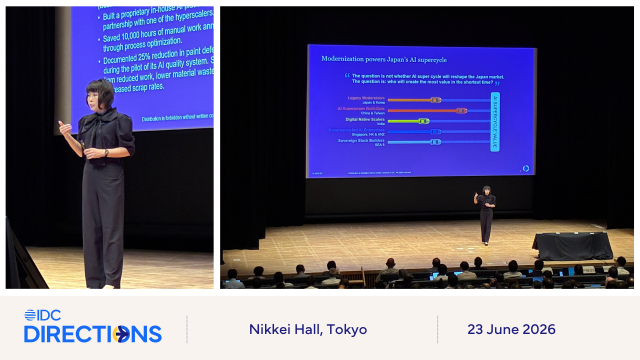
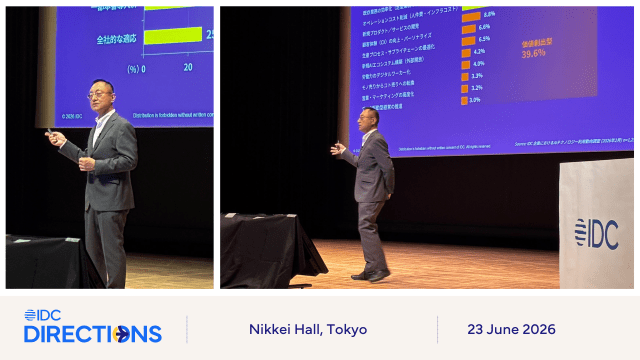
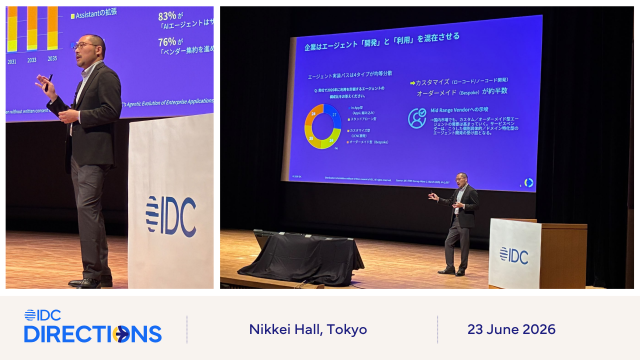
The energy in the room at IDC Directions Tokyo 2026 on June 23 said it all: Japan’s AI moment is no longer approaching — it has arrived. And the central message from IDC’s Senior Vice President Sandra Ng was both a wake-up call and a roadmap. The question, as she put it bluntly, is not whether AI will reshape the Japan market. It is: who will create the most value in the shortest time?

IDC Directions Tokyo 2026 brought together close to 400 attendees, with 65% at Director level or above, a room full of decision-makers, not just observers. Analyst 1-on-1 sessions were fully booked, and the volume of questions from the floor made one thing clear: the conversation was hitting a nerve.

The Supercycle Is Real and Japan Is Playing Catch-Up

To understand the scale of what is happening, consider this: global IT spending in 2025 is growing at 14% on a $4.2 trillion market base, the strongest IT spending growth since 1996. Back then, that same 14% growth rate applied to a $700 billion market. The numbers are in a different league entirely. (Source: IDC Worldwide Black Book, 31 March 2026)

This is the AI supercycle. While regions like China, Taiwan, and India are racing ahead as “AI Superpower Built-Outs” or “Digital Native Scalers,” IDC positions Japan alongside Korea as a Legacy Modernizer, a market where the path to AI value runs directly through modernization. That is not a disadvantage. It is a specific strategic imperative.

Japan’s AI market reflects this momentum. Domestic AI infrastructure spend is expected to reach $9 billion by end of 2026, growing at a 24% CAGR through 2029. AI services are projected to hit $8 billion by 2030 or 3.2x the 2025 figure. Moreover, 61% of CEOs in Asia Pacific named agentic and generative AI at scale as their number-one new investment priority. (Source: IDC Worldwide AI and Generative AI Spending Guide, Forecast V1 2026; IDC CEO Survey, March 2026)

The Vendor-Buyer Disconnect Is Costing Everyone

Here is where the conversation got uncomfortable and important.

Sandra Ng identified four persistent gaps between what enterprise buyers in Japan need and what technology vendors are actually delivering:

Gap #1 — Business case clarity. Buyers want outcomes grounded in their industry, not generic global benchmarks. “Show me what this looks like for a Japanese manufacturer” is a very different ask from a global case study slide.

Gap #2 — Total cost of AI ownership. This one deserves more attention than it typically gets. Hidden AI implementation costs in Japan — covering data preparation, system integration, ongoing model maintenance, compliance monitoring with METI guidelines, and change management, routinely add 50–70% beyond the headline technology price. Vendors who do not address this upfront are losing trust at the CFO conversation.

Gap #3 — AI governance readiness. Japan’s regulatory environment is real and specific. The FSA AI guidance, METI’s AI governance framework, and the Act on Protection of Personal Information (APPI) set high standards. Buyers are moving faster than many vendors’ governance answers can keep up.

Gap #4 — The “show me” moment. Japanese enterprise buyers want a local reference customer, a deployment timeline, and measurable outcomes, not a global success story. Vendors who cannot produce this are losing shortlist positions.

What Japan’s Leading Enterprises Are Actually Doing

These gaps are not theoretical. IDC’s CxO conversations in 2025–2026 point to concrete examples of how Japan’s most forward-thinking companies are navigating them:

  • Toyota built a proprietary in-house AI platform with a hyperscaler partner, saving 10,000 hours of manual work annually and documenting a 25% reduction in paint defects through AI-assisted quality systems.
  • Tokio Marine responded to METI and FSA guidance by publishing a 5-pillar AI governance policy first, covering transparency, human oversight, bias elimination, data protection, and operational reliability, before deploying AI for document and image analysis. Governance policy first, deployment second—this is the sequence Japan’s regulators now expect.
  • Yamato Transport used AI-driven supply chain optimization across 1.6 million corporate customers and 4,000+ logistics partners, targeting a 65% reduction in labor costs and a 42% cut in GHG emissions by optimizing relay points across 80 routes.

These are not pilots. These are production deployments with documented outcomes—exactly the reference stories buyers are demanding.

Your Buyers Are Already Using AI to Research You

One of the most striking data points from Sandra Ng’s presentation is that 84% of global technology buyers agree that AI will change how their companies buy technology in the next 12 months. (Source: IDC B2B Technology Buyer Survey 2025, WW n=406)

The buying journey has already shifted and it looks like this: AI discovery → vendor website check → peer and colleague validation → channel partner consultation → shortlist. If your brand and solutions do not surface clearly when a CIO or CFO uses ChatGPT or Google Gemini to research a purchase decision, you are being eliminated before you even know you are in the running.

This makes Answer Engine Optimization (AEO) and Generative Engine Optimization (GEO) business-critical capabilities, not just marketing experiments. By 2027, 35% of Japanese organizations are projected to have unified, coordinated AI governance in place. The vendors who are visible, credible, and well-structured in AI-generated answers will have a compounding advantage. (Source: IDC FutureScape 2026 – AI-Fueled Business Strategies, Japan)

Agentic AI: The Next Competitive Frontier

The broader industry shift reinforces why speed matters. As highlighted in the presentation by IDC Japan’s Takuya Uemura, the AI supercycle is now entering its second investment wave — moving from infrastructure build-out to enterprise application and services adoption. Enterprise AI platform, app, and services spend globally is projected to grow from $400 billion in 2026 to $1 trillion by 2029. (Source: IDC Worldwide AI and Generative AI Spending Guide V1 2026)

Critically, 83% of buyers surveyed agreed that AI agents are lowering switching barriers between suppliers. The vendors who lock in outcome-based relationships now, before the market commoditizes, will be the ones defining the next competitive moat.

Three Moves That Matter Right Now

Sandra Ng’s closing framework was direct and actionable:

Do now: Replace generic benchmarks with a single Japan reference customer, one metric, one timeline. Map your go-to-market pitch to the full buying committee, not just the CIO. Fix your AI discoverability gap immediately.

Do this year: Make ROI transparency your competitive weapon. Build deployable agentic workflow stories. Invest in AI-optimized third-party content that earns citations in AI-generated answers.

Bet on this: Position into AI governance, trust, and compliance as a revenue line, or become the vendor that makes compliance an outcome rather than a conversation. Start measuring your share of answer by category, persona, and geography. Execute a layered discovery strategy: SEO + AEO + GEO. (Source: IDC C-suite Survey, September 2025, APJ, n= 300)

Japan’s AI Supercycle Will Not Wait

The window to establish leadership positioning in Japan’s AI market is open—but it will not stay open indefinitely. The enterprises that move from experimentation to outcome-based deployment, the vendors who close the four gaps, and the organizations that make themselves discoverable in AI-powered buying journeys are the ones who will define the next era of Japan’s technology market.

The conversation that started in Tokyo continues in Osaka.

Join us at IDC Directions Osaka on July 28, 2026 to go deeper on how Japan’s AI supercycle is reshaping your industry, what the data says about where the next wave of value will be created, and how your organization can get ahead of it. Register for IDC Directions Osaka today. Seats are limited.

Mike de la Cruz - Corporate Communications Director - IDC Asia/Pacific

Mike de la Cruz is Corporate Communications Director for Asia Pacific at IDC, bringing over 25 years of career experience in marketing and communications for the information technology industry. He shapes and amplifies IDC's research-driven narratives, positions executives and analysts as authoritative industry voices, builds relationships with top-tier technology and business media across the region, ensures consistent brand voice and positioning, develops content that drives audience engagement, and leverages social media and digital communications to extend IDC's reach.

For years, small and medium-sized businesses took the same approach to AI: watch, wait, and let someone else absorb the cost of a failed experiment. In 2026, that calculus has changed. IDC’s Katie Evans, Senior Director of Worldwide Small and Medium Business Research, sat down to share what the latest data, drawn from more than 2,700 IT decision-makers across 23 countries, reveals about where SMBs are now, what’s driving the shift, and what any SMB owner should do before making their first AI investment.

The “fast follower” strategy paid off

Three years ago, IDC research consistently surfaced a pattern in how SMBs talked about AI. They weren’t early adopters. They were deliberate holdouts, not because they didn’t see the opportunity, but because the risk calculus didn’t work in their favor.

“They would say, ‘I want to be a fast follower,'” Evans explains. “We don’t have the budget for a failed AI experiment.”

That instinct turned out to be sound strategy. While large enterprises absorbed the costs of early-stage AI experiments (the failed pilots, the shaky implementations, the expensive custom builds), SMBs watched and learned. By the time vendors began packaging AI into the tools SMBs were already using, those businesses knew exactly what they were looking for.

IDC’s 2025 survey captured the inflection: in 2024, AI ranked third among forward-looking technology priorities for SMBs. By 2025, it had jumped to number one. The share of SMBs not using AI at all dropped from 11.2% to 6.3% in a single year.

The proof arrived. The fast followers moved. And the first thing most of them did was look inward.

What SMBs are actually using AI for

The businesses that have moved fastest share a common starting point: they looked at their own operations before they looked at any vendor. The number one current AI use case for SMBs worldwide reflects that instinct: generative AI for content creation. That includes marketing copy, internal documentation, customer communications, and code. It’s the entry point, and it’s well-established.

But the picture is expanding. IDC’s research shows SMBs are moving beyond isolated productivity tools into more operational territory. Digital assistants to manage tasks are rising fast, particularly among smaller businesses with lean staff. Robotic process automation (RPA) is growing. And the next wave, agentic AI, which can take autonomous action on behalf of a business, is already on the planning horizon.

Evans points to a practical lens for SMBs trying to decide where AI fits in their business: look at where work is piling up.

“Look for high-volume, repetitive tasks: invoice processing, data entry, inventory tagging, moving figures from PDFs to spreadsheets,” she says. “If those tasks are increasing as your business grows, you’re building a bottleneck. That’s where AI can take over.”

There’s a retention argument here too. SMBs, which often can’t match the compensation packages of larger competitors, can use AI to remove the dull, error-prone work that drives good employees out the door. “If you can make their workplace more fulfilling by leaning into technology,” Evans notes, “it really helps with retention.”

The goal, she is clear, isn’t to save a few minutes per task. It’s to increase revenue per employee.

But knowing where AI can help is only half the equation. The other half is finding a solution that a lean, non-technical team can actually use.

Why embedded AI is winning

Here is the constraint that shapes everything else for SMBs: 40% of the nearly 3,000 SMBs IDC surveyed do not have a single full-time IT employee in-house. That number has held steady for several years, even as SMB technology budgets have grown. A third of SMBs cite lack of IT staff as a top challenge. Another third flag user adoption as a major obstacle.

These numbers explain why standalone AI point solutions are losing to embedded ones.

“SMBs that are seeing real results from AI are not adding it as a separate point solution,” Evans says. “They’re turning on AI capabilities that are already inside the platforms they use every day: their CRM, their ERP, their accounting system.”

The logic is straightforward: no new interface to learn, no separate implementation cycle, no change management burden. The vendor is already known and trusted. The AI feature is just a feature that gets switched on.

Vendors have started meeting SMBs where they are. IDC’s 2026 market data shows a clear shift toward GenAI as the top forward-looking technology priority, overtaking traditional AI and process automation. And increasingly, vendors are embedding those capabilities directly into their products: consumer-grade interfaces, guided chat prompts, no-code and low-code options, designed for non-technical staff with no IT backup.

“As easy as you can make AI for your employees to use is the key,” Evans says. “Think of it like an app on your phone. Something that just works.”

Vendors are getting there. But two obstacles are slowing the journey for SMBs that are ready to move.

The barriers that still need solving

Unpredictable pricing is the first. When an SMB implements an AI capability, sees it working, and then watches its bill triple because it crossed an invisible usage tier, trust breaks down fast. Evans puts it plainly: “SMBs have tighter budgets. Unpredictable costs are a big red flag.”

What SMBs want is transparency: credit-based models that let them control usage, freemium options that allow experimentation before commitment, and clear communication about what each pricing tier actually means. The lowest price isn’t always the winner. Predictable pricing, where the total cost of ownership is legible, is.

Security is the other major barrier, and it’s gotten bigger, not smaller. IDC’s 2026 data found that implementing new technology securely is the number one challenge SMBs name when asked what’s standing between them and their business priorities. It ranked above lack of budget, above user adoption, above lack of IT staff.

“AI is a data guzzler,” Evans says. “It constantly needs new, fresh data to train its models. So SMBs are asking: where is the data coming from? Are you using my customers’ data? How long is it being stored?”

The ask from SMBs is clear: security and compliance built in, not bolted on. A business with no cybersecurity expert on staff needs its vendor to handle that layer. And for an SMB still building consumer trust and brand reputation, a breach isn’t just an operational disruption. It’s potentially an existential one.

IDC forecasts that 50% of SMBs will increase security spending over the next 12 months. For tech suppliers, that is signal: security credibility is a sales requirement, not a feature differentiator.

For SMB owners, it is a checklist item. Before signing with any AI vendor, ask how they handle your data, where it is stored, and what compliance frameworks they operate under. Pricing and ease of use matter. So does knowing your customers’ information is protected. With those boxes checked, the path forward is clearer than it has ever been.

What smart SMBs should do next

The data is there. The vendor options are growing. The path to AI adoption for SMBs isn’t as steep as it was three years ago. But it still requires some deliberate homework.

Evans’s advice, distilled from conversations with hundreds of SMBs and thousands of data points: start with an operational audit. Before evaluating any specific AI tool, walk your own business and look for the work that consistently slows you down. High-volume, repetitive tasks. Processes that pile up as you grow. Places where a lean staff is spending hours on work that produces no strategic value.

Then look for AI that is embedded in platforms you already trust, built for non-technical users, and priced transparently. Any vendor worth considering should be able to show you measurable outcomes, not just capabilities.

“Many solutions that are a good fit for your business are out there,” Evans says. “But you need to find something that meets your unique needs. Do your homework.”

IDC predicts that by 2027, driven by the widespread adoption of AI and agentic AI, 70% of medium-sized businesses will achieve digital payback at twice the rate of previous technology cycles. That’s not a forecast about large enterprises with armies of engineers. That’s a forecast about companies like yours.

The window the fast followers waited for is open. The question now is how confidently you walk through it.

Christina Cardoza - Content Marketing Manager - IDC

Christina Cardoza is a Content Marketing Manager at IDC, where she specializes in brand content and social media strategy. With a background in journalism and editorial leadership, she has a proven ability to transform complex technology topics into clear, actionable insights.

The way business buyers find and evaluate solutions has changed more in the last two years than in the previous two decades. The arrival of AI-powered search hasn’t just added a new channel. It has reorganized where discovery happens, who shapes the shortlist, and whether a brand even gets a chance to be seen. 

During a recent IDC expert panel, Addressing the Pipeline Conversion Gap, analysts examined the shift from traditional ranked search to AI-facilitated discovery and beyond. 

“You’ve spent years perfecting your Google rank. Your buyers just stopped using Google.” — Roger Beharry Lall, Research Director, Advertising Technologies and SMB Marketing Applications at IDC. 

To capitalize on this new mode of discovery and capture the market before competitors, CMOs, digital marketing leaders, demand gen managers, and B2B marketers must pivot from search engine optimization (SEO) to a new discipline: answer engine optimization (AEO). 

AEO is not SEO with a new name 

AEO and SEO operate on fundamentally different logics. The SEO pipeline was built on a clear sequence: optimize pages for keywords, earn backlinks to build domain authority, and win placement in a ranked list on Google or Bing. The buyer clicks your link. From that point forward, you control the experience. 

AEO, also called generative engine optimization (GEO), operates entirely differently. Large language model (LLM) chatbots like Gemini or ChatGPT synthesize an answer before the buyer even sees the options. Brands that get cited in AI-generated responses aren’t necessarily those with the best keyword density. They’re the ones with a deep, authoritative, and interconnected content infrastructure. 

In SEO, keywords signal relevance. In AEO, context and content depth establish authority. An LLM evaluating whether to cite your brand isn’t scanning meta titles. It’s assessing whether your information ecosystem is comprehensive enough to trust. 

Treating AEO as an extension of existing SEO practice is the most common and most costly mistake marketers are currently making. 

Most organizations aren’t ready for the shift 

According to IDC Research Director Roger Beharry Lall, only 35% of organizations have enterprise-wide content capabilities. That means nearly two-thirds of B2B brands are structurally unprepared to succeed in the AEO environment. 

Enterprise-wide content capability means more than a well-maintained website. It means product information management (PIM) systems that are integrated and externally surfaceable. Engines must be able to parse your digital asset management (DAM) libraries. Knowledge bases and technical documentation need to be connected to public-facing repositories. 

Most marketing teams have optimized their digital presence for ranked search engine performance. AEO requires something more: deep connection layers into your full data stack, exposed to the platforms buyers are now using to form their views. That demands cross-functional reach that most demand gen teams haven’t had to develop before. 

And that’s only the half you can control. 

Reputation is the new discoverability asset 

The “dark funnel” describes the portion of B2B buyer discovery that happens inside AI systems, beyond a brand’s direct control. In the traditional B2B discovery model, channels like communities, social, PR, ratings and reviews, and advertising reached buyers directly. In the emerging model, those same signals flow through AI first. The buyer receives a synthesized view of your brand, one that draws on everything the internet says, not just what lives on your domain. 

Buyers asking an LLM about your company aren’t just getting your FAQs and product specs. They’re getting a response built from analyst citations, peer review websites, press coverage, forum discussions, and social media. All of it beyond your control. 

For CMOs, the implication is significant. Reputation management, earned media, analyst relations, and community presence are no longer solely the domain of PR. They are the foundations for AEO. 

The window for early movers is real 

Most organizations haven’t begun to address AEO, which is precisely what makes this moment significant. The brands investing in it now are doing so before the field gets too crowded. That won’t be true for long. 

In IDC’s conversations with CMOs this year, the organizations moving on AEO now share one trait: they’re planning 12-month content infrastructure investments, not 90-day campaigns. AEO isn’t a campaign. It rewards consistent, long-term investment in how a brand shows up across the information environments buyers use, not just the ones you control. 

One area to watch closely: in-LLM advertising. The field is still in its early stages, but all the major platforms are working out how to monetize their models. When they do, the data a user prompt carries, who the buyer is, what problem they’re solving, how urgently they need it. That data will give advertisers a level of unprecedented targeting precision, at exactly the moment a purchasing decision is beginning to form. 

When advertising models mature, they have the potential to shift meaningful control back to the CMOs and marketing leaders who are positioned to capitalize on it. 

Fixing the funnel for the age of AEO 

The pipeline conversion problem doesn’t start at the qualification stage. It begins the moment a buyer asks an AI chatbot which vendors to consider and your brand doesn’t appear in the answer. Fixing the bottom of the funnel matters. But the organizations that will succeed in the AEO era are those shining a light on the dark funnel and investing in discoverability at the top. 

IDC’s latest expert panel explores how AI is reshaping buyer behavior across discovery, evaluation, and purchase, and what marketing and revenue leaders must change to remain competitive. 

Interested in exploring more of Roger Beharry Lall’s research on AI-era demand generation? Contact IDC today. 

IDC - -

International Data Corporation (IDC) is the premier global market intelligence, data, and events provider for the information technology, telecommunications, and consumer technology markets. With more than 1,300 analysts worldwide, IDC offers global, regional, and local expertise on technology and industry opportunities and trends in over 110 countries. IDC’s analysis and insight help IT professionals, business executives, and the investment community make fact-based technology decisions and achieve their key business objectives.

There is a well-established playbook for calculating the return on an IT investment. Define a baseline, model the efficiency gains, project the cost savings, and present a number to the CFO. For most technology investments, that approach works.

Agentic AI breaks it.

Unlike conventional software deployments, agentic AI (systems that execute multi-step tasks autonomously, make real-time decisions, and interact with external tools and other agents) does not deliver a fixed, predictable output in exchange for a fixed, predictable input. Agents learn. They adapt. They make decisions autonomously across multi-step processes, interact with other systems and other agents, and generate value or risk that compounds in ways traditional ROI models were never built to capture.

The top barriers: limited visibility into long-term impact, undefined or inconsistent baseline metrics, and the absence of a dedicated AI value office or task force. Agentic AI does not solve these problems. It amplifies them.

The answer is not to stop measuring. It is to measure differently.

Why agentic AI demands a new value framework

The core challenge is that agentic AI value is nonlinear. A single agent interacting with a customer, a data pipeline, and a back-office process does not generate a tidy productivity percentage. It generates outcomes shaped by adoption quality, autonomy boundaries, feedback loops, and the quality of the data and processes the agent operates within.

Costs present an equally complex picture. Agentic AI spending spans LLM and SLM licensing, API calls, token consumption, and cloud infrastructure, but the larger drivers are often orchestration and governance. IDC’s framework identifies agentic AI cost as fundamentally behavioral, shaped by how agents are prompted, how often they invoke external tools, and how closely they are supervised. Assuming linear cost scaling is one of the more expensive mistakes an IT leader can make.

Risk adds a third dimension. In agentic systems, failures propagate. A misconfigured decision boundary in one agent can cascade across steps, tools, and downstream processes in ways that static risk models do not account for.

A six-pillar framework for maximizing business value

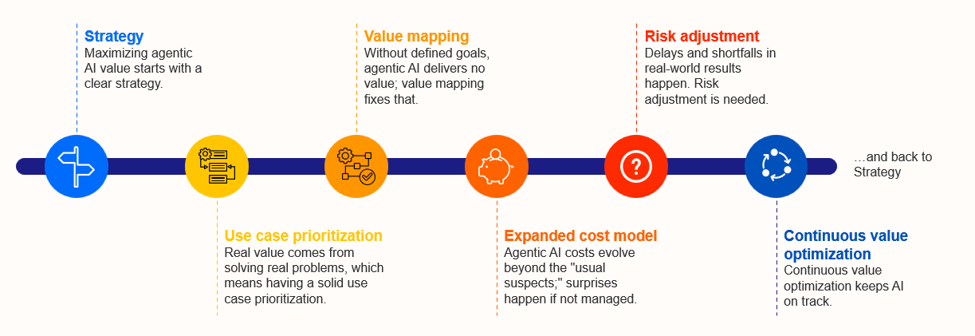
To address this, IDC has developed the Agentic AI Business Value Maximization Framework, a structured approach built around six pillars, with governance as the thread running through all of them.

Strategy. Agentic AI introduces autonomous decision-making, so strategy must define where autonomy is permitted and where it is constrained. The output is not a vague aspiration toward “better productivity.” It is a multi-time horizon road map with metric owners, shared across the organization, and tied explicitly to investment prioritization. Organizations that treat agents as tools rather than autonomous actors are setting themselves up for governance failures, not productivity gains.

Use case prioritization. Not every problem is an agentic problem. Deploying agentic AI on narrow, siloed tasks that deterministic automation handles perfectly well wastes investment and adds unnecessary complexity. IDC’s framework introduces prioritization dimensions specific to agentic contexts: multi-step reasoning requirements, dynamic decision-making needs, orchestration complexity, and the degree to which autonomy itself generates value. The output is a ranked, feasibility-adjusted use case portfolio, not a list of technically interesting experiments.

Value mapping. Value mapping anchors agentic AI investments in clear business outcomes and prevents the aimless experimentation that inflates AI budgets without delivering measurable results. Critically, agentic AI value is not static. It compounds as agents learn, adapt, and expand scope. Value mapping must account for the learning curve, not just immediate efficiency gains, and must incorporate non-financial drivers such as sustainability and customer trust alongside traditional financial metrics.

Expanded cost model. IDC’s framework calls for a dynamic total cost of ownership model that distinguishes capital expenditure from continuous, AI-specific operational costs, and that gives FinOps, legal, and financial governance teams the visibility they need to manage the complex, usage-based economics of agentic AI.

Risk adjustment. ROI for agentic AI should not be presented as a single point estimate. It should be scenario-based, tied to adoption trajectory, output quality, and timing assumptions, all assigned to explicit owners with documented confidence levels. Risk should be treated as dynamic, updated as real data replaces estimates, and modeled for the interdependencies that make agentic system failures systemic rather than isolated.

Continuous value optimization. IDC’s lifecycle analysis of agentic deployments finds that without active tuning, agent performance degrades as context shifts and edge cases accumulate. Sustained value requires treating agentic AI as an ongoing lifecycle management challenge, not a project to be completed and handed off to operations. That requires a dedicated Centre of Excellence with a strong governance cadence, defined standards, and the organizational mandate to enforce continuous optimization.

From framework to action

IDC’s Agentic AI Business Value Maximization Framework is designed to deliver six concrete outputs: a multi-time horizon autonomy road map, a ranked use case portfolio, a business value calculator, a dynamic TCO model, a scenario-based risk evaluator, and an agent lifecycle governance model. These are not aspirational deliverables. They are the minimum set of instruments an organization needs to manage agentic AI as a business investment rather than a technology experiment.

IDC’s framework analysis indicates that organizations that build this infrastructure now will extract more value from current agentic deployments and will be structurally better positioned to scale as the next wave of capability arrives.

Get in touch

If you are a Technology Provider and want to learn more about how IDC’s Business Value Consulting practice can help you build a rigorous, defensible framework for measuring and communicating the value of your agentic AI solutions, or explore ROI-focused go-to-market and lead generation tools backed by IDC research, reach out to start the conversation.

If you are a Technology User and want to learn more about how IDC’s Business Value Consulting practice can help your organization measure, justify, and maximize the business value of your agentic AI investments, reach out to start the conversation.

Andrea Siviero

Andrea Siviero - Vice President, AI-fueled Business Strategies

Andrea Siviero leads IDC’s AI-Fueled Business Strategies Global Research Group, which examines how AI and other Emerging Technologies accelerates digital maturity, enables new business models, delivers measurable business value (ROI), supports practical use cases, and strengthens the organizational capabilities required…

Last week, a select group of senior print and imaging executives gathered in London for IDC’s Print and Imaging Leadership Dinner. During this invitation-only evening, a conversation unfolded between IDC analysts and the people shaping the industry, moderated by IDC’s Sandra Ng.  

What came out of that dinner? Some of the discussions reaffirmed what many already suspected. But some of the insights revealed will fundamentally change how forward-thinking vendors approach the next 18 months. Here’s a taste of what was discussed, and why you’ll want to be in the room for one of IDC’s executive dinners next time.  

The buying committee has expanded, and most vendors are still selling to the wrong people  

Two years ago, a print deal sat with IT and procurement. That’s no longer the world we’re operating in. IDC’s 2026 European Print Survey, covering 2,000 organisations across eight markets, revealed that the stakeholder landscape has shifted dramatically. The conversation that used to happen in one room now happens in four.  

The implications for how vendors structure their go-to-market approach are significant, and the dinner surfaced a very specific playbook that the those gaining the most ground are already executing. We’ll leave the details for the briefing room.  

Security just overtook cost reduction as the #1 investment driver in print. 

A striking 24% of European technology buyers now cite security and compliance as their primary reason for investing in print. That puts it ahead of both cost reduction and productivity.  

This is more than a repositioning opportunity, as it moves the conversation to a different level within the organization,  with a different buyer. Those in the room heard exactly which messaging reaches the CISO, which regulatory triggers are opening budgets right now, and where the hardware story needs to evolve to stay relevant.  

IDC predicts that 40% of worldwide new office MFP shipments will be classified as AI MFPs by 2027. The vendors with a credible roadmap published today will be the ones with a strategic seat in 24 months. Those without one are already behind.  

The buyer has already formed a view before your sales team picks up the phone  

This was the session’s sharpest insight, and the one most likely to keep vendor CMOs up at night.  

GenAI-sourced web traffic grew 1,200% between 2024 and 2025. Two in three searches today end without a single click. Buyers are shortlisting vendors, forming preferences, and making preliminary decisions inside AI assistants, before they’ve seen your website, opened your brochure, or taken a sales call.  

IDC’s Gala Spasova gave a demonstration that stopped the room. When major AI assistants were asked the questions a head of digital workplace would actually type, around 30 vendor names came back consistently. Not a single print OEM appeared. When the question became print-specific, all the familiar names showed up.  

The print category is owned. The workplace category, where your buyers are actually looking, is invisible.  

What it takes to change that, and how fast it compounds once you do, was laid out in detail at the dinner. The short version: it’s not pay-to-play, and the window to act is narrow.  

Three places the money is actually moving in 2026, and the 12–18 month window you can’t afford to miss  

IDC analysts Jacqui Hendriks and Gala Spasova mapped out three near-term growth areas where European buyer investment is already building, from value-add software and services through to Intelligent Document Processing and a sustainability play that changes both the buyer and the budget.  

The most time-sensitive of these? A three-way alliance opportunity, vendor, channel, certified refurbisher, that’s unserved by the larger SIs and telcos, but not for long. European refurbished device shipments grew 28% in 2025. Demand is running well ahead of vendor readiness. The potential of such a model was discussed at the dinner in some detail.  

The commercial model shift that separates the winners  

The evening closed with a discussion on what’s actually different about the vendors capturing European growth. It’s not just what they’re selling. It’s the contracts they’re willing to sign, the conversations they’re prepared to have, and the partnerships they’re building now.  

Roberto Alunni and Phil Sargeant laid out, with uncomfortable precision, the behaviours that distinguish vendors gaining ground from those defending yesterday’s revenue. Some of it is replicable quickly. Some of it takes 18 months of investment to build. All of it was on the table.  

Were you in the room?  

If you weren’t at IDC’s Print & Imaging Leadership Dinner, or if you’re wondering how to get on the guest list for the next executive dinner, now is the time to reach out. Events like this are where the defining conversations happen: the information and insight that doesn’t make it into LLMs and the strategic debates that shape how the market moves, alongside networking and the connections that open doors.  

Whether your focus is European print and imaging, AI-driven workplace transformation, digital sovereignty, channel partnerships, or any of the many other topics shaping the European technology landscape, IDC brings together the senior leaders and the research to drive the conversation forward.  

To find out more about IDC’s European print and imaging research programme, or to join the conversation at our next event, contact your IDC representative or simply fill in our contact form.  

IDC’s European print and imaging research covers 2,000 organisations across Czech Republic, France, Germany, Italy, Poland, Spain, the UK and the Nordics, across 15 verticals. The 2026 European Print Survey data underpinning this dinner is available to IDC clients and select briefing participants.  

Phil Sargeant

Phil Sargeant - Senior Program Director, Imaging and Hardcopy Devices and Document Solutions, European Region

Phil Sargeant is IDC’s leading expert in the field of imaging, hardware devices and document solutions. As senior program director, he researches and reports on the key aspects of the multifunction, production and large format printer markets and is also…
Gala Spasova

Gala Spasova - Senior Research Manager, Europe Smart Office and EMEA Content & Knowledge Management Strategies

Gala Spasova is a senior research manager in IDC's Future of Workplace & Imaging team. Her research focus is on Hybrid working, Smart Office technology and Content & Knowledge Management Strategies in EMEA.  Spasova is also part of the European…
Jacqui Hendriks

Jacqui Hendriks - Associate Research Director, European Print Vendor Transformation Strategies

Jacqui Hendriks, Associate Research Director, European Imaging, Printing and Document Solutions Jacqui Hendriks heads up IDC's European Print Vendor Transformation Strategies research program, in collaboration with various IDC research domains. Hendriks has more than 30 years of experience of working…
Roberto Alunni

Roberto Alunni - Senior Research Director, EMEA Data & Analytics

Roberto Alunni is a Senior Research Director at IDC for imaging, print, and document solutions research across the EMEA region. He is responsible for strategic and operational implementation and leads an international analyst team. He is a specialist in imaging…
Sandra Ng

Sandra Ng - Senior Vice President, WW and APJ Research

Sandra Ng is Senior Vice President at IDC and the Global Domain Leader for Devices, Consumers, Imaging, and Japan. Based in Singapore, she advises technology buyers and vendors worldwide on technology investments, financial priorities, and go-to-market strategies. She leads a…

When Phillip Langeberg took over IT leadership at The Resorts Companies in 2017, he faced a problem that doesn’t show up in business school case studies. He was building a modern technology organization for a company that operates at the intersection of hospitality, real estate, and recreation, and there was no obvious playbook for it.

The company runs two flagship properties in Virginia: Wilderness Presidential Resort, a 600-acre camping and recreation destination, and Massanutten Resort, a 6,000-acre, four-season property with 2,500 accommodations, ski, an indoor and outdoor waterpark, four restaurants, two recreation centers, two golf courses, and more. Its technology ecosystem has to support everything from reservations and guest engagement to point of sale, property management, marketing platforms, and operational systems across multiple venues and verticals. And as a 100% employee-owned (ESOP) company since 2015, every technology decision carries weight beyond the immediate bottom line. Every employee has an ownership stake. Getting it wrong is not just a budget problem.

“The challenge is really trying to find the software and build the ecosystem that allows all these different business verticals to work together,” said Langeberg, CTO of Resorts Companies. Benchmarks from companies far smaller or far larger weren’t useful. He needed a perspective that could meet him where he actually was.

Seeing the larger framework

That’s where IDC came in. Over more than a decade, Langeberg has used IDC analyst conversations and IDC Roundtables to validate strategy, pressure-test decisions, and benchmark against peers across industries well beyond hospitality.

In 2021, a group of IDC analysts helped him think through the right staffing model for his IT organization, making recommendations based on the company’s goals, existing systems, and where technology was heading. Knowing that the future would be shaped by AI and data analytics, Langeberg used that guidance to build those capabilities in-house, reducing reliance on external vendors before the wave hit.

More recently, as The Resorts Companies planned a 140-room hotel addition to its waterpark, the expansion became a catalyst to standardize point of sale systems across the entire resort. IDC helped cut through a crowded vendor market to identify the solutions that actually fit. “You Google point of sale vendors and there’s a ton out there,” said Langeberg. “That’s really what IDC can bring to the table, the ability to come in and say, you’re in this industry, you’re doing this, let’s figure out what software platforms align with what you guys are doing as a business.”

IDC Roundtables added another dimension, bringing Langeberg into conversation with CIOs and CTOs from industries ranging from water treatment to manufacturing. Hearing what leaders in completely different sectors were building, and what they were running into, shaped decisions he never would have reached staying inside the hospitality lane.

“Being able to have conversations with IDC analysts is really helpful because they see the larger framework,” said Langeberg. “There could be a solution I’m not considering because I’m only looking at the hospitality sector.”

The relationship becomes a platform

When IDC introduced Quanta, a new AI platform built on IDC’s proprietary research and intelligence, Langeberg recognized immediately what made it different from the general-purpose AI tools he had already been using. “If I go to one of the other AI products out there and search for something, it’s searching the internet, and we all know that everything on the internet isn’t always accurate,” he said. “Maybe it’s paid marketing material for a product, and that’s weighing the decision and ultimately weighing where you’re guiding your business.” Quanta draws from verified IDC intelligence instead, with every response citing the underlying report or MarketScape it came from.

The trust, though, didn’t come from the platform’s architecture. It came from the relationship. “It’s almost like taking the power of all the IDC analysts and putting it into a simple query engine that I’m able to use,” said Langeberg. “An AI backed by IDC’s research gives me a lot more confidence in the answers.”

Looking around the corner

With major expansions underway, including a new waterpark hotel with a redesigned check-in experience, and the Bluestone Peak 55+ active adult community, The Resorts Companies is entering its most complex period of growth. Langeberg plans to use Quanta to build multi-year technology roadmaps and model vendor decisions before committing, backed by IDC’s market intelligence.

“When I walk into that moment where I’m not sure where I need to be on something, I know that IDC is there as a partner, through their research, the AI platform, the analysts, to help us plot the right course.”

For technology leaders navigating complex, niche industries without a natural peer group, that combination of earned credibility and on-demand access is exactly the edge that’s hard to find anywhere else.

Christina Cardoza - Content Marketing Manager - IDC

Christina Cardoza is a Content Marketing Manager at IDC, where she specializes in brand content and social media strategy. With a background in journalism and editorial leadership, she has a proven ability to transform complex technology topics into clear, actionable insights.