As B2B buyers turn to AI-powered search to evaluate solutions, CMOs are facing a universal pain point: pipeline quality has decoupled from pipeline quantity.

In IDC’s recent expert panel, Addressing the Pipeline Conversion Gap, analysts discussed the impact on lead capture and how marketing organizations can modernize their processes to fit the new discovery paradigm.  

After the discussion, our analysts took a deeper dive and answered your questions about improving pipeline conversion.

Which marketing roles own the lead pipeline transformation?

IDC recently completed research about CMOs and their approach to a new operating model for the AI era. One interesting finding is that the leaders who are furthest ahead in the maturity cycle aren’t focused on specific teams like content, operations, or SEO. Instead, they’re first reframing what marketing should look like – and their vision is to create an integrated marketing organization.

To influence change, marketing will need the help of other functions. CMOs should think about how to bring in the CFO, CIO, and CRO, as well as legal and compliance, into the conversation. They can align upon specific outcomes and gain a clear understanding of the metrics and KPIs for each function. Real change happens when everyone is working together toward the same goals.

How do you measure ROI on AI?

The tricky part of calculating ROI on AI is that the traditional formula – how much revenue you make divided by the cost – no longer works.

AI is not just about tangible impact. You also need to translate indirect impacts into financial terms. Revenue is one of the elements, but there are other KPIs to evaluate, including: employee experience, customer experience, security, trust, and more. The other big element is risk in each of the AI use cases.

The first step for calculating ROI is to apply the business value equation to specific use cases, rather than the technology itself. Then, you can assess the risk for each use case. If you need help, IDC has developed a full AI business value assessment framework to help clients maximize their ROI.

Is it possible to target buying committees on LLMs?

Every AI engine is looking at how to monetize with advertising, but this area is still evolving. Right now, vendors’ early attempts at advertising offer limited targeting, where the focus is on the top of the funnel. We expect this to change quickly, as vendors leapfrog to the opposite extreme. Segmentation will become much more advanced than even today’s demand platforms and programmatic tools, because LLMs are better at capturing the specific intent of buyers.

And intent data is powerful fuel for reaching buying committees.

That’s because buyers aren’t simply interested in running shoes. Their prompts are much more specific. They want size 10 running shoes suitable for a specific marathon and that also address their foot problems. That’s the kind of intent data vendors will be able to provide advertisers in the form of very specific audience segments.

Is there risk in sharing pricing before understanding the customer problem and establishing a value-based solution?

Opaque pricing tells a sophisticated buyer one of three things: you’re going to price discriminate based on perceived budget, you don’t trust them to self-qualify, or your products are too expensive.

Pricing is tricky any way you go about doing it because it is both mathematical and psychological. Just like pricing strategies need to be tailored to specific business needs, the way this information is exposed will also need to be calibrated in a strategically optimized manner.

It’s almost impossible to give one-size-fits-all guidance about this topic, but there are more clever ways to handle this than just a static form.

So, what’s the best alternative to ‘Contact Us’ for B2B pricing?

Any alternative depends on why your organization needs to talk to the buyer. For example, software pricing has too many dependencies and variables about scope of work, so a custom quote is often necessary.

One option for surfacing this information is with agentic AI. A chatbot can provide a custom quote using the rules already stored within your configure, price, quote (CPQ) software or CRM. Unlike salespeople, who can break the rules – sometimes to the detriment of the company – an AI agent will follow them to the letter, making this a very efficient way to handle 80% or 90% of your custom quote needs.

You can also rethink the customer journey and redesign a more modern workflow that is not based on patience, but readiness to buy. Prospects should be able to get answers they need at the right moment – while they’re on your site and ready to purchase. This contactless flow reduces friction and is more likely to convert.

Can FAQ documents and chatbots assist in combatting the gated content issues?

With gated content, you’re trading a white paper for an email address from someone who could have asked an AI for the same information in 30 seconds. The marketing team’s goal now is to help buyers get the details they need without having to click away.

An FAQ and chatbot can serve that need – but not the typical ones we’ve become accustomed to. This change is reminiscent of the early web, where informational – not marketing – content drove most of the engagement. Each product detail page, for example, should have its own mini-FAQ. However, this just scratches the surface. The content model will need to be much more technically mapped to appeal to AI agents, including schema updates and metadata adjustments.

Could we engage buyers by offering both gated and passive contact options? For example, could we have a “can we call you?” box and a “subscribe to our email” box?

That’s still too passive. It’s much better to encourage engagement right on the website via chat and then use that chatbot to collect and present the relevant information. The goal is to give the prospect greater access to the information they need and avoid forcing them to browse your site.

Remember, today’s buyer journey is much more compressed. There are fewer touch points to be seen and heard, which means you have to make every single one of those encounters really count.

An inversion of the traditional qualification model is what’s really needed. Instead of making buyers prove that they’re serious, you let them prove it to themselves and then contact you when they’re ready to buy. You can do that by front loading with a little bit more content.

While these are the questions attendees had, we understand you might want to dig deeper into this topic. Contact IDC today to request an analyst briefing.

For decades, manufacturing was transformed by a single insight: Build only what you need, exactly when you need it. Toyota’s just-in-time model introduced the precision delivery of exactly the right parts, at exactly the right moment, for exactly the right task—eliminating warehouses full of idle inventory and accelerating production. It was one of the most consequential operational shifts of the 20th century.

Enterprise software is about to experience its own JIT moment. And the implications are just as large.

The old model is breaking

Traditional enterprise applications were built on a simple premise. Define a function (finance, HR, procurement, etc.), build a system around it, and get users to come to that system. For decades, that model has held. ERP, CRM, HCM, SCM. Each application owned its functional domain, and humans navigated between them.

That premise is now collapsing.

IDC’s Agentic Evolution of Enterprise Applications Framework, first published in early 2025, laid out the stages through which software was expected to evolve.  Moving through progressive phases, from AI assistant-enhanced applications, to agent-supplemented, to agent-led, and ultimately to agents-as-apps. Now, the next phase is emerging, which IDC refers to as Cross-Application Agents. The concept is simple. AI agents will no longer work inside a single application. They will work across all of them, executing on real-time composability, pulling capabilities, workflows, and data from wherever they live and assembling exactly what the user needs in real time, for that specific outcome.

That is just-in-time software.

What JIT software actually means

In manufacturing, JIT eliminated the cost of excess inventory. In software, JIT eliminates the cost of excess interface. Users no longer navigate to a system. The system comes to them, assembled on demand, hyper-personalized to their role, context, and intent.

Oracle’s recent announcement of 22 Fusion Agentic Applications is a concrete, production example of this model. These are not pre-built applications that users log into. They are cross-application agents created autonomously in real time when needed, combining functionality, workflows, and data from ERP, financials, HCM, CRM, and wherever else the work requires. The application is built in the moment the outcome is requested.  And depending on the likelihood that the request will be repeated in the future, the application may also be dissolved when the work is done.

SAP is making the same bet but framing it differently.  With Joule as the anchoring AI layer sitting between the user and enterprise execution, users state their business intent, and SAP’s autonomous systems handle the rest. It pulls from the underlying application estate to deliver the outcome without requiring the user to understand which systems provide which pieces of the solution.

The Toyota parallel is not subtle

Toyota’s JIT model worked because it required a complete rethinking of the supply chain, including clean supplier relationships, reliable APIs between partners, and shared standards that made on-demand assembly possible. The enterprise software equivalent is identical. Cross-application agents require clean APIs, event-driven architectures, semantic data models, and open connectivity standards like MCP that allow agents to discover and orchestrate capabilities across vendors.

Vendors that haven’t invested in that infrastructure will find themselves on the wrong side of a distribution shift that is already underway. Distribution, in the agent era, no longer runs through a UI. It runs through agent marketplaces, connectors, and open protocols. If an agent can’t find your capability, your capability doesn’t exist.

The stakes are real

This is not a five-year horizon thought experiment. Our Agentic Evolution of Enterprise Applications Framework places cross-application agents as an emerging reality, with leading vendors already building their initial JIT software solutions. IDC’s updated 2026 framework is scheduled for publication in early August. It will not only show the projected transition timing of the enterprise application market toward JIT software (both in aggregate and within 15+ individual application markets), but it will also break down the pricing model progression that is set to accompany this transformation. 

The window for vendors to make their products agent-operable has already begun. APIs must be clean, connectors must be built, and packaging needs to be redesigned around outcomes and consumption, not seats.

For buyers, the shift is equally urgent. The traditional bounds of application markets are becoming transient. The question will no longer be just about which ERP or HCM vendor has the best capabilities. It will be about whether your enterprise architecture can support agents that move freely across it, and whether your software vendor can deliver you the same types of JIT efficiencies that manufacturers started benefiting from nearly 80 years ago.  Just-in-time manufacturing didn’t make the parts less important. It made the system that assembled them the competitive advantage. The same logic applies here.

Software that arrives exactly when needed, assembled precisely for the outcome at hand, and drawing from the full capability estate of the enterprise… that is the model that wins.

Eric Newmark

Eric Newmark - Group Vice President & General Manager of IDC's SaaS, Enterprise Software, CX and Workplace Solutions Division

Eric Newmark is Group Vice President & General Manager of IDC’s SaaS, Enterprise Software, CX, and Workplace Solutions Division, which includes several teams of analysts covering SaaS, 18 enterprise application markets, software monetization, business platforms, marketplaces, and services firms focused…

これまで、国内のビジネスコンサルティング市場の成長は、個別テーマへの需要と、それを担うコンサルタントの人員拡大によって説明されてきました。「需要が増えれば人を増やし、売上が伸びる」これが長く前提とされてきた成長の方程式です。

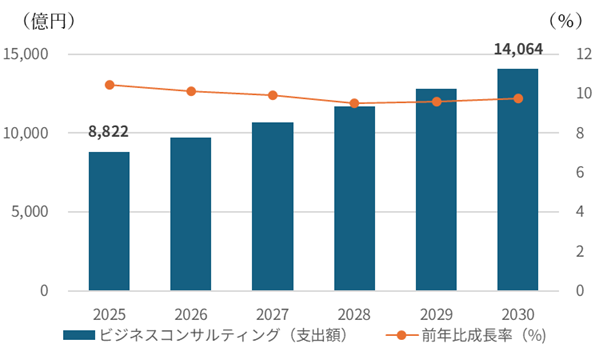
しかし、その前提は変わりつつあります。IDCは、国内ビジネスコンサルティング市場の支出額が、2025年の約8,822億円から2030年には約14,064億円へと、年間平均成長率(CAGRCompound Annual Growth Rate9.8%で拡大を続けると予測しています。

注目すべきは規模だけではありません。AIを核とした企業変革が市場を牽引する中で、案件の規模や収益化、そして成長と人員数の関係そのものが構造的に変化し始めています。本稿では、IDCの最新予測から読み解ける3つの構造変化を解説します。

構造変化(1)AIを核とした「全社変革」が市場を牽引し、案件が大型化する

成長の最大のドライバーは、企業のAI活用と変革需要です。生成AIやエージェンティックAIが「試す」段階から「変革する」段階へ移行し、局所的なAI導入ではなく、業務プロセス・データ基盤・組織体制を一体的に変革する全社変革型の案件が増え、ディールサイズの大型化と複数年にわたる長期プログラム化が進んでいます。

この動きはセグメント別の成長率にも表れています。業務改善コンサルティングは、AIエージェントの業務実装支援やERPのサポート終了(EOS)対応、レガシーモダナイゼーションに伴う上流支援を背景に、全セグメントで最も高い成長を示す見通しです。組織/変革コンサルティングも、後述する「人と組織」の変革需要を背景に堅調な成長が見込まれます。

構造変化(2):「人員増を上回る成長」への転換

より本質的な変化は、売上成長と人員数の関係が切り離され始めていることです。従来の労働集約的な人月モデルに対し、人員数の伸びを上回るペースで売上を拡大するファームが増えています。背景には、複数の要因が同時に作用しています。

  • フィー単価の上昇:人材の供給不足を背景に、案件単価が人員数の伸びを上回って上昇し、1人当たり売上を押し上げています。
  • ソリューション化・アセット化:再利用可能なフレームワークやAIツール、業界別テンプレートを提供物に組み込み、人員を比例的に増やさずに価値を拡大しています。
  • グローバルデリバリーの活用:海外デリバリーセンターやニアショア/オフショアを活用し、国内人員コストを抑えながら供給能力を拡張しています。
  • AIによるデリバリー生産性の向上:現時点で「劇的」ではないものの、1人当たり売上額の着実な向上として表れ始めており、2030年に向けて効果は累積していきます。

さらに中長期では、提供モデルそのものの変容も萌芽的に進んでいます。

  • 成果報酬型(アウトカムベース)契約:顧客の成果指標に連動した報酬設計。
  • プラットフォーム/マネージドサービス型:継続的な収益(リカーリング)を生む提供形態。
  • BOT型・内製化支援:顧客の自走を支えるBOT(Build-Operate-Transfer)型の関与モデル。
  • GCCの活用支援:GCC(グローバルケイパビリティセンター)の構築・活用支援。

これらはまだ一部にとどまりますが、顧客の価値可視化ニーズの高まりとともに採用事例は増えており、人月依存型モデルからの構造転換がファーム各社の戦略課題として明確になりつつあります。

構造変化(3):「人と組織」の変革支援が成長の中核テーマに

企業変革の主軸は、戦略と業務、人と組織、テクノロジー(AI)を横断する形へと拡張しており、中でも「人と組織」の変革支援の重要性が高まっています。全社的なAI変革においてチェンジマネジメントとタレント支援は不可分であり、その需要は単独の案件としてだけでなく、大型変革案件の不可欠な構成要素として組み込まれる傾向を強めています。具体的には、以下のような領域で需要が拡大しています。

  • リスキリング/アップスキリング:AIを前提とした働き方に向けた人材育成。
  • 人的資本経営(HCM):戦略立案から実践までの支援。
  • ワークフォース変革:AIケイパビリティを軸とした役割・組織・チームの再設計。
  • チェンジマネジメント:大型変革プログラムに組み込まれる変革推進支援。

これらは経営戦略や財務・経理など他機能と統合され、複合的な「経営課題」として扱われるようになっています。組織変革の実績を持たないファームは、最も価値の高い変革案件を獲得・維持することが難しくなりつつあります。

ビジネスコンサルティングはITコンサルティングを上回る成長を続ける

国内コンサルティング市場全体(ビジネス+IT)は、2025年の約1兆4,554億円から2030年には約2兆2,897億円へと拡大します。このうちビジネスコンサルティングはCAGR 9.8%でITコンサルティング(同9.0%)をわずかに上回り、全体に占める構成比は2025年の60.6%から2030年には61.4%へと緩やかに上昇する見通しです。背景には、AIを核とした変革の入り口が「経営アジェンダ」からトップダウンで設定されるようになり、戦略立案や業務変革設計といったビジネスコンサルティング領域から案件が起動するケースが増えています。主要事業者の多くが上流のビジネス領域とIT実装を一体化したデリバリーへ移行しており、ビジネスコンサルティング比率の高い案件が収益成長を牽引しています。

コンサルティング事業者のリーダーへの示唆:2030年に向けた5つの戦略的優先事項

以上の構造変化を踏まえると、市場の拡大に乗るだけのファームは、構造転換を進めた競合に成長率で劣後するおそれがあります。次の成長フェーズを取り込むために、各社が優先すべき打ち手は明確になりつつあります。

  • AIを核とした全社変革案件の獲得:個別ソリューションではなく、複数年にわたる大型プログラムにポジショニングする。
  • AIによるデリバリー生産性への投資:競争要件になる前に、今から体制と仕組みを構築する。
  • スケーラブルなソリューション・アセットの整備:人員数に比例しない収益構造へ転換する。
  • 「人と組織」の変革ケイパビリティの確立:最大級の案件を勝ち取る鍵として、組織変革の実績を積む。
  • 成果報酬型・プラットフォーム型モデルの探索:価値の可視化を求める顧客の増加に備える。

国内ビジネスコンサルティング市場は、これからも堅調に拡大します。しかし、その成長の「中身」は、AIを前提とした提供モデルへの転換と、「人と組織」を中核に据えた全社変革支援へと確実にシフトしていきます。この構造変化を早期に捉え、自社のオファリング・人材・デリバリー体制を適応させたファームこそが、2030年に向けた次の成長フェーズを取り込むことができるでしょう。

関連する調査やご相談について 本稿は『国内ビジネスコンサルティング市場予測、2026年~2030年』(IDC #JPJ53501026、2026年5月発行)[MD1][TU2]に基づいています。市場規模・予測の詳細、セグメント別・産業分野別のデータ、主要事業者の動向については、当社アナリストへお気軽にご相談ください[MD3][TU4] 。

植村 卓弥 (Takuya Uemura) - Senior Research Manager, AI and Automation, IDC Japan - IDC Japan

IDC Japanにおいて、年間情報提供プログラムであるJapan AI and Data Platformsのリードアナリストとして、国内AI市場について、サービス/ソフトウェア/インフラストラクチャといったテクノロジースタック全般の予測やシェアの調査/分析を担当する。 IDCでは、15年以上に渡り、ビジネスコンサルティングやITサービス市場などサービス市場全般の予測や競合分析、企業ユーザーニーズなどの調査を担当し、国内市場におけるデジタルトランスフォーメーション/デジタルビジネスの動向と、これらを実現するサービス市場(デジタルビジネスプロフェッショナルサービス市場)についての専門性を持つ。 IDC Japan入社前は、主に国内大手IT ベンダー/通信事業者/電機メーカーなどに向けて、上位レイヤーサービスや各種製品の事業性評価などの調査・コンサルティングに従事。IT関連市場においてSMBを含む法人、消費者の各市場分野についての定量、定性両面の調査経験を有する。 【専門の分野/テーマ】 国内AI市場 国内企業のAI駆動型(AI Fueled)ビジネス動向

これまで、国内のビジネスコンサルティング市場の成長は、個別テーマへの需要と、それを担うコンサルタントの人員拡大によって説明されてきました。「需要が増えれば人を増やし、売上が伸びる」これが長く前提とされてきた成長の方程式です。

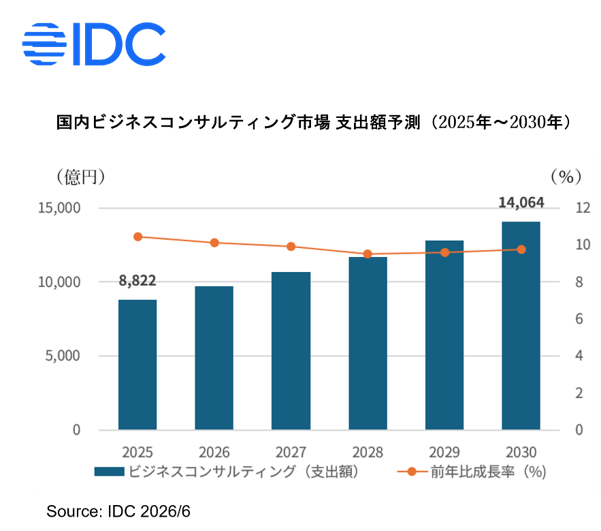
しかし、その前提は変わりつつあります。IDCは、国内ビジネスコンサルティング市場の支出額が、2025年の約8,822億円から2030年には約1兆4,064億円へと、年間平均成長率(CAGR:Compound Annual Growth Rate)9.8%で拡大を続けると予測しています。

2025の市場規模(支出額)

8,822億円

2030年までのCAGR

9.8%

注目すべきは規模だけではありません。AIを核とした企業変革が市場を牽引する中で、案件の規模や収益化、そして成長と人員数の関係そのものが構造的に変化し始めています。本稿では、IDCの最新予測から読み解ける3つの構造変化を解説します。

図表1:国内ビジネスコンサルティング市場 支出額予測(2025年~2030年)

Source: IDC 2026/6

構造変化(1)AIを核とした「全社変革」が市場を牽引し、案件が大型化する

成長の最大のドライバーは、企業のAI活用と変革需要です。生成AIやエージェンティックAIが「試す」段階から「変革する」段階へ移行し、局所的なAI導入ではなく、業務プロセス・データ基盤・組織体制を一体的に変革する全社変革型の案件が増え、ディールサイズの大型化と複数年にわたる長期プログラム化が進んでいます。

この動きはセグメント別の成長率にも表れています。業務改善コンサルティングは、AIエージェントの業務実装支援やERPのサポート終了(EOS)対応、レガシーモダナイゼーションに伴う上流支援を背景に、全セグメントで最も高い成長を示す見通しです。組織/変革コンサルティングも、後述する「人と組織」の変革需要を背景に堅調な成長が見込まれます。

構造変化(2):「人員増を上回る成長」への転換

より本質的な変化は、売上成長と人員数の関係が切り離され始めていることです。従来の労働集約的な人月モデルに対し、人員数の伸びを上回るペースで売上を拡大するファームが増えています。背景には、複数の要因が同時に作用しています。

  • フィー単価の上昇:人材の供給不足を背景に、案件単価が人員数の伸びを上回って上昇し、1人当たり売上を押し上げています。
  • ソリューション化・アセット化:再利用可能なフレームワークやAIツール、業界別テンプレートを提供物に組み込み、人員を比例的に増やさずに価値を拡大しています。
  • グローバルデリバリーの活用:海外デリバリーセンターやニアショア/オフショアを活用し、国内人員コストを抑えながら供給能力を拡張しています。
  • AIによるデリバリー生産性の向上:現時点で「劇的」ではないものの、1人当たり売上額の着実な向上として表れ始めており、2030年に向けて効果は累積していきます。

さらに中長期では、提供モデルそのものの変容も萌芽的に進んでいます。

  • 成果報酬型(アウトカムベース)契約:顧客の成果指標に連動した報酬設計。
  • プラットフォーム/マネージドサービス型:継続的な収益(リカーリング)を生む提供形態。
  • BOT型・内製化支援:顧客の自走を支えるBOT(Build-Operate-Transfer)型の関与モデル。
  • GCCの活用支援:GCC(グローバルケイパビリティセンター)の構築・活用支援。

これらはまだ一部にとどまりますが、顧客の価値可視化ニーズの高まりとともに採用事例は増えており、人月依存型モデルからの構造転換がファーム各社の戦略課題として明確になりつつあります。

構造変化(3):「人と組織」の変革支援が成長の中核テーマに

企業変革の主軸は、戦略と業務、人と組織、テクノロジー(AI)を横断する形へと拡張しており、中でも「人と組織」の変革支援の重要性が高まっています。全社的なAI変革においてチェンジマネジメントとタレント支援は不可分であり、その需要は単独の案件としてだけでなく、大型変革案件の不可欠な構成要素として組み込まれる傾向を強めています。具体的には、以下のような領域で需要が拡大しています。

  • リスキリング/アップスキリング:AIを前提とした働き方に向けた人材育成。
  • 人的資本経営(HCM):戦略立案から実践までの支援。
  • ワークフォース変革:AIケイパビリティを軸とした役割・組織・チームの再設計。
  • チェンジマネジメント:大型変革プログラムに組み込まれる変革推進支援。

これらは経営戦略や財務・経理など他機能と統合され、複合的な「経営課題」として扱われるようになっています。組織変革の実績を持たないファームは、最も価値の高い変革案件を獲得・維持することが難しくなりつつあります。

ビジネスコンサルティングはITコンサルティングを上回る成長を続ける

国内コンサルティング市場全体(ビジネス+IT)は、2025年の約1兆4,554億円から2030年には約2兆2,897億円へと拡大します。このうちビジネスコンサルティングはCAGR 9.8%でITコンサルティング(同9.0%)をわずかに上回り、全体に占める構成比は2025年の60.6%から2030年には61.4%へと緩やかに上昇する見通しです。背景には、AIを核とした変革の入り口が「経営アジェンダ」からトップダウンで設定されるようになり、戦略立案や業務変革設計といったビジネスコンサルティング領域から案件が起動するケースが増えています。主要事業者の多くが上流のビジネス領域とIT実装を一体化したデリバリーへ移行しており、ビジネスコンサルティング比率の高い案件が収益成長を牽引しています。

コンサルティング事業者のリーダーへの示唆:2030年に向けた5つの戦略的優先事項

以上の構造変化を踏まえると、市場の拡大に乗るだけのファームは、構造転換を進めた競合に成長率で劣後するおそれがあります。次の成長フェーズを取り込むために、各社が優先すべき打ち手は明確になりつつあります。

  • AIを核とした全社変革案件の獲得:個別ソリューションではなく、複数年にわたる大型プログラムにポジショニングする。
  • AIによるデリバリー生産性への投資:競争要件になる前に、今から体制と仕組みを構築する。
  • スケーラブルなソリューション・アセットの整備:人員数に比例しない収益構造へ転換する。
  • 「人と組織」の変革ケイパビリティの確立:最大級の案件を勝ち取る鍵として、組織変革の実績を積む。
  • 成果報酬型・プラットフォーム型モデルの探索:価値の可視化を求める顧客の増加に備える。

国内ビジネスコンサルティング市場は、これからも堅調に拡大します。しかし、その成長の「中身」は、AIを前提とした提供モデルへの転換と、「人と組織」を中核に据えた全社変革支援へと確実にシフトしていきます。この構造変化を早期に捉え、自社のオファリング・人材・デリバリー体制を適応させたファームこそが、2030年に向けた次の成長フェーズを取り込むことができるでしょう。

関連する調査やご相談について

本稿は『国内ビジネスコンサルティング市場予測、2026年~2030年』(IDC #JPJ53501026、2026年5月発行)に基づいています。市場規模・予測の詳細、セグメント別・産業分野別のデータ、主要事業者の動向については、当社アナリストへお気軽にご相談ください。

植村 卓弥 (Takuya Uemura) - Senior Research Manager, AI and Automation, IDC Japan - IDC Japan

IDC Japanにおいて、年間情報提供プログラムであるJapan AI and Data Platformsのリードアナリストとして、国内AI市場について、サービス/ソフトウェア/インフラストラクチャといったテクノロジースタック全般の予測やシェアの調査/分析を担当する。 IDCでは、15年以上に渡り、ビジネスコンサルティングやITサービス市場などサービス市場全般の予測や競合分析、企業ユーザーニーズなどの調査を担当し、国内市場におけるデジタルトランスフォーメーション/デジタルビジネスの動向と、これらを実現するサービス市場(デジタルビジネスプロフェッショナルサービス市場)についての専門性を持つ。 IDC Japan入社前は、主に国内大手IT ベンダー/通信事業者/電機メーカーなどに向けて、上位レイヤーサービスや各種製品の事業性評価などの調査・コンサルティングに従事。IT関連市場においてSMBを含む法人、消費者の各市場分野についての定量、定性両面の調査経験を有する。 【専門の分野/テーマ】 国内AI市場 国内企業のAI駆動型(AI Fueled)ビジネス動向

SpaceX’s $60 billion acquisition of Cursor is the largest deal in the history of AI software and one that reshapes the competitive landscape for agentic coding. The all-stock transaction, filed with the SEC and expected to close in Q3 2026, follows an option SpaceX secured in April and exercised just two trading days after its Nasdaq debut, the largest IPO in history. Cursor enters the deal with reported annualized revenue near $2.6 billion, a growing enterprise customer base, and a proprietary coding model in Composer that the two companies have already been jointly training on Colossus, xAI’s purpose-built supercomputing cluster.

The acquisition gives Cursor the GPU capacity, power, cooling, and land to build a best-in-class coding LLM on its own terms, while giving SpaceX a commercially proven path into enterprise software engineering that its AI division has been unable to build on its own. The question now is whether Cursor can translate that infrastructure position into a proprietary model layer that rivals what Anthropic and OpenAI offer, and whether SpaceX can provide the operational conditions for that to happen.

The SpaceX acquisition empowers Cursor to produce a best-in-class coding LLM

Cursor’s most important strategic move in this acquisition is gaining the infrastructure to build a proprietary coding model that can compete directly with the best models from Anthropic and OpenAI. In agentic coding, innovation now occurs at two layers. The harness shapes how the system plans, uses tools, navigates repositories, and interacts with developers across a workflow. The model determines the quality of reasoning, coding intelligence, and long-horizon execution. Cursor has established credibility at the harness layer through its product, but the model layer is where the economics and competitive dynamics of the business are decided.

Today, Anthropic and OpenAI occupy a dual role in Cursor’s stack. They supply the models that power much of the product while competing directly against it through Claude Code and Codex. That overlap gives outside providers influence over Cursor’s cost structure, release timing, and the pace at which underlying model quality improves. Under those conditions, revenue can scale faster than gross margin improvement, because incremental usage continues to flow through the same high-cost third-party model APIs. Cursor can grow more successful commercially without becoming proportionally more efficient.

Cursor has already demonstrated the ability to develop promising coding models of its own. The progression from Composer 2 to Composer 2.5 has combined coding-specific pretraining, large-scale reinforcement learning, and synthetic data generation to improve end-to-end software engineering performance. With access to Colossus, Cursor can now run pretraining, post-training refinement, synthetic data generation, and evaluation across successive model generations on its own timeline, at the cadence and scale required to produce a best-in-class coding LLM. A proprietary model layer at that level would reduce Cursor’s exposure to supplier concentration, give the company greater control over gross margins, and allow it to set its own cadence for performance improvement and product releases rather than tracking the road maps of its direct competitors.

Cursor’s domain focus is an advantage in model development that broader frontier labs cannot easily match

Cursor’s exclusive focus on coding and software engineering gives it an advantage over Anthropic and OpenAI that the SpaceX acquisition now allows it to exploit at frontier scale. Its model-development effort, from pretraining data to post-training refinement to evaluation benchmarks, is organized around the developer personas and workflows that define the agentic coding market. Anthropic and OpenAI, by contrast, build general-purpose frontier models where coding is one priority among many, competing for post-training resources against writing, content generation, multimodal reasoning, and other capabilities their customers depend on. Post-training involves trade-offs across a model’s capability surface, and improving performance in one dimension can diminish it in others. Cursor faces no such constraint. Because Composer serves one use case, Cursor can push post-training as far as coding performance allows without managing the downstream effects on capabilities it does not need to preserve.

That advantage compounds over time because feedback loops are tighter, improvement cycles are more targeted, and the benchmarks that matter are directly tied to what determines whether a developer trusts a coding tool enough to make it part of their daily workflow. With Colossus behind it, Cursor can run that focused, domain-specific development loop at frontier scale and at a pace that broader frontier labs, managing far wider capability obligations, will find difficult to match.

Secured GPU capacity determines who can compete at the frontier

The SpaceX acquisition gives Cursor access to GPUs at a scale previously secured only by the hyperscalers and a small number of frontier AI companies and infrastructure providers such as OpenAI, Anthropic, Oracle, and NVIDIA. GPU capacity remains the primary gating factor in the development of frontier foundation models. The companies that can train and refine the best coding models are, in large part, the companies that can secure sustained access to large concentrations of GPUs. Without that access, a company may have strong model-development methods but no way to apply them at the scale that frontier competition demands.

Securing that level of dedicated GPU capacity is difficult through conventional channels. Neocloud providers such as CoreWeave and Lambda can supply GPU capacity, and hyperscaler marketplaces offer on-demand and reserved instances, but none of these can guarantee the sustained, concentrated access that frontier model development requires. Training runs for successive model generations span weeks at high utilization across thousands of chips simultaneously. That demand profile is incompatible with shared infrastructure and variable availability.

Power, cooling, and land are the infrastructure constraints that sit upstream of GPU access

GPU scarcity is only the most visible bottleneck. Sustained model training at frontier intensity also depends on physical infrastructure that most organizations cannot assemble on demand. Power is the first constraint, because training runs at this scale require continuous, uninterrupted supply measured in hundreds of megawatts, backed by utility agreements that take years to negotiate. Cooling is the second, because dense GPU clusters running at sustained utilization generate thermal loads that require purpose-built systems designed and installed before a facility becomes operational. Land is the third, because suitable sites must offer grid access sufficient to support these loads, zoning and permitting conditions that allow large-scale datacenter construction, and proximity to transmission infrastructure. These inputs are increasingly contested as AI infrastructure buildouts compete with other industrial and residential demands for the same sites and the same grid capacity.

Anthropic, OpenAI, and Google have secured their compute positions through years of capital commitment, hyperscaler relationships, and direct NVIDIA agreements. Colossus, xAI’s purpose-built supercomputing cluster, reflects a comparable effort to control the full set of inputs required for frontier-scale compute. The SpaceX acquisition transfers that secured position to Cursor, bypassing the procurement bottleneck that would otherwise define the company’s model development ceiling. Cursor gains immediate access to infrastructure that would have taken years to assemble independently.

SpaceX acquires enterprise distribution it could not build through model development alone

The acquisition gives SpaceX something its AI division has been unable to build on its own, a commercially proven path into enterprise software engineering. Strong foundation models often struggle to translate into meaningful adoption inside engineering teams because this market is shaped by workflow fit, developer trust, product integration, and the degree to which a tool becomes part of daily software development rather than an occasional assistant. xAI has faced exactly that challenge. Despite investing heavily in Grok, it has not built the product surface, the developer relationships, or the commercial traction needed to compete for enterprise software engineering workflows against Anthropic and OpenAI. Cursor closes that gap in a way that model development alone cannot.

Cursor has already built one of the most commercially significant agentic coding products in the market, with reported annualized revenue near $2.6 billion and a growing enterprise customer base. That position took years of product execution to build and cannot be replicated by releasing a better model. At 3.4% dilution against its IPO valuation, SpaceX is making a concentrated bet that enterprise software distribution is worth acquiring rather than building from scratch. That bet becomes more credible as Composer improves on Colossus, because the infrastructure investment and the distribution asset reinforce each other. A better model running inside a trusted developer product is the combination that drives sustained enterprise adoption.

Conclusion

The central risk to Cursor’s enterprise position is whether SpaceX under Elon Musk can sustain the organizational conditions that enterprise software adoption requires. Musk’s stewardship of X raised legitimate questions about product stability, developer relations, and sustained institutional engagement. His outspoken political positions and willingness to use his platforms to advance them have also made brand association a factor in enterprise procurement decisions in ways that most technology vendors do not face. Those concerns affect procurement conversations and vendor risk assessments, and they are not unreasonable. SpaceX has strong financial incentives to grant the Cursor team a high degree of operational independence, because the alternative would erode the asset it just paid $60 billion to acquire. Whether those incentives prove sufficient is not yet clear.

The more important question, however, is what Cursor can become with the resources now behind it. With dedicated access to one of the largest GPU clusters outside the hyperscalers, a focused model-development effort unconstrained by the multi-domain trade-offs that Anthropic and OpenAI must manage, and a product that has already reached meaningful commercial scale, Cursor is positioned to build one of the strongest proprietary coding model layers in the industry. If SpaceX provides the operational autonomy and infrastructure access the deal implies, the ceiling on what Cursor can achieve in agentic coding is substantially higher than it was as an independent company.

Arnal Dayaratna

Arnal Dayaratna - Research Vice President, Software Development

Dr. Arnal Dayaratna is Research Vice President, Software Development at IDC. His research focuses on agentic AI, generative AI, foundation models, agentic coding technologies, and low-code and no-code developer technologies. He also examines the broader technology stack around foundation models,…

In the first quarter of 2026, the worldwide Ethernet switch market reached $15.4 billion, growing 39.8% year over year, according to IDC’s Quarterly Ethernet Switch Tracker. The datacenter segment, which covers high-speed switching infrastructure inside hyperscale and enterprise data centers, surged 61.0% YoY to $10.0 billion, fueled by AI infrastructure investments for AI inferencing and training workloads at scale. In a landmark shift, NVIDIA became the #1 vendor by revenue in datacenter Ethernet switching for the first time. Campus and branch switching grew 12.3% YoY, supported by a hardware refresh cycle and rising component prices.

Ethernet switch market highlights

Datacenter segment

The datacenter portion of the Ethernet switch market grew 61.0% YoY in 1Q26 to reach $10.0 billion, according to IDC. This growth reflects the continued build-out of AI infrastructure by hyperscalers, cloud providers, and large enterprises. High-speed ports dominate spending: 800G switches accounted for 35.8% of datacenter segment revenues, while 200Gb/400Gb speeds represented 34.1% combined, together making up nearly 70% of datacenter Ethernet switch spending.

Campus/branch (non-datacenter) segment

Enterprise campus and branch Ethernet switch revenue grew 12.3% YoY in 1Q26 to $5.4 billion, per IDC. Two forces are at work: a broad hardware refresh cycle as organizations upgrade aging infrastructure to support newer Wi-Fi standards, AI-powered applications, and modern digital workloads; and average selling price increases driven by component shortages, particularly memory, which amplified revenue growth above underlying unit shipment trends.

Regional performance

Total Ethernet switch revenues grew across all regions in 1Q26, according to IDC. The Americas led with 49.7% YoY growth, reflecting strong hyperscaler and enterprise AI investment in North America. EMEA posted 32.2% growth, while Asia Pacific grew 25.9% YoY.

Router market highlights

The total router market reached $3.8 billion in 1Q26, growing 11.3% year over year, driven by continued investment in both service provider and enterprise network infrastructure, according to IDC’s Quarterly Router Tracker.

Service provider segment

The service provider segment, including communications service providers and cloud SPs, made up 77.2% of total router market revenues in 1Q26, reaching $2.9 billion with 12.9% YoY growth. Cloud and telecom infrastructure upgrades remain the primary driver.

Enterprise segment

The enterprise router market contributed $867 million, growing 6.1% YoY in 1Q26, reflecting ongoing investment in enterprise WAN connectivity and SD-WAN-enabled infrastructure modernization.

Regional performance

In 1Q26, the Americas router market rose 19.6% YoY, leading all regions. EMEA grew 9.8% YoY, while Asia Pacific posted 2.8% growth.

Vendor highlights

Cisco

$4.5B revenue, 29.3% market share, +24.0% YoY.  Cisco’s total Ethernet switch revenues increased 24.0% YoY in 1Q26, capturing 29.3% market share, per IDC. Non-datacenter revenues, representing 60.5% of Cisco’s total, grew 14.1% YoY, reflecting the campus refresh tailwind, while datacenter revenues rose 43.0% YoY on strong AI infrastructure demand. Cisco’s total router revenue grew 24.4% YoY, giving the company a 35.1% market share in 1Q26.

NVIDIA

$2.1B revenue, 21.5% datacenter segment share, +192.7% YoY.  NVIDIA’s Ethernet switch revenues, entirely from the datacenter segment, surged 192.7% YoY to $2.1 billion in 1Q26, giving it a 21.5% share of the datacenter segment, according to IDC. This result marks a significant milestone: NVIDIA is now the #1 vendor by revenue in datacenter Ethernet switching. NVIDIA’s Spectrum-X platform, an end-to-end AI networking solution that integrates Spectrum Ethernet switches with BlueField DPUs and NVIDIA LinkX cables, purpose-built for large-scale GPU clusters, has emerged as the preferred network interconnect for large-scale AI training, winning significant traction with hyperscalers and AI-native cloud providers building AI factories.

Arista Networks

$2.2B revenue, 14.6% market share, +37.3% YoY.  With 92% of its Ethernet switch revenues in the datacenter segment, Arista’s revenues grew 37.3% YoY in 1Q26 to $2.2 billion, per IDC. Arista holds a 14.6% share of the total Ethernet switch market and 20.7% in the datacenter segment, maintaining strong positioning in 400G and 800G deployments with hyperscale customers.

Huawei

$895M revenue, 5.8% market share, +27.2% YoY.  Huawei’s total Ethernet switch revenue increased 27.2% YoY in 1Q26 to $895 million, giving the company a 5.8% market share, per IDC. Huawei’s router revenue grew 0.8% YoY in 1Q26, with a 25.4% market share, underscoring continued strength in the service provider networking segment, particularly in China and select emerging markets.

HPE

$985M revenue, 6.4% market share, +15.4% YoY.  HPE’s total Ethernet switch revenue (70.5% from the non-datacenter segment) grew 15.4% YoY in 1Q26, reaching a 6.4% market share, per IDC. HPE revenues now include Juniper Networks, following the July 2025 acquisition. The company’s deepened campus and branch portfolio is converting the current refresh wave into revenue.

Market dynamics

NVIDIA becomes #1 in datacenter Ethernet switching

The main takeaway for 1Q26 is NVIDIA’s position at the top of the datacenter Ethernet switch market. IDC data shows that with 192.7% YoY growth and $2.1 billion in quarterly revenue, NVIDIA’s Spectrum-X platform has captured hyperscaler and enterprise demand for AI factory network infrastructure through integrated co-design across GPUs and networking. This structural shift is redrawing vendor standing across the datacenter networking industry.

AI as the primary demand driver

AI deployments are accelerating across both hyperscalers and large organizations, applied to enhance customer experience, reduce operational risk, and empower key business areas, including IT infrastructure and operations, software development, and sales. According to IDC, this broad adoption of AI workloads, from large-scale training clusters to inferencing at the enterprise edge, is driving sustained demand for high-speed, low-latency datacenter networking.

Campus refresh cycle and component-price inflation

Non-datacenter switching is benefiting from a convergence of a broad enterprise hardware refresh cycle and rising average selling prices driven by memory component shortages, according to IDC. Organizations are replacing switching infrastructure to support modern wireless standards and digital workloads, while supply constraints are inflating revenue growth above underlying unit volumes, a dynamic IDC expects to persist in the near term.

“NVIDIA’s rise to #1 in datacenter Ethernet switching in a single year is one of the most significant vendor landscape shifts IDC has tracked in enterprise networking. Spectrum-X’s integrated GPU-plus-networking design is winning AI factory deals that incumbent networking vendors cannot match with standalone hardware alone. The campus side tells a different but equally important story: the refresh wave is real, but IT teams should plan for ASP normalization once memory supply constraints ease. Budget for the transition now, not after prices move.” — Paul Nicholson, Research Vice President, Cloud and Datacenter Networks, IDC

“Enterprise campus and branch ethernet switching growth is driven by a variety of factors: First, organizations are upgrading both their wired and wireless networks as part of a multi-year refresh cycle to support Wi-Fi 7, and enhanced speeds across the access, distribution, and core layers of the network. AI, security and IoT are other key drivers. Meanwhile, memory-driven supply chain concerns are a headwind worth watching in the coming quarters.” — Brandon Butler, Senior Research Manager, Network Infrastructure and Services, IDC

Why it matters

Who should care?

CIOs, network architects, IT procurement teams, and technology vendors should pay close attention. According to IDC, NVIDIA’s position as the #1 datacenter Ethernet switching vendor in 1Q26 signals a shift in datacenter networking, reflecting the growing influence of AI infrastructure on purchasing decisions. Campus-focused buyers should factor in the impact of sustained ASP increases when planning budget refreshes.

Business impact

Organizations building AI infrastructure now face a more complex vendor landscape for datacenter networking, with compute and network decisions increasingly intertwined. On the campus side, the convergence of a refresh wave and price inflation is creating both urgency and budget pressure for IT teams.

Ecosystem signal

The composition of the datacenter Ethernet switching market is being redrawn. Vendors that meet AI factory requirements with highly integrated functionality, including high-bandwidth, low-latency, lossless fabrics, are gaining share at scale. This is reshaping the competitive outlook for all incumbent networking vendors.

What’s next for the Ethernet switch and router market

IDC expects the Ethernet switch market to sustain strong momentum through 2026, underpinned by continued AI infrastructure investment from hyperscalers and enterprises. As inferencing deployments scale alongside training workloads, demand for high-speed datacenter switching, particularly at 800G and beyond, should remain robust. NVIDIA’s position will face increasing competitive responses from Cisco, Arista, and Broadcom ecosystem vendors, making the datacenter segment one of the most actively contested in networking.

In campus and branch, the refresh cycle is expected to continue, though revenue growth could moderate if memory supply constraints ease and reduce the ASP tailwind. Macro uncertainty, including tariff risks and regional economic volatility, remains a watch item that could temper investment decisions in some geographies.

Learn more

For deeper analysis and IDC research on enterprise network infrastructure trends, visit the IDC Quarterly Ethernet Switch Tracker and IDC Quarterly Router Tracker at idc.com, or contact IDC for the latest market insights and custom research.

Paul Nicholson

Paul Nicholson - Research Vice President, Networking and Infrastructure Services, Enterprise Infrastructure

Paul Nicholson is Research Vice President within IDC’s enterprise infrastructure global research domain and part of the networking infrastructure and services subdomain. He focuses on AI, cloud, and datacenter network infrastructure. His research spans Ethernet and InfiniBand switching, application delivery…
Brandon Butler

Brandon Butler - Senior Research Manager, Networking and Infrastructure Services, Enterprise Infrastructure

Brandon Butler is a Senior Research Manager within IDC’s enterprise infrastructure global research domain and part of the networking infrastructure and services subdomain. His research covers market and technology trends, forecasts, and competitive analysis in enterprise campus, branch, and edge…
Petr Jirovsky

Petr Jirovsky - Senior Research Director, Networking and Infrastructure Services, Enterprise Infrastructure

Petr Jirovsky is a Senior Research Director within IDC’s enterprise infrastructure global research domain and part of the Networking and Infrastructure Services subdomain. He provides quantitative insights on network infrastructure for the datacenter, cloud, and campus/branch environments. He serves as…
Diego Anesini

Diego Anesini - VP Data and Analytics, Networking

Diego Anesini serves as Vice-President, Data & Analytics, Networking. Prior to this position, Diego held various roles in the company. The most recent was VP, Data & Analytics for Latin America. He has extensive experience in the Networking, Telecom and…

The worldwide WLAN market reached $2.7 billion in 1Q26, growing 15.9% year over year. Wi-Fi 7 (802.11be) now accounts for 44.5% of enterprise dependent access point revenues (up from 11.8% in 1Q25). Within four quarters, Wi-Fi 7 went from a nascent segment to the dominant enterprise Wi-Fi generation being deployed globally. The shift is driven by enterprise demand for higher throughput, lower latency, and Multi-Link Operation (MLO) capabilities, all essential for AI-powered applications, high-density wireless environments, and modern IoT-intensive workloads. Source: IDC Quarterly Wireless LAN Tracker, 1Q26.

WLAN market highlights

Total market

The worldwide WLAN market grew 15.9% year over year in 1Q26, reaching $2.7 billion. The dependent AP segment (the majority of the market) grew 18.5% YoY to $2.1 billion, outpacing overall market growth. According to IDC’s Quarterly Wireless LAN Tracker, this reflects sustained corporate investment in wireless infrastructure modernization.

Wi-Fi 7 inflection

Wi-Fi 7 dependent AP revenues reached $958.4 million in 1Q26, representing 44.5% of dependent AP revenues and growing 348% year over year from $214.1 million in 1Q25. IDC’s tracker shows the pace of adoption has been rapid: from under 1% of enterprise revenues in 1Q24 to nearly half the market by 1Q26.

Wi-Fi 6/6E migration

As Wi-Fi 7 accelerates, earlier-generation standards are declining in share. Wi-Fi 6 (802.11ax) accounted for 34.8% of enterprise dependent AP revenues in 1Q26 (down from 54.4% a year ago), while Wi-Fi 6E held 20.0%. Both are now primarily driven by refresh, mid-market, and value-based deployments rather than strategic enterprise wireless initiatives.

Regional performance

The Americas led WLAN growth in 1Q26 at 17.0% YoY, reaching $1.29 billion and accounting for 48.5% of total revenues. EMEA grew 15.7% YoY to $799.7 million; APJ expanded 13.7% YoY to $565.5 million.

Vendor highlights

Cisco

$1.0B revenue, 38.9% market share, +14.1% YoY.  Cisco remains the market share leader, supported by strong enterprise demand for its Wi-Fi 7 portfolio and continued momentum in large-scale campus and branch deployments.

HPE

$527.9M revenue, 19.9% market share, +8.9% YoY.  The combined HPE Networking business (comprising HPE Aruba Networking and HPE Juniper Networking) brings complementary strengths to enterprise WLAN, spanning cloud-managed deployments to AI-powered operations.

Ubiquiti

$345.1M revenue, 13.0% market share, +29.1% YoY.  The strongest revenue growth among the top five vendors. Ubiquiti’s platform continues to gain traction with mid-market enterprises and managed service providers attracted by competitive pricing, rapid Wi-Fi 7 product refresh, and cloud-based management.

Huawei

$158.5M revenue, 6.0% market share, +27.7% YoY.  Growth is driven primarily by Wi-Fi 7 campus solutions and an integrated campus-LAN portfolio, mainly in markets outside the USA, Canada, and Western Europe.

Vistance Networks

$91.6M revenue, 3.5% market share, +12.9% YoY.  Formerly CommScope/Ruckus. In April 2026, Belden announced its intent to acquire Ruckus Networks from Vistance.

Market dynamics

Wi-Fi 7: from emerging to dominant in eight quarters

Wi-Fi 7 is one of the fastest-ramping enterprise wireless standards in IDC’s tracking. In 1Q24, Wi-Fi 7 represented less than 1% of enterprise dependent AP revenues. By 1Q26, it accounts for 44.5%.

The drivers are structural. The combination of Multi-Link Operation (MLO), 320 MHz channel bandwidth, and 4096-QAM delivers throughput that prior generations cannot match at scale. For enterprise buyers deploying AI-assisted collaboration, high-density video, and real-time location services, Wi-Fi 7 addresses requirements that Wi-Fi 6 and 6E cannot efficiently serve at scale.

AI workloads as a catalyst for wireless refresh

AI-powered enterprise applications are showing up in WLAN refresh conversations in a way that wasn’t true two years ago. As organizations deploy AI tools across workforce productivity, customer engagement, and operations, the demands on network infrastructure intensify. Applications requiring real-time inference, constant cloud connectivity, and low-latency responses to mobile users all stress WLAN capacity. This is pulling forward Wi-Fi 7 decisions on otherwise conservative refresh timelines.

Enterprise refresh cycle and multi-standard coexistence

Not all enterprise buyers are moving to Wi-Fi 7 at the same pace. Large, distributed organizations are managing multi-standard environments where Wi-Fi 6, Wi-Fi 6E, and Wi-Fi 7 coexist across campuses and branch sites. Vendors with strong cloud management platforms that can orchestrate heterogeneous deployments are better positioned to capture refresh spend. The rising average selling price (ASP) of Wi-Fi 7 access points is also contributing to the revenue mix shift above and beyond unit volume.

“Wi-Fi 7’s move to 44.5% of enterprise dependent AP revenues in a single year is one of the faster standard transitions we’ve tracked in enterprise WLAN. The drivers are real and reinforcing: AI workloads demanding lower latency, denser IoT environments, and MLO capabilities that earlier standards simply can’t deliver at scale. The growth outlook for 2026 remains strong, but macroeconomic pressure, memory supply constraints, and competing IT budget priorities are headwinds worth monitoring as the year progresses.” – Brandon Butler, Senior Research Manager, Network Infrastructure & Services, IDC

Why it matters

Who should care?

CIOs, network architects, IT procurement teams, and CFOs planning capital budgets should take note. The Wi-Fi 7 inflection is not a distant trend: it is happening now and the transition carries real implications for refresh planning, vendor selection, and total cost of ownership. Organizations that delay Wi-Fi 7 adoption risk falling behind on the network capabilities required to support enterprise AI and next-generation mobile workloads.

Business impact

The rapid mix shift to Wi-Fi 7 is reshaping enterprise wireless economics. Access points that support Wi-Fi 7 carry higher average selling prices than previous generations, raising per-site deployment costs and requiring renewed budget conversations with finance teams. At the same time, organizations that invest in Wi-Fi 7 are positioning themselves to support AI-driven applications and high-density connectivity scenarios that Wi-Fi 6/6E cannot efficiently serve at scale.

What’s next for the WLAN market

IDC expects the WLAN market to sustain strong growth through 2026, with Wi-Fi 7 continuing to capture a larger share of enterprise revenues as the installed base of Wi-Fi 6 and 6E access points comes up for refresh. IDC’s trajectory analysis suggests Wi-Fi 7 will exceed 50% of enterprise WLAN revenues in the near term, accelerated by enterprise AI adoption, the ongoing campus modernization wave, and competitive pricing pressure as the vendor ecosystem scales up Wi-Fi 7 supply chains.

Competition among the top vendors will stay intense. Cisco’s scale holds in large enterprise. HPE Networking’s AIOps differentiation with HPE Juniper Networking is a credible differentiator in intelligence-forward environments. Ubiquiti is applying cost pressure in the mid-market that the larger players can’t ignore. Macro risks (memory supply chain challenges and tariff exposure) are real headwinds, particularly outside the Americas, but the structural demand driving Wi-Fi 7 adoption isn’t discretionary. The applications requiring it exist today.

Learn more

For deeper analysis and IDC research on enterprise wireless LAN trends, visit the IDC Quarterly Wireless LAN Tracker at idc.com, or contact IDC for the latest market insights and custom research.

Brandon Butler

Brandon Butler - Senior Research Manager, Networking and Infrastructure Services, Enterprise Infrastructure

Brandon Butler is a Senior Research Manager within IDC’s enterprise infrastructure global research domain and part of the networking infrastructure and services subdomain. His research covers market and technology trends, forecasts, and competitive analysis in enterprise campus, branch, and edge…
Petr Jirovsky

Petr Jirovsky - Senior Research Director, Networking and Infrastructure Services, Enterprise Infrastructure

Petr Jirovsky is a Senior Research Director within IDC’s enterprise infrastructure global research domain and part of the Networking and Infrastructure Services subdomain. He provides quantitative insights on network infrastructure for the datacenter, cloud, and campus/branch environments. He serves as…
Diego Anesini

Diego Anesini - VP Data and Analytics, Networking

Diego Anesini serves as Vice-President, Data & Analytics, Networking. Prior to this position, Diego held various roles in the company. The most recent was VP, Data & Analytics for Latin America. He has extensive experience in the Networking, Telecom and…

We are projecting global IT spending on AI to reach $409 billion in 2026, roughly 53% year-over-year growth, and on track to reach $700 billion by 2029. That is not a trend. That is a structural transformation of the global technology economy, playing out in real time.

And yet, for all that investment, the enterprise is not keeping up. AI is now mainstream in production use, with roughly two-thirds of organizations already using AI in live production environments as of the beginning of 2026. But most have not scaled meaningfully beyond targeted, isolated deployments. Broad, full-scale operationalization remains the exception, not the rule. IDC’s FutureScape 2026 research puts a finer point on this, projecting that nearly 50% of AI-driven digital use cases will miss their ROI targets in 2026 due to unclear business gains, weak human-machine collaboration, and poor data foundations.

This is not a technology problem. Technology is advancing faster than at any point in modern enterprise computing history. This is an adoption enablement problem. If you want to dive deeper into the reasoning behind why this is happening, check out our previously published report, The Speed of AI Value Creation in Applications: What’s Causing the Delay?. But the bottom line is that the gap is widening. AI innovation is outpacing enterprise adoption, and vendors building and selling AI software are the only ones positioned to solve it.

The pilot-to-production gap is where value goes to die

We have been here before. In the early cloud era, organizations ran dozens of successful pilots while struggling to migrate core workloads. In the early SaaS era, adoption stalled on integration complexity and change management, not product capability. The pattern is familiar. Technology races ahead, and the enterprise ecosystem (integrations, governance, skills, data infrastructure) takes years to catch up.

AI is repeating this cycle at a faster and more consequential pace. The vendors who recognize that and act on it will define the next era of enterprise software leadership. The vendors who do not will find that great technology alone does not close a revenue gap.

Lead with outcomes, not capabilities

The first imperative is a reframing of what vendors are actually selling. Enterprises do not struggle to understand what AI can do in a demo. They struggle to connect AI capabilities to measurable business outcomes within their specific operating environments, data, workflows, and compliance requirements.

Vendors that lead with model benchmarks and feature roadmaps are speaking a language their buyers have stopped prioritizing. Vendors that lead with quantified outcomes (reduced invoice processing cycle times, lower error rates in demand forecasting, faster financial close) will earn the trust and the internal sponsorship needed to move from pilot to production. This is not a marketing adjustment. It is a fundamental repositioning of the value proposition with direct revenue implications. For any AI provider, growth is no longer tied to license counts. It is tied to how deeply customers embed AI into daily workflows. Outcome-led selling accelerates that depth.

Time-to-value is now a competitive differentiator

One of the most important metrics vendors need to track is time-to-value: how quickly a new customer achieves a materially improved workflow through AI. Right now, that timeline is too long for too many enterprises. Integration complexity, data readiness gaps, and internal skills shortages create friction that stalls momentum and gives procurement committees reasons to pause.

Vendors can close this gap directly. Pre-built integrations for common enterprise architectures, workflow templates calibrated to specific industry use cases, and structured onboarding programs that guide customers from pilot to production are no longer nice-to-have services. They are now the product. Enterprises successfully scaling AI are doing so with vendor partners who meet them where they are, not where the vendor’s road map assumes they should be.

Stop handing the data problem back to the customer

Poor data foundations are consistently among the top barriers to AI ROI. Our research has explicitly shown this, and it’s a core reason why roughly half of AI pilots fail to deliver ROI. Yet many vendors still mistakenly treat data readiness as a customer prerequisite rather than a shared problem.

That assumption needs to end. Vendors who win the next phase of this market will be those who help enterprises assess, clean, and structure their data as part of the implementation process, not as a precondition that customers must solve before the real engagement begins. That means investing in data readiness tooling, offering pre-implementation assessments, and building data quality explicitly into success criteria from day one. At best, handing the data problem back to the customer delays deployment. At worst, it kills the project entirely and takes the renewal with it.

Governance is not a feature. It’s a foundation.

Governance concerns (security, auditability, regulatory compliance, responsible AI use) are significantly slowing enterprise decision cycles. Vendors that treat governance as a layer to add later are creating their own headwinds. Enterprises that stall after a successful pilot often do so not because the AI stopped working, but because legal, compliance, or IT security raised issues that the product was not designed to address.

Building explainability, access controls, audit trails, and compliance frameworks into the core product, rather than bolting them on top, is what separates vendors well-positioned for enterprise deployments from those perpetually stuck at the proof-of-concept stage. And the window to get this right is narrowing, as governance requirements are quickly moving toward regulatory mandates.

Align commercial models to customer success

The vendors best positioned to close the adoption gap will be those who structure their commercial relationships around customer outcomes rather than seat counts or token consumption. Oracle’s recently announced 22 Fusion Agentic Applications are a great example of this refocusing, as they shift their enterprise software solutions from being passive “systems of record” to autonomous “systems of outcomes”. SAP and ServiceNow both recently announced similar positioning. SAP is moving beyond traditional SaaS toward an outcome-oriented model where agentic AI, anchored by Joule, sits between the user and enterprise execution. Users state their business intent, and SAP’s autonomous systems handle the rest, more closely aligning execution with outcome. ServiceNow also made a deliberate pivot toward outcome-driven execution, repositioning itself from a platform of record into what it now calls an “AI control tower.” The shift extends to its partner ecosystem as well, where updated programs now reward vendors based on actual customer outcomes and successful deployments rather than traditional membership tiers.

Vendors need to continually focus more on outcome-based pricing, adoption milestone incentives, and dedicated customer success resources to ensure they’re clearly demonstrating to clients that their financial interests are aligned with customers’ results, and not just with the initial transaction. That alignment builds the trust required for long-term expansion that benefits both parties.

The widening gap between AI innovation and enterprise adoption is real, but it’s closeable. Technology is not the constraint. The path to closing it runs directly through how software vendors show up for their customers, not just at the point of sale, but across the full journey from pilot to production to scale. Vendors who embrace that responsibility will win twice: earning enterprise trust and capturing the market share that comes with it.

Eric Newmark

Eric Newmark - Group Vice President & General Manager of IDC's SaaS, Enterprise Software, CX and Workplace Solutions Division

Eric Newmark is Group Vice President & General Manager of IDC’s SaaS, Enterprise Software, CX, and Workplace Solutions Division, which includes several teams of analysts covering SaaS, 18 enterprise application markets, software monetization, business platforms, marketplaces, and services firms focused…

The extended reality (XR) market is not the same industry it was two years ago. What was once defined by bulky headsets and gaming-first use cases has transformed, rapidly and decisively, into a market shaped by smart glasses you’d actually want to wear to the grocery store.

A market on the move

Smart glasses without displays, surged 167% year-over-year in Q1 2026, reaching approximately 2.25 million units in a single quarter. To put that in perspective: the entire category shipped roughly the same number (2.7M) units in all of 2024 than it did in the first three months of this year. That is the kind of growth that reorganizes industries.

Meanwhile, eyewear with displays tracked under IDC’s ARVR segment, encompassing Augmented Reality, Extended Reality, Mixed Reality, and Virtual Reality, grew 86% year-over-year in Q1 2026.

The message is clear: eyewear-form-factor devices are no longer the niche. They are the market.

Who’s winning right now: Q1 2026 market share

Meta continues to dominate with 69.2% market share in Q1 2026, a commanding lead built on the strength of its Ray-Ban partnership with EssilorLuxottica, the world’s largest eyewear maker, and a marketing machine that few hardware companies can replicate. The Ray-Ban Meta lineup has done something rare in consumer tech: it created a device people are genuinely unafraid to be seen wearing in public.

The rest of the competitive field remains fragmented. RayNeo captured 3.4% share thanks to its lower cost display glasses. Xiaomi held 3.1% share, fueled primarily by China shipments across its audio-first and camera-equipped models. Viture’s expansion into US retail and the launch of its Beast glasses helped the company rank fourth with 2.5% share while XREAL rounded out the top five with 2% as the company preps for its big push on the Android XR platform.

The Others category, comprising a long tail of Chinese and global brands, accounts for 19.8% collectively, a number that will only grow as more vendors enter.

CompanyQ1 2026 Market Share
Meta69.2%
RayNeo3.4%
Xiaomi3.1%
Viture2.5%
XREAL2.0%
Others19.8%

The competitive pressure building on Meta

Meta’s lead is real, but it is not impenetrable, and the challengers assembling against it are formidable.

Google enters the smart glasses race with an advantage no rival can manufacture overnight: an ecosystem already embedded in billions of lives. Gemini is already in people’s email, photos, search history, and calendars. When someone puts on a pair of Android XR glasses, the AI assistant doesn’t need an introduction. It already knows you. That depth of integration is structurally different from what Meta offers. Meta’s glasses are compelling, but they require a smartphone connection and depend heavily on Meta’s own social and advertising platform for discovery and relevance. Google, by contrast, is creating stickiness through the very services consumers already use daily.

Snap has spent a decade building something no hardware startup can buy overnight: a generation of users who think in visual, ephemeral, camera-first terms. Its Lens Studio ecosystem already has tens of thousands of developers who have spent years building AR experiences, meaning the content and creative layer for Specs arrives largely pre-built. Five generations of Spectacles hardware, sold initially at a loss and iterated quietly, gave Snap real-world learnings on optics, thermal management, and social comfort that simply cannot be shortcut. Unlike every other company entering this space, Snap has demonstrated that it can change how a generation communicates through software alone. That is a harder trick than shipping hardware, and Snap has already pulled it off once.

The Chinese vendor ecosystem, including Xiaomi, Huawei, Alibaba, and RayNeo among a growing cast of others, will apply sustained pressure on pricing and volume, particularly in Asia-Pacific markets. These vendors are not just competing on cost; they are iterating quickly, and several are developing AI capabilities in-house that could rival Western models within the forecast horizon.

What unites Google, Samsung, and Snap is a critical shared requirement: a smartphone. Meta’s Ray-Ban glasses also depend on a phone for full functionality, but Google and Samsung’s glasses will be deeply integrated with the Android XR ecosystem, leaning heavily into existing device relationships. The question is not whether you need a phone. It is whose phone, and what experience that phone unlocks.

That said, dethroning the giant that is Meta won’t come easy. Meta’s core advantage isn’t just market share; it’s distribution. The partnership with EssilorLuxottica gives Meta access to the largest eyewear retail network in the world, putting Ray-Ban Meta frames in optician shops alongside prescription lenses, not just in electronics stores. That kind of shelf presence is extraordinarily difficult to replicate. Layer on top of that a social graph of more than three billion people, an advertising business that funds aggressive hardware subsidies, and two-plus years of real-world usage data from millions of Ray-Ban Meta wearers, and Meta enters this next competitive cycle with structural advantages that go well beyond the device itself. The question is whether a head start in hardware translates into a platform moat, and that is precisely what Google, Snap, and others are betting it won’t.

The smart glasses race is no longer just about who ships the most units. It’s about who builds the most indispensable experience. Meta has the head start and the hardware momentum, but Google is entering with an AI assistant that already lives in your pocket, your photos, and your daily routine. New products from Google’s Android XR ecosystem, Snap, and a growing number of Chinese vendors will accelerate adoption by expanding smart glasses availability and familiarizing consumers with AI-first experiences, and that puts real pressure on Meta to evolve beyond hardware into a full platform play.

The road ahead: Forecast 2026–2030

The scale of what is coming is difficult to overstate.

Display-less Glasses: Volume soars, ASPs compress

IDC forecasts shipments for glasses without will reach approximately 13.6 million units in full-year 2026, growing to 27.3 million units by 2030, a compound annual growth rate (CAGR) of 18.9%. In revenue terms, the category is expected to reach $5.1 billion in 2026 and $6.4 billion in 2027, before moderating as pricing pressure intensifies.

This is where the ASP story becomes important. The average selling price (ASP) for smart glasses is approximately $376 in 2026, already reflecting the mid-market positioning of the Ray-Ban Meta and its emerging rivals. By 2030, ASPs are forecast to compress to approximately $229, a decline of nearly 40% over four years. This is not bad news; it is the hallmark of a maturing market. Falling ASPs mean more consumers can access the category, which in turn drives volume. But it also means vendors who compete purely on hardware will face margin pressure, and software, services, and AI differentiation will become the real moat.

Mixed reality: The platform bet paying off

Mixed reality, the category anchored by devices like Meta’s Quest series and ByteDance’s headsets, is forecast to grow from 3.2 million units in 2026 to 10.4 million by 2030, a CAGR of 34.4% in units and 31.6% in value. Revenue is expected to reach $7.1 billion by 2030, up from $2.4 billion in 2026. ASPs hold relatively steady, ranging from $742 in 2026 to $682 in 2030, reflecting the premium nature of these devices and the enterprise and prosumer audiences they serve.

Optical See Through (OST) glasses (augmented and extended reality): The display glasses inflection

The combined OST opportunity across augmented and extended reality represents the most dynamic segment of the XR forecast. Display glasses from companies like XREAL, Viture, and RayNeo are forecast to grow from 3 million units in 2026 to 12.2 million by 2030, a CAGR of 41.9% in units. ASPs are expected to hold in the $516 to $547 range, reflecting steady demand for quality display hardware without the extreme price compression seen in screenless smart glasses. However, the most sophisticated hardware will sell well above $1000 bringing with it the benefits of spatial computing such as 3D imagery and the ability to anchor visuals within the world.

This bifurcation of pricing is also expected to reflect real world demand as enterprise users will lean into the sophistication to offset other costs while increasing productivity. Meanwhile, consumers are likely to latch onto mid-priced products that offer simpler use cases.

What this means for the industry

The XR market is at a genuine inflection point. The technology has crossed the fashion threshold: people will wear these devices, and that changes everything. But the real competition ahead is not hardware. It is platform, ecosystem, and AI. Companies that can deliver seamless, always-on assistance through a pair of glasses that people actually want on their face will define this decade’s computing transition.

Jitesh Ubrani

Jitesh Ubrani - Director, Consumer Devices Research

Jitesh Ubrani is a Director at IDC leading a team of analysts within the Worldwide Consumer Device Trackers group, covering wearables, augmented reality (AR), virtual reality (VR), tablets, phones, PCs, gaming, and smart home devices, with a focus on market…

The persistent presence of unauthorized device channels in the Middle East and Africa (MEA) is frequently mischaracterized. To many observers, the grey market appears to be the product of loose regulatory frameworks, complex trader networks, or opportunistic supply chain manipulation.

IDC data tells a more straightforward story. The grey market in MEA runs on basic supply and demand. When official channels cannot serve a population’s actual demand, others move in to fill the gap.

The global chasm: Extreme per-capita underserving

The device shortage in MEA becomes uniquely striking when examined through a global, per-capita lens. IDC shipment data across all major regions shows that MEA is not merely underserved relative to developed markets. It ranks last among every significant global region in per-capita notebook availability.

Using 2024 global population figures and IDC shipment data for the same year, the table below shows notebook shipments per capita.

Notebook Shipments Per Capita, 2024 (Per 1,000 People)

Global RegionUnits Shipped per 1,000 People
United States206.9
Canada142.5
Western Europe117.8
Japan113
Central & Eastern Europe42.7
Global Average41.6
Asia-Pacific (APeJC)34.2
People’s Republic of China (PRC)32.2
Latin America30.3
Middle East & Africa (MEA)6.9

What stands out in MEA is the sheer size of the gap. While the United States moves 206.9 notebooks per 1,000 people (30 times higher than MEA) and Western Europe ships 117.8 per 1,000 (17 times higher), MEA sits at a fraction of those figures. Even Latin America, a developing market facing its own distinct affordability challenges, ships 30.3 units per 1,000 people, which is 4.4 times higher than MEA.

Western Europe alone ships more PCs annually than the entire Middle East and Africa combined, despite MEA holding a population of over two billion people. When official channels deliver far less than the population requires, the structural inadequacy creates an unavoidable supply crisis.

The shipment story: Stagnant supply vs. accelerating demand

The fundamental driver of this imbalance is a stark divergence between flat allocation and a rapidly growing, increasingly digital population.

  • Flat official supply: From 2020 to 2024, MEA PC shipments remained essentially flat, moving from 12.2 million units to 13.7 million units, a marginal gain of 1.5 million units over four years. In contrast, the Asia-Pacific (APeJC) region expanded its shipments by 3.8 million units (a 10.2% growth rate) during the same period.
  • The demands of a two-billion-person market: The MEA region encompasses 73 countries (54 African nations and 19 Middle Eastern countries). A current allocation of 13.7 million units per year serves less than 1% of this population annually.
  • Strong macroeconomic drivers: The region’s projected growth rate sits at approximately 5.2% for 2025 [IDC projection]. Demand is accelerating via comprehensive government digitalization programs, bulk educational procurement initiatives, rapid SMB expansion, and a younger, digitally native population that views computing access as a basic utility.

Major global manufacturers systematically prioritize shipments to developed markets where margins are higher and procurement infrastructure is established. This leaves MEA as a highly fragmented market served by thin authorized retail channels that cannot lower prices to match what price-sensitive institutional or individual buyers can afford. That gap is where the grey market steps in, not as a parasite, but as a rational market correction.

The 13,500-kilometre journey: The economics of arbitrage

A recent market visit illustrates how this alternative supply chain functions in practice. A pallet of 20 factory-sealed, genuine laptops, originally destined for an Australian hospital, surfaced on a hand cart rolling through Dubai’s Deira trading district, its original shipping labels and valid serial numbers still completely intact.

This journey from Sydney to Dubai illustrates the economic mechanics of diversion:

  • Institutional discounting: Large public entities, hospitals, and universities in developed nations secure substantial volume discounts. A bulk order in Australia might secure a per-unit price well below retail. These price differentials give market players an incentive to rebalance and ship to a better-margin market.
  • Authorized MEA barriers: These deep institutional discount tiers are unavailable to commercial distributors in MEA, who are bound by strict brand pricing floors that keep devices uncompetitive.
  • The arbitrage opportunity: Intermediaries leverage the gap between the Australian institutional discount and the going rate on Dubai’s grey market (USD 700 to USD 790).

Grey Market Intermediary Cost Structure (Per Unit)

  • Acquisition Cost (Post-Diversion): USD 550
  • Air Freight (Sydney to Dubai): USD 35 to USD 45
  • Customs, Handling and Fees: USD 15 to USD 20
  • Total Landing Cost (Deira, Dubai): USD 615
  • Estimated Gross Margin: approximately USD 85 per unit

Multiplied across dozens of weekly consignments, the business model is sustainable. The air freight corridor remains highly resilient. Even when global freight rates fluctuate, the 30% acquisition discount provides traders with more than enough margin to absorb premium shipping increases.

Dubai as the velocity hub

Dubai’s position as the primary grey market distribution hub for EMEA is backed by 40 years of established trader networks, pragmatic customs infrastructure, and highly liquid wholesale buyer bases. A consignment arriving at Dubai International Airport can be cleared, moved to a warehouse, broken down, and partially distributed within 24 hours. From there, onward shipments rapidly penetrate markets across Africa, South Asia, and the wider Middle East where authorized retail channels either do not exist or are priced out of reach.

Strategic imperative for manufacturers: Serve or cede

The grey market does not generate demand. It responds to the structural scarcity that authorized channels fail to address. Schools in Nairobi, government agencies in Cairo, and SMBs in Dubai must navigate an environment where official channels systematically under-allocate hardware relative to the population.

Hardware manufacturers looking to reduce grey market activity face two clear strategic choices:

  • Option 1: Restructure supply and pricing. Find avenues to lower official pricing floors and aggressively scale shipment volumes directly to MEA to close the per-capita gap with other developing regions like Latin America.
  • Option 2: Cede the market volume. Accept that alternative grey channels will continue to fill the supply vacuum, maintaining visibility and resilience as an essential supply mechanism for the region.

A rapidly digitalizing region of two billion people cannot be sustainably served by 13.7 million authorized notebooks per year. Until global allocation models change or official pricing adapts to local realities, the mathematics of scarcity ensures that the grey market will remain a fixture of the MEA tech ecosystem.

Isaac Ngatia

Isaac Ngatia - Senior Research Analyst, Mobile Handsets, Systems & Infrastructure Solutions, Middle East & Africa

Based in Dubai, Isaac T. Ngatia is a senior research analyst within IDC's Personal Computer Trackers team for the Middle East, Turkey, and Africa (META), where he is responsible for conducting all annual, semi-annual, and quarterly research on PCs and…