The story being written by the AI market is extraordinary by almost any measure. OpenAI’s revenue grew from $2 billion in 2023 to $20 billion in 2025. Anthropic’s annualized revenue run rate surged from $87 million in January 2024 to $30 billion by April 2026, a trajectory that Salesforce took 20 years to achieve. NVIDIA’s revenue grew eightfold from $27 billion to over $216 billion between 2023 and 2026, achieving that growth in just one-third of the time it took Apple to do so during its heyday between 2007 and 2015. By nearly every reported metric, the AI market is delivering growth at a scale and speed that defies historical comparison.

Yet a narrative has emerged about how much of that growth reflects genuine market demand and how much reflects the circular financing structures that have become a defining feature of AI infrastructure investment. Circular financing in AI describes investment structures where the same capital flows simultaneously as vendor payment and equity stake. A company funds its own customer’s revenue while also supplying that customer’s core infrastructure. The result is reported revenue growth that is real but not cleanly separable from investment activity. The answer matters enormously, not just for investors in AI infrastructure companies, but for every enterprise software vendor and technology buyer trying to make sense of what’s actually happening in the market.

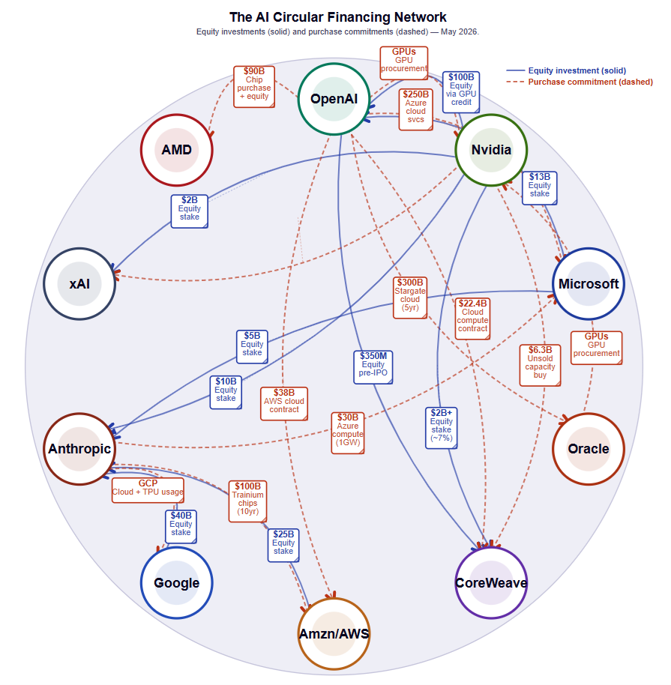
Without getting into any financial analysis of the diagram below, I include it simply to demonstrate the extreme complexity and circular nature of these financial relationships.

Figure 1:
The circular financing problem

Circular financing in AI works through a self-reinforcing loop. NVIDIA committed $30B as part of OpenAI’s $110B financing announced in February 2026, while simultaneously serving as OpenAI’s primary GPU supplier, making it both a major investor in and a vendor to the same company. NVIDIA simultaneously holds equity in CoreWeave, which supplies infrastructure to Oracle, which signed a $300 billion Stargate commitment with OpenAI. Microsoft has invested more than $13 billion in OpenAI while serving as its primary cloud provider, meaning a substantial portion of OpenAI’s rapidly escalating compute spend flows back into Azure revenue. Microsoft has disclosed more than $600 billion in AI-driven remaining performance obligations, of which management confirmed approximately 45% is attributable to OpenAI-related activity. These are just some of the interdependencies that exist, and while they do not make the revenue fabricated, they do make it very difficult to read reported growth figures as clear evidence of external market demand expanding at the rates that match recent headlines.

Stripping out circular flows to estimate genuine arm’s-length revenue is nearly impossible from the outside because none of these companies has any incentive to disaggregate them. What is clear is that OpenAI’s compute costs, projected to reach tens of billions annually, still dramatically exceed its current revenue. While their internal projections point to massive revenue growth over the longer term, the company is expected to remain unprofitable through at least 2029, with positive cash flow not expected until 2030. The infrastructure layer is being built on a combination of genuine demand and financial engineering, and the two are not currently separable from reported figures alone.

Why the application layer is the real signal

This is why revenue growth on the enterprise application layer has become the most important signal in the entire AI market. Enterprise application software does not carry a circularity problem. When an ERP vendor reports AI-driven ARR expansion, when an HCM platform demonstrates higher attach rates on AI-enabled capabilities, when a finance or procurement solution delivers measurable process efficiency gains that a CFO chooses to fund again at renewal, those signals reflect real buyers making real budget decisions based on perceived business value. There is no investment web distorting the demand signal. The revenue either reflects a genuine willingness to pay for demonstrated outcomes, or it does not.

What’s interesting is that we’ve seen this same exact pattern play out multiple times before during historical tech market revolutions. In each of the last several significant platform transitions, the application layer lagged the infrastructure layer in value creation, but eventually surpassed it as the platform matured.

The historical pattern

During the internet buildout, infrastructure companies captured the overwhelming share of market value. Cisco dominated with networking equipment and briefly became the most valuable company on earth, reaching a market cap of nearly $560 billion in March 2000. Companies like Sun Microsystems and Dell supplied servers, and even fiber optic cable makers like Corning and JDS Uniphase had their moment. Meanwhile, the application layer was largely characterized by money-losing dot-com ventures that collapsed when the bubble burst. But over the long term, application layer players like Amazon, Salesforce, and Google eventually dwarfed those companies.

The cloud era was no different. AWS launched in 2006 and, for years, held a dominant share of the cloud market, while enterprise SaaS applications were still proving their business model viability. IDC’s Worldwide Semiannual Public Cloud Services Tracker shows that by 2020, the SaaS application layer had grown to $148 billion in revenue, nearly half of the total $312 billion public cloud market, while IaaS, despite its faster growth rate, remained a significantly smaller share of the overall pie. Once the cloud infrastructure platform matured, value creation in the application layer far exceeded it.

Looking at the current AI boom, it’s following the same early-stage script. NVIDIA first became the world’s most valuable company in mid-2024, and we are in the middle of an AI infrastructure super cycle with trillions of dollars flowing into compute, datacenter construction, and power generation. Meanwhile, enterprise AI application revenues remain nascent relative to the trillions being invested in the infrastructure layer beneath them.

Agentic AI is triggering a fundamental reconsideration of how companies invest in packaged software, as AI agents effectively become the new enterprise apps. IDC’s spending forecasts project AI investment growing 31.9% annually between 2025 and 2029, reaching $1.3 trillion. These are real demand signals, and they are large enough to sustain significant growth at the application layer if enterprise software vendors can connect their AI capabilities to the business outcomes buyers are seeking.

The monetization gap that still needs closing

The monetization gap, however, remains significant and is not yet closing at the pace the market requires. IDC’s Future Enterprise Resiliency and Spending Survey (FERS) finds that few organizations report measurable financial results from their AI projects, despite widespread improvements in individual productivity. While most organizations aspire to grow revenue through AI initiatives, the majority have yet to achieve that goal. This distinction between individual productivity gains and organizational-level financial outcomes is one that enterprise software vendors have been slow to confront directly. Productivity at the individual level is real, documented, and genuinely valuable. Translating those gains into measurable business results that justify enterprise software pricing premiums is a fundamentally different challenge, and one that buyers are increasingly demanding vendors address more explicitly during renewal and contract-expansion discussions.

What vendors must do now

Closing that gap is the defining commercial challenge for enterprise software vendors over the next 12 months. The most urgent shift is from feature availability to outcome accountability: specific, auditable improvements in process efficiency or cost reduction that survive CFO scrutiny at renewal. Transparent commercial models follow from that. If buyers have to build the business case themselves, or fund significant professional services to reach value, adoption curves will flatten and renewal risk will rise. The competitive differentiator in this environment is not model sophistication. It is workflow transformation. Enterprises evaluate software on whether it changes the workflows that actually drive their business.

The infrastructure layer of the AI market may ultimately prove resilient. The circular financing dynamics, while real, are not unlike the capital formation structures that funded prior technology infrastructure buildouts, and genuine demand for compute at scale is not in dispute. The application layer is not a downstream beneficiary of the AI infrastructure boom. It is the proof point on which the entire narrative depends.

Eric Newmark

Eric Newmark - Group Vice President & General Manager of IDC's SaaS, Enterprise Software, CX and Workplace Solutions Division

Eric Newmark is Group Vice President & General Manager of IDC’s SaaS, Enterprise Software, CX, and Workplace Solutions Division, which includes several teams of analysts covering SaaS, 18 enterprise application markets, software monetization, business platforms, marketplaces, and services firms focused…

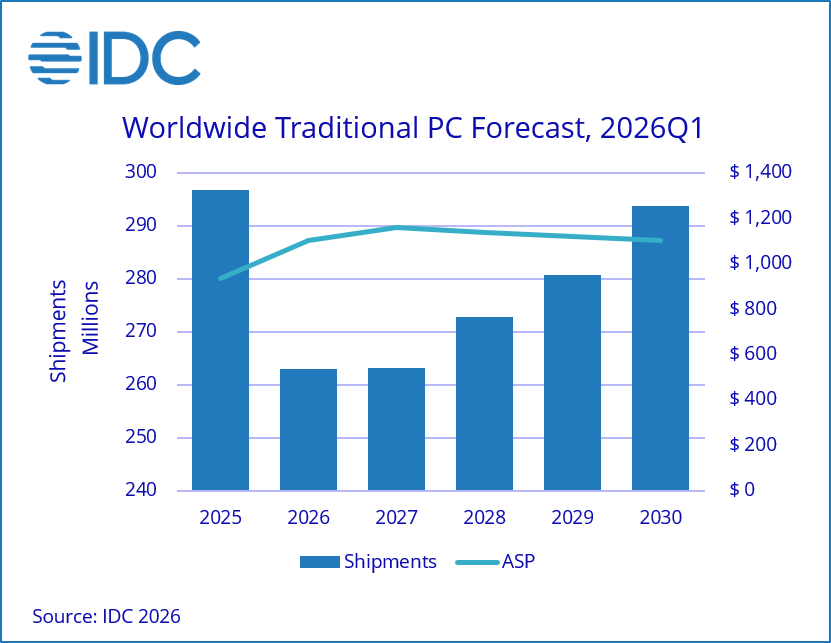
The global PC market is heading into a turbulent second half of 2026, and there’s no quick fix on the horizon. IDC now forecasts global PC shipments will decline 11.3% for the full year, with conditions worsening progressively through Q4, when shipments are expected to fall 20% year-over-year.

The culprit is a persistent memory shortage with no meaningful relief expected before the end of 2027. The knock-on effects are significant: prices are rising and PC manufacturers are struggling to maintain full product portfolios.

Pull-forward demand masked the problem, temporarily

The first quarter of 2026 offered a deceptively encouraging signal, with shipments growing 3% versus the same period last year. But that strength was largely borrowed from the future. Buyers, both consumer and commercial, accelerated purchases ahead of anticipated price hikes and product availability constraints.

“The anticipation of rising prices and of limited availability of some system configurations due to memory and other component shortages has led some end-users to make purchases earlier than anticipated,” said Jean Philippe Bouchard, Vice President of Devices and Consumers at IDC. “We’re not seeing any relief to the memory shortage situation before the end of 2027, which means prices will continue to rise and PC manufacturers will struggle to maintain full product portfolios for the foreseeable future.”

Some of that momentum is carrying into Q2, but the remaining quarters are expected to deteriorate gradually and sharply.

The MacBook Neo factor

One notable wildcard is Apple’s MacBook Neo, which has driven stronger-than-expected notebook demand and prompted IDC to revise its notebook forecast upward. But its ripple effects cut both ways.

“The introduction of the MacBook Neo is putting real pressure on the entire PC ecosystem,” said Jitesh Ubrani, research manager for IDC’s Consumer Devices Trackers. “We expect vendors to respond with a combination of new silicon, a more efficient OS from Microsoft, and aggressive promotional pricing.”

“The competitive pressure from the Neo is providing a partial offset to broader price increases, keeping some low-cost notebook options alive. But the overall trajectory for average selling prices (ASPs) is firmly upward. IDC forecasts ASP growth of 17% in 2026, and even as memory capacity expands over the next two years, pricing is unlikely to return to 2025 levels,” Ubrani added.

What to watch

The PC market is navigating a rare combination of structural supply constraints, macroeconomic headwinds, and platform-level disruption. For buyers, the window for favorable pricing is narrowing. For vendors, the challenge is sustaining portfolio breadth while managing component scarcity and competitive pressure from Apple’s latest hardware.

IDC tracks ongoing developments through its Worldwide Quarterly Personal Computing Device Tracker.

Jitesh Ubrani

Jitesh Ubrani - Director, Consumer Devices Research

Jitesh Ubrani is a Director at IDC leading a team of analysts within the Worldwide Consumer Device Trackers group, covering wearables, augmented reality (AR), virtual reality (VR), tablets, phones, PCs, gaming, and smart home devices, with a focus on market…
Jean Phillippe Bouchard

Jean Phillippe Bouchard - Vice President, Data & Analytics

Jean Philippe (JP) Bouchard is Vice-President, Data & Analytics at IDC Canada. In this role, JP is responsible for leading the team of analysts delivering Continuous Intelligence Services, Trackers and custom research in the Future of Work and Mobility group,…

Five years ago, enterprise technology roadmaps stretched across half a decade. Then they shifted to three years. Today, many organizations are planning just 18 months ahead, and even that horizon is getting shorter. As AI accelerates innovation, the challenge is no longer access to technology. The challenge is applying it effectively in a world that is changing faster than most organizations can plan for.

Perficient is not waiting for the dust to settle.

The global consultancy, with more than 7,000 advisors, engineers, and designers, has deep expertise in heavily regulated sectors such as banking, financial services, insurance, healthcare and life sciences, as well as auto and industrials. Working as a strategic partner to Fortune 100 companies, Perficient helps organizations become more data-driven, make better decisions, and move faster without losing their footing.

Its approach is grounded in a particular kind of pragmatism.

“Our focus is really on helping our clients understand the world around them and be very pragmatic in their approach to leveraging technology,” said Eric Walk, Vice President, AI Data Platforms at Perficient, “cutting through the noise and the buzzword bingo.”

That means treating AI as a practical tool rather than a destination, applying it to specific problems with clear outcomes in mind, and working iteratively with clients so they can adapt as conditions change.

“That type of agile iteration where we’re moving in weeks, not years, is the key to effective adaptation to the way the world is changing around us,” Walk said.

Building intelligence that can keep up

Speed alone does not improve outcomes. Organizations also need confidence in the direction they are moving.

Perficient uses a balanced intelligence model that brings together proprietary knowledge, open-source intelligence, and premium analyst research to create a complete view of the market. AI helps teams analyze large volumes of information and surface insights more quickly, and the firm is building internal AI agents to help consultants work more efficiently and deliver higher-quality work for clients. But the quality of those outputs depends entirely on the quality of what goes in.

“You can open up the world and have AI crawl the internet and look at any source of information, but you’re going to get results that reflect the internet,” Walk said. “It’s critical for us to ensure we have trusted inputs to produce trusted outputs.”

The role of trusted insight

That focus on trusted inputs is where analyst research earns its place in the model.

IDC’s research helps Perficient teams validate assumptions, challenge internal perspectives, and understand how markets are evolving in real time. It fills gaps in areas where consultants may not have deep specialization and gives them the external grounding to give clients advice they can stand behind.

“The more curated, more insightful, more thoughtful content that IDC provides is critical in helping us give our clients more effective advice and understand the world that we and they are living in day to day,” Walk said.

As AI becomes more integrated into consulting workflows, how teams access that insight is evolving too. Walk was among the beta testers for IDC Quanta, IDC’s new AI platform built on its proprietary research. For a firm already invested in making consulting more natively AI-enabled, the ability to query trusted IDC intelligence through a conversational interface, with every response grounded in specific research, points directly at the problem Perficient is trying to solve.

Turning disruption into advantage

Perficient is applying these same principles to itself, actively building AI-driven capabilities to improve how its own teams operate across research, delivery, and execution. Whatever it recommends to clients, it is already doing internally.

“We want to be out front and thinking about new ways of doing business and putting them into practice to drive outcomes for our clients,” Walk said. “At the end of the day, what matters is increasing revenue, reducing cost, and driving efficiencies in the right way to make both us and our clients successful.”

In a market that is not slowing down, that combination of trusted intelligence, honest advice, and a genuine willingness to lean into change is what separates the firms helping clients navigate disruption from the ones still trying to plan their way around it.

“We want to be the disruptor,” said Walk. “We want to lean into disruption.”

Christina Cardoza - Content Marketing Manager - IDC

Christina Cardoza is a Content Marketing Manager at IDC, where she specializes in brand content and social media strategy. With a background in journalism and editorial leadership, she has a proven ability to transform complex technology topics into clear, actionable insights.

Your pipeline is growing. Conversion isn’t. That gap has a specific cause, and it’s not your demand generation.

In IDC’s recent expert panel, Addressing the Pipeline Conversion Gap, analysts examined why deal velocity and win rates are stagnating even as MQL volume climbs. The problem isn’t at the top of the funnel. It’s in what happens next.

They arrive having already evaluated options, checked pricing signals, and narrowed the field. Traditional qualification processes, built for a different era, are removing them before sales ever gets involved.

Today’s buyers are qualifying themselves. Your process just isn’t built for that.

The result is a filter that works backwards: organizations collect leads from browsers with no intent to buy while systematically losing their most qualified, motivated prospects.

“The funnel isn’t filtering for quality, it’s filtering for patience. And your best buyers have none.” — Heather Hershey, Research Director, Worldwide Digital Commerce

Five practices that push your best buyers out

AI has shifted information power to the buyer. Many qualification practices built to capture leads are now the reason those leads leave.

1. Gated content in an AI-first discovery environment

When decision-makers can get summarized answers instantly through AI tools, requiring registration for basic information creates friction without payoff. The problem has moved beyond conversion optimization. If your most valuable technical or educational content is inaccessible to AI indexing and answer engines, you risk disappearing from the places where B2B research now begins. The gate doesn’t just slow buyers down. It removes you from their consideration entirely.

2. Multi-step qualification chains

Traditional sales flows required multiple touchpoints before a prospect ever saw the product. Many buyers today want the opposite: the ability to self-evaluate first and engage with experts only when it’s worth their time. IDC research finds that high-intent buyers increasingly treat a mandatory demo sequence as a preview of what the purchase and implementation experience will be like. What they see is friction. What they do is leave.

3. Opaque pricing models

“Contact sales for pricing” once created negotiating leverage. Increasingly, IDC sees buyers interpret it as a signal that costs are inconsistent, negotiable in nontransparent ways, or deliberately difficult to benchmark. When prospects can compare alternatives through AI searches in minutes, withholding pricing information often accelerates movement toward competitors with cleaner commercial models , not away from them.

4. Requiring human contact for basic information

In IDC’s research, one of the most consistent buyer frustrations is being required to schedule a call to answer questions about integrations, security standards, deployment requirements, or product compatibility. When those answers are hard to find, buyers draw a conclusion: if pre-sale support is this cumbersome, post-sale support probably will be too. Self-service documentation isn’t a support cost. It’s where sales cycles now begin or end.

5. Repetitive discovery and qualification theater

Many organizations ask buyers to repeat the same background, pain points, and requirements across multiple calls with different representatives. What sales teams call thorough qualification is what decision-makers experience as a sign that your internal process matters more to you than their time does. Every redundant exchange reinforces that judgment.

The conversion gap isn’t a marketing problem

Most of the revenue challenges being attributed to marketing performance are symptoms of an outdated pipeline model. The organizations outperforming in this environment aren’t generating more leads. They’re removing friction for the buyers who already know what they want, and who expect to move on their own terms.

Closing that gap means changing some operating assumptions:

  • Let prospects self-educate before you bring them into human-led sales motions.
  • Make pricing, technical specs, and implementation details easy to find — not guarded.
  • Treat human engagement as something buyers opt into, not a gate you control.
  • Build for speed and buyer control. That’s it.

As AI intermediaries reshape how buyers discover and evaluate solutions, intent signals become harder to track. Qualification systems built for click-based, form-fill journeys are less effective when buyers expect answers before they ever identify themselves to a vendor.

Your competitors are probably making the same mistakes. The organizations that redesign for how buyers actually want to research and buy will capture the high-intent segment, the one that converts fastest and churns least.

Want to identify where your revenue process is creating buyer friction? Request a consultation with an IDC analyst.

IDC - -

International Data Corporation (IDC) is the premier global market intelligence, data, and events provider for the information technology, telecommunications, and consumer technology markets. With more than 1,300 analysts worldwide, IDC offers global, regional, and local expertise on technology and industry opportunities and trends in over 110 countries. IDC’s analysis and insight help IT professionals, business executives, and the investment community make fact-based technology decisions and achieve their key business objectives.

Google officially launched the Fitbit Air alongside the broader rollout of the Google Health platform, and while the hardware is getting most of the attention, enterprise and vendor watchers should keep their eyes on the software layer. This launch is less a fitness tracker story than a platform consolidation story, with significant implications for the broader health and wellness technology market.

The hardware: Deliberate, not derivative

The Fitbit Air is Google’s first screenless fitness tracker, priced at $99.99 and positioned squarely against the premium screenless wearables segment dominated by Oura and Whoop. The device is notably smaller than previous Fitbits and packs a meaningful sensor suite (heart rate, SpO2, HRV, irregular rhythm notifications, and automatic exercise detection) into a form factor designed to disappear on the wrist.

The deliberate absence of a screen is a strategic positioning decision, not a cost-cut. As the wearables market fragments, a growing segment of users prefers passive tracking devices that can be worn alongside a traditional watch rather than compete with one. The Fitbit Air isn’t the first screenless tracker to market, but it’s the first with a real chance to reach mainstream users, offering essentially the same health insights as premium incumbents at a fraction of the cost.

The lack of built-in GPS and NFC are notable omissions. Neither is a dealbreaker for the mass-market consumer Google is targeting, but both are worth flagging for more demanding buyers.

The real story: Google Health as a Platform

The hardware is secondary to what Google is actually building. The Fitbit app has been formally rebranded as Google Health, consolidating years of fragmented efforts across Google Fit, Health Connect, and Fitbit into a single platform. This is the kind of ecosystem rationalization that creates durable platform moats, and it matters for several reasons.

Google Health Coach, now out of public preview, is the differentiated layer. Built on Gemini, it functions as a personalized AI advisor across fitness, sleep, and health metrics; proactively surfacing insights rather than waiting to be queried. The coach delivers morning and evening summaries, post-workout analysis, and adaptive weekly fitness plans that update based on readiness scores and user context. In the US, it can connect to medical records, creating a longitudinal health data layer that goes well beyond what consumer wearables have historically offered.

What makes the coach genuinely interesting is its ability to incorporate life context, not just biometric data. When testing an earlier version as a new father traveling across multiple time zones with a sleep-training baby, the coach didn’t nag me to hit my workout targets. It recognized I wasn’t sleeping well, understood the circumstances I had shared, and offered practical alternatives such as a short walk, or pushing strength training to the next day. That kind of contextual flexibility is exactly what has been missing from wearables for years, and it’s where Google’s AI investment starts to show real differentiation over hardware-first competitors.

The platform also supports third-party device integrations via Health Connect and Apple Health, and Google intends to extend the experience to non-Google devices over time. The signal is clear: Google is less interested in selling you a tracker than in becoming the platform that ties all your health data together.

Competitive positioning and market implications

Several dynamics are worth watching. First, the Whoop comparison is apt but incomplete. The Fitbit Air takes the in-depth health analysis approach Whoop pioneered and opens it to the mass market at a budget price point. Whoop has a defensible customer base in enterprise wellness and athletic training; Google’s play is the mass consumer market plus enterprise wellness programs, an area where Fitbit has years of execution history. Notably, both represent a much larger total addressable market for Google than the competition it most directly displaces.

Second, Apple Health remains the obvious benchmark for platform completeness, and Google Health is clearly designed to close that gap on Android while making inroads on iOS. Limitations exist today, but Google has signaled plans to narrow the gap between Android and iOS experiences in the coming months.

Third, the subscription economics deserve attention. The Fitbit Air includes three months of Google Health Premium, after which the service runs $9.99/month or $99.99/year. Google is also bundling Health Premium into its broader AI subscription tiers (Google AI Pro and Ultra), a classic platform bundling move that mirrors its approach with cloud storage and productivity tools. This positions Google Health as a stickiness driver for the broader Google ecosystem, not a standalone revenue line.

One genuine limitation worth flagging

One architectural gap hasn’t received enough attention: although Google Health Coach is built on Gemini, it does not yet share context with the broader Gemini assistant. Users cannot tell Gemini “I’m traveling this week, pause my workout reminders until I get home” and have Health Coach act on it. The two systems currently operate in separate silos. For a company positioning Google Health as the intelligent, context-aware layer of its ecosystem, closing this gap should be a near-term priority.

The bigger picture

Google’s healthcare ambitions have historically outpaced execution, but this launch feels different. The coherence of the platform vision is clearer than it has ever been: a single app, an open third-party ecosystem, medical records integration, and an AI coaching layer all pointed at the same user experience. The Fitbit Air is the entry-point hardware, priced to drive volume. The data and subscription layer is the actual business, and the early signs suggest Google is serious about building it.

Jitesh Ubrani

Jitesh Ubrani - Director, Consumer Devices Research

Jitesh Ubrani is a Director at IDC leading a team of analysts within the Worldwide Consumer Device Trackers group, covering wearables, augmented reality (AR), virtual reality (VR), tablets, phones, PCs, gaming, and smart home devices, with a focus on market…

When drone strikes hit data centers in the UAE and Bahrain, disrupting cloud regions, it was more than an infrastructure crisis. It was a stress test the industry wasn’t prepared to pass. The old playbook of cybersecurity, disaster recovery, and backup no longer covers the necessary ground. Business continuity now carries a new mandate. Organizations that grasp this shift early will be the ones still operating when the dust clears.

What the conflict revealed about resilience

The numbers from the region are stark. During the escalation period, UAE organizations reported more than 800,000 cyberattacks per day, a figure documented across regional incident tracking and government disclosures. More than 150 hacktivist and cyber incidents swept across the region. Oracle was named as a target by Iran’s IRGC; Microsoft, Google, and Nvidia received direct threats. Subsea cables and Gulf digital infrastructure faced escalating risk. Airspace closures disrupted not only aviation but also connectivity, technology systems, and daily operations.

At the same time, physical access to offices, data halls, and SOCs became impossible for many organizations. This was not because their systems were compromised, but because security restrictions, travel advisories, and employee displacement locked recovery teams out of the buildings where they needed to work.

This is the defining lesson of this conflict: Cyber and physical threats no longer take turns. They converge.

Five things war conditions change for business continuity

  1. Premises denial is now as critical as cyber compromise. Even when systems are intact, staff may be unable to reach offices, SOCs, plants, or branches due to security restrictions, curfews, or evacuation orders. Physical access failure is a continuity failure.
  2. Recovery teams become the bottleneck. Displaced personnel, degraded telecom access, and broken leadership chains make it harder to approve failover, validate clean backups, or execute safe recovery. People are the constraint now, not just technology.
  3. Physical and cyber events are the same event. A missile strike, cable cut, or power disruption opens exactly the window attackers exploit, ransomware, wipers, credential abuse, and disinformation running in parallel.
  4. “Availability” means more than uptime. In conflict conditions, the real continuity question is operational: can the organization still deliver critical services to customers, citizens, patients, or counterparties at the minimum level that keeps them functioning?
  5. Geographic redundancy can fail if it’s too correlated. If your primary and DR locations share the same regional risk envelope, you may technically have redundancy, but operationally you’re still exposed. Diversity of risk, not just diversity of location, is what matters.

The new framework: ResOps

Organizations navigating this moment with confidence are building what IDC defines as Resilience Operations (ResOps): a continuous, operational discipline that spans cyber, infrastructure, and business layers simultaneously.

ResOps is not a product or a checklist. It is the organizational capacity to maintain essential services when faced with degraded networks, dispersed staff, and inaccessible facilities, all at once, in real time.

The value proposition is direct: stay remotely operable, controlled, and clean under conditions that would break a traditional continuity model.

Four pillars for building a resilience offering in the region

For security vendors and MSSPs operating in the Middle East, IDC’s research identifies four areas where providers need to structure their capabilities:

  1. Protect: Harden and segment everything that can be targeted, digitally and physically. This includes identity and access resilience, data and workload protection, and physical and environmental security.
  2. Isolate: Assume compromise and loss of premises. Capabilities here include clean room recovery, cyber vaulting, out-of-band secure administration, forensic readiness, and recovery orchestration.
  3. Operate: Keep essential services running. This requires remote SOC operations, workforce continuity planning, alternative connectivity, crisis command centers, and defined minimum viable service thresholds.
  4. Prove: Test, learn, and demonstrate resilience through simulations, tabletops, recovery testing, sector runbooks, and third-party assurance.

Where spending is going

IDC’s Future Enterprise Resiliency & Spending Survey is clear: security and resilience budgets are among the most protected in the enterprise, regardless of broader economic conditions.

Cyber recovery and cyber resilience are expected to see significant investment increases across the META region in 2027, pushing META security spending to nearly $13 billion by end of 2026. Providers who position around resilience operations, not point security products, are the ones who will capture this spend.

The bottom line for providers

The Middle East war is not an isolated event. It’s a preview of what geopolitical risk looks like for enterprise technology in the years ahead.

Providers who win in this environment are those who help organizations answer one question with confidence: when everything goes wrong at once, can you still deliver?

Build your portfolio around that answer. Give your customers the evidence they need to act and the path to get there.

Shilpi Handa

Shilpi Handa - Associate Research Director (META), IDC

Shilpi Handa is an associate research director at IDC, with responsibility for the Middle East, Turkey, and Africa cybersecurity practice. Her core research coverage revolves around cybersecurity, with a focus on network security, cloud security, application security, and security operations.…

The smartphone market is headed into its worst year on record.

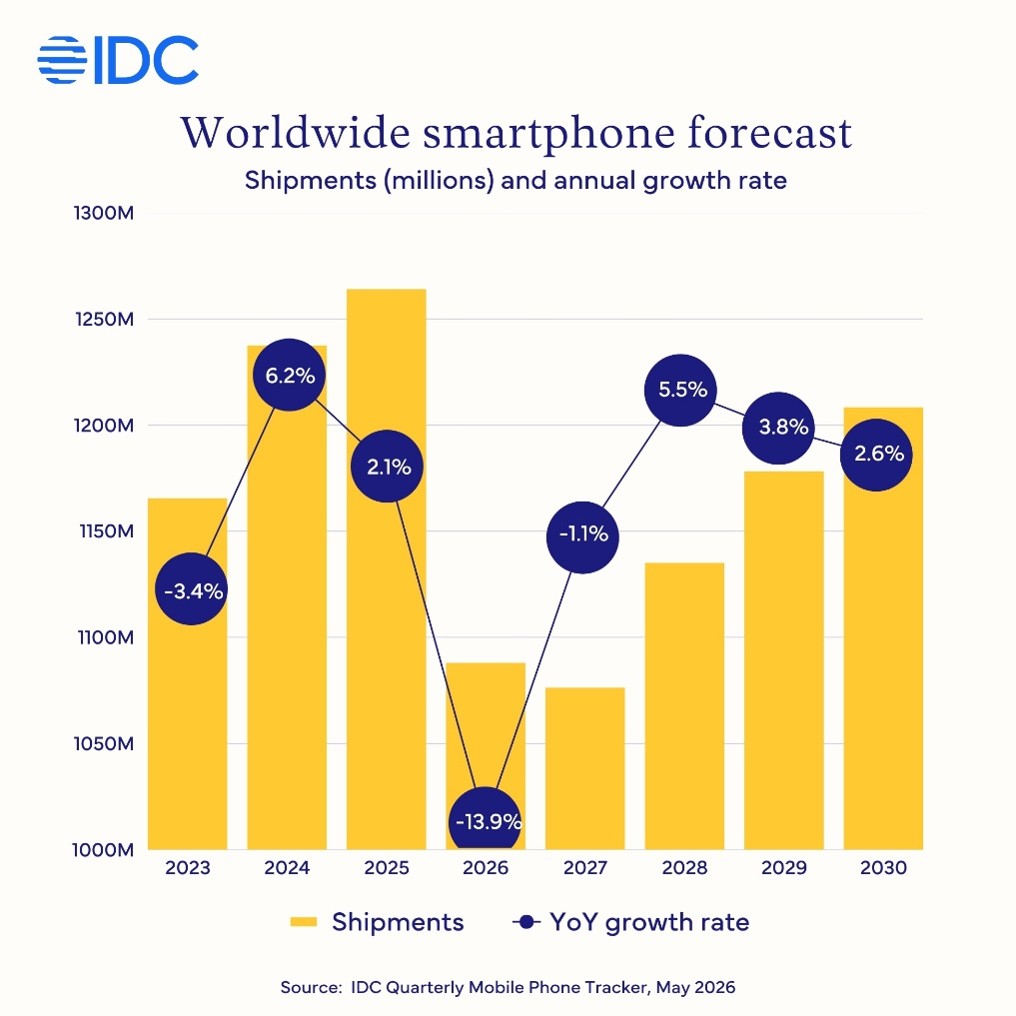
According to IDC’s Worldwide Quarterly Mobile Phone Tracker, worldwide smartphone shipments are forecast to decline 13.9% year-on-year in 2026 to 1.09 billion units. That is a further downward revision from IDC’s February forecast of a 12.9% decline, and it would mark the steepest annual contraction in smartphone history. A second consecutive decline of 1.1% is now expected in 2027, with a 5.5% rebound forecast in 2028 as memory supply normalises.

So what is behind the numbers, and what do they mean for vendors, regions, and operating systems trying to navigate this moment?

Why will the smartphone market see a record decline in 2026?

The memory shortage that began reshaping the market in 2025 is still the primary driver. But it is no longer working alone.

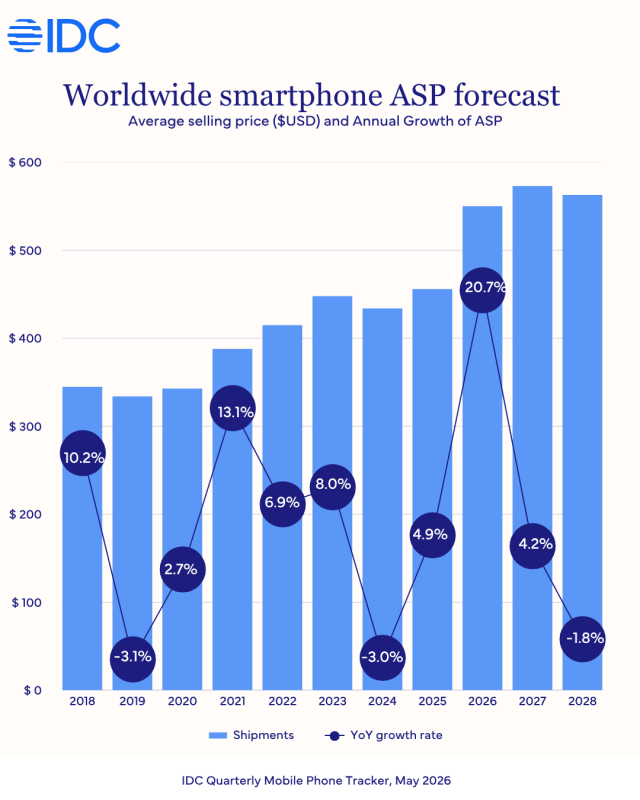
“The deepening memory shortage crisis remains the dominant force behind the record 14% drop this year, but it is no longer the only one,” said Nabila Popal, Senior Research Director with IDC’s Worldwide Quarterly Mobile Phone Tracker. “The US-Iran war has added a fresh layer of cost pressure for smartphone OEMs, driven by rising oil prices and transportation costs. Combined, these pressures are compelling vendors to reduce shipments, raise prices and concentrate on higher price tiers — elevating smartphone ASP to a record $550, up $100 from last year. 2026 will be a defining year for the industry as new reality of structurally higher costs take hold. For consumers, it means the era of ultra cheap smartphones is over. For vendors, it means only those that can adapt their strategies to this new cost environment and sustain demand at elevated price points will survive.”

How will different regions perform in 2026?

The decline is not distributed evenly. It is concentrated at the bottom of the market, and that means emerging markets will absorb the most pain.

The sub-$200 segment, where margins are already thin and consumers are most price-sensitive, will shrink the most. Regions with the highest concentration of sub-$200 devices are facing the sharpest declines: Middle East and Africa (MEA) is forecast to drop 23%, Central and Eastern Europe 19%, and Asia Pacific excluding Japan and China (APeJC) 14%.

North America holds up comparatively well, with only a 6.3% decline. The region is dominated by the premium segment, with 60% of shipments in 2026 Q1 above $800, and Apple and Samsung have proven resilient to the crisis at that tier. China is also forecast to decline double digits at 13%, as low-end Android players struggle to compete in the new cost environment.

How will performance differ across vendors and operating systems?

Android as a whole is forecast to see a 21% year-on-year drop, but that number masks two very different stories playing out within it.

Samsung is expected to grow market share in 2026, defying the broader Android decline by expanding in the premium segment and taking share in the mid-range. A combination of secured memory supply, a stronger Galaxy S26 line-up, and aggressive mid-range positioning is allowing Samsung to capture demand that smaller Android vendors simply cannot serve as memory costs squeeze their bill of materials.

iOS tells a different story. Apple’s forecast improved from an 8.1% decline to just 5.2% in 2026, a meaningful divergence at a time when the rest of the market is heading sharply downward. Apple secured the memory supply it needed early and is seeing exceptionally strong demand for the iPhone 17 series across developed markets and especially in China.

“2026 will be a defining year for Apple,” said Francisco Jeronimo, Vice President for Worldwide Client Devices at IDC. “In a year when the broader smartphone market will record its steepest decline in history, iOS will deliver its highest annual share ever, at 22%. Apple has done three things that few of its competitors have managed: it secured memory supply early, it built a portfolio strong enough to drive a remarkable turnaround in China, and it positioned the iPhone 17 to capture demand exactly when consumers in developed markets are extending replacement cycles and trading up. The shift in market share that follows from this crisis will benefit Apple more than any other vendor.”

HarmonyOS is the other bright spot. Huawei’s operating system is forecast to reach 62 million units in 2026, up sharply from the 42 million previously forecasted. Huawei has expanded HarmonyOS into the entry-level segment, sustained or reduced pricing on new models, and continued promotional support for older devices. The strategy has worked particularly well in China’s lower-tier cities, where the affordability gap created by rising Android ASPs has created space for a domestic alternative.

Will foldable smartphones grow in 2026?

Yes, and it is one of the few unambiguously good news stories in this forecast.

For the second consecutive year, foldables are defying the broader downturn. The category is forecast to grow 20% year-on-year in 2026, supported by new models from existing players and, more importantly, Apple’s long-anticipated entry into the segment in the second half of the year. Foldables remain a small share of total smartphone volumes, but they are now the only segment where vendors can credibly defend premium pricing and grow units at the same time.

What does this mean for vendors and the industry?

The forecast draws a clear dividing line. Vendors with scale, supply leverage, and pricing power, namely Apple, Samsung, and Huawei within China, will gain share. Smaller Android brands concentrated in entry-level price bands and emerging markets will face the sharpest contractions and, in some cases, exit the market.

ASPs are unlikely to return to 2025 levels within the forecast horizon. The sub-$100 segment, which accounted for over 170 million devices in 2025, becomes economically unviable as memory and NAND costs settle at a permanently higher level, even after the memory shortage stabilises in 2028.

The next 18 months will determine who emerges from this reset with a sustainable position and who does not.

Nabila Popal

Nabila Popal - Senior Director, Data & Analytics

Nabila Popal is Senor Director with IDC's Data & Analytics team, specializing in Mobile Phones, PC Monitors and other consumer devices.  Ms. Popal is responsible for the global research and quality and timely delivery for her respective technologies, coordinating with regional…
Francisco Jeronimo

Francisco Jeronimo - VP, Data and Analytics, Devices, IDC EMEA

Francisco Jeronimo is VP for Data and Analytics at IDC EMEA. Based in London, he leads the research that covers mobile devices, personal computing devices, emerging technologies and the circular economy trends across EMEA. His team delivers data on personal…

Image: Sundar Pichai at Google I/O 2026. © Google

Google I/O 2026 kicked off with a packed two-part run: an Android Show preview on May 12 followed by Google I/O in Mountain View one week later. IDC’s devices analysts attended vendor briefings and were on-site at I/O, and the common thread across it all is the push of Gemini Intelligence via the Gemini 3.5 series of models.

Android XR glasses: Google shows up with an advantage

Even though Android XR (Google’s extended reality platform) and its OEM partners were already announced last year, we finally got to see the final form of Warby Parker and Gentle Monster’s glasses, the designs of which are just as important, if not more, than the technical specifications given how eyewear is deeply personal and reflective of one’s identity. Prices were not announced, but this confirmed shipping timelines and refined use cases, including automatic language translation and smartwatch integration.

These designs do not have displays, and hence Google referred to them simply as “audio glasses.” That’s in contrast with “display glasses,” such as XREAL’s Project Aura, which also made an appearance with a redesigned compute puck and fingerprint sensor. It shouldn’t be a surprise that the audio glasses ship first.

Competition-wise, Meta has a head start in smart glasses but relies on discovery through its social media assets. Google, on the other hand, is entering with an AI assistant that is already in one’s email, photos, search history, and calendar. For users within Google’s ecosystem, the proposition is stronger. Gemini can draw on email, photos, calendar, and search history to be proactive in ways Meta’s assistant cannot. In IDC’s view, being late to a market with a structural advantage is not a bad place to be.

Gemini Spark: Bringing the agent craze to everyone

If you follow tech enthusiast communities, you’ve probably noticed the OpenClaw craze that’s taken hold over the past several months. Hobbyists and early adopters have been dedicating Mac Minis and spare machines as local AI agent systems, running workflows that monitor inboxes, execute tasks, and automate digital life around the clock. The results have captured people’s imaginations, but the catch is that getting there requires navigating CLIs, configuring local models, and tackling other technical challenges that limit its usage to hobbyists and very early adopters.

Gemini Spark (Google’s cloud-based AI agent system) has the potential to address that; it runs on Google Cloud rather than local hardware, so it works whether or not one’s PC is powered on, and doesn’t require complicated installation or configuration. Unlike local AI agent setups, Gemini Spark requires no hardware configuration or technical setup. It was a matter of time before the industry began abstracting technical complexities into interfaces that more mainstream users could adopt, and Gemini Spark fits neatly with Google’s lean toward the consumer.

To that end, it is good to see guardrails accompanying the new capability. Android Halo surfaces agent activity in a phone status bar so one always knows what Spark is doing. And the Agents Payment Protocol acts as a sandboxed payment system, constraining what AI agents can spend on your behalf.

Googlebooks: Finally on an Android stack

The big hardware announcement from The Android Show in the prior week was the Googlebook — Google’s new premium laptop category that finally merges Android and ChromeOS into a single platform. Launch partners include Acer, ASUS, Dell, HP, and Lenovo, with devices expected in fall 2026, powered by Qualcomm, MediaTek, and Intel processors. Every Googlebook also sports a glowbar on the lid as a physical differentiator, and we covered Googlebooks in detail in our full client brief.

Googlebooks run on what the industry has known internally under the code name Project Aluminium. While Google hasn’t given the OS an official external name yet, it runs on an Android stack that allows for better unification with other devices like phones, which has been eagerly awaited. Features like Magic Pointer and Create My Widget seem more like novelties; we were hoping to see more unveiled at Google I/O the following week, but Googlebooks were not covered much there. Nonetheless, the big question is where Chromebooks go from here.

Chromebooks aren’t going anywhere, with support confirmed through at least 2034 and a continuing focus on the browser and education markets. IDC data shows ChromeOS at roughly 9% of global notebook shipments in 2025, with about three-quarters of those units in education, a segment that won’t migrate overnight. Even though Googlebooks will eventually succeed Chromebooks, that means that this premium positioning will change over time if it is still going after the low-end education segment.

On that note, there is a generational angle that is worth noting: the Chromebook generation is entering the workforce. Kids who spent their school years on ChromeOS are now professionals with disposable income and deep-rooted familiarity with the Google ecosystem. For them, a Googlebook can be a natural upgrade to the OS they already know, now layered with Gemini’s agentic capabilities that help shift users from web-based workflows to task-based ones.

Gemini Intelligence on Android 17: AI that actually does things

Central to Android 17 is a set of Gemini Intelligence capabilities that shift the AI from an assistant to an agent: booking concert tickets, completing travel forms using passport photos, and adding textbooks to a shopping cart across websites. Google calls this agentic task execution, and it represents a meaningful step forward from the prompt-and-respond model most users are accustomed to.

A few features stand out. Rambler converts messy, natural speech into clean text with multilingual support, reflecting Google’s decades of language data from Search, Maps, and Assistant. Create My Widget extends to phones and watches, letting users define exactly which information they want surfaced, something off-the-shelf widgets have never done well. And an overhauled iOS-to-Android switching experience covering passwords, photos, apps, contacts, and home screen layout signals that Google believes Gemini Intelligence is now compelling enough to make the migration worthwhile for iPhone users.

The trust question looms large, however. Letting an AI access passport data, financial accounts, and personal apps requires a level of user confidence that Google hasn’t yet fully earned. How Google handles transparency and oversight around these agentic features will be as important as the features themselves.

Bryan Ma

Bryan Ma - Vice President, Client Devices

Bryan Ma is Vice President of Client Devices research, covering mobile phones, tablets, PCs, AR/VR headsets, wearables, thin clients, and monitors across Asia as well as worldwide. Based in Singapore, Bryan provides insights and advisory services for both vendors and…
Jitesh Ubrani

Jitesh Ubrani - Director, Consumer Devices Research

Jitesh Ubrani is a Director at IDC leading a team of analysts within the Worldwide Consumer Device Trackers group, covering wearables, augmented reality (AR), virtual reality (VR), tablets, phones, PCs, gaming, and smart home devices, with a focus on market…
Ryan Reith

Ryan Reith - Group Vice President, WW Device Trackers

Ryan Reith is the Group Vice President for IDC's Worldwide Device Tracker suite, which includes mobile phones, tablets, wearables, and most recently AR/VR. His teams research focuses on the quantitative aspects of the mobile device industry, including market sizing, forecasting,…
Bryan Bassett

Bryan Bassett - Research Manager, Enterprise Mobility

Bryan Bassett is Research Manager for IDC's Enterprise Mobility: Workspace and Deployment Strategies program. Bryan's research focuses on the evolution of mobile hardware deployments in large corporate environments and the impact mobility has on modern enterprise workflows, business end-users, and…

When Phillip Langeberg took over IT leadership at The Resorts Companies in 2017, he faced a problem that doesn’t show up in business school case studies. He was building a modern technology organization for a company that operates at the intersection of hospitality, real estate, and recreation, and there was no obvious playbook for it.

The company runs two flagship properties in Virginia: Wilderness Presidential Resort, a 600-acre camping and recreation destination, and Massanutten Resort, a 6,000-acre, four-season property with 2,500 accommodations, ski, an indoor and outdoor waterpark, four restaurants, two recreation centers, two golf courses, and more. Its technology ecosystem has to support everything from reservations and guest engagement to point of sale, property management, marketing platforms, and operational systems across multiple venues and verticals. And as a 100% employee-owned (ESOP) company since 2015, every technology decision carries weight beyond the immediate bottom line. Every employee has an ownership stake. Getting it wrong is not just a budget problem.

“The challenge is really trying to find the software and build the ecosystem that allows all these different business verticals to work together,” said Langeberg, CTO of Resorts Companies. Benchmarks from companies far smaller or far larger weren’t useful. He needed a perspective that could meet him where he actually was.

Seeing the larger framework

That’s where IDC came in. Over more than a decade, Langeberg has used IDC analyst conversations and IDC Roundtables to validate strategy, pressure-test decisions, and benchmark against peers across industries well beyond hospitality.

In 2021, a group of IDC analysts helped him think through the right staffing model for his IT organization, making recommendations based on the company’s goals, existing systems, and where technology was heading. Knowing that the future would be shaped by AI and data analytics, Langeberg used that guidance to build those capabilities in-house, reducing reliance on external vendors before the wave hit.

More recently, as The Resorts Companies planned a 140-room hotel addition to its waterpark, the expansion became a catalyst to standardize point of sale systems across the entire resort. IDC helped cut through a crowded vendor market to identify the solutions that actually fit. “You Google point of sale vendors and there’s a ton out there,” said Langeberg. “That’s really what IDC can bring to the table, the ability to come in and say, you’re in this industry, you’re doing this, let’s figure out what software platforms align with what you guys are doing as a business.”

IDC Roundtables added another dimension, bringing Langeberg into conversation with CIOs and CTOs from industries ranging from water treatment to manufacturing. Hearing what leaders in completely different sectors were building, and what they were running into, shaped decisions he never would have reached staying inside the hospitality lane.

“Being able to have conversations with IDC analysts is really helpful because they see the larger framework,” said Langeberg. “There could be a solution I’m not considering because I’m only looking at the hospitality sector.”

The relationship becomes a platform

When IDC introduced Quanta, a new AI platform built on IDC’s proprietary research and intelligence, Langeberg recognized immediately what made it different from the general-purpose AI tools he had already been using. “If I go to one of the other AI products out there and search for something, it’s searching the internet, and we all know that everything on the internet isn’t always accurate,” he said. “Maybe it’s paid marketing material for a product, and that’s weighing the decision and ultimately weighing where you’re guiding your business.” Quanta draws from verified IDC intelligence instead, with every response citing the underlying report or MarketScape it came from.

The trust, though, didn’t come from the platform’s architecture. It came from the relationship. “It’s almost like taking the power of all the IDC analysts and putting it into a simple query engine that I’m able to use,” said Langeberg. “An AI backed by IDC’s research gives me a lot more confidence in the answers.”

Looking around the corner

With major expansions underway, including a new waterpark hotel with a redesigned check-in experience, and the Bluestone Peak 55+ active adult community, The Resorts Companies is entering its most complex period of growth. Langeberg plans to use Quanta to build multi-year technology roadmaps and model vendor decisions before committing, backed by IDC’s market intelligence.

“When I walk into that moment where I’m not sure where I need to be on something, I know that IDC is there as a partner, through their research, the AI platform, the analysts, to help us plot the right course.”

For technology leaders navigating complex, niche industries without a natural peer group, that combination of earned credibility and on-demand access is exactly the edge that’s hard to find anywhere else.

Christina Cardoza - Content Marketing Manager - IDC

Christina Cardoza is a Content Marketing Manager at IDC, where she specializes in brand content and social media strategy. With a background in journalism and editorial leadership, she has a proven ability to transform complex technology topics into clear, actionable insights.

Hangzhou has always defied expectations. Once celebrated for the serene beauty of West Lake, it reinvented itself as the birthplace of China’s digital economy through the rise of Alibaba. Now, it’s doing it again — emerging as one of China’s most serious players in artificial intelligence and embodied intelligence.

That’s why IDC Directions 2026 is coming to Hangzhou for the first time.

In 2025, the added value of Hangzhou’s core digital economy industries reached RMB 678 billion — accounting for 29.5% of the city’s GDP, with annual growth of 9.3%, according to the Hangzhou Municipal Bureau of Statistics. That momentum outpaces the broader national trend for digital sectors, underscoring the city’s leading position as a regional innovation hub. This isn’t a city on the rise. It’s a city already there.

Why Hangzhou, and Why Now

IDC Directions Beijing and Shenzhen have long been the go-to forum for China’s ICT community — drawing hundreds of industry participants, delivering senior analyst insights on AI, cloud, cybersecurity, and emerging technologies, and offering one-on-one sessions where ICT leaders dig into their real challenges and growth opportunities. The 2025 edition alone attracted nearly 300 industry leaders, digital experts, and investors when it launched in Shenzhen.

Now, that same calibre of conversation is coming to the Yangtze River Delta — and Hangzhou is the right city for it.

Three things set Hangzhou apart:

  • A proven innovation ecosystem. Hangzhou is home to a dense mix of startups, scaled enterprises, and specialized industry clusters. It’s not an emerging hub — it’s an active one, with real deal flow and real decision-makers already operating here.
  • Leadership in tomorrow’s technologies. Robotics, intelligent computing, and smart home industries are growing fast here, and Hangzhou’s engineering and R&D capabilities have already been showcased on a national stage at the CCTV Spring Festival Gala. This is a city that builds things.
  • Strong institutional backing. The Hangzhou municipal government’s Future Industry Cultivation Action Plan (2025–2026) is already in motion, and major national gatherings — including the China (Hangzhou) Embodied Intelligent Robot Industry Conference and the National Artificial Intelligence Industry Development Conference — have firmly established the city as a destination for serious tech collaboration.

What to Expect at IDC Directions 2026 Hangzhou

What we can already say: Curated event sessions will center squarely on Hangzhou’s flagship strength sectors—robotics, smart home ecosystems, and intelligent computing—while linking local innovation to the transformative trends reshaping China’s broader ICT industry agenda.

The event will feature keynote and breakout sessions delivered by IDC China’s most senior analyst team, with deep expertise spanning enterprise AI, emerging technology, digital economy, and industry transformation across core verticals.

Featured discussion themes will dive into tangible, high-impact topics: the rapid commercial adoption of AI Agents, full-stack cloud and computing platform evolution fueled by open-source models such as DeepSeek, and projected industrial AI investment in China set to hit RMB 900 billion by 2028.

Beyond insightful content, the event will gather a high-caliber audience pool including enterprise CxOs, top tech solution vendors, industry innovators, and institutional investors from Hangzhou and across the Yangtze River Delta—covering Shanghai, Nanjing, Suzhou and surrounding tier-one innovation cities. It offers a chance to network with regional decision-makers, benchmark industry best practices, and align long-term business strategies with local growth momentum as well as the strategic priorities outlined in China’s 15th Five-Year Plan.

Join Us in IDC Directions 2026 in Hangzhou

IDC Directions 2026 Hangzhou is where the region’s most important technology conversations will happen. Whether you’re sharpening your AI strategy, exploring opportunities in robotics and embodied intelligence, or building the partnerships that will define the next phase of your business — this is where you need to be. Register now!

Elly Hao - Senior Marketing Manager, Demand Generation - IDC China

Elly Hao is Senior Marketing Manager, Demand Generation, at IDC China, where she drives data-backed, integrated marketing initiatives that deliver qualified leads and support business growth. A seasoned cross-functional collaborator, she has overseen key programs including the annual FutureScape campaign. This year, Elly is leading the marketing efforts for IDC Directions Hangzhou, a key strategic growth initiative.