Enterprise software has always been built around the assumption that there will be a human sitting at the keyboard. Every design decision, every workflow, every pricing model has been optimized for people interacting with interfaces. That assumption is collapsing faster than most vendors anticipated. Vendors who don’t adapt won’t just lose market share. They’ll become infrastructure.

AI agents don’t care about your UI. They don’t appreciate an elegant dashboard or a well-designed navigation menu. What they need is data access, API depth, and integration reliability. That’s a fundamental shift in what enterprise software is actually for. And the numbers suggest it’s happening faster than most vendors anticipated.

The moment is now

When Anthropic launched the Model Context Protocol (MCP) in November 2024, it recorded roughly 100,000 downloads in its first month, a solid start for a new integration standard. When OpenAI adopted MCP in March 2025, monthly downloads jumped to 22 million within weeks. A more than two-hundred-fold increase in a matter of days. That’s not the adoption curve of an interesting experiment. That’s a standard taking hold.

Several vendors moved quickly. Salesforce launched the Agentforce Sales app inside ChatGPT in open beta in December 2025. Block, Pfizer, and Cloudflare all started running agent-driven workflows in production. The theoretical became operational, and the competitive dynamics of enterprise software reset while some vendors were still debating whether agents were real.

Own the agent or feed it

The most instructive thing happening right now isn’t any single vendor move. It’s the contrast between how different vendors are positioning for an agent-driven world.

Salesforce built Agentforce in 2024 as a proprietary agent harness: running inside the Salesforce ecosystem, optimized for sales and customer service, priced as a premium product. The logic was clean. Own the orchestration layer, control the experience, deepen customer commitment. Then in 2025, they pivoted toward MCP. An Agentforce MCP client entered beta. Salesforce-hosted MCP servers went into beta at Dreamforce in October 2025, with general availability in 2026. The Agentforce Sales app went live inside ChatGPT in December 2025. This is textbook hedging: they want customers in Agentforce, but they know external agents are coming regardless, so they’re making sure Salesforce is in the workflow either way.

Contrast that with a different posture visible across several ERP and back-office vendors: positioning the system of record as the agent destination, not the agent source. The pitch is openness. Rather than racing to own the AI layer, these vendors are investing in clean APIs and MCP compatibility so external agents can call their systems without friction, whatever model or orchestration layer the customer chooses. They’re not betting on owning the agent. They’re betting on being indispensable to it.

Two coherent bets on the same future. One side believes they can own the orchestration layer. The other believes the durable value sits in being the cleanest, most accessible system of record. Both could be right. What matters is that neither is waiting to find out.

From sandbox to production

Adoption at the enterprise level matters because it removes the theoretical from the conversation.

Block built an internal AI agent called Goose, running on MCP, that orchestrates workflows across internal systems and connects data warehouses to internal service registries. Cloudflare built an internally governed MCP platform that lets teams expose internal resources to agents without creating security exposure, with governance built at the protocol layer rather than bolted on afterward. Enterprises across financial services and life sciences are using MCP servers for controlled agent access to sensitive data under the same architecture. This pattern keeps surfacing: agents at the orchestration layer, enterprise systems as the data and execution layer, humans reviewing outputs rather than executing workflows.

These aren’t proofs of concept. They’re production deployments at sophisticated organizations. That pattern is consistent enough to call it a new architecture for enterprise computing, not just a trend.

The UX moat is gone

If agents become the primary orchestration layer (and the current trajectory points there), competitive advantage in enterprise software shifts from interface quality to data quality and API comprehensiveness.

A cross-application agent coordinating work across CRM, ERP, and HCM systems isn’t choosing platforms based on how they look. It’s choosing them based on how reliably they expose their capabilities and how trustworthy their data is. That’s existential for vendors whose moats are built on UX. And it forces a rethink of pricing, go-to-market, and product strategy from the ground up. If the primary user of your platform might be an AI rather than a human, who are you selling to? How do you price when consumption is driven by agent calls rather than seat count? These aren’t hypothetical future problems. Forward-looking vendors are working through them right now.

Make the call before the market does

Vendors best positioned for this shift are investing in API depth, clean data models, and MCP compatibility, and making a clear call on whether they want to own the orchestration layer or be the best-in-class system agents call. The vendors most exposed are still competing primarily on interface, without a coherent answer to the agent question.

The deeper divide: which vendors become the nerve center of the agent era, and which become the infrastructure those agents run on? Both are viable businesses. But they require completely different product strategies, pricing models, and customer relationships.

The window to make that choice deliberately is closing. Vendors who wait for the market to decide will find the decision has already been made.
Eric Newmark

Eric Newmark - Group Vice President & General Manager of IDC's SaaS, Enterprise Software, CX and Workplace Solutions Division

Eric Newmark is Group Vice President & General Manager of IDC’s SaaS, Enterprise Software, CX, and Workplace Solutions Division, which includes several teams of analysts covering SaaS, 18 enterprise application markets, software monetization, business platforms, marketplaces, and services firms focused…

AI is reshaping how partner ecosystems create value. As automation absorbs traditional delivery work, partner-led growth is shifting toward influence, orchestration, and trusted advisory roles. Here’s what ecosystem leaders need to know for 2026. 

Artificial intelligence (AI) has moved from experiment to operating reality across the technology ecosystem. Models are scaling fast, agents are being embedded into platforms, and automation is absorbing activities that partners have historically delivered as billable services. For ecosystem leaders, this has created an uncomfortable question: where does partner value sit in an AI-driven world – and how does growth happen next? 

The short answer is that partners are not being disintermediated. But their role is being fundamentally rewritten. 

Across IDC’s 2026 partnering ecosystem research, partner advisory board discussions, and recent market analysis, a consistent pattern is emerging. AI is not eliminating partners – it is reshaping where, when, and how value is created across the ecosystem. This shift is happening faster than many organizations’ partner models, metrics, and engagement structures can keep up with. 

How AI Is Shifting Partner Value from Delivery to Decision Influence 

One of the clearest signals we see is that AI is absorbing many traditional partner value activities: configuration, basic implementation, tier-one support, and even elements of solution design. Agentic systems and AI-driven service layers are reducing friction and cost in these areas – but they are also compressing margins and undermining longstanding partner revenue assumptions. 

At the same time, customer expectations are changing just as quickly. Buyers are no longer navigating linear vendor-to-partner journeys, or making decisions through a single buying role. Instead, buying journeys are fragmented, non-linear, and shaped by multiple stakeholders across IT, business, finance, and operations. 

Influence is spread across a blend of direct and indirect touchpoints – platforms, marketplaces, peer communities, embedded AI recommendations, and trusted advisory relationships that cut across suppliers and traditional channel boundaries. 

In this environment, execution alone is no longer a sufficient source of partner differentiation. 

What customers increasingly need is help deciding where and how to apply AI, how to control risk and cost, how to curate models and agents, and how to operationalize them inside real business processes. That shifts partner value up the stack – from doing, to guiding; from delivering, to shaping outcomes. 

Why AI Is Raising the Bar for Partner Value in the Ecosystem 

Another consistent theme from partner advisory board discussions is that while AI lowers barriers to entry in some areas, successful AI adoption at customers is anything but “plug and play.” 

AI must be: 

  • Created and adapted for specific business contexts  
  • Curated across multiple models, tools, and platforms  
  • Governed for security, cost, compliance, and performance  
  • Controlled over time as usage, scale, and risk increase 

These are not one-off tasks. They require ongoing judgment, trust, and ecosystem coordination. In practice, this makes the partner role – particularly the trusted advisor role – more critical, not less, as the pace of change accelerates. 

The challenge is that many partner programs and metrics are still optimized for yesterday’s value creation logic: certifications, headcount leverage, implementation scale, or resale volume. As AI reshapes economics, these signals tell an increasingly incomplete story. 

AI-Driven Partner Transformation: What’s Changing in 2026 

All of this points to 2026 as a transition year. Not a collapse of partner models, but a period of accelerated partner transformation. 

We see clear divergence emerging: 

  • Partners who double down on execution alone face margin pressure  
  • Partners who invest in advisory, IP, ecosystem orchestration, and AI control layers are gaining influence  
  • Vendors and platforms that continue to treat all partners the same risk misallocating investment 

The opportunity now is to rethink ecosystem strategy through the lens of buyer influence, value creation, and AI-driven change, rather than legacy program structures. 

Ecosystem Strategy in 2026: Key Trends and Insights 

In our upcoming webinar, Ecosystem Strategy in 2026: Turning AI Disruption into Partner-Led Growth, IDC will bring together: 

  • 2026 partnering ecosystem trends  
  • Real-world partner advisory board insights  
  • Buyer journey and influence models  
  • Practical guidance on where focused ecosystem investment can drive sustainable growth 

This session is designed for leaders across cloud platforms, enterprise SaaS, GSIs, distributors, infrastructure vendors, and AI-driven ecosystems who are shaping partner and growth strategy for the years ahead. 

If you are navigating how AI is reshaping your ecosystem – and where partners fit next – this is a conversation you will not want to miss. 

If you have any questions about anything in this blog, please drop them in here.  

Stuart Wilson

Stuart Wilson - VP, WW Partnering Ecosystems, Alliances and Channels

Stuart Wilson is VP, Worldwide Partnering Ecosystems, Alliances & Channels at IDC. He leads IDC's research and advisory agenda focused on partnering ecosystems, strategic alliances, channels, marketplaces, and ecosystem-led growth. He currently leads IDC's EMEA Partnering Ecosystems research program and…
Andreas Storz

Andreas Storz - Research Director, Software Channels and Ecosystems

Andreas Storz is Research Director for IDC's Software Channels and Ecosystems program. Based in the US, Andreas focuses on the evolution of go-to-market models, new digital value chains and the wider impact on partner ecosystems, exploring how current and future trends will…

The sustainability software market has over 500 vendors, a consolidation wave in progress, and no obvious safe harbor. Here’s how to cut through it.

More than 500 vendors now compete in the sustainability management software market — a field encompasses greenhouse gas (GHG) accounting, regulatory disclosure, supply chain emissions tracking, and decarbonization planning. Competitors range from early-stage startups with narrow, specialized capabilities to some of the world’s largest enterprise technology companies. It is a market defined less by steady growth than by turbulence: new entrants arrive regularly, established players acquire or are acquired, and some vendors quietly exit.

IDC’s From Data to Disclosure: Sustainability Software Vendor Mapping and Capability Assessment maps this landscape systematically, categorizing vendors by capability domain and strategic positioning. Paired with the IDC MarketScape: Worldwide Carbon Accounting and Management Applications 2026, the two documents offer a structured view of a market that remains genuinely difficult to navigate.

The picture that emerges is one of significant opportunity and significant risk. Three realities deserve the attention of any organization evaluating sustainability management software in 2026:

  1. The vendor landscape is turbulent, consolidating, and uneven
  2. Vendor solution portfolios matter as much as feature sets
  3. Selection is a strategic decision — and the stakes have never been hig

1. The vendor landscape is turbulent, consolidating, and uneven

The sustainability software market is consolidating rapidly. According to IDC’s February 2026 vendor mapping report, acquisition activity accelerated throughout 2024 and 2025: Makersite announced a deal to acquire Siemens’ SiGREEN product carbon footprint platform (closing June 2026). Diginex acquired Plan A.earth in December 2025. Position Green acquired Greenomy in September 2025. Ecologi absorbed Net Zero Now in February 2025. Asuene took on NZero in May 2025. Workiva acquired Sustain.Life in 2024.

Pressure is also building from the other direction. Shifting regulations and tightening venture capital have left a number of underfunded startups struggling to find new customers or investors, with several choosing to sell or merge rather than continue independently.

For buyers, consolidation cuts both ways. Acquired platforms can gain infrastructure and R&D investment, but acquisitions also introduce roadmap uncertainty and the risk that a specialist solution becomes subordinated to a larger platform’s priorities. Given the market’s turbulence, vendor stability should be a critical evaluation criterion alongside functional capability. A platform that is the right fit today but struggles to sustain its roadmap in two years is a liability, not an asset.

2. Vendor solution portfolios matter as much as feature sets

Organizations that select sustainability management platforms misaligned with their operational context will face costly platform migrations as they attempt to close capability gaps that feature comparisons failed to surface.

Nearly every vendor in the IDC mapping peport claims support for Scope 1, 2, and 3 emissions, regulatory reporting, supplier engagement, and decarbonization planning. The real differentiation lies in operational assumptions, industry fit, and integration architecture. IDC’s mapping report identifies five meaningfully distinct vendor archetypes, each suited to a different organizational context:

Pure-play carbon accounting specialists — Normative, Greenly, Watershed, Persefoni, Sweep, Terrascope, and Unravel Carbon — are purpose-built for GHG management, with strength in methodological rigor, audit readiness, and AI-driven Scope 3 automation.

Large enterprise platform providers — SAP, Microsoft, IBM, Salesforce, ServiceNow, and Workiva — embed sustainability within platforms organizations already run on. SAP’s Green Ledger integrates carbon accounting directly into financial systems; Salesforce’s Agentforce Net Zero sits on the same platform as CRM.

Industrial and operational specialists — IFS, Siemens, GE Vernova, Honeywell, and Schneider Electric — treat carbon as an outcome of operational performance, capturing emissions at the equipment level via IoT and rolling up results through the asset hierarchy. For asset-intensive industries, this operational embedding is the primary differentiator.

EHS-adjacent providers — Cority, Sphera, EcoOnline, Ideagen, and Quentic — extend established environmental health and safety (EHS) platforms into sustainability, offering natural evolution pathways for organizations with existing EHS programs.

Supply chain and compliance specialists — Blue Yonder, Coupa, and Sedex— focus on sustainable logistics/shipping, responsible sourcing, and value chain transparency. For many organizations, this category addresses the most strategically significant portion of their carbon footprint: Scope 3 supply chain emissions frequently represent 70% or more of total enterprise emissions, yet they are also the hardest to measure, manage, and reduce without dedicated tools for supplier engagement, audit management, and risk analytics.

3. Selection is a strategy decision, and the takes have never been higher

Some of today’s vendors will not exist independently in three to five years. Architectural fit matters and alignment with organizational use cases and goals is paramount. And the consequences of a poor selection — regulatory exposure, integration complexity, increased costs — are compounding.

IDC’s vendor mapping and MarketScape research provide the structure to navigate this with discipline.

“Sustainability management is no longer a reporting exercise — it’s the new foundation for enterprise strategy, risk, and value creation in a decarbonizing world.”

Amy Cravens, IDC Research Manager

The vendors best positioned to support that foundation are those whose operational DNA, strategic roadmap, and market stability align with the organizations they serve.

Amy Cravens

Amy Cravens - Research Manager, Sustainability and ESG Software

Amy Cravens is Research Manager contributing to IDC’s Sustainable Strategies and Technologies Team. In this role she is responsible for the Sustainability and ESG Software research program, providing strategic guidance and research on market trends, technology usage, and business strategies.…

日本のテクノロジー市場で事業展開するベンダーやサービスプロバイダーにとって、AIインフラが成長するかどうかは既に決着した問題です。問題は、AI向けサーバーやストレージで構成される国内AIインフラ市場が1兆円の壁を超えようとする中で、どれだけ速く、どのような形で、そして誰がその市場を獲得できるかということです。

IDCの最新データと予測は、市場成長について明確な答えを示しています。以下は、このエコシステムのすべてのベンダーが理解すべき戦略的視点です。

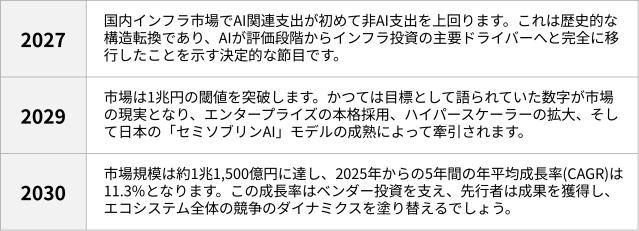
1兆円への道筋:市場機会を定義する3つのマイルストーン

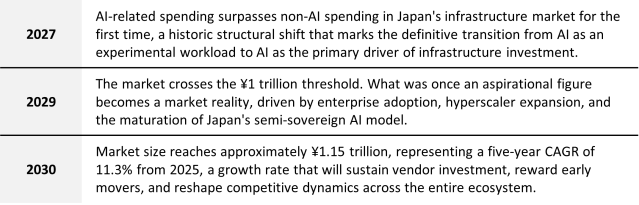
IDCは、今後5年間で国内AIインフラ市場が明確かつ力強い成長軌道を描くと予測しています。特に注目すべきマイルストーンは3つあります。

これらは楽観的な予測ではありません。政府の政策、エンタープライズのデジタル化への圧力、ハイパースケーラーのコミットメント、そしてAIの日本経済への不可逆的な統合という構造的な力に裏づけられており、その流れが反転する兆候はありません。

国内AIインフラの現在地:この成長を可能にする土台

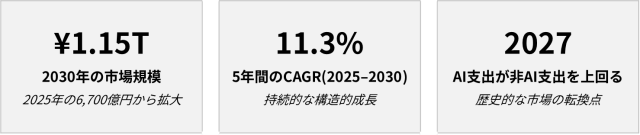
これから起きることの規模を理解するには、日本のAIインフラ市場がいかに速く動いてきたかを把握する必要があります。2025年、国内市場は6,700億円に達しました。アクセラレーター搭載サーバーに限れば、2023年から2025年の3年間のCAGRは200%に迫り、世界平均を大きく上回っています。

この成長は偶然ではありません。政府の経済安全保障政策と国内資本の動員が意図的に重なり合った結果です。政府の技術的自立を推進するクラウド関連政策の下、国内資本のサービスプロバイダーや通信キャリアが、日本市場では稀に見るスピードで大規模なAIインフラ整備に乗り出しました。

物理的な変化も目覚ましいものがあります。かつての2U GPUサーバーから、ラックスケールシステムや水冷を前提とした複数ラック構成が標準的になり、データセンター全体がAIワークロードを中心に設計される時代へ向かっています。2025年の6,700億円規模の市場はこの土台の上に成り立っており、2030年の1兆円市場はその次に来るものの上に築かれます。

ベンダーが理解すべき市場の構造的ダイナミクス

2025年の国内AIインフラ市場は、ハイパースケーラーを含むサービスプロバイダーに大きく集中しており、市場支出全体の90.6%を占めています。この数字には、2030年に向けた競争環境を形成する3つのダイナミクスがあります。

・拡大を続けるハイパースケーラー: 投資シェアは2022年の39.8%から2025年には58.9%に急増し、3年間で19ポイントの上昇となりました。ハイパースケーラーのプラットフォームとロードマップへの対応は、この市場における存在感を維持するための前提条件であり続けます。

・戦略的重要性を持つ国内サービスプロバイダー: 政策支援を受けた国内サービスプロバイダーや通信キャリアを含むその他のサービスプロバイダーは、ハイパースケーラーの急拡大にもかかわらず、2025年のシェアを31.6%と維持し、2022年の31.8%からほぼ横ばいです。このセグメントは、純粋な価格競争よりもローカルな信頼、法規制対応、継続的なパートナーシップを重視する、強靭な顧客基盤です。

・次の成長フロンティアとなるエンタープライズの直接投資:現在9.4%という市場シェアながら、エンタープライズのAIインフラ直接投資は2022年比で絶対額が倍以上に拡大しており、成長の萌芽は確実に生まれています。現時点では大多数のエンタープライズが生成AIサービスやSaaSを通じてAIを利用していますが、AIへの野心が深まり、消費から保有へと移行するにつれて直接投資は加速します。今エンタープライズとの関係を構築するベンダーが、この波を最も有利な立場で捉えられます。

セミソブリンAIモデル:日本を特徴づける戦略的アーキテクチャ

2026年4月、マイクロソフトは2026年から2029年にかけて日本へ約1.6兆円を投資する計画を発表しました。これと合わせて、国内パートナー2社が国内で運用するAIインフラをAzureから利用可能にする構想が示されました。国内サービスプロバイダーの保有するAIインフラが、グローバルなハイパースケーラーのサービスレイヤーに接続されます。

IDCはこの構造を「セミソブリンAI」と捉えており、日本のAIインフラ戦略の特徴的なモデルとして急速に確立されつつあります。外国資本のハイパースケーラーへの完全依存でもなく、完全独立の国内AIインフラという過大なコストを強いるものでもない、現実的かつ政治的にも持続可能な折衷案です。

ベンダーにとって、このモデルは制約ではなく構造的な機会です。セミソブリンAIは、インフラ設計、システムインテグレーション、マネージドサービス、コンプライアンス対応、そして日本固有のAIプラットフォーム開発において、豊かで拡大し続ける市場を生み出します。このモデルを深く理解し、その中に意欲的に自社を位置づけるベンダーやインテグレーターが、2030年以降の日本AIインフラ市場の競争環境を定義することになります。

ベンダーへの示唆:動くなら今

国内AIインフラの基盤を築いた政策主導のアプローチは、需要主導の成長段階へと移行しています。もはや、適切なAIインフラが存在するかどうかは中心的な質問にはなりません。問うべきは「誰がエンタープライズのAI活用を、測定可能なビジネス価値を生む形へスケールさせるのか」です。この市場で競争するベンダーには、3つの行動指針が求められます。

エンタープライズのエンゲージメントの加速:現在9.4%というエンタープライズのシェアが、明日の成長ストーリーになります。エンタープライズとの関係構築、日本特有のユースケース開発、ROI実証フレームワークに投資するベンダーが、この10年で最大の需要の波に乗る準備を整えられます。

セミソブリンAIモデルへの適合: 国内のAIインフラ所有者、ハイパースケーラーのサービスレイヤー、政府の政策フレームワークの相互作用を理解することは、持っていたほうが良い背景知識ではありません。この市場で勝つための戦略地図です。

規模だけではない市場理解: 国内市場は持続的な地域へのコミットメント、深い技術的専門性に加え、日本の商習慣にも理解を示すベンダーを評価します。1兆円のチャンスは単なる取引量だけでは捉えられません。

ベンダーシェアや需要構造の詳細はIDC Worldwide Quarterly AI Infrastructure Trackerで継続的に分析しています。

関連する調査やご相談について

より詳細なインサイトや市場動向については、当社アナリストへお気軽にご相談ください。

Shinya Kato - Senior Research Manager, AI and Automation - IDC Japan

Shinya Kato is a Senior Research Manager at IDC Japan and is responsible for the data analysis and forecasting team of Japan enterprise infrastructure market. He analyzes the impact of product technology, service offerings, and marketing strategies on enterprise infrastructure market and provides market forecasts, focusing on the domestic enterprise storage systems market. Through understanding technology adoption trends, he also provides insight into emerging devices such as flash, accelerators, and quantum computing. In addition to researching the HPC and AI infrastructure markets, he is also investigating new consumption models such as Hardware-as-a-Service, to help stimulate the market. Prior to joining IDC, he spent more than 10 years at Silicon Graphics, which was later acquired by HPE, where he held various domestic positions in sales, marketing, and business development. He has covered a wide range of businesses, from infrastructure hardware and container-based data center facilities to digital asset management, industrial virtual reality, and software for media & entertainment. He also served as a product manager for enterprise internet security software and appliances at the emerging vendor. He holds a Bachelor of Economics degree from Rikkyo University.

The foundational question for any vendor or service provider operating in Japan’s technology market today is no longer whether AI infrastructure will grow. That is settled. The question is how fast, in what form, and most importantly who will capture the value as Japan’s AI infrastructure market, consisting of servers and storage for AI, approaches and surpasses the ¥1 trillion threshold.

IDC’s latest data and forecasts provide a clear-eyed answer. What follows is the strategic view every vendor in this ecosystem needs to understand.

The road to ¥1 trillion: Three milestones that define the opportunity

IDC projects Japan’s AI infrastructure market will follow a clear and compelling trajectory over the next five years. Three milestones stand out:

These are not optimistic projections. They are grounded in structural forces – government policy, enterprise digitalization pressure, hyperscaler commitments, and the irreversible integration of AI into Japan’s economic fabric – that show no signs of reversing.

Where we are today: The foundation that makes this possible

To appreciate the scale of what lies ahead, it helps to understand how quickly Japan’s AI infrastructure market has already moved. In 2025, the domestic market reached ¥670 billion. For accelerator-equipped servers alone, the three-year CAGR from 2023 to 2025 approached 200%, significantly outpacing the global average.

This growth was not accidental. It was driven by a deliberate convergence of government economic security policy and domestic capital mobilization. Under cloud-related policy frameworks designed to advance Japan’s technological sovereignty, domestically capitalized service providers and telecommunications carriers launched large-scale AI infrastructure buildouts at a pace rarely seen in the Japanese market.

Physically, the transformation is equally striking. Rack-scale systems and multi-rack liquid-cooled configurations are becoming the new standard. What was once a 2U GPU server is evolving into an infrastructure architecture where entire data centers are purpose-designed around AI workloads. The ¥670 billion market of 2025 is built on this foundation, and the ¥1 trillion market of 2030 will be built on what comes next.

The structural dynamics vendors must understand

Japan’s AI infrastructure market in 2025 is heavily concentrated in service providers, who accounted for 90.6% of total market spend. With that figure, three dynamics will shape the competitive landscape through 2030:

  • Hyperscalers will continue to expand. Their investment share surged from 39.8% in 2022 to 58.9% in 2025, a 19-point gain in three years. Alignment with hyperscaler platforms and roadmaps will remain a prerequisite for relevance in this market.
  • Domestic service providers will remain strategically critical. Other service providers including policy-backed Japanese service providers and telcos held 31.6% share in 2025, essentially unchanged from 31.8% in 2022 despite the hyperscaler surge. This is a resilient customer segment that values local trust, regulatory compliance, and sustained partnership over pure price competition.
  • Enterprise direct investment is the next growth frontier. At 9.4% of the market today, enterprise direct AI infrastructure investment has more than doubled in absolute terms since 2022, yet it remains nascent. Most large enterprises currently consume AI through generative AI services and SaaS platforms. As enterprises deepen their AI ambitions and move from consumption to ownership, direct infrastructure investment will accelerate. Vendors who build enterprise relationships now will be best positioned to capture this wave.

The semi-sovereign AI model: Japan’s defining strategic architecture

In April 2026, Microsoft announced plans to invest approximately ¥1.6 trillion in Japan between 2026 and 2029. Alongside this commitment came a plan to make AI infrastructure operated domestically by two partner companies available through Microsoft Azure, domestically built and owned infrastructure, connected to a global hyperscaler’s service layer.

This is what IDC describes as “Semi-Sovereign AI” and it is rapidly emerging as the defining model for AI infrastructure strategy in Japan. It represents a pragmatic and politically viable middle path: neither complete dependency on foreign hyperscalers, nor the prohibitive cost of fully independent domestic AI capability.

For vendors, this model is not a constraint. It is a structural opportunity. Semi-Sovereign AI creates a rich and expanding set of market roles in infrastructure design, systems integration, managed services, compliance, and the development of Japan-specific AI platforms. The vendors and integrators who understand this model deeply, and position themselves within it deliberately, will define the competitive landscape of Japan’s AI infrastructure market through 2030 and beyond.

What this means for vendors: Act now, not later

The policy-driven supply wave that built Japan’s AI infrastructure base is transitioning into a demand-driven growth phase. The central question is no longer whether the infrastructure exists, it does. The question is who helps enterprises put it to work, at scale, in ways that generate measurable business value. Three imperatives stand out for vendors competing in this market:

  • Accelerate enterprise engagement. The 9.4% enterprise share of today is the growth story of tomorrow. Vendors who invest in enterprise relationships, Japan-specific use cases, and ROI demonstration frameworks now will be positioned to ride the most significant demand wave of the decade.
  • Align with the Semi-Sovereign AI model. Understanding the interplay between domestic infrastructure owners, hyperscaler service layers, and government policy frameworks is not optional background knowledge. It is the strategic map for winning in this market.
  • Build for depth, not just scale. Japan’s market rewards vendors who demonstrate sustained local commitment, deep technical expertise, and an understanding of Japanese enterprise culture. The ¥1 trillion opportunity will not be captured by volume alone.

Ongoing vendor share and demand analysis is available via the IDC Worldwide Quarterly AI Infrastructure Tracker. For more detailed insights and market trends, please contact our analysts by completing this form IDC | Identifying Market Opportunities – Contact Us.

Shinya Kato - Senior Research Manager, AI and Automation - IDC Japan

Shinya Kato is a Senior Research Manager at IDC Japan and is responsible for the data analysis and forecasting team of Japan enterprise infrastructure market. He analyzes the impact of product technology, service offerings, and marketing strategies on enterprise infrastructure market and provides market forecasts, focusing on the domestic enterprise storage systems market. Through understanding technology adoption trends, he also provides insight into emerging devices such as flash, accelerators, and quantum computing. In addition to researching the HPC and AI infrastructure markets, he is also investigating new consumption models such as Hardware-as-a-Service, to help stimulate the market. Prior to joining IDC, he spent more than 10 years at Silicon Graphics, which was later acquired by HPE, where he held various domestic positions in sales, marketing, and business development. He has covered a wide range of businesses, from infrastructure hardware and container-based data center facilities to digital asset management, industrial virtual reality, and software for media & entertainment. He also served as a product manager for enterprise internet security software and appliances at the emerging vendor. He holds a Bachelor of Economics degree from Rikkyo University.

The Middle East War is no longer just a regional risk for technology leaders. It is becoming a global economic stress test — affecting energy prices, supply chains, inflation, business confidence, and IT budget decisions across Asia Pacific.

For CIOs, CFOs, and technology suppliers, the question is not simply whether IT spending will continue to grow in 2026. The sharper question is: which investments will still earn approval when volatility hits the budget?

That is the central signal from IDC’s latest webinar, Asia Pacific IT Spending Outlook 2026: Where to Win Amid Market Volatility. The market is not freezing. It is filtering.

This matters because the disruption is emerging against a market with strong underlying momentum. The opportunity is still there. The rules for winning it are changing.

The Middle East War is the shock

IDC’s earlier point of view on the Middle East War’s impact on IT spending outlined the broader global pressure points, from energy price volatility to supply chain disruption and cloud resiliency.

In Asia Pacific, those pressures are showing up in practical ways. Higher oil and electricity costs can raise operating expenses. Supply chain disruption can increase hardware costs and delay availability. Currency and pricing pressure can make approvals harder. As uncertainty rises, organizations move faster into contingency planning.

The first effect is not always a budget cut. More often, it is hesitation. Organizations start asking which projects are necessary, which can be phased, and which need to prove value faster.

As I noted during the webinar: “IT spending is likely to remain more resilient than in previous downturns because AI investment continues to support both the IT industry and broader economic growth.”

Resilience matters. It keeps the outlook from becoming a slowdown story. But resilience does not remove risk. The longer energy prices and supply chain disruption remain elevated, the more likely selective delays become targeted cuts.

Budget rotation is the signal

The most important shift is not how much organizations spend, but what they are willing to defend.

In a more volatile environment, buyers are becoming more risk-averse. ROI thresholds are rising. Procurement cycles involve more stakeholders. Vendors are seeing longer deal cycles, greater pricing pressure, and less predictable pipelines.

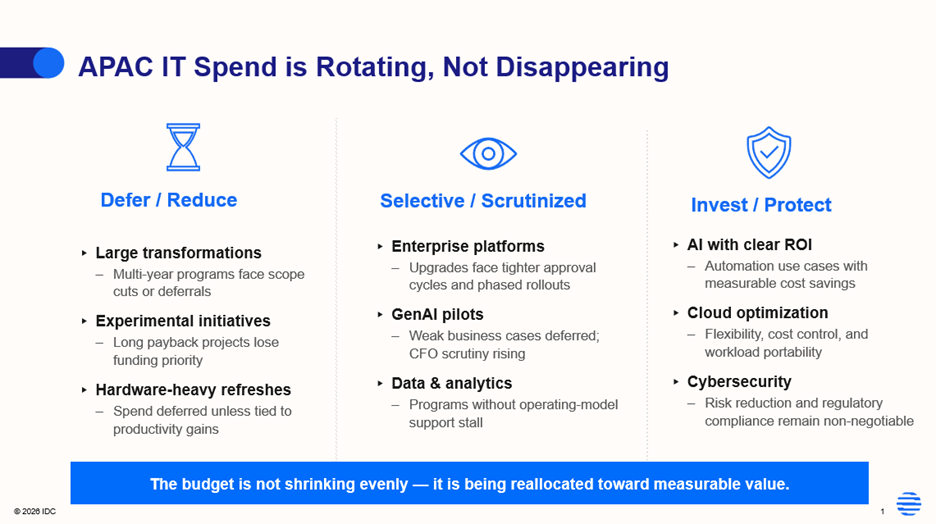
The visual above captures the core market signal: APAC IT spend is rotating, not disappearing.

Large transformations, experimental initiatives, and hardware-heavy refreshes are more likely to be deferred or reduced unless they are directly tied to productivity gains. Enterprise platform upgrades, GenAI pilots, and data and analytics programs are still in play, but they face tighter scrutiny and phased rollouts.

What remains protected? Investments tied to measurable outcomes. AI with clear ROI. Cloud optimization that supports flexibility and cost control. Cybersecurity that reduces risk and supports regulatory compliance. Infrastructure resiliency that helps organizations absorb disruption.

My colleague Vinayaka Venkatesh, summarized the shift directly: “The deals are not disappearing, but they are taking longer and require more effort to close.”

For technology suppliers, that line is the market cue. In 2026, vendors will not win by selling transformation in broad terms. They will win by helping buyers make the case for action now.

AI remains resilient, but proof matters more

AI remains central to the Asia Pacific technology agenda. IDC’s Asia/Pacific AI and GenAI spending outlook shows continued growth momentum as organizations invest in automation, productivity, and new business models.

But resilience does not mean every AI project gets a free pass.

One of the more important nuances from the webinar is the gap between AI infrastructure investment and enterprise AI execution. Hyperscalers and service providers continue to invest aggressively in AI infrastructure. At the same time, some enterprise AI initiatives are being de-scoped, delayed, or challenged on measurable outcomes.

This is where the “year of reckoning” for AI becomes real. AI use cases tied to cost savings, automation, customer experience, risk reduction, and operational efficiency will be easier to defend. Weak GenAI pilots, unclear operating models, or projects without a credible path to production will face more scrutiny from CFOs and cross-functional decision-makers.

AI for AI’s sake will not win the next budget cycle. AI with measurable business impact will.

What to remember for H2 2026 planning

As technology leaders plan for the second half of 2026, three takeaways matter most:

1. APAC IT spending is being disrupted, not derailed
The Middle East War is creating real pressure through energy costs, inflation, supply chain disruption, and weaker business visibility. But priority investments continue to support the market, especially AI infrastructure, cybersecurity, resiliency, and cloud optimization.

2. Budgets are rotating toward measurable value
Lower-priority initiatives, long-payback projects, and unclear business cases are facing delays. Investments that reduce risk, improve efficiency, support compliance, or deliver near-term ROI are better positioned for approval.

3. AI remains resilient, but the proof bar is rising
AI investment remains strong, but enterprise projects need clearer outcomes, stronger business cases, and a faster path from pilot to production.

The path forward is not about spending more for the sake of momentum. It is about knowing where to spend, what to protect, and what to pause.

Register for the on-demand webinar

The Middle East War is the shock. Budget rotation is the signal. Measurable value is the next move.

Register for the on-demand webinar, Asia Pacific IT Spending Outlook 2026 to see IDC’s latest scenario analysis, buyer data, and guidance on where IT spending is holding, where it is slowing, and what it means for H2 2026 planning.

Stephen Minton - Group Vice President, Data & Analytics - IDC

Stephen Minton is a group vice president with the IDC Data & Analytics group, focusing on ICT spending and macroeconomics. Mr. Minton is responsible for Worldwide ICT Spending programs, including the Worldwide Black Book, Worldwide 3rd Platform Spending Guides, and Worldwide Telecom Services Tracker. Mr. Minton's research expertise includes global ICT and economic analysis, and he tracks market data across hardware, software, services, telecom and emerging technologies. He is the author of papers that focus on the economic impact of IT, and is a regular speaker on the subject of IT spending. In 2002 he addressed the United Nations in New York, speaking to UN ambassadors on the subject of the Information Society. Mr. Minton previously worked with Digital Equipment Corporation (DEC), before joining IDC in 1998. Originally from Hartlepool in the North of England, he graduated from the University of Salford in 1995. He has also worked in the field of consumer market research with Millward Brown International.
Vinayaka Venkatesh

Vinayaka Venkatesh - Senior Market Analyst

Vinayaka Venkatesh is a senior market analyst for the IDC Asia/Pacific IT Spending Team based in Bangalore, India. He currently works as a vertical analyst, covering multiple spending guides for Asia/Pacific (excluding Japan and China) (APEJC). He joined IDC in…

レガシーシステムが稼働し続けるたびに、競合他社が優位を築いていく。日本の2.1兆円規模のITモダナイゼーション市場は待ってくれない—変革を急ぐ企業も同様である。

主要指標

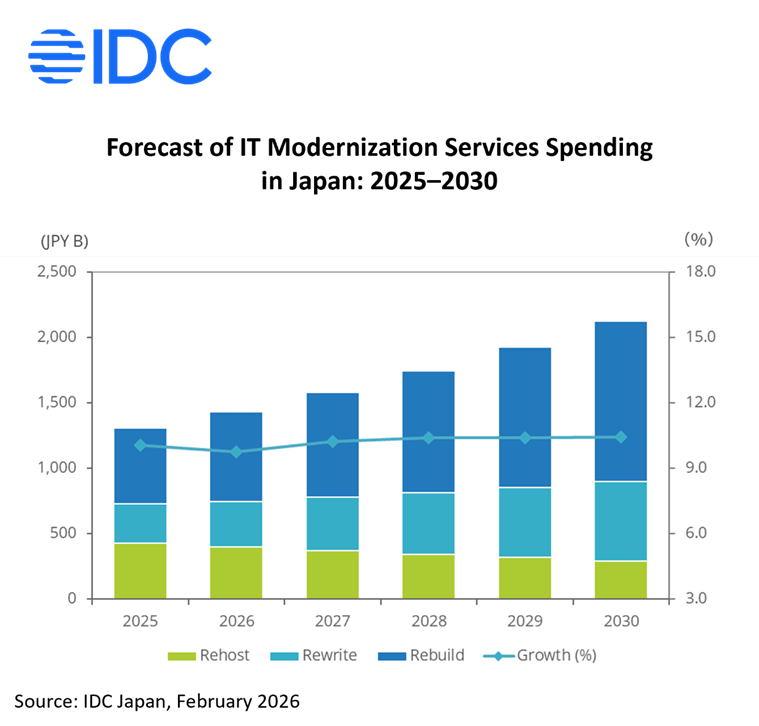
1,304億円 — ITモダナイゼーションサービス市場規模(2025年)

10.2% — 年平均成長率(2025〜2030年)

2,123億円 — 市場規模予測(2030年)

約80% — 依然としてレガシーシステムを稼働させている大企業・中堅企業の割合

なぜ日本は世界を上回るペースで成長しているのか

日本のITサービス市場は2024年から2029年にかけて年平均6.6%成長すると予測されており、世界平均の3.6%のほぼ2倍にあたる。その背景には構造的な要因がある。日本は特有の重いレガシー資産を抱えている——長年にわたる汎用機(メインフレーム)やオフィスコンピュータなどへの投資、複雑な個別開発システム、そしてそれらを長年維持してきた人材がある。今、これら三つに起因する課題が重なり合う中、ITモダナイゼーションが避けられないものになっている。

富士通メインフレームのサポート終了

2022年、富士通はメインフレームおよびUNIXサーバー製品の販売・サポートの2030年前後の終了を発表した。この発表により、1,000社以上の企業が後戻りのできないカウントダウンに入り、日本市場全体でITモダナイゼーションの取り組みが加速している。

AIへの対応という至上命題

AIの活用には、緊密に統合されたデータパイプラインと近代的なビジネスプロセス基盤が前提となる——まさにレガシーシステムはこれらの実現を阻む要素となっている。AI競争力を維持したい企業にとって、ITモダナイゼーションはもはや選択肢ではない。

人口動態の圧力

日本のレガシーシステムを構築・維持してきた世代のエンジニアが退職しつつある。そのノウハウや技術が失われてしまう前に、知識とインフラを移行できる時間は着実に縮まっている。

モダナイゼーションへの三つのアプローチ

IDCはITモダナイゼーションサービスを三つの実行タイプに分類しており、それぞれがサービス企業に異なる意味をもたらす。

リホスト

既存のアプリケーション資産を維持しながら、レガシー以外のプラットフォームへリフト&シフトする。予算や移行期間に制約を抱える企業にとっての入口となる手法である。

リライト

ビジネスロジックを変えずに、レガシーのソースコードを現代的な言語に変換する。管理された変革のための中間的なアプローチである。

リビルド

プロセス、データモデル、アーキテクチャをゼロから再定義する。最も高い価値をもたらす一方、最も複雑なアプローチでもある。

短期的には、リホストはリビルドに次ぐ2番目に大きなセグメントであり、メインフレームなどのEOL(End of Life)に対し早急な対応を要するに企業による支出が市場を牽引している——ただし既に成熟期を迎えており、今後はマイナス成長が予測されている。中長期的な成長機会は、アプリケーションのモダナイゼーション——リライト、リファクタリング、マイクロサービス化やクラウドネイティブアーキテクチャの採用——にある。

国内ITモダナイゼーションサービス市場 支出額予測: 2025年~2030年

Source: IDC Japan, 2/2026

企業がサービスプロバイダーに本当に求めているもの

IDCの調査では、レガシー依存度が相対的に高い大企業・中堅企業は、単なる技術的な実行だけを求めているのではなく、変革のパートナーを求めていることがわかった。セキュリティは基本的な前提として期待される一方、上位のニーズにはビジネスプロセス変革の支援やクラウド活用支援が挙がっている。

需要のシグナルはセクターによっても明確に異なる。

金融サービス

クラウドネイティブなアプリケーション開発能力、すなわち近代的なインフラ上で素早くイノベーションを起こす能力を優先している。

製造・流通

ビジネスプロセスの変革を優先している。基盤となる技術を刷新するだけでなく、業務に効率性とインテリジェンスを組み込むことを重視している。

全セクターを通じて、IDCは企業の期待に一貫した変化を観察している。ビジネス上の成果が主要な購買基準になりつつある。技術的な能力は当然のこととして見なされ、価値の創出が差別化要因となっている。

今、勝てるポジションを築くために

サービス企業にとって、競争上の必要性は明確だ。この市場で勝利する最良のポジションにある企業は、次の三つを実行する。

1. レガシーモダナイゼーションの実績を体系化する

過去の案件は活用されていない資産だ。サービス企業は、達成したビジネス成果——コスト削減、リードタイムの改善、AI対応力の解放——を体系的にまとめた資料を構築し、これを市場への訴求の核にすべきである。

2. AIの時代に向けた業種別のリファレンスアーキテクチャを開発する

汎用的なモダナイゼーションの提案は説得力を失いつつある。企業は自社のセクター、規制環境、そしてAIへの志向に合わせたシステムアーキテクチャと実装ロードマップを求めている。

3. 需要に先行してアプリケーションモダナイゼーション能力に投資する

リホストの波は既にピークに差し掛かりつつある。高い利益率をもたらす機会——リライト、リファクタリング、リビルド——がその後に続いている。クラウドネイティブとマイクロサービスの深い能力を培ったサービス企業こそが、2030年に向け企業から選ばれる存在となる。

IDCが提供するレポートのご紹介

IDCでは、国内ITモダナイゼーション市場の動向を詳細に分析したレポートを発行しています。

本調査レポートは、IDCの国内サービス市場予測における主要な成長促進要因の一つであるレガシーシステム(老朽化・陳腐化、肥大化・複雑化、ブラックボックス化したシステム)のITモダナイゼーションについて、市場規模の中期予測を示すと共に、国内企業(ITバイヤー)の取り組み動向や、それを支援するサービスベンダーの動向を分析しています。国内ITモダナイゼーションサービス市場予測では、サービスセグメント別、実行タイプ別(リホスト、リライト、リビルド)、システムタイプ別、産業分野別に予測しています。これらの分析から、国内企業のITモダナイゼーション支援におけるニーズ変化や市場機会、サービスベンダーの支援サービスの特徴や戦略を包括的に把握できます。

関連する調査やご相談について

より詳細なインサイトや市場動向については、当社アナリストへお気軽にご相談ください。

Masaru Muramatsu - Senior Research Analyst, Software, Services, and IT Spending, IDC Japan - IDC Japan

Masaru Muramatsu is a senior research analyst, responsible for research and analysis of the Japanese IT services market, including IT consulting, systems integration, business services. Prior to joining IDC, Masaru worked to help digitalize local government in Japan, implementing software as a service (SaaS) in the education and taxation sectors. He also acquired experience in domestic and international sales/marketing with his work for a company that provided materials for electronic devices like smartphones, PCs, and printers. Masaru Muramatsu earned a master’s degree in engineering from Chuo University, Japan.

If you’ve spent the last few years talking to enterprise IT leaders about cost efficiency, you weren’t wrong. That was the conversation. But over the past few months, things have clearly shifted.

The outbreak of war in the Middle East, with its direct impact on people and organizations in the region, as well as broader effects on energy costs and IT manufacturing supply chains, is a primary driver. At the same time, early AI buildout pressures on memory supply were already raising concerns.

Today, when CIOs and their teams make technology decisions, the question is no longer, “How do we optimize spend?” It’s, “How do we keep the business running when things break?”

This shift shows up clearly in data from two major surveys on IT priorities and spending plans conducted in February and again in March. Concerns about hardware supply constraints have increased by more than 15%, and geopolitical risk is rising quickly. Meanwhile, traditional cost pressures, while still present, are starting to take a back seat.

This is not because cost no longer matters. It is because cost is now seen as downstream. If systems go down, supply chains stall, or cyber incidents escalate, cost becomes secondary very quickly.

What are IT leaders most concerned about in 2026?

When you talk to IT leaders today, the tone is different. There is more urgency, more realism, and more skepticism. They are thinking about exposure:

  • Where are we too dependent on a single cloud region?
  • What happens if a supplier cannot deliver?
  • How quickly can we recover from a cyber event?

Increasingly, they recognize that these risks are interconnected. A geopolitical event can disrupt supply chains, which impacts infrastructure, which affects applications, and ultimately hits revenue.

That is why IDC is seeing a clear pivot toward resilience.

Cybersecurity has moved to the top of the investment list globally, not just as a defensive measure but as a core part of keeping operations running. At the same time, organizations are accelerating investments in multi-region cloud architectures and backup strategies. Cloud security and multi-region resilience are now leading priorities across every major region.

IDC is also hearing from CIOs about a growing push to reduce dependency. CEOs are placing more focus on diversifying suppliers across all parts of the business. CIOs are responding by exploring sovereign cloud options and rethinking how and where infrastructure is deployed.

AI has not disappeared from the agenda, but it is being reframed. It is no longer just about innovation. It is about using automation and intelligence to keep systems stable under pressure.

Put simply, IT buyers are trying to build systems that can bend without breaking.

What does this shift mean for IT suppliers?

For suppliers, this shift creates both risk and opportunity.

The biggest risk is continuing to sell the way you did before. Leading with performance benchmarks, cost savings, or incremental features will not resonate the same way.

The opportunity is much bigger. Buyers are actively looking for partners who can help them navigate uncertainty. They are asking tougher questions:

  • What happens if this service goes down in one region?
  • How quickly can workloads move?
  • Where are the hidden dependencies?
  • How exposed am I if conditions worsen?

If you can answer these questions clearly and credibly, you move from being a vendor to becoming a strategic partner.

How should IT suppliers respond to rising resilience demands?

The challenge is that resilience means something different depending on where you sit in the ecosystem. The common thread is this: you must show how your offering performs under stress, not just under ideal conditions.

Cloud providers: How to prove resilience beyond scale

For cloud providers, this is a moment to rethink the narrative.

Scale and efficiency still matter, but they are no longer enough. CIOs want to know how your platform behaves when a region is disrupted, connectivity is constrained, or workloads need to move quickly.

This means making multi-region resilience the default, not an add-on. It also requires transparency about risk exposure and greater flexibility around sovereignty and localization.

In short, you are not just selling capacity anymore. You are selling survivability.

SaaS providers: Why continuity is now a core differentiator

SaaS providers are increasingly part of the critical path of operations. If your application goes down, the business feels it immediately.

Buyers want reassurance. They want to understand your disaster recovery posture, regional architecture, and dependencies. They want to know how their data is protected and how quickly services can be restored.

The vendors that stand out will clearly articulate how they maintain continuity, not just deliver functionality.

IT and professional services firms: From transformation to readiness

For services firms, the conversation has shifted from long-term transformation to immediate readiness.

Clients still care about transformation, but right now they need help answering urgent questions: Where are we exposed? What should we fix first? How do we prepare for multiple scenarios?

There is a real opportunity to lead with practical, actionable support. Rapid assessments, scenario planning, and resilience design are where clients need help now.

Speed matters. Clarity matters even more.

Communications providers: Why network resilience is now critical infrastructure

Connectivity has always been important. Now it is critical infrastructure in the truest sense.

Organizations are looking for redundancy, alternative routing, and, in some cases, entirely new connectivity models, including satellite and hybrid networks.

The differentiator is reliability under pressure. If you can demonstrate that your network keeps people and systems connected when other options fail, that becomes a powerful advantage.

Infrastructure vendors: Delivering certainty in uncertain supply chains

Hardware vendors are facing a different kind of scrutiny.

Availability and certainty in delivery are becoming as important as performance. Buyers want to know not just what the system can do, but whether they can actually get it, deploy it, and rely on it.

Transparency into supply chains, flexibility in configurations, and the ability to adapt to constraints are becoming key differentiators. In this environment, certainty is value.

Why IT buying decisions are shifting from optimization to assurance

Stepping back, what we are seeing is a shift in how technology decisions are made.

It is less about optimization and more about assurance. Less about peak performance and more about consistent operation.

The suppliers that win over the next six months will be the ones that can answer a simple but critical question:

What happens when things do not go according to plan?

From an enterprise IT leader’s perspective, that is no longer a hypothetical. It is the reality they are planning for every day. Resilience is no longer just a capability. It is the basis for trust.

What should IT suppliers do next?

If you are an IT supplier, now is the time to recalibrate how you engage with customers.

Start by pressure-testing your value proposition:

  • Can you clearly articulate how your offering performs under disruption?
  • Can you quantify how you improve resilience, not just efficiency?
  • Can you help customers understand and reduce their exposure?

Just as importantly, ground your strategy in real buyer insight.

IDC’s latest Future Enterprise Resiliency & Spending Survey (March 2026, Wave 2) provides a detailed view into how enterprise IT leaders across regions are reprioritizing risk, resilience, and investment decisions in response to geopolitical and supply chain disruption.

We encourage you to explore the survey findings to better understand:

Suppliers that align early with these shifts will be better positioned to engage, differentiate, and win. Because in this market, insight isn’t just helpful.

It’s your competitive edge.

Rick Villars

Rick Villars - Group Vice President Worldwide Research

Rick is IDC's leading analyst guiding research on the future of the IT Industry. He coordinates all IDC research related to the impact of Cloud and the shift to digital business models across infrastructure, platforms, software, and services. He helps…

Key figures at a glance

  • ¥1,304B – IT modernization services market size, 2025
  • 10.2% – Projected average annual growth rate, 2025–2030
  • ¥2,123B – Forecast market size by 2030
  • ~80% – Large and mid-sized enterprises still running legacy systems

Why Japan is outpacing the world

Japan’s IT services market is forecast to grow at a CAGR of 6.6% from 2024 to 2029, nearly double the global average of 3.6%. The answer is structural. Japan carries a uniquely heavy legacy burden, decades of investment in proprietary mainframe environments, complex bespoke systems, and a workforce that has long maintained them. Now, three forces are converging to make modernization unavoidable:

  • Fujitsu Mainframe Sunset – In 2022, Fujitsu announced the end of sales and support for its mainframe and UNIX server products around 2030. This single announcement put more than 1,000 enterprises on an irreversible countdown, accelerating timelines across the entire Japanese market.
  • AI Readiness Imperative – AI adoption presupposes tightly integrated data pipelines and modern business process architectures, exactly what legacy systems make impossible. Modernization is no longer optional for companies that want to remain AI-competitive.
  • Demographic Pressure – The generation of engineers who built and maintained Japan’s legacy systems is retiring. Organizations face a narrowing window to migrate knowledge and infrastructure before institutional memory disappears entirely.

Three paths to modernization

IDC segments IT modernization services into three execution types, each with distinct implications for services firms:

  • Rehost – Lift-and-shift to non-legacy platforms. Preserves existing application assets. The near-term entry point for enterprises constrained by budget or migration timelines.
  • Rewrite – Convert legacy source code to modern languages without changing business logic. A middle path for controlled transformation.
  • Rebuild – Redefine processes, data models, and architecture from the ground up. The highest-value, highest-complexity path.

Near-term, rehost is the second-largest segment after rebuild, driven by enterprises responding urgently to mainframe end-of-life deadlines — though it has already reached maturity and is forecast to decline. The mid-to-long-term growth opportunity lies in application modernization, rewriting, refactoring, and the adoption of microservices and cloud-native architectures.

What enterprises need from services firms

IDC surveyed large and mid-sized Japanese enterprises and found that organizations with significant legacy exposure do not simply want technical execution, they want transformation partners. Security remains a baseline expectation, but top-ranked needs now include business process redesign and cloud architecture strategy.

Demand signals also diverge meaningfully by sector:

  • Financial Services – Prioritizes cloud-native application development capabilities, the ability to innovate rapidly on modern infrastructure.
  • Manufacturing and Distribution – Prioritizes business process transformation, embedding efficiency and intelligence into operations, not just upgrading the underlying technology.

Across all sectors, IDC observes a consistent shift in enterprise expectations: business outcomes are becoming the primary purchase criterion. Technical competence is assumed; value creation is the differentiator.

How to build a winning position now

For services firms, the competitive imperative is clear. The service providers best positioned to win this market will do three things:

1. Codify your legacy modernization track record

Past engagements are an underutilized asset. Service providers should build structured libraries of business outcomes achieved, cost reductions, cycle time improvements, AI readiness unlocked and make these the core of their go-to-market narrative.

2. Develop industry-specific reference architectures for the AI era

Generic modernization pitches are losing traction. Enterprises want system architectures and implementation roadmaps calibrated to their sector, their regulatory environment, and their AI ambitions.

3. Invest in application modernization capabilities ahead of demand

The rehost wave is already approaching its peak. The high-margin opportunity –  rewrite, refactor, rebuild – is building behind it. Service providers who develop deep cloud-native and microservices capabilities now will be the ones enterprises turn to in the second half of this decade.

About the IDC Report

IDC has published a comprehensive analysis of Japan’s IT modernization market: 2026 Japan IT Modernization Market Analysis. The report provides a medium-term market forecast for IT modernization of legacy systems — a primary growth driver in IDC’s Japan IT services market outlook. Legacy systems are characterized by aging and obsolescence, excessive complexity and scale, and a lack of transparency. It covers enterprises’ IT modernization trends and an analysis of the service vendors’ services trend. Market forecasts are segmented by service type, execution type (rehost, rewrite, rebuild), system type, and industry vertical. Together, these analyses offer a comprehensive view of shifting enterprise needs, emerging market opportunities, and the strategies and service offerings of leading vendors in Japan’s IT modernization landscape.

For more detailed insights and market trends, please contact our analysts by completing this form IDC | Identifying Market Opportunities – Contact Us.

Masaru Muramatsu - Senior Research Analyst, Software, Services, and IT Spending, IDC Japan - IDC Japan

Masaru Muramatsu is a senior research analyst, responsible for research and analysis of the Japanese IT services market, including IT consulting, systems integration, business services.

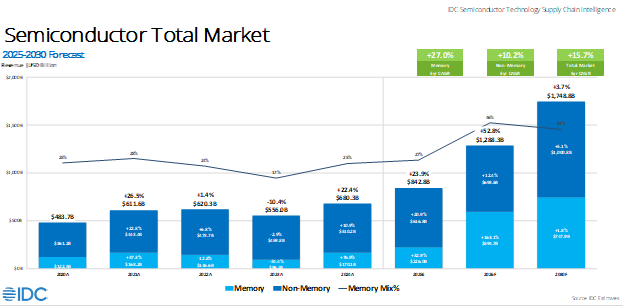
The global semiconductor market is undergoing a seismic transformation. IDC’s latest forecast projects the industry will surge past the $1 trillion revenue threshold in 2026, significantly ahead of prior expectations. The growth will be driven overwhelmingly by AI infrastructure investment, which is reshaping the entire market.

Total semiconductor revenues are forecast to reach $1.29 trillion in 2026, up 52.8% year over year from $842.8 billion in 2025. The memory segment is at the epicenter of this shift: DRAM revenues alone are projected to nearly triple in 2026 to $418.6 billion, driven by demand for high-bandwidth memory (HBM) and DDR from hyperscalers and AI infrastructure providers. Meanwhile, non-memory semiconductors are growing at a robust but more measured pace, reaching $693.5 billion in 2026.

In this post, we break down three forces reshaping semiconductors right now: why AI infrastructure has become the industry’s new center of gravity, what’s happening in memory markets and why it matters beyond the data center, and how other markets from automotive and IoT to mobile and PCs are navigating a market increasingly defined by AI.

Global Semiconductor Market: Selected Forecast (USD Billions)

Source: IDC Semiconductor & Semiconductor Applications Forecast, April 2026. A = Actual, E = Estimate, F = Forecast.

AI infrastructure: The engine of the supercycle

The single most consequential shift in the semiconductor market is the emergence of AI infrastructure as a structurally dominant end market. What began as a cyclical uplift in data center spending has evolved into a self-reinforcing investment cycle that is reshaping demand patterns across the semiconductor value chain.

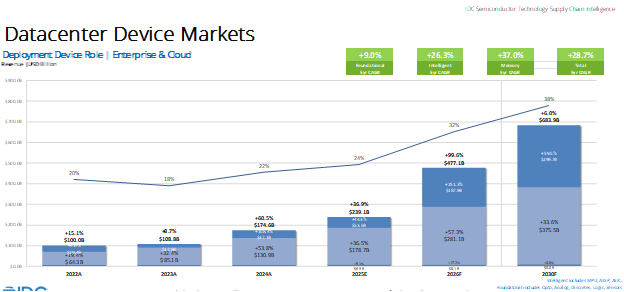
Hyperscale capital expenditure exceeded $100 billion for the first time in Q3 2025, and the i4 are expected to increase capex by 70% year over year to approximately $600 billion in 2026. IDC forecasts data center semiconductor revenues to reach $477.1 billion in 2026. By 2030, data center semiconductors will account for $843.2 billion, nearly half the total semiconductor market.

Datacenter Semiconductor Revenue Decomposition

Source: IDC Semiconductor Applications Forecast, April 2026.

The $281 billion “intelligent” datacenter segment, encompassing CPUs, AI accelerators, GPUs, custom ASICs, and networking silicon, now constitutes the largest identifiable category within non-memory semiconductors. Spending is heavily concentrated among top-tier hyperscalers and a growing set of sovereign AI infrastructure programs, many of which have secured long-term supply agreements with leading chip manufacturers.

Three factors are keeping this growth self-sustaining rather than cyclical:

  • Compute intensity continues to rise. Generative AI and agentic workloads require far more compute density per rack than prior architectures, increasing the overall silicon footprint
  • Inference demand compounds on itself. Each new model generation increases the volume of inference, requiring ongoing hardware upgrades
  • AI is spreading beyond the data center. As enterprises, edge deployments, and client devices begin running AI workloads locally, demand becomes more distributed

Memory: From cyclical commodity to strategic constraint

If you want to understand what’s really happening in semiconductors right now, start with memory.

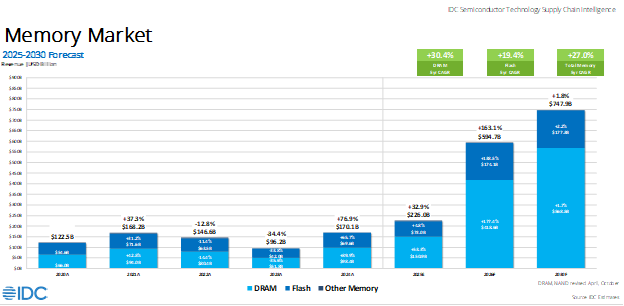
Total memory revenues rise from $226 billion in 2025 to $594.7 billion in 2026, and then to $790.4 billion in 2027. This is not simply a recovery cycle, it reflects a market that is being structurally repriced.

DRAM is where the shift is most visible. IDC forecasts $418.6 billion in DRAM revenues for 2026, up 177% year over year. This is not primarily a volume story driven by consumer devices. Hyperscalers are buying a fundamentally different, more expensive class of memory and are willing to pay a premium to secure supply. Each HBM chip also requires significantly more silicon real estate, further tightening the availability of other types of DRAM.

The HBM bottleneck

High-bandwidth memory has become the primary constraint in the AI accelerator supply chain. Most capacity is already pre-committed through 2026, with forward allocations extending into 2027. That capacity is concentrated in NVIDIA and AMD GPU platforms, along with a growing set of hyperscaler custom silicon programs.

The production economics are also very different. HBM relies on advanced packaging and stacking technologies, resulting in per-bit costs that are several times higher than standard DRAM.

Suppliers are investing aggressively to expand capacity, but the technical complexity and capital intensity mean meaningful new supply will not reach the market until late 2026 at the earliest.

NAND: AI drives storage demand

NAND Flash revenues are forecast to reach $174.1 billion in 2026, up 138.5% from 2025. AI infrastructure is again the dominant driver, with demand coming from training datasets, checkpoint storage, and high-performance inference environments.

Unlike DRAM, the NAND market is seeing broader repricing. Enterprise SSD prices have surged as hyperscalers secure supply, which is tightening availability across consumer and OEM channels.

Other markets: Navigating the shadow of the AI supercycle

While AI infrastructure dominates the headlines, the broader semiconductor market is facing a more nuanced environment.

Non-memory, non-datacenter revenues are projected at $406.3 billion in 2026. Several end markets are dealing with margin pressure, supply allocation challenges, and macroeconomic headwinds.

In mobile, semiconductor revenues are forecast to decline to $89.8 billion in 2026. The issue is not consumer demand, particularly for AI-capable devices, but cost pressure. Memory now represents a larger portion of the bill of materials, forcing OEMs to make difficult tradeoffs between margin, pricing, and product specifications.

Automotive is being shaped more by macro factors than AI. Tariffs, interest rates, and energy prices are weighing on demand. While the long-term outlook remains strong, 2026 reflects a period of near-term softness.

IoT shows a similar pattern. The segment is projected at $136.6 billion in 2026, with near-term pressure from inventory digestion and cautious spending. However, edge AI is beginning to create a new, higher-value demand category that will become more meaningful over time.

Source: IDC Semiconductor Forecast, April 2026.

Outlook: Path to $1.75 trillion

IDC’s base case projects semiconductor revenues reaching $1.75 trillion by 2030.

Several dynamics will shape that trajectory:

  • Memory pricing will normalize, but remain structurally higher than pre-AI levels
  • Non-memory semiconductors will continue steady growth, driven by AI adoption across devices and industries
  • Macro and geopolitical risks will remain important variables

What is clear is that the semiconductor market has undergone a fundamental shift.

IDC will be tracking how AI infrastructure investment continues to reshape semiconductor demand at Computex 2026.

Jeff Janukowicz

Jeff Janukowicz - Vice President, Computing Systems Platforms and Technologies, Enterprise Infrastructure

Jeff Janukowicz is a Vice President within IDC’s enterprise infrastructure global research domain, and the global subdomain lead for the Computing Systems Platforms and Technologies subdomain. Jeff and his team deliver data-driven analysis, technology insights, market trends, and strategic guidance…
Nina Turner

Nina Turner - Research Director, Computing Systems Platforms and Technologies, Enterprise Infrastructure

Nina Turner is Research Director within IDC's enterprise infrastructure global research domain, part of the computing systems, platforms, and technologies subdomain. Nina and her team cover the breadth of processors and architectures, from datacenters to client devices, including embedded use…