近日,2026世界机器人大会在北京举行。本届大会以“人机共生,产需共融”为主题,吸引300余家企业参展,展出超过2000件展品,150余件新品集中发布。值得关注的是,大会首次设立采购日,49家央企以创新联合体形式集中亮相,并围绕12个应用场景展示产业需求,机器人产业的应用导向进一步增强。

需求侧变化正在与产业规模增长形成共振。据工信部数据,2026年1—5月中国机器人规上企业营收突破900亿元,同比增长26.9%;国际数据公司(IDC)数据显示,2025年全球人形机器人出货量约1.8万台,同比暴增近800%。但另一组数据同样值得注意:IDC调研显示,在已开展具身智能机器人试点应用的企业中,大多处于POC阶段,从技术验证到规模部署之间,横亘着稳定性、成本、ROI和运维能力的多重考验。

从本届大会的现场展示来看,机器人正在从单一动作展示转向完整任务执行,从实验室验证走向真实业务场景。Physical AI正在进入从技术能力竞争向产业化能力竞争转变的关键阶段,而本届大会的四个趋势,勾勒出了这条转折路线的清晰轮廓:

  • 从模型竞赛走向真实世界学习,数据成为Physical AI新壁垒
  • 从Demo能力走向规模交付,机器人竞争进入商业化深水区
  • 从单一场景突破走向分层落地,工业制造率先成为规模化主战场
  • 从整机竞争走向生态竞争,产业链加速形成系统化能力

趋势一

数据驱动:从“模型竞赛”走向“真实世界学习”

过去一年,具身智能大模型、VLA模型和世界模型快速发展,推动机器人从感知、理解向复杂任务决策与执行演进。但进入2026年,行业竞争正从“谁的模型更强”进一步转向“谁能让机器人真正干活,并在真实场景中持续学习和进化”。IDC认为,模型是Physical AI的能力基础,而真实世界数据和持续学习能力将成为下一阶段的重要竞争壁垒。

2026世界机器人大会上,世界模型、VLA、仿真平台、机器人训练场及数据采集等技术持续受到关注,虚实结合正成为数据获取的重要路径。通过仿真生成大规模数据并结合真实场景数据,可以降低真实机器人试错成本;机器人运行数据持续回流训练体系,则可形成“感知—训练—执行—反馈”的数据飞轮,推动机器人持续进化。

当前,中国已有14个以上省市布局或建设40余家机器人训练场,成熟训练场数据年产量可达到数百万条,Physical AI的数据基础设施正在加速形成。与此同时,灵巧手、力传感器等硬件能力持续提升,也为机器人获取更加丰富的操作数据提供了基础。

未来,具身智能将进一步形成模型、数据、仿真与机器人本体协同演进的技术体系,企业竞争也将从单纯比较模型能力,转向数据获取、工程化处理和持续学习能力的比拼。

趋势二

交付决胜:从“Demo能力”走向“规模交付”

随着机器人逐步进入真实业务环境,产业竞争的评价标准正在发生变化。本届大会上,多家厂商从单一动作展示转向拆垛、分拣、搬运、配送、清洁、巡检等完整任务验证,机器人正在从展示单项能力转向验证完整任务流程。

机器人产业竞争的分水岭正在从技术Demo能力转向稳定交付能力。

  • 任务能力从单点执行向连续作业升级。机器人需要具备自主感知、任务规划、连续执行及异常恢复能力。
  • 应用部署从POC向规模复制升级。汽车、3C电子、物流仓储等成为重点验证方向,用户对稳定性、部署效率、维护成本及ROI提出更高要求。
  • 评价标准从技术指标向商业指标升级。任务成功率、连续运行时间、单位任务成本和投资回报周期将逐步成为采购决策的重要依据。

IDC用户调研结果显示,已有超过20%的用户从市场关注进入试点探索阶段,但从POC到规模化部署进程正在加速。未来2—3年,稳定运行、快速部署、持续运维和商业ROI将成为机器人规模化落地的关键能力。

趋势三

场景分层:从“单一场景突破”走向“分层落地”

Physical AI不会在所有场景同步实现规模化落地。随着技术成熟度、环境复杂度和商业ROI差异显现,机器人应用正在形成更加清晰的分层路径。当前,具身智能机器人正呈现“服务探索、工业扩张、家庭蓄势”的发展格局。

  • 商用服务进入深入探索阶段。餐饮酒店、零售等场景具有明确的任务需求,但环境复杂程度高于工业场景,对自主导航、环境理解和异常处理能力提出更高要求,具身智能化加速。
  • 工业制造将加速规模化。汽车、3C电子、物流仓储等场景结构化程度较高,任务边界相对清晰,同时存在较强的降本增效需求,是当前技术成熟度与商业价值匹配度较高的应用方向。IDC数据显示,2025年中国工业具身智能机器人市场规模约57.4亿元,其中工业机器人和人形机器人分别贡献约36.2亿元和21.2亿元。
  • 家庭消费市场具备长期潜力。家庭环境高度非结构化,任务类型复杂且长尾,对机器人的泛化能力、安全性、交互能力和成本提出更高要求,其潜在应用场景广泛,长期市场空间更为可观。

未来,机器人应用将沿着高结构化—中结构化—低结构化路径逐步向复杂环境渗透。不同机器人形态也将围绕自身能力优势,与具体场景形成更加明确的匹配关系,推动Physical AI从场景验证走向规模化应用。

趋势四

生态协同:从“整机竞争”走向“系统能力竞争”

随着Physical AI进入产业化阶段,机器人产业链正从单一本体向算力、模型、数据、核心零部件及行业应用全面延伸。本届大会上,国内外产业链企业深度参与,49家央企以创新联合体形式集中亮相,产业竞争正从单一技术供给走向产业链协同与场景共创。

随着Physical AI正在推动机器人产业从整机竞争走向系统能力竞争,企业竞争边界将进一步扩展至软硬件协同与产业生态。

  • 产业链协同持续深化。芯片、传感器、减速器、伺服系统、灵巧手等核心部件与机器人本体加速协同,供应链能力持续提升。
  • 模型与本体加速融合。大模型企业、机器人厂商及科研机构围绕VLA、世界模型、运动控制等开展合作,推动AI能力进一步进入真实机器人和实际应用。
  • 产业支撑体系加速完善。中国各地方已落地数十个具身智能相关创新中心,覆盖技术攻关、中试验证、数据训练及场景落地等环节,产业协同基础持续增强。
  • 国际合作持续深化。大会吸引30家国际支持机构参与,覆盖科研、工程、产业及投资等领域,推动全球机器人技术交流、产业协同与创新成果共享。

未来,企业竞争将从单一产品能力进一步转向软硬件协同、数据闭环、产业链整合和行业交付能力。具备完整生态组织能力的企业,将更有机会推动机器人从单点应用走向规模化商业部署。

IDC未来展望

WRC 2026释放出的信号越来越明确:具身智能机器人产业正在从技术展示走向产业价值验证。

未来机器人企业的核心竞争力,将不只是技术先进性,更在于能否把技术转化为稳定、可复制、具备商业价值的产品与解决方案。

Physical AI正在进入产业化深水区,机器人行业的下一阶段竞争,也将更加聚焦真实需求与实际价值。

IDC相关研究

IDC长期追踪机器人与Physical AI产业发展,形成从市场追踪、技术评估到用户洞察的持续性研究体系,并在工业制造、商用服务、特种作业及家庭消费等场景方向均有深入研究布局。如需了解更多IDC在机器人领域的研究内容或获取定制化数据分析,欢迎与IDC中国分析师团队联系。

进一步沟通

机器人产业正站在从技术验证迈向规模应用的关键节点。若您关注Physical AI落地路径、具身智能场景价值评估或产业链竞争格局,欢迎与IDC中国分析师团队深入交流。我们将结合WRC 2026现场一手观察与持续研究积累,为您提供定制化洞察与数据支撑。请点击此处进行联系。

Lily Li

Lily Li - Research Manager

Lily is the Research Manager for China Robotics and Embodied Intelligence, specializing in market research on embodied intelligent robots. She has long focused on the development trends of China’s embodied intelligence robotics industry, systematically studying the evolution of robot hardware,…

生成式AI正以前所未有的速度渗透到企业的核心业务中——无论是研发、运营还是客户服务,AI都在重塑我们的工作方式。但你有没有注意到,随着AI系统架构越来越复杂,安全风险也在同步升级?

过去我们担心的只是模型越狱、敏感信息泄露这些“老问题”,现在,提示注入、知识库投毒、工具滥用、智能体越权、多智能体协同攻击等新型威胁层出不穷。企业的安全治理对象,早已从单一模型扩展到整个生成式AI应用系统,安全边界变得模糊且动态。

安全评估的方式也在快速演进——从人工测试到自动化红队、从静态规则到动态风险评分,再到如今覆盖RAG、智能体和系统级的持续安全监测。企业管理者们越来越关心:我的AI系统到底有多“可信”?上线前后如何持续掌控风险?

IDC认为,生成式AI安全评估平台正从“单点测试”走向“系统级守护”,未来将深度融入AI开发、部署、运营和治理的每一个环节,实现从一次性检测到全流程、持续的安全验证。只有这样,企业才能真正让AI成为安全、可信的生产力,而不是新的风险源。

国际数据公司(IDC)特别针对中国市场发布了《IDC MarketScape:中国生成式AI的安全评估平台厂商评估,2026》(Doc# CHC54110426,2026年8月)研究报告,IDC针对入选的提供商的能力和战略进行综合评估,评估标准包括收入规模、产品技术能力、行业和客户拓展、生态系统建设以及未来发展战略等方面,综合分析并确定各厂商在IDC MarketScape中的相对位置,并探讨厂商的特点和战略,总结发展趋势,为企业级客户选择生成式AI的安全评估平台能力提供商提供参考。

报告揭示了一个关键信号:IDC认为,头部厂商的竞争焦点已从“单点测试工具”转向“系统性安全治理平台” ——这一转变直接决定了企业该选择什么样的合作伙伴,以及该用什么样的标准去判断谁更值得信任。报告的完整评估结果与厂商定位分析,可向IDC进一步了解。

未来,企业关注的不再只是模型是否能够抵御越狱攻击,而是更加关注整个AI应用系统在实际业务场景中的安全表现,包括知识库安全、智能体运行安全、工具调用安全以及业务流程安全等多个方面。与此同时,评估能力也将逐步融入企业AI开发、部署、运营及治理全过程,实现由”一次性安全测试”向”持续安全验证”转型。

生成式AI的安全评估平台未来演进方向

  • 评估对象持续扩展。随着生成式AI技术持续向智能体、多智能体协同及具身智能等方向发展,企业AI系统的复杂度和应用边界将不断拓展。未来,生成式AI的安全评估平台将逐步突破单一模型评测范畴,形成覆盖基础模型、AI应用、智能体、具身智能及相关生态组件的综合评估体系,持续提升对新型AI应用场景的风险识别与安全验证能力。
  • 评估体系更加完善。未来安全评估将更加注重建立统一、标准化的评估体系,在覆盖风险类型、评估维度及评价指标等方面持续完善,提高不同产品之间评估结果的可比性,为企业提供更加客观、可信的评估依据。
  • 智能化能力持续增强。人工智能技术将进一步融入安全评估过程,自动化红队测试、智能风险分析、攻击样本自动生成及评估结果智能分析等能力将不断成熟,进一步提升风险发现效率和评估质量。
  • 持续评估能力成为核心竞争力。安全评估将逐步融入企业AI研发、测试、部署及运营全过程,形成覆盖模型上线前验证、运行中监测以及版本迭代评估的持续安全验证体系,为企业提供动态、实时的风险管理能力。
  • 平台化能力不断提升。未来生成式AI的安全评估平台将进一步与AI开发平台、安全运营平台及AI治理平台深度融合,由独立评估工具逐步发展为企业AI安全治理的重要基础设施,为企业构建可信生成式AI体系提供持续支撑。

IDC给技术买家的建议

  • 建议结合企业AI应用现状制定评估需求。不同行业、不同规模企业的生成式AI建设阶段存在较大差异,安全评估需求也各不相同。技术买家应结合自身AI应用场景、业务规模及安全治理目标,明确评估范围和重点,避免单纯关注评测数量或功能覆盖,而应重点考察产品是否能够满足企业实际业务需求。
  • 建议重点关注评估体系的科学性和完整性。安全评估平台的核心价值不仅体现在风险发现能力,更体现在评估体系的完整性和结果的可信度。技术买家应关注产品是否建立了完善的评估指标体系、风险分类体系及评分机制,评估结果是否具有可解释性和可追溯性,是否能够为企业风险治理提供有效依据。
  • 建议关注产品的持续演进能力。生成式AI技术快速发展,新的应用形态和安全风险不断出现,安全评估平台需要持续更新评测能力和风险场景。技术买家应重点考察厂商在技术研发、规则更新、测试场景维护及产品迭代方面的能力,确保产品能够适应未来AI技术的发展需求。
  • 建议关注平台的开放性与生态兼容能力。企业AI应用通常涉及多个基础模型、开发框架及业务平台,安全评估平台应具备良好的开放能力,支持多模型、多场景及多种部署方式,并能够与企业现有AI开发平台、安全运营平台及治理体系实现有效集成,降低后续建设和运维成本。
  • 建议将安全评估纳入AI治理体系建设。生成式AI的安全评估不应作为模型上线前的一次性测试,而应贯穿AI研发、部署、运营及持续优化全过程。技术买家应推动安全评估与AI开发流程、安全运营流程及风险治理机制相结合,逐步建立持续、动态的生成式AI的安全评估机制,提升企业整体AI安全治理能力。
  • 建议结合实际业务场景开展产品验证。生成式AI的安全评估平台的能力最终需要在真实业务环境中得到验证。技术买家在产品选型过程中,建议结合自身AI应用场景、典型业务流程及安全需求开展概念验证(PoC),重点考察产品在风险识别准确性、评估覆盖范围、自动化水平及评估结果稳定性等方面的实际表现,避免仅依据产品演示或功能清单进行判断。
  • 建议综合评估厂商的持续服务与运营能力。生成式AI的安全评估是一项持续性的工作,产品能力需要随着AI技术演进和风险变化不断更新。技术买家除关注产品功能外,还应重点评估厂商的技术研发能力、评测体系更新能力、行业实践经验、专业服务能力及持续运营支持能力,优先选择能够提供长期技术服务和持续能力演进的合作伙伴,为企业生成式AI安全治理提供长期支撑。

IDC中国网络安全分析师陈佳表示,生成式AI安全评估平台正由早期合规检测工具向企业AI治理的基础安全能力平台演进,企业关注点从“可用”转向“安全、可靠、可控”,平台能力覆盖模型、数据、内容、智能体安全及持续运营管理。随着行业标准完善,评估指标、测试集和自动化能力成为厂商差异化关键,未来相关能力将平台化融合,推动生成式AI从“可用”迈向“可信”。

进一步交流

生成式AI安全治理进入关键阶段。IDC持续关注生成式AI安全评估平台技术演进与市场实践,助力企业识别模型风险、完善治理体系、构建可信AI能力。欢迎联系IDC,获取行业洞察与定制化评估服务,共同探索生成式AI安全落地新路径。

Jackson Chen

Jackson Chen - Research Analyst

Jackson Chen is a research analyst for IDC China's Emerging Technology Research department, whose focus is on research of the business sector of the China data security market. Jackson is also responsible for providing relevant security research and consulting services…

2025 年作为 “十四五” 收官、“十五五” 开局的过渡年份,中国银行业在宏观经济结构调整、政策驱动与数字技术深度融合的背景下,中国银行业整体呈现出稳规模、息差企稳、风险整体可控的阶段特征,并加速由“信息化驱动”向“数智化驱动”跃迁的关键阶段,中国银行业整体发展逻辑从规模驱动转向价值驱动。

中国银行业IT解决方案市场进入低速高质发展阶段

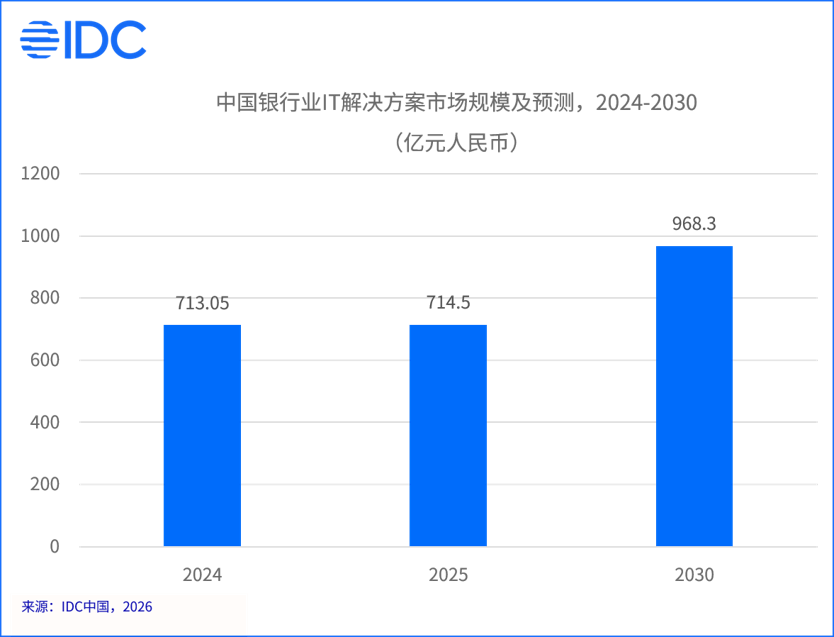
国际数据公司(IDC)最近发布的《中国银行业IT解决方案市场份额,2025》报告显示,2025 年中国银行业 IT 解决方案市场规模为714.5亿元,与 2024年的713.05亿元相比,同比增长0.2%,解决方案市场已步入存量博弈阶段,整体增速大幅放缓。这主要是因为2025年银行净息差持续收窄、营收承压,倒逼全行业坚定推进降本增效,银行整体缩减了IT投资预算,并对IT解决方案投入也更加谨慎,整体呈现出自主创新驱动、高价值驱动。

  • 自主创新驱动:2025年,IT自主创新正由外围系统向核心交易与关键数据架构深入推进。监管部门通过“渗透率”指标对机构进行考核,直接拉动银行核心系统、信贷管理、支付清算等解决方案的应用适配与系统升级需求。这也是银行IT支出的重点。
  • 高价值驱动:随着银行息差的持续收紧,倒逼银行降本增效,银行更加重视对数据资产进行精细化挖掘,对业务进行精细化运营,将有限的预算集中砸向能直接带来收入增长、风险降低或运营效率质变的高价值领域。

IDC 预测,到 2030年中国银行业 IT 解决方案市场规模将达到968.30 亿元,从2025-2030年的年复合增长率(CAGR)达到 6.3%。整体来看,IDC认为,2025年及之后两年,中国银行业IT解决方案市场正步入一个“低速高质”的结构性变革期。市场增速虽放缓,但价值创造逻辑发生根本性跃迁——从“量的扩张”全面转向“质的提升”。

中国银行业IT解决方案市场持续演化,与AI融合成为必然趋势

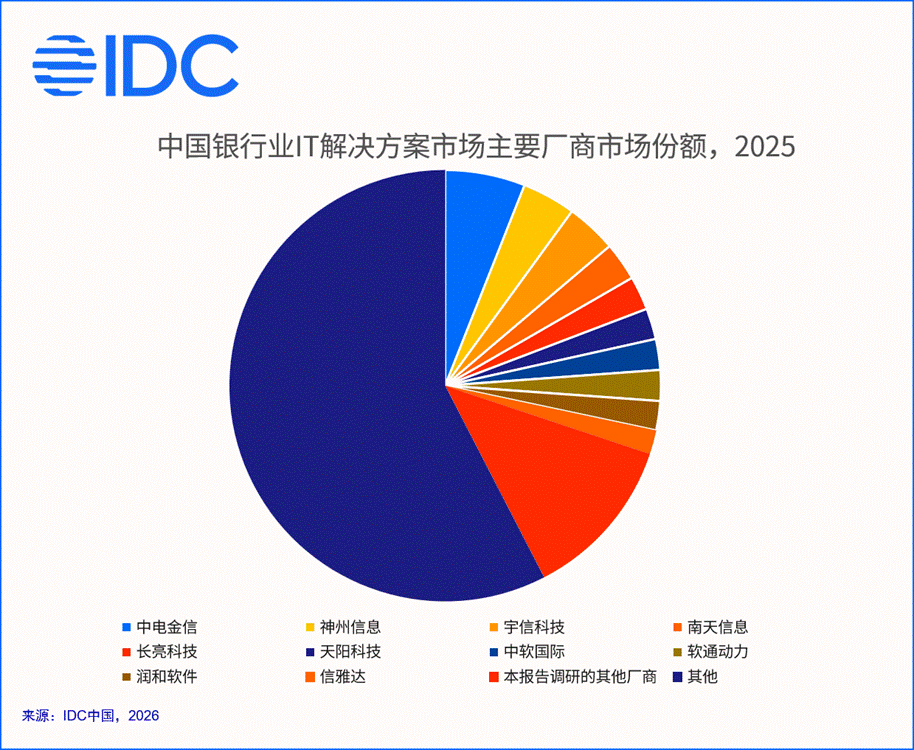
根据IDC对30多家中国银行业IT解决方案厂商的调研发现,2025年度市场呈现“头部格局稳固、腰部剧烈分化、集中度长期偏低”的核心特征。行业从增量扩张全面转向存量深耕,且银行IT解决方案厂商正从“被动式服务”模式向追求高质量项目和高毛利产品的模式转型。整体市场分散度依旧处于高位,前 20 家头部厂商合计市场份额不足 40%,其余中小厂商合计占比达 60.2%,大量区域性、细分赛道厂商仍有生存空间,但行业整体竞争强度持续上升。

备注:本次调研的其他厂商包括:安硕信息、博彦科技、法本信息、高伟达、恒生电子、衡泰技术、慧博云通、京北方、凯美瑞德、科蓝软件、领雁科技、魔数智擎、时代银通、思迈特软件、银丰新融、永洪科技、用友金融、赞同科技、兆尹科技、中软融鑫。

同时,IDC也发现,中国银行业IT解决方案厂商与AI大模型的融合已从“概念验证”全面迈入“规模化落地”阶段。大多数厂商都开始基于自身技术积累与客户基础,探索出差异化的融合路径。具体表现为如下特点:

  • 第一,从“模型接入”走向“知识融合” 。头部厂商不再满足于简单调用通用大模型API,而是将数十年积累的金融业务know-how转化为AI可理解、可执行的结构化知识,构建垂直领域的竞争壁垒。
  • 第二,从“单点工具”走向“流程重构” 。厂商基于对业务的长期积累,更擅长深入核心系统、信贷管理、财富管理、风险管理、以及手机银行、远程银行、智慧网点等核心业务流程,解决智能体落地的最后一公里,实现端到端的流程再造,价值从“提效”向“重构业务模式”升级。
  • 第三,从“大模型”走向“智能体” 。2025-2026年银行生成式AI的投入重点正从“大模型落地”,演进为“智能体上岗”——大模型是“脑子”,智能体是“脑子+手”。各厂商根据自身资源禀赋推出了相关平台类产品、智能体应用类产品以及以业务konw-how为基础的工程化落地服务。在这一进程中,能够将垂直领域专业能力与AI工程化能力深度融合的IT解决方案厂商,将在新一轮市场竞争中占据主动。

未来2年中国银行业IT解决方案厂商市场机会

面对行业净息差持续收窄、盈利结构单一、资本补充承压、资产风险结构性失衡等突出矛盾,2025 年银行业全面转向轻资产、价值化经营,银行 IT 解决方案厂商需紧扣政策导向与业务转型需求,围绕五大核心赛道挖掘市场机遇。

打造对公零售一体化全链路信贷解决方案。行业信贷投放重心向科创、绿色、普惠领域倾斜,零售信贷落地 “杠铃风控策略”,粗放扩量模式终结,精细化全流程信贷系统需求激增。厂商需搭建覆盖智能尽调、线上审批、贷后预警、不良处置的一体化信贷中台,配套小微轻量化信用贷、对公债务重组专项工具,打通对公、零售信贷数据与核心系统,支撑银行差异化信贷投放与存量风险化解。

全域渠道智能化改造,搭建公私一体化客户经营工具。息差压缩倒逼银行发力财富、交易银行等轻资本业务,线上线下渠道融合、AI 智能运营成为降本增效关键。厂商需整合手机银行、对公网银、远程银行、智慧网点多渠道中台,搭建统一客户视图与智能营销平台,打通公私客户经营数据;同时将智能体嵌入客服、营销、网点运营全场景,实现精准获客与深度客户分层运营。

全域前置型智能风控合规平台升级。地产、消费信贷风险持续出清,关注类贷款迁徙风险走高,监管报送、内控审计要求持续收紧,传统事后风控工具已无法适配。厂商需打破单一风控系统局限,搭建覆盖信用、市场、流动性、操作风险一体化平台,重点落地存量不良智能识别、全流程反欺诈反洗钱、自动化监管报送三大模块;依托数据智能、自助分析能力推动风控从事后处置前置为实时预警,降低银行合规与减值管理成本。

布局中间业务与金融市场一体化系统,助力银行拓宽非息收入。财富代销、资金、资管、自营、托管是对冲息差损失的核心抓手,相关数字化需求快速扩容。财富板块搭建产品货架、分层投顾、适当性合规一体化系统,推动银行从单纯代销转向全生命周期财富服务;金融市场板块围绕资金交易、资管投研、自营风控、托管清算打造一体化工具,适配理财净值化与精细化资产负债管理,提升交易、投研、后台运营效率,打造差异化轻资本业务竞争力。

落地价值导向经营管理数字化工具。行业摒弃规模导向,成本管控、分层价值核算、资本平衡管理需求凸显。厂商可面向总分行打造一体化经营分析平台,整合信贷、客户、风控、财务全域数据,搭建多维经营指标看板,实现机构、条线、客户分层收益核算;叠加流程自动化工具压缩线下人力成本,以数据智能为基础为信贷投放、客户经营、资源分配提供量化决策支撑,匹配银行价值转型顶层目标。

整体来看,当前银行业处于盈利重构、风险缓释、AI转型深度推进的叠加周期,那些深度绑定银行轻资本转型主线,具备全业务一体化数智交付能力或在某一垂直领域长期深耕的解决方案厂商,将在行业长期变革中确立竞争优势,持续打开增长空间。

IDC更多相关研究:

进一步交流:

如您希望深入了解中国银行业IT解决方案市场的竞争格局、厂商份额、AI落地路径或细分赛道机会,欢迎随时与我们联系。IDC金融研究团队可提供定制化数据解读、趋势研判及厂商对标分析,助力您在低速高质周期中精准布局、抢占先机。期待与您展开更深入的对话与合作,联系我们。

Siri Si

Siri Si - Research Manager

Siri Si is a Research Manager for IDC Financial Insights. His core research scope includes the latest development models and trends in the financial industry, and the development and application status of various technologies in the financial technology field, focusing…

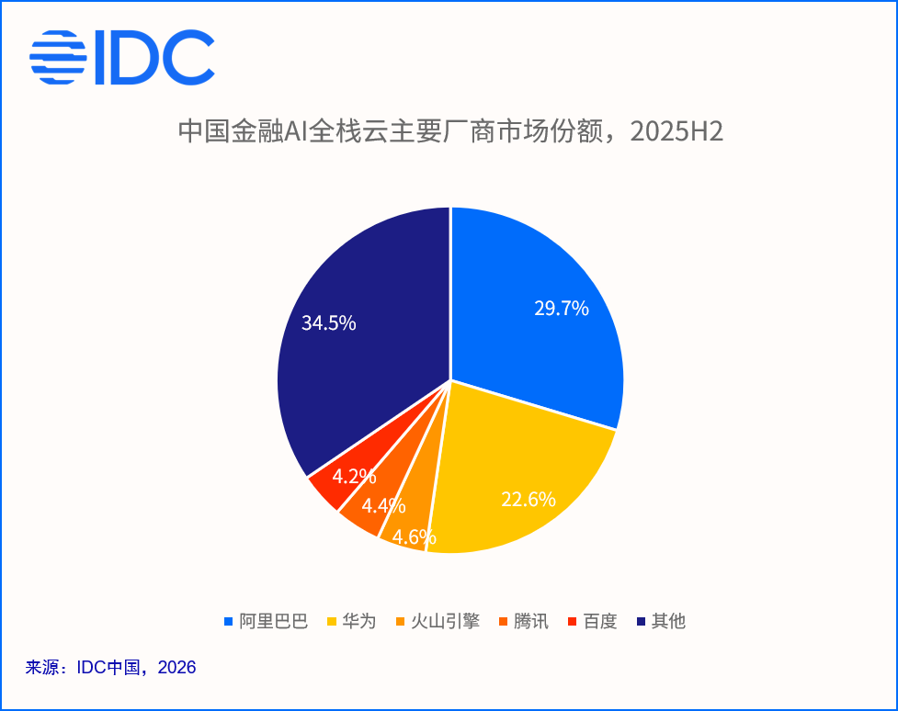
2025年,中国金融行业站上了从”数字化”迈向”智能化”的关键转折点。银行、保险、证券这类一向以稳健著称的机构,在合规与风控的硬约束之下,对新技术的引入历来审慎;但生成式AI带来的效率跃升与体验重塑,又是任何一家金融机构都不愿错过的红利。行业演进的核心驱动力,已经从最初”要不要用大模型”的试探和观望,转向场景的快速扩张、应用的规模化落地,以及对底层算力、解决方案与合规能力的系统性需求。金融AI云的竞争逻辑由此发生了一次根本性跃迁——从比拼算力”资源供给”维度,转向以”算力底座、平台调度、行业模型与合规可控”为核心的全栈能力竞争。

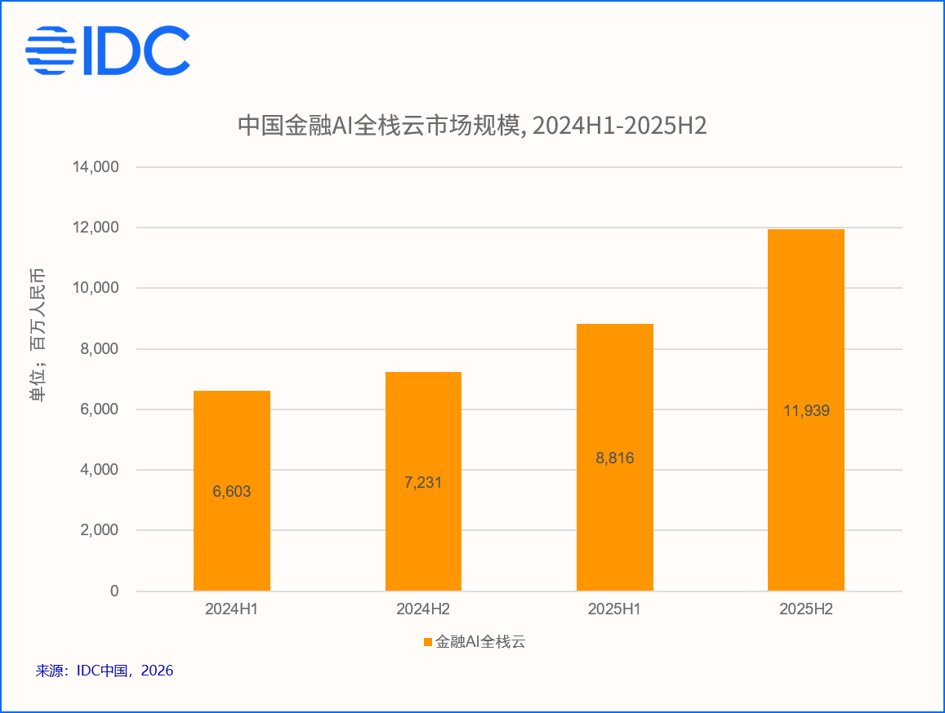
国际数据公司(IDC)最新发布的《中国金融云市场跟踪研究Add-on_AI全栈云》报告首次对中国金融云市场中公有云AI算力服务、私有云软硬件AI基础设施和GenAI解决方案子市场做出全栈式市场营收评估,中国金融AI全栈云市场2025全年市场规模207.6亿人民币,较2024年同比增长50.0%,远超金融云总盘23.9%的同比增速。这个数据对比显示出金融机构对AI相关领域的重视程度不断升级,预算投入持续加码,市场潜力快速兑现。

金融全栈布局下,头部云厂商的五种路径

经过几轮市场调整,金融AI全栈云的第一梯队逐渐清晰。五家代表性厂商在算力、平台、模型与应用上的侧重各有不同,拼出一张完整的能力地图。

“公有云算力+私有化交付“双轨并进:代表厂商 阿里云

阿里金融云,在公有云一侧依托灵骏智能计算集群,在大规模算力调度与推理优化上持续投入;金融自主私有云一侧,平头哥自研的真武AI芯片已进入规模化部署阶段,并从2025年下半年开始逐步起量。叠加面向金融场景打磨的通义点金行业大模型,以及可落入客户机房的一体机交付形态,阿里云事实上把”芯片—模型—应用”的链路在金融场景里走通了一遍,并将在2026年持续深耕,加速复制。

软硬协同稳扎稳打:代表厂商 华为云

华为昇腾系列智算服务器,多年来在国产算力替代的进程中扮演压舱石角色。对金融机构而言,华为的吸引力恰恰在于”软硬一体、自主可控”带来的确定性——在数据不出域、供应链安全成为硬约束的当下,一套经过大规模验证的昇腾底座,往往比单纯的性能参数更有说服力。

AI应用和智能体先行:代表厂商 火山引擎

背靠字节跳动内部高并发推理场景的长期锤炼,火山引擎在推理成本控制与资源利用率方面建立了差异化优势,豆包C端的成功也给火山解决方案带来足够的曝光度和品牌效应,豆包大模型与火山方舟平台构成其对外的主要解决方案抓手。在智能营销、智能客服等高频交互场景中,这种”应用先行、智能体多点开花”的策略,更容易让金融客户在数据非敏感领域优先尝到AI红利甜头。

让金融AI“融汇贯通”起来:代表厂商 腾讯云

依托在平台层数据库和大数据产品的行业优势,腾讯云从AI通用大模型到上层AI应用,从平台产品到底层异构算力管理,试图把这条链路做成一个连续整体,而非彼此割裂的模块。对于拥有庞大存量系统、又要稳步引入AI能力的金融客户来说,这种平滑过渡、整体交付的能力,本身就是一种稀缺竞争力。

“芯片+平台”组合拳:代表厂商 百度智能云

昆仑芯P800已完成规模化验证,2025年以来已交付多个万卡集群,并支撑了文心大模型新版本的训练。配合百舸AI计算平台在异构调度上的能力和千帆平台对金融应用场景的支撑,百度为金融客户从模型基础训练到推理开发上线,铺设了一条相对完整的国产化通道。

五家厂商路径不同,指向的判断却高度一致:在金融这样对”稳健”近乎苛求的行业里,单点能力很难构成壁垒,唯有把算力、平台、模型、应用与合规能力打通,才能真正站稳脚跟。

金融ISV服务商的“喜“与“痛“:增量市场背后的挑战

在AI云厂商与金融机构之间,往往活跃着各个子赛道金融ISV服务商的身影。他们既是AI方案的集成者,也是AI应用落地的”最后一公里”。2025年,金融ISV服务商感受到了明显的市场变化,AI市场带来新增营收机会的同时,也带来了全新的机遇和挑战。

一方面,金融AI场景在2025年正式跨过了“项目落地“的门槛,并呈现出明显的量价齐升势头。在传统金融预算大环境整体承压的当下,这样一块实打实的市场增量殊为不易,它意味着新的项目机会、新的合作入口,以及与客户重建深度连接的契机。不过,这份增量需要冷静看待,AI相关收入对整体金融云解决方案营收的直接贡献占比仍然偏小,更多扮演的是”敲门砖”与”引流器”的角色——通过AI项目切入客户、增强黏性,再向定制化开发、平台软件乃至底层基础设施资源的销售导流,而这些方向的受益者往往是云厂商占优。真正的商业价值,可能兑现在AI之外。

另一方面,金融机构对AI方案的选型普遍呈现迷茫状态。用哪家大模型,走开源还是闭源,部署在公有云还是落到本地机房,是否涉及业务系统解耦和微服务改造,数据安全合规如何满足监管要求,未来方案兼容性与可持续性又如何保证——这些问题几乎没有现成经验可以照搬。金融ISV服务商需要陪伴客户共同摸索试错,在反复的POC与调优中消耗大量人力成本。这种”陪跑”固然能加深信任,却也推高了交付成本,挤压了本就不宽裕的利润空间。

IDC市场调研发现,金融ISV AI服务商正从”项目制交付”向”持续运营”转型,从单纯的技术提供者,转变为深度参与客户流程重构的”业务转型伙伴”。金融AI可能对未来ISV服务商竞争格局带来颠覆性变化,金融服务商不仅要懂业务,还要懂AI、养AI、用AI,扛的住长期AI运营的玩家才能在未来竞争中立于不败之地。

IDC洞察:金融AI要以全栈能力和生态协同赢得长期战斗的胜利

对于金融云服务商和云厂商而言,是否全栈式布局已不再是选答题,而是必答题。金融客户要的不是某一颗更快的芯片或某一个更准的模型,而是一套“数据—模型—平台—应用—服务“端到端打通、并能自我迭代和强化的能力体系。在这一点上,自主算力与行业大模型的协同尤为关键,它既回应了自主可控的政策诉求,也构筑起别人难以复制的护城河。与此同时,”合规”应当被前置为产品能力而非事后补丁——数据不出域、决策可追溯、幻觉可约束,在通用市场或许是加分项,在金融市场却是入场券。

随着智能体应用从单点走向全流程,推理调用量将呈指数级放大,按需租赁、弹性扩容与混合部署在未来三到五年内,有望逐步替代传统的重资产采购模式,成为金融AI基础设施建设的新常态。能在保障性能的同时把综合成本压下来的厂商,将在长期竞争中占得先机。

此外,建议金融云厂商加大对金融ISV服务商的支持力度。ISV是云厂商触达金融客户的重要渠道,也是行业Know-How的历史沉淀者,并在AI拓展方面成本承压。云厂商在算力补贴、平台开放、收益合作与人才培养上给予生态伙伴更深层的支持,可加快金融AI整体升级节奏。

金融行业要的,从来不是非此即彼的”创新”或”稳健”,而是两者之间的平衡。能否帮客户既迈得开步子、又站得稳脚跟,正是这场金融AI全栈云竞速中,最终拉开差距的地方。

如需进一步了解IDC相关研究,或就中国金融云AI市场发展趋势进行深入交流,欢迎与IDC联系,获取更多洞察与数据支持。

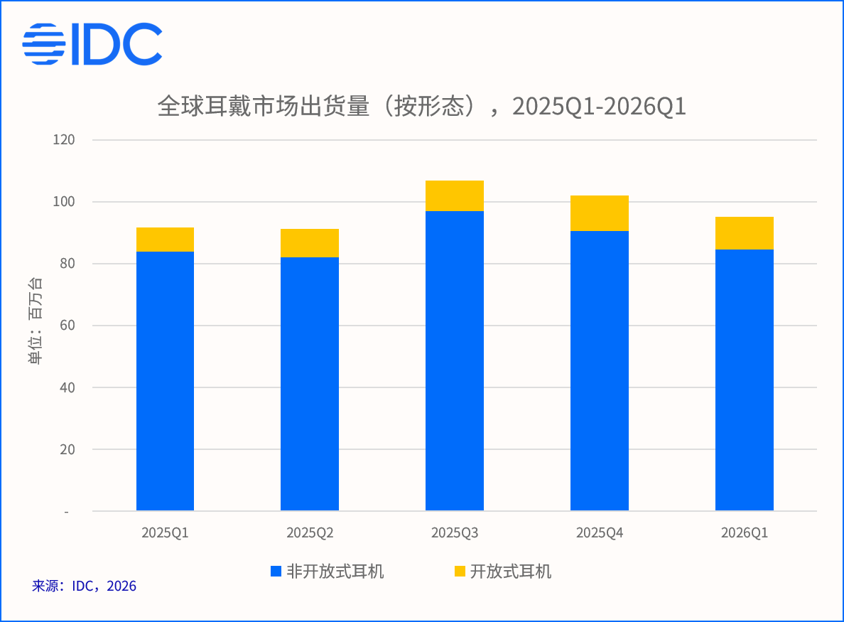
国际数据公司(IDC)最新发布的2026年第一季度全球耳戴市场数据显示,开放式耳机出货量同比增长39.9%,在整体耳戴市场仅增长3.9%的背景下表现突出。但IDC认为,比增速更值得关注的是品类结构,竞争格局与市场需求的多重转变。品类结构上,耳夹式占比首次过半,稳固其主流产品形态的地位。当前全球开放式耳机市场由中国厂商主导,海外品牌加速入局,行业竞争持续升温。与此同时,AI技术为市场注入全新动能,智能化将成为下一阶段竞争核心。

根据IDC最新发布的《全球可穿戴设备市场季度跟踪报告,2026年第一季度》显示,2026年一季度全球耳戴市场出货9,520万台,其中开放式出货1,067万台,同比增长39.9%,占比达到11.2%。凭借差异化的佩戴体验,开放式耳机在蓝牙耳机品类中的出货占比正持续攀升。

IDC三大核心洞察

结合开放式整体市场走势与市场竞争态势,2026年一季度全球开放式市场耳机三大核心洞察如下:

洞察一:细分品类格局重塑,耳夹式领跑市场增长

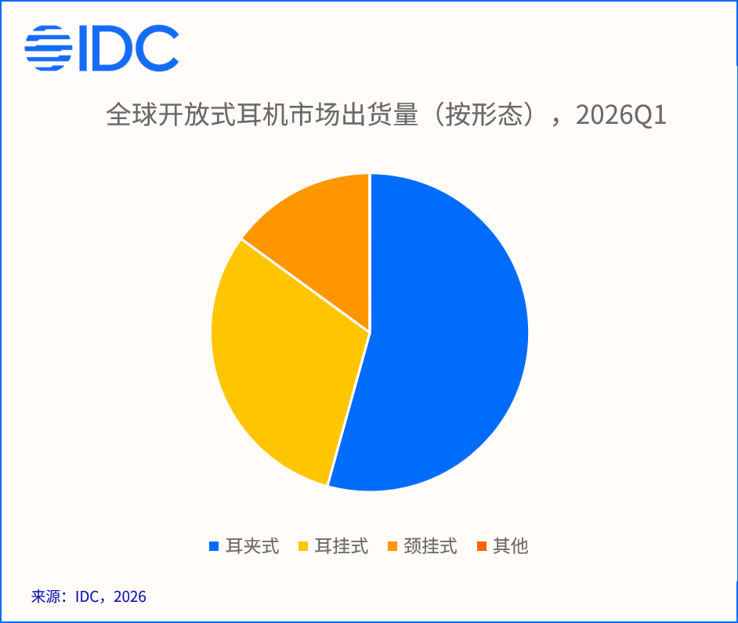
开放式耳机细分形态迎来明显更迭,品类内部竞争格局持续重构。2026年一季度,耳夹式在开放式产品中占比54.3%,同比份额增幅超10个百分点,已成为全球开放式耳机的主流形态。该品类凭借精巧的外观与多场景适配的能力受到市场认可,叠加时尚属性带来的溢价能力,部分采取机海战术的厂商逐步调整布局重心,从耳挂式赛道转向加码耳夹式产品。耳挂式同比增长11.8%,市场份额有所回落,凭借佩戴稳定性,现阶段头部品牌主要聚焦于运动细分场景。作为开放式领域成熟度最高的品类,颈挂式产品凭借骨传导技术深耕运动赛道,并依托游泳等专属场景稳固市场定位,同比增长11.9%,增速保持稳健。

洞察二:中国厂商主导市场,差异化竞争格局深化

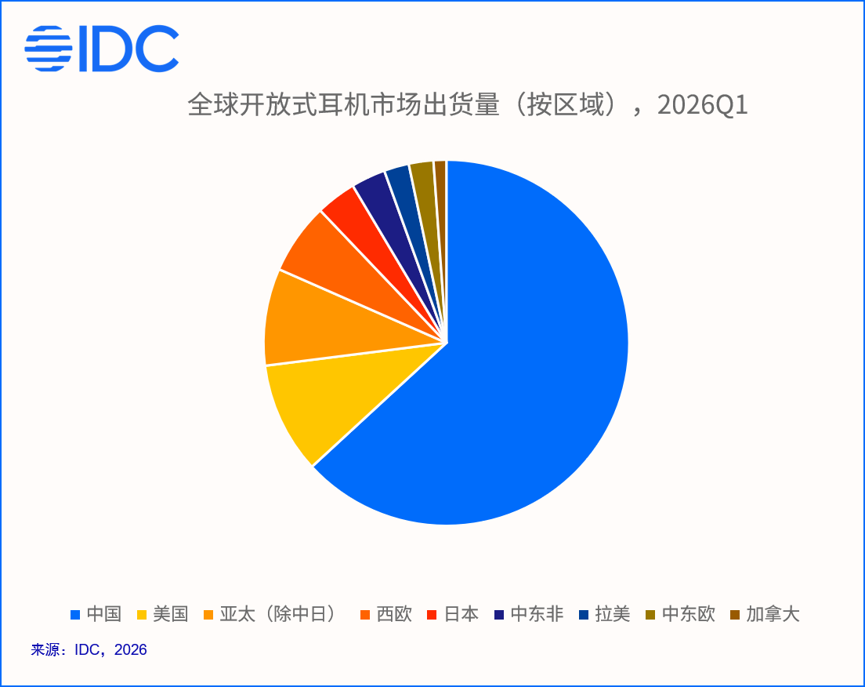
中国是开放式耳机起步最早,规模最大的核心市场,2026年一季度中国市场出货量占比超过六成。美国,亚太(不含中国和日本)及西欧市场紧随其后,增长态势亮眼。中国厂商利用先发优势全球布局,凭借完善的供应链与多元化产品矩阵持续抢占全球市场份额。市场主流集中在50美元以下及100美元以上两大价格区间,分层竞争特征显著。100美元以上高端市场中,核心技术,音质表现,品牌力与智能化成为竞争关键。韶音,华为凭借综合实力稳居领先位置。Bose,JBL等海外传统音频厂商也加码布局,依靠声学技术优势夯实产品实力,丰富自身产品线。50美元以下入门市场主打性价比,厂商凭借多样外观,新颖形态及丰富机型吸引消费者,中国与印度厂商为该市场主力。

洞察三:AI赋能硬件升级,智能化渗透空间广阔

随着蓝牙耳机硬件日趋同质化,AI技术已成为行业破局的重要方向。智能服务的迭代优化,离不开长期佩戴所沉淀的用户数据,而开放式耳机适配长时间佩戴的特性,为AI功能落地提供了天然优势。部分中国厂商已将产品搭载AI功能作为营销亮点,入门级产品主要对接第三方云端大模型,落地场景以实时翻译,会议纪要等办公需求为主,相关功能主要依托手机APP运行,并不具备端侧实时运算能力。优质的智能化体验目前仍集中于中高端产品线。定位商务场景的厂商,搭配自研大模型与端侧处理芯片,将AI打造为核心竞争壁垒,而非常规附加功能。手机品牌则凭借自有操作系统优势,整合自研大模型与终端硬件,构建“系统+模型+硬件”一体化生态闭环。该模式深度绑定用户使用习惯,有效强化用户粘性与品牌忠诚度。目前全球市场中的AI功能整体渗透率有待提升,品类智能化升级仍拥有广阔发展空间。

IDC建议

面对开放式耳机品类格局重构,中国厂商领跑全球,AI技术驱动产品升级的行业新态势,IDC为行业参与者提出以下三点切实可行的战略建议:

建议一:找准市场定位,优化产品结构与资源布局

开放式耳机品类加速分化,市场格局不断演变。厂商需明确自身赛道定位,避免盲目跟风内卷。耳夹式增长势头强劲,而耳挂式凭借更大的机身空间,更利于搭载元器件,落地 AI相关功能。厂商需结合自身核心优势搭建产品矩阵,平衡流量型与技术型产品布局,合理分配研发与产能资源,打造符合行业长期发展趋势的产品体系。

建议二:依托产业优势,深耕差异化竞争与品牌力建设

依托成熟的供应链与规模化制造能力,中国厂商可充分发挥产业优势。作为市场的先发参与者,应把握发展窗口期,聚焦品牌建设,规避同质化低价竞争。同步推进本土化运营,结合各地消费特征,文化偏好制定市场策略,以差异化产品与本地化服务提升用户认同,持续夯实全球品牌价值与综合竞争力。

建议三:着眼长远发展,强化AI核心能力建设

随着蓝牙耳机产品同质化问题日益凸显,厂商应将AI智能化升级确立为长期核心战略。依托开放式耳机可长时间佩戴、持续沉淀用户数据的特性,在现有的语音助手,AI降噪等应用基础上,拓展个性化服务,智能自适应调节等高阶体验。推动AI从单纯的营销亮点转变为核心产品实力,把握行业智能化转型机遇,充分释放市场增长潜力。

IDC中国研究经理戴翘楚认为,当前全球开放式耳机品类结构加速调整,中国厂商依托产业积淀与先发优势领跑市场,AI智能化则将成为行业下一阶段竞争焦点。厂商需明确发展方向,打造差异化产品,推进全球化布局,同时坚持长期投入,深耕AI核心技术,夯实可持续发展根基。

综合来看,IDC认为2026年第一季度全球开放式耳机市场的核心变化在于:耳夹式正在重塑品类格局,中国厂商持续主导全球市场,而AI技术的实际落地仍处于早期阶段。对于行业参与者而言,单纯依靠形态创新或价格策略的增长空间正在收窄,下一阶段的竞争将更多取决于厂商在技术深耕和智能化能力上的长期投入。市场仍在高速增长,但赛道逻辑正在变化,唯有做出清晰战略选择的厂商才能在竞争中占据主动。

如对本次报告内容感兴趣,或咨询其他相关内容,欢迎与IDC联系,以获取更多信息或探讨合作机会。

请点击此处与我们联系。

Most EMEA organisations have the intent to scale AI. What they are missing is a way to execute. On May 28, 2026, IDC’s EMEA Digital Leaders Hub brought together Martina Longo, Daniel Saroff, and Giulia Carosella for a live session drawing on 12 months of conversations within the Hub and fresh IDC research. Below is a brief overview. The full recording is available on demand. 

AI maturity in EMEA in 2026: why execution, not intent, is the real gap 

IDC’s latest MaturityScape Benchmark (EMEA, N=583) tells a clear story: 63% of EMEA organisations are still in the two lowest AI maturity stages. Fourteen percent are ad hoc: scattered initiatives, no coherent strategy. Forty-nine percent are opportunistic, running pilots but without the repeatability needed to scale. Just 2% are effectively scaling AI and Agentic AI initiatives across their organizations, including unlocking AI-driven revenue growth. 

The journey maps from the (Gen)AI Scramble (fragmented, investment-heavy experimentation) through the AI Pivot (structured scaling) to the Agentic Organisation (AI embedded across operations). Most EMEA organisations are stuck in the transition between the first and second stage. The blocker is almost never ambition. It is the ability to execute. 

Why AI adoption in EMEA is stalling: five challenges organisations need to address 

Notably, 49% of EMEA organisations have already shifted their focus from launching new AI pilots to improving existing initiatives The experimentation phase is peaking, and EMEA organizations are no longer seeking new tools but instead focusing on making current AI work effectively first. But five structural challenges continue to slow progress: 

  • Competition for resources among digital initiatives 
  • Regulatory uncertainty slowing deployment decisions 
  • Resistance to process change within the business 
  • Difficulty quantifying and demonstrating AI ROI to the board 
  • Lack of executive sponsorship or organisation-wide buy-in 

These are not isolated problems. They compound each other. Without a shared language for value, the resource conversation is difficult to win. The webinar addressed all five, and the one that generated the most discussion was ROI. 

Measuring AI ROI: why cost savings are not enough 

The most common reason AI initiatives stall is not technical. It is that no one agreed upfront on what success looks like. IDC’s AI Business Value Benefit framework maps nine dimensions where AI creates measurable impact, spanning Revenue Generation and Customer Experience through to Sustainability, Time to Market, and Business Resilience. Most organisations are measuring only one or two of these dimensions and are therefore systematically underselling the value they already have. 

“Know what you want to achieve and how you will measure it” 
  — Alex Catmur, Commercial Director Digital, AtkinsRéalis 

Three practices that came up consistently in the session: 

  • anchor every initiative to a specific business outcome before selecting any tool: Start with value drivers, not technology 
  • if no executive has a stake in the metric, the initiative will eventually stall: Align to KPIs executives already own 
  • productivity gains are visible; resilience and trust are harder to quantify but equally real, and the framework accounts for both: Separate direct and indirect value 

The session also walked through a detailed case study of a global professional services firm that went from no shared ROI lens to confident scale decisions. If that is where your organisation is at present, it is worth watching the recording to hear how they structured the turnaround. 

How the CIO role is evolving in the age of AI 

IDC’s WW C-Suite Tech Survey (EMEA, N=300) makes the expectation clear: 42% of the broader C-suite now expects the CIO to lead digital and AI transformation with a major focus on creating new revenue streams. That expectation is growing faster than the formal authority that would make it achievable. 

The digital leader of the future, as IDC frames it, is an architect of three things: Workforce (orchestrating AI-fuelled change management), Resilience (modernising IT for strategic alignment), and Value (demonstrating what digital technologies actually deliver for the business). 

Three steps for digital leaders looking to prepare for this shift: 

  • not called in to implement choices that have already been taken: Get in the room before decisions are made 
  • accountability for results, not just go-live dates: Own the business outcome, not just the delivery 
  • design AI deployments to grow and withstand failure, not just to ship: Architect for scaling and recovery from the start 

The session went into considerably more detail on each of these steps, including the structural and political dynamics that make them harder in practice than they appear on paper. 

A practical AI transformation playbook: four steps that matter

The session closed with a synthesis that cuts through the complexity. Leading AI-fuelled business transformation comes down to four sequential actions: 

  • modernise architecture and data before scaling AI; pilots built on brittle infrastructure do not survive production: Fix the foundation 
  • anchor every initiative to a KPI an executive already owns; no metric, no mandate: Define the value 
  • redesign workflows and roles alongside the technology; AI layered onto old processes delivers expensive old results: Change the model 
  • run experiments to disprove bad assumptions quickly; promote only what survives to a funded pilot with a scale plan: Scale what works 

Straightforward to state, harder to execute. The webinar covers what this looks like in practice, including the Q&A that followed. 

The complete recording covers the full AI Business Value Benefit framework across all nine dimensions, the case study of a professional services firm moving from pilot to scale, the detailed best practice sessions on ROI measurement and the evolving CIO mandate, and the Q&A with the IDC analysts. If the topics covered are relevant to your organisation’s AI journey, IDC’s EMEA Digital Leaders Hub offers advisory support, benchmarks, and peer roundtables for CIOs and digital leaders navigating this transition. Reach out via the contact form to continue the conversation. 

Martina Longo

Martina Longo - Research Manager, CIO and CTO Buyer Insights

Martina Longo is a Research Manager for the CIO and CTO Buyer Insights program. Her research focuses on the emerging priorities, programs and decision making processes linked to the modern CIO/CTO agenda. This includes advancing AI from experimentation to operational…
Daniel Saroff

Daniel Saroff - Group Vice President Research and Consulting

  Daniel Saroff is Group Vice President of Research and Consulting at IDC, where he leads the research agenda focused on end-user technology leaders, including CIOs and their direct leadership teams. He oversees a team of analysts and advisory professionals…
Giulia Carosella

Giulia Carosella - Senior Research Manager

Giulia Carosella is a Senior Research Manager in IDC's AI-Fueled Business Strategies team, leading the Worldwide research program. In this role, she researches current and emerging global trends in AI?driven business transformation, examining how organizations can reinvent themselves by leveraging…

AI正在深刻重塑数据架构,并显著提升企业对其的关注度。随着生成式AI与Agent技术的爆发式发展,商业智能与分析、数据目录与血缘、数据质量评分、湖仓一体、数据治理等议题,已经成为超过40%组织的首要建设重点。

这一变化的深层逻辑在于,Data与AI正在形成一种前所未有的紧密交互关系,而非传统的运维流程管理。Scaling Law依然成立——高质量的数据支撑着上层AI与Agent的开发,而Agent本身又以数据库、数据湖、数仓、数据中台、数据分析平台为基础设施。更重要的是,Agent所产生的频繁交互,正在催生大量运行时数据和记忆的出现,这对数据的存储与管理提出了全新要求。

一、Data Agent:定义与趋势

IDC对Data Agent的定义是:利用Agent管理和治理数据,通过对话式或低代码入口实现精准查询、分析、决策,降低获取洞见的门槛。需要强调的是,Data Agent并非指向Agent工具本身,而是在广泛的数据场景中嵌入Agent能力,以实现更快速的数据集成、管理、开发、查询、分析和可视化内容生成。其核心覆盖场景包括数据集成、数据治理、数据发现、指标开发与知识管理、查询分析、Memory与上下文管理等。

从市场趋势来看,Data Agent已成为数据与分析行业未来的重要发展方向。IDC预测,到2028年,60%的中国500强企业将部署企业级Data Agent;到2026年,50%将部署数据分析Agent,以自动化日常任务、加速战略决策。

二、为什么Data Agent会成为趋势

要理解Data Agent的兴起,需要从政策、技术与市场需求三个维度来看。

首先是政策环境向好。2026年作为“十五五”开局之年,政府及央国企有望加大数字化预算。国家明确要激活数据要素潜能,深化“人工智能+”,这为Data Agent提供了坚实的政策土壤。

其次是基础模型的持续演进。过去大模型能力集中在文娱对话,而当前技术突破重点已转向数学、代码、长上下文理解与任务执行。这些能力对于数据开发和管理至关重要,使得Data+AI场景更加成熟可落地。

第三,Agent标准协议和框架的成熟正在加速发展。MCP、A2A等协议的快速普及,大幅降低了数据软件之间的互操作性难度,使得Data Agent的技术成熟度足以支撑大规模应用部署。

最后,企业技术架构正在螺旋式演进。2025年头部企业将预算优先投入湖仓一体与数据治理;随着基础设施完善,2026年企业希望通过Agent直接获取洞见、提升决策效率并降低人力成本。

三、为什么一定是Data Agent有更大需求

Agent可以在各个场景落地,但Data Agent会成为最先落地的方向,这可以从三个维度来回答。

从需求端看,企业的核心资产是数据。企业在对外合作和对内管理中沉淀了庞大的经营、财务、代码等数据资产。企业真正需要的,不是通用Agent,而是能够处理内部全流程的Data Agent。

从商业闭环看,Data Agent的盈利模式最容易实现。相比C端Agent仍处探索阶段,Data Agent面向企业客户,部署后可以快速显现效率提升。未来付费模式可能转向Tokens消耗或RaaS(结果即服务),且Data Agent的“每Token价值”比文字、视频内容更加清晰可衡量。

从技术迭代看,数据市场已发展数十年。所有企业都已接受并落地了各种数据底座。在已有IT基础之上,企业进一步“+AI”更容易实现,且能够保持技术延续性。

四、Data Agent在2026年会发展到什么程度

当前,Data Agent市场呈现出明显的供需错配:技术厂商的投入热情超过了客户的实际需求意愿。2025年厂商密集推出Data AI Agent产品,但在需求侧,企业仍处于基础设施建设和数据治理过程中,对新技术缺乏完整认知。这意味着2026年仍需厂商持续的市场培育。

OpenClaw的爆火远超预期,这一现象值得数据厂商深思。它反映出企业和用户真正需要的是“互操作性”和“主动性”。映射到数据层,这恰恰需要Data Agent来更好地接入和管理企业数据与Memory。

但必须承认,Data Agent的商业模式仍然未定。当前企业明确投入算力与数据,但对上层Agent功能是否单独付费尚未形成共识。Agent是附加价值还是下一代必需品?是单独付费还是默认“+AI”即为未来产品形式?市场倾向于后者,但尚未有定论。

此外,Data Agent最快落地的场景不是营销,而是商业分析。企业当前对AI的认可仍集中在“降本增效”上。Data Agent擅长执行内部数据工作,但复杂多变的营销场景仍需能力提升。

五、可能的抑制因素有哪些

在讨论抑制因素时,需要先明确一个判断:数据的高价值不会改变,但未来的话语权不一定仍在数据厂商手中。在AI逐步替代多种场景功能的趋势下,掌握数据的可能是AI软件而非传统数据产品。当前来看,做“中间层”(衔接数据与AI出口的综合引擎)的企业更有机会。

另一个重要判断是:Data Agent市场似乎不会出现“DeepSeek/Manus时刻”。数据市场更符合稳定增长路线,难以复现AI领域的轰动效应。数据厂商真正的护城河,在于多模态数据管理、治理与垂直行业经验。

此外,轨道偏移也可能带来不确定性。智慧办公等Personal Data产品可能颠覆传统SaaS交付逻辑,企业核心资产将从经营数据扩展为“经营数据+员工办公数据”,但市场目前缺乏对应产品。

最后,合成数据可能影响高质量数据的价值。虽然尚未完全成熟,但当合成数据的价值高于真实数据时(拐点取决于成本与准确率对比),数据资产价值可能被重构。

六、技术厂商应该怎么应对

面对上述趋势与挑战,技术厂商需要从四个方面着手应对。

第一,打造轻量化的数据平台。企业不会再经过漫长周期建设颠覆性数据底座,而是通过AI实现快速数据集成与应用,包括流式集成、Data Flow管理、本体与指标分析等。

第二,从被动工具型转向主动任务型。借鉴OpenClaw,让企业用户通过对话指令跨SaaS执行数据管理和分析。

第三,强化运行时安全。2026年预计会有更多厂商涌入Agent Infra赛道,保障Agent运行时安全与企业数据安全。

第四,关注Agent带来的数据变化。用户与Agent交互产生大量指令、记忆、中间态数据,厂商需尽快打造Data与AI之间的中间层,这将成为用户核心关注点。

七、市场应该如何选型

需要明确,Data Agent不是某一具体功能的代称,而是实现数据全流程AI自动化的总集。IDC调研显示,企业最希望建设的Data Agent类型包括:用户合规监管Agent、自动分析Agent、知识搜索Agent、动态执行优化Agent、自动决策Agent、Text2SQL Agent等。

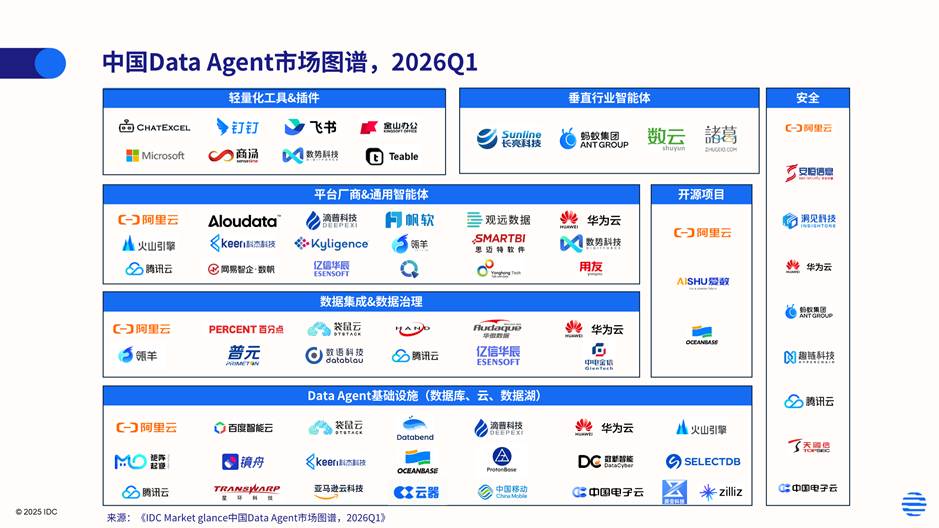
在IDC《Data Agent MarketGlance 2026Q1》中,整体市场被划分为:Data Agent基础设施、数据集成与治理、平台厂商与通用智能体、轻量化工具与插件、垂直行业智能体、开源项目、安全方向。

从市场格局来看,传统Data Infra厂商正利用AI搭建数据开发入口;SaaS厂商基于客户资源拓展Data Agent能力;AI初创公司以轻量化插件快速对接数据格式,模仿Manus路径吸引用户。

分析师观点

IDC中国高级分析师李浩然表示,Data Agent将在2026年迎来快速落地。技术厂商需明确区分Data Agent与OpenClaw/AI办公软件的竞合关系,将自身开发经验沉淀为Skills和Mem-kit,加快轻量化部署。

与IDC同行,抢占Data Agent的战略先机

IDC长期追踪全球与中国Data Agent市场,已发布《Data Agent市场图谱2026Q1》《Data Agent市场预测,2026》《金融和零售行业Data Agent最佳实践》等报告,即将发布《中国Data Agent厂商评估,2026》《Data Agent开发平台技术能力评估》等重磅报告,并可为企业提供定制化场景评估与选型服务。

请点击此处与我们联系。

Leo Li

Leo Li - Senior Market Analyst

Leo Li is a senior market analyst on artificial intelligence (AI) and big data for IDC China. He conducts research and analysis on AI and big data for the China and worldwide markets. He is also involved in regional and…

AI is redrawing the rules of the partner ecosystem faster than most organisations can adapt. Last week, Stuart Wilson, IDC’s Senior Research Director for Partnering Ecosystems, and Andreas Storz, Senior Research Manager in the same practice, shared IDC’s latest research on what that means in practice for vendors, partners, and distributors operating across Europe and beyond. Drawing on survey data from more than 1,000 established partners, direct feedback from IDC’s European Partner Advisory Board, and real-world vendor examples, they made the case that the ecosystem is not simply evolving: it is being structurally reset. Here is a brief overview. The full recording is available on demand. 

How AI is eroding traditional partner revenue streams 

Stuart opened with a finding that will resonate with anyone tracking partner economics right now: AI is systematically compressing the lifecycle phases where partners have historically earned the most. Implementation, integration, and basic support are not disappearing, but they are becoming thinner and, in a growing number of cases, absorbed directly into vendor platforms. IDC has documented specific examples of how this compression is already playing out at scale, with leading vendors publicly committing to timelines and automation levels that would have seemed ambitious just 18 months ago. 

What makes this moment different from previous platform shifts is the speed and simultaneity of the impact. AI is hitting vendor economics, partner margins, and customer expectations at the same time. Partners who are waiting for the dust to settle before repositioning are likely to find the window has already closed. 

Where partner value is growing: advisory, AI governance, and outcome-based services 

The compression of execution-heavy activities does not mean the overall ecosystem opportunity is shrinking. IDC’s data points clearly to a redistribution of spend toward higher-order roles: AI solution design and agent creation, governance and compliance services, industry advisory, data engineering, and reusable marketplace IP. These are areas that reward deep domain knowledge and customer trust rather than delivery capacity. 

Customers are also changing how they expect to be served. Rather than relying on a single partner to cover the full lifecycle, they increasingly want a coordinated network of specialists. That shift has direct implications for how vendors structure their ecosystems and how partners think about collaboration rather than competition. The recording covers the full breakdown of where IDC sees demand growing and shrinking, and what partners are doing today to get ahead of it. 

Agentic marketplaces and the new partner go-to-market playbook 

Andreas Storz walked through a structural shift in how technology solutions are discovered and bought. Marketplaces are moving inside products, and IDC is seeing real evidence that customers are making decisions before a formal procurement process ever begins. This compresses buying cycles, introduces new buyer personas including business users and domain specialists who are not traditional IT buyers, and moves partner influence upstream into phases where most partner programs have little presence today. 

Partner Advisory Board members were frank about what this looks like from the front line. One dimension that generated particular discussion was the growing scrutiny customers apply to every new AI investment: 

“Customers scrutinize every purchase order. We are having to prove the ROI to the last penny before new AI work is approved.” — IDC Partner Advisory Board member, November 2025

Co-sell models are adapting accordingly. The shift away from field-led selling toward digital and telemetry-driven motions is not a future state: it is already shaping how the most forward-leaning vendors are structuring partner engagement today. The recording covers what that looks like in practice and what partners need to do to remain visible in these new buying journeys. 

Why vendor partner programs need a fundamental redesign for the AI era 

The structural conclusion Stuart and Andreas reached is that most partner programs in operation today were designed for a world that is rapidly ceasing to exist. The incentive structures, metrics, and engagement models built around resale transactions and implementation milestones are misaligned with where ecosystem value is now being created. Vendors that do not address this gap will find themselves losing the partners best positioned to deliver AI-driven outcomes to customers. 

The research points to a dual imperative: accelerating existing partners toward AI-centric delivery models while simultaneously cultivating a new generation of AI-native partners who bring differentiated industry IP and a very different set of expectations around how vendor relationships should work. How to run both strategies in parallel, without letting either undermine the other, is one of the more complex programme design challenges IDC is helping clients navigate right now. 

“AI-native competitors without legacy delivery models are coming. If we don’t pivot, we will be disrupted.” — IDC Partner Advisory Board member, November 2025 

The Q and A that followed also surfaced sharp questions on how AI model providers are disrupting established alliance hierarchies for global systems integrators, and whether the net effect of all this change will be a more consolidated or more fragmented ecosystem. Stuart’s answer to the latter was more nuanced than a binary either/or, and worth hearing in full. 

The complete recording includes data from the IDC EMEA Partner Survey data (N=1,001), a detailed breakdown of the dual partner strategy framework, and a live Q and A with both analysts. If the topics covered resonate with your ecosystem strategy, IDC’s Partnering Ecosystems practice offers advisory support, custom research, roundtables, and strategic workshops tailored to vendors, distributors, and partners navigating this transition.  
 
Our experts are always happy to continue the conversation. Simply reach out via the contact form.  

Stuart Wilson

Stuart Wilson - VP, WW Partnering Ecosystems, Alliances and Channels

Stuart Wilson is VP, Worldwide Partnering Ecosystems, Alliances & Channels at IDC. He leads IDC's research and advisory agenda focused on partnering ecosystems, strategic alliances, channels, marketplaces, and ecosystem-led growth. He currently leads IDC's EMEA Partnering Ecosystems research program and…
Andreas Storz

Andreas Storz - Research Director, Software Channels and Ecosystems

Andreas Storz is Research Director for IDC's Software Channels and Ecosystems program. Based in the US, Andreas focuses on the evolution of go-to-market models, new digital value chains and the wider impact on partner ecosystems, exploring how current and future trends will…

Digital accessibility is shifting from a compliance requirement to a key driver of inclusion, productivity, and innovation in the modern workplace. This blog explores where European organizations stand today and outlines a practical, technology-driven approach to turning accessibility into a competitive advantage. 

What Is Digital Accessibility in the Workplace? 

Digital accessibility refers to the design, development, and delivery of digital technologies, products, and services in a way that ensures they can be perceived, understood, navigated, and interacted with by all people, consistent with the principles established by the W3C Web Accessibility Initiative. This applies regardless of ability or disability and includes individuals with physical, sensory, cognitive, and neurodivergent conditions, such as impairments related to vision, hearing, motor function, speech, and information processing, as well as situational or temporary limitations. 

It encompasses not only compliance with accessibility standards and guidelines, but also the proactive inclusion of diverse user needs throughout the entire lifecycle of digital experiences, enabling equitable, independent, and dignified access for everyone. 

In simple terms, in today’s AI-enabled workplace, accessibility is no longer just a legal box to tick. It is a design choice that determines who gets to fully participate, innovate, and grow. 

The State of Digital Accessibility in European Organizations 

European legislation on workforce accessibility is comprehensive but uneven. Countries such as Italy, France, Germany, and Poland enforce employment quotas for people with disabilities, while the UK and Denmark rely on antidiscrimination and reasonable-accommodation laws. To harmonize these differences, the European Commission introduced the Disability Employment Package and the Strategy for the Rights of Persons with Disabilities 2021 to 2030, outlining shared approaches to inclusive recruitment, workspace adaptation, flexible working, and assistive technology adoption. 

Despite this robust framework, execution lags. IDC research shows that diversity and inclusion, including accommodation for people with disabilities, ranks near the bottom of EMEA organizational priorities at just 27 percent, well behind talent retention and reskilling. Around 30 percent of employees say their organization has not adopted any digital accessibility solution at all. Interestingly, employees are more optimistic than their employers. One in two believe AI is already improving digital accessibility and will help close the digital divide. 

The real issue is not missing legislation. It is the gap between what companies say they will do and what they actually deliver. 

How to Build a Digital Accessibility Strategy 

So how can organizations close that gap? IDC’s The Four Tech Pillars to Create a Digital-Accessible Work Environment lays out a closed-loop, five-step journey that keeps accessibility moving instead of getting stuck in a one-off project. 

  1. Start by listening. Assess what employees actually need through surveys, one-on-ones, and functional and contextual evaluations.  
  1. Review your technology stack. Evaluate hardware, software, productivity suites, and assistive tools for compatibility and gaps.  
  1. Embed accessibility early. Integrate accessibility into design and procurement, turning standards such as WCAG and EN 301 549 into mandatory checkpoints.  
  1. Establish governance. Define clear roles, responsibilities, escalation paths, and cross-functional ownership.  
  1. Measure impact. Use data to track ROI and support CSRD reporting on productivity, inclusion, and compliance.  

This should be seen as a continuous loop rather than a checklist, one that evolves alongside people, technology, and regulation. 

The Four Technology Pillars of Digital Accessibility 

Assistive technologies alone are not enough. IDC identifies four interdependent technology pillars, all supported by a foundation of best practices. 

  • AI-enabled assistive technologies: AI-driven screen readers, image and audio descriptions, captioning, and voice input integrated into mainstream collaboration platforms, matching the right technology to the right user.  
  • Accessible-by-design AI-driven platforms: HR, productivity, and collaboration tools built from the outset to meet EU accessibility standards, shifting remediation earlier and reducing long-term costs.  
  • AI-empowered configuration and orchestration layer: A governance backbone that sets standards, automates testing, and scales accessibility across workflows, teams, and vendors.  
  • AI, data, and analytics: Privacy-preserving analytics on usage, barriers, and outcomes to demonstrate ROI, support ESG and DEI reporting, and anticipate future needs.  

Underlying these pillars, best practices, including executive sponsorship, shared accountability, training, and continuous feedback loops, ensure that strategy translates into everyday operations. Without them, even the most advanced technology stack risks remaining underutilized. 

Why Digital Accessibility Is a Competitive Advantage 

Digital accessibility is no longer just about compliance. It plays a critical role in attracting diverse talent, enabling innovation, and responding to increasing ESG scrutiny. European regulation provides the framework, but culture, technology, and governance determine the outcome. 

By combining a closed-loop approach with the four technology pillars and strong best practices, organizations can move beyond risk mitigation and position accessibility as a true competitive advantage. 

Want the full picture? For the European legislative landscape and where organizations stand today, see IDC’s Digital Accessibility for the Workforce: European Legislation and Organizations’ Responses (IDC #EUR154346826, March 2026). For a practical technology playbook, refer to The Four Tech Pillars to Create a Digital-Accessible Work Environment (IDC #EUR154347126, April 2026). 

And if you would like to explore what these trends mean specifically for your business, our experts are always happy to continue the conversation. Simply reach out via the contact form. 

Erica Spinoni

Erica Spinoni - Senior Consultant, IDC4EU IDC European Government Consulting

Erica Spinoni is a Senior Consultant at the IDC4EU European Government Consulting unit. She led IDC’s EMEA-focused research for the Future of Work group, examining how AI, automation, and emerging workplace models are reshaping employee experience and productivity across the…

For years, the security platform was the Pinocchio of enterprise technology. It looked like the real thing. It told a convincing story. Vendors put it on stage and pulled the strings, and the puppet moved beautifully. Then you went backstage and found the strings. The telemetry was siloed. The policies were fragmented. The dashboards required a UN interpreter to reconcile. Analysts were manually stitching together context that the platform was supposed to handle automatically. The nose, in other words, was growing.

I have sat through more of those briefings than I can count. The slides were gorgeous. The architecture diagram had arrows pointing everywhere, suggesting a kind of unified, harmonious security nirvana. The gap between the deck and the deployment was, shall we say, significant.

That gap has finally started to close, and the puppet has become a real boy.

IDC’s research finds that organizations now running modern security platforms in production are delivering measurably better outcomes across threat detection, operational efficiency, cost management, and business resiliency. The story has moved from aspirational to architectural, and it is worth unpacking exactly what that transformation looks like.

What a security platform actually is

Let me be precise about the definition, because vendors still stretch this term like taffy, and Pinocchio’s nose did not get that long without some help.

A security platform is not a vendor’s portfolio of products bundled under one invoice. It is an integrated collection of security capabilities delivered through a unified architecture, management plane, and data model. The critical distinction is that platform components share telemetry, policy, analytics, and automation natively, rather than through custom connectors bolted on after the fact by a professional services team charging by the hour. That last arrangement is what the old platforms actually were. It just did not look that way on the slide.

IDC’s research across multiple vendor studies, including Check Point, Palo Alto Networks, and CrowdStrike, consistently points to six structural elements that define a genuine security platform. These are not features to check off a procurement list. They are architectural commitments that determine whether a platform actually delivers or simply repackages the fragmentation problem under a shinier brand.

Unified telemetry and shared data model. A platform aggregates signals from endpoints, networks, cloud environments, identities, workloads, applications, and data repositories into a common data architecture. The operative word is “common.” Rather than asking analysts to manually pull context from separate consoles and reconcile it by hand, the platform normalizes and enriches signals automatically. The result is cross-domain visibility that supports more accurate threat prioritization and closes the blind spots that emerge when identity, network, and workload context all live in different zip codes. Greater aggregation unlocks greater value: the more telemetry flows into a shared model, the more the analytics engine can do with it.

Centralized policy and management. A unified management plane is one of the clearest signals that an organization is running a real platform rather than a curated collection of tools. Security controls are defined once and enforced consistently across hybrid, multicloud, and on-premises environments. This matters because configuration drift is one of the most reliable sources of security gaps I see in my research. When multiple tools are administered independently, inconsistencies accumulate quietly, like technical debt, until something breaks in a way that makes headlines. Centralized policy eliminates that drift and simplifies governance, audit reporting, and compliance validation as a bonus.

Integrated analytics and threat intelligence. Platforms embed analytics and intelligence across functional domains rather than isolating detection engines inside separate products. Intelligence feeds and behavioral analytics inform prevention, detection, and response in a coordinated manner, so a risk signal in one domain can immediately influence controls in another. An anomalous identity behavior can trigger network access restrictions before an analyst has finished reading the alert. The output is not simply more alerts, which would be the opposite of helpful. It is contextualized insight that lets security teams act on what actually matters rather than chase noise across a dozen different consoles.

Automation and orchestration. Automation is central to the operational value a platform delivers, and I want to be direct about why. Platforms incorporate automated workflows for investigation, remediation, credential lifecycle management, certificate issuance, patching, and policy enforcement. Orchestration capabilities reduce manual effort and accelerate response times across those workflows. Most importantly, automation lets security teams manage increasing complexity without proportional increases in headcount. In a market where skilled security talent is harder to find than a reasonable parking spot in San Francisco, that is not a marginal benefit. It is a structural necessity.

Response across control planes. A platform spans multiple control planes, including identity, endpoint, network, cloud workload, and data security, rather than optimizing a single domain in isolation. Value emerges not only from the breadth of that coverage but from the architectural integration across domains. Controls operate cohesively rather than independently, so a detection in the endpoint layer informs the response in the identity layer without requiring manual handoffs between teams who may not even share an org chart. As digital environments expand, this integrated coverage directly reduces the gaps that arise when controls are deployed in functional silos and expected to somehow coordinate on their own.

Operational simplification. I save this one for last because it is the most underappreciated element of the group, and frankly the one I hear security leaders mention most when they get candid over a coffee. As organizations accumulate tools over the years, the resulting complexity introduces inefficiencies, alert fatigue, integration fragility, and processes that vary depending on which analyst happens to be on shift. A platform consolidates workflows, minimizes dashboard-switching, standardizes operating procedures, and reduces the overhead of managing multiple vendor relationships simultaneously. Fewer tools requiring independent configuration. Fewer integration points to babysit. Fewer procurement cycles. Streamlined audit evidence collection. Lower training requirements, because analysts work within a consistent environment rather than context-switching across systems that each have their own logic and quirks. Operational simplification does not mean reduced capability. It means architectural coherence, and in an environment defined by talent shortages and relentless digital expansion, coherence is a genuine competitive advantage.

Four outcomes, regardless of who built it

IDC measures platform value through structured interviews with organizations running platforms in production, capturing before-and-after data across detection and response times, staffing requirements, downtime, incident frequency, compliance effort, and tool consolidation. Operational improvements are converted to financial value using standardized assumptions for labor costs, productivity, and risk, analyzed through a three-year discounted cash flow model. I am not accepting vendor claims at face value. I am talking to the customers actually living with the outcomes.

What IDC consistently finds falls into four patterns, regardless of the technology domain or deployment scope:

  • Faster, more contextual threat detection and response
  • Reduced operational complexity
  • Lower security-related costs
  • Business enablement and revenue protection

The platform is live. The hard part just started.

I want to be straight with you: becoming a real boy is not a one-afternoon project. Platform adoption is both an architectural and an organizational transformation, and organizations that treat it as a straightforward product deployment tend to learn otherwise rather quickly.

The most common friction points include disentangling legacy workflows and brittle integrations accumulated over years; reengineering detection logic and response playbooks rather than simply migrating telemetry; managing extended coexistence periods where parallel systems add temporary complexity; and navigating the organizational realignment that comes when automation and centralized policy management reshape roles that people have held for a long time.

None of these challenges disqualify the platform approach, but they do argue strongly for phased deployment, deliberate tool consolidation, and treating the operating model as part of the transformation rather than a problem to solve after go-live. Pinocchio did not become real by wishing hard. He earned it.

Go deeper: The full research is worth your time

My colleagues and I go considerably deeper on all of this in the full IDC Perspective, Defining and Implementing Security Platforms: Differentiating “PowerPoint” from Engineering Reality, including the complete measurement methodology behind the business value findings, a detailed breakdown of implementation challenges, and best practices for organizations at every stage of platform adoption. The puppet has become a real boy. This is the research that shows you what that looks like in practice, and what it takes to get there. If you are a security leader thinking through platform strategy, this is where to start.

Frank Dickson

Frank Dickson - Group Vice President, Security & Trust

Frank Dickson is the Group Vice President for IDC’s Security & Trust research practice.  In this role, he leads the team that delivers compelling research in the areas of AI Security; Cybersecurity Services; Information and Data Security; Endpoint Security; Trust;…