Lizzie Li is Associate Research Director of IDC China's Enterprise System and Software Research that focuses on research and analysis of the China Datacenter, Cloud Computing, and IT infrastructure markets. She also provides intelligence and consulting services in customized projects for…
Lily is the Research Manager for China Robotics and Embodied Intelligence, specializing in market research on embodied intelligent robots. She has long focused on the development trends of China’s embodied intelligence robotics industry, systematically studying the evolution of robot hardware,…
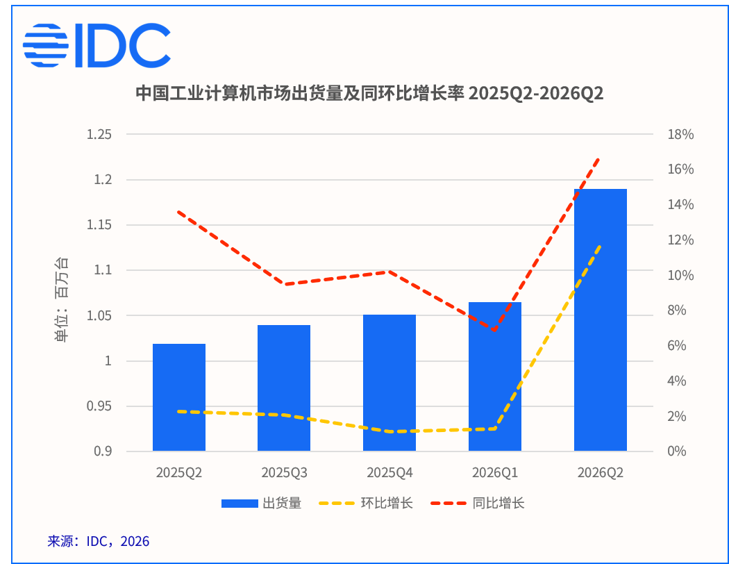
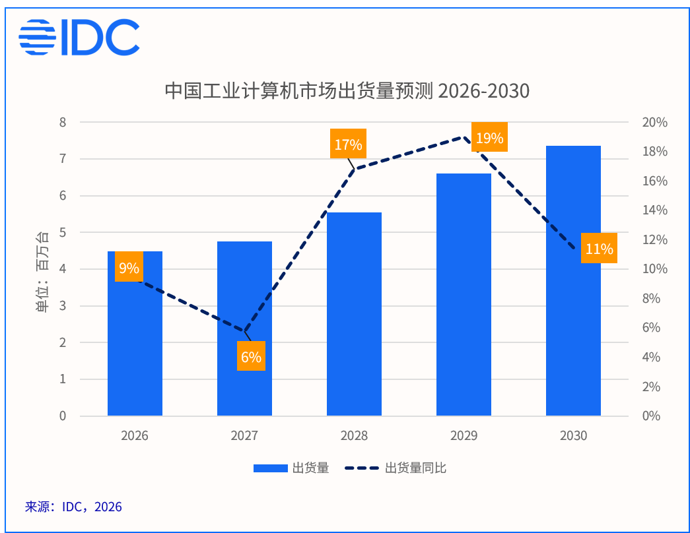
国际数据公司(IDC)最新数据显示,2026年第二季度,中国工业PC市场出货量同比增长16.8%,增速创下近五个季度新高。但亮眼数据背后,市场参与者正面临更复杂的周期挑战:本轮增长同时包含 AI 转型带来的真实增量,与短期供需波动催生的前置需求,无法通过简单线性外推判断未来走势。厂商需穿透数据表象调整经营策略,从追求规模增速转向订单质量与产品竞争力的提升。
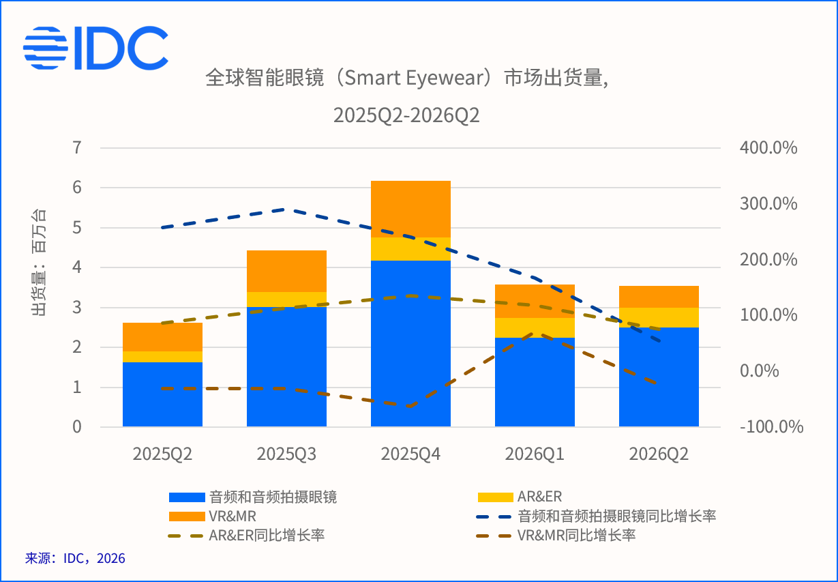
Global shipments of XR headsets and glasses rose 35.3% year over year in the second quarter of 2026, strong growth but a significant moderation from the 130.2% increase IDC tracked in the prior quarter. Much of that slowdown reflects tougher comparisons and a pause between major product cycles rather than any softening in consumer interest. Growth should pick back up as the next wave of product launches arrives later this year.
Audio glasses, the display-less category that includes devices like Ray-Ban Meta, represented the largest portion of shipments, capturing 70.3% share during the quarter, up from 61.9% a year ago. Display glasses represented 14.3% share, up from 11% a year ago, while headsets held the remaining 15.4%. Glasses overall have turned a corner and are quickly being recognized by a mainstream audience. Recent privacy backlash over always-on recording shows not all of that attention is flattering.
Who’s winning right now: Q2 2026 market share
Meta continued to dominate the market with 68.7% share. Its growth this quarter came from pushing into two additional segments: prescription eyewear, with the launch of its Blayzer and Scriber Optics lines, and lower-cost options that skip the fashion branding EssilorLuxottica normally provides. That expansion is only part of the story. Meta’s lead also rests on distribution scale, brand recognition, and AI features built across its product line, advantages that are harder for challengers to replicate than any single hardware launch.
RayNeo ranked second with 3.6% share, up 83.3% year over year, on the strength of its low-cost, personal-theater-style devices. Alibaba, a relative newcomer to the category, ranked third at 2.6% share thanks to the popularity of Qwen and the company’s already-established presence in China. XREAL and Xiaomi rounded out the top five, though Xiaomi’s share nearly halved from a year ago as competition in its home market intensified.
What’s coming next: The launches that could reshuffle the board
A lot is going to change in the remaining months of 2026 as next-gen products arrive from multiple vendors, each chasing a similar set of goals: more capable AI experiences, lighter hardware, and use cases that go beyond entertainment into everyday productivity. Those shared priorities, more than any single launch, will shape competition through the rest of the year.
Snap is launching its Specs, which bring genuine AR capabilities packaged into the most consumer-friendly design the category has seen yet, backed by a marketing campaign built around fashion icons.
Samsung and XREAL are both readying Android XR products. XREAL’s Aura pairs the company’s personal-theater-style hardware, already strong for content consumption, with Google’s Android XR platform, putting productivity use cases on equal footing with entertainment. Samsung’s audio glasses, meanwhile, bring Google’s Gemini assistant together with the distribution and design sensibility of Gentle Monster and Warby Parker.
Meta’s upcoming Connect event is widely expected to launch a more premium mixed reality headset with better visuals and a slimmer, lighter form factor that should appeal to enthusiasts. IDC also anticipates new display and audio glasses at the show, with the display glasses aimed at broader availability and a more accessible price point.
Beyond these headline launches, products from Pico, RayNeo, Viture, and a growing list of other brands will help drive further growth in 2026 and into the years ahead.
The road ahead: Forecast 2026–2028
IDC forecasts total unit shipments will grow 26.3% in 2026, then accelerate to 40.5% growth in 2027 and another 26.4% in 2028. Audio glasses will keep leading the category, though display glasses and headsets will continue to ramp alongside them.
For consumers, that growth will be driven by a wider range of products, price points, and channels, plus the spread of AI and friction-reducing use cases like easy photo and video capture. Among businesses, training and design use cases will keep driving adoption, since IDC has tracked ROI gains in early enterprise pilots, and more businesses continue to start them.
Growing pains: Privacy and business-model tension
There are also growing concerns behind the scenes that need to be addressed, as they stand to reshape the adoption curve going forward.
Privacy and shifting consumer attitudes. Many products and services surrounding XR glasses have clear, tangible benefits, though IDC has tracked growing concern over the need for privacy controls. IDC has also observed a shift from early jokes about social acceptance to more serious concerns about the lack of meaningful notice and consent mechanisms while recording, along with AI-enabled data collection, raising the stakes for how vendors respond. Meta, the current leader, has taken action to reduce misuse of its products, but those steps came only after public backlash forced its hand. That leaves room for a competitor willing to build privacy safeguards in before launch, not after a headline forces the issue.
Competing business models. XR glasses are a relatively new category, and tech companies are quickly partnering with fashion companies to leverage their expertise in design, manufacturing, and distribution. There’s tension between these camps, though, as fashion companies often operate on higher margins while tech companies are willing to sacrifice margin in favor of ongoing subscription or advertising-based models, where the hardware can be offered at a lower upfront cost to keep the consumer inside the ecosystem. This is likely one reason Meta launched glasses without EssilorLuxottica’s branding. It also puts smaller players at a disadvantage, since they face pricing pressure on hardware from incumbents like Meta and potentially Google and Samsung, and will likely have to adjust their own business models to offer subscription services alongside their XR products going forward.
What this means for the industry
Smart glasses are genuinely being worn now, not just tested, and that changes the competitive picture. Meta still holds the lead, but the next round of launches from Snap, Samsung, XREAL, and Meta’s own Connect event will show whether that lead holds up. The rest of 2026 will be shaped as much by these launches as by the numbers themselves. Even with this quarter’s slower growth, consumer awareness keeps building and AI is unlocking new use cases — the vendors that move first on privacy may be the ones who convert that awareness into share.
Jitesh Ubrani - Director, Consumer Devices Research
Jitesh Ubrani is a Director at IDC leading a team of analysts within the Worldwide Consumer Device Trackers group, covering wearables, augmented reality (AR), virtual reality (VR), tablets, phones, PCs, gaming, and smart home devices, with a focus on market…
The worldwide WLAN market reached $3.2B in the second quarter of 2026 (2Q26), growing 23.2% year over year (YoY). That’s an acceleration from the 15.6% growth in 1Q26. The quarter’s growth reinforced Wi-Fi 7 (802.11be) as the new dominant Wi-Fi standard in the enterprise.
Wi-Fi 7 is now the single largest revenue category in enterprise WLAN, reflecting a broad shift in enterprise purchasing priorities.
The results span all major regions and vendor tiers. The market has moved past its early-adoption phase into a full replacement cycle.
WLAN market highlights
Total market: The worldwide WLAN market grew 23.2% YoY in 2Q26, reaching $3.2B. That’s a meaningful acceleration from the prior quarter. The enterprise dependent access point (AP) segment grew 27.6% YoY to $2.7B, outpacing the broader market and reflecting sustained corporate investment in dependent wireless infrastructure. The pace of growth suggests that enterprise Wi-Fi refresh cycles are broadening beyond early adopters to mainstream deployment.
Wi-Fi 7 momentum: Wi-Fi 7 dependent AP revenues reached $1.4B in 2Q26, representing 53.0% of enterprise dependent AP revenues and growing 219.5% year over year. This transition reflects the convergence of a maturing Wi-Fi 7 product ecosystem, enterprise demand for higher-throughput infrastructure, along with the pull-forward effect of AI-driven network requirements and AI-powered wireless management.
Wi-Fi 6/6E trajectory: As Wi-Fi 7 adoption continues, earlier-generation standards are declining in share. Wi-Fi 6 accounted for 29.4% of enterprise dependent AP revenues in 2Q26 (down from 34.8% in 1Q26), while Wi-Fi 6E held 16.9%. Both previous-generation standards remain relevant in phased enterprise rollouts and mid-market deployments. In new projects, though, Wi-Fi 6/6E investment has largely given way to Wi-Fi 7.
Regional performance: Growth was broad-based across all three regions in 2Q26. EMEA led with 32.2% YoY growth, reaching $1.0B supported by enterprise refresh investment and expanding Wi-Fi 7 adoption across Western and Central Europe. The Americas grew 21.6% YoY to $1.5B, maintaining its position as the largest regional market. APJ expanded 15.2% YoY to $708.1 million.
Vendor highlights
The 2Q26 vendor field reflects a market in active expansion, with the top five vendors posting revenue growth.
Cisco: Cisco posted $1.3B in enterprise WLAN revenues in 2Q26, growing 27.2% YoY and maintaining its position as the market share leader with a 39.0% share. Cisco’s growth reflects enterprise demand across its Wi-Fi 7 portfolio and continued momentum in large campus and branch deployments. Cisco’s scale and long-standing enterprise relationships keep it entrenched in complex, multi-site deployments, backed by a go-to-market channel that’s hard for smaller vendors to match.
HPE/Juniper: The combined HPE and Juniper entity posted $557.2 million in enterprise WLAN revenues in 2Q26, growing 7.5% YoY with a 17.2% market share. While the growth rate is more moderate than its peers this quarter, HPE’s Aruba and Juniper Mist AI-driven platforms remain the pick for enterprises that prioritize AIOps and cloud-managed deployments, particularly those consolidating wired and wireless management under one roof.
Ubiquiti: Ubiquiti posted $415.9 million in 2Q26 revenues, growing 33.1% YoY with a 12.8% market share. Its continued above-market growth reflects traction in the mid-market and among managed service providers, where the company’s competitive pricing and rapid Wi-Fi 7 product refresh are leading to consistent revenue momentum.
Huawei: Huawei posted $339.7 million in 2Q26 revenues, growing 44.0% YoY and reaching a 10.5% market share, up from 6.0% in 1Q26. Growth was driven by its Wi-Fi 7 campus portfolio and integrated campus networking solutions, with standout performance in markets across Asia Pacific and EMEA where Huawei holds established enterprise customer relationships.
Vistance Networks: Vistance Networks (formerly CommScope/Ruckus) posted $107.2 million in 2Q26, growing 9.9% YoY with a 3.3% market share. The Ruckus portfolio continues to hold its position in high-density verticals including hospitality, education, and large venues, where its enterprise-grade quality and deployment flexibility remain competitive differentiators. In April 2026, Belden announced its intent to acquire Ruckus Networks from Vistance Networks, a $1.85B deal that closed in July 2026.
WLAN Top Companies Chart
Market dynamics
Wi-Fi 7 as the new enterprise baseline
The 2Q26 results confirm that Wi-Fi 7 is no longer a premium upgrade choice, rather it has become the default selection for enterprise wireless procurement. The speed and breadth of this transition is driven by a combination of factors: a broad hardware refresh cycle that has created natural replacement demand across installed Wi-Fi 5 and early Wi-Fi 6 deployments; a matured vendor product portfolio that has brought Wi-Fi 7 to competitive price points across all market tiers; and the pull-forward effect of enterprise AI adoption, which is raising throughput and latency requirements across office environments, campuses, and branch sites.
Persistent supply chain headwinds caused by industry-wide memory shortages continue to extend lead times and increase average selling prices (ASPs) across the enterprise WLAN market, forcing enterprise buyers into difficult trade-offs. Organizations are choosing between accelerating purchases to secure inventory or deferring deployments to manage costs, reshaping buying patterns as cost-conscious enterprises prioritize strategic deployments while others absorb premium pricing.
“
Strong 2Q26 results in the enterprise WLAN market underscore a market in full transition. The campus refresh cycle is accelerating across regions, driven by the convergence of Wi-Fi 7, multi-gigabit switching, and AI adoption. Organizations are modernizing networks to support AI workloads while simultaneously leveraging AI and agentic capabilities to streamline engineering and operations. Despite supply chain headwinds, IDC expects momentum in the enterprise wireless industry to continue as organizations across the globe prioritize network modernization in the AI era.
Why it matters
Who should care? CIOs, network architects, and IT procurement teams making refresh decisions in the next 12-18 months should treat Wi-Fi 7 as the standard starting point, not an optional upgrade. The market has moved: vendors are shifting development and supply chain focus to Wi-Fi 7, and the price premium over Wi-Fi 6 is narrowing rapidly. Deferring Wi-Fi 7 now means retrofitting networks to meet AI application requirements sooner than expected.
Business impact: The acceleration in enterprise WLAN growth, 23.2% YoY, up from 15.6% in the prior quarter, reflects real enterprise budget commitment to wireless modernization. Organizations that have invested in Wi-Fi 7 infrastructure are building the connectivity foundation for AI-powered collaboration, real-time location services, and high-density mobile workloads. The TCO calculus increasingly favors Wi-Fi 7 over incremental Wi-Fi 6E upgrades.
What’s next for the WLAN market
IDC expects the enterprise WLAN market to sustain growth through the second half of 2026, with Wi-Fi 7 continuing to consolidate its dominant position, despite supply chain headwinds. As the enterprise installed base of Wi-Fi 6 and 6E access points continues to mature, the addressable refresh opportunity remains substantial. Demand from AI-intensive applications (spanning inference at the edge, high-density video, and IoT integration) will continue to pull forward network investment decisions. Integrated, secure networking is another key driver in the refresh opportunity.
The competitive dynamics established in 2Q26 are likely to persist. Cisco’s scale advantage in large enterprises is durable, but Huawei’s trajectory and Ubiquiti’s mid-market momentum mean that market share will remain actively contested. Macro risks, including regional economic uncertainty and supply chain disruptions, are real watch items for the back half of the year. None of them have shown up yet in the refresh demand IDC is tracking.
For deeper analysis and IDC research on enterprise wireless LAN trends, visit the IDC Quarterly Wireless LAN Tracker, or contact IDC for the latest market insights and custom research.
Brandon Butler - Senior Research Manager, Networking and Infrastructure Services, Enterprise Infrastructure
Brandon Butler is a Senior Research Manager within IDC’s enterprise infrastructure global research domain and part of the networking infrastructure and services subdomain. His research covers market and technology trends, forecasts, and competitive analysis in enterprise campus, branch, and edge…
Petr Jirovsky - Senior Research Director, Networking and Infrastructure Services, Enterprise Infrastructure
Petr Jirovsky is a Senior Research Director within IDC’s enterprise infrastructure global research domain and part of the Networking and Infrastructure Services subdomain. He provides quantitative insights on network infrastructure for the datacenter, cloud, and campus/branch environments. He serves as…
Diego Anesini serves as Vice-President, Data & Analytics, Networking. Prior to this position, Diego held various roles in the company. The most recent was VP, Data & Analytics for Latin America. He has extensive experience in the Networking, Telecom and…
Sophie Pan is a research director for the Client Systems Research team at IDC China. She is responsible for emerging technology device research, including wearable devices and smart home devices. Sophie has a deep understanding of the landscape and ecosystem…
OpenAI公布的评测显示,Astra完成特定场景专业任务时,相比其他旗舰模型的耗时与输出Token消耗有所降低,例如在OSWorld 2.0离线评测的延迟模拟中,单任务耗时比Sol下降约47%;Agents’ Last Exam中,输出Token消耗比Opus 5减少约65%。长链路任务的综合成本因此可能下降,但短链路任务与高频调用则随着Token单价的提升可能会变的更贵;企业的实际支出更多取决于推理档位选择、缓存复用与路由策略,以及智能体场景的工程优化与Skill建设水平。旗舰模型单价随能力代际上移已在形成趋势,Token成本治理也因此成为企业的必要能力。
Zhenya Sun is a research manager for the IDC team focused on exploring the application of technology and industrial development of AI and AI agents. He is also responsible for providing clients with consulting services on technologies, products, and markets…
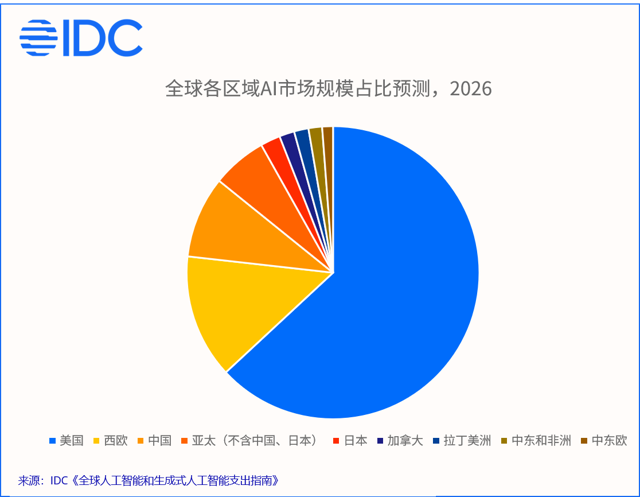
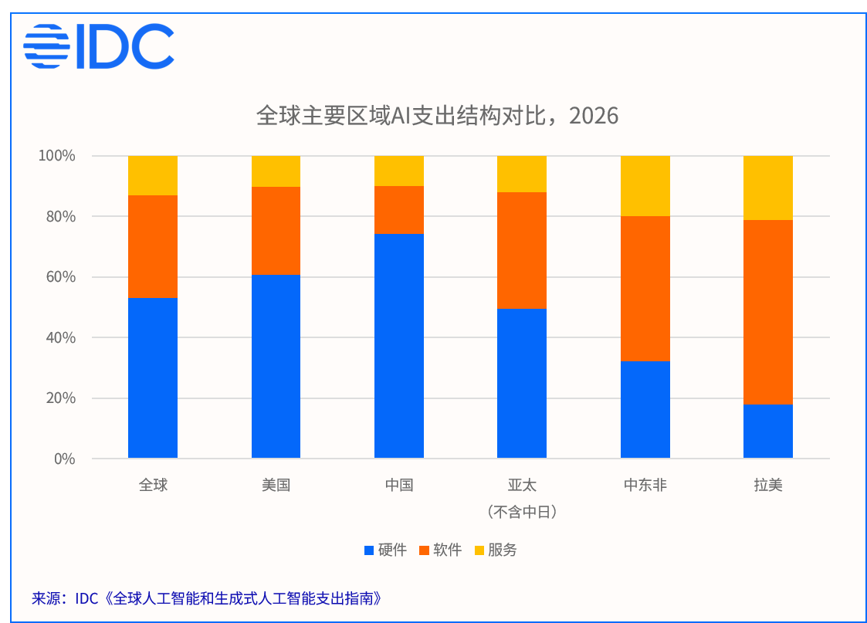
解构 AI 硬件、软件与服务三大技术板块可以发现,海外市场与国内市场在产品形态偏好上差异明显。2026年中国AI支出中硬件占比高达74.3%,呈强基础设施驱动特征。但到了海外,情况截然不同——拉美地区AI硬件仅占18.0%,软件则占比高达60.9%;中东非软件与服务合计占比达67.9%。这意味着,把国内“卖服务器、卖算力卡”的模式直接搬到海外,将遭遇严重的水土不服。
Wendy Zhang is a research analyst in the Data and Analytics group at IDC China. She is responsible for business operations and spending guide in China Enterprise Team. She provides dynamic forecasts of future China and global ICT market development.…
很多人聊保险业的生成式 AI,第一反应都是 “省人力、提效率、降成本”,把它当成存量周期里的运营优化工具。但 IDC 的核心判断是:这是对技术价值的严重低估。生成式 AI 真正重塑的,从来不是单点运营效率,而是保险业整条价值链的价值边界 —— 它正在推动行业从被动赔付的“风险兜底者”,向主动干预风险的“价值创造者”跃迁。
2025 年中国保险业站在深度转型的关键路口,利率持续下行、赔付支出高企、人力成本上涨的三重压力并未消解,行业经营逻辑已从规模扩张转向精细化运营。这一阶段最鲜明的特征是:数字化投入全面 “有保有压”—— 能降本控险、满足监管要求的项目投入保持稳定,无法量化收益的项目被严格管控,行业从“被动收缩” 转向“主动取舍”,投入产出比成为筛选 IT 项目的核心标准。
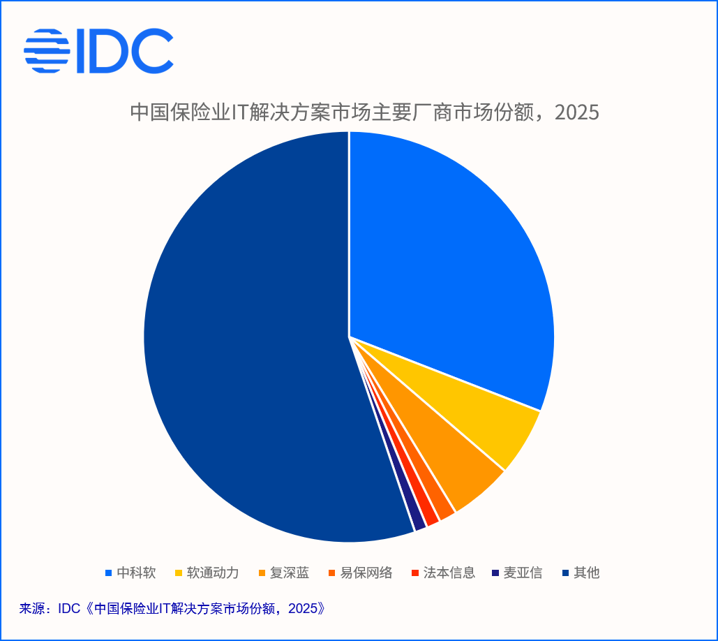
从市场基本面看,国际数据公司(IDC)近日发布的《中国保险业IT解决方案市场份额,2025》报告显示,2025 年中国保险行业 IT 解决方案市场规模达 100.6 亿元,降幅已明显收窄,正式进入企稳分化与存量竞争新阶段。市场呈现“一超 + 长尾”格局:一方面头部集中度持续提升,龙头厂商的客户、产品与服务壁垒不断加厚;另一方面长尾市场体量依然庞大,垂直细分场景与技术创新应用仍存在大量生存空间。
在这样的周期下,生成式 AI 成为少数既能契合监管 “防风险、促合规、降成本、提质量”主线,又能量化产出价值的技术方向。当保费增速放缓、人力规模收缩,通过 AI 提升人均产能、优化运营成本、创新服务模式,已经成为险企穿越周期的核心战略,而非可选项。
2、7.5 倍增速绝非概念泡沫,生成式 AI 已从“试点品”变为“硬刚需”
市场上至今还有声音认为生成式 AI 仍是噱头、投入多产出少,但 IDC 报告显示:2025 年中国保险业 IT 投资规模达 517.3 亿元,其中硬件板块增幅显著,核心驱动力来自自主创新与 AI 基础设施建设。长期来看,2030 年中国保险行业 IT 投资规模将达 805.5 亿元,年复合增长率为 9.3%。
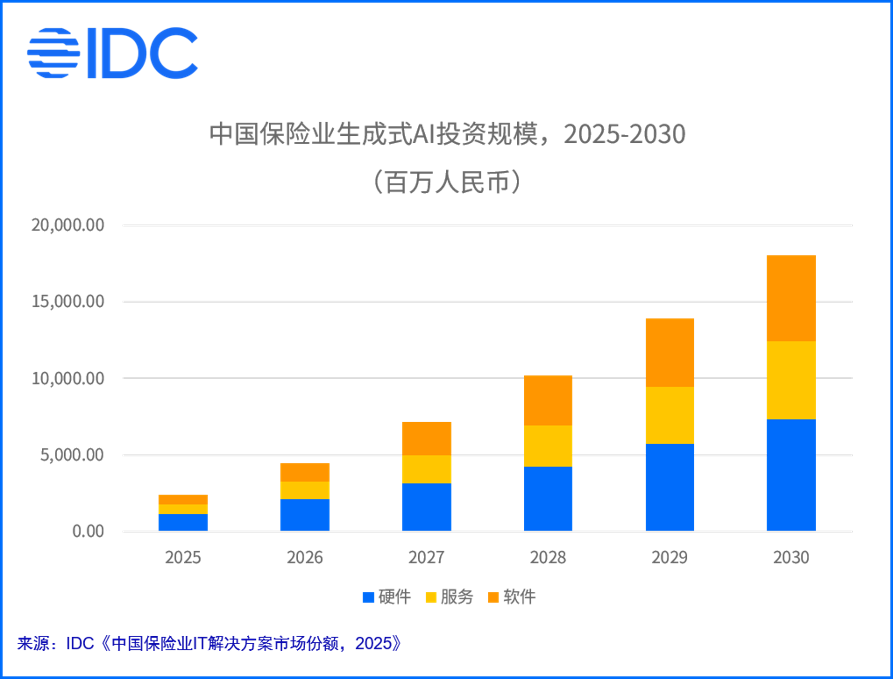
而生成式 AI 领域的增长远超整体大盘:投资规模从 2025 年 24.22 亿元升至 2030 年 180.05 亿元,五年增长近 7.5 倍,年复合增长率超 49%。这意味着生成式 AI 已彻底走出概念验证阶段,正式进入规模化投资周期,是当前保险科技领域最具确定性的增长引擎。
3、AI 穿透全价值链,改写的是每个环节的价值定义
很多人对 AI 在保险业的价值认知还停留在 “客服机器人”“自动核保省工时”,但 IDC 认为,生成式 AI 的改造是深入骨髓的 —— 它正在改写定价、核保、理赔、服务、风控的每一个底层逻辑,从辅助工具进化为核心生产系统,在每个环节都在拓展行业的价值边界。2026 年将是保险行业生成式 AI 从“试点” 走向 “规模化”的关键之年,保险 IT 系统内置 AI 能力将成为行业标配。
产品定价:从静态精算走向个体实时风控
传统定价依赖历史数据与静态模型,本质是群体层面的风险均摊,难以反映个体风险动态变化。生成式 AI 正在把定价变成随个体行为实时波动的变量:车险 UBI 模式通过车联网数据实现驾驶行为定价,健康险通过可穿戴设备将保费与健康管理挂钩。未来的核心竞争力将是基于客户实时行为与外部风险信号的动态定价能力,推动行业从 “群体定价” 向 “个体定价” 演进。
IDC预测,到 2026 年险企与投保人超 60% 的交互将通过数字自助服务实时完成。智能客服已升级为具备多轮对话、意图识别、情感分析能力的对话式 AI,大幅提升服务体验与响应效率。营销端的改变在于重塑作业模式:生成式 AI 基于客户画像生成个性化保障方案,智能问数让业务人员通过自然语言即可查询业务数据。渠道 IT 系统的价值从 “支持运转” 变为 “产能放大器”。
风险减量:推动行业从被动赔付转向主动价值创造
传统保险业的价值终点是出险赔付,本质是“风险兜底者”。但生成式 AI 正在把行业的价值边界往前移。农业领域用气象大数据与卫星遥感指导防灾减损,财险领域用物联网监控安全生产,健康险领域用平台引导健康管理。大模型在其中扮演核心角色 —— 海量数据实时分析、风险模型动态迭代、预警信号精准推送,均依赖生成式 AI 的能力支撑,推动行业从“事后赔付” 向 “事前预防”延伸,真正成为“价值创造者”。
4、转型的真正瓶颈不是技术,而是三个被高估的难题
生成式 AI 的规模化落地并非坦途,数据治理、组织能力、合规风控是公认的三大挑战。但在 IDC 看来,挑战并非都是长期壁垒,其中有短期可突破的关口,有被过度放大的伪命题,更有被忽视的增量机会。
第一,数据治理:“先治理后落地”是最大的转型伪命题。数据治理不是 AI 落地的前置条件,而是与 AI 场景落地相互驱动的长期工程。IDC建议,短期优先补齐数据质量、数据血缘、元数据管理能力,优先保障核心场景 AI 输出的一致性和可信度,用小切口场景快速验证价值;中长期通过战略合作推进数据架构重构。而IFRS17 全面实施与生成式 AI 场景落地,本身就是倒逼数据治理加速的强大动力。
组织转型:组织重构与“ROI闭环”才是真挑战。技术与组织的错位是主要矛盾——多数银行在组织重构、流程再设计建设方面明显滞后于技术演进速度。真正的组织挑战是如何建立组织信任、设计人机分工模式、培养全员人机协作能力。IDC 判断,到 2029 年 40% 的保险从业者需要掌握人机协作技能。此外,存量竞争下,生成式 AI 是少数能清晰量化 ROI 的技术方向,险企需要把 AI 当作“直接绑定业务成果的能力”,而不仅仅是工具的使用。
合规风控:监管不是绊脚石,是差异化壁垒与全新赛道。很多人把强监管当成 AI 落地的最大阻碍。但我们认为,合规正是筛选玩家的竞争壁垒,甚至是全新的增量赛道。IDC建议,短期从数据、模型、流程、人才四个层面推进负责任 AI(RAI)建设,把合规要求嵌入 AI 全流程,筑牢落地底线;中长期全面改革治理、风险与合规框架,适配 AI 规模化应用的管理需求。
Siri Si is a Research Manager for IDC Financial Insights. His core research scope includes the latest development models and trends in the financial industry, and the development and application status of various technologies in the financial technology field, focusing…
IDC Environmental Policy
International Data Group is committed to protecting the environment, the health and safety of our employees, and the community in which we conduct our business. It is our policy to seek continual improvement throughout our business operations to lessen our impact on the local and global environment. We are committed to environmental excellence, pollution prevention and to purchasing products that reduce the use of natural resources.
We fulfill this mission by a commitment to:
Encouraging all partners to share in our mission
Understanding environmental issues and sharing information with our partners
Recognizing that fiscal responsibility is essential to our environmental future
Instilling environmental responsibility as a corporate value
Developing innovative and flexible solutions to bring about change
Using our platforms and position in the IT industry to promote sustainability
Minimize air travel to help reduce our impact on the environment
Minimize use of materials and energy consumption in our offices
Create a working environment that efficiently uses our office space
Develop and maintain a hybrid working model that benefits both our employees and business partners
Encourage employees to measure, minimize and collaborate on reducing energy consumption at home and in the office
Engaging employees and promoting active participation in environmental and sustainability initiatives
Leaving?
You are about to leave this section. Do you wish to continue?


.png?w=640)