核心洞察

AI 产业化正从“模型竞赛”迈入“应用深水区”。2025 年,中国 AI 应用公有云服务市场规模突破 137 亿元人民币,已显著超过大模型训推公有云市场的 79.4 亿元。IDC 认为,这一结构性变化表明:企业客户正从“探索模型能力”转向“为业务价值付费”。未来 12–18 个月,能够将 AI 封装为行业应用、并支持智能体(Agent)工程化的云厂商,将成为新一轮增长的主导者。单纯提供模型 API 或通用算力的服务商,将面临被市场边缘化的风险。

从“模型竞赛”到“应用深水区”

AI 产业化正从“模型竞赛”步入“应用深水区”。谁能将 AI 能力真正嵌入业务流程、带动规模化落地,谁就将在未来的云服务竞争中赢得先机。那些能够将 AI 从“演示 Demo”转化为“业务系统”的厂商,正在加速拉开与跟随者之间的差距。IDC 追踪了公有云上 AI 应用市场,以及支持 AI 应用的大模型训推平台市场,可以看到公有云上 AI 市场格局正在发生巨变。

AI 应用公有云服务:137.3 亿元,应用落地成为核心战场

2025 年,中国 AI 应用公有云服务市场保持高速增长,市场规模突破 137 亿元人民币。在这一赛道上,头部云厂商凭借全栈 AI 能力和丰富应用场景占据领先地位。

百度智能云以 30.7% 的市场份额位居第一,依托包括智能客服、内容创作、知识管理等全面的企业级 AI 应用场景实现广泛落地。阿里云凭借智能语音、客服及视觉 AI 能力,在智能办公、营销创意等场景表现突出。腾讯云依托视觉 AI 能力、智能客服等在消费互联网、媒体、金融等场景持续发力。华为云则凭借盘古大模型在政务、金融、制造等行业的深度耕耘,稳居第四。
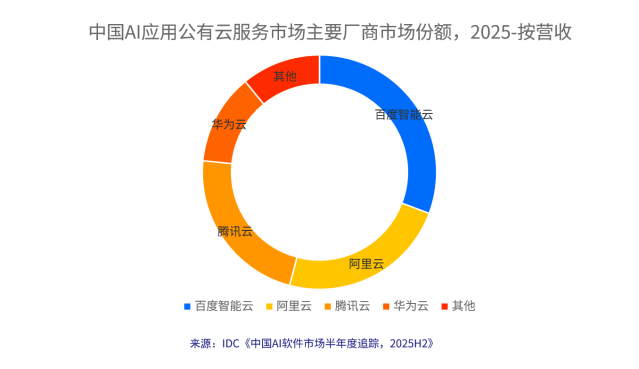
AI 应用市场的本质竞争,已从模型参数的“军备竞赛”转向场景价值的“落地之争”。
用户所需要的,并非孤立的模型 API 调用,而是一个能够真正解决业务问题、提升效率的完整应用。无论是智能客服、内容生成、数字人营销,还是企业知识库问答、代码辅助开发,云厂商需要将大模型能力封装为开箱即用的产品,方能打动最广泛的企业级客户。考虑到这一点,领先厂商均应将 AI 应用服务的投入重心,从底层模型能力向行业解决方案、数据接入、工作流编排等“最后一公里”能力快速倾斜。

应用背后的“算力暗流”:大模型训推市场持续扩张

AI 应用市场的繁荣并非凭空而来。每一次智能客服的响应、每一次营销文案的生成,背后都是大模型推理能力的消耗;而企业为打造差异化应用所进行的模型微调与训练,则构成了另一层刚需——大模型训推公有云服务市场。该市场虽然规模小于应用层,但其增长稳定性与客户粘性更高。

2025 年,大模型训推公有云服务市场规模达到 79.4 亿元人民币,呈现出与前文 AI 应用市场不同的竞争格局。

阿里云以 42.2% 的市场份额遥遥领先,凭借在 AI 算力领域的长期积累和完善的 MLOps 工具链,成为大模型训练和推理的首选平台。华为云(13.1%)依托昇腾 AI 芯片和全栈自主可控能力,在政企市场获得广泛认可。亚马逊云科技(7.1%)则凭借全球化的 GPU 资源和先进的模型训练框架,在出海企业和外资企业中保持优势。
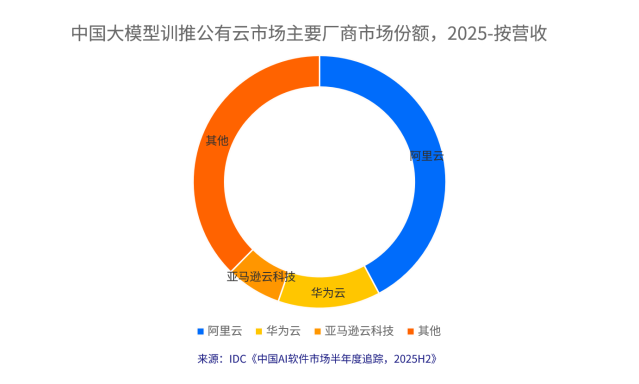
大模型训推市场的快速增长,背后有三大驱动力

第一,生成式 AI 应用爆发驱动训推需求激增。
从文本生成到图像创作,从代码辅助到多模态理解,生成式 AI 应用的繁荣带来了对模型训练和推理的海量需求。企业不仅需要调用预训练模型进行推理,更需要基于自有数据对模型进行微调,以打造差异化的 AI 能力。

第二,智能体(Agent)应用推动复杂推理需求。
随着智能体从概念走向落地,多步骤任务规划、工具调用、长上下文推理等复杂能力成为标配。这对模型的推理效率、并发能力和响应延迟提出了更高要求,也推动企业寻求更专业的训推服务。

第三,算力调度、管理和优化成为刚需。
大模型训练和推理对 GPU 算力的需求呈指数级增长,但算力资源稀缺且昂贵。如何高效调度异构算力、优化模型推理性能、降低单位 Token 成本,成为企业面临的核心挑战。这催生了 AI 算力管理平台、模型推理优化、弹性扩缩容等一系列专业服务需求。

市场隐含的分化信号

值得注意的是,训推市场的增长并非均匀分布。头部三家厂商(阿里云、华为云、亚马逊云科技)合计占据超过 62% 的市场份额,而中小型 AI 算力服务商正在被加速挤出。IDC 判断,算力调度效率与模型优化能力正在取代“裸算力价格”成为客户选择的关键因素。这意味着,未来训推市场的集中度还将进一步提高,缺乏工程优化能力的算力提供商将难以维持竞争力。

IDC 展望:四个不可逆的市场趋势

趋势一:AI 产业化进入深水区,应用价值成为核心衡量标准

Token 经济的兴起降低了企业试用 AI 的门槛,但真正的商业价值在于应用落地。未来,能够提供端到端 AI 应用解决方案、或支持企业快速构建行业专属应用的厂商,将在竞争中占据优势。IDC 认为,市场正在从“技术可行性驱动”向“业务 ROI 驱动”加速迁移。

趋势二:训推一体化平台成为主流采购标准

随着模型迭代速度加快和应用场景复杂化,企业需要无缝衔接模型训练、微调、部署、推理的全流程平台。训推一体化不仅能够提升开发效率,更能通过持续优化降低 AI 应用的总体拥有成本(TCO)。IDC 观察到,2025 年已有超过 35% 的头部企业客户在选型时将“是否具备训推一体化能力”作为核心评估指标。

趋势三:多云与混合云策略成为常态

考虑到数据安全、成本优化和供应商风险,越来越多的企业采用多云策略部署 AI 应用。这要求 AI 云服务厂商提供开放的 API 标准、灵活的部署选项和跨云的一致性体验。单一云绑定策略正在被企业客户重新审视。

趋势四:行业垂直化与场景精细化并行

一方面,金融、医疗、制造、教育等行业对垂直领域 AI 应用的需求日益增长;另一方面,营销创意、智能办公、客户服务、代码开发等通用场景也在持续深化。厂商需要在“行业深度”和“场景广度”之间找到平衡。IDC 预计,未来两年内,行业定制化 AI 解决方案的增速将超过通用型 AI 应用。

IDC 建议:厂商与用户应如何行动

对云厂商的建议

  • 从“提供模型”转向“提供业务模板 + 低代码 Agent 构建能力”,降低企业落地门槛。
  • 投资训推一体化的工程能力,而非单纯扩大算力池。算力效率管理将成为差异化竞争的关键。
  • 主动拥抱多云生态,避免锁定策略带来的客户流失风险。

对企业用户的建议

  • 优先选择具备行业解决方案 + 训推闭环能力的云厂商,避免被单一模型或单一算力源绑定。
  • 关注跨模型迁移成本,在选择模型 API 或训推平台时,将标准化与开放性纳入长期评估体系。
  • 在智能体(Agent)类应用上,建议从非关键业务场景(如内部知识问答、辅助写作)起步,逐步向自动化流程演进。

IDC 中国研究总监卢言霞表示,中国 AI 公有云服务市场正处于从‘技术驱动’向‘价值驱动’转型的关键期。Token 经济打开了市场天花板,但只有真正解决业务问题的 AI 应用,才能为企业带来持续价值。未来,兼具模型能力、应用生态和工程化落地能力的厂商,将引领 AI 产业化的下一波浪潮。

本文相关报告:

IDC《中国AI软件市场半年度追踪,2025H2》

进一步联系:

如需获取本文引用的完整数据报告、细分市场数据表格、定制化分析服务,或希望与IDC分析师进行一对一交流,欢迎与IDC联系。

请点击此处与我们联系。
Yanxia Lu

Yanxia Lu - Research Director

  Yanxia Lu is a research director, focusing on big data and artificial intelligence (AI). Her responsibilities include big data information management platform, and big data analytics and applications. She is also involved in research on AI technology and enterprise…

Telecom operators are entering a new phase of digital infrastructure and AI monetization. That was the clear signal at FutureNet World in April 2026. The conversation is no longer about whether AI belongs in telecom. That question has been answered. The real question is which operators can turn experimentation into measurable commercial value reflected in P&L statements.

What is emerging is not simply a new set of AI use cases. It is a broader redefinition of what telecom providers can offer. For enterprise customers, the product is shifting from raw connectivity to orchestrated outcomes. The winners will not necessarily be the operators with the biggest AI infrastructure footprints or the most GPU capacity. They will be the ones that can combine connectivity, cloud, edge, automation, and governance into trusted, SLA-backed services.

That is the framing from IDC’s panel on April 23, 2026, “Unlocking New Revenue Opportunities by Monetizing AI and Digital Infrastructure” at FutureNet World London. The panelists were senior telecom executives: Emilio Varas Jiménez, Customer Fulfilment Head of AI and Operations Improvement, Vodafone; Franck Morales, Senior Vice President, Marketing and Business Development, Orange Wholesale International; Natali Delić, Chief Strategy and Digital Officer, Telekom Srbija; and Martin Rueckert, Chief AI Officer, Tallence AG.

AI monetization starts at home

External AI monetization has to be built on internal proof points. Before operators can credibly take AI capabilities to enterprise customers, they need to show they can deploy them inside their own business.

This matters because enterprise buyers are increasingly skeptical of AI promises not backed by operational experience. Telcos that can demonstrate AI-driven improvements in field service operations, assurance, employee productivity, and customer experience will be in a stronger position to package that expertise into enterprise services.

For telecom executives, this means the first monetization opportunity is often not a customer-facing AI product. It is the ability to refine, prove, and operationalize AI internally and then externalize that know-how as a service.

From connectivity to business outcomes

The enterprise buying center is changing. Businesses are looking beyond bandwidth or basic cloud access. They want guaranteed performance, sovereign routing, managed AI-enabled operations, and real-time decisioning environments that align with business risk and revenue goals.

This is especially visible in financial services, manufacturing, and retail, where latency, compliance, and uptime have direct commercial consequences. In these environments, value comes from combining multiple layers: network slicing, APIs, edge compute, AI orchestration, and managed service delivery.

Telecom providers are being pulled higher up the stack. The role of the operator is evolving from connectivity provider to orchestrator of digital infrastructure outcomes. 

Orchestration is becoming the real differentiator

Enterprises do not want to decide what runs in the public cloud, what belongs at the edge, and what must stay on-premises. They want those decisions handled for them, governed, compliant, cost-predictable, and reliable.

That changes the basis of competition. Operators that can orchestrate workloads across hyperscaler, edge, and on-premise environments build a durable market position. Those that cannot risk turning AI infrastructure into a commodity layer with limited pricing power.

The long-term value in AI and digital infrastructure will accrue to operators who can integrate, operate, and govern AI-enabled services at scale.

Edge AI will favour smaller, purpose-built models

For most real-time telecom and enterprise use cases, the requirement is not maximum model size. It is deterministic performance, low latency, and auditability.

That favors smaller, domain-specific models and, in some cases, non-transformer architectures, particularly in industrial automation, remote diagnostics, and real-time network decisioning.

This has major implications for investment strategy. Operators that assume the future of edge AI depends on pushing large language models closer to the endpoint may be overestimating both enterprise demand and the technical fit. In many scenarios, the commercial opportunity will come from deploying the right model, not the largest one.

Agentic AI remains one of the most talked-about areas in the market, but many enterprise pilots are still failing to reach production. [Source: attribute to panelist name or add IDC data reference.] The problem is not only technical capability. It is trust.

For agentic AI to be backed with an SLA, enterprises need confidence that decisions are bounded, explainable, and auditable. In regulated and mission-critical environments, free-form reasoning is not enough. Determinism matters. Governance matters. Standards alignment matters.

Telecom providers looking to monetize agentic AI should focus on domain-constrained deployment models. The path to commercial scale is likely to come from tightly scoped, standards-aligned agents that can operate within controlled decision environments.

Sovereign AI infrastructure brings opportunity and risk

Sovereign AI demand is real, particularly in regulated sectors, but that does not mean every operator should rush to build large-scale local AI factories.

There is significant capex risk in overbuilding. If utilization remains low or infrastructure cycles shorten faster than expected, operators could face stranded assets within three to five years. [Per panel discussion, April 23, 2026. Add IDC data reference if available.]

The more sustainable approach is hybrid and multi-cloud by design: combining hyperscaler or neo cloud computing, edge resources, and targeted sovereign deployments where regulation or national security requirements justify them. The key is to align infrastructure investment with verified demand rather than hype-driven positioning.

The bottom line

Telecom AI monetization between 2026 and 2028 will be defined less by model ownership and more by execution discipline. Operators that can prove value internally, orchestrate hybrid environments effectively, deploy trusted and auditable AI, and match infrastructure investment to real demand will be best positioned to capture new revenue and higher margins.

The market is past experimentation. The next phase belongs to operators that can industrialize AI as a commercial capability.

Masarra Mohamed

Masarra Mohamed - Senior Research Analyst, Communications Platform as a Service

Masarra Mohamed is an expert in digital infrastructure, cloud, AI, and communications platform-as-a-service (CPaaS). She leads IDC’s global CPaaS research and advisory practice, shaping the firm’s perspective on API-driven communications, customer engagement platforms, and their convergence with contact centre and…

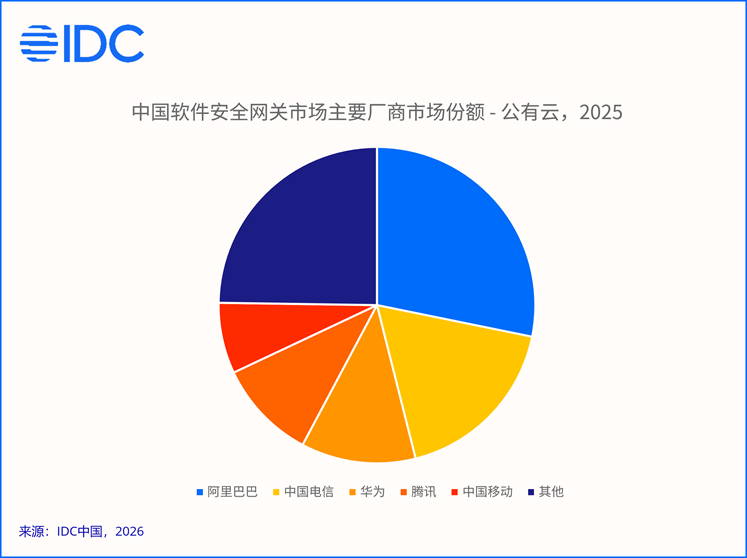
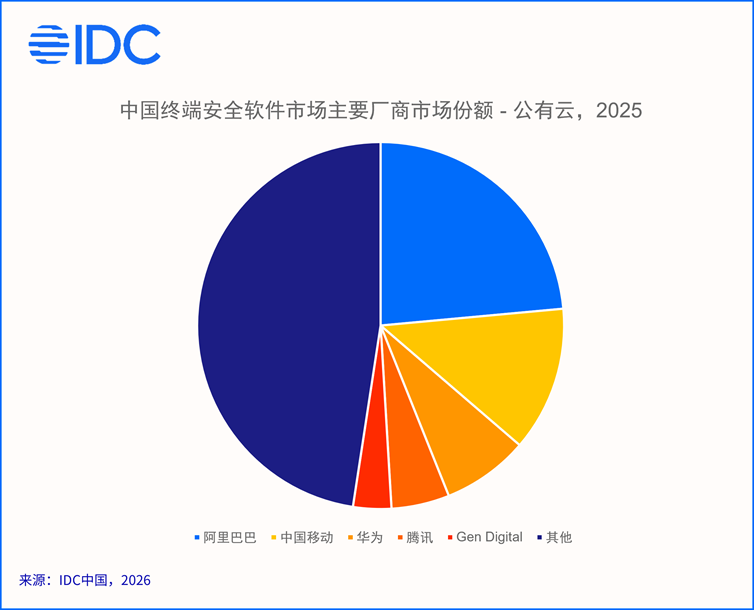
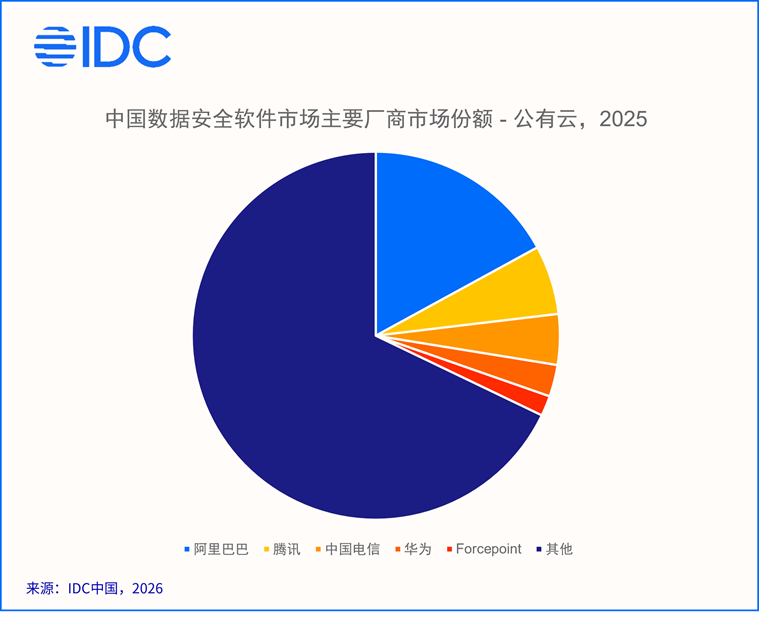
视角决定格局。​若仍将公有云安全视作单一的技术模块,便无法窥见其真正的战略全貌。

IDC 2025全球数据指明:公有云安全已跨越单纯的合规门槛,跃升为企业的数字生存底座。​ 它不再是隐匿于防火墙之后的附属插件,而是支撑AI规模化落地、护航业务出海、乃至抵御周期波动的核心底层资产。

三个信号值得认真对待:

  • 信号一:全球公有云安全支出超1100亿美元,增速超20%,是IT支出中最坚硬的赛道
  • 信号二:中国市场云安全收入增速普遍高于云基础设施本身增速,客户正在从为资源付费向为安全付费跨越
  • 信号三:随着AI业务场景的深化,云原生安全已成为大模型落地的隐性门槛,若缺乏深度集成的原生安全体系,企业很难安心地将高价值数据与应用托管其上

一、全球浪潮:安全正在重新定义云的价值

站在2026年的时间节点回看,公有云早已不再仅仅是企业的外挂资源,而是数字化生存的电力系统。

2025年,全球企业正在混合云和多云架构中疯狂奔跑,全球公有云安全市场连续多年保持每年20%以上增速,2025年支出飙升至1100亿美元。

在全球范围内,AWS、Microsoft Azure和Google Cloud等头部玩家正经历着前所未有的技术迭代。他们不再仅仅提供安全插件,而是通过硬件级隔离、身份边界重塑以及AI驱动的情报分析,将安全深度嵌入云原生底座。

与此同时,以Palo Alto Networks、CrowdStrike、Wiz和Zscaler为代表的安全巨头也在快速进化。他们正推动从单一工具向CNAPP云原生应用保护平台和代码到云(Code-to-Cloud)的统一平台转型,试图在多云环境中建立一道跨厂商、自动化的全栈防御屏障。

在这场技术长跑中,谁能率先解决复杂环境下的可见性真空,谁就将定义下一个十年的云安全标准。

二、中国实践:快速跟进与创新,但仍有差距

2025年,中国云计算市场规模持续扩大,云安全产品的营收增速普遍高于云基础设施本身的增速,显示出客户从买资源向买安全的意识跨越。

作为国内市场的领头羊,阿里云已将其安全产品线全面推向智能体时代,通过升级Agentic SOC,利用大模型实现了超过80%的安全事件自动响应。华为云演进为AI原生安全架构,通过其安全大模型实现对AI算力集群的实时监测。腾讯云充分发挥攻防领域的深厚沉淀,在内容风控、反欺诈、DDoS高防等领域形成了极高的市场占有率。

传统网安巨头正通过云地协同战略,在云安全管理平台C-SOC市场占据核心位置。深信服、奇安信等厂商通过与公有云厂商的深度技术绑定,成功实现了从卖防火墙硬件到卖云安全服务的转型。

但不可忽视的是,相比于全球安全厂商,中国安全厂商目前在公有云安全市场仍需发力。虽然在私有云和特定业务场景中展现了卓越的实战能力,但在全球化的SaaS安全标准、跨云的Agentless治理精度、以及安全左移的代码级闭环上,国内厂商仍有巨大的进阶空间。

三、商业启示:为什么公有云安全是好生意

海外巨头的成功路径为中国厂商提供了极具诱惑力的商业模板:

极致的用户粘性

安全业务之所以具备IT板块中最高的粘性,是因为它正逐渐从外部挂载的锁具演变为深度嵌入企业架构的神经系统。一旦部署,更换安全供应商不再是简单的卸载与重装,而是一场涉及底层策略重写、合规记录迁移以及全员操作习惯重塑的伤筋动骨式手术。

抵御周期的现金流

与传统网络安全硬件的订单式生存不同,Wiz和CrowdStrike的成功路径证明了SaaS化订阅模式在资本市场中的统治力。这种模式具有极强的抗周期属性,即便在经济下行期,企业可能会削减新员工入职或新业务线扩张,但绝不敢轻易关掉云端的安全防护。

掌握AI与全球化的通行证

在当前的全球技术格局下,拥有顶级的云安全能力已不再仅仅是为了防御黑客,它更是企业进军AI云和全球化市场的入场券。只有具备原生云安全能力的厂商,才能解决大模型在云端训练、推理过程中的数据投毒和提示词注入风险。中国厂商若能构建起符合国际主流标准的云安全体系,本质上就是为中国企业的全球化交付提供了一套合规标准化的底座。

四、IDC:不止于数据,更是决策指南

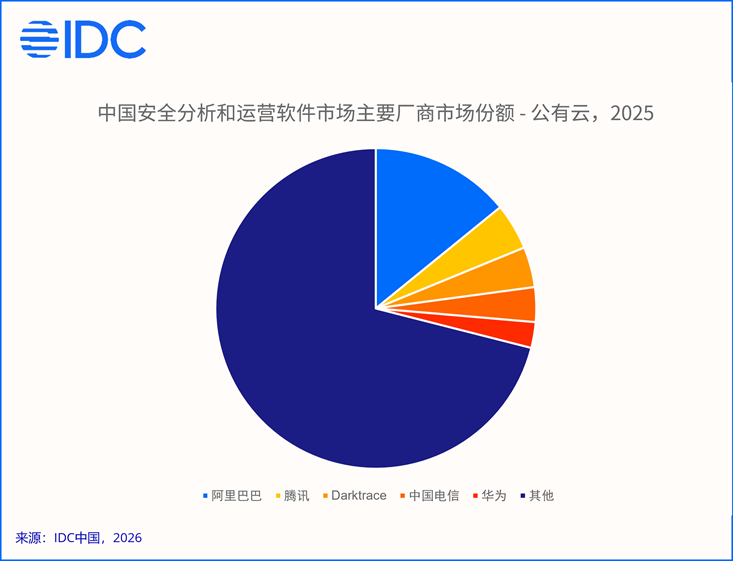
IDC已发布 《IDC中国半年度安全软件数据跟踪报告——公有云,2025H2》,其中包含公有云部署模式下的数据安全软件、终端安全软件、身份和访问控制软件、软件安全网关、安全分析和运营软件、漏洞管理软件等子市场的厂商数据跟踪。

上述商业逻辑的兑现,最终需要落地到真实的市场数据中加以验证。化繁为简,洞见未来。 本次报告透过公有云安全市场不同赛道中的厂商营收数据,为您剥离噪音、还原真相,助您在复杂的市场环境中精准锚定业务增长点与投资机遇。无论您是寻求赛道突围的企业,还是布局未来的投资者,皆能在此获取专属的行动指南。

具体而言,可以为不同角色的参与者提供以下支持——

云厂商:帮助您精准识别自身安全产品的市场位次,明确自身赛道定位与竞争位置。

安全厂商:帮助您应找准生态位,重点锚定高增长赛道,避免无效内卷;同时积极融入头部云厂商生态,通过技术集成与联运合作,借助云市场流量触达客户。

企业客户:为您提供了客观的供应商评价维度,帮助 CIO 识别哪些厂商在特定公有云安全领域具备长期投入和领先地位。

投资机构:报告是评估公有云安全景气度的核心参考,能够清晰展现公有云安全市场的天花板及各子市场的集中度,利用数据降低因信息不对称导致的投资偏差。

结语

公有云安全已经完成了从附加品到必需品的身份蜕变。在客户从买资源向买安全的意识跨越中,IDC 将持续通过系统性的研究,助力每一位参与者:看清坐标、捕捉先机、定义未来。

欢迎广大云厂商和安全厂商关注IDC公有云安全系列研究,如需进一步沟通或获取深度数据与战略洞察,请与IDC联系。

请点击此处与我们联系。

Joe Zhao

Joe Zhao - Senior Research Manager

Joe Zhao is a senior research manager of Enterprise Research for IDC China. He focuses on research and analysis of the China security market. Joe has more than 12 years of domestic and international work experience in ICT. Prior to…

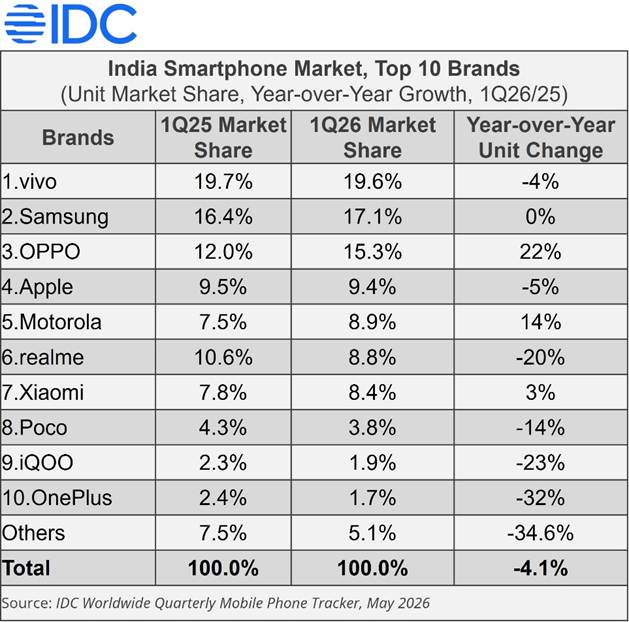
What Happened in India’s Smartphone Market in Q1 2026?

India’s smartphone market shipments declined 4.1% year over year to 31.0 million units in Q1 2026, according to IDC’s Worldwide Quarterly Mobile Phone Tracker. Rising memory prices drove brands to front-load channel inventory ahead of anticipated cost escalations, pushing shipment volumes above initial expectations. However, underlying consumer demand remained subdued — weighed down by a typical post-festive slowdown, elevated device prices, and cautious spending sentiment. Despite falling volume, the market grew 5.8% in value terms, underscoring India’s ongoing shift from volume-led to value-driven growth.

Why It Matters

The Q1 2026 data signals a structural turning point for one of the world’s largest smartphone markets. Brands, retailers, and investors should take note:

  • Device makers relying on entry-level volume face shrinking margins and reduced market viability as memory costs continue to rise.
  • Consumers in sub-US$100 brackets are being pushed upmarket by necessity rather than aspiration — a trend that reshapes demand forecasting for 2026 and beyond.
  • The gap between channel inventory and actual consumer demand points to a near-term correction risk, particularly in affordable segments.

Market Dynamics: What Drove the Outcome?

The market’s performance was shaped by three converging forces:

  • Memory cost inflation → entry-level collapse: A global memory shortage drove up component prices across newly launched and existing models alike. Brands could no longer sustain profitability in the sub-US$100 tier, leading to reduced model availability and weaker channel participation. Shipments in this entry-level segment fell 59% YoY, with segment share collapsing from 18% to just 8%.
  • Forced premiumization → mass-budget gains: Consumers who could no longer find affordable sub-US$100 options migrated upward. The mass-budget segment (US$100–200) grew 10% YoY, expanding its share from 39% to 45% — driven more by eroding entry-level value than deliberate upgrade intent.
  • Promotional pullback → constrained demand recovery: Rising input costs limited brands’ ability to deploy the aggressive discounting and channel-led promotions that historically fuel mass-market growth. With fewer price interventions, underlying consumer demand stayed soft, particularly online, where shipments fell 14% YoY and share declined from 42% to 38%.

Price Band Performance

  • Entry-level (sub-US$100): −59% YoY; share fell from 18% to 8%
  • Mass-budget (US$100–200): +10% YoY; share rose from 39% to 45%
  • Entry-premium (US$200–400): −3% YoY; share edged up from 26% to 27%
  • Mid-premium (US$400–600): +29% YoY; share rose from 6% to 8%
  • Premium (US$600–800): +32% YoY; share rose from 4% to 6%
  • Super-premium (US$800+): −1% YoY; 7% share maintained

India Smartphone Market at a Glance – Q1 2026

  • Total shipments: 31.0 million units (−4.1% YoY)
  • Average selling price (ASP): US$302 (+10.4% YoY) — a record high
  • Market value growth: +5.8% YoY despite volume decline
  • Offline channel: 62% share (up from 58%); +3% YoY
  • Online channel: 38% share (down from 42%); −14% YoY
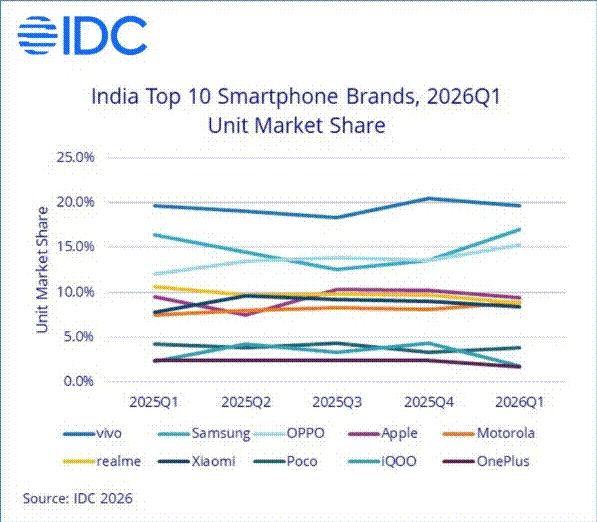
  • Top five brands: vivo (#1), Samsung (#2), OPPO (#3), Apple (#4), Motorola (#5, new entrant)

Analyst Insight

“Average selling prices increased 10.4% YoY to a record US$302 in Q1 2026, driven by persistent memory cost inflation across both newly launched devices and existing models. Unlike previous quarters, aggressive discounting and channel-led promotional schemes remained limited, as rising input costs constrained brands’ ability to stimulate demand through pricing interventions. The current environment signals a broader structural shift in the market, where brands may increasingly need to rely on product differentiation, financing offers, and premiumization strategies rather than price-led promotions to drive demand through the remainder of 2026.” said Aditya Rampal, senior research analyst, Devices Research, IDC Asia Pacific.

Note: This chart/table shows data by IDC’s Brand field. Company ranking may differ where Companies own more than one Brand.

*Figures in tables/charts rounded to the first decimal point.

IDC Outlook: What’s Next?

The first half of 2026 is expected to remain relatively resilient as brands draw on existing component inventories to partially offset rising memory costs. However, brands are increasingly revising annual shipment targets downward, with channel inventory managed cautiously — especially in entry-level segments.

Recovery in the second half will depend on how effectively brands balance product innovation, pricing strategy, and cost management against sustained component inflation and uneven consumer demand.

  • What could accelerate growth? Stabilization of memory prices, new financing models, and festive-season promotional activity.
  • What could slow it down? A prolonged memory shortage, further rupee depreciation, and continued weakness in mass-market consumer confidence.
  • What should readers watch next quarter? Whether brands can close the gap between channel inventory and end user sales, and how second-half pricing strategies unfold.

“In a value-conscious market like India, consumers have traditionally delayed purchases in anticipation of festive discounts and promotional offers. However, that pattern is unlikely to hold in the current cycle. With the global memory shortage expected to continue into 2027 and rupee depreciation adding further cost pressure, smartphone prices are set to rise further across segments. Consumers considering an upgrade may find better value in purchasing sooner, as pricing pressures are expected to intensify over the coming quarters,” said Upasana Joshi, senior research manager, Devices Research, IDC Asia/Pacific.

Frequently Asked Questions

Why did the market decline despite strong premium demand?

Growth in higher price bands could not offset the sharp collapse of the entry-level segment. While brands pushed inventory ahead of anticipated price hikes, weak consumer demand and limited promotional activity constrained actual market absorption, leaving supply-side momentum ahead of end-user demand.

Which brands benefited most in Q1 2026?

Motorola and OPPO were the only top-five brands to register YoY growth, with Motorola entering the top five for the first time. Apple held fourth place with a 9% shipment share while leading the market by value with a dominant 28% share. Notably, despite a 5% YoY decline in Apple shipments, the iPhone 17 alone contributed 4% of total smartphone volumes — underscoring Apple’s sustained premium strength amid broader demand softness.

What risks could impact the market in 2026?

A prolonged memory shortage, rupee depreciation, and weakening mass-market viability are the key near-term headwinds. Recovery will increasingly depend on brands’ ability to drive demand through financing and affordability-led models, rather than the aggressive price-led promotions that have historically fueled market growth.

-Ends-

About IDC

International Data Corporation (IDC) is the premier global provider of trusted technology intelligence, advisory services, and events. With more than 1,000 analysts worldwide, IDC offers global, regional, and local expertise on technology, IT benchmarking and sourcing, and industry opportunities and trends in over 100 countries. IDC’s analysis and insights help IT professionals, business executives, and the investment community to make fact-based technology decisions and to achieve their key business objectives. To learn more about IDC, please visit  www.idc.com. Follow IDC on Twitter at @IDC and LinkedIn. Subscribe to the IDC Blog for industry news and insights.

All product and company names may be trademarks or registered trademarks of their respective holders.

Upasana Joshi

Upasana Joshi - Research Manager

Upasana Joshi is an Research Manager for Channel Research at IDC India. Based in Delhi, Upasana is primarily responsible for City Level Smartphone Tracker in India. The research involves analyzing the trends within Smart Phone domain, market sizing, brand performance…
Aditya Rampal

Aditya Rampal - Senior Research Analyst

Aditya Rampal is a senior research analyst for the India mobile market at IDC. He is responsible for end-to end mobile devices market research involving both primary and secondary research for smartphone and feature phones. Aditya analyzes trends within the…

Digital sovereignty is becoming a strategic priority across EMEA, reshaping how governments and enterprises choose infrastructure and network partners. This blog explores what the shift means for telcos, sovereign cloud, and AI infrastructure. 

Around the early 2010s, data residency was already part of the policy debate, but the infrastructure landscape was still more fragmented, and the issue had not yet become as central to cloud, AI, and national digital strategy as it is today. Telcos, regional ISPs, and a long tail of independent providers ran most of the hosting. The policy debates of the time already touched on carrier-neutral internet exchange points, peering, net neutrality, and data residency – how traffic moved between networks, where data was hosted, and who had jurisdiction over it. 

That picture has since changed twice over. 

First, market gravity shifted. A handful of hyperscalers and major social platforms absorbed most of the workloads, the storage, and the user attention. Hosting that used to sit inside national operators’ data centers consolidated into a few global clouds. 

Then policy caught up. Across EMEA, governments and regulators have moved data privacy, residency, and infrastructure control out of the compliance file and into national and regional strategy, with AI sovereignty layered on top, and geopolitical sovereignty sitting above all of it. 

For telcos, this is no longer a niche or optional conversation. It is actively shaping how enterprises and governments choose their network and infrastructure partners. 

How digital sovereignty is influencing buying decisions in EMEA 

The signal is clear. IDC’s EMEA Enterprise Communications and Collaboration Survey 2025 shows that, in response to geopolitical uncertainty, 28% of organizations are now more likely to use network service providers based in their own region, 27% are increasing their use of sovereign network services, and 26% are diversifying their network providers. Network infrastructure sits at the center of this shift, 70% of organizations cite sovereign controls over network infrastructure software as the most important component of technical sovereignty.  

The shift is showing up in budgets too. IDC’s 2025 Future Enterprise Resiliency & Spending Survey shows that nearly 30% of telcos plan to migrate applications from public cloud to country sovereign cloud infrastructure in 2026, with cybersecurity, regulatory compliance, and operational resilience among the top drivers of increased telco spending. 

Where AI and digital sovereignty converge 

AI has become a central thread in sovereignty conversations. The connection between cloud and AI needs has tightened, and sovereignty is now a recurring factor in both. IDC’s Worldwide AI and Generative AI Spending Guide Forecast (August 2025) projects AI and GenAI spending in EMEA telecommunications growing at a CAGR of 32% between 2024 and 2029, with telco AI spending set to treble by 2028. On the demand side, 53% of EMEA governments plan to increase their use of sovereign cloud for AI solutions, putting telcos squarely in the frame as infrastructure partners in sovereign AI ecosystems. 

The infrastructure shift is concrete. Among telcos, expanding data center capacity, AI inferencing (58%) and LLM training (54%) are the workloads driving most of the new build. Where these facilities sit, who certifies them, and who governs them is becoming a first-order strategic question. 

The role of telcos in sovereign cloud and AI ecosystems 

Governments across EMEA are pushing sovereign cloud and AI initiatives to take greater control of digital infrastructure and compute, and that is sharpening what buyers expect from their providers. 

Enterprise and public sector buyers are increasingly evaluating providers based on capabilities such as: 

  • In-country or in-region data centers  
  • Country-level certifications  
  • Freedom from lock-in 
  • Solutions to support operational resilience 
  • Sovereign controls of infrastructure  

Telcos are well placed to answer this list. National operators already own most of the underlying assets: in-country and in-region data centers, a regulatory and certification footprint, established government and enterprise relationships, and the connectivity layer itself. This is where telcos hold something cloud providers don’t; sovereign control over data in transit and the network layer itself. The bigger opportunity isn’t supplying pieces of someone else’s sovereign build. It’s pairing with sovereign cloud providers to deliver an end-to-end sovereign stack, data at rest and in motion, that neither side can credibly offer alone. 

What sovereignty looks like across Europe, the Middle East, and Africa 

Sovereignty is not a single play. The operator playbook looks different by sub-region. 

In Europe, regulation matters; and most of it now sits at EU level rather than national, but the top driver has shifted to protecting against extra-territorial data requests. Operators with strong domestic positions and certified infrastructure are best placed for both. 

In the Middle East, sovereignty is being driven top-down as national strategy. Governments are pairing sovereign cloud and AI ambition with serious capital, often through national champions, with major operators positioned as primary infrastructure partners. Established data localization regimes in some markets give operators a head start on dedicated capacity. 

In Africa, the story is data localization meeting infrastructure scale. National data protection frameworks are increasingly pushing data inside national borders, and pan-regional operators are expanding capacity that doubles as a sovereign-cloud foundation. 

Across all three, the playbook converges on regional infrastructure, certifications, simpler portfolios, and active ecosystem participation. Operators are also working with fewer, more strategic partners, ones that can take end-to-end accountability. 

Why sovereignty is becoming a default expectation 

Sovereignty has moved from a compliance topic to procurement criterion. It now sits alongside performance, cost, and scalability. AI and platform-based models only sharpen the demand for control, transparency, and resilience. 

For telcos, this isn’t a niche compliance discussion. It’s a strategic play, redefining what credible infrastructure looks like across EMEA, and where operators sit in the sovereign cloud and AI stack. 

Download the eBook to explore the data behind these developments and better understand how the telco landscape is evolving. 

Sovereignty itself is worth a closer look. IDC’s strategic guide, Digital sovereignty beyond the label, sets out what it takes to move from a sovereignty claim to a credible, defensible position. The case study shows how one global technology provider put that to the test ahead of a major infrastructure launch. And for a closer look at how customer expectations are shifting, the webinar Digital sovereignty beyond the label: how customer expectations are changing is now available on demand.

If you’re currently evaluating how sovereignty requirements will impact your network, infrastructure, or partner strategy, our experts are happy to exchange perspectives. Whether you’re at an early stage or already executing, we welcome the conversation. Get in touch with our team to continue the discussion. 

Tolga Yalcin

Tolga Yalcin - Research Director, Telecoms and ICT Regulations, IDC Middle East, Turkey, and Africa (META)

Tolga oversees the telecommunications and ICT policy and regulations side of IDC’s syndicated research, custom consulting, and advisory services in the Middle East, Turkey, and Africa region. Tolga plays an integral role in all IDC telecommunications-related initiatives in the Middle…

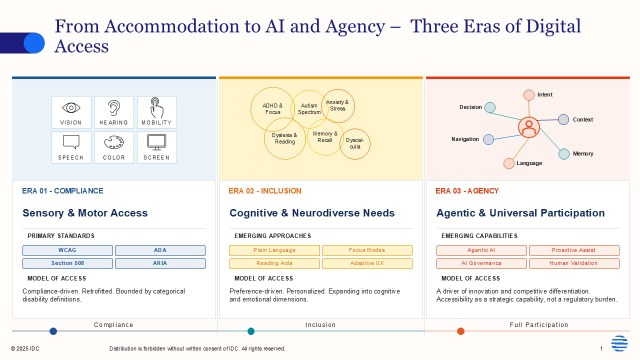
For years, digital accessibility, the practice of ensuring that digital products and services can be perceived, understood, and used by everyone regardless of ability, was treated as a compliance checkbox. That framing is no longer adequate. AI is reshaping accessibility into a strategic capability, one that is adaptive, continuous, and embedded in how people work, interact, and innovate.

As AI-enabled work becomes the norm, accessibility is no longer about supporting a small subset of users. It is about ensuring that everyone, across physical, sensory, cognitive, and neurodiverse dimensions, can fully participate in increasingly digital and AI-mediated environments. In this context, accessibility becomes foundational to productivity, inclusion, and ultimately business performance. Accessibility is also part of company culture: involving disabled and neurodiverse individuals in co-design, not just testing, creates more robust and adaptable systems. Sustaining long-term impact also requires investment in skills and culture, training employees, fostering inclusive design practices, and making accessibility a shared responsibility across teams.

The opportunity: AI as a scaler of inclusion and innovation

AI introduces a powerful opportunity to rethink accessibility at scale.

First, it enables real-time content adaptation. Capabilities such as automatic captioning, transcription, translation, and alternative text generation allow organizations to dynamically tailor content to different user needs. AI can also adjust reading levels, restructure complex information, and personalize interaction styles, supporting a broader range of cognitive and sensory preferences.

Second, AI supports continuous accessibility operations. Traditionally, accessibility has relied on periodic audits and remediation efforts. AI-driven testing tools now allow organizations to embed accessibility checks directly into development pipelines, transforming accessibility into a continuous, iterative process aligned with DevOps cycles.

Third, AI helps democratize innovation. By making tools and workflows more accessible, organizations can engage a wider and more diverse talent pool, including neurodiverse individuals and those historically underserved by traditional work environments. This expands creative input, improves problem-solving, and strengthens organizational resilience.

Finally, AI enables data-driven accessibility insights. Organizations can use AI to analyze accessibility barriers, monitor usage patterns, and measure outcomes, linking accessibility directly to business metrics such as productivity, employee engagement, and customer satisfaction.

The pitfalls: Bias, complexity, and the risk of scaling barriers

Despite its promise, AI also introduces significant risks that organizations must actively manage.

One of the most critical challenges is bias in AI models. Many AI systems are trained on data and designed by teams that lack diversity. This can result in outputs that unintentionally exclude or disadvantage certain groups, particularly people with disabilities or non-standard interaction patterns. Without deliberate inclusion in design and testing, AI can reinforce existing barriers or create entirely new ones. Feedback loops that combine AI-driven insights with real user experiences are essential to countering this risk.

Another risk lies in inaccessible AI-generated content. While generative AI can produce fluent and polished outputs, these may still fail accessibility standards through improper structure, missing semantic cues, or formats that are difficult for assistive technologies to interpret. Auto-generated captions, for example, are often not accurate enough for compliance purposes.

The rise of agentic AI systems (autonomous AI that acts across workflows and applications without direct human instruction at each step) adds further complexity. If poorly designed, they can propagate inaccessible processes at scale, embedding friction into core operations rather than eliminating it.

There is also a governance challenge. As AI becomes embedded across systems, organizations must ensure clear accountability, transparency, and control over how accessibility preferences are handled, how decisions are made, and how user data is used.

Recommendations: Turning intent into impact

Organizations that want to lead in AI-enabled accessibility should focus on four key actions:

  • Prioritize accessibility as a design principle. Move from reactive compliance to proactive, accessible-by-design systems embedded in AI-enabled platforms and services.
  • Establish proactive AI accessibility governance. Integrate accessibility into AI governance frameworks early, ensuring inclusive workflows and avoiding costly retrofits.
  • Design for workforce adaptability and inclusion. Extend accessibility strategies beyond compliance to support diverse employee needs, including neurodiversity, aging workforces, and varying cognitive styles.
  • Act early to mitigate risk and maximize value. Early investment reduces remediation costs, strengthens trust, and positions accessibility as a strategic differentiator rather than a regulatory burden.

AI is redefining digital accessibility as a core element of how organizations operate, innovate, and compete. Those that embrace accessibility as a strategic priority will not only meet regulatory requirements but also unlock broader talent, improve user experiences, and build more resilient AI systems.

Erica Spinoni

Erica Spinoni - Senior Consultant, IDC4EU IDC European Government Consulting

Erica Spinoni is a Senior Consultant at the IDC4EU European Government Consulting unit. She led IDC’s EMEA-focused research for the Future of Work group, examining how AI, automation, and emerging workplace models are reshaping employee experience and productivity across the…
Amy Loomis, Ph.D.

Amy Loomis, Ph.D. - Group Vice President, Workplace Solutions

Amy Loomis is Group Vice President for IDC’s worldwide Workplace Solutions.  Amy leads a team of analysts focused on the evolving nature of human resources, skills development, collaboration, and leadership across the employee lifecycle. Her research into the Future of…
Melinda-Carol Ballou

Melinda-Carol Ballou - Research Director, AI Assurance, ALM, Quality & Portfolio Strategies

Melinda Ballou delivers insights into the future of AI assurance, the impact of AI, ML and agentic adoption on agile and digital work, resilience, quality, product and software engineering, the role of technology in business and culture, and the evolution…

AI is not just changing job descriptions; it is actively rewiring how work is coordinated, controlled, and created, and it is doing so on multiple fronts at once, inside the same organization.

AI Is Transforming Work on Multiple Fronts Simultaneously

Some of our IDC Future of Work predictions bring this into sharp focus: by 2027, 40% of current job roles in large organizations will be redefined or eliminated, accelerated by GenAI adoption. At the same time, by 2030, around 70% of new job roles in Europe are expected to be directly enabled by AI technology. This is not a neat “old jobs out, new jobs in” swap. It is a systemic reconfiguration of how value flows through the enterprise. Yet most leadership frameworks still present AI scenarios as if they were mutually exclusive: automate to cut headcount, augment to boost productivity, redesign work for agility, or push toward autonomous operations.

When Automation, Augmentation, and Autonomy Collide

On the ground, those dynamics do not arrive one by one; they collide. In the same business unit, you may be cutting FTEs as routine tasks are automated and taken over by “digital colleagues,” while simultaneously hiring AI orchestrators, prompt engineers, and automation product owners to keep up with demand for AI-adjacent skills. You may be tearing up long-standing workflows as agentic systems reshape a significant share of knowledge work, at the same time as parts of your operation drift toward near-autonomous execution, powered by employees building personal agents and conversational workflows that quietly absorb whole segments of the process. These are not options on a slide; they are concurrent forces acting on the same organizational fabric. Treating them like menu choices is not workforce planning. It is misdiagnosing an organizational phase transition, a fundamental shift in the underlying architecture of how work happens.

From Role-Based Models to Capability-Based Architectures

The uncomfortable truth is that many leaders are still planning for roles, new and “to be eliminated,” while AI is reshaping the landscape at the level of capabilities and architecture. You can see the tension in three simple signals. A clear majority of European organizations have already deployed or are piloting automation to offset chronic labor shortages. A growing share of executives openly discusses replacing positions with automation, and many plan to substitute a measurable portion of their workforce with “digital colleagues.” Meanwhile, by the end of this year, a meaningful slice of frustrated knowledge workers with no formal development background will be building their own agentic workflows to change how they work, regardless of what HR’s role catalog says. When people can spin up an agent in a week, any static role taxonomy you publish today is out of date tomorrow. The center of gravity moves from “what roles do we have?” to “what capabilities can we compose, and how fluidly can we recombine them as AI matures?”

Why Traditional Role Models No Longer Hold

Role-centric models allow for some seriously wrong assumptions: that tasks are stable enough to bundle into jobs, that jobs are stable enough to plan around for three to five years, and that hierarchies are stable enough to govern how value flows. Agentic AI quietly breaks all three. Tasks fragment, recombine, and migrate between humans and machines in near real time. Work starts to look less like a tidy org chart and more like a living graph of capabilities, human, machine, and hybrid. In that context, planning headcount against static job descriptions is like trying to architect a cloud-native platform using only server rack diagrams.

Architecture Determines the ROI of AI

However, IDC’s Future of Work research also shows that when enterprises invest in digital adoption and automated learning technologies, they can unlock substantial productivity gains. The pattern across these findings is consistent: it is the architecture that determines the yield of AI, not just the tools themselves. If your workflows are fragmented, AI struggles to “see” the end-to-end journey it needs to transform. When critical data is locked in legacy systems, it cannot provide the rich, contextual recommendations you were promised. When governance is tuned for stability rather than experimentation, it throttles the learning cycles AI needs to be useful. Layer on top the reality that many organizations openly acknowledge they lack the capability support to implement automation effectively, and a clear picture emerges.

AI Amplifies Existing Organizational Weaknesses

In that environment, throwing more AI at the problem does not fix anything. It amplifies what is already there. Bad processes simply run faster. Poor decisions scale further. Shadow automation blooms in the gaps, as frustrated employees script around the constraints of the operating model. AI becomes an accelerant, not a cure.

Reframing the Strategic Question for Leaders

This is why the strategic question has to change. Instead of asking, “Which jobs will we automate?”, leaders need to ask, “Is our organization structurally able to absorb intelligence at scale?” Answering that requires moving from headcount planning to capability mapping, designing work around the interplay between human strengths, judgment, domain expertise, relationship-building, and machine strengths such as pattern recognition, generation, and orchestration. It means treating architecture as a product: standardizing interfaces, workflows, and data contracts so AI can plug into work without bespoke integration every single time. It means tracking how many workflows, decisions, and customer journeys are genuinely enhanced by AI, not just how many licenses have been bought. And it means steering reduction, augmentation, redesign, and autonomy as one coherent portfolio of change, not four disconnected projects.

Conclusion: The Real Stress Test Is Your Operating Model

AI is already changing jobs. The real test is whether your operating model can evolve quickly enough to harness that change, or whether AI will simply accelerate you toward the limits of the system you already have.

If you would like more information, drop your details in here.

Meike Escherich - Associate Research Director, European Future of Work - IDC

Meike Escherich is an associate research director with IDC's European Future of Work practice, based in the UK. In this role, she provides coverage of key technology trends across the Future of Work, specializing in how to enable and foster teamwork in a flexible work environment. Her research looks at how technologies influence workers' skills and behaviors, organizational culture, worker experience and how the workspace itself is enabling the future enterprise.

AI adoption is accelerating across EMEA, yet many organizations struggle to translate investment into measurable business value. This blog explores the structural challenges behind stalled AI initiatives and what differentiates organizations that successfully scale.

AI Adoption in EMEA: High Investment, Limited Business Value

AI adoption across EMEA has progressed significantly over the past 12–18 months, with organizations moving beyond experimentation into broader deployment phases. However, progress remains uneven.

IDC research shows that a substantial share of organizations are slowing down, scaling back, or refocusing their AI initiatives. This reflects a shift in priorities rather than a decline in interest. As macroeconomic pressures, regulatory complexity, and competing IT investments intensify, organizations are increasingly challenged to execute AI initiatives while demonstrating measurable business outcomes.

Why AI Projects Fail: The Execution Gap

The challenges that limit AI impact are consistent across industries, but particularly pronounced in EMEA.

According to IDC research, organizations continue to face difficulty in quantifying and demonstrating AI-driven ROI, alongside competition for resources and increasing regulatory uncertainty. According to IDC research, only 9% of EMEA organizations have been able to deliver measurable business outcomes from most of their AI-related projects over the past two years (Source: IDC Future Enterprise and Resiliency Survey, Wave 1, March 2026), At the same time, resistance to process change remains a persistent barrier, especially where AI requires cross-functional alignment and new ways of working.

These factors rarely cause projects to fail outright. Instead, they contribute to a gradual loss of momentum, where initiatives remain in pilot phases or are scaled selectively without broader organizational impact.

AI ROI: Why Proving Business Value Remains So Difficult

A central issue in AI adoption is the ability to measure value consistently.

IDC research highlights that AI impact extends beyond direct cost reduction to include indirect benefits such as productivity gains, revenue enablement, and risk mitigation. This makes it difficult to capture value using traditional ROI models.

As a result, many organizations lack a standardized approach to evaluating AI initiatives. This leads to fragmented decision-making, where use cases are assessed in isolation and scaling decisions are not consistently aligned with business priorities.

Without a clear framework for value measurement, AI initiatives often struggle to move beyond experimentation.

Scaling Enterprise AI: Why Moving Beyond Pilots Is So Hard

Scaling AI requires more than successful use cases. It requires integration into core business processes and operating models.

IDC research indicates that organizations face increasing challenges when moving from pilot to scale, particularly in relation to budget allocation, operational complexity, and governance requirements. While initial projects are often funded as innovation initiatives, scaling requires sustained investment in infrastructure, data, and ongoing operations.

This transition exposes structural gaps. Organizations that lack alignment between business strategy, data architecture, and execution models often struggle to scale beyond isolated successes.

AI Governance and Regulation in EMEA: Barrier or Opportunity?

Regulation is a defining factor for AI and broader technology adoption in EMEA.

According to IDC research, regulatory requirements around data protection, AI, and cybersecurity are significantly shaping how organizations approach AI deployment. While compliance increases operational and infrastructure costs, it is also driving more structured approaches to governance.

At the same time, organizations report benefits such as improved resilience, stronger ESG performance, and increased customer trust. This suggests that regulation is not only a constraint, but also a catalyst for more sustainable and trusted AI adoption.

Organizations that integrate governance early are better positioned to scale AI effectively.

AI and Workforce Transformation: Why the Human Factor Matters

AI transformation is not purely a technology challenge. It is fundamentally an organizational one.

IDC research emphasizes the importance of aligning AI initiatives with workforce capabilities, culture, and leadership. This includes reskilling, change management, and building trust in AI-driven processes.

Organizations that fail to address these elements often encounter slower adoption and limited impact. In contrast, those that integrate the human factor into their AI strategy are better positioned to realize long-term value.

The Evolving Role of the CIO in AI-Driven Organizations

As AI becomes central to business strategy, the role of the CIO continues to expand.

IDC research shows that digital leaders are increasingly expected to drive business value, support growth, and strengthen resilience. For instance, 42% of EMEA C-Suite leaders expect their CIO role to lead digital and AI transformation with a major focus on specifically creating new revenue streams (Source: IDC Worldwide C-Suite Tech Survey, September 2025). This requires a shift from a technology-centric role to a more strategic position aligned with business outcomes.

CIOs and digital leaders are therefore playing a critical role in connecting AI initiatives with measurable impact and ensuring alignment across the organization.

From AI Strategy to Execution: What Differentiates Leading Organizations

The current phase of AI adoption in EMEA is defined by execution.

Organizations that successfully scale AI tend to take a more structured approach, linking initiatives to business objectives, embedding governance early, and aligning technology with organizational change.

However, many organizations are still in transition. Key questions remain:

  • How can AI ROI be measured consistently across different use cases?
  • Which frameworks support scaling AI at the enterprise level?
  • What changes are required to align workforce and operating models?

How should the role of digital leaders evolve to effectively support AI-fueled business transformation? These questions will be explored in more detail in the upcoming webinar.

Drawing on insights from the IDC EMEA Digital Leader Playbook, the session will provide a practical perspective on how organizations across the region are approaching AI strategy and value realization.

Join the Discussion

For organizations seeking to move from AI experimentation to measurable business impact, understanding these dynamics is critical.

Watch the recording here to gain deeper insight into how leading organizations in EMEA are turning AI into real business value.

Martina Longo - Research Manager, Digital Business - IDC

Martina Longo is a research manager in the IDC Digital Business Research Group. In her role she advises ICT players on how European organizations create business value using digital technologies. She also leads IDC European Digital Native Business research, focused on those enterprises born in a modern technological world in a mix of start-ups, scaleups, and more mature digital natives. Within the European Digital Business Research, the European Digital Native Business, Start-ups and Scale-ups theme advises technology suppliers on the market dynamics and segmentation, business priorities, tech buying patterns and go to market approaches (sell to/sell with) needed to engage digital native organizations in Europe.

Hannover Messe 2026 ran from April 20 to 24 in Hannover, Germany, and it delivered. Under the theme “Think Tech Forward”, the show brought together over 130,000 visitors from more than 150 countries, 4,000 exhibitors, and 300+ start-ups across industrial automation, software, and hardware.

Brazil was this year’s partner country, and the event itself got a makeover: a new hall layout, a revamped thematic structure, and a brand-new Defense Production Park zone, reflecting just how much the scope of industrial technology has shifted.

Here are the Top 10 things I’m taking home, and yes, I’m happy to be challenged on any of them.

The user attention battle is quietly beginning

My deepest feeling coming out from the #HMI26 floor was to be the witness of the first deployments of the armies fighting for who controls the factory of the next decade. Most demos at Hannover Messe 2026 I was exposed to started with a chat box prompting the users. The question is how many of them can co-exist in a factory setup. My answer is as little as possible. The battle for the factory UI has hence started. It can turn out this way: one system as the front-end workers actually use, the others as solid back-end.

Context is the new competitive asset. Whoever owns it, then owns the process. And physics-aware data fabrics are the competitive moat

The differentiating capability in industrial AI is not model quality, but it is contextual depth. A physics-aware industrial data fabric that connects real-life physics, process history, sensor telemetry, operational and operator knowledge provides more competitive advantage than any algorithm running on top of it. Hopefully, manufacturers will define a technology journey built around data first, then context, then impact, but I fear the need to rush the deployment of industrial AI apps may result in missed opportunities in building the critical industrial model foundation.

MES stands for “Must Evolve Soon”

This application is the spine of the plant (because it acts as both the system of engagement and the system of record). But process flexibility is now its hardest test… Why? First, top-down. Advanced Planning and Scheduling applications are seeing accelerated adoption, driven by a new generation of algorithms capable of delivering real-time, context-rich, executable plans. As APS systems push dynamic re-sequencing into execution, MES must evolve fast enough to receive and act on what APS produces, or risk being seen as the weakest link. To this, it directly follows… the bottom-up pressure. Unstructured production cells (i.e. multifunctional robots, wireless machines, AMR-driven object routing) are going to be gradually replacing fixed lines. Customer requests are shifting toward rapid configuration, faster changeovers, and multifunctional automation. MES must evolve to accommodate less deterministic workflows, or lighter tools will fill the gap.

Forget upskilling. The connected worker is all about context generation and retention

The ability to bring anybody “to speed” has been so far one of the typical selling points for connected frontline worker platforms so far. But this is barely scratching the surface. The combination of AI-first vision systems, IIoT, RFID, RTLS, and mobile or wearable devices creates an ultra-visible data substrate that makes the factory transparent. On top of it, the layer of human-process interaction managed through connected worker platforms enables unprecedented levels of visibility on how people interact with process execution steps. This is truly the best material for AI-driven process improvement. This data gold mine is not just in the machine data. It is the analysis of what happens between the worker and the process.

The industrial metaverse is developing as a hyper-contextual decision-making environment

The exponential growth in data availability, combined with falling costs of modelling and representation, is unlocking use cases that were economically impossible two years ago. Hence, we can say that the “VCR” moment has arrived. Now we have the full capability to “zoom in and zoom out” and as well as “fast forwarding” the process for continous multi-scenario process planning and simulation, as well as “rewind” or playback the process for traceability and analysis.

Right-size AI now or face the potential consequences

The differentiating capability will be the agentic continuum, i.e. the unbroken intelligent chain across production execution. But building that chain responsibly requires confronting infrastructure and cost realities that vendor marketing may be now underplaying. Right-sizing AI and matching model scale and infrastructure to actual operational demand is a business continuity decision. The question is not “what is the most powerful model?” but “ do we need AI at all for this, and if the answer is “yes”, then “what is the appropriate model for this decision/process automation, in this operating environment?”

Manufacturing runs on deterministic sequences. Agentic AI is inherently non-deterministic. Reconciling these two realities is the governance challenge

Two distinct scenarios define the governance challenge. In the first, the desired output is well understood, and users can accept or reject an AI result without a care in the world about inspecting the internal process. In the second, the correct answer is uncertain, and full transparency into how the model generated its output is required before the result can be trusted. The challenge is how to gradually hand over large bits of process control to an agentic software layer that is stochastic in nature. Most manufacturing companies today are only comfortable approving small, incremental AI-driven changes, not because AI is incapable of more, but because the accountability and auditability frameworks for automating larger decisions do not yet exist.

So what?

What does this mean in practice? Three implications stand out.

Survive to Scale: Link the technology curve to the organisation curve

Technology is advancing faster than most organisations can absorb. The strategic risk for many manufacturers is not deploying too slowly, but it is scaling before the organisational substrate is ready.

Bring in the Naysayers: Organisational buy-in requires involving sceptics early, not convincing them late

There is a very nice saying that goes more or less as “Don’t let people saying that it can’t be done disturb the people who are already doing it.” But in this new venture, bringing the contrarians will be important. Creatin forums where sceptics stress-test plans with the utmost ferocity (before the market does it!) will be key.

Complexity demands simplicity: Focus on fundamental problems, not exhaustive use-case catalogues

Technology is evolving faster than any list can stay current. Vendors and manufacturers alike should resist chasing every new capability appearing on the horizon, and rather concentrate on first principle-based, core solutions that foster data integration for autonomy and decision-making improvement.

For a deeper look into Lorenzo’s research, visit our website. If any of these perspectives challenge your thinking or connect to your priorities, we would be glad to continue the discussion via our contact form.

Lorenzo Veronesi - Associate Research Director, IDC Manufacturing Insights - IDC

Lorenzo Veronesi is an associate research director for IDC Manufacturing Insights EMEA. In this role, Veronesi leads the Worldwide Smart Manufacturing research program and supports all the IDC MI research services for EMEA, by looking at Digital Transformation drivers in multiple manufacturing industry sub-verticals. He is also often involved in consulting projects across the world for end-users, IT vendors and public authorities. During the last decade his research has focused across key processes such as manufacturing operations management, supply chain management, and product lifecycle management in multiple manufacturing verticals, including - among others - automotive, aerospace, machinery, high-tech, chemicals, CPG, and fashion. Before joining IDC, Veronesi worked as analyst in multiple projects including research in the industrial logistics sector and as advisor for public authorities in Italy. Veronesi holds an MSc Degree in Regional Science at the London School of Economics and Political Science and has graduated cum laude at the Bocconi University in Milan.

中国PC市场进入调整与转型的交汇阶段

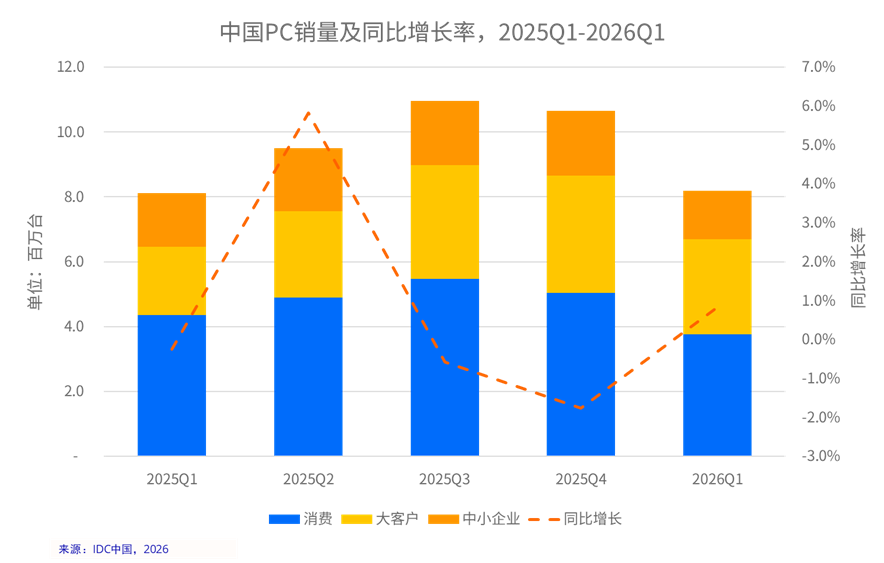
2026年第一季度,中国PC市场整体呈现出“弱增长”与“强分化”并存的特征。根据IDC最新数据,一季度中国PC市场整体销量达到819万台,同比增长0.8%。这一增幅虽实现由负转正,但从结构上看,市场仍处于深度调整阶段,需求恢复动力不足,行业正在从传统的周期性波动转向由结构性因素主导的发展阶段。

与以往由换机周期或宏观需求驱动的增长不同,本轮市场变化更多受到政策环境、供应链成本以及技术演进等多重因素影响。在此背景下,“是否增长”已不再是核心问题,增长来自何种结构、由何种动力驱动,成为判断市场走势的关键。

细分市场分化加剧,增长动能出现结构性转移

从细分市场表现来看,一季度中国PC市场呈现出明显的分化态势。消费市场同比下滑13.6%,在核心元器件价格上涨、补贴政策收紧以及终端需求疲软等多重压力下,整体恢复仍面临较大挑战。与此同时,中小企业市场同比下降9.6%,企业在宏观不确定性背景下趋于谨慎,IT预算收紧、设备更新周期延长,进一步抑制了采购需求。

相比之下,大客户市场实现38.8%的同比增长,在国产化替代持续推进以及政府、教育、大型企业采购需求释放的带动下,成为支撑整体市场的核心力量。

这一结构变化表明,中国PC市场正逐步从以消费驱动为主,转向由政企与结构性需求主导的发展模式,市场内部的增长动能正在发生明显转移。

AI笔记本加速渗透,推动产品结构升级

在本轮市场调整过程中,AI正逐步从技术概念走向实际应用,并成为推动PC市场结构升级的重要因素。随着端侧AI应用场景的不断丰富,具备本地算力能力的AI笔记本需求快速提升,带动整体产品形态和配置标准发生变化。

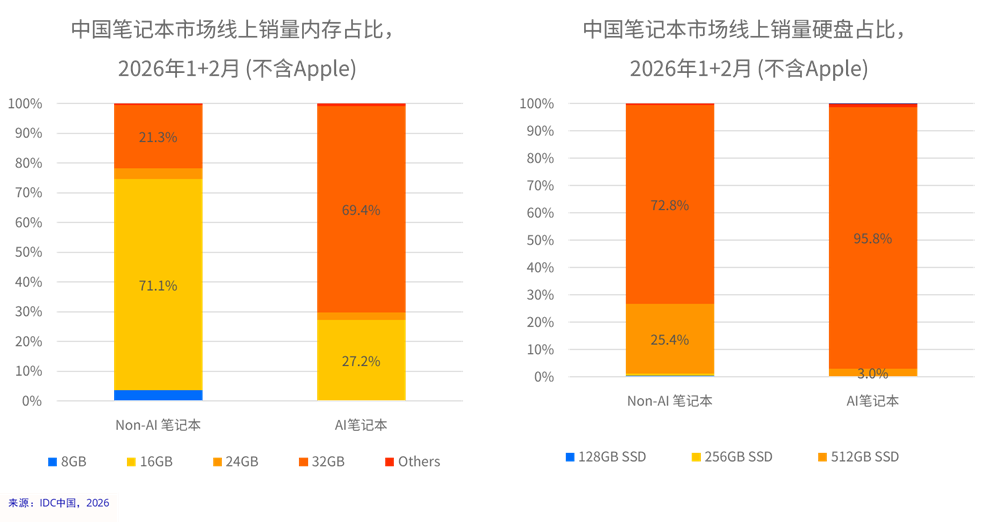
IDC数据显示,2026年1至2月,不含Apple在内的高算力AI笔记本销量占比已达到33.0%。与此同时,用户对高性能配置的需求显著提升,32GB内存搭配1TB固态硬盘的组合已成为主流配置,占比达到68.5%。

这一趋势反映出,用户对PC的需求正从“满足基础使用”转向“支持复杂应用与智能化体验”。在AI应用驱动下,PC正在从传统生产力工具演进为具备智能处理能力的终端设备,带动整个行业向高性能与智能化方向升级。

高端细分市场表现稳健,成为对冲周期波动的重要支撑

尽管整体市场承压,高端细分市场依然展现出较强韧性。以高性能游戏PC为代表,该领域在一季度保持稳健运行。尽管元器件价格上涨推动终端价格上行,但相关用户群体对性能更为敏感,对价格波动的承受能力较强,厂商也能够通过产品溢价与供应链管理对冲成本压力。

从市场竞争格局来看,头部厂商凭借产品矩阵、供应链能力以及品牌优势,持续巩固市场地位,同时部分厂商通过深耕细分领域实现稳定增长。这一趋势与AI PC的发展路径形成一定呼应,即通过提升性能与差异化能力,推动产品向中高端升级,从而在整体需求波动中保持相对稳定的发展节奏。

市场展望:结构升级与供应链因素将持续影响行业走势

展望2026年,中国PC市场仍将受到多重因素影响。上半年,元器件价格预计维持高位,供应链压力依然存在,叠加需求恢复节奏较为缓慢,市场整体仍将处于调整阶段。下半年,随着成本压力逐步缓解以及政策环境的进一步明朗,市场有望迎来温和改善。

从更长期来看,行业将持续向中高端与智能化方向演进,中低端市场空间逐步收缩,厂商竞争焦点将转向产品能力、技术整合以及供应链韧性。市场集中度有望进一步提升,头部厂商优势更加明显,而中小厂商则需要通过细分市场与差异化策略寻找发展空间。

IDC观点

总体而言,当前中国PC市场并非简单意义上的“复苏”或“下行”,而是处于结构重塑的关键阶段。AI技术的持续渗透、硬件配置的升级以及需求结构的变化,正在共同推动行业进入新的发展周期。

在这一过程中,厂商需要更加关注增长质量与结构变化,通过产品创新与能力升级,构建面向未来的竞争优势。

如需进一步了解IDC相关研究,或就中国PC市场发展趋势进行深入交流,欢迎与IDC联系,获取更多洞察与数据支持。请点击此处与我们联系。