
Resource Regions: Asia Pacific
IDC’s Insights From the 2026 World Robot Conference in Beijing
The 2026 World Robot Conference (WRC) took place in Beijing this August under the theme “Human-Machine Symbiosis, Integrated Production and Demand.” More than 300 companies exhibited, showing over 2,000 products and launching more than 150 new ones. For the first time, the conference added a dedicated Procurement Day, where 49 state-owned enterprises appeared together as an innovation consortium, laying out real industrial demand across 12 application scenarios. Robotics is becoming more application-focused, and shifts on the demand-side are now driving the industry’s growth at scale.
The numbers back that up. China’s Ministry of Industry and Information Technology reports that revenue at the country’s above-scale robotics enterprises topped RMB 90 billion (USD 13.4 billion) between January and May 2026, up 26.9% year-on-year. IDC’s own data shows global humanoid robot shipments reached roughly 18,000 units in 2025, up nearly 800% year-on-year.
IDC’s research also finds that most enterprises piloting embodied intelligence robots are still stuck at the proof of concept stage. Between validating the technology and deploying it at scale sit several real hurdles: stability, cost, ROI, and the operations and maintenance work that keeps a robot running day to day. This year’s show floor told a more advanced story anyway. Robots demonstrated complete task execution rather than single task actions, and several ran in real business settings rather than labs. Physical AI is now competing in industrialization capability as much as technical capability. Four trends from this year’s conference bring that into focus.
Trend One: The Model Race Is Giving Way to Real-World Learning
Over the past year, large embodied intelligence models, VLA models, and world models have advanced quickly, pushing robots beyond perception and understanding into complex task decisions and execution. Heading into 2026, though, the competition is shifting: whose model is strongest matters less than which vendor can get robots working, and learning, in real scenarios. Models are the capability foundation for Physical AI; real-world data and continuous learning are what will define the next stage’s edge.
At WRC 2026, world models, VLA, simulation platforms, robot “training grounds,” and data collection technologies all drew sustained attention. Combining virtual and real environments is becoming an important path to data acquisition: simulation generates data at scale, real scenario data keeps it grounded, and together they lower the cost of trial and error. Operational data flowing back into the training pipeline forms a flywheel: perceive, train, execute, get feedback keep improving.
China already has more than 40 robot training grounds planned or under construction, spanning more than 14 provinces and municipalities. The most mature ones can produce data output in the millions of records a year. At the same time, steady improvement in dexterous hands, force sensors, and other hardware is giving robots the means to capture richer manipulation data. As models, data, simulation, and hardware start to co-evolve, enterprise competition is starting to hinge less on whose model scores best and more on who can turn operational data into a working training loop.
Trend Two: Demo Capability Is Giving Way to Scaled Delivery
As robots move into real business environments, the standard for judging them is changing too. At this year’s conference, several vendors moved past single-action demos to validate complete task workflows, including depalletizing, sorting, delivery, cleaning, and inspection. They are proving out full processes now, not isolated capabilities. The real dividing line in robotics has shifted from technical demos to stable delivery.
Task capability now means continuous operation, not single operation execution: robots need autonomous perception, task planning, continuous execution, and the ability to recover from exceptions on their own. Deployment is the harder test. Moving past a proofmeans users are raising the bar on stability, deployment efficiency, maintenance cost, and ROI, with automotive, 3C electronics, and logistics and warehousing serving as the key proving grounds. And the metrics buyers actually use have shifted with it: task success rate, continuous run time, cost per task, and payback period, not the technical benchmarks vendors cite in a demo.
IDC’s user research shows more than 20% of users have already moved from market attention into pilot exploration, and the pace of progression from proof of concept to scaled deployment is accelerating. Stable operation, rapid deployment, ongoing maintenance, and commercial ROI are the capabilities that will separate vendors over the next two to three years.
Trend Three: From Single Scenario Breakthroughs to Layered Deployment
Physical AI won’t scale across every scenario at once. Differences in technical maturity, environmental complexity, and commercial ROI are settling applications into a layered path: commercial services are exploring, industrial settings are expanding, and home and consumer use is still building toward the future.
- Commercial services are in a deep exploration phase. Dining, hospitality, and retail all have clear task demand, but their environments are more complex than industrial settings, so they need stronger autonomous navigation, environmental understanding, and exception handling. Embodied intelligence is accelerating here, carefully.
- Industrial manufacturing will scale fastest. Automotive, 3C electronics, and logistics and warehousing are relatively structured, with clearer task boundaries and strong demand to cut cost and improve efficiency. IDC data shows China’s industrial embodied-intelligence robot market was worth approximately RMB 5.74 billion in 2025, with industrial robots contributing about RMB 3.62 billion and humanoid robots about RMB 2.12 billion. Right now, this is where technical maturity and commercial value line up best.
- The home and consumer market holds long-term potential. Home environments are highly unstructured, with complex, long-tail task types that demand more from a robot’s generalization ability, safety, interaction skills, and cost. The potential application scope is broad enough, though, and the long-term market opportunity is significant.
Robot applications will keep working their way from highly structured environments toward moderately and then loosely structured ones, and different robot form factors will keep finding sharper matches to specific scenarios as they go.
Trend Four: Whole Machine Competition Is Giving Way to System Capability
As Physical AI enters its industrialization phase, the robotics industry chain is expanding from a single hardware platform to include computing power, models, data, core components, and applications, all at once. At this year’s conference, companies from across the domestic and international industry chain participated deeply, and the 49 SOEs appeared together as an innovation consortium. Competition is shifting from single-technology supply to industry chain collaboration and joint scenario creation, and the boundary of enterprise competition is expanding into hardware-software collaboration and ecosystem building as a result.
- Industry chain collaboration continues to deepen: chips, sensors, reducers, servo systems, dexterous hands, and other core components are accelerating collaboration with robot platforms.
- Models and hardware are converging faster, as large model companies, robot manufacturers, and research institutions collaborate on VLA, world models, and motion control.
- Industry support systems are accelerating. Dozens of embodied intelligence innovation centers have already launched across China, covering technology development, pilot-scale validation, data training, and scenario deployment.
- International cooperation is widening the circle further: the conference attracted 30 international supporting institutions across research, engineering, industry, and investment.
The companies best positioned to move from point applications to scaled commercial deployment will be the ones with the strongest ecosystem-organizing capability, not necessarily the strongest single product.
IDC Outlook
Physical AI is moving from technology display to industrial value validation. Robotics companies’ core competitiveness will depend not just on technical sophistication, but on whether they can turn that technology into stable, replicable products and solutions with real commercial value. Physical AI is entering the deep waters of industrialization, and the next stage of competition in robotics will focus more closely on real demand and real value.
The next two to three years will be an important window, as embodied intelligence robots move from technology validation to scaled application. Different scenarios will show a layered deployment pattern: service scenarios will be first to explore application, industrial scenarios will become the key direction for scaled deployment, and the home and consumer market holds long-term development potential. At the same time, Physical AI will push industry competition from single hardware capability toward a systemic capability built on models, data, hardware, and applications together.
Upcoming Webinar: Global Robotics Outlook 2026-2027
WRC 2026 showed where robotics is headed technically. But a new US policy is redrawing who wins. Join IDC’s live webinar, How the US ban is reshaping the robotics market, on Wednesday, October 14, 2026 at 11:00 AM EDT. We’ll cover the 2025-2030 forecast for humanoid, autonomous mobile, and commercial service robots, the competitive landscape, and what the July 2026 US restriction means for your next move. Register now!
Can’t join live? Register anyway — an on-demand recording and translated access will be available afterward.
For Further Discussion
The robotics industry stands at a critical juncture, moving from technology validation toward scaled application. If you’re interested in Physical AI deployment pathways, embodied-intelligence scenario value assessment, or industry-chain competitive dynamics, visit IDC Physical AI Resource Center for more resources or contact us for an in-depth discussion with IDC analyst team.
Navkendar Singh - Associate Vice President, Client Devices & IPDS, IDC India
Navkendar Singh is a Associate Vice President with IDC India, based in Gurgaon. His research domains encompass deep-dive research and insights in and around mobile devices, smart homes, PCs, tablets, wearables, and the printing market in India, Bangladesh, and Sri Lanka.…
Asia/Pacific AI and GenAI Spending to Reach $555 Billion by 2030 as Enterprises Scale AI Beyond Pilots: IDC
IDC forecasts APAC AI and GenAI spending to reach $555.2B by 2030, as agentic AI and orchestration platforms drive enterprise-wide deployment beyond pilots.
Read full releaseIDC近期的企业用户调研和交流表明,企业建设和应用智能体时主要面临两个难题:哪些业务场景值得优先投入?项目建成后能否取得可验证的业务成效?
围绕这些问题,IDC通过中国企业级Agent最佳实践与案例精选(ROI)视角这本报告,对中国企业Agent的应用案例进行了深入研究,案例覆盖金融、制造、港口、建筑、贸易、零售、能源、医药和城市治理等场景或行业。报告重点关注Agent进入了哪些业务,企业采用了怎样的实践路径,以及项目上线后的投入和效果如何评估。
同时,我们也通过以下四方面的深入观察,洞悉项目建设和运行过程中出现的数据、知识、业务规则、流程与组织协作变化,以及这些积累对后续Agent建设的影响。
一、ROI难以量化已成为企业Agent规模化的首要问题
IDC中国企业智能体调研显示,52.0%的受访企业将ROI难以量化列为智能体规模化落地的最大挑战,远高于其它影响因素:模型能力尚未达到业务要求、Agent基础设施不成熟、人才与技能不足占以及组织内部的变革阻力。
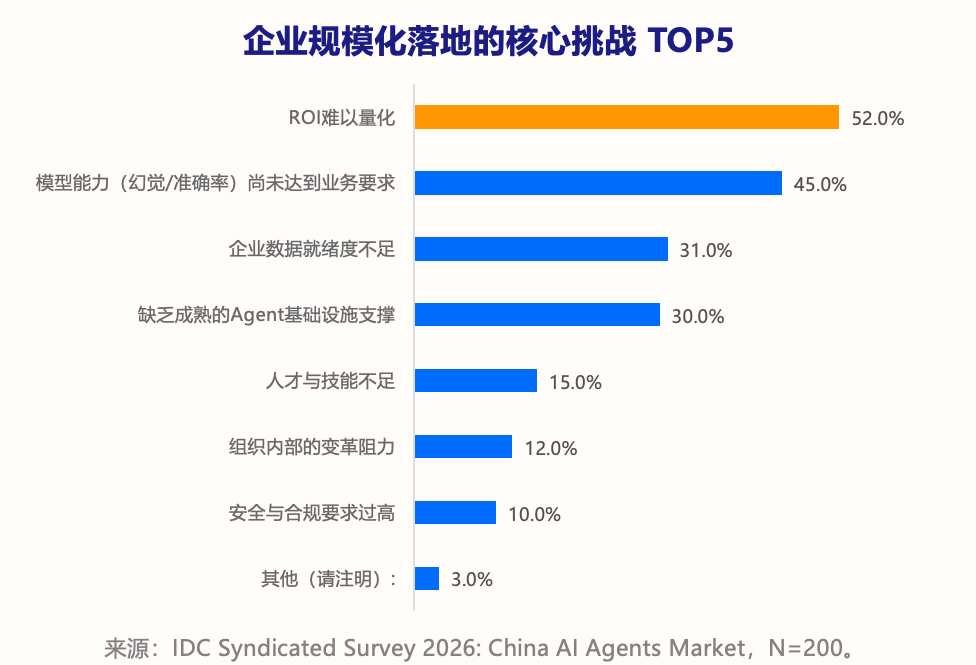
在AI落地初期,部分企业基于推广普及AI的需求一般会更关注覆盖率、使用量和员工采用情况。另外当前部分企业主要落地的知识库问答或简单Workflow的智能体通常任务相对简单,模型调用、系统改造和持续运营投入有限,成本压力暂时不大。
但在复杂任务场景中,Agent则需要反复调用模型和工具,执行链路更长,多Agent模式下还会增加模型调用和系统交互频次,运行成本可能迅速上升。尤其是当前基于Harness架构、具备自主规划循环能力的Agent,在部分场景中的运行成本甚至可能超出企业可以承受的范围。
在涉及到业务和生产流程的高价值场景中,企业往往还需要数据治理、系统连接、权限与审计设计、业务规则整理和流程重构等基础能力建设。这些工作往往需要业务专家、IT团队和FDE长期参与,人力投入通常较高。
而在Agent带来的收益方面,往往又是分散在多个部门。企业如果缺少持续的业务数据监控机制,还需要跨部门统一指标口径、价值归属和成本分摊方式,收益核算会变得十分复杂,不亚于一次组织重构。以客服Agent为例,它可能减少坐席工时、提高一次解决率、缩短投诉周期、改善客户满意度,同时能够将新的问题和解决方法沉淀到企业知识库。经营分析Agent则可能缩短取数时间、统一指标口径、减少分析遗漏,并帮助业务人员更早发现库存、回款或客户流失风险。这些收益由客服、业务、数据、财务和风险管理等不同部门获得,价值兑现时间和衡量标准也有较大差异,难以核算清楚。
但即便当下Agent建设的ROI难以算清,企业也很难绕开这一关键指标。企业最终是要对利润和经营结果负责,Agent作为企业投入的项目同样需要说明这些成本投入能够为企业带来什
二、企业如何判断Agent项目是否值得持续投入
IDC在智能体的企业价值研究中也专门提到了要从战略匹配、用例优先级、价值映射、扩展成本、风险校正和持续优化等方面讨论Agent价值管理(《Agentic AI Business Value Maximization Framework: A Practical Guide for IT Leaders to Unlock Business Value from Agentic AI》)。
结合企业实践,可以用一条公式、两本账和三层观察来理解和应用这套方法,能够兼顾财务核算的严谨性和长期能力建设的观察需求。
- 一条公式:把投入与回报算清楚
场景ROI=(年度可量化收益-年度TCO)÷年度TCO×100%
(注:公式中的年度TCO除了软件和模型费用,也应包含业务数据和知识的建设、相关系统的改造,业务、IT和实施团队长期参与迭代的投入。)
其中,年度可量化收益通常来自三类,第一类是降本,包括节省工时对应的综合人力成本、减少的外包支出和运营费用;第二类是增收,可以根据转化率增量、客单价、有效触达量或新增产能估算;第三类是风险规避,可以根据风险敞口、原始发生概率和Agent介入后风险发生概率的下降幅度,估算预期损失的减少额。这些收益都需要通过上线前后的业务基线计算增量,企业需要提前记录业务量、处理时间和人力投入,才能在智能体应用上线后形成可比较的数据。
- 两本账:同时记录当期业务收益和长期能力资产
第一本是业务账,回答项目在当前周期产生了什么结果。处理时间缩短了多少,人工投入下降了多少,准确率、自动化率、客户转化率、风险发现率和业务采纳率发生了什么变化,这些指标关系到项目是否继续运行、相关Agent是否向更多部门推广,以及下一轮的投入预算。
第二本是能力账,观察企业的数据、知识、系统、人员和治理方式能否支撑Agent稳定参与实际业务,以及AI Ready与Agent Ready能力是否得到提升。这些变化会影响后续Agent建设的速度、应用范围和运行质量,也会改变企业未来的组织运行方式。
- 三层观察:不同的层级需要关注不同的价值结果
企业不同层级关注的Agent价值结果有所不同,主要分为三层:
- 场景层关注单项任务是否值得继续运行,比较投入与处理效率、质量、增长或风险控制结果。
- 部门层关注Agent是否改善团队整体产能与业务表现,以及收益能否覆盖部门承担的持续成本。
- 组织层关注跨部门复用、整体能效、治理体系和人员能力,评估Agent对企业运行方式产生的长期影响。
三、哪些Agent场景已经取得可验证的业务成效
本次案例研究覆盖的相关案例主要从两个维度展开研究:一是Agent在企业中落地了哪些业务场景,建设的方案和依赖的基础条件;二是项目运行后取得了哪些效果,以及企业是如何计算ROI的。(注:不同项目的场景和环境并不相同,相关统计数据不适用于跨案例对比。)
- 规则明确的重复流程最容易形成可量化结果
在案例研究中我们发现,很多业务工作流中传统需要大量人工处理重复操作的场景是最容易体现项目效果的。
例如在腾讯云与找钢网的案例中,其将Agent用于询价、报价和采购比价,原来需要近一小时完成的比价工作缩短到几分钟,报价效率也提升了10-20倍。来也科技帮助某电子元器件分销商处理订单,订单处理团队从约20人减少到1人,只需要负责监管和异常复核工作就能够完成大量的订单处理工作。在金智维与国盛证券的案例中,他们将证券运维中的CMDB查询接入工单和自动处置流程,把查询时间从数天或缩短到秒级。得帆与中国弹簧把计划物流、采购、排产和质量整改等业务流程整理为Skills,并连接企业业务系统帮助员工处理业务任务,实现整体效率70%—80%的提升。
- 数据检索和分析类场景任务能够显著提效
在数据分析方面智能体也在多家企业中展现出了业务价值,例如某全球医药企业原本需要排期2至5天完成报表查询和分析工作,采用神州数码的方案后缩短到分钟级。汉得帮助中亿丰建设了知识问答、经营分析和客商风险预警等问答和数据分析的能力,智能问数从小时级响应缩短至分钟级。迈富时为某全球美妆集团建设数据分析Agent,将经营决策周期从5天缩短到1天之内,支撑集团实现了更敏捷的经营管理能力。
- 营销和客服场景Agent已经带来了显著的业务回报
在销售和客户经营场景中,蓝凌与加福加德通过Agent将行业情报、客户资料、话术和配方知识实时提供给销售人员,可以在客户现场实时完成响应,并将日均有效触客量提升30%以上。蚂蚁数科与杭州银行案例中基于多个Agent处理客户洞察、产品分析和营销策略,项目测算显示,策略生成时间从天级缩短到分钟级。火山引擎与来伊份上线了预测补货、智能导购和AI客服等能力,其AI购物助手的下单转化率能够提升190%,AI客服已经可以独立回答约70%的咨询。
- 基于专业模型和算法的Agent在专业场景也有显著效果
百度伐谋使用Agent持续优化青岛港的配载算法,项目统计显示,算法迭代周期缩短50%以上,从数周缩短到小时级。商汤大装置的方案支持上海市规划和自然资源局通过自然语言调用地图和空间数据,处理城市治理任务,已经覆盖50多个核心场景,业务处理时长缩短60%,人均产出效率提升70%。
- 在组织运营场景Agent也能带来直接的产出提升
昆仑数智数字化咨询中心用Agent帮助完成AI组织变革,先以标准工单记录任务、责任与交付,再用任务督办、方案共创、消息监控、会议纪要和知识检索Agent智能化自动化的协助处理日常工作。部门平均任务响应时间从24小时缩短到4小时;人员规模缩减的同时,营业收入增长30%。
四、案例企业中Agent落地的最佳实践
综合案例研究,企业Agent的落地过程可以概括为一个业务价值闭环。Agent位于企业现有业务系统之上,负责协调判断与执行:先读取业务状态和任务输入,结合企业数据、知识与规则形成判断,再调用工具和系统完成业务动作,而执行结果、异常情况和人工反馈会被记录下来,继续用于更新知识、规则和评测依据,形成“感知—分析—执行—沉淀”的持续循环。
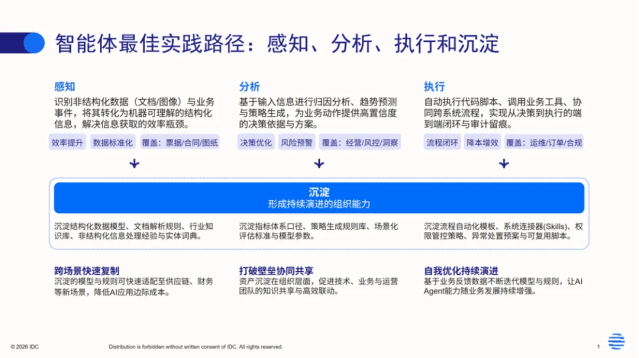
Source:中国企业级Agent最佳实践与案例精选(ROI视角)
- 优先选择结果可以验证的业务问题
期望短期把业务账算明白的企业,可以优先从业务量稳定、结果可以验证、责任人明确的业务场景开始,而能力账的建设投入则应该拉长ROI的观察周期,例如来伊份在企业实践中就分别为经营项目和战略项目设置了不同观察周期。
- 持续完善数据、知识和业务规则
专业Agent依赖企业对业务数据和知识的长期治理,智能体依赖的数据、知识和业务规则需要在实际使用中不断校正,才能确保其在业务场景中能够持续稳定运行。
- 业务人员需参与任务定义和结果验证
业务人员最清楚任务是否合理、结果能否使用,也最早发现Agent在真实工作中的偏差。例如得帆和中国弹簧的案例中,就由中国弹簧的业务人员参与提供了具体的Agent业务定义和测试样例,并完整参与了结果验证,这类做法能够确保Agent能够更符合业务需求。
- 把评估、治理和改进纳入日常运营
Agent上线后的评估和治理也是构成业务价值闭环的关键环节,企业需要根据真实运行数据发现偏差和风险,找出需要调整的环节,并持续更新迭代智能体以满足实际的业务需求。
更多内容请关注IDC报告:
中国企业级Agent最佳实践与案例精选(投资回报率视角)——从场景落地方法到业务价值。(Doc#CHC 54811526,2026年8月)
如果您希望了解人工智能相关的研究或开展进一步交流,欢迎点击 联系我们!
Zhenya Sun - Research Manager
Zhenya Sun is a research manager for the IDC team focused on exploring the application of technology and industrial development of AI and AI agents. He is also responsible for providing clients with consulting services on technologies, products, and markets…
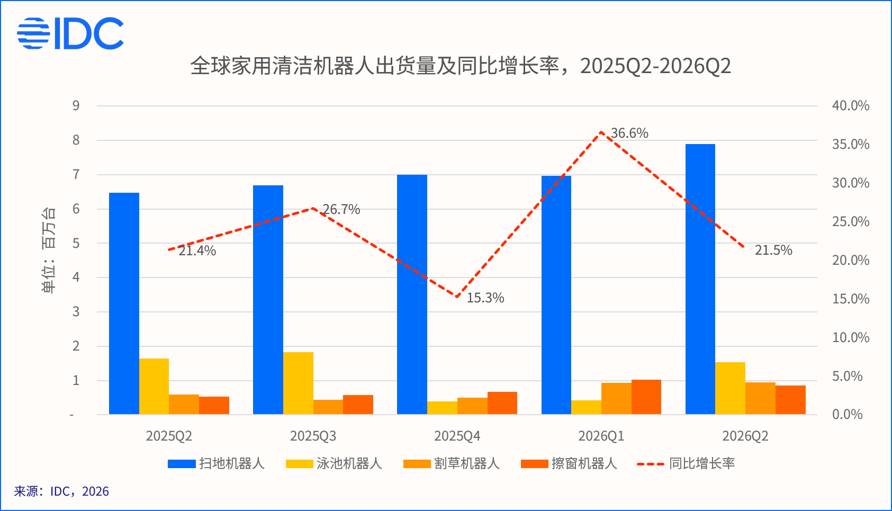
从扫地、割草到擦窗、泳池,家用清洁机器人正在从“单一爆品”走向“全场景清洁生态”。国际数据公司(IDC)最新追踪报告数据显示,2026 年第二季度,全球家用清洁机器人市场出货约 1120 .5万台,同比增长 21.5%。其中扫地机器人市场出货 788.5 万台,头部厂商集中度持续攀升。经历一季度 36.6% 的高增长后,二季度市场增速回归常态,但结构性分化进一步加剧:扫地机头部三强垄断格局固化,割草机器人延续高增,泳池机器人进入传统旺季。
本文以 IDC 最新追踪报告为依据,深度剖析扫地、割草、擦窗、泳池机器人细分市场的关键节点,助力行业伙伴制定科学可行的发展战略。
扫地机器人
2026 年第二季度,全球扫地机器人市场出货 788.5 万台,销额达38.9 亿美元。市场集中度显著提升:前五大厂商合计占据 75% 的出货量份额和 82.0% 的销额份额。二季度欧洲市场持续引领增长,出货量同比增长64%,其中800美金(不含税)以上的高端机型出货占到欧洲市场的16.6%,在春促期间头部品牌大批量本地仓备货,低价品牌成本承压加速出局。欧洲市场终端机型降价促销,旗舰机型加速放量。
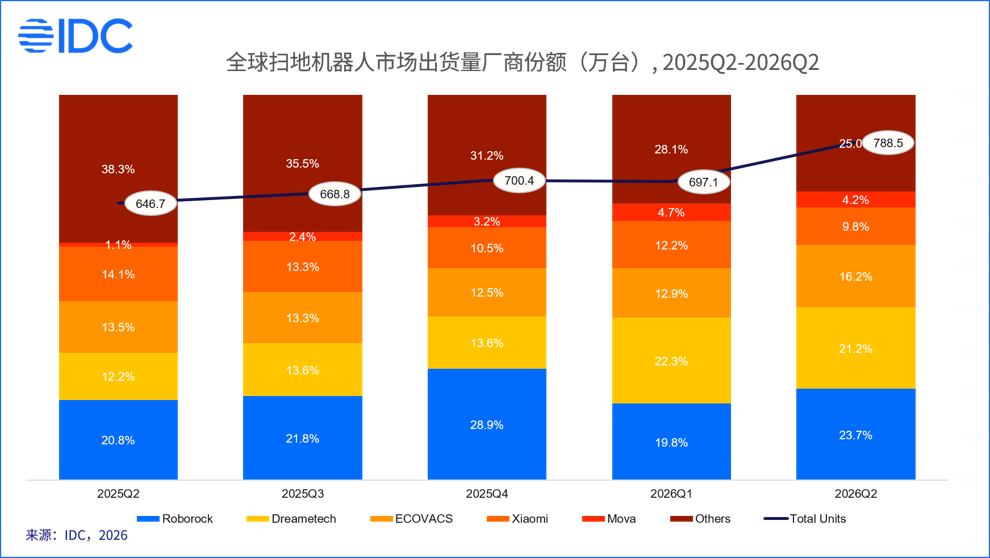
IDC 洞察:全球扫地机器人市场已经进入 “头部固化、尾部出清” 的阶段。头部商凭借技术研发、品牌溢价和全球化运营能力,持续拉大与中尾部品牌的差距,高端市场的利润和话语权进一步向头部集中。对于中尾部品牌而言,单纯依靠价格竞争已难以突围,必须在细分场景、差异化技术或特定区域市场找到生存空间。二季度全球扫地机器人平均售价约 4943美金(不含税),同比上涨7.9%,高端化趋势仍在延续,行业产品迭代逻辑告别同质化参数比拼,转向聚焦家庭真实深度清洁体验,平板、圆盘、滚筒等多类硬件方案同步演进、多元并行。
割草机器人
2026 年第二季度,割草机器人延续高景气态势,出货93.9万台,同比增长59.7%,保持高速增长。无边界机型已成为市场绝对主流,出货占比持续提升至84.2%。
IDC 洞察: 割草机器人的增长逻辑仍由供给端主导。头部国产品牌凭借从激光雷达、驱动电机、动力电池到整机代工的全链条国产化配套,在成本管控与交付周期上建立显著优势;与此同时,传统清洁龙头加速入局,推动行业格局快速出清,中小尾部品牌生存空间持续收窄。需求端,二季度欧洲及北美草坪进入生长旺季,季节性爆发特征显著;国产头部厂商今年以来持续加码北美线下渠道布局,市场起量迅速。价格端,全球割草机器人平均单价环比下探至 1,431 美元,国产供应链成本优化成效持续释放。
擦窗机器人
二季度全球擦窗机器人出货约 84.7 万台,同比增长59.8%,延续一季度的高增长态势。尽管二季度缺少一季度 “春节除尘” 的季节性拉动,但海外市场开拓和产品性能升级持续驱动需求增长。伴随行业规范落地、国标正式推行,市场资源与份额加速向头部品牌聚拢,全年赛道有望延续高增长态势。
IDC洞察:无线化、智能喷水、边角清洁等技术升级显著改善产品体验;欧美等市场的大面积玻璃、高层住宅及人工清洁成本进一步强化需求,同时中国品牌凭借成熟供应链和快速产品迭代加速全球渠道铺设,使擦窗机器人从小众尝鲜品类逐步走向大众化。
泳池机器人
二季度为泳池机器人传统旺季,全球出货约 153.3 万台,同比下滑6.3%。在地下泳池清洁机器人中,无缆产品占比持续提升至61.6%。高基数下换机周期拉长叠加欧美渠道去库存,中国品牌加速进入带来的价格竞争,使2026年Q2海外泳池机器人市场短期承压。
IDC洞察:疫情期间需求集中释放形成的高基数,正推动部分成熟市场步入存量换机周期;叠加欧美渠道去库存与住宅市场偏弱,短期出货端承压显著。供给端,中国品牌加速入局欧美市场,以无线化产品和高性价比策略加剧价格与份额争夺,传统品牌持续承压。二季度的小幅下滑本质上是成熟市场周期性调整与品牌格局重构的叠加结果,而非泳池机器人长期需求的根本性衰退。
IDC总结与展望
头部品牌不再只争夺扫地机器人这一单一市场,而是开始同时布局扫地、割草、擦窗、泳池等多个品类,争夺家庭清洁市场的整体份额。在这一过程中,行业竞争逻辑正在发生三个层面的转变:从卖硬件转向卖体验,从产品出海转向本地化经营,从打造单品爆款转向多品类协同。简而言之,家用清洁机器人正在从“单品爆款”走向“全场景生态”,竞争规则也随之改写。
第一,从卖硬件转向卖体验。
随着AI导航和具身智能技术不断成熟,机器人会越来越“聪明”,能够自己学习家庭环境、规划清洁路线,并根据用户需求做出调整。因此,未来产品之间的差距不只是硬件配置,更取决于软件算法、AI能力以及长期积累的数据。
第二,从产品出海转向本地化经营。
中国品牌出海正在从“把产品卖出去”,逐步转向“在当地扎下来”。除了发挥中国供应链的成本优势,头部品牌正在海外加快建设前置仓、线下门店和售后服务网络,并加强本地团队和渠道建设。未来,海外市场的竞争不只是产品竞争,更是物流、服务、渠道和品牌的综合竞争,率先完成本地化布局的企业,有望建立更强的长期竞争壁垒。
第三,从打造单品爆款转向多品类协同。
同时布局多个清洁品类,可以共享研发、供应链和销售渠道,降低整体成本;另一方面,也可以为消费者提供从室内到室外的“一站式家庭清洁方案”,提高客单价和用户复购。未来清洁机器人不再是孤立的家电,而会逐渐与门锁、摄像头、空调、音箱等智能家居设备连接,并与其他清洁机器人形成协同,为家庭提供更完整的智能服务
进一步交流
如需了解更多IDC相关研究或进一步与我们沟通,欢迎与 IDC 联系,我们将安排专人与您对接,为您提供定制化的市场洞察与咨询服务。请点击此处与我们联系。
Claire Zhao - Research Manager
Claire Zhao is a Research Manager for Client System Research of IDC China. She is responsible for conducting research on the augmented reality (AR)/virtual reality (VR) market, and vertical analysis for the PC market. She started working for IDC China as…
2026年,Agentic AI 已全面进入生产环境。然而,早期部署者正面临一个普遍且棘手的现象:活跃智能体数量平稳增长,而月度Token消耗与基础设施成本却出现数倍乃至数十倍的剧烈波动。单纯关注Agent数量已无法解释成本曲线的陡峭程度。本文基于IDC《Worldwide Agentic AI Adoption Guide》数据,从算力消耗结构、部署形态演进与行业渗透路径三个维度,给出2026-2030年的关键判断。
本文的核心结论:未来五年,企业智能体的竞争将从“数量战”转向“质量与路径之争”。真正的竞争优势将来自三大转向:从关注部署数量转向关注 Token 资源的实际承载效率;从套用全球模式转向拥抱“自定义配置+独立智能体”的中国特色路径;从一刀切部署转向结合行业基因的差异化布局。
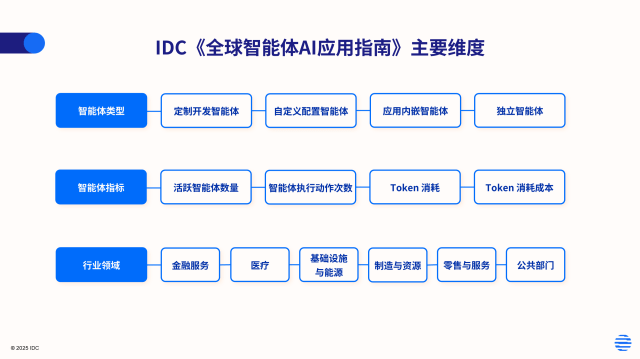
IDC《全球智能体 AI 应用指南》呈现了全球智能体AI的最新应用机遇与发展趋势,覆盖六大行业领域、四大智能体部署类型,围绕四项核心指标提供多维度的预测数据。
一、Token消耗增速远超Agent数量:算力预算的考量维度迎来重构
从总体规模来看,中国在活跃智能体数量、动作执行次数、Token 消耗以及相关成本等核心指标上,整体占全球近10%的市场份额。中国企业在 Agentic AI 的应用节奏上与全球大盘保持同步,本土落地准备度正加速释放。但更值得技术决策者关注的,是增长背后的结构性分化:
1. 智能体急剧“变忙”,单体任务Token消耗呈爆发式增长
最新趋势表明,Token消耗与动作执行数的增速已远超Agent数量本身的增速。这意味着,规模化的内涵正从“数量堆砌”转向“单个Agent的任务链长度与执行频次”。随着长上下文、多步推理及复杂工具调用成为常态,单次任务所需的Token消耗量正呈爆发式增长。
2. 算力降本反向刺激了更庞大的复杂需求
另一个关键信号是:Token消耗的年均复合增速(CAGR >3500%)远超企业实际成本增速(CAGR ~260%),体现出大模型单位推理成本的快速下降。正是这种“算力降本”带来了正向的弹性需求——企业不再满足于单次问答,而是敢于让Agent执行长链条自动化任务,从而形成了“Token消耗指数级增长、成本相对平缓”的剪刀差效应。
二、自定义配置统治力不改,独立智能体开启结构性跃迁
规模增长只是表象,部署形态的结构性变化才是更值得关注的底层逻辑。
IDC将智能体分为四类:定制开发(Bespoke)、自定义配置(Custom-configured)、应用内嵌(In-application)以及独立智能体(Standalone)。对比中国与全球的数据,一个极为显著的“中外双轨”现象浮出水面。
1. 自定义配置智能体:中国的统治形态,全球正加速追赶
在中国市场,自定义配置智能体占据了绝对主导地位。这一特征反映了中国企业IT生态的本土基因:一方面,中国企业的业务流程个性化程度高,标准化SaaS内置的Agent难以完美贴合实际工作流;另一方面,基于低代码/零代码平台进行自定义配置,既保留了编排专属工作流的灵活性,又大幅降低了开发门槛,成为中国企业综合ROI最优的选择。
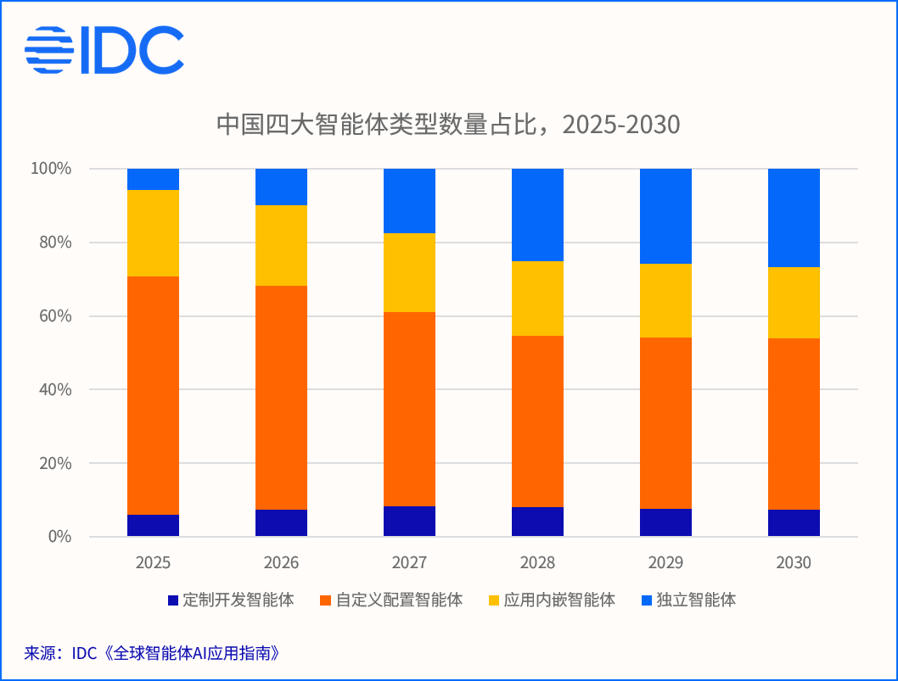
放眼全球,2026年应用内嵌智能体仍是主流形态,但到2030年,全球自定义配置智能体在数量、动作与Token消耗占比将全面反超。全球正沿着中国已走通的道路演进——从“开箱即用”的标准化交付,转向“深度配置”的灵活平台。
2. 独立智能体:从“配角”到“核心骨干”的跃迁
另一个极为亮眼的趋势是独立智能体的崛起。独立智能体不依附于单一应用运行,可通过标准协议穿梭于 API、数据库、ERP、CRM 及各类微服务之间,承担跨系统的复杂任务。
未来五年,独立智能体在中国的Token消耗与动作执行数占比均将升至超三成——这意味着,独立智能体将从今天的“小众探索”跃升为企业自动化的核心支柱。对技术供应商而言,这不仅是产品形态的补充,更是卡位机会:谁能率先提供稳定、安全、可观测的独立智能体框架,谁就有望在下一轮企业级采购中占据先机。
三、零售与服务业占据主力,行业基因决定Agent部署逻辑
在行业分布上,中国市场呈现出“大盘结构极其稳定”的特征:零售与服务业占据了近四成的绝对主力;制造与资源业约占两成,金融服务业约占一成半。三者构成了中国 Agentic AI 应用的稳健基本盘。
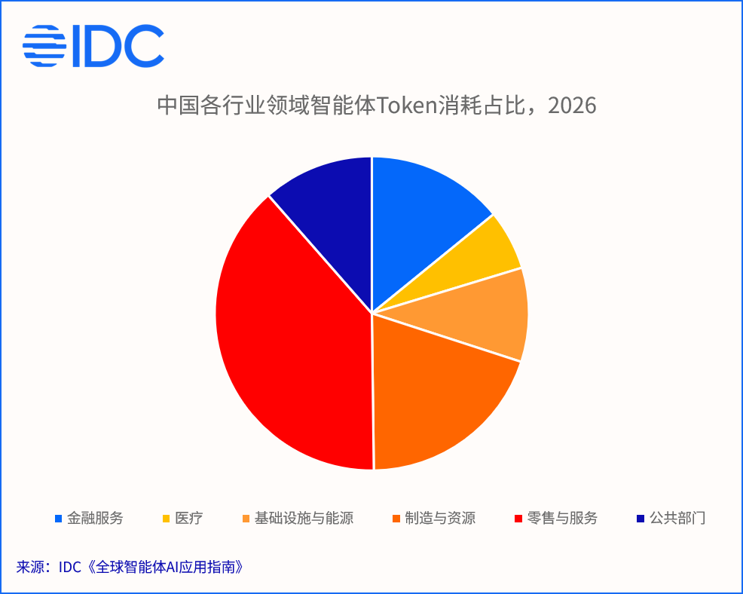
但在大盘稳定的表象下,底层场景与部署形态却呈现出鲜明的行业分化:
- 零售与服务业内部形成双轮驱动格局
“零售与服务业”独占中国近四成的 Agent 算力与成本消耗,主要驱动力来自两个方向:
- 业务侧:消费零售的高频客户交互。在面向消费者的前端场景中,Agent 被大量用于智能客服、个性化推荐、社群运营等。这一类场景的特点是“高并发、高频次”,构成了智能体动作次数的庞大基数。
- 技术侧:软件与信息服务的AI原生开发运维。在软件与信息服务领域,Agent 正在深度重构软件工程全生命周期。从代码生成、代码审查到 DevOps 排障,代码与系统架构处理天然具备“上下文超长、多步推理、工具调用频繁”的特征,单次任务Token消耗往往是普通对话的数十倍。
- 行业基因决定Agent的“部署偏好”
将行业数据与部署形态交叉分析,还会发现不同行业的Agent部署偏好存在鲜明差异:
- 零售与服务:极度依赖自定义配置智能体和独立智能体。企业需要快速迭代营销策略与开发工具,要求Agent具备极高的编排自由度与跨系统能力。
- 公共领域、基础设施与能源:自定义配置仍是第一大形态,但应用内嵌智能体的应用显著高于零售等敏捷型行业。此类稳健合规型行业对数据安全与系统合规有着极高要求,更倾向于将智能体活动限制在既有ERP、办公套件或国产化核心业务软件内部,优先保障数据不出域。
总结与展望:给企业决策者的行动指引
回顾2025-2030年中国Agentic AI的落地轨迹,结论已清晰浮现:这不是智能体数量的军备竞赛,而是企业运营模式的底层重构。未来五年的赢家,不是部署Agent最多的企业,而是最早理解并驾驭“Token消耗、部署形态、行业基因”三者互动关系的决策者。
基于上述洞察,建议企业重点推进三项战略行动:
1. 从“按并发数”转向“按Token容量”规划
企业面临的不是Agent数量增多的线性挑战,而是单个Agent复杂化导致Token消耗量爆发式增长。基础设施规划不能仅按当前对话调用量预估预算,需建立针对长上下文、多轮工具调用的算力容量模型,引入智能路由与缓存机制,避免成本失控。
2. 采取“自定义配置 + 独立智能体”的主流组合架构
海外应用内嵌的模式并非中国企业自主搭建核心智能体体系的优先选项,全自研同样不是最经济的选择。建议重点构建统一的低代码Agent编排平台:针对多数业务流程,采用自定义配置模式敏捷搭建;针对通用型跨系统复杂流程,重点布局独立智能体,形成企业的“数字化劳动力网络”。
3. 按行业基因制定部署策略
零售与服务等敏捷行业追求效率最大化,应给予自定义配置智能体与独立智能体充分的编排自由度;公共领域、基础设施和能源等强合规行业,非核心通用场景可以自定义配置为主,兼顾效率与管控;核心敏感流程优先采用自有系统内的私有化部署方案,将 Agent 活动范围限定在已通过安全认证的自有软件边界内。
Agentic AI 并非短暂的技术热潮,而是长达数年的生产力范式转移。深刻理解落地规律的企业,将在 2026 – 2030 年的智能化浪潮中,精准锚定架构方向,真正将 AI 转化为可持续的竞争优势。
备注:本文中的 Token 消耗仅统计生产环境中企业级智能体执行业务动作时产生的 Token 及 API 调用消耗,不包含模型预训练、消费级个人设备上的智能体以及独立生成式 AI(如通用聊天机器人)所消耗的 Token。
IDC对四类智能体的定义如下:
定制开发智能体(Bespoke agents):这类智能体依托专用的智能体 AI(Agentic AI)框架或平台实现,在 AI 智能体的设计、开发与部署全环节具备极高的灵活性与可定制性。纯代码级(Pro-code)智能体 AI 框架与平台最适配技术功底深厚的团队——这类团队需要对开发过程拥有极致掌控权,以此落地高度专业化的功能。
自定义配置智能体(Custom-configured agents):企业可围绕主流业务运营自动化需求,自行设计、配置并部署这类 AI 智能体,无需具备深厚的编程能力。低代码工具能够简化、加速 AI 智能体的开发流程,但和所有低代码 / 无代码工具一样,存在相应的权衡取舍:由于深度复用预构建的框架与组件库,开发过程中会内置预设的前提假设与能力边界。
应用内嵌智能体(In-application agents):应用内嵌智能体直接植入服务商的应用产品内部,用户无需跳出当前应用界面,即可借助它完成任务、获取问题解答,或是实现工作流自动化。
独立智能体(Standalone agents):独立智能体是面向特定场景打造的成品化智能体,由智能体服务商独立部署运行,不依附于某一款单一应用(典型如深度研究智能体、会议纪要智能体、客户支持智能体)。
IDC《支出指南》致力于为IT厂商、行业用户和投资/金融机构在战略规划、产品研发、IT支出及投资规划等方面提供数据支撑。《支出指南》系列产品聚焦IT热门领域,从多个维度预测市场规模和增速,助力厂商发掘市场潜力;引导行业用户根据热点技术及应用场景进行IT规划;通过分析特定市场的发展前景,帮助投资和金融机构更好地做出决策。
IDC《支出指南》相关研究:
China Provincial Cloud Solutions Spending Guide
Worldwide AI and Generative AI Spending Guide
Worldwide ICT Spending Guide Enterprise and SMB by Industry
Worldwide Software and Public Cloud Services Spending Guide
进一步交流:
如您希望进一步了解IDC《全球智能体AI应用指南》细分数据,或需要针对贵公司目标市场进行定制化数据解读,欢迎联系IDC中国分析师团队。请点击此处与我们联系。
Wendy Zhang - Research Analyst
Wendy Zhang is a research analyst in the Data and Analytics group at IDC China. She is responsible for business operations and spending guide in China Enterprise Team. She provides dynamic forecasts of future China and global ICT market development.…
Worldwide External Enterprise Storage Systems Market Grows 33.6% in the Second Quarter of 2026, Extending Its Strongest Growth Run in Years, according to IDC
The worldwide external OEM enterprise storage systems (ESS) market continued its sharp acceleration in the second quarter of 2026, reaching $10.3 billion in vendor revenue,...
Read full releaseWorldwide Server Market Revenue Hits Record $166.3 Billion in the Second Quarter of 2026 as AI Infrastructure Investment Continues to Broaden, according to IDC
— The worldwide server market reached a record $166.3 billion in vendor revenue in the second quarter of 2026 — the highest quarterly total in...
Read full release2026 IDC FinTech Rankings: Top Firms Grew Financial-Services Revenue 20% in 2025, Nearly Double Overall IT Spend Growth
Firms on the 2026 IDC FinTech Rankings Top 100 grew their 2025 financial-services revenue almost 20% year over year.
Read full releaseAI加速进入经营全链路,135亿元零售云市场迎来全新价值坐标—— IDC最新零售云报告发布
随着零售行业数字化进入深水区,云计算正在发生一次角色迁移:从承载业务系统的基础设施,逐步成为连接数据、业务与智能应用的技术底座;AI也从单点能力展示走向营销、门店运营、供应链等核心流程。
Read full release