The 3 Dimensions of Retail Immersive Customer Experience

The opportunity with the Metaverse is it creates infinite possibilities for us to connect, create and belong. […] In essence, how can we help our current members, get educated, informed and show them the way?” Tareq Nazlawy – Senior Director Digital, adidas

Despite the internal and external challenges that retailers must face, real-time contextual customer experience is a key factor for retailers and brands that aims to engage, retain and enhance shoppers’ experiences during different and multiple interactions and interfaces.

According to our Global Retail Operating Models 2022 Survey, brick-and-mortar remains retailers’ main channel source of revenue generation over the next two years. At the same time, eCommerce and marketplaces as well as retail media networks, conversational and social commerce are expected to become new and increasing channels of new revenue streams.

This would allow retailers’ operating models to become fully omni-channel while completely integrate online and physical operations, in real-time.

However, the traditional convergence between online and offline is now nowadays characterized by a third dimension that aims to augment the overall shopping experience, including the metaverse continuum. This ranges from AR-enable visual and image search to 3D product visualization, to more sophisticated and immersive virtual realities for visual commerce, such as Web3 and Metaverse platforms and related NFT capabilities.At the center of this 3D integration – between online, physical stores, and metaverse continuum – there are three core elements that are foundational of the immersive retail customer experience. The core elements are:

  • Customers. Shoppers’ need, behaviour and preference as well as the customer-centric approach that permeates B2C, B2B2C and D2C business models.
  • Data. Collecting and managing first-, second- and/or third-party, retailers and brands become key players of partners ecosystems for leveraging customer data platforms (CDPs) and customer data sharing hubs to guarantee data accuracy, security and identity management.
  • Technology. AR, VR, digital twin, and Metaverse are (re)emerging technologies that fueled by data and powered by AI and ML analytics, enable retailers to enhance personalization of the customer journey model.

As we have recently published in the IDC FutureScape on Worldwide Retail 2023 Preditions, “By 2024, 65% of Retailers Will Invest in Visual Commerce to Enable Personalization Through 3D Product Configuration and Virtual Try-On and Reduce Complexity Through Image-Based Interfaces”.

There are also concrete examples of retailers that launched metaverse initiatives, such as Nike launching on Roblox; Walmart adopting an AR-powered virtual try-on option for in-app virtual fitting from home; recently, LaCoste opened its Web3 community for Le Club loyalty program members or the Swedish retailer H&M is currently piloting a new tech-enabled collection of style (COS) store — including smart mirrors — with the intention to expand this format soon across all its stores.

These are all examples of retailers already investing on visual commerce-enabling technologies enhancing personalization and customer engagement at the highest level of immersion. To achieve this goal, there are some IT implications to consider:

Frame visual search applications with the overall retail commerce platform infrastructure to enrich a solid customer data base (such as customer data platform) for CX personalization.

Integrate AR/VR to the current in-store technologies (e.g., RFID, sensors, and smart mirrors) to achieve a fully omni-channel experience.

Set the basis for metaverse requires overcoming any complexities deriving from existing customer-facing disconnected interfaces.

Key Actions for Retailers

So, what retailers should do then? Here there are three immediate key actions:

  • Include augmented commerce as part of business model innovation, and long-term strategic digital road map use case definition.
  • Go or become fully and truly omni-channel implementing those capabilities and technologies that bridge personalization to augmented customer experience.
  • Co-innovate along retail metaverse continuum with the right partners to generate customer lifetime value across multiple interfaces and – again! – reducing complexities.

IDC Retail Insights analysts Ornella Urso and Filippo Battaini will be onsite in New York for NRF 2023: Retail’s Big Show. They look forward to meeting you and share their research themes and upcoming IDC initiatives for 2023!

The digital airwaves and social media feeds have recently gone wild with examples of how the AI-driven chatbot ChatGPT has solved riddles, generated high school essays and explained why the Croatian football team has outperformed similar sized nations at recent World Cup Tournaments. Understandably, it has again raised important questions about the impact of AI on our lives, enterprises, and broader society.

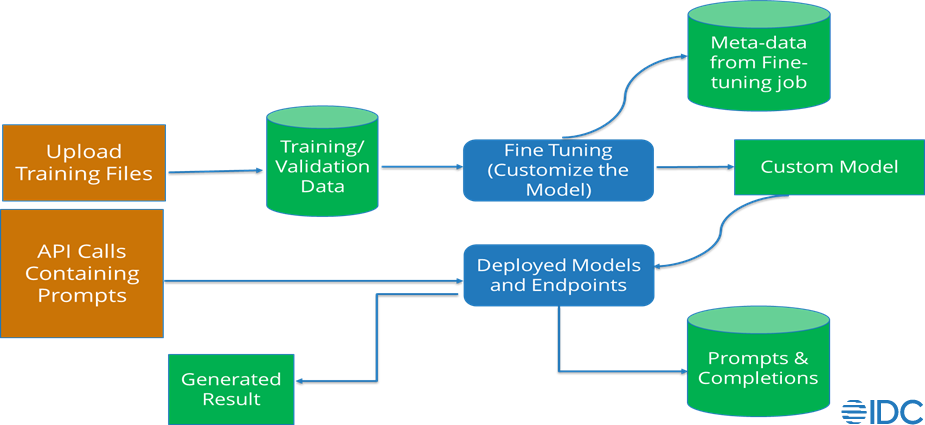
First and foremost, let’s start with definitions. What is Generative AI and where does OpenAI/ChatGPT fit within all of this? Generative AI is a branch of computer science that involves unsupervised and semi-supervised algorithms that enable computers to create new content using previously created content, such as text, audio, video, images and code.

ChatGPT (which stands for Chat Generative Pre-Trained Transformer) is a chatbot developed by OpenAI. ChatGPT is built on top of OpenAI’s GPT-3.5 family of large language models (LLMs) and is fine-tuned with both supervised and reinforcement learning techniques. It is being hailed as the smartest chatbot ever developed. OpenAI was founded in 2015 (initially as a non-profit organization) and early investors included Elon Musk & Peter Thiel. In 2019, it became a for-profit organization and inked a $1bn deal from Microsoft. This deal allowed it to use Microsoft’s Azure Cloud Platform for its research and development; and in return, Microsoft was given the first opportunity to commercially leverage early results from OpenAI’s research. OpenAI has a stated goal of promoting and developing friendly AI in a way that benefits humanity as a whole and is viewed as the leading competitor to DeepMind (acquired by Google in 2014 for $500M).

It is important to understand that while ChatGPT is a good example of generative AI technology, the market segment is much broader.  LLMs began at Google Brain in 2017, where they were initially used for translation of words, while preserving context. Since then, large language and text to image models have proliferated at leading tech firms like Google (BERT and LaMDA), Facebook(OPT-175B and BlenderBot) and OpenAI (GPT-3 for text, DallE-2 for images and Whisper for speech). Online communities (e.g. MidJourney), open-source providers (e.g. HuggingFace) and startups such as Stability AI have also created generative models. In Q4 this year, a spate of text-to-video models from Google, Meta and others have emerged. Generative models have largely been confined to larger tech companies because training them requires massive amounts of data and computing power. But once a generative model is trained, it can be “fine-tuned” for a particular content domain with much less data.  Today, Generative AI applications largely exist as plugins within software ecosystems.

The questions that technology and business leaders should be asking in terms of what Generative AI means for the enterprise are outlined below:

How will it be incorporated in existing enterprise technology environments?

  • Code Generation – GPT-3 has proven to be an effective generator of computer program code. GPT-3’s Codex program is specifically trained for code generation and works well when given a small function. Microsoft’s Github has a version of GPT-3 for code generation and is called CoPilot. The latest versions of Codex can identify bugs and fix mistakes in its code and can explain what it does occasionally. The goal for these tools is to not eliminate programmers but to make tools like Codex and CoPilot “pair digital assistant” with humans to improve their speed and effectiveness.
  • Enterprise Content Management – Vendors in the Headless content management space are incorporating these types of generative AI tools for both content generation and recommendations. This is to deal with the increased content velocity as additional forms of content are based on a single source generated by AI with human oversight.  It is not being used to write whole copy, but rather an outline for the content author to use as a draft.  In addition, there it is likely to impact GUI design in the form of “generative design” with the likes of Figma or Stackbit potentially including generative AI capabilities in as part of collaborative interface design engines.  
  • Marketing and CX Applications – Outside of the use of content generation for advertising and marketing along with the automation of marketing campaigns, the primary application for early versions of generative AI is in AI driven chatbots and agents for contact centers and customer self-service such as employed by Salesforce and Genesys, and these have initially delivered mixed results. However, this next generation of capabilities will mean a broader range of interactions, more accurate answers, and lower levels of required human interactions which will result in higher adoption and eventually more training data for the models. In the near future, generative AI will become more prevalent in the creation of personalized product recommendations through insight analytics, better and deeper customer segmentation as a steppingstone to true personalization and contextualization of experiences, and better understanding customer satisfaction and performance.  
  • Product Design & Engineering – It will also affect technologies in the product lifecycle management (PLM) and innovation space with the likes of Autodesk, Dassault Systemes, Siemens, PTC and Ansys continuing to build capabilities to enable design engineers & R&D teams to automate and expand the ideation and optioning process during early-stage product design, simulation, & development.  Generative AI design would allow options for engineering and R&D teams to consider in terms of structure, materials, and optimal manufacturing/production tooling.  For example, it would potentially suggest a part design that optimizes against factors like cost, load bearing, and weight. Generative design can also enable reimagining of product look and feel, often resulting in unique aesthetics and form that is not only more compelling to end users, but more practical and environmentally sustainable. Many of these vendors have attached their generative design offerings to additive manufacturing capabilities that are needed to realize these unique products.  Opportunities exist across multiple industries for generative design.  Automotive, aerospace, and machinery organizations can improve product quality, sustainability, and success, while life sciences, healthcare, and consumer products companies can improve patient outcomes and customer experiences.   

What are the pitfalls?

Generative AI, while providing lower-cost, higher-value solutions, has significant ethical and perhaps legal implications. There are significant questions over issues like copyright, trust and safety. Organizations must consider issues such as privacy and consent around data, reproduction of biases and toxicity, generation of harmful content, sufficient security against third-party manipulation, and accountability and transparency of processes. Neglect of AI ethics isn’t just a moral quandary – it is a significant business risk that means less trust, less control, and less ability to advance the models in an optimal way. Businesses must take a multi-pronged approach to AI from developer to end-user, first and foremost guided by a framework including principles that appropriately consider all ramifications of AI. Businesses should also choose models where techniques such as adversarial input (training against bad or manipulated data), benchmark dataset training (checking for biases via label tests), and XAI (explainable AI) are used. Finally, concerns with AI ethics are intrinsically linked to how accountability measures are enacted. Businesses should ensure they take a Human-in-the-Loop (HITL) approach to ensure minimal model drift, rigorous monitoring of output, and continuous improvement. AI must not be viewed as an independent, black box entity, but should rather be seen as human-computer interaction where optimal usage comes from deep understanding, meticulous monitoring, and striving for accuracy of the model.

How will it affect jobs?

At the end of 2020, the World Economic Forum (WEF) predicted that AI would displace 85 million jobs by 2025. The main jobs it identified under threat would be the likes of data entry clerks, administrative assistants, accounting and auditing professional amongst others. By the same timeframe, it predicted that 97 million new jobs would be created as AI becomes more mainstream in the enterprise. Growing job demand would focus on data scientists, process automation specialists, digital marketing and strategy experts as well as many other more roles. Generative AI means that we can add a new role to that list – prompt engineers. Basically, this role focuses on working out what to type into AI chatbots to get the best out of them. Some would expect these individuals to also deal with so-called ‘hallucinations’ – where Generative AI gets it completely wrong. These types of entirely new job descriptions highlight how an emerging technology not only displaces activities, but also creates new ones. The classic creative destruction principle initially outlined by Schumpeter. However, for business and technology leaders – it does require a dynamic and ongoing assessment of required digital skills including continuous gap analysis and roadmaps to ensure that the necessary capabilities are available to support the digital business of the future.

Moving forward, the best place to watch new and interesting generative AI use cases is in the start-up and scale-up space. The likes of Jasper (Copywriting), Stability AI (Visual art), DoNotPay (Legal Services), Omnekey (Creative Content), Paige.ai (Cancer diagnostics) and Mostly.ai (Synthetic data) showcase how quickly this space is fueling a range of game changing innovations across the industry – and potentially what’s around the corner for so many industries. It is incumbent on all of us to ensure that we approach this fascinating space with the right balance of curiosity and skepticism.

Philip Carter - Group Vice President, General Manager, Research AI - IDC

Philip Carter is General Manager and Group Vice President for AI, Data, and Automation research at IDC. In this role, he leads a global team of analysts focused on delivering IDC's research and insights at the intersection of AI, data platforms, and intelligent automation - three foundational areas shaping the future of technology and business. His work is centered on helping C-Suite executives make sense of the rapid innovation in the AI space, and drive meaningful transformation through data- and intelligence-led strategies. BACKGROUND Carter has held multiple senior roles at IDC across regions. Prior to his current position, he served as GVP and GM of IDC TechMatch, where he led a global team tasked to build and commercialize IDC's first AI-powered digital platform - focused on helping CIOs and procurement executives evaluate and source technology vendors leveraging IDC trusted intelligence. Earlier in his IDC career, Carter was the lead for IDC's Global Thought Leadership research function and was also Chief Analyst for IDC Europe, where he drove innovation in research related to digital transformation, emerging business models, and technology strategy at the C-suite level. Before that, he worked in IDC's Asia/Pacific region, covering software, services, and sustainability. Prior to joining IDC, he held various leadership roles at SAS Institute across EMEA and APAC in marketing strategy, product management, and business development. He is a recognized industry voice, regularly featured on platforms such as CNBC and Bloomberg, and quoted in leading publications including the New York Times. EDUCATION/INDUSTRY ACCOMPLISHMENTS: - Honors degree in Business Science, majoring in Economics and Law, University of Cape Town, South Africa.

The number of digital native businesses (DNBs), start-ups, and scale-ups has grown exponentially over the past decade and now represents a significant market cap. Despite the economic downturn, Digital Native Businesses should be on your radar as they drive economic growth, create new jobs, and foster innovation. However, their DNA differs from traditional organizations as they are completely cloud driven.

What is a Digital Native Business?

IDC defines Digital Native Businesses (DNBs) as companies built from the start around modern, cloud-native technologies, leveraging data and AI across all aspects, from product development to logistic operations and customer engagement. By leveraging new and emerging technologies, platform services, and marketplaces, DNBs grow and scale fast, disrupt industries, and create new markets.

DNBs set the pace when it comes to product innovation and development; they set new standards in customer intimacy and customer experience. As technology gives them their competitive advantage, even more important in today’s economic environment, they should be on every tech vendor’s radar.

Simone De Bruin, Research Director, Worldwide Digital Native Business, Start-ups & Scale-ups, IDC

DNBs encompass a wide range of both B2B and B2C enterprises, from food delivery to carbon sequestration to cryptocurrency. There are five defining characteristics of DNBs, distilled below as follows:

  1. Use tech as differentiator – they depend on UX-driven innovation cycles, and use tech to compete or to monetize their services and products. All core value and revenue-generating processes are dependent on digital technologies.
  2. Are born digital – they are cloud-native and data-driven and being digital is part of their DNA. They have a tech-driven operating model.
  3. Scale and innovate at speed – with tech-savvy developer and data scientist teams, DNBs aim for rapid growth.
  4. Have an ecosystem-centric approach – they are highly marketplace-driven and a DNB leverages its ecosystem of stakeholders to drive community-led innovation, dynamically evolve, and co-create offerings.
  5. Significantly funded – whether it’s venture capital, bootstrapped, or crowdfunded, DNBs enjoy a high degree of funding to support their ambitious growth ambitions.

Why it’s Important to Pay Attention to DNBs

Despite the economic downturn, DNBs should be on your radar. There is a number of reasons for this, but mostly it boils down to a combination of their innovative mindsets, focus on customers, and ability to rapidly scale, leveraging new technologies. Other factors that help set the trend:

  • The number of DNBs continues to increase, and the time it takes startups and scale-ups to grow into unicorn status decreases (average 6 years)
  • At the same time, traditional enterprises are fading as a concept as their lifespan decreases.
  • Compared to 2021, VC investments in 2022 have dropped. Over the longer term though, VC investments and startup initiatives have grown significantly. 2022 again broke records on fundraising levels as well as on dry powder (funds to invest) available.

The rise of DNBs has been set in motion two decades ago and they will continue to be a major source of innovation for some decades to come. The value that startups create is nearly on par with the GDP of a G7 economy. As Eynat Guez, co-founder and CEO of Papaya Global says, “Technology startups are more than catalysts for growth. They are the engine of growth itself. They solve problems no other sector is addressing with innovative thinking, thus pushing society forward – all while creating jobs, stimulating the economy, and attracting foreign investment.”

DNBs scale rapidly and can generate returns unparalleled to those in traditional enterprises. Vendors who aim to engage with DNBs in the traditional way will find it difficult to keep up with their fast-changing requirements. In addition, they represent different opportunities as well. IDC sees vendors engaging in three ways:

  1. Invest / Acquire – CVC invests in young & emerging startups, and scale-ups. For example, Salesforce Ventures, M12, Workday Ventures etc.
  2. Partner / Accelerate – Vendors partner with DNBs, start-ups, and scale-ups, or they engage with them through accelerator or incubator programs. Examples include SAP.io, and IBM Sustainability Accelerator.
  3. Sell-to – Focused on a commercial relationship where DNBs, startups, and scale-up are a new customer segment.

Although there is a fair amount of overlap between these categories, many initiatives are still disconnected and siloed. Vendors should take a more holistic approach to engaging digital native businesses to build longer relationships, partnerships, and commercial relationships. Once a vendor is clear on the type of engagement, vendors need to assess what type of DNBs fit that purpose. The following segmentation looks at the DNB business model:

IDC distinguishes:

  • Technology Providers. Providing third-party organizations with next-generation technology products or services (e.g., a chatbot for enabling better customer experience in retail banking, a SaaS tool for analyzing space imagery).
  • Technology Enabled – B2B. Offering products or services to businesses where those services are enabled by next-generation technologies at the core (e.g., a B2B e-commerce company connecting businesses with suppliers and manufacturers or a B2B trading platform for SMEs to source products from distributors and wholesalers).
  • Technology Enabled – B2C. Offering products or services to consumers where those services are enabled by next-generation technologies at the core (e.g., a car-sharing service enabling consumers to book and locate cars on the fly using an app, a social network for dating, a video-streaming application).

Vendors will look to identify, or recruit, technology-oriented DNBs to invest in, or partner with. The B2C and B2B types of DNBs are more likely a new customer segment. Vendors who want to engage with the next Snowflake, Uber of Instacart need to first be able to identity what type of opportunity they provide, and then have the system in place to cherish and nurture them to grow. 

Taking this segmentation one step further, the following subsegments can be distilled to look at high-growth opportunities. Each category within the DNB landscape consists of various functional markets. These functional markets are not mutually exclusive. Metaverse (tech-driven) solutions will impact the (tech-enabled B2B) retail industry that eventually effect the (tech-enabled B2C) consumer tech in fashion for example.

Source: IDC, 2022. This market glance highlights some of the largest (either unicorn, or recently substantially funded) Digital Native Businesses per segment, illustrating the type of vendors that play in each category. Company selection is up to analyst discretion.

The lifeblood of the Future Digital Economy

DNBs are the lifeblood of the future digital economy. With growing investments in digital natives and an exponential growth of companies born in the digital age, digital natives start to command a sizeable portion of tech spend. However, that tech spend will differ for each of the different categories as defined by IDC. ​As DNBs exert a strong influence on the market, they should be on the radar of any tech provider. Tech is their key competitive advantage. Even during an economic downturn, they are not likely to downsize their IT investments. However, to get traction and increase engagement there is great value in understanding their business operations, what enables their success, and what their IT requirements are.

  • If you’d like to learn more check out our latest research here, or contact Simone de Bruin, Research Director, WW Digital Native Business, Start-ups & Scale-ups
  • At the moment we are collecting data from digital native businesses. So, if you are a startup, scale-up, or mature digital native business and would like to participate in our research – and receive our CEO tech book as a thank-you gift, please click this link to participate!

“Humanity has a choice: cooperate or perish. It’s either a Climate Solidarity Pact — or a Collective Suicide Pact”.

COP27, held in Sharm El Sheikh, Egypt, in November 2022, began with this sobering opening statement from UN Secretary-General António Guterres. It set the mood for the two-week conference, which fell well short of meeting its targets. According to the Economist, “There is no way Earth can now avoid a temperature rise of more than 1.5°C. There is still hope that the overshoot may not be too big, and may be only temporary, but even these consoling possibilities are becoming ever less likely.”

Governments need to keep investing to tackle climate change, but they now also need to invest to increase our collective resilience. Since COP26 in 2021, not only has the geopolitical environment changed significantly, but the increase in global temperatures, causing wildfires and flooding, has reminded us of the heavy cost of inaction.

While people expect decisive action from their governments, their leaders seem overwhelmed with different priorities and planned investments.

A Real Test of Leadership

This year, 130 developing countries succeeded in their attempt to add the notion of “loss and damages” to the official COP27 agenda. But with COP now over for another year, that looks like the only success in 2022. Even that still needs to be ironed out, however, and it should also be remembered that it only tackles the consequences and not the causes.

Mahmoud Mohieldin, UN Climate Change High Level Champion for Egypt, reminded us that global warming is not only about changing the way we produce and consume energy, but also about the way we produce food. “Transforming food systems could release back the $12 trillion the world spends on the hidden cost of food, from transportation to fertilisers,” he said. “We could also eliminate nearly all of the 8.5% of emissions that come from agriculture.”

There are many reasons why such important matters were not intensively discussed at COP27, but we believe one of them was the lack of global leadership.

If no leader stands out when there is so much to coordinate and activate, the transformation must come from cooperation and greater transparency in the promises made to lower our emissions and our dependence on fossil energies.

COP28: Climate Data for the Common Good

Next year’s COP will come at the same time as the first report since the Paris Agreement of 2015, as the final biennial reports for developed countries will be multilaterally assessed to complete the final IAR cycle during 2023–2024. It’s hard to believe that the direction set in 2015 — to limit global warming to well below 2°C and preferably to 1.5°C — will be reached by then. It’s also hard to think that we will have concrete data to rely on by then.

Some initiatives with data transparency at their core have already been implemented. We think of the Climate Data Steering Committee, the EU’s Corporate Sustainability Reporting Directive and the One Data Hub. By the time these reporting mechanisms are live, there will be more data to track and report, including the loss and damages funds agreed at COP27.

These reports include the same KPIs and data format to follow up on, however. One goal for government executives will be to agree on a data format for each component of climate change, which will need to be transparent for citizens so that they can hold their governments to account.

Philosopher Günther Anders once explained the notion of the Promethean gap, which refers to the incapacity of the human brain to perceive the danger it might encounter. At the beginning of 2022, IDC revealed that the number 2 challenge for governments when attempting to become more sustainable was the lack of IT tools to measure the impact, which was almost as challenging as the lack of funds. If we need concrete data before we take action, it’s time to understand that when it comes to “cooperate or perish” it’s not too late to make the right choice.

Remi Letemple - Senior Research Analyst, IDC Government Insights - IDC

Remi Letemple leads IDC’s Worldwide Sustainable Transportation and Smart Vehicles Strategies service, where he provides strategic guidance and thought leadership on the future of mobility and transportation. Operating at a global level, he is recognized as a subject matter expert in smart mobility and transportation technologies—including connected, autonomous, shared, and electric mobility—enabled by software-defined vehicle (SDV) architectures, over-the-air (OTA) updates, cloud and edge platforms, and AI, including generative AI.

At IDC Cloud Pulse, a quarterly survey that takes in views from up to 1,700 cloud consumers, we have been tracking how companies are being impacted by, and how they are responding to, macroeconomic trends. We then consider how this relates to the consumption of cloud. Questions around Inflation and Energy Costs were added to our survey first in Q1, 2022. The Possibility of a Recession was new in Q3. And we will now be adding Recession into future surveys.

These new additions tell a story about the challenges businesses have had to endure over this last year. Not as much, however, as the responses we received when we asked about the likely impacts to businesses.

Source: n = 1,700 Source: QP1 3Q22 Cloud Pulse Survey, September 2022, IDC

Each quarter companies are asked what events are most likely to cause disruption to their business over the course of the year. They can respond using a sliding scale of 0-10 with 10 being the highest amount of disruption. The above results show only those responses between 8-10 (what we would consider as ‘high impact’).

During Q1 and Q2, not too many more than a third of companies said they felt they were experiencing major impacts from the macroeconomic trends we asked about. In Q3, this rose to around a half.  Inflationary costs were seen across more of the business, energy price rises became a reality, and national and global recessions became less likely to avoid. At the same time, markets still battled ongoing supply chain challenges, in part brought on by continued to reactions to the COVID pandemic. Many of these impacts are intertwined, making the current macroeconomic landscape even more difficult for companies to navigate.

IT Budgetary Impacts

During Q3, for the first time, we saw companies shift towards a more pessimistic view of the business environment. Early indications from our Q4 data suggest we will see even higher rates of pessimism moving forward.

This pessimism impacts budgets. Cloud makes up around 31% of IT budgets – this is up only slightly from around 30% seen in Q4, 2021 despite previous years showing higher annual rates of growth in terms of cloud as part of IT budgets. The real challenge is, however, that IT budgets are decreasing when viewed as a proportion of overall company revenue. As we know, company revenue is also being challenged (and where it isn’t, margins are suffering from increased costs).

Source: IDC, 2022

If we focus on the area of inflation – where we see some of the earliest impacts on industry in terms of economic stress – we gain valuable insight into why we are seeing budgetary constraints across IT. Companies operating or consuming a cloud environment first felt inflationary pressure in the form of increased professional services costs, and then application software subscriptions. These are two areas where companies are more likley to operate with rolling monthly contracts.

During Q3, we started to see more companies (25%) saying they could now see increases across private cloud infrastructure (most likely brought about as a result of increased equipment and energy costs). Internal skills costs were also a major challenge.

Public Cloud as a Response

Responding to these challenges, a quarter of respondents said they will be looking to migrate more of their environments to public cloud/ Software-as-a-Service. Around the same amount again (23%) said they will be looking to find reductions for spend across their cloud estates.

With almost a fifth (18%) of respondents saying they are still waiting to assess the impact of inflationary pressures, these figures could grow.

Cloud Pulse findings also show that the number of companies that say they are ‘Public Cloud First’ when it comes to their cloud adoption strategy is more (32%) when companies say they are directly impacted by inflation compared to just 21% for those that are not.

Note, the rate of Public Cloud First companies has been decreasing annually. Q3 marks an increase overall in the number of companies relying on Public Cloud before taking a hybrid approach – though hybrid remains the number-one approach to adoption).

Qualities that Count

Another shift is in the qualities companies are now requiring of their cloud providers. In Q3, 2020, the most important Company Attribute sought by cloud consumers was a global/international footprint. What companies now seek are providers they can label ‘trustworthy’.

In this case, Trustworthy relates to a provider’s ability to be reliable and responsive, to meet contractual requirements, to be transparent about pricing and to keep promises made to the business (we did ask). During this time of macroeconomic uncertainty, customers also want to work with technical experts that can deliver services at speed with guarantees along the supply chain.

We also see shifts in what companies require in terms of cost and pricing. In 2020, the focus was on flexible payment terms and enterprise-wide agreements. Now it is more about flexbile licencing and credits that allow companies to move their applications and workloads across cloud and even non-cloud environments as they require.

Many companies know their business could have to alter the way they consume and gain access to IT over the coming year. Where rising costs – from inflation or energy increases – are already felt the requirement for flexibility gives way to predictable pricing,  with many IT departments focussing more on cost optimization and forecasting.

Many cloud vendors have already started to notice these shifts across their own businesses, from customer conversations they are now having to the budgtary bottom line. Those who will succeed will be those that can quickly pivot and reinvent solutions – in particular with the right financial models.

Companies want to continue to benefit from cloud as they navigate uncertain times but companies will be more selective about what they are deploying and how over the coming year. Many will be taking stock on current digital transformation agendas and application portfolios to create leaner, more efficient, IT responses to current business needs.

For more on these key cloud trends, including how individual providers aligned to current market sentiments and needs, ask further about IDC’s Cloud Pulse data. Cloud Pulse’s rich insights cover a range of cloud topics from deployments to application landscapes, vendor selection, ROI and more.

As business across many industries struggle with supply chain disruptions, rising energy costs, talent constraints, and pressure to improve sustainability metrics, achieving operational excellence and resilience continues to be challenging. According to results in IDC’s recent Worldwide Future of Operations Survey, only about half of survey respondents saw improvement in operations over the past two years. In last year’s survey, 70% of respondents reported improvement.

Recognizing the need for new approaches and new technologies, IDC has developed the Data-Driven Operations (DDO) framework and maturity model. It helps organizations benchmark themselves and develop plans to improve operational performance across multiple dimensions – efficiency, productivity, quality, safety, reliability, and sustainability.

Becoming a data-driven organization is a journey that requires an honest assessment of current state and a willingness to embrace the changes necessary to improve operational performance.

The next five years will be transformational for operations as organizations find new and more effective ways to manage, analyze, and collaborate around their operational data. The impacts will extend beyond the data, impacting how decisions are made and who makes them. It will also impact which roles are needed, who fills those roles, and how organizations manage their operations.

The following 10 predictions delve in into some of the coming changes. From resources and talent to emerging technologies to the increased emphasis on sustainability, IDC predictions explores the implications and the timeline of major aspects of DDO.

Top 10 Predictions: Future of Operations

  • Prediction 1: By 2025, 50% of G2000 industrial organizations will make real-time decisions balancing economic and sustainability metrics, simultaneously improving both sets of metrics by 5% across the enterprise.
  • Prediction 2: By 2026, 40% of product-centric organizations will use digital tools to measure life-cycle carbon footprint, creating demand for better integration between PLM and operational data.
  • Prediction 3: By 2023, talent shortages and pressure to improve operational performance will force organizations to reevaluate their approach to digital transformation, resulting in greater use of outside services.
  • Prediction 4: By 2027, the use of extended reality technology, including AR/VR/MR tools, will increase by 40%, creating a new breed of digital worker and reducing operator/field worker errors by 30%.
  • Prediction 5: By 2026, the use of robots in nontraditional sectors, most notably remote inspection and maintenance, will increase by 35%, resulting in a 50% drop in inspection errors.
  • Prediction 6: By 2023, digital-first operations enabled by 5G connectivity will improve worker safety, resulting in a 20% reduction in lost time accidents.
  • Prediction 7: By 2027, 50% of remote operations will use satellite-enabled AI/ML technology to collect and analyze data at the edge, reducing costs and improving yields and energy usage in the natural resource sectors.
  • Prediction 8: By 2024, the cloud will surpass on-premises infrastructure as the primary location where operational data is stored, managed, and analyzed for 50% of G2000 organizations.
  • Prediction 9: By 2024, 30% of industrial organizations will have become leaner and more agile than their competitors as a result of making real-time operational insights available anytime, anywhere, to anyone.
  • Prediction 10: By 2025, 50% of organizations will increase the use of IoT and OT cybersecurity solutions at the edge, cutting OT cybersecurity breaches in half.

Interested in learning more? Watch our on-demand webinar, IDC FutureScape: Worldwide Future of Operations 2023 Predictions.

Extending and opening innovation, collaboration, and operation with partners across an ecosystem inside and outside any given industry has become a critical strategy for executives and their organizations.

CEOs and executive leadership recognize the critical supporting role that industry ecosystem partners play in ensuring the growth and stability of their businesses. Opportunities, disruptions, and delivering upon customer needs quickly with a high level of quality are complex pursuits and having a flexible industry ecosystem of partners — an on-demand set of talent, resources, and capabilities — is an important element of the digital-first organization.

According to IDC’s 2022 Future of Industry Ecosystems Global Survey, the next step in the industry ecosystem journey is to incorporate partners from outside the core industry, learn best practices, and add assets, resources, and knowledge that may not be present within a business’ own core industry.

The world and each industry landscape are too complex, dynamic, and disruptive for any one organization to address on its own. The pace of innovation makes it difficult for organizations to keep up. As such, every organization needs an external source of data, insights, applications, operations, and expertise to complement and grow their business. Expansion, collaboration, and innovation with industry ecosystems has become the next phase of digital transformation for every organization.

IDC’s top 10 predictions for the Future of Industry Ecosystem in 2023 are:

  • Prediction 1: By the end of 2023, organizations that share data, applications, or operations with their ecosystem partners through joint ventures will increase profitability by 5 percentage points.
  • Prediction 2: By 2028, consortium-based DAOs will be the de facto standard for complex industry ecosystem ventures that involve a combination of process, application, and data sharing for new revenue growth.
  • Prediction 3: By 2025, 60% of intercompany shared applications available on industry clouds will be built on blockchain technology, enabling a robust Web3 foundation for industry ecosystem activities.
  • Prediction 4: By 2024, although 80% of global organizations will leverage on-demand resources in industry ecosystems to improve supply chain logistics, only 40% will improve profitability.
  • Prediction 5: By the end of 2026, 40% of G20 governments will promote the global data economy through funding of technology infrastructure, enablement of legal provision, and active participation in data spaces.
  • Prediction 6: By 2025, 60% of G2000 organizations will form cross-ecosystem ESG teams that are accountable for sharing of data, applications, operations, and expertise that facilitates sustainable ecosystem practices.
  • Prediction 7: By 2023, only 20% of metaverse experiments for industry ecosystems will succeed, as organizations continue to evolve their ability to deliver products and services in a blended physical and digital way.
  • Prediction 8: By 2025, 25% of organizations that do not share operations and expertise across their industry ecosystems to address talent shortages will struggle to remain viable or be acquired.
  • Prediction 9: By 2027, 60% of industry ecosystems will be driven by regulations for data, IP, and cloud that require standards to be collectively adopted to ensure digital sovereignty and reduce cross-border risk.
  • Prediction 10: By 2024, organizations that automate IT processes for data model and application development as well as sharing across their industry ecosystems will deliver products and services 30% faster.

Interested in learning more? Watch our on-demand webinar, IDC FutureScape: Worldwide Future of Industry Ecosystems 2023 Predictions.

Jeffrey Hojlo - Research Vice President - IDC

As Research Vice President, Future of Industry Ecosystems, Innovation Strategies, & Energy Insights at IDC, Jeff Hojlo leads one of IDC's Future Enterprise practices at IDC - the Future of Industry Ecosystems. This practice focuses on three areas that help create and optimize trusted industry ecosystems and next generation value chains in discrete and process manufacturing, construction, healthcare, retail, and other industries: shared data & insight, shared applications, and shared operations & expertise. Mr. Hojlo manages a group focused on the research and analysis of the design, simulation, innovation, Product Lifecycle Management (PLM), and Service Lifecycle Management (SLM) market, including emerging strategies across discrete and process manufacturing industry such as product innovation platforms and the closed loop digital thread of product design, development, digital manufacturing, supply chain, and SLM. He also manages IDC's North American Energy Insights group, with a focus on key topics such as energy transition & sustainability, distributed energy resource management, and digital transformation in the Oil & Gas and Utilities industries.

This year’s Enlit Europe, which took place between November 29 and December 1 in Frankfurt, attracted almost 18,000 visitors and 1,000 exhibitors from 100 countries — proving once again to be a reference point for the European (if not worldwide) utility sector.

Sessions on flexibility, energy transition, and digitalization, as well as numerous hub sessions, provided a great opportunity for knowledge sharing during the three-day event. Here are our key takeaways from discussions and debates with technology providers and utilities.

  • European power DSOs are feeling the pinch due to accelerating demand for electrification and distributed generation. One DSO from the DACH region we talked to said it expects requests for PV connections to increase fourfold this year over 2021 in power terms. A Scandinavian operator said it needed to deploy as much capacity by the end of the decade as it had built over the past century. This was expected, of course, as distribution is where most of the energy system transformation is taking place. But things have now spread to a large and diverse cross-section of the power distribution world and DSOs don’t want to become the bottleneck of the energy transition. Distributors urgently need tools to shed light on the LV level of their grid — for planning, operations, and maintenance purposes — and marketplaces to access and procure flexibility in coordination with fellow DSOs and TSOs.
  • Despite the events of the past 10 months, consumers still appear to be an afterthought for most energy suppliers and utilities (and numerous governments) across Europe. With energy and related energy costs top of mind for most customers, it was a great opportunity for companies to create awareness and educate customers on the energy transition, and the critical role they play in making it a reality. But that opportunity has been squandered, with companies failing to deliver on what matters most to customers: high-bill alerts and personalized, meaningful energy efficiency advice. Due to skyrocketing energy prices, energy suppliers are significantly worse off than before in terms of customer satisfaction and net promoter scores. By failing to support customers at a time of need, utilities have failed to change the narrative around them and become trusted energy advisors in the energy transition.
  • As the energy transition accelerates, partnering and co-innovation are becoming critical tools to accelerate the development of solutions designed to respond to this acceleration. These are no longer buzzwords on slideware. Co-innovation between utilities and solution providers is happening on the ground and it is slashing time to market by a factor of three on average. There are hardly any strategic product initiatives by established software providers in this space that are not driven in cooperation with a carefully curated group of end users, leveraging design thinking and agile principles. Partnering between the incumbent enterprise and operational software vendors in the utilities space and their specialty counterparts has also accelerated significantly, offering a new procurement paradigm that combines what we call a platform approach to operations with a new wave of best-of-breed.
  • The industry mantras of electrification, decarbonization, and energy transition continue to be recited despite the impact of the ongoing energy crisis. While the criticality of climate change can’t be neglected, it appears to some extent that the energy crisis has dampened the urgency for some companies and the industry as a whole to invest in making grids reliable for what’s to come. This is a concern, as some areas are already at risk of bottlenecks, as uptake of EVs, heat pumps, etc. increases. There are numerous European initiatives to foster electrification, such as “Fit for 55,” which will end the sale of new CO2-emitting cars in Europe by 2035, and “REPowerEU,” which aims to install 50 million heat pumps by 2030. But this begs the question: Where are we going to get all this power from”

The overall impression is that of an industry chugging along, conscious that it can’t do it alone and increasingly reliant on its partners and innovation with other sectors. We have seen pockets of real disruptive innovation, but for the most part the industry feels a bit weary, and understandably so.

Here’s to brighter times when we meet in Paris at next year’s Enlit Europe.

Developing compelling content, messaging, and campaigns that engage your target audience and move your prospects and customers along the buying cycle is not a simple task. In another IDC blog post, we discuss the challenges of a hyperaware buyer, with a decreased attention span. It’s a time and cost struggle to create the varying content that your buyer is looking for at each stage of their journey.

An effective way of obtaining content for your marketing messaging is by licensing it from a research company. With this method, you obtain digital distribution rights to the research document so you can share it with your target audience in various marketing formats. Licensed content reach can be easily extended if you distribute it across multiple channels, in a variety of media, such as, data graphics, quotes, blogs, animated infographics, short videos and social media posts.

Benefits of Licensed Content

  • Lower cost
  • Short time to market (generally 1-2 days to delivery)
  • Analyst insights

Customized content is a more approachable way to building your content calendar. It involves leveraging expert opinion and adapting research into content that includes customized insight and commentary from an industry analyst that validates your marketing messages. Customized content will often come in the form of a white paper or industry spotlight.

Benefits of Customized Content

  • Developed around your message
  • Created for multiple formats
  • Flexible pricing
  • Leverage the brand equity and trust associated with the research

Marketing programming and operations have undergone a paradigm shift to focus on whole journey marketing, extend into post-sales loyalty, advocacy, and renewal, connect storytelling and content across connected channels, and blend digital into all marketing programming. To serve the digital-first customer, content needs to evolve to meet the needs of a buying cohort and support their full journey, rather than islands of episodic content creation we experience today.

Start with a deep assessment of your end-to-end content marketing practice including evaluating: strategy, talent, organization, governance, business processes, data and enabling technology.  The assessment will inspire a prioritized roadmap to systematically address gaps, challenges and opportunities. Licensed or customized content can fill in the gaps where gaps, such as talent and data, are identified.

To learn more about licensing or customizing IDC’s research content and how to leverage our global analyst insights, contact us today.

Watch our latest webinar where we introduce a new model for marketers and sellers to work within, for lead generation, customer creation, and value management efforts.

Introducing a new lead generation service! To make it easier for marketers to gain the most value of their IDC MarketScape and truly drive qualified leads, we have worked with Foundry to create an enticing lead generation package leveraging their media brands that capture proven customer engagements.

Digital businesses depend on digital infrastructure – compute and data management horsepower; network connectivity; operational support; and management – to power business applications, analytics, and activities.

What comprises digital infrastructure?

It includes dedicated on-premises datacenters and edge systems, as well as shared public cloud services. It spans compute, storage, network, infrastructure software (including virtualization and containers) and the automation, AI/ML analytics, and security software and cloud services needed to maintain and optimize legacy and modern applications and data. Ecosystem partners, including systems integrators and channel partners, are also important contributors to the future of digital infrastructure.


IDC’s research shows that 80% of decision makers worldwide recognize that digital infrastructure is important or mission critical to enabling the achievement of business goals.


Organizations that can best optimize multicloud and hybrid digital infrastructure environments consistently realize higher levels of operational resiliency, security, revenue growth, and overall productivity at scale. This IDC FutureScape highlights key trends for the future of digital infrastructure that will have the greatest overall impact and presents the top 10 predictions and key drivers for the next five years:

  • Prediction 1: By 2026, 65% of tech buyers will prioritize as-a-service consumption models for infrastructure purchases to help restrain IT spending growth and fill ITOps talent gaps.
  • Prediction 2: By 2026, 65% of IT organizations will only purchase infrastructure solutions that incorporate predictive cyber-resiliency mechanisms proven to reduce post-cyberintrusion recovery efforts.
  • Prediction 3: By 2027, AI-enabled automation will ensure consistent digital infrastructure configuration, performance, cost, and security by reducing the need for human operations intervention by 70% and improving SLOs.
  • Prediction 4: By 2023, amid ongoing IT supply chain disruptions, 80% of G5000 infrastructure customers will adopt proactive multisourcing strategies to protect themselves against future IT supply risks.
  • Prediction 5: By 2024, 40% of digital business apps will depend on contractually guaranteed cross-provider data transfer and operational/financial data sharing agreements between public clouds and on-prem tech partners.
  • Prediction 6: By 2026, 95% of companies will invest in fit-for-purpose, heterogeneous compute technologies that deliver faster insights from complex data sets to drive differentiated business outcomes.
  • Prediction 7: By 2025, 70% of the G2000 will prioritize the trusted infrastructure of sovereign clouds to ensure consistent security and local/regional regulatory compliance for specific sensitive workloads and data.
  • Prediction 8: By 2025, to ensure data and workflow integrations spanning distributed clouds and edge environments, 50% of enterprises will deploy multicloud networking, bringing consistency and simplicity to NetOps.
  • Prediction 9: By 2027, the need for faster, higher-quality data-driven decisions will cause 80% of G2000 CIOs to mandate companywide data logistics strategies for data management, protection, and integration.
  • Prediction 10: By 2024, due to economic pressures, 50% of G2000 will prioritize infrastructure vendor selections based on tech partner ecosystems that offer cost savings provided by preferred pricing and support deals.

Interested in learning more? Watch our on-demand webinar, IDC FutureScape: Worldwide Future of Digital Infrastructure 2023 Predictions.

Mary Johnston Turner - Research VP - IDC

Mary Johnston Turner is Research Vice President within IDC's worldwide infrastructure research organization and global research lead the Digital Infrastructure Strategies practice. Mary's coverage tracks enterprise tech buyer sentiment related to compute, storage, edge, operations and cloud platforms and deployment models. Current research priorities emphasize the impact of rising requirements for data-driven AI-Ready Infrastructure, Fit-for-Purpose Hybrid and Multicloud Architectures, Autonomous Operations, Edge Integration, and collaborative business and IT governance. Her practice emphasizes the voice of the enterprise customer, based on surveys and in-depth analysis of best practices and infrastructure investment priorities. Mary's research emphasizes consideration of topics related to AI-ready infrastructure, tech debt avoidance, data center modernization, mainframe modernization, infrastructure governance, staffing and skills priorities, and infrastructure operating models. Within the infrastructure research organization, Mary collaborates with other practice leads to ensure coherency and alignment of insights and published research.