This year, the UNHCR announced that the number of people forcibly displaced exceeded 100 million globally for the first time on record. This means 1 in every 78 people has been forced to flee their homes. The number of people displaced, internally or externally, from weather-related disasters, famine and unemployment is also rising. The Institute for Economics and Peace (IEP) estimates that there could be 1.2 billion climate refugees by 2050.

A proactive approach is needed to help manage this perennial challenge and to improve the lives of refugees. Or, in the words of the Mayor of Warsaw, Poland, “it is time we phased out improvisation and instead created a strategy for coping and appropriate systems for helping refugees.”

To create more effective and empathetic systems for refugees, governments and their partners should consider taking a life-event approach. The life-event approach to digital service delivery includes bringing a range of services together to coincide with a particular event, such as a birth, marriage, and death. Rather than people having to reach out to a variety of agencies to access different services, governments can integrate information and resources to provide these services in a more seamless way.

More mature approaches also include service coordination and data exchange across agencies as well as with private sector and civil society organisations.

Some governments, including the US Federal Government, have started to take a life event approach to disaster response, from floods to wildfires. These sudden and unplanned life events require citizens and residents to access services from several agencies and require a more empathetic and personalised approach.

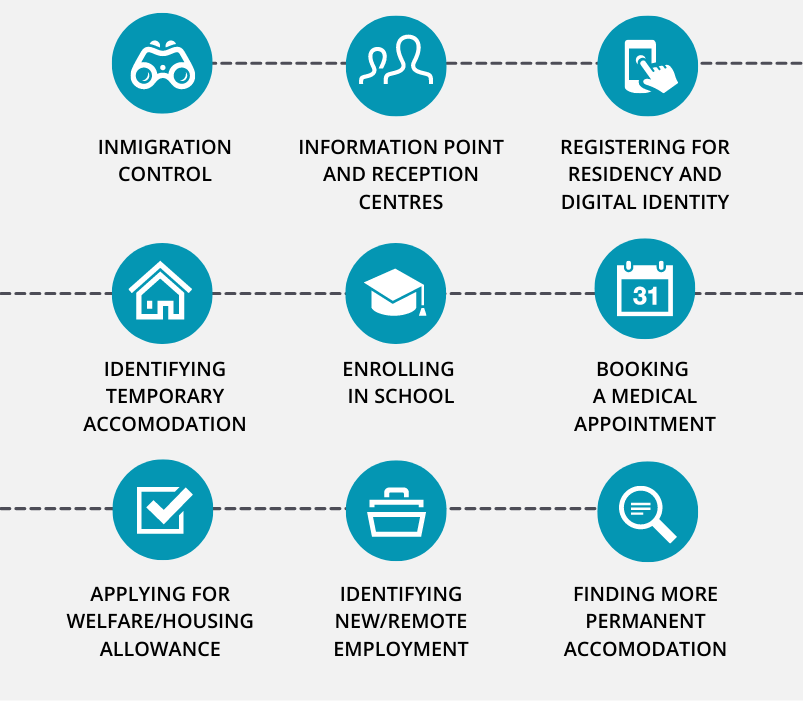
The same can be applied to the arrival of a refugee. When refugees arrive in a new country, they generally need to register for residency and digital identity, whether through the government or an NGO, and need immediate access to food, cash programs, and shelter. These short-term needs then morph into longer terms needs, including accessing healthcare services, education, and the labour market.

Taking a life event approach and bundling these services together can help to make often bureaucratic systems and services easier to navigate. This is even more important for vulnerable populations in a time of need and uncertainty. It can also improve efficiency, save time, and reduce costs for government agencies.

For example, in New Zealand, the government created SmartStart, a cross-agency online service to help parents navigate government services around the birth of a child. In its first year, the service resulted in 6,000 fewer visits to the Ministry of Social Development and has been well received by parents, midwives, and NGOs.

However, this should not be seen as a replacement for face-face support when needed. Some groups of refugees, such as unaccompanied minors or people with cognitive or physical disabilities, may require additional specialised and hands-on support from governments and NGOs

Source: IDC 2022

The Government of Portugal is leading the way in providing joined-up services for refugees. The Borders and Immigration Service has set up the Temporary Protection Regime for Ukrainian refugees. When Ukrainian refugees register through the online portal or in person, they receive identity numbers from key agencies including a tax identification number, social security identification number, and a national health service user number so that they can access key services.

Providing integrated services organised around planned or sudden lifetime events comes with its own challenges. It requires governments to set up the right governance mechanisms to collaborate across departments, share data in a secure and trusted way, and share budgets to enable integrated service delivery.

This is no small feat and requires a strategic approach and strong leadership, but there are examples of governments successfully overcoming these barriers.
National and local governments and international institutions looking to improve the lives and livelihoods of refugees should embrace this approach.

Leveraging technology for humanitarian purposes — HumTech — will require the right political motivation and leadership to turn refugee management from an ad hoc response to a crisis to a more systematic response to a perennial challenge.

For more information about technology and it’s impact on refugees:

To explore more of our coverage, please visit our Government Insights page.

Get in touch:

In this session of the Digital Leaders Community, we had experts from Nutanix and IDC Metri on hand to share their experience with the community.

The interactive session started as usual with a roundup of the reasons attendees from the community had joined. There was a variety of interests among the digital leaders from around Europe including one company that has made the decision to move to the cloud, some that have plans based on the maturity of different workloads, and others that wanted to hear about peers that have already moved to cloud.

One public organisation told how it had become completely cloud based. Did it save money? The attendee commented on the need to make sure the CFO and finance team understood that opex would increase. There is a need to make sure finance sees the savings as well. They talked about the datacentre no longer being needed, so that space can be used as offices. It was concluded that FinOps is tricky, but especially important as it is hard to forecast costs as more people move to cloud.

Nutanix has many customers moving to cloud, and sees how cloud costs have evolved for clients. The expert from Nutanix, Steen Dalgas, in particular has been helping companies figure out the TCO of cloud and other environments. Cloud is great for companies in innovation/growth mode — to rent capacity when you don’t know what parts will work. It is better to keep mature areas on-premises, as it is much more cost effective.

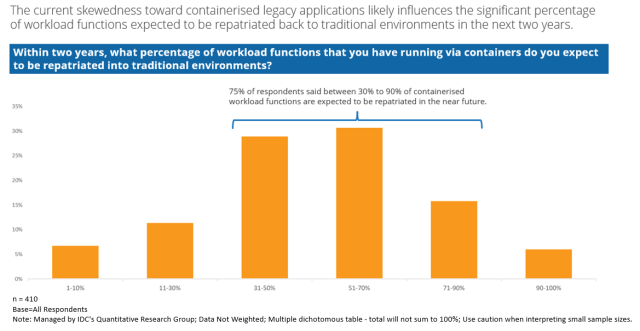
You can compare with on-premises with infrastructure as a service (IaaS). Platform as a service (PaaS) is quite different, and is hard to compare with on-premises. It is also extremely hard to repatriate from PaaS. The majority of cloud use now is IaaS, but PaaS will start to become more dominant.

A word of caution — the attendees mostly agreed that “By moving to the cloud, you don’t get rid of problems, you just move them somewhere else.

There followed a discussion on cloud-related skills. One attendee noted that they are outsourcing the skills they need to core suppliers. Some people feel more secure in the cloud than on-premises. However, cloud provides an opportunity for people to be lazy — sloppy code with data leaks was the example — that is a problem on-premises that in the cloud can become very expensive very quickly.

There is major demand for FinOps — managing the different environments, figuring which workloads to use in which environment. And this is a key skill along with the software skill of internal cloud governance; what users buy from the cloud on company credit cards can be significant if they don’t understand the issues in terms of variable costs and security.

The meeting discussed whether you could prohibit people from using the cloud, or do you educate people about costs and let them get on with their work? You need to monitor cloud bills very closely, to educate people, and you need people with knowledge of cloud biz models. There is always a need to ask many questions about the cloud invoice and figure out what’s happening internally.

One suggestion was that line of business people need to be aware that what they do costs money. Ideally, make sure costs come straight back to users. This can be done by tagging cloud resources with an app name, environment name, or resource tag so you know who is using what and how much it costs. One comment was that unfortunately sometimes even IT doesn’t know how the cloud business model works. ­­


Two years ago, one global bank said it would move out of datacentres. Now it says it will keep DCs in major global centres but make them a cloud-like experience. One attendee related how their company tried a shared private cloud, but consider it as on-premises. They can control a lot, but don’t need to pay for the whole thing when capacity is not used.

The IDC CIO Advisory team would like to thank everyone who came to the call for their input. It is always inspiring to hear from those making changes in their business and taking the tough calls with their management colleagues. We hope this session was valuable and provided many takeaways for you.

If you already receive invitations to our sessions, I hope to see you there. If you would like to join this community, please email Marc Dowd mdowd@idc.com.


IDC Digital Leadership Community: Topics 3Q22

Brainstorming Out of the Box

Thursday, August 25, 2022, 17:00 CET

Sometimes doing something unexpected can really pay off. This is true of being a digital leader, just as it is for disruptive innovation.

In this light-hearted but serious session we will look at the “hacks” and experiences that we collectively can share. We will be dealing with subjects in all areas from leadership “masterstrokes we have witnessed” to unusual policies that work:

In this session you can expect:

  • Amusing anecdotes with a deeper meaning
  • Car crash policies and how to avoid them
  • The heroes of digital leadership, and why we think they are great

Data and Analytics/Data Culture/Data Management Technology

Thursday, September 29, 2022, 17:00 CET

I for one thought it would never happen: IDC research shows that organisations are looking to move to being data-driven. I see movements among my clients to gather all the data in the organisation that is relevant and make it available.

Is the dream coming true? Are we moving to a world where data will at last come into its own and become the “new oil”?

In this session, we will discuss how to move towards a better use of data. Topics will include:

  • Developing trust in data — is that the key?
  • Governance of data
  • Managing the complexity of data initiative
  • The security and sovereignty issues around the use of data

We hope you will join us. Please feel free to suggest digital leaders who might benefit from these discussions.

https://www.idc.com/eu/digital-leadership-advisory

Marc Dowd - Principal, Client Advisory - Research and Consulting - IDC

Marc Dowd is the principal for IDC’s European client advisory practice. Dowd has over 25 years of experience working with the leaders of corporate IT across a wide range of industries. This includes 9 years as principal for EMEA advising CIOs of large international companies and government bodies for Forrester Research. Recently he has been focusing on Digital Transformation (DX) and the use of emerging technology such as AI, IoT and blockchain to develop new business models and business capabilities. His experience enables him to provide CIOs and strategic business planners within organisations who use technology, with market and customer insight, analysis, tactical advice, forecasting and technology trend intelligence to senior management teams at local, regional and worldwide levels.