Fall traditionally means Predictions time for the entire IDC community. That point of the year where we gather across different research domains to reflect on those trends steering organizations’ digital agendas and predict what will characterize the digital landscape in the months and years to come.

This year, this is happening at the dawn of a new chapter in the Digital Business Era: the chapter of AI Everywhere.

Generative AI triggered the opening of this chapter because it holds the potential to drastically reduce the time and long-term costs associated with developing solutions across a wide range of use cases associated with automation and intelligence. It is completely changing our relationship with data and how we extract value from both structured and unstructured data.

This era is about how we use data as input and as a business outcome:

  • 18% of EMEA organizations believe that GenAI is already disrupting their business, and 70% of all organizations believe it will do so in the next 18 months.
  • 44% of EMEA organizations are already investing in GenAI or doing initial model testing and proofs of concepts.
  • Customer-facing applications, financial and operational decision support applications, and employee experience applications are sweet spots for GenAI integration.
  • GenAI is expected to capture 15% of EMEA organizations’ new IT projects budgets in 2024, representing a must-have chevron in technology vendors capabilities and portfolios (IDC GenAI ARC Survey, August 2023 — GenAI Awareness, Readiness, and Commitment: A First Look at IT Leaders’ Expectations and Concerns for Generative AI).

For organizations to gain a competitive edge in this new era, a full reimagination is needed.

Creating an intelligent architecture that is supported by a cost-effective digital infrastructure and relevant capabilities is a priority. At the same time, this journey raises ethical and trust-related questions that purpose-driven organizations must prepare for.

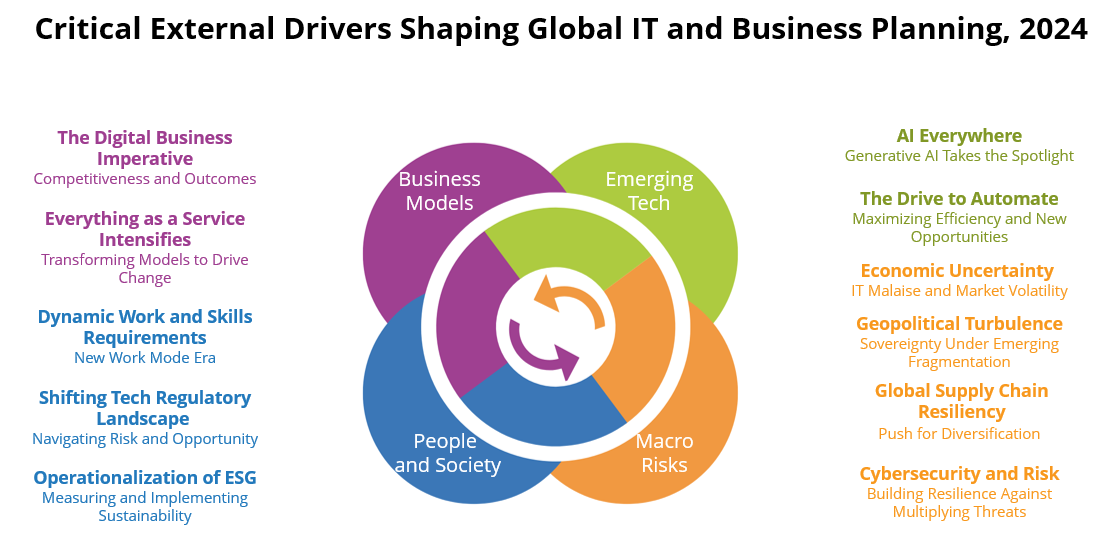
AI Everywhere is certainly the key factor altering the global business and digital ecosystem for the next 12-24 months and beyond, but other critical external drivers will also shake 2024:

  1. The Drive to Automate
  2. Economic Uncertainty 
  3. Geopolitical Turbulence
  4. Global Supply Chain Resiliency
  5. Cybersecurity and Risk
  6. The Digital Business Imperative
  7. Everything as a Service Intensification
  8. Dynamic Work and Skills
  9. Shifting Tech Regulatory Landscape 
  10. Operationalization of ESG 

This year’s unveiling of IDC’s EMEA Predictions for 2024 and will take place on December 11. In the weeks leading up to the reveal, we will release a series of thought leaderships assets that will double-click on these key drivers, analyzing their digital impact and highlighting actions that organizations will have to take to be Digital Future ready (the partial list of upcoming webcasts with registration links can be found below).

In the meantime, if you want to remain updated on the upcoming releases, please visit our IDC European FutureScape page, and register to join us for the IDC EMEA Futurescape 2024 webcast.


Upcoming October and November IDC EMEA webcasts you can register for:


Andrea Siviero - Senior Research Director, MacroTech, Digital Business, and Future of Work - IDC

Andrea Siviero leads IDC's European Digital Business and Future of Work Research group. The group provides market research insights to foster a purposeful and fair adoption of technologies supporting digital societies, businesses and workforce and empower tech providers in strategic decision making, planning and go-to-market activities. Siviero also co-leads the IDC Worldwide MacroTech Research program, focused on the intertwined connection between the Economical and Digital worlds - analyzing the impact key MacroEconomic factors have on the digital landscape and viceversa, how technologies are impacting economies around the world.

As business across many industries struggle with supply chain disruptions, rising energy costs, talent constraints, and pressure to improve sustainability metrics, achieving operational excellence and resilience continues to be challenging. According to results in IDC’s recent Worldwide Future of Operations Survey, only about half of survey respondents saw improvement in operations over the past two years. In last year’s survey, 70% of respondents reported improvement.

Recognizing the need for new approaches and new technologies, IDC has developed the Data-Driven Operations (DDO) framework and maturity model. It helps organizations benchmark themselves and develop plans to improve operational performance across multiple dimensions – efficiency, productivity, quality, safety, reliability, and sustainability.

Becoming a data-driven organization is a journey that requires an honest assessment of current state and a willingness to embrace the changes necessary to improve operational performance.

The next five years will be transformational for operations as organizations find new and more effective ways to manage, analyze, and collaborate around their operational data. The impacts will extend beyond the data, impacting how decisions are made and who makes them. It will also impact which roles are needed, who fills those roles, and how organizations manage their operations.

The following 10 predictions delve in into some of the coming changes. From resources and talent to emerging technologies to the increased emphasis on sustainability, IDC predictions explores the implications and the timeline of major aspects of DDO.

Top 10 Predictions: Future of Operations

  • Prediction 1: By 2025, 50% of G2000 industrial organizations will make real-time decisions balancing economic and sustainability metrics, simultaneously improving both sets of metrics by 5% across the enterprise.
  • Prediction 2: By 2026, 40% of product-centric organizations will use digital tools to measure life-cycle carbon footprint, creating demand for better integration between PLM and operational data.
  • Prediction 3: By 2023, talent shortages and pressure to improve operational performance will force organizations to reevaluate their approach to digital transformation, resulting in greater use of outside services.
  • Prediction 4: By 2027, the use of extended reality technology, including AR/VR/MR tools, will increase by 40%, creating a new breed of digital worker and reducing operator/field worker errors by 30%.
  • Prediction 5: By 2026, the use of robots in nontraditional sectors, most notably remote inspection and maintenance, will increase by 35%, resulting in a 50% drop in inspection errors.
  • Prediction 6: By 2023, digital-first operations enabled by 5G connectivity will improve worker safety, resulting in a 20% reduction in lost time accidents.
  • Prediction 7: By 2027, 50% of remote operations will use satellite-enabled AI/ML technology to collect and analyze data at the edge, reducing costs and improving yields and energy usage in the natural resource sectors.
  • Prediction 8: By 2024, the cloud will surpass on-premises infrastructure as the primary location where operational data is stored, managed, and analyzed for 50% of G2000 organizations.
  • Prediction 9: By 2024, 30% of industrial organizations will have become leaner and more agile than their competitors as a result of making real-time operational insights available anytime, anywhere, to anyone.
  • Prediction 10: By 2025, 50% of organizations will increase the use of IoT and OT cybersecurity solutions at the edge, cutting OT cybersecurity breaches in half.

Interested in learning more? Watch our on-demand webinar, IDC FutureScape: Worldwide Future of Operations 2023 Predictions.

Extending and opening innovation, collaboration, and operation with partners across an ecosystem inside and outside any given industry has become a critical strategy for executives and their organizations.

CEOs and executive leadership recognize the critical supporting role that industry ecosystem partners play in ensuring the growth and stability of their businesses. Opportunities, disruptions, and delivering upon customer needs quickly with a high level of quality are complex pursuits and having a flexible industry ecosystem of partners — an on-demand set of talent, resources, and capabilities — is an important element of the digital-first organization.

According to IDC’s 2022 Future of Industry Ecosystems Global Survey, the next step in the industry ecosystem journey is to incorporate partners from outside the core industry, learn best practices, and add assets, resources, and knowledge that may not be present within a business’ own core industry.

The world and each industry landscape are too complex, dynamic, and disruptive for any one organization to address on its own. The pace of innovation makes it difficult for organizations to keep up. As such, every organization needs an external source of data, insights, applications, operations, and expertise to complement and grow their business. Expansion, collaboration, and innovation with industry ecosystems has become the next phase of digital transformation for every organization.

IDC’s top 10 predictions for the Future of Industry Ecosystem in 2023 are:

  • Prediction 1: By the end of 2023, organizations that share data, applications, or operations with their ecosystem partners through joint ventures will increase profitability by 5 percentage points.
  • Prediction 2: By 2028, consortium-based DAOs will be the de facto standard for complex industry ecosystem ventures that involve a combination of process, application, and data sharing for new revenue growth.
  • Prediction 3: By 2025, 60% of intercompany shared applications available on industry clouds will be built on blockchain technology, enabling a robust Web3 foundation for industry ecosystem activities.
  • Prediction 4: By 2024, although 80% of global organizations will leverage on-demand resources in industry ecosystems to improve supply chain logistics, only 40% will improve profitability.
  • Prediction 5: By the end of 2026, 40% of G20 governments will promote the global data economy through funding of technology infrastructure, enablement of legal provision, and active participation in data spaces.
  • Prediction 6: By 2025, 60% of G2000 organizations will form cross-ecosystem ESG teams that are accountable for sharing of data, applications, operations, and expertise that facilitates sustainable ecosystem practices.
  • Prediction 7: By 2023, only 20% of metaverse experiments for industry ecosystems will succeed, as organizations continue to evolve their ability to deliver products and services in a blended physical and digital way.
  • Prediction 8: By 2025, 25% of organizations that do not share operations and expertise across their industry ecosystems to address talent shortages will struggle to remain viable or be acquired.
  • Prediction 9: By 2027, 60% of industry ecosystems will be driven by regulations for data, IP, and cloud that require standards to be collectively adopted to ensure digital sovereignty and reduce cross-border risk.
  • Prediction 10: By 2024, organizations that automate IT processes for data model and application development as well as sharing across their industry ecosystems will deliver products and services 30% faster.

Interested in learning more? Watch our on-demand webinar, IDC FutureScape: Worldwide Future of Industry Ecosystems 2023 Predictions.

Jeffrey Hojlo - Research Vice President - IDC

As Research Vice President, Future of Industry Ecosystems, Innovation Strategies, & Energy Insights at IDC, Jeff Hojlo leads one of IDC's Future Enterprise practices at IDC - the Future of Industry Ecosystems. This practice focuses on three areas that help create and optimize trusted industry ecosystems and next generation value chains in discrete and process manufacturing, construction, healthcare, retail, and other industries: shared data & insight, shared applications, and shared operations & expertise. Mr. Hojlo manages a group focused on the research and analysis of the design, simulation, innovation, Product Lifecycle Management (PLM), and Service Lifecycle Management (SLM) market, including emerging strategies across discrete and process manufacturing industry such as product innovation platforms and the closed loop digital thread of product design, development, digital manufacturing, supply chain, and SLM. He also manages IDC's North American Energy Insights group, with a focus on key topics such as energy transition & sustainability, distributed energy resource management, and digital transformation in the Oil & Gas and Utilities industries.

Digital businesses depend on digital infrastructure – compute and data management horsepower; network connectivity; operational support; and management – to power business applications, analytics, and activities.

What comprises digital infrastructure?

It includes dedicated on-premises datacenters and edge systems, as well as shared public cloud services. It spans compute, storage, network, infrastructure software (including virtualization and containers) and the automation, AI/ML analytics, and security software and cloud services needed to maintain and optimize legacy and modern applications and data. Ecosystem partners, including systems integrators and channel partners, are also important contributors to the future of digital infrastructure.


IDC’s research shows that 80% of decision makers worldwide recognize that digital infrastructure is important or mission critical to enabling the achievement of business goals.


Organizations that can best optimize multicloud and hybrid digital infrastructure environments consistently realize higher levels of operational resiliency, security, revenue growth, and overall productivity at scale. This IDC FutureScape highlights key trends for the future of digital infrastructure that will have the greatest overall impact and presents the top 10 predictions and key drivers for the next five years:

  • Prediction 1: By 2026, 65% of tech buyers will prioritize as-a-service consumption models for infrastructure purchases to help restrain IT spending growth and fill ITOps talent gaps.
  • Prediction 2: By 2026, 65% of IT organizations will only purchase infrastructure solutions that incorporate predictive cyber-resiliency mechanisms proven to reduce post-cyberintrusion recovery efforts.
  • Prediction 3: By 2027, AI-enabled automation will ensure consistent digital infrastructure configuration, performance, cost, and security by reducing the need for human operations intervention by 70% and improving SLOs.
  • Prediction 4: By 2023, amid ongoing IT supply chain disruptions, 80% of G5000 infrastructure customers will adopt proactive multisourcing strategies to protect themselves against future IT supply risks.
  • Prediction 5: By 2024, 40% of digital business apps will depend on contractually guaranteed cross-provider data transfer and operational/financial data sharing agreements between public clouds and on-prem tech partners.
  • Prediction 6: By 2026, 95% of companies will invest in fit-for-purpose, heterogeneous compute technologies that deliver faster insights from complex data sets to drive differentiated business outcomes.
  • Prediction 7: By 2025, 70% of the G2000 will prioritize the trusted infrastructure of sovereign clouds to ensure consistent security and local/regional regulatory compliance for specific sensitive workloads and data.
  • Prediction 8: By 2025, to ensure data and workflow integrations spanning distributed clouds and edge environments, 50% of enterprises will deploy multicloud networking, bringing consistency and simplicity to NetOps.
  • Prediction 9: By 2027, the need for faster, higher-quality data-driven decisions will cause 80% of G2000 CIOs to mandate companywide data logistics strategies for data management, protection, and integration.
  • Prediction 10: By 2024, due to economic pressures, 50% of G2000 will prioritize infrastructure vendor selections based on tech partner ecosystems that offer cost savings provided by preferred pricing and support deals.

Interested in learning more? Watch our on-demand webinar, IDC FutureScape: Worldwide Future of Digital Infrastructure 2023 Predictions.

Mary Johnston Turner - Research VP - IDC

Mary Johnston Turner is Research Vice President within IDC's worldwide infrastructure research organization and global research lead the Digital Infrastructure Strategies practice. Mary's coverage tracks enterprise tech buyer sentiment related to compute, storage, edge, operations and cloud platforms and deployment models. Current research priorities emphasize the impact of rising requirements for data-driven AI-Ready Infrastructure, Fit-for-Purpose Hybrid and Multicloud Architectures, Autonomous Operations, Edge Integration, and collaborative business and IT governance. Her practice emphasizes the voice of the enterprise customer, based on surveys and in-depth analysis of best practices and infrastructure investment priorities. Mary's research emphasizes consideration of topics related to AI-ready infrastructure, tech debt avoidance, data center modernization, mainframe modernization, infrastructure governance, staffing and skills priorities, and infrastructure operating models. Within the infrastructure research organization, Mary collaborates with other practice leads to ensure coherency and alignment of insights and published research.

The need for a unified approach to disruption of any kind is key to success in the future of work. With global attention divided between many disruptors, the future of work is fraught with many unknowns, from where and how work will be done to how economic pressures will change job opportunities to how social, skills, and climate concerns will have a broad impact.

The reality of our current global economic, climate, and business challenges requires workers to be a part of dynamic and reconfigurable teams that can quickly adapt to business demands and new market requirements — anytime, anywhere, and from any physical location.

Hybrid work – once thought to be a temporary fix throughout the COVID-19 pandemic – is now a mainstay in the global future of work landscape, despite public focus on return to office initiatives. 

The future of work will be one that is defined by a variety of work approaches capable of supporting the ebb and flow of change as the world learns to navigate new challenges.

The promise of such hybrid work models is clear. Rapid adoption of more automated, cloud-based, and artificial intelligence (AI)–enabled work practices increases work productivity and introduces new, more agile ways of working. Insights from more digital-first ways of working are enabling organizations to be responsive to the needs of customers and employees alike, driving improvements in talent acquisition, employee retention, and customer satisfaction.  They also underscore the need for greater focus on skills development in the flow of work itself at a time when many workers struggle to keep pace with new features, functions and applications designed to make work “easier”.

Organizations sufficiently prepared to find and capitalize on opportunities in spite of current and future disruptions will be the ones that define the next future of work.

IDC’s top 10 predictions for the Future of Work in 2023 are:

  • Prediction 1: To address health, sustainability, travel, and other disruptions, 30% of G2000 organizations will adopt immersive third-party metaverse conferencing tech services to enable client engagement by 2027.
  • Prediction 2: By 2024, the business developer role will be ubiquitous, with 60%+ enterprises training and supporting business users to build their own applications and automated processes using low-code tools.
  • Prediction 3: Driven by skills shortages, CIOs that invest in digital adoption platforms and automated learning technologies will see a 40% increase in productivity by 2025, delivering greater speed to expertise.
  • Prediction 4: By 2024, organizations deploying employee micro-monitoring measures (camera/keystroke) will see a 20% decrease in actual employee productivity.
  • Prediction 5: G2000 companies that deploy reactive and tactical hybrid work models will see a 20% revenue loss in 2024 due to job attrition and underperforming teams.
  • Prediction 6: By 2025, organizations that have created dedicated hybrid security policies and developed a culture of trust will be 3x less likely to suffer a security breach.
  • Prediction 7: By 2024, companies offering frontline workers democratized access to digital collaboration, process automation, and similar tools will see 20% increase in revenue due to improved productivity.
  • Prediction 8: Holistic and integrated analytics within an intelligent digital workspace (IDW) ecosystem will drive a 70% increase in differentiated business outcomes for adopters by 2026.
  • Prediction 9: Effectively blurring space and place, by 2025, 65% of G2000 companies will consider online presence to be at parity to “in real life” across their engaged workforce.
  • Prediction 10: By 2024, 55% of C-suite teams at global enterprises will use intelligent space and capacity planning technology to reinvent office locations for gathering, collaborating, and learning.

Interested in learning more? Watch our on-demand webinar, IDC FutureScape: Worldwide Future of Work 2023 Predictions.

Amy Loomis, Ph.D. - GVP, Research - IDC

Amy Loomis is Group Vice President for IDC's worldwide Workplace Solutions. Amy leads a team of analysts focused on the evolving nature of human resources, skills development, collaboration, and leadership across the employee lifecycle. Her research into the Future of Work explores the influence of hardware and software technologies such as artificial intelligence, data analytics, augmented and virtual reality and automation on the changing the nature of work. Her research also explores how technology and business strategy influence workers' skills and behaviors, organizational culture and how the workplace itself is enabling the future enterprise.

Sustainability is a mainstream business concern across all industries – fueled by greater scrutiny from stakeholders comprising investors, regulators, customers, and consumers. As business leaders respond to this stakeholder pressure and incorporate sustainability initiatives into broader business strategies, many are looking at ways to address the environmental, social, and governance (ESG) issues with the greatest impact on enterprise value. These business leaders are looking beyond the costs of building and implementing sustainability programs and see an opportunity to create competitive differentiation by increasing operational and financial performance through sustainable transformation.

Operationalizing ESG

In order to comply with regulatory requirements and demonstrate progress on sustainability initiatives, organizations need a technology platform to help automate the capture, curation, analysis, and reporting of ESG data. But, simply reporting information and ‘checking off boxes’ aren’t enough for businesses that seek competitive advantage. They must operationalize ESG.


Operationalizing ESG is the next maturity step for organizations’ sustainability journey and requires a technology-enabled infusion of ESG into every part of the organization.


For organizations to be successful in their sustainability journeys, they need to take a more holistic approach across all material ESG topic areas, including social sustainability. IDC has been tracking a rapid rise in the importance of human and social capital topics, including diversity, equity, and inclusion (DEI), employee well-being, and human rights management and responsible sourcing. And once again, IT and professional services will play a critical role in these sustainability efforts.

IDC’s top 10 predictions for sustainability/ESG are:

  • Prediction 1: By 2024, 80% of G2000 companies will capture their carbon data and report their

Enterprise-wide carbon footprint using quantifiable metrics compared with 50% today.

  • Prediction 2: By 2026, ESG performance will be viewed as a top 3 decision factor for IT equipment purchases and over 50% of RFPs will include metrics regarding carbon emissions, material use, and labor conditions.
  • Prediction 3: By 2025, more than 60% of organizations will require datacenter providers to disclose to them their energy usage, use of renewable energy sources, and recyclable IT equipment.
  • Prediction 4: By 2026, circularity will become a key component of PLM and 60% of organizations will require their IT equipment vendors and partners to provide end-to-end visibility of their sustainability process.
  • Prediction 5: By 2024, 30% of organizations will leverage ESG data management platforms to steer ESG KPIs via a centralized system of record for reporting purposes and real-time operational decision-making support.
  • Prediction 6: By 2027, 25% of G2000 companies will have assigned a chief sustainability officer responsible for meeting their organization’s ESG goals and making ESG-related IT purchasing decisions.
  • Prediction 7: By 2023, ESG performance will become a standard component for third-party risk assessment with 20% of organizations placing greater weight on these risks than security, financial, or operational risks.
  • Prediction 8: By 2025, 40% of ESG services engagements will require a managed services component to better address the long-term nature and intense data needs of sustainable transformation and ESG reporting.
  • Prediction 9: By 2026, 70% of organizations with integrated planning and execution will achieve improved operational efficiencies leading to distinctive business benefit of improved ESG and financial performance.
  • Prediction 10: By 2024, 40% of use cases for sustainability/ESG software worldwide will have a strong focus on social sustainability topics due to organizations’ more integrated approaches to ESG.

Interested in learning more? Watch our on-demand webinar, IDC FutureScape: Worldwide Sustainability/ESG 2023 Predictions.

“Intelligence is a core differentiator.” – UPS

We have to use data to become the utilities company of the future.”– Con Edison

“The science of healthcare has progressed. The business of healthcare has not kept up. Only data and analytics can help our business stay viable.” – Michiana Hematology Oncology

“Our people needed to understand the potential of data.” – Texas Department of Transportation

What do these companies have in common? They have all invested in programs to improve their enterprise intelligence capabilities and have seen success in the form of positive business outcomes. All four were winners in IDC’s 2021 Future Enterprise Best in Future of Intelligence North America Awards, with UPS taking honors as the overall winner, demonstrating strength across all four pillars of enterprise intelligence:

  • Information Synthesis
  • Insights Delivery
  • Collective Learning
  • Data Culture

IDC’s Enterprise Intelligence (EI) benchmarking research shows that enterprise intelligence maturity makes a material difference to business outcomes. Top-quartile EI performers are 2.7x more likely to have experienced strong revenue growth between 2020 and 2022, and 3.6x more likely to have accelerated time to market for new products, services, experiences, and other initiatives.

While organizations that invest in enterprise intelligence will find that they become more digitally resilient, agile, innovative, and dynamic than their peer companies, they must direct those investments across different areas, including:

  • Data platforms to enable more openness, flexibility, scale, and connectivity
  • Pipelines and processes to enable more effective, consistent processing of data to make it “insight-ready”
  • Tools to build and deliver analytics and insights; improve decision-making and action-taking processes; and enhance culture.

The following 10 predictions represent the trends we expect to see across the four pillars of enterprise intelligence:

  • Prediction 1: By 2024, organizations with greater enterprise intelligence will have 5x institutional reaction time, resulting in persistent first-mover advantage in capitalizing on new opportunities.
  • Prediction 2: By the end of 2025, vigilant C-suite leaders of G2000 will invest 40% more on enterprise and market intelligence, helping them counter the recession and slice through the storms of disruption.
  • Prediction 3: By the end of 2024, 30% of enterprises using video surveillance technologies will also be using video data analytics to support operational decision making requiring more oversight.
  • Prediction 4: By 2024, 80% of G2000 companies will increase investment in intelligence about threats/opportunities to local operations posed by external threats such as supply chain disruptions.
  • Prediction 5: 30% of G2000 organizations will fail to deliver on their enterprise intelligence goals by 2026 because they have not centered trusted capabilities in their efforts to develop data culture.
  • Prediction 6: By 2025, real-time intelligence will be leveraged by 90% of G1000 to improve outcomes such as customer experience by using event-streaming technologies.
  • Prediction 7: By 2027, 66% of large enterprises will make major investments in data control plane technologies that can measure the risk inherent in data and reduce risk through security and screening.
  • Prediction 8: By the end of 2025, >50% of G2000 organizations will face penalties if they do not use AI for detection and automatic remediation of data due to growing complexity, volatility, and resource scarcity.
  • Prediction 9: Facing increased demand for enterprise intelligence skills and to meet employee expectations, 70% of G1000 will have formal programs fostering data literacy and upskilling by 2028.
  • Prediction 10: By 2026, 30% of G1000 companies will extend investments in AI infrastructure to performance-intensive computing to solve the most complex problems using HPC-driven simulations to improve outcomes.

Interested in learning more? Watch our on-demand webinar, IDC FutureScape: Worldwide Future of Intelligence 2023 Predictions.

As we move beyond COVID-driven restrictions, we must now confront a new set of macroeconomic challenges – inflation, global economic instability, and flattening customer growth – while still navigating new hybrid work and organizational leadership models. These disruptions are significantly impacting customers across B2B and B2C markets.

Customers are now demanding greater value, more memorable and immersive experiences, and greater control over how they engage with enterprises, becoming equal stakeholders in the customer experience (CX) ecosystem. Going forward, customer-centric business resilience will require enterprises to move beyond transactional-level experiences and tie business outcomes to relationship-based experiences that will be fulfilled by delivering customer value and trusted customer outcomes.


IDC’s Future Enterprise Resiliency and Spending Survey shows that in the 12-month period from July 2021 to June 2022, enterprises globally prioritized customer experience (CX) and operational efficiency – placing them on almost equal footing.


Building and scaling empathetic customer outcomes will require CX executives to leverage a strong technology foundation comprising customer data, AI/ML, and zero trust architectures. A few leaders are even dipping their toes into the Web3 pool. Future experiences will be tied to customer data as an enterprise service that gathers intelligence across the CX ecosystem to elevate context and deliver novel, immersive experiences that create more value parity for customers.

These CX initiatives will usher in an era of new customer metrics, greater focus on quantifying customer and business value, and the rise of trusted communities where the role of the customer evolves as an active participant in the experience ecosystem, as both creators and consumers of experiences. With digital business models becoming a steppingstone to the future enterprise, the imperative to maintain the human element in customer experiences will assume more importance.

In a world of accelerated uncertainty, the next era of CX innovation will be led by those brands that improve value for the customer through empathy and delivering outcomes for customer success. Thrivers will share and apply intelligence at the speed of customer engagement, create new customer engagement models and metrics for a digital business, and tap into the power of decentralization and Web3 to create equitable value parity in customer and business outcomes alike.

IDC’s top 10 predictions for the Future of Customer Experience in 2023 are:

  • Prediction 1: By 2027, one-fourth of global brands will abandon CSAT as a measure of customer experience and adopt a Customer Effort Score correlated to outcomes as a key indicator of journey satisfaction and success.
  • Prediction 2: By 2024, 50% of the G2000 will adopt CDPs as the enterprise customer data service for real-time customer interactions like a central nervous system, increasing CX metrics and revenue by 5%.
  • Prediction 3: To foster loyalty and a competitive edge, 64% of the G2000 will own online communities by 2027 and core IT application integrations will enable a new wave of collaboration and outcome-based insights.
  • Prediction 4: By 2026, 40% of the Global 2000 will incorporate employee experience initiatives into their core CX strategies to compete in CX, talent acquisition, and retention but will struggle to measure EX+CX.
  • Prediction 5: Adopting Web3 technologies will drive 45% of global brands to create new immersive experiences, accessible content, and engaged communities and grow the CX creator economy into a $300 billion market by 2024.
  • Prediction 6: By 2026, 45% of the Global 2000 will use AI/ML to elevate context and nudge customers into unfamiliar and novel experiences that simultaneously improve sentiment metrics and brand upselling potential.
  • Prediction 7: By 2024, at least 30% of organizations will introduce new success metrics to track and measure the internal and external flows of customer value creation.
  • Prediction 8: By 2025, 50% of G2000 enterprise customers will primarily select their CX platform provider based on the efficacy of the vendor’s customer success services.
  • Prediction 9: By 2024, 30% of organizations will be forced to expand data management and privacy measures to mitigate risks of data breaches caused by ecosystem partners costing $4.6 million per breach.
  • Prediction 10: By 2026, 40% of G2000 companies will build safe communities to foster interpersonal guardrails for future metaverse platforms — and collect first-party data.

Interested in learning more? Watch our on-demand webinar, IDC FutureScape: Worldwide Future of Customer Experience 2023 Predictions.

Sudhir Rajagopal - Research Director, Future of Customers and Consumers - IDC

Sudhir is Research Director for the CMO Advisory Service, focused on creating and executing programs and research to help companies make data-informed decisions about marketing. Sudhir's research and advisory focuses on how organizations must consider transforming their marketing function with AI at the center. In his role, Sudhir monitors the continual innovation of technologies, business strategy, and customer experiences to empower marketing leaders to make decisions on marketing strategy and operationalization.

We just released our annual top 10 predictions for utilities worldwide. The predictions enable the IDC Energy Insights team to reflect on the current year and on what the future holds for the industry. This year, it’s fair to say, there was a lot to think about.

2022 has given us the worst energy crisis in a generation, especially in Europe, with day-ahead power prices growing more than 500% since 2020, and natural gas futures spiking by more than 1,000% year on year in August. We all knew price volatility was going to be part of the game, at least in the initial stages of the energy transition (at least until we sorted out functioning flexibility markets and deployed enough storage in the system).

But no one was really prepared for a pandemic, followed by a war in Europe, by the world’s biggest energy exporter.

Let’s not forget climate change, with some of the worst heatwaves, draughts, and floods in decades (if not centuries) and the huge impact they have had on the so-called energy-water nexus. 

While these are only a few of the challenges that have grabbed the headlines in the past 12 months, utility companies are increasingly accepting the unpredictable world they operate in and are becoming more resilient, predictive, and flexible in their operations. They don’t have a choice, as there is no time to stagger slowly toward the overarching goal of net zero.

Significant investments are needed, and a critical mass of technologies must be deployed at pace to transform energy and water systems for the better.

Energy transition, climate disruptions, and social sustainability have demonstrated that utilities are at the heart of economic resilience. Utilities must become business and infrastructure platforms to lead decarbonization, foster demand efficiency and circularity, and promote electrification.

Utilities can create positive outcomes by mastering​ their day-by-day execution in:​​

  • Technology: to accelerate and scale sustainable energy, the electrification of transportation, and the sustainability of industrial clusters (and more broadly the economy)
  • Data: to drive purpose across power generation, energy and water delivery, markets, customers, energy services, and new clean energy supply chains​
  • Ecosystems and their emerging operating models: to generate new value

These elements combined will make utilities trustworthy to customers, employees, suppliers, shareholders, and society as a whole.

Given all this, here are the top 10 predictions for utilities:

  1. By 2025, a third of competitive gentailers will have set up integrated supply, efficiency, decarbonization, and electrification service portfolios, growing average profit per customer by more than 20%.
  2. By 2023, 60% of competitive power generators and traders will have AI-powered forecasting capabilities in production, helping to improve day-ahead demand and price forecast accuracy by more than 15%.
  3. By 2027, driven by the need to detect and manage behind-the-meter flexibility, 70% of electric utilities in advanced markets will deploy distributed resource management and demand response solutions.
  4. By 2024, 50% of gas utilities will use cloud platforms and drones, aircraft, or satellites equipped with image-based detection technology to detect fugitive emissions and deliver on net-zero targets.
  5. By 2024, 25% of utilities will invest in new talent management applications to become skills-driven high-performance organizations, boosting work productivity and quality by 15%.
  6. In 2023, pushed by energy price and security concerns, 55% of energy suppliers will leverage energy system data to identify those at risk of fuel poverty and foster more efficient consumption.
  7. By 2026, 60% of utilities will converge IT and operational technology (OT) security personnel, technologies, and processes to better protect against both cyber and physical threats, reducing overall security breaches by 50%.
  8. By 2024, 70% of utilities will use specialized sustainability SaaS platforms to track and report scope 1 and 2 and estimate scope 3 emissions to meet regulatory and financial disclosure requirements.
  9. By 2027, longer droughts and more volatile energy prices will have pushed 40% of water companies to invest in IoT- and AI-based smart applications to cut non-revenue water (NRW) and power consumption by 20%.
  10. By 2025, 50% of utilities will implement a platform approach to operations, integrating core applications, improving visibility, management, and efficiency to boost tight operating margins.

For each of these predictions, the IDC Energy Insights team has developed a detailed analysis, with associate drivers and IT impact and guidance for utilities. A selection of these predictions will be presented by IDC Energy Insights analysts in an live webinar on Thursday, December 1, at 16:00 CET.

To complement the top 10 predictions, the IDC Energy Insights analyst team also develops a series of recommendations for utilities that have embarked on the energy transition journey. This year’s recommendations are:

  • Deliver on your purpose. Sustainability, decarbonization, and electrification offer endless opportunities, so it’s easy to get overwhelmed by the possibilities. Balance immediate urgencies around security of supply and consumer protection, without losing momentum on long-term net-zero goals. Focus resources and efforts on energy transition use cases and initiatives that support and enrich your company’s future business portfolio.
  • Nurture your internal resources. The decade-long talent drain in the utilities industry has been exacerbated by the global skills and talent crunch that affects all sectors, including technology companies. The old practice of relying on technology partners and IT and business service providers to cover skill gaps is no longer sufficient as many of these companies have themselves also been negatively affected. It’s imperative to focus on internal workforces to boost productivity and work quality and to improve employee experience and ward off the “Great Resignation.”
  • Rekindle your relationship with customers. The global energy crisis and economic uncertainties have made energy consumption (and related costs) top of mind for customers across all sectors. Now is the time to become true energy advisors, supporting customers with personalized, timely, and valuable offers around sustainability and new energy products and services. This could have a long-term impact on customer experience and revenues from new business models.
  • Engage in ecosystem innovation. Collaborative innovation and co-creation are crucial to successfully navigate the accelerating pace of energy transition. In many cases, emerging utility business and operating models also require cross-industry ecosystems, so an ecosystem-first mindset is a powerful tool. Establish an internal engagement platform that brings together business stakeholders, technology partners, end users, and start-ups with a focus on idea conversion and incubation and an end goal of driving operating models to generate new value.​

Support the integration of the energy system. Work with regulators and policymakers to link different production modes with different types of demands through the most sustainable and cost-efficient physical, digital, and market infrastructure. Support the creation of markets where price signals guide consumers to the cheapest and most efficient decarbonization option. Drive the creation of physical links between existing and new energy carriers. Digitize the system to harmonize demand and supply, orchestrate markets, and link energy flows.

IDC Energy Insights analysts Jean-François Segalotto, Gaia Gallotti, Daniele Arenga, and Roberta Bigliani will be onsite in Frankfurt for Enlit 2022. They look forward to meeting you and discussing their predictions and more.

The past always informs the future, so it would be hard to discuss the Future of Trust without, at first, acknowledging the significant impact that the COVID-19 pandemic has had on computing. Pushed into supporting remote and hybrid work models, organizations scrambled to set up the necessary infrastructure to continue operating, while people incorporated more technologies and digital identities into their everyday experiences.

In the Future of Trust, we see the push and pull of digital services. With the growing prevalence of cloud-based services, greater volumes of data are collected and analyzed, driving the need for more automation to provide insights into the data, as well as artificial intelligence innovations that promise to alleviate pain points experienced by organizations and their customers.

Meanwhile, consumers are ever more aware of and sensitive to data breaches as cyberthreats increase in number and sophistication. Privacy by Design principles are being re-evaluated as customers become more curious and cautious about how their personal information is used. And, while rules and regulations regarding where and how data is stored and transmitted are changing, businesses recognize that their customers cannot tolerate disruptions to the digital infrastructures that undergird their work and daily lives.

All of this uncertainty is prompting organizations to turn to “the certainty of data.” In our top 10 Future of Trust predictions, we see the thread of data-driven insight running through privacy, security, compliance, risk, and ESG – the elements comprising the Framework of Trust. This relationship between data-driven insight and Trust is cyclical. Customers confer Trust onto organizations that transparently share data driven insights, but Trust is a prerequisite to overcome consumer reluctance to share the personal data required to generate high quality organizational insight.

  • Prediction 1: By 2026, 30% of large enterprise organizations will migrate to autonomous security operations centers accessed by distributed teams for faster remediation, incident management, and response.
  • Prediction 2: By 2024, 35% of organizations will employ a privacy engineer to operationalize Privacy by Design principles into IT systems, processes, and product development strategy.
  • Prediction 3: By 2024, 30% of heavily regulated organizations will adopt confidential computing technologies to combine and enrich sensitive data critical to multiparty compute applications while preserving privacy.
  • Prediction 4: By the end of 2024, 65% of major enterprises will mandate data sovereignty controls from their cloud service providers to adhere to data protection and privacy regulatory requirements.
  • Prediction 5: By 2026, driven by steep regulatory growth, talent gap, and cost efficiency measures, 40% of organizations will invest in compliance-as-a-service offerings to meet their regulatory mandates.
  • Prediction 6: By 2027, 60% of G2000 companies will adopt continuous risk assessments over annual security audits, leveraging service providers to limit the burden of policies, practices, and technical debt.
  • Prediction 7: By 2025, the SEC will publish standards for cyber-risk scoring, and publicly traded companies will be required to update and report this score on an annual basis.
  • Prediction 8: By 2024, 30% of organizations will advance their ESG metrics and data management beyond reporting capabilities to generate sustainably driven cost and competitive advantages.
  • Prediction 9: By 2024, 75% of large enterprise firms will implement purpose-specific ESG data management and reporting software as a response to emerging legislation and increased stakeholder expectations.
  • Prediction 10: By 2025, 45% of CEOs, fatigued by security spending without predictable ROI, will demand security metrics and results measurement to assess and validate investments made in their security program.

Interested in learning more? Watch our on-demand webinar, IDC FutureScape: Worldwide Future of Trust 2023 Predictions.

Grace Trinidad - Research Director, Future of Trust - IDC

Grace Trinidad is Research Director in IDC's Security & Trust research practice responsible for the Future of Trust research program. In this role she provides strategic guidance and research support on approaches to trust that include risk, security, compliance, privacy, ethics, and social responsibility. Dr. Trinidad has published peer-reviewed research on privacy and trust in healthcare, exploring public attitudes towards commercial use of personal health information. Other areas of Dr. Trinidad's research include the ethics of artificial intelligence and data sharing, trust in healthcare providers and in healthcare organizations, genomic database use and accessibility, and data equity.