AI will continue to shape the enterprise communications landscape in 2026, with organisations seeking practical value while navigating cost, governance, and deployment constraints. Interest in AI is high, but companies still face gaps around affordability, readiness, and real-world use cases. As a result, the market will progress through grounded, incremental steps, supported by stronger data foundations, evolving pricing models, and greater collaboration across ecosystems and service partners.

1. AI Adoption Will Remain Pragmatic and Focused on Clear ROI

AI will continue to gain momentum, but organisations will prioritise capabilities that deliver immediate, measurable value, such as summarisation, transcription, call insights, and automated follow-ups.

While interest in agentic AI grows, mainstream adoption will be limited by cost and narrow use-case readiness. Vendors will increasingly focus on making agentic capabilities more affordable, modular, and easier to deploy.

2. Data Foundations Will Become the Enabler for Context and Automation

As organisations look into value extraction, data quality and connectivity become essential. AI will need access to contextual, structured, and cross-functional data to deliver accurate outcomes and automate workflows.

To meet these needs, vendors will open their ecosystems, deepen integrations with CRM, ERP, and workflow tools, and begin supporting agent-to-agent orchestration (A2A/MCP) across front-, mid-, and back-office processes.

3. Pricing Models Will Evolve to Reflect AI Consumption Patterns

As AI features become more widely used, traditional subscription pricing will feel less aligned with the way organisations actually consume AI. Vendors will gradually introduce usage-based or metered models, allowing customers to scale AI adoption at their own pace.

To ensure reliability, AI will increasingly blend generative and deterministic approaches, supported by stronger AI observability to maintain accuracy and trust.

4. Verticalisation and Professional Services Will Help Close the Adoption Gap

AI adoption challenges vary significantly by industry. In 2026, more vendors will develop vertical-specific UC&C solutions that reflect distinct workflows in sectors such as healthcare, retail, financial services, and manufacturing.

Because the gap between vendor innovation and customer adoption persists, vendors will collaborate more closely with professional services providers who can translate innovation into practical transformation through guided deployment and workflow redesign.

5. Europe Prioritises Hybrid Deployment and Democratized AI for SMBs

In Europe, concerns around data sovereignty and transparency will continue to influence technology decisions, prompting sustained interest in private cloud and selective retention of on-premises components. Most organisations will move toward hybrid models that offer both innovation and control.

At the same time, European vendors will intensify their focus on SMBs, which represent the bulk of the region’s economy. 2026 will see continued efforts to democratise AI, offering simpler, lighter-weight solutions—such as AI receptionists—as well as modular capabilities that make AI adoption accessible to smaller businesses via partner-led delivery.

Conclusion

In 2026, enterprise communications will move forward through practical AI adoption, deeper data integration, flexible pricing, verticalised innovation, and hybrid deployment models. Markets like Europe will emphasise sovereignty and SMB accessibility, but globally, success will depend on vendors balancing innovation with pragmatism—offering AI that is trustworthy, affordable, and genuinely transformative for how people and organisations communicate and work.

For more information, drop your question in here.

For more predictions, watch IDC’s EMEA FutureScape predictions webcast here.

Oru Mohiuddin - Research Director - IDC

Oru Mohiuddin is a Research Director in the European Enterprise Communications and Collaboration team. Based in London, she is responsible for IDC’s coverage of Unified Communications and Collaboration in the region. Her work focuses on tracking the markets for premise-based and cloud solutions and new developments and trends, particularly in the light of changing work patterns impacting the traditional mode of enterprise communication. Prior to joining IDC, Oru worked for Euromonitor International, where she focused on Future of Work and technology in the SMB context. She also worked in New York and Bangladesh and speaks English and Bengali. Oru was awarded Chevening Scholarship by the British Foreign and Commonwealth Office to pursue her MSc in International Development from the University of Birmingham. In addition, Oru has a BA from Marymount Manhattan College in New York.

Graham Fruin - Senior Research Analyst, European Enterprise Communications and Collaboration - IDC

Graham Fruin is a senior research analyst in IDC's European Enterprise Communications and Collaboration team. Based in the U.K., his primary focus is on the voice and data connectivity markets. His work has a particular emphasis on the migration from legacy voice solutions to IP-based platforms and the way they are used in conjunction with unified communications. In addition, he analyzes the evolution of the internet access market, which includes the rapid proliferation of Fiber to the Premises (FttP) across Europe.

Artificial Intelligence is entering its most transformative phase yet: The agentic future. In this new era, humans and intelligent systems don’t just interact; they act together with intention, autonomy, and scale. According to IDC’s FutureScape 2026 predictions, organizations in Asia/Pacific are rapidly shifting from AI experimentation to enterprise-wide orchestration—where adoption fuels growth, innovation, and market leadership.​

Why 2026 will be a pivotal year for AI adoption

AI has already moved beyond proof-of-concept. IDC projects that AI-related investments in Asia/Pacific will grow 1.7x faster than overall digital technology spending, creating a $1.6 trillion economic impact by 2027.

By early 2025, AI spending reached $90.3 billion, signaling unprecedented momentum. This acceleration is not just about technology—it’s about competitive advantage.

Key AI adoption trends driving the shift:​

  • Enterprise AI transformation – Companies are integrating AI into core operations to boost productivity, lower costs, and open new revenue streams.​
  • AI-powered customer experience – Personalized, emotionally intelligent interactions are becoming the norm.​

Autonomous systems in business – From supply chains to marketing, autonomous agents are optimizing decisions in real time.​

Opportunities across the AI ecosystem

For technology providers, the agentic future opens massive possibilities:​

  • Infrastructure and cloud providers – Demand is surging for AI-ready platforms and compute resources.​
  • Model and tool developers – Specialized AI models tailored to industry needs are gaining traction.​
  • Consultancies and integrators – Enterprises need guidance on how to implement and scale AI for maximum ROI.​
  • Consumer devices – Tap into where technology providers can serve up new use cases and opportunities in the AI era ​

For enterprise leaders, the biggest gains will come from integrating AI capabilities across departments — not just in isolated use cases.​

Turning predictions into impact

IDC’s predictions for 2026 and beyond are more than industry forecasts—they are a roadmap to revenue. Whether you’re a CIO, CMO, product leader, or technology provider, understanding these trends will help you:​

  • Identify emerging markets before competitors do.​
  • Prioritize high-impact AI investments.​
  • Build an AI adoption strategy that scales.​
charting the agentic future

Step into the future ahead of your competition in the Asia/Pacific region. Join us on November 14, 12:00-5:00 PM, and get access to exclusive IDC insights on tech predictions, market forecasts, and direct buyer feedback from IDC’s leading voices on Asia/Pacific technology and innovation:

  • IDC Predictions 2026: Charting the Agentic FutureSandra Ng, GVP and General Manager for Asia/Pacific Japan Research
  • Everything AIDr. Chris Marshall, VP APAC AI and Industry Research
  • Consumers in the AI EraBryan Ma, Global and APAC Devices Research
  • Decoupling and Top China B2B/B2C TrendsZhenshan Zhong, VP China Research
  • Services Disruption in Tech: Thriving in the Age of AILinus Lai, VP APAC Services and CEO/CIO Research

Seats are limited so reserve your spot now, register today!

Customer relationships shift across moments, usage, roles, and goals, often in ways that challenge traditional thinking. It’s no longer sufficient for brands to predict what someone might do next. Instead, they must also understand why customers behave as they do and act while the engagement window remains open.

Today’s customer dynamics demand systems that can read intent and purpose in real-time, explain decision logic transparently, and trigger contextually appropriate responses. This requires predictive AI models augmented with generative AI capabilities and AI agents designed to analyze patterns, operationalize insights, make decisions, execute interventions, and learn from outcomes continuously.

Brands need to understand that customer intent or behavior shifts do not wait until the next daily or weekly campaign planning and execution cycles. They need to synthesize intent signals, build accurate AI models and put them to work before they become irrelevant.

Data foundation reality check

Organizations rushing to augment their predictive AI systems with generative AI and AI agents often discover that their data architecture cannot support the complexities required to transform raw data and context into AI-ready inputs. This is not a minor issue.

The challenge isn’t just traditional data quality – it’s creating a unified data environment where structured customer transactions, unstructured behavioral signals, social interactions, and external market indicators can be processed collectively. When data sources remain siloed or poorly integrated, AI agents make decisions based on incomplete context, generative AI produces responses that ignore critical customer history, and predictive models optimize for patterns that no longer reflect current customer reality.

Industry-specific requirements

Organizations often overlook customer data characteristics and AI model needs by industry, even within context of marketing and CX use cases. In travel and hospitality, the emphasis might be on seasonal demand patterns, loyalty program activity, and booking lead times, whereas in fashion retail, it could center on style preferences, return behavior, and fast-moving trend adoption. These variations shape not just the data collected, but also how it’s processed, modeled, and translated into timely marketing actions.

Best-fit customer analytics applications embed industry-specific frameworks, data models, and campaign templates. Prebuilt workflows and segmentation logic grounded in industry IP reduce customization effort, accelerate time-to-value, and ensure that marketing teams can act on insights in ways that resonate with their customers’ actual behaviors.

The autonomous future

The promise of autonomous customer analytics lies in its ability to analyze vast streams of customer data, make decisions and take actions at scale, and learn from the results to improve future performance. When built on a solid foundation, these systems don’t just respond to customer behavior, they adapt continuously, refining rules, models, and strategies based on what works and what doesn’t.

Achieving this requires more than deploying an advanced AI model. It requires continuous learning architecture that captures outcomes, detects drift in data, model, or customer patterns, and adjusts actions accordingly. Without these capabilities in place, moving too quickly to autonomous AI decision-making can be risky. Weak data quality, insufficient governance, and lack of monitoring can allow small errors to accumulate rapidly, resulting in inconsistent actions.

Value measurement systems

Organizations struggle to measure the ROI of traditional predictive AI. Even in batch-driven models, linking predictions to business impact can be challenging with unclear baselines and inconsistent attribution. If it’s difficult to quantify the value of a churn prediction or a propensity score today, the challenge grows when moving to generative AI and AI agents.

Successful organizations will be those that build value measurement into their customer analytics applications. This means not only track the business impact from predictive AI use case but also show the direct link between model outputs, actions taken, and outcomes achieved. By establishing this closed loop, organizations lay the groundwork for measuring GenAI and AI agent performance, where the same approach must scale and provide continuous feedback for improvements.

Practical readiness

Successful customer analytics transformation requires organizations to start with a fundamentally different question: not “what insights can we generate?” but “what customer behaviors can we influence, and what organizational capabilities do we need to influence them effectively?”

Selecting the right use case (e.g., customer segmentation, propensity, personalization, journeys, digital experience, next best recommendations, etc.), strengthening the data foundation, pairing predictive AI with generative AI, piloting a bounded AI agent, governance, and establishing AI operationalization framework is critical to deliver consistent, measurable improvements in customer engagement and outcomes.

IDC MarketScape Customer Analytics Applications

Tapan Patel - Research Director for Customer Data Platform (CDP) - IDC

Tapan Patel is Research Director for Customer Data Platform (CDP), Intelligence and Analytics software market segments and a member of the Customer Experience (CX) Research team at IDC. Tapan’s core research coverage includes market trends, end-user requirements, use cases, market sizing, and business models for these critical segments. He is lead analyst for the CDP market, used by brands to improve customer insights and journeys across all touchpoints. His other research coverage areas include customer and product analytics and AI applications used by marketing, service, sales, contact center, and other enterprise teams to improve CX in B2C, B2B, and DTC engagements.

Europe will present strong opportunities for unified communications and collaboration (UC&C) and contact center (CC) vendors/providers in 2025. Businesses are increasingly receptive to modern technologies — but succeeding in this market requires tailored approaches by country and business segment.

1. The European Market Will Become More Vibrant and Dynamic

As the external environment evolves and legacy infrastructure comes to end of life, European businesses are more open to upgrading to modern IT infrastructure that can drive future business outcomes. Awareness of what modern technology can achieve is growing thanks to campaigns led by market players. AI is contributing to this receptiveness, with businesses recognizing its immense potential.

Our European UC&C and CC research has revised upward the five-year forecast for both markets. While Europe is ready to embrace new technology at a faster pace, it is important to understand that this complex and unique market requires a tailored approach by country. This economy, composed largely of small and medium-sized businesses (SMBs), has been underserved and offers new opportunities. To succeed in Europe, it is crucial to understand specific country dynamics and buying behaviors and the value Europeans place on trust and working relationships.

2. UCaaS/CCaaS Bundles Will Become More Popular

UCaaS/CCaaS bundles are not new, but IDC’s 2024 European Enterprise Communications and Collaboration Survey indicates their growth will accelerate. This will be driven by contact centers as well as businesses that do not operate contact centers but require lightweight contact center functionalities for customer engagement (marketing/sales). This is particularly true for Europe, where contact centers are relatively smaller and the economy is comprised of more SMBs, making them inclined to consolidated solutions. Their smaller operations also make them more agile and adaptable to new solutions.

Businesses increasingly understand that isolated stacks create silos, leading to disjointed and frustrating experiences for both employees and customers, negatively impacting business outcomes. Businesses realize that analytics can reveal meaningful insights for informed decision-making. Given the large proportion of smaller businesses, resource optimization is important, leading to the blurring of front- and back-office workers. AI can facilitate this by guiding workers through workflows, minimizing the need for in-depth expertise. From an IT perspective, a consolidated stack is easier to manage, leading to greater efficiency.

3. Hybrid Deployments Will Grow

Europe is opening up to modern technologies but the transition from legacy to cloud is not linear. Some businesses/verticals will need to remain on premises for security reasons. Those migrating their entire stack from on premises to cloud will usually do so in stages, resulting in a period of hybrid deployment. IDC’s European Communications and Collaboration Survey showed that contact center hybrid deployments in Europe will grow over the next two years, although some countries will differ. The survey also revealed that a small fragment of businesses may return to on premises from cloud. Providers must offer flexible options to meet customers where they are and provide what they need.

4. GenAI Will Shift to Value-Based Conversations

While the benefits of GenAI are widely discussed, the conversation in 2025 will shift to the actual value it drives. This involves evaluating benefits in relation to costs. In theory, GenAI can automate many functions in UC&C and CC, driving greater efficiency while keeping overhead costs down. However, GenAI is still expensive and businesses are exploring use cases specific to their needs. Efficacy remains an issue due to dispersed data sources and unstructured formats.

There are also concerns about data privacy. Despite GenAI’s fluidity in interactions, sufficient guardrails are needed to prevent data leakage, limiting its performance. Businesses will consider pricing more closely in relation to benefits. Some functions, such as summarization, have become popular. GenAI is here to stay but needs to be value-driven going forward. Vendors/providers need to showcase real-life cost benefits that customers have derived from their GenAI solutions.

5. Opportunities for Service Providers Will Increase

There are some gaps in the market deterring the adoption of modern UC&C and CC technologies and this will create scopes for service providers in 2025. Our survey found that a key reason why businesses are not migrating to the cloud is a lack of the support needed to do so. This includes support with identifying the right solutions, implementation, change management, and aftersales service.

Another reason is that alternatives do not match specific requirements, indicating the need for customization and integration with business-specific IT applications. The emergence of GenAI creates new opportunities, including data management, consolidation, and aggregation. Service providers can also form strong partners in catering to the SMB segment.


Europe is set to become a dynamic market in 2025, offering ample opportunities for vendors/providers — but competition will be fierce. Succeeding in this market is not just about innovation but also about getting the go-to-market approach right. This involves understanding the intricacies of the European market very well.

IDC’s European Unified Communications and Collaboration and Contact Center research provides in-depth coverage of the European market by country and business size segments and can offer data-based strategic guidance.

Oru Mohiuddin - Research Director - IDC

Oru Mohiuddin is a Research Director in the European Enterprise Communications and Collaboration team. Based in London, she is responsible for IDC’s coverage of Unified Communications and Collaboration in the region. Her work focuses on tracking the markets for premise-based and cloud solutions and new developments and trends, particularly in the light of changing work patterns impacting the traditional mode of enterprise communication. Prior to joining IDC, Oru worked for Euromonitor International, where she focused on Future of Work and technology in the SMB context. She also worked in New York and Bangladesh and speaks English and Bengali. Oru was awarded Chevening Scholarship by the British Foreign and Commonwealth Office to pursue her MSc in International Development from the University of Birmingham. In addition, Oru has a BA from Marymount Manhattan College in New York.

The role of the Chief Information Officer (CIO) has evolved significantly in the digital age. From managing IT infrastructure to becoming key business strategists, CIOs now stand at the intersection of technology and business, leveraging innovations to shape organizational directions, create value, and boost revenue. 

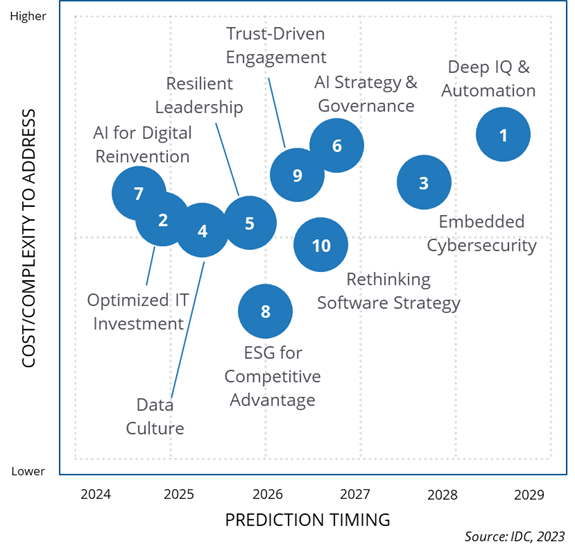
The “IDC FutureScape: Worldwide CIO Agenda 2024 Predictions” provides valuable insights into the future of this role. The FutureScape prediction looked at ten different predictions across the next four years and their impact for CIOs (see Figure, below). In this blog we will detail out the first five.  

Here are five key predictions that every CIO should be aware of:

1. Embracing AI, Automation, and Analytics

By 2028, it is predicted that 85% of CIOs will leverage organizational changes to harness AI, automation, and analytics, driving agile, insight-driven digital businesses. This means that CIOs will need to stay ahead of the curve in understanding these technologies and implementing them effectively within their organizations. The most challenging aspect will not be the technology, but aligning both the business and technical cultures to make these changes successful.  

2. Pressure to Adopt Digital Tech

By 2024, 65% of CIOs will face pressure to adopt digital tech such as GenAI and deep intelligence. However, limited IT support may diminish the benefits and heighten risks. CIOs will need to ensure they have the right support and talent in place to navigate these challenges and reap the benefits of these advanced technologies. In fact, we give in-depth guidance on approaches to adopting and applying GenAI to the organization in this eBook. In some cases, IT may have the talent they can leverage internally or train-up, but in other cases, IDC sees CIOs leveraging third-parties to  initially provide this talent and support.

3. Proactive Cybersecurity Measures

By 2027, 75% of CIOs will integrate cybersecurity measures directly into systems and processes to proactively detect and neutralize vulnerabilities, fortifying against cyberthreats and breaches. This highlights the increasing importance a multi-layer, systematic and systemic approach to cybersecurity protection rather than the more traditional point solution approach organizations have adopted over the years. Download this checklist to unlock that set of practices that Technology Leaders should employ to proactively protect your organization.

4. Prioritizing Strategic Data Management

By 2025, 45% of CIOs will prioritize strategic data management and foster a data-centric culture, ensuring competitive differentiation in the digital era. This means that CIOs will need to focus on how data is managed and used within their organizations, ensuring it is used strategically to drive business outcomes. As part of this, IT organizations will need to work with the business to identify what data is critical to achieving business outcomes and also the quality of the data. And as part of driving out a data centric culture, creating a common data platform (which doesn’t mean one tool, but common set of process, practices, and accessibility of data) is critical to enterprise success.

5. Misaligned Investments Hindering Business Performance

Two-thirds of CIOs will not meet their 2025 digital revenue goals due to misaligned investments hindering business performance. This highlights the need for CIOs to ensure their IT investments align with their business goals and strategies and that CIOs must understand both their company and the markets their company competes in. CIOs can no longer simply be good technologists. They also must gain acumen in their business and their market. They must understand the ‘art of the possible’ with technology and be able to translate it in terms that brings business conviction.

Above all, these forecasts highlight the crucial need for CIOs to sync up IT investments with the wider business strategy. It’s not enough to chase the latest trends; it’s about ensuring that every tech move aligns with the company’s goals. By fostering collaboration between tech experts and business leaders, CIOs can steer their organizations toward sustainable growth and success in the digital age. So, as we look ahead, let’s embrace these insights, stay agile, and keep innovating to thrive in tomorrow’s world.

To wrap things up, the IDC FutureScape forecasts paint a vivid picture of the road ahead for CIOs navigating the ever-evolving tech landscape. From AI to automation and analytics, the opportunities for innovation are huge. Yet, it’s not just about adopting shiny new tools; it’s about building a solid foundation of data management, resilient platforms, and proactive cybersecurity measures.

For more IDC FutureScape content for CIOs, be sure to check out the on-demand webinar, IDC FutureScape: Worldwide CIO Agenda 2024 Predictions. Click the button below to watch the webinar now.

Mona Liddell - Research Manager, Quantitative Analysis, CIO Executive Research - IDC

Mona Liddell is a Research Manager for IDC’s CIO Executive Research team. She is responsible for leading the creation, analysis, and delivery of quantitative-based research and related marketing content for business and technology leaders. This research provides guidance on how to leverage technology to achieve innovative and disruptive business outcomes.

After much back-and-forth on work models, bold ultimatums from employers and staunch resistance from workers, European businesses are in the process of codifying different ways of where, how, when, and why we work. One of the many reasons for this change is the speed with which technology, especially artificial intelligence and GenAI, have made it possible to work equally well in varying, flexible work models.

The downside of this rapid technology development has been that European organizations simply cannot hire enough workers with current or deep skills – both technical and human. Do you manage highly distributed teams performing complex and interdependent tasks? Certainly not easy. Finding employees trained sufficiently well to safely transition to the use of Gen AI solutions? Not easy either.

Enter the promise of automation and in particular the ability of AI and Gen AI tools to both facilitate repetitive tasks like coding, data entry, research, and content creation but also to amplify the effectiveness of learning in the flow of work and secure company assets.

The following 3 predictions are examples of what work in Europe might look like in the next five years, considering the areas of work personalization, skills development and the impact of climate change on office design.

Future of Work Predictions for 2024 and Beyond

  • Prediction 1: 60% of Large Businesses will upgrade hardware and software technologies to increase worker retention with personalized work experiences and enhanced collaboration by 2025.

Rapidly evolving technologies and work methods are forcing companies to upgrade hardware and implement new software technologies that support better employee experiences, personalization and improved collaboration.

Collaboration apps are becoming more visual and continue to develop features unlike multiplayer games that enable a more personalized view of work and teams, better targeting of projects, and hands-on collaboration apps. Meetings and other work resources, including collaboration resources (workflow, meetings, new document formats, etc.) are translated and transcribed in real time, captured, analyzed and exploited by other integrated business data sources. The results enable faster and more personalized decisions and collaboration, including summaries using generative AI. AI solutions are gradually increasing the ways people consume content and data, and AI itself will become a digital collaborator.

  • Prediction 2: Enterprises will leverage personalized technology skills development to drive $1T in productivity gains by 2026, enabled by GenAI and automation everywhere.

As the development and use of technology in everyday work environments becomes more complex, organizations struggle to find experts for programming, security, architecture, operations, management and many other roles. IDC data from 2023 shows that 43 % percent of organizations lack the capability support needed to successfully implement automation.

One of the reasons Gen AI adoption and experimentation has grown so rapidly is that everyday workers can see its immediate value. As new jobs come online due to new automation requirements and workers learn new skills, Gen AI is being incorporated into tools that create employee training. Workers with entry-level skills can better target individual learning needs based on the speed with which Gen AI can generate code, summarize data, and create first-draft multimedia products. This customized approach ensures that people (including IT staff) receive the most appropriate training, optimizing efforts to increase their skills and competencies as jobs evolve, plus the need to program GenAI applications themselves.

  • Prediction 3: By 2028, organizations will invest in office climate havens, using asset-based/renewable energy to defray 30% of their ongoing operating costs.

It is not just work patterns that are rapidly changing. The environment we live and work in is rapidly changing too. As uncontrolled wildfires, climate change and extreme weather events become more common in Europe, the consequences are affecting human health and the ability to work effectively. Sustainability measures are no longer considered optional as organizations worldwide recognize them as necessary components of strategic planning and sustainable operational excellence.

In future, progressive companies will adopt a combination of innovative building design, digital twins, robotics and integrated climate systems to create climate havens where workers and their families can both find relief and focus on work. Unfortunately, simply rebuilding existing buildings with AI or robotics adds energy demand to an already struggling European energy infrastructure.

Companies that invest heavily in asset-based energy (hydro/tidal, geothermal, solar and wind) on-site in their climate havens, support both their operating costs and potentially create a secondary revenue stream when they feed electricity back into the grid. This is reversing the long-term trend of digital organizations threatening their local communities through excessive power usage, while improving community relations, employee retention and talent recruitment.


All the above predictions have much in common – they seek to better understand the intersection of technology and human behavior. Science fiction predicts dystopian visions of mechanized and artificially controlled societies where human efficacy is threatened. IDC far from that point of view, but we also see how the concerns raised by new technologies such as Gen AI can play a big role in hindering adoption—for better or for worse.

Organizational leaders must invest time and money in the strategic planning for the adoption of AI and GenAI technologies, as well as the new roles and ways of working they create. This is not just a technology issue that affects computing, security, hardware, infrastructure, and integration requirements. It is also a human issue that must be addressed employee empowerment through skill development and the development of appropriate, re-imagined career paths.

For more information on the impact of Automation on the European Future of Work, please access the following resources:

Meike Escherich - Associate Research Director, European Future of Work - IDC

Meike Escherich is an associate research director with IDC's European Future of Work practice, based in the UK. In this role, she provides coverage of key technology trends across the Future of Work, specializing in how to enable and foster teamwork in a flexible work environment. Her research looks at how technologies influence workers' skills and behaviors, organizational culture, worker experience and how the workspace itself is enabling the future enterprise.

With the introduction of OpenAI’s GPT-3.5 series in late 2022, the world witnessed a surge in investment in generative AI. IDC predicts that worldwide spending on AI solutions will surpass $500 billion by 2027, signifying a significant shift in technology investments toward AI implementation and the adoption of AI-enhanced products and services.

IDC recently hosted a FutureScape webinar by Ritu Jyoti, group vice president of Worldwide Artificial Intelligence and Automation Market Research and Advisory Services. This webinar highlights some of the top 10 worldwide AI and automation predictions for 2024 and beyond. Watch now on-demand.

“ChatGPT’s explosive global popularity has given us AI’s first true inflection point in public adoption,” says Ritu Jyoti. “As AI and automation investments grow, focus on outcomes, governance, and risk management is paramount.”

IDC’s FutureScape 2024 research focuses on the external drivers that will alter the global business ecosystem over the next 12 to 24 months. It also addresses the issues technology and IT teams will face as they define, build, and govern the technologies required to thrive in a digital-first world.

A closer look at IDC’s top ten predictions for artificial intelligence, GenAI, and automation reveals the following:

  • Prediction 1: Tempering GenAI’s Risks: Accelerated efficiency and catastrophic risk are the two sides to the shiny new GenAI coin. To reduce the risks, cloud and software platform providers will bundle GenAI safety and governance packages with their primary services to add value and differentiate their offerings.
  • Prediction 2: Diverse Regulatory Requirements: Efforts to regulate the deployment and development of AI systems will vary across regions and countries. These diverse regulatory requirements are likely to result in organizations taking more phased approaches to AI rollouts. This will also increase time to value.
  • Prediction 3: Conversation as the Standard UI: Conversation is already emerging as the standard user interface (UI) for both enterprise and consumer applications and solutions. These conversational AI interfaces will significantly affect customer engagement, sales, marketing, and even the IT help desk.
  • Prediction 4: The Focus Shifts to Outcomes: As their understanding of automation matures, project sponsors have shifted from a technology focus to an outcomes mindset where they require tangible proof of value delivered for their investments This is measured by KPIs aligned with business and financial outcomes.
  • Prediction 5: GenAI-based Tools Automate Software Quality: Because of the value GenAI brings to automated testing, IDC expects it to quickly change the landscape of software testing. Vendors will become capable of producing a significant percentage of tests to decrease manual efforts and improve test coverage leading to better code quality.
  • Prediction 6: GenAI Transforms Application Modernization IT Services: Increased utilization of AI in application modernization IT services can streamline efficiency, enhance services delivery speed, and bolster IT services margins.
  • Prediction 7: Bringing AI to Knowledge Discovery: The latest advances in generative AI have prompted a surge of demand for capabilities such as natural language question answering and conversational search to support self-service knowledge discovery.
  • Prediction 8: Monetizing GenAI: While technology is a source of advantage, it is the business model that will help businesses monetize generative AI and drive lasting competitive advantage. By 2024, 33% of G2000 companies will exploit innovative business models to double their monetization potential of GenAI.
  • Prediction 9: AGI on the Horizon: Multiple groups are working toward Artificial General Intelligence (AGI) and companies will be experimenting with AGI systems by 2028. As it progresses, AGI will be transformative, impacting everything from the labor market to how we understand concepts like intelligence and creativity.
  • Prediction 10: Chip Priorities Change: Until AI workloads that require the offload of tasks from server processors to accelerators standardize on algorithms and software stacks tuned to server processors, purchase of accelerators (GPU, FPGA, and AI ASIC and ASSP) will eat into purchase of server processors (CPUs).

Are you interested in learning more? Access the complete IDC FutureScape event series and stay updated on the latest IT industry trends.

Explore IDC’s top 10 worldwide predictions for digital business in 2024 and beyond, straight from the latest IDC FutureScape.

IDC has recently published its annual FutureScape report, IDC FutureScape: Worldwide Digital Business Strategies 2024 Predictions. This focuses on the external drivers that will alter the global business ecosystem over the next 12 to 24 months and the issues technology and IT teams will face as they define, build, and govern the technologies required to thrive in a digital-first world.

For years, digital transformation (DX) has been the focus for organizations looking to gain competitive advantages and modernize their processes and technology. The goal: to become digital businesses where value creation is based on the use of technologies for processes, products, services, and experiences.

Now, the digital business (DB) era has arrived. Companies are seeking new digital revenue streams while digitizing operations to reduce costs and increase efficiency. Spending on digital technologies is growing while traditional, nondigital spending is stagnating or even declining. And demand for digital experiences from customers, employees, partners, and suppliers has become an expectation.

“Digital transformation was only the first step — to truly gain value from change, companies need to move to an innovative state,” said Craig Powers, research director, Worldwide Digital Business Strategies at IDC. “IDC expects more companies to improve their innovation capabilities through 2024 because digital innovation — the process of ideating and testing new digital technologies — is increasingly prioritized. The time for companies to build up innovative capabilities and cultures of innovation is now if they want to stay competitive in the digital business era.”

Let’s take a closer look at IDC’s top ten predictions for digital business strategies:

  • Prediction 1: GenAI Will Be Used to Innovate – GenAI will be used to codevelop digital products and services by pinpointing market opportunities and allocating company resources. The companies that utilize GenAI in this way will more efficiently and effectively roll out new revenue-generating endeavors, leading to faster-paced growth that their competitors not using GenAI will struggle to match.
  • Prediction 2: The Pace of Investments in Digital Technologies Will Continue – Spending on digital technology by organizations will grow seven times faster than the overall economy in 2024, as companies are compelled by market demands to grow digital business models and strengthen digital capabilities.
  • Prediction 3: Elevating AI to the C-Suite – A recent IDC survey found that just over half of CIOs say their organization has or plans to have an individual leader responsible for AI, and approximately half of those CIOs believe the leader will be part of the C-suite executive team.
  • Prediction 4: Digital Native Businesses Will Embrace GenAI – Digital-native businesses rely on technology to support their disruptive business models and to create their competitive edge. These companies will be early adopters of GenAI and will invest heavily to further their competitive advantage.
  • Prediction 5: Digital Business Platforms Enable Success – Digital business platforms enable greater visibility into a company’s operations, allowing for greater insight into the impacts of their investments. As businesses mature digitally, they find measuring ROI to be more straightforward and they are more likely to build leading-edge capabilities that can drive successful digital revenue initiatives.
  • Prediction 6: AI Everywhere Will Supercharge New Digital Business Models – IDC expects that the combination of predictive AI, machine vision, and GenAI capabilities, and the provisioning of on-demand services through digital ecosystems, will take on a new dimension. This will open opportunities to create new products and services for customer segments that will appreciate the appeal of these capabilities.
  • Prediction 7: Measuring Success Will Require New KPIs – Tracking what is truly relevant to the business is critical for strategic decision-making. We expect to see new key performance indicators (KPIs) implemented that reflect a shift toward the creation and delivery of digital products, services, and experiences, which are the defining attributes of a digital business.
  • Prediction 8: Digital-First Becomes the Investment Priority – CEOs increasingly expect their organization’s technology leader to be focused on delivering better business outcomes, increasing business agility, and bringing in new revenue through digital products, services, and experiences.
  • Prediction 9: AI Will Impact Workflows and Drive Employee Retraining – The wholesale adoption of AI will bring challenges for employees who see their overall workflow and learning process impacted. To mitigate negative impact and drive adoption, employees will need to be reskilled to work alongside GenAI.
  • Prediction 10: Digital Technologies Will Be Used to Meet Sustainability Goals – To achieve their sustainability ambitions, organizations will require both business and IT leaders to pursue digital technology investments that are twofold: meeting their digital goals while taking sustainability into account.

“Investment in digital business, augmented by GenAI, will continue to drive new models and positive outcomes going forward. Those organizations that have already begun their digital business journeys have seen the value and will continue to invest and innovate. Those that have delayed are at risk of losing significant market share over the next five years,” Powers added.

Stay informed and be prepared for the AI revolution that will reshape the IT industry and the way businesses operate. Don’t miss our annual prediction webinar series to gain deeper insights into the future of technology and business:

  • Worldwide Artificial Intelligence and Automation 2024 Predictions, November 8 at 12:00 pm U.S. Eastern time, featuring Ritu Jyoti
  • Worldwide Digital Business 2024 Predictions, November 29 at 12:00 pm U.S. Eastern time, with Tony Olvet & Craig Powers
  • Worldwide CIO Agenda 2024 Predictions, December 6 at 12:00 pm U.S. Eastern time, with Daniel Saroff & Mona Liddell
  • Worldwide Emerging Technologies 2024 Predictions, December 13 at 12:00 pm U.S. Eastern time, featuring Rick Villars

Interested in learning more? Access the full IDC FutureScape event series and stay updated on the latest IT industry trends.

IDC has just released its annual top 10 predictions for utilities worldwide. The predictions enable the IDC Energy Insights team to reflect on the current year and on what the future holds for the industry. This year, it’s fair to say, there was a lot to think about.

Following a very difficult 2022, characterized by spiraling energy prices from the ongoing Russia-Ukraine War negatively impacting businesses around the world, this year had a more positive note. With receding energy prices, which are still not back to pre-energy-crisis levels and possibly never will, focus returned to long-term initiatives and planning related to the energy transition. According to IDC’s Worldwide Energy Transition Survey (December 2022), almost 60% of organizations globally indicated they were steaming ahead with their energy transition plans, either proceeding at the same pace as before the energy crisis or even accelerating their plans (more than 1 in 10 in the latter case).

Additionally, the extreme weather events of 2023 — including the flooding in Libya and Eastern Africa, the blazing wildfires in Canada and Hawaii, the ice storm in Texas (U.S.), and severe heat waves that once again broke records all around the world — forced the spotlight back on mitigating climate change through decarbonization, electrification, and energy efficiency. Globally, 84% of companies still plan to become carbon neutral by 2040, and just under one-third plan to get there by the end of this decade. However, they admittedly need help as 60% consider their decarbonization plans challenging.

This is a tremendous opportunity for utilities — which have decades-long expertise around electrification, decarbonization, and energy efficiency — to drive the energy transition while growing their own businesses. Additionally, the energy transition, climate disruptions, and social sustainability have demonstrated that utilities are at the heart of economic resilience. Utilities are the only ones with experience managing the critical infrastructure the economy relies on to thrive, and they understand the implications of new disruptive technologies.

By using technology as a lever, electricity, gas, and water companies across the value chain will continuously optimize their operations, processes, and resources, offloading more and more non-core burdensome work, enabling utilities to focus on their core business and pursue new business opportunities. In the year of artificial intelligence (AI) everywhere, utilities have the power to advance further, helping to solve issues around procurement of flexibility, prioritizing connection queues and grid planning, addressing issues around integrated resource planning, and helping to crack more active customer participation, just to name a few.

Given all this, here are the top 10 predictions for utilities:

  1. In 2024, 45% of frontrunner energy suppliers will leverage generative AI (GenAI) technologies, especially chatbots, to improve customers’ digital journeys, cutting fallback calls to contact centers by over 60%.
  2. In 2025, 55% of utilities will prioritize supporting customer engagement with personalized energy efficiency and demand response programs, helping customers save 15% on utility bills’ energy component.
  3. By 2027, 50% of utilities will implement digital twins, improving asset optimization of power grids, decreasing unplanned outages by 30%, and supporting simulations for network expansion.
  4. By 2025, 60% of electric utilities will have integrated non-wire alternatives in standard planning, deferring up to $7 in system capex for every $1 spent on procuring distributed energy resources (DERs).
  5. By 2026, 40% of utilities will implement GenAI, improving asset and equipment restoration times by 30% and establishing a knowledge management platform for the next generation of field technicians.
  6. By 2026, 50% of utilities in advanced markets will invest in advanced distribution management system (ADMS) or distributed energy resources management system (DERMS) to optimize the influx of renewables and DERs coming online, decreasing their carbon footprints by 30% in the long run.
  7. By 2026, 25% of water distribution companies will have operationalized multispectral satellite imaging and AI-powered computer vision, improving the efficacy of leak detection by a factor of seven.
  8. By 2028, 35% of integrated electric utilities will offer integrated infrastructure, technology, and energy services for electric vehicle (EV) fleets, helping to accelerate public transport decarbonization.
  9. In light of escalating hacking incidents, by 2027, 25% of utilities will turn to managed security service providers (MSSPs) for outcome-based services that align security performance with business outcomes.
  10. Due to shifting regulations requiring greater supply chain transparency and due diligence, by 2026, 60% utilities will invest in environmental, social, and governance (ESG) data platforms to build sustainable supply chains and manage risks.

For each of these predictions, the IDC Energy Insights team has developed a detailed analysis, with associate drivers and IT impact and guidance for utilities (published here).

To complement the top 10 predictions, the IDC Energy Insights analyst team also develops a series of recommendations for utilities that have embarked on the energy transition journey. This year’s recommendations are:

  • Deliver on your purpose. Now that immediate issues around security of supply and consumer protection have subsided, it is time for utilities to revamp momentum on long-term net-zero goals. Sustainability, decarbonization, and electrification offer endless opportunities, so focus resources and efforts on energy-transition use cases and initiatives that will support and enrich your company’s future business portfolio.
  • Execute and communicate. The utilities industry must grasp the opportunity presented by the energy transition to make a positive impact on the fight against climate change and be recognized for it. Communication and drawing attention to related initiatives is as important as execution to support a change in perception of the utilities industry for the future.
  • Prioritize your people. More than ever, companies must prioritize making the most of their workforces, which have an abundance of company and industry knowledge that cannot be lost. With less resources available, companies will need to support their workforces in leveraging the most advanced technologies to optimize operations and drive efficiencies.
  • Harness GenAI. Cautiously go beyond the hype to understand how this technology can really support your organization. Liaise with industry peers regarding GenAI use cases, the benefits it brings, and the challenges that emerge. GenAI has the potential to help solve many deep underlying issues the utilities industry has been facing, and it can help utilities move into a new era.

IDC Energy Insights analysts Gaia Gallotti and Daniele Arenga will be onsite in Paris for Enlit 2023. They look forward to meeting you and discussing their predictions and more.

IDC has recently published its highly anticipated FutureScape report, IDC FutureScape: Worldwide IT Industry 2024 Predictions (IDC #US50435423) offering a compelling glimpse into the future of the IT industry and the pivotal role of artificial intelligence (AI). In this blog post, we’ll explore the key takeaways from this year’s IDC predictions, underlining the profound impact that AI is poised to have on the entire technology landscape and the way businesses conduct their operations.

This year’s predictions are centered around the emergence of AI as a groundbreaking inflection point in the technology domain. While AI is not a new concept, the release of the GPT-3.5 series from OpenAI in late 2022 acted as a catalyst, capturing global attention and leading to a surge in investments in generative AI. In light of this, IDC foresees global spending on AI solutions surging to over $500 billion by 2027. This, in turn, will usher in a remarkable shift in the allocation of technology investments toward AI implementation and the adoption of AI-enhanced products and services.

Rick Villars, Group Vice President of Worldwide Research at IDC, encapsulated this transformative moment by stating, “Every IT provider will incorporate AI into the core of their business, investing treasure, brainpower, and time.” This signifies not just a technological advancement but a significant shift in the mindset of CIOs and the digitally savvy C-Suite. While the pivot towards AI promises a wealth of innovative AI-enhanced products and services, it also poses challenges such as the proliferation of “now with AI” options, which could lead to uncontrolled cost increases and a loss of data control.

IDC’s FutureScape 2024 research is focused on the external factors that will reshape the global business ecosystem over the next 12 to 24 months and it also delves into the issues IT teams will encounter as they work on defining, building, and governing the technologies needed to excel in a digital-first world. To gain a more detailed understanding of these predictions, let’s explore IDC’s top ten worldwide IT industry forecasts:

  • Prediction 1: Core IT Shift – IDC expects the shift in IT spending toward AI will be fast and dramatic, impacting nearly every industry and application. By 2025, Global 2000 (G2000) organizations will allocate over 40% of their core IT spend to AI-related initiatives, leading to a double-digit increase in the rate of product and process innovations.
  • Prediction 2: IT Industry AI Pivot – The IT industry will feel the impact of the AI watershed more than any other industry, as every company races to introduce AI-enhanced products/services and to assist their customers with AI implementations. For most, AI will replace cloud as the lead motivator of innovation.
  • Prediction 3: Infrastructure Turbulence – The rate of AI spending for many enterprises will be constrained through 2025 due to major workload and resource shifts in corporate and cloud datacenters. Uncertainty about silicon supply will be joined by shortcomings in networking, facilities, model confidence, and AI skills.
  • Prediction 4: Great Data Grab – In an AI Everywhere world, data is a crucial asset, feeding AI models and applications. Technology suppliers and service providers recognize this and will accelerate investments in additional data assets that they believe will improve their competitive position.
  • Prediction 5: IT Skills Mismatch – Inadequate training in AI, cloud, data, security, and emerging tech fields will directly and negatively impact enterprise attempts to succeed in efforts that rely on such technologies. Through 2026, underfunded skilling initiatives will prevent 65% of enterprises from achieving full value from those tech investments.
  • Prediction 6: Services Industry Transformation – GenAI will trigger a shift in human-delivered services for strategy, change, and training. By 2025, 40% of services engagements will include GenAI-enabled delivery, impacting everything from contract negotiations to IT Ops to risk assessment.
  • Prediction 7: Unified Control – One of the most challenging tasks for IT teams in the next several years will be navigating the maturation of control platforms as they evolve from addressing a few basic systems to becoming a standard platform that orchestrates operations across infrastructure, data, AI services, and business applications/processes.
  • Prediction 8: Converged AI – Today’s fascination with GenAI should not delay or derail existing or other AI investments. Organizations must contemplate, trial, and bring to production fully converged AI solutions that allow them to address new uses cases and customer personas at significantly lower price points.
  • Prediction 9: Locational Experience – The accelerated adoption of Gen AI will enable organizations to enhance their edge computing use cases with contextual experiences that better align business outcomes with customer expectations.
  • Prediction 10: Digital High Frontier – Satellite-based Internet connectivity will deliver broadband everywhere, helping to bridge the digital divide and enabling a host of new capabilities and business models. By 2028, 80% of enterprises will integrate LEO satellite connectivity, creating a unified digital service fabric that ensures resilient ubiquitous access and guarantees data fluidity.

IDC’s FutureScape predictions provide valuable insights into the future of the IT industry and the pivotal role of artificial intelligence. As AI becomes the driving force behind innovation, businesses must adapt and invest in AI to stay competitive. The rapid growth of AI spending, the transformation of IT services, and the convergence of AI solutions are just a few of the significant changes we can expect in the tech landscape.

Stay informed and be prepared for the AI revolution that will reshape the IT industry and the way businesses operate. Don’t miss the upcoming webinars to gain deeper insights into the future of technology and business:

  • Worldwide Artificial Intelligence and Automation 2024 Predictions, November 8 at 12:00 pm U.S. Eastern time, featuring Ritu Jyoti
  • Worldwide Digital Business 2024 Predictions, November 29 at 12:00 pm U.S. Eastern time, with Tony Olvet & Craig Powers
  • Worldwide CIO Agenda 2024 Predictions, December 6 at 12:00 pm U.S. Eastern time, with Daniel Saroff & Mona Liddell
  • Worldwide Emerging Technologies 2024 Predictions, December 13 at 12:00 pm U.S. Eastern time, featuring Rick Villars

Interested in learning more? Access the full IDC FutureScape event series and stay updated on the latest IT industry trends.