From Digital Sovereignty to Data Spaces

Digital and data have transformed enterprises and changed consumer experiences and society. According to the European Political Strategy Centre, “In the 21st century, those who control digital technologies are increasingly able to influence economic, societal and political outcomes. In this context, the growing ‘geopoliticisation’ of technology implies a paradigm change for the notion of strategic autonomy … the EU’s ability to defend and promote its interests — as well as its credibility as a strong foreign policy actor — is ever more a function of its cyber resilience and technology leadership.”

The European Union has responded to the challenge with the ambitious Digital Decade plan to “pursue a human-centric, sustainable vision for digital society” and increase the EU’s “strategic autonomy in tech and develop new rules and technologies to protect citizens from counterfeit products, cybertheft and disinformation.” One of the eight objectives of the 2030 Policy Programme Path to the Digital Decade is to “ensure digital sovereignty notably by a secure and accessible digital infrastructure capable of processing vast volumes of data that enables other technological developments, supporting the competitiveness of the Union’s industry.”

The programme also proposes to establish multicountry projects to develop “European common data infrastructure and services”. In combination with regulations such as GDPR, the upcoming Digital Operational Resilience Act and Data Act, the Digital Decade programmes and projects aim to put Europe at the forefront of reshaping the global data economy along two closely intertwined axes: digital sovereignty and data spaces.

How Are Digital Sovereignty and Data Spaces Paving the Way for the Data Economy in Europe and Beyond?

IDC defines digital sovereignty as the capacity for self-determination by nations, companies and individuals. Digital sovereignty is more than just data sovereignty or data localisation. It entails cloud platforms, workload software, datacentre assets, communications infrastructure, processes, and operations used to control and manage digital infrastructure, services, and access and identity.

It underpins a digital-first Europe where governments, enterprises and individuals have genuine choice to control their data and digital destinies. But digital sovereignty alone is not enough. It’s a means to achieve outcomes, such as realising the value of data and data spaces through interoperable, innovative, easy to operate and control, secure, energy efficient, regulatory compliant and resilient next-generation infrastructure and platforms.

The European Union’s European Strategy for Data sets a bold vision “to create a single European data space — a genuine single market for data, open to data from across the world — where personal as well as non-personal data, including sensitive business data, is secure and businesses also have easy access to an almost infinite amount of high-quality industrial data, boosting growth and creating value, while minimising the human carbon and environmental footprint.” That bold vision is far from accomplished. IDC’s research shows that a unified data space for Europe, let alone the globe, will not exist in the near future. There are too many digital sovereignty, governance, semantic and technical interoperability challenges to overcome. Nonetheless Europe is setting a direction of travel that other regions and countries are watching.

Private and public sector entities understand that data sharing is a critical success factor to accelerate their success in the data-driven economy. And they understand that to realise the benefits, data sharing needs to happen not only within each organisation, but also with external partners, including beyond one’s industry.

In fact, our research on the future of industry ecosystems found that over 90% of public and private sector organisations globally share data with external partners, although around 60% do it only in a limited fashion or when strictly necessary. Europe’s strategic data spaces vision is the next stage of evolution, where data sharing can happen at a greater scale and beyond industry boundaries, thanks to:

  1. Federated architectures that dynamically match data demand and supply
  2. Governance policies and processes where matching of demand and supply takes place thanks to trusted rules and intermediaries that enable secure, transparent and fair participation of both data users and data providers
  3. The ability to provide and use data to and from the common space, either for non-profit/altruistic purposes or for-profit purposes, or both

What Can European Public Sector Leaders do to Benefit from the Digital Sovereignty-Data Spaces Twin Transition?

As for the rest of the economy, public sector organisations are trying to figure out how to leverage data to improve policymaking, service delivery and operational efficiency. Beyond EU-wide initiatives, public sector leaders across the region have a role to play to:

  • Incentivise the private sector to help achieve both for profit and non-profit outcomes, while protecting personal data, intellectual property and trade secrets
  • Work with the tech industry to promote the use of semantic and technical interoperability standards
  • Collaborate with the tech industry and academia to foster R&D to accelerate adoption of technologies, such as secure hardware architectures, probabilistic computing and homomorphic encryption, which in the future will enable trusted data sharing even on non-trusted systems
  • Invest in digital sovereign infrastructures and services, for the data spaces where digital self-determination can accelerate value realisation
  • Initiate data spaces that have immediate societal benefits, such as digital citizen wallets that ensure citizens have to provide data to public administration once only, and contribute critical data that they own, to data spaces that encompass a public-private ecosystems, such as health, mobility and the built environment

Join IDC experts and public sector leaders from around Europe at the IDC Government Summit to learn more about digital sovereignty and data spaces, and to share your experiences.

Massimiliano Claps - Research Director - IDC

Massimiliano (Max) Claps is the research director for the Worldwide National Government Platforms and Technologies research in IDC's Government Insights practice. In this role, Max provides research and advisory services to technology suppliers and national civilian government senior leaders in the US and globally. Specific areas of research include improving government digital experiences, data and data sharing, AI and automation, cloud-enabled system modernization, the future of government work, and data protection and digital sovereignty to drive social, economic, and environmental outcomes for agencies and the public.

How companies are partnering with a service for true end-to-end process support that brings full cloud cost savings

48% of enterprises plan to keep spending steadily on cloud, according to IDC research, making cloud costs a focus for IT leaders. And, the majority of organizations believe they’re overspending on cloud.

Many organizations are aware that they need to improve their cloud spending habits, but the process that it takes to get there often seems exorbitant, causing them to instead disregard the changes needed to turn their cloud spending around. This blog intends to show that the time and resources involved in executing shouldn’t deter companies from making the necessary changes.

From insights to process, these two companies found that hiring a partner to guide them through the work needed to transform their cloud costs, in ways that were custom to their needs, made all the difference in ensuring that they not only followed through on executing a plan of action but giving them a successful outcome.

An international telecommunications company has migrated its entire infrastructure to the public cloud (AWS and Azure) and uses a broker towards AWS and Microsoft, performing contract management and basic security services. For both providers, a System Integrator (SI) has been contracted to provide managed services (IM and TAM) on top of the cloud providers. 

During the migration, cloud costs rose above the available budgets that had been set, based on advice by the SI’s. During migration, the SI’s focused on the project deadlines rather than optimizing and saving on what was already running in the cloud. The telecommunications company turned to IDC Metri for independent advice on cloud cost savings.

IDC Metri has helped to improve tooling, and to define processes and ways of working, for this telecommunications company to analyze and manage cloud costs themselves. IT leaders can learn from their experience that recommendations from tools, including those from cloud providers, aren’t always realistic. They tend to be opportunistic, like suggesting that all instances should be reserved for three years, and that this will save over 50% of costs for those instances. That is the same as expecting your IT landscape to remain the same within that time – this is simply not true.

PostNL has been one of the first listed companies in the Netherlands to go ‘all in’ to the public cloud, starting in 2012. Nowadays, PostNL is in the second stage transforming all of its bespoke applications from IaaS to PaaS solutions, like BI/Analytics platforms, container platforms and serverless computing. When compared to IaaS, price models for PaaS are more usage based than capacity based. Saving costs on usage-based priced services means optimizing the software, rather than the underlying infrastructure.

Unlike the anonymous international telecommunications company in our example, PostNL doesn’t have SI’s in-between them and the cloud providers that offer managed services. The application teams, mainly DevOps based, are managing the cloud infrastructure themselves. Also here, cloud costs had an upward trend, from which PostNL has asked IDC Metri to bend it.

IDC Metri has made recommendations, which were much less supported by tools, since these focus on IaaS, rather than PaaS. With the top 10 teams concerning costs, alignment has been done on savings, which has led to about 8% savings. A must know here is that large scale optimizations, such as applying savings plans, had already been done by PostNL itself. The savings IDC Metri helped to achieve were more on architecture and licenses.

In conclusion, using tools that generate recommendations is only the starting point for achieving savings. First of all, the recommendations need to be taken with a grain of salt since they tend to be rather opportunistic. Furthermore, a list of recommendations is one thing, to actually achieve savings, hereby overcoming indifference or even resistance to save costs, is another thing. IDC Metri does support the full process, from analyzing costs through setting up processes to actually achieving savings.

Can’t wait until the next blog is published to learn more about cutting cloud costs? Contact us to schedule a conversation.

At its core, market intelligence helps organizations understand their customers, competitors, and markets better, and allows them to capitalize on changing conditions. As the interplay between these elements becomes more complex, organizations are investing more in aligning the innovation process with market demands. Leveraging market intelligence data, companies can better understand market size and growth opportunities, accelerate innovation, and identify key adjacencies.

Key assets for best-in-class market intelligence organizations are total addressable market (TAM) forecasts and market share data. These tools provide a clear picture of the current state of the markets a company participates including, who key competitors are and their market shares, the expected growth rates of those markets, as well as key adjacent markets that a company considers complementary, competitive, or otherwise ripe for expansion.  This forecast and share data is typically customized to:

  • Align to the taxonomic lens through which the company chooses to view the market (this may be on a number of axes from technology to geography to vertical and business size segments to unique sales territories and structures)
  • Provide the necessary resolution of data (e.g. at the geographic groupings that the company manages to or at the technology market detail that effectively informs product teams and individual product analysis)
  • Be delivered with the latest insight at the right time, so it can be fed into yearly or regular strategic planning cycles, sales operations decisions, capital allocation analysis, product management decisions, and other critical data-driven decision processes

The goal of all of this is to create a single version of market truth that all internal parties including marketing, sales operations, finance, strategy, and senior management can use to inform critical business decisions about investment, product development, sales team focus and allocation, partnering, M&A, and more.

Building, regularly delivering, and continually evolving such a data set is challenging work. However, the payoff is significant:

Market intelligence tools allow you to:

  1. Focus on a single, credible data set  so you can reduce or eliminate internal debate over things like opportunity sizes and expected growth rates
  2. Build internal consensus and agreement on highest priority target markets for core business and growth opportunities
  3. Eliminate duplicate work that may be going on in regions/countries or teams evaluating similar opportunities
  4. Free internal resources to focus on making strategic decisions with the data not assembling it

Without regularly developed, consistent market data, mapped to your business, planning decisions can take longer or be based on ad hoc data or opinion. Market intelligence data provides quantitative analytic support to aid in business and investment management, product and market feasibility and competitive strategy.

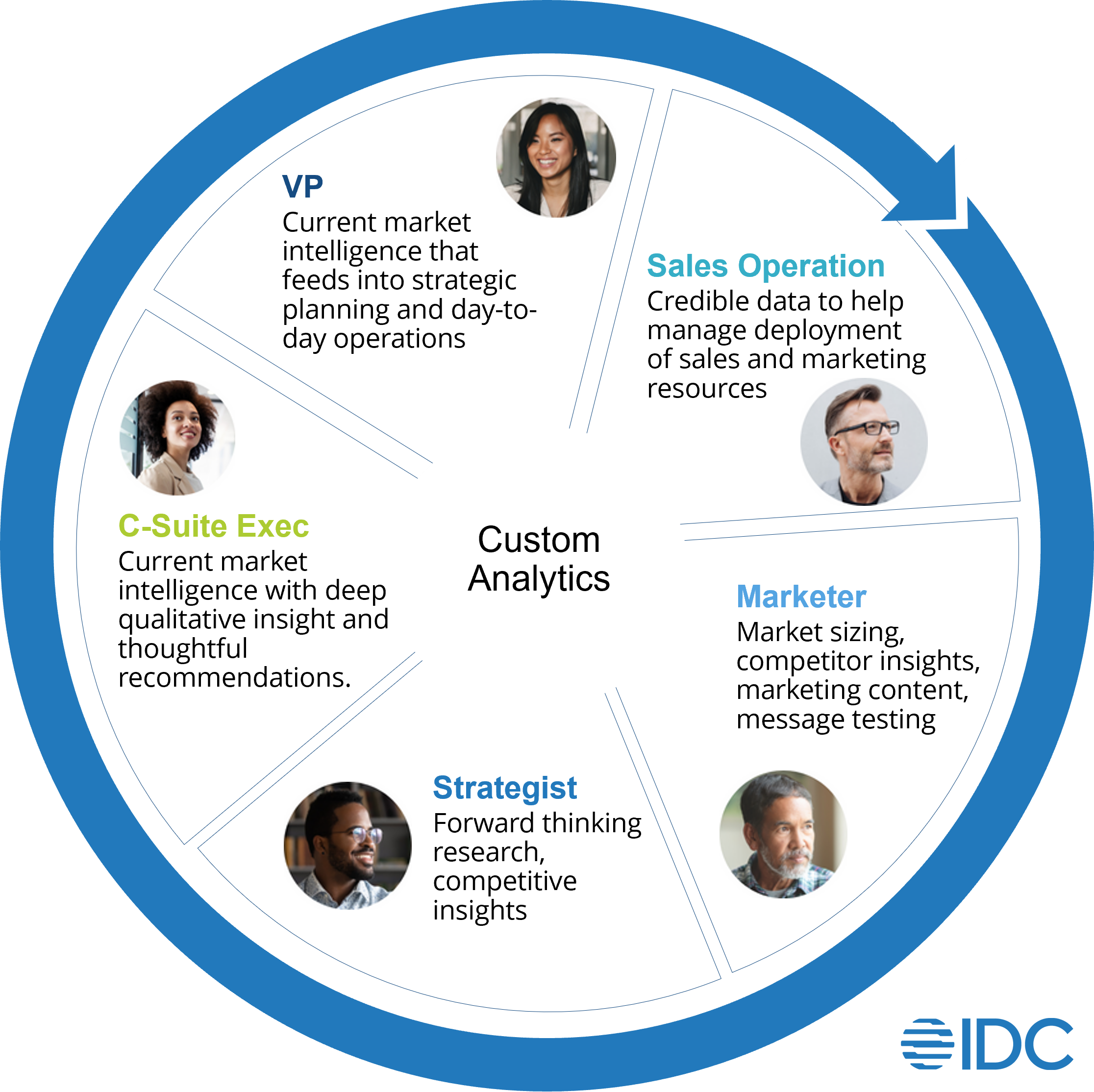
IDC has found the best organizations build this single version of market truth, build consensus that it should be used by all relevant teams, distribute it widely so it is well utilized, and rigorously and regularly revise and update its taxonomies, definitions, and data so it evolves with the company. If this is done, it enables C-Suite executives to identify markets where they can obtain and retain a competitive advantage. (i.e., how to do better in markets they’re currently in and how to identify new market adjacencies they should move into). Sales Operations can use market intelligence tools to incentivize their sales team and resolve conflicting views between, typically, anecdotal sales feedback and central estimates. Marketers benefit from identifying trends early, validating the market for their products and services and crafting messages that are fresh and relevant.

What Goals Can Market Intelligence Achieve?

  • Identify business growth opportunities
  • Provide quantitative analytic support to aid in business and investment management, product and market feasibility
  • Identify performance in existing markets
  • Identify compelling market adjacencies that can be entered via organic, acquisitive, or partnering actions
  • Confirm market for existing product, how to expand addressable market for current offers, and how to develop new products for existing and new markets
  • Target key geographies, verticals, and other segments
  • Identify key competitors in existing and planned market, their offers, market share, recent performance

Selecting the Right Market Intelligence Tool

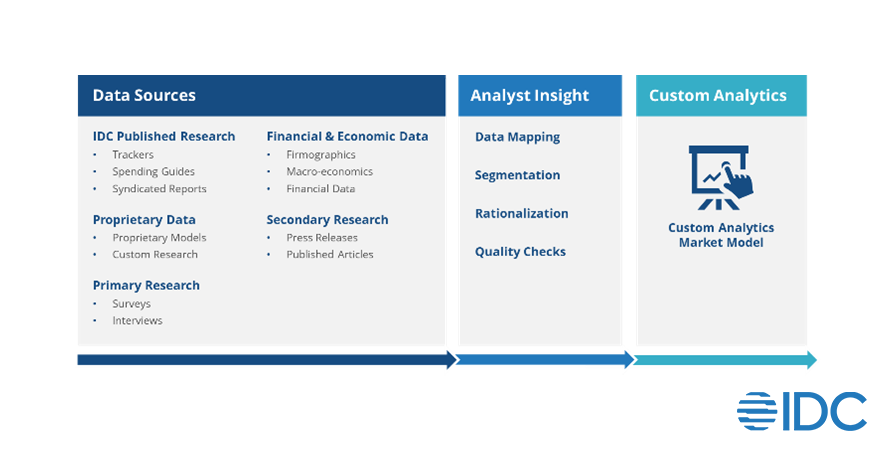
You need to be sure that the tool you use maps the technology world, and creates extensive, insightful data, customizing it to support your critical decision making. To do that, you will want to understand the approach used to develop these custom data sets. What are the sources of data? How is the data validated and rationalized?

IDC maps the world of technology through extensive, well documented taxonomies in technology domains (hardware, software, services) as well as vertical, business size, and use cases. Through this rich set of regularly updated data and taxonomies, methodologies, and tools, as well as a worldwide network of analysts, we deliver these customized market views to the largest, most advanced, and innovative technology driven companies in the world helping them   better manage their business.

The right market intelligence data can help you overcome product and market complexities, more accurately forecast revenues and outpace competitive forces by providing current insights that feeds into your strategic planning as well as day-to-day operation of your organization.

IDC’s Custom Analytics practice and how it can help you with reliable market intelligence data.

DOWNLOAD NOW:

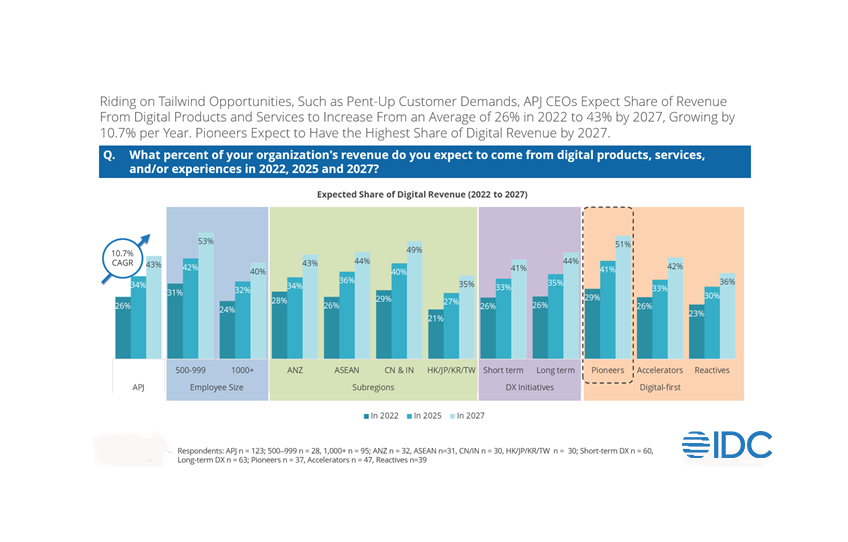
One of the key measures I like to use when talking to the C-Suite about their digital transformation initiatives is to ask how much revenue do digital products, services and experiences bring to the business, as well as how much is expected. This simple, but telling, question lets me know how mature they are, and if they are well on their way to employing a digital-first strategy. 

Back in 2019, the percentage of revenue attributed to digitally enhanced products, services and experiences was less than 5% of total revenue. Today, our recent IDC CEO Sentiment Survey shows that it’s over 20%, and by 2027 it’s expected to be more than 40% of total company revenue.

How a business operates during its experimentation stages of digital transformation is vastly different from more mature digital businesses. As enterprises scale their innovation and transformation capabilities, a trigger point is reached that causes it to start to think about a digital-first strategy. We’ve seen this accelerate because of the pandemic, with examples from the health sector, port authorities, retail, financial institutions, as well as government services. Today, 90% of Asia/Pacific organizations are in various stages of executing their digital-first strategies.

At the same time, IDC’s Future Enterprise Wave 7 Survey (Aug 2022) show that CEOs who champion digital-first strategies are more concerned about reaching ESG (Environmental, Social and Governance) goals and creating an innovation culture, and use these as critical levers in running a digital business compared to their peers.  Project failure rates also drop by as much as 13 percentage points as a result of a CEO champion.

While there are many benefits, one of the biggest challenges mentioned when running a digital business is transitioning to new metrics on how business value is measured. Even mature digital businesses say that business value realization can be difficult to achieve partly because of how legacy metrics and measures are used during this critical time of transition. 

A more holistic approach is to use a mix of internal and external oriented metrics to align financial performance in the short term, and ecosystem and sustainability impacts over the longer time horizon. The same Future Enterprise Survey shows that close to half of organizations who consider themselves a digital business agree that ESG impacts, and ecosystem contributions constitute part of the enterprise business value. Yet, in practice, only 28% of the same organizations are using sustainability metrics and 26% are using ecosystem metrics as success measures.

Over the last 12 months we have seen measuring ESG impact and value generated from digital ecosystems rise above more traditional and lagging financial metrics. I think these measures will only rise in importance, as purpose-driven culture and shared values across the digital ecosystem creates new businesses that have social, economic and sustainable outcomes.

One such example is Tsingtao Brewery in Qingdao, China, which has not only successfully deployed digital solutions to reduce lead time to address consumer demands for customized orders but is also looking at using technology to achieve sustainable business growth.

Kexing Huang, Chairman and CEO of Tsingtao Brewery, said “Consumers expect a good product, but also a company that has values and produces in a green and simple manner. By using new technology, we can improve our efficiency and reduce energy consumption and incorporate green and sustainable development to the whole value chain.”[1]

In transforming into digital business that can align both short- and long-term goals, it’s not only business models that are undergoing complex changes, but as a result, organizational and operating model changes are occurring to support a more agile, data-driven and collaborative culture.

The same Future Enterprise Wave 7 Survey mentioned earlier shows that Asia/Pacific organizations’ top challenges in running a digital business are (1) building a data-driven business and culture, (2) engaging with new digital ecosystems, and (3) modernizing their operating models. Digital ecosystems are integral to digital business models where value creation activities are orchestrated across the value chain using technology, connectivity, and shared data. This brings in cascading ramifications to the enterprise’s operating and organizational models which needs to change in a lockstep fashion to be executed successfully.

It is in my belief that building up next generation digital business platforms forms the core part of the solution in addressing these complex and interconnected challenges.

To become a digital business, organizations must orchestrate change – rebuild one’s digital foundation, while competing and innovating in the digital marketplace. I akin this to an orchestra where each part of the symphony plays an equally undismissible role. The foundational bass, the harmonic brass, and the melodic strings each represents the sturdy digital foundation, compelling digital offerings, and delightful innovations required to bring a masterpiece composition to life. With its data fabric, the platform represents an orchestration point in harmonizing change so as to manifest the melody of a purposeful business.

I hope to showcase to you leading organizations in the Asia/Pacific region at IDC’s Future Enterprise Awards 2022, where we have seen how these changes resulted in new direct-to-consumer experiences, radically overhauled HR practices, recalibrated finance systems and data-driven supply chain visibility.  I hope to see you all in Singapore as we unpack the Digital Business Era and announce this year’s Future Enterprise Award winners for the Asia/Pacific region.


Linus Lai - Group Vice President, Research - IDC

Linus Lai is a distinguished member at IDC Asia/Pacific, in which he spearheads research in digital business, trust, infrastructure, and services. With over 25 years of industry experience, Linus is based in Sydney and serves as the chief analyst for Australia and New Zealand (ANZ). He is a founding member of IDC's Emerging Technology Advisory Council and a respected senior member of the region's CIO100, CSO, and Future Enterprise awards. In his role, Linus provides strategic insights for digital leaders and the technology sector, focusing on sourcing strategies and emerging technology across Asia/Pacific. His expertise has earned him numerous accolades for his contributions to country, regional, and quality research. Previously, as the head of research in Southeast Asia, Linus was instrumental in expanding IDC's presence and influence in the region. His thought leadership is frequently sought after through regular features in various publications and media outlets. He is also a prominent speaker at industry forums, keynote events, and strategy workshops. Before joining IDC, Linus worked with a leading outsourcing service provider with a digital banking focus. He holds a Master of Science degree from the University of Lincoln, United Kingdom.

There is no doubt that we live in the age of video. IDC research shows a 32% increase in video usage since the start of the pandemic. Whether it’s watching YouTube clips to research a product or service, attending B2B meetings and events live online, or watching news reels on Instagram, the use of this medium has grown in all areas of communication. Other than a live personal interaction, nothing tells a story, communicates, informs, or entertains better than video.  

“Every industry has the opportunity to use video to educate, persuade, and communicate with its customers. Defining and implementing a cohesive content strategy can be a game changer in how an organization connects with its employees and customers in a more engaging and immersive manner.” (Marci Maddox, research vice president, IDC Digital Experience Strategies) 

All generations and demographics prefer to interact with video and other rich media over any other content.  While in the past consumers would look at online reviews, read blog posts, or watch commercials, now they are relying more heavily on this type of content in their research phase.  

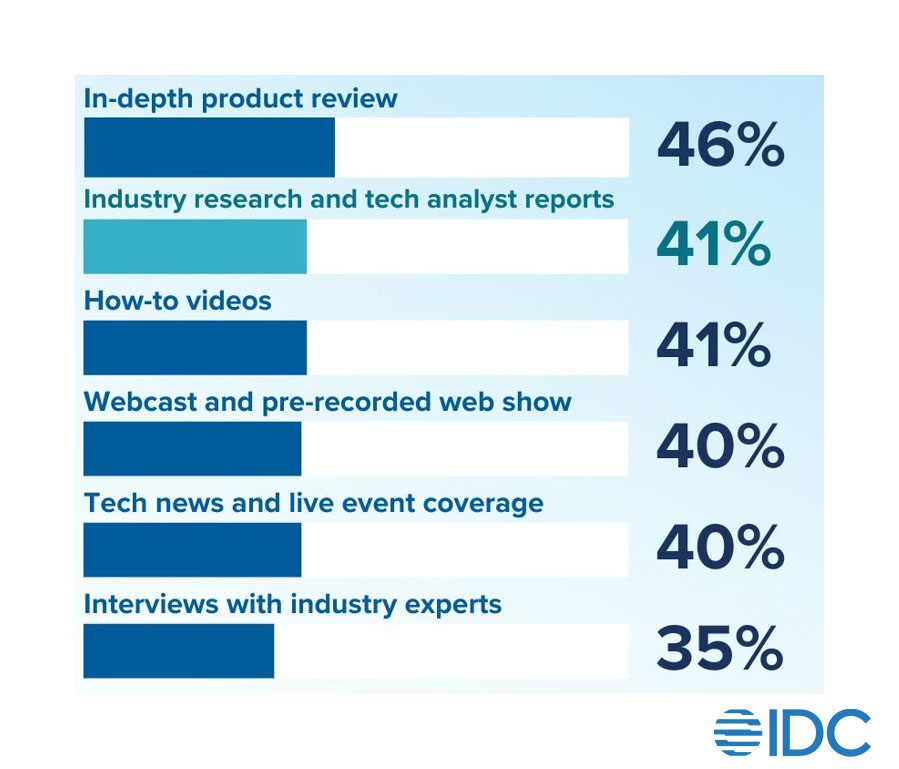
B2B customers use video for many professional reasons. 

Which of the following types of technology-related video content are you likely to watch for business purposes? 

Source: Foundry Role & Influencer of the Technology Decision-Maker Survey, 2022 

Lights! Camera! Leads? 

A recent study from Wyzowl found that 86% of businesses use video as a marketing tool. But does this mean that they all make a significant impact? Can you even remember the last marketing video that really impressed you and made you act?  

Most marketing videos are light on information and heavy on repetition. You can and should do better, as a well-planned video can create a powerful, lasting impact, create brand awareness, and ultimately leads.  

You are ready to invest in video. Read on to learn how to create a video that really delivers results.

The Makings of a Great Video 

You might want to delve straight into pre-production, but have you thought about the reason you want to use video and who it will address? What’s the story you are telling, how do you want to tell it, and who do you tell it to? And, most importantly, will it satisfy your audience’s needs and pain points? Only then you can decide on what video format, if any, you want to use.  

Also, remember to make the video timely as well as respectful of other people’s time. Don’t waste your time with lengthy introductions. Instead, get straight to the point.  

Finally, what’s the rationale behind the video? How does it fit into your overall content strategy? What’s the messaging? Where will you promote it? Is it part of a series? 

To sum it up: Remember the three Rs – reason, respect, and rationale – before you even start pre-production. This will save you time as well as money in the longer run. 

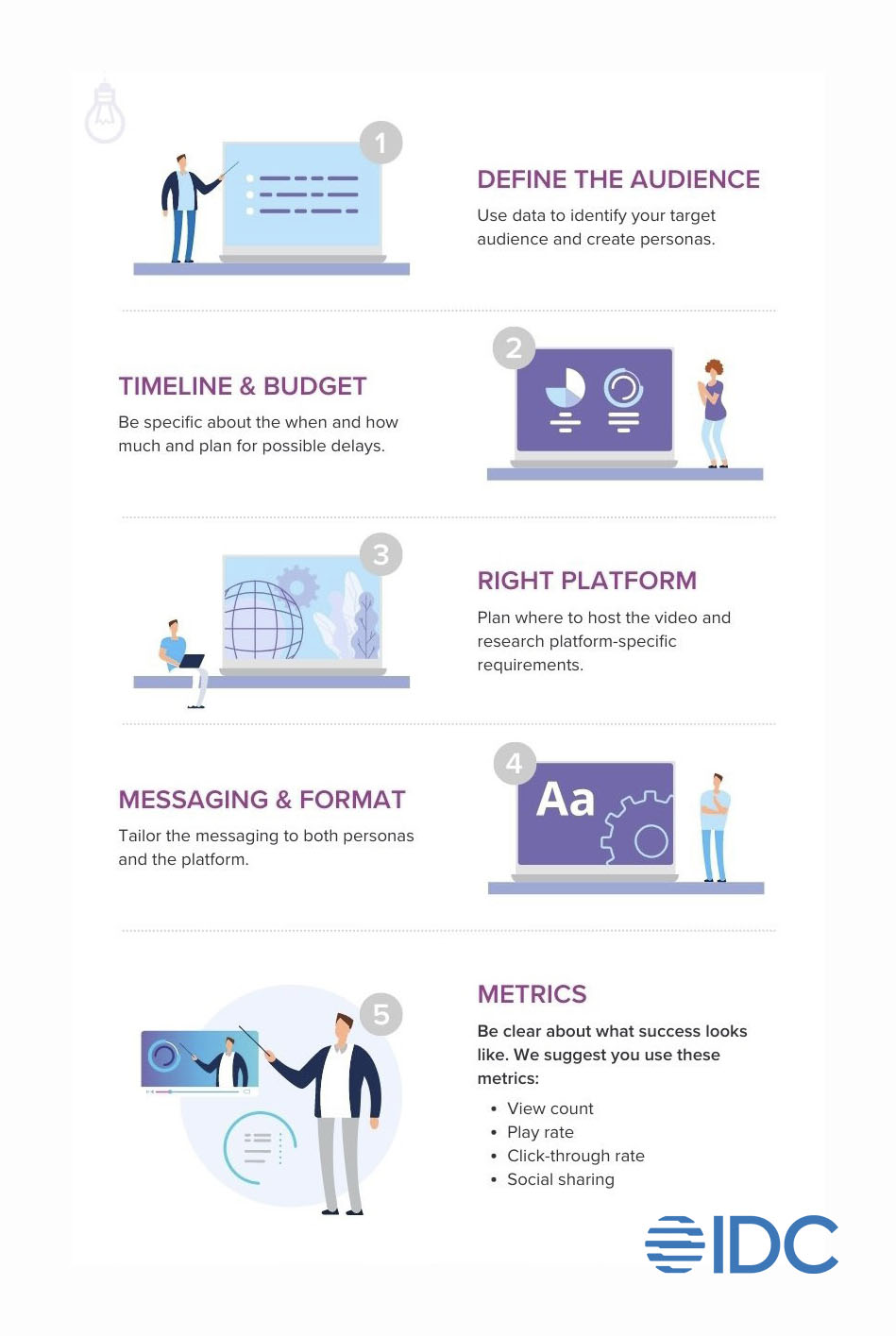
5 Steps to Successful Video Marketing 

Define the audience 

Knowing who you market to is the key to a successful campaign. Use reliable data to identify your target audience and create personas to express clearly who you have in mind when creating your content. 

Set a timeline and budget 

Even though we are not about talking Hollywood-like productions, the creation of video content can be time-consuming and expensive. That’s why it’s important to create a clear timeline for every step of the process and plan for occasional delays. Even a small production relies on the skills of many different people, so using basic project management tools will save you time and money. 

Choose the best hosting platform  

Before creating your video, think about where you will be hosting it and research platform-specific requirements. You will want to consider what people on each platform are looking for. Also, take into consideration that a video doesn’t promote itself. You will have to put in some time and effort to make sure your video gets seen by the right people.  

Develop messaging and choose the right type of video 

Your message should always be tailored to both personas and the platform. For example, longer formats work well on YouTube, while other social media channels like Instagram prefer short-form content. 

Decide which metrics you will track and what success looks like 

Before you start production, you must be clear about what success will look like. The best place to find out which metrics to use is to define the video’s place in the marketing funnel.  

For example, if you address the top of the funnel, and your aim is to introduce your brand to potential customers, your KPIs will be related to the discovery of the brand, not sales. Examples of this are total views, view duration, or 3-second views.  

If you are looking to deepen the relationship with potential customers mid-funnel and create consideration content, you will be looking at metrics like click-through rates or view length.  

Only at the conversion stage at the bottom of the funnel, your KPIs should be related to sales outcomes.  

Interested in learning more? Download IDC’s Tech Marketer’s Guide to Video Marketing today. 

Beyond high availability and disaster recovery, cloud infrastructure provides the capital markets with scalability and versatility that standalone organizations would typically struggle to replicate with traditional computing, networking, and storage solutions. These attributes of scalability and versatility are foundational to sustained real-time connectivity and interoperability needed for open and resilient capital markets. The resiliency of the capital markets rests on their capacity to sustain internal and external stressors while meaningfully adapting to new operating parameters, from the economic to the regulatory and everything in between. Cloud infrastructure is an excellent means of strengthening the capital markets’ adaptive capacity.

What’s next for the capital markets and cloud services?

Industry ecosystem collaboration around shared cloud native utilities is an essential next step toward maximizing the benefits of cloud within the capital markets at scale. Narrow, use case-specific cloud initiatives have demonstrated, replicable outcomes for institution-specific processes. Growing product and service commodification within the markets is making the broad adoption of shared utilities and business-process-as-a-service (BPaaS) offerings an apparent inevitability. This trend towards shared utility platforms is anticipated to be self-reinforcing and perpetuate ongoing industry consolidation.

As firms adopt cloud infrastructure en masse and the capital markets ecosystem embraces public and private shared utility platforms, competition is expected to solidify with a few large firms competing on volume and a raft of smaller firms providing specialized services, or competing in narrow market segments. So, while cloud infrastructure will help cultivate openness and resiliency in the markets that global industries rely on, it will also diminish traditional competitive attributes. Investment in non-differentiated business processes, including those executed on the cloud, will increasingly fail to provide a defensible competitive positioning.

How can capital markets firms differentiate themselves considering these potential outcomes?

A great first step is to identify and eliminate technical debt in the process of comprehensively leveraging cloud infrastructure elements towards a digital-first business model. Next, firms might consider how mutualized industry infrastructure is going to change the value of their competitive differentiators. Are the profits stemming from superior speed to market sustainable or will technology have eliminated informational asymmetries and associated profits? Are the industry channel partners going to be around in five years to provide deal flow or will access have been democratized by a variety of agile new market entrants? For those firms unable to consolidate deal or order flow and operate profitability across commoditized product and service classes, the answer may lie in how they can generate and monetize data. Presumably, there will always be a marginal competitive benefit in customizing technologies like cloud services faster or better than the competition, but ultimate differentiation will likely originate from firms’ capacity to generate or acquire and then either sell or act upon quality data.

As discussed, cloud architecture lends well to shared industry utilities and is generative to openness and resiliency which the public and therefore (hopefully!) regulators demand. A natural evolution of this impending market development is the adoption of distributed ledger technologies (DLT). DLT further enhances the openness and resiliency cloud architecture provides by introducing an immutable quality of transparency. The trusted capital markets ecosystem model of tomorrow rests on the successful co-adoption of these technologies. Firms and technology vendors in the space are encouraged to think critically about their current business models as tomorrow’s market structure is expected to exhibit markedly different competitive dynamics.

To learn more about the ways in which technologies like cloud are expected to affect the capital markets, click the button below to access IDC’s new eBook, Planned Adoption of Private Cloud within the Capital Markets.

Thomas Shuster - Research Director - IDC

Thomas Shuster is Research Director for IDC Financial Insights responsible for the Worldwide Capital Markets, Wealth, and Digital Asset Strategies program. Mr. Shuster's core research coverage includes the transformation of the capital markets industry, particularly sell-side investment banking, and the use of technologies to modernize and leverage opportunities in the market. Previously, Mr. Shuster was Vice President of Sales with Alpha Ledger Technologies, a digital asset origination platform startup, where he advised the founding team on capital markets processes, financial technology product development, and go-to-market strategy. Prior to Alpha Ledger, Mr. Shuster led new deal origination as Director of Business Development at Charter Asset Management. Earlier, Mr. Shuster was a Director, Investment Banking with UBS Financial Services where he originated underwriting business, a Vice President with Blue Rose Capital Advisors where he advised clients on capital markets access, and a Financial Research Analyst with the International Monetary Fund (IMF) where he structured sovereign debt arrangements during the 2007-2009 Great Recession. - B.S. in International Business from Northeastern University

5G, IoT and Edge Driving Telcos to Embrace Platform Architectures

The overarching theme in the telecoms marketplace is that the rise of 5G, IoT and edge is driving telcos to consider new platform architectures and ecosystems to deliver the right solutions for their customers. Telcos are searching for more intelligent ways to monetise their network data and to create value beyond connectivity as we surge towards an increasingly connected world.

Increasing connectedness also increases the amount of data that telcos must support. IDC’s Global DataSphere Forecast projects that data created and consumed will grow at a rate of 26% through 2024, topping 142EB.

To support the vast increase in data, and to successfully monetise adjacent services, telcos must embrace intelligent automation, containerised architectures and cloud-native principles to modernise and simplify operations for business agility and faster time to market. This will be facilitated through cloud platform solutions that can scale in line with continuously changing market demands and requirements, and which necessitate a new class of digital ecosystem partnerships.

Driving Revenue Growth Through Programmable Networks

Telcos globally are at different stages on their journeys to becoming cloud native. Some are aggressively pursuing a public-cloud-first strategy while others are taking cautious steps away from on-premises by having a hybrid cloud focus.

Most telcos are taking a pragmatic approach and have begun their migration from legacy and network functions virtualisation (NFV) platforms to container-based, cloud-native platforms. These shifts are driven by the lower cost of ownership and elastic scaling of the network.

Cloud-native network functions (CNFs) are being progressively deployed alongside virtual network functions (VNFs) so that customer-centric services can be scaled, updated and orchestrated more easily. However, the vast majority of telco cloud workloads still leverage VNFs and we expect the overall spending on telco cloud software to grow from $7.5 billion in 2020 to $29.0 billion in 2025 at a CAGR of 30.9%.

Cloud and the convergence of compute, storage, networking and edge will enable CSPs and enterprises to offer their customers completely reimagined user experiences. The openness and programmability of telco cloud will also give rise to further industry collaboration — Vodafone teamed up with AWS in 2021 to launch Europe’s first public multi-access edge computing (MEC) deployment providing a platform for applications developers to deliver low-latency use cases leveraging the full breadth of AWS cloud services, right at the edge of 5G networks.

This enabled AWS Wavelength customers to explore new business opportunities, build applications and services that were not possible before, and transform user experiences. Unlocking 5G revenues will also depend on a major shift towards adaptable operations and monetisation systems.

Across EMEA, particularly in Europe, partnerships between telcos and public cloud providers to support OSS/BSS deployments continue to strengthen as operators seek to implement deep digital transformations to drive revenue growth. Examples in the first half of 2022 include Vodafone’s deal with Oracle in June 2022 to migrate many of its IT systems to Oracle Cloud Infrastructure, and BT’s five-year deal with AWS announced in May 2022 as the telco seeks to modernise its IT infrastructure.

Three Emerging Business Models for Telco Cloud

The relationships between telcos and their cloud/technology partners are complicated and still evolving. CSPs are still refining their own network transformation and road maps, while having to decide between using their own private network cloud solutions versus working with public cloud providers.

We have seen the formation of three business models between the CSPs and cloud providers:

  • Outsourcing back-office and IT functions: CSPs runs back-office operations like billing, service management and customer relationship management in a public cloud environment.
  • Enabling service channels, partnerships and application creation: The telco and cloud providers work together to deliver end-user services (sell-with model), mainly to enterprise customers.
  • Migrating network workloads: This involves shifting the core, RAN and other essential networking components of the telco to the cloud.

Of the three business models, telcos using cloud to host network workloads is the newest and the riskiest. This model received mainstream attention when AT&T announced it would use Microsoft Azure to host its mobile core network.

The purpose of this action is to enable the migration of AT&T’s 5G core workloads to Azure as AT&T continues its transformation into a cloud-native 5G mobile operator. AT&T is not the first mobile operator to do this — DISH had already announced plans to work with AWS to host its network functions.

The difference here is that AT&T has an established network with traffic and DISH is a greenfield network operator. Outsourcing a core network competency requires significant trust and confidence between the telco and cloud provider as any notable disruption or interference could negatively impact operations and cause outages, seriously harming the business reputation of the telco.

To provide relevant 5G solutions to the market and drive revenue growth, telcos must go beyond connectivity and focus on delivering outcomes. The deployment of 5G core will further anchor the importance of having a cloud platform solution in place since the standard defines a service-based architecture (SBA) and implements IT network principles with a cloud-native design approach.

These deployments were ongoing in 2020 and will continue into 2022 and beyond.

What’s Next for European Telcos

Telcos are increasingly embracing disaggregated, cloud-native architectures as part of their next-generation network deployments — mixing bare metal, Kubernetes containers and IaaS solutions.

Our 2022 IDC Telco Transformation Survey listed cloud and cloudification as a top transformation activity to implement for CSPs on their journey to becoming DSPs, and we are witnessing telcos adopting new methodologies, practices and tools to underpin their cloud-orientated digital strategies. These strategies also depend on what they deem as best in class to meet their expectations.

This will require a complex web of alliances and partners ranging from legacy vendors to hyperscale cloud providers to other software vendors. While there are challenges to overcome, there are many technological, commercial and strategic advantages to be gained.

IDC’s Telco Digital Summit, on November 22, will look at these themes in more detail. The summit will feature Europe’s leading telco analysts and senior telco executives and will include keynotes from industry leaders to help attendees chart a path through the storms in the European telco market.

This is the second blog in IDC’s Telco Digital Summit Series. The first blog — How Telcos Are Transforming in Europe: Technology, Services and Customers — is available here.

Have you noticed how often we reference maps, floor plans or other location and geospatial tools in our everyday lives? Did you monitor the Johns Hopkins COVID-19 map early in the pandemic? Look at photos of the Ever Given ship trapped in the Suez Canal and try to figure out if that was going to impact your supply chain? Start anticipating your delivery when Door Dash showed you your driver’s progress?

No matter what industry you are in, it is time to make location and geospatial intelligence a part of your enterprise strategy so that you can realize the benefits there too. IDC has a growing body of research to show how this capability adds value to software and to the enterprise overall.

Are you capturing ‘place’ with any of your current enterprise sensors and software?

Everything that happens in your enterprise happens somewhere. Whether it is a worker at a certain spot in a manufacturing facility or a data center where you are storing data or an address where a customer’s order is supposed to arrive, that physical context of where the action takes place impacts the action. Any type of IoT sensor is ripe to be analyzed by its placement, and could be analyzed against other factors of that immediate environment such as weather, air quality, or the number of other devices nearby. Maybe you just want to check that physical assets are where they are supposed to be. Your asset inventory probably specifies where each item is, but there’s a lot you can do beyond just basic tracking of whether an asset is in its correct position.

Recent IDC research on data buyers showed that 74% are using location data today, whether they source it internally or externally. Across every industry we studied, at least 25% of enterprises are using more location data than they did just 1-3 years ago. The usage by those in transportation and logistics has soared by nearly 60%; while finance and retail/wholesale upped their already-leading usage of this data type by nearly 50%.

Not every analytical package, developer tool or even database can handle the varied types of location and geospatial data that exist. In order to turn this data into insight, you need fit for purpose tools that can assist with data preparation functions such as geocoding, normalizing and cleansing what can be massive datasets. More and more database vendors are including geospatially compatible structures at no additional cost, even if many of their users are not taking advantage of those features.

Are you using enterprise SaaS that has location and/or geospatial capability?

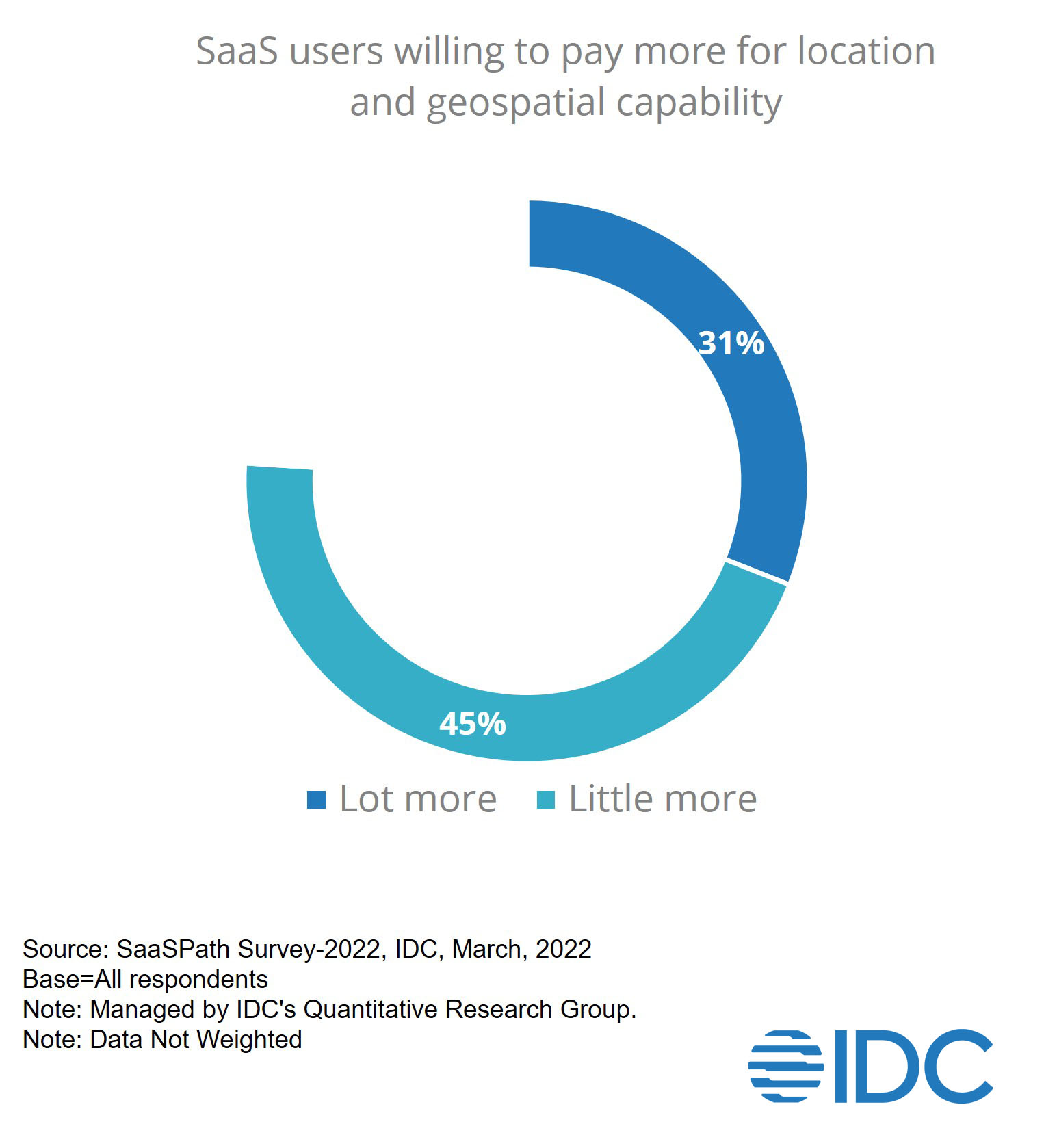
Business process enterprise SaaS has not incorporated location and/or geospatial capabilities to the extent that some database tools have to date. This is likely to be on the horizon though because recent IDC research shows that 76% of SaaS buyers would be willing to pay more for applications that include location and/or geospatial capability. That is huge – and a greater percentage than would be willing to pay extra for almost any possible add-on capability.

There wasn’t huge variance across enterprise applications either. While subscription management was the highest at 86%, the least appealing offer would be with Talent Management, and 73% of SaaS users were willing to pay more for additional location capabilities in that application.

In another study, 40% of external data buyers said that they were sourcing location data from within their enterprise applications. Clearly, there is a lot of draw for enterprise applications that are making use of location and geospatial points to enhance the value to their users.

This doesn’t even touch upon the use of a variety of spatial analytic and data science applications that you may be able to deploy. From traditional GIS (that is moving to the cloud) to open source tools to no-code and low-code platforms, the market has been exploding with new offerings and extended capabilities from more mature vendors. However, the efforts to equip more data scientists and data analysts with spatial skills (and have historical GIS departments partner with a broader range of business functions) have been slow to gain traction.

Are you missing out on opportunities to glean better insight into your processes and assets?

This is a bit of a rhetorical question, since I firmly believe that the context of where something is happening (or should happen, or might happen) unlocks greater value by unlocking meaning that hadn’t been taken into consideration previously. We are finding that enterprises with even a low level of geospatial capability improve their performance across a wide spectrum of metrics – and those at the top of the geospatial maturity scale have a 50% greater benefit. The areas these enterprises can improve are quite diverse, from things that are fairly obvious like managing facilities and routing deliveries, to less expected areas such as developing business plans and pursuing new markets. As just one example, indoor space planning has become much more sophisticated with BIM integration, indoor wayfinding, and applications that helped to register and monitor how space was being used under pandemic restrictions and for ongoing benefits.

Can you really make the best possible decisions and have keen insight to your processes and assets without considering WHERE they are?

As I’ve written elsewhere, I believe that using ‘place’ as a context in business processes and analytics is going to become as commonplace as using ‘time.’ While it is true that your use cases might drive you to new technologies, analytical tools and new people and skills for your organization, adding (or fortifying) location and geospatial as part of your data strategy is an investment that will not take long to pay off.

Want to chat about how you have been using – or getting ready to use – location and geospatial dimensions in your data and applications?

Lynne Schneider - Research Director - IDC

Lynne Schneider is Research Director leading IDC's Data Collaboration & Monetization, and Location & Geospatial Intelligence market research and advisory practices. Ms. Schneider's core research coverage in DaaS includes data sourcing and delivery services from traditional and emerging data providers along with evolving data aggregation and dissemination platforms. The breadth of coverage includes services that enable an organization to externally monetize data generated as part of the organization's ongoing operations, value-added information derived from this data, and the marketplace for combining data with other solutions. This research analyzes the supply and demand side business and technology trends of this emerging category.

We recently had our Advisory Board meeting, comprised of senior executives from European manufacturing organisations, with an objective to understand the latest topics or challenges they are dealing with. The two main challenges that were on their lists were energy prices and cybersecurity, how these two converge, and the role that technology can play to overcome the obstacles created by these threats.

Exploding Energy Prices

Unsurprisingly, the first challenge is exploding energy prices and how most manufacturers are struggling to cope with the ongoing situation here in Europe. They are in firefighting mode and find it extremely challenging to make profits from their operations.

Many companies have had to completely stop production for a few weeks, and this will continue even more in the coming months as prices rise exponentially. Some European manufacturers that have recently announced shutdowns are Arcelor Mittal (Germany), Aperam (Belgium), and CF Industries (United Kingdom).

Manufacturers tend to get energy price visibility only a week ahead and are therefore unable to plan for longer. Unless these costs can be passed on to customers, they have an impact on everything else and are pushing manufacturers beyond limits.

The cost uncertainty significantly complicates the S&OP process. For instance, frozen food requires storage in cold conditions and soaring energy prices lead to planning constraints. The bigger challenge is that this doesn’t seem to be going to stabilise anytime soon.

Are such high prices now the new normal? It is getting complex, since absorbing the costs or keeping high safety stock is making it difficult for manufacturers to even stay afloat.

Cybersecurity

There has been a shift from traditional closed systems to interconnected and open ones as part of digital transformation in manufacturing. This has made the industrial internet environment extremely complex, leaving the internet with many weaknesses and attracting more and more criminal attacks.

These cyberattacks have risen massively in the past six months. The manufacturing industry is only now waking up to the need for and importance of cyber security.

Most manufacturing organisations are increasing their investments in cybersecurity, but this is also leading to limitations in their operational technology (OT). They have mentioned how some of these cybersecurity measures had to be disabled because they impacted the performance of their equipment.

The desired output wasn’t being achieved, which required decision-making between a secure environment and the performance of the equipment.

When cyberattacks are successfully made on the systems or equipment that produce gas, it leads to a production shutdown causing an energy war. Unfortunately, this is the current reality that manufacturers are dealing with.

Producers acknowledge supply chain struggles caused by the pandemic, but these attacks on energy-producing equipment are hitting them at their core. The situation is making them rethink their IT capabilities — what to continue to do in-house vs. what to outsource/partner with and with whom.

The most important thing in such times is to be resilient, but the question is how? How to have safe energy, smarter supply chains, optimised and secure systems, visibility into what is happening and what needs to be done?

This is where technology can play a key role and manufacturers are looking for technology partners, not just to help them solve these challenges but also to build long-term resilience, especially around energy and materials. These challenges also provide an opportunity to think differently, innovate, and explore different business models, and only those manufacturers that can sail through this challenging phase will stay relevant in the market.

IDC the European Manufacturing Summit

Join us on November 15 at IDC’s European Manufacturing Digital Summit as it will be a perfect opportunity for manufacturing executives to discuss further on these challenges, share lessons learned, and network with the peer group.

Our advisory board members are keen to hear from technology providers during our summit about how they are helping solve these challenges. A summary of previous discussions with our Advisory Board can be found here. The summit also provides an opportunity for manufacturing organisations and technology providers to discuss how they can thrive in an increasingly digital and sustainable but also uncertain, volatile, and complex economy.

IT executives and senior decision makers can register here for the summit.

For more information about the summit, please contact Stefanie Naujoks or Gunjan Bassi, or head over to https://www.idc.com/eu

Gunjan Bassi - Research Manager - IDC

Gunjan Bassi has more than 14 years' experience working in the logistics and transportation sector. Before joining IDC, she worked with Transport Intelligence (Ti), a transportation and logistics research firm based in Bath, England, where she was responsible for vertical sector research covering qualitative and quantitative reports. She was also actively involved in the development of new research capabilities and product features of Ti's flagship market intelligence portal. Previously, based in India, she was leading the global logistics research team at Evalueserve where she was responsible for running custom research projects commissioned by leading logistics service providers (LSPs) and focussed on strategy/GTM, sales enablement, and market and competitive intelligence. Bassi holds a bachelor's degree from Shri Ram College of Commerce (SRCC), Delhi University, and post-grad studies in management.

Agile development promises faster, more responsive development. This aligns better with the transformation of organizations, as they face heightened, more competitive environments. Driven by market and technology changes, organizations are re-structuring themselves and their products and services to be more Agile and opportunistic to market changes. Agile should be suited to delivering this responsiveness when building and supplying technology capabilities to transforming organizations. 

But, frequently, it isn’t. 

By its nature, Agile can and should be a major enabler supporting these changes, but many organizations find it difficult to manage and extract this value. This is due to the challenges in measuring productivity, quality, performance, and forecasting delivery. It’s hard to manage what can’t easily be measured. 

Why is Agile Hard to Measure and Harvest Value From? 

Waterfall and other goal- or milestone-focused development methodologies are structured with clear definitions of project phases (requirements gathering, sequential development, codified dev-test-QA-production flows) and milestones. Agile is more fluid. Agile measures productivity in terms of qualitative measurement, Story Points, that make cross-team productivity comparisons difficult. Agile value is based on individuals and interactions getting it done over process. It drives to create working code (moving quickly) while back-seating documentation. By working closely with the customer in the development process, it is more responsive and adaptable at the risk of increasing backlog, and expanding scope and requirements. 

While Agile is well suited for delivering capabilities in a modern, competitive landscape, getting that value is hard, but not impossible. Typically, organizations struggle in three areas of Agile value:

  • Predictable delivery of capabilities (reliable productivity)
  • Quality
  • Cost to performance, including with service providers

IDC Metri’s Agile Value Management product addresses these management challenges by assessing agile development efforts across team and product performance categories. Key team factors assessed are productivity, cost efficiency, delivery speed, and quality. For product quality, we evaluate robustness, efficiency, security, changeability, transferability, and technical debt. Future, it allows for benchmarking team performance against other teams within an organization and against market peers. These assessments filter up into management dashboards, to help identify trends, and engineering dashboards that drill into specific recommendations and remediation. 

Predictable Delivery of Capabilities

With the Agile framework being structured around sprints (typically two-week cycles of refactoring, back-log attack, development, and just-in-time requirements gathering), Story Points for goals, and velocity (Story Point clearing) for progress, it’s hard for organizations to translate these measures to more traditional measures of progress. A lot of motion and momentum is demonstrated, but how this leads to predictable delivery of capabilities is elusive. To address this, IDC Metri uses a proven methodology for assessing progress and ensuring predictability—automated and enhanced function point analysis (FPA).  

The IDC Metri Agile Value Management (AVM) solution assess a development team’s progress using both enhance and automated function point analysis. FPA delivers a concrete assessment of size delivered (value) and enables comparison of productivity across teams and benchmarking against industry peers. AVM provides management with the progress measurement dashboards for productivity and delivery speed. To measure and assess these, IDC Metri uses the functional output a team has delivered in a certain timeframe, leveraging the NESMA standard of functional size added + changed + deleted. In the case of automatic measurement of functional size, IDC Metri measures according to the ISO 19515 standards of Automated Function Points (AFP), and Enhancement Function Points (EFP). This data is presented in a fashion that allows managers to understand progress to goals and transparency to understand and predict capability delivery.

Quality

Ensuring predictable, or efficient development, only matters if the product being produced is of the quality (stability, security, efficiency, etc.) necessary to meet the business goals. For this reason, it is important to balance performance measures of the team with quality measures of the code. We don’t want measures and goals for performance to have the unintended consequence of driving down quality. 

AVM provides source code analysis. This analysis provides ongoing assessment and trends in team quality over time and highlighting key areas of deficit. With this analysis, an Engineering dashboard is created showing the (critical) violations found, why these are violations, where they are found and how to solve them. The most critical ones are put on an action plan. This data is also presented in easily digestible fashion for managers responsible for managing and ensuring product quality. 

The Engineering dashboards clearly identifies poor code and critical violations (CVEs) allowing the development team to better, and more rapidly, address quality issues. When adopting the guidance from the Engineering dashboard, overall development team practices improve. Quality and performance enhances, due to lower testing efforts, resulting from enhanced coding practices. Also, improving practices and identifying better practices reduces team stress and enables recently onboarded team members to become more rapidly productive.

Cost to Performance

Sourced Agile development projects are typically time and materials (T&M), which shifts budget risk from the sourcing vendor to the buyer. Previously, development projects were typically fixed prices where risk (especially financial) was weighted towards the sourcing vendor. Similarly, even with internal projects, budgeting and cost were more predictable, due to the structure and predictable nature of methodologies like Waterfall. 

AVM, by putting measurable, traceable and consistent metrics around development, helps make cost management and cost efficiency easier and transparent. Also, by providing benchmarking within an organization and against peers, a client has the context to understand the competitive meaning of these assessments (i.e., is my team underperforming in my industry in the cost/performance ratio for development?). Further, by assessing sourcing vendor current performance versus cost, goals can be set and measured consistently, over time, for assessment. AVM, with its combination of market benchmarking for services and concrete performance metrics, benchmarks the sourcing vendor performance against market peers. This enables buyers to determine whether the service capabilities they procured are delivered competitively to other vendors in the market. Furthermore, it gives leverage to the buyer in ensuring that a T&M development contract is performing at a minimum to market peers, i.e., that the buyer is not over-paying for the quality and productivity of the development they receive. 

Supplier Improvement Actions

A client example illustrates this. The client company nearshored application development and maintenance. They were concerned they were paying more than the value they received. IDC Metri performed an AVM assessment demonstrating gaps in value based on the hours (cost) put into the sprints. Productivity was 30% lower and cost 22% higher than market average. Maintenance cost four times the market average. This assessment culminated in supplier improvement actions to comply with performance and product health metrics (with ongoing verification by IDC Metri). 

To rephrase an earlier observation: if you can’t easily measure something, you can’t easily manage it. AVM allows organizations to clearly understand how their Agile development teams (staff or sourced or hybrid) perform and deliver value. It cleanly addresses three key organization struggles around Agile: predictability, quality, and cost. It makes it easy to measure and assess Agile development, which means it enables easier and effective management of Agile. 

Interested in learning more about IDC Metri? Let’s schedule an appointment for an introductory meeting.