
For years, B2B marketing revolved around the funnel. Awareness led to consideration, then to decision. It was a clean, linear model that helped teams structure campaigns and measure success. But that model was built for a predictable buyer, and today’s buyers don’t follow the same rules.
Modern B2B buyers are using AI tools to guide their own discovery, compare vendors, and evaluate fit long before they ever engage with sales. They expect interactions to be immediate, relevant, and personalized. They’re in control of how, when, and where they move.
AI doesn’t just influence how buyers behave. It has become the connective tissue of the entire journey, reshaping how decisions are made and how marketers respond.
From linear funnels to living journeys
AI has replaced the static funnel with something dynamic: a constantly adapting journey that reflects intent in real time. IDC predicts that 62% of traditional demand generation will be AI-led by 2028, transforming engagement into an orchestrated system that continuously learns and evolves.
The sequence is no longer awareness to conversion. Buyers move between exploration, validation, and decision at their own pace, sometimes looping back, sometimes skipping ahead. The buyer journey has become a network of decisions powered by data and context. That shift in buyer behavior demands a new kind of marketing system—one that can interpret, predict, and act in real time. This is where AI becomes the orchestrator.
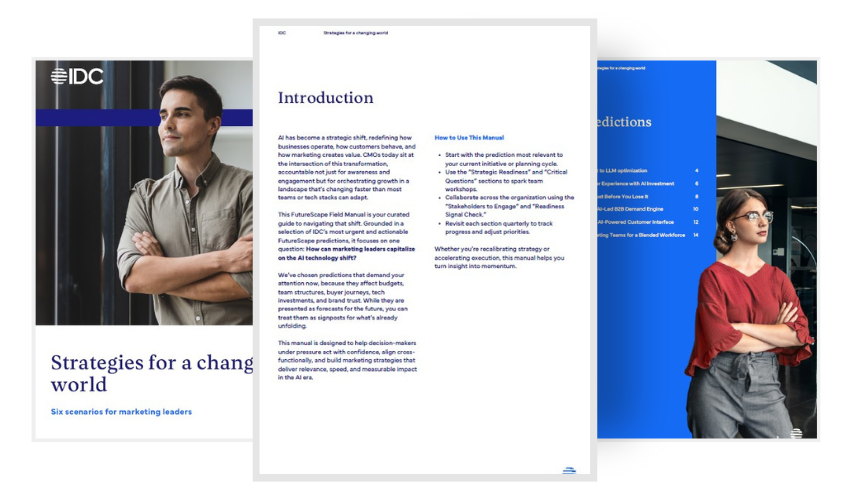
AI is not just changing how buyers behave—it’s changing what marketing must deliver. Download IDC’s Six Scenarios for Marketing Leaders to see how organizations are adapting their strategies, reshaping demand engines, and turning AI into a growth advantage.
AI as the new orchestrator
AI reads the signals that marketers used to miss. It detects intent in real time by tracking actions like page visits, content engagement, chat interactions, and sentiment changes. It connects these dots instantly and determines what should happen next.
This orchestration isn’t about replacing the marketer. It’s about giving teams the intelligence and agility to meet buyers where they are.
- AI-triggered journeys adapt automatically based on engagement and readiness.
- Dynamic segmentation updates audiences as intent changes.
- Predictive models identify in-market buyers early and route them to sales faster.
Orchestration is only effective when every interaction feels personal. As AI takes control of timing and delivery, marketers must ensure it also enhances relevance.
The personalization mandate
Buyers expect relevance across every touchpoint. IDC research shows that 69% of buyers engage only with content that feels personalized. This expectation extends beyond targeted emails or landing pages. It includes every conversation, chatbot, webinar, and digital ad.
AI enables that scale of personalization by unifying data across systems and continuously learning from buyer behavior. It helps marketers build cohesive experiences where every message feels timely and specific to the individual’s needs.
Personalization creates opportunity, but it also raises expectations around responsibility. As experiences become more automated, buyers want assurance that AI operates transparently and ethically.
Trust as the foundation
With automation advancing, digital trust has become the new measure of loyalty. Buyers want to understand when and how AI is being used, what data informs personalization, and how it is managed ethically.
The brands that communicate openly about their AI use will earn confidence and stand out. Trust is the foundation. Building on it requires marketers to evolve their role—from storytellers to orchestrators of growth.
The new role of marketing
In this AI-driven era, marketing’s role has expanded from awareness generation to full journey orchestration. The modern marketing organization connects product, sales, and customer experience through a single source of buyer intelligence.
Every signal, every conversation, and every piece of content becomes part of a coordinated system designed to move buyers forward with clarity and confidence.
The traditional funnel structured marketing. AI now defines how growth happens.
Ready to see where your strategy stands?
Download IDC’s Six Scenarios for Marketing Leaders to explore how AI is reshaping every stage of marketing—from visibility and trust to orchestration and execution.