
Many executive teams are asking the same question: How can we shorten the distance between a business event and a decision that matters? IDC’s FutureScape: Worldwide Data and Analytics 2026 Predictions points to a clear direction:
By 2029, 60% of enterprise data platforms will unify transactional and analytical workloads, powering agentic AI and enabling real-time, continuous intelligence.
In this post, I explain what converged workloads mean in practice, why adoption is accelerating, how vendors are packaging the approach, and what to prioritize as you plan the next phase of your database strategy.
What “converged” really means
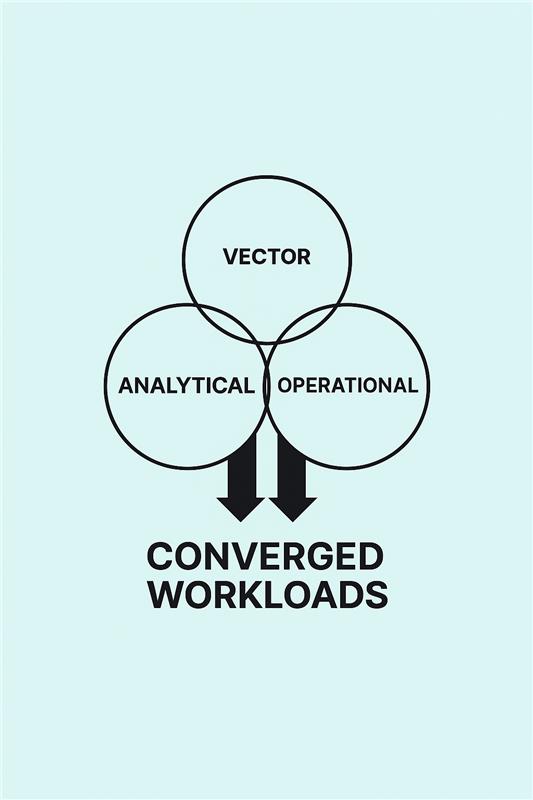
Converged workloads bring transactions and analytics together so insight and action can occur simultaneously on the same data. Instead of exporting from operational systems to a separate analytics stack, with the copies, cost, and delay that entails, a converged approach runs both in one governed environment. The outcome is straightforward: decisions based on live data, not yesterday’s batch.
This shift turns databases from systems of record into systems of intelligence, where every transaction can be analyzed and acted on immediately. It forms the foundation for continuous intelligence in areas such as fraud prevention, asset health, and customer personalization.
Why it is accelerating now
Three forces are turning convergence from concept into practice. Cloud elasticity allows IT teams to right-size mixed workloads as demand changes, avoiding unnecessary cost and overprovisioning. Streaming and in-memory processing make it possible to ingest and analyze data as it arrives, significantly reducing latency. IDC research shows that 96% of enterprises are using or planning to use streaming for AI and analytics.
Bringing AI closer to the data further reduces pipeline friction. Seventy-five percent of organizations use or plan to use integrated vector databases to store and query embeddings for AI. Adoption of agentic patterns is also accelerating, with 53% of enterprises already running AI agents in production and another 28% planning deployments within six months.
A look at one approach in the market
Vendors are packaging convergence in different ways. Oracle’s approach connects Oracle AI Database 26AI, which serves as the operational system of record with in-database AI and vector search for real-time decisioning on multi-model data, and Oracle Autonomous AI Lakehouse, which provides the enterprise analytics and governance layer. The two work together to unify operational and analytical data. The lakehouse extends discovery and governance across environments, integrates with third-party catalogs, supports open engines and formats, and runs AI (including vector search) directly on lake tables. Real-time pipelines keep information synchronized across sources.
Across the market, the pattern is consistent: unify workloads, minimize data copies, keep analytics and AI close to where data resides, and apply governance end to end.
Other leading providers are taking similar paths, adding operational capabilities to lakes, analytical depth to transactional systems, and stronger governance across both.
What leaders should expect
Simplification and speed. Early wins come from fewer data copies and fewer ETL hops, which shorten time to insight and reduce integration work. Embedded automation, including self-tuning, anomaly detection, and workload management, shifts focus from maintenance to innovation.
Performance without trade-offs. Modern converged platforms are designed to analyze live operational data while preserving transactional responsiveness. In practice, that means fewer compromises between “run the business” and “analyze the business.”
Governance up front. As AI becomes operational, unified auditing, lineage, and policy enforcement are non-negotiable. Converged designs help by applying consistent controls in one place rather than stitching them together across multiple stacks.
A market tilting to cloud. Database spending continues to concentrate in cloud services. Public-cloud DBMS revenue is projected to grow at 18.3% CAGR through 2029, reflecting the shift to flexible, scalable architectures that support mixed workloads.
How to get started
- Start with a few high-value, time-sensitive use cases. Fraud detection, predictive maintenance, and key customer interactions are strong candidates. Allow legacy systems to coexist while you validate latency, reliability, and governance controls.
- Build governance and observability in from day one. Prioritize clear lineage, unified access policies, and end-to-end monitoring across both operational and analytical environments.
- Choose AI-ready data platforms. Integrated retrieval and in-database AI reduce pipeline complexity and keep inference close to the data for faster insights.
- Plan for Agentic AI. Establish real-time connections between converged data stores and agent frameworks, with clear policies for access, lineage, rollback, and audit.
Takeaways
Converged workloads are transforming databases from systems of record into real-time systems of intelligence. This shift is driven by cloud elasticity, streaming and in-memory processing, and AI that operates close to the data, with agentic AI emerging as the main demand signal. In the near term, expect simpler architectures and greater automation, but make governance and observability first-class priorities from the start. Begin with a few high-value, time-sensitive use cases, validate performance and controls, and expand as operating patterns stabilize.
For the full analysis, frameworks, market context, and buyer guidance behind this summary, read the IDC report Converged Workloads: Enabling Real-Time Enterprise Intelligence and AI Innovation.
You can also explore other key predictions shaping the future of data and analytics in IDC FutureScape: Worldwide Data and Analytics 2026 Predictions.