
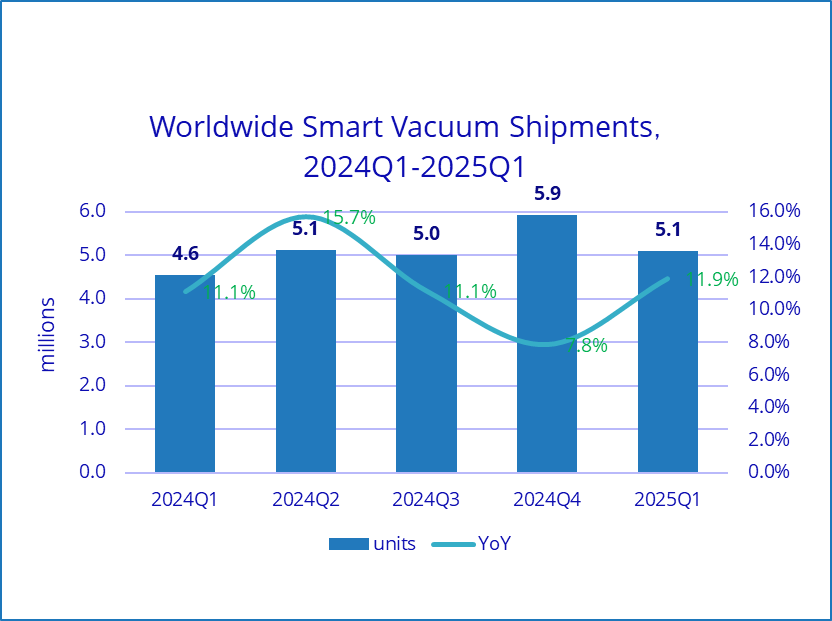
NEEDHAM, Mass., June 24, 2025 — According to IDC’s Quarterly Smart Home Device Tracker, Q1 2025, the global smart vacuum market shipped 5.096 million units, up 11.9% from the prior year. Market share concentration amongst vendors intensified, with the top 5 companies capturing 63.4% of total shipments, an additional 3.5% compared to the same period last year. Driving the growth was a combination of government subsidies in China as well as rapid channel expansion in developed markets such as the US.
“Chinese brands continue to eye the US market as it remains the most lucrative region,” said Claire Zhao, senior analyst at IDC China. “In the current environment, channel expansion and operation are paramount to overseas success and will likely be a key factor determining success for many smart vacuum brands.”
“Smart vacuum manufacturers are rapidly expanding the boundaries of their products, moving beyond traditional cleaning functions to encompass large-scale cleaning scenarios and even broader home appliance ecosystems,” continued Zhao.
“In 2025, smart vacuums have transformed from simple cleaning tools into intelligent, multifunctional home assistants,” said Jitesh Ubrani, research manager at IDC. “We’re seeing a shift toward devices that not only clean more efficiently with advanced AI and 3D spatial mapping but also integrate seamlessly into broader smart home ecosystems. Features like robotic arms, self-maintenance capabilities, and adaptive learning are redefining user expectations. This evolution is fueling growth, especially in premium segments and emerging markets where consumers are looking for both convenience and innovation.”
Thanks to the continued innovation, average selling prices (ASP) have climbed by $14 since the same period last year and with the onset of additional Chinese made goods, ASPs are likely to climb even higher in the near future. Despite these increases, IDC does not anticipate a meaningful drop in demand for the category. The high utility for consumers, combined with shifts in the supply chain will help mitigate some of the tariff-related risks faced by other consumer electronics categories.
Top Companies:
|
Worldwide Smart Vacuum Market Shares, Units, 2025Q1 |
||
|
Ranking |
Company |
share |
|
1 |
Roborock |
19.3% |
|
2 |
Ecovacs |
13.6% |
|
3 |
Dreame |
11.3% |
|
4 |
Xiaomi |
9.9% |
|
5 |
Irobot |
9.3% |
|
Source:IDC Quarterly Smart Home Device Tracker, 2025Q1 |
- Roborock solidified its global leadership, shipping 982,000 units and capturing a 19.3% market share—an impressive 50.7% year-over-year increase. Building on its No.1 global position in both units and value in 2024, Roborock’s shipments to PRC and Western Europe accounted for over half of its total volume. The brand led in shipments across multiple countries, including Germany, South Korea, the UAE, and several Nordic and Eastern European markets. Notably, Roborock introduced a groundbreaking vacuum model equipped with robotic arms, marking a leap from 2D surface cleaning to 3D spatial organization. With a diversified product portfolio spanning various price points and a growing offline retail presence in key overseas markets like the U.S., Roborock is well-positioned to sustain its global growth trajectory.
- ECOVACS shipped 693,000 smart vacuums in Q1, reflecting an 11% year-over-year increase. The company focused on expanding in Asia-Pacific, Russia, and the Middle East, while also strengthening its retail footprint in Western Europe. ECOVACS continues to evolve its “home service robot” concept, transitioning from single-function cleaning devices to comprehensive smart home assistants.
- Dreame posted robust growth, particularly in Southwestern Europe, where it ranked first in shipments in France, Italy, and Belgium. Its premiumization strategy gained traction, with an average shipment price of $627 in Q1, underscoring its strong performance in the high-end segment.
- Xiaomi launched a new line of AI-driven smart vacuums in Q1, achieving solid results in both domestic and international markets. Leveraging its strong brand and distribution channels, Xiaomi maintained a competitive edge in the entry-level segment, especially in Southeast Asia and Southwestern Europe.
- iRobot faced headwinds, with global shipments declining 30.6% year-over-year and its market share falling to fifth place. In the U.S., the average shipment price dropped to $385, reflecting intense price competition and ongoing market contraction. iRobot continues to lag in product innovation and is challenged by high North American supply chain costs, which have eroded its price competitiveness.
About IDC
International Data Corporation (IDC) is the premier global provider of market intelligence, advisory services, and events for the information technology, telecommunications, and consumer technology markets. With more than 1,300 analysts worldwide, IDC offers global, regional, and local expertise on technology, IT benchmarking and sourcing, and industry opportunities and trends in over 110 countries. IDC’s analysis and insight helps IT professionals, business executives, and the investment community to make fact-based technology decisions and to achieve their key business objectives. Founded in 1964, IDC is the world’s leading tech media, data, and marketing services company. To learn more about IDC, please visit www.idc.com. Follow IDC on Twitter at @IDC and LinkedIn. Subscribe to the IDC Blog for industry news and insights.
-###-
All product and company names may be trademarks or registered trademarks of their respective holders.