

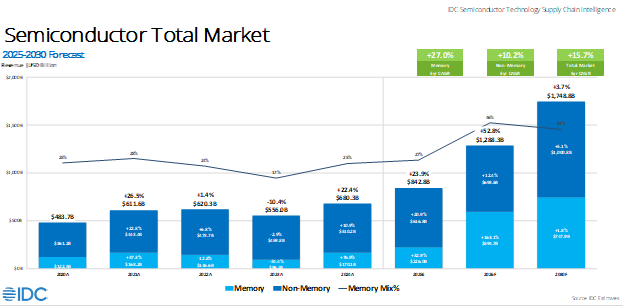
The global semiconductor market is undergoing a seismic transformation. IDC’s latest forecast projects the industry will surge past the $1 trillion revenue threshold in 2026, significantly ahead of prior expectations. The growth will be driven overwhelmingly by AI infrastructure investment, which is reshaping the entire market.
Total semiconductor revenues are forecast to reach $1.29 trillion in 2026, up 52.8% year over year from $842.8 billion in 2025. The memory segment is at the epicenter of this shift: DRAM revenues alone are projected to nearly triple in 2026 to $418.6 billion, driven by demand for high-bandwidth memory (HBM) and DDR from hyperscalers and AI infrastructure providers. Meanwhile, non-memory semiconductors are growing at a robust but more measured pace, reaching $693.5 billion in 2026.
In this post, we break down three forces reshaping semiconductors right now: why AI infrastructure has become the industry’s new center of gravity, what’s happening in memory markets and why it matters beyond the data center, and how other markets from automotive and IoT to mobile and PCs are navigating a market increasingly defined by AI.
Global Semiconductor Market: Selected Forecast (USD Billions)
AI infrastructure: The engine of the supercycle
The single most consequential shift in the semiconductor market is the emergence of AI infrastructure as a structurally dominant end market. What began as a cyclical uplift in data center spending has evolved into a self-reinforcing investment cycle that is reshaping demand patterns across the semiconductor value chain.
Hyperscale capital expenditure exceeded $100 billion for the first time in Q3 2025, and the i4 are expected to increase capex by 70% year over year to approximately $600 billion in 2026. IDC forecasts data center semiconductor revenues to reach $477.1 billion in 2026. By 2030, data center semiconductors will account for $843.2 billion, nearly half the total semiconductor market.
“The semiconductor industry has crossed a structural threshold. AI is no longer a demand catalyst — it is the demand foundation. The race to build out AI infrastructure is consuming silicon at a pace the industry has never seen, and the implications for memory, logic, and packaging are profound.” — Jeff Janukowicz, Research VP, Semiconductors & Semiconductor Manufacturing, IDC
Datacenter Semiconductor Revenue Decomposition
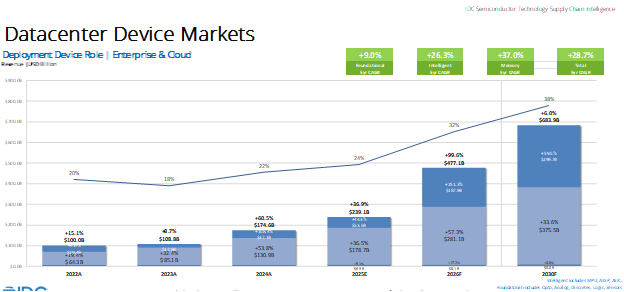
The $281 billion “intelligent” datacenter segment, encompassing CPUs, AI accelerators, GPUs, custom ASICs, and networking silicon, now constitutes the largest identifiable category within non-memory semiconductors. Spending is heavily concentrated among top-tier hyperscalers and a growing set of sovereign AI infrastructure programs, many of which have secured long-term supply agreements with leading chip manufacturers.
Three factors are keeping this growth self-sustaining rather than cyclical:
- Compute intensity continues to rise. Generative AI and agentic workloads require far more compute density per rack than prior architectures, increasing the overall silicon footprint
- Inference demand compounds on itself. Each new model generation increases the volume of inference, requiring ongoing hardware upgrades
- AI is spreading beyond the data center. As enterprises, edge deployments, and client devices begin running AI workloads locally, demand becomes more distributed
Memory: From cyclical commodity to strategic constraint
If you want to understand what’s really happening in semiconductors right now, start with memory.
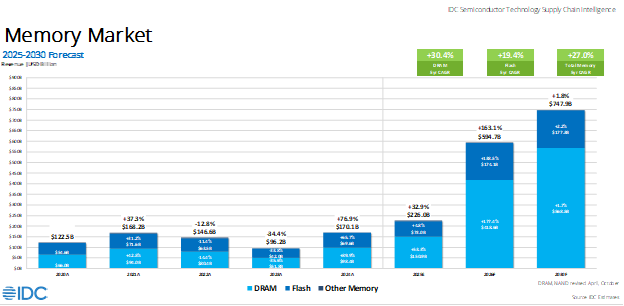
Total memory revenues rise from $226 billion in 2025 to $594.7 billion in 2026, and then to $790.4 billion in 2027. This is not simply a recovery cycle, it reflects a market that is being structurally repriced.
DRAM is where the shift is most visible. IDC forecasts $418.6 billion in DRAM revenues for 2026, up 177% year over year. This is not primarily a volume story driven by consumer devices. Hyperscalers are buying a fundamentally different, more expensive class of memory and are willing to pay a premium to secure supply. Each HBM chip also requires significantly more silicon real estate, further tightening the availability of other types of DRAM.
“The memory market is at an unprecedented inflection point, with demand materially outpacing supply. For an industry long characterized by boom-and-bust cycles, this time is different. The rapid expansion of AI infrastructure and workloads is placing significant pressure on the memory ecosystem. As a result, the market is shifting from a cyclical recovery following the 2023 downturn to a more structurally constrained environment, with clear implications for end markets.” — Jeff Janukowicz, Research VP, Semiconductors & Semiconductor Manufacturing, IDC
The HBM bottleneck
High-bandwidth memory has become the primary constraint in the AI accelerator supply chain. Most capacity is already pre-committed through 2026, with forward allocations extending into 2027. That capacity is concentrated in NVIDIA and AMD GPU platforms, along with a growing set of hyperscaler custom silicon programs.
The production economics are also very different. HBM relies on advanced packaging and stacking technologies, resulting in per-bit costs that are several times higher than standard DRAM.
Suppliers are investing aggressively to expand capacity, but the technical complexity and capital intensity mean meaningful new supply will not reach the market until late 2026 at the earliest.
NAND: AI drives storage demand
NAND Flash revenues are forecast to reach $174.1 billion in 2026, up 138.5% from 2025. AI infrastructure is again the dominant driver, with demand coming from training datasets, checkpoint storage, and high-performance inference environments.
Unlike DRAM, the NAND market is seeing broader repricing. Enterprise SSD prices have surged as hyperscalers secure supply, which is tightening availability across consumer and OEM channels.
Other markets: Navigating the shadow of the AI supercycle
While AI infrastructure dominates the headlines, the broader semiconductor market is facing a more nuanced environment.
Non-memory, non-datacenter revenues are projected at $406.3 billion in 2026. Several end markets are dealing with margin pressure, supply allocation challenges, and macroeconomic headwinds.
In mobile, semiconductor revenues are forecast to decline to $89.8 billion in 2026. The issue is not consumer demand, particularly for AI-capable devices, but cost pressure. Memory now represents a larger portion of the bill of materials, forcing OEMs to make difficult tradeoffs between margin, pricing, and product specifications.
Automotive is being shaped more by macro factors than AI. Tariffs, interest rates, and energy prices are weighing on demand. While the long-term outlook remains strong, 2026 reflects a period of near-term softness.
IoT shows a similar pattern. The segment is projected at $136.6 billion in 2026, with near-term pressure from inventory digestion and cautious spending. However, edge AI is beginning to create a new, higher-value demand category that will become more meaningful over time.
Outlook: Path to $1.75 trillion
IDC’s base case projects semiconductor revenues reaching $1.75 trillion by 2030.
Several dynamics will shape that trajectory:
- Memory pricing will normalize, but remain structurally higher than pre-AI levels
- Non-memory semiconductors will continue steady growth, driven by AI adoption across devices and industries
- Macro and geopolitical risks will remain important variables
What is clear is that the semiconductor market has undergone a fundamental shift.
“What the data makes clear is that the semiconductor market has undergone a permanent expansion of its addressable opportunity. AI infrastructure has reset the demand baseline, memory has repriced as a strategic asset, and the industry’s growth trajectory through 2030 is no longer contingent on a consumer refresh cycle.” — Nina Turner, Research Director, Semiconductors, IDC
IDC will be tracking how AI infrastructure investment continues to reshape semiconductor demand at Computex 2026.