
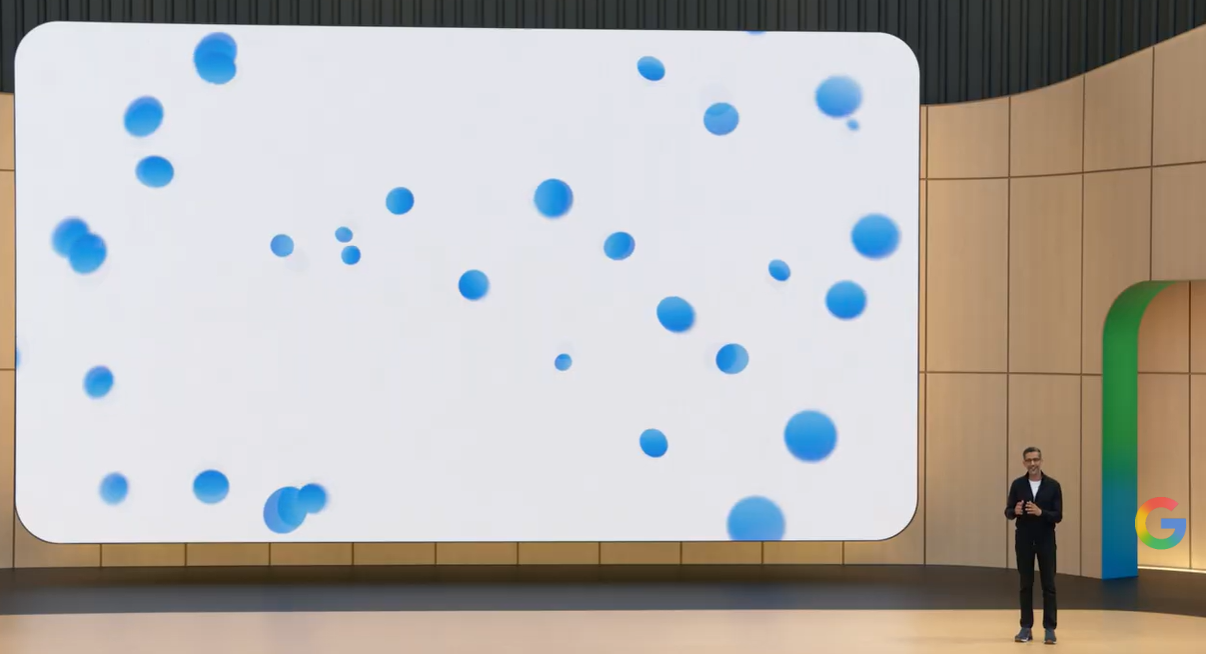
Image: Sundar Pichai at Google I/O 2026. © Google
Google I/O 2026 kicked off with a packed two-part run: an Android Show preview on May 12 followed by Google I/O in Mountain View one week later. IDC’s devices analysts attended vendor briefings and were on-site at I/O, and the common thread across it all is the push of Gemini Intelligence via the Gemini 3.5 series of models.
Android XR glasses: Google shows up with an advantage
Even though Android XR (Google’s extended reality platform) and its OEM partners were already announced last year, we finally got to see the final form of Warby Parker and Gentle Monster’s glasses, the designs of which are just as important, if not more, than the technical specifications given how eyewear is deeply personal and reflective of one’s identity. Prices were not announced, but this confirmed shipping timelines and refined use cases, including automatic language translation and smartwatch integration.
These designs do not have displays, and hence Google referred to them simply as “audio glasses.” That’s in contrast with “display glasses,” such as XREAL’s Project Aura, which also made an appearance with a redesigned compute puck and fingerprint sensor. It shouldn’t be a surprise that the audio glasses ship first.
Competition-wise, Meta has a head start in smart glasses but relies on discovery through its social media assets. Google, on the other hand, is entering with an AI assistant that is already in one’s email, photos, search history, and calendar. For users within Google’s ecosystem, the proposition is stronger. Gemini can draw on email, photos, calendar, and search history to be proactive in ways Meta’s assistant cannot. In IDC’s view, being late to a market with a structural advantage is not a bad place to be.
Gemini Spark: Bringing the agent craze to everyone
If you follow tech enthusiast communities, you’ve probably noticed the OpenClaw craze that’s taken hold over the past several months. Hobbyists and early adopters have been dedicating Mac Minis and spare machines as local AI agent systems, running workflows that monitor inboxes, execute tasks, and automate digital life around the clock. The results have captured people’s imaginations, but the catch is that getting there requires navigating CLIs, configuring local models, and tackling other technical challenges that limit its usage to hobbyists and very early adopters.
Gemini Spark (Google’s cloud-based AI agent system) has the potential to address that; it runs on Google Cloud rather than local hardware, so it works whether or not one’s PC is powered on, and doesn’t require complicated installation or configuration. Unlike local AI agent setups, Gemini Spark requires no hardware configuration or technical setup. It was a matter of time before the industry began abstracting technical complexities into interfaces that more mainstream users could adopt, and Gemini Spark fits neatly with Google’s lean toward the consumer.
To that end, it is good to see guardrails accompanying the new capability. Android Halo surfaces agent activity in a phone status bar so one always knows what Spark is doing. And the Agents Payment Protocol acts as a sandboxed payment system, constraining what AI agents can spend on your behalf.
Googlebooks: Finally on an Android stack
The big hardware announcement from The Android Show in the prior week was the Googlebook — Google’s new premium laptop category that finally merges Android and ChromeOS into a single platform. Launch partners include Acer, ASUS, Dell, HP, and Lenovo, with devices expected in fall 2026, powered by Qualcomm, MediaTek, and Intel processors. Every Googlebook also sports a glowbar on the lid as a physical differentiator, and we covered Googlebooks in detail in our full client brief.
Googlebooks run on what the industry has known internally under the code name Project Aluminium. While Google hasn’t given the OS an official external name yet, it runs on an Android stack that allows for better unification with other devices like phones, which has been eagerly awaited. Features like Magic Pointer and Create My Widget seem more like novelties; we were hoping to see more unveiled at Google I/O the following week, but Googlebooks were not covered much there. Nonetheless, the big question is where Chromebooks go from here.
Chromebooks aren’t going anywhere, with support confirmed through at least 2034 and a continuing focus on the browser and education markets. IDC data shows ChromeOS at roughly 9% of global notebook shipments in 2025, with about three-quarters of those units in education, a segment that won’t migrate overnight. Even though Googlebooks will eventually succeed Chromebooks, that means that this premium positioning will change over time if it is still going after the low-end education segment.
On that note, there is a generational angle that is worth noting: the Chromebook generation is entering the workforce. Kids who spent their school years on ChromeOS are now professionals with disposable income and deep-rooted familiarity with the Google ecosystem. For them, a Googlebook can be a natural upgrade to the OS they already know, now layered with Gemini’s agentic capabilities that help shift users from web-based workflows to task-based ones.
Gemini Intelligence on Android 17: AI that actually does things
Central to Android 17 is a set of Gemini Intelligence capabilities that shift the AI from an assistant to an agent: booking concert tickets, completing travel forms using passport photos, and adding textbooks to a shopping cart across websites. Google calls this agentic task execution, and it represents a meaningful step forward from the prompt-and-respond model most users are accustomed to.
A few features stand out. Rambler converts messy, natural speech into clean text with multilingual support, reflecting Google’s decades of language data from Search, Maps, and Assistant. Create My Widget extends to phones and watches, letting users define exactly which information they want surfaced, something off-the-shelf widgets have never done well. And an overhauled iOS-to-Android switching experience covering passwords, photos, apps, contacts, and home screen layout signals that Google believes Gemini Intelligence is now compelling enough to make the migration worthwhile for iPhone users.
The trust question looms large, however. Letting an AI access passport data, financial accounts, and personal apps requires a level of user confidence that Google hasn’t yet fully earned. How Google handles transparency and oversight around these agentic features will be as important as the features themselves.