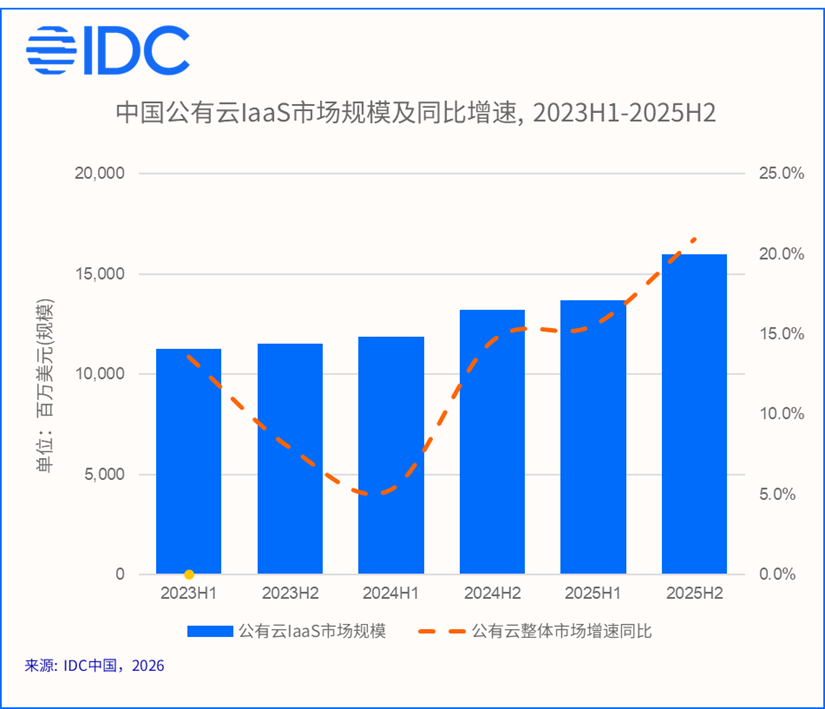
中国公有云市场正在经历一场由AI驱动的结构性转折。IDC最新发布的《中国公有云服务市场跟踪报告,2025 下半年》数据显示,2025年下半年公有云IaaS市场人民币同比增速恢复至20.0%,整体公有云市场(IaaS+PaaS+SaaS)半年总值首次突破2000亿元。这一增长并非简单的市场回暖,其背后是AI需求对云计算产业底层逻辑的重塑:市场认可度的提升正在从“资源规模”转向“全栈AI能力”,市场份额正加速向“算力+大模型”双强厂商收敛,出海成为增长第二曲线,而行业间的需求分化也将进一步拉大。IDC认为,未来三到五年,公有云市场的竞争将不再是价格战与规模战,而是算力、模型、行业方案、生态与全球化能力的综合较量。谁能在这一轮AI红利中真正从“云厂商”升级为“AI服务商”,谁就将主导下一轮市场格局。

AI 能力重构市场份额 大模型为云厂夺回定价权

在传统IaaS市场中,云主机租赁长期占据主导,价格战也因此成为竞争的主旋律。然而,随着生成式AI和大模型需求的爆发,客户在选择云服务商时的核心依据正在发生根本性变化。算力、大模型、芯片与平台的全栈能力,正取代过去的资源规模与价格优势,成为新的竞争焦点。相应地,定价逻辑也在从资源计费转向价值付费。

这一转变最直接的体现,是市场增长动力从存量博弈转向增量创新。传统IaaS价格战逐步退潮,取而代之的是智算需求驱动的新一轮扩张。大模型产品的定价模式正向按Token计费倾斜,云基础设施产品,尤其是高性能算力的需求大幅提升。在这一新竞争环境中,云服务商是否具备AI原生能力与高效的算力调度能力,将直接决定其能否占据有利位置。

全栈能力成为竞争壁垒,市场向算力+大模型双强厂商收敛

智算集群、液冷数据中心、自研芯片、大模型训练等领域均属于高投入赛道,只有具备完整闭环能力的厂商,才能实现算力规模化变现并穿越投入周期。根据IDC MarketScape评估,阿里云、百度智能云等具备全栈能力的云厂商,其市场份额正持续提升。这些厂商凭借硬件芯片、异构算力兼容、集群调度、MaaS平台及行业生态等综合优势,已在政企、互联网等多个行业中积累起丰富的落地案例。

相比之下,单纯依赖资源出租的厂商,由于缺乏技术与生态支撑,增速已开始放缓。未来市场将进一步向具备全栈AI能力、生态协同能力和行业深度适配能力的头部厂商集中。

行业分化加剧,高适配行业领跑

不同行业在公有云需求上的差异正在拉大。自动驾驶、电商、游戏、互联网金融、协同办公等与AI结合度高且资本红利充足的领域,公有云需求保持高速增长。IDC预测,2025年泛科技行业的AI公有云渗透率将持续提升,行业间的市场增速差距将进一步扩大。而政务、制造、传统金融等行业,则受合规要求和系统改造周期等因素限制,上云节奏相对缓慢。这些行业客户在选型时,更加关注模型的训练与推理性能、行业精调落地情况、数据主权与合规、成本治理等多维度能力,这也在推动云服务商加快行业化与场景化产品的布局。

海外资源加速布局,出海成为增长第二曲线

海外背景的云厂商,如AWS和微软Azure,在云算力出海领域依然保持强劲竞争力,持续服务于中资企业的全球化部署与跨境AI业务。与此同时,阿里云、腾讯云、华为云以及运营商阵营也在积极瞄准中资企业出海需求,在跨境电商、游戏发行、AI应用出海等领域加速落子。根据IDC跟踪数据显示,中过企业出海用云市场规模五年复合增长率超过30%,远高于国内市场增速。出海正成为中国云厂商寻找增长“第二曲线”的重要方向。

AI红利花落谁家:三类厂商各显其能

在这一轮AI驱动的市场重构中,不同类型的云服务商正走出截然不同的增长路径。

以阿里云和百度智能云为代表的全栈型厂商,凭借“模型+芯片+平台+公有云基础设施”形成的产品线闭环,构建起公有云竞争的护城河。其公有云IaaS同比增速已从2024年的个位数增长提升至2025年的25%以上,市场份额持续提升,并在大模型平台、MaaS、行业精调等领域不断加码。

以腾讯云和火山引擎为代表的场景驱动型厂商,则更加聚焦AI的商业化落地,推动将AI真正“用起来”。腾讯云在2025年首次实现规模化盈利,而火山引擎则凭借高性价比的智算方案与灵活计费模式,在2025年再次实现超100%的同比增速,市场份额快速提升。

以中国电信天翼云、移动云和华为云为代表的算力运营型厂商,依靠自建与跨平台调度能力的结合,灵活适配第三方方案,为政企、金融等高安全性行业的AI应用提供保障。凭借多年积累的机房资源、属地化服务和央企背景,这些厂商的企业级服务优势逐步显现,市场排名稳居前五。

从算力到模型:未来四阶段演进路径正在形成

展望未来,中国公有云市场的竞争将沿着清晰的阶段路径演进。

在2026年的第一阶段,算力投入依然是AI发展的核心方向。智算集群、自研芯片、数据中心建设推动资本开支持续攀升。IDC预测,到2027年,超过85%的中国组织将把传统云环境转型为适配AI工作负载的新型平台。

到2027年前的第二阶段,商业化将迎来突破。云服务商的营收模式将从单纯算力出租,转向“Token+算力”的双营收结构,收费模式从资源侧向场景侧迁移,云厂商的盈利格局将随之重塑。大模型驱动的AI云服务市场格局正在形成,MaaS、行业精调和Agent平台等新型商业模式加速落地。

进入2028年的第三阶段,竞争焦点将从算力底座转向大模型应用场景的的训练、微调和推理优化。“云上模型好用度”将成为企业客户选择云服务商的决定性因素。企业买家将优先评估多模态模型覆盖能力、推理准确性、行业适配能力以及生态工具链的完备性。

而纵观未来五年,行业分化将成为长期特征。泛科技行业将持续领跑,传统行业则在政策引导与国产化适配推动下逐步而坚定的推进上云进程。市场将向具备全球化能力、行业方案能力和生态协同能力的综合AI服务商集中,头部厂商将通过全栈能力与行业深耕构建起长期壁垒。

分析师结语:从云厂商“AI服务商的升级之战

2025年下半年中国公有云市场重回高增长,其本质是AI产业爆发所带来的公有云基础设施红利。IDC中国研究经理崔婷婷表示,IaaS增速重回20%以上,标志着中国公有云行业已从存量博弈转向增量创新。未来三到五年,AI能力的竞争将进入白热化阶段,市场不再是简单的价格与规模比拼,而是算力、模型、行业方案、生态与全球化能力的综合较量。云计算,尤其是公有云服务,作为AI竞争的核心载体,其资源铺设广度、能力韧性、安全性、营收增长与利润转换率的动态提升,也将直接反映出AI阵营的发展状态,成为AI竞争态势的晴雨表。在这场升级之战中,谁能更快将AI能力转化为客户可感知的业务价值,谁就有望在下一轮格局洗牌中占据先机,真正完成从“云厂商”到“AI服务商”的跃迁。

如需进一步了解IDC相关研究,或就中国公有云市场发展趋势进行深入交流,欢迎与IDC联系,获取更多洞察与数据支持。

请点击此处与我们联系。

AI is starting to be framed as a price war. Vendors are cutting costs, model access is becoming more competitive, and the market is beginning to assume that cheaper AI will decide the winners.

That view is not wrong. It is just not deep enough.

What is happening now is bigger than pricing pressure. The market is not simply resetting the cost of AI. It is resetting the enterprise application model. And in that shift, price matters, but outcomes matter more.

From an IDC perspective, this is the real issue: enterprises are moving from a world where employees use applications to do work to one where agents increasingly become the work layer itself. That is a major change in how software is consumed, how value is created, and how buying decisions will be made.

In the old model, users opened applications, navigated workflows, triggered tasks, and completed processes. Automation improved parts of that model, but people still sat at the center of execution.

In the new model, employees express intent, and agents increasingly interpret, orchestrate, and act across systems, with guardrails in place. The application does not disappear, but it fades into the background. The workstream becomes the interface.

That is why the AI price-war narrative misses the point. Enterprises are not buying AI because it is cheap. They are buying AI to improve productivity, accelerate decisions, reduce friction, strengthen customer experiences, drive better business outcomes, and increase sustained economic value. The real competition is not over lowest-cost intelligence. It is over who can deliver trusted, measurable outcomes at scale.

The technology is moving faster than enterprise readiness

Enterprise software vendors have responded quickly to the AI push. They are embedding assistants, conversational interfaces, agentic capabilities, and tools for building new AI-driven workflows. At the same time, AI-native platforms are offering alternatives that promise faster innovation and, in some cases, lower cost.

But the key issue is not whether the technology is available. It is whether enterprises are ready to use it now.

In many cases, they are not. This is the gap that matters most right now. Organizations may be eager to adopt AI, but many are not yet prepared to move from human-led application workflows to agent-driven operating models. Lower prices will encourage experimentation, but they will not fix the operational weaknesses that limit scale and business value.

That is where the market will be won or lost.

Four issues will decide who gets value

Skills must shift from usage to orchestration
The move to agent-driven work demands a different set of skills. Employees need to do more than know how to use software. They need to define intent clearly, manage exceptions, understand workflow dependencies, and evaluate AI-driven outputs.

IDC research finds that 44% of organizations have prioritized an AI-ready workforce in 2026 to enable employees to use AI assistants and agents.

(IDC Future Enterprise Resilience and Spending Survey, Wave 1, March 2026 )

This raises the importance of prompt design, orchestration thinking, API awareness, and analytical judgment. These are not side skills. They are becoming essential to turning AI into real performance improvement.

Governance becomes the scaling mechanism
Agentic systems raise the stakes on trust. These systems do not just assist; they can take action across systems, shape decisions, and influence business outcomes. That creates new challenges around security, identity, explainability, compliance, and control.

IDC research continues to show that weak governance and unclear ROI are among the top reasons AI initiatives stall.

IDC research also finds that 39% of organizations are prioritizing AI governance in 2026 to establish trusted AI decision and risk frameworks, while 35% report difficulty quantifying and demonstrating AI ROI to stakeholders.

(IDC Future Enterprise Resilience and Spending Survey, Wave 1, March 2026 )

In an agent-driven model, governance is not a back-office exercise. It becomes the operating discipline that allows organizations to scale AI with confidence and trust.

Operating models need redesign
Enterprises cannot simply layer agents onto existing workflows and expect transformation. Agent-driven execution changes the role of the employee, the structure of the process, and the logic of oversight.

IDC research finds that 46% of organizations are prioritizing their AI business strategy in 2026 to increase the adoption of AI use cases tied to business goals.

(IDC Future Enterprise Resilience and Spending Survey, Wave 1, March 2026 )

Organizations need to rethink where humans stay in the loop, how exceptions are handled, how performance is measured, and how trust is maintained. This is not a feature upgrade. It is an operating model change.

Data and integration still decide the outcome
Agents are only as good as the systems and data they can access. If data is fragmented, APIs are weak, and workflows are disconnected, agent-driven execution will break down quickly.

This is why the most visible AI layer is rarely the hardest problem. The real challenge is below the surface: trusted data, strong integration, clear lineage, high-quality metadata, and resilient process connectivity. Without that foundation, outcome-based AI models collapse under complexity.

 IDC research finds that 46% of organizations are focused on AI data-ready architecture in 2026, implementing controlled access to all enterprise data, whether structured, unstructured, or event streams.

(IDC Future Enterprise Resilience and Spending Survey, Wave 1, March 2026 )

This market is shifting from features to outcomes

That is the real strategic change now underway.

The winners will not be the vendors with the most AI features or the lowest-cost model access. They will be the ones that help enterprises reduce manual effort, improve process completion, increase productivity, and deliver measurable business value.

For enterprise application vendors, embedded AI is becoming table stakes. Buyers will increasingly ask not whether AI is in the product, but whether it improves outcomes across workflows. Vendors that can orchestrate across systems, support trusted execution, and align pricing to measurable value will have the stronger position.

For services providers, the opportunity is also shifting. Enterprises need help redesigning workflows, modernizing integration, strengthening governance, and measuring value. The market will reward providers that can connect AI strategy to operating reality.

For enterprises, the message is simple: buying tools is not enough. Organizations that succeed with AI will invest in operational readiness. They will build new skills, strengthen governance, redesign workflows, and improve data discipline. They will treat AI as a new execution model, not just another feature set.

Price matters, but it is not the main event

None of this means pricing is irrelevant. Lower-cost AI will matter. It will pressure incumbents, expand experimentation, and change software economics.

But price is not the endgame. It is the opening move.

In enterprise markets, the cheapest AI does not automatically win. The AI that wins is the AI that works consistently, securely, and at scale. This is why AI pricing should be viewed less as a race to the bottom and more as a race to the outcome layer.

Bottom line

The market is right to watch AI pricing. It is wrong to make pricing the center of the story.

What is really happening is a shift in the enterprise software model, from users operating applications to agents increasingly executing work across them. That changes how enterprises buy, how vendors compete, and how value is measured.

The winners will not be the ones with the cheapest AI. They will be the ones that help enterprises achieve trusted outcomes at scale.

Price may open the door. Outcomes will decide who stays in the room.

What to watch

There are several signals that will confirm or challenge this shift over the next year.

First, watch buyer conversations. If enterprises start focusing less on AI feature breadth and more on cycle time, productivity, workflow completion, customer experience, and financial impact, that will confirm that outcome-based competition is taking hold.

Second, watch pricing models. If vendors move toward transaction-based, workflow-based, or value-based pricing, rather than simply charging for seats or usage, that will be a clear sign that the market is reorganizing around outcomes.

Third, watch deployment patterns. If organizations continue to pilot AI widely but struggle to scale it across core workflows, it will reinforce the point that operational readiness, not price, is the real constraint.

Finally, watch where value accrues. If the market rewards vendors and providers that can orchestrate across ecosystems and deliver measurable business outcomes, then the real battleground has shifted to the outcome layer. If value moves mainly to the lowest-cost providers, then the price-war thesis will prove stronger than this view suggests.

Mickey North Rizza - Group Vice President - IDC

Mickey North Rizza is Group Vice-President for IDC's Enterprise Software. She leads the Enterprise Applications & Strategies research service along with a team of analysts responsible for IDC's coverage of next generation of enterprise applications including digital commerce, employee experience, enterprise asset management and smart facilities, ERP, financial applications, HCM and payroll applications, procurement, professional services automation and related project-based solutions software, supply chain automation, and talent acquisition and strategies. In her role, Mickey and the team advises clients on these intelligent, modern, and modular enterprise applications for businesses of all sizes with an emphasis on the key trends, opportunities, innovation and the IT and Business Buyer concerns, requirements, and buyer behaviors.

Public sector senior leaders, such as mission and program executives, CIOs, CTOs, and CAIOs, have always faced a dual mandate: drive technology-enabled innovation while controlling risk. Private sector IT and business leaders have historically leaned more toward innovation, although leaders in regulated industries have faced pressures similar to those in the public sector.

That tension has escalated over the past twelve to eighteen months. The potential benefits and disruptive impact of AI have raised new questions about how to manage its risks. At the same time, geopolitical turbulence has made strategic autonomy in technology choices, control over data, and operational resilience paramount. These forces have converged in the sovereign AI debate.

In a recent conversation with senior government officials in a major Asian country, IDC found that the country’s vision is to build national AI infrastructure capabilities that they can “control in time of crisis.” While they recognize they cannot manufacture everything overnight, they “cannot accept dependency without a plan.” At the same time, their goal is “not to lock data away so tightly that no one can innovate,” but to find the right balance.

How the sovereignty debate is evolving from control to strategy

That tension between speed and control, and between innovation and sovereignty, sits at the heart of today’s digital and AI strategies. It also reflects how the conversation around sovereignty has evolved.

Early digital and cloud sovereignty discussions were driven by a specific concern: that sensitive data could be accessed by foreign jurisdictions. That narrow focus has now expanded into something much broader. Sovereignty has become a strategic imperative that shapes how organizations design their entire technology stack.

Today, sovereignty is no longer just about where data resides. It is about control over data, infrastructure, operations, and even the supply chain. AI sovereignty extends this further, encompassing control across the entire AI lifecycle, from model development to deployment and governance.

IDC research shows that market signals are clear. Governments are investing in sovereign AI capabilities, from national cloud infrastructures to domestic AI ecosystems. They are incentivizing local data centers, funding native-language AI models, and defining guidelines that will shape how sovereign solutions are acquired and deployed. For policymakers, AI is no longer just a technology. It is an instrument of economic competitiveness and national security.

For organizations, this creates a new reality. Senior business and IT leaders are no longer designing a single global architecture. They are navigating a fragmented, multi-sovereign world.

Choosing the right sovereign AI deployment approach

Faced with this complexity, many leaders look for a single answer: which deployment model is the most sovereign?

The reality is that the market offers a spectrum of deployment archetypes, ranging from public cloud to fully air-gapped environments. Each comes with different levels of control, agility, innovation speed, and cost. There is no one-size-fits-all approach.

A highly regulated AI workload may require a sovereign or even air-gapped environment. A customer-facing application may benefit from the scalability of the public cloud, combined with added sovereign controls.

The real challenge is selecting the right model for different use cases, or even different components of the same use case. For example, one deployment model may be used for AI training, another for retrieval-augmented generation, and a third for an agentic AI orchestration layer.

This is why hybrid architectures are emerging as the dominant pattern across both the public and private sectors. According to IDC’s 2025 Digital Sovereignty survey of more than 900 IT and business leaders, 37% of respondents say on-premises is currently their main environment and that sovereign cloud is, or will be, the only type of cloud they use. At the same time, 55% say sovereign cloud is, or will be, part of a multicloud or hybrid strategy.

IDC predicts that by 2028, CIOs at multinational organizations will increase investments in modular, sovereign-ready cloud and data localization environments by 65% to future-proof operations against rising sovereignty demands. Additionally, by 2026, 55% of governments will adopt hybrid sovereign cloud stacks, blending hyperscaler scale with national control to ensure compliance, security, and strategic autonomy for AI.

Public and private sector leaders are not retreating from the cloud. They are reshaping it. By combining global hyperscaler capabilities with local control layers, they are creating what IDC describes as sovereign-ready environments.

This approach reflects a deeper truth: sovereignty is not about isolation. It is about choice and control.

What leaders need to know about sovereign AI strategy

The conversation around digital and AI sovereignty is often framed as a trade-off between control and innovation. The organizations that will succeed are those that reject this binary thinking. They understand that sovereignty is not about limiting innovation, but about enabling it on their own terms.

In a world where AI is becoming the backbone of economies and societies, IDC research helps connect the dots between technology providers offering cloud and AI solutions and the business and IT leaders who must select the right deployment approaches to achieve their sovereignty goals.

Massimiliano Claps - Research Director - IDC

Massimiliano (Max) Claps is the research director for the Worldwide National Government Platforms and Technologies research in IDC's Government Insights practice. In this role, Max provides research and advisory services to technology suppliers and national civilian government senior leaders in the US and globally. Specific areas of research include improving government digital experiences, data and data sharing, AI and automation, cloud-enabled system modernization, the future of government work, and data protection and digital sovereignty to drive social, economic, and environmental outcomes for agencies and the public.

Rahiel Nasir - Research Director, European Cloud Practice, Lead Analyst, Digital Sovereignty - IDC

Rahiel Nasir is responsible for leading and contributing to IDC's European cloud and cloud data management research programs, as well as supporting associated consulting projects. In addition, he leads IDC's worldwide Digital Sovereignty research program. Nasir has been watching technology markets and writing about them throughout his professional life.

In January, Carla Arend, Rahiel Nasir and Luis Fernandes presented IDC’s predictions for cloud in 2026 and beyond. Below is a summary of the main points that were made in the webcast.

The need for digital resilience has never been more crucial

  • Tariffs, supply chain glitches, regulations, skills shortages… digital organisations are being assaulted from all sides.
  • For the majority of EMEA organisations, maintaining operational resilience and cyber security is the top priority.
  • To survive, organisations need to ensure their tech stack is robust and assess the strengths of their tech partner ecosystem. Adaptability and financial stability will also be key weapons to add to the armoury.

Digital sovereignty could help

  • Around half of organisations in EMEA have increased interest in implementing digital sovereignty solutions due to all the geopolitical uncertainties, such as trade tensions, regional conflicts, and regulatory shifts, witnessed in 2025.
  • Digital sovereignty solutions offer data owners complete control and autonomy over their digital assets – maintaining operational resilience is a key tenet of sovereignty.
  • Governance, risk and compliance solutions will be the key focus for organisations looking for sovereign cloud providers, especially for their AI. This will help them reassess their cloud provider options, determine the right IT venue for their workloads, and help to create a more robust tech stack.

The right venue for AI workloads

  • Enterprises are shifting to specialized AI providers and edge infrastructure to maximize performance and efficiency.
  • By 2028, physical AI use cases will experience explosive growth with cloud providers powering the bulk of these deployments at the edge with industry-specific AI agents and high-performance edge infrastructure.
  • By the end of this decade, at least 30% of advanced GPU needs will be met by specialised AI cloud providers offering true cloud features, flexible pricing, APIs, and software services (unlike GPU-only providers).

 AI and cloud modernisation

  • Cloud modernisation continues while legacy systems are re-platformed for AI, using autonomous agents to automate operations and orchestration.
  • Over the next two years, more than half of enterprise apps will leverage SaaS platforms to orchestrate predefined app functions and AI agents for real-time workflows, enabling modular and interoperable solutions.
  • By 2030, 45% will use cloud AI-infused tools to assess cost and performance metrics to optimise workload placement. Furthermore, a fifth will use AI agents to automate workload orchestration.

 Recommendations for cloud users

  • With geopolitical turmoil continuing into 2026 (and probably beyond), organisations are advised to take a risk-based approach to their cloud and AI strategies.
  • Choose the most appropriate venue for your workload. This should be supported by a hybrid and multicloud ecosystem of partners who offer services tailored to your needs.
  • The time to modernise your cloud estate to get ready for AI is now.

Watch the European cloud predictions webcast here:

For the EMEA FutureScape predictions webcast, click here.

If you would like more information on any of the above, please drop your details in here.

Rahiel Nasir - Research Director, European Cloud Practice, Lead Analyst, Digital Sovereignty - IDC

Rahiel Nasir is responsible for leading and contributing to IDC's European cloud and cloud data management research programs, as well as supporting associated consulting projects. In addition, he leads IDC's worldwide Digital Sovereignty research program. Nasir has been watching technology markets and writing about them throughout his professional life.