

For three decades, the IT and business services industry has run on a familiar formula: scale headcount, drive utilization, price work by time and materials. That model built a $1.6 trillion industry. It will not carry the next one.
Agentic AI is changing the economics, the contract, and the control point of the services market. Service providers that recognize the shift early will redesign their portfolios around platforms, productized IP, and measurable outcomes. Those that wait will find themselves competing on price for work that is rapidly being automated, productized, or absorbed by software vendors and AI-native challengers.
This is not simply about doing the same work more efficiently. It is a fundamental shift in how services are built, sold, and delivered.
The three waves and why the next one is different
The services industry has evolved through distinct waves of value creation.
- Outsourcing and systems integration created value through labor arbitrage.
- Managed services and cloud migration created value through operational efficiency.
- Digital transformation created value through business innovation.
The next wave breaks that pattern. Agent-enabled service delivery creates value through automation, intelligence, and measurable outcomes, and it rewrites the value equation on three axes at once. Buyers are moving from time and materials to outcomes and impact, from expertise access to insight and enablement, and from project delivery to platform-based action. What remains human moves up the stack: relationships, strategic judgment, and contextual understanding.
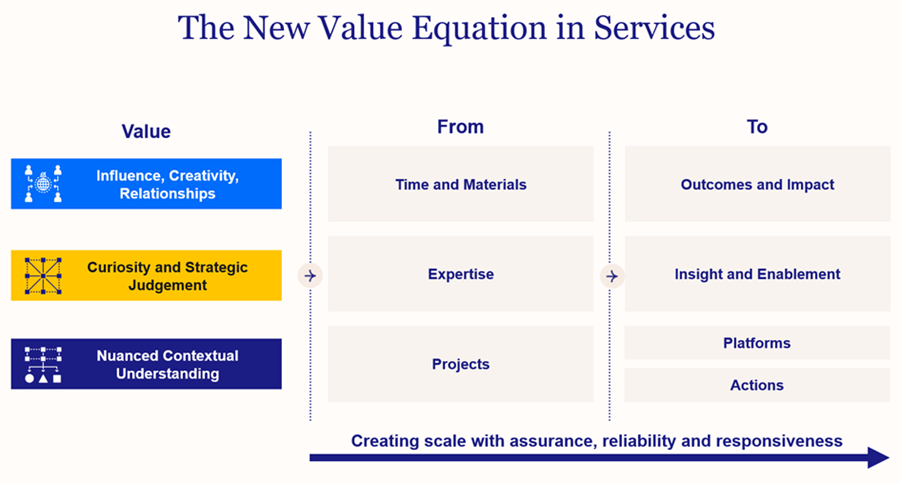
IDC data backs this up. By 2029, IDC expects 30% of all contractual engagements with service providers to be outcome-based, and 30% of IT services to be delivered as modular, platform-enabled products.
What is a SPAAP and why it matters
That shift is creating a new asset class. IDC calls it the Service Provider Agentic AI Platform, or SPAAP: a proprietary platform built, operated, and maintained by firms whose primary business is services, not software. SPAAPs are the AI-native expression of the Services as a Product model, and they are quickly becoming the strategic core of how a modern services firm scales.
These platforms serve two purposes, often simultaneously. They can function as internal delivery platforms that industrialize how a service provider designs and delivers services at scale. They can also be client-facing platforms that complement or replace business and technical processes inside the client environment, persisting after the engagement ends.
The industry is bifurcating and the gap is widening fast
The services industry is splitting into two camps. Winners are rebuilding their business models around client outcomes. Everyone else is defending legacy structures.
Winners run productized portfolios aligned to industries, domains, and buyer personas. They invest in proprietary, modular platforms with orchestration, governance, observability, and interoperability. They build smaller, higher-value teams of humans and agents. They price on outcomes, with clear IP and data ownership and shared risk structures. They earn trust by being transparent and auditable.
The losing profile looks different: broad menus of generic capabilities, fragmented delivery tooling, pyramid talent models, and time-and-materials pricing. Black-box solutions. Deflected accountability. The gap between the two groups is widening and fast.
Two new competitor types are entering the arena
Service providers face two distinct new categories of competitor.
AI-native firms like Harvey, Sierra AI, Hyperscience, and others promise 60% to 80% automation of traditional SOW work with outcome-based pricing. They are not trying to replicate the full services model. They disintermediate specific high-value workflows, often the ones that previously went to BPO firms and lower-tier SIs.
Platform players like AWS, Microsoft, Google, SAP, ServiceNow, Salesforce, Palantir are moving differently. They are bundling software, tokens, and forward-deployed engineers into outcome-priced offers. The contract is not just price-competed. It is structurally redesigned around the product.
The strategic battleground is no longer service execution. It is the workflow and outcome layer and whoever owns that layer owns the customer relationship.
Where established service providers have a structural advantage
It is easy to assume that hyperscalers, ISVs, and AI-native firms will simply absorb the services market. They will not. Service providers hold a real structural advantage across three layers of the agentic stack: build and deploy, govern and operate, and orchestrate.
Portability is the most visible piece. No enterprise wants lock-in to a single foundation model, a single hyperscaler, or a single agent framework. Buyers want freedom to swap models as they improve, move workloads as economics shift, and integrate agents across platforms they already own. Service providers are the only vendor category whose business model rewards staying open on those choices while remaining accountable for the outcome.
Governance is the more durable piece. Agentic delivery raises the stakes on identity, observability, auditability, and risk controls. Enterprises need explainable behavior, evidence trails for regulators, and clear human accountability when an agent acts autonomously. Service providers sit closest to the client’s process, the people in the loop, and the contractual liability for the outcome, which is exactly where agentic governance has to hold. Governance declared in a product spec and governance operationalized inside a client environment are two different things.
Orchestration is where the advantage compounds. Enterprise work spans ERP, CRM, ITSM, data platforms, custom applications, and cloud workloads. Agentic delivery has to coordinate across all of them, often with agents built on different frameworks and run by different teams. Cross-system, cross-vendor integration is what service providers do for a living. Extending that into multi-agent orchestration, A2A and MCP interoperability, and the workflow layer that ties internal delivery agents to client-side agents is a natural extension, not a pivot.
Underneath all three layers sits the differentiator hyperscalers and horizontal ISVs find hardest to replicate: industry depth. Workflows, regulations, KPIs, and the definition of a good business outcome differ sharply across banking, healthcare, manufacturing, retail, and the public sector. Service providers have spent decades embedding that context into delivery teams. They are now encoding it into agentic platforms through vertical playbooks, domain ontologies, and persona-targeted agent suites. The substrate can be built quickly. The industry context is what turns agent activity into measurable business outcomes.
Three priorities for services leaders
Three moves should be on every services leader’s agenda right now.
Productize delivery. Treat your agentic platform as a product, not an internal accelerator. Give it a roadmap, dedicated engineering, security hardening, transparent pricing, and clear IP and data ownership terms. Buyers are already asking whether providers will maintain proprietary platforms the way a software vendor would. Adoption increases when the answer is yes.
Modernize the commercial model. Outcome-based, fixed-fee, and consumption pricing should sit alongside time and materials as first-class options. Build the instrumentation, KPIs, and reporting that make outcomes credible to buyers. Reinvest cost savings from automation into the next round of platform R&D.
Differentiate beyond the core platform. As agentic tooling commoditizes, the edge moves to vertical playbooks, ISV-specific accelerators, domain packs, and persona-targeted agent suites. Business context, workflow logic, and compliance depth are encoded most deeply here, and general-purpose platforms cannot easily follow.
Agentic AI is rewriting the economics, the contract, and the control point of the services industry. The providers that win the next decade will productize delivery through proprietary agentic platforms, treat governance and interoperability as differentiators, and price on client outcomes.
For the platforms, archetypes, and strategic moves shaping that shift, explore IDC’s new research domain: Service Provider Agentic AI Delivery Models and Platforms.