A little over a year ago, a new phase of the digital business era began with OpenAI’s launch of ChatGPT. The generative AI (GenAI) boom is expected to roundly influence what comes next: AI Everywhere. AI is expected to become a driving force of our digital future, impacting individual lives, consumers, citizens, workers, businesses, and society.

Henry Ford said, “The only real mistake is the one from which we learn nothing.” What should we learn from the past to determine the way forward?

After the 2023 hype (see Reimagining an AI Everywhere Digital Future: IDC EMEA FutureScape 2024), 2024 is expected to be the year when AI becomes real for organizations. The focus is expected to remain predominantly on GenAI for many organizations through the first half.

When looking at the future, there are urgent actions EMEA organizations should take to accelerate their AI Everywhere readiness. And there are some useful lessons we can learn from the past.

According to IDC’s Future Enterprise Sentiment Survey, in 2022 just 9% of EMEA organizations considered their digital transformation (DX) projects to have been successful. This is a clear indicator of the multiple pitfalls that can plague a DX journey, including organizational silos, lack of ROI, unreasonable time frames for completing the initiative, lack of internal skills and change management, and gaps in infrastructure requirements.

Looking at the DX challenges of past years provides us with a clear indication regarding “things not to do/forget” when charting a successful AI Everywhere road map.

In October 2023, when we asked EMEA CIOs about their spending plans for 2024, 91% confirmed they expect to maintain or increase their budgets in 2024. That investment needs to drive a return.

If you don’t want to follow the organizations that saw digital projects fail in past years, what should (or shouldn’t) you do?

5 Lessons for your AI Business Strategy

  1. Don’t regard AI as an IT tool. It’s a business reimagination. AI should not be seen just as another tool, but as an opportunity to transform the business to become more efficient, deliver new value to customers, and innovate with products and services. Aligning technology and AI investments to business strategy and requirements is critical to achieving higher returns in the age of digital business.

The stakes are high — these decisions will determine the success or failure of businesses. From developing an overarching strategy and identifying the right business use cases, to deciding whether workloads will work best on premises, in the public cloud, or in a hybrid environment, there are numerous decision points. Dealing with the challenges of a potential proliferation of AI applications requires foresight and forward-looking leadership.

As mentioned by the CEO of a Global Professional Service organization, every leader in the organization should engage at least with the “what” of this technology, understanding what the real use cases and opportunities are. Initially, the budget for experimenting with the technology will come from the IT and data department, but business will increasing lead when progressing with the use case road map budget.

With so many decision makers, having a coordinated holistic approach is paramount. Whether through the creation of new roles (e.g., chief AI officer) or within the remit of existing ones, organizations need to manage AI initiatives through a defined organizational structure. There’s a need to have a structured and coordinated approach from the AI strategy to the use cases road map, all surrounded by strong governance to foster a responsible AI deployment.

  1. Don’t forget to measure. Quantify the digital business impact. In the past, we talked about the digital ROI gap — the gap between digital investments and the ability to generate results from them. The greater cautiousness driven by the volatile macroeconomic scenario, combined with tech pricing concerns, imposes a laser focus on ROI. It is imperative for organizations to define the business outcomes they want to achieve with AI, check them against the investments needed, and measure the progress toward their achievement to adjust the tech strategy procurement if needed.
  2. You won’t have three years to show results. Start small, think big. The use case prioritization exercise should factor in the quantification of business value, the cost and capabilities requested, and the risk of the initiative — as well as the time to outcomes. Make sure your use case portfolio is well balanced, with several smaller projects that have a shorter time to market and can better demonstrate business value, and few mid-sized ones that have a slightly longer timeline.

The CEO of a non-profit organization told us, “We have reengineered the technology road map to completely align to business requirements. What have we changed? We reprioritized projects so we are now working on fewer bigger projects and then a lot of small, more innovative projects that are creating value in the in the short term.” Particularly regarding GenAI initiatives focused on productivity, the CIO feedback is that these need to be proven within two to six months.

  1. You won’t go far without the basics. Prioritize building a secure, intelligent architecture and data foundation. If you are looking at AI as an opportunity to transform the business and not another tool to plug and play — which is the way you should approach the AI Everywhere transformation journey — you should not overlook the importance of the required foundations and the alignment with partners and the broader ecosystem.

A successful AI road map can only be realized through a solid, agile and intelligent technology backbone. This must comprise key technology enablers, foundational data and analytics, cloud for scale and agility, security technologies to ensure cyber protection and remediation, as well as regulatory compliance and smart risk mitigation.

A well-governed data system is critical to ensure data quality, trustworthiness, and actionability. According to IDC’s Digital Executive Sentiment Survey (September 2023), only 53% of EMEA organizations have integrated data sets and effectively manage them to deliver returns.

  1. Don’t underestimate the importance of change management. Humans should be at the center. As happened in the past 200 years, industrial revolutions have brought tech closer to humans, unlocking new opportunities. Similarly, we are now undergoing an industrial revolution powered by AI — and the human element should remain central to the process.

A main pitfall companies should avoid is not considering it a change management program. Developing the right culture and skills is critical. This applies to all organizational levels. According to European CEOs, the top skill to be successful in their role is AI proficiency. Engaging all stakeholders from the get-go is key for successful AI projects, as we have seen many digital initiatives fail because of organizational silos.

The CEO of a fintech company, for example, has championed the development of an AI certification program for the entire organization. The program has multiple levels and is mandatory for all employees. As a true change management program, the members of the leadership team actively drove change in the organization. They were the first to complete the certification program and developed guidelines and procedures for a responsible use of the tech.

Similarly, a member of the IDC CIO Advisory Board highlighted the employee journey as one of three critical pillars to be successful on the journey: Build transparency on upcoming tech needs and train the people to adopt and leverage future technologies.

Practical Steps to Move Forward on Your AI Journey

In a nutshell, here’s what you should do:

  • Bring the C-suite dream team together to develop an aligned strategy.
  • Create a road map for use cases.
  • Embed GenAI’s transition into a more comprehensive AI strategy.
  • Measure your AI-enabled business impact.
  • Decide on your next infrastructure approach: Build, buy, amend, or have it managed.
  • Plan for an agile yet secure digital platform with a strong data foundation.
  • Engage employees and build talent for new ways of working.
  • Build strategic and trusted partnerships and ecosystems for co-innovation.

As we have seen since the beginning of DX, IT teams and CIOs will play a central role in the AI Everywhere age. The increasing importance of the CIO role and the opportunities it brings in 2024 are unmistakable.

With the expected increase in IT investments, especially in the field of AI, CIOs face a unique opportunity to position themselves as a driving force behind the next level of transformation. However, it should be emphasized: These investments should not be made lightly.

The transition to the AI world requires careful planning, resource allocation, and implementation, and will likely impact the operating and organizational model. But as a medtech CIO put it, if you can learn from the past and embrace the future, “The future will be bright.”

Andrea Siviero - Senior Research Director, MacroTech, Digital Business, and Future of Work - IDC

Andrea Siviero leads IDC's European Digital Business and Future of Work Research group. The group provides market research insights to foster a purposeful and fair adoption of technologies supporting digital societies, businesses and workforce and empower tech providers in strategic decision making, planning and go-to-market activities. Siviero also co-leads the IDC Worldwide MacroTech Research program, focused on the intertwined connection between the Economical and Digital worlds - analyzing the impact key MacroEconomic factors have on the digital landscape and viceversa, how technologies are impacting economies around the world.

Saudi Arabia is making good on its ambition to become a global smart and sustainable tourist destination.

Not long ago, however, such an outcome seemed unlikely. When we traveled from Europe to the kingdom in 2015, for example, we were required to prepare piles of documents months in advance. We also had to make a trip to a Saudi visa application center, which existed in only a handful of European cities.

Getting through passport control at King Khaled International Airport meant standing in line for at least an hour. The quickest way to get to town was via a pre-booked car service, which invariably came in the form of a gas-guzzling SUV. After arrival in Riyadh, the entertainment options were slim.

But now, nine years later, the immigration process and airplane boarding can take literally a blink of an eye. This reflects the Saudi aviation industry’s investments in growth, customer experience, and operational excellence.

Commuting to Riyadh also comes in all shapes and forms of private transportation — and public transit is on the way. The city buzzes with museums, theaters, concerts, sport events, and Michelin star restaurants. It will host, along with partner cities across the country, the Asian Winter Games 2029, as well Formula 1, Formula E, the Dakar Rally, World Expo 2030, and the FIFA World Cup in 2034.

Obviously, these rapid changes did not occur accidentally. They are the fruits of an ambitious vision to enhance the country’s social fabric and lay the foundation for a diversified economy that leverages the full spectrum of its population’s talents and contributions. Saudi Arabia aspires to reduce its dependence on oil and ensure economic resilience by cultivating sectors such as tourism and entertainment.

Bold Vision — Sustainable Execution

The government’s Vision 2030 marks a pivotal chapter in the history of the kingdom, signaling a transformative shift towards the goals of openness, cultural evolution, and economic diversification. Travel, tourism, and entertainment are strategic priorities in this economic diversification and social reform road map.

The Digital Tourism Strategy aims to boost tourism’s contribution to GDP from 3% to 10% by 2030 and to increase the number of foreign visitors from around 60 million to 100 million annually by 2030. Investments are already paying off.

Since the opening of its doors in 2019 to international tourists, the kingdom has become the fastest growing tourism destination in the G20.

But the ambition extends beyond growth of the tourism industry. Giga projects like Neom, Diriyah, and Red Sea — backed by the $600 billion Public Investment Fund (PIF) — are being developed not only to increase capacity to host new residents, visitors, and global events, but also to reimagine the quality of life and the cultural, heritage, leisure experiences, environmental sustainability, and innovation expectations of next-generation tourists.

Saudi Arabia seeks to explore “the art of the possible” in terms of eco-friendly tourism, architectural design, and green technologies. The kingdom seeks to align these developments with the United Nations’ Sustainable Development Goals. The aim is to pioneer a responsible tourism model that safeguards the country’s rich natural and cultural heritage while fostering economic prosperity and improving Saudi quality of life.

By 2030, the kingdom plans to reduce by 50% the carbon emissions generated by the tourism industry. In parallel, it is creating wildlife sanctuaries and developing sustainable tourism initiatives that protect endangered species and the natural landscape. Planned developments at the Red Sea project are an example of authorities’ regenerative environmental approach.

Saudi Arabia largely imports its food from abroad and is running out of water. To address this, Neom plans to become food self-sufficient and source water from carbon-free desalination plants. Some resorts are exploring the concepts of biomimicry and developing nature-based architectural designs.

To accelerate the execution of such an ambitious vision, Saudi public institutions and private investors are working closely with local and global technology companies to empower them to reimagine the visitor experience and operational excellence in a sustainable manner.

Sustainable Tourism: Powered by Tech Innovation

The Saudi Tourism Authority’s (STA) traveler-centric approach and ambition to develop personalized experiences for visitors is a major differentiator from other destinations. Visitors who share their interests and preferences, for example, can receive customized recommendations during their stay in the kingdom. For world sports events like Formula E, guests can enjoy immersive experiences.

Digital technology is also powering Saudi Arabia’s long-standing tradition of hosting the annual religious pilgrimages of Hajj and Umrah, with a range of apps offered to enhance the safety and experience of millions of pilgrims from around the globe.

Plans also call for the building and operation of digital-by-design entertainment facilities that leverage digital twins and metaverse-centric solutions. These require partnering with technology companies that can deliver next-generation digital infrastructure, platforms, and user experience capabilities that align with the kingdom’s sustainable tourism and entertainment agenda.

To execute these ambitious visions, local and global technology vendors need to partner with the senior leaders driving the giga projects, as well as with national authorities like the STA and the Authority for Data and AI (SDAIA), which serves as a strategic decision maker for Saudi aspirations to leverage AI to enhance smart tourism destinations. Technology vendors and advisors can also help the kingdom leverage international best practices, such as the UNWTO framework, and to set the baseline and measure progress against sustainable tourism targets.

From personalized travel experiences to efficient resource management and environmentally and socially responsible engineering and construction supply chains, Saudi Arabia is being watched by global leaders who are also reimagining and developing new standards for sustainable tourist destinations.

Tech innovation will be critical to execute such an ambitious vision while confronting a demographic boom and limited natural resources — all while keeping a human touch that allows tourists as well as citizens to enjoy the fruits of these developments.

Making government services more people-centric is not a new aspiration, but with fast advances in technology and rising societal expectations, public sector senior leaders are re-imagining how to deliver on that promise.

Since the inception of e-government in the early 2000s (later also known as smart government and digital government), making services available through digital channels became a critical instrument to improve citizen and business experience, as well as to attract investors and tourists, and collaborate with across government entities. These initiatives yielded results in terms of operational efficiency, convenience for and engagement with constituents.

Notwithstanding the progress, siloed processes and systems, forcing people and businesses to experience time-consuming bureaucratic services, and inequality of access to e-government services are still open issues.

Public sector leaders that aim to usher in the next generation of the people-centric services should understand people’s and businesses’ needs and circumstances through intelligent use of data, simplifying and joining up services across programs, partnering with the private sector, making digital services more inclusive, and enabling trusted interactions to make the bureaucracy truly “invisible”.

Reimagining Service Delivery, Operating and Trust Models

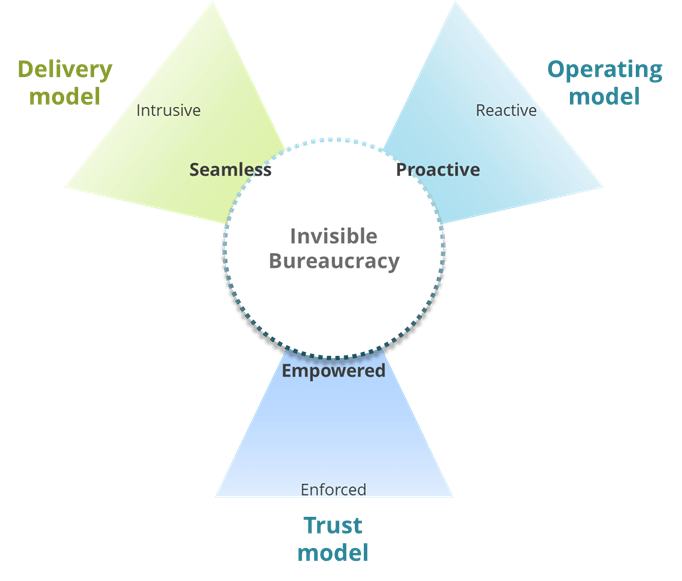
Making government bureaucracy invisible means embracing technology-powered innovation to drive proactive operations that will deliver seamless services for empowered people and businesses:

  • Service delivery model. The next generation of invisible services will be seamless. Constituents (citizens, businesses, investors, tourists, etc.) will not realize that public services are being delivered. They will not be asked to interact with the government to know what services they are entitled to or be interrupted in their daily routine because they receive a request to provide data to prove changes in circumstances.
  • Operating model. The next generation of invisible operations will be proactive. Without intruding into people’s and businesses’ daily lives, the government will know enough to understand the events that impact constituents and changes in circumstances. Governments will proactively register constituents for programs that they are entitled to and automatically deliver services.
  • Trust model. The next generation of invisible bureaucracy will shift from enforcement to empowerment. Instead of enforcing compliance after the fact, the government will make compliance easy for constituents through automated, proactive services, and simplified regulations. Government will invest in digital trust through proactive, transparent personalized notifications, and tools to see how personal data is being used across departments.

The Road to Invisible Government Bureaucracy

To accelerate the road towards Invisible Government Bureaucracy, public sector senior leaders should implement changes around the six building blocks:

  1. Building a holistic view of people, businesses, and communities. To avoid asking for the same data again and again, to understand when a change in circumstances offers an opportunity for the government to proactively deliver a service, and to empower open engagement, governments are investing to build a 360° view of people, businesses, communities.
  2. Scaling cognitive processes and services. Governments need to re-engineer processes and embed AI-enabled cognitive capabilities into systems so that they can recognize changes in the circumstances of their constituents, identify root causes and trigger operational workflows or dynamically reconfigure services and programs to satisfy the evolving constituent needs.
  3. Designing and delivering people-centric experience journeys. Increasingly, people will expect to interact with systems through conversational interfaces that can recognize their language, accent, tone of voice, instead of having to scroll through screens and fill forms. Cognitive capabilities will be embedded in every touch points throughout the user experience journey.
  4. Ensuring accessibility and inclusion for all. The non-intrusive and proactive nature of the invisible government bureaucracy will also enhance inclusion by lowering accessibility the barriers. However, as conversational and generative AI, immersive reality solutions become more pervasive, they must be designed with accessibility in mind.
  5. Investing in next-generation trust services. The public sector should invest in digital trust tools that enable citizens to conveniently access digital services across government, without having to remember multiple login credentials. Such tools will help citizens have a transparent understanding on how government use personal data and opt-in or opt-out of data sharing.
  6. Expanding collaboration with third parties. Government are working with private enterprises and community organizations to enable constituents to enjoy the lowest possible number of interactions with the government, to eliminate duplicate request for personal data, and the best possible convenience and proximity when those interactions are needed.

The latest IDC Government Insights study explores how to adapt organizational capacity and competencies, revisit policies, work with the ecosystem, and ensure public trust, to make Invisible Government Bureaucracy a reality.

Massimiliano Claps - Research Director - IDC

Massimiliano (Max) Claps is the research director for the Worldwide National Government Platforms and Technologies research in IDC's Government Insights practice. In this role, Max provides research and advisory services to technology suppliers and national civilian government senior leaders in the US and globally. Specific areas of research include improving government digital experiences, data and data sharing, AI and automation, cloud-enabled system modernization, the future of government work, and data protection and digital sovereignty to drive social, economic, and environmental outcomes for agencies and the public.

Strong Headwinds Disrupting the Built Environment Industries

The built environment sector is often seen as a laggard in productivity and technology adoption. However, this is changing: the strong headwinds of the last few years have forced companies to evolve and innovate.

The pandemic led to widespread supply chain shocks felt acutely by the construction sector and with geopolitical tensions increasing, including in the Red Sea, this issue is here to stay. Covid-19 also led to one of the largest shake ups in the real estate industry with significant drops in office occupancy rates in the move back to hybrid work.

While occupancy rates are recovering, they are not expected to return to pre-pandemic levels. Add to this potent mix, the energy crisis and increasing ESG targets and regulatory requirements.

PropTech Companies Are Injecting Innovation

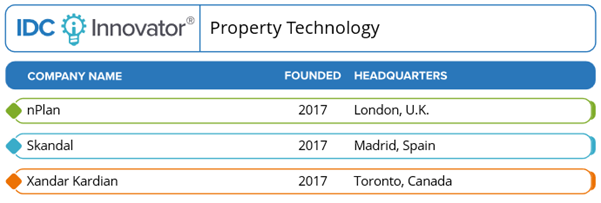
Property technology (PropTech) companies are injecting much-needed innovation into the industry and driving significant changes across building life cycles from design to construction, operation, maintenance, and demolition. We have published a PropTech Innovator Report highlighting 3 Innovate companies that are providing transformative solutions across the built environment sector.

In line with the AI era,  which IDC refers to as to as AI Everywhere, each Innovator highlighted in the report is leveraging AI in their solutions.

Our research highlights that the top priorities for built environment executives are improving operational efficiency and cost reduction, enhancing environmental sustainability and improving resilience to climatic hazards. Organizations are increasingly applying technology to help support these business objectives.

For example, to meet their sustainability goals, 66% of real estate companies are investing in data and analytics including AI, and 61% are investing in space and workplace technology (IDC’s Sustainable Buildings, Homes, and Districts Survey, 2023, n = 654).

Announcing IDC’s “Worldwide PropTech Innovators, 2023”

The PropTech companies highlighted in the Innovator span the building lifecycle and reflect the diverse range of companies encapsulated in this market. The first innovator — nPlan — is changing the way in which major projects can be planned, designed, and monitored through an AI-enabled software solution drawing on over 750,000 project schedules. The second — Skandal — is providing IoT driven lighting displays that respond to building inhabitants to improve occupant experience and promote behavioral change. Finally, Xandar Kardian’s solution monitors occupant motion through the innovative use of radar technology and can also monitor resting heart rate and respiratory rate for applications in health and social care facilities.

IDC is developing further Innovator reports focused on innovation in the built environment so please get in contact if you are an SME and meet the eligibility criteria – jdignan@idc.com lbarker@idc.com

You may also be interested in:

Louisa Barker - Senior Research Manager, IDC Government Insights, Europe - IDC

Louisa Barker is a senior research manager in the European IDC Government Insights team, leading research on smart, sustainable, and resilient cities and communities. She has international experience providing analysis, policy advice, and consultancy to the public sector on disaster risk management, urban building and planning regulation, and smart cities. Previous roles have included Urban Resilience Consultant at the World Bank, focused on projects in the Caribbean and East Africa, and as a researcher at technology and innovation accelerators such as the Future Cities Catapult and the University College London City Leadership Laboratory. She is also a Specialist Advisor to the International Building Quality Centre.