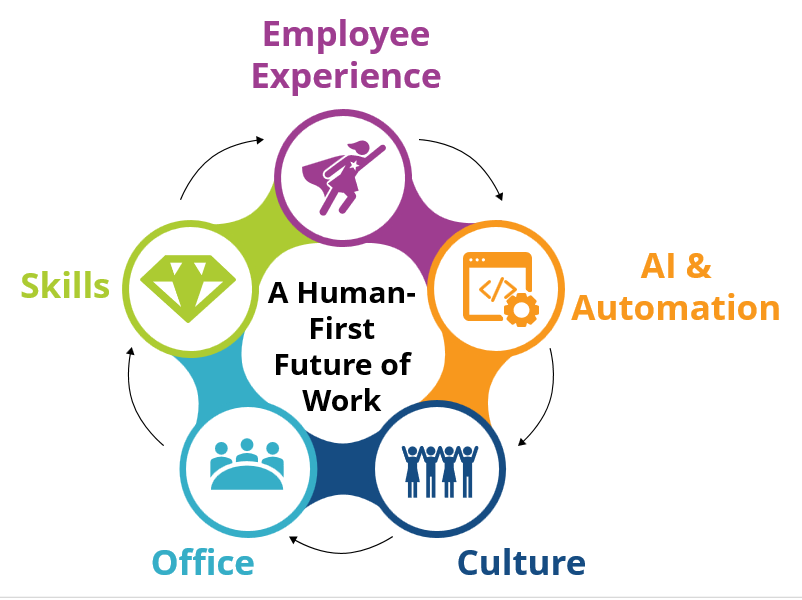
After much back-and-forth on work models, bold ultimatums from employers and staunch resistance from workers, European businesses are in the process of codifying different ways of where, how, when, and why we work. One of the many reasons for this change is the speed with which technology, especially artificial intelligence and GenAI, have made it possible to work equally well in varying, flexible work models.

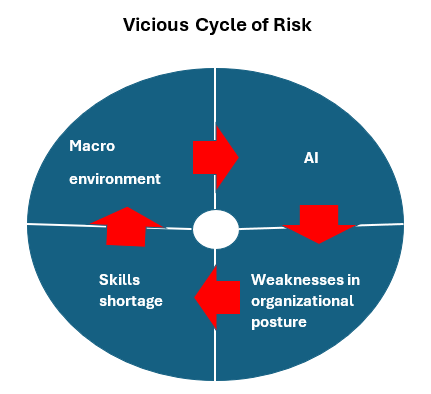
The downside of this rapid technology development has been that European organizations simply cannot hire enough workers with current or deep skills – both technical and human. Do you manage highly distributed teams performing complex and interdependent tasks? Certainly not easy. Finding employees trained sufficiently well to safely transition to the use of Gen AI solutions? Not easy either.

Enter the promise of automation and in particular the ability of AI and Gen AI tools to both facilitate repetitive tasks like coding, data entry, research, and content creation but also to amplify the effectiveness of learning in the flow of work and secure company assets.

The following 3 predictions are examples of what work in Europe might look like in the next five years, considering the areas of work personalization, skills development and the impact of climate change on office design.

Future of Work Predictions for 2024 and Beyond

  • Prediction 1: 60% of Large Businesses will upgrade hardware and software technologies to increase worker retention with personalized work experiences and enhanced collaboration by 2025.

Rapidly evolving technologies and work methods are forcing companies to upgrade hardware and implement new software technologies that support better employee experiences, personalization and improved collaboration.

Collaboration apps are becoming more visual and continue to develop features unlike multiplayer games that enable a more personalized view of work and teams, better targeting of projects, and hands-on collaboration apps. Meetings and other work resources, including collaboration resources (workflow, meetings, new document formats, etc.) are translated and transcribed in real time, captured, analyzed and exploited by other integrated business data sources. The results enable faster and more personalized decisions and collaboration, including summaries using generative AI. AI solutions are gradually increasing the ways people consume content and data, and AI itself will become a digital collaborator.

  • Prediction 2: Enterprises will leverage personalized technology skills development to drive $1T in productivity gains by 2026, enabled by GenAI and automation everywhere.

As the development and use of technology in everyday work environments becomes more complex, organizations struggle to find experts for programming, security, architecture, operations, management and many other roles. IDC data from 2023 shows that 43 % percent of organizations lack the capability support needed to successfully implement automation.

One of the reasons Gen AI adoption and experimentation has grown so rapidly is that everyday workers can see its immediate value. As new jobs come online due to new automation requirements and workers learn new skills, Gen AI is being incorporated into tools that create employee training. Workers with entry-level skills can better target individual learning needs based on the speed with which Gen AI can generate code, summarize data, and create first-draft multimedia products. This customized approach ensures that people (including IT staff) receive the most appropriate training, optimizing efforts to increase their skills and competencies as jobs evolve, plus the need to program GenAI applications themselves.

  • Prediction 3: By 2028, organizations will invest in office climate havens, using asset-based/renewable energy to defray 30% of their ongoing operating costs.

It is not just work patterns that are rapidly changing. The environment we live and work in is rapidly changing too. As uncontrolled wildfires, climate change and extreme weather events become more common in Europe, the consequences are affecting human health and the ability to work effectively. Sustainability measures are no longer considered optional as organizations worldwide recognize them as necessary components of strategic planning and sustainable operational excellence.

In future, progressive companies will adopt a combination of innovative building design, digital twins, robotics and integrated climate systems to create climate havens where workers and their families can both find relief and focus on work. Unfortunately, simply rebuilding existing buildings with AI or robotics adds energy demand to an already struggling European energy infrastructure.

Companies that invest heavily in asset-based energy (hydro/tidal, geothermal, solar and wind) on-site in their climate havens, support both their operating costs and potentially create a secondary revenue stream when they feed electricity back into the grid. This is reversing the long-term trend of digital organizations threatening their local communities through excessive power usage, while improving community relations, employee retention and talent recruitment.


All the above predictions have much in common – they seek to better understand the intersection of technology and human behavior. Science fiction predicts dystopian visions of mechanized and artificially controlled societies where human efficacy is threatened. IDC far from that point of view, but we also see how the concerns raised by new technologies such as Gen AI can play a big role in hindering adoption—for better or for worse.

Organizational leaders must invest time and money in the strategic planning for the adoption of AI and GenAI technologies, as well as the new roles and ways of working they create. This is not just a technology issue that affects computing, security, hardware, infrastructure, and integration requirements. It is also a human issue that must be addressed employee empowerment through skill development and the development of appropriate, re-imagined career paths.

For more information on the impact of Automation on the European Future of Work, please access the following resources:

Meike Escherich - Associate Research Director, European Future of Work - IDC

Meike Escherich is an associate research director with IDC's European Future of Work practice, based in the UK. In this role, she provides coverage of key technology trends across the Future of Work, specializing in how to enable and foster teamwork in a flexible work environment. Her research looks at how technologies influence workers' skills and behaviors, organizational culture, worker experience and how the workspace itself is enabling the future enterprise.

This year’s Enlit Europe, which took place between November 28 and November 30 in Paris, attracted almost 12,000 visitors,700 exhibitors from 100 countries and 500 speakers, — proving once again to be a reference point for the European (if not worldwide) utility sector.

Sessions on the energy transition (energy efficiency, electrification and decarbonization), flexibility, and digitalization, as well as numerous hub sessions, provided a great opportunity for knowledge sharing during the three-day event. Here are our key takeaways from discussions and debates with technology providers and utilities.

Among the conversations with various utility leaders, three key themes emerged that outline the direction in which this industry is moving.

  • Flexibility at the heart of energy transformation. One of the dominant conversations that continued this year at Enlit is the growing criticality of flexibility for the utility industry. With increasing renewable energy sources and the need to integrate distributed energy resources more effectively, utilities are increasingly focusing on operational flexibility. Additionally, booming electrification requires demand flexibility to mitigate the impact of the energy transition on grids, which are the invisible enabler of it all. Industry representatives stressed the importance of investing in technologies and systems that enable more dynamic grid management, ensuring more efficient and sustainable energy distribution and consumption.
  • The imperative of marketing. Another interesting aspect that emerged during the event was the growing success of utilities that understand the value of marketing, to change customers’ perception of their company and the industry as a whole, while improving their relationship with consumers. Utilities that have invested in understanding consumer needs and have built strong brands are reaping the benefits. Utilities are at the heart of a transformation that impacts everyone and will set the stage for the next generations, if done right and marketed well, companies can turn misconception of the industry on its head, leading to newfound success.
  • What about Generative AI? Despite growing interest over the last year, the topic of GenAI was not as apparent as we would have expected. Discussions we had were more focused on the benefits of horizontal applications of GenAI and very rarely on industry specific use cases that utilities should be digging into. Currently, the discourse on GenAI tends to be more high-level than practical, with utilities trying to figure out how to integrate this technology effectively into their daily operations. The largely uncharted territory of GenAI also raised additional conversations around artificial intelligence and machine learning overall and the untapped potential that still exists. And it all came back to the topic of “data” … the quality of the data, the frequency of the data, the amount of data, etc. The challenge now is for utilities to translate high-level discussions into concrete and practical action, successfully addressing industry challenges and capitalizing on emerging opportunities. And for this they need the help of their peers and the technology ecosystem that surrounds them.

Overall, it was positive to see an Enlit returning to its pre-COVID bustle, with a diverse pool of companies exhibiting on the floor, both from a software and a hardware perspective. Let’s hope the onsite enthusiasm trickles into utilities daily activities fostering more drive to the energy transition.

Here’s to quickening progress in 2024 to be discussed when we meet in Milan at next year’s Enlit Europe.

For more of our coverage on the energy market, visit our website.

Dec 11, 2023

IDC Government Innovation Forum 2023. Итоги

Астана, 11 декабря — Ведущее мировое аналитическое агентство IDC 7 декабря провело в Астане IDC Government Innovation Forum 2023: Технологические инновации в государственном секторе. Мероприятие...

Read full release

In 2023, I attended and spoke at many IDC conferences, such as the IDC Government Xchange, IDC Portugal Directions, and non-IDC events, like the Smart Cities Expo and the ServiceNow World Forum in Rotterdam, to name a few. One common thread of many of the conversations that I had and the presentations I listened to was how executives felt the pressure to increase their organizations’ speed, to keep up with the fast pace of innovation.

Everyone seemed obsessed with speed being the big difference between how innovation happens today versus how it happened twenty, fifty or a hundred years ago. That may be true for enterprises that want to be fast followers, for instance to drive incremental productivity improvements through digital transformation; in fact, IDC’s research indicates that the average time to value of digital projects was in the 6 to 24 months range, two years ago, while now it is less than 10 months.

But enterprises that are looking for opportunities to re-shape their destiny and gain competitive advantage should take a closer look at the way technology innovation shapes the creation of new markets. And that is different today, not only because of its pace, but also because of the dynamics among the key attributes of a market.

No matter whether one tries to interpret market dynamics through the lenses of neoclassical economic, Austrian school of economics, institutional economics and other theories, the common elements of market formation are the exchange of products and services, the narratives built around buyer and seller values that define how they perceive the benefits and risks of those products and services, and the norms – including laws, policies, standards – that regulate the exchange to maximize benefits and reduce risks.

From Linear to Warped Innovation

In the past, the interplay between exchanges, narratives and norms not only took a long time to come together but was quite linear. When the car market formed, Daimler and others invented the product in the 1880s, then Henry Ford and Alfred Sloan at GM shaped the narratives of the car for the mass consumer in the early 1900, and it was not until the 1950s that car safety regulations started to become more pervasive.

Overall, it took over 70 years for exchanges, narratives, and norms to fall into place and in a linear sequence. Fast-forward to today to look at how the Generative AI market is shaping up. In 2017, Google researchers published a paper on transformer models that was born out of a specific need – making language translation more efficient – but was soon understood as the seminal moment of a new category of product and services based on large language models (LLMs).

In late 2022, OpenAI public launch of ChatGPT detonated a new narrative about mass usage of LLMs to search and synthesize knowledge and create new content, being images, text, or computer code. While ChatGPT was launching, the EU was finalizing its AI Act, but decided to delay the completion of the draft regulation, to consider the impact of GenAI.

In essence, over the course of six years, the development of products and services to be exchanged, the narratives and the norms started to interplay. And one year after the launch of ChatGPT, new products and services are constantly coming to market in the form of public platforms, domain-specific models, capabilities embedded in enterprise software; the narratives around the value and risk of GenAI have not yet crystallized at all, with suppliers and buyers that are trying to figure out the impact across the most disparate use cases; the AI Act was modified, and then went through a first approval cycle.

So, not only the timeline was compressed, but the dynamic interplay of exchanges, narratives, and norms, was (and still is) far from linear. It is a warped dynamic, meaning, not only happening at “warp speed” compared with the past, but also sometimes convoluted and unpredictable because of the feedback loops among all its determinants.

In many scientific fields new discoveries are accelerating, often powered by emerging tech such as AI and quantum computing, like in nano materials, bio-engineering, space-tech, and nuclear fusion. At the same time, there are plenty of societal challenges where technology innovation can find applications, such as energy efficiency and climate change resilience, healthy and sustainable food for all, smart and sustainable roads, sustainable use of precious water resources.

These momentous changes will bring more warped innovation and less linear innovation. Enterprises and their technology partners that want to shape new markets in this context need to consider that:

  • Proving the value or ROI of technology innovation will revolve around business and revenue model re-imagination, creation of new industries and ecosystems, nurturing of jobs and skills for the future, rather than considering only efficiency and speed of product and service development.
  • Governing innovation will require making organizations more permeable to bring together stakeholders across enterprises and often across industries to explore new ecosystems through virtual joint ventures and outcome-driven joint development projects, rather than scaling partnerships with suppliers and customers along familiar value chains.
  • Business value will be created by investing in organizational capacity and skills that nurture collaboration, curiosity, data literacy, storytelling and scenario narrative, user-centricity, and pervasive resilience that enables to withstand the failures and mistakes that come from serendipitous trial and error iterations.

Private and public sector leaders that want to succeed in shaping new markets in the world of warped innovation should concede some slowness and sloppiness to shape the intricate interplay between turning new scientific discoveries into products and services that can be exchanged, crystalizing the narrative around the social and economic values that drive buyers and sellers, and designing the norms that maximize benefits and minimize risks.

Massimiliano Claps - Research Director - IDC

Massimiliano (Max) Claps is the research director for the Worldwide National Government Platforms and Technologies research in IDC's Government Insights practice. In this role, Max provides research and advisory services to technology suppliers and national civilian government senior leaders in the US and globally. Specific areas of research include improving government digital experiences, data and data sharing, AI and automation, cloud-enabled system modernization, the future of government work, and data protection and digital sovereignty to drive social, economic, and environmental outcomes for agencies and the public.

As it’s ChatGPT’s first birthday, now seems like a good time to look back at what its arrival has sparked, and to look forward at what might happen next with Generative AI.

There is no doubt that when OpenAI launched ChatGPT in late November 2022, it kickstarted a huge new wave of excitement about the potential for AI within business. A major survey conducted by IDC in August 2023 showed that in just a few months, we arrived at the situation where 75% of European organizations said they were already working with Generative AI (GenAI) in some capacity. What’s more, 18% of European organizations said that GenAI had already disrupted their business to some extent.

In August 2023. That’s just 9 months after ChatGPT’s debut.

It’s important that we remember that GenAI didn’t come from nowhere: prior to ChatGPT’s launch, a number of organisations (including Google, and OpenAI itself) had been working on GenAI technologies for years. But it was ChatGPT’s user-friendly conversational interface, and free service, that created high levels of awareness about what GenAI might be able to do – in an extraordinarily short space of time.

Of course, it’s important to note (as we have in numerous publications) that the GenAI opportunity is about much more than chatbots. Organizations are exploring use cases spanning marketing content generation, knowledge management, automation of software development activities, and much more.

Together, this span of use cases is driving massive interest. Some other key insights from IDC’s August GenAI survey:

  • 55% of European organizations said their C-Suite leaders are actively engaged with IT leaders about GenAI on a regular basis.
  • European C-Suite leaders are most interested in how GenAI can have an impact on customer experience (24.3% said this was the most sought information); how it can improve the performance of decision making (18.1%) and how it can improve employee productivity (15.8%).
  • European C-Suite leaders want to move fast: 88% of respondents said their C-Suite leaders wanted to integrate GenAI into applications and processes within 18 months.
  • On average, European organizations expected that investments in GenAI would account for 11% of new IT project budget in the next 18 months.

IDC forecasts that worldwide spending on GenAI implementation will reach $143.1B by 2027: that accounts for about 28% of the expected overall spending on AI implementation in that year. At a 5-year CAGR of 73.3% between 2023 and 2027, this represents a colossal market opportunity, that will significantly affect existing hardware, software and services markets.

As a result, it’s natural that OpenAI has now been joined by many new competitors all aiming to provide commercial GenAI models. The company now has competition from AWS, Google, and IBM, as well as other specialists (Cohere, Anthropic, Mistral, Inflection and Aleph Alpha are some examples). And enterprise application vendors like SAP, Salesforce and ServiceNow are leveraging open-source alternatives as well as partnering with a wide range of commercial model providers, in order to embed GenAI features in their application suites and platforms.

So – with GenAI set to be a major force in enterprise technology over the coming years, what happens next?

I’ve long wondered whether OpenAI might be an outlier in terms of how it approaches the GenAI opportunity; and indeed, whether its strategy makes it risky to focus too much on what OpenAI does, as a way to get a sense of overall market direction. I’ve said multiple times to colleagues and clients that OpenAI is more like a research outfit that is figuring out how to make its tech available to the world, than a product company.

Certainly, OpenAI has been culturally distinct from its competitors since before the launch of ChatGPT. While its competitors are primarily focused on developing products that businesses can use, OpenAI has operated as a hybrid between a not-for-profit research outfit committed to trying to develop what it calls “AGI” (Artificial General Intelligence) – something that many commentators feel is a very long-term project – and a commercial venture. Because it is at least partly focused on this long term mission, OpenAI is less focused than many of its competitors on meeting the real-world current needs of business customers. Which means that although OpenAI created the market that we see today, its future as a significant force in the market is far from guaranteed.

This question has come into sharp focus in recent days, as a soap opera has rapidly unfolded at OpenAI. On November 17th, without any warning, the company’s board fired its CEO, Sam Altman. The company’s President and co-founder Greg Brockman also quit. But within 48 hours, investors in the company called for Altman’s reinstatement as CEO, and for the board to quit instead. At the same time, Satya Nadella, CEO of Microsoft (OpenAI’s strategic investment backer) announced that Altman and Brockman would join Microsoft to found a new AI research lab; and hundreds of OpenAI employees signed an open letter to OpenAI’s board, saying they would quit unless Altman and Brockman were reinstated.

At one year old, human children are a hot mess of crying, screaming and unexpected and unmanaged bodily functions. Based on current events, it looks like the organization behind ChatGPT, which kicked off so much industry excitement, might be exhibiting the same tendencies…


For more information on GenAI in EMEA download our eBook: Generative AI in EMEA: Opportunities, Risks, and Futures , or visit our website.  

Neil Ward-Dutton - VP AI, Automation, Data & Analytics Europe - IDC

Neil Ward-Dutton is vice president, AI, Automation, Data & Analytics at IDC Europe. In this role he guides IDC’s research agendas, and helps enterprise and technology vendor clients alike make sense of the opportunities and challenges across these very fast-moving and complicated technology markets. In a 28-year career as a technology industry analyst, Neil has researched a wide range of enterprise software technologies, authored hundreds of reports and regularly appeared on TV and in print media.

Heavy machinery, automotive, and machine building typically have complex bills of material, multi-tier supply chain networks, and depend on carbon-intensive materials such as steel, aluminum, and plastics. To meet sustainability goals, these engineering-oriented value chains (EOVC) must undergo a transformative shift.

Manufacturing organizations stand at the forefront of decarbonization efforts worldwide. In 2022, IDC’s Industry Intelligence Survey found that customer requirements drove investments in sustainability as a strategic business priority for 45% of U.S. and 39% of European manufacturing respondents. For 40% of U.S and European respondents, regulatory requirements were the leading sustainability investment driver.

Decarbonizing the entire value chain — with a particular focus on Scope 3 emissions — is central to the evolution of EOVCs. Scope 3 emissions represent a significant share of a company’s overall carbon footprint, extending beyond direct operational activities (Scope 1) and indirect energy consumption (Scope 2). Scope 3 emissions encompass indirect emissions generated across the value chain, including the production of materials like steel, plastics, aluminum, batteries, and glass.

Understanding the dynamics of affordable (and available) clean and renewable energy is crucial to developing an emissions-free supply chain. Europe, however, faces significant challenges in deploying the low-carbon energy resources crucial to decarbonizing supply chains in general.

Many challenges related to value chain decarbonization are addressed at the C-suite level. However, the roles that must implement these strategies include material engineers, procurement department leaders, quality managers, and supplier management leaders.

As material and production technology evolves, new components are developed, and new regulations emerge, those in supplier network management-related positions must have detailed knowledge about the impact of component materials on carbon footprints. We are not talking about emissions related solely to logistics, but about the carbon footprint of the production process itself.

Products like steel, aluminum, electric batteries, and plastics are often referred to as “hotspots” — that is, making them produces major emissions of CO2 and other greenhouse gases and is a leading contributor to the auto industry’s emissions footprint.

According to a McKinsey & Company study, typical upstream EV emissions include the battery (40%–60%), steel (15%–20%), aluminum (10%–20%), and plastics (around 10%). Upstream internal combustion engine (ICE) vehicle emissions include steel (25%–35%), aluminum (20%–30%), and plastics (15%–20%).

Let’s briefly examine the carbon-emitting hotspots in EOVC supply chains.

Batteries

The rise of EVs has highlighted the environmental impact of battery production. Manufacturing lithium-ion batteries involves resource-intensive processes that contribute to Scope 3 emissions. EV batteries contain nickel, manganese, cobalt, lithium, and graphite, which emit substantial amounts of GHGs during their mining and refining processes.

Some processes in the production of anode and cathode active materials require high, energy-intensive temperatures. Other factors that determine the amount of embedded production carbon include battery chemistry, the production technology, the raw material suppliers, and transportation routes.

Oliver Zipse, chairman of the Board of Management of BMW, said in a statement that the company’s competence center near Munich is laying the technological foundations for the efficient and resource-saving production of battery cells along the entire value chain. The statement said sample production of sixth-generation round cells has already begun. These cells are characterized by an up to 20% higher energy density, and BMW has been able to reduce the CO2 footprint in cell production by up to 60%, according to the statement.

  • Worth Watching: On November 21, 2023, Swedish company Northvolt announced a state-of-the-art sodium-ion battery developed to expand cost-efficient and sustainable energy storage systems. The cell has been validated for an energy density of 160+ watt-hours per kilogram at the company’s R&D and industrialization campus in Västerås, Sweden. This energy density is close to that of the type of lithium batteries typically used in energy storage. Lithium batteries used in electric cars have an energy density of up to 250–300 watt-hours per kilogram.  Northvolt says the technology can minimize dependence on China for the green transition. Battery designers and engineers, as well as supply chain managers, are advised to keep an eye on the company’s efforts to scale the technology for industrial use.

Steel

Traditional methods of steel production cause high emissions due to the use of fossil fuels in the smelting process. Decarbonization efforts involve adopting innovative technologies like hydrogen-based steelmaking and electric arc furnaces powered by renewable energy. Transitioning to sustainable steel production is vital to mitigating the impact of Scope 3 emissions and reducing the automotive industry’s overall carbon footprint.

Plastics

Plastics, widely used in automotive components, pose an environmental and sustainability challenge. The production of plastics, particularly from petrochemical sources, contributes significantly to carbon emissions. Addressing this hotspot involves embracing circular economy principles, recycling plastics, and developing bio-based alternatives. Recycling initiatives and reducing dependence on fossil fuels for plastic production will enable the automotive industry to make substantial strides in Scope 3 emissions reduction.

Aluminum

Aluminum, valued for its lightweight properties crucial to fuel efficiency, is a key material in automotive manufacturing. Traditional aluminum production is energy-intensive and contributes to significant carbon emissions. The adoption of recycled aluminum, coupled with advancements in low-carbon primary aluminum production, is essential to mitigate environmental impacts. Innovations in aluminum production processes (e.g., smelting using renewable energy sources) offer promising avenues for reducing Scope 3 emissions.

Conclusion

Collaboration across the entire value chain — from raw material suppliers to manufacturers and consumers — is critical to drive meaningful change and accelerate the transition toward a low-carbon EOVC sector.

Establishing a transparent and trusted carbon-free environment requires an understanding of the entire Scope 3 upstream supplier footprint. Understanding the Scope 2 emissions of each supplier is also essential. Acquiring this level of transparency requires tools and data platforms that offer access to trusted information provided by suppliers and suppliers’ suppliers, as well as tools that monitor OEM compliance with regulatory obligations.

The future of decarbonization of the entire manufacturing supply chain is, of course, inevitably enabled by ubiquitous data. Sustainable zero-carbon efforts span not only the visible chain of tier suppliers but also primary and secondary raw material processing plants and green energy providers.

Automotive, machinery, and heavy machinery OEMs may share suppliers; hence, an OEM can benefit from the sustainability-related transparency of the supplier network established by another OEM.

Utilizing a secure, scalable, and transparent digital data collection platform is an absolute must to successfully achieve the net-zero supply chain transition. I was pleasantly surprised to find that 70% of global manufacturing respondents to IDC’s 2022 Industry Intelligence Survey were already using cloud infrastructure to support sustainability metrics.

My Recommendation: Go beyond the obvious. In addition to Scope 3, focus on Scope 1 and Scope 2 of each entity in your supply chain. Turn suppliers into ecosystem stakeholders. Provide them with knowledge, help develop their workforce, and offer digital technology support!


Find out more about our Manufacturing Insights coverage, visit our website.

Nov 17, 2023

Технологические инновации в государственном секторе обсудят на IDC Government Innovation Forum 7 декабря в Астане

Астана, 17 ноября — IDC Government Innovation Forum 2023 – ежегодное событие ИТ-рынка Казахстана, организуемое ведущим международным аналитическим агентством IDC. Форум соберет более 100 руководителей...

Read full release