

In the fourth quarter of 2025 (4Q25), the worldwide enterprise WLAN market reached $2.9B, growing 13.9% year over year. The primary driver was the rapid adoption of Wi-Fi 7, which accounted for 39.7% of dependent access point segment revenue, up from 10.25% a year earlier. For full-year 2025, the market totaled $10.5B, with 11.4% annual growth, reflecting ongoing demand for advanced wireless standards.
Why enterprise WLAN matters in the AI era
In the AI era, connectivity is no longer just infrastructure—it is a strategic foundation for digital business. Enterprise WLAN plays a critical role in delivering secure, reliable, and high-performance connectivity across enterprise campuses, branches, and edge environments. At the same time, AI-driven applications, video traffic, and the rapid growth of IoT devices are placing unprecedented demands on network capacity, latency, and efficiency, pushing organizations to rethink and modernize their wireless networks.
IDC’s 4Q25 WLAN Tracker highlights a clear inflection point: 60% of global enterprise WLAN spending is now directed toward Wi-Fi 6E and Wi-Fi 7. This shift reflects a move from early adoption to mainstream deployment, as enterprises invest in next-generation WLAN technologies to support higher performance requirements and enable emerging AI-driven and distributed business models.
“Enterprise WLAN is entering a new phase where it’s no longer just about connectivity—it’s about enabling AI-driven and digital business operations. The rapid adoption of Wi-Fi 6E and Wi-Fi 7, combined with expanded 6GHz spectrum and AI-driven network operations, is reshaping expectations for performance, automation, and scale. At the same time, organizations are prioritizing integrated, platform-based architectures that unify networking, security, and observability, making modern WLAN a strategic foundation for intelligent, high-performance, and secure digital experiences.” — Brandon Butler, Senior Research Manager, Network Infrastructure and Services
Market dynamics: WiFi 7 and AI drive upgrades
The enterprise WLAN market is being shaped by continued innovation, evolving architectures, and the growing influence of AI. The expansion of 6GHz spectrum with Wi-Fi 6E and the accelerating adoption of Wi-Fi 7 are driving a new wave of upgrades.
At the same time, AI is improving how WLANs are designed and operated through greater automation and optimization, while enterprises adopt platform-based approaches that integrate WLAN with broader networking, security, and observability tools. Combined, these trends are driving strong growth in the enterprise WLAN market, both in 4Q25 and for full-year 2025.
From a geographic perspective, in 4Q25, the Americas saw a 13.9% year-over-year increase, while Europe, the Middle East & Africa experienced robust growth of 25.2% YoY. In contrast, the Asia Pacific region saw a slight revenue decline of 0.9% YoY, highlighting regional disparities in technology adoption and investment priorities.
Vendor performance: Cisco leads as growth accelerates
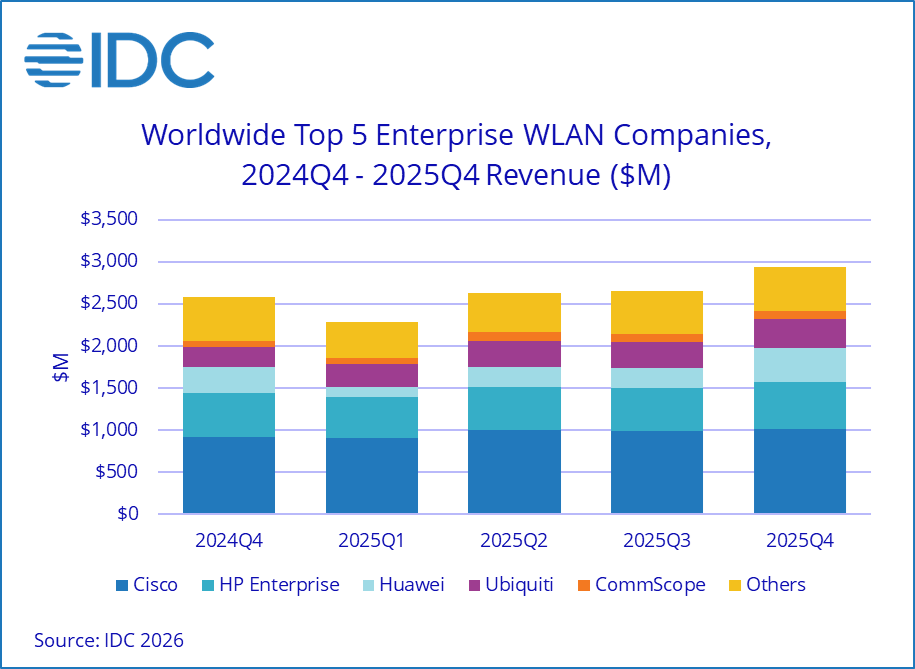
Cisco maintained its leadership in the enterprise WLAN market, with revenue rising 10.8% year over year to $1.0B and a market share of 34.6% in 4Q25. For the full year, Cisco’s revenue increased 4.9% to $3.9B, giving the company a market share of 37.2% at year-end.
HPE, now including Juniper following its July 2025 acquisition, grew 4.7% YoY to $552.8M, capturing 18.8% of the market in 4Q25. For the full year, HPE’s revenue increased 7.6% to $2.0B, giving the company a market share of 19.7% at year-end.
Ubiquiti saw the highest growth among major vendors, increasing 49.0% YoY to $344.5M and holding 11.7% market share in 4Q25. For the full year, the company’s revenue grew 53.1% to $1.2B, maintaining an 11.7% share in 2025.
Huawei posted strong growth, up 32.1% YoY to $409.8M, with a 14.0% share in 4Q25. For the full year, revenue rose 18.4% to $1.0B, giving the company a 9.6% share.
CommScope (Ruckus Networks) grew 13.4% YoY to $88.8M, representing 3.0% of the market in 4Q25. For the full year, revenue rose 26.0%, giving the company a 3.4% share.
Outlook: Wi-Fi 7 momentum and AI-driven networks
IDC expects continued momentum in enterprise WLAN upgrades as organizations pursue higher performance, greater automation, and tighter integration with AI-driven and distributed workloads. Wi-Fi 7 adoption is likely to accelerate further—alongside increased deployment of tri-band APs—particularly in regions with strong digital transformation initiatives.
Growth will also be supported by rising adoption of AI-driven network operations, platform-based networking approaches, and cloud-managed architectures, as enterprises seek more scalable and flexible environments. At the same time, evolving security requirements, including zero trust frameworks, will remain a key driver, while supply chain constraints or macroeconomic headwinds may temper growth in certain regions. Watch for continued innovation in AI capabilities, architectural models, and vendor strategies in the coming quarters.
For deeper analysis and IDC research on enterprise WLAN trends, visit IDC’s Worldwide Quarterly WLAN Tracker or contact IDC for the latest market insights.