

Key Takeaways:
- Global enterprise AI spending will reach $940B in 2026, growing to $2.1 trillion by 2029. (IDC, 2026)
- China’s spending on embodied intelligence is forecast to grow from $1.4B to $77B in five years — a 94% CAGR. (IDC, 2026)
- China’s MaaS market is growing at 1,154.9% CAGR (2024–2030), reaching 40,000 trillion Token calls in 2026. (IDC, 2026)
- AI-native endpoints, Industrial AI, and the 15th Five-Year Plan are reshaping China’s digital economy.
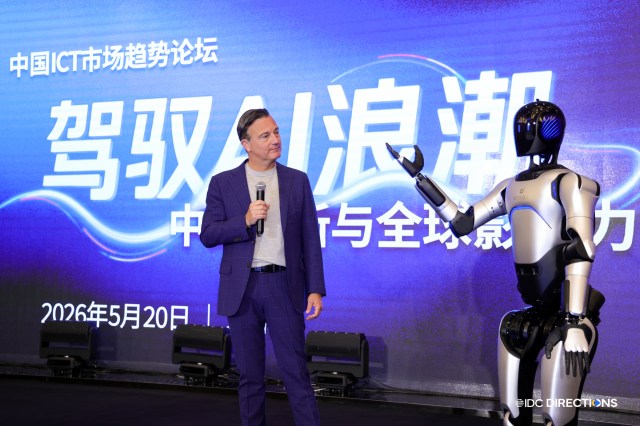
BEIJING, 21 May 2026 — China isn’t waiting. As the global AI industry shifts from infrastructure build-out to enterprise application at scale, China is already running — and the gap with most other markets is widening. That was the signal at IDC Directions 2026 in Beijing, where more than 400 technology decision-makers, analysts, and investors gathered to take stock of a market moving faster than almost anywhere else on earth. The event opened with a moment that said more than any data point could: IDC CEO Lorenzo Larini sharing a stage with an AI-powered robot built in China, deployed in China, and already competing globally.
“IDC has been on the ground here since 1986, and we’ve never seen the pace of change move faster than it is right now,” said Lorenzo Larini, CEO, IDC. “What has become clear is that China is not a market you can afford to observe from a distance because it is a technology force actively shaping how the world moves. At IDC, our job is to give our clients the clarity they need to make confident decisions in this dynamic market that grows both exciting and more complex everyday.”
What is the AI Supercycle — and what phase is it in now?
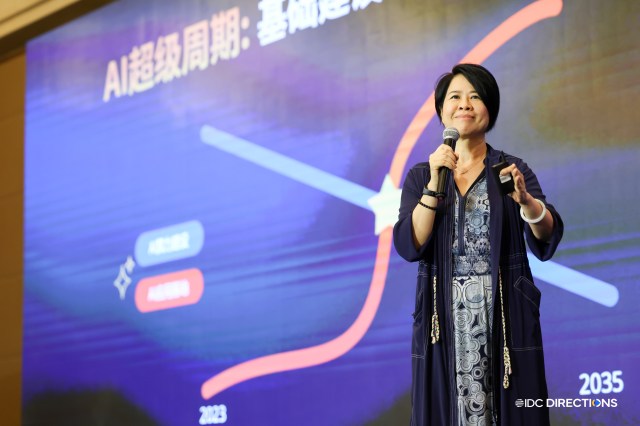
Global enterprise spending on AI will reach $940 billion in 2026 and grow to $2.1 trillion by 2029 — with China among the fastest-growing markets worldwide. According to Kitty Fok, managing director at IDC China, the first phase of the AI Supercycle was about computing power, foundational models, and infrastructure. The second phase — now underway — is about enterprise applications, Agentic AI, and intelligent services at scale.
“The global AI industry has entered a super cycle, and the market is now moving from infrastructure build-out to enterprise application explosion,” said Fok.
How big is China’s robotics market?
China is on track to become the world’s largest robotics market by 2029. Chinese manufacturers already lead global shipments across multiple categories. Spending on embodied intelligence in China will grow from $1.4 billion today to $77 billion within five years — a 94% CAGR — according to IDC research forecast.
What is driving the cost of enterprise AI — and what does it mean for ROI?
The Token is now the defining unit of enterprise AI — both for cost and for value. The shift, as Zhenshan Zhong, vice president at IDC China, framed it: enterprise AI has moved from “generation” to “execution.” Tokens are the core of cost, and Agents are the core of value.
MaaS market growth: China’s Model-as-a-Service market will hit 40,000 trillion Token calls in 2026, with revenue reaching approximately 18.6 billion RMB — a 1,154.9% CAGR from 2024 to 2030. Over 60% of leading Chinese enterprises have already integrated generative AI into core business processes. (IDC, 2026).
Why “Tokens per watt” is replacing FLOPS as the key efficiency metric
Raw compute performance (FLOPS) no longer tells the story. The metric that matters now is “Tokens per watt” — how efficiently a system generates useful AI output per unit of energy. By 2027, inference will account for over 70% of intelligent computing demand, with edge infrastructure growing faster than core data centers. The global accelerated computing server market will exceed $1 trillion by 2029, growing more than 30% annually. The competitive advantage in AI has shifted: it’s no longer about who has the most computing power — it’s about who converts AI into sustainable business capability at the lowest Token cost. (IDC analysis: Thomas Zhou, vice president at IDC China.)
How is China’s 15th Five-Year Plan reshaping its digital economy?
Three priorities define China’s digital economy under the 15th Five-Year Plan, which began in 2026: business opportunity creation, digital sovereignty, and global capability restructuring. As AI, data, and computing power converge, IDC expects China’s digital technology spending to maintain double-digit growth for several years. The strategic shift among Chinese companies is clear: the focus is moving from product exports to capability, platform, and ecosystem exports. Those that build AI-native platforms first, deepen industry scenarios, and expand developer ecosystems are best positioned to win the next growth cycle. (IDC analysis: Lianfeng Wu, vice president and chief analyst at IDC China.)
What is Industrial AI — and how is it changing Chinese manufacturing?
Industrial AI has moved past pilot programs. Enterprises are integrating AI into production, supply chain management, operational decision-making, and after-sales service — driving end-to-end value chain upgrades. The generational difference in industrial software is stark: traditional systems focused on recording and control; the new generation adds perception, prediction, and collaborative execution. For Chinese manufacturers, the real value lies in breaking down data silos and restructuring collaboration across R&D, production, supply chains, and services. (IDC analysis: Kai Cui, assistant research director at IDC China.)
How are smart devices evolving in China’s AI-native era?
900 million smart devices will ship in China in 2026 — up ~0.3% year-on-year. However, driven by tightening supply of critical components such as memory, the market is now confronting substantial cost pressure. The more important shift is what buyers are paying for. Hardware specifications are no longer the purchase driver — intelligent experiences and ecosystem capabilities are. AI-native endpoints represent a new round of value distribution and ecosystem competition, not a product upgrade cycle. (IDC analysis: Dr. Antonio Wang, global and China research vice president at IDC.)
IDC in China: 40 years of on-the-ground intelligence
IDC has operated in China since 1986, tracking three major waves of ICT evolution: infrastructure build-out, digital transformation, and AI-driven intelligence upgrading. That depth — 40 years of local market knowledge — is what gives IDC clients the confidence to navigate China’s technology landscape and act on it.
###
About IDC
International Data Corporation (IDC) is the premier global provider of trusted technology intelligence, advisory services, and events. With more than 1,000 analysts worldwide, IDC offers global, regional, and local expertise on technology, IT benchmarking and sourcing, and industry opportunities and trends in over 100 countries. IDC’s analysis and insights help IT professionals, business executives, and the investment community to make fact-based technology decisions and to achieve their key business objectives. To learn more about IDC, please visit www.idc.com. Follow IDC on X at @IDC and LinkedIn. Subscribe to the IDC Blog for industry news and insights.