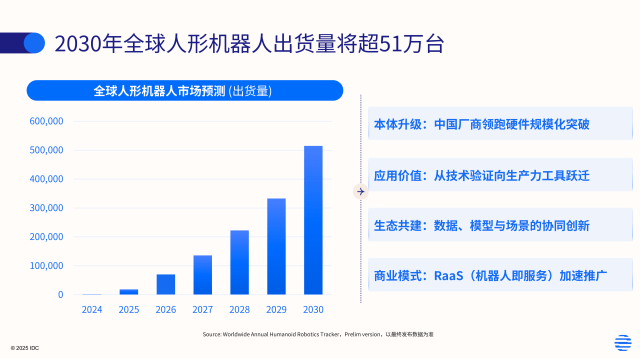
近日,2026 北京亦庄人形机器人半程马拉松落幕。从赛事规模、技术复杂度与产业参与度来看,较 2025 年大幅提升,再次展示行业迈向商业导入的能力与进展。IDC 预测,2030 年全球人形机器人出货量将突破 51 万台,年复合增长率近 95%。伴随本体技术升级、应用价值挖掘、产业生态共建及商业模式持续完善,未来行业竞争将聚焦应用能力与商业价值交付。

本届赛事吸引超百支企业、高校等多元主体队伍同台竞技,在核心技术与产品性能上实现多项突破。荣耀等厂商为代表的参赛主体表现突出,部分机器人奔跑速度已超越人类水平,核心运动性能显著提升,为产业落地注入强劲动能。

荣耀夺冠进一步体现出产业参与主体持续扩展,越来越多厂商开始从战略层面重视人形机器人的长期发展。在具身智能演进过程中,算力、算法与模型仍将构成核心底座。同时,消费终端厂商的入局,有望在端侧算力与视觉模型等关键环节形成差异化优势,叠加其庞大的用户基础与生态能力,将加速技术迭代与应用落地进程。

自主导航升级,从单项能力展示走向系统级能力验证

本届赛事对机器人的要求已超越基础运动能力,38% 的参赛队伍采用全自主导航模式,且自主导航机器人凭借赛事加权规则夺得冠军。贴近真实应用场景的综合考验,标志着人形机器人竞争核心转向复杂环境持续稳定运行,打通算法与本体之间的深度融合,更要求其实现感知到执行全链路高效协同,兼具高水准系统稳定性与规模化部署的工程化能力。

  • 多模态融合让机器人具备复杂环境的自主感知。机器人依托多传感器融合(卫星、激光雷达、视觉、IMU等)与实时建图技术(结合预加载赛道地图),实现对复杂物理环境的自主感知,在坡道、急弯、不平整路面及动态障碍等场景中保持稳定运行,显著提升对多样化真实环境的适应能力。
  • 强化学习与运控突破赋予机器人高拟人动态运动能力。当下,通过在仿真环境中大量开展化强化学习训练,并结合高质量人类运动数据的采集与应用,持续优化运控算法,同时在现实环境中进行持续适配与调优,机器人在运动过程中的实时感知、平衡稳定、姿态优化及拟人化表现均取得显著提升,实现了长距离赛道中的自主导航、动态避障与路径优化。
  • 热插拔换电与液冷散热是关键突破,保障机器人长时连续运行。热插拔实现机器人高效电池更换与补能;同时通过轻量化设计、能耗优化、智能功率分配及液冷散热系统的多维升级,全面提升机器人整体续航表现,二者结合为机器人长时间运行的连续性、稳定性提供双重支撑。
  • 软硬一体的系统协同与工程化能力获突破,成赛事亮点与后续攻坚重点。面向实际物理环境与作业任务需求,机器人需持续学习适配新环境、新任务,实现感知、决策、执行模块的全链路高效协同;同时推动算法模型与不同构型的硬件本体深度融合与精准适配,打通实时交互链路,在复杂任务中保障响应速度、控制精度与系统稳定性,从而加速向高可靠性、可维护性及规模化部署的工程化落地演进。

人形机器人商业化跑出中国速度 2030 年全球出货量将超 51 万台

总体来看,人形机器人正向“感知—学习—决策—执行”闭环的具身智能体系演进,工程化能力成为产品商业应用落地的核心,赛事验证能力也将加速向真实场景迁移。

回顾2025年,以中国厂商引领的全球人形机器人市场迎来爆发,出货量超1.8万台。其中,以技术验证、展示交互为主的文娱表演、教育科研及导览导购等场景应用出货量占比超过85%,工业制造、仓储物流场景也已开展一批试点探索。

IDC预测,到2030年全球人形机器人出货量将超过51万台,随着本体升级、应用价值提升、生态共建推进及商业模式持续完善,行业将逐步进入规模化应用阶段,实现近95%的年复合增长率

本体升级:中国厂商领跑硬件规模化突破

  • 市场格局: 2025 年中国厂商人形机器人出货量预计占全球 95%,在硬件制造与规模化领域形成绝对主导优势;同时,多家中国头部厂商预计将在 2026 年实现万台级产能,进一步强化规模化供给能力,并有望持续巩固这一先发优势。
  • 本体升级:聚焦本体结构优化、关节与能源系统升级、量产能力提升及运控算法优化,为后续商业化落地筑牢硬件基础。此外,作为精细操作核心载体的灵巧手,也将迎来快速发展。
  • 品类增长轮式与全尺寸双足人形机器人是增速最快品类。其中,轮式人形机器人于2025年应用起步,凭借更高的稳定性与可靠性可快速适配并运行于室内及半结构化环境,预计到 2030 年实现年复合增长率约120%的快速发展;全尺寸双足人形机器人依托全方位的灵活性实现更广泛场景落地,年复合增长率预计超 95%。

应用价值:从技术验证向生产力工具跃迁

  • 工业加速:联合工业龙头企业开展场景探索,完成节拍、作业成功率及连续作业稳定性验证后,加速工厂环境落地推广,预计2026 年以出货增速超 200% 居首。IDC 调研显示,未来3年,用户计划进一步在码垛、搬运、拾取、上下料场景应用机器人的比例均超 80%,这些场景可作为重点突破方向。
  • 服务深入:向个性化服务延伸,通过优化用户满意度客户粘性,拓展在导览导购、餐饮等商业服务市场的应用空间。

生态共建:数据、模型与场景的协同创新

  • 数据规模:融合仿真数据、互联网视频数据及各类数采中心的实操数据,推动虚实数据融合与规模扩张,为核心算法与具身智能的通用能力提升提供关键支撑。当下,中国已汇集上万小时、近千TB数据集,并牵头立项全球首项《人形机器人数据集》国际标准。
  • 模型迭代:加速机器人运动模型的升级以提升运控能力,推动世界模型与VLA模型的深度融合以增强智能泛化性,从而强化人形机器人的具身智能通用能力。全球头部人形机器人AI模型厂商正持续加速底座模型的迭代升级。
  • 场景共创:面向真实产业应用场景,推动应用开发解决方案的生态共建,打通从技术验证到规模化应用的关键链路,加速人形机器人技术的产业化落地。

商业模式:RaaS(机器人即服务)加速推广

  • 租赁、订阅等RaaS模式通过降低用户的使用门槛,显著加快市场对人形机器人的认知与推广速度。IDC最新调研显示,用户对RaaS模式的接受率较上一年翻倍。随着服务体系、计费模式及运维体系完善,RaaS普及将进一步提速。

IDC认为,2026北京亦庄人形机器人半程马拉松已成为观察人形机器人技术成熟度与产业进展的重要窗口。赛事不仅验证了关键技术能力,也加速了产业生态构建与商业化进程。未来2–3年,人形机器人行业将进入关键发展阶段,厂商竞争将从技术展示转向实际应用能力与商业价值交付。具备系统级能力与工程化落地能力的厂商,将在新一轮市场竞争中占据主导地位。

本文核心内容引自IDC相关报告:

IDC《Worldwide Annual Humanoid Robotics Tracker》(即将发布)

IDC《具身智能与人形机器人:中国工业落地新机遇》(Doc# CHC53325326,2026年2月)等。

了解更多:

人形机器人正处于从“技术可行”迈向“商业可行”的关键窗口期,领先企业已经开始加速布局并锁定核心场景。对于仍在观望的企业而言,留给试错与判断的时间正在快速减少。

基于长期跟踪与一线调研,IDC已形成覆盖市场规模预测、重点行业机会、应用优先级排序及厂商竞争格局的完整研究框架,可为企业提供从战略判断到落地路径的系统性支持,帮助快速识别可规模化复制的商业机会。

如果您正在:

  • 评估是否进入人形机器人赛道
  • 寻找优先落地的高价值应用场景
  • 分析重点厂商能力与合作机会
  • 制定未来2–3年的业务布局与投资策略

欢迎与IDC研究团队直接联系,获取最新研究数据与定制化洞察支持。我们也可根据您的业务需求,提供一对一交流与专项分析,帮助您在关键窗口期做出更快、更准的决策。

请点击此处与我们联系。

Lily Li - Research Manager - IDC

Lily Li is a research manager for emerging technologies in IDC China. She is responsible for conducting research and analysis for Internet of Things (IoT) in the same country. She is also involved in global and regional consulting as well as business development in related markets. Prior to joining IDC, Lily has had in-depth working experiences in the urban digital transformation (DX) field and a wide range exposure to Smart City developments. She has a deep understanding of the status quo and is knowledgeable about the market's future trends. Lily holds a master's degree from the Graduate University of Chinese Academy of Sciences (GUCAS).

医疗大模型的准确率已从80%提到95%,但真正的下一站不是更准的模型,而是智能体驱动软件重构。IDC最新实测揭示:通用大模型与医疗大模型的差距正在收窄,未来的分水岭在于——谁能用智能体重塑长流程业务。

本文核心观点来自IDC于2026年4月发布的两份最新研究报告,为医疗机构及软件厂商提供技术选型、产品演进与市场策略的参考。

医疗大模型技术的价值初步得到认可

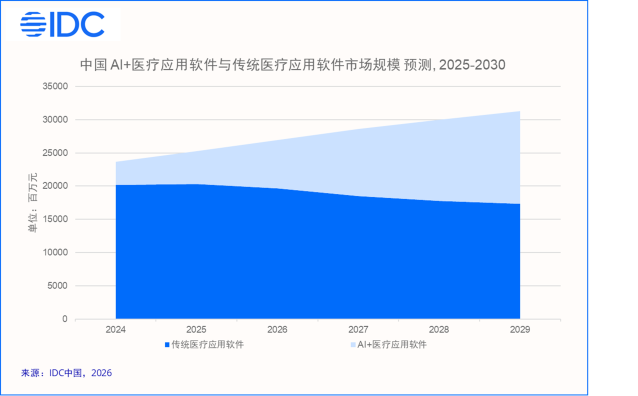
从通用大模型到部署垂直医疗大模型,2025年大模型在中国医疗体系中的应用进程被显著加速。医疗机构对这一技术的态度从被动向主动合作转变,部分机构展现出了付费意愿。2025年AI+医疗应用软件市场规模达到35.4亿元人民币,预测到2030年市场规模将达到140.0亿元人民币,渗透率达44.7%,成为医疗应用软件市场的重要增长来源。

医疗大模型实测:头部厂商的模型实现从性能到质量的综合能力提升

医疗大模型作为重要基座,其能力将影响智能体在医疗场景的能力,因此继2025年3月的第一次实测之后,IDC展开了第二次医疗大模型实测工作,此次收录的医疗大模型厂商包括百川智能、东软集团、福鑫科创、浪潮云、讯飞医疗、卫宁健康(按名称首字母排序)等发布了医疗大模型的厂商。设计了目前医疗机构最为广泛采用的医学知识、健康咨询、门诊病历生成、辅助诊断、病历分析、检验检查解读、诊后管理及随访场景实测。经过实测,IDC 有以下发现:

  • 模型在场景中的表现较去年显著提升。在任务场景表现方面,厂商的准确率较2025年有明显提升,尤其是客观选择题方面正确率从80%提升至95% ,集中在了案例类的题目;在分析类场景中,头部能够全面考虑给出的信息,引用给定的信息和出处,多模态融合决策分析,给出全面性、可循证的信息。
  • 医疗大模型之间呈现梯队化差异。相较于第一期的测试,头部厂商的大模型,如东软集团、讯飞医疗、卫宁健康等(按名称首字母排序)在各类场景中的准确率、专业度、可解释性明显提升,呈现出专业医师的水平,同时其模型性能、生成质量、模型数据显著改善。
  • 服务及落地能力形成了明显差异。基于厂商的基因不同,厂商在AI方面的人才结构、业务和客户资源、对产品的理解能力不同,部分技术厂商在向医疗领域切入时,会发现其能力方面表现较好,但是在落地应用、产品开发及验证、客户拓展等方面与头部厂商形成了明显差异;同时,医疗背景厂商在技术表现上较优,但对其AI方面能力的认可较低。
  •  

未来,以医疗领域的大型模型为基础,加速软件向AI原生化革新,重塑业务流程

在本次实测中,IDC同时纳入通用大模型,根据结果发现,头部的医疗大模型和头部的通用大模型在一些标准化程度较高的病历生成、检验检查解读,以及这些单点化场景的结果差异并不显著。因此,相对于发展全科的医疗大模型以及外挂的单点智能体,行业发展将从以下两点展开:

  • 医疗大模型需持续提升模型的性能及生成质量,同时深入肿瘤、妇科、儿科等专科的数据训练,完善门诊到住院的长流程的场景化模型训练,从而为智能体奠定基础;
  • 从单点的医疗软件+智能体的形式,转变成Agent原生的软件体系,从而发挥出大模型的推理、决策,以及智能体的自主、执行等能力,切入更长流程的业务,打造更灵活的业务流程。

适配技术发展,厂商所须具备的能力也需要对应提升

短期,跑马圈地,通过高频场景的Agent占市场先机。软件+AI形式仍将是短期内大模型技术进入医疗机构的重要落地形式,也成为了厂商产品进入医院市场的重要方式,厂商需要从高频的病历生成、检验检查解读等场景切入,尽快完善医疗软件+AI的产品及服务能力,尤其与HIS、EMR等主流软件的融合,加速验证该类产品的成熟度,从而快速抢占医院的AI需求,从而为后续的增值扩展合作建立基础。

中长期,重构软件,储备全栈式智能体能力切入长流程场景。厂商需要拓展更面向复杂的手术、住院的医疗场景,从而形成差异化竞争。厂商一方面需要重新构建由智能体驱动的软件体系,储备从全域数据平台建设、数据治理、数据标注、模型开发训练、智能体开发等综合技术能力,另一方面也要深入医院实际工作和业务系统,加深对长流程业务场景的理解。

配套按量、按需、按效果等多元化付费模式。近年来医疗机构的信息化预算收缩,而大模型及智能体的广泛应用需要配套软件及硬件的全面升级,面对高昂的费用支出,医疗机构将会望而却步。因此,厂商需要调整合作模式以适配用户的需求,包括按照分期付费、调用次数付费、按照资源消耗付费、按照使用效果付费模式等的前期探索也是厂商取得成功的关键。

本文核心观点来源于以下IDC研究报告:

  • 《中国医疗大模型技术评估,2026》(Doc# CHC53377725,2026年4月)
  • 《中国医疗软件系统解决方案市场预测, 2026-2030》(Doc# CHC53828426,2026年4月)

医疗大模型的竞赛,正在从“模型有多强”转向“业务流能改多深”。IDC最新实测显示,当标准化任务的准确率突破95%之后,真正的分水岭已经出现——谁能用智能体重构长流程业务,谁才能真正占领未来五年的医疗软件市场。

如果您正在关注:

  • 医疗大模型的真实落地能力与选型评估
  • 智能体如何与HIS、EMR等核心系统深度耦合
  • 从“软件+AI”到“Agent原生”的路径规划
  • 医疗AI应用的付费模式与ROI测算

IDC医疗行业研究团队持续追踪医疗大模型、智能体应用及医疗软件市场,拥有覆盖技术评估、厂商实测、市场预测的完整研究体系。欢迎随时与我们联系,获取报告更多信息,或针对您业务场景的定制化交流。让决策,先于趋势。

请点击此处与我们联系。

Erin Lin - Senior Market Analyst - IDC

Erin Lin serves as a senior market analyst of the IDC China Health Insights group. She is responsible for conducting research and analysis about the health industry for both domestic and regional markets. She is also involved in consulting and business development in related markets. Before joining IDC, Erin had four years of experience in medical administration; then served as an analyst in the health industry for two years. Erin is familiar with healthcare institutions and related businesses, and has been gathering deep insights into the health industry and emerging medical technologies. Erin holds a master's degree in Leadership and Management in Health and Social Care from the University of Southampton, and a bachelor's degree in Clinical Medicine from Capital Medical University.

AI is starting to be framed as a price war. Vendors are cutting costs, model access is becoming more competitive, and the market is beginning to assume that cheaper AI will decide the winners.

That view is not wrong. It is just not deep enough.

What is happening now is bigger than pricing pressure. The market is not simply resetting the cost of AI. It is resetting the enterprise application model. And in that shift, price matters, but outcomes matter more.

From an IDC perspective, this is the real issue: enterprises are moving from a world where employees use applications to do work to one where agents increasingly become the work layer itself. That is a major change in how software is consumed, how value is created, and how buying decisions will be made.

In the old model, users opened applications, navigated workflows, triggered tasks, and completed processes. Automation improved parts of that model, but people still sat at the center of execution.

In the new model, employees express intent, and agents increasingly interpret, orchestrate, and act across systems, with guardrails in place. The application does not disappear, but it fades into the background. The workstream becomes the interface.

That is why the AI price-war narrative misses the point. Enterprises are not buying AI because it is cheap. They are buying AI to improve productivity, accelerate decisions, reduce friction, strengthen customer experiences, drive better business outcomes, and increase sustained economic value. The real competition is not over lowest-cost intelligence. It is over who can deliver trusted, measurable outcomes at scale.

The technology is moving faster than enterprise readiness

Enterprise software vendors have responded quickly to the AI push. They are embedding assistants, conversational interfaces, agentic capabilities, and tools for building new AI-driven workflows. At the same time, AI-native platforms are offering alternatives that promise faster innovation and, in some cases, lower cost.

But the key issue is not whether the technology is available. It is whether enterprises are ready to use it now.

In many cases, they are not. This is the gap that matters most right now. Organizations may be eager to adopt AI, but many are not yet prepared to move from human-led application workflows to agent-driven operating models. Lower prices will encourage experimentation, but they will not fix the operational weaknesses that limit scale and business value.

That is where the market will be won or lost.

Four issues will decide who gets value

Skills must shift from usage to orchestration
The move to agent-driven work demands a different set of skills. Employees need to do more than know how to use software. They need to define intent clearly, manage exceptions, understand workflow dependencies, and evaluate AI-driven outputs.

IDC research finds that 44% of organizations have prioritized an AI-ready workforce in 2026 to enable employees to use AI assistants and agents.

(IDC Future Enterprise Resilience and Spending Survey, Wave 1, March 2026 )

This raises the importance of prompt design, orchestration thinking, API awareness, and analytical judgment. These are not side skills. They are becoming essential to turning AI into real performance improvement.

Governance becomes the scaling mechanism
Agentic systems raise the stakes on trust. These systems do not just assist; they can take action across systems, shape decisions, and influence business outcomes. That creates new challenges around security, identity, explainability, compliance, and control.

IDC research continues to show that weak governance and unclear ROI are among the top reasons AI initiatives stall.

IDC research also finds that 39% of organizations are prioritizing AI governance in 2026 to establish trusted AI decision and risk frameworks, while 35% report difficulty quantifying and demonstrating AI ROI to stakeholders.

(IDC Future Enterprise Resilience and Spending Survey, Wave 1, March 2026 )

In an agent-driven model, governance is not a back-office exercise. It becomes the operating discipline that allows organizations to scale AI with confidence and trust.

Operating models need redesign
Enterprises cannot simply layer agents onto existing workflows and expect transformation. Agent-driven execution changes the role of the employee, the structure of the process, and the logic of oversight.

IDC research finds that 46% of organizations are prioritizing their AI business strategy in 2026 to increase the adoption of AI use cases tied to business goals.

(IDC Future Enterprise Resilience and Spending Survey, Wave 1, March 2026 )

Organizations need to rethink where humans stay in the loop, how exceptions are handled, how performance is measured, and how trust is maintained. This is not a feature upgrade. It is an operating model change.

Data and integration still decide the outcome
Agents are only as good as the systems and data they can access. If data is fragmented, APIs are weak, and workflows are disconnected, agent-driven execution will break down quickly.

This is why the most visible AI layer is rarely the hardest problem. The real challenge is below the surface: trusted data, strong integration, clear lineage, high-quality metadata, and resilient process connectivity. Without that foundation, outcome-based AI models collapse under complexity.

 IDC research finds that 46% of organizations are focused on AI data-ready architecture in 2026, implementing controlled access to all enterprise data, whether structured, unstructured, or event streams.

(IDC Future Enterprise Resilience and Spending Survey, Wave 1, March 2026 )

This market is shifting from features to outcomes

That is the real strategic change now underway.

The winners will not be the vendors with the most AI features or the lowest-cost model access. They will be the ones that help enterprises reduce manual effort, improve process completion, increase productivity, and deliver measurable business value.

For enterprise application vendors, embedded AI is becoming table stakes. Buyers will increasingly ask not whether AI is in the product, but whether it improves outcomes across workflows. Vendors that can orchestrate across systems, support trusted execution, and align pricing to measurable value will have the stronger position.

For services providers, the opportunity is also shifting. Enterprises need help redesigning workflows, modernizing integration, strengthening governance, and measuring value. The market will reward providers that can connect AI strategy to operating reality.

For enterprises, the message is simple: buying tools is not enough. Organizations that succeed with AI will invest in operational readiness. They will build new skills, strengthen governance, redesign workflows, and improve data discipline. They will treat AI as a new execution model, not just another feature set.

Price matters, but it is not the main event

None of this means pricing is irrelevant. Lower-cost AI will matter. It will pressure incumbents, expand experimentation, and change software economics.

But price is not the endgame. It is the opening move.

In enterprise markets, the cheapest AI does not automatically win. The AI that wins is the AI that works consistently, securely, and at scale. This is why AI pricing should be viewed less as a race to the bottom and more as a race to the outcome layer.

Bottom line

The market is right to watch AI pricing. It is wrong to make pricing the center of the story.

What is really happening is a shift in the enterprise software model, from users operating applications to agents increasingly executing work across them. That changes how enterprises buy, how vendors compete, and how value is measured.

The winners will not be the ones with the cheapest AI. They will be the ones that help enterprises achieve trusted outcomes at scale.

Price may open the door. Outcomes will decide who stays in the room.

What to watch

There are several signals that will confirm or challenge this shift over the next year.

First, watch buyer conversations. If enterprises start focusing less on AI feature breadth and more on cycle time, productivity, workflow completion, customer experience, and financial impact, that will confirm that outcome-based competition is taking hold.

Second, watch pricing models. If vendors move toward transaction-based, workflow-based, or value-based pricing, rather than simply charging for seats or usage, that will be a clear sign that the market is reorganizing around outcomes.

Third, watch deployment patterns. If organizations continue to pilot AI widely but struggle to scale it across core workflows, it will reinforce the point that operational readiness, not price, is the real constraint.

Finally, watch where value accrues. If the market rewards vendors and providers that can orchestrate across ecosystems and deliver measurable business outcomes, then the real battleground has shifted to the outcome layer. If value moves mainly to the lowest-cost providers, then the price-war thesis will prove stronger than this view suggests.

Mickey North Rizza - Group Vice President - IDC

Mickey North Rizza is Group Vice-President for IDC's Enterprise Software. She leads the Enterprise Applications & Strategies research service along with a team of analysts responsible for IDC's coverage of next generation of enterprise applications including digital commerce, employee experience, enterprise asset management and smart facilities, ERP, financial applications, HCM and payroll applications, procurement, professional services automation and related project-based solutions software, supply chain automation, and talent acquisition and strategies. In her role, Mickey and the team advises clients on these intelligent, modern, and modular enterprise applications for businesses of all sizes with an emphasis on the key trends, opportunities, innovation and the IT and Business Buyer concerns, requirements, and buyer behaviors.

AI infrastructure investment is accelerating at a pace that signals a clear shift from experimentation to long-term commitment. The latest Q4 2025 data highlights just how quickly spending is scaling and where momentum is building across regions and technologies.

AI infrastructure moves from experiment to scale

Worldwide spending on artificial intelligence (AI) infrastructure reached $89.9 billion in Q4 2025, a 62% year-over-year increase from Q4 2024, closing a record year. Full-year 2025 AI infrastructure spending totaled $318 billion, more than double the $153 billion recorded in 2024. Growth was anchored by continued hyperscaler investment in the United States, accelerated server adoption, and the early expansion of sovereign AI programs across emerging regions.

Why it matters

The Q4 2025 results confirm that AI infrastructure investment has moved well beyond initial proof-of-concept phases into a sustained, multi-year capital commitment cycle. Enterprise technology buyers, cloud service providers, and national governments are making long-term decisions about where to build, how much to spend, and which AI workloads to prioritize.

For vendors, this signals a prolonged period of elevated demand across accelerated compute, high-performance storage, and supporting network infrastructure. For enterprises, the data shows that AI capacity is becoming a structural cost of doing business at scale and that late movers risk falling behind on both performance and cost efficiency.

IDC now projects the global AI infrastructure market will surpass $1 trillion by 2029, underscoring the long-term structural importance of investments being made today.

What is shaping AI infrastructure spending

Four key forces shaped AI infrastructure spending in Q4 2025:

  1. U.S. hyperscaler dominance continued to expand. The United States accounted for $69.2 billion, representing 77% of global AI infrastructure spending, growing 81.5% year over year. Large-scale data center buildouts by leading AI platform providers drove sustained demand for GPU servers and high-capacity networking infrastructure. This dominance is expected to persist through 2026 and beyond, though its relative share may moderate as other regions catch up.
  2. Accelerated compute remains the structural backbone. Server spending represented $87.7 billion, or nearly 98% of total AI infrastructure in Q4. Within that, accelerated systems (primarily GPU-based) drove the majority of value. Both ODM Direct and OEM channels saw elevated activity as AI platforms scaled to meet growing training and inference workloads.
  3. China faced export-control headwinds. China (PRC) recorded an 8.1% year-over-year decline in Q4 2025, falling to $8.4 billion, as restrictions on advanced semiconductor exports continued to constrain access to leading-edge accelerators. Despite this, China remains the second-largest AI infrastructure market globally, with significant domestic investment in alternative compute architectures.
  4. Emerging regions accelerated sharply. The Middle East & Africa region grew by more than 500% year over year in Q4 2025, reaching $1.8 billion, driven by sovereign AI initiatives in the Gulf region and targeted government investment in national AI infrastructure. Asia/Pacific (excluding Japan) grew 47%, and Western Europe advanced 42%, both benefiting from hyperscaler expansion and regional cloud buildouts.
Total AI Infrastructure Spending (Q4 2025)$89.9 billion
Year-over-Year Growth (Q4 2025 vs. Q4 2024)+62.2%
Full-Year 2025 AI Infrastructure Spending$318 billion
Full-Year 2024 AI Infrastructure Spending$153 billion (YoY +107.6%)
Server Share of Q4 2025 AI Spending$87.7 billion (97.6%)
Storage Share of Q4 2025 AI Spending$2.2 billion (2.4%)
USA Market Share (Q4 2025)$69.2 billion (77.0%, +81% YoY)
China (PRC) Market Performance (Q4 2025)$8.4 billion (9.4%, -8.1% YoY)
Middle East & Africa Growth (Q4 2025)$1.8 billion (+535% YoY)
2029 Forecast — AI Infrastructure>$1 trillion

What to expect in 2026 and beyond

IDC projects AI infrastructure spending will reach $487 billion in 2026, representing approximately 53% year-over-year growth. This marks a moderation from 2025’s triple-digit gains, but still reflects one of the largest absolute-dollar expansions ever recorded in a single IT market segment. By 2029, global AI infrastructure is forecast to exceed $1 trillion, with a five-year compound annual growth rate (CAGR) of approximately 31% from 2025.

What could accelerate this trajectory:

  • Faster-than-expected scaling of inference workloads as enterprise AI application deployment broadens
  • Expansion of sovereign AI programs in the Middle East, Southeast Asia, and Europe, driving incremental greenfield investment
  • New model architectures and AI agent frameworks requiring deeper, more distributed compute infrastructure

What could constrain growth:

  • Power generation and grid capacity constraints, which remain the primary operational bottleneck for new data center commissioning in major markets
  • Memory and storage component scarcity, which can increase server BOMs and slow procurement cycles
  • Expanded export controls and data sovereignty regulations, which could reshape where AI workloads are deployed and which vendors win enterprise deals

Investors and technology buyers should monitor Q1 2026 capital expenditure guidance from leading hyperscalers and AI platform providers, as these forward signals remain the most reliable leading indicator of near-term infrastructure demand.

For comprehensive vendor share, forecast data, and taxonomy detail, see: IDC Worldwide Quarterly AI Infrastructure Tracker. For taxonomy and methodology definitions, see: Worldwide Artificial Intelligence Infrastructure Tracker Taxonomy, 2025.

Juan Seminara - Research Director, Worldwide Infrastructure Trackers - IDC

Juan Pablo Seminara is the Research Director for IDC's Worldwide Enterprise Infrastructure Trackers within the Data & Analytics organization. Mr. Seminara is responsible for leading a team of analysts in charge of the product concept, roadmap, implementation, execution, and client support for IDC’s enterprise infrastructure Trackers and forecast worldwide. In his role, he oversees the quarterly interaction amongst a global group of more than 50 IDC analysts in different regions that participate in the execution and market trend analysis of all enterprise infrastructure Trackers and forecast for IDC.

Digital sovereignty is moving from concept to strategic requirement. As organisations focus on managing IT risk, control, and compliance, expectations towards providers are rising. This blog explores why the “sovereign” label is no longer enough and what it takes to meet these new demands. 

Many technology providers in Europe today claim to offer “sovereign” solutions. 

But ask a simple follow-up question, what exactly makes them sovereign, and the answers quickly become less clear. 

At the same time, demand for digital sovereignty is increasing. Over the past 15 months, geopolitical and economic uncertainties have pushed the topic higher up the agenda. When asked about digital sovereignty, almost 50% of organisations globally say their interest has increased compared to the previous year. 

But focusing on geopolitics alone misses the bigger shift. 

Why digital sovereignty expectations are changing 

As interest grows, so do expectations. Digital sovereignty is no longer an abstract or purely regulatory concept. It is becoming an essential strategic requirement in IT decision-making. 

At the same time, it remains a source of confusion. Many organisations still struggle to define what sovereignty actually means in practice, what is required to achieve it, and whether they need it at all. And then you need to ask, who can you trust? And then you need to ask, who can you trust? 

This creates a gap in the market. Providers talk about sovereignty. Customers are still trying to understand it. 

What is really driving digital sovereignty adoption 

Despite the geopolitical backdrop, the main drivers are far more practical. 

Organisations are prioritising control over their data, stronger governance and compliance, and the ability to manage risk. In Europe in particular, protection against extra-territorial data requests has emerged as the highest concern. 

This is where expectations begin to change. 

More than 40% of organisations globally say they will increase the frequency and granularity of their reviews of IT vendors and platforms to better assess and manage this risk. Furthermore, when asked what was most needed to achieve data sovereignty, 85% cited enhanced tools and solutions for governance, risk and compliance as the extremely or very important. 

Thus, if digital sovereignty is ultimately about managing IT risk, it cannot be reduced to a label or a feature. It needs to be something that is tangible and can be clearly explained, implemented, and validated. 

This also changes the role of providers. They need to help organisations assess their risk appetite, manage that risk, and deliver the solutions required to meet these expectations. 

And this is where many providers are not yet aligned. 

What digital sovereignty actually requires 

Part of the challenge lies in how sovereignty is framed. It is often treated as a single capability, when in reality it spans multiple dimensions. 

One practical way to approach it is through three areas: data sovereignty, technical sovereignty, and operational sovereignty. These form the three key pillars of cloud sovereignty, which itself represents a subset of the broader concept of digital sovereignty. 

Together, these define how control is exercised across data, infrastructure, and operations. 

For providers, this raises the bar. Sovereignty is no longer something that can be communicated in broad terms. It needs to be articulated across these dimensions, in a way that is transparent and verifiable. 

Where sovereignty really matters: high-risk workloads 

It is also important to clarify where sovereignty actually needs to be applied. 

Sovereign requirements are typically focused on workloads that involve sensitive data, regulatory exposure, and or critical business processes. This increasingly includes certain AI use cases, where data control and model governance are essential. 

This is also where trust becomes central. 

Customers need confidence that sovereignty claims hold up under scrutiny, especially in high-risk scenarios. It is no longer enough to state that a solution is sovereign or to only address isolated aspects such as data residency or localisation. 

Providers need to demonstrate how sovereignty is ensured, where the boundaries lie, and what guarantees are in place. This assurance must extend across the entire partner ecosystem, from primary providers to their partners and beyond. 

From positioning to proof 

The conversation around digital sovereignty is evolving quickly. Expectations are rising, and with them, the level of scrutiny applied to providers. 

In this environment, sovereignty is no longer a positioning or marketing statement. It is something that needs to be clearly defined, agreed upon by all stakeholders, consistently implemented, and credibly demonstrated. 

For many providers, that requires a shift. From broad claims to precise explanations. From messaging to evidence. 

And ultimately, from sovereignty as a label to sovereignty as a trust model that delivers autonomy, control, transparency, and resilience. 

If you are reassessing how to position and deliver digital sovereignty, speaking to an expert can help clarify what your customers will expect next. Request a call here

Join the webcast “Digital Sovereignty Beyond the Label: How Customer Expectations Are Changing” at the link here.

 
All data sources: IDC Europe, Worldwide Digital Sovereignty survey 2025, July 2025 

Rahiel Nasir - Research Director, European Cloud Practice, Lead Analyst, Digital Sovereignty - IDC

Rahiel Nasir is responsible for leading and contributing to IDC's European cloud and cloud data management research programs, as well as supporting associated consulting projects. In addition, he leads IDC's worldwide Digital Sovereignty research program. Nasir has been watching technology markets and writing about them throughout his professional life.

Global disruption is not caused by an isolated event. It is continuous, multidimensional, and increasingly interconnected. Economic volatility, geopolitical fragmentation, regulatory expansion, workforce transformation, and rising customer expectations are converging to reshape how organizations operate and compete.

IDC’s FutureScape 2026 identifies this convergence of forces as Navigating the Crosscurrents of Disruption. This defines how organizations can respond to these overlapping pressures with deliberate strategy rather than reactive adjustment. At the core of that response is agentic AI, not as an isolated capability, but as a governed, strategy-aligned force that converts disruption into momentum.

Without deliberate navigation, leaders risk being dragged sideways by disruption, leaving them unprepared to capture the benefits of the agentic economy.

A framework for navigating compounding disruption

Crosscurrents are not independent variables that can be managed in sequence. They have a cascading effect.

A regulatory shift in one market affects supply chain strategy. Geopolitical instability reshapes technology sourcing decisions. Workforce disruption intersects with AI adoption. Leaders acting on one pressure are already absorbing consequences from several others.

This is the decision environment mapped by FutureScape. Not as a catalog of threats, but as an analytical lens for understanding how simultaneous forces compound and where deliberate action creates leverage.

Leaders must balance competing priorities while maintaining forward momentum. Success depends less on predicting disruption and more on navigating it effectively.

AI sits at the intersection of these crosscurrents. It is subject to regulatory and sovereignty constraints and is often limited by fragmented implementation. Yet it can also serve as a mechanism for coordination, enabling organizations to integrate data, align decisions, and respond more dynamically to economic and operational complexity at scale.

When governed and aligned with enterprise strategy, AI transforms the crosscurrents into momentum. Deployed without that alignment, it can amplify the complexity leaders are already facing.

The structural impact of disruption

The crosscurrents are no longer hypothetical pressures on the horizon. They are already reshaping infrastructure decisions, cost structures, and leadership accountability across technology suppliers and enterprise buyers.

Disconnected systems, duplicated investments, and uneven execution are introducing new layers of cost and operational burden that organizations must actively manage.

Architecture is being reshaped by sovereignty and regulation

This shift is most visible in AI architecture. Sovereignty laws and evolving regulatory requirements are forcing organizations to make deliberate decisions about where data resides, how models are deployed, and which systems can operate across jurisdictions.

Compliance fragmentation is becoming a defining constraint. Organizations must navigate inconsistent regulatory frameworks across regions, often requiring localized architectures, governance models, and data environments. This limits standardization and increases structural complexity.

IDC predicts that 60% of global firms will split their AI stacks across sovereign zones by 2028. Enterprise architecture is no longer designed for global uniformity. It must accommodate regulatory divergence while maintaining cohesion across the organization.

Implementation complexity is slowing outcomes

As AI adoption scales, the focus is shifting from experimentation to execution. Disconnected investments across business units, regions, and use cases are creating duplication, inefficiencies, and inconsistent results.

This increases cost and slows progress. Organizations must fund parallel initiatives, manage overlapping capabilities, and invest in integration to connect systems separated by region and function.

According to IDC research, 40% of organizations will miss their AI goals due to implementation complexity in 2026. The issue is rarely the technology itself. It is the gap between AI deployment and the enterprise structures, governance models, and integration required to make it work at scale.

Complexity becomes the primary constraint

As these forces converge, complexity becomes the defining constraint on progress.

For leaders, this translates into rising costs, slower execution, and reduced strategic flexibility. Organizations must coordinate across architectural boundaries and operational silos while managing regulatory demands and investment trade-offs.

Those that build alignment across architecture, investment, and execution will be better positioned to sustain momentum. Those that do not risk being constrained at every layer of the enterprise.

Maintaining direction in a shifting environment

Navigating the crosscurrents requires getting three foundational areas right. These areas are interdependent, and gaps in any one limit what is possible in the others.

To move forward, leaders must:

1. Define ownership and strategic direction
Crosscurrents do not respect organizational boundaries. Economic risk, AI governance, regulatory compliance, and technology investment are converging into the same course of decision making. Leaders must ensure the right stakeholders own these decisions and that CIO and CFO mandates are aligned around shared outcomes rather than managed in parallel.

2. Evolve workforce models for new operating realities
Workforce fragmentation is increasing across regions, regulatory environments, and technology stacks, creating inconsistencies in execution and decision-making. Navigating at the pace of change requires unifying this environment through human–AI collaboration as a core operational capability.

3. Strengthen foundations for integration and adaptability
Infrastructure decisions made today define future strategic options. Data foundations, integration architecture, and sovereignty-ready systems are not simply IT priorities. They are decisions about where the organization can operate and how quickly it can adapt.

Deliberate navigation across these three fronts separates organizations positioned to capture the agentic economy’s upside from those that lose direction in the crosscurrents.

The stakes of standing still

The crosscurrents shaping the agentic economy are not temporary conditions. Economic and geopolitical volatility, regulatory fragmentation, and workforce disruption are structural features of the environment in which leaders now operate.

Leaders who build strategic alignment, workforce capability, and infrastructure readiness will not only maintain direction within this changing environment but also convert external pressures into coordinated progress. That preparation cannot happen at the point of disruption. It must be in place before challenges arise.

Navigating the crosscurrents is where that work begins. Understanding the crosscurrents, mapping their interactions, and identifying where deliberate action creates the most leverage are the first steps to success in the agentic economy.

Explore navigating the crosscurrents of disruption in depth

Explore navigating the crosscurrents of disruption in depth

FutureScape 2026 includes detailed research, analyst perspectives, and webinars that expand on the themes within navigating the crosscurrents.

Core research

Analyst perspectives

On-demand webinars

eBooks

IDC - -

International Data Corporation (IDC) is the premier global market intelligence, data, and events provider for the information technology, telecommunications, and consumer technology markets. With more than 1,300 analysts worldwide, IDC offers global, regional, and local expertise on technology and industry opportunities and trends in over 110 countries. IDC’s analysis and insight help IT professionals, business executives, and the investment community make fact-based technology decisions and achieve their key business objectives.

IDCの最新レポートでは、今回の中東での戦争が2026年に向けてクラウドのレジリエンス、サイバーリスク、サプライチェーン、IT計画にどのような影響を及ぼすかを考察しています。
地政学的危機は、明確な予兆なく発生することがほとんどです。そして一度発生すれば、デジタルインフラ、サプライチェーン、テクノロジー運用に即座に大きな負荷がかかります。
今回の中東での戦争は、現代のデジタル経済、そして混乱下でも事業継続を担うCIOにとって、構造的なストレステストとなっています。
過去の紛争と異なり、現在の企業IT環境はクラウドインフラ、サブスクリプション型サービス、そしてグローバルに相互接続されたサプライチェーンに大きく依存しています。そのため、影響は局所的にとどまらず、地域・システム・パートナーを横断して急速に拡大します。
CIOにとっての課題は、単なるリスク管理ではありません。変化する状況に適応しながら事業運営を維持し続けることです。

IDC の見解:From Conflict to Continuity: How CIOs Can Respond to Disruption from the Middle East War.

なぜ今回の危機はCIOにとってこれまでと異なるのか

企業ITは、従来の内部完結型環境から、高度に分散されたエコシステムへと移行しています。

現在の企業は以下に依存しています:

  • クラウドプロバイダーおよびプラットフォームサービス
  • 分散型インフラおよび運用
  • テクノロジー供給および提供におけるグローバルサプライチェーン

この依存構造は、新たなリスクを生み出しています。

地域の不安定化は、以下に影響を与えます:

  • アプリケーションの可用性およびパフォーマンス
  • ハードウェア導入スケジュール
  • サイバー攻撃の増加
  • インフラおよびエネルギーコスト

これらの圧力は、既存のデジタル戦略の前提をすでに揺るがしています。

CIOにとっての優先事項は、自社のリスク露出(エクスポージャー)を把握し、それが業務にどう影響するかを理解することです。

エクスポージャーマッピングとシナリオプランニングから始める

最初のステップは、どこにリスクが集中しているかを特定することです。

CIOは以下の4つの観点で依存関係を整理すべきです:

  • 影響地域に所在する従業員・契約社員
  • 影響市場に関連する顧客および収益源
  • 混乱が発生している物流ルートやサプライヤー
  • 地域インフラに依存するアプリケーション、データ、運用

このマッピングが意思決定の基盤となります。

その上で、シナリオプランニングにより複数の展開に備えることが可能になります。

IDCは、CIOが検討すべき2つのシナリオを提示しています:

  • 地域の不安定状態が長期化するケース
  • エネルギーやサイバー領域に波及する広範なエスカレーション

シナリオごとに、レジリエンス、セキュリティ、投資の優先順位は変化します。

CIOが今優先すべきこと

CIOは以下の5つを直ちに見直す必要があります:

1. クラウドとインフラのレジリエンス再評価

単一リージョンや特定プロバイダーへの依存度を確認し、フェイルオーバー体制のギャップを特定する。

2. サイバーセキュリティの強化

脅威の増加を前提に、検知・対応・復旧能力を強化する。

3. テクノロジーサプライチェーンの多様化

供給のボトルネックを特定し、単一供給源への依存を低減する。

4. データ主権とコンプライアンスの見直し

地政学的緊張はデータローカライゼーションや規制強化を加速させる。

5. 人材・業務継続計画の整備

リモートワークや代替コミュニケーション手段を含め、業務継続を確保する。

これらは新しい課題ではありませんが、「同時に、かつ迅速に」対応する必要性が高まっています。

IDC アジアウェビナー(英語):Asia Pacific IT Spending Outlook 2026: Where to Win Amid Market Volatility

混乱下でのリーダーシップ

レジリエンスは技術課題であると同時に、リーダーシップの課題でもあります。

CIOは不確実性の中で明確な方向性を示す必要があります。成功する組織は、チームが目的を理解し、迅速に行動できる組織です。

有効なリーダーシップ行動には以下が含まれます:

  • 重要システム保護への明確なフォーカス
  • 意思決定の迅速化
  • 課題の分解と優先順位付け
  • 環境の簡素化と強化の機会特定

こうした局面では、技術的負債や運用の非効率、レジリエンスの欠如が顕在化します。

優れた組織は、混乱を「停止」ではなく「行動の契機」として捉えます。

混乱からオペレーショナル・レディネスへ

現在の状況は、地政学とデジタル運用の関係が変化していることを示しています。

CIOはもはや単発のインシデントに備えるのではなく、複数領域に同時影響が及ぶ前提で対応を進めなくてはなりません。

そのためには、継続的なレジリエンス強化が必要です:

  • 依存関係とリスクの可視化の継続
  • 複数シナリオを前提とした計画
  • 日常業務へのレジリエンスの組み込み

この能力を構築できた組織は、不確実性の中でもパフォーマンスを維持できます。

シナリオフレームワークの活用

リスクの把握は出発点に過ぎません。重要なのは、それを意思決定に落とし込むことです。

IDCのレポートでは以下について詳述しています:

  • IT支出やAI投資への影響
  • インフラ、サイバーセキュリティ、人材継続性への考慮点
  • 状況変化を把握するためのリスク指標

執筆者(Authors)

Rick Villars – Group VP, Worldwide Research – IDC

原文:2026年3月23日公開(英語)|日本語版監修:寄藤 幸治

関連する調査やご相談について

より詳細なインサイトや市場動向については、当社アナリストへお気軽にご相談ください

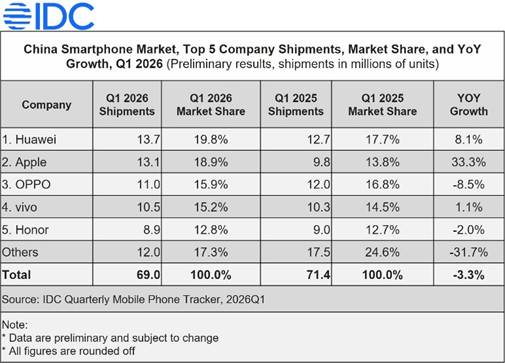
BEIJING, April 15, 2026 – China’s smartphone market declined 3.3% year over year in the first quarter of 2026, with shipments reaching approximately 69.0 million units. Despite a slight contraction, performance exceeded initial expectations due to strong demand for premium products from Huawei and Apple. Rising memory and component costs constrained supply and forced vendors to prioritize high-end models, signaling a from a volume-driven recovery to a margin-protection phase, making quality growth and operational efficiency the primary indicators for the year.

China smartphone market shipments Q1 2026 IDC data

“China’s smartphone market is entering a phase where profitability matters more than shipment growth,” said Will Wong, senior research manager, Devices Research, IDC Asia/Pacific. “Vendors are making deliberate trade-offs by reducing low-end exposure and focusing on premium segments to offset rising costs and protect margins,” Wong ends.

What happened in the China smartphone market in Q1 2026?

The market declined 3.3% year over year to 69.0 million units, but outperformed expectations due to strong premium demand led by Huawei and Apple. Growth was constrained by rising component costs and supply shortages, prompting vendors to reduce low-end exposure and prioritize profitability over shipment volume.

China Smartphone Market at a Glance — Q1 2026

  • Total shipments: 69.0 million units (–3.3% YoY)
  • Primary growth driver: Premium demand from Huawei and Apple
  • Key constraint: Rising memory and bill-of-materials costs
  • Supply challenge: Component shortages limiting full demand realization
  • Market shift: Transition from volume growth to margin protection

Why did the market change?

Premium demand remained resilient, particularly for Huawei’s Mate 80 series and foldable Pura X, as well as Apple’s iPhone 17 lineup. However, rising memory costs increased overall device production expenses, forcing vendors to reduce exposure to low-margin segments. Supply constraints further limited shipment potential, especially for Apple, where growth could have been higher without shortages.

IDC outlook

The first quarter is expected to be the strongest period of 2026. Vendors are revising annual targets downward and maintaining tight control over low-end inventory. Market performance for the rest of the year will depend on how effectively vendors balance innovation, cost management, and supply chain resilience amid sustained pricing pressure.

Vendor Highlights

Huawei maintained market leadership, supported by improved supply of its flagship and foldable devices, with the Pura X exceeding 1.5 million units in shipments. Apple recorded the fastest growth among the top five vendors, with shipments increasing 33.3% year over year, although overall volume was constrained by supply limitations.

FAQs

Why did the market decline despite strong premium demand?

Rising component costs and supply constraints offset gains from premium devices. Vendors reduced low-end production to protect margins, resulting in an overall shipment decline.

Which vendors benefited the most?

Huawei and Apple led market resilience. Huawei benefited from strong flagship and foldable demand, while Apple recorded the highest growth rate among leading vendors.

What risks could impact the market in 2026?

Persistent component cost inflation, supply chain disruptions, and reduced low-end demand could limit recovery. Vendor discipline on inventory and pricing will remain critical.

-Ends-

About IDC Trackers

IDC Tracker products provide accurate and timely market size, company share, and forecasts for hundreds of technology markets from more than 100 countries around the globe. Using proprietary tools and research processes, IDC’s Trackers are updated on a semi-annual, quarterly, and monthly basis. Tracker results are delivered to clients in user-friendly excel deliverables and on-line query tools. The IDC Tracker Charts app allows users to view data charts from the most recent IDC Tracker products on their iPhone and iPad.

About IDC

International Data Corporation (IDC) is the premier global provider of market intelligence, advisory services, and events for the information technology, telecommunications, and consumer technology markets. With more than 1,300 analysts worldwide, IDC offers global, regional, and local expertise on technology and industry opportunities and trends in over 110 countries. IDC’s analysis and insight helps IT professionals, business executives, and the investment community to make fact-based technology decisions and to achieve their key business objectives. Founded in 1964, IDC is a wholly-owned subsidiary of International Data Group (IDG), the world’s leading tech media, data and marketing services company. To learn more about IDC, please visit www.idc.com/ap. Follow IDC on Twitter at @IDCAP and LinkedIn. Subscribe to the IDC Blog for industry news and insights.

Will Wong - Senior Research Manager - IDC

Will Wong is a Senior Research Manager with IDC’s Asia/Pacific Client Devices Group. Based in Singapore, he covers the mobile phone market and is responsible for formulating valuable insights to help clients stay competitive and successful.

当生成式 AI 从“技术试验”走向“业务核心”,企业真正面临的挑战已不再是模型能力,而是如何高效、可控地规模化落地。训推一体化优化,正在成为企业构建竞争壁垒的关键抓手。

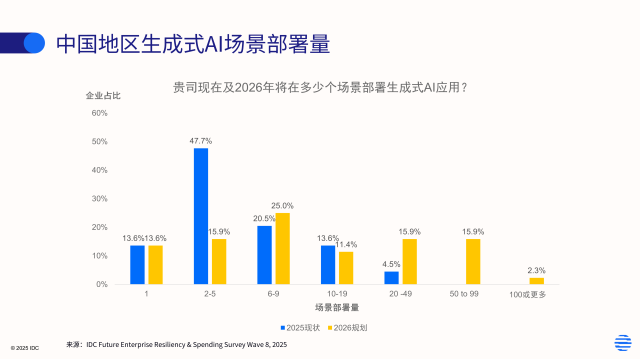
生成式 AI 正在加速向企业核心业务渗透,其价值重心也从“功能创新”转向“效率重构”。IDC研究显示,到2026年,近半数中国企业将部署超过10个生成式 AI 应用场景,这意味着AI已从探索阶段进入规模化应用阶段。在这一过程中,企业逐渐意识到,大模型的真正挑战并不在于“是否拥有”,而在于“是否能够稳定、高效、低成本地运行并持续优化”。

一、生成式 AI 进入规模化落地阶段

从行业演进来看,生成式 AI 正在经历从“点状应用”向“系统性重构”的关键跃迁。早期应用主要集中在内容生成、电商营销等互联网场景,而当前则加速渗透至金融、制造、医疗等核心行业,并逐步深入到采购、销售、财务以及IT运维等企业关键流程之中。这一变化意味着AI不再只是提升局部效率的工具,而正在成为重构企业运营模式的重要基础设施。

与此同时,用户侧的使用习惯也在发生根本性变化。生成式 AI 的使用频率不断提升,越来越多用户已经形成日常依赖,这从侧面推动了企业对AI系统稳定性和响应能力提出更高要求。在此背景下,智能体(Agent)逐渐成为新的应用形态,其“认知—决策—执行”的闭环能力,使AI能够直接参与业务流程,而非仅提供辅助支持。IDC认为,智能体将成为企业数字化转型的核心驱动力之一。

二、Scaling Law 之下的工程复杂性挑战

虽然大模型能力仍然遵循Scaling Law,即通过增加数据规模、模型参数和算力投入来持续提升效果,但在实际落地过程中,这一规律正面临越来越明显的工程约束。随着模型规模扩大,企业不仅需要应对训练成本的指数级增长,还必须解决推理延迟、系统吞吐以及服务稳定性等问题。

更重要的是,系统瓶颈正在发生转移。在早期阶段,算力是主要限制因素,而在当前阶段,跨节点通信、数据传输以及系统调度能力逐渐成为新的瓶颈。特别是在多节点、多GPU环境下,网络带宽和通信效率直接影响整体性能,使得“等数据”而非“等算力”成为常态。

因此,大模型优化已经从单一算法问题,演变为涵盖计算、存储、网络和软件栈的复杂系统工程问题。这一转变也意味着,企业竞争的焦点正在从模型能力本身,转向整体工程能力和架构设计水平。

三、训推一体化成为主流优化路径

在上述背景下,企业逐渐倾向于采用端到端的训推一体化框架,以降低系统复杂度并提升整体效率。这类框架能够贯穿模型生命周期,从数据处理、模型训练到推理部署,实现统一管理与持续优化,从而显著缩短模型迭代周期。

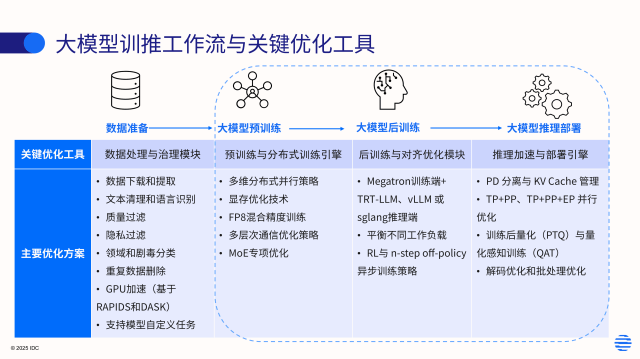
在训练阶段,优化重点已经从增加算力投入转向提升算力利用效率通过多维分布式并行策略以及混合精度训练技术,企业可以在有限资源条件下显著提升训练效率,并降低硬件成本。同时,显存优化和通信优化技术的应用,使得大规模模型训练逐渐具备可扩展性和可持续性。

进入后训练阶段,模型优化的重点转向业务适配能力。通过参数高效微调、模型蒸馏以及强化学习等技术,企业能够在控制成本的同时提升模型在特定场景中的表现。尤其是在智能体应用中,强化学习成为提升复杂推理能力的关键手段,但其高计算成本和系统复杂度也对企业提出了更高要求。

在推理部署阶段,优化的核心目标则是实现性能与成本之间的动态平衡。随着模型规模和上下文长度不断增加,推理系统需要同时满足低延迟、高吞吐以及高并发需求。在这一过程中,KV Cache优化、动态批处理以及低精度量化等技术成为关键手段,而PD分离架构(Prefill与Decode分离)及其配套的缓存管理机制,已逐渐成为行业共识。

在当前主流的大模型开发框架中,通常会提供覆盖模型训练与推理全流程的多种优化模型与工具。下图展示了在一个典型的大模型应用流程中,这类框架所包含的核心优化工具及其对应的主要优化方案。

四、基础设施成为新一轮竞争焦点

随着大模型应用规模的扩大,底层基础设施的重要性显著提升。IDC数据显示,中国生成式 AI 基础设施市场正处于高速增长阶段,预计未来几年将保持超过60%的年复合增长率。这一趋势表明,企业对算力资源、存储能力以及网络架构的需求正在快速提升。

更深层次来看,AI竞争正在从“模型竞争”转向“基础设施与系统能力竞争”。高性能GPU、低精度计算能力、多级缓存体系以及高速互联网络,正在共同构成新一代AI基础设施的核心。这些能力不仅决定模型训练效率,也直接影响推理成本和服务质量,从而成为企业构建长期竞争优势的重要基础。

五、对技术决策者的关键建议

大模型正在快速迭代和扩展,在训练和推理阶段都面临算力成本和数据质量的挑战。随着模型规模的增长和新技术的涌现,如何在提高训练效果和推理效率的同时,确保模型的稳定性和可控性,是技术提供方需要解决的重要问题。

模型训练阶段:采用多维分布式并行(如数据并行、张量并行、流水线并行)和混合精度训练(BF16/FP16),可大幅提升训练效率,缩短开发周期,降低硬件资源消耗。利用高效的数据管道和动态负载均衡,确保算力利用最大化,减少资源闲置。

后训练(微调/蒸馏)阶段:应用参数高效微调技术(如LoRA、Prefix Tuning)和模型蒸馏,可在保持模型性能的同时显著降低部署成本,提升模型适应性。结合自动化超参搜索和增量训练,提升模型在特定业务场景下的表现。

推理环节:采用低精度量化(FP8/INT4)、内核融合、KV Cache优化和动态批处理等技术,能有效提升推理吞吐量和响应速度,降低显存和算力需求。部署高效的服务架构(如PD分离、异步调度),保障高并发场景下的稳定性和可扩展性。

结论

大模型技术正在快速走向成熟,但真正拉开企业差距的,未来将不仅仅是模型本身,更是围绕训练、后训练与推理的系统化优化能力,这也决定了基础设施是否能输出高质量、有效Token。实践表明,通过构建统一的优化框架并持续迭代技术栈,企业不仅能够加速AI应用落地,还能够显著降低创新成本,提升整体业务价值。

本文IDC相关报告:

  • IDC《大模型训练推理优化部署的最佳实践》

基于上述分析,IDC在大模型、生成式AI以及智能体等领域已形成系统化的研究体系。围绕中国AI与GenAI市场、智能体与自动化应用、以及Data+AI与Data Agent等方向,IDC持续发布涵盖市场规模与预测、技术趋势洞察、厂商竞争格局评估(如MarketScape)、产品与能力评测(Tech Assessment / ProductScape),以及最佳实践与行业案例等多类型研究成果。同时,IDC还可为企业提供定制化咨询服务,包括技术选型与架构规划、市场进入与竞争分析、产品策略与生态评估,以及行业应用落地路径设计等。

请点击此处与我们联系。

IDC在2025年下半年实施的一系列消费者研究显示,伴随着“国补”政策的逐渐退坡,日益增长的价格使得消费者对终端商品的选择更加理性。端侧AI与智能体能力的不断增强一方面推动AI渗透率与使用率的提升,另一方面也促使智能体验成为影响用户NPS的关键因素。

通过IDC对消费终端市场最为核心的笔记本、平板以及手机市场主要厂商NPS排名与市场动态的解析,可以看到智能体验等因素如何影响消费者对终端厂商的评价,以及在2026年智能终端消费市场,厂商应该聚焦哪些方面来达成用户NPS的提升。以下为本次研究的主要发现:

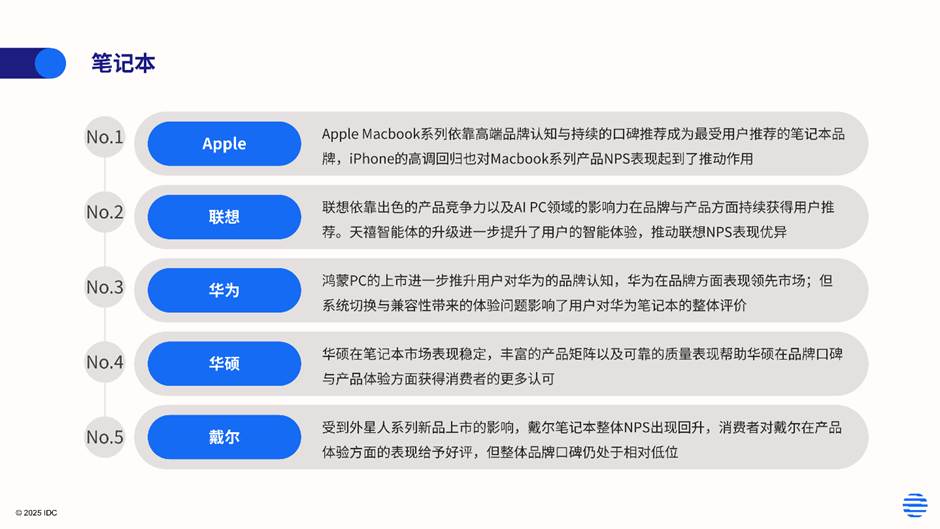
笔记本市场

笔记本市场消费者在2025年下半年仍处于价格敏感期,普遍升高的到手价格对大部分品牌都产生了一定的负面影响。产品体验对于用户对品牌的推荐意愿影响力提升,笔记本产品能否提供最佳的日常使用体验以及超出预期的智能体验成为影响用户口碑的关键

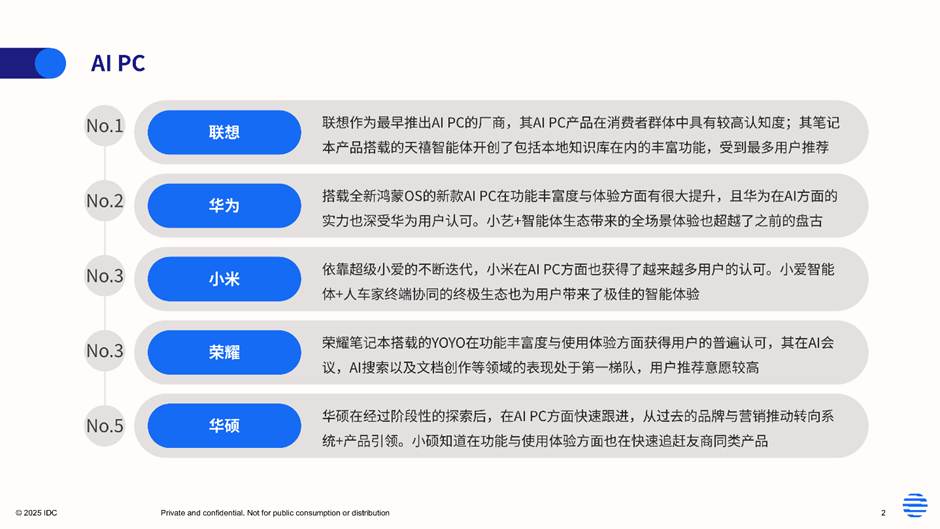
AI PC细分市场

由于用户对笔记本智能体验关注的的持续提升,IDC针对AI PC市场开展了独立的调研。根据研究,AI PC消费者重视设备是否搭载有功能丰富的AI助手。本地知识库与大模型,AI创作与研究能力等功能的可用性及使用体验均对用户NPS有直接影响。是否与系统深度融合,能否跨生态智能互联或将成为AI PC竞争的新高地。

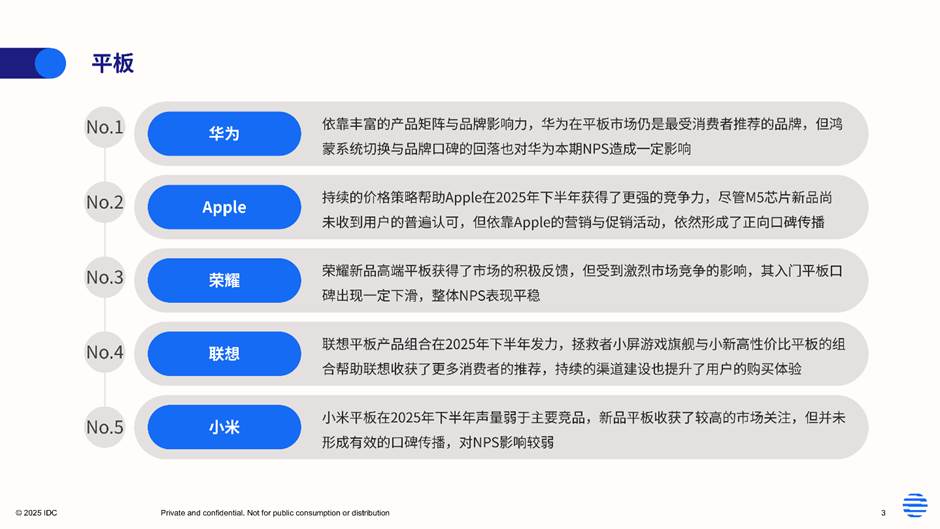
平板市场

平板市场厂商通过不断推出新品拉动消费者热情,2025年下半年密集上市的新品也提升了用户对于产品体验的关注度。差异化的使用场景使得不同平板群体的关注因素存在差异,但性能与高性价比是平板消费者共同关注的重点。能否通过AI功能进一步提升使用体验将是影响用户选择的关键因素。

手机市场:

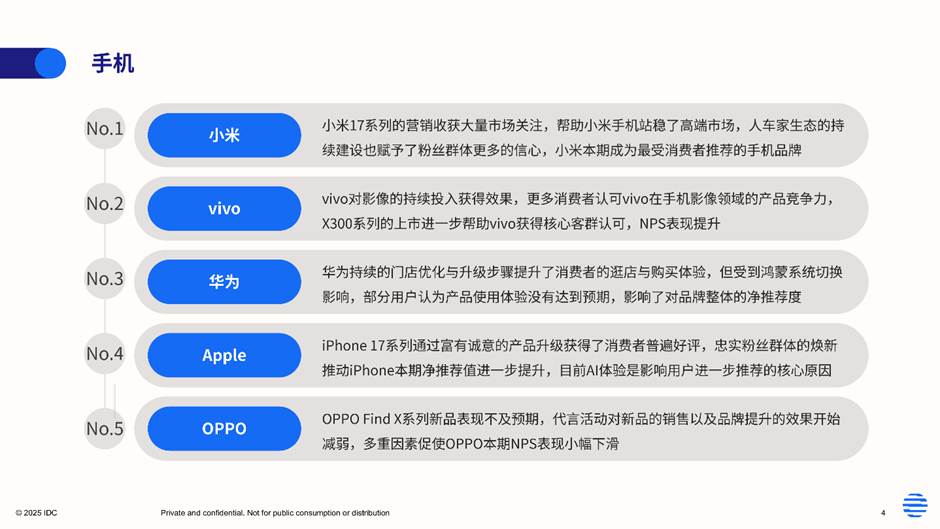
手机市场延续数年的产品“内卷” 出现缓和迹象,不断上升的成本促使厂商对新品迭代更加精打细算。但消费者对于手机产品体验的预期也在不断提升,任何因素导致的负向体验都会对品牌NPS产生较大影响。消费者对手机端AI与智能体体验的关注度快速提升,并且显著高于其他终端市场。

市场洞察与建议

洞察一:消费逐渐回归理性,务实主义有望回归

2026年,关键元器件成本的持续上涨将推动终端产品价格持续上行,用户的购买决策将趋向理性与谨慎。产品功能,使用体验,品牌口碑以及价格因素将成为用户未来购买消费终端产品的首要考虑因素

洞察二:智能需求升级,端侧AI将成为关键要素

AI智能体认知率与使用率不断提升,“AI PC”与“AI手机”等概念被更多消费者熟知。用户对于智能体验的需求也将快速迭代。端侧搭载AI能力将逐渐成为市场标配,而能否为用户提供跨场景,无缝的智能体验将成为厂商成功的关键

洞察三:体验决定价值,场景痛点更受关注

用户的价值感受中枢将回归到场景与体验,用户的高频痛点更加具象化,且与场景深度绑定。如果厂商提供的产品与服务能够帮助用户解决高频场景下的核心体验问题,将能为用户带来最强的价值感受。同时,更多的用户开始期待AI智能体在特定场景下的表现与体验,在垂类场景深度优化的智能体验有望快速形成正向口碑传播。

分析师观点

IDC中国研究经理王楷表示,中国智能终端消费市场处于持续变化阶段,涨价与AI体验升级预计将成为影响2026年市场的核心要素。更高的购买成本将进一步提升用户对于“买的值”的期待,能否在保证产品的基础体验过硬的同时,通过AI与智能体为用户带来实质性的体验升级,将成为厂商能否获得更多用户推荐的关键。

如需了解更多IDC相关研究或进一步与我们沟通,欢迎识别二维码与 IDC 联系,我们将安排专人与您对接,为您提供定制化的市场洞察与咨询服务。


如需了解IDC在智能终端领域的最新研究报告、数据产品及行业分析,请扫描二维码,在线获取完整研究目录与内容简介,助您精准把握市场脉动。

请点击此处与我们联系。