IDC Directions 2026 brought together more than 700 technology and business leaders for a single day of focused, analyst-led intelligence on where enterprise AI is heading and what to do about it.

The scale tells part of the story: 82 IDC analysts, 56 speakers, and 29 sessions across marketing, data, emerging technology, and AI-ready infrastructure. The attendee response tells the rest. In IDC’s post-event attendee survey, 98% said the day was worth their time and 96% left with insights they could act on.

Catch up on what you missed at IDC Directions 2026.

IDC built this year’s Directions around a question most technology executives are wrestling with right now: AI ambition is everywhere. How do you turn it into enterprise results? Every session pointed toward an answer.

Three Conversations That Set the Agenda

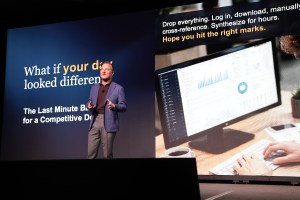
Chief Product & Research Officer Meredith Whalen opened with her keynote on the AI Supercycle, IDC’s term for the once-in-three-decades technology expansion cycle now underway, driven by AI infrastructure investment and the enterprise adoption wave that follows. The infrastructure buildout is already underway. The enterprise adoption wave is next. Whether your organization captures value as it shifts to new layers of the stack depends on decisions being made right now.

IDC CEO Lorenzo Larini brought the broader context into sharp relief. The volume of information is now growing at 17 petabytes per second. That’s not a backdrop — it’s the challenge. Making confident decisions in that environment requires a different kind of intelligence infrastructure, one built for speed and clarity rather than volume alone.

Lorenzo Larini speaking about the volume of data growth
Alessandro Perilli looks to the future in his Directions presentation

Vice President of Enterprise AI Strategies Alessandro Perilli put a number on what’s coming: by 2029, IDC forecasts that enterprises will collectively be running more than one billion AI agents. The organizations now designing cross-functional, multi-agent environments for orchestration and resiliency will have a structural edge over those that aren’t.

IDC Quanta: A New Platform for the AI Era

Directions was also where we shared more about IDC Quanta, our AI platform that puts IDC’s research and market intelligence directly into the tools enterprise teams already use. Built on 60+ years of IDC data and developed with input from more than 65 customers, Quanta is contextual, secure, and built to surface the signals that matter to your business before you think to ask.

Joe Bradley encourages the audience to join the waitlist for IDC Quanta, IDC's new AI platform

Early access is now full. The next window is coming. Reserve your spot now to be first in line when it opens, and get exclusive updates as the platform evolves.

 Visit our AI platform page to stay in the loop on IDC Quanta.

Everything Is Now Available on Demand

Whether you attended and want to revisit what you saw, or couldn’t make it and want to see what you missed: it’s all there. Sessions available include:

  • General sessions and mainstage keynotes
  • Breakouts across the Marketing, Data, Emerging Technology, and AI-Ready Infrastructure tracks
  • Analyst perspectives from across IDC’s research practice

The sessions were designed to give you something to take back to your team, your planning process, your next conversation about where to invest. They still will.

Don’t wait. See IDC Directions on Demand.

Ryan Smith - Content Marketing Director - IDC

Ryan Smith is the Director of Content Marketing at IDC, where he leads brand-level content and social media strategy, aligning research insights with compelling storytelling to engage technology decision-makers. With a background in both IT and marketing, Ryan brings a unique blend of technical understanding and creative strategy to his work. He’s also a seasoned storyteller, speaker, and podcast host who believes the right message, told the right way, can drive both trust and transformation.

IT has never been an easy job for CIOs and their teams. There’s the day-to-day reality of running the business, keeping systems available, managing risk, supporting customers, and delivering new capabilities. At the same time, CIOs are expected to keep pace with both the evolution of existing technologies and the steady stream of new ones entering the market. Some of the toughest challenges aren’t technical. They come from friction across roles, overlap, turf, and unclear ownership across IT and the business.

AI accelerates both progress and pressure

AI can help on the technology front. It can accelerate development, improve productivity, and make it easier to keep up with change. But it’s also introducing a new set of challenges — ones that can quickly turn into operational issues if CIOs don’t get ahead of them. Most CIOs are already feeling pressure from multiple directions. Boards and executive teams have invested heavily in AI and expect results. Business units are under the same pressure — and they don’t always wait for IT. Sometimes they partner. Other times, they move ahead on their own. That dynamic isn’t new. What’s changing is how easy it has become for the business to build technology without IT.

From IT-led development to business-led build

A recent article in The Wall Street Journal noted that OpenAI is working with firms like Accenture, Capgemini, and PwC to expand adoption of its AI coding tool, Codex — which generates and updates code from plain-English prompts — across enterprises, with millions of weekly active users and growing enterprise uptake. OpenAI Chief Revenue Officer Denise Dresser was quoted as saying that OpenAI’s consulting partners will help bring Codex “into every single line of business.”

Tools like Codex allow users to generate and update code using natural language. But that framing understates what’s really happening. These tools can be used to build applications, automate workflows, and create AI-driven agents that execute tasks across the business. Adoption is moving quickly. Finance teams can build finance applications. Sales teams can build sales tools. Increasingly, they’re doing it using plain-English prompts.

How boundaries blur

For CIOs, the challenge isn’t the technology; it’s the breakdown of traditional boundaries. Business units have often stepped in when they felt IT couldn’t move fast enough. Most CIOs have heard some version of: “I’m trying to run a business here. Either get it done or get out of the way.” What’s different now is that the barrier to entry is gone. With tools like Codex, and the support of external partners, business units don’t just have ideas. They can build and deploy. That’s where turf skirmishes emerge.

Development is no longer confined to IT. It’s happening across marketing, finance, and operations — anywhere there’s a problem to solve and the motivation to act. Without clear alignment within the organization, that quickly turns into overlapping solutions, duplicated effort, and ambiguous responsibilities.

Left unmanaged, this leads to familiar issues: fragmented architectures, integration challenges, security gaps, and increased operational risk. IDC’s 2025 assessment of low-code and no-code developer technologies confirms this shift is already underway at scale. But handled well, it can unlock a level of innovation most organizations struggle to achieve through centralized IT alone.

What CIOs should do next

The CIOs who get ahead of this won’t try to shut it down. They’ll get in front of it and shape it. In IDC’s conversations with enterprise CIOs, this is one of the most common inflection points we’re tracking right now. A few practical steps can make a meaningful difference.

Build fluency inside IT

Your teams need to understand tools like Codex well enough to guide the organization. That may mean partnering with firms like Accenture or PwC to accelerate the learning curve. The objective is straightforward: be the team the business turns to — not the one it works around.

Enable fast experimentation — but define the path to scale

Business units should be able to prototype quickly. In many cases, they’re closer to the problem and can move faster. But prototypes need a clear path into production. IT’s role is to take what works and integrate it, secure it, and operationalize it so it can scale across the enterprise.

Define roles early, before they get defined for you

If you don’t establish clear roles across IT and the business, they will emerge on their own — and usually through friction. Align early on:

  • Who builds demos and proofs of concept versus test and production
  • Who owns ideation versus scaling out and running
  • How solutions move from idea to production

Without that clarity, turf issues don’t go away — they grow.

Balancing speed and control

This isn’t just about Codex. It’s about what happens when the ability to build technology moves beyond IT. The CIOs who succeed won’t focus solely on control. They’ll focus on enablement — creating the conditions for the business to move faster while ensuring the right guardrails are in place. That balance — between speed and structure, autonomy and accountability — will determine how effectively organizations turn AI investment into real business outcomes.

Gerald Johnston

Gerald Johnston - Adjunct Research Advisor

Jerry Johnston, an adjunct research advisor with IDC’s IT Executive Programs (IEP), founded GJ Technology Consulting, LLC, where he assisted global financial institutions and helped launch a UK startup bank. Johnston is an experienced financial services and consulting executive who…

An AI system flags a high-value customer for fraud and blocks a transaction.
The customer churns within days. The business cannot explain why the decision was made.

A regulator asks for an audit trail of an autonomous workflow.
The organization cannot trace how the outcome was generated.

These are not edge cases. They are early signals of a broader shift.

As AI systems move into core operations, decisions are faster, workflows are more autonomous, and consequences are more visible. What changes is not just scale. It is accountability.

The challenge is no longer whether AI works.
The challenge is whether it can be trusted to work reliably, transparently, and at scale.

The new reality: scale without trust creates instability

Enterprise AI is entering high-stakes environments.

  • Decisions are automated
  • Workflows are autonomous
  • Data moves across systems and partners

This creates new pressure points:

  • Limited visibility into AI-driven decisions
  • Increasing regulatory and compliance exposure
  • Vulnerabilities across data, models, and agents
  • Erosion of customer and stakeholder confidence

Expectations are rising at the same time. Customers, regulators, and employees demand accountability, explainability, and control.

Without trust, scale introduces instability.

The shift: from AI adoption to trusted AI systems

IDC’s FutureScape 2026 predictions highlight a critical transition.

Organizations are moving from deploying AI systems to embedding trust into those systems.

This requires a new operating model:

  • Trust is built into workflows, not added after deployment
  • Governance operates continuously, not periodically
  • Security spans the full AI ecosystem, not isolated components

In practice, this means an AI-driven decision is no longer a black box.

A financial services firm deploying agentic AI for credit decisions can trace how a decision was made, validate the data used, demonstrate compliance, and apply human oversight where needed. That level of visibility allows AI to operate in regulated environments with confidence.

Trust, in this context, is operational.

To get there, organizations must move from principle to execution.

Charting the path: four moves to build trust and resilience

To succeed in this environment, leaders must take a deliberate approach to governance, transparency, security, and organizational readiness.

1. Embed governance into everyday operations

AI governance must move beyond policy frameworks.

Leading organizations are integrating governance directly into workflows through automated compliance checks, continuous monitoring, and embedded controls.

Without this:
Governance becomes reactive. Issues surface after failure, increasing regulatory risk and slowing adoption.

2. Establish transparency and accountability at scale

Autonomous systems require visibility.

Organizations must ensure that AI decisions can be traced, audited, and explained, with clear ownership for outcomes.

Without this: Decisions cannot be defended to regulators, customers, or internal stakeholders, limiting the use of AI in critical operations.

3. Strengthen security across the AI ecosystem

AI expands the attack surface across data, models, and agent interactions.

Organizations are adopting unified approaches to security, risk, and compliance that operate continuously across the AI lifecycle.

Without this: Vulnerabilities scale with adoption, exposing organizations to breaches, manipulation, and operational disruption.

4. Build a resilient, AI-ready organization

Resilience extends beyond systems to people and processes.

Organizations must prepare for workforce shifts, system disruptions, and evolving regulatory requirements.

Without this: AI-driven operations become fragile, with disruptions cascading across workflows and slowing response to change.

The payoff: trust as a foundation for scale

When trust is embedded into AI systems, organizations unlock consistent and measurable impact.

They gain:

  • Confidence in scaling AI initiatives
  • Stronger relationships with customers and stakeholders
  • Faster adoption of new capabilities
  • Greater resilience in uncertain environments

Trust enables organizations to move forward with clarity and control.

From control to confidence

The agentic future introduces new forms of risk alongside new opportunity.

Organizations that cannot explain, govern, or secure their AI systems will encounter increasing friction as they scale. Those that embed trust into their operations will move with greater confidence, expand into higher-value use cases, and sustain performance over time.

FutureScape 2026 makes the trajectory clear.

AI adoption is accelerating.
Trust will determine who can sustain it.

Those who operationalize trust will define the next phase of competitive advantage in the agentic economy.

Explore the FutureScape 2026 predictions behind trusted AI systems

FutureScape 2026 includes detailed research, analyst perspectives, and events that expand on building trust, resilience, and prosperity in the agentic future

Core Research

Analyst perspectives

On-demand webinars

IDC - -

International Data Corporation (IDC) is the premier global market intelligence, data, and events provider for the information technology, telecommunications, and consumer technology markets. With more than 1,300 analysts worldwide, IDC offers global, regional, and local expertise on technology and industry opportunities and trends in over 110 countries. IDC’s analysis and insight help IT professionals, business executives, and the investment community make fact-based technology decisions and achieve their key business objectives.

企业看到了智能体但不知道如何落地

2026年初,OpenClaw(龙虾)这类开源智能体产品很快成为市场焦点,端到端任务执行能力对企业很有吸引力。但智能体(智能体)要在企业里真正用起来,在什么场景落地成了主要的卡点。企业认知到了智能体的能力,但回到自己的业务流中,不清楚哪些环节可以交给智能体去做,哪些场景最值得优先投入。IDC 2026年智能体企业用户的调研数据显示,仍有60%的中国企业处于了解评估和试点智能体的阶段,仅有18%的企业把智能体纳入了核心业务流(IDC Syndicated Survey 2026: China AI Agents Market 2026),企业仍然难以跨越从Copilot助理向Agentic AI转型的阶段。为了解决这一问题,IDC提出了一个从业务约束出发的智能体落地框架——COMPASS模型。

业务卡点是关键:从企业业务的三层效率约束入手

到底应该如何选择智能体在业务中的落地场景呢?我们可以参考企业价值链流程,通过观察业务场景中的效率约束,来寻找切入点。一项业务从外部信息进入企业、到内部处理完成、再到能力沉淀放大,效率约束主要集中在三个层面。

第一层,信息输入的约束。企业每天接收大量外部输入,包括邮件、扫描件、图片、语音、聊天记录和表单。很多信息不能直接进入业务系统,要先经过识别、提取、转换和归类,才能变成后续流程可用的数据。

第二层,信息处理的约束。信息进入业务流之后,要在多个系统、多个角色之间流转、分析、协调。数据需要跨系统汇总,状态需要同步,异常需要及时发现,决策需要结合多方信息判断,责任需要在不同角色之间衔接。

第三层,信息资产化的约束。这是容易被管理者忽略的深层约束,企业高价值的业务经验和决策逻辑通常固化在少数员工手里。而人的并发处理能力也存在刚性上限,业务波峰时很难敏捷弹性的应对,也很难规模化增长。这一环节的关键在于让知识经验沉淀和复用,确保企业规模化扩张时不再出现效率瓶颈。

COMPASS模型企业智能体落地的七维度指南

基于这三层约束,我们可以进一步拆解出企业智能体落地的七个关键能力维度,即IDC提出的COMPASS模型。

1.      感知与理解(Perception

外部输入格式各异,进入核心业务系统前往往要依赖人工识别文档类型、提取字段、比对票据,效率瓶颈集中在非标准信息怎样被理解提取、怎样转化为系统可用的结构化数据。

智能体借助多模态大模型能力可以直接读取手写单据、非标合同、会议录音和视频素材,提取关键实体,按要求输出JSON或其它结构化数据,让海量外部信息直接成为系统可用的结构化信息。

2.      分析与决策(Analysis

企业数据和业务规则分散在不同系统中,人工做综合分析效率往往很低,关联节点越多越容易疏漏,依赖经验的判断也缺乏清晰的决策记录,组织很难做系统性复盘。

智能体可以通过工具调用从多个系统实时拉取数据,结合预设业务规则和历史模式,输出结构化分析结论和决策建议。低风险或标准场景可以直接调用执行,非标和高风险场景则带着完整分析升级给人工处理。

3.      流程编排(Orchestration

单个系统内部流转通常比较顺畅,跨系统连通往往比较脆弱。过去依赖API解决跨系统流转,建立的是确定性规则,一旦出现条件分支、异常状态,或者需要根据实时反馈在ERP、CRM和财务系统之间切换判断,硬编码连接容易中断退回人工,构建这些自动化流程本身也要占用较多IT开发资源。

智能体在任务执行环节能够做到系统调用的动态规划,接收到像”给大客户安排加急发货”的指令后,会根据上下文自主决策,调用RPA或基于API接口依次调用ERP核对库存、向WMS确认排期、在CRM中更新状态;流程生成环节,智能体可以基于已有规则库和流程模板,自动组装出RPA或自动化流程并部署上线,构建和迭代周期都会明显缩短。

4.      监控与主动响应(Monitoring

供应链延误、财务偏差、客户行为异常、系统运维故障,任何一环的响应滞后都可能带来连锁影响。人无法7×24小时保持稳定判断,传统做法依靠阈值报警、定时巡检和轮班值守,覆盖范围有限。

智能体可以在持续监测的基础上结合上下文做智能判断,一笔异常大额退货可以同时关联该客户的近期订单模式、产品批次的质量数据、物流环节的异常记录,在告警的同时给出初步的归因分析和处理建议。

5.      协调沟通(Collaboration

跨部门协作中信息天然不对称,产品设计的背后逻辑、法务建议的依据、仓库的实时库存,散落在不同的人、系统和沟通记录里,需要时很难立刻拼出全貌。澄清、追踪、同步消耗的时间往往占据业务人员相当大的比例。

智能体可以作为跨部门协作的中枢,持续追踪任务各环节进展,在关键节点主动通知相关方,出现延误或阻塞时自动升级;需要多方对齐时,能够快速汇总散落在各系统和沟通记录中的上下文,生成结构化的决策议题。

6.      知识沉淀(Sedimentation

企业大量执行能力和决策能力绑定在个体员工身上,关键人员离职、调岗或休假,流程质量和决策水平都会受到影响,新人入职要经过较长周期才能积累足够的隐性知识。

智能体的运行过程本身就可以是知识显性化的过程,任务执行路径、分析框架、决策规则和异常处理方式均可以便捷的结构化地记录下来,并随着运行时间持续积累,可以复用到新的业务场景、新的分支机构和新的团队,同时也能反过来优化智能体自身的响应策略,形成持续迭代的数据飞轮。

7.      规模弹性(Scalability

人的产能是线性的,一个人一天处理100笔订单就是极限,高峰期临时加人未必能带来同比效率提升。《人月神话》里有一个经典观察,项目每增加一个人,沟通链路会延长,交接成本也会上升,整体效率的提升往往被初始化和协调的开销抵消。

智能体的处理能力则可以随算力弹性扩展,业务高峰期不需要临时招人培训,订单量翻倍时调度更多计算资源就能跟上,背后是运行沙箱、记忆存储、调度管理等基础能力模块在支撑智能体在生产环境中稳定可控的弹性伸缩。

这七个维度就是COMPASS(指南针)模型,由上面提到的Collaboration、Orchestration、Monitoring、Perception、Analysis、Sedimentation、Scalability七个首字母构成。COMPASS对应三层约束视角,Perception对应的是信息输入层,解决外部信息能否准确进入企业系统的问题;Analysis、Orchestration、Monitoring、Collaboration对应的是信息处理层,覆盖分析决策、跨系统流转推进、监控响应和跨角色协同;Sedimentation和Scalability对应的是信息资产化层,把个人经验转化为企业可复用的数字资产,同时支撑企业规模化增长。

分析师观点

COMPASS模型可以作为企业落地智能体的诊断和指导工具,企业可以对照七个维度盘点自身业务流的关键瓶颈,识别出需要优先交给智能体的环节。从业务瓶颈倒推切入点,更贴近企业实际的业务需求,也能够减少企业因为智能体技术或产品高速迭代带来的选择困难。

从做什么到用什么:IDC MarketGlance解决选型问题

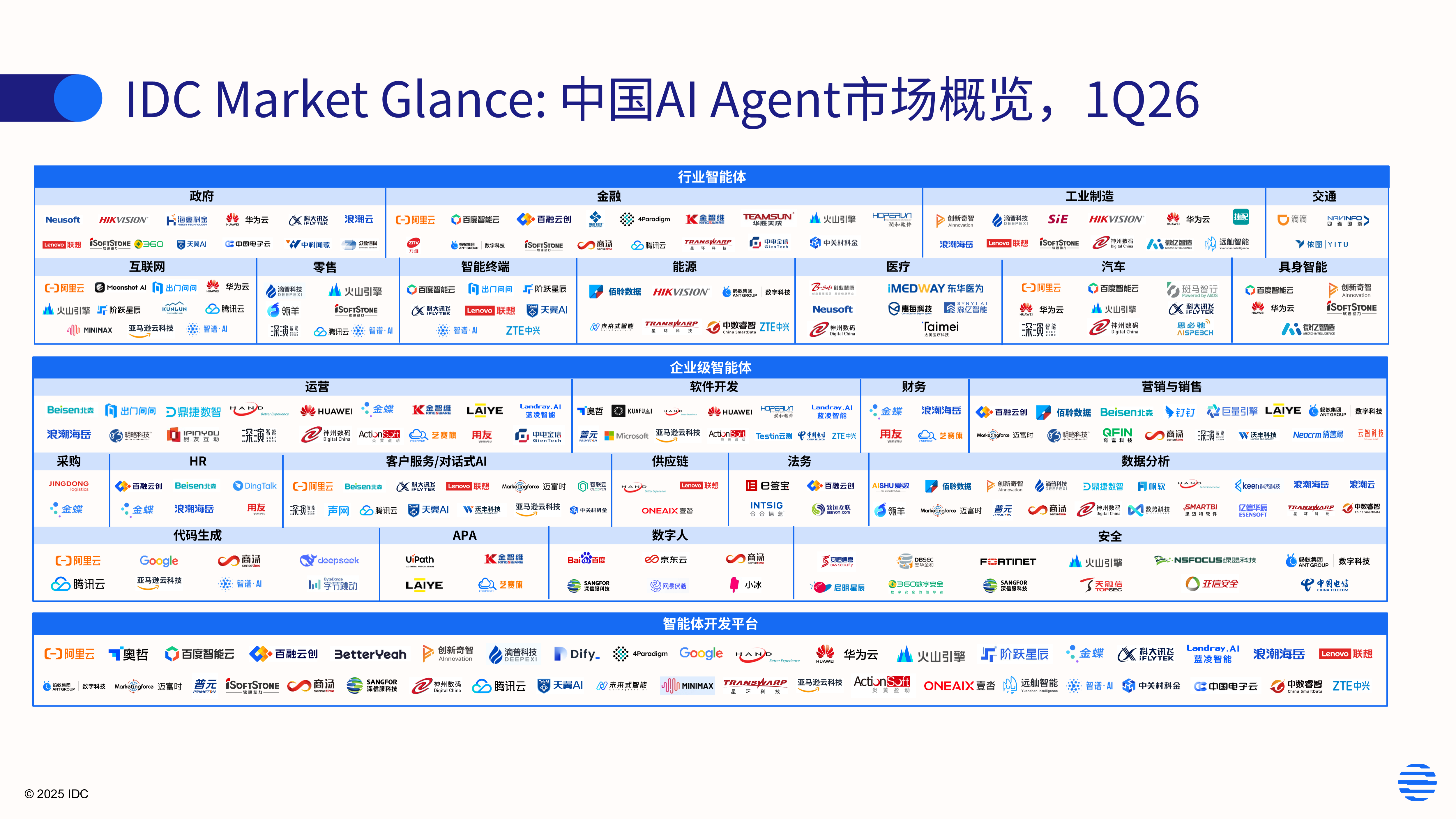
COMPASS模型回答的是智能体怎么切入的问题,但企业在落地时仍然会面临怎么在市场上找到合适的产品和供应商这一问题。当下市场中宣称具备智能体产品和服务能力的厂商数量已经相当可观,但能力层次和落地经验的差异很大,企业难以抉择。IDC通过大量深度的厂商调研和观察,为企业提供了中国智能体市场概览这一报告(包含中国智能体行业应用与开发平台市场概览和企业级智能体应用市场概览),预先筛选出了覆盖不同行业和业务场景中,满足评估要求的可靠智能体产品及解决方案供应商,供企业参考选择。

配套工具与实践:从方法论走向落地(限时资料免费获取)

另外基于COMPASS模型,我们准备了两份配套的智能体落地指南材料,一份是面向人的,一份是面向智能体的skill。这个skill我们已经上传了Openclaw的官方skill商店clawhub中,可以直接把skill链接( https://clawhub.ai/seanlandtop/idc-enterprise-agent-compass )给智能体安装使用,让智能体可以基于IDC的COPASS模型帮助企业进行智能体落地指引。

限时资料免费下载:可扫描二维码下载详情:

案例征集:寻找可量化ROIAgent实践

为了进一步沉淀实践经验,IDC计划于2026年4月启动Agent最佳实践案例(ROI视角)研究,面向已经在真实业务场景中部署Agent并取得可量化效果的企业与技术供应商开展案例征集,以期为更多企业提供可参考的落地路径。

IDC进一步交

如果您的企业正在评估或推进Agent在业务中的落地,或希望基于COMPASS模型进一步梳理业务切入点与优先级,IDC可以提供相应的研究支持与分析服务,包括基于行业与业务场景的落地路径分析,以及结合IDC MarketGlance的供应商方向参考。

同时,对于已经进入实践阶段的企业,IDC也可以围绕Agent应用效果与ROI进行评估与复盘,帮助企业更系统地推进从试点到规模化落地的过程。

如需进一步了解相关研究内容或开展交流,欢迎与IDC联系。请点击此处与我们联系。

Zhenya Sun - Research Manager - IDC

Zhenya Sun is a research manager for the IDC team focused on exploring the application of technology and industrial development of AI and AI agents. He is also responsible for providing clients with consulting services on technologies, products, and markets related to large language models (LLMs) and AI agents, as well as delivering speeches at industry conferences and internal seminars. Before joining IDC, Zhenya served as a project management officer (PMO), responsible for internal and external strategic consulting, AI application research and advisory services, AI project framework standardization, management system construction, and technical training on AI applications. Prior to that, he also led initiatives in product development process optimization and user market analysis. Zhenya holds a Master's Degree in Engineering Management with a specialization in Information Systems Engineering from the University of the Chinese Academy of Sciences.

2026年4月24日,中国大模型厂商DeepSeek正式推出DeepSeek-V4预览版,同步开源并上线官网、官方App及API服务,标志着百万级超长上下文能力进入普惠阶段。DeepSeek-V4以100万token超长上下文为标配,通过架构创新实现性能与效率双重突破,开源版本在Agent能力、世界知识、数学推理、代码生成四大核心维度实现跨越式提升。DeepSeek-V4也将逐渐实现以华为昇腾为代表的全栈本土化算力适配,这将重塑企业级AI应用部署格局,推动大模型从”参数竞赛”转向”价值落地”。

核心观点:百万上下文成标配,全球用户准备好了吗?

DeepSeek-V4 依托稀疏注意力、升级 MoE 架构等全链路技术创新,实现高效长文本处理,全系免费标配百万级上下文,并优化 Agent 能力,降低企业落地成本。市场层面,其极致低价推动长文本服务普惠化,拓宽多行业 AI 应用场景,同时促使全球大模型形成海外高端闭源与中国普惠开源两大竞争阵营。IDC 建议,企业分阶段落地应用、抢抓智能化红利,同时兼顾技术稳定性、算力适配、合规安全等各类潜在风险。

技术影响:技术革新赋能超长文本与高效 AI 能力

DeepSeek-V4 跳出参数堆叠的研发模式,依托全链路技术创新,实现百万级上下文高效处理,核心亮点突出。

其一,自研 DSA 稀疏注意力机制,借助 token 智能压缩破解长文本算力困境,大幅减少推理运算与缓存消耗,压缩算力成本,降低企业落地难度。

其二,全面升级 MoE 架构,搭载 384 专家融合内核,以少量激活专家兼顾模型能力与推理效率,搭配 mHC 技术稳定训练效果,避免模型遗忘,适配复杂任务迭代。

其三,为个人用户、开发者和企业用户全系标配百万 token 超长上下文,赋能多类AI任务。此外,该版本还适配优化多款主流 Agent 产品,显著提升代码编写、文档生成等任务表现,为个人、企业智能化开发与办公提供更强动力。

其四,全链路本土算力支持,DeepSeek-V4 摆脱部分对英伟达 CUDA 生态的依赖,全面适配本土芯片,实现从训练到部署的全链路安全可控。

市场影响:重塑行业规则,加速全球 AI 应用分化

DeepSeek-V4 的落地,恰逢全球 AI 产业从 “模型竞争” 向 “应用落地” 转型的关键期,其技术特性与定价策略,正从价格体系、应用生态、竞争格局三大维度,深刻影响全球 AI 市场走向。

价格体系重构——开源 + 极致性价比:DeepSeek-V4定价延续 “普惠全球” 路线,V4-Flash 输入缓存命中0.2 元 / 百万 Token、未命中 1 元、输出 2 元;V4-Pro 输入缓存命中 1 元、未命中 12 元、输出 24 元,推理成本仅为 GPT-5.5 的 1/8 至 1/50,让全球中小企业与个人用户都能用上顶级 AI 能力。

应用生态爆发——解锁全场景价值,渗透核心业务:百万上下文 + 低成本 + 强 Agent 能力的组合,为企业打开全新智能体应用空间;代码能力、推理能力、世界知识能力提升也将提升相关应用的模型生成效果。

竞争格局重塑——中国与全球大模型阵营分化:全球大模型市场逐渐分化为两大阵营:以 OpenAI、Google、Anthropic 为代表的 “闭源高端+ 海外算力” 阵营,聚焦极致性能与生态壁垒, 以 DeepSeek 为代表的 “开源普惠 + 中国算力” 阵营,主打高性价比与安全可控。这种分化将为全球企业提供更多选择,同时推动 AI 产业全球化竞争进入新阶段。

行动指南:把握技术红利,分阶段落地适配

面对 DeepSeek-V4 等基础大模型带来的技术变革与市场机遇,IDC 建议企业摒弃观望心态,按照评估、试点、落地、优化四阶段稳步推进,充分挖掘其商业价值。前期需结合业务痛点,聚焦长文本处理、代码开发、智能体应用等核心场景,盘点现有算力资源,结合自身规模选择部署模式,并测算 AI 使用成本与收益。其次开展小范围试点,按需选用适配的大模型版本,在核心业务场景短期测试,核验任务运行效果,对比原有方案排查问题并优化使用策略。最后持续跟进模型迭代升级,不断拓展应用边界,持续深化 AI 落地成效,全面赋能企业内部发展。

理性拥抱变革,平衡红利与风险

用户需警惕技术稳定性、本土算力适配等风险,避免盲目落地导致损失:百万上下文在极限场景下易出现信息遗漏、逻辑断裂,MoE 架构规模化部署易负载不均、引发服务中断,Agent 适配不成熟也会导致复杂任务失败。另外用户也需警惕算力适配风险,需重视从 CUDA 向本土生态的迁移成本和性能波动。

IDC中国研究经理程荫表示,DeepSeek-V4的发布,标志着中国大模型行业正式从”参数竞赛”(1.0时代)、”能力竞赛”(2.0时代)进入”价值竞赛”(3.0时代)——以高效架构、普惠成本、场景落地为核心,解决企业实际问题。企业需密切关注大模型技术迭代,结合自身业务场景,布局百万上下文、高效推理、开源可控的AI解决方案,抢占智能化转型先机,同时也需警惕安全合规、技术稳定性、本土算力适配等风险。

IDC更多相关研究:

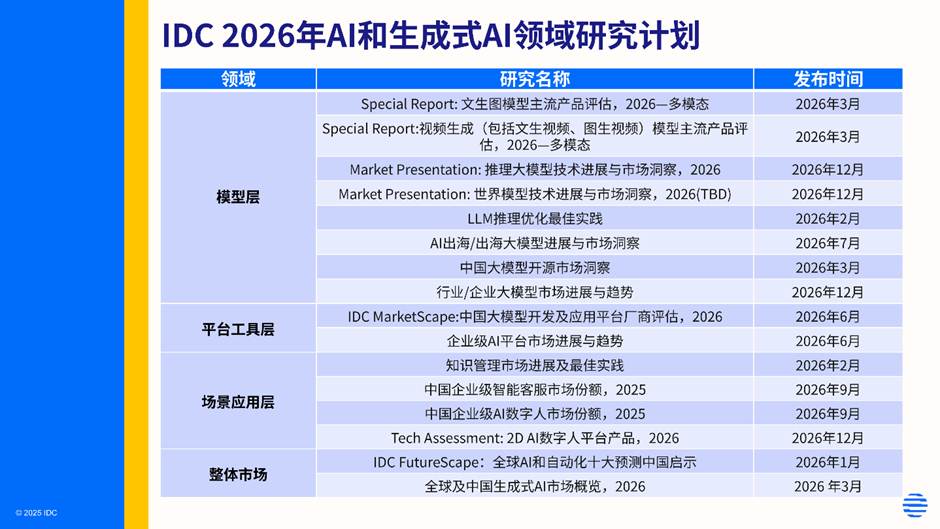
IDC在大模型与生成式AI领域已形成系统性研究积累,涵盖技术演进路线、行业应用成熟度、供应商竞争力及投资风向标等多个维度。我们不仅发布公开报告,也为企业级用户和投资机构提供定制化研究。

如您对IDC的相关研究感兴趣或有进一步需求,欢迎与我们联系,IDC的分析师团队期待与您进一步沟通。

请点击此处与我们联系。

Anne Cheng - Research Manager - IDC

Anne Cheng is a research manager in IDC China whose research focuses on the AI and big data markets. She collaborates with IDC's regional and global consulting teams and is involved in the business development of related markets. Prior to joining IDC, Anne had nearly four years of working experience in the IT/ecommerce and consulting industries, serving as consultant and business analyst. Her experiences made her familiar with industry data/customers and helped her gain deep insights into the business application scenarios. Anne holds a master's degree in Statistics from the University of Missouri Columbia.

中国智能手机市场正从规模驱动加速转向结构与利润驱动,高端化成为抵御成本压力的关键路径。

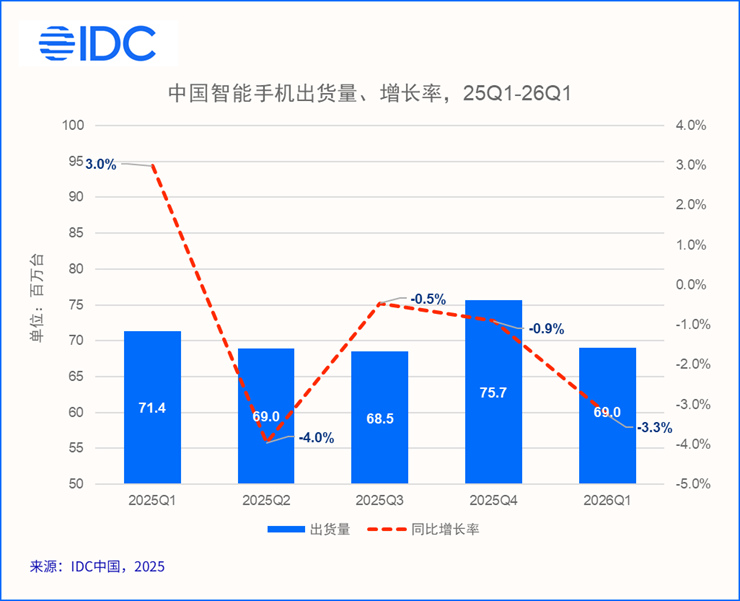
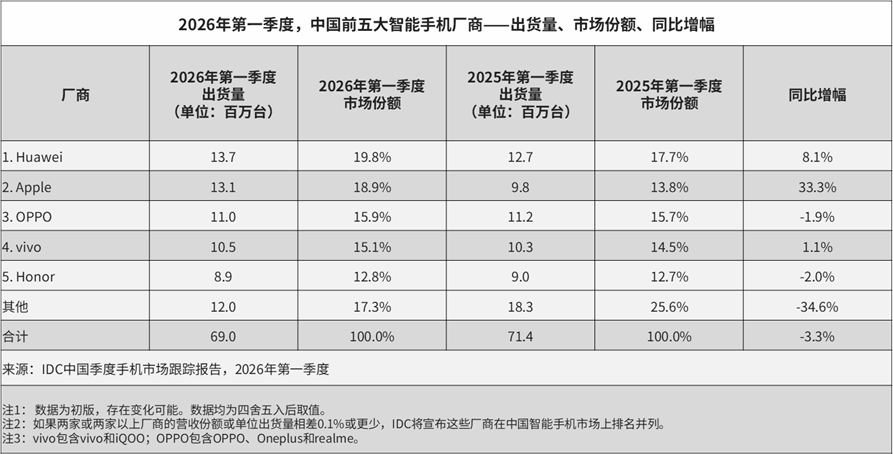
国际数据公司(IDC)最新手机季度跟踪报告显示,2026年第一季度,中国智能手机市场出货量约为6,904万台,同比下降3.3%,整体表现略高于预期,主要得益于华为与苹果的强势拉动。

其中,华为Mate 80系列供货明显改善,全新形态折叠屏产品Pura X出货量突破150万台,助力华为延续去年以来的增长势头,继续稳居中国智能手机市场第一。与此同时,苹果iPhone 17系列持续热销,但受限于供货不足,未能进一步推高出货规模。此外,部分消费者由于即将涨价选择提前购买更换手机,消费需求的前置也有利于今年第一季度的市场表现。但是面对今年严峻的存储等成本上升压力,其它品牌除陆续开始进行价格调整以外,也在减少低端产品出货量,保证自身利润。

2026年第一季度中国前五大智能手机厂商市场表现各不相同

Huawei:从恢复增长走向结构性领先

随着Mate 80系列供应能力稳步提升,延续2025年的强劲势头,再次稳居2026年第一季度中国智能手机市场第一。在行业成本普遍高企的背景下,华为成为唯一在当季为消费者提供广泛促销优惠的厂商。HarmonyOS Next市场份额持续攀升,已突破18%。折叠屏领域,华为优势明显,全新形态“阔折叠”Pura X正引领折叠屏手机未来的发展方向。随着供应持续改善,产品逐步覆盖更多价格段,华为有望进一步巩固在中国市场的领先地位。

Apple需求强劲但受制于供应

凭借iPhone 17 系列整体保持热销态势,在安卓旗舰频繁调价的市场环境下,该系列凭借加量不加价的定价策略更具市场吸引力,叠加一贯出色的二手保值能力,综合性价比进一步凸显。然而受核心 SoC 产能不足影响,iPhone 17 系列整体供应持续受限,出现发货周期延长、现货紧缺情况,直接制约其出货量与市场表现进一步冲高,未能完全释放销量潜力。

OPPO:高端化进入成果兑现阶段

稳居中国智能手机市场第三位,以372 美元的产品均价领跑安卓头部阵营,高端化成效显著。Reno 系列持续发力,稳固OPPO在 400–600 美元安卓中高端市场的领先优势。全新折叠旗舰 Find N6 凭借近乎无折痕的极致屏显体验,市场表现相较同类产品有显著领先优势,成为当季最畅销折叠屏新品。子品牌一加保持强劲增长,季度同比增幅接近 30%。随着 OPPO 完成品牌架构与产品分工的优化调整,投入资源将得到更高效整合,整体竞争力有望进一步提升,为后续市场突破与高端化布局注入更强动力。

Vivo:实现规模与高端双突破

本季度成为唯一实现出货量同比增长的安卓头部厂商,整体表现稳健亮眼。旗舰阵营持续发力,X300 系列保持热销势头;而X200s 作为 vivo 史上销量最高的 X 系列机型,奠定坚实基础;全新 X300s 全面升级为影像与性能双优的全能水桶机,助力 vivo 稳居 600 美元以上高端市场前三。与此同时,X300 Ultra 凭借手机与专业影像兼备的综合实力,进一步强化品牌影像标杆地位。依托行业首发的 2 亿像素潜望长焦技术,vivo 在高端 2 亿像素手机赛道持续领跑,产品力与高端化成果显著,整体市场竞争力持续提升。

Hono:多产品线协同稳健发展

稳居中国智能手机市场TOP5阵营。X70 系列自上市以来,长期占据安卓最畅销机型位置,成为拉动销量的核心主力。Win 系列凭借深度性能优化持续树立行业标杆,Power 系列以超长续航形成差异化竞争力,数字 500 系列则保持稳定市场表现。折叠屏方面,新一代 Magic V6 正式发布后,产品力与市场热度同步攀升,助力荣耀稳居中国折叠屏市场第二位。多系列协同发力,荣耀在主流价位段与高端市场持续巩固竞争力,整体发展态势平稳向好。

存储成本压力下,中国智能手机市场价格段变化情况如何?

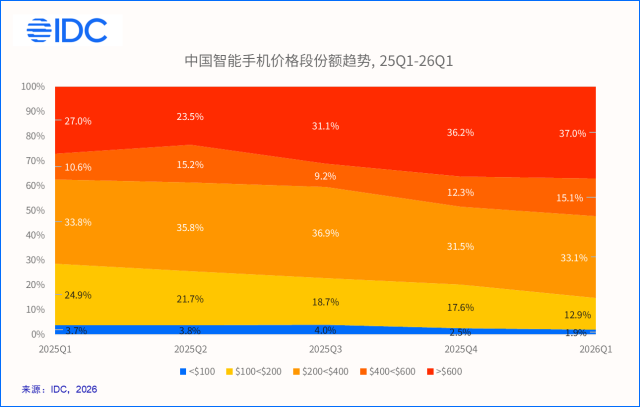
受全球核心元器件与存储芯片成本持续上涨影响,手机厂商在内部严控成本的同时,被迫采取缩减低端机型出货、上调产品售价的策略以缓解压力。自 3 月下半月起,多家品牌陆续调整定价,进一步传导成本压力。2026 年第一季度,中国智能手机市场结构显著分化:200 美元以下入门级市场份额同比大幅收缩 13.9 个百分点;厂商资源全面向中高端倾斜,200–600 美元中端市场份额提升 3.8 个百分点,600 美元以上高端市场份额大幅扩大 10.1 个百分点。具备更高利润空间的高端产品线,已成为厂商抵御寒冬、实现稳健经营的核心支柱。

IDC中国研究经理郭天翔指出,总体来看,尽管2026年开年中国智能手机市场出现小幅回落,但预计仍将成为全年表现最佳季度。当前,存储成本大幅攀升叠加其他物料价格持续高位,给厂商带来了巨大压力。为应对成本压力,多家中国厂商已连续下调全年出货目标,尤其严格控制低端产品的出货节奏,从而将压力传导至整个产业链上下游,进一步加剧了市场的寒意。而海外品牌极有可能利用自身优势,趁势抢夺市场份额。面对行业深度调整与成本持续高企的双重挑战,稳健经营、提质增效、安全过冬,将成为 2026 年国内手机厂商最为核心的发展课题。唯有守住基本盘、修炼内功,才能在后续市场环境回暖时,快速提升产品竞争力,重新抢占行业优势地位。

如需进一步了解中国智能手机市场竞争格局、价格段变化趋势及重点厂商策略,或获取更详细的数据拆分与预测分析,欢迎与IDC中国团队联系。IDC可提供包括季度跟踪数据、专项市场研究以及定制化咨询服务,助力企业在复杂市场环境中制定更具前瞻性的业务决策。

请点击此处与我们联系。

从“能用”走向“可控”,企业关注点正在发生变化

2026年,生成式AI与大模型驱动的智能体(Agentic AI)正在从技术探索走向规模化落地。越来越多的企业开始将智能体嵌入客服、研发、运维甚至业务决策流程之中,推动生产效率与业务模式的深度重构。在这一过程中,企业关注的焦点正在从“能否用起来”,逐步转向“能否用得安全、用得可靠”。近日,Harness engineering(驾驭工程)理念在业界持续升温,其强调通过设计合理的约束、权限边界和行为控制机制,为智能体设定“安全护栏”,确保其在复杂业务环境下的行为可控、合规、可解释,防止因幻觉、目标偏移或恶意利用带来的安全与合规风险。这一理念的流行,进一步凸显了智能体安全治理的紧迫性和必要性。

IDC最新调研显示,安全与道德问题已成为企业在部署AI智能体时最为关注的风险因素。同时,约64%的企业已经在生产环境中发现未授权的智能体或自动化脚本运行在关键业务流程中 ,企业亟需一套智能体安全治理体系来帮助其AI系统的稳定安全运行。

智能体带来的,不只是效率提升,还有攻击面的重构

与传统应用系统相比,智能体具备更强的自主性与动态性。它不仅可以基于自然语言输入生成决策,还能够调用外部工具、访问多种数据源,并在复杂环境中持续执行任务。这种能力使得智能体在提升效率的同时,也显著扩大了企业的攻击面。不可预测的用户输入、复杂的任务规划路径、多组件协同运行以及与外部系统的频繁交互,都可能成为潜在的攻击入口。

从实践来看,当前智能体面临的安全风险呈现出多维度特征。首先,智能体的开发与运行依赖大量第三方组件与工具链,软件供应链风险随之放大;其次,智能体自身仍存在幻觉、目标错位等问题,在特定场景下可能被恶意利用;此外,提示词注入(Prompt Injection)正在成为典型攻击手段,可诱导智能体执行非预期操作甚至泄露敏感信息。同时,随着智能体权限范围的扩大,访问控制的复杂性显著提升,而员工自行部署的“影子智能体”也在无形中增加了企业安全治理的难度。

智能体管理从“安全问题”走向“治理问题”

这些变化意味着,智能体安全正在演变为一个贯穿全生命周期的系统性治理议题。企业智能体安全和治理工作应和智能体应用部署工作同步开展,立足智能体全生命周期管理思想,开展智能体全流程检测与管控工作。用户的智能体安全体系建设需要从智能体思考、规划、编排、执行、反馈的全流程进行规划设计和执行,尽可能关注智能体全生命周期覆盖的所有核心组件,如大模型、知识库、RAG、Skill、思维链、MCP、API、第三方工具等,根据不同阶段所存在的安全风险对应检测和防护措施,搭配AI合规、AI道德、AI隐私等管控方向,构建符合企业需求的AI治理体系。

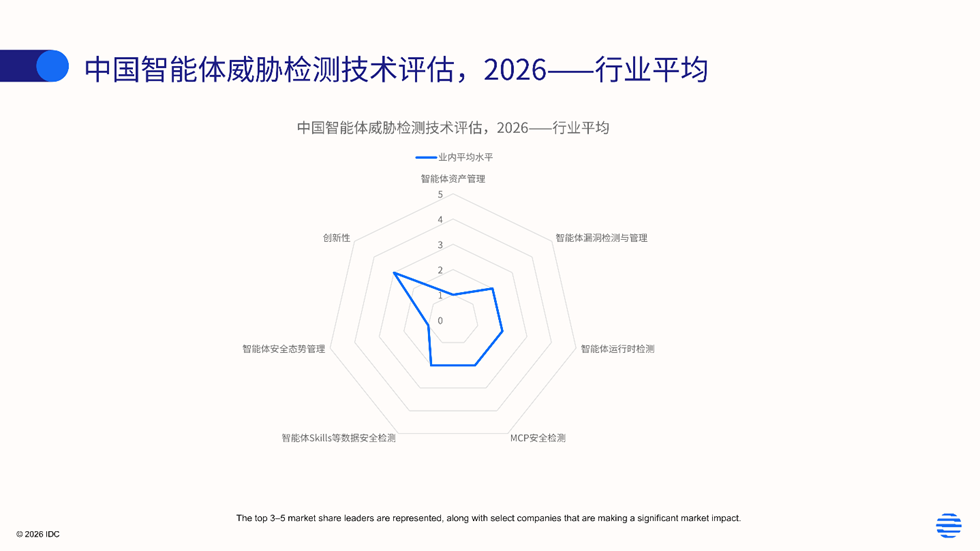
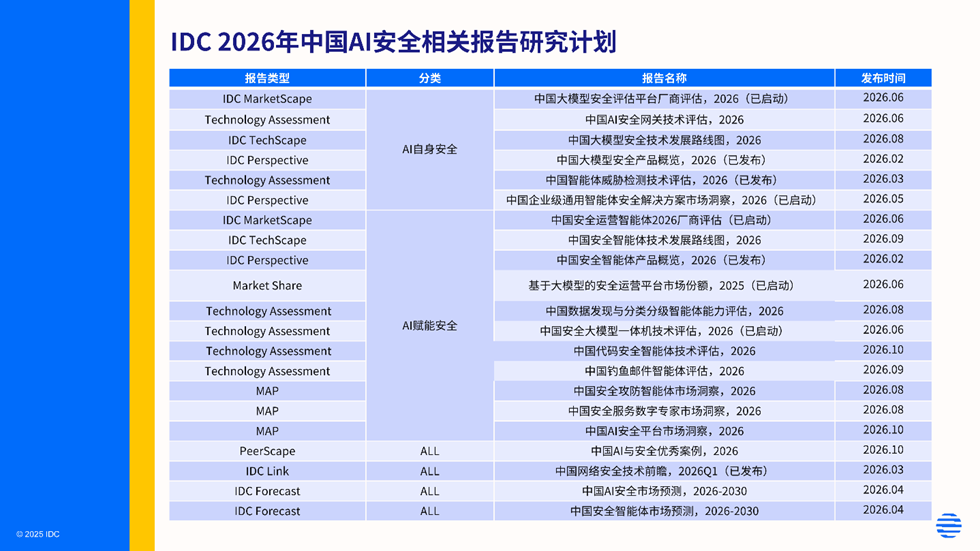
IDC在最新发布的《中国智能体威胁检测技术评估,2026》报告指出,当前市场上的智能体安全能力正在从单点检测向体系化治理演进,相关能力涵盖资产管理、漏洞检测、运行时监测、协议安全、数据安全以及安全态势管理等多个方向。该报告综合评估了国内主要厂商在相关领域的技术能力,报告入选厂商包括360数字安全集团、安恒信息、阿里巴巴、火山引擎、华为、君同未来、绿盟科技、领信数科、启明星辰集团、瑞数信息、新华三、亚信安全以及中国电信等 。截止到2026年4月,中国智能体威胁检测这一市场仍处于技术快速迭代的状态,技术服务提供商的产品服务能力仍处于快速补齐功能的阶段,技术的精细化、行业化水平仍存在不足。

随着企业应用的深入,构建“可信的AI智能体体系”将成为用户最为迫切的需求之一,解决该需求的核心在于提升系统的可解释性、公平性、透明性、准确性与可追溯性。

可见性成为基础能力,AIBOM成为核心技术方向

在这一过程中,“可见性”正在成为智能体安全的基础能力。企业需要清晰掌握自身智能体资产的构成、依赖关系及其运行状态,才能有效识别风险并制定应对策略。

IDC预测,到2028年,50%的部署Agentic AI的企业将要求具备人工智能物料清单(AIBOM),以实现对模型、数据、API及第三方组件的结构化管理与持续风险监测 。AIBOM的引入,将推动AI系统从“黑盒运行”走向“透明可控”。

协议与协作:智能体时代的新风险边界

与此同时,随着智能体之间协作能力的增强,通信协议层面的安全问题也日益凸显。以模型上下文协议(MCP)为代表的交互机制,使智能体能够在多系统之间传递信息并协同行动,但也带来了新的风险挑战。

如何实现对协议行为的持续监测、身份验证与权限控制,将成为保障智能体系统稳定运行的重要环节。MCP资产的发现与风险监测、MCP行为监测和异常检测以及MCP身份和权限的管控将成为重要的技术发展方向。

零信任进入智能体时代,身份与权限体系被重塑

在访问控制方面,传统基于边界的安全策略已难以适应智能体环境的复杂性。以“永不信任、持续验证”为核心的零信任理念,正在逐步延伸至智能体体系中。

无论是用户访问智能体,还是智能体调用外部服务、智能体之间的互相调用,都需要在动态环境中进行实时验证与策略调整,这对身份管理与权限管控、访问控制方向的技术提出了更高要求。从人的身份、智能体的身份入手、通过对资产、环境、行为等多方面的动态监控与检测,运用AI进行动态策略推荐与调整,将更高效地帮助用户处理复杂的身份、权限和访问控制问题。

AI检测防护技术加速整合,向一体化、平台化的AI安全治理方向演进

从体系化、工程化视角来看,统一化、一体化的AI安全治理平台将成为用户AI系统的综合治理平台。该系统将从AI系统的可见性出发,逐步向AI安全态势管理(AISPM),AI检测与响应(AIDR)方向迭代,最终融合道德、伦理等能力,构建一体化的AI安全治理体系。

2026年,平台化加速,大模型安全评估平台、大模型应用防火墙(大模型安全护栏)、智能体威胁检测、智能体身份与访问控制系统等主流生成式AI检测与防护产品将快速集成并平台化,以模块式架构,构建统一的AI安全管理平台,帮助用户一体化、平台化管理AI安全态势。

IDC观点:智能体安全将成为AI落地的关键分水岭

总体来看,智能体安全正在从一个技术细分领域,演变为企业AI战略中的核心组成部分。未来几年,随着智能体规模化应用的加速推进,安全与治理能力将直接影响企业释放AI价值的效率与边界。

如何在创新与风险之间取得平衡,将成为企业在AI时代必须持续面对的重要课题。

IDC中国网络安全领域研究经理王一汀表示: “IDC预计,到2031年,中国企业将拥有3. 5亿个活跃的智能体。各类智能体在帮助企业提质增效的同时,也带来了巨大的安全暴露面,智能体安全已成为企业用好智能体的关键。其中,智能体威胁检测作为企业安全风险管控的核心,将帮助企业实现智能体资产梳理、漏洞检测、风险评估等关键工作,并协助形成威胁响应闭环。当前,中国智能体安全市场和相关技术仍处于起步阶段,产品形态、检测机制和标准体系仍需完善。随着企业智能体应用规模的持续扩张,企业对智能体安全检测与防护的需求将加速释放,市场有望迎来快速发展期。”

IDC更多相关研究:

IDC已于2026年启动AI安全技术系列研究,围绕AI原生安全架构、安全智能体成熟度评估、AI驱动DevSecOps实践路径以及企业级AI治理框架等方向展开持续跟踪与分析。对于希望进一步了解相关研究、评估自身AI安全能力或探讨落地路径的企业,欢迎与IDC分析师团队进行深入沟通,以获得更具针对性的洞察与建议。

请点击此处与我们联系。

Sophia Wang - Research Manager - IDC

Sophia Wang is a Research Manager in IDC China. She is responsible for the analysis and research of China's cybersecurity market. Her primary focus is on China's cybersecurity appliance and services market and operational technology (OT) security market. Additionally, she provides related research and consulting services for regional and global IT customers and supports their business development. Prior to joining IDC, Sophia worked in several consulting companies. She was independently responsible for consulting projects in fast-moving consumer goods (FMCG), internet, and other industries. Through market analysis and benchmarking analysis, she helped many clients solve problems in the different stages of their development. Sophia graduated from the University of Southern California with a master's degree in econometrics. She also majored in human resource management and journalism for her bachelor's degree.

Organizations today are navigating powerful crosscurrents. Economic uncertainty, regulatory shifts, and workforce disruption are intensifying at the same time that AI is moving from experimentation to enterprise scale. Many leaders have responded by launching pilots, testing use cases, and investing in new tools.

A gap is emerging.

AI is present across the enterprise, yet measurable value remains limited.

Across industries, organizations are finding that experimentation does not automatically lead to impact. Pilots stall. Use cases remain isolated. Investments increase, but outcomes remain uneven.

The challenge is no longer whether to adopt AI. The challenge is how to operationalize it at scale.

The hidden barrier: From pilots to fragmentation

Most organizations are now well into their AI journey, yet many are unable to move beyond early deployments.

Isolated use cases create pockets of progress, but they do not transform the enterprise. Teams deploy agents, automate workflows, and generate insights, but these efforts are not connected to core operations.

This creates a new layer of complexity:

  • AI tools that do not integrate
  • Data that does not move in real time
  • Agents that operate without shared governance
  • Workflows that cannot scale across the organization

At the same time, the number of AI agents is increasing rapidly, introducing new demands for coordination, lifecycle management, and oversight.

Without a unifying approach, organizations face rising costs, inconsistent results, and delayed returns on investment.

In this environment, fragmentation becomes the primary barrier to progress.

The inflection point: From experimentation to orchestration

IDC’s FutureScape 2026 predictions highlight a clear shift.

Organizations that achieve impact will move beyond experimentation and adopt enterprise-wide orchestration.

This shift changes how the enterprise operates.

AI becomes embedded into the way decisions are made, work is executed, and systems interact.

Enterprise-wide orchestration includes:

  • Agents coordinating work across functions
  • Continuous data flow across systems
  • Applications evolving into AI-driven platforms
  • Governance integrated into daily operations

This is the transition from isolated deployments to connected systems that operate as a unified whole.

Charting the path: Four moves to scale AI with confidence

Reaching enterprise-wide orchestration requires deliberate action across strategy, architecture, and operations.

Based on FutureScape 2026 insights, four moves define this path.

1. Establish a control plane for AI orchestration

Scaling AI requires centralized coordination.

Leading organizations are building orchestration layers that manage agents, workflows, and governance across the enterprise. This creates consistency, reduces duplication, and enables AI systems to function together.

Without this coordination, complexity increases as deployments expand.

2. Re-architect for real-time, event-driven operations

Agentic AI depends on timely and contextual data.

Organizations must shift from batch-based systems to event-driven architectures where data flows continuously. This enables faster decision-making and allows agents to respond in real time.

In this model, data becomes an active component of operations rather than a static resource.

3. Build an AI lifecycle, not just deployments

Deploying AI is only the first step.

Organizations need structured lifecycle management that includes development, deployment, monitoring, and governance. This ensures that AI systems remain reliable and aligned with business objectives as they scale.

The adoption of formal lifecycle practices is becoming essential as agent usage expands.

4. Align the workforce to an orchestrated future

Enterprise orchestration requires changes in how work is performed.

As AI agents take on execution tasks, human roles shift toward oversight, coordination, and innovation. New responsibilities emerge in managing outcomes, ensuring accountability, and guiding AI systems.

Organizations that prepare their workforce for these roles will be better positioned to scale AI effectively.

The payoff: Enterprise impact at scale

When orchestration is achieved, organizations begin to see consistent and measurable impact.

AI supports coordinated operations across functions. Decision-making improves through real-time insights. Automation becomes more efficient and scalable. Innovation becomes a continuous process.

Organizations also gain greater adaptability. They can adjust workflows, reallocate resources, and respond to change more effectively.

From navigation to execution

The crosscurrents shaping the global economy will continue to evolve.

Navigation remains essential. Execution determines outcomes.

Organizations that adopt enterprise-wide orchestration can maintain direction, manage complexity, and scale their AI investments with confidence.

FutureScape 2026 makes the path forward clear.

AI adoption alone is not enough.
Operationalizing AI at scale is what drives results.

Those who take this step will define the next phase of the agentic future.

Explore the predictions behind charting the path to enterprise-wide orchestration

To move from AI experimentation to enterprise-wide orchestration, leaders need a coordinated view across applications, data, infrastructure, and operating models. The following FutureScape 2026 reports provide deeper insight into the predictions shaping this transition:

Core Research

Analyst perspectives

On-demand webinars

eBooks

IDC - -

International Data Corporation (IDC) is the premier global market intelligence, data, and events provider for the information technology, telecommunications, and consumer technology markets. With more than 1,300 analysts worldwide, IDC offers global, regional, and local expertise on technology and industry opportunities and trends in over 110 countries. IDC’s analysis and insight help IT professionals, business executives, and the investment community make fact-based technology decisions and achieve their key business objectives.

The 2026 Beijing Humanoid Robot Half Marathon has officially concluded. Compared with the 2025 event, this year’s competition demonstrated significant advancements in scale, technical complexity, and ecosystem participation—highlighting the industry’s accelerating transition toward commercialization.

According to IDC, global shipments of humanoid robots are expected to exceed 510,000 units by 2030, representing a compound annual growth rate (CAGR) of nearly 95%. As foundational technologies mature, application value deepens, ecosystems expand, and business models evolve, competition will increasingly center on real-world deployment capabilities and value delivery.

Industry Participation Expands as Performance Breakthroughs Accelerate

This year’s event attracted over 100 teams from enterprises, universities, and research institutions. There were notable breakthroughs in both core technologies and product performance. Leading players—including Honor—delivered standout results, with some robots surpassing human-level running speeds, reflecting significant improvements in locomotion capabilities.

Honor’s championship win underscores a broader industry trend: growing strategic commitment to humanoid robotics. As embodied intelligence continues to evolve, computing power, algorithms, and foundational models remain critical. Meanwhile, the entry of consumer device vendors is expected to create differentiation in edge computing and visual models. Combined with their large user bases and ecosystem strengths, they are well-positioned to accelerate both technological iteration and real-world adoption.

Autonomous Navigation Upgrade, From Single Capabilities to System-Level Validation

The competition has moved beyond testing basic mobility. Notably, 38% of participating teams adopted fully autonomous navigation, and the winning robot leveraged this capability under weighted scoring rules.

This shift reflects a broader transition: humanoid robots are now evaluated by their ability to operate reliably in complex, dynamic environments. Success requires seamless integration across perception, decision-making, and executions supported by high system stability and engineering readiness for scalable deployment.

Key Technology Highlights

Multimodal Perception
Robots combined data from multiple sensors—including satellite positioning, LiDAR, vision systems, and IMUs—along with real-time mapping technologies. This enabled stable operation across slopes, sharp turns, uneven terrain, and dynamic obstacles, significantly enhancing adaptability to real-world environments.

Reinforcement Learning and Motion Control
Extensive reinforcement learning in simulation environments, combined with high-quality human motion data and continuous adaptation and tuning in real-world environments, has driven major improvements in motion control algorithms. Robots now demonstrate enhanced balance, posture optimization, and human-like movement, enabling long-distance autonomous navigation, obstacle avoidance, and path optimization.

Hot-Swappable Batteries and Liquid Cooling
Energy management emerged as a critical enabler. Hot-swappable battery systems allow efficient recharging without downtime, while advancements in lightweight design, energy optimization, intelligent power distribution, and liquid cooling significantly extend operational endurance.

Hardware-Software Co-Optimization
Breakthroughs in hardware-software integration and engineering capabilities emerged as a key highlight and a critical focus for future development. Facing real-world physical environments and task requirements, robots must continuously learn and adapt to new scenarios and tasks, enabling end-to-end coordination across perception, decision-making, and execution. At the same time, deeper integration and precise alignment between AI models and diverse hardware configurations are required to establish real-time interaction loops. This ensures responsiveness, control precision, and system stability in complex tasks, accelerating progress toward highly reliable, maintainable, and scalable real-world deployment.

Commercialization Accelerates at “China Speed”

Humanoid robotics is rapidly evolving toward a closed-loop embodied intelligence system encompassing perception, learning, decision-making, and execution. Engineering capability is emerging as the key determinant of commercial viability.

In 2025, the global humanoid robot market experienced a breakout year, led by Chinese vendors, with shipments exceeding 18,000 units. More than 85% of deployments were concentrated in performances, education, data collection and guided tour service scenarios—primarily focused on demonstration, interaction, and technology validation. Early pilots have also emerged in manufacturing and logistics.

Looking ahead, IDC Humanoid Robotics Research forecasts that by 2030:

  • Global shipments will surpass 510,000 units
  • The industry will enter a scaling phase
  • Growth will be driven by improvements in hardware, application value, ecosystem collaboration, and business models

1. Hardware Evolution: China Leads in Scale and Manufacturing

Chinese vendors are expected to account for 95% of global shipments in 2025, establishing a dominant position in manufacturing and scalability. Several leading companies are projected to achieve annual production capacity in the tens of thousands by 2026, further strengthening supply capabilities.

Key innovation areas include structural optimization, joint and energy system upgrades, mass production capabilities, and motion control improvements. Additionally, dexterous hands—critical for fine manipulation—are poised for rapid development.

Fastest-growing categories:

  • Wheeled humanoid robots: High stability and suitability for indoor/semi-structured environments (projected CAGR ~120%)
  • Full-size bipedal humanoids: Greater flexibility for diverse scenarios (projected CAGR >95%)

2. Application Value: From Demonstration to Productivity

Industrial Adoption Accelerates
Collaboration with industrial leaders is validating performance metrics such as cycle time, task success rates, and operational stability. Deployment in manufacturing environments is expected to scale rapidly, with shipment growth exceeding 200% in 2026.

IDC research indicates that over the next three years more than 80% of users plan to deploy robots in tasks such as palletizing, handling, picking, and machine tending.

Service Applications Deepen
Humanoid robots are expanding into personalized services, enhancing customer experience and engagement in areas such as retail guidance and food service.

3. Ecosystem Development: Data, Models, and Scenarios

Data Scale Expansion
The integration of simulation data, internet video data, and real-world operational datasets is driving rapid growth in training data. China has already accumulated tens of thousands of hours and nearly petabyte-scale datasets, andis leading the development of the world’s first international standard for humanoid robot datasets.

Model Evolution
Advancements in motion models, combined with deeper integration of world models and vision-language-action (VLA) models, are improving generalization and intelligence. Leading global humanoid robotics and AI model companies are continuously accelerating the iteration and upgrading of foundational models.

Scenario Co-Creation
Oriented toward real-world industrial application scenarios, ecosystem players are jointly advancing application development and solution building, bridging the critical gap between technical validation and large-scale deployment, and accelerating the industrialization of humanoid robotics technologies.

4. Business Models: RaaS Gains Traction

Robot-as-a-Service (RaaS) models—including leasing and subscription—are lowering adoption barriers and accelerating market penetration.

IDC research shows that user acceptance of RaaS has doubled year-over-year. As service systems, pricing models, and maintenance capabilities mature, adoption is expected to further accelerate.

Outlook: A Critical Window for the Next 2–3 Years

IDC believes the 2026 Beijing Humanoid Robot Half-Marathon has become a key benchmark for assessing both technological maturity and industry progress. The event not only validated core capabilities but also accelerated ecosystem development and commercialization.

Over the next 2–3 years, the humanoid robotics industry will enter a pivotal phase:

  • Competition will shift from technical demonstrations to real-world application performance
  • Vendors with system-level capabilities and engineering execution will emerge as market leaders

Humanoid robotics is transitioning from technically feasible to commercially viable. Leading companies are already securing strategic positions in high-value scenarios, while the window for late entrants is rapidly narrowing.

Learn More

This analysis is based on IDC research, including:

For organizations evaluating entry strategies, identifying priority use cases, or assessing vendor capabilities, IDC offers comprehensive research and advisory services to support decision-making and accelerate time-to-market. For more information and related research, please contact trago@idc.com.


Lily Li - Research Manager - IDC

Lily Li is a research manager for emerging technologies in IDC China. She is responsible for conducting research and analysis for Internet of Things (IoT) in the same country. She is also involved in global and regional consulting as well as business development in related markets. Prior to joining IDC, Lily has had in-depth working experiences in the urban digital transformation (DX) field and a wide range exposure to Smart City developments. She has a deep understanding of the status quo and is knowledgeable about the market's future trends. Lily holds a master's degree from the Graduate University of Chinese Academy of Sciences (GUCAS).

Why scaling AI and proving ROI are now the real challenge for European organizations.

What comes next is far less straightforward.

For some time, the European AI narrative was fairly comfortable: lots of enthusiasm, plenty of pilots, and just enough regulatory drama to keep things interesting. Companies could experiment broadly, point to a few wins, and call it a strategy.

IDC’s recent research, based on a survey of 200+ European organizations conducted in late 2025, tells a story that is a tad inconvenient for anyone still in “innovation exploration” mode: more than half of European companies report that over 50% of their AI projects have already delivered measurable business outcomes. This is no longer a single pilot result; it is becoming a pattern. And patterns have a tendency to change expectations.

Europe is past the “AI is interesting” phase, but not quite at “AI is effortless” either. Most organizations are somewhere in the messy middle: proof points, momentum, but still unable to explain why that momentum is not turning into something more systematic. Nearly 9 in 10 say their ability to scale AI has improved. And yet, a large portion is operating with what you might call partial discipline. They are moving forward, but without the playbooks, governance structures, and execution models that make scaling feel less like controlled improvisation.

The technology was never the hard part of AI scaling
European organizations are not struggling to build AI. They are struggling to absorb it. When asked what most prevents them from realizing the full potential of their AI investments, the top answers were competition with other transformation priorities, regulatory uncertainty, resistance to process change, difficulty proving ROI, and budget pressure. None of these are technology problems. The blockers are organizational, political, and structural. Throwing more engineering at them will not help.

This is, in fact, a sign of progress. Europe’s AI constraints have shifted from technical feasibility to enterprise commitment, which means the technology has largely done its job. The hard part now is everything surrounding it: sponsorship that survives the next budget cycle, processes redesigned after years of inertia, and ROI demonstrated clearly enough to compete with every other initiative in the budget allocation process. AI is now being tested as a business program, and business programs depend on organizational discipline.

But can organizations measure AI ROI and business impact?

European organizations are no longer just tracking model performance or project completion. Operational efficiency, user adoption, business KPIs, and financial outcomes are all on the scorecard now. This removes a certain flexibility that AI teams might have previously enjoyed. A technically elegant deployment that nobody uses is no longer a qualified success. It is simply not a success.

The encouraging news is that many organizations are starting to respond, with a clear move toward formal business metrics and ROI logic built in from the start.

The gap is widening

Europe’s AI market is entering a separation phase. This is the point where the gap between organizations that can operationalize AI and those still generating isolated use cases starts to widen. The organizations pulling ahead are building the necessary connective tissue: prioritization discipline, outcome measurement, and governance that works at speed. Meanwhile, those still in exploration risk producing impressive narratives about their AI journey while actual business outcomes remain limited.

For enterprise leaders, IDC research is clear about what separates the scalers from the stragglers:

  • Stop treating AI as a project portfolio. Projects create motion; systems create lasting value.
  • Build measurement in from day one, not just as good practice, but because organizations that cannot prove value will lose internal budget competition to those that can.
  • Treat governance as a speed advantage. Organizations that build compliance into reusable controls will move faster, not slower, than those handling it case by case.

For vendors and service providers, the message is equally clear: more features are not the answer to executive skepticism. Proof of business impact is becoming a primary buying criterion. The ability to show how value will be measured, attributed, and reviewed matters more than model benchmarks.

Want to go deeper?
These dynamics are part of a broader shift shaping IT investment across EMEA in 2026. In our recent webcast, IDC analysts explored where growth is materialising, how AI maturity is evolving from pilots to scaled deployment, and what separates organisations that are successfully operationalising AI from those that are not.

If you missed it, the session is now available on demand. Watch it here and get the full data-driven perspective for your strategy.

Ewa Zborowska - Research Director, AI, Europe - IDC

Ewa Zborowska is an experienced technology professional with 25 years of expertise in the European IT industry. Since 2003, she has been a member of the IDC team, based in Warsaw, researching IT services markets. In 2018, she joined the European team with a specific emphasis on cloud and AI. Ewa is currently the lead analyst for IDC’s European Artificial Intelligence Innovations and Strategies CIS.