The escalation of conflict in the Middle East introduces new variables into an already fragile global technology economy. While IDC does not comment on political developments, the economic transmission mechanisms into the IT sector are clear and measurable. The central question for technology leaders is not whether there will be impacts, but their depth, duration and derivative consequences. 

At this stage, our baseline assumption remains that the conflict is contained within weeks, with growth and recovery in the second half of the year. Under that view, global IT spending growth in 2026 remains near 10%, with only modest disruption to enterprise investment plans for the year overall. In the Middle East and Africa (MEA), where devices account for a larger share of spending, growth would track closer to 5%.  

However, the risk of a downside scenario is growing. The recent oil price spike could be the first stage of a broad-based economic slowdown. A conflict lasting up to three months would reduce global IT market growth by roughly one percentage point and push MEA expansion into the 3–4% range. A more sustained escalation beyond that 3-month timeframe would introduce materially greater downside risk, particularly through energy markets and inflation. If escalation continues in the coming weeks, the likelihood of that more severe slowdown will increase.

Energy Shock and Macroeconomic Transmission into IT Spending

Energy prices are the primary transmission channel into the technology sector. Oil volatility quickly feeds into inflation expectations, operating costs, and ultimately capital availability. Data centers, semiconductor fabrication facilities, global logistics networks, and advanced manufacturing operations are all energy intensive. Even modest increases in oil and gas prices raise operating expenditure across the digital infrastructure stack. If elevated prices persist, central banks may delay interest rate normalization, tightening financing conditions for enterprise IT projects. The risk is not an abrupt collapse in demand, but rather a measured slowing of discretionary spending and device refresh cycles as businesses and consumers absorb higher costs. 

This dynamic is particularly relevant for the MEA region.  A blockage of the Strait of Hormuz would constrain Gulf oil export volumes and limit revenue gains, even if prices rise. Prolonged conflict would also increase defense spending and heighten regional risk perception and uncertainty. Under growing fiscal pressure, governments and sovereign wealth funds may scale back or further recalibrate mega projects, with national transformation agendas reprioritized or phased. This could delay or downsize related IT investments. Stronger Gulf states may sustain digital transformation, but elsewhere spending is likely to shift toward mission-critical priorities as foreign direct investment (FDI) and sector activity soften. 

Infrastructure Resilience, Cloud Architecture, and Sovereign Digital Strategy

The conflict also marks a substantial shift for the cloud industry. For the first time, major hyperscale regions are operating within an active conflict zone. That reality changes how enterprises think about geographic risk. Multi-availability-zone architecture is rapidly becoming the minimum acceptable standard, and multi-region deployment is emerging as the default design for mission-critical workloads. Resiliency is no longer a compliance checkbox; it is a board-level concern tied directly to operational continuity for enterprises and for SaaS providers who use these same facilities. 

In the Middle East, this is likely to accelerate sovereign infrastructure initiatives. However, unlike such initiatives in other regions and countries, this may be different given the fragility of the region. Governments that were already pursuing digital sovereignty will intensify efforts to build nationally controlled cloud platforms, AI infrastructure, and cyber defense capabilities. However, it is highly likely that they may add a mandate for robust operational and disaster recovery to accompany sovereignty. In other words, these initiatives are not merely modernization programs; they are increasingly viewed as components of strategic autonomy. And that strategic autonomy needs service level objectives around business continuity if not present today. For now, fiscal trade-offs will depend on the duration of military engagement. A short conflict reinforces momentum. A prolonged one could create temporary budget competition between defense and digital investment. Add business continuity to the mix, and costs can go up significantly. 

Beyond infrastructure design, the region’s geographic position introduces supply chain considerations. The Strait of Hormuz remains a critical artery for global energy shipments, and Gulf ports function as essential transshipment hubs linking Europe, Africa, and South Asia. Any sustained disruption would ripple through three channels: higher energy input costs for semiconductor fabrication and data centers; increased freight and insurance expenses; and delays in technology component flows. 

Sector Impacts: Semiconductors, Cybersecurity, AI, and Consumer Technology

Semiconductor markets are especially sensitive. Memory supply was already tight entering 2026. A prolonged conflict could increase defense-related demand for advanced chips and memory used in smart munitions and autonomous systems. In extreme scenarios, governments could intervene to secure strategic semiconductor supply, placing additional upward pressure on DRAM and NAND pricing. That would elevate infrastructure costs for AI deployments and enterprise storage, reinforcing near-term capital discipline. 

While certain segments face pressure, cybersecurity spending stands out as structurally resilient. Geopolitical escalation typically coincides with heightened state-sponsored cyber activity targeting energy infrastructure, financial services, telecommunications networks, and cloud platforms. In such environments, organizations rarely reduce security budgets. Instead, they modernize detection and response capabilities, harden operational technology environments, and expand cloud and identity protections. Cybersecurity behaves counter-cyclically during periods of geopolitical stress, and this episode is unlikely to prove different. 

Consumer technology spending, by contrast, remains more vulnerable. Inflationary fatigue was already weighing on device demand, particularly in regions where smartphones represent a large share of IT expenditure. Higher input costs tied to memory and logistics, combined with deteriorating consumer confidence, could further delay refresh cycles. In downside scenarios, the device segment absorbs a disproportionate share of growth moderation. 

AI investment sits at the intersection of these forces. On one hand, rising infrastructure costs, memory constraints, and tighter capital conditions may encourage enterprises to scrutinize large-scale deployments. On the other, AI continues to be positioned as a lever for productivity and cost efficiency, particularly valuable in inflationary environments. Defense analytics, cybersecurity applications, and sovereign AI initiatives in the Gulf may even accelerate. Compared with prior geopolitical conflicts, today’s IT market is structurally different: a greater share of spending is subscription-based, hyperscale providers account for a larger portion of infrastructure capex, and AI is embedded within core transformation strategies. For these reasons, AI investment is likely to prove more resilient than traditional discretionary IT categories, though not immune in a prolonged energy shock. 

Under our baseline scenario of a contained conflict, disruption remains limited and largely temporary. A conflict extending for several months would shave approximately one percentage point from global IT growth, with most downside concentrated in devices and nonessential enterprise projects. A six- to nine-month escalation, accompanied by oil prices sustained above $100, would exert more pronounced pressure on consumer spending, capital markets, and project pacing globally. 

Strategic Implications for the Digital Economy

From IDC’s perspective, this conflict represents more than a regional geopolitical event. It is a stress test of the digital economy’s energy dependence, infrastructure concentration, semiconductor supply chain complexity, and cyber resilience. While immediate exposure is highest in the Middle East, second-order effects will flow globally through energy costs, capital allocation decisions, and hardware pricing. It is also true, seen in prior global disruptions, that technology ‘proves’ itself when the environment is turbulent or unpredictable. While the shorter-term impact of the Middle East conflict will put some downward pressure on IT investment growth, in the medium and longer terms it will likely be seen as another disruption that accentuates the importance of quick response and operational resiliency and reminder that these things are underpinned by continuing investments in modern IT tools  

Even in downside scenarios, three areas remain structurally prioritized: AI infrastructure, sovereign digital platforms, and cybersecurity. The principal risk to the IT industry is not structural demand destruction, but cost-driven moderation and selective reprioritization. As macroeconomic conditions evolve, IDC will continue to refine its outlook. 

Stephen Minton - Group Vice President, Data & Analytics - IDC

Stephen Minton is a group vice president with the IDC Data & Analytics group, focusing on ICT spending and macroeconomics. Mr. Minton is responsible for Worldwide ICT Spending programs, including the Worldwide Black Book, Worldwide 3rd Platform Spending Guides, and Worldwide Telecom Services Tracker. Mr. Minton's research expertise includes global ICT and economic analysis, and he tracks market data across hardware, software, services, telecom and emerging technologies. He is the author of papers that focus on the economic impact of IT, and is a regular speaker on the subject of IT spending. In 2002 he addressed the United Nations in New York, speaking to UN ambassadors on the subject of the Information Society. Mr. Minton previously worked with Digital Equipment Corporation (DEC), before joining IDC in 1998. Originally from Hartlepool in the North of England, he graduated from the University of Salford in 1995. He has also worked in the field of consumer market research with Millward Brown International.

Laurie Buczek - GVP, Research - IDC

Laurie Buczek is the Group Vice President of Executive Insights at IDC, where she spearheads the global research initiatives that shape the industry's understanding of digital business transformation, evolving buying behaviors, and technology investments. She leads IDC's premier research practices, including the CMO Advisory Practice, C-Suite Tech Agenda, and Digital to AI Business Transformation. As the principal analyst for the CMO Advisory Practice, Laurie advises senior marketing leaders on driving business growth through deeper customer connections and the strategic evolution of the marketing function, with a keen focus on AI's transformative impact. Her expertise and thought leadership empower executives to navigate the intersection of technology, business strategy, and customer engagement in today's dynamic digital landscape.

Rick Villars - Group VP, Worldwide Research - IDC

Rick is IDC's chief analyst guiding research on the future of the IT Industry. He coordinates all IDC research related to the impact of Cloud and the shift to digital business models across infrastructure, platforms, software, and services. He helps enterprises develop effective strategies for using their diverse portfolio of cloud investments and applications. He supplies early guidance on implications of critical innovations such as the shift to cloud-based control platforms for deploying/managing infrastructure, data, and code delivery as well as the emergence of AI as a critical IT workload and part of all IT products/services.

Lapo Fioretti - Senior Research Analyst - IDC

Lapo Fioretti is a Senior Research analyst in IDC Digital Business Research Group, leading the European Emerging Technologies Strategies research. In his role, he advises ICT players on how European organizations leverage new technologies to create business value and achieve growth and analyzes the development and impact of emerging trends on the markets. Fioretti also co-leads the IDC Worldwide MacroTech Research program, focused on the intertwined connection between the Economical and Digital worlds - analyzing the impact key MacroEconomic factors have on the digital landscape and viceversa, how technologies are impacting economies around the world.

Ranjit Rajan - Research Vice President, Worldwide C-Suite Tech Agenda - IDC

Ranjit Rajan leads IDC’s Worldwide C-Suite Tech Agenda program, advising technology vendors and providers on offerings, competencies, and go-to-market strategies to engage C-level decision makers - including CEOs, CTOs, CAIOs, CIOs, CFOs, and other line-of-business executives. His program analyzes C-suite technology spending and buyer behavior, delivering insights on leadership dynamics, business objectives, technology priorities, and adoption of emerging technologies such as AI and agentic AI. He is a frequent speaker at CxO conferences and often moderates panels and roundtables on technology strategies for C-suite executives. He regularly advises technology vendors, service providers, and telecom operators on market positioning, competitive strategy, and CxO engagement, and has worked with government and regulatory clients on Smart City initiatives, ICT policy, digital skills and innovation. Ranjit also serves as executive analyst for key customers in Middle East, Türkiye, and Africa.

Harish Dunakhe - Senior Research Director, Software and Cloud, META IDC - IDC

Harish Dunakhe leads IDC’s research & advisory practice for the software program in the Middle East, Africa, and Turkey (META) region. He is responsible for a team of research analysts and manages the delivery of insights in IDC’s software program and syndicated research. Harish and his team have expertise in studying technology trends to provide our clients with thought leadership and actionable insights. He is based in Dubai.

Andrea Siviero - Senior Research Director, MacroTech, Digital Business, and Future of Work - IDC

Andrea Siviero leads IDC's European Digital Business and Future of Work Research group. The group provides market research insights to foster a purposeful and fair adoption of technologies supporting digital societies, businesses and workforce and empower tech providers in strategic decision making, planning and go-to-market activities. Siviero also co-leads the IDC Worldwide MacroTech Research program, focused on the intertwined connection between the Economical and Digital worlds - analyzing the impact key MacroEconomic factors have on the digital landscape and viceversa, how technologies are impacting economies around the world.

Jebin George - Senior Research Manager, Software, Cloud, and Industry Transformation, IDC MEA - IDC

Jebin handles IDC's software, cloud, and industry-specific research for the Middle East, Turkiye, & Africa region. He is located at IDC's regional headquarters in Dubai and works closely with his team and other analysts to gain insights into digital transformation trends, analyze technology spending patterns, and advise technology suppliers and end-users.

Thomas Meyer - General Manager and Group Vice President, IDC EMEA - IDC

Thomas Meyer joined IDC in January 1999 and is currently responsible for managing IDC's Research Division in EMEA. This includes Practices focused on Digital Transformation, Cloud, Artificial Intelligence, IoT, Blockchain, Intelligent Process Automation and Accelerated Application Development as well as Core ICT (Software, Services, Infrastructure and Devices) and Industry-specific teams (Financial, Manufacturing, Energy, Retail, Healthcare, Government and Telco Insights)

Ashish Nadkarni - GVP/GM, Infrastructure Research - IDC

Ashish Nadkarni is Group Vice President and General Manager within IDC's worldwide infrastructure research organization. Ashish oversees seven global research practices: infrastructure software platforms, cloud and edge services, storage and converged systems, performance intensive computing, compute infrastructure and service provider trends, enterprise and emerging workloads, and the future of digital infrastructure. Additionally, he oversees two regional research practices: Canadian infrastructure solutions, and Latin America enterprise infrastructure and cloud services. Ashish and his team also curate BuyerView, an industry leading portfolio of primary research products that provide a voice of the IT buyer on technology and services adoption trends including cloud and edge services, artificial intelligence (AI), high performance computing (HPC), security and networking, xOps, and software development.

Simon Ellis - Program GVP - IDC

As Group Vice President, Simon Ellis currently leads the U.S. Manufacturing Insights, U.S. Energy Insights, and Global Supply Chain Strategies practices at IDC, specializing in advising clients on manufacturing/energy strategies, supply chain digital transformation, sustainability, cloud migration, network, and ecosystem design. Mr. Ellis works with end user companies, supply chain organizations and technology providers to develop best practices and strategies leveraging IDC quantitative and qualitative data sets. Within the Supply Chain practices, Mr. Ellis contributes extensively to the Supply Chain Planning and Multi-Enterprise Networks Strategies practice while also overseeing the Supply Chain Execution practices. These supply chain practices specialize in advising clients on supply chain network design, S&OP, global sourcing (Profitable Proximity and Low-Cost Sourcing), warehousing and inventory management, transportation, logistics, and more.

Jean Philippe Bouchard - Vice President, Data & Analytics - IDC

Jean Philippe (JP) Bouchard is Vice-President, Data & Analytics at IDC Canada. In this role, JP is responsible for leading the team of analysts delivering Continuous Intelligence Services, Trackers and custom research in the Future of Work and Mobility group, by providing insights on how technology is changing work culture, the workspace, and the workforce itself in Canada. JP’s team also provides insights on mobile phones, PCs, tablets, hard copy peripherals, 3D printing, wearables, AR-VR and consumer services.

2026年全国两会释放明确信号:“深化拓展人工智能+”与“打造智能经济新形态”,正成为ICT市场增长的双引擎。政府工作报告中强调的“促进新一代智能终端和智能体加快推广”、“推动重点行业领域人工智能商业化规模化应用”以及“实施超大规模智算集群、算电协同等新基建工程”,为企业级ICT市场的持续扩张提供了明确的政策方向。IDC基于最新发布的2026年V1版《全球ICT支出指南:行业与企业规模》(Worldwide ICT Spending Guide Enterprise and SMB by Industry)及《中国IT市场省级及云解决方案支出指南》(China Provincial Cloud Solutions Spending Guide),对中国ICT市场的结构性机遇进行了梳理。

基于上述指南的数据分析,IDC从市场格局、技术演进、行业赛道等维度,提炼出中国ICT市场的五大核心洞察:

洞察一:市场稳健增长,“深化拓展‘人工智能+’”成核心引擎

IDC《全球ICT支出指南:行业与企业规模》数据显示,2025年中国ICT市场投资规模为6889亿美元。展望未来,中国ICT市场支出将以7.8% 的五年复合年增长率稳步增长,到2029年有望突破9187亿美元。

从企业级视角来看,这一增长态势更为强劲。企业端的“‘人工智能+’深化拓展”战略正驱动着从基础设施到应用服务的全链条投入。IDC《全球ICT支出指南:行业与企业规模》预测,到2029年中国企业级ICT市场规模将达到5120亿美元,五年复合增长率13.3%,高于整体市场增速,成为推动新质生产力发展的关键力量。

洞察二:硬件为基,软件与服务引领智能化转型

IDC《全球ICT支出指南:行业与企业规模》数据显示,中国企业级ICT市场在硬件、软件、IT服务等多个领域展现出差异化的发展前景。

硬件:规模最大的“压舱石”。作为数字化转型的核心基础设施,硬件市场依然是当前中国企业级ICT支出中规模最大的组成部分,2025年占比超过五成。值得注意的是,AI训练和推理需求的爆发直接拉动了对GPU服务器、高性能存储及相关网络设备的投入,服务器和存储市场的投资到2029年有望实现24.4%的五年复合年增长率,成为硬件领域中增长最快的子市场。

软件:智能化转型的核心引擎。随着生成式AI的加速落地,软件正在成为企业智能化决策、业务流程自动化和数据治理的核心载体。IDC预测,2029年中国企业级软件市场规模预计达到933亿美元,五年复合增长率13.6%。其中,受到大模型发展的驱动,应用开发与部署市场成为软件市场中增长最快的子市场。

IT服务:不可或缺的赋能者。无论是在企业架构优化、系统集成,还是在智能化技术落地等关键环节,IT服务都扮演着至关重要的角色。IDC预测,2029年中国企业级IT服务市场规模将接近750亿美元。

洞察三:云部署模式分化,公有云领跑、私有云稳增

两会提出的“深化拓展人工智能+”行动正深刻影响企业技术路线的选择。IDC《中国IT市场省级及云解决方案支出指南》数据显示,2025-2029年间,三大部署模式的结构性变迁趋势愈发清晰。

公有云:增速领跑,占比突破四成。公有云是三大部署模式中增长最快的板块。IDC预计,2025年公有云支出规模达1018亿美元,占中国企业级IT市场总规模的44.2%;到2029年,这一规模预计将增长至2144亿美元,五年复合增长率高达23.4%。这一增长的核心驱动力首先来自互联网行业的持续投入,2025年其在公有云市场中的贡献占比超过50%;与此同时,传统行业的数字化转型也在加速推进,正在成为公有云市场增长的新动能。

私有云:规模持续扩大,占比稳步提升。私有云是中国企业级IT市场中占比持续提升的部署模式,2025年占比16.8%,到2029年预计提升至18.9%。私有云市场的高速增长,得益于AI工作负载的私有化部署需求激增。此外,数据安全政策的驱动,正推动大型国央企、金融机构等将核心业务系统向云原生架构加速演进。

传统IT:存量巨大,占比逐年收窄。尽管云计算的浪潮席卷各行各业,但传统IT部署模式依然在中国企业级IT市场中占据重要地位。2025年传统IT支出规模达900亿美元,占市场总规模的39.0%;到2029年,这一规模将增长至1193亿美元,但占比下降至29.0%。

洞察四:互联网行业领跑,企业级IT投资结构性分化

从行业维度看,IDC《中国IT市场省级及云解决方案支出指南》数据显示,互联网、金融、政府、制造、电信等行业的IT投资规模均位居前列。其中,互联网行业占据规模优势,金融与政府行业稳步推进数字化转型,而制造业则在政策强力驱动下,成为增长动能较为突出的领域之一。

互联网:份额领跑,AI驱动高增长。互联网行业依然是中国企业级IT市场投资占比最高的行业,2025年占中国企业级IT市场总规模的33.1%,并以25.2%的五年复合增长率高速增长,在各行业中增速最快。随着生成式人工智能进入商业化落地关键期,互联网企业从模型训练走向应用创新,对GPU服务器、AI加速芯片、高性能存储的需求持续井喷。

金融与政府:科技金融与数字政府双轮驱动。金融与政府行业在市场规模和增长态势上较为接近,2025年企业级IT支出规模分别占中国企业级IT市场总规模的12.3%和11.1%。在“科技金融”和“稳妥推进数字化转型”的导向下,金融机构正积极探索智能客服、风险管理、智能投研等AI在业务端的应用;政府行业则围绕“数字政府”建设,从政务云基础设施向“一网通办”、“一网统管”等创新应用持续延伸。

制造:增速领先,智能制造催生多元需求。两会报告中, “因地制宜发展新质生产力”及“实施新一轮制造业重点产业链高质量发展行动”被置于突出位置。制造业IT支出规模的五年复合增长率达13.3%。IT技术正在渗透到制造业全价值链,包括研发设计端的仿真软件,生产制造端的工业机器人、智能产线,经营管理端的ERP,以及产品服务端的远程运维等。

洞察五:区域与规模分化,超大型企业主导市场

两会报告中明确提出“深入实施区域协调发展战略、区域重大战略”,支持京津冀、长三角、粤港澳大湾区打造世界级城市群。IDC《中国IT市场省级及云解决方案支出指南》的分省数据,为量化评估这一战略下各省的数字经济活力提供了一把标尺。

从区域分布看,中国企业级IT市场呈现明显的梯度格局。中国七大区域中,华北、华东、华南三大区域在2025年的企业级IT投资规模合计占比超过85%,构成市场主力。聚焦省份层面,北京市以2025年33.4%的企业级IT投资占比成为全国企业级IT市场的绝对龙头;上海市在软件、IT服务、人工智能平台等投入上遥遥领先;广东省在电子信息制造业、智能硬件等领域积淀深厚,其中深圳IT支出五年复合增长率达15.2%。

从企业规模看,IDC《全球ICT支出指南:行业与企业规模》数据显示,超大型企业(1000+人)仍然是企业级ICT支出的主要力量,2025年占据超过五成的投资份额。超大型企业在智能算力、云原生平台、大数据平台等前沿领域的投入持续加码,为市场增长注入核心动力。

【IDC分析师观点】

IDC中国分析师张文蕙认为,2026年是“人工智能+”行动全面落地的关键之年。政策持续加码与市场需求释放形成合力,为技术供应商和行业用户创造了广阔空间。AI不再只是技术热点,而是重塑硬件、软件、服务及云部署模式的核心变量。展望未来,市场竞争将不再局限于单一产品的性能比拼,而是上升为算力、平台、生态的综合能力较量。对企业而言,既要把握AI赋能的确定性趋势,也要将AI能力与自身业务场景深度融合,在算力投入与价值实现之间找到平衡点。

IDC中国高级研究经理郭越认为,当前中国ICT市场保持稳健增长、结构升级、智能驱动的整体态势,在政策与产业双轮驱动下,AI 成为核心引擎,推动硬件、软件、服务协同共进,行业热点清晰聚焦。中国ICT市场中软件与信息技术服务业、云计算、智算中心等板块领跑增长,企业数字化与智能化需求旺盛,市场韧性强劲。人工智能从技术探索走向规模化落地,大模型、智能体、端云协同快速普及,带动芯片、服务器、操作系统、数据库、行业解决方案全栈升级,形成 “硬件筑基、软件赋能、服务变现” 的一体化发展格局。

备注:IDC《全球ICT支出指南:行业与企业规模》及《中国IT市场省级及云解决方案支出指南》数据中不包含企业运营技术支出(Operational Technology Spending)数据。

IDC《支出指南》致力于为IT厂商、行业用户和投资/金融机构在战略规划、产品研发、IT支出及投资规划等方面提供数据支撑。《支出指南》系列产品聚焦IT热门领域,从多个维度预测市场规模和增速,助力厂商发掘市场潜力;引导行业用户根据热点技术及应用场景进行IT规划;通过分析特定市场的发展前景,帮助投资和金融机构更好地做出决策。

IDC《支出指南》相关研究:

China Provincial Cloud Solutions Spending Guide

Worldwide ICT Spending Guide Enterprise and SMB by Industry

Worldwide AI and Generative AI Spending Guide

Worldwide Software and Public Cloud Services Spending Guide

Worldwide Security Spending Guide

如需进一步了解与研究相关内容或咨询 IDC其他相关研究,请点击此处与我们联系。

Wendy Zhang - Market Analyst - IDC

Wendy Zhang is a research analyst in the Data and Analytics group at IDC China. She is responsible for business operations and spending guide in China Enterprise Team. She provides dynamic forecasts of future China and global ICT market development. Wendy previously held research positions at ByteDance and Kingsoft Office, where she worked on global payment products and the WPS Cloud Platform, respectively. She conducted research on landscape and competitors of corresponding markets to provide market entry strategies. Prior to that, she was responsible for industry research for TMT companies at Capital Securities, providing stock price prediction and investment advice. Wendy graduated from the University of Wisconsin-Madison with an M.S. in Business Analytics and earned a B.S. in Economics from Beijing Normal University. She is an active leader in programs, including Deloitte data analysis program and entrepreneurship program. She speaks fluent English and Chinese.

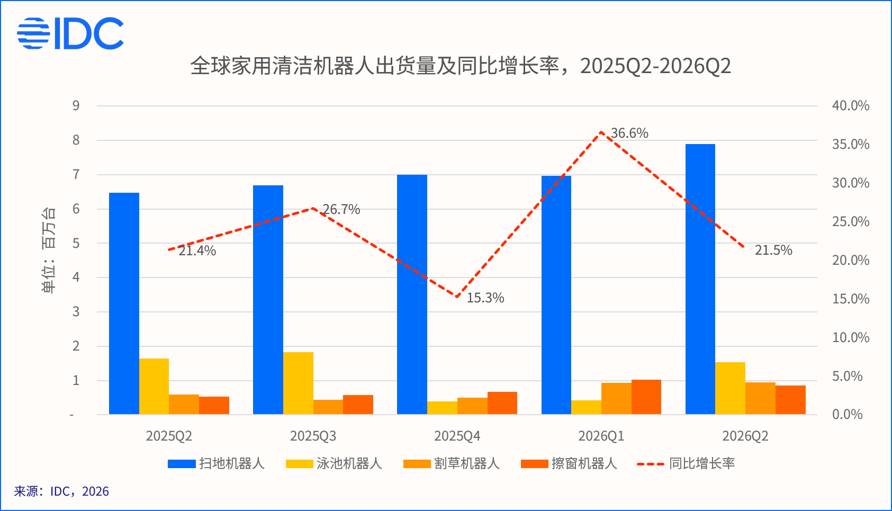
2025年,全球家用清洁机器人市场交出亮眼成绩单,总量突破3200万台。但数据背后的结构性变化更值得深究:哪些赛道正在爆发?谁在改写竞争规则?企业应如何布局未来?本文基于IDC最新发布的系列跟踪报告,为您深度解读扫地、擦窗、割草、泳池等细分赛道的关键转折点,并为行业参与者提供切实可行的战略建议。

IDC最新发布的《全球家用智能清扫机器人市场跟踪报告》等系列报告显示,2025年全球家用清洁机器人市场整体出货量达到3272万台,同比增长20.1%,其中割草机器人同比增长63.8%,引领细分品类增长。2025 年,头部扫地机器人企业持续拓展产品边界,布局割草机器人、泳池机器人等新兴细分赛道。与此同时,中国初创企业在割草机器人与泳池机器人领域表现亮眼,凭借出色的产品竞争力在欧洲、北美市场快速提升份额,对割草、泳池赛道中的海外传统行业龙头形成有力冲击。对于行业从业者、投资者以及关注这一领域的观察者而言,理解这些变化背后的驱动力,是在未来竞争中占据主动的关键。

一、 扫地机器人:存量竞争下的战略分野

作为家用清洁机器人的基本盘,扫地机器人市场在2025年出货2412.4万台,同比增长17.1%。其中,中东非与中东欧市场表现尤为突出,增速分别高达95.6%和40.3%,成为拉动全球扫地机器人行业增长的核心区域。IDC分析认为,这一增长态势得益于两大因素:一是这些地区城镇化进程加快,中产阶级家庭数量上升,对智能化家居产品的接受度提升;二是中国品牌加速出海布局,通过本地化运营和更具竞争力的产品定价,激活了此前未被充分开发的潜在需求。

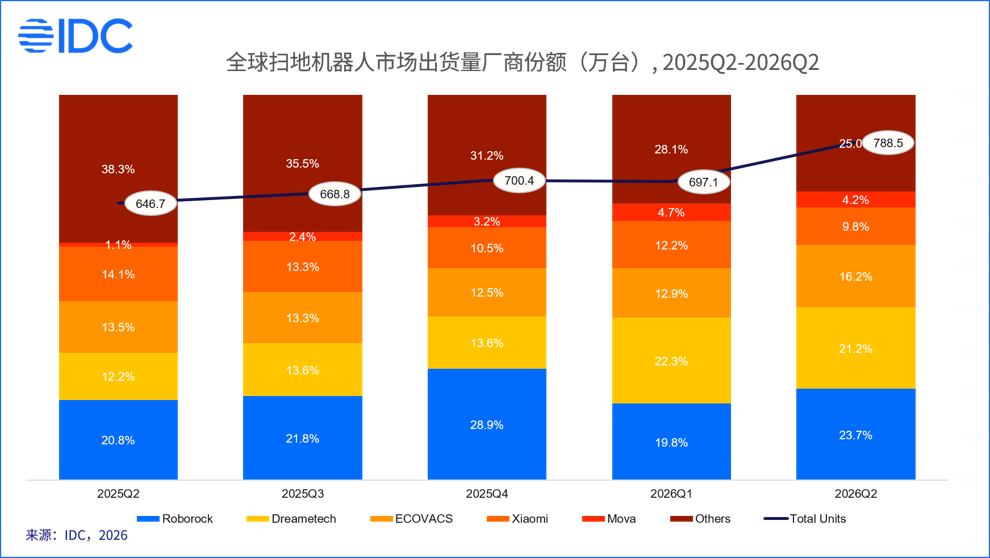
石头科技凭借技术优势和全球化布局,2025年继续稳居全球市场首位,同时在美国、德国、韩国等主要国家位列第一;追觅则依托在欧洲市场的强劲增长,市场份额快速提升,成为中国品牌出海的又一成功样本。曾经的行业巨头iRobot在2025年跌出全球前五,其传统优势区域如北美、日本等地的市场份额,正被中国品牌进一步蚕食。这一此消彼长的态势,不仅是市场份额的转移,更深刻反映出不同战略路径的阶段性结果。

IDC观察到,面对日益激烈的竞争,扫地机器人企业正加速战略转型,呈现出两条清晰的演进路径:一部分厂商选择“纵向深耕”,聚焦全场景家庭机器人赛道,围绕家庭环境拓展产品矩阵,从地面清洁延伸到家庭户外庭院等场景;另一部分则选择“横向拓展”,向全品类科技企业升级,依托在算法、供应链等方面的积累,布局更多消费电子领域,拓宽业务边界。这两种路径各有利弊,如何选择未来的战略方向,将成为企业下一阶段发展的分水岭。

二、擦窗机器人:结构性需求与同质化竞争并存

擦窗机器人作为家用清洁机器人的重要补充,2025年出货量达到237.3万台,同比增长70.4%,增速仅次于割草机器人。科沃斯以超50%的份额稳居行业首位。在中国市场,城镇化进程中高层住宅比例的提升,使得外窗清洁成为刚需,而人工清洁不仅成本高,且存在安全隐患,这为擦窗机器人创造了巨大的替代空间。在海外市场,大户型住宅的落地窗设计同样催生了对自动化清洁方案的需求。IDC调研发现,中低端产品同质化严重,产品功能、外观设计高度相似,导致促销周期价格战频发。当前产品正朝着无线化、智能化持续迭代升级。

割草机器人:技术迭代引爆市场,中国初创改写游戏规则

2025年,全球割草机器人市场迎来爆发式增长,全年出货199.2万台,同比增长高达63.8%,成为所有细分品类中增长最快的赛道。比整体增速更值得关注的是内部的结构性巨变:无边界割草机器人出货量达到131.8万台,占比跃升至66.2%,同比暴涨182.4%;而传统的埋线款割草机器人则出货67.3万台,同比下滑10.1%。IDC深入分析认为,这一转型的背后是三大驱动力的共同作用:首先,定位导航技术的成熟是关键基础,卫星定位、视觉导航、激光雷达等技术的成本下降和性能提升,使得无边界方案从高端走向普及;其次,用户体验的代际差异加速替代,埋线方案需要复杂的施工布线,而无边界产品真正做到“开箱即用”,契合了欧美DIY文化的消费偏好;第三,中国供应链的规模化优势大幅降低了高性能产品的制造成本,使得无边界割草机器人的价格进入大众市场可接受的区间。

在快速增长的无边界割草机器人市场,一个引人注目的现象是:前六名均为中国厂商。以九号公司、追觅、科沃斯为代表的科技企业,凭借高性能产品及极具竞争力的价格,正在加速超车。IDC指出,传统园林工具厂商虽然在品牌认知和渠道布局上具备先发优势,但在智能化技术的快速迭代面前,这一优势正被快速削弱。中国厂商不仅在产品性能上实现赶超,更通过电商渠道和新兴零售模式,直接触达终端消费者,绕过传统渠道壁垒。

泳池机器人:平静水面下的暗流涌动

泳池机器人市场整体表现较为平稳: 2025年,全球泳池机器人市场细分数据显示:地上泳池机器人(不具备爬墙能力)出货125.7万台,水面清洁机器人出货23.3万台,地下泳池机器人(具备爬墙能力)出货274.7万台。

在这三大细分品类中,地下泳池机器人是技术门槛最高、价值最大的核心赛道。值得注意的是,在这一品类中,无缆部分占比达到55%,同比增长32.8%。近年来中国厂商凭借无缆产品的创新突破,对这一格局形成有力冲击。智能化趋势正在加速渗透这一传统赛道。消费者对泳池机器人的期待,正从“能清洁”转向“会清洁”——能够自主规划路径、识别污渍类型、通过APP远程控制、甚至与家庭智能系统联动。这一趋势为中国厂商提供了弯道超车的机会,也对传统厂商的技术升级提出紧迫要求。

从数据看趋势:2025年全球清洁机器人市场的三大核心洞察

洞察一:中国品牌主导产品形态升级和技术创新方向,同时加速抢占全球市场份额

依托完整供应链、快速迭代能力与算法优势,中国厂商在扫地、擦窗、割草、泳池等多品类同步突破。从无线化到AI导航,从全能基站到多机协同,这些由中国厂商率先大规模应用的技术正在成为行业标准。当前全球头部阵营已基本由中国品牌占据,技术与规模双重壁垒不断加固。

洞察二:细分市场品牌竞争仍处于洗牌期,尤其在割草机器人与泳池机器人赛道,厂商格局仍有较大变化空间

这两大品类正从有线向无线、从随机向规划快速升级,行业渗透率仍处低位。以初创企业为主的新玩家与跨界大品牌持续涌入,技术路线、渠道布局与产品定义尚未完全固化。价格、性能、资本稳定度与海外本土化运营共同影响最终格局,头部集中度仍有重塑可能。

洞察三:具备持续AI能力的厂商将在新一轮竞争中胜出。AI大模型、多传感器融合、自主决策与具身智能技术,正在重构避障、路径规划、污渍识别、故障自愈与智能交互能力。这些能力的提升,正在带来显著的体验差异与品牌溢价,而清洁能力正是消费者最为重视的产品基础。能够持续投入算法、数据与场景理解的厂商,将在高端化、全球化与生态化竞争中占据主动,最终成为市场主导者。

结论与建议:如何决胜家用清洁机器人下半场

2025年的数据清晰地表明,家用清洁机器人市场正加速从单一的家庭清洁工具,向家庭智能服务助手跃迁。面对中国品牌主导、技术快速迭代、细分赛道分化的竞争新格局,IDC为行业参与者提出以下四点切实可行的战略建议:

建议:在细分赛道的洗牌期精准卡位,寻找战略定位。割草机器人和泳池机器人仍处于从有线向无线、从随机向规划快速升级的窗口期,品牌格局远未定型。新玩家和跨界者仍有大量机会进入并建立优势。企业的成功将不仅仅取决于产品性能与价格,更取决于多维度的战略选择:技术路线上,是采用RTK还是视觉导航,需要根据目标市场和成本结构做出权衡;渠道布局上,是发力线上直营还是线下渠道合作,需要结合产品定位和区域特点;资本策略上,如何在研发投入和价格竞争中保持财务稳健;海外运营上,如何实现真正的本土化而非简单的产品出口。这些问题的答案,将共同决定企业在洗牌期中的最终位置。

建议:将AI能力构建为长期核心护城河,而非营销噱头。AI大模型与具身智能技术正在从根本上重构用户体验的核心环节:避障能力从“识别障碍物”升级到“理解场景”,路径规划从“全覆盖”升级到“重点区域强化”,污渍识别从“按模式清扫”升级到“按污渍类型调整清洁策略”,人机交互也从“按键控制”升级到“自然语言对话”。厂商应将AI能力建设作为长期战略投入,而非短期营销噱头。清洁能力始终是产品的基石,而AI能力则是实现高端化、全球化和生态化的通行证。

建议:构建多品类协同的场景生态,而非孤立产品。2025年的数据表明,头部厂商正在从单一品类向全场景布局演进。对于用户而言,清洁不是孤立的需求,而是家庭生活的一部分。能够提供更多场景家庭服务的厂商,有机会构建更高的用户粘性和品牌忠诚度。IDC建议,有条件的厂商可以思考如何通过统一的APP、一致的交互体验、共享的技术平台,实现多品类产品的协同效应。这不仅能提升单客价值,也能积累更丰富的数据资产,反哺算法迭代和产品创新。

IDC中国高级分析师赵思泉认为,作为机器人市场的重要组成部分,家用清洁机器人凭借落地场景及成熟技术率先走入大众视野,服务全球家庭。在消费升级、技术成熟与场景拓展的共同驱动下,行业整体保持高速增长,智能化成为长期发展主线。

延伸阅读与交流:

如需了解更多IDC相关研究或进一步与我们沟通,欢迎识别二维码与 IDC 联系,我们将安排专人与您对接,为您提供定制化的市场洞察与咨询服务。


如需了解IDC在智能终端领域的最新研究报告、数据产品及行业分析,请扫描二维码,在线获取完整研究目录与内容简介,助您精准把握市场脉动。

Claire Zhao - Senior Market Analyst - IDC

Claire Zhao is senior market analyst for Client System Research of IDC China. She is responsible for conducting research on the augmented reality (AR)/virtual reality (VR) market, and vertical analysis for the PC market. She started working for IDC China as a summer intern in 2019 as part of the Telecommunication group. Prior to joining IDC, Claire did some internships in the banking and insurance industries, and had some research experiences related to risk management, financial market, and data analytics. Claire graduated from Rensselaer Polytechnic Institute with a master’s degree in Financial Mathematics.

AI is no longer an experiment. It is becoming the operating system of the enterprise.

IDC Directions 2026 is designed for leaders who need to move from AI pilots to coordinated, enterprise-wide execution with clarity, confidence, and evidence behind every decision.

On April 8 in Boston, senior technology and business leaders will come together to distill IDC’s global research into the signals that matter most now and pressure-test their strategy directly with the analysts shaping the conversation.

Why IDC Directions Matters Now

In the AI era, competitive advantage will belong to organizations that orchestrate intelligence not just deploy it.

Organizations are navigating converging pressures: economic volatility, regulatory scrutiny, workforce disruption, and the shift from AI experimentation to agentic execution.

The risk is not lack of information. It is misalignment.

When AI initiatives scale without orchestration:

  • Infrastructure fragments
  • Data governance lags
  • Security gaps widen
  • Value becomes difficult to prove

IDC Directions 2026 is structured to eliminate that drift. It brings together macro-level intelligence and practical dialogue so leaders can align architecture, data, governance, and business outcomes before decisions harden.

From Hundreds of Reports to Clear Priorities

IDC publishes hundreds of research reports each year across AI, infrastructure, data, security, services, telecom, devices, industries, and more.

That depth is a strength. But for executives, the question is focus.

  • Which signals require action now?
  • Where should you go deep?
  • What research should guide your next investment decision?

Directions distills that portfolio into one concentrated experience built around strategic decision areas.

The day opens with exclusive keynotes that frame the enterprise challenge:

  • Lorenzo Larini, IDC CEO will outline how IDC is transforming tech intelligence for the AI economy, delivered at AI speed, embedded into workflows, and grounded in research rigor.
  • Meredith Whalen, Chief Product & Research Officer will demonstrate how IDC’s product and platform innovation is translating research vision into applied value.

This sets the context: insights must move at the speed of AI without sacrificing credibility.

What Technologies Will Define Competitive Advantage?

In the morning Lightning Round, IDC analysts provide a curated scan of what is approaching enterprise relevance.

Expect rapid insights on:

  • Agentic AI platforms
  • Quantum computing pathways
  • Robotics and edge intelligence
  • Advanced connectivity and intelligent networks
  • The evolution of consumer engagement in an AI-driven world

This is not speculation. It is research-backed perspective designed to help leaders separate signal from noise.

Four Tracks. Four Strategic Decision Areas.

The afternoon breakout sessions are organized around distinct enterprise priorities so you can go deep where it matters most.

Track 1: AI-Ready Infrastructure

How organizations are modernizing compute, storage, networking, and cloud operations to support agentic workloads at scale. Sessions address ROI tradeoffs, deployment models, silicon strategy, security, observability, and AI-ready data centers.

Track 2: Emerging Tech

How agentic AI, quantum computing, advanced connectivity, robotics, and intelligent devices are reshaping industries and competitive dynamics.

Track 3: Putting Data to Work

How trusted data foundations enable AI value. Explore governance, event-driven architectures, data products, integration, and risk mitigation strategies required for autonomous execution.

Track 4: Marketing & Business Growth Strategies

How AI is transforming marketing from campaign execution to continuous intelligence reshaping discovery, brand relevance, and C-suite alignment.

Each track reflects areas where IDC has produced extensive research and where leaders are facing immediate decisions.

Direct Access to 100+ IDC Analysts

What differentiates IDC Directions is not just the content; it is the dialogue.

More than 100 IDC analysts across AI, infrastructure, security, data, enterprise applications, services, public sector, manufacturing, retail, financial services, telecom, and sustainability will be onsite.

This breadth matters because AI investments are cross-domain decisions.

Attendees can schedule dedicated 1:1 meetings to:

  • Pressure-test investment strategies
  • Validate architectural assumptions
  • Understand peer approaches
  • Identify relevant IDC research for deeper follow-up

In a year defined by agentic orchestration, synthesis across disciplines becomes a competitive advantage.

How Do You Turn AI Investment into Durable Value?

Enterprises turn AI investment into durable value by aligning infrastructure, trusted data, governance, security, and measurable business objectives before scaling initiatives. Architecture and oversight must be designed early — not retrofitted after pilots show promise.

Across the agenda, a central question drives discussion:

How do enterprises move from AI pilots to scalable, governed, value-producing systems?

Leaders are confronting practical challenges:

  • How do we operationalize agentic AI responsibly?
  • What infrastructure is required to support autonomous workflows?
  • How do we measure ROI realistically?
  • How do we maintain governance and compliance at scale?

IDC analysts will provide research-backed guidance grounded in real-world implementation patterns.

The focus is pragmatic: aligning architecture, data, governance, and business impact so AI initiatives do not stall between pilot and production.

A Concentrated Way to Gain Strategic Clarity

IDC Directions 2026 is not a replacement for IDC’s research portfolio. It is a catalyst for using it more effectively.

In one day, you can:

  • Understand macro forces shaping the AI-driven economy
  • Go deep into priority areas aligned to your role
  • Engage directly with leading analysts
  • Identify which research should guide your next decisions
  • Experience the AI Lab and emerging intelligence tools
  • Build peer connections facing similar inflection points

In an AI-fueled economy, clarity is a competitive advantage.

Leaders who align architecture, data, and governance early will scale faster and with fewer costly missteps.

IDC Directions 2026 is built to help you navigate your next move with confidence.

IDC Directions 2026
April 8, 2026 | Boston, MA

Explore the agenda and register at:
https://www.idc.com/events/directions/

Ryan Smith - Content Marketing Director - IDC

Ryan Smith is the Director of Content Marketing at IDC, where he leads brand-level content and social media strategy, aligning research insights with compelling storytelling to engage technology decision-makers. With a background in both IT and marketing, Ryan brings a unique blend of technical understanding and creative strategy to his work. He’s also a seasoned storyteller, speaker, and podcast host who believes the right message, told the right way, can drive both trust and transformation.

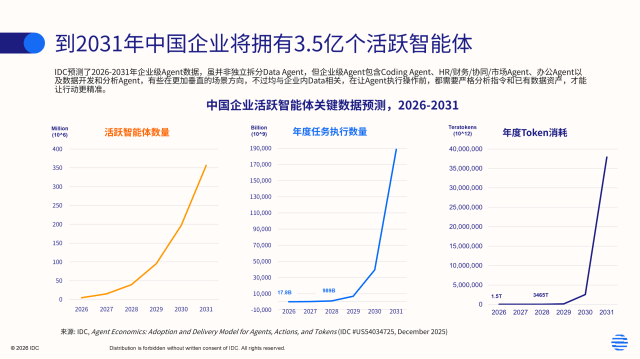
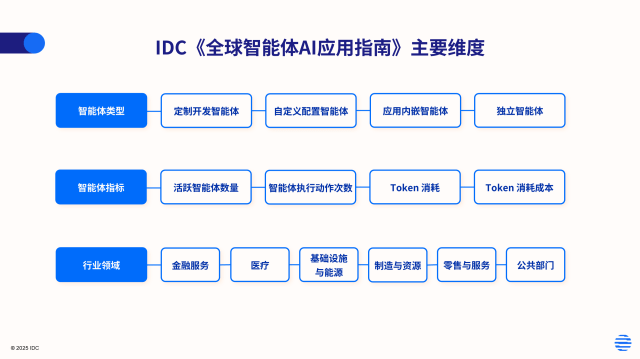
中国企业的活跃智能体规模正在进入一段前所未有的加速期。随着本土模型能力的持续升级、智能体技术与应用生态的快速成熟,以及产业政策的叠加共振,中国企业活跃智能体数量将在2031年突破3.5亿规模,年复合增长率达到135%以上,这一增速将领先全球主要市场。同时由于智能体任务执行密度的增长和任务复杂度的提升,也将带来智能体Token消耗年均超30倍的指数级跃升。在规模爆发的背后,是中国智能体市场技术、生态、政策的三重叠加

中国智能体规模爆发的底层逻辑

中国智能体市场之所以能够在未来几年迎来如此陡峭的增长曲线,有三个关键因素:模型能力的跃升,智能体生态的成熟,以及产业政策的推动。三者的叠加,共同构成了这轮爆发的底层逻辑。

1. 模型能力的跃升

过去两年,中国本土大模型在推理、工具、代码、长上下文处理等核心能力上持续突破,为智能体的落地提供了坚实的技术底座。更重要的是中国本土模型兼具性能与成本优势,这使更多中小规模场景具备了经济可行性,也为智能体开始大规模进入企业场景创造了条件。

2. 智能体生态的成熟

模型能力的成熟只是基础,生态的互联则是智能体规模化更为关键的一环。以OpenClaw为代表的智能体产品,通过生态打通和工具整合,展示了智能体在跨系统跨生态场景下能够实现超预期的生产潜力。这背后正是MCP、Skills等标准化协议的落地,让智能体以标准化方式低门槛的接入更多的系统、工具和能力,拓展了智能体能够完成任务的边界,也为智能体的规模化提供了现实条件。

3. 产业政策的推动

产业政策也是中国市场智能体爆发的重要推手。国务院印发的《关于深入实施”人工智能+”行动的意见》(国发〔2025〕11号)明确提出,到2027年智能体等应用普及率超过70%,到2030年超过90%,同时,各部委及地方政府也在产业政策与财政支持层面持续加码。在政策支持下,智能体相关项目的预算确定性与推进节奏会进一步提升,推动中国智能体市场进入加速放量阶段。

规模化将带来更大挑战

当模型能力已经跨过可用门槛,智能体技术和生态日趋成熟,企业获得智能体的门槛正在快速降低。但拥有智能体只是第一步,企业真正的挑战,则是如何在生产环境中稳定、安全、可持续地同时运营成百上千个智能体。

1. 架构压力:系统必须对AI可读

随着智能体逐步融入企业运营的核心执行层,企业级软件系统正进入一个新的设计范式。未来的系统在服务人类用户的同时,也需要具备高度的AI可读性,使智能体能够通过MCP等标准化协议进行无缝调用。这对软件供应商的产品架构提出了系统性的升级要求。

2. 治理压力:信任成为生产前提

随着智能体进入核心业务流程,全链路可观测、细粒度权限控制、可审计机制将成为基础能力。

尤其在中国市场,数据安全与信创要求使部署环境更为复杂。核心数据不出域成为前提,端云协同与混合部署成为常态。智能体数量越多,治理能力越成为门槛。未来的分水岭,不在技术,而在组织信任结构。

3. 成本压力:Token正在改变IT预算逻辑

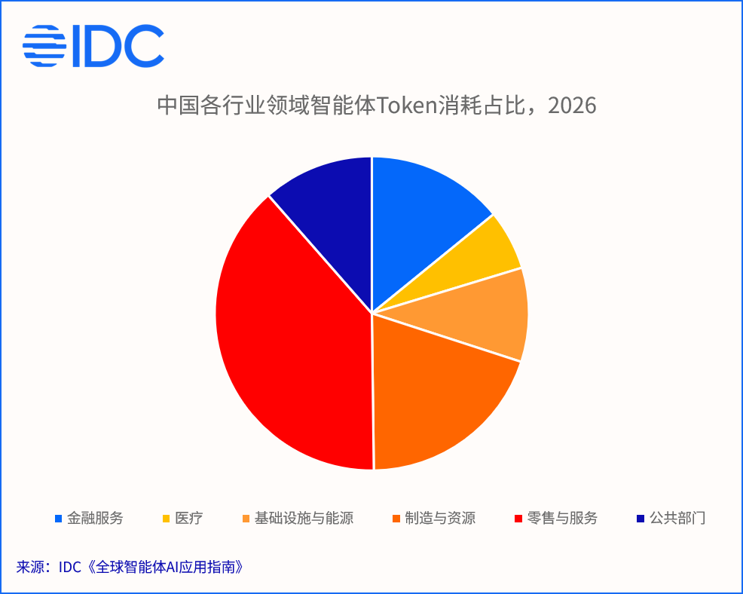
当前中国市场的企业端的Token消耗仍以对话与生成式AI为主,但随着智能体运行规模与任务复杂度的同步提升,活跃智能体的Token消耗进入高速增长期,将为企业带来持续的成本压力。因此成本可观测与效能监测,将成为智能体应用商业可持续性的核心能力。

四类智能体,四种增长路径

并不是所有智能体都会以相同节奏增长。中国市场正在形成四类结构分化。

  • 应用内智能体:最快落地,但增速将趋稳

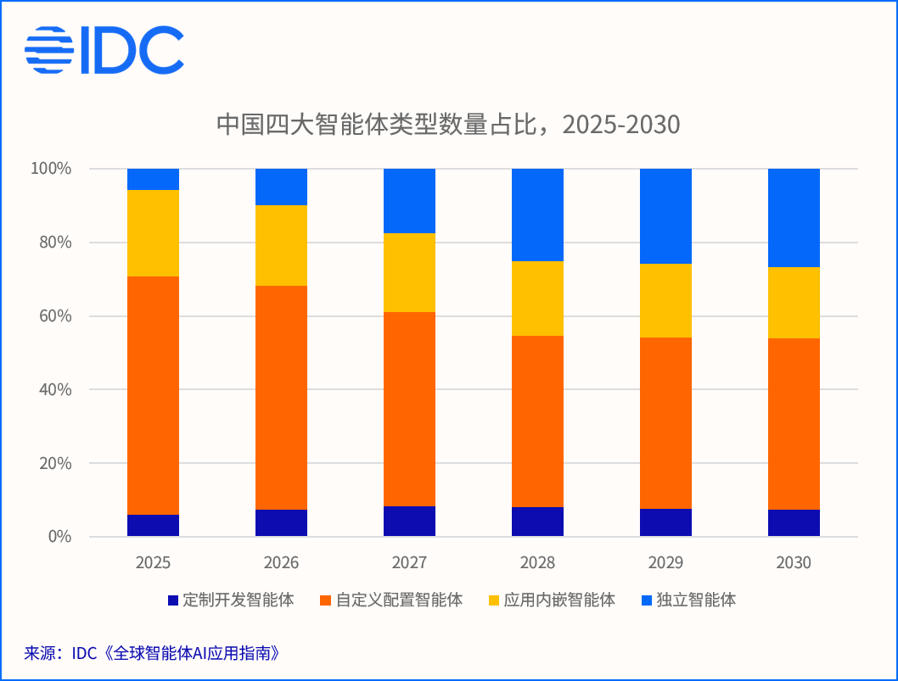
在智能体技术普及初期,ERP、CRM、IM等企业级SaaS厂商正积极在其产品线中嵌入智能体能力,依托入口优势与庞大的客户基础快速打开市场。应用内智能体的核心优势在于零迁移开箱即用,天然打通已有业务数据和工作流,且与企业存量采购路径一致,能够大幅降低企业应用智能体的决策门槛和组织阻力。随着企业需求逐步向端到端跨系统协同演进,此类智能体的增速将在2027年后将逐步放缓。

  • 低代码/无代码智能体:数量最大

在中国市场,基于低代码/无代码平台构建的智能体在数量上将持续占据绝对多数,主要得益于中国市场早期开源和免费的平台级产品的教育和普及。这类智能体能够支持业务团队快速开发智能体,降低智能体应用门槛,满足企业长尾场景中的智能体需求,因此总量将非常巨大。IDC预测,这类智能体将从2026年的约300万增长至2031年的近2亿,并始终占据全部活跃智能体的半数以上。

  • 独立智能体:弹性最大

独立智能体是不依附于某个主应用、能够跨系统执行复杂任务的智能体产品,当前的部署规模仍然较少,但增速弹性最大。独立智能体会随着系统的开放性和智能体互操作协议与工具生态(如MCP等)的发展而快速爆发。到2031年,中国市场独立智能体的活跃数量占比将从2026年的7.5%升至20.1%,与应用内智能体的数量持平。

  • 定制智能体:数量少,价值密度高

定制智能体的部署数量占比最少,其主要服务于专有业务、高安全性与高可控需求的高价值场景,尤其是大型国有企业、政府及事业单位这类对信息安全和自主可控有严格要求的组织。定制化交付成本高、实施周期长、治理复杂度大,这类智能体的数量不会特别多,其增长更多体现在价值密度而非数量。

IDC中国研究经理孙振亚表示,这一轮增长将为企业打开一个难得的战略机遇期,率先布局智能体的企业,将在效率提升、成本优化与业务创新三个维度同步获益。在这一进程中,企业应尽快完成从智能体场景验证到规模化运营的能力沉淀,在架构升级、治理体系与成本管控上做好准备。

给技术供应商与企业用户的建议

智能体技术生态的成熟与国家战略的牵引正在形成共振。企业应主动将智能体纳入数字化转型的核心规划,加速完成智能体体系能力的沉淀;而技术供应商更应紧抓这一战略机遇,抢占发展先机。建议技术供应商和企业采取如下行动:

  • 推动AI可读的架构演进

积极采纳MCP等主流互操作标准,通过模块化与标准化接口降低集成门槛,使智能体能够跨生态系统流畅地检索信息、调用工具并完成端到端的任务闭环。系统架构应从顶层设计上支持多智能体与人的灵活协同,以平台化、组件化思路沉淀可复用的能力模块,为智能体的规模化增长奠定基础。

  • 深化数据与知识工程建设

智能体的高效运转依赖于高质量的数据与领域知识支撑。中国市场SaaS渗透率相对较低,企业内部数据治理尚不完善,大量关键业务经验仍以隐性知识的形式留存在核心人员的经验中,尚未转化为可被系统化调用的显性资产。企业应优先推进数据治理与知识沉淀,打通数据孤岛,将行业专有经验与隐性知识转化为智能体可调用的规则体系与知识资产。

  • 建立智能体运维体系

随着智能体运行规模与任务复杂度的同步提升,Token消耗将进入高速增长通道,算力成本将成为关键要素。技术供应商需在Token缓存、上下文加载、智能体记忆管理等环节持续布局,企业则需建立常态化的成本效能监测与治理机制,精准掌握各项投入产出指标,确保技术应用的商业可持续性。

  • 完善合规治理与可观测性

在引入智能体之初即应规划健全的权限管理、行为审计与责任追溯机制,将合规约束转化为标准化的平台服务。尤其在政务、金融、央国企等强监管领域,全链路可观测与可审计的能力覆盖将成为生产级部署的基础要求。

更多研究,请关注IDC 2026年中国AI研究计划。

如需进一步了解与研究相关内容或咨询 IDC其他相关研究,请点击此处与我们联系。

Zhenya Sun - Research Manager - IDC

Zhenya Sun is a research manager for the IDC team focused on exploring the application of technology and industrial development of AI and AI agents. He is also responsible for providing clients with consulting services on technologies, products, and markets related to large language models (LLMs) and AI agents, as well as delivering speeches at industry conferences and internal seminars. Before joining IDC, Zhenya served as a project management officer (PMO), responsible for internal and external strategic consulting, AI application research and advisory services, AI project framework standardization, management system construction, and technical training on AI applications. Prior to that, he also led initiatives in product development process optimization and user market analysis. Zhenya holds a Master's Degree in Engineering Management with a specialization in Information Systems Engineering from the University of the Chinese Academy of Sciences.

OVERVIEW

The escalation of conflict in the Middle East introduces a new macroeconomic and geopolitical variable into an already fragile global technology environment. While IDC does not comment on political dynamics, the technology sector implications are immediate and measurable. Based on early regional intelligence and IDC’s macroeconomic modeling framework, we see six primary impact vectors on IT spending: energy price volatility, cloud and data center resiliency, sovereign infrastructure acceleration, cybersecurity, supply chain, and shifts in consumer and enterprise investment sentiment. Given the early and rapidly developing nature of this situation, we are focusing most of our scenario analysis and forecasts on a war limited to the middle east  which lasts for less than 3 months. We won’t be publishing scenario data for a longer timeline at this stage. As we continue to monitor the situation, we’ll decide whether the likelihood of that longer timeline becomes clearer and more relevant.

In a downside scenario where the conflict lasts for up to 3 months, the impact on IT spending would be measurable but relatively moderate. Service providers are likely to maintain aggressive investment plans for AI infrastructure deployment at global scale, even in the context of a weakening macroeconomic environment. A relatively short conflict would have limited impact on demand for cloud services and enterprise software, but returning inflationary pressures could put a drag on device upgrades and some discretionary spending.

In this downside scenario, global IT spending would grow by around 9% in 2026, versus our baseline forecast of 10% growth. A longer conflict would have a more pronounced impact on IT spending but is currently more difficult to predict.

IT spending in the Middle East and Africa region was $155 billion in 2025, representing 4% of the global market, and is currently forecast to increase by 5% in 2026. This is lower than global growth, due to memory price pressures on device markets which make up a larger share of IT spending in the region.

In a downside scenario where the conflict is resolved within 3 months, IT spending growth in MEA would fall into the range of 3-4% this year, with negative implications for business and investor confidence in the short term. The impact at country level would be extremely mixed, reflecting oil supply dynamics and other factors. A longer conflict would have a greater impact.

However, we currently maintain our baseline forecast which assumes a short conflict that will be less disruptive for underlying IT demand including AI infrastructure deployment, cloud migration and ongoing digital transformation initiatives.  We will continue to monitor and update as the situation develops.

Below is IDC’s structured assessment of the near- and mid-term implications for IT spending across the Middle East and globally.

1. Energy Price Shock: The Primary Transmission Mechanism

Oil prices rose 7–8% immediately following the escalation, with Brent crude moving toward the $70–$80 range. IDC’s IT spending model has an oil price baseline average in the $65-75 range.  IDC’s model assumes average oil prices will rise between $75-85 based upon a 3-month conflict and if the conflict last longer, IDC expects oil prices to inch close to $100 or more.

Amplifying supply side concerns is the shutdown of Aramco refinery production—reportedly impacting approximately 500,000 barrels per day.  Qatar Energy has temporarily stopped gas production, which has escalated gas prices in Europe to 40-50% higher.  If the war continues for an extended period of time, the input costs will greatly increase for those countries that heavily rely upon gas and oil from the region.  

Energy price volatility is the most significant macro transmission through which this conflict will impact overall IT spending assumptions for 2026. Energy price increases will create new inflationary pressures and could have a significant impact on central bank monetary policy. Business and consumer confidence remain extremely fragile, following the period of high inflation in recent years, while IT products are also facing inflationary pressures from memory component shortages. Rising prices may result in spending delays and reallocations.

IT Spending Implications

Global Level
  • Higher energy prices increase operating costs for data centers, semiconductor fabrication, logistics, and manufacturing.
  • Sustained inflation may delay interest rate cuts, tightening capital availability for enterprise IT projects; and negatively impact business and consumer sentiment for IT purchases.
  • Input cost pressures could trigger reprioritization of AI and digital transformation initiatives.
Regional (Middle East)
  • Prolonged conflict and defense expenditures could offset surplus revenues from oil price increases, postponing spending on technology investments.
  • Only mandatory technology spending to support business continuity, strengthen cybersecurity, and adoption of sovereign infrastructure will be prioritized.
  • Government-led digital transformation programs may be sustained in wealthier Gulf states but face reprioritization elsewhere.

2. Cloud & Data Center Resiliency Becomes a Strategic Imperative

This war marks the first time where major cloud provider regions and availability zones are operating in an active conflict zone. A series of strikes on multiple facilities of a global cloud provider within multiple availability zones in first few days highlights architectural resiliency, but also the potential vulnerability of cloud environments in a period of sustained conflict. IDC projects that investments in cloud, storage and data center architecture will be an investment priority. However, data center construction is capital intensive and multi-year. Rising construction costs, higher financing costs, and supply chain friction could slow execution timelines.

Key Structural Shifts

  • Multi-Availability Zone (AZ) architecture becomes the minimum standard for enterprises and SaaS providers using public clouds. Multi-region becomes a best practice.
  • Risk modeling for cloud deployments by multinational entities will expand from country-level to regional resiliency frameworks.
Middle East Impact

We expect:

  • Acceleration of locally owned sovereign cloud and domestic datacenter investments with built-in redundancy.
  • Increased hyperscaler commitments to multi-AZ, physically separated infrastructure (e.g., three-AZ designs vs. single-AZ footprints).
Global Impact

Globally, this event resets expectations around:

  • Cloud recovery planning.
  • Resilient data center infrastructure
  • Geographic dispersion strategies.
  • Risk premiums embedded in infrastructure investment decisions.

While long-term cloud investment may increase, near-term project pacing could slow as enterprises reassess architecture.

3. Sovereign Infrastructure and Strategic Autonomy

Digital sovereignty was already a defining force in cloud strategy across the Gulf as countries prioritize digital self-determination for their organizations and citizens. Even at this early point in the conflict, governments across the Gulf, particularly capital-rich states, are likely to accelerate investment in sovereign digital infrastructure and distributed cloud models to strengthen agility, resilience, and long-term survivability. They will focus on:

  • Sovereign cloud platforms
  • National Public AI infrastructure
  • Enhanced Cybersecurity systems and response practices by government entities

Countries will increasingly focus on creation of a Critical infrastructure resilience model that aligns with a broader push for “strategic autonomy” and reduces over-reliance on foreign infrastructure providers:

  • Shared public:  Share infrastructure, global operations
  • Dedicated public: Dedicated region, shared operations with local partner
  • National public: Owned & operated by a local cloud service provider
  • Managed private: Customer of provider hosted, provider managed
  • Air-gapped private: Isolated, customer operated

Fiscal dynamics matter, however. Active military expenditures—estimated in billions within the first days of escalation—introduce budget trade-offs. The duration of conflict will determine whether sovereign IT investments accelerate or face temporary reprioritization.

4. Supply Chain: Memory Supply, Smart Munitions, and Semiconductor Pressure

The Middle East plays a crucial role in the global technology supply chain: both as an energy artery and as a logistics and transshipment hub. Any closure or sustained disruption of the Strait of Hormuz would represent a high-severity, low-frequency shock with material implications for global IT markets.

The Strait of Hormuz carries roughly 20% of global oil shipments and a meaningful share of liquefied natural gas (LNG) flows. The most immediate effects of the strait disruption would be to drive energy cost increases resulting in gas price spikes affecting Europe and Asia, higherdata center operating expenses, and increased semiconductor fabrication energy costs. Strait disruptions would also affect shipping and logistics, with expectations for elevated logistics and air freight costs, delays in inbound components destined for consumer technology assembly and distribution, and interruptions to outbound shipments into Africa and parts of Europe.

The strait also underpins major shipping lanes serving Gulf ports such as Jebel Ali (UAE), Dammam (Saudi Arabia), and Hamad Port (Qatar)—critical nodes for re-export of all types of products (including technology products and components) into Africa, South Asia, and parts of Europe.

The global memory market was already constrained prior to escalation. This conflict could exacerbate an already tight memory environment, creating ripple effects across the global IT hardware ecosystem.

Recent efforts to regionalize manufacturing—such as Lenovo’s Saudi-based manufacturing expansion—highlight the Middle East’s increasing role in the global tech supply chain

Risks include:

  • Logistics disruption through Gulf shipping routes
  • Delays in new manufacturing hubs
  • Increased insurance and freight costs

A sustained conflict would drive a spike in military consumption of advanced semiconductors and memory in smart munitions and drone systems and could trigger additional state interventions to secure semiconductor supply for national security purposes. These would introduce additional upward pressure on DRAM and NAND pricing, AI accelerator memory configurations, and Enterprise storage infrastructure costs. Enterprises planning AI deployments may re-evaluate project sequence if hardware costs rise further. Consumer device pricing is also at risk.

The broader effect will depend on the duration and geographic containment of the war. If the war is resolved within weeks, short-term disruption would likely be followed by rapid recovery. A longer conflict would have more serious implications for regional and worldwide market conditions.

5. Cybersecurity: Immediate Escalation and Structural Spending Growth

Geopolitical conflict materially elevates cyber risk. State-sponsored and proxy cyber activity typically increases during periods of military escalation, targeting:

  • Energy infrastructure
  • Financial services
  • Telecommunications
  • Government systems
  • Cloud platforms and SaaS providers

The Middle East has already been a focal point for advanced persistent threat (APT) activity. Escalation raises both attack frequency and sophistication.

Immediate IT Spending Impacts

1. Acceleration of Security Budgets
Security is typically one of the last IT budgets to be cut in uncertain environments. In this context, it is likely to expand. Enterprises and governments will increase spending across:

  • Managed detection and response (MDR)
  • Security operations center (SOC) modernization
  • Zero-trust architecture
  • Endpoint detection and response (EDR)
  • Cloud workload protection
  • Identity and access management (IAM)

2. Infrastructure Hardening
Critical infrastructure operators—energy, utilities, transportation—will increase investment in:

  • Operational technology (OT) security
  • Network segmentation
  • Air-gapped recovery environments
  • Backup and cyber recovery vaults

3. Cloud Security Uplift
As cloud environments become strategic targets, enterprises will:

  • Increase investment in cloud security posture management (CSPM)
  • Expand multi-region backup strategies
  • Demand higher transparency from hyperscalers regarding resilience and incident response

Regional vs. Global Effects

Middle East
  • Government-led cybersecurity programs will expand.
  • Sovereign cyber defense capabilities will receive additional funding.
  • Cyber resilience has become integrated into national digital transformation programs.
Global
  • Multinational enterprises with regional exposure will raise cyber defense spending.
  • Insurance costs for cyber coverage may rise, reinforcing investment in risk mitigation.
  • Defense-related cybersecurity and secure communications markets will grow.

Cybersecurity emerges as a relative beneficiary within overall IT spending, even if broader macro conditions soften total growth rates. Even in a scenario of a longer conflict, security investments would remain relatively resilient.

6.  Consumer Technology Spending and Sentiment

Consumer IT spending was already under pressure due to persistent inflation and memory-related device cost increases. Escalation adds:

  • Consumer sentiment deterioration, with consumer confidence still extremely fragile.
  • Higher device prices due to input costs
  • Supply chain disruption risk

The Middle East also serves as a transshipment hub—particularly through ports such as Jebel Ali—impacting flows into rest of the Middle East, Africa and Europe

Disruption to supply chains could affect PC, smartphone, and device availability regionally and beyond.

Meanwhile, industries linked to discretionary wealth—such as luxury real estate and tourism—may experience spending pauses, indirectly affecting associated enterprise IT investments in the region.

Outside of the Middle East, fragile consumer spending is unlikely to withstand a major or prolonged period of price increases, with rising energy costs potentially causing consumers to delay purchases of PCs, tablets, smartphones and other devices. With prices for these device categories already rising due to memory price shortages, this will only lead to more consumers choosing to wait before replacing their existing devices.  

IMPACT ON IT SPENDING & INVESTMENT

AI Investment: Acceleration or Pause?

Rising input costs and macro uncertainty may cause some enterprises to reassess AI production deployments, especially if the conflict lasts for a longer period. As with consumer confidence, business sentiment remains extremely fragile and uncertain. Any signs of areal slowdown in economic activity may translate into some projects being delayed or downscaled in the near term.

On the other hand, where proven ROI cases and measurable outcomes are delivering rapid efficiency savings, AI may in some cases be deployed more aggressively to mitigate macroeconomic headwinds. Our surveys have shown a consistent trend of more organizations indicating their intention to utilize IT deployments as a tactical response to macroeconomic pressure. This represents a change from previous economic downturns, when IT spending cuts were often a primary contingency response to the first signs of a softening external environment.

Overall, a relatively short conflict is unlikely to severely derail AI and IT spending plans for most organizations. Underlying demand is strong and has proven resilient in the face of external shocks such as tariffs and other geopolitical conflict in recent years. AI remains highly prioritized, with a strong focus on deploying at scale for greater business impact in 2026.

The greater risk would be from a longer conflict, which could place more pressure on available capital and resources due to inflationary pressures and supply chain disruption. AI spending would likely be more resilient than other types of investment, but not immune to a worst-case scenario. .

Two opposing forces are at play:

Constraining Forces
  • Higher infrastructure costs
  • Tighter capital environments
  • Memory scarcity
Accelerating Forces
  • Increased cybersecurity demand
  • Defense-related AI and analytics investment
  • Sovereign AI initiatives in the Gulf

Net impact will vary by geography:

  • Gulf states: continued state-backed AI investment likely.
  • Europe and Asia: greater macro sensitivity.
  • Global enterprises: tighter ROI scrutiny.

Three-Scenario Outlook for IT Spending

IDC’s forecasts for IT spending are updated every month to reflect the latest macroeconomic and industry data. This monthly forecast includes scenarios which reflect historical correlations between technology markets and their sensitivity to changes in economic conditions.

Our most recent baseline forecasts were published on February 27 and already reflect assumptions relating to some volatility in oil prices and supply chain factors. We’ve created two new scenarios to assess the likely impact of a regional conflict which lasts for up to 3 months (scenario 1) or most of 2026 (scenario 2).

While there will be some short-term disruption from a much shorter conflict which is resolved within weeks, we don’t currently plan to revise our baseline February 27 Black Book forecast. A shorter conflict will result in a much faster rebound and resumption of ongoing investments and projects over the course of the year. This is a highly fluid environment, and our baseline assumptions may change in the coming weeks, before the next scheduled forecast release on March 30.

Of the two alternative scenarios we have created, the more likely outcome is one in which the conflict is resolved within 3 months or less. This lingering conflict (months, not weeks) would have a more measurable impact on IT spending, resulting in around a 1.0 percentage point reduction in annual growth. Most of this impact would be concentrated in devices and discretionary project spending. In the absence of other external factors, we don’t expect service providers to significantly pull back their AI investment plans.

Compared to previous military conflicts such as the Iraq war in the early 2000s, the IT industry is now extremely different, having undergone a period of radical transformation over the past two decades. A much larger share of enterprise IT spending is now opex and subscription-based, while a larger share of infrastructure investment is now concentrated in the service provider segment.

The primary risk to enterprise IT spending is related to macroeconomic factors, in particular a period of much higher oil prices which would affect business and consumer spending in addition to central bank decisions around interest rate policy. In the second scenario, where a conflict lasts for more than 3 months, this would result in more postponements of IT projects and device upgrades. The impact on IT spending in this scenario would be greater than 1.0 percentage point.

In the Middle East/Africa region, the impact is more complicated, and likely to be more fluid in the context of ongoing political developments which are difficult to predict. Strategic, regional investment in AI is likely to continue, however, with most of the downside impact focused on business and consumer spending delays.

Our current baseline forecast of 5% growth in MEA IT spending this year would likely fall into a range of 3-4% in the first scenario, where the conflict lasts for several months. The smartphone market was already expected to decline this year, partly due to memory price increases, and things may get worse before they get better. Smartphones make up a larger share of IT spending in MEA than other regions, resulting in lower IT spending growth overall expected in 2026.

However, even in a worst-case scenario where the conflict lasts for longer than 3 months, underlying demand for cloud and AI deployment in the region is likely to remain strong and would recover quickly.

Baseline: Contained Conflict (Weeks)

  • Temporary oil spike.
  • Modest pause in regional projects.
  • Minimal revision to global IT growth outlook.

Scenario 1: Prolonged Regional Instability (Less than 3 Months)

  • Oil sustained at $85–$95.
  • Inflationary pressure dampens global IT growth by 0.5–1.0 percentage points.
  • Accelerated sovereign cloud buildout.
  • Slower consumer device recovery.

Scenario 2: Escalation and Energy Shock (6-9 months)

  • Oil above $100.
  • Delayed interest rate normalization.
  • Significant consumer contraction.
  • Enterprise reprioritization toward resiliency, cybersecurity, and critical infrastructure.
  • More pronounced impact on IT spending, especially in the MEA region.

IDC’s Strategic View

The war in the Middle East is not simply a regional geopolitical event, it is a structural test of the digital economy’s energy dependence, infrastructure resilience, and supply chain architecture.

Key themes IDC will monitor:

  1. Energy price persistence and inflation trajectory.
  2. Cloud infrastructure risk reassessment and redundancy investments.
  3. Memory market tightening linked to defense demand.
  4. Government fiscal trade-offs between defense and digital transformation.
  5. Consumer sentiment shifts and device demand elasticity.

While the Middle East faces immediate exposure, the global IT industry will feel second-order effects through energy costs, semiconductor supply, and capital allocation decisions.

In the near term, caution and scenario planning will dominate enterprise decision-making. In the medium term, this conflict may accelerate structural investments in sovereign infrastructure, cybersecurity, and multi-region cloud resiliency.

IDC will continue to refine its spending outlook as economic assumptions evolve. IT Spending forecasts are published on the last working day of every month, reflecting the latest market data and developments. We’ll monitor this data closely in the days and weeks ahead.

Stephen Minton - Group Vice President, Data & Analytics - IDC

Stephen Minton is a group vice president with the IDC Data & Analytics group, focusing on ICT spending and macroeconomics. Mr. Minton is responsible for Worldwide ICT Spending programs, including the Worldwide Black Book, Worldwide 3rd Platform Spending Guides, and Worldwide Telecom Services Tracker. Mr. Minton's research expertise includes global ICT and economic analysis, and he tracks market data across hardware, software, services, telecom and emerging technologies. He is the author of papers that focus on the economic impact of IT, and is a regular speaker on the subject of IT spending. In 2002 he addressed the United Nations in New York, speaking to UN ambassadors on the subject of the Information Society. Mr. Minton previously worked with Digital Equipment Corporation (DEC), before joining IDC in 1998. Originally from Hartlepool in the North of England, he graduated from the University of Salford in 1995. He has also worked in the field of consumer market research with Millward Brown International.

Laurie Buczek - GVP, Research - IDC

Laurie Buczek is the Group Vice President of Executive Insights at IDC, where she spearheads the global research initiatives that shape the industry's understanding of digital business transformation, evolving buying behaviors, and technology investments. She leads IDC's premier research practices, including the CMO Advisory Practice, C-Suite Tech Agenda, and Digital to AI Business Transformation. As the principal analyst for the CMO Advisory Practice, Laurie advises senior marketing leaders on driving business growth through deeper customer connections and the strategic evolution of the marketing function, with a keen focus on AI's transformative impact. Her expertise and thought leadership empower executives to navigate the intersection of technology, business strategy, and customer engagement in today's dynamic digital landscape.

Rick Villars - Group VP, Worldwide Research - IDC

Rick is IDC's chief analyst guiding research on the future of the IT Industry. He coordinates all IDC research related to the impact of Cloud and the shift to digital business models across infrastructure, platforms, software, and services. He helps enterprises develop effective strategies for using their diverse portfolio of cloud investments and applications. He supplies early guidance on implications of critical innovations such as the shift to cloud-based control platforms for deploying/managing infrastructure, data, and code delivery as well as the emergence of AI as a critical IT workload and part of all IT products/services.

Lapo Fioretti - Senior Research Analyst - IDC

Lapo Fioretti is a Senior Research analyst in IDC Digital Business Research Group, leading the European Emerging Technologies Strategies research. In his role, he advises ICT players on how European organizations leverage new technologies to create business value and achieve growth and analyzes the development and impact of emerging trends on the markets. Fioretti also co-leads the IDC Worldwide MacroTech Research program, focused on the intertwined connection between the Economical and Digital worlds - analyzing the impact key MacroEconomic factors have on the digital landscape and viceversa, how technologies are impacting economies around the world.

Andrea Siviero - Senior Research Director, MacroTech, Digital Business, and Future of Work - IDC

Andrea Siviero leads IDC's European Digital Business and Future of Work Research group. The group provides market research insights to foster a purposeful and fair adoption of technologies supporting digital societies, businesses and workforce and empower tech providers in strategic decision making, planning and go-to-market activities. Siviero also co-leads the IDC Worldwide MacroTech Research program, focused on the intertwined connection between the Economical and Digital worlds - analyzing the impact key MacroEconomic factors have on the digital landscape and viceversa, how technologies are impacting economies around the world.

Thomas Meyer - General Manager and Group Vice President, IDC EMEA - IDC

Thomas Meyer joined IDC in January 1999 and is currently responsible for managing IDC's Research Division in EMEA. This includes Practices focused on Digital Transformation, Cloud, Artificial Intelligence, IoT, Blockchain, Intelligent Process Automation and Accelerated Application Development as well as Core ICT (Software, Services, Infrastructure and Devices) and Industry-specific teams (Financial, Manufacturing, Energy, Retail, Healthcare, Government and Telco Insights)

Ashish Nadkarni - GVP/GM, Infrastructure Research - IDC

Ashish Nadkarni is Group Vice President and General Manager within IDC's worldwide infrastructure research organization. Ashish oversees seven global research practices: infrastructure software platforms, cloud and edge services, storage and converged systems, performance intensive computing, compute infrastructure and service provider trends, enterprise and emerging workloads, and the future of digital infrastructure. Additionally, he oversees two regional research practices: Canadian infrastructure solutions, and Latin America enterprise infrastructure and cloud services. Ashish and his team also curate BuyerView, an industry leading portfolio of primary research products that provide a voice of the IT buyer on technology and services adoption trends including cloud and edge services, artificial intelligence (AI), high performance computing (HPC), security and networking, xOps, and software development.

Simon Ellis - Program GVP - IDC

As Group Vice President, Simon Ellis currently leads the U.S. Manufacturing Insights, U.S. Energy Insights, and Global Supply Chain Strategies practices at IDC, specializing in advising clients on manufacturing/energy strategies, supply chain digital transformation, sustainability, cloud migration, network, and ecosystem design. Mr. Ellis works with end user companies, supply chain organizations and technology providers to develop best practices and strategies leveraging IDC quantitative and qualitative data sets. Within the Supply Chain practices, Mr. Ellis contributes extensively to the Supply Chain Planning and Multi-Enterprise Networks Strategies practice while also overseeing the Supply Chain Execution practices. These supply chain practices specialize in advising clients on supply chain network design, S&OP, global sourcing (Profitable Proximity and Low-Cost Sourcing), warehousing and inventory management, transportation, logistics, and more.

Ranjit Rajan - Research Vice President, Worldwide C-Suite Tech Agenda - IDC

Ranjit Rajan leads IDC’s Worldwide C-Suite Tech Agenda program, advising technology vendors and providers on offerings, competencies, and go-to-market strategies to engage C-level decision makers - including CEOs, CTOs, CAIOs, CIOs, CFOs, and other line-of-business executives. His program analyzes C-suite technology spending and buyer behavior, delivering insights on leadership dynamics, business objectives, technology priorities, and adoption of emerging technologies such as AI and agentic AI. He is a frequent speaker at CxO conferences and often moderates panels and roundtables on technology strategies for C-suite executives. He regularly advises technology vendors, service providers, and telecom operators on market positioning, competitive strategy, and CxO engagement, and has worked with government and regulatory clients on Smart City initiatives, ICT policy, digital skills and innovation. Ranjit also serves as executive analyst for key customers in Middle East, Türkiye, and Africa.

Harish Dunakhe - Senior Research Director, Software and Cloud, META IDC - IDC

Harish Dunakhe leads IDC’s research & advisory practice for the software program in the Middle East, Africa, and Turkey (META) region. He is responsible for a team of research analysts and manages the delivery of insights in IDC’s software program and syndicated research. Harish and his team have expertise in studying technology trends to provide our clients with thought leadership and actionable insights. He is based in Dubai.

Jebin George - Senior Research Manager, Software, Cloud, and Industry Transformation, IDC MEA - IDC

Jebin handles IDC's software, cloud, and industry-specific research for the Middle East, Turkiye, & Africa region. He is located at IDC's regional headquarters in Dubai and works closely with his team and other analysts to gain insights into digital transformation trends, analyze technology spending patterns, and advise technology suppliers and end-users.

Jean Philippe Bouchard - Vice President, Data & Analytics - IDC

Jean Philippe (JP) Bouchard is Vice-President, Data & Analytics at IDC Canada. In this role, JP is responsible for leading the team of analysts delivering Continuous Intelligence Services, Trackers and custom research in the Future of Work and Mobility group, by providing insights on how technology is changing work culture, the workspace, and the workforce itself in Canada. JP’s team also provides insights on mobile phones, PCs, tablets, hard copy peripherals, 3D printing, wearables, AR-VR and consumer services.

In January, Carla Arend, Rahiel Nasir and Luis Fernandes presented IDC’s predictions for cloud in 2026 and beyond. Below is a summary of the main points that were made in the webcast.

The need for digital resilience has never been more crucial

  • Tariffs, supply chain glitches, regulations, skills shortages… digital organisations are being assaulted from all sides.
  • For the majority of EMEA organisations, maintaining operational resilience and cyber security is the top priority.
  • To survive, organisations need to ensure their tech stack is robust and assess the strengths of their tech partner ecosystem. Adaptability and financial stability will also be key weapons to add to the armoury.

Digital sovereignty could help

  • Around half of organisations in EMEA have increased interest in implementing digital sovereignty solutions due to all the geopolitical uncertainties, such as trade tensions, regional conflicts, and regulatory shifts, witnessed in 2025.
  • Digital sovereignty solutions offer data owners complete control and autonomy over their digital assets – maintaining operational resilience is a key tenet of sovereignty.
  • Governance, risk and compliance solutions will be the key focus for organisations looking for sovereign cloud providers, especially for their AI. This will help them reassess their cloud provider options, determine the right IT venue for their workloads, and help to create a more robust tech stack.

The right venue for AI workloads

  • Enterprises are shifting to specialized AI providers and edge infrastructure to maximize performance and efficiency.
  • By 2028, physical AI use cases will experience explosive growth with cloud providers powering the bulk of these deployments at the edge with industry-specific AI agents and high-performance edge infrastructure.
  • By the end of this decade, at least 30% of advanced GPU needs will be met by specialised AI cloud providers offering true cloud features, flexible pricing, APIs, and software services (unlike GPU-only providers).

 AI and cloud modernisation

  • Cloud modernisation continues while legacy systems are re-platformed for AI, using autonomous agents to automate operations and orchestration.
  • Over the next two years, more than half of enterprise apps will leverage SaaS platforms to orchestrate predefined app functions and AI agents for real-time workflows, enabling modular and interoperable solutions.
  • By 2030, 45% will use cloud AI-infused tools to assess cost and performance metrics to optimise workload placement. Furthermore, a fifth will use AI agents to automate workload orchestration.

 Recommendations for cloud users

  • With geopolitical turmoil continuing into 2026 (and probably beyond), organisations are advised to take a risk-based approach to their cloud and AI strategies.
  • Choose the most appropriate venue for your workload. This should be supported by a hybrid and multicloud ecosystem of partners who offer services tailored to your needs.
  • The time to modernise your cloud estate to get ready for AI is now.

Watch the European cloud predictions webcast here:

For the EMEA FutureScape predictions webcast, click here.

If you would like more information on any of the above, please drop your details in here.

Rahiel Nasir - Research Director, European Cloud Practice, Lead Analyst, Digital Sovereignty - IDC

Rahiel Nasir is responsible for leading and contributing to IDC's European cloud and cloud data management research programs, as well as supporting associated consulting projects. In addition, he leads IDC's worldwide Digital Sovereignty research program. Nasir has been watching technology markets and writing about them throughout his professional life.

一个正在被低估的变化已经不只是算力池

过去十多年,云计算的核心价值在于弹性、规模和成本效率。但 IDC 指出,随着生成式 AI 和智能体(Agentic AI)走向生产环境,云计算正在发生一次根本性转变——它不再只是承载应用的基础设施,而正在演进为 AI 运行、治理与协同的核心平台

在中国市场,这一变化尤为明显。一方面,AI 应用对算力、数据、网络和安全提出了更复杂、更高频的需求;另一方面,数据安全、数字主权和成本压力,使企业无法简单依赖单一公有云模式。云计算,正在被迫“进化”。

在《IDC FutureScape:全球云计算2026年预测——中国启示》(Doc# ,2026年,1月)中,IDC 系统性地刻画了未来五年云计算将如何围绕 AI 重构自身形态与价值。

十大预测:AI 如何重新定义云计算的形态与边界(原文引用)

预测 1|云基础架构现代化

2027 年,海量的计算和数据需求将强制超过 85% 的中国组织将传统云环境转型适配 AI 工作负载的新型平台。

这意味着,传统以 IaaS/PaaS 为中心的云架构已难以支撑 AI 应用规模化,云基础架构现代化将成为企业发展智能业务的前提条件。

预测 2|代理式 AI 云运营

2027 年,80% 的中国 500 强企业将会部署代理式 AI 平台,为自动化 IT 云运营提供大规模、持续性的监控、分析、故障修复能力,最小化人工干预。

云运维正从“人驱动”走向“智能体驱动”,IT 团队的角色将随之发生转变。

预测 3|专业的 AI 云服务提供商

2029 年,区别于 GPU 资源提供商,至少 30% 的高等级 GPU 将由 AI 云服务商的具备云特性、灵活计费、API、软件服务的资源覆盖。

企业将越来越倾向于选择“懂 AI 的云”,而不仅仅是提供算力的云。

预测 4|边缘 AI 智能体

2028 年,具身智能将迎来爆发式增长,云服务提供商将通过在企业边缘环境部署 AI 基础设施和智能体支撑其中 60% 的业务场景。

AI 正从中心云走向边缘,云计算的服务边界被显著拉长。

预测 5|基于私有云的企业级 AI 平台

2028 年,为了满足数据隐私需求以及降低公共大语言模型的数据泄露风险,60% 的中国组织将采用能够在数据治理方面提供更多控制能力的私有云平台方案。

私有云正在成为企业级 AI 的关键承载平台,而非“过渡选择”。

预测 6AI 成本治理

2028 年,没有把 AI 投入并入成本治理范围的企业 FinOps 团队将在 AI 相关项目方面面临 30% 的成本增长以及更低的总体回报。

AI 时代,成本治理能力将直接影响云与 AI 投资的可持续性。

预测 7|异构云基础设施

2028 年,超过 80% 的中国组织将采用异构云基础设施,用于平衡混合的 CPUGPU、存储技术以优化 AI 工作负载的性价比。

单一算力形态已无法满足 AI 需求,异构成为常态。

预测 8|云端风险管理

2029 年,基于地缘政治的不确定性,50% 的实施数字化自治的中国组织将迁移敏感的工作负载到新的云平台以降低风险和提高自主能力。

云计算正在被纳入更宏观的风险与主权考量。

预测 9AI 辅助工作负载替代

2029 年,60% 的中国组织将采用云端的 AI 融合工具用于评估成本和性能指标,通过部署 25% AI 智能体自动化工作负载的协同,以优化工作负载的替代。

AI 将参与云资源与工作负载的“自我优化”。

预测 10|智能体 SaaS 平台

2029 年,50% 的中国企业应用将采用 SaaS 平台模式进行实时工作流中的预定义 APP 功能和 AI 智能体的协同,构建模块化和共享交互的解决方案。

SaaS 正在向“应用 + 智能体”的平台形态演进。

这些预测共同说明了什么?

IDC FutureScape 2026 反复传递出一个清晰信号:AI 已经成为云计算发展的第一驱动力。

云不再只是支撑 IT,而是直接决定 AI 能否落地、能否规模化、能否在合规和成本可控的前提下持续运行。忽视云基础架构演进的企业,将很难在 AI 投资上获得长期回报。

分析师观点

IDC 中国高级研究经理张犁认为,中国云计算市场正从“规模增长期”迈入“能力重构期”。FutureScape 2026 显示,云计算正在围绕 AI 重塑自身的架构、服务形态与商业模式——从基础架构现代化、代理式 AI 运维,到私有云与异构云并行发展。那些能够将云战略与 AI 战略深度融合的企业,更有可能在复杂环境中实现业务韧性与持续创新;而仍将云视为单一基础设施选项的组织,将面临更高的成本、风险与转型阻力。

一个面向管理层的综合建议

IDC 并不建议企业孤立地“上云”或“上 AI”。更重要的是, AI 为核心,重新审视云基础架构、云运营模式、成本治理与风险管理能力
云计算,已经从“是否采用”的问题,转变为“是否足以支撑下一代智能业务”的问题。

如需进一步了解与研究相关内容或咨询 IDC其他相关研究,请点击此处与我们联系。

Lee Zhang - Senior Research Manager - IDC

Lee Zhang is a senior research manager for IDC Cloud Computing whose research theme focuses on cloud technology, namely hybrid cloud infrastructure, cloud-native infrastructure, big data infrastructure, microservice architecture, and deep learning (DL)/machine learning (ML) architecture, among others. Lee is also responsible for providing project consulting, market analysis for cloud service providers and end users, in collaboration with IDC local and regional consulting/research teams. Lee previously worked as a solution architect for Alibaba Cloud in the retail business, primarily focused on hybrid cloud solution design and delivery, and digital transformation project management. He assisted all types of clients, such as private enterprises, state enterprises, and government departments, designing digital transformation solutions with cloud technology such as hybrid cloud infrastructure including infrastructure as a service (IaaS)/platform as a service (PaaS)/desktop as a service (DaaS)/software as a service (SaaS), middle-stage infrastructure, big data platform, migration to cloud methodology, microservice architecture, and DL/ML, to name a few. Lee graduated from Beijing Institute of Technology with a master's degree in Business Administration (MBA). He obtained his bachelor's degree in Automation from the Huazhong University of Science and Technology.

当前,中国工业行业正处于由“数字化”向“智能化”跨越的关键拐点,“人工智能+工业”融合发展已成为产业转型升级的核心引擎。向国内市场看,随着需求加速升级、政策持续加码、技术不断演进,工业 AI 正从概念探索迈向规模化应用的新阶段;向全球市场看,各地区及国家对工业场景 AI 采用的重视程度空前高涨,但由于产业基础、IT/OT 架构与合规环境差异,不同区域在落地阶段与机会窗口上呈现明显分化。IDC 认为,中国工业厂商可依托自身技术积累与产业链优势,以多元化路径有针对性地推进海外市场拓展,实现“场景能力—交付体系—生态伙伴”的渐进式出海。

国内市场

工业 AI 规模化落地与智能体爆发式增长的双向共振

工业 AI 的需求已从早期头部企业的探索性投入,转向全行业“提质降本增效”的刚需。根据 IDC 预测,到 2028 年,中国工业企业 AI 支出规模将接近 900 亿元人民币,年复合增长率达到 38%。

到 2030 年,全球活跃智能体数量将突破 22.16 亿个,年复合增长率达到 139%,其中工业领域的活跃智能体是最重要组成部分之一。IDC 认为,智能体数量的快速增长将与工业 AI 的规模化需求形成共振:一方面,工业企业对跨系统协同与流程闭环的诉求更强;另一方面,智能体作为“任务编排与流程执行载体”,有助于将 AI 从“点状能力”升级为“可运营的生产力”,从而加速规模化落地。

国家布局加码,“人工智能+”专项行动锚定工业 AI 规模化落地

2026 年 1 月,工业和信息化部等八部门联合印发《“人工智能 + 制造”专项行动实施意见》,明确提出到 2027 年推出 1000 个高水平工业智能体的目标,标志着工业智能体已从企业自发探索上升为国家层面的系统性布局;同期,国家发展改革委、国家能源局发布《关于推进“人工智能 +”能源高质量发展的实施意见》,与前者形成政策合力,共同推动人工智能技术与制造、能源等工业领域的深度融合应用。

工业智能体正在向强专业属性/高专业适配度技术路线演进

工业本身具有强行业差异与强流程约束,无论制造还是能源行业,每个环节的业务语义、数据形态与约束条件都不同,难以依赖消费级通用智能体“一招通用”。因此,针对工业生产中的设计研发、仿真测试、工艺改进、质量检查、设备运维、能耗管理等不同细分环节,专门适配的工业智能体正在快速增多,并呈现出“更强专业、更深嵌入、更可控可管”的演进趋势。

全球市场

全球各区域工业企业需求多元,中国工业 AI 出海瞄准差异化缺口

根据 IDC 的预测,到 2028 年,全球工业企业 AI 支出规模将接近 2.2 万亿人民币,年复合增长率达到 63%。与中国市场对比可以看出,中国市场的 900 亿人民币工业 AI 支出占比仍有限,海外市场在需求体量、行业多样性与付费能力上,存在更大的市场空间。

同时,IDC 观察到,全球各区域工业 AI 需求呈现差异化:

  • 在欧洲、北美等发达市场,工业企业具备更成熟的数字化与工业软件体系,更偏好体系化、高端定制与长期服务续订,但整体成本高、交付周期长。中国工业 AI 厂商可从工业视觉、能耗优化、新能源场站运维等细分场景切入,以“轻量部署 + 快速见效 + 性价比”形成差异化补位;
  • 在东南亚等新兴市场,工业 AI 落地意愿强但适配性方案与本地化交付供给不足。中国厂商可输出成熟的场景化方案与一体化服务,重点强化本地生态伙伴、交付标准化与运维体系建设,以提升可复制性与持续收入能力。

IDC 也建议,出海不应仅理解为“卖产品/做项目”,更需要同步构建三层能力:合规与数据治理能力、本地交付与合作伙伴体系、以及行业场景的可复用产品化封装。

针对全球制造业、能源行业、供应链三大主题,IDC 全球工业研究在今年已启动一系列与工业智能化相关的研究议题,助力中国工业 AI 厂商进入国际工业企业视野,强化品牌可信度与市场触达效率。

IDC 2026年中国及全球工业研究计划:

更多推荐:

在全球工业 AI 政策护航、需求升级、技术迭代与出海进阶的发展背景下,IDC 同步启动工业 AI 领航者奖项征集,围绕行业先锋、出海先锋、创新先锋等多个维度展开评选,旨在发掘具有可复制价值的行业实践,推动工业智能化从“示范”走向“规模化”,并助力“中国方案”在全球工业智能价值分工中占据更重要的位置。

如需进一步了解与研究相关内容或咨询 IDC其他相关研究,请点击此处与我们联系。

AI 时代的一个被低估事实算力不是瓶颈基础架构才是

在过去一年里,企业对 AI 的讨论几乎全部围绕模型、算力和应用展开。但 IDC 指出,一个正在被反复验证的现实是:真正限制 AI 规模化落地的,并不是模型能力,而是数字化基础架构的成熟度。

当 AI 从“试点探索”走向“生产级运行”,企业的操作系统、数据中心、网络、存储、边缘节点和运维体系,开始承载前所未有的复杂度和压力。数字化基础架构,已经从后台支撑,转变为 直接影响业务速度、成本结构、韧性与可持续性的核心能力。

在《IDC FutureScape:全球数字化基础架构2026年预测——中国启示》(Doc# ,2026年1月)中,IDC 描绘了未来五年企业基础架构将经历的一次系统性重构。

十大预测:数字化基础架构正在发生哪些质变

预测 1|智能体嵌入操作系统成为标配

到2029年,65%的新操作系统版本将搭载基础设施运维 AI 智能体与 MCP 服务器,大幅提升系统利用率、安全性与能耗效率。

操作系统正从“被动平台”演进为“主动运维中枢”,IT 团队将从日常维护中解放出来,转向更高价值的架构与业务协同工作。

预测 2|人工处理逐步退出日常运维

到2030年,45%的日常 IT 运维任务将由智能体 AI 处理;若事件未在平均解决时间(MTTR)目标内完成处理,则采用通知 IT 人员的模式提供指导。

AIOps 正在改变运维范式,人类不再是第一响应者,而是“最终裁决者”。

预测 3|数字孪生优化基础设施

到2028年,40%的数据中心将通过数字孪生(覆盖 IT 设备至设施全环节)实现优化,推动数字基础设施向可持续、高成本效益、强韧性的方向发生根本性转变。

数据中心运维从“事后响应”走向“事前模拟与预测”。

预测 4|异构计算的应用

到2030年,75%的数据中心将在 CPU、GPU、QPU、NPU、LPU、APU 和 DPU 的混合架构上运行工作负载,从而在特定应用场景中实现显著更快、更节能的处理能力。

未来的数据中心,不再是“单一算力池”,而是高度专业化的计算调度系统。

预测 5|液冷标准形成

到2030年,65%的新液冷部署项目将集成开放式行业标准,实现平台兼容性,并将部署、维护、改造及扩容成本降低三分之一。

液冷从“高端选项”走向“规模化基础设施能力”。

预测 6AI 加速容器化转型

到2028年,75%的新 AI 工作负载将实现容器化,从而显著提升模型与工作负载更新的速度、一致性与安全性。

容器成为 AI 推理时代的“默认交付形态”。

预测 7|数据管道现代化

到2028年,65%的中国500强企业将实现数据存储基础设施的现代化,并优化数据流程,以便在可优化 GPU 集群的存储系统上,向 AI 模型提供高质量、经过整理的数据。

没有高质量数据管道,再多算力也无法转化为业务价值。

预测 8|推理向边缘侧迁移

到2027年,随着 AI 的重心从训练转向推理,80%的企业将部署分布式边缘基础设施,以提升 AI 应用的延迟表现与响应速度。

AI 正在从“云中心”走向“业务现场”。

预测 9|网络互联驱动基础设施发展

到2027年,75%的企业将部署面向互联的网络,以支持先进 AI 推理与分布式应用,提升安全性、敏捷性与风险管控能力。

网络从“连接工具”升级为“算力与数据流动的关键底座”。

预测 10|私有数字基础设施的复兴

到2026年,60%的企业将主动对私有 IT 基础设施进行再投资,以提升混合云一致性,优化数据隐私、业务韧性、性能与成本。

私有基础设施并未消失,而是在 AI 时代被重新定义。

这些预测共同说明了什么?

IDC FutureScape 2026 反复强调:AI 的竞争,最终会回到基础架构。

模型可以快速迭代,但基础架构一旦落后,企业的 AI 战略将很难持续。真正的领先者,将是在自动化、异构计算、数据流动和治理能力上,提前完成布局的组织。

分析师观点

IDC 中国研究副总裁周震刚认为,中国企业正从“云优先”迈向“AI 优先”的新阶段。FutureScape 2026 显示,数字化基础架构正在从成本中心转变为战略资产——它直接决定 AI 能否规模化落地、业务是否具备韧性,以及企业能否在不确定环境中持续增长。忽视基础架构现代化的企业,将在 AI 投资回报率、系统稳定性和长期成本控制上承受更大压力。

一个面向管理层的综合建议

IDC 并不建议企业孤立地升级某一层基础设施。更重要的是,以“AI 可持续运行”为目标,对操作系统、算力架构、数据管道、网络与运维体系进行系统性重构。


基础架构不是“是否够用”的问题,而是“是否能持续支撑下一代 AI 应用”的问题。

如需进一步了解与研究相关内容或咨询 IDC其他相关研究,请点击此处与我们联系。

Thomas Zhou - Vice President - IDC

Thomas Zhou is the vice president of Enterprise Research for IDC China. He leads the enterprise research team in covering market analyses, tracking of data, forecasting, and consulting for enterprise computing, storage, networking, infrastructure software, cloud, and datacenter. He is also responsible for IDC data tracking of software, services, and the public cloud services market in China. Thomas speaks frequently at IDC, industry, and user events and is always quoted in leading business and technology publications. Thomas joined IDC in 2006. He provides in-depth market analysis, research, and consulting on all aspects of the enterprise infrastructure to IT vendors and investors. During his tenure at IDC China, Thomas has led IDC's primary research focused on emerging trends in enterprise systems and datacenters. This research continues to make IDC a thought leader in enterprise infrastructure‒powered digital transformation. Thomas's recent topics covered software-defined infrastructure, hyperconvergence, virtualization, and cloud computing infrastructure. Prior to joining IDC, Thomas worked for 10 years as a senior project manager and business consultant for several leading IT companies in China. Thomas holds a master's degree in Computer Engineering from the University of Science and Technology of China.