
IDC predicts that by 2025, the top 1000 organizations in Asia will allocate over 50% of their core IT spend on AI initiatives, leading to a double-digit increase in the rate of product and process innovations1. Moreover, according to a recent IDC survey, 35% of Asia/Pacific Japan (APJ) organizations will increase their IT budget to fund their AI Everywhere initiatives2. Both are proof of the ongoing AI revolution in the region.

As AI adoption continues to increase in the region, some organizations will find out the hard way though that they cannot simply replicate what peers or competitors are doing. Worse, some will realize they cannot buy or build just any AI solution they fancy and hope for the best.

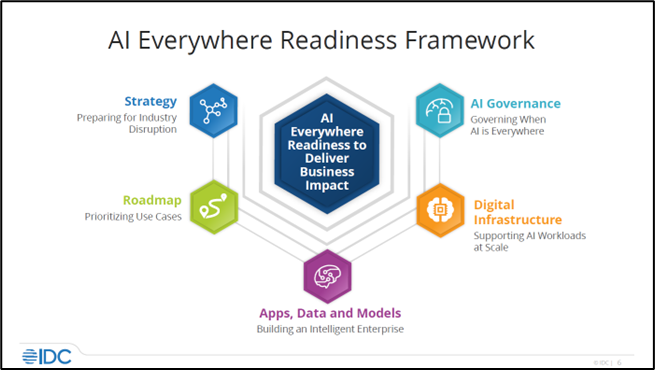
As a framework to assess their organization’s AI Everywhere readiness, IDC drafted a framework outlining the key elements of successful AI implementations. First, it is imperative for organizations to be strategic in deploying AI in preparation for industry disruptions. Second is the importance of creating a roadmap that prioritizes use cases based on an organization’s distinct requirements. These first two are all about planning for success.

Next will be to build their enterprise on a foundation of intelligent apps, data and models to drive productivity, enhance operational efficiency, and create exceptional customer, partner, and employee experiences, among other benefits. Fourth will be the importance of having a robust digital infrastructure able to support AI workloads at scale to fully harness AI’s potential. These two are all about transforming their people, processes, technology, business models, and data readiness.

And, finally, the necessity of a rigid AI and data governance system to ensure data security, and safety and trust of their users.

In short, organizations who are already or about to embark on an AI journey will need to have a foundation of various digital innovations in place and to AI-engineer their AI adoption path before they can ensure AI creates the most significant business impact for their organizations.
It goes without saying then that tech vendors must master their customer’s AI journeys and readiness. Tech vendors must guide tech buyers every step of the way in effectively aligning their business objectives and priorities to their AI Everywhere initiatives. But, at the same time, tech vendors must also understand that each customer has unique objectives that require unique solutions. To succeed, tech vendors must be equipped to help them assess their markets better. Tech vendors should have the capabilities to demonstrate their AI solutions’ value, grow their business, create new opportunities, and elevate brand awareness.

IDC recently hosted a discussion on this topic with a group of leading global IT vendor CMOs in Singapore during a Sunrise Kopi briefing on AI Everywhere. At the event, IDC Research and IDC Custom Solutions had a lively discussion and advised them on how they can improve their AI solutions’ go-to-market strategies while aligning these to their customer’s objectives and challenges. Below are some of the key points discussed during the session:

  • Generate demand in a crowded market. Almost every vendor is touting an AI solution. Tech vendors need to raise their brands above the noise of the over 200 AI use cases available in the market by demonstrating the business impact of their “real AI’ solutions through effective content marketing.
  • Go beyond the CIO – Convincing the CEO through other decision influencer personas.  AI is more of a strategic initiative than an IT investment.  The decision-making process involves multiple personas with the need to convince the CEO and the board.  Tech vendors need to understand the priorities of these different personas and position their solutions appropriately, and not just focus on the CIO agenda.  IDC shared some of its published research on the AI investment priorities and buyer behavior of different personas across industries, and how to drive targeted marketing and enable sales teams to engage more effectively with these personas.
  • Communicate brand position clearly and change brand perception to an AI provider.  There is a need to cut across the hype and demonstrate who has a “real AI” solution.  We advised them on how to leverage thought leadership assets to show their understanding of the buyer journey and its corresponding issues, and to clearly demonstrate their solution’s business value and ability to generate tangible and significant business outcomes.
  • Shorten the decision-making process.  Although the buying decision involves multiple personas, the CEO and CIO must engage and align on the strategy.  A lot of conversations need to happen between the CEO and CIO.  IDC discussed its AI Readiness Maturity Model that helps bring all parties into a common assessment of where they are in their AI journey and aligns all stakeholders into a common decision pathway.  This tool can be used to measure partner/channel readiness to sell AI solutions as well as open an engagement opportunity for sales.
  • Tracking the dark funnel.  How do we track buyers who are clicking through, researching into the topic but are not picked up by the sales/marketing funnel?  IDC shared some of the TCO/ROI tools that can help tech vendors assess their customer’s environments and help draw them from the dark funnel into the sales/marketing funnel.  In addition, IDC also talked about leveraging media amplification and lead-generation services to facilitate the conversion of buyers in the dark funnel as marketing qualified leads.

In summary, there is a lot of noise in the market that muddles tech buyers’ visions as they search for suitable, legitimate, and reliable AI solutions to help them address their unique business needs. Given the right data, insights, and go-to-market strategies, tech vendors can clear tech buyer’s views if they plan, market, and sell their AI solutions well, and stand out as the preferred and trusted AI technology vendors of choice.

IDC Custom Solutions helps tech vendors enhance results with tailored insights and proven tools.


For organizations globally, experience matters, be it the employees, customers, suppliers, partners, and the business itself.  In the digital world, an exceptional experience will create technology stickiness, while also potentially reshaping the relationship between constituents.

With great experience, an individual, regardless of the role within an organization, will look at it positively and is usually not opposed to continuing on with it. But if the experience is negative, another opportunity that is more positive will quickly overtake the negative experience, shifting away from a potential business decision to another that is more appealing. This results in lost revenue, profitability, and/or future growth for additional products and services.  

Individuals cement relationships based on the experience they have with others.  Sometimes relationships are forged immediately and other times, they take time. Regardless, relationships have been at the heart of businesses for years. Robin Sharma, an author and speaker says it well, “the business of business is relationships; the business of life is human connection.”

Human Experience in the Digital World

The IDC FutureScape: Worldwide Intelligent ERP 2024 Predictions, finds by mid-2024 30% of global organizations will take advantage of humanlike interfaces in their enterprise applications to gain more insights quickly, improving decision velocity.

At the heart of this prediction is the use of Generative AI (GenAI) and its ability to elevate the user experience to a new digital level.  If an individual no longer must search through data, spreadsheets, reports, and across enterprise applications to find information and can interact with technology differently, it changes the experience. 

A digital world experience means instead of searching through many data sets, an individual can interact with the technology in a conversational form, by inputting text, or interacting with a chatbot or digital assistance. This information can be surfaced in a matter of moments creating a likely positive experience.  This aspect requires the large language models (LLMs) that generate a human like recommendation based on the sets of data the system has been trained on.

With a multitude of data that can be tied to the systems overall, the individual will discover a wealth of information that delivers more insights, opportunities to weigh different points and elements against each other, and thoughtful considerations for better decisions. These information interactions mimic exchanges of helpful information between individuals, enabling faster and more decisive actions. Individual and organizational productivity gains are initially massive and then enable both to start to see the power of technology enabling a better experience while also improving overall performance.  And it creates a positive experience and an opportunity to recreate this methodology for the next interaction. From a technology point of view it creates more stickiness of the applications and data.

Experience Creates Differentiating Value and Relationships

Using a mobile phone or tablet, one has a different experience with the technology than they do with their enterprise software. An individual can talk or type what it needs with the mobile devices and they provide answers.  While not always correct and in some cases needing more clarification, it is quicker than using enterprise software applications.  The mobile devices represent technology platforms with a multitude of cloud software enabled by a common design, even though the software is all different.  The value is clear in the use of the software on the devices and its incorporation into ones life. 

But with current enterprise software, mostly on-premise and legacy, the experience is less than stellar and doesn’t even begin to mirror the mobile experience. Automation of simple tasks is typically lacking, importing/exporting of data and sharing it is done in a plethora of applications, and integrating the workflows and data to enable a decision point can take time.

In the digital world of on-demand experience and answers, most enterprise software falls short.  Unfortunately finding the information is dependent upon the individual organization and its technology stack, as well as preference for particular technologies.  The value derived is not only a bad experience but also one fraught with creating a better solution than the currently used technology solution.  This only leads to devaluing the current technology and moving the value to the employee that can navigate to the right solution the fastest. 

In this way the experience is a competition of legacy technology savviness to meet performance requirements.  With so many organizations still in the modernization stage with their enterprise software, the struggle towards a better experience and a better value for their employees overall continues to be unattainable. 

Innovation Creates and Reshapes the Experience

In the absence of personal relationships in the digital world, experience is a replacement to help foster a better relationship with an organization, employee, customer, supplier and partner.  The better the experience, the more replication of the process and usage of the enterprise software.  In a nutshell the experience is positive and the usage will continue to grow. 

Shaping the experience in the enterprise software world is GenAI which improves the business by streamlining operations through the automation of business tasks.  Typically workflows are long and cumbersome and don’t work from one line of business application to another nor are tasks the same for mirror types of processes such as ordering and buying.  This itself makes it hard for the organization to interact with each part of the business and come together to solve a business problem. 

GenAI can help streamline long tasks by learning the workflows and data that impact it, and reshaping it to a shorter workstream. Once this is done some of the previous processes go away or become autonomous because they have been consumed into the workflow already.  So, for instance, if I need to call customer service I might wait in a queue for awhile – to the point where they need to call me back and it could be a few days. But if I use the enterprise software that I ordered through, I can ask the question and a bot or agent will come up with several recommendations for me.  In this way, the system has been trained and can help me immediately.  When it can’t, a ‘live’ person will come on and will work with me to solve my issue.  This person will have all information in front of them and can come back to me with more information to solve my issue.  Innovation is creating a new experience for both me and the operator. 

Experience Matters

Organizations are finding experience improves productivity and metrics, from financial metrics to customer satisfaction scores, asset maintenance and production run time, employee knowledge and well-being, and brings a reduction in non-value add tasks than can be quickly automated.  As organizations mature in their usage of more experience-orchestrated business applications, they will find more shared value powered by intelligence.  At the heart of the business is experience.  The experience is reshaping the usage of enterprise applications and pushing the enterprise application vendors and their ecosystem of partners to bring more value to the organization. 

The questions to ask are few but critical:  How will this new digitally intelligent experience reshape your organization?  Do you have the right technology and services team in your business helping you unleash the heart and pulse of your organization so it can run a digitally intelligent business? 

If not, rethinking your strategy is critical to your survival in the digital world.  IDC finds those organizations that cannot unleash the power of experience with innovative technologies like AI, will be responding to disruptions and making decisions much slower than their counterparts.  Those that rely on intelligent technologies to create a better experience and operate at a much faster decision velocity will gain competitive advantage quickly and in what seems like an instantaneous moment. 

Mickey North Rizza - Group Vice President - IDC

Mickey North Rizza is Group Vice-President for IDC's Enterprise Software. She leads the Enterprise Applications & Strategies research service along with a team of analysts responsible for IDC's coverage of next generation of enterprise applications including digital commerce, employee experience, enterprise asset management and smart facilities, ERP, financial applications, HCM and payroll applications, procurement, professional services automation and related project-based solutions software, supply chain automation, and talent acquisition and strategies. In her role, Mickey and the team advises clients on these intelligent, modern, and modular enterprise applications for businesses of all sizes with an emphasis on the key trends, opportunities, innovation and the IT and Business Buyer concerns, requirements, and buyer behaviors.

One thing is clear: the B2B buying journey is increasingly resembling its B2C counterpart. With B2B buyers spending a significant portion of their time online, the temptation for marketers to flood the digital sphere with content is strong.

However, the truth is that more content doesn’t necessarily equate to more success. The digital landscape is cluttered with content, making it imperative for marketers to differentiate their offerings with high-quality, impactful solutions. This involves leveraging advanced analytics to understand customer behavior, personalizing content to meet the specific needs of different segments, and optimizing digital channels for maximum reach and engagement.

Bombarding potential clients with irrelevant or low-quality content can be akin to sending them digital junk mail. Instead, the key lies in crafting fewer pieces of high-quality content that truly resonate with your audience.

What We Know about Successful Digital Marketing Content

Successful content must withstand scrutiny from three critical factors: search engines, social sharing platforms, and trust. To truly make an impact, content must not only be optimized for search engine visibility but also be compelling and shareable across social media channels. Communities and networks matter. Additionally, trust is paramount – content must be credible, reliable, and resonate with the audience, on a persona level, to establish and maintain trustworthiness.

So, how can B2B marketers captivate their audience amidst the noise of the digital space?

Three Proven Methods To Stand out and Forge Meaningful Connections With B2B Buyers

  • Know Your Customers: It all starts with understanding your audience inside and out. Take the time to dive deep into their vertical and identify their pain points. What challenges are they facing? What are their goals? By gaining a comprehensive understanding of your customers, you can tailor your content to address their specific needs and interests.
  • Unduplicable Content: In the current digital age, marked by an unprecedented surge in online content largely fueled by AI-generated material, the synergy between human creativity, in the form of thought leadership, and AI capabilities has never been more critical. Thought leadership, characterized by original, insightful, and forward-thinking content, distinguishes itself in a sea of generic and often repetitive information. While AI can swiftly generate vast quantities of content, it’s the human touch that infuses it with authenticity and nuanced understanding. As AI continues to streamline content creation, making it more accessible and abundant, the challenge for individuals and organizations is to produce content that is unduplicable—content that resonates on a deeper level, offering unique perspectives and fostering trust and engagement among audiences.
  • Leverage Rich Industry Insights: In today’s information-driven world, B2B buyers crave content that is backed by credible research and insights. By leveraging the latest industry research, you can create content that not only educates but also positions your brand as a trusted authority in your field. From white papers to interactive tools, there are various formats you can utilize to deliver valuable insights to your audience.

For example, consider partnering with a reputable research firms like IDC to develop content that is grounded in unbiased data and analysis. Here are a few successful tools we use:

IDC InfoBrief – A source for data-driven insights presented in a visually captivating format! Dive into essential audience data derived from published and primary research, all expertly analyzed by IDC analysts. Whether it’s market trends or technology analysis, each InfoBrief provides a high-level assessment of audience needs and strategic recommendations for technology adoption.

IDC Business Value White Paper – Provides an in-depth ROI and business value analysis of your company’s products and solutions based on in-depth interviews with your end-user base. Each white paper combines customer interviews, business value analysis and model and Analyst technology expertise.

Business Value Snapshot Tool – Your buyers are provided a business value assessment for investing with your solution, in a web-based and self-service calculator format. Our business value calculators are based on IDC research that ties in your solution benefits through an interactive experience which includes up to five assessment questions. The user experience concludes with a personalized Business Value Snapshot report (one-page summary) that is emailed to your prospect. The result is an interactive asset that generates real-time leads.

Content marketing services play a crucial role in building and nurturing your customer connections through the creation and distribution of valuable, relevant, and consistent content. The goal is to attract and retain a clearly defined audience, ultimately driving profitable customer action.

Content marketing services should focus on understanding the audience’s needs and interests to develop a strategic content plan that includes a mix of formats such as blogs, videos, infographics, and case studies. By providing content that educates, informs, and entertains, businesses can establish themselves as thought leaders in their industry, build trust with their audience, and support their overall digital marketing strategy. Effective content marketing services are about telling a brand’s story in a way that resonates with the target audience, encouraging engagement, and fostering long-term relationships.

To truly captivate B2B buyers in today’s digital landscape, marketers must shift their focus from quantity to quality. So, before hitting the publish button on your next piece of content, take a step back and ask yourself: does this add genuine value to my audience? If the answer is yes, you’re on the right track to success in your B2B digital marketing.

Learn More About IDC’s:

In recent years, we’ve witnessed a significant shift in the technology landscape, with AI-enabled automation, data, and cloud-native architecture emerging as powerful enablers of business transformation. This evolution has transformed how SaaS applications are built and deployed. Most users will experience the power of AI-enabled automation through the SaaS applications they use daily.

Today, delivering superior user experiences is not a one-time event. Expectations change with each new set of features and capabilities and every emerging alternative to address business challenges, creating a flywheel for innovation. The ability of a SaaS provider to systematically capitalize on this flywheel effect directly impacts net revenue retention (NRR) and growth.

The financial prospects for SaaS and cloud software are incredibly promising. By 2027, global revenue from SaaS and cloud software is projected to reach a staggering $1,004 trillion, growing at a Compound Annual Growth Rate (CAGR) of 18.5%, significantly higher than the slightly more than 3% CAGR observed in perpetual licensed software. Notably, SaaS applications, which accounted for over half of total cloud software revenue in 2023, are expected to maintain their robust growth trajectory, reaching $504 billion in revenue by 2027. The assurance of business transformation, ongoing disruptions, and the rapid pace of supplier innovation all point to double-digit growth in the near future.


The Rapid Rise of Generative AI
2023 was a landmark year for AI, with GenAI dominating conversations across industries. The advent of GenAI marks a new chapter in the digital journey, necessitating adjustments in strategy, structured investment in new technologies, and the cultivation of new skills within organizations. GenAI is poised to significantly influence where and how investments in AI are made, with its software experiencing a 5-year CAGR of 37% and representing nearly 30% of AI spending. From the start, IDC has invested in developing research and methodologies, including a GenAI Path to Impact Framework that features more than 260 industry and functional use cases. This high-impact work continues to evolve alongside GenAI infrastructure, software, and services advances.

GenAI is initially poised to revolutionize SaaS applications in three key areas: enhancing user productivity, data, and model-driven analytics for faster decision-making and creating dynamic, personalized content for superior user engagement. IDC CloudShare emerging ISV research shows that more than 50% of ISVs are investing significantly in generative AI with a focus on automated testing and improving quality assurance (40.2%), providing smart recommendations (39.8%), autonomous developer training (37%), and rapid prototyping to accelerate innovation (33.7%).

These advancements will enable Independent Software Vendors (ISVs) to optimize customer experience, accelerate innovation cycles, and adapt to future customer needs and market trends more efficiently. Longer-term, advanced, and GenAI will disrupt how applications are developed and transform the traditional categories used to define business software, i.e., enterprise resource management, supply chain management, customer relationship management, and human capital management, to name a few.


Navigating the Monetization Dilemma
One of the most pressing challenges facing SaaS providers is monetizing GenAI features. The variable cost associated with GenAI usage introduces complexity to the monetization strategy. While some providers grapple with whether to charge directly for these innovative features or enhance product value indirectly, it’s clear that developing an effective monetization strategy is crucial for achieving lasting impact. According to IDC SaaSPath 2024 research, 77% of buyers are willing to pay between 10% and 30% more for GenAI-enabled SaaS applications.

The GenAI Journey for SaaS Providers
The journey towards integrating GenAI into SaaS offerings has accelerated rapidly over the past 18 months. As mentioned, more than half of ISVs are already investing significantly in GenAI, with established plans for training and purchasing GenAI-enhanced software and services. This investment reflects the growing buyer demand for GenAI across all industries and geographies, underscoring its potential to redefine the SaaS landscape. Currently, AI is considered integral to the application’s value.

The Role of Use Cases in Driving GenAI Adoption
As the variety and number of use cases for GenAI expands, the focus is increasingly shifting toward revenue generation. Tech buyers are willing to invest in software with embedded GenAI capabilities, indicating a readiness to spend more on these advanced features. This trend highlights the importance of prioritizing and addressing industry-specific use cases with the greatest near-term opportunity to enhance value while exploring opportunities to expand into new use cases systematically.

The convergence of SaaS and AI, particularly GenAI, represents a significant milestone in the evolution of business software technology. As we navigate this new era, organizations must adapt strategies, invest in cutting-edge technologies, and embrace the opportunities presented by GenAI. At IDC, we are committed to supporting businesses in this journey by developing, defining, and defining the value for GenAI use cases to drive business impact across industries and functions.

Learn what matters most to your customers with IDC’s AI Use Case Discovery Tool—find out more.

Frank Della Rosa - Research VP - IDC

Frank Della Rosa is Research Vice President responsible for SaaS, Business Platforms, and Industry Cloud. Mr. Della Rosa's core research analyzes current market conditions and trends and provides strategic guidance to technology suppliers and mid-market and enterprise technology buyers. Ongoing research highlights various SaaS and cloud computing aspects, including hybrid and multi-cloud application deployments, business platforms, cloud marketplaces, buyer behavior, and global trends across vertical and functional markets. Mr. Della Rosa's research covers emerging ISVs' journey to SaaS, SaaS management platforms, market forecasts, and supplier market shares.

Supply chain disruptions — unpredictable supplies, product shortages, increasing material costs — continue to have a profound impact on manufacturers worldwide. In response, remanufacturing, which has long been a part of the industry, has seen a surge in popularity in recent years.

Companies are turning to remanufacturing as an alternative solution when they face challenges in procuring components or encounter skyrocketing prices. This approach not only helps address immediate supply chain issues but also fosters resilience and mitigates risks by prompting manufacturers to rethink their sourcing strategies and diversify their supply chains.

Moreover, remanufacturing is emerging as a key component of manufacturers’ sustainability strategies. Beyond its role in addressing supply chain disruptions, remanufacturing delivers significant environmental benefits. By reusing raw materials, it conserves resources and minimizes waste, contributing to a more sustainable use of resources.

Remanufacturing also promotes energy efficiency, reduces emissions, and embodies the principles of the circular economy, bolstering its appeal as a sustainable practice in manufacturing. As companies increasingly prioritize sustainability goals, remanufacturing is poised to play a crucial role in achieving these desired outcomes while also addressing supply chain challenges.

What is Remanufacturing?

According to the Remanufacturing Industry Council, “Remanufacturing is a comprehensive and rigorous industrial process by which a previously sold, leased, used, worn, remanufactured, or non-functional product or part is returned to a like-new, same-as-when-new, or better-than-when-new condition from both a quality and performance perspective, through a controlled, reproducible, and sustainable process.”

At the center of remanufacturing lies the concept of the “core.” The core refers to the existing, used, or worn-out part that serves as the starting point for the remanufacturing process. This core component undergoes a series of steps, including tracking, identification, disassembly, cleaning, inspection, repair, and reassembly, to transform it into a product or part that meets the desired quality and performance standards.

Effective core management is essential for manufacturers engaged in remanufacturing. It allows them to maximize the value of core assets, manage costs, and strengthen relationships with customers and suppliers. Additionally, robust core management practices help minimize waste and environmental impact by promoting the reuse of existing materials and reducing demand for new resources.

Closing the Gap: The Need for Remanufacturing Software

Remanufacturers in discrete manufacturing environments face distinct challenges that are not adequately addressed by traditional ERP systems. While ERPs offer essential functionalities like inventory management, testing, and quality control, remanufacturers require specialized core management features tailored to their needs, including:

  • Core Tracking and Disassembly: Efficiently collect and inspect individual components or parts for wear, damage, or defects, ensuring thorough assessment and tracking throughout the remanufacturing process.
  • Reconditioning, Repair, and Replacement: Address wear, damage, or defects in components through reconditioning or repair processes, or replace them with new or remanufactured parts as needed.
  • Reassembly: Reassemble products according to technical specifications, ensuring that the final product matches the quality and performance of the original.
  • Complex Product Configurations: Manage complex product configurations, accommodating a mix of old, new, or remanufactured components while maintaining accuracy and consistency.
  • Cost Estimation and Pricing: Provide accurate cost estimation and pricing based on the type of components used, enabling transparent and competitive pricing strategies.
  • Traceability and Compliance: Ensure traceability and compliance with regulatory requirements by generating reports and documentation necessary for regulatory purposes, maintaining transparency and accountability throughout the remanufacturing process.
  • Integration Capabilities: Seamlessly integrate with other systems such as ERP or CRM, enabling data exchange and process synchronization across the organization.

By investing in specialized remanufacturing software, manufacturers can streamline operations, enhance productivity, and ensure compliance while effectively managing the complexities of the remanufacturing process.

Regional Approaches to Remanufacturing

Remanufacturing approaches vary across the globe, with each region displaying unique drivers and focus areas.

Primarily driven by cost savings but also influenced by federal/state regulations, the North American remanufacturing market is well developed. There is growing demand for remanufactured products across automotive, electronics, and aerospace.

In Europe, the growth of remanufacturing is closely tied to circular economy principles. With a strong emphasis on resource efficiency and waste reduction, government policies and initiatives play a significant role in driving adoption.

A key manufacturing hub, Asia holds immense potential to integrate remanufacturing practices into its industrial landscape. Technological advancements and a growing awareness of sustainability issues are driving the region toward embracing remanufacturing as part of its transition to a circular economy.

Cross-regional collaboration and knowledge-sharing initiatives are important for driving progress in remanufacturing practices globally. Leveraging insights and best practices from different regions can accelerate the adoption of remanufacturing and work toward achieving shared sustainability outcomes.

Guidance for End Users: Choosing the Right Remanufacturing Software

Selecting the right remanufacturing software is a critical decision, whether it’s an off-the-shelf (COTS) solution, customized, or a packaged solution offered by vendors. Regardless of the approach, the software should address the specific needs of remanufacturers while complementing existing systems and processes.

  1. Identify Your Unique Needs: Consider your remanufacturing business’ unique requirements, including core management, inventory control, quality assurance, cost savings, and regulatory compliance.
  2. Comprehensive Functionality: Look for solutions that offer a comprehensive range of functionalities, addressing core management challenges while also supporting traditional manufacturing processes.
  3. Ease of Use and Scalability: Prioritize solutions that are user-friendly and scalable to accommodate your business’ growth.
  4. Customization and Integration: Evaluate the software’s customization capabilities to tailor it to your specific remanufacturing workflow. Assess its integration capabilities to ensure smooth data exchange with other systems, such as ERP or CRM.
  5. Vendor Success Stories: Request case studies or success stories highlighting real-world implementations and measurable improvements achieved by other remanufacturing businesses. This can offer valuable insights into the software’s effectiveness and suitability for your needs.
  6. Road Map and Technological Advancements: Inquire about the vendor’s road map for future software developments and how they plan to incorporate the latest technological advancements such as automation, advanced analytics, and AI. Understanding the vendor’s commitment to innovation can help ensure that the software remains relevant and competitive in the long term.

By carefully considering these factors and collaborating closely with software vendors, end users can select remanufacturing software that not only addresses current challenges but also supports future growth and innovation in their operations.


Further reading: IDC MarketScape: Worldwide Remanufacturing Management Software 2024 Vendor Assessment

Gunjan Bassi - Research Manager - IDC

Gunjan Bassi has more than 14 years' experience working in the logistics and transportation sector. Before joining IDC, she worked with Transport Intelligence (Ti), a transportation and logistics research firm based in Bath, England, where she was responsible for vertical sector research covering qualitative and quantitative reports. She was also actively involved in the development of new research capabilities and product features of Ti's flagship market intelligence portal. Previously, based in India, she was leading the global logistics research team at Evalueserve where she was responsible for running custom research projects commissioned by leading logistics service providers (LSPs) and focussed on strategy/GTM, sales enablement, and market and competitive intelligence. Bassi holds a bachelor's degree from Shri Ram College of Commerce (SRCC), Delhi University, and post-grad studies in management.

The era of autonomous AI agents is rapidly approaching, poised to radically reshape marketing and commerce as we know it. Within the next few years, AI “CoPilots,” “Concierges,” and “Super Agents” will become powerful personal assistants that remove the need for consumers to click or code their way through technology. Instead, these AI helpers will enable users to simply ask systems to perform tasks, make purchases, manage projects, and more through intuitive conversational interfaces.

This blog explores how the advent of AI marketing assistants and autonomous Super Agent platforms will dramatically boost productivity, transform customer engagement models, redefine data ownership dynamics, and ultimately re-platform the entire economy into an intelligent, AI-driven marketplace.

CoPilots, Concierges, And Super Agents: AI’s New Tri-Force of Commerce

Artificial intelligence is poised to revolutionize the economy by re-platforming various industries. CoPilots, Concierges, and Super Agents represent innovative forms of powerful personal assistants that eliminate the necessity for coding or manual interaction with technology. Instead, they empower users to simply request actions from systems, whether it’s task execution, project management, making purchases, and beyond.

In simple terms,

  • CoPilots are digital assistants evolved into co-workers
  • Concierges are personal assistants evolved into brand ambassadors
  • Super Agents are personal shoppers evolved into lifelong companions

No later than 2026, IDC expects consumer AI Super Agents running on smartphones to support $500B of economic activity in less than 10 years – faster than the internet, mobile, or social did.

CoPilots, Tomorrow’s New Co-Workers

CoPilots will enable marketers to ask: “Build a campaign for our new product launch”, and AI will produce everything needed to execute – schedules, workflows, audience segments, customer journeys, creative, offers, pricing, and metrics. It will test and optimize everything in flight and measure and report on results, conversing with marketers throughout the process.

IDC expects these capabilities to result in a more than 40% productivity improvement for entire marketing organizations. As a result, some jobs will disappear, others will expand, and organizational structures, job descriptions, and required skills will change dramatically.

Sam Altman has been quoted as saying in the next 5-7 years, AGI will do 95% of the creative work marketing teams do and the work they hire outside services to do for them.

Meet Your New Personal Assistant: The Concierge

Concierges are AI-powered agents built by brands to assist customers. IDC expects to see AI Concierges proliferate in 2025. Brands will embed concierges into their mobile apps and web sites. AI substantially raises their ability to assist and advise consumers in a conversational way. But digital concierges supplied by individual brands will have inconsistent quality and usability issues. Branded concierge agents are owned and operated by brands and therefore do amend the problem of consumer data ownership and privacy protections.

While AI Concierges will proliferate, they are not likely to be a long-term consumer preference once Super Agents become available. However, they will be essential to brands’ ability to engage, negotiate, and transact with consumer Super Agents in autonomous AI marketplaces.

Super Agents, Your New Lifelong Companions

Super Agents will be the killer app of AI-powered smartphones. IDC expects that by 2026, AI will emerge as the next platform of global commerce. Super Agents will be widely available and capable of managing every aspect of consumer commercial activity. Users will be able to fully customize their agents from gender, language/accent, personality traits, how proactive or passive they are, what information and activities they are allowed to track and share (birthdays, holidays, purchase histories, brand preferences, medical and financial records, etc.) Agents will learn by monitoring user behavior and by conversing with users, making them even more intuitive than managing a Spotify playlist.

Consumer adoption will be similar in speed and scale to search, mobile, and social media, each of which scaled rapidly because they put the power of the platform in the palm of your hand, and because scale scales upon scale. This is not to suggest an all or nothing transformation. Super Agents will be another form of commerce and like search, mobile and social, they will encroach on but not completely displace existing forms of retail or digital interactions. Super Agents will do everything that apps and search do while hiding those tasks from the user’s experience. Apps and search capabilities will still be needed behind the scenes and users can always opt to use them if they wish. Super Agents will be ever present, intuitive, and able to research, recommend, and purchase anything – saving consumers and brands money, time, and aggravation. Consumers will be able to ask things such as:

  • “Here’s what my family wants to eat this week get the best deals ready for pick up at 6:30 tomorrow night.”
  • “Save me $100 on my monthly food bill and cut down our sugar intake by 10%.”
  • “Suggest several [beach, ski, etc.] vacation options for my family for less than $5,000 in June.”
  • “Create a financial plan for our first house purchase.”
  • “Find the best doctor for my child’s illness.”

AI can converse with consumers throughout these activities (and throughout their daily lives.) Talking to your Super Agent may become the next form of journaling.

Through Super Agents, consumers will be able to programmatically tell brands which products they are in-market for, when, and under what terms. Which products have “no substitutes” tags and which substitutes will be considered. Brands will no longer have to make massive investments in data and compute to know how hard to compete for whose business.

The biggest paradigm shift for brands and advertisers is that Super Agent markets will monetize on sales commissions not ad impressions which are irrelevant to AI buyers.

But Super Agents will be equally able to communicate with ad networks making it possible to personalize ads on any media more accurately than ever. Imagine being able to send personalized ads over any medium, including CTV to enhance how your customer uses a specific product of yours. Instead of generically shilling beverage, pharma, and CPG products to everyone, you can create an ad that reminds a person to take their meds, ask about any side effects they may be experiencing, suggest lifestyle or dietary habits that would speed their recovery. Or recommend new features of your digital service that may be underutilized. Or ask them to swipe or click on which product design they like better for your new spring clothing line.

Super Agents require the industry to irrigate the consumer data desert. Ironically, consumers retain far less data about commercial activities than brands and ad networks do. The paper receipt must be relegated to the trash heap of history (clay tablets anyone?) so consumers can have all the data needed for Super Agents to learn and represent them most effectively in the market. Open data sharing with consumers may be the greatest mindset shift required for everyone locked into today’s economic model but the payoff for doing so will be dominating the next digital economy.

Importantly, Super Agents will track and protect users’ personal information, disclosing only what is necessary or approved by their user to garner better deals and services. They will track what personal data gets shared with which commercial entities, manage consent agreements, and make requests for data records and deletion. Super Agents eliminate the need for cookies because they can declare intent to ad networks and marketplaces. This will make consumer privacy protection both more important and more effective.

A New Engagement Model For AI

As Super Agents proliferate, marketers and advertisers will have to build new engagement models for AI buyers and influencers. Advantages will go to those that respond to agent bids with the greatest speed and personalization; build progressive incentives to influence the agent to either buy or escalate to their user; engage in trusted transactions; deliver on product, logistics, and support expectations; use all means of communication to progressively improve the personal and/or professional lives of every individual customer. That last one is the key to differentiation. Humans are almost always willing to pay a premium for trust and for better emotional outcomes over better economic ones.

As AI re-platforms the economy there will be novel emergent opportunities for marketers and advertisers to completely rethink their roles in marketplaces and how they conduct their relationships with customers human and AI alike.

Gerry Murray - Research Director, Marketing and Sales Technology - IDC

Gerry Murray is a Research Director with IDC's Marketing and Sales Technology service where he covers marketing technology and related solutions. He produces competitive assessments, market forecasts, innovator reports, maturity models, case studies, and thought leadership research. Prior to his role at IDC, Gerry spent six years in marketing at Softrax Corp. an enterprise financial solutions provider. There, he managed marketing programs that produced 4 million emails a year, multiple websites, interactive tools and product tours, an online game, collateral, and PR. Concurrently, he was Managing Editor at RevenueRecognition.com, a thought leadership site featuring partnerships with IDC and the Financial Accounting Standards Boards (FASB) which was quoted and referenced in leading industry publications such as CFO magazine, BusinessFinance, and others. Gerry spent the first half of his career at IDC advising executives from some of the world's largest software and services providers on market strategy, competitive positioning, and channel management. He was the Director of Knowledge Management Technology and conducted research on a worldwide scale including: market sizing and forecasting, ROI models, case studies, multi-client studies, focus groups, and custom consulting projects.

The plane ride to Shoptalk 2024 was a precursor of what was to come – a bit of a hike for a New Englander – the trip to Las Vegas took over 6 hours. Looking out my window seat, I witnessed the Hoover Dam and the accompanying Mike O’Callaghan-Pat Tillman arch bridge spanning the outcroppings in front of the dam.

Just like the bridge, the conference presented the opportunity to reach across the chasm and connect with retailers, vendors, and professionals in retail. Without doubt, it fulfilled this purpose.

The event drew about 10,000 people across 3 days with a substantial expo floor and educational sessions. The event opened with Sophie Wawro, President of Shoptalk and Mike Antonecchia, SVP discussing the focus of Shoptalk, standing on a sparkling stage that seemed right out of the Twilight Zone.

The duo mapped out the day’s events and agenda and opened the stage to the keynote speakers including Colleen Aubry from Amazon and Tony Spring, CEO at Macy’s Inc. with additional thoughts about Reimagining Retail from Gina Boswell, CEO at Bath & Body Works. The conference had broadened its scope from prior years. More specifically, Shoptalk, better known for their digital focus had adopted a track for Merchandising, Assortment and Supply Chain – entering deeper into the application of technology for the merchandising sector. Clearly, merchandising continues to be a hot topic for retail. We discuss some takeaways below.

The event is well known for it’s 1:1 meeting formats, and frankly it felt like speed dating to get to know people in the industry. Shoptalk had refined their meetings from prior years – and most importantly, made it a much smoother, straightforward process with announcements and a pair of gigantic digital clocks at either end of the Shoptalk meeting floor, making sure we kept to time. The tables were tiny, two-seaters you’d find in a cafe, but perfect for a quick conversation. As with any large event, as soon as the ‘voice of God’ announcements were made, decibel levels grew from a murmur to hundreds of conversations all at once, echoing off the walls of the Las Vegas Mandalay Bay event halls. However, I will say, most of these meetings were interesting enough to sit through the 15 minutes of introductions and beginnings of a conversation – which was the intent.

The diversity of meetings included large retailers like Macy’s and Sainsburys but also ecommerce firms like Peapod, independent consultants, and fellow Rethink Retail Top Retail Experts (you know who you are!) Being in the industry for decades, not everyone was a new face. The folks whom I knew offered reinforcement of new research topics such as Retail Media or Generative AI and others focused on my passion for Merchandising and Analytics. Some of the new folks I met surprised with future of retail conversations to both learn and understand their perspectives. Expanding my horizons was the most rewarding part.

Beyond the speed meeting rituals, we had rounds with top retail vendors that continuously make inroads in the market. Part of the view included exciting meetings with Oracle in a Starbucks, innovation meetings with Blue Yonder at their booth, touching base with Zebra and their focused expansion into merchandise planning, and also speaking with Centric Software, an interesting new add in to my merchandising and planning perspective.

I can’t leave out Bazaarvoice who hosted a fantastic post-dinner engagement with deep conversations about retail marketing and the media angle. Other productive engagements included conversations with CDP firm Twilio about retail data.

Shoptalk 2024 enabled a number of tracks, but my limited availability required that I focus on merchandising, assortment and supply chain with a small selection of education tracks. The most exciting session I attended was an interview with Aimee Bayer-Thomas, Chief Supply Chain Officer at Ulta Beauty. Key learnings from this session revolved around the impact and perspective of technology in terms of supply chain:

  • Tech is needed in retail:  While Ms Bayer-Thomas highlighted this fact, it is not by chance that retailers adopt technology at a rapid clip. Overall spending for IT spending in retail has grown at a pace of over 5.5% YOY, with expectations to grow to over 8% by 2027 (Source: IDC Data). For instance, Walmart incurred capital expenditures of almost $12 Billion on supply chain, customer facing initiatives and technology in just the United States a growth of 28.4% over Fiscal Year 2023.  Other large retailers are showing similar investments in technology innovation with companies like Home Depot investing $150 million into a venture capital fund in 2022. Target announced $4 to $5 billion of investment in 2023 “to expand its guest-centric services, operations network of stores and supply chain facilities, digital experiences and other capabilities.” Clearly, the investment in technology isn’t slowing down, and retailers continue to leverage a critical part of technology for supply chain and merchandising.
  • Tech is an enabler: Also focused on during Shoptalk’s session, Ulta Beauty leverages tech to enable outcomes. According to Ms. Bayer-Thomas, “Tech must improve strategic imperatives.”  The purpose of technology is to improve and optimize the ability for distribution centers and micro-fulfillment centers within the organizations to operate more efficiently and smoothly. Technology must service the end goals of these very different types of supply chain facilities that must work together in concert to yield the best results for retail.
  • Tech must fit the business: Not all technology is appropriate, and the criticality of the supply chain combined with the need to service the business means that any technology used must proactively fit business needs. Ulta Beauty is balancing the technology with investments in people, and for the most part must ensure that there is an active tradeoff in new technologies that will result in leaving the company merchandising and supply chain better off than without the tech. Some technologies are worth examining however. For instance, the growth of AI in retail since the launch of ChatGPT in the public arena has been exponential. Per Ms. Bayer-Thomas, “AI is something we’re watching”. More specifically, retailers are looking at AI for supply chain use cases, testing applications, and piloting AI capabilities across their organizations. Not all of these efforts coincide with supply chain or merchandising, but some highly interesting use cases have arisen. Find out more about such opportunities here:  Understanding the Generative AI Use Case Landscape: The Industry Perspective

As a retailer, following these guidelines are mandatory. The rapidly changing world of technology intersects with the high performing retail world creating conditions where retailers must invest in technology. Doing this correctly will mean the difference between successful applications of technology and failed projects that missed the mark. Technology must address a business need and not be pursued for technology’s sake.

Tech must improve strategic imperatives.

Aimee Bayer-Thomas, Chief Supply Chain Officer, Ulta Beauty

Any gathering of retailers, retail vendors, and a mix of adjacent professionals can be an opportunity for business value creation – but the most significant events proactively bring people together. Shoptalk 2024 is one of these avenues where business creation happens. Tagged as one of the top retail events, my experience at Shoptalk 2024 was the right kind of nudge, especially in understanding the criticality and balance required for applying technology to merchandising and supply chain. The event addressed many of the critical challenges in retail through content, people, and engagement with industry players.

Ananda Chakravarty - Research VP, Retail Merchandising and Marketing Analytic Strateg - IDC

Ananda Chakravarty is Vice President for IDC Retail Insights, responsible for the Retail Merchandising and Marketing Analytics Strategies practice. Mr. Chakravarty's core research covers in-store and digital retail merchandising, digital tools, artificial intelligence, intelligent store operations, retail marketing, and retail media. It includes application of data and data analytics for retail including pricing, tech, and decision making. Ananda builds actionable strategic research focused on retail business merchandising and marketing.

Value-based selling is a sales technique that focuses on understanding and reinforcing the various benefits a product or service will deliver to the customer, rather than focusing solely on the features or the price of the product. This approach is rooted in the belief that customers buy products and services because they perceive them to offer value that is greater than the cost. Value-based selling is about communicating this perceived value effectively, ensuring that the customer understands how the product or service can solve their problems, improve their situation, or help them achieve their goals.

Value Selling

The core of value-based selling lies in the salesperson’s ability to identify and understand the customer’s needs, challenges, and goals. This requires thorough research, active listening, and insightful questioning. Salespeople must then tailor their sales pitch to highlight how their product or service can address these specific needs, offering a solution that is not just beneficial but also superior to alternatives. This approach shifts the focus from the transaction itself to the relationship between the customer and the product or service, emphasizing long-term benefits and satisfaction.

Value-based selling also involves quantifying the value proposition. This means providing the customer with clear, tangible evidence of how the product or service will deliver a return on investment (ROI). This could be in the form of cost savings, increased revenue, improved efficiency, or other measurable benefits. By presenting a compelling case that the benefits of the product or service outweigh the costs, salespeople can more effectively persuade customers to make a purchase.

Now, let’s compare value-based selling with consultative selling. While both approaches are customer-centric and focus on solving the customer’s problems, there are key differences between them.

Consultative Selling

Consultative selling, on the other hand, adopts a more holistic approach to sales. It positions the salesperson as a trusted advisor who collaborates with the customer to identify solutions tailored to their requirements. Consultative selling is a sales approach where the salesperson acts as a consultant to the customer, working closely with them to identify and understand their needs, challenges, and objectives. The salesperson then recommends products or services that best meet those needs. This approach is characterized by a high level of engagement with the customer, with the salesperson asking questions, listening to the customer’s responses, and offering tailored advice and solutions. Unlike traditional sales approaches that focus solely on closing deals, consultative selling prioritizes building long-term relationships based on trust and mutual understanding.

The main difference between value-based selling and consultative selling lies in the focus and end goal of the sales process. In consultative selling, the emphasis is on the salesperson’s role as an advisor or consultant, with the primary goal being to find the best solution for the customer’s needs, regardless of whether it leads to a sale. The salesperson’s expertise and advice are the main value propositions in this approach.

In contrast, value-based selling focuses more on the value that the product or service will provide to the customer. While it also involves understanding the customer’s needs and offering tailored solutions, the emphasis is on communicating the specific benefits and ROI that the customer will gain from making a purchase. The salesperson’s role is not just to advise but to persuade the customer that their product or service offers the best value.

Both value-based selling and consultative selling require a deep understanding of the customer and a focus on building long-term relationships. However, value-based selling goes a step further by quantifying the value proposition and making a compelling case for the financial and strategic benefits of the product or service. This approach can be particularly effective in competitive markets where customers are looking for clear, tangible reasons to choose one product or service over another.

Tips for Implementing Each Sales Strategy

Understand Your Customer: Regardless of the sales methodology you employ, understanding your customer is paramount. Take the time to research their industry, challenges, and competitors. This knowledge will serve as the foundation for tailoring your approach and articulating the value proposition effectively.

Ask Probing Questions: In consultative selling, asking the right questions is key to uncovering the customer’s underlying needs and motivations. Focus on open-ended questions that encourage dialogue and allow the customer to express their concerns freely. Active listening is equally important, as it demonstrates your genuine interest in understanding their perspective.

Highlight Unique Value Propositions: In value selling, emphasize the distinctive features and benefits of your product or service that set it apart from the competition. Rather than adopting a one-size-fits-all approach, tailor your pitch to resonate with the customer’s specific pain points and priorities. Use case studies, testimonials, and ROI calculations to quantify the value proposition and reinforce your arguments.

Focus on Building Trust: Whether you’re practicing consultative selling or value selling, trust is the cornerstone of successful relationships. Be transparent, authentic, and empathetic in your interactions with customers. Demonstrate your expertise by offering insights and recommendations that genuinely add value to their business.

Adapt and Iterate: Sales is a dynamic field that requires constant adaptation to changing market conditions and customer preferences. Continuously evaluate your sales approach, solicit feedback from customers, and iterate on your strategies accordingly. Embrace innovation and leverage technology to streamline your sales process and enhance productivity.

While value-based selling and consultative selling share some similarities, they differ in their focus and approach. Value-based selling emphasizes the value and benefits of the product or service, aiming to demonstrate a clear ROI to the customer. Consultative selling, on the other hand, centers on the salesperson’s role as an advisor, with the goal of finding the best solution for the customer’s needs. Both approaches can be effective, but choosing the right one depends on the sales context, the nature of the product or service, and the specific needs and preferences of the customer.

Learn More About IDC’s:

The artificial intelligence (AI) revolution has been heralded as the most disruptive technological force since the digital age dawned. With generative AI (GenAI) models like ChatGPT and GPT4, Claude, and Gemini capturing global attention, businesses across sectors are scrambling to explore and harness these emerging capabilities.

However, amid the AI gold rush, a crucial truth is crystallizing – for organizations to truly innovate and drive transformative impact with AI, deep domain expertise and industry-specific knowledge about use cases are non-negotiable prerequisites. 

What Are GenAI Use Cases And How Do I Identify Them?

At their core, effective AI use cases are focused business initiatives that harness various technologies to achieve specific, measurable outcomes. They go beyond just implementing a single technology solution, instead centering on addressing core business needs or challenges through a strategic combination of tools and strategies. Critically, a use case is not simply a discrete offering like a chatbot or an isolated technology project. Rather, it’s a holistic approach that aligns technological capabilities with broader business objectives, enabling quantifiable results.

The most impactful use cases are driven by a clear understanding of organizational pain points and a vision for leveraging emerging technologies like GenAI to create innovative solutions. By identifying and pursuing well-defined use cases, businesses can unlock AI’s full potential while delivering tangible value.

GenAI use cases broadly fall into three principal categories: productivity, business function, and industry-specific.

Productivity use cases streamline work tasks like report summarization, job description generation, or code creation by integrating GenAI features into existing applications. Many derive value from pre-trained models.

Business function use cases involve integrating AI models with proprietary corporate data or specific departments/functions. Data governance is crucial, necessitating integration with established enterprise platforms. 

Industry use cases generally require extensive customization to offer significant value to larger enterprises. These specialized vertical applications entail tailored architectures and implementation efforts, leveraging unique data assets.

Preparing For AI Everywhere: The Great Data Grab

The “Great Data Grab of 2024” underscores the urgency around the need for preparation. AI providers are aggressively expanding their data repositories and platform portfolios through acquisitions, partnerships, and arduous self-collection efforts. The goal? To amass as much raw training data as possible to feed increasingly powerful AI models spanning industries and use cases.

This explosive growth in data and AI assets presents a double-edged sword. The sheer abundance opens up tantalizing opportunities to experiment and push boundaries. Yet, it also manifests a bewildering sprawl of options that can just as easily lead businesses astray if not approached with laser-focused strategy and domain-specific expertise.

The stakes are rising exponentially. IDC’s industry predictions suggest that by 2025, a staggering 40% of all professional services engagements will involve GenAI-augmented delivery models in some capacity. This wholesale disruption to human-delivered services will upend long-established processes, roles, and competency models. Success in this new paradigm hinges on skillfully blending cutting-edge AI capabilities with nuanced, sector-specific wisdom.

The Four Pillars of Preparation: Skills, Cost, Innovation, Governance

As organizations attempt to construct compelling GenAI value propositions, four overarching pillars emerge as focal points – skills, costs, innovation, and governance. Mature AI proficiencies in areas like machine learning (ML), natural language processing (NLP), data science, and cloud architecture are essential foundational elements.

Skills: Upskilling in core AI/ML disciplines like coding, model training, and data wrangling is now table stakes. But combining those horizontal proficiencies with rich, verticalized wisdom is what unlocks exponential value creation. A manufacturing AI wizard intimately versed in supply chain complexities and constraints will run circles around a generalist.

Cost: The underlying economics of productionizing and scaling advanced AI workloads at an enterprise level can be extremely complex and capital-intensive. Here, granular knowledge of industry-specific processes, inefficiencies, variable cost drivers and fluctuating demand signals is indispensable. Those insights ensure AI investments remain sustainable and tightly aligned with the pragmatic financial realities of a given business sector.

Innovation: AI is a potent catalyst for digital innovation, promising to streamline and augment development processes. But a relentless focus on measurable business results – not just shiny new tech for tech’s sake – must persist. Seasoned industry veterans skilled at mapping AI tools to specific sectoral pain points and KPIs help maintain this all-important outcomes-driven discipline.

Governance: Robust AI governance programs and rigorous data governance guardrails are no longer nice-to-have footnotes; they’re essential safeguards in an era of widespread AI adoption. Authoritative domain experts play a pivotal role in ensuring these frameworks holistically account for sector-specific risks, compliance requirements, ethical nuances, and regional regulatory variances from the outset.

Lest we forget, these escalating talent and policy demands are unfolding against a backdrop of continued infrastructure turbulence. Industry analysts forecast that well into 2025, enterprises will still be contending with degrees of uncertainty, cost volatility, and accessibility constraints surrounding the foundational compute, network and storage resources underpinning AI/ML workloads.

Navigating these intersecting infrastructure, skillset and governance complexities in pursuit of sustainable AI-driven innovation will require a depth of industry-specific intelligence. From evaluating build-vs-buy infrastructure options to right-sizing investments to mitigating sector-specific risks, vertical expertise is mission-critical.

Riding the AI Revolution: Essential Guidance

So as the AI revolution kicks into an even higher gear, here are some essential guideposts for businesses looking to leverage GenAI effectively:

Understand: Don’t treat AI as an isolated technological sphere. Immerse yourself in the unique cultural, operational, and financial dynamics, legacy constraints, customer/user pain points and market opportunities within your specific industry vertical. Your customers, employees and partners demand relevance and context, not generic AI solutions. 

Prioritize: Approach GenAI use case exploration through the lens of tangible, high-impact business outcomes. What are the most pressing strategic challenges specific to your domain? Prioritize accordingly, while carefully weighing factors like potential costs, risks, downstream adoption barriers and competitive implications. Provide crisp, industry-contextualized starting points and strategic roadmaps to chart the course.        

Establish: Certainly, it’s crucial to establish the right technical foundations like data-centric platforms, cost-effective AI infrastructure environments and robust API-driven integration frameworks. But recognize that these critical enablers must be purpose-built and customized to synchronize with the unique operating models, skills profiles and technology stacks present in each vertical. 

The AI age represents an era of incredible potential and opportunity. But it’s also one of unprecedented complexity – a reality that demands a sharp re-think of how companies acquire, nurture, and apply talent and domain expertise.

By treating specialized industry knowledge as a core competency on par with AI/ML capabilities themselves, businesses can firmly establish themselves as indispensable leaders driving the next waves of sectoral transformation.

After all, deep insight is the spark that will ultimately ignite an organization’s capacity to innovate. Generic AI will only get you so far. Expertise is what allows you to separate noise from signal and elevate AI into a tsunami of outcomes-driven impact.

Cambridge Healthtech Institute’s Bio-IT World Conference & Expo was held from April 15-17, in Boston. It represented an appealing blend of software companies, including many innovative start-ups, a few system integrators, some big pharma, such as Pfizer, Novartis, Merck, Astra Zeneca, Bristol Myers Squibb, Johnson & Johnson, Roche, Regeneron, and Sanofi to name a few, as well as investors. With over 3,000 Life Science and IT experts attending this event, it brought to the table an excellent fusion of life sciences innovation and technology.

Dr. Caroline Chung, VP and Chief Data Officer and Director of Data Science Development and Implementation of the Institute for Data Science in Oncology, at MD Anderson Cancer Center, in her excellent keynote on digital twins in cancer care and research emphasized the importance of the verification, validation, and uncertainty quantification (VVUQ) for building trust in digital twins. She drew an interesting parallel between medicine and AI, while, referencing Sir William Osler, the father of modern medicine’s quote, which states, ‘Medicine is a science of uncertainty and an art of probability’, highlighting the fact that while AI is indeed top of mind for the industry, there is still a lot of uncertainty that needs to be dealt with.

Bryan Martin, Research Fellow, and Head of AI, Abbvie presented the Abbvie Intelligence platform (including AI Chat, AI analyze, AI Translate, and AI Ask a Source) that leverages GenAI and has a running cost of less than 250 dollars per day for 50,000 users. He discussed how Abbvie overcame implementation challenges. IDC’s PlanScape for GenAI in life sciences and healthcare examines some of these challenges and provides guidance to the industry on how to navigate the GenAI journey.  Bryan discussed how Abbvie is in the process of implementing Project Delphi (automated document generation) for generating consent forms, protocols, clinical study reports, and periodic safety update reports (PSURs) using generative AI this year. He highlighted how Abbive is targeting 10 million dollars in cost savings based just on these four documents.

Anu Sharma, Principal Scientist, Director, Center for Observational and Real-World Evidence from Merck spoke about RWD, Merck’s real-world data platform that leverages Generative AI to identify patient populations to optimize trial design, treatment effectiveness, disease progression, disease burden. She shared how it shortened timelines for health technology assessment HTA submissions and regulatory submissions, from weeks to hours. While Rishi Gupta shared how Novartis was leveraging GenAI for drug discovery and generative chemistry, he also cautioned about the need to distinguish the hype from the reality. Nick Brown, Executive Director of Imaging and Data Analytics presented about Aegis, its digital twin that predicts dose dependent human drug-induced liver Injury (DILI) using gene changes, and shared how this has already been used across 200 compounds at Astra Zeneca.

The fact that the focus on generative AI is growing aggressively was stressed by one and all. This aligns with the findings from IDC’s Life Sciences Generative AI Survey which indicated that in just 4 months the percentage of companies investing significantly in GenAI had jumped from 13% to 46%.  Data used to train LLMs is not easily available and is expensive, and the data costs can serve as a roadblock for smaller start-ups to leverage GenAI. Hence, it is critically important to have venture capital investment to enable start-ups to be able to leverage GenAI. Generative AI reigned supreme at this event. Look out for IDC’ upcoming report on GenAI use cases in life sciences.

It was highlighted that industry is not looking only at real-world data (RWD) today but is increasingly recognizing the importance of synthetic data in the near future, as it is coming up against a data wall. In fact, IDC had predicted that by the end of 2027, 95% of pharma companies will have established strategic partnerships to access RWD, with 25% transitioning to the adoption of synthetic data. It was stressed that organizations should build out a defensible data strategy, focusing not only on long-term vision, but also on demonstrating immediate value to patients.

Other interesting topics ranged from quantum-aided-drug-design, to lab-automation-as-a-service (refer to IDC’s Lab of the Future Technology Solutions and Consulting Services MarketScape to understand the technology vendor landscape and the key trends in this space), and from data meshes to knowledge graphs.

Venture Innovation Partners was an interesting addition to the event bringing together government, venture capitalists, private equity professionals, bank investors, and executive leadership of both innovative biotechs, tech-bios, as well as large pharma to drive conversations around what it takes for biotech innovations to attract investments, and growth and investment strategies. Scott Penberthy, CTO, Google, highlighted transformative AI-driven initiatives and touched upon key investment opportunities in biotechs and drug discovery. IDC foresees that it is not only biotechs, but the innovative ecosystem of TechBios that will transform drug discovery.

There was a discussion around how organizations needed to ‘weaponize AI’ to use it to their competitive advantage. The need to both understand the external market, while aligning with internal organizational strategy were seen as key factors in driving ‘Build vs Buy’ decisions. The fact that innovation is a team sport was emphasized. In a final wrap up on how to sustain Massachusetts as a biotech hub and an investment powerhouse, Yvonne Hao, Secretary of economic Development, Commonwealth of Massachusetts, beautifully articulated the fact that Massachusetts as a state was big enough to drive investment and power innovation and yet small enough to keep it personal.

“Two things stood out at this event. One, not surprisingly, was ‘Generative AI’ – which clearly led the way. And the second was drug discovery. In addition, the Venture Innovation Partners initiative provided a great platform connecting venture capitalists, innovative tech start-ups, and large pharma, as well as government, to power innovation and help Boston retain its title as the world’s largest biotech hub. If you were seeking tech innovation in life sciences, Bio-IT was the place to be”, said Dr. Nimita Limaye, Research VP, Life Sciences, R&D Strategy and Technology, IDC.

Nimita Limaye - Research Vice President - IDC

Dr. Nimita Limaye is a Research VP with IDC Health Insights and provides research-based advisory and consulting services, as well as market analysis on key topics related to R&D Strategy and Technology in the life sciences industry. She addresses aspects such as the role of digital transformation in discovery research, e-clinical ecosystems, the role of NLP, AI, ML, DL, RPA, in transforming drug development, precision medicine, pharma R&D execution and strategic outsourcing models.