The past year and a half has demonstrated the impressive capabilities of generative AI (GenAI) systems, such as ChatGPT, Bard, and Gemini. Business application vendors have since begun a sprint to include the most recently enabled capabilities (summarizing, drafting text, natural language conversation, etc.) into their products. And organizations across industries have started to deploy generative AI to help serve customers — hoping that GenAI-powered chatbots could provide a better customer experience than the failed and largely useless service chatbots of the past.

The results have started to come out, and they are mixed. The service chatbots of organizations such as Air Canada and DPD have made unsubstantiated offers or even rogue poetry. Another customer chatbot for a Nordic insurance company was not updated with the latest website reorganization and kept sending customers to outdated and decommissioned web pages.

The popular Microsoft Copilot hallucinated about recent events and invented occurrences that never happened. Based upon personal experience, a customer meeting summary written by generative AI included a final evaluation of the meeting as “largely unproductive due to technical difficulties and unclear statements” — an assessment not echoed by the human participants.

These issues highlight several dilemmas related to using generative AI in software applications:

  • Autonomous AI functions versus human-supervised AI. Autonomous AI is attractive to customer service departments because of the cost difference between a chatbot and a human customer service agent. This cost saving potential must, however, be balanced against the risk of reputational damage and negative customer experiences as a result of chatbot failures and mishaps.

Instead, designing solutions with “human in the loop” may have multiple benefits. Incorporating employee oversight to guide, validate or enhance performance of AI systems may not only drive outputs accuracy, but also increase adoption of GenAI solutions. For example, a customer service agent could have a range of tools, such as automatically drafted chat and email responses, intelligent knowledge bases, and summarization tools that augment productivity without replacing the human.

  • At what point is company-specific training enough? In other words, extensive training investments into company-specific large language models (LLMs) versus relying on out-of-the-box LLMs, such as ChatGPT, for good-enough answers. In some of the generative AI failures described above, it seems that the company-specific training of the AI engine was too superficial and did not cover enough interaction scenarios.

As a result, the AI engine resorted to its foundational LLM, such as GPT or PaLM, and these did, in some cases, act in unexpected and undesired ways. Organizations are obviously eager not to reinvent the wheel with respect to LLM, but the examples above show that overly reliance upon general LLMs is risky.

  • Keeping the chat experience simple versus allowing the user to report issues. This includes errors, biased information, irrelevant information, offensive language, and incorrect format. To this end, it is crucial to understand sources and training methods. A good software user experience is helped by a clean user interface. In the context of generative AI, think of the prompt input field in an application. Traditional wisdom suggests keeping this very clean. However, what is the user supposed to do in case of errors or other types of unacceptable AI responses, and how is the user supposed to verify sources and methodologies?

This is linked to the need for “explainable AI”, which refers to the concept of designing and developing AI systems in such a way that their decisions and actions can be easily understood, interpreted, and explained by humans.

The need for explainability has arisen because many advanced machine learning models, especially deep neural networks, are often treated as “black boxes” due to their complexity and the lack of transparency in their decision-making processes.

  • Using generative AI for very specific and controlled use cases versus general AI scenarios. One way to potentially curb the risks of AI errors is to frame the use of AI into specific and limited application use cases. One example is a “summarize this” button as part of a specific user experience next to a field with unstructured text. There is a limit to how wrong this can go, as opposed to an all-purpose prompt-based digital assistant.

This is a difficult dilemma simply because of the attractiveness of a general-purpose assistant, which has prompted vendors to announce such general assistants (e.g., Joule from SAP, Einstein Copilot from Salesforce, Oracle Digital Assistant, and the Sage Copilot).

  • Charging customers for generative AI value versus wrapping into existing commercial models. GenAI is known to be expensive in terms of compute costs and manpower needed to orchestrate and supervise training. This begs the question of whether such new costs should be rolled over to the customers.

This is a complex dilemma for a number of reasons. Firstly, AI costs are expected to decline over time as this technology matures. Secondly, AI functionality will be embedded into standard software, which is already paid for by customers.

The embedded nature of many AI application use cases will make it very difficult for vendors to change for incremental, separate new AI functions. Mandatory additional AI-related fees related to existing SaaS solutions are likely to be met by strong objections from customers.

  • Sharing the risk of Generative AI outputs inaccuracy with customers and partners versus letting customers be fully accountable. Generative AI will be increasingly leveraged in supporting key personas’ decision-making processes in organizations. What if it hallucinated and the outputs were misleading? And what if the consequence is a wrong decision that will have serious negative impact on the client organization? Who is going to take the responsibility for the consequences of those actions? Should customers accept this burden alone, or should the accountability be distributed between vendors, their partners (e.g., LLMs), and end customers?

In any case, vendors should have full transparency of their solutions (including clear procedures regarding training, implementing, monitoring, and measuring the accuracy of generative AI models) to be able to immediately provide required information to the customer in the case of an emergency.    


After having taken the enterprise technology space by storm, generative AI is likely to progress slower than initial expectations. As a new technology, GenAI might enter the “phase of disillusionment,” to paraphrase colleagues in the analyst industry.

This slowdown will be driven by a more cautious adoption of AI in enterprise software, as new horror stories instill fear of reputational damage in CEOs across industries. We believe that new generative AI rollouts will have more guardrails, more quality assurance, more iterations, and much better feedback loops compared to earlier experiments.


Bo Lykkegaard - Associate VP for Software Research Europe - IDC

Bo Lykkegaard is associate vice president for the enterprise-software-related expertise centers in Europe. His team focuses on the $172 billion European software market, specifically on business applications, customer experience, business analytics, and artificial intelligence. Specific research areas include market analysis, competitive analysis, end-user case studies and surveys, thought leadership, and custom market models.

The efficient management of identities and access has become central to digital business. It determines the speed and agility with which an organization is able to operate or pursue new goals; it underpins employee productivity and enables operational efficiencies; and it is key to security, privacy, and compliance. Most organizations have deployed identity and access management (IAM) solutions to handle their operational demands effectively.

However, the identity infrastructure and processes themselves are a frequent target of cyberattackers, driving recognition that identity security measures need to be improved.

What Are the Main Identity Threats?

IDC’s Global Identity Management Assessment Survey 2023 found that in Western Europe, the two categories of identity that are perceived as the biggest threats are hybrid or remote employees and partners, suppliers, or affiliates (each category mentioned by 49.6% of respondents). The external nature of these identities — from a location perspective, an employment perspective or both — increases the attack surface of the organization and creates potential vulnerability and exposure of data, systems, and processes.

Nevertheless, those roles also provide access to a broader talent pool and deliver operational efficiencies and economies of scale, allowing organizations to outsource non-core functions. Consequently, organizations are striving to accurately assess and manage the risk.

What Are the Top IAM Investments?

Accordingly, the top two service areas in which Western European organizations are planning to make significant IAM investments to address the security risk are identity management for roles and authorizations (56.9%) and privileged access management (PAM – 53.3%).

Note that since the onset of the COVID-19 pandemic in 2019, investments in PAM have been growing steadily, as organizations required greater control over remote employees accessing sensitive corporate applications and data.

Which IAM Areas Must Improve

The survey also asked which IAM areas organizations need to improve on significantly in the next 18 months. From a list of options including functional, operational, structural, and organizational aspects, the top responses were squarely in the area of identity security:

  • The biggest share of organizations (45.1%) want to improve their ability to detect insider threats.
  • A further 44.3% aim to improve identity threat detection and response (ITDR).
  • 9% aim to improve integration with other IT security solutions.

The emergence of ITDR in the last couple of years as a key priority for organizations building out their security and identity capabilities has been a key takeaway of multiple IDC surveys now.

The final area to touch on is the “wish list” question, always a good barometer of what respondents really value. In this case, if your organization had the budget and resources to do so, what’s the one identity technology solution you’d add or strengthen in the next three months?

The top response was strong authentication, such as two-factor authentication or multifactor authentication (MFA), cited by 25.6%. This was followed by generative AI (GenAI) for fraud detection and identification of synthetic identities (20.3%) and, again, ITDR (19.5%).

The rapid maturing of deep fake tools and capabilities underlined by real-world examples of successful attacks is already driving demand for security tools to protect against them as the GenAI arms race heats up.

Identity really is at the heart of everything in the digital era: business, security, trust, compliance, risk management, operational efficiency, and more. It is fundamental to enterprise initiatives such as building cyber resilience or adopting zero trust principles.

Many direct references to IAM and identity security controls in the growing landscape of EU legislation further emphasize why identity should be high on every organization’s priority list. This new report maps many of the key trends shaping the European identity and access landscape in 2024.

Mark Child - Associate Research Director, European Security - IDC

Associate Research Director Mark Child of IDC’s European Security Group leads the group's Endpoint Security and Identity & Digital Trust (IDT) research for both Western Europe and Central & Eastern Europe. He monitors developments in security technologies and strategies as organizations address the challenges of evolving business models, IT infrastructure, and cyberthreats. Mark's coverage includes in-depth security market studies, end-user research, white papers, and custom consulting.

When NASA created its Apollo launch vehicles to take payloads to space (including humans), they were designed with multiple segments. The segment nearest the ground on launch (the “first stage”) contained huge rockets and fuel tanks that could get everything into the air and accelerate it to a velocity where it could escape Earth’s gravity. At this point, still some way before the edge of Earth’s atmosphere, the first stage would be jettisoned, to fall back to Earth. The rest of the vehicle would continue on its way, with escape velocity now reached.

A Frenzy of FOMO

OpenAI is the outfit that — above all others — is responsible for the rapid acceleration of interest and investment in generative AI (GenAI) technologies. The launch of ChatGPT in November 2022 kick-started a frenzy of FOMO, first for many individuals (after all, ChatGPT did surpass 1 million users in just five days) and then in businesses — as well as catalyzing conversations about intellectual property in the digital age, potential impacts of AI on employment and skills, and more.

Just over 12 months from the GenAI market launch created primarily by the attractiveness of OpenAI’s consumer services, IDC conducted a worldwide survey that demonstrated the incredible momentum behind the new technology within businesses: in January 2024, 68% of organizations already exploring or working with GenAI said it would have an impact on their business in 2024-2025, and an astounding 29% said that GenAI had already disrupted their business to some extent.

OpenAI continues to benefit from amazing levels of mindshare, thanks to the good old rule of “be first”, but also to the undeniable PR power of its CEO Sam Altman — not least within senior business leadership circles. But mindshare is not enough; it also benefits from a strategic partnership with Microsoft, which has seen Microsoft committing to provide $13 billion of investment, in return for an exclusive license to OpenAI’s IP and an agreement that it would be OpenAI’s exclusive cloud provider.

The heavily promoted downstream results of that partnership (Azure OpenAI Service, use of OpenAI models in CoPilots, and so on) have continued to create mindshare momentum.

And yet: OpenAI is not currently traveling along the route that businesses want to take.

OpenAI’s Alignment Problem

The outfit was founded as a not-for-profit research institute, focused on developing artificial general intelligence (AGI) — a currently hypothetical future level of capability that envisions AI systems that can perform as well or better than humans on a wide range of cognitive tasks — with a capped profit company subsidiary (which is the entity invested in by Microsoft and others).

However, when we ask organizations what they need from GenAI in order to create business value from the technology, they typically cite qualities such as accuracy, privacy, security and frugality. For example: 28% of organizations are concerned that GenAI jeopardizes control of data and intellectual property; 26% are concerned that GenAI use will expose them to brand or regulatory risks; and 19% of respondents are concerned about the accuracy or potential toxicity in the output of GenAI models.

OpenAI is innovating fast, but the dominant innovation focus is on breadth and depth of functionality (e.g., the introduction of “multimodal” models that can manipulate multiple content types, including text, images, sound, and video). Not on accuracy, privacy, security, frugality, and so on.

Currently, it is vendors “higher up the stack” (enterprise application and enterprise software platform vendors) who are attempting to bridge the gap with functionality aimed at addressing trust issues and minimizing risks. But it is clear that foundation model providers also need to bear some responsibility for… being responsible.

Beyond OpenAI: An Explosion of GenAI Model Providers

OpenAI might have amazing mindshare right now, but it is already far from the only source of GenAI model innovation. Fueled by venture capital and corporate investment, competitors have flooded into the space, including:

  • GenAI research-focused vendors like Anthropic, AI21, and Cohere
  • Hyperscale public cloud providers AWS and Google
  • Enterprise technology platform vendors including IBM, Oracle, ServiceNow, and Adobe
  • Sovereignty-focused providers, including Mistral, Aleph Alpha, Qwen, and Yi
  • Industry-specialized providers, including Harvey (insurance) and OpenEvidence (medicine)
  • A vibrant and fast-growing open-source model community, with thousands of GenAI-related projects hosted by Hugging Face and GitHub

Open-source communities are a particularly energetic vector of innovation: open-source projects are quickly evolving model capabilities in terms of model size and efficiency, training and inferencing cost, explainability, and more.

Microsoft Is Clearly Looking Beyond OpenAI

In late February, Microsoft President Brad Smith published a blog post announcing Microsoft’s new “AI Access Principles”.

There’s a lot of detail in the post, but underpinning it all is a clear direction: in order to reinforce its credentials as a “good actor” in the technology industry and minimize the risks of interventions by industry regulators around the world, Microsoft is committing to support an open AI (no pun intended) ecosystem across the full AI technology stack (from datacenter power and connectivity and infrastructure hardware to services for developers). As part of this, it is increasingly emphasizing the importance of a variety of different model providers. For instance, it’s made a recent small investment in France’s Mistral AI and is expanding support for models from providers like Cohere, Meta, NVIDIA, and Hugging Face in its platform.

Will OpenAI Fly or Crash?

In order for OpenAI to reap significant rewards from business demand for GenAI technology implementation, it is going to have to evolve its approach. While the initial success of ChatGPT captured market attention, the rapidly evolving landscape of both GenAI technology supply and demand requires a stronger business focus. OpenAI is faced with tension between its research-oriented ethos and the market’s demand for practical AI applications. This alignment problem raises questions about its identity and future strategy.

Lastly — what about Microsoft? It must back its new principles with tangible actions that genuinely advance AI responsibly. It needs to ensure transparency and avoid actions that would suggest it only uses “responsible AI” as a PR tool for driving profits. It needs to promote both innovation and competition. Nobody wants a world where one model’s dominance could stifle competition and limit options for developers.

Hence, fostering an open and inclusive ecosystem where smaller players can grow will be imperative for Microsoft’s credibility and allow for a trustworthy AI ecosystem benefiting everyone.


Want to know more? Join IDC’s experts on the 19th of the March from across EMEA for an exclusive peek into our latest research to:

  • Uncover real-world use cases from organizations aiming to maximize positive impact of GenAI on their business,
  • Learn about evolving GenAI technology, supplier dynamics, and the shifting regulatory landscape,
  • Gain actionable insights to reveal a roadmap to get through GenAI possibilities and challenges in 2024 and beyond.

Register for the webcast here: How EMEA Organizations Will Deliver Business Impact With GenAI – Beyond the Hype.

Neil Ward-Dutton - VP AI, Automation, Data & Analytics Europe - IDC

Neil Ward-Dutton is vice president, AI, Automation, Data & Analytics at IDC Europe. In this role he guides IDC’s research agendas, and helps enterprise and technology vendor clients alike make sense of the opportunities and challenges across these very fast-moving and complicated technology markets. In a 28-year career as a technology industry analyst, Neil has researched a wide range of enterprise software technologies, authored hundreds of reports and regularly appeared on TV and in print media.

Governments across Europe, the Middle East, Africa (EMEA) and beyond are busy experimenting with and scaling AI and GenAI (generative artificial intelligence) use cases. The French and U.K. central governments’ GenAI-powered virtual assistant projects — in one case targeted at civil servants and the other at citizen chatbots — show the high level of interest and the early stages of maturity. Also in France, a large language model (LLM) is being introduced to improve the processing of legislative proceedings.

According to IDC EMEA’s 2023 Cross-Industry Survey, the government sector currently has the second-lowest level of adoption of GenAI in comparison to other industries (ahead of only agriculture). But the government sector has the highest percentage of organizations that plan to start investing in it over the next 24 months. Some government entities are taking a more cautious approach, putting restrictions on the use of commercial GenAI platforms, while considering developing their own LLMs.

This phenomenon is not new in the public sector. For several reasons, governments usually have a slower rate of adoption of new technologies.

One is that the public sector is obligated to guarantee access to their services to everyone. Government bodies thus require longer to test innovative technologies in order to deliver inclusive outcomes. Legal requirements can also constrain technology procurement, as can limited capacity and competencies.

The current AI investments are all critical steps toward realizing the benefits of data and AI in government — but they are not sufficient. Beyond operational use cases like virtual assistants, summarizing council meetings, expediting code development and testing for software applications, flagging risks of fraud in procurement and tax collection, and drafting job requisitions, governments need to think of the long-term impacts of AI and GenAI.

They need to think of what will happen when AI is used pervasively across industries and is widely accessible by individuals on their smartphones — when the potential benefits and risks of AI will impact government operations well beyond the current stage of maturity and affect the government’s role in society.

The Potential Impact of AI and GenAI on Future Government Operations and Policy

AI has been used in government — particularly by tax, welfare, public safety, intelligence, and defense agencies — for more than a decade. But the advent of GenAI indicates that existing AI applications only scratch the surface of what’s possible.

Government Operations

From a government operations perspective, AI- and GenAI-powered chatbots are just the beginning. European and United Arab Emirates government officials that we recently spoke with are already thinking about how the next generation of virtual assistants could entirely replace government online forms and portals.

For example, a natural language processing algorithm trained to recognize languages, dialects, and tones of voice could enable citizens to apply for welfare programs, farming grants, business licenses, and more just by sending voice messages.

An AI-powered system combining an automatic speech recognition system and an LLM model would comb through voice messages to identify the entity (individual or business) making the request and the key attributes, then feed the data to an eligibility verification engine. No forms would need to be filled in manually.

This scenario is not too far off. A regional government we spoke with is already collecting voice samples to test such a system for farming grant applications.

But multiple questions are raised. Legal and technical questions like: How and where should voice data be collected and stored to comply with GDPR? How can a citizen’s or business owner’s identity be verified through a voice message in compliance with GDPR and eIDAS? How can the government remain transparent and accountable for its decisions if there is not even a digital front end?

It also raises business and operational questions like: Will such a system really replace online forms — or instead become an additional channel that segments of the population use, thus pushing the volume of requests to a level that causes delays in government responses? Will the pervasive use of GenAI in the private sector multiply that volume effect?

Will lawyers’ pervasive use of GenAI incentivize them to file more proceedings, even ones they do not expect to win, because it is so easy that they may as well try? How will government business, legal, operational, technical, and functional capabilities evolve to cope with these challenges?

Policy

From a policy perspective, the spectrum of open questions is expanding by the day. One of the most critical questions, and one that many are thankfully already asking, is about the impact of AI-powered automation on the job market.

If workers are displaced by AI-powered automation, there is no silver bullet. Training programs are not fast enough and may not work for everybody.

Universal basic income can be part of the recipe. But how much is affordable and what is the right level of income? Will the government need to consider employing more people to cushion a drop in employment in other industries?

If so, are roles requiring both expertise and empathic interactions, such as education, healthcare, and social care, the right public sector domains to do so? If new jobs appear on the market, how does that impact worker social protection policies?

In a year when half of the global population will be asked to cast a vote, the impact of AI on democracy is also called into question. AI is already generating a surge in misinformation and increasing risks of polarized political positions.

What if the attempt of mainstream media to protect copyrights from web crawlers used to feed LLMs unintentionally opens the door for bad actors to make even more misinformation available to train GenAI? Does the government need to establish counter-misinformation authorities or issue laws and guidelines that hold the private sector accountable to do so?

If a government authority is established, how can it ensure public oversight and independence from the already existing cyberunits of defense and intelligence departments, which have a different mission? In France, a recent debate over media independence and balanced journalism might be settled by AI analyzing speeches, attendees, and ensuring pluralism. But who would train a democratic judge of pluralism?

What about the government’s ability to regulate private markets? What if AI and GenAI accelerate medical science through analysis of vast amounts of real-world health data that have been historically hard to collect and prepare for algorithm training? What if, for example, such an acceleration in medical sciences finds a cure that diabetics can use to treat their disease once and for all, instead of having to take medication for the rest of their lives? What would be the impact on the revenue model of pharma companies? Will governments have to change intellectual property rights entirely, to make sure that pharma companies invest in such treatments and make them affordable to all diabetics people around the world?

The same goes for cultural companies and intellectual properties. What would be the role of governments to ensure that culture workers can continue to participate in the entertainment industry and in the creativity and identity of a country through their art?

Finally, what are the ethical implications of using AI in warfare? There are already systems that can alert snipers of targets. What is their impact on the rules of engagement on the battlefield and on the accountability of the individual soldier and the chain of command?

These are big questions that require technology, legal, policy, ethical, and process experts to come together. They cannot be left to the chief information officer or the chief data officer. And they require civil service and policymaking leaders to engage openly with the public, with academic and private sector experts, to avoid the risks of being influenced (or perceived being influenced) only by lobbyists. They require international collaboration. They require measuring the value of AI not just in terms of productivity, but also in terms of fairness, robustness, responsibility, and social value.

Remi Letemple - Senior Research Analyst, IDC Government Insights - IDC

Remi Letemple leads IDC’s Worldwide Sustainable Transportation and Smart Vehicles Strategies service, where he provides strategic guidance and thought leadership on the future of mobility and transportation. Operating at a global level, he is recognized as a subject matter expert in smart mobility and transportation technologies—including connected, autonomous, shared, and electric mobility—enabled by software-defined vehicle (SDV) architectures, over-the-air (OTA) updates, cloud and edge platforms, and AI, including generative AI.

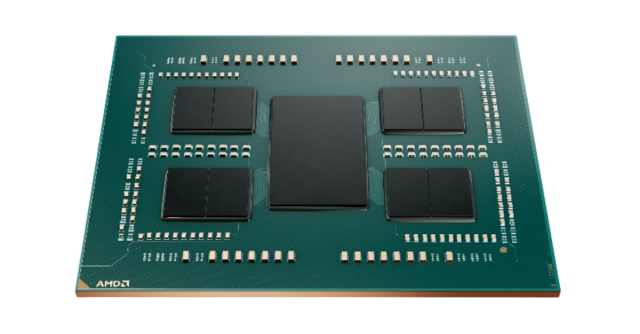
On October 19th, 2023, AMD announced new processors for the workstation and high-end desktop (HEDT) markets. The processors are based on 5nm Zen 4 architecture and offer up to 96 cores and 192 threads of performance.

The Ryzen Threadripper PRO 7000WX series of processors, which are designed for professionals and businesses that demand top-tier performance, reliability, expandability, and security, feature AMD PRO technologies and eight channels of DDR5 memory.

Meanwhile, the Ryzen Threadripper 7000 series signals AMD’s return to the HEDT market, offering overclocking capabilities and the maximum clock rates possible on a Threadripper-based CPU. Power, performance, and efficiency are all made possible by 5nm technology and Zen 4 architecture. The Threadripper 7000 series provides ample I/O channels for desktop users, with up to 48 PCIe Gen 5.0 lanes for graphics, storage, and more.

The new processors were available from OEM and system integrator (SI) partners, including Dell Technologies, HP, and Lenovo, as well as do-it-yourself (DIY) retailers, from November 21st, 2023.

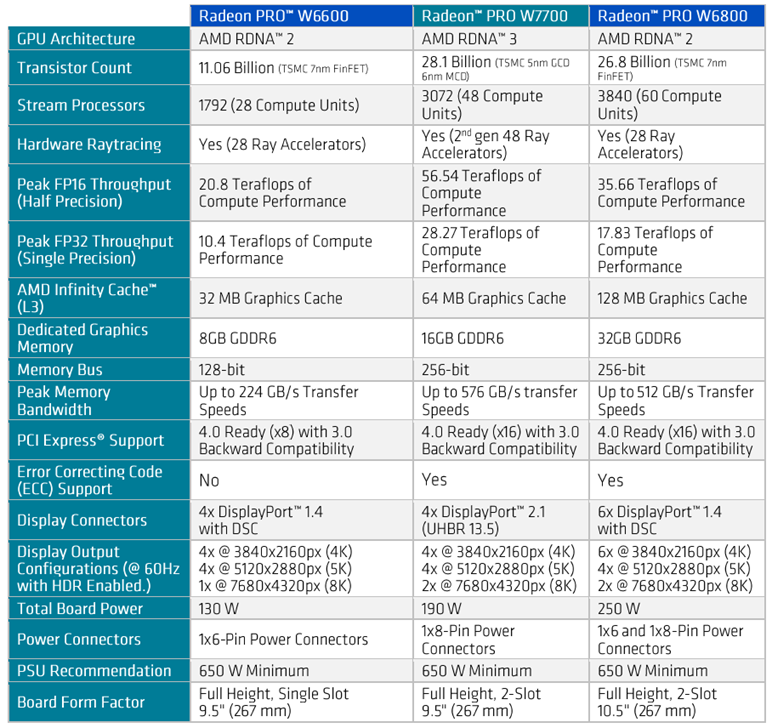
On November 13th, 2023, AMD announced the Radeon PRO W7700, a new workstation graphics card that offers high performance, reliability, and top-notch price/performance ratios for professional applications. The new card bridges the gap between the high-end Radeon PRO W7800 (32GB GDDR6) and the entry-level Radeon PRO W7600 (8GB GDDR6). The 16GB VRAM graphics card supports DisplayPort 2.1, AI acceleration, and hardware-based codecs for video editing and production.

This review will focus on the AMD Ryzen Threadripper 7980X processor, with additional coverage of the AMD Radeon PRO W7700 professional graphics card.

Test System Details

AMD Ryzen Threadripper 7980X Processor

The AMD Ryzen Threadripper 7980X processor (non-pro) signals AMD’s return to the HEDT market, offering overclocking capabilities and the maximum clock rates possible on a Threadripper series CPU.

Power, performance, and efficiency are all made possible by 5nm technology and Zen 4 architecture, which are available for the DIY market and SI partners. The Threadripper 7000 series provides ample I/O channels for desktop users, with up to 48 PCIe Gen 5.0 lanes for graphics, storage, and more.

AMD Radeon PRO W7700

With 16GB of Error Correction code (ECC) memory, the AMD Radeon PRO W7700 easily handles data-intensive operations. In terms of visual fidelity, the card features the New Radiance Display Engine, which supports 12-bit high dynamic range (HDR) color and recreates over 68 billion unique colors with high precision.

The Radeon PRO W7700 GPU’s major feature is its 48 unified RDNA 3 compute units, 48 second-generation ray accelerators, and 96 Al accelerators. The card has 16GB of GDDR6 ECC memory and four DisplayPort 2.1 (UHBR 13.5) connectors. The connectors, which provide up to 52.2 Gbit/s total bandwidth, are designed for 10K displays with 60Hz refresh rates, 2x8K displays, or 4x4K displays with Display Stream Compression technology.

AMD’s new dual media engine offers hardware-accelerated support for AV1 encoding, with the Radeon PRO W7700 capable of delivering 7680×4320 video at 60fps (8K60). The media engine supports two AVC and HEVC streams that can be encoded or decoded simultaneously. For live broadcasters, AMD has included many capabilities that increase both performance and quality.

Memory and Motherboard

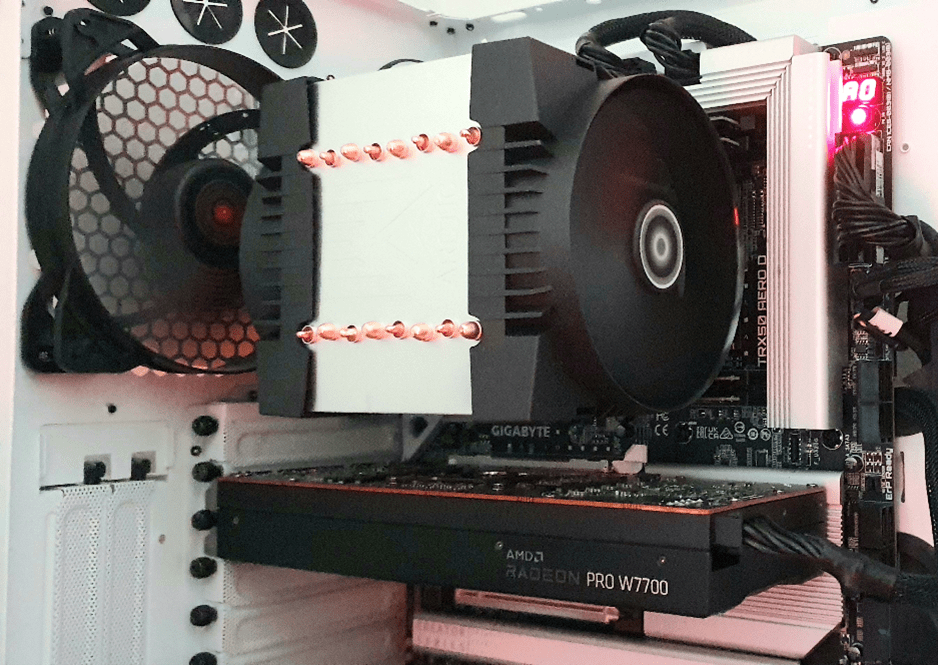
We installed the Ryzen Threadripper 7980X processor on a Gigabyte TRX50 AERO D motherboard, alongside the G.SKILL Zeta R5 Neo DDR5-6400, CL32-39-39-102, 1.40V, 128GB (4x32GB) kit with AMD EXPO memory overclocking and ECC support enabled.

AMD Ryzen Threadripper CPUs only support DDR5, LRDIMM, and 3DS RDIMMs. Threadripper 7000 processors can handle up to 8 channels/2TB on PRO motherboards (based on 8x256GB DIMMs) and up to 4 channels/1TB on HEDT motherboards (based on 4x256GB DIMMs), with support for both single-rank and dual-rank at 5200Mhz and a single DIMM per channel. ECC is enabled, although its functioning varies depending on the motherboard. The maximum official transfer rate varies by DIMM configuration, like with other AMD Ryzen CPUs.

Other Components

The Windows 11 main storage device was a 1TB GIGABYTE AORUS NVMe Gen4 solid-state drive. AMD provided a 360 all-in-one water cooler; however, it did not completely cover the CPU surface. Instead, we used the Arctic Freezer 4U-M, an 8x6mm direct contact heatpipe tower cooler with 2x120mm fans in push/pull mode. This cooler is intended for the most powerful server and workstation CPUs with up to 96 cores and a thermal design power of up to 350W.

The be quiet! STRAIGHT POWER 11 Platinum 850W power supply powered the system. A 34″ Dell Gaming S3422DWG monitor — a Quad-HD 3440×1440 display with a 144Hz refresh rate, FreeSync, 10-bit colors, and HDR support — was also utilized.

Benchmarks

Blender Benchmark

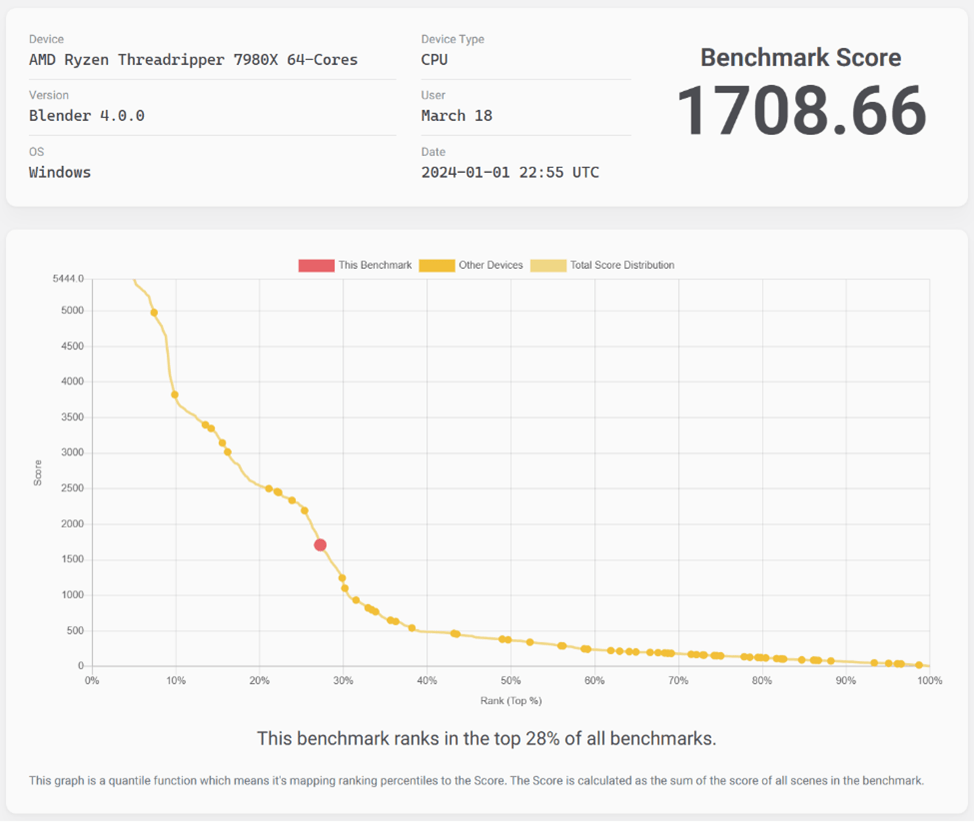
Blender Benchmark version 4.0.0 was used to assess the AMD Ryzen Threadripper 7980X processor’s rendering performance. With a score of 1708.66, the processor’s performance ranked among the top 28% of benchmarks running the same workloads. Given the inclusion of GPU results, the CPU performed brilliantly.

In terms of GPU results, the AMD Radeon PRO W7700 ranked in the top 27% of benchmarks, with a slightly elevated score of 1883.80. This reflects how strong the processor is at GPU-level rendering, which is fantastic news for studios that rely on CPUs for production.

IndigoBench

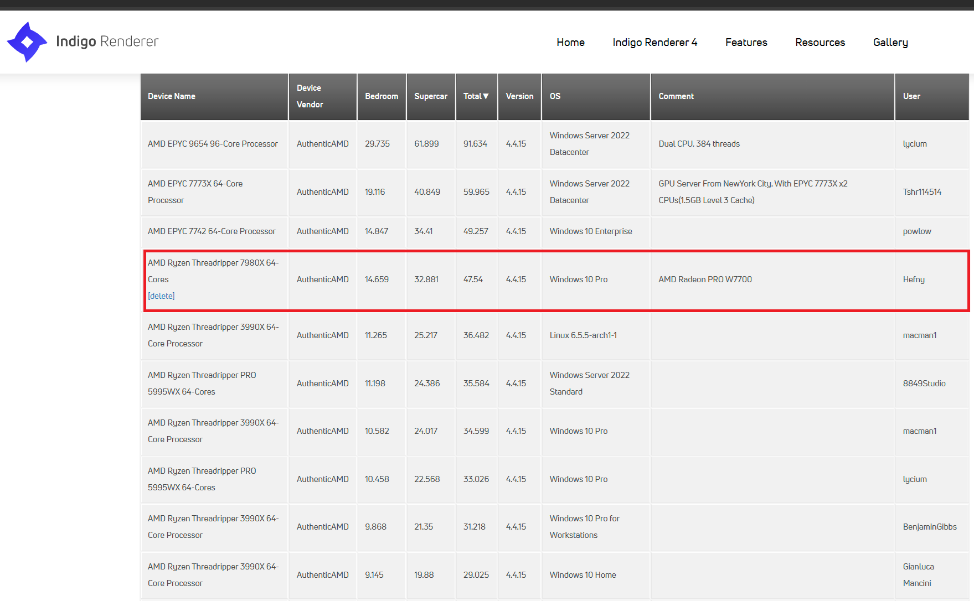
IndigoBench v4.4.15 is another standalone benchmark based on Indigo 4’s rendering engine and the industry-standard OpenCL.

With a total score of 47.54 million samples per second, the Threadripper 7980X ranks fourth among the top CPU performances when using normal settings and no overclocking. The processor also outperforms the Threadripper 3990X and Pro 5995WX by 30% and 33%, respectively, demonstrating a significant generational jump.

PCMark 10

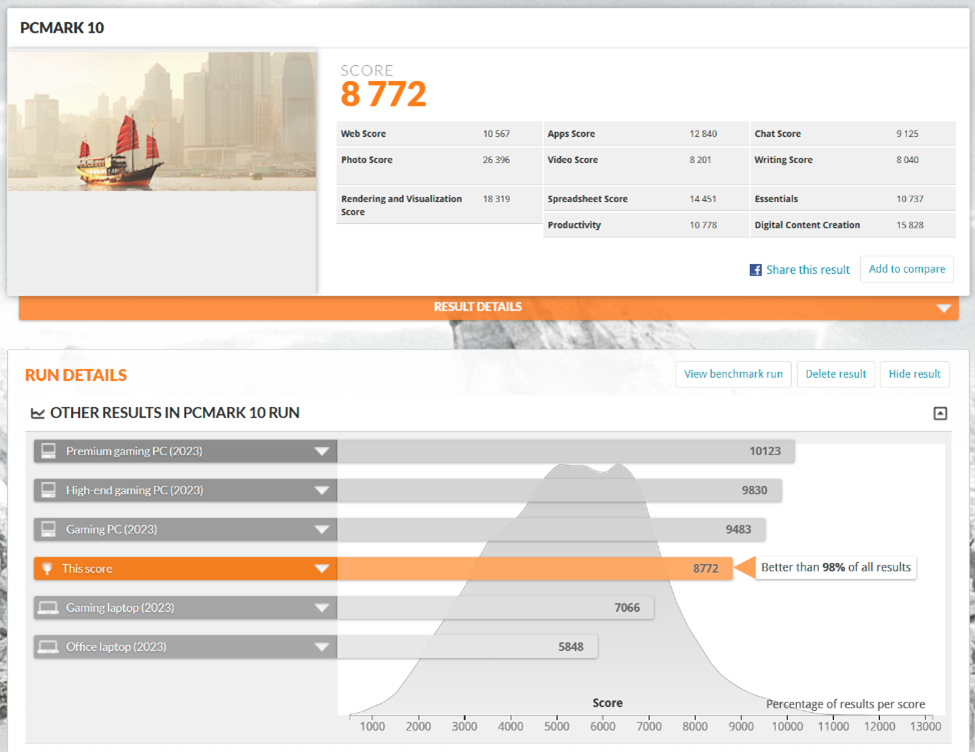
PCMark 10 is a comprehensive benchmarking tool that covers the wide variety of tasks performed in the modern workplace. Web browsing, videoconferencing, spreadsheet and word processing, photo and video editing, and rendering and visualization are some of the tasks tested by the tool.

The 8,772 score the test platform achieved was better than 98% of all results produced by PCMark 10.

CINEBENCH

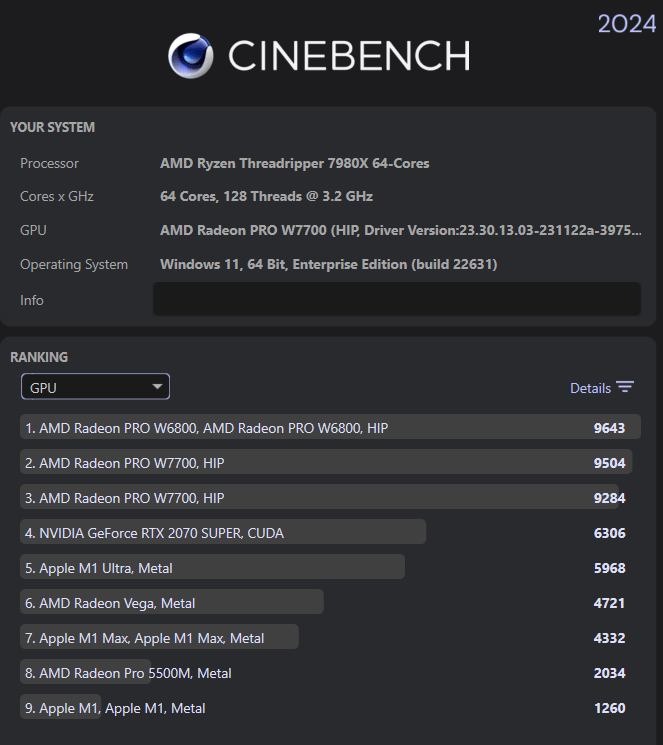
The 2024 edition of Cinebench now includes a GPU benchmark that takes advantage of Redshift, Cinema 4D’s default rendering engine. The Radeon PRO W7700 scored 9,504, nearly matching the Radeon Pro W6800, which scored 9,643 (according to the test database). This result demonstrates the level of sophistication of RDNA 3 computation, given the Radeon Pro W7700 has half the infinity cache and dedicated graphics RAM of the W6800.

Based on the 92,817 Cinebench R23 result, the AMD Ryzen Threadripper 7980X CPU is nearly three times faster than the Ryzen 9 7950X. This result demonstrates that the Threadripper is in a class of its own and is a much-needed high-performance solution.

3DMark CPU Profile

This test stresses the CPU at various levels of threading while reducing the GPU burden, ensuring that GPU performance is not a limiting factor. It takes advantage of sophisticated CPU instructions sets supported by different processors, including Advanced Vector Extensions 2 (AVX2). It also leverages the straightforward, highly efficient simulations provided by the SSSE3 code path.

With standard settings and no overclocking, the AMD Ryzen Threadripper 7980X CPU score of 25,374 qualifies for 3DMARK’s MAX Threads Hall of Fame. It ranks among the top 100 benchmark scores ever recorded, and holds 25th place among the world’s most skilled overclockers.

V-Ray 6 Benchmark

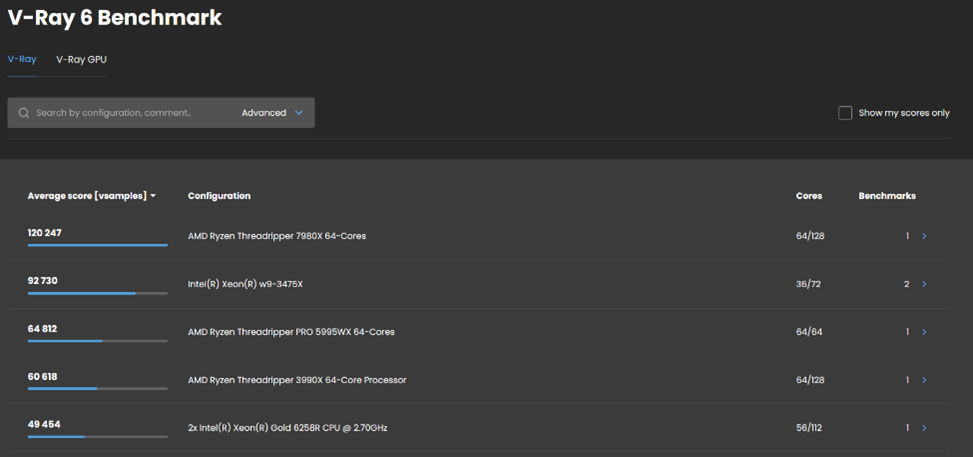
The V-Ray Benchmark, which uses the V-Ray 6 render engines, was used to gauge the system’s rendering speed.

With a vsamples score of 120,247, the AMD Ryzen Threadripper 7980X CPU is nearly twice as fast as the Threadripper Pro 599XWX and 3990X, representing a considerable generational leap.

SPECworkstation

The SPECworkstation 3.1 Benchmark fully assesses workstation performance across a variety of professional applications.

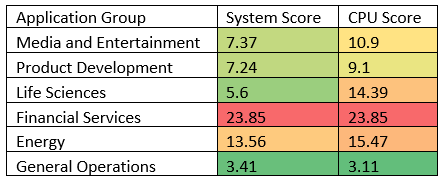
The AMD Ryzen Threadripper 7980X CPU scores are higher across all application groups, except for apps that rely more on the processor (such as financial services). This exception is due to the use of the Radeon PRO W7700, a midrange professional graphics card. Higher results across all application groups could be achieved with the use of the Radeon Pro W7800 or W7900.

Gaming

Since many professional gamers and streamers utilized HEDTs in the past to support multitasking — playing games, encoding and recording gameplay, and streaming to several web platforms — the Threadripper’s gaming performance was evaluated on this professional test platform. Professionals that enjoy playing games would undoubtedly prefer not to invest in another gaming PC after paying a premium for this test platform.

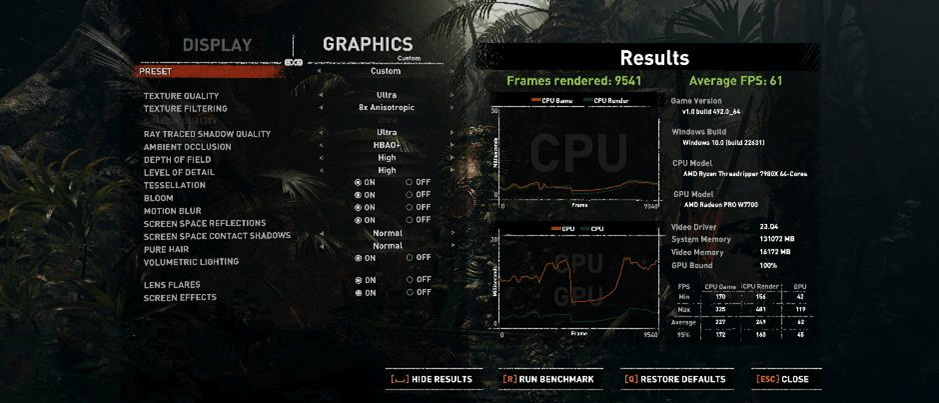
Shadow of the Tomb Raider ran at an average 61 frames per second (fps) at 1440p, with a minimum of 42fps. The highest graphical settings, as well as AMD’s FidelityFX CAS package, were enabled. Surprisingly, the use of XeSS for upscaling while running the game test boosted performance by 10% at the same settings, achieving a minimum of 50fps and an average of 66fps. This might be a demonstration of the RDNA3 architecture’s AI acceleration capabilities and the Radeon Pro W7700’s AI accelerators.

Far Cry 6 ran at an average 104fps at 1440p, registering a minimum of 92fps. All DirectX Raytracing (DXR) and FidelityFX Super Resolution (FSR) features were enabled during testing.

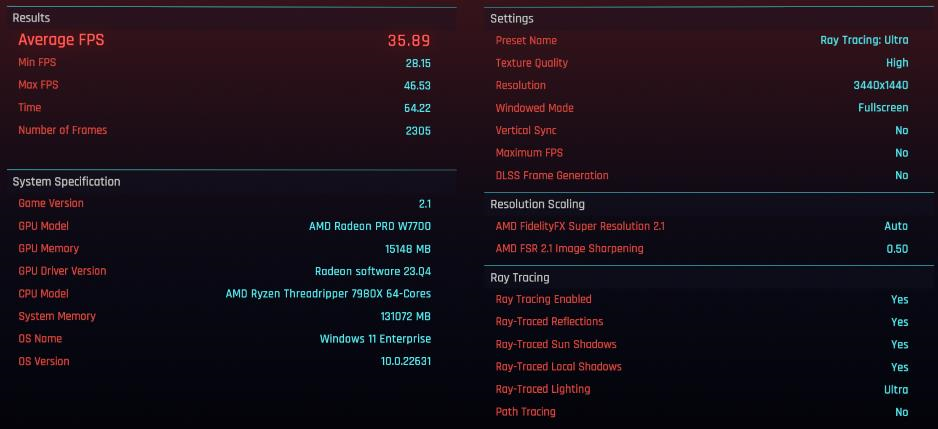
Cyberpunk 2077 ran at an average 36fps at 1440p, registering a minimum of 28fps. Ultra-ray tracing presets and FSR 2.1 features were automatically enabled.

The fact that the gaming results were 100% GPU bound indicates that the CPU was never a bottleneck and that employing top-tier gaming cards can improve gaming performance.

IDC Opinion and Conclusion

When AMD announced the Threadripper 5000 series in the Pro-only category, primarily for OEMs, the enthusiast community was left feeling let down. However, we are pleased that AMD did not abandon those customers for too long. AMD brought this category back to life after realizing — as its competitor had already done — that this is a prestigious and necessary niche market that cannot be satisfied by high-end consumer CPUs.

We are also pleased to see that the HEDT refreshment with the Ryzen 7000 platform supports the newest and greatest in networking and connectivity with excellent I/O support, including PCIe5 and DDR5 ECC registered memory modules (RDIMM/RDIMM-3DS), in addition to USB4 Type-C, 10 gigabit ethernet (10GbE), and Wi-Fi 7.

In the past, it was impossible to reach extremely high speeds while remaining stable and controlling voltage and temperature. However, this CPU is so quick, snappy, and opportunistic as it can surge up to 5.1 GHz when just a few cores are on demand, and 4.1 to 4.7 GHz when all cores are stressed, which is incredible.Furthermore, attaining rates of up to 6400MHz is another productivity breakthrough as it was previously difficult to overclock ECC RAM above the norm.

Aside from its intense performance, efficiency is the most striking aspect of the processor. Under full load, the Threadripper 7980X’s power consumption did not go over 340W. High-end consumer CPUs with fewer cores use the same amount of energy.

Although the Radeon Pro W7700’s power output stayed under 140W, we were not as satisfied with its clock speed, and thought there was potential for a higher frequency that was purposefully regulated. With our 850W platinum power supply, we had no trouble operating the system overall, and were even able to install it in a midi tower case.

We would love to see more partner solutions for cooling to fully cover the processor’s integrated heat spreader as well as motherboard support for extreme high-end use cases that require up to seven or eight graphics cards. The Threadripper 7000 series is more than capable of handling booming AI, machine learning, and training solutions — as well as media production and automotive rendering workloads — when needed on desktop platforms.

AMD should consider a SI certification scheme, similar to AMD Advantage in gaming. By doing so, it can provide customers with reliable and better experiences on an all-AMD platform that features the Threadripper and the Radeon PRO. This strategy will strengthen trust in the AMD brand and help SIs compete against OEMs with ISV-approved devices.

In conclusion, the AMD Ryzen Threadripper 7980X reigns supreme among HEDT CPUs. It delivers great performance straight out of the box, with most cores running at the highest clock speeds in a very energy efficient manner.

Mohamed Hakam Hefny - Senior Program Manager - IDC

Mohamed Hefny leads market research in EMEA on professional workstation PCs and solutions. He also reports on professional computing semiconductors, processors, and accelerators (CPUs and GPUs), as well as breakthroughs and trends related to the market. In addition, Mohamed is actively involved in AI PC taxonomy and research. He participates in business development projects, contributes to consulting activities, and provides IDC customers with analysis, opinions, and advice.

From its inception, the telecommunications industry has leveraged automation to enhance services and user experiences. As AI takes center stage, IDC surveys have shown that the primary use case for telco AI will be the improvement of customer experience (CX).

Telco AI: What’s Already Been Done?

The advent of telco AI can be seen as early as the beginnings of mechanical telephone switching in the 1890s. The introduction of the mechanical switch revolutionized the way callers connected, leading to faster connections and effectively managing the exponentially increasing complexity of connections as landline phone penetration skyrocketed.

“That’s not AI — that’s just automation!” you may cry. But the impact on the workforce of manual switch operators was profound. And this shares some similarities to the transformative effect that generative AI (GenAI) applications are having on creative professionals today.

In recent history, the visible face of AI in telecoms is the ubiquitous digital customer service agent — the chatbot. Examples like Vodafone’s TOBi, launched in 2017, showcase the initial steps toward automated customer interactions.

These applications, however, often struggle when customers deviate from predetermined scripts. Beneath the surface, telecom networks rely heavily on AI and automation to optimize services, rout network traffic, monitor anomalies, and analyze customer interactions to recommend tailored product bundles.

What Telco AI Use Cases Will Be Big in 2024?

The successful launch of OpenAI’s ChatGPT in 2022 significantly elevated industry expectations for AI applications. Throughout 2023, experimentation accelerated, particularly in telecom CX, software coding support, and knowledge management.

In 2024, these use cases are set to expand into production environments, with continued exploration of how predictive and generative AI can support existing telecoms use cases.

Two key CX use cases are customer-facing chatbots that have enhanced natural language understanding, and AI customer sentiment analysis and personalization. By leveraging large language models (LLMs) and retrieval augmented generation (RAG) capabilities, chatbots will be able to answer customer questions like, “Why is my bill higher this month?” Such capability was extremely rare previously. Telcos like BT, DT, Orange, and Vodafone are examples of telcos exploring these capabilities.

Beyond CX, AI will bolster coder productivity with solutions like Microsoft Github Copilot and Amazon CodeWhisperer. Investment will go toward internal chatbots and knowledge management tools across departments, including sales, HR, legal, and network operations.

How AI Will Shape Telco CX by 2030

Looking to 2030, AI’s role in telecoms will become even more customer-centric. For example, energy efficiency solutions, currently focused on macro-networks, could be extended to customer devices, prolonging battery life.

Direct changes in customer interactions will manifest in advanced chatbots offering complete digital sales experiences. These chatbots will craft personalized packages based on customer preferences and budgets, eliminating the need for human intervention.

Moreover, this evolution in chatbots will align with the rise of metaverse environments that will incorporate visual representations of AI agents and use features like AI-driven body language to boost customer engagement in a 3D environment.

In summary, 2024 sees the telecoms industry again at the forefront of significant transformations, propelled by AI’s ability to automate tasks and deliver an elevated customer experience. At IDC, we will continue to cover the development of AI technologies and the telecoms industry in depth, with some of our most recent reports focusing on the telecoms GenAI value chain and the AI-driven evolution of telco CX platforms.

Chris Silberberg - Research Manager, Communication Service Provider Operations and Monetization - IDC

Chris Silberberg is Research Manager for IDC's global Communication Service Provider Operations and Monetization research. Chris' core research coverage includes the evolution of telco monetization, customer experience, orchestration, and assurance capabilities. Telcos are at a crossroads, double down as utility providers or become digital service power houses. Both strategies demand communication service providers fundamentally transform their IT capabilities to enable customer first experiences, autonomous operations, and the capacity to innovate monetization models at scale.

The space economy has undergone a transformative evolution in the past two decades. The entry of private companies into the industry has created new avenues for business in Earth’s orbit and beyond.

This journey began with the milestone 2004 commercial spaceflight of Scaled Composites’ SpaceShipOne, funded by the Ansari XPrize, which showcased the viability of privately-funded space travel. The success laid the groundwork for pioneers like SpaceX, Blue Origin, and others to venture into commercial endeavors that span space exploration, satellite launches, crewed missions, and more.

Widely recognized examples — such as the GPS technology that shapes our navigation systems and the satellites that enable television broadcasting to our homes — show space’s impact on our daily lives.

We note the acceleration of the space economy and are taking this opportunity to delve into ICT opportunities arising from space tech and research. There’s still a vast reservoir of untapped business potential within the space economy.

McKinsey has projected the market to reach a value of $1T by 2030,  doubling its 2022 size.

This unprecedented growth is concentrated on four subdomains:

Earth Observation Technologies: Space-derived technologies have become integral to Earth observation. They facilitate precise weather forecasting, disaster management, and environmental monitoring, optimizing routes, tracking assets, monitoring infrastructure and managing supply chains. Satellites equipped with advanced ICT systems capture invaluable data, empowering diverse sectors.

In precision agriculture, satellite data is used to optimize crop yields by monitoring factors such as soil moisture levels and crop health. This data enables farmers to make informed decisions about irrigation, fertilization, and pest control, ultimately increasing productivity and reducing resource usage.

In disaster management, satellites provide real-time situational awareness during crises such as hurricanes, wildfires, and floods. By monitoring changes in weather patterns and surface conditions, authorities can effectively plan and coordinate emergency response efforts, minimizing damage and saving lives.

Companies like Maxar Technologies provide satellite imagery and analytics platforms that support industries in monitoring aspects of Earth. Airbus Defense and Space collaborates with Maxar Technologies to enhance global imaging capabilities through satellite projects. The World Bank utilizes Maxar’s expertise in satellite imagery for disaster risk management and infrastructure planning. Mining giants like Rio Tinto rely on Maxar’s solutions to optimize exploration and monitor environmental impacts.

Communication Satellites and Global Connectivity: Constellations of small satellites in low Earth orbit are transforming telecommunications. These satellites promise faster internet speeds and lower latency, disrupting traditional satellite systems and terrestrial ISPs alike.

The mesh network architecture of Starlink facilitates seamless communication between satellites and ground stations, ensuring high-speed internet access even in remote areas like the Amazon rainforest that lack technical infrastructure.

This innovative approach enhances connectivity for individuals and businesses and opens new opportunities for telecommunication providers, content providers, and ecommerce platforms to expand their outreach and services globally. Starlink’s impact spreads across industries.

For Carnival Cruise Line, Starlink facilitates crew connectivity with loved ones while enhancing guest experiences and operational functions on its world-class cruises. Brightline, a transportation company, credits Starlink for revolutionizing train connectivity, providing reliable connectivity for guests and invigorating excitement among train enthusiasts. In the education sector, Chilean school districts have experienced a significant upgrade in connectivity, with Starlink empowering teachers and students with robust and efficient high-speed internet.

Telemedicine from Space: The convergence of space technology and healthcare has sparked significant innovations in telemedicine, leveraging robotic telepresence systems for remote specialist consultations and surgeries.

Drawing inspiration from space mission requirements for remote task execution, these systems enable healthcare providers to deliver care to patients in remote or underserved areas, transcending geographical barriers. The integration of space-derived technologies into healthcare holds the potential to revolutionize patient care, address healthcare disparities, and optimize clinical outcomes.

Companies like Intuitive Surgical have been instrumental in advancing robotic surgical systems, as exemplified by the da Vinci Surgical System. This technology has significantly improved minimally invasive surgeries by enhancing precision and control.

Intuitive’s Single-Site technology, designed for specific procedures, aims to minimize scarring and enhance patient satisfaction. Intuitive’s robotic platforms utilize high-precision imaging and visualization technologies, including high-definition 3D vision and magnification capabilities. These contribute to improved surgical precision and better outcomes for patients.

Space Robotics and Automation: Specialized robots are being designed and developed for space exploration, satellite servicing, and tasks in harsh space environments. These robots handle assembly, maintenance, repair, and exploration missions, operated remotely from Earth or autonomously. Their crucial role in advancing space exploration makes them indispensable for future missions and scientific discoveries.

Honeybee Robotics leads the fusion of space robotics with terrestrial applications, revolutionizing industries spanning mining, energy, infrastructure inspection, and agriculture. Leveraging space-derived technologies, the company develops autonomous systems that enhance efficiency and safety across diverse sectors.

In mining, robotic drilling systems and sampling tools facilitate exploration and resource extraction in remote or hazardous environments, boosting productivity while minimizing operational risks. In agriculture, robotic systems streamline tasks such as soil sampling, crop monitoring, and harvesting, optimizing practices and bolstering yields.

Pacific Gas and Electric Company (PG&E) harnesses Honeybee Robotics’ robotic platforms to inspect and maintain critical infrastructure, including natural gas pipelines and electrical transmission lines. These solutions empower PG&E to conduct remote inspections, detect anomalies, and execute maintenance tasks with greater efficiency and safety.

Honeybee Robotics works with agricultural equipment manufacturers like John Deere to explore the integration of robotic technologies into farming equipment, providing farmers with innovative solutions for precision farming and crop management.

Life in Space: The Role of ICT

If we take some research applications and look into future business opportunities, shaping life in space is the way to go. During mission planning, technology tools assist in trajectory optimization, resource allocation, and risk management, ensuring efficient utilization of resources and the achievement of mission objectives in the unforgiving space environment.

From an operational perspective, tech enables real-time monitoring and control of spacecraft systems, as well as communication between ground control centers and astronauts aboard spacecraft.

Looking even further into the future, there is immense potential for ICT technologies to support extraterrestrial activities, such as mining on Mars or the Moon, where advanced robotics, AI, and data analytics will be essential for resource extraction and colonization.

As we wrap up this dive into ICT opportunities within the space economy, it’s evident we’ve only skimmed the surface. From telecommunications to healthcare, space tech is reshaping industries, offering countless business prospects.

The space economy not only fuels tech advancement and scientific collaboration but also equips businesses with cutting-edge solutions, tested in real-world conditions. By embracing space-derived tech like satellite imaging and remote sensing, industries boost efficiency, optimize resources, and make crucial decisions more effectively.

The convergence of space tech with various sectors highlights the need for a robust tech ecosystem and interconnectivity. This fusion drives demand for key ICT technologies, including data analytics, telecommunications, cloud computing, AI, and robotics.

Data analytics, powered by satellites, aids precision agriculture and disaster management. Telecom innovations, such as small satellite constellations, expand global connectivity. Cloud computing processes vast data sets from satellite imagery, fostering innovation. AI analyzes satellite data for resource optimization and urban planning. AI-driven robotics perform tasks autonomously, from infrastructure inspections to surgical procedures.

Industry collaboration, R&D investment, and further implementation of space tech applications will unlock new markets, drive innovation, and propel growth for the entire technology sector.

As we dive deeper into our space economy research, we want to hear success stories and lessons learned from early adopters. If you want to join the conversation, please contact me at.anguedes@idc.com.

On Sunday, February 25, we hosted our brunch event to kick off IDC’s Mobile World Congress (MWC) activities in Barcelona. Key executives and decision makers from leading companies in the telecoms and technology sectors attended.

We delivered presentations addressing key transformations underway in the telecoms sector. A panel discussion was held in which senior industry executives shared their perspectives on the future.

Key Overarching Challenges Across the Industry

The telecoms market is massive, with annual worldwide telco services spending of around $1.6 trillion, according to IDC’s Telecoms Services Tracker. The industry, which is showing growth after an anaemic period, makes up 27% of the overall ICT market and employs 4.5 million people globally.

The market is a critical component of the global economy, as well as a key element of public safety. This was underlined last week in the United States, when millions of people in several large states were unable to dial through to the 911 emergency system because of a telecoms issue.

Telco SPs annually invest over $330 billion to build their communication networks. These investments are made to meet several corporate strategies, including driving new network performance efficiencies and creating platforms for future revenue growth.

Given the size of these capex investments, it is important for telcos to monetize their investments and cut costs in order to compete as vigorously as possible. This has led to a wave of M&A activity across the world, especially in Europe, with massive multibillion deals involving Orange, Masmovil, Colt, Lumen, Vodafone, and others.

At the same time, we’re seeing the entry of new types of players, including satellite companies such as Starlink, making an already complex ecosystem even more so.

Value Propositions Beyond the Pipe

Understanding the multifaceted opportunities for monetization is key to thriving in the telecom industry. We identify three levels of connectivity monetization: 

  1. Network Infrastructure Enhancement: Leveraging technologies like network slicing and multi-access edge computing (MEC), and optimizing bandwidth and latency for diverse use cases
  2. Service Innovation: Offering tailored solutions such as fixed wireless access (FWA), private networks, and unified communications and collaboration (UC&C)
  3. Solution Development: Exploring avenues in automation, robotics, and the Internet of Things (IoT) for transformative business solutions

However, telecom features, services, and solutions must solve business issues to deliver material revenue gains. IDC’s 2023 Future of Connectedness Survey, conducted in June 2023, found that 42% of organizations prioritize enhanced access to critical business applications both on premises and in the cloud as their top metric for evaluating connectivity initiatives.

Following closely, 39% prioritize faster data throughput, while 36% emphasize increased levels of automation. This underscores the importance of aligning telecom offerings with the core objectives of businesses to drive meaningful value and performance.

We identify four essential strategies for elevating connectivity:

  1. Network APIs fuel successful revenue opportunities across all three levels.
  2. External partnerships are critical to integrating diverse technology sets into comprehensive solutions.
  3. Utilize differentiated, dynamic pricing models to increase adoption of connectivity-enabled solutions.
  4. Focus on business outcomes, not technologies, to court customer trust and validate meaningful ROI analysis.

Telcos Walking the Walk: Transform Internally to Lead Externally

In 2024, the transformation of telecom operators will encompass internal initiatives, such as cost optimization and the pursuit of new revenue streams through the integration of cloud data and intelligence. Externally, transformation responds to shifting customer expectations and the erosion of traditional core business models.

To navigate these changes effectively, operators are adapting to evolving partner ecosystems, leveraging synergy and agility to remain competitive in a dynamic marketplace.

The journey toward the telco cloud continues unabated. Almost three-quarters (73%) of respondents to IDC’s EMEA Telco Transformation Survey confirmed the deployment of BSS workloads in cloud environments. Similarly, 65% of respondents have already migrated OSS workloads to the cloud. Among the 150 sampled telcos, 37% have taken the significant step of transferring core workloads to cloud platforms.

The hypothesis of “telco wait-and-see” is now obsolete. We believe the success factors for telecom companies are:

  • Connectivity Diversity: Overhauling traditional business models to enable a broader range and higher volume of new services
  • Profitability: Boosting customer loyalty, generating new revenue streams, and enhancing operational efficiency
  • Automation: Adopting advanced technologies and refining processes for innovation and competitiveness

Telcos are gearing up for a transformative era of digital services and mobile applications through the deployment of open network APIs. Demonstrating a strong commitment to this evolution, telcos are actively engaged in the development of telco API standards, with 29 companies already enlisted in the GSMA’s Open Gateway initiative.

As these initiatives mature, attention naturally shifts toward monetization strategies, including the establishment of API marketplaces, and fostering engagement with a wider array of third-party developer communities.

More than half (53%) of our survey respondents indicated their primary focus for API investment lies in developing network APIs capable of being commercialized both internally and by third parties, thereby facilitating transformative changes within their business operations. An effective go-to-market strategy for exposing network APIs will hinge on factors such as segment type, specific use cases, and geographical reach. 

In conclusion, the telco industry stands at a pivotal juncture. It is undergoing a profound transformation that will shape its trajectory for the next 15–20 years. The convergence of culture, technology, internal operations, and customer experience underscores the hyper-complexity of the current landscape.

As we navigate these changes, it’s crucial to recognize that the stakes are high: There will be winners and losers, and the status quo is being redefined. Embracing a mindset of agility and experimentation is paramount.

Don’t hesitate to try and fail fast. Leverage every opportunity to learn collaboratively with your customers. Seek out strategic partnerships to enhance your chances of success in this dynamic environment.

Remember: In such complex scenarios, focus is key. Each player must define their priorities and steadfastly pursue them, recognizing that there’s no one-size-fits-all approach to thriving in the evolving telco ecosystem.

Masarra Mohamad - Senior Research Analyst, European 5G Enterprise Strategies - IDC

Masarra Mohamed is a senior research analyst specializing in analysing the connectivity and communications services markets, focusing on the changing networking requirements, trends, and competitive dynamics that support enterprises in their digital transformation. She explores how enterprise network strategies evolve to enable cloud, AI, and security.