Heavy machinery, automotive, and machine building typically have complex bills of material, multi-tier supply chain networks, and depend on carbon-intensive materials such as steel, aluminum, and plastics. To meet sustainability goals, these engineering-oriented value chains (EOVC) must undergo a transformative shift.

Manufacturing organizations stand at the forefront of decarbonization efforts worldwide. In 2022, IDC’s Industry Intelligence Survey found that customer requirements drove investments in sustainability as a strategic business priority for 45% of U.S. and 39% of European manufacturing respondents. For 40% of U.S and European respondents, regulatory requirements were the leading sustainability investment driver.

Decarbonizing the entire value chain — with a particular focus on Scope 3 emissions — is central to the evolution of EOVCs. Scope 3 emissions represent a significant share of a company’s overall carbon footprint, extending beyond direct operational activities (Scope 1) and indirect energy consumption (Scope 2). Scope 3 emissions encompass indirect emissions generated across the value chain, including the production of materials like steel, plastics, aluminum, batteries, and glass.

Understanding the dynamics of affordable (and available) clean and renewable energy is crucial to developing an emissions-free supply chain. Europe, however, faces significant challenges in deploying the low-carbon energy resources crucial to decarbonizing supply chains in general.

Many challenges related to value chain decarbonization are addressed at the C-suite level. However, the roles that must implement these strategies include material engineers, procurement department leaders, quality managers, and supplier management leaders.

As material and production technology evolves, new components are developed, and new regulations emerge, those in supplier network management-related positions must have detailed knowledge about the impact of component materials on carbon footprints. We are not talking about emissions related solely to logistics, but about the carbon footprint of the production process itself.

Products like steel, aluminum, electric batteries, and plastics are often referred to as “hotspots” — that is, making them produces major emissions of CO2 and other greenhouse gases and is a leading contributor to the auto industry’s emissions footprint.

According to a McKinsey & Company study, typical upstream EV emissions include the battery (40%–60%), steel (15%–20%), aluminum (10%–20%), and plastics (around 10%). Upstream internal combustion engine (ICE) vehicle emissions include steel (25%–35%), aluminum (20%–30%), and plastics (15%–20%).

Let’s briefly examine the carbon-emitting hotspots in EOVC supply chains.

Batteries

The rise of EVs has highlighted the environmental impact of battery production. Manufacturing lithium-ion batteries involves resource-intensive processes that contribute to Scope 3 emissions. EV batteries contain nickel, manganese, cobalt, lithium, and graphite, which emit substantial amounts of GHGs during their mining and refining processes.

Some processes in the production of anode and cathode active materials require high, energy-intensive temperatures. Other factors that determine the amount of embedded production carbon include battery chemistry, the production technology, the raw material suppliers, and transportation routes.

Oliver Zipse, chairman of the Board of Management of BMW, said in a statement that the company’s competence center near Munich is laying the technological foundations for the efficient and resource-saving production of battery cells along the entire value chain. The statement said sample production of sixth-generation round cells has already begun. These cells are characterized by an up to 20% higher energy density, and BMW has been able to reduce the CO2 footprint in cell production by up to 60%, according to the statement.

  • Worth Watching: On November 21, 2023, Swedish company Northvolt announced a state-of-the-art sodium-ion battery developed to expand cost-efficient and sustainable energy storage systems. The cell has been validated for an energy density of 160+ watt-hours per kilogram at the company’s R&D and industrialization campus in Västerås, Sweden. This energy density is close to that of the type of lithium batteries typically used in energy storage. Lithium batteries used in electric cars have an energy density of up to 250–300 watt-hours per kilogram.  Northvolt says the technology can minimize dependence on China for the green transition. Battery designers and engineers, as well as supply chain managers, are advised to keep an eye on the company’s efforts to scale the technology for industrial use.

Steel

Traditional methods of steel production cause high emissions due to the use of fossil fuels in the smelting process. Decarbonization efforts involve adopting innovative technologies like hydrogen-based steelmaking and electric arc furnaces powered by renewable energy. Transitioning to sustainable steel production is vital to mitigating the impact of Scope 3 emissions and reducing the automotive industry’s overall carbon footprint.

Plastics

Plastics, widely used in automotive components, pose an environmental and sustainability challenge. The production of plastics, particularly from petrochemical sources, contributes significantly to carbon emissions. Addressing this hotspot involves embracing circular economy principles, recycling plastics, and developing bio-based alternatives. Recycling initiatives and reducing dependence on fossil fuels for plastic production will enable the automotive industry to make substantial strides in Scope 3 emissions reduction.

Aluminum

Aluminum, valued for its lightweight properties crucial to fuel efficiency, is a key material in automotive manufacturing. Traditional aluminum production is energy-intensive and contributes to significant carbon emissions. The adoption of recycled aluminum, coupled with advancements in low-carbon primary aluminum production, is essential to mitigate environmental impacts. Innovations in aluminum production processes (e.g., smelting using renewable energy sources) offer promising avenues for reducing Scope 3 emissions.

Conclusion

Collaboration across the entire value chain — from raw material suppliers to manufacturers and consumers — is critical to drive meaningful change and accelerate the transition toward a low-carbon EOVC sector.

Establishing a transparent and trusted carbon-free environment requires an understanding of the entire Scope 3 upstream supplier footprint. Understanding the Scope 2 emissions of each supplier is also essential. Acquiring this level of transparency requires tools and data platforms that offer access to trusted information provided by suppliers and suppliers’ suppliers, as well as tools that monitor OEM compliance with regulatory obligations.

The future of decarbonization of the entire manufacturing supply chain is, of course, inevitably enabled by ubiquitous data. Sustainable zero-carbon efforts span not only the visible chain of tier suppliers but also primary and secondary raw material processing plants and green energy providers.

Automotive, machinery, and heavy machinery OEMs may share suppliers; hence, an OEM can benefit from the sustainability-related transparency of the supplier network established by another OEM.

Utilizing a secure, scalable, and transparent digital data collection platform is an absolute must to successfully achieve the net-zero supply chain transition. I was pleasantly surprised to find that 70% of global manufacturing respondents to IDC’s 2022 Industry Intelligence Survey were already using cloud infrastructure to support sustainability metrics.

My Recommendation: Go beyond the obvious. In addition to Scope 3, focus on Scope 1 and Scope 2 of each entity in your supply chain. Turn suppliers into ecosystem stakeholders. Provide them with knowledge, help develop their workforce, and offer digital technology support!


Find out more about our Manufacturing Insights coverage, visit our website.
Nov 17, 2023

Технологические инновации в государственном секторе обсудят на IDC Government Innovation Forum 7 декабря в Астане

Астана, 17 ноября — IDC Government Innovation Forum 2023 – ежегодное событие ИТ-рынка Казахстана, организуемое ведущим международным аналитическим агентством IDC. Форум соберет более 100 руководителей...

Read full release

Generative AI (GenAI) attracted significant interest in 2023 and has already begun to impact horizontal and industry applications and use cases. According to our predictions for 2024, it’s anticipated that in 2026, half of G2000 companies will have integrated operational systems with GenAI to better ingest data, identify issues, and provide real-time context to operators, improving efficiency by 5%.

GenAI’s influence on the manufacturing sector is poised to be pivotal. It has already triggered a transition in which AI is omnipresent, no longer an emerging software segment amidst the technological stack.

Numerous firms, including industrial organizations, are assessing how AI can bring value to their operations. They may not have been early adopters of GenAI, but industrial organizations are well-placed to utilize the technology to generate diverse content and conduct extensive research. Algorithms can be trained using existing large data sets to produce text, video, images, even virtual environments.

Download eBook: Generative AI in EMEA: Opportunities, Risks, and Futures

Guidelines to Develop GenAI-powered Use Cases

To help organizations learn from company experiences, successes, and challenges in developing GenAI-powered use cases, I have established some guidelines:

  1. Do Not Underestimate Implementation

GenAI holds a lot of promise, but implementation carries risks that adopters have to watch very carefully. Appropriately trained and utilized, it proves reliable and can be implemented at a reasonable cost. From my perspective, organizations should view GenAI-powered solutions as an integral part of a digitally enabled strategy, particularly in fields like asset maintenance.

It’s essential to meticulously plan each phase of the solution’s implementation journey. The desired goals should be outlined, and key performance indicators should be identified. Regarding ROI, the total cost of ownership should be accounted for, including OPEX.

During the planning stages, organizations should project how the solution will scale and integrate with existing IT systems (especially in terms of technology standards). Organizations should also not undervalue the importance of the post-implementation period. Establishing review cycles with technology partners is crucial to ensure that user feedback is appropriately addressed. Finally, organizations should engage in discussions with experts who can provide insights into other areas that could benefit from GenAI solutions.

  1. Expand on Technology Partnerships

I recommend that organizations forge partnerships with technology providers and establish trusted relationships that foster the sharing of goals, capabilities, and values. A collaborative approach enables organizations to expedite and expand innovation. Due to the potentially lengthy journey from proof of concept to implementing company-wide solutions, organizations should ensure that their partners are capable of delivering scalable solutions and offering guidance throughout the implementation process.

When constructing a private and secure GenAI environment, organizations should consider technology partners capable of transferring internal data into large language models (LLMs) securely and without loss. Such partners can also facilitate knowledge transfers to internal staff for ongoing management and proficiency.

  1. Keep Security in Mind

Organizations should be on guard against potential data leaks and biases, while also retaining control over the IT processes operating in the background. It is vital to establish a governance mechanism to tackle concerns related to privacy, manipulation, biases, security, transparency, disparities, and potential workforce displacement.

I suggest actively participating in specialized drills aimed at mitigating the risk of sophisticated phishing attacks. Organizations can also enhance data security by updating their data infrastructures to meet the expanding data requirements of GenAI models.

  1. Be Creative in Finding New Use Cases

Organizations should prioritize using AI to deliver value and enhance business outcomes; AI should not be pursued for its own sake. The decision-making process regarding ROI involves various parameters. Early adopters have suggested focusing on one of the most critical aspects: the strategic fit of the investment. A fundamental approach is to give priority to initiatives that offer the most beneficial outcomes but require the least effort. Based on the experiences of GenAI adopters, I support adopting an agile methodology and the minimum viable product (MVP) strategy, which should prevent investment in non-value-added projects.

In a recent interview with an end user, it was revealed that 100+ potential use cases were identified during GenAI ideation workshops. Of these, two have already been launched as MVPs, and 14 are in active development.

Watch the Webcast: Generative AI in EMEA: Opportunities, Risks, and Futures

Conclusion

GenAI solutions are transforming manufacturing operations, improving efficiency, facilitating data-driven decision-making, and simplifying complex processes for frontline workers. By implementing these innovative practices, organizations can adapt to the changing manufacturing landscape and significantly enhance operations.

Our research indicates that the adoption of GenAI by manufacturing organizations is still in the early stages. However, there has been a notable increase in GenAI awareness: IDC’s July 2023 Future Enterprise Resiliency and Spending Survey revealed that just 19% of manufacturing organizations were unaware of GenAI, compared to 35% in March 2023. This trend suggests that GenAI is steadily being integrated into the technology frameworks of organizations, putting them on an innovation trajectory.

To explore more of our coverage on Gen AI, visit our dedicated page.

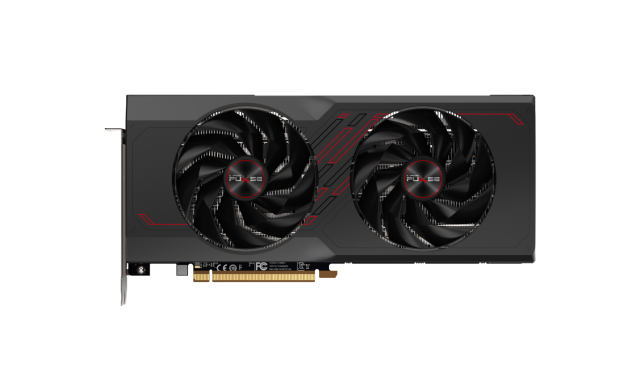
In September 2023, two and a half years after the launch of the Radeon RX 6700 XT and Radeon RX 6800 XT, AMD introduced two new GPUs to round out its new RDNA 3-based graphic card portfolio: the midrange Radeon RX 7700 XT and high-end Radeon RX 7800 XT. AMD also published the most recent version of AMD Software: Adrenalin Edition, which introduced AMD HYPR-RX and FidelityFX Super Resolution 3 (FSR 3) with frame generation technologies. In addition, AMD released a technical preview driver that allows all DirectX 11 and DirectX 12 games to benefit from Fluid Motion Frames, a frame generation technology.

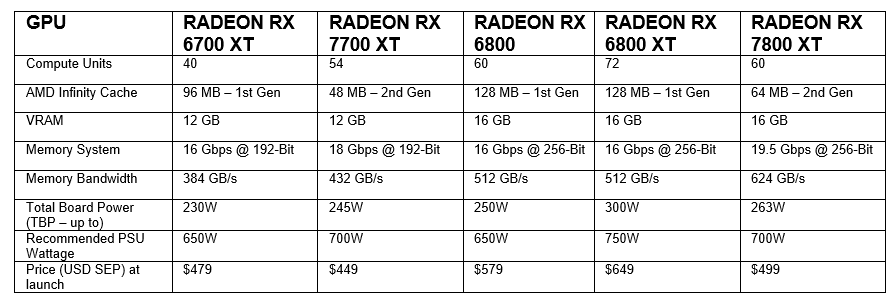
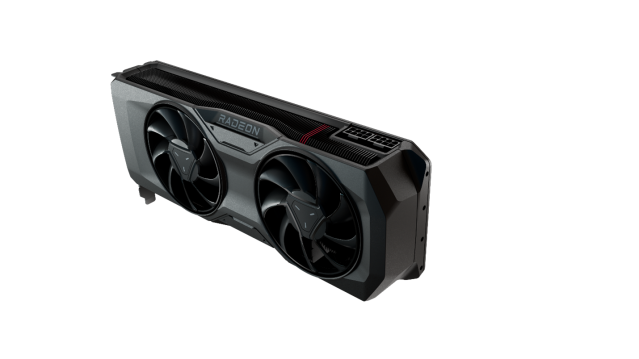
The 12 GB AMD Radeon RX 7700 XT and 16 GB Radeon RX 7800 XT graphics cards are equipped with second-generation AMD Infinity Cache technology and are based on the groundbreaking AMD RDNA 3 architecture. They offer 1440p high refresh rate gaming experiences with good performance at reasonable prices.

The AMD Radeon RX 7800 XT and 7700 XT graphics cards, which have suggested etail prices of $449 and $499, respectively, went on sale from September 6, 2023. For this review, we installed sample AMD cards in two systems, each with a Ryzen 9 7950X CPU, a Gigabyte X670E Aorus Master motherboard, and a G.SKILL Trident Z5 Neo 2x16GB DDR5-6000 EXPO memory kit.

Architecture

RDNA 3

The Radeon RX 7700 XT and RX 7800 XT respectively have 54 and 60 unified AMD RDNA 3 compute units. These new cards are built on the RDNA 3 architecture, which include new Infinity Cache technology, AI accelerators, and second-generation raytracing accelerators. The AMD Radiance Display Engine, with DisplayPort 2.1 support for high refresh rate displays, is also incorporated into the new cards.

2nd Generation AMD Infinity Cache

The new cache hierarchy balance has been optimized for the ideal mix of 2nd Generation Infinity Cache and L2 cache to allow fast data access and act as a significant bandwidth amplifier despite being half the size of the RDNA 2-based GPUs. The new cards thus have better performance and are more power efficient than previous models.

Media Engine

Like the previously announced RDNA 3-based GPUs, the new media engines on the Radeon RX 7700 XT and RX 7800 XT have hardware-accelerated support for AV1 encoding up to 8K resolution at 60 frames per second (FPS). It is now possible to produce output videos at smaller file sizes while maintaining the same bitrate and quality. The current versions of OBS, DaVinci Resolve, and Adobe Premiere Pro, with the Voudoker plug-in, all have support for AMD RDNA 3 Media Engine AV1 encoding. Support for FFmpeg and Handbrake encoding will be introduced in future.

Game Bundles

AMD continues to offer newly released AAA gaming titles alongside its launch of new products and seasonal promotions. AMD is the exclusive PC partner for Starfield, Bethesda Game Studios’ new open world game in almost 25 years. Starfield was created by the award-winning designers of The Elder Scrolls V: Skyrim and Fallout 4. The Radeon RX 7800 XT and Radeon RX 7700 XT, as well as qualifying Radeon + Ryzen PCs offered with these graphics cards, are eligible for the Starfield Premium Edition package, which provides gamers with free access to the game.

Adrenalin Software

The latest AMD Adrenalin Edition driver update adds additional performance and feature upgrades. The new HYPR-RX and AMD Radeon Anti-Lag+ technologies allow for next-generation gaming experiences on AMD Radeon RX 7000 Series GPUs.

To produce a performance-stacking effect, the AMD HYPR-RX technology streamlines and handles the simultaneous interoperation of AMD Radeon Super Resolution, Radeon Anti-Lag, Radeon Anti-Lag+, and Radeon Boost. AMD Radeon Anti-Lag+ allows players to reduce input latency.  However, AMD encountered a problem with Anti-Lag+ along with some anti-cheating technologies used in multiplayer games. This problem prompted the company to release the AMD Software: Adrenalin Edition 23.10.2 driver, which disables Anti-Lag+ technology in all supported games. AMD now advises gamers to use the new driver. AMD also stated that it is actively working with game developers on a solution to re-enable Anti-Lag+ and reinstate gamers who have been affected by anti-cheat restrictions.

Performance

Scale-Up

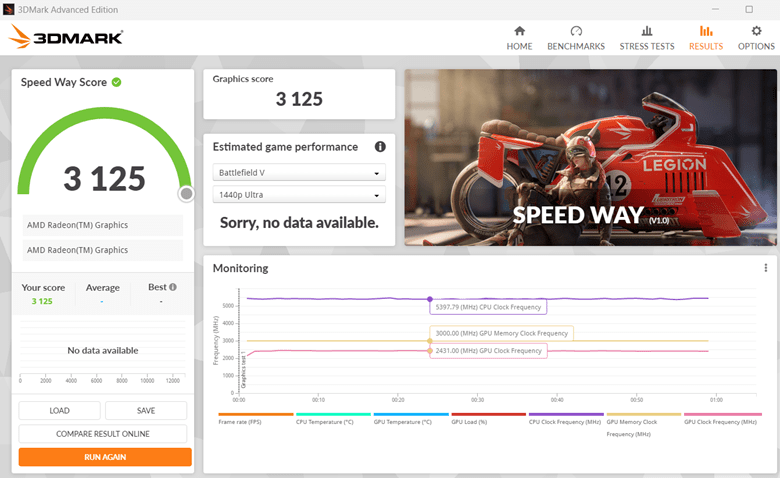
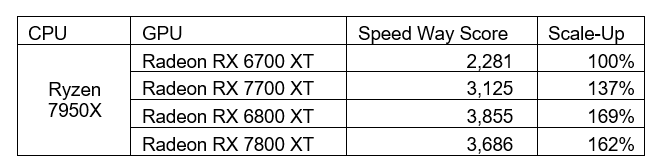
Because it employs DirectX 12 Ultimate Raytracing tier 1.1 for real-time global illumination and raytraced reflections as well as new performance enhancements such as Mesh Shaders, 3Dmark Speed Way is an ideal synthetic benchmark for comparing the performance of the latest AMD graphics cards with their predecessors.

The Radeon RX 7700 XT represents a great generational jump over the RX 6700 XT. However, the RX 7800 XT did not scale up against the RX 6800 XT, as the additional 12 compute units of the RX 6800XT compensate for the new architecture with quicker memory.

Ultra-Wide 1440p Gaming with Radeon RX 7700 XT

Games were tested on a 34-inch ultra-wide quad-HD 1440p monitor with a 144Hz frame rate, FreeSync, and 10-bit colors. We utilized the games’ maximum graphics settings, with ultra raytracing, FSR, and HYPR-RX enabled.

In the Forspoken demo, AMD FSR 3 was put to the test with the Radeon RX 7700 XT. The average FPS jumped from 55 to 96. During gaming, there was no latency or stuttering.

Gaming in 4K with Radeon RX 7800 XT

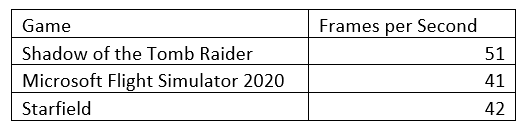
The Radeon RX 7800 XT was tested at 4K resolution and maximum graphical settings, with ultra raytracing enabled were possible. In a demanding game like Microsoft Flight Simulator 2020, with the FlyByWire A32NX and the Terrain LoD set to 400, the AMD Radeon RX 7800 XT had an average FPS of 41 and a one percentile low frame rate of 35 FPS for a smooth and predictable experience in the cockpit.

Flight Simulator 2020 is an ideal game for the technical preview driver with AMD Fluid Motion Frames, as the simulator is quite CPU bound when to playing on ultra settings. Limiting the FPS to 30 with RivaTuner Statistics Server and enabling Fluid Motion Frames resulted in a smooth 60 FPS experience, even over highly detailed areas such as New York or London.

With the typical slow and smooth scenery movements from the cockpit view, Fluid Motion Frames technology consistently generated additional in-between frames for a great flight sim experience.

Starfield achieved an average 42 FPS at 4K ultra settings on the AMD Radeon RX 7800 XT without resolution scaling. However, the FPS dropped significantly in built-up areas within the game. Game performance improved when the settings were lowered, with an average 50 FPS recorded at high settings. AMD Fluid Motion Frames can be enabled for Starfield with the technical preview driver. While Fluid Motion Frames help smooth some areas of the game, processing can temporarily stop when there are rapid direction changes during gameplay. This effect results in an FPS drop and stuttering, just when a gamer needs additional frames to smooth out motion. Improving this capability of Fluid Motion Frames in the driver will really improve the overall experience and make RDNA 3 and RDNA 2-based cards much more usable over time, especially as more demanding games come to market.

IDC Opinion and Conclusion

The RX 7700 XT, which is $30 less than the RX 6700 XT at launch (at $449), nonetheless has a noticeable increase in performance. The RX 7700 XT outperforms the previous generation in raytracing games, with up to 40% better performance. With the Radeon RX 6700 XT, playing demanding games like Cyberpunk 2077 at maximum visual settings was impractical. An average 27 FPS was recorded with ultra raytracing enabled on an ultrawide 1440p monitor. In contrast, the RX 7700 XT’s 12GB of VRAM did not pose any restrictions at 1440p. The card is a worthwhile improvement and will become more popular should a price decrease be effected in future.

The AMD Radeon RX 7800 XT is a bit more of a complex proposition for a consumer. The AMD RX 6800 XT’s suggested retail price at launch was $649, while the RX 7800 XT costs $499. With fewer but higher performing compute units, the Radeon RX 7800 XT performs broadly at par with the Radeon RX 6800 XT, but costs 25% less compared to the latter’s original launch price. The card thus represents much better value, especially as the stock of end-of-life RDNA 2-based GPUs dries up.

AMD has definitely read the market and is taking competition in the midrange gaming market seriously, as evidenced by the lower launch prices of its new cards. Due to market demand, AMD will likely reduce the suggested price of the RX 7700 XT even more in the near term, given the small $50 (10%) price difference between it and the RX 7800 XT and the much greater overall performance of the RX 7800 XT.

Mohamed Hakam Hefny - Senior Program Manager - IDC

Mohamed Hefny leads market research in EMEA on professional workstation PCs and solutions. He also reports on professional computing semiconductors, processors, and accelerators (CPUs and GPUs), as well as breakthroughs and trends related to the market. In addition, Mohamed is actively involved in AI PC taxonomy and research. He participates in business development projects, contributes to consulting activities, and provides IDC customers with analysis, opinions, and advice.