Marc Dowd, Executive Partner from the IDC Executive Advisory service opened the call by thanking everyone for joining and with some of the Analyst Industry report data. Using extensive research IDC predicts that companies which use process mining tools will be 20% more profitable than their peers who do not use these tools. 

Evidence shows that 74% of organizations which start a process mining project are successful with the implementation.

Lessons Learnt

One leader felt that business tend to love business process mining tools or not use them at all. He said that he had used process mining to get ready for new ERP. 

He found that old ERP system is not a good way to figure out actual processes as this was fine where you had an end-to-end process in a single system, but this became more complex outside of this theoretical view. He hopes that these tools will help figure out actual processes.

Another attendee told the team about a BPM deployment they had begun 4 years ago. He was skeptical of the business benefits of these tools. His organisation found that these tools were too labour intensive to use to accurately define processes. 

The eventual outcome was where the business decided to drop BP tools– but use SAP instead to establish same processes, and procedures.

Marc thanked the attendees for their honesty on successes as well as less successful initiatives as a learning point for the others on the call as these lessons were invaluable.

Success with Process Modelling and ERP

Another attendee spoke about how he had used these business modelling tools for 10 years. The process had started with the idea of moving from internal development systems to SAP and the tools they implemented were to clean up processes taking 5 years of work to clean up business processes in a continuous improvement cycle. 

The CIO spoke of how they worked through but didn’t finish before SAP was introduced. Now after the fact, they are still trying to clean up processes which means they have implemented some of these which are sub optimal into their new ERP system. 

Marc asked about which process intel models the attendees had used. SAP Signavio solutions, which states it “can help you quickly empower your organization with business process transformation” had been used to mine SAP processes but people had issues where the process extended outside the SAP system. 

Managing Non-standard Apps and Processes

Marc opened the floor for the leaders to ask each other for help. One asked, how do you measure how custom developed apps and forms are used?

I Keeling, another IDC Executive Partner, explained that there are a number of tools and techniques available, but the fallback can always be basic manual process mapping and optimization and data flows are a good validation that you have captured everything.

BPM uses

Marc asked the audience, whether you need to model all your processes and how to know what should be modelled? 

A participant commented that they were pitched BPM tools to audit their systems as they needed to know how many issues were being handled as exceptions, rather than as normal processes and therefore costing the business money. They then asked, what is value that people get out of these tools?

Another Digital leader replied they had used business process mapping with ERP systems implemented 20 years ago to find out what parts of system/data was actually still being used by the business and remove redundancy to clean up the system.

Another said it was pitched to the board as a tool to help to find value destroyers and optimize.

The Executive Partners from IDC discussed how combining BPM with AI with automation tools could be used to track SLAs and trigger action.

Rolling out BPM

Some of the CIO’s said they have created a Centre of Excellence around processes within their business which had been successful.

I brought her experience as an ex-CIO to the proceedings and spoke about how she has done BPM using a Lean Six Sigma Black Belt to process map with alternative methods. She did not choose a blanket approach but looked for immediate value and savings. 

In both cases, she has used different approaches to look at ‘procure to pay’, ‘order to cash’ as the first key areas as well as with the data flow for GDPR which has given a good grounding in processes optimization. “For peripheral areas, we asked do we need to have all of these processes. Once we can see them, we can evaluate them” she said. 

It took a few years to work through the key processes across other areas, but reduced wait times, improved SLAs and got great results.

Another CIO agreed. He stated, “We focus on key processes – cash in, cash out, or in operations heavy organization. The focus on key processes is save time/money. He felt that if you try to model all processes, you get lost in the detail. They were now trying to use RPA and UI Path, feeling that maybe process modelling will help the automation.

Different Models

One CIO told us that in their experience with companies, one team is modelling, a different team is working to improve the processes. This didn’t work as well as one team working end-to-end.  

It was also felt that using process tools to help with IT governance to help with business cases for new technology allows you to measure demand better, but this had not been used extensively.

Shaping the Future

Marc posed a question to the leaders, “Is process mining a prerequisite for advanced tech like AI, virtual reality, etc?” 

Another leader said that if we can find a model, all apps become connected, we have a full flow of processes, a full landscape, that will be the main model and we will be able to use it rather than spending time on documentation. He felt it would probably be used more to workflow applications and will control many of the systems in the future, in real time.

Marc commented that while many companies want to automate processes and decisions but often, trust in the data is lacking. The closer you are to a process and related data, the less trust you have in the data, something the IDC Advisory team have worked through with a number of clients based on industry reports.

Marc stated that maybe we are the last generation of leaders who make decisions without data before the processes are fully available and data is available at every point as industries move closer to industries such as manufacturing.

More in Depth Knowledge

A rhetorical question was asked by the audience; how are companies high in the S curve doing? What are they doing in terms of process mining?

Marc mentioned that IDC research with vendors indicates that some process tools will soon be able to write code themselves or make suggestions around optimization based on AI in the near future

Questions were also asked about how process automation and task automation fit in with process mining. It was mooted that a “360 degree” Master Class to look at the best practices in leading companies bringing together knowledge from an Advisory, Analyst, CIO, Business and IT leader perspectives could be planned for 2024 if there is appropriate interest from the Digital Leadership Community. 

I and Marc thanked everyone for their attendance and candid “Chatham House rule” protected discussions and the shared value they bring.

The start of the new year brings many people closer to realizing ways they can improve, perhaps its eating better, or fitting in more time with family and friends. There might be professional resolutions such as meeting more regularly with your boss, connecting with colleagues outside of your department. For IT, cutting back on wasted cloud spending is often high on the list but tends to eventually fall through the cracks, with no resolution to this pattern.

According to Forbes, while executives estimate that 30% of their cloud spending is wasted, at the same time enterprises intend to spend even more on cloud services. Clearly wasteful cloud spending is a recognized yet growing problem that for many continues to go unresolved. As this blog will show, where IT leaders fall short on is not identifying areas of spending that can be improved but implementing a plan of action for cost savings and maintaining it.

To elaborate on cloud costs, there are many tools available from cloud providers and third parties that provide reports and dashboards, and even recommendations about which instances can remove or reduce/enlarge (rightsizing). Tools that provide intelligence can also determine how to use discount options (reserved instances, savings plans, reserved capacity, etc.), how to handle licenses smartly and what to do in application architecture to save costs. And, instances can be disabled when not in use.

In summary these resources provide insight, but knowledge into your spending is only as useful as what you do with it to turn around your spending. And how you act will determine how effective you are at plugging the holes of your spending.

Because of the effort that’s needed its common for IT to plug their holes with patches. Take, for example, disabling instances outside working hours. In theory this is an excellent saving, but instances are part of applications, which in turn are part of chains. And then it may just be the case that data exchange takes place in a chain outside working hours. But also, test teams that are approaching a deadline may sometimes need their environment outside the pre-planned working hours. And if environments are used in the management chain, they must also be available after hours in case of an emergency. Overall savings is easier said than done, mainly because it takes work to get there.

Rightsizing is also more difficult than it seems. Users and administrators are often hesitant about removing capacity; users see their performance decrease, and administrators see the risk that more failures will occur because there is less overcapacity to absorb issues. In the latter case, you must carefully analyze where these issues come from; a mediocre application can benefit from more capacity, but that is not a long-term solution. Remember, if the roof leaks, you can replace the bucket that collects the water with a larger tub, but that too will become full at some point. You’ll eventually need to repair the roof.

Ultimately, you’ll have to move towards an entirely new approach in which you not only have insight into the costs, but also involve users and administrators, so that you can make the right decisions about saving on your cloud costs. This isn’t as daunting or unattainable as it sounds. In our next blog we’ll reveal how some IDC Metri Cloud Economics clients have transformed their cloud spending, so you can see how to get there too.

Last year we predicted that “70% of CEOs of large European organisations will be incentivised to generate at least 40% of their revenues from digital by 2025, driving more than €4 trillion of gross value added in Europe.”

As we approach 2023, do we expect this to change?

If anything, the trend has accelerated. According to IDC’s Digital Executive Sentiment Survey (October 2022), European organisations now expect more than 50% of their revenues to come from digital business models on average in the next three years.

Listening to C-level executive priorities for the coming year, it’s clear that despite the polycrisis macroeconomic scenario, the C-suite remains optimistic about future digital investments and is increasingly looking at technology as a critical business differentiator to better deliver business outcomes, increase resilience and accelerate revenue growth. According to the chief innovation officer of a transportation company: “For the next six months our priority will be to build capabilities, including bringing people onboard, to help us build digital products.”

This is the dawn of a new digital decade — the digital business era. But even if the “what” is clear, the “how” is somewhat less clear.

There is urgency, particularly in Europe, to connect technology investments and revenue generation. The majority — 61% of European organisations — take a very siloed and disconnected approach to software projects. This results in one-off or reactive software innovation efforts that only occur in response to urgent market or customer demands. More often than not these efforts do not have a positive impact on revenue generation.

To succeed as a digital business, we argue that companies need to leverage a digital business platform. IDC defines this platform as a multilayered enterprisewide technology architecture, integrating different systems and applications, to enable use cases that ensure business competitiveness and innovation. Only 13% of European organisations have such an architecture, according to IDC’s Digital Executive Sentiment Survey, October 2022.

The platform can be segmented into 3 main layers:

  • Foundational IT. These are the key tech building blocks forming the foundational tech layer required to deliver digital products and services. This includes 12 main elements: APIs, data systems, automation and orchestration capabilities, OT technologies, microservices, programmable infrastructure, multicloud services, security, AI/ML and other emerging technologies (blockchain, AR, VR, robotics, edge, etc.), integration tools, network and connectivity. Some digital design principles and practices should guide the CIO in implementing the right digital architecture.
  • Tech use cases to build business resilience. These are specific digital products that enable the company to remain competitive, responding to the key business challenge of building resilience. This includes use cases that future-proof business, organisational and operations models such as contingency planning for the supply chain and customer churn analysis.
  • Tech use cases to accelerate business growth. These use cases to accelerate growth and innovate include ecosystem data monetisation and intelligent M&A modelling.

As organisations build out their digital business platforms, this paves the way for business outcomes such as:

  • Expanded target markets through innovative partnerships
  • Extended digital use case road maps
  • Greater opportunity to diversify the business model
  • Greater loyalty/reduced churn with both customers and employees


If you want more information, reach out to Giulia Carosella, Neil Ward-Dutton, Jennifer Thomson, Mark Child, Andrew Buss, Archana Venkatraman or Tom Vavra.

Neil Ward-Dutton - VP AI, Automation, Data & Analytics Europe - IDC

Neil Ward-Dutton is vice president, AI, Automation, Data & Analytics at IDC Europe. In this role he guides IDC’s research agendas, and helps enterprise and technology vendor clients alike make sense of the opportunities and challenges across these very fast-moving and complicated technology markets. In a 28-year career as a technology industry analyst, Neil has researched a wide range of enterprise software technologies, authored hundreds of reports and regularly appeared on TV and in print media.

Home Office is an Advantage, But Security Risks Remain

Would you work for a company that wants you to spend 40 hours a week at the office? Three years ago, you probably would have raised your eyebrows at the question. But times have changed — and the answer may not be as evident as it used to be.

The COVID-19 pandemic has dramatically altered how we work. Lockdowns and social distancing made the introduction of home office working inevitable for many companies. For a period, this was necessary to keep companies afloat without putting the health of employees at risk.

But home working has now become an expectation for many employees — and it is widely offered by employers to attract and retain workers.

To stay competitive, enabling a hybrid home-office model, full-time home working, or remote working is an increasingly popular strategy for organizations. But it requires the deployment of substantial security measures to limit risks in a digital environment that remains highly threatening.

Home Office: A Key to Attracting Professionals

Our research reveals that companies are using hybrid and remote working models to strengthen their competitiveness. From the employer point of view, offering a home office opportunity can improve employee satisfaction. In many cases, it also boosts productivity, resulting in better products and services and greater customer satisfaction.

Companies want to keep employees motivated — and hybrid working models are one way to do so. IDC’s European Industry Acceleration Survey 2022 found that 37% of the 1,500 respondents regard hybrid working as an external force that positively impacts the organization. Among all listed options, hybrid working won the most support from survey respondents.

Job seekers increasingly prefer companies that enable them to work from home on a regular basis. Many employers have supported this preference to avoid losing applicants. IDC’s 2022 Future Enterprise Resiliency and Spending Survey (Wave 6) offers confirmation: One-third of respondents cited offering a hybrid working opportunity as their top strategy for attracting and retaining IT professionals.

The survey also found that 29% of organizations regard offering a hybrid model as having the most impact of a range of strategies. Offering competitive compensation packages or designing inspiring workplaces were lower-ranked options.

Almost half of respondents said choosing the right strategy is crucial in the recruitment of IT professionals, particularly those who possess key skills that are in high demand.

Same Road, Different Stages

Companies are generally open to taking the necessary steps to satisfy the home office-related needs of their employees. But they are at different stages of introducing hybrid working models.

Around one-quarter of IDC survey respondents said company leadership had expressed interest in learning more about employee perspectives on hybrid or fully home-based working. One-quarter of respondent organizations have introduced short-term policies for it. Nearly one-third have invested in technologies to support ongoing remote and hybrid work based on feedback from employees, while 13% intend to maintain hybrid and remote working models over the long term.

Of course, not everyone has a positive view of home/remote working. But the Future Enterprise Resiliency and Spending Survey found that only a minority of enterprises face a situation in which the leadership and employees have completely divergent views on the subject.

What does home office working cost employers? IT investments, mostly related to infrastructure, are a major spend. IDC’s Future of Work Spending Guide reported that European companies are expected to spend $4.3 billion on remote team enablement this year. Increasing storage capacity and scaling VPN solutions are two of the most common upgrades that organizations implement.

Home Office or Remote Working?

The focus on VPNs illustrates that organizations must address the security risks of working from home. From the security point of view, there is a difference between home office and remote working. In the case of home office, employees are restricted to working in a specified location, their home, using equipment provided by the employer. In remote working, employees may work from anywhere and use personal equipment.

Remote working poses a much higher security risk. Unsafe networks, weak passwords, and unverified software are among the leading risks. People around the employee may also jeopardize the security of sensitive information. At home offices, unsecure networks, employee exhaustion, a sense of comfort and security, and distractions are among the risk factors. Security measures implemented by the employer can alleviate many of these concerns.

Increasing Focus on Security

After data management, cybersecurity is the second-ranked focus area for organizations. More than two-thirds of IDC survey respondents cited cybersecurity as a focus of skills acquisition and training. Having security experts at the company is essential for technology projects. Many respondents highlighted that IT security professionals remain in high demand, especially for key initiatives.

Security is indeed an increasingly crucial sector for investments, especially in the current era of cyberwar. IDC’s Security Spending Guide reveals that European organizations spent more than $42 billion on security technologies in 2021. A nearly 11% increase is expected in 2022.

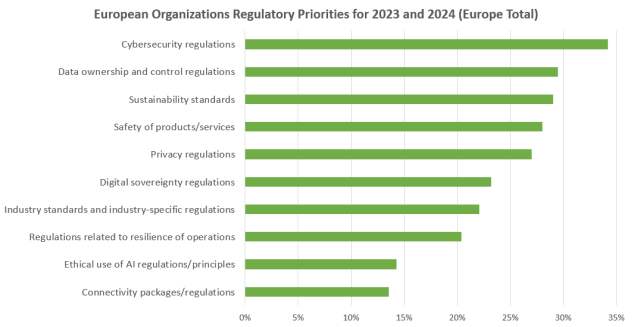
The results of IDC’s European Industry Acceleration Survey 2022 align with this trend: 32% of respondents regard cyberthreats as an external factor that negatively impacts the organization. It is thus not surprising that 34% of respondents expect cybersecurity regulations to have a major impact on business in the next two years. In 2023, cybersecurity will continue to be among the top priorities driving digital investment.

There are many ways to boost an organization’s cyber-readiness. Among the listed security services in the Future Enterprise Resiliency and Spending Survey, security training received the most votes (33.6%). When working from home, employees leave the secure working environment provided by the office, exposing employers to greater risk of data breaches and cyberattacks.

Increased spending on cybersecurity, however, is not solely due to the risks posed by home and remote workers. Private and the public sector organizations may be targeted for cyberattacks no matter how many employees are physically present in the office. Because an inability to secure sensitive data poses operational and reputational risks, security budgets must not become victim to budget cuts by organizations trying to survive inflation and recession.

Home office has become widely popular and, for many, the default way of working. It remains to be seen whether the rising cost of living will force employees back to the office. But for now, labor market competitiveness depends on whether companies are willing and/or able to satisfy employee demands for home office. And this trend will continue to influence security sector spending.