The rapid evolution of AI technologies worldwide highlights a strong and growing commitment from both the public and private sectors to leverage AI for innovation, competitive advantage, and tackling complex challenges. As AI and Generative AI become increasingly integrated into various business domains, IDC offers a detailed perspective on this transformation with a comprehensive overview of AI spending by technology type, geography, and use case.

In 2024, organizations are projected to spend $235 billion on AI, a figure that is expected to nearly triple, reaching over $630 billion by 2028, fueled by an almost 30% compound annual growth rate (CAGR). Generative AI, a subset of this broader AI ecosystem, accounts for 17.2% of global AI spending today. Its growth is particularly remarkable, with projections indicating it will make up 32% of AI investments by 2028, driven by a staggering 60% five-year CAGR.

Key Drivers of AI Investment

Several factors are driving this surge in AI spending:

  • Technological Advancements: Innovations in AI, including machine learning, natural language processing, and computer vision, are rapidly expanding the potential applications of AI. These advancements are encouraging organizations to invest more heavily in AI solutions.
  • Economic Competitiveness: AI is increasingly seen as essential for enhancing operational efficiency, spurring innovation, and maintaining a competitive edge in the global market.
  • Data Explosion: The exponential growth of data has created an urgent need for advanced data analysis, interpretation, and security. AI is playing a pivotal role in helping organizations manage and make sense of this vast data landscape.
  • Consumer Expectations: As consumers demand more personalized, efficient, and innovative services, companies are turning to AI to meet these rising expectations.

IDC’s AI and Generative AI Spending Guide is designed to keep pace with these developments, offering the most up-to-date market insights through a comprehensive and high-quality forecast. This latest release features expanded technology coverage and a modernization of AI use cases, ensuring our clients have the best data to support their strategic decisions.

Learn more about IDC’s AI and GenAI Spending Guide by downloading this product overview.

AI Spending by Technology: A Closer Look

AI Platforms have emerged as the leading area of investment, accounting for nearly 25% of the overall AI core IT spend by 2028. Within this category, Generative AI Software Services stand out as the most significant and fastest-growing segment, with a 70% five-year CAGR. To provide a clearer view of the landscape, IDC has expanded its coverage of AI Platforms, offering insights into vendor market share as well as forecasts for industry and use case opportunities.

While software represents about 57% of AI and Generative AI spending, hardware and services each account for approximately 24%. Service providers are particularly active in investing in server and storage hardware, especially as they seek to offer Infrastructure-as-a-Service (IaaS) to enterprise customers. This focus on infrastructure highlights the critical role that robust hardware plays in supporting the expanding demands of AI applications.

Regional Insights: AI Spending Across the Globe

From a regional perspective, the Americas lead the way in AI investment, commanding nearly 60% of global AI spending and experiencing a 30% five-year CAGR. EMEA follows as the second-largest region, capturing 23% of global spending with growth rates comparable to those in the Americas. Meanwhile, organizations in the Asia-Pacific and Japan (APJ) region, who were early adopters of certain AI technologies, may see their global share decrease slightly by 2028 as other regions accelerate their investments and catch up.

Looking Forward: Navigating the Future of AI

As we look ahead, AI spending is expected to continue its robust growth, driven by new applications and innovations. However, this rapid expansion also underscores the importance of developing ethical frameworks, cultivating skilled workforces, and implementing transparent policies to ensure that AI is used responsibly and effectively. The future of AI holds great promise, but it also demands careful stewardship to maximize its benefits while minimizing potential risks.

IDC’s commitment to providing deep insights and forward-looking analysis remains unwavering, as we help our clients navigate the evolving AI landscape with confidence and clarity.

Conclusion:

As AI continues to redefine industries and reshape global markets, staying informed about its trends and impacts is critical for making sound strategic decisions. IDC’s latest insights into AI and Generative AI spending offer a clear and comprehensive guide to navigating this dynamic landscape. By understanding the key drivers, technological advancements, and regional differences, organizations can better position themselves to harness AI’s full potential. As we move forward, the focus must remain on not only embracing these innovations but also ensuring they are deployed ethically and sustainably, paving the way for a future where AI benefits all.


Learn what matters most to your customers with IDC’s AI Use Case Discovery Tool—find out more.

Karen Massey - Research Director - IDC

Karen Massey is a research director within IDC's Data & Analytics Organization where she manages and contributes to several programs, consulting engagements and custom research, including the Worldwide AI and Generative AI Spending Guide, Worldwide Big Data and Analytics Spending Guide, and Worldwide Industry Insights Spending Guides (Financial, Government, Health, Manufacturing, and Retail). In this role, she analyzes technology trends across industry, region, use case, company size and line of business to quantify and forecast spending and trends for AI and BDA technologies. Ms. Massey also engages in custom projects and research requests supporting vendor market strategies and opportunities, and end user planning and budget cycles. Ms. Massey brings more than 20 years of research, consulting and analysis experience to IDC, previously with IDC Financial Insights leading research and consulting on transformational technologies and services impacting financial institutions including digital transformation, cloud, and innovation accelerators.

With each positive interaction a customer has with a brand, they expect similar or higher levels of service in the future. Unfortunately for brands there is no finish line, only continuous improvement to create better experiences.

Brands realize that putting the customer at the center of their business is a way to deliver consistent, personalized, and timely engagement across digital and physical channels and across marketing, sales, service, and support functions.  

According to IDC’s September 2023 Future Enterprise Resilience and Spending (FERS) survey, respondents ranked delivering great customer experience as their top focus area to derive customer value. Brands have a clear mandate to augment personalized experiences and acquire and retain customers through customer experience (CX) technology investments.

To fulfill that mandate, customers should first prioritize continuous integration of dynamic data across touchpoints and deliver high-quality data using Customer Data Platforms (CDPs). IDC’s July 2024 Future of Customer Experience (FoCX) Survey identified that over the next 12 months, 77.8% of respondents plan to increase technology spending for CDPs.  

Secondly, using AI and GenAI driven processes and tasks will help to better identify and segment audiences, uncover new levels of customer insights and create effective engagements. IDC’s April 2024 FERS survey shows that spending on GenAI–related infrastructure, models, applications, and services is expected to increase by an average of 64% across all companies. The survey also shows that companies that report an 80% success rate with their GenAI proof-of-concept efforts ranked “access to required high-quality data sets” as a top five success factor.  

The final point is that acquiring customer data that fuels personalization and engagement is back in the news with Google’s latest planned announcement that it won’t be deprecating third-party cookies. 

Google announced that it is introducing a new experience in Chrome that lets users make an informed choice across their browsing habits. While regulators decipher the plan and users decide on choices they face, organizations should continue to investigate what zero-, first- and second-party data they need to build segments and models with trust. Customers strongly prefer brands that are transparent and prioritize their data security and privacy, leading to a stronger, trust-based relationship. 

Customer Data Platform to Enhance Customer Experience  

According to IDC’s 2024 CX Path Survey, the top business outcome that organizations want to achieve from implementing CDPs is enabling customers to curate contextual experiences. CDPs provide high-quality data and analytics for this and other use cases involving growing revenue streams and delivering differentiated experiences with high value business outcomes. CDPs must include the following key components:  

  1. Aggregation: Ingest, integrate, cleanse, resolve and consolidate individual-level customer data from multiple sources and formats and determine which attributes and dimensions to include in a profile or segment.  
  1. Engagement: Activate segments for campaigns, advertising, and messaging across different channels and audience groups defined by multiple attributes and dimensions. Includes next best action, recommendations, etc. based on end-user choices and preferences synchronized across channels. 
  1. Insights: Descriptive, diagnostic, and predictive analytics to understand the complexities of the customer journey, predict future behaviors and tailor marketing efforts. Augment it with GenAI to drive automation and improve productivity for users to engage with CDPs and improve self-service.  
  1. Orchestration: Shared set of services will help to deliver a common orchestration layer for workflows, event management, scheduling, and rules. Having a solid framework for data governance and AI governance will help to balance personalization versus privacy, trust, and transparency.  

GenAI and CDP to Drive Productivity and Personalization 

While vendor roadmaps for AI are advancing, narrow down on which GenAI use cases you want to pursue and what does it take to implement the prioritized ones in context of CDPs. In parallel, define and develop the metrics and analysis required to justify investment in the selected use case or two. Organizations should use GenAI to improve productivity for CDP users and how it can deliver personalization to meet rising customer expectations in the following ways: 

  1. Custom GenAI models trained on CDP data are used for generating personalized content like product descriptions, custom messaging, landing pages, email copy.  
  1. Combine retrieval-augmented generation with GenAI models to provide grounded, trusted responses by extracting information within CDP and other knowledge repositories. 
  1. Conversational AI assistants enable marketers to query and interact with data or describe the customer journeys they want to create using natural language, making it more intuitive and efficient for marketers.  
  1. Dynamic segmentation allows for real-time adjustments to customer segments based on their behaviors and interactions analyzed by GenAI models with marketing campaigns.  
  1. Synthetic data generation helps in augmenting datasets where actual data is sparse or limited, enhancing the robustness of AI models. This approach is particularly useful in scenarios where data privacy concerns limit the availability of real data.  

Prepare for the Next Phase of Customer Experience 

According to IDC FutureScape 2024 Predictions, Customer Data Platforms will deliver high-quality data for predictive AI and GenAI, activating 80% of real-time personalized customer interactions at scale for G2000 firms with four times engagement gains by 2026. Organizations need to identify primary use cases that highlight the growing importance of unified customer data beyond marketing and across sales, customer service, and field service.

They also need to quickly build a picture of full journey and behaviors exhibited by customers by accessing intent data, service and support data, and customer interactions captured in unstructured sources in a secure and trusted manner. Finally, understand what is practical today with GenAI and how it will automate CDP tasks and workflows to make marketers more productive and use it to build personalized content for activation in the best channel preferred by the customer.  

Is your firm ready to take the next steps to meet rising customer experience expectations? Organizations need to prioritize investments in customer data platforms to deliver high-quality data for GenAI use case that will add to marketing productivity, enable CDP automation, and adopt trust- and governance-based marketing programs to drive personalization at scale and streamline customer experiences.  

Learn what matters most to your customers with IDC’s AI Use Case Discovery Tool—find out more.

Tapan Patel - Research Director for Customer Data Platform (CDP) - IDC

Tapan Patel is Research Director for Customer Data Platform (CDP), Intelligence and Analytics software market segments and a member of the Customer Experience (CX) Research team at IDC. Tapan’s core research coverage includes market trends, end-user requirements, use cases, market sizing, and business models for these critical segments. He is lead analyst for the CDP market, used by brands to improve customer insights and journeys across all touchpoints. His other research coverage areas include customer and product analytics and AI applications used by marketing, service, sales, contact center, and other enterprise teams to improve CX in B2C, B2B, and DTC engagements.

With Broadcom’s acquisition of VMware in 2023, the new VMware by Broadcom has undergone an overall program of merger and reorganization, which in turn has led to a restructuring and consolidation of many of the most prominent and popular VMware product offerings.

As a result of some of these changes, many customers are seeing significant cost increases at both purchase and renewal for VMware products, with new more expensive subscription bundles replacing common perpetual software licenses. These changes have caused much consternation and concern for customers, with even Broadcom CEO Hock Tan acknowledging and referenced these post-merger; 

“We overhauled our software portfolio, our go-to-market approach and the overall organizational structure. We’ve changed how and through whom we will sell our software. And we’ve completed the software business-model transition that began to accelerate in 2019, from selling perpetual software to subscription licensing only – the industry standard. 

Of course, we recognize that this level of change has understandably created some unease among our customers and partners. But all of these moves have been with the goals of innovating faster, meeting our customers’ needs more effectively, and making it easier to do business with us. We also expect these changes to provide greater profitability and improved market opportunities for our partners.” 

What is this means for customers 

VMware by Broadcom has recently made significant changes which includes the end of sale of perpetual licenses, change of license metrics and announcement of new product bundles. 

End of Sale of Perpetual Licenses 

Where customers have not already transitioned to Subscription licenses, Broadcom by VMware is mandating subscription transitions at renewals and purchase, with the majority of Perpetual Licenses removed from General Availability. For many customers this shift to subscription increases annual costs with subscription licenses generally being more expensive than equivalent perpetual support and maintenance. 

Changes of License Metric 

In 2020 VMware amended license metrics for many of its most popular products from per CPU to Per Core, with an entitlement of 32 cores per CPU license/subscription. In 2023 VMware shifted this entitlement to 16 cores per CPU subscription, which for many customers with high core counts effectively doubles their license requirements, thus resulting in further purchasing and increased costs. Furthermore in 2024 with the introduction of the new Subscription bundles, VMware by Broadcom moved to per core licensing overall. 

New Product Announcements  

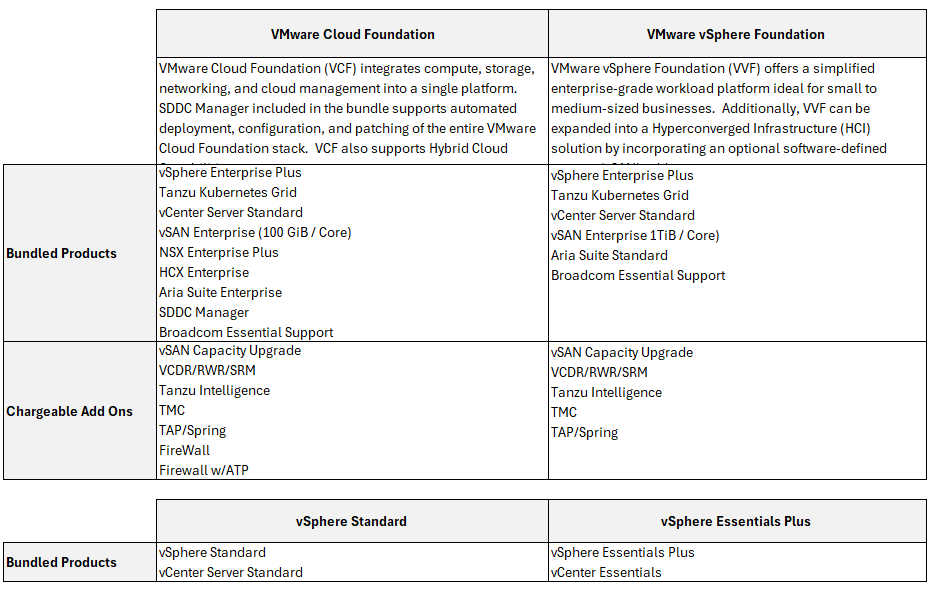
Upon completing the acquisition, VMware by Broadcom moved quickly to consolidate and “simplify” their product offerings, effectively bundling many popular products into a small number of distinct combined product offerings whilst discontinuing individual sales of individual products. Below is the feature comparison of these new offerings: 

The key challenge for buyers is that it severely limits flexibility in terms of product choice. As an example, a customer previously purchasing vSphere Enterprise and vCenter Server, at renewal will no longer be able to purchase those licenses individually, instead now having to purchase subscriptions to VMware Cloud Foundation or VMware vSphere Foundation, thus having to purchase the likes of Tanzu and vSAN, regardless of whether that customer requires these products. These bundles come at an increased cost above the previous individual subscription costs, reflecting the extra value they give customers, however are unavoidable for customers regardless of their need or requirement. 

Divestment of VMware Products 

Further to Broadcom’s acquisition, in February 2024 Broadcom agreed to divest VMware’s End User Computing decision to KKR, which has become a standalone company called Omnissa. 

“Workspace ONE and Horizon are best-in-class platforms chosen by many of the world’s leading enterprises to create seamless and secure digital workspaces with interoperability across increasingly complicated technology stacks,” said Bradley Brown, Managing Director at KKR. “We see great potential to grow the EUC Division by empowering this talented team and investing in product innovation, delivering excellence for customers and building strategic partnerships.” 

For some EUC customers, this may dilute the overall Broadcom investment into another company, potentially resulting in lower Broadcom discounts, and therefore, not only extra costs for remaining VMware investments but also for those divested EUC products. 

Longer Term Deals 

In addition to these changes, we note that Broadcom are incentivizing longer term deals, offering the most optimal pricing for customers considering 3–5 year terms. Where customers opt for short term renewals, pricing per unit is often much higher, effectively disincentivizing these options and limiting short term extensions. 

Quotation Delays 

As might be expected with such wide-reaching changes to commercials and business structure, customers are reporting that renewal quotations are taking longer than expected to be provided, which in turn gives less time to review and negotiate.  

Reseller Restructures 

Along with changes to commercial offerings, Broadcom have restructured their channel sales and resellers. For larger companies, Broadcom has chosen to take these accounts direct, which means customers may no longer have the support of their reseller in ascertaining requirements and facilitating negotiations. Negotiating direct can be very different to via a reseller and may require more preparation and potentially leveraging other Broadcom interests, interactions and investments. 

What might the cost impact be? 

Whilst every customer scenario is different, overall we see that large cost increases are inevitable and indeed crucial to VMware by Broadcom’s growth strategy. Customers exiting and renewing long-term deals may see compounded impact from multiple changes that have as yet not affected them whilst in contract. In real terms customers may see cost increases anywhere from 100% to potentially as high as 800% at renewal   

Predominantly the transition to new bundled products is impacting customer costs the most, however these extra bundled entitlements equally bring extra added value which may be beneficial to customers and potentially give opportunity for replacing incumbent products and costs in the technology estate, or optimizing current VMware by Broadcom deployments and operations. 

What should customers do? 

  • Act now to understand potential impact and risk, potentially modelling future cost scenarios to drive visibility internally and gain traction for strategy review and change 
  • Understand future strategy and requirements, and how these might align to VMware technology and offerings 
  • Consider the benefits of the new product bundles and whether they represent value and/or opportunity for other vendor displacement and indirect savings 
  • Review entitlements to understand how the divesture of VMware EUC products to a separate company might impact investments overall 
  • Review VMware use cases and identify whether other vendors solutions might be feasible and cost effective to migrate to 
  • Noting the earlier comment regarding long lead times for quotations, push for an early quotation to quantify cost increases and allow as much time as possible for post-proposal negotiations 
  • Understand the impact of changes to reseller involvement to the purchasing organization and the impact that may have. As a corollary, seek external counsel from market intelligence partners to address any knowledge gaps left by changing resellers 
  • Benchmark existing BAU deals to establish a baseline and retain a benchmarking partner that can provide accurate data on new products, pricing metrics and license rules 
  • Note that any previous price protection or fixed renewal costs agreed in contract may likely no longer apply as they are generally centered on like for like renewals, which are no longer available given the product changes 
  • Create a post-renewal strategy and timeline for any decisions made that may require more time to implement with forward milestones to review progress 
  • Recognize that any current or future partial reductions in subscription quantities will generally not generate linear savings at renewal and might be modelled prior to ascertain impact. 

In Summary 

Product changes and cost increases are almost inevitable for customers renewing post Broadcom acquisition, therefore immediate planning for those potential increases and the leverage of Broadcom VMware technologies in both the short and long term is key. IT Buyers should look to highlight these changes to key Stakeholders, Budget Holders and Strategic decision makers at the earliest opportunity to allow as much time as possible to determine the extra value and opportunities in these new bundles and/or where necessary discuss impact mitigation options.

Ascertaining, modelling and benchmarking potential costs may give further impetus and leverage so that these changes are high on the agenda, and where customers maintain internal IT/Technology risk registers, this technology might be added as a commercial risk in order to gain further visibility and traction. 

IDC’s Sourcing Advisory Services (SAS) provides you with the industry’s most-recognized price benchmarks, analyst advice and IT optimization insight.  

Ateequr Rahim contributed to this blog.

Neil Stewart - Vice President-Software Contracting Advisory (Major Vendors) - IDC

Neil Stewart, IDCs Senior Research Director for the Sourcing Advisory Service, provides expert coverage and insight into the Software Procurement and Commercial Market for Global Customers. Focusing on Major Software Vendors, Mr Stewart provides research, data and competitive intelligence helping customers to optimise their Software Investments, providing research and commercial insight on optimal pricing, contract vehicles and terms, available concessions, and proven negotiation strategies. Where Vendors might be transitioning to new product offerings, or where customer requirements are yet to be fully developed, he also provides more consultative assistance and strategic insight helping organisations both right-size software services and product requirements, but also understand their ongoing investments, entitlements and contractual responsibilities.

Today’s business leaders have a new area of priority: environmental, social, and governance (ESG), which is a hot topic from boardroom to blog page. In the recent IDC Worldwide CEO Survey conducted in February 2024, 42% of European CEOs stated that meeting ESG goals is among their top 3 business priorities and requirements, with social sustainability representing a pivotal point.

Moreover, CEOs think that the changing ESG targets and regulations are among the top three external factors impacting organizations over the next 12 months.

However, we haave noted a sharper focus on the environmental and governance aspects than on the social side. Even when the social side is the subject of focus, the initiatives considered most often typically relate to gender diversity, belief respect, cultural integration, and similar areas.

One important aspect that has been and is still too often neglected is the accessibility of organizations’ digital workspaces and workplaces.

Addressing the vast aspect of digital accessibility is complex.

The Future of Work Must Be All-Inclusive

We define digital accessibility as digital technologies and services being accessible to everyone, including people with physical impairments, regardless of whether they are related to motor function, vision, hearing, speech or neurodivergence.

Until now, the breadth and complexity of digital accessibility has slowed down development in areas such as regulation, as well as an understanding of how to include in the workplace people with disabilities. Today there is a sharper focus on levelling the ground in the job market, vendors are specializing in transformation, certification, and training or taking the first steps in implementing them in their products. Some were even created with this purpose in mind — i.e., funded to assist with digital accessibility mandates and requirements.

Digital accessibility evaluates the accessibility of technologies, but technologies are also the key solution for organizations to address their digital accessibility implementation gaps. Advances in technologies, especially in generative AI, will be beneficial in further integrating digital accessibility into internal and external process, products, and services, supporting mandates on digital accessibility for consumers and the workforce – as the workforce is the organization’s internal technology “consumer”.

A plethora of hardware and software has been delivered to assist organizations in closing the digital accessibility gap, but there are even more technologies that have not been designed for this purpose, but which in everyday use will contribute to closing the digital accessibility gap.  The latter includes AI and generative AI, which were designed as general-purpose technologies, but which can support closing the dig accessibility gap across numerous use cases.

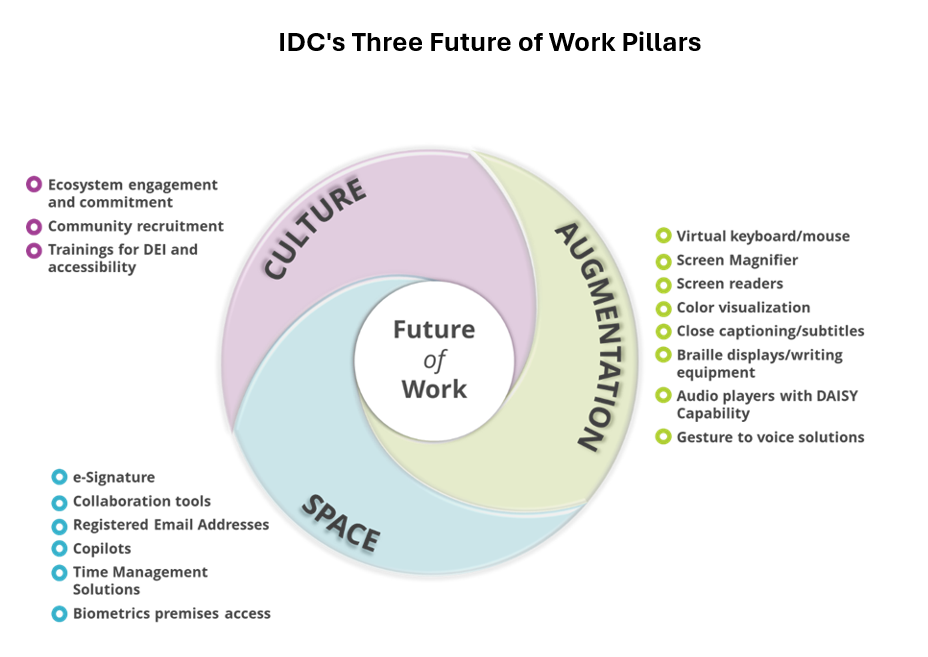
The figure below showcases technologies and initiatives that could be implemented for digital accessibility across IDC’s three main Future of Work pillars.

Within the augmentation pillar, technologies support people with different disabilities, with the clear objective of augmenting them. Gesture-to-voice solutions help people with phonological difficulties to integrate in the workplace and workspace, as the technology facilitates communication with people not versed in sign language.

Technologies in the space pillar have the objective of supporting people with impairments in accessing the organization’s resources and other daily activities and tasks. eSignature, for example, helps people with impaired physical dexterity or loss of touch (hypoesthesia) to sign documents digitally, removing the need for pens or physical documents.

Within the culture pillar, technology plays a side role, but numerous initiatives must be implemented by organizations to create a more digitally inclusive environment. For example, with trainings and firsthand experiences or community recruitment for testing and allies.

5 Recommendations to Improve Digital Accessibility

Guidance in this area is clearly needed, especially as the European Accessibility Act will be enforced across the entire European Union in 2025. Here is our short to-do list for initiating or improving your organization’s approach to digital accessibility:

  1. Assess and audit internal and external products, tools, and services for accessibility and remediate to ensure everyone is onboard and no one is left behind.
  2. Create a solid community to help the organization meet accessibility requirements through firsthand experience.
  3. Educate your internal and external communities on accessibility and DEI with general mandatory training for the entire workforce and tailored learning paths that are function- or role-specific.
  4. Keep up with changing technologies and regulatory requirements, ensuring full local and international compliance, and make certain that worker and customer experience meet generally accepted standards.
  5. Shift to an accessible-by-design mindset, ensuring that apps, platforms, and software developed for internal use — as well as products, services, customer experience — are accessible-by-design.

Digital accessibility is a goal we are approaching incrementally, but if you are interested and want more information, you can check out our report “Digital Accessibility in Europe in a Nutshell” or reach out to the IDC Future of Work team and stay tuned for future details.

Erica Spinoni - Senior Research Analyst, European Research - IDC

Erica Spinoni is a senior research analyst for the European Research Team. Based in Milan, Spinoni supports IDC’s European Digital Business Strategies and IDC’s European Future of Work practices. In her role she advises ICT players on European digital business and future of work market trends, supporting them in their planning, go-to-market and sales cycles with market research, custom projects, as well as honoraria.

This year, the convergence of cloud computing and generative AI (GenAI) is creating unprecedented opportunities for innovation. For growing tech vendors and startups, leveraging these technologies is not just a competitive edge—it’s a necessity. This blog explores how GenAI is transforming cloud infrastructure, offering practical insights and strategies to help your business thrive. 

The Convergence of Cloud and GenAI 

Cloud computing provides scalable, on-demand resources that allow businesses to be agile and responsive. Generative AI, on the other hand, brings advanced machine learning capabilities that can turn vast amounts of data into actionable insights and automate complex tasks. The intersection of these technologies marks a paradigm shift, enabling smarter, more efficient, and highly adaptive cloud environments. 

Key Benefits of Integrating GenAI with Cloud Infrastructure 

Predictive Scaling and Resource Allocation 

AI models can forecast workloads based on historical data, enabling dynamic resource provisioning. This means your cloud infrastructure can automatically scale up or down based on demand, ensuring optimal performance and cost-efficiency. Predictive scaling helps avoid over-provisioning and under-utilization, common pitfalls in traditional cloud management. 

Predictive scaling involves using AI to analyze patterns in data usage and forecast future needs. This proactive approach ensures that resources are available when needed, without wasting money on unused capacity. For example, an e-commerce platform might see spikes in traffic during holidays. AI models can predict these spikes and adjust resources accordingly, ensuring smooth operation during peak times. 

Automated Cloud Cost Optimization 

Managing cloud costs is a critical challenge for startups and growing tech vendors. GenAI can analyze spending patterns and recommend cost-saving measures. AI-driven tools can help you select the most cost-effective instances, rightsizing your infrastructure, and even automate budget alerts and recommendations. This ensures that you get the most out of your cloud investment without unnecessary expenses. 

Cost optimization is not just about reducing expenses but about making smart investments in cloud resources. AI can provide detailed insights into where money is being spent and identify areas where savings can be achieved. For instance, AI might suggest moving non-critical workloads to less expensive storage options or shutting down underutilized instances automatically. 

Intelligent Load Balancing and Traffic Management 

Efficient load balancing and traffic management are crucial for maintaining high performance and user satisfaction. AI-powered traffic prediction models can anticipate traffic spikes and direct load accordingly, optimizing resource use and minimizing latency. Additionally, smart CDN optimization and adaptive application performance management ensure that your applications run smoothly, even under varying load conditions. 

AI can predict traffic patterns and dynamically adjust load balancing to ensure optimal performance. This is particularly important for applications with fluctuating traffic, such as social media platforms or online gaming services. By distributing traffic efficiently, AI helps prevent bottlenecks and ensures a seamless user experience. 

Enhancing Cloud Security with GenAI 

Security is a paramount concern for any tech business. GenAI enhances cloud security by providing advanced anomaly detection, adaptive security policies, and automated threat response. 

Anomaly detection involves using AI to identify unusual patterns in data that could indicate a security breach. By continuously monitoring network traffic and user behavior, AI can detect and respond to threats in real time. Adaptive security policies use AI to adjust security measures based on current threats, ensuring robust protection. 

Automated threat response leverages AI to triage incidents, contain threats, and even predict future vulnerabilities. This proactive approach to security helps businesses stay ahead of potential threats and maintain a strong security posture. 

AI-Driven Cloud Management 

GenAI streamlines cloud management through intelligent monitoring, automated incident response, and performance optimization. 

Intelligent monitoring involves using AI to analyze logs and performance metrics, identifying issues before they become critical. This proactive approach minimizes downtime and ensures smooth operation. Automated incident response uses AI to classify and route incidents efficiently, often resolving common issues without human intervention. 

Performance optimization is another key area where AI can make a significant impact. By continuously analyzing performance data, AI can identify bottlenecks and recommend optimizations to improve efficiency. This ensures that your cloud infrastructure runs at peak performance, delivering the best possible user experience. 

Cloud-Native AI Development 

Developing AI models in a cloud-native environment offers significant advantages in terms of scalability and flexibility. 

Containerized environments package AI models with all their dependencies, ensuring consistency and portability. This simplifies deployment and scaling, allowing businesses to respond quickly to changing demands. Kubernetes, a popular orchestration tool, automates the deployment, scaling, and management of containerized AI services, providing robust and reliable infrastructure for AI workloads. 

Serverless architectures offer another layer of efficiency. Event-driven AI processing allows code to be executed in response to specific events, optimizing resource usage and reducing costs. This pay-per-use model means businesses only pay for the computational power they consume, making it a cost-effective solution for many applications. 

MLOps, the practice of combining machine learning with DevOps, is essential for managing the lifecycle of AI models. Automating the deployment, monitoring, and retraining of models ensures they remain accurate and relevant over time. Version control for data, models, and code is crucial in maintaining consistency and reproducibility. Continuous integration and deployment (CI/CD) pipelines enable frequent updates and improvements, keeping AI systems at the cutting edge of performance and reliability. 

Future of Cloud AI 

Looking ahead, the integration of AI with emerging technologies like quantum computing and autonomous systems will further revolutionize cloud infrastructure. Companies that stay ahead of these trends will be better positioned to leverage new opportunities and maintain a competitive edge. 

Quantum computing will enable the development of more sophisticated models and algorithms, accelerating research and innovation. Hybrid quantum-classical cloud architectures will become more prevalent, allowing organizations to harness quantum computing’s power for specific tasks while leveraging classical computing for others. 

The next generation of cloud infrastructure will be characterized by autonomous systems powered by AI. These self-organizing and self-optimizing environments will manage resources, detect anomalies, and resolve issues without human intervention, reducing operational complexity and enhancing system reliability. 

Conclusion 

The convergence of GenAI and cloud computing is revolutionizing how tech vendors and startups manage their infrastructure. By embracing predictive scaling, automated cost optimization, intelligent load balancing, and advanced security measures, businesses can ensure their cloud environments are efficient, secure, and highly adaptive. As AI continues to evolve, integrating these technologies will be crucial for staying competitive and driving innovation in the digital age. 

The Artificial Intelligence (AI) revolution has taken the world by storm. IDC forecasts that worldwide AI spending will exceed $512 billion by 2027, more than double its 2024 market size. While AI was picking up pace, the introduction of Generative AI (GenAI) changed the way enterprises leveraged AI.

In India, AI and GenAI adoption is significantly increasing across software, services, and hardware for AI-centric systems, with AI and GenAI spending projected to reach $6 billion by 2027 with a compound annual growth rate (CAGR) of 33.7% for the period 2022-2027. The AI revolution has also accelerated digital adoption in India with 62% of Indian enterprises expecting more than 50% of revenue to come from digital models by 2026.

Multiple AI Use Cases Are Emerging Across Indian Industries

Industries that have been slow in terms of digital adoption have accelerated their journey to get ready for their AI journey while industries that have been digital leaders have already started evaluating and deploying relevant use cases.

Governments in the Asia Pacific are the third-largest adopters of AI/GenAI, with spending expected to increase with a 5-year CAGR of 96.2% by 2027. This growth offers a chance to enhance efficiency, transparency, and citizen engagement in public services. In India, almost 50% of government organizations are planning to invest significantly in data management-related services, such as discovery, quality, data engineering, and governance in 2024. Hence, the approach is clearly shifting towards data-centric rather than model-centric. Additionally, a sizable chunk of these organizations is planning to significantly increase investments in AI and Machine Learning (ML), including GenAI. For example, citizen services in states like Haryana are leveraging Jugalbandi, a new GenAI-powered chatbot on WhatsApp, to facilitate a wide range of tasks, including pension payments and college scholarship applications. While adopting AI/GenAI, the government also has a responsibility to govern the usage of this technology while giving the necessary impetus for innovation.

Digital in healthcare has been a focal point in recent years, particularly in the post-pandemic period. The Indian healthcare sector is witnessing a surge in clinical data driven by patient-centric care management that is evolving into real-time patient data capture and analysis. Such a surge in the clinical data, along with immunity to AI investments by healthcare organizations aligns the healthcare sector increasingly towards an “AI everywhere” approach. There is already an increased focus on early detection of diseases, both communicable and non-communicable diseases.

During our discussions with CIOs of multi-specialty hospitals, AI-based use cases, mainly focusing on diagnostic accuracy, speed, and workflow efficiency are popular. For example, Apollo Hospital is set to leverage the use of AI to detect TB from chest X-rays, as a means of triaging. They even scan the villages to screen TB cases. Another case is the launch of “iOncology.ai”, by AIIMS Delhi for early detection of breast and ovarian cancers, the two most prominent types of cancer in the country and percolate the solution to district hospitals.

AI is also transforming every corner of the Banking, Financial Services, and Insurance (BFSI) sector, with the most significant impact on customer interactions, risk management, and operational efficiency in India’s financial landscape. JP Morgan’s AI-focused strategy, implemented six years ago, exemplifies the long-term commitment of leading financial institutions to AI integration. In a highly regulated industry like BFSI, institutions face challenges such as big data management, outdated IT infrastructure, market responsiveness, and cyber fraud risks, which function as a speed breaker for AI adoption. Despite that, we are witnessing growing importance for GenAI pilots among many BFSI institutions in India across various business functions primarily to enhance existing services.

Telecom operators are aspiring to be more than just connectivity providers –  they want to be recognized as digital leaders. India is the second largest market by subscribers globally, yet it has one of the lowest average revenues per user. IDC predicts total connections in India will reach 1.5 billion in 2028 (both mobile and fixed) with a total data traffic of 468 exabytes. Though the demand is high, balancing churn and profit margins have continued to challenge telcos in India.

Two areas which tie into churn and profit margins are customer experience (CX) and network operations. For CX, the augmentation of AI is at the forefront of addressing customers across various touchpoints. For example, any ambiguity in the bill will lead to customer churn, both in consumers and enterprises. Use of AI to explain and analyze bills consisting of varying bill cycles, bill splits, multiple payment modes, loyalty, and promotional offers reduces the number and duration of calls for contact center agents.  On the network operations side, AI is infused to shift from reactive to proactive network management eventually to predictive network management. As networks become more disaggregated with increased virtualization and edge deployments, the urgent need to look past manual troubleshooting has led to network automation. The closed-loop network management should span across network operation workflows and BSS systems.  

India is at a pivotal moment, ready to become a global manufacturing hub as the world looks for alternatives to China. Today, China makes up about 28% of global manufacturing, while India accounts for only 3.3%, competing with countries like Vietnam and South Korea in Southeast Asia. For India to become a manufacturing hub, India must leverage technologies like AI, robotics, automation, IoT, and 3D printing. Furthermore, the manufacturing industry also faces challenges with regular supply chain disruptions. According to IDC’s April 2024 Global Supply Chain Survey, more than 30% of India’s manufacturers, retailers, and logistics companies are expecting supply chain disruptions due to rising costs, talent shortages, and regulatory compliance issues.

These challenges are also accelerating the adoption of data-driven technologies and AI in the manufacturing sector. AI can help India with three very important competitive factors in the manufacturing industry – enable scale, reduce cost, and increase efficiency. AI can also enhance supply chain security by detecting any risk or fraud in the supply chain system. Furthermore, navigating regulatory compliance is becoming more manageable with AI solutions that automate compliance monitoring and reporting, ensuring adherence to complex regulations.

Given all these, the expectations of Indian enterprises from AI vendors are around multiple dimensions and IDC recommends tech vendors to take the following approach to be successful:

  1. Develop robust data platform (necessary governance, security, data privacy, ethics and so on) and sound, workable & effective data infrastructure.
  2. Offer data integration and data management capabilities which align with existing legacy government IT infrastructure.
  3. Identify specific use cases for national priorities & areas such as agriculture, healthcare, traffic, insurance, etc., and build relevant solutions around those.
  4. Controlling Costs is critical. Explore the option of a “pay-as-you-go” model, explore Small Language Models (SLM) and Medium Language Models (MLM) instead of full-fledged Large Language Models (LLM) which may not be needed for all enterprises. 
  5. Ensure Trust most importantly, ensure trust by maintaining transparency.
  6. Communicating the functionalities and risks of AI systems to stakeholders and offering continuous education and training are essential for effective AI utilization and to bridge knowledge gaps.
  7. Expedite the implementation process to ensure faster time to value, helping organizations quickly realize the benefits of AI

Sharath Srinivasamurthy - Associate Vice President - IDC

Sharath Srinivasamurthy is an associate vice president who heads the research group for IDC India. His research expertise cuts across the multiple facets of digital transformation (DX). Sharath has around 20 years of experience in different leadership roles with leading IT services firms. Before IDC, he worked in different roles including solutioning, presales, project management, business analysis, and application support and development. Sharath has worked in various capacities in global markets, namely the United States, Asia, Europe, and the United Kingdom. Sharath previously worked with DXC Technology as Asia Head-Solutioning for Application Services, Global Head-Solutioning and Business Unit head in the application services business of Xchanging and led application support and development services for Zensar Technologies. He also worked with Hewlett-Packard and Cognizant. He is a distinguished leader and a frequent keynote speaker. Sharath's views on technology have been quoted in numerous publications such as CNBC, Forbes India, The Economic Times, and CIO.com. Sharath holds a Global MBA from SP Jain, Singapore and a bachelor's degree in Engineering from VTU, Karnataka.

As GenAI increasingly becomes mainstream, its applications in smartphones are fast becoming a key design vector for smartphone manufacturers.

IDC’s latest forecast estimates that GenAI smartphone shipments will grow 364% year-over-year in 2024, reaching 234.2 million units, growing to 912 million units in 2028 implying a compound annual growth rate (CAGR) of 78.4% for 2023-2028.

Over the past year, many market participants have announced their own set of artificial intelligence (AI) tools to demonstrate smartphone UX changes. These are based on various foundational models, large and small language models (LLM and SLM) enabling generative AI (GenAI) features with on-device processing, and multimodal input and output. The OEMs have a hybrid approach to enabling AI features-device-based for localized and cloud-based for heavy computational activities.

While many of these AI features are presently limited to premium smartphones, we should expect to see these trickle down the pecking order made possible by the use of cloud-based AI solutions as these devices will lack necessary hardware. However, a reduced scope and privacy/latency remain key considerations. Below are some of these features and how they are different across the OEMs.

OEMs are Adding Their Unique Flavor with AI Features

While the AI features fall within the same broad categories for all major platforms and devices, each OEM imprints their unique signature, along with the tools from the likes of Google and OpenAI.

Almost every key OEM has announced features/tools for photo/video editing, writing/editing, translation and interpretation, summarizing, search enhancement etc., targeting the most used smartphone features. To most users, it may not matter if AI is the enabler as long as they get a better outcome. Case in point, users are more interested in the final portrait photo than in the hardware, software, or AI driving it.

A big hit, according to the market participants, are Circle to Search, a Google AI feature tied to Android 14, mentioned by Samsung in their earnings in Apr 2024 as the most used feature and Eraser which OPPO claimed is used 15 times per day on average. Live translation is another extremely useful feature overcoming the barriers of language and can be used conveniently even in an offline mode. There is also increased focus on wellness, where Google, for example has Sleep and Snore detection, Samsung recently announced Sleep Apnea detection, and Apple has been talking about monitoring vitals.

AI Features – An Extension of Brand Message for the OEMs

While the end-use for GenAI features is driven by the same user needs, OEMs use AI features as an extension of their brand message and stand out from the others.

  • Apple announced GenAI capabilities as “Apple Intelligence”, indicating AI is central and all under one hood on its devices, with features designed to have cross-functionality across various apps and iPad, iPhone, and Mac devices. It might not be a radically new way of how a user interacts with the iPhone, but enhancing the app functionalities and fun activities such as creating personalized memories, Genmojis and avatars. The revamped Siri with access to underlying user data (emails, messages, photos, locations, files etc.,) can be more context-aware, while sticking to its central message around privacy even as the user connects to ChatGPT. Apple’s vertically integrated approach relies largely on in-house language models and its private cloud infrastructure, while partnering with OpenAI for ChatGPT. 
  • Google continued with its legacy of using software to enhance smartphone capabilities. Pixel 8 Pro enabled many on-device GenAI features by running language models on the device. It has a host of features such as call management (Clear Calling, spam calls, Call Assistant); photo/video editing (Photo/Audio Eraser, Best Take); communication (Proof Read, Smart Reply, Summarize, Magic Compose) etc. For Google, it can be a blurry line between what is unique to Pixel smartphones vs the rest of the Android lineup. Google has been managing this by bringing some of the features to Pixel smartphones first before they go to the wider Android players.
  • OPPO, in continuation of its focus on camera and photography features, has features such as AI Best Face, AI Eraser, AI Studio and AI Clear Face, while also expanding AI features to broader spectrum of AI applications for communication and productivity. OPPO also introduced Social Media Creation tools to assist in creating content specifically tailored for social media platforms.
  • Samsung launched Galaxy AI tools on its flagship Galaxy S24 series and on Galaxy Z6 Foldables recently, and extended some of these features to its older models, focusing on communication and productivity. Live translation as well as real-time Interpreter are standout features. Galaxy AI includes Photo Assist, Instant Slow-Mo, AI summarization, Chat Assist and Magic compose writing/editing tools. Features such as dual-screen mode for Interpreter are customized for the foldable form factor. 
  • While other Android players have also announced AI tools – Xiaomi’s AI-generated subtitles for video calls and Image Editor, Honor’s eye-tracking AI functions, Motorola’s personalization and privacy-oriented features – partnership with Google remains vital to have access to the broader set of tools integrated with the Android operating system.  

Another area of differentiation is the size and number of LLMs and the training material used which impact performance and UX. Apple uses its own language models, and OpenAI for tasks that are beyond its realm. Android players use Gemini models (Pro and Nano) and multiple other different-sized models. OPPO has its own SLM that uses 7 billion parameters as well as an LLM AndesGPT in addition to using Gemini. There are partnerships with other tech companies including Qualcomm, MediaTek, and Microsoft.

Further, there are differences in the execution of these features and their accessibility for third-party apps.

  • iOS developers and apps have experience of automating tasks or working with features such as Siri Intents and Shortcuts. For example, developers and apps with SiriKit already integrated into their apps could see immediate enhancement with new Siri capabilities. Some of their AI tools such as writing tools would be easily available to developers for their third-party apps.
  • Google also provides developers with APIs and SDKs to integrate Gemini AI into their apps. However, Google, OEMs and developers have to work with diverse hardware of multiple Android smartphones and ensuring adequate testing for seamless integration.

AI will be Central in Driving UX Across Smartphones

The opportunity and the challenge for OEMs is to deliver UX that matches the AI hype. Specifically, OEMs can leverage AI to get past user fatigue from the hardware features that have faced backlash as being boring. Just as we now use dictation, text prediction and photo editing, these new AI features will also become everyday tools on smartphones. In any event, below is a summary of key action items that OEMs will need to bring front and center as they embark on this next phase of evolution of smartphones.  

  • Overall, a more personalized, intuitive and user-friendly experience that doesn’t interrupt the normal workflow can create more stickiness. While iPhone users have high loyalty, it’s not the same for Android users who easily switch between brands. A radical shift such as opting for an app-less device is not yet for the masses, while a traditional interface with an app may be a bit outdated and inefficient for an evolved user. An in-between approach with a generative user interface could take the users on the AI track more gradually.  
  • Network connectivity will also play a key role to have a faster, smoother connection and a seamless experience for using AI features, especially if there is cloud processing. Together with faster processing on the device, Wi-Fi 6E/7 and 5G network connectivity will help in faster response with lower latency. This will also help with democratization of AI by enabling more smartphones with cloud-AI features.
  • User privacy will remain central to these experiences, partly enabled by on-device AI but also reflected in a company’s philosophy to ensure user data remains private while also contextualizing it to provide more personal results. The side benefit of on-device AI is that by spreading out the processing to on-device AI across the installed base of devices, much less server CAPEX is required than would be if AI was only processed on servers.
  • As these features go beyond the native apps and start to be integrated in the third-party apps, it will be imperative to work with the developers to bring AI features to more apps and ensuring easy ways for developers to integrate AI features into their apps.

OEMs are riding on the AI hype to develop and integrate the AI features in their smartphones and at the same time educating and convincing the users of the benefits of AI. Afterall, to drive more users to their brand, AI capabilities can have consequences beyond immediate upgrade to a new smartphone.

For a look at industry and segment spending forecasts for broader AI and GenAI use cases, read about IDC’s ⁠AI and GenAI Spending Guide.

Learn what matters most to your customers with IDC’s AI Use Case Discovery Tool—find out more.
Kiranjeet Kaur - Associate Research Director - IDC

Kiranjeet Kaur is an associate research director for IDC Asia/Pacific. She is involved in building IDC's successful research tracker programs and producing core market data used across all of IDC's Asia/Pacific research reports and consulting projects. Based in Singapore, Kiranjeet is part of a team that manages the quarterly Mobile Device Tracker where she is responsible for sizing and forecasting the Smartphone and mobile phone markets on a quarterly basis, examining competitive trends and studying end user trends.

IDC’s Quick Take

The recent IT outage caused by silent updates pushed out by CrowdStrike to its Falcon agent exposes an issue that is at the heart of how the IT industry operates. It highlights the contrasting trust and attestation mechanisms taken by operating system vendors like Microsoft, Apple, and Red Hat in allowing its ecosystem of independent software vendors (ISVs) direct access to certain parts of the operating system stack and especially software that can potentially severely negatively impact the system kernel.

While this issue impacted Windows devices– network and human centric – managed by CrowdStrike, none of the iOS, MacOS, or even Linux devices were affected. That is very telling and should compel vendors like Microsoft and Apple to take a long hard look at what “openness” means in the wake of regulations like EU’s Digital Markets Act (DMA). It should also compel the largely Windows-dependent customer base to redefine their long-term cyber recovery strategy. It should include making a shift to more modern operating system environments.

Event Highlights

On July 19, 2024, at 04:09 UTC, a sensor configuration update was released by CrowdStrike for Windows systems as part of the Falcon platform’s protection mechanisms. This update contained a logic error that led to a “blue screen of death” (BSOD), affecting certain systems. A remediation was implemented by 05:27 UTC on the same day.

According to CrowdStrike, the impact of this event was specific to customers using Falcon sensor for Windows version 7.11 or higher. It needs to be pointed out that to make their endpoint protection products effective, vendors like CrowdStrike require access to the system files. Any configuration issues with these files can lead to unpredictable behavior at best and leave the system in an unrecoverable state at worst.

The resulting outage caused disruptions to airlines, businesses and emergency services and could be the largest IT outage in history. In time, we will know whether the scale and impact of the outage will reach the level of the “NotPetya” cyberattack in 2017. At the time of writing, two days later, airlines – the biggest group of affected enterprises – were still reeling from the outage.

It is important to note that this incident was not caused by a cyberattack but rather routine update to configuration files, often referred to as “Channel Files.” In the context of the Falcon sensor, Channel Files are integral to the behavioral protection mechanisms that safeguard systems against cyber threats. These files are dynamically updated multiple times daily. The Falcon sensor’s architecture, designed to incorporate these updates seamlessly, has been a foundational component.

In Windows environments, Channel Files are typically located within the directory path C:\Windows\System32\drivers\CrowdStrike\, identifiable by their “C-” prefix. Each file is uniquely numbered, serving as an identifier that aids in the management and deployment of updates. For instance, Channel File 291, denoted by the filename “C-00000291-“, plays a crucial role in how Falcon assesses the execution of named pipes—a standard method for interprocess communication within Windows systems.

The significance of Channel File 291 came to the forefront during an update aimed at neutralizing the threat posed by malicious named pipes associated with prevalent Command and Control (C2) frameworks. The update introduced a logic error, leading to a system crash.

IDC’s Point of View

For historical context, this is not the first time something like this has happened. For example, in 2010, McAfee had an issue with a “DAT” file. The issue with McAfee’s DAT file version 5958 caused a reboot loop and loss of network access on Windows XP SP3 systems due to a false positive that misidentifies the Windows binary “svchost.exe” as the virus “W32/Wecorl.a”. In 2017, Webroot released an update that misidentified Windows system files as malware and Facebook as a phishing site. This update quarantined essential files, leading to instability in numerous computers. In 2021, a mass internet outage was caused by a bad software update by Fastly, there have been many others.

This situation – which is not unique to CrowdStrike – exposes four key issues that are fundamental to the IT industry and its complex ecosystem of ISVs.

  • First, it exposes the fact that by giving its ecosystem ISVs direct access to the system kernel, the operating system vendor is essentially removing itself from the trust value chain. Thus, the trust value chain now only includes the ISV and its customers.
  • Second, the process of silent updates in which the customers implicitly rely on the QA process employed by the ISV leaves them inadequately prepared for drastic and timely intervention in the case of mass outages that leave the system in an unrecoverable state.
  • Third, this situation is a wake-up call for the industry on what a system of checks and balances means and what kind of accountability operating system vendors, ISVs and customers must play to avoid this kind of a situation from repeating itself.
  • And finally, fourth, this situation indirectly exposes the fragile human-centric Windows stack that unlike modern network-centric Unix and Linux operating systems cannot robustly manage exception errors instead defaulting to a manually recoverable state.

The first point exposes contrasting approaches taken by leading operating system vendors. On one side there are vendors like Apple that take a very prescriptive and closed approach to endpoint protection making it almost impossible for any ecosystem ISV/provider like CrowdStrike to push out configuration changes that can potentially catastrophically impact on the operating system (e.g., iOS or macOS) kernels. Apple has been a fierce advocate of a “walled garden” approach implementing stringent attestation mechanisms to ensure that no one – and we mean no one – gets to modify the system kernel without express approval from Apple. This has made Apple run afoul of the European Commission, and its hawkish regulatory approach to open up operating systems under the premise of fair competition. On the other hand, Microsoft takes – or more importantly was forced to take – a more open approach enabling at least a dozen ISVs in offering modern endpoint protection software. Here too, regulation forced their hand. For example, according to Microsoft it cannot legally wall off its operating system in the same way Apple does because of an understanding it reached with the European Commission following a 2009 complaint to give makers of security software the same level of access to Windows that Microsoft gets.

And then there is the ecosystem of Linux vendors that are staunch proponents of validating software from third parties to ensure enterprise customers from inadvertently creating kernel level “panics” en masse.

The second and third points above speak to the process of “silent patching” or “silent upgrades” where the customers often do not have the luxury of QA’ing updates – and especially endpoint updates – before they are rolled out. For one, they are too frequent. For another, as history shows, they are often harmless. Though, all it takes is one outage to question if this implicit trust needs to be revisited.

The final point speaks to a fundamental difference between modern operating systems that are Unix- or Linux-based and are designed from the ground up to be network centric. This is in contrast with Windows variants – especially those used in embedded environments like terminals used by Banks and Airlines – that are modified human-centric operating systems. While the IT industry has slowly migrated their infrastructure stacks to Unix or Linux environments, for convenience, the embedded side often remains on Windows (running on “bare metal”). Unfortunately, that leaves them exposed to cyber security threats and hence the reliance on external providers. When there is a catastrophic failure of any kind, the only recourse is to send the IT guy with a USB drive to fix all the affected units. System rollback and recovery – available in many virtualized environments – is unfortunately not an option.

For those unfamiliar with CrowdStrike, CrowdStrike is positioned as a leader in the 2024 IDC MarketScape for worldwide modern endpoint security for enterprises. With its cloud-native platform and lightweight sensor agent, and as an early-to-the-market provider of EDR capabilities, CrowdStrike quickly gained prominence in the modern endpoint security market, expanded its cloud-native platform into adjacent security categories that also benefit from large and diverse data sets, integrated threat intelligence, and centralized analysis and, in the process, increased its wallet share among security-spending decision makers.

In this instance, CrowdStrike’s strength aggravated the issue. The cloud-based analytics backend architecture has a lightweight agent on the endpoint that allows the solution to scale really well according to CISOs with whom IDC speaks. In this instance, the platform also allowed the solution scale the logic error.

To be clear, we are discussing more than a cybersecurity issue. CrowdStrike and its competitors are simply relying on endpoint configuration management and more broadly IT service management framework that has been developed by Microsoft for managing Windows devices. The problem with this framework is that it is a one-way street. Once the system goes into a recovery mode there is no automatic way to recover it. Network recovery is possible but only if it has been set up by the enterprise.

For any affected entity, the effort to correct the logic error issue in the CrowdStrike platform was the easy part. Identifying effected systems is even easier than that as blue screens of death are easy to see – you can perhaps still see them in many public places or lights out environments where the institutions lacked the wherewithal for fast manual intervention. Recovering the hyperconnected and hardened systems into a known good state or safe mode for remedial action is the hard part. And ensuring it does not happen again is perhaps the hardest part.

This incident – and the scale at the entire IT industry globally is reeling from it – should be the basis for CIOs to ask their organizations to:

  • Update Cyber Recovery Procedures: Revise their recovery strategies to include automated or remote recovery in situations where the system requires manual intervention.
  • Shift to a better operating environment. Push for more reliable and verifiable solutions from OSE vendors and endpoint security providers. These must be built on network-centric operating systems.
  • Short-Term Focus Shift: Prioritize basic IT Service Management issues over emerging technologies like AI and Generative AI. The depth and breadth of the impact from a basic unsupervised configuration change shows that sometimes the small things matter the most.

The insights provided in this blog are sourced from IDC’s Endpoint Security and Future of Trust research. If you are interested in learning more about cybersecurity best practices businesses should embrace you can listen to the recent IDC Webinar, Cybersecurity Norms and Trends: How Does Your Business Stack Up via the link below.

IDC analysts Ashish Nadkarni and Matthew Eastwood contributed to this article.

Frank Dickson - Group Vice President, Research - IDC

Frank Dickson is the Group Vice President for IDC's Security & Trust research practice. In this role, he leads the team that delivers compelling research in the areas of AI Security; Cybersecurity Services; Information and Data Security; Endpoint Security; Trust; Governance, Risk & Compliance; Identity & Digital Trust; Network Security; Privacy & Legal Tech; and Application Security & Fraud. Topically, he provides thought leadership and guidance for clients on a wide range of security topics including ransomware and emerging products designed to protect transforming architectures and business models.

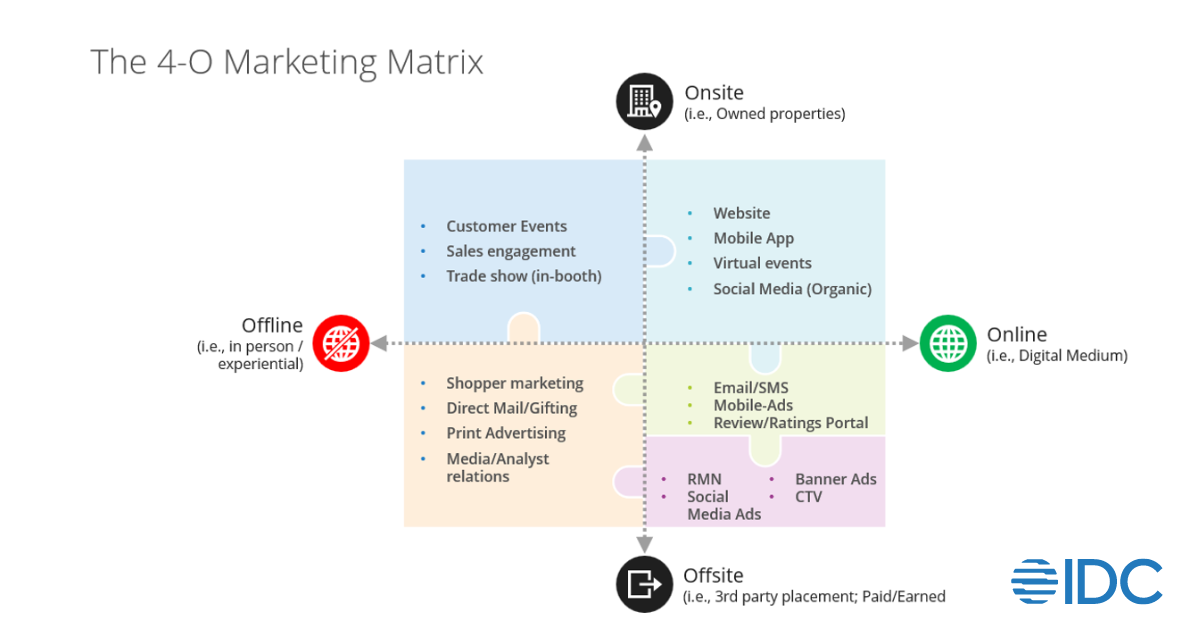
In today’s crowded marketing landscape, the 4-O Marketing Matrix offers a critical upgrade from the traditional 4 Ps model (Product, Price, Place, Promotion). While the 4 Ps remain foundational, they fall short in addressing the complexities of modern customer engagement. The 4-O Matrix—encompassing Online, Offline, Onsite, and Offsite strategies—provides a comprehensive framework that aligns with shifting consumer behaviors and preferences.

The 4-O Marketing Matrix encourages marketers to diversify their promotional tactics across Online, Offline, Onsite, and Offsite channels. This approach not only broadens the scope of engagement opportunities but also aligns more closely with the multifaceted journeys of today’s consumers. By integrating this matrix with the traditional 4 Ps, organizations can enhance their promotional outreach, drive higher conversion rates, and build greater trust with their prospects and clients.

In an era where single-format promotional efforts (typically email marketing) dominate the landscape, the necessity for a more expansive and empathetic marketing model is clear. The 4-O Marketing Matrix represents a pivotal evolution in marketing strategy, urging marketers to leverage a variety of tools and technologies to engage with audiences in a more meaningful and impactful way.

Adopting the 4-O Marketing Matrix is not just about expanding the promotional mix; it’s about embracing a more holistic and customer-centric approach to marketing that resonates with the complexities of the modern market.

Thinking Outside the (In)box

Relying too heavily on email has limited the reach and effectiveness of many organization’s efforts and simultaneously overlooks consumers’ changing preferences. Once the cornerstone of digital outreach, email has become a comfort zone, leading to inbox overload and diminishing returns as consumers grow disinterested in repetitive messages. This focus fails to recognize the importance of personalization and relevance in terms of both content, channel, and context.

Consumers today crave authentic connections and personalized experiences. Email campaigns, often impersonal and detached due to both their content and the nature of the medium, fail to meet these expectations.  By concentrating too much on email, businesses miss out on opportunities offered by social media, messaging apps, and other digital platforms that facilitate meaningful connections.

The limited diversity in contemporary marketing outreach is a consequence of the industry’s own oversights. Martech vendors, influenced by the preferences of marketing users, especially non-marketing executives, have emphasized readily quantifiable and commonly referenced funnel metrics, like Marketing Qualified Leads (MQLs). This focus on simple metrics obstructs a holistic understanding of the “Real” customer journey and pushes marketers towards myopic email-centric campaigns. 

Modern tools that track lead scores based on limited activities miss critical insights from the ‘real’ customer journey, including interactions on competitors’ sites, analyst assessments, peer reviews, and user communities. This focus on short-term, funnel-based MQL targets inspired the creation of the 4-O Marketing Matrix, which encourages organizations to adopt a more holistic approach and engage prospects throughout their entire lifecycle.

Exploring the 4-O Marketing Matrix

The 4-O Marketing Matrix is a revolutionary model that encourages marketers to broaden their promotional approaches beyond traditional methods.

This model is divided into four components: Online, Offline, Onsite, and Offsite. Each of these elements plays a crucial role in creating a comprehensive marketing strategy that addresses the diverse needs and preferences of today’s consumers.

Online and Offline: Bridging Digital and Physical Worlds

The Online component focuses on digital interactions that occur through various electronic devices, offering marketers a vast playground for digital campaigns, social media engagement, and more. In contrast, Offline marketing involves physical, in-person experiences that can create lasting impressions through human touch and personal interaction. Balancing these two aspects allows marketers to cover the entire spectrum of consumer engagement, from the convenience of digital to the authenticity of face-to-face encounters.

Onsite and Offsite: Reaching customers where they are

Onsite marketing refers to promotional activities conducted on a brand’s platforms, such as its website, physical store, or other “owned” environments. These efforts are directly under the brand’s control and provide a space to fully express the brand’s message. Offsite marketing, however, takes place on external platforms, reaching consumers where they spend their time outside of the brand’s direct influence. This could include social media, third-party websites, or even physical locations not owned by the brand.

By leveraging both Onsite and Offsite marketing, brands can ensure they are not only drawing consumers into their own controlled environments but also engaging with them in spaces where they already exist and feel comfortable. This dual approach maximizes visibility and interaction opportunities, making it easier to connect with a wider audience.

The Power of the 4-O Marketing Matrix

By integrating Online, Offline, Onsite, and Offsite elements, the 4-O Marketing Matrix helps marketers move beyond traditional tactics to create dynamic, impactful campaigns. This holistic approach not only enhances brand visibility but also builds deeper connections and trust with consumers. The 4-O Matrix is more than a theoretical model—it’s a practical guide for developing customer-centric strategies that adapt to the evolving marketing landscape.

Embracing the 4-O Marketing Matrix allows marketers to craft strategies that are not only comprehensive but also deeply resonant with the modern consumer’s lifestyle. It’s about enriching the dialogue, understanding their journey, and being present in ways that are both meaningful and impactful.

Navigating the Future of Marketing with the 4-O Framework

The 4-O Marketing Matrix stands out as a novel and crucial framework for organizations seeking to deepen market engagement and build meaningful connections. This model emphasizes a balanced approach across Online, Offline, Onsite, and Offsite dimensions, offering a comprehensive blueprint for moving beyond traditional promotional tactics.

The 4-O Marketing Matrix guides marketers to transcend conventional strategies and adopt a more nuanced understanding of customer engagement. It enables organizations to navigate modern marketing complexities with agility, optimizing every touchpoint for maximum impact. By integrating this matrix, businesses can engage customers more successfully through innovative Offline events, impactful Online campaigns, or effective Onsite and Offsite strategies.

This approach fosters a holistic and adaptable engagement strategy, unlocking new opportunities for growth, customer loyalty, and market leadership. Embracing the 4-O Marketing Matrix ensures that organizations not only keep up with the evolving market but also lead towards a more connected and customer-centric future.

When facing critical business decisions about targeting the right audience, consider integrating IDC Strategic Market Insights (SMI) into your process. Learn more here.

Roger Beharry Lall - Research Director, Marketing Applications for Growth Companies - IDC

With over 25 years' experience leading technology driven marketing programs, Mr. Beharry Lall is now a Research Director with IDC covering Advertising Technologies and SMB Marketing Applications. He brings a unique multidisciplinary perspective, evangelizing the innovative and pragmatic use of both martech and adtech solutions for companies of all sizes. Early in his career Rog worked with an IBM subsidiary expanding into the Asian Market and subsequently, he spent over a decade at RIM (BlackBerry) building marketing leadership across new industry segments, geographies, and product categories. This background fuels his perspective as he researches enterprise customers engagement tools and tactics across the unified omnichannel.

AI has come a long way, turning from a futuristic concept into a driving force behind some of today’s most exciting and impactful innovations, but that benefit comes at a cost.  AI requires performance-intensive computing achieved with high core count CPUs, coprocessors such as GPUs, and high-speed networking, which can require up to 10 times the amount of power for AI infrastructure compared to general-purpose computing. While organizations need to minimize the environmental impact of AI, the true sustainability promise of AI is how to make all industries more sustainable. 

Energy and Carbon Estimates 

IDC estimates that AI datacenter energy consumption was 23.0 Terawatt hours (TWh) in 2022, growing at a CAGR of 44.7% and reaching 146.2 TWh by 2027.  To put that into perspective, the forecasted total for 2027 exceeds the estimated 2021 country usage of Sweden, Argentina, or the United Arab Emirates1. In recent years, the datacenter industry has made significant strides in sustainability. Despite being expected to account for 18.0% of the carbon emissions in 2027, AI is expected to account for 14.6% of all datacenter carbon emissions. Those sustainability efforts are apparent, but unfortunately, carbon emissions are still expected to grow by 2027. 

Completing the Journey to Net Zero

Regardless of industry, most organizations see the business value of environmental goals, with many having set net-zero targets. In IDC’s Datacenter Operations and Sustainability Survey, datacenter operators indicated that Improving Sustainability was their second-highest priority. While sustainability goals can be a tapestry of many initiatives, three principles stand out: energy sourcing, efficiency, and circularity. 

Energy Sourcing

Data centers significantly lower their carbon footprints by leveraging renewable energy sources such as solar, wind, and hydroelectric power, whether onsite generation via microgrids or funded via power purchase agreements, long-term contracts between an electricity generator and a buyer to purchase renewable energy at predetermined prices. Many sustainable data centers also invest in energy storage solutions to effectively balance supply and demand. Technologies such as advanced battery systems and thermal storage help ensure a consistent energy flow, even when renewable sources are intermittent or the generation grid mix is unfavorable. 

In addition to traditional carbon-free renewables, the industry is starting to see investment and implementation via hydrogen and nuclear power. 

Efficiency

Simply put, efficiency is maximizing datacenter performance and minimizing resource usage, including energy, space, and hardware. Furthermore, sustainable datacenters often implement energy-efficient infrastructure, such as advanced cooling systems, workload consolidation and optimized server configurations, to minimize energy consumption. By prioritizing these green energy initiatives, sustainable datacenters also pave the way for more resilient and cost-effective data management solutions. 

Efficiency is not limited to energy.  Datacenter water efficiency focuses on minimizing water usage in cooling systems and other operational processes to reduce environmental impact. Techniques such as liquid cooling, evaporative cooling, and water reclamation systems help data centers achieve this goal by optimizing water consumption and recycling. By implementing these strategies, datacenters can significantly lower their water footprint while maintaining optimal performance and cooling efficiency. 

Circularity

AI is driving the need for IT asset refreshes. Datacenter capacity planning that includes the circularity, or resale, value of IT assets can open up investment capacity for GenAI budgets and new equipment. IDC forecasts the market for refurbished IT equipment and attached services to reach nearly $15 billion in 2028. 

Responsible processing of the used datacenter assets, whether they get recertified for redeployment and resale, harvested for parts, or recycled, represents an opportunity to not only create investment capacity but also be part of meeting corporate sustainability targets. IDC research shows that while organizations increasingly value a broad set of sustainability factors when it comes to IT procurement, the sense of shared sustainability aspirations with suppliers and partners comes in as a top 2 requirement. 

Another example of circularity is waste heat reuse. Liquid cooling, a staple in AI datacenters, involves capturing the heat generated by servers and repurposing it for other uses, such as heating nearby buildings or industrial processes. In addition to its energy efficiency, liquid cooling enhances energy efficiency and reduces the data center’s environmental footprint.  

AI For Sustainability 

While AI will undeniably consume significant amounts of energy, making every effort to implement sustainable AI practices is crucial. This energy use should be viewed as an investment in a more sustainable world, as AI has the potential to drive substantial improvements across various industries. Despite the projected increase in energy consumption, IDC forecasts that datacenters in total, not just AI, will account for only 2.5% of global energy use by 2027, highlighting its relatively modest footprint. The true value of AI lies in its ability to enhance sustainability in sectors such as agriculture, manufacturing, and transportation by optimizing resource use, reducing waste, and improving efficiency. Thus, embracing AI responsibly can lead to a net positive impact on global sustainability efforts, outweighing its energy demands. 

Learn what matters most to your customers with IDC’s AI Use Case Discovery Tool—find out more.