In today’s digital world, buyers discover, evaluate, and purchase solutions in new ways. To remain competitive, organizations must understand these evolving behaviors and act on them.  

With trusted insights, marketing, sales, and executive leaders can make smarter, faster decisions and reshape their go-to-market strategies. Analyst relations (AR) professionals are uniquely positioned to bridge these insights with influence. In a recent IDC webinar, “Turning Insights into Influence: Leveraging Buyer Behavior Research,” Laurie Buczek, Group VP of Executive Insights and Thought Leadership Services at IDC, shared how AR leaders can guide their organizations through the next wave of change.

AI is reshaping the C-suite

Sixty-three percent of CEOs are already operationalizing AI initiatives.

AI is no longer experimental. It’s strategic, and the shift is starting at the top. IDC research shows AI is accelerating from ad hoc adoption to full-scale transformation:

  • 51% of organizations are in the opportunistic phase of AI adoption.
  • 47% of CEOs rank AI-driven business automation as a top investment priority.
  • 54% see AI as a lever to reinvent business models.

This shift is bigger than technology. AI is influencing how decisions are made across the entire C-suite. That makes it critical for vendors and AR teams to influence beyond IT teams, reaching across business and technical leadership.  

The buyer journey is now AI-first

Sixty-eight percent of the buyer journey is now digital.  

As AI reshapes decision-making at the executive level, it’s also transforming how buyers themselves discover, evaluate, and engage with vendors. IDC research shows: 

  • Application-based searches, like YouTube and Reddit, now surpass traditional internet search for vendor discovery. 
  • 73% of decision makers expect to rely more on AI chatbots in the future. 
  • Among IT buyers, that number rises to 85%. 

The trend is clear: buyers aren’t just digital first. They are becoming AI-first. That means your messaging, content, and influence strategy must be optimized not only for SEO, but for AI prompts, jobs-to-be-done, and discovery tools. 

Marketing’s mandate has changed

These shifting buyer expectations demand new leadership. Marketing, once focused on campaigns and channels, is now being redefined as the orchestrator of the entire journey. IDC research shows CMOs are evolving into Chief Market Officers focused on integrating cross-functional engagement and driving growth. 

This evolution is backed by changing skill demands: 

  • Marketing science and analytics are critical for decision-making. 
  • Creative storytelling remains vital to differentiate and connect. 
  • AI fluency, from prompt engineering to agentic workflows, is becoming a core requirement. 

One CMO summarized the shift well, “Sales has integrated into marketing. The CMO is now the chief commercial officer. We view sales as a channel in the customer’s journey versus a standalone function.” 

Where AR leaders come in

With CMOs stepping into broader commercial roles, AR professionals have a unique opportunity to ensure executives stay aligned with market realities and to turn insights into true influence. 

AR professionals can turn insight into influence by: 

  • Explaining how AI is reshaping customer business models and updating messaging to reflect it. 
  • Mapping the expanded buying committee to avoid missed revenue opportunities. 
  • Rebuilding the content supply chain for a digital, omnichannel, AI-first world. 
  • Helping executives understand that an AI-ready marketing organization is no longer optional. 

Bringing these threads together, the future of buyer engagement is clear: omnichannel, AI-led, and persona-rich. For AR professionals, the mandate is not just to capture insights, but to turn them into influence. 

Christina Cardoza - Content Marketing Manager - IDC

Christina Cardoza is a Content Marketing Manager at IDC, where she specializes in brand content and social media strategy. With a background in journalism and editorial leadership, she has a proven ability to transform complex technology topics into clear, actionable insights.

Artificial Intelligence is entering its most transformative phase yet: The agentic future. In this new era, humans and intelligent systems don’t just interact; they act together with intention, autonomy, and scale. According to IDC’s FutureScape 2026 predictions, organizations in Asia/Pacific are rapidly shifting from AI experimentation to enterprise-wide orchestration—where adoption fuels growth, innovation, and market leadership.​

Why 2026 will be a pivotal year for AI adoption

AI has already moved beyond proof-of-concept. IDC projects that AI-related investments in Asia/Pacific will grow 1.7x faster than overall digital technology spending, creating a $1.6 trillion economic impact by 2027.

By early 2025, AI spending reached $90.3 billion, signaling unprecedented momentum. This acceleration is not just about technology—it’s about competitive advantage.

Key AI adoption trends driving the shift:​

  • Enterprise AI transformation – Companies are integrating AI into core operations to boost productivity, lower costs, and open new revenue streams.​
  • AI-powered customer experience – Personalized, emotionally intelligent interactions are becoming the norm.​

Autonomous systems in business – From supply chains to marketing, autonomous agents are optimizing decisions in real time.​

Opportunities across the AI ecosystem

For technology providers, the agentic future opens massive possibilities:​

  • Infrastructure and cloud providers – Demand is surging for AI-ready platforms and compute resources.​
  • Model and tool developers – Specialized AI models tailored to industry needs are gaining traction.​
  • Consultancies and integrators – Enterprises need guidance on how to implement and scale AI for maximum ROI.​
  • Consumer devices – Tap into where technology providers can serve up new use cases and opportunities in the AI era ​

For enterprise leaders, the biggest gains will come from integrating AI capabilities across departments — not just in isolated use cases.​

Turning predictions into impact

IDC’s predictions for 2026 and beyond are more than industry forecasts—they are a roadmap to revenue. Whether you’re a CIO, CMO, product leader, or technology provider, understanding these trends will help you:​

  • Identify emerging markets before competitors do.​
  • Prioritize high-impact AI investments.​
  • Build an AI adoption strategy that scales.​
charting the agentic future

Step into the future ahead of your competition in the Asia/Pacific region. Join us on November 14, 12:00-5:00 PM, and get access to exclusive IDC insights on tech predictions, market forecasts, and direct buyer feedback from IDC’s leading voices on Asia/Pacific technology and innovation:

  • IDC Predictions 2026: Charting the Agentic FutureSandra Ng, GVP and General Manager for Asia/Pacific Japan Research
  • Everything AIDr. Chris Marshall, VP APAC AI and Industry Research
  • Consumers in the AI EraBryan Ma, Global and APAC Devices Research
  • Decoupling and Top China B2B/B2C TrendsZhenshan Zhong, VP China Research
  • Services Disruption in Tech: Thriving in the Age of AILinus Lai, VP APAC Services and CEO/CIO Research

Seats are limited so reserve your spot now, register today!

The 2025 Asian Financial Services Congress (AFSC) and Financial Insights Innovation Awards (FIIA) were more than just industry events. They reflected the rapid pace of financial services transformation and spotlighted the technologies and strategies that help institutions respond to constant change.

One truth came out clearly this year: Resilience and innovation are essential for success in 2025 and beyond. At AFSC, financial services leaders explored the emerging technologies and real-world AI use cases that are driving competitive advantage—and discussed how institutions can respond to increasing complexity, from geopolitics to talent shortages.

In adapting to the new landscape, two powerful forces are shaping transformation in 2025:

  • Technology suppliers accelerating innovations, setting benchmarks, and raising the bar for performance.
  • Financial institutions navigating shifting demand, geopolitical pressure, and execution risks.

Staying competitive requires clarity. It’s no longer just about adopting technology—it’s about applying it with precision.

Three strategies to strengthen financial services

These three proven strategies emerged as critical for leaders navigating digital transformation and rising expectations.

  1. Responding to geopolitical risk with five key levers

To stay agile, financial institutions are aligning technology and operating models to address:

  • Technology decoupling and regional sovereignty
  • Intraregional trade and its impact on growth
  • Cybersecurity threats intensified by AI and automation
  • De-dollarization trends in global finance
  • Procurement changes in a shifting supply chain
  1. Closing the financial services skills gap

The challenge isn’t technology, it’s execution. Despite a surge of more than 8 million new STEM graduates in Asia and the release of over 70 new large language models (LLMs) within three years of first launch, many projects failed before delivering value.

To realize ROI, institutions must evolve their workforce. That means reskilling technically trained professionals into financial services experts who can connect innovation to business goals.

  1. Prioritizing high-impact AI use cases

Leaders are no longer experimenting—they’re scaling what works. IDC identified 12 AI use cases delivering measurable value across banking and insurance, including:

  • SME lending automation
  • Customer onboarding optimization
  • Fraud detection
  • Risk modeling and forecasting

Each use case was validated by case studies from top Asian financial institutions, demonstrating operational gains and business impact.

Throughout the event, CXOs and digital transformation leaders reinforced these strategies during expert panels. Technology suppliers brought critical perspective, showcasing how successful AI implementations are creating repeatable models for the industry.

Real use cases. Real results.

Execution matters. The FIIA Awards honored institutions that turned their ideas into action. Ten awards were presented to eight financial institutions, including five full-service banks, one digital-only bank, and two insurers.

Winners were selected based on clear, outcome-oriented criteria:

  • Demonstrated scalability and ROI
  • Customer-centric innovation promoting inclusivity and access
  • Forward-looking initiatives with industry-wide implications.

Congratulations to all the winners for showing how innovation can move from pilot to proof.

What comes next for 2026 onwards

As 2025 enters its final quarter, the direction is clear—financial services institutions must act on proven strategies, invest in execution, and double down on AI use cases that deliver value.

Chart your Agentic AI future! Attend these IDC AI webinar series to dive deeper into the Agentic AI and its use cases:

Ashish Kakar - Research Director - IDC

Dr. Ashish Kakar is research director for IDC Financial Insights in Asia/Pacific. Based in Singapore, he is the lead Financial Insights analyst responsible for all aspects of banking and insurance research. Dr. Ashish's own interest is in fraud and risk, resilience, customer centricity, AI/ML, retail banking, insurance, alternative investment management, cloud and infrastructure, and credit risk management. Prior to joining IDC, Dr. Ashish had over 16 years' experience in Citibank, five years' experience with insurance companies, and has run his own asset management start-up for two years. In his last role in Citibank, Dr. Ashish managed processes across banking technology, servicing operations, and product. He was a regional senior with oversight of the Asia and Europe operations.

Most marketing leaders would agree that driving growth is a critical aspect of their role. But when met with day-to-day realities, growth often takes a back seat. Marketers have to juggle limited budgets, competing demands, and the pressure to show quick wins. This results in marketing efforts that focus on what feels urgent and out of line with what leadership expects.

Forty-one percent of midmarket CMOs say that developing a strategy for new customer acquisition is their CEO’s top expectation over the next 12-18 months. This is according to IDC’s 2025 Global Midmarket Tech CMO Priorities Survey.

Yet many marketing teams remain focused on other outcomes. In fact, 30% say their top priority is increasing revenue from existing customers. Another 29% are focused on reducing costs and streamlining operations.

This isn’t a sign that marketing is off course. It’s a sign that the course itself is more complex. But when executive expectations point one way and internal execution points another, the disconnect can undermine momentum. This is the second of four major disconnects facing marketing teams, as identified by IDC. If left unaddressed, it limits marketing’s ability to deliver measurable business impact at the time it matters most.

nd the first step to achieving true AI-driven growth is breaking through the illusion.

How marketing lost sight of growth

In many ways, this disconnect was inevitable. Over the past few years, CMOs have had to adapt quickly — grappling with new technologies, shifting buyer behavior, and intensifying pressure to do more with less. Along the way, the role itself has fundamentally changed.

Just a few years ago, IDC’s survey data confirmed that most midmarket CMOs didn’t see that change coming. In 2021, 49% of CMOs said they expected no change in their role over the next two years, and only 15% predicted an evolution toward becoming a Chief Market Officer — a title that signals broader responsibility for revenue growth and customer insight. Today, that view has shifted: 33% of CMOs now recognize their role has expanded to include a new title, greater responsibility for understanding the market, and increased accountability for both marketing and sales outcomes.

In short, marketing is no longer responsible solely for generating leads or building awareness. Executives now expect it to directly fuel business growth through acquisition, expansion, and orchestrated, insight-driven customer journeys that span the entire funnel.

Against that backdrop, it’s understandable why many CMOs have leaned into retention and efficiency. In a time of rapid change, focusing on what already works can feel like the safest choice. But when the rest of the business pivots toward bold growth, those instincts can become misaligned. Efforts to protect what’s already working may unintentionally push growth initiatives to the sidelines.

The risks of misalignment

When executive expectations lean into growth while marketing remains focused on retention and efficiency, frustration builds. From the CEO’s perspective, marketing appears out of step. Results are being delivered, just not the ones the business is counting on.

At first, this disconnect can be hard to spot. A strong retention strategy can keep revenue steady in the short term, creating the impression that everything is on track, even as new customer growth begins to stall. Over time, however, the lack of a replenished pipeline becomes impossible to ignore.

The consequences compound quickly:

  • Revenue projections slip as acquisition lags.
  • Cross-functional trust erodes.
  • Strategic credibility suffers.

If this sounds familiar, you’re not alone. Many teams face challenges moving beyond their traditional role at the top of the funnel. Nearly 35% of midmarket CMOs say demonstrating marketing’s strategic impact and ROI beyond lead generation is the top credibility challenge their teams face, according to IDC’s research. Another 25% report difficulty reinforcing marketing’s leadership role in driving business growth across the organization.

Additionally, challenges in measurement deepen the disconnect. While the C-suite continues to prioritize outcome-based KPIs, midmarket CMOs report that these metrics remain the hardest to define and track. Without a clear way to measure and communicate progress toward growth, internal alignment stalls, and confidence from leadership wanes.

Meanwhile, competitors that invest in acquisition today are building relationships that may be difficult to disrupt later. And when pressure to deliver spikes during budget season, board reviews, or sudden pivots in business direction, marketing teams are left scrambling to respond, without the infrastructure or momentum to do so effectively.

This mirrors another key disconnect IDC identified for 2025: the “illusion of AI adoption.” In both cases, surface-level activity is mistaken for strategic progress. A well-run retention strategy may look like success until growth becomes the mandate, and marketing finds itself unprepared to scale.

Recognizing the need for rebalance

This isn’t about choosing between growth, efficiency, or retention. The most effective marketing strategies in 2025 will do it all. But to meet rising expectations from the C-suite, CMOs must rebalance attention, resources, and measurement frameworks toward initiatives that drive net-new business.

That starts with acknowledging the gap:

  • Are your current campaigns designed to reach new audiences?
  • Are acquisition metrics part of your performance benchmarks?
  • Is your team resourced and empowered to prioritize growth?

For many, the honest answer is “not yet.” But that’s not a failure. It’s a starting point. And it signals that now is the time to course correct. The sooner CMOs confront this disconnect, the better positioned they’ll be to respond before it widens.

Realigning for growth

Recognizing the gap is one thing. Closing it takes action.

Retention and efficiency will always matter, but acquisition needs to have a clear place in the strategic plan, with dedicated resources, defined metrics, and visibility across the organization. For many teams, that requires a shift in how priorities are set and how success is measured.

IDC’s Executive Insights Brief: The four disconnects shaping marketing in 2025 outlines specific actions that can help marketing leaders move toward better alignment with growth expectations. These are practical, manageable steps designed to show momentum now and build strategic strength over time.

Ready to bridge the gap between marketing and executive growth goals?
Get the four actionable steps to realign your strategy and strengthen your acquisition efforts today.

Christina Cardoza - Content Marketing Manager - IDC

Christina Cardoza is a Content Marketing Manager at IDC, where she specializes in brand content and social media strategy. With a background in journalism and editorial leadership, she has a proven ability to transform complex technology topics into clear, actionable insights.

As cloud marketplaces continue to grow in scale and influence, they are reshaping how software is bought, sold, and delivered. For independent software vendors (ISVs), cloud platforms, and partners, marketplaces offer a streamlined route to customers, accelerated procurement, and new monetization models. But as this ecosystem matures, a subtle but important issue is emerging: the potential for revenue double-counting across the value chain.

The marketplace revenue flow

In a typical cloud marketplace transaction, a customer may purchase a SaaS or PaaS solution from an ISV via a private offer. That offer might be created by a distributor and fulfilled by a partner, while the ISV itself runs its solution on the same cloud platform that hosts the marketplace. Each party in this chain—partner, distributor, ISV, and cloud provider—may record the full transaction value as revenue or gross merchandise value (GMV), depending on their role and reporting model.

Where overlap occurs

The potential for double-counting arises when the same infrastructure spend is captured in multiple places. For example, an ISV may purchase infrastructure-as-a-service (IaaS) from a cloud provider to run its application. That same ISV may then sell its solution via the cloud marketplace, where the customer pays for the full SaaS offering—including the embedded IaaS costs. In this scenario, the cloud provider may record both the ISV’s IaaS consumption and the customer’s SaaS purchase as separate revenue streams, even though they are economically linked to the same infrastructure usage.

Estimating the impact

Our latest estimates suggest that up to 10–20% of reported marketplace revenue could be subject to some form of double-counting. This is particularly relevant in complex enterprise deals involving multiple intermediaries and multi-year commitments. The risk of overlap is higher in marketplaces with mature ISV ecosystems and transactional depth, where infrastructure and software are tightly coupled.

Implications for the ecosystem

This dynamic doesn’t imply wrongdoing—each party is legitimately recognizing revenue based on their role in the transaction. However, it does raise questions about how we measure the true size and growth of the cloud economy. Without careful deduplication and end-user-level spend tracking, there is a risk of overstating total IT spend, partner influence, and marketplace adoption.

Why it’s hard to fix

The challenge lies in the complexity of the ecosystem. Each participant has different incentives, reporting standards, and visibility into the transaction flow. Cloud providers may report gross marketplace volume, ISVs may report full contract value, and partners may claim influence or attach credit. Without a standardized framework for revenue attribution, it’s difficult to isolate and remove duplication.

A subtle signal

This isn’t a crisis—but it is a signal. As marketplaces become a larger share of enterprise IT procurement, the need for transparency and consistency will grow. For ISVs and cloud platforms alike, understanding where and how revenue is recognized can help avoid misaligned incentives and ensure sustainable growth. It’s something to be aware of as the ecosystem continues to evolve.

IDC’s EMEA Partnering Ecosystems team helps technology vendors, platforms, and ISVs navigate the evolving dynamics of cloud marketplaces and partner ecosystems.

Through continuous engagement with the ecosystem and proprietary survey data, we provide grounded, real-world insights into how value flows, where overlaps occur, and what it means for your go-to-market strategy. Whether you’re refining partner models, optimizing marketplace presence, or simply seeking clarity in a complex landscape, we can help. Get in touch to access the intelligence you need to make smarter, faster, and more efficient ecosystem decisions. For more information on the research, click here.

Listen to Stuart and Andreas’ webcast “The New Partner Playbook: Ecosystem-Led Growth in EMEA” register here.

If you have a question on this or anything related to partnering, please drop it here.

Stuart Wilson - Senior Research Director, EMEA Partnering Ecosystems - IDC

Stuart Wilson is senior research director for IDC’s Europe, Middle East & Africa (EMEA) Partnering Ecosystems program. With over two decades of global experience, Stuart focuses on the rise of complex, connected ecosystems and how platform models are reshaping routes to market and partner engagement frameworks.

In a world increasingly driven by sustainability and cost-efficiency, the used device market is no longer a secondary consideration; it’s a strategic frontier. From smartphones and laptops to wearables and tablets, pre-owned tech is gaining traction across consumer and enterprise segments alike. At IDC, we’ve been closely monitoring this evolution through our Quarterly Used Device Tracker, uncovering the key trends that reveal how the market is maturing, diversifying, and reshaping the broader device ecosystem.

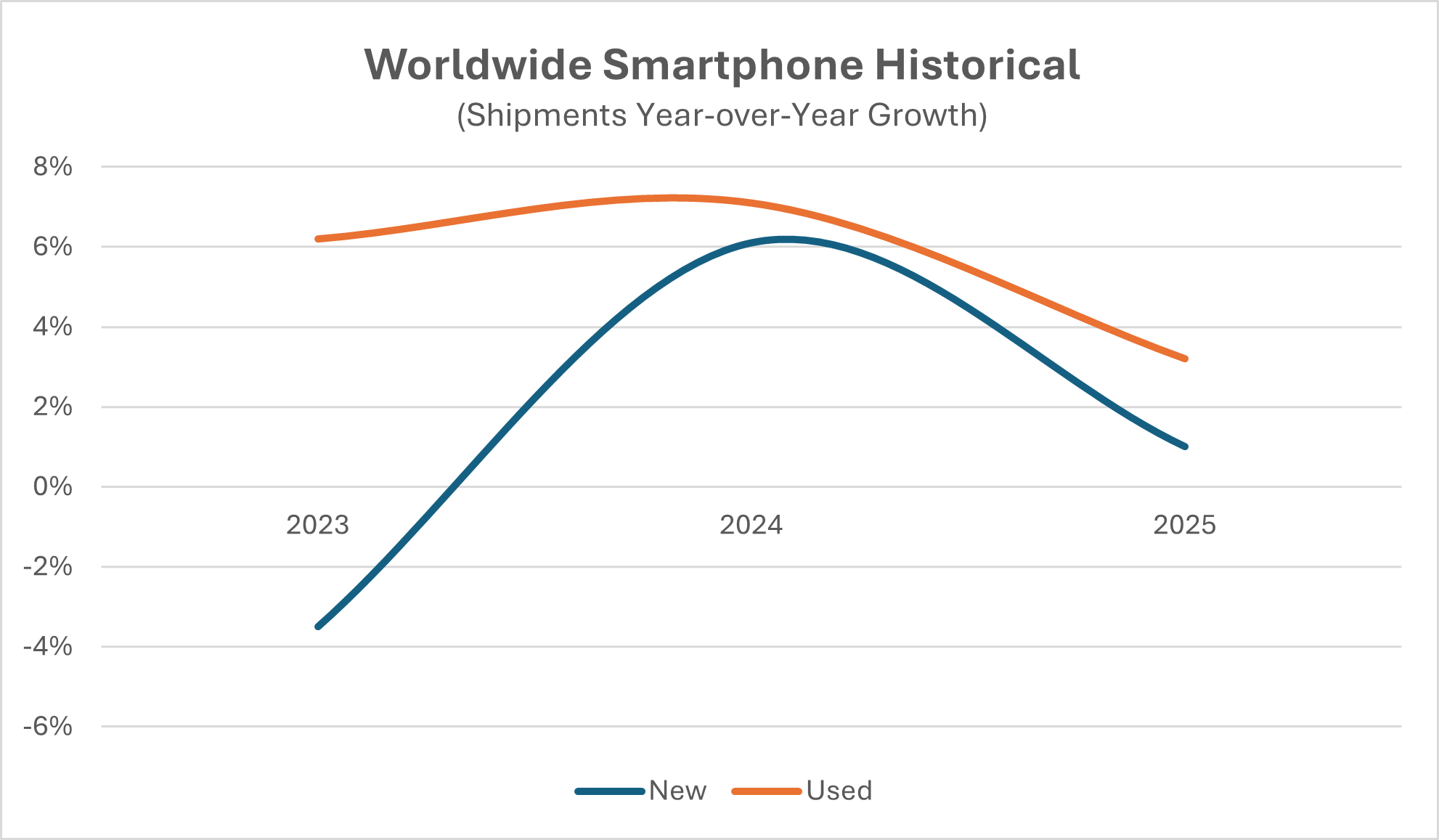
IDC’s recent forecast indicates that global shipments of used smartphones alone will grow by 3.2% year-over-year in 2025, whilst the worldwide market for new smartphones is only projected to grow 1% over the same period. This is fueled by widespread trade-in programs, improvements in refurbished device quality, and rising environmental awareness. As affordability meets reliability, the appeal of second-hand devices is expanding beyond budget-conscious consumers to mainstream buyers and businesses.

Used vs. new smartphone shipments: A diverging growth story

The smartphone market is undergoing a notable shift, with sales of new devices having declined in both 2022 and 2023, before seeing a modest recovery in 2024. In contrast, the used smartphone market has been constantly growing.

This divergence reflects changing consumer priorities: affordability, sustainability, and the growing trust in refurbished devices. As shown in the graphs below, the used device segment is not just resilient, it’s becoming a growth engine in its own right.

What’s fueling the shift

The slowdown in new smartphone shipments stems largely from economic caution and longer device lifespans. With inflation squeezing budgets and phones lasting longer thanks to improved hardware and software support, consumers are holding onto their devices for extended periods. Add to that a lack of groundbreaking innovation and saturation in mature markets, and it’s clear why growth has stalled.

Meanwhile, the used smartphone market is thriving. Buyers are drawn to the value and reliability of refurbished devices, especially as trade-in programs expand and certification standards improve. Sustainability is also playing a bigger role; choosing a used device is increasingly seen as a wise, eco-conscious decision. As consumers become more environmentally conscious, buying second-hand devices helps reduce electronic waste and makes more efficient use of resources. Additionally, the rapid pace of technological advancement means that even older models can still perform well and meet everyday needs. Consequently, the market for second-hand smartphones is thriving, often outpacing sales of brand-new devices.

Forecasting the future

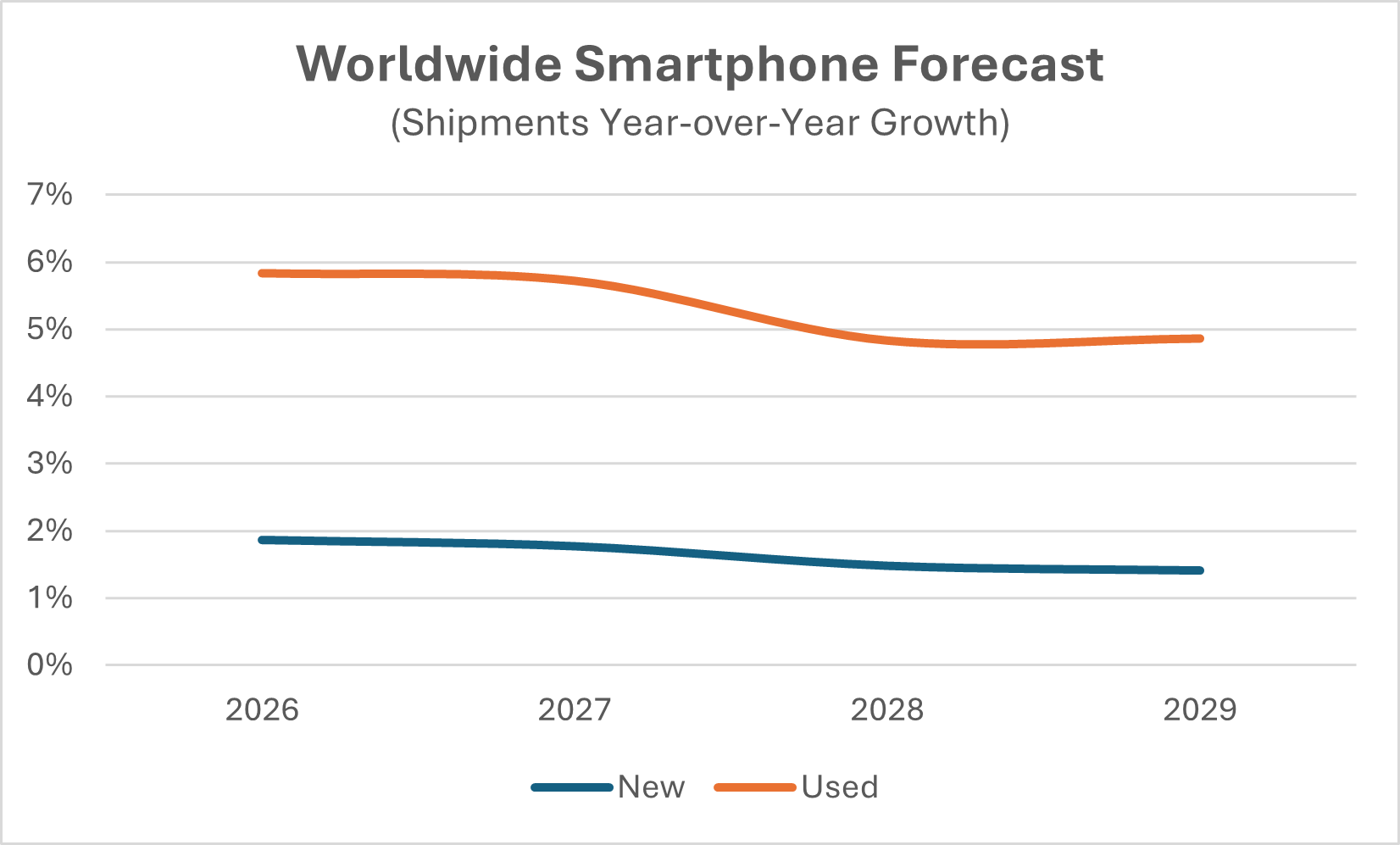
As the smartphone market looks ahead to the second half of the decade, the growth dynamics between new and used devices are expected to shift. According to IDC’s forecast, new smartphone shipments will gradually recover, with growth rates climbing from 1% in 2025 to 1.4% by 2029. This rebound reflects improving macroeconomic conditions, renewed upgrade cycles, and innovation in areas like AI and foldable devices.

However, the used smartphone market will continue to grow at a faster pace, albeit with a gradual deceleration. Starting at 5.8% in 2026, growth is projected to ease to 4.9% by 2029 as the market matures and supply chains stabilize. The sustained momentum in the used segment underscores its role as a mainstream choice, driven by affordability, sustainability, and the continued expansion of trade-in and refurbishment programs.

The graph below illustrates this, highlighting how both segments are growing, but with used smartphones maintaining a clear lead.

Looking ahead

As the smartphone market evolves, the used device segment is redefining value, sustainability, and accessibility. With strong growth expected to continue through 2029, it’s evident that second-hand smartphones have moved beyond being a niche market; they are now a strategic pillar of the industry. Whether you are an original equipment manufacturer (OEM), a retailer, or an enterprise buyer, understanding this shift is crucial for staying competitive in an increasingly circular, data-driven, and consumer-focused market.

Diogo Santos - Data & Analytics Analyst - IDC

Diogo Santos is the Global Lead for IDC's Used Device Research. In this role, he oversees the design, development, and strategic direction of the Worldwide Used Device Tracker, collaborating across teams to deliver insights that support some of the world's largest technology firms. Diogo coordinates research across a global network of analysts and integrates regional data into a unified product that provides industry benchmarks, resale trends, and demand forecasts for used and refurbished devices. Santos has a bachelor of management degree from Universidade Europeia in Lisbon and Università di Bologna. He has also studied business intelligence and risk assessment, and took part in the INOV Contacto program. He is fluent in English and Portuguese.

Given all the geopolitical and economic upheavals so far seen in 2025, concerns about U.S. tech dominance, and fear of services from (non-European) IT providers being withdrawn as a result of government executive orders, the big question we keep hearing in Europe is “What is Plan B”?

I can answer that.

Firstly though, it should be noted that Europe’s interest in digital sovereignty has always been high. Now, as geopolitical tensions escalate and regulatory uncertainty deepens, many organisations on the continent see this as a strategic imperative.

But…

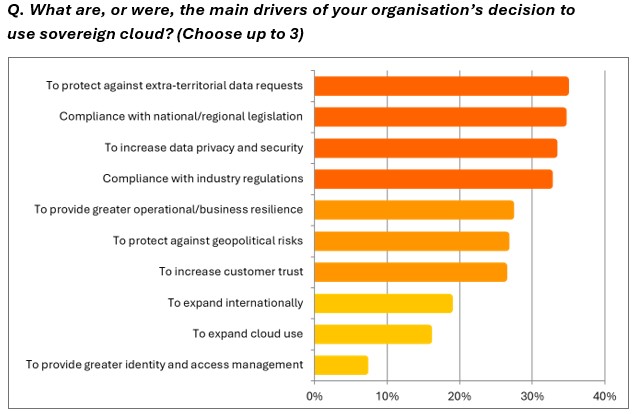
Geopolitical risk has typically been a low-ranking market driver for those seeking sovereign solutions in Europe. Sure, IDC’s 2025 Worldwide Digital Sovereignty Survey shows that this has climbed up the rankings, now attracting more than a quarter of responses compared to last year when it was slightly less and even coming bottom of the list of drivers as it has done so in the years prior to 2024.

What’s more revealing is that Europe now has a new top sovereign cloud market driver: protection against extra-territorial data requests.This reflects growing anxiety over foreign access to sensitive data and a clear signal that sovereignty is no longer just about compliance and control, but has a greater focus on autonomy.

The European provider’s response: “Plan B”

In what can be regarded as a largely unprecedented move, Europe’s service providers have reacted swiftly and have taken a proactive approach, joining forces to offer what they consider to be the “alternative” (and many also promote the idea of services, platforms and providers that can be labelled as “Made In Europe”).

Some examples here include EuroStack, which calls for a Europe-led digital supply chain spanning chips, cloud, AI and digital governance; virt8ra (pronounced virtoora), which is billed as Europe’s first sovereign edge cloud; and the EU-funded Sovereign European Cloud API (SECA) which is available to all European cloud providers for cloud infrastructure management.

These initiatives reflect a broader push to reclaim digital autonomy and reduce dependency on non-European tech giants.

The global cloud providers’ response: committed to Europe

The global cloud providers have not been standing still. And of course, none of them are about to walk away from their highly successful business operations in Europe.

In recent months, several big name providers, such as Google and Microsoft, have enhanced their sovereign offerings to emphasize how sovereignty and U.S. big tech can work provided the right controls and partnerships are in place.

And clearly, just as the global cloud providers are not planning to abandon Europe, Europe is not planning to abandon them.

For instance, despite all the media hype earlier this year around German authorities “ditching” Microsoft in favour of their own home-grown solutions (in June 2025, the German state of Schleswig-Holstein rolled out the OpenTalk videoconferencing solution, developed by Berlin-based Heinlein Support, across all state agencies), partnerships with U.S. providers continue to be announced.

These include the German Federal Office for Information Security’s (BSI) strategic cooperation agreement with AWS in the run-up to the launch of the AWS European Sovereign Cloud in Germany later this year.

Separately, the BSI has also teamed-up with Google Cloud to support the development and deployment of secure and sovereign cloud solutions for government agencies, including the German military that will use an air-gapped version of Google distributed cloud.

IDC’s response: Techxit? What techxit?

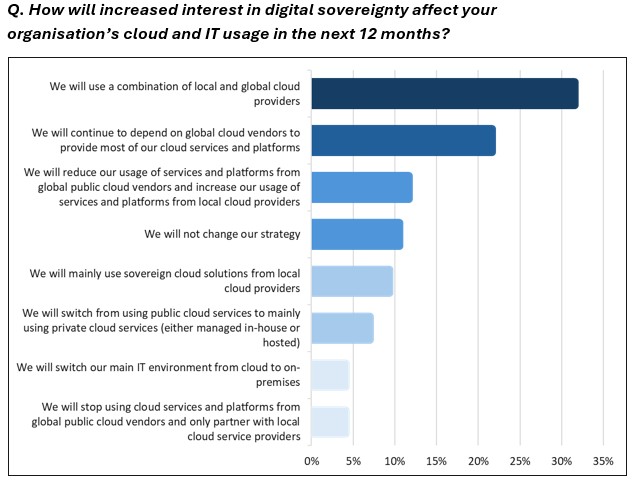
Despite their increased interest in sovereign solutions due to all the geopolitical turmoil, just 4% of European organisations say they plan to stop using cloud services and platforms from global public cloud vendors and only partner with local cloud providers.Thus, reports of ‘techxit’ – the prospect of U.S. providers being forced out of Europe for whatever reason – are greatly exaggerated.

Instead, the dominant strategy is staying “glocal”: combining global innovation with local control by using both global and local providers, and many organisations in Europe say they will continue to depend on global cloud vendors.

What’s more, the idea of a full-scale “techxit” remains impractical, given the deep integration of global technologies in European IT environments.

Of course, it would be naïve to think that buyer expectations have remained unchanged in 2025 – far from it.  The expanded interest in digital sovereignty in Europe is expected to account for a decrease in organisations using sovereign cloud from not only global providers but also their local counterparts, with managed providers seeing a slight increase. The changes here are not huge but significant enough for all providers to take not.

What all providers need to consider

To succeed in this evolving landscape, cloud providers must:

  • Offer verifiable protections against extra-territorial data access
  • Prioritize network sovereignty, including data in transit
  • Invest in AI governance and compliance-first infrastructure
  • Build regional partnerships to meet local expectations
  • Embrace open standards to support interoperability and avoid vendor lock-in

So what is “Plan B”?

IDC has long maintained that a trusted ecosystem of partners is needed for sovereignty to work at scale, and we believe this should include a combination of using global and local providers.

For the global cloud players that means looking for the right regional and in-country partners to help boost local credibility and to deliver local services, local expertise and leverage local knowledge.

For the local service providers, it means partnering with global players to help deliver innovation and scalability.

And then the global SaaS providers need to be able to work across both to develop and deliver customized offerings within sovereign frameworks.

Europe’s vision for digital sovereignty is not about isolation — it’s about balance. The goal is to level the playing field, reduce dependency, and ensure that the continent can compete globally while retaining control locally.

Ultimately it’s about the sovereign aspect of digital self-determination and survivability and self-sufficiency. The latest geopolitical uncertainties indicate a recalibration of Europe’s cloud market, not a rejection of global providers.

So what’s Plan B? Our advice to organisations in Europe seeking sovereign solutions is to stick to Plan A.

For more information and to see what Rahiel is covering, look here: Digital Sovereignty. 

Got a specific question? Drop it in here.

Rahiel Nasir - Research Director, European Cloud Practice, Lead Analyst, Digital Sovereignty - IDC

Rahiel Nasir is responsible for leading and contributing to IDC's European cloud and cloud data management research programs, as well as supporting associated consulting projects. In addition, he leads IDC's worldwide Digital Sovereignty research program. Nasir has been watching technology markets and writing about them throughout his professional life.

On the surface, AI seems woven into modern marketing. Pilot programs are evolving into real workflows. AI tools are being deployed for a variety of tasks. Teams are becoming more fluent in GenAI, automation, and orchestration.

But underneath it all, the foundation is often still rocky. Insufficient infrastructure, skill shortages, and a lack of clear governance reveal a distinct disconnect: many organizations are mistaking adoption for advancement, and it’s creating a false sense of AI maturity.

In fact, just over half of midmarket CMOs have implemented AI or GenAI into their marketing strategy, according to IDC’s 2025 Global Midmarket Tech CMO Priorities Survey. Yet only 26% are seeing improved efficiency, creativity, and effectiveness as a result.

This gap between confidence and capability defines what IDC calls the illusion of AI adoption.

At the same time, CMOs face mounting pressure to deliver more, faster. From bold innovation and customer acquisition to measurable ROI and alignment with enterprise tech infrastructure, today’s marketing leaders are navigating what IDC refers to as the Pressure Cascade: a compounding set of executive expectations with limited room for missteps.

This illusion of AI adoption is just one of four key disconnects reshaping marketing in 2025. And the first step to achieving true AI-driven growth is breaking through the illusion.

The mirage of AI maturity

Momentum can create the illusion maturity. The presence of AI tools, active experimentation, and a handful of successful use cases can have organizations thinking they’ve successfully transformed into optimized, AI-infused operations.

But the reality is that most transformations are still in the early stages.

According to IDC’s MaturityScape: AI-Fueled Organization 1.0, a majority of midmarket businesses are undergoing an opportunistic pivot to AI while working to formalize strategy, establish oversight, and integrate practices across teams.

The problem isn’t that these companies are doing the wrong things. It’s that they’re doing the right things in isolation.

Experimentation remains siloed. Cross-functional learning is limited. AI efforts may be structured, but they’re not yet orchestrated or repeatable.

This pivot phase can generate positive signals such as early productivity gains, promising pilot outcomes, and internal excitement. But those signals can also be misleading. Without a strong foundation in place, organizations can’t move from experimentation to scale.

What emerges is a semblance of progress: a hodgepodge of capabilities that looks advanced but doesn’t have the basis to deliver long-term value.

Understanding where your organization stands on the AI maturity journey is a critical step toward ensuring your efforts in AI aren’t just active, they’re effective. And without that clarity, it’s easy to mistake movement for mastery.

The AI readiness gap: Perception vs. preparedness

While many marketing leaders are confident in their organization’s AI trajectory, IDC’s research reveals a different picture. On paper, AI adoption appears to be surging. However, operationally, most organizations are still grappling with fundamental gaps that limit impact and scalability.

For example, 37% of midmarket CMOs believe AI-enabled marketing technologies have potential to help their organizations over the next 12-18 months, according to the Midmarket survey. This includes incorporating tools and workflows to boost content creation and automate campaigns, critical elements of modern marketing success.

Still, only 31% of the same CMOs are prioritizing the modernization of their MarTech stacks. This is a crucial metric. Without updated systems and integrated data pipelines, even the most sophisticated AI tools remain disconnected from broader workflows, limiting their value.

What emerges is a widening gap between perception and preparedness.

Leaders may feel confident in their AI capabilities, but confidence alone doesn’t modernize platforms, upskill teams, or align cross-functional strategy. Without a clear-eyed look at operational readiness, organizations risk mistaking AI activity for AI advantage. And in doing so, they leave substantial business value untapped.

The blind spots hiding true transformation

The illusion of AI readiness isn’t just about overconfidence: It’s about overlooked fundamentals. Lurking beneath the surface of many marketing organizations are three persistent blind spots that impede progress, even as AI use proliferates.

  1. Unsustainable infrastructure: Legacy systems and siloed data remain some of the biggest barriers to AI effectiveness, yet few CMOs report modernizing their tech as a top priority. Too often, marketers layer new AI solutions onto outdated architectures, expecting transformation from tools that lack full integration with customer and operational data.
  2. Untapped talent: AI adoption isn’t just a technology challenge. It’s a people challenge. Marketing teams need fluency in how AI works, where it adds value, and how to measure and report ROI. Still, many teams lack the training or hiring support to confidently engage with AI tools. The result is inconsistent usage, limited experimentation, and stalled progress.
  3. Undefined governance: Perhaps the most insidious blind spot is the absence of a centralized AI strategy. In many organizations, no single leader owns AI enablement. Without clear accountability and guidance, AI initiatives tend to remain ad hoc, driven by interest or urgency rather than overarching business priorities. This leads to duplication, wasted investment, and difficulty measuring success.

Together, these blind spots don’t just delay AI maturity, they hide its true nature. Organizations may appear active in their use of AI, but without addressing these core areas, their progress remains tenuous at best. The longer these issues go unaddressed, the harder it becomes to scale success, drive innovation, or justify further investment.

Now is the time to break the illusion of AI adoption

AI is no longer optional. It’s a modern-day must. Customers anticipate personalization in real time. Executives expect measurable ROI and aggressive acquisition strategies. And the organizations that have made meaningful investments into foundational AI readiness are beginning to pull ahead.

For CMOs still operating under the illusion of AI capability, it’s time to wipe the fog from the mirror. The gap between perception and reality isn’t just a strategic misalignment – it’s a missed opportunity to gain a competitive advantage.

Without a concentrated effort to strengthen technological infrastructure, elevate team capabilities, and establish clear ownership, AI initiatives risk becoming isolated experiments rather than engines for long-term growth.

Forty-two percent of organizations plan to increase their IT spending in 2025 to support greater AI use, found IDC’s Future Enterprise Resiliency and Spending Survey Wave 11. But that investment won’t pay off without alignment across strategy, systems, and people. The marketing leaders who take ownership of that alignment now will be best positioned to turn AI ambition into operational impact.

The illusion of AI adoption won’t be broken with more tools or individual use cases. It requires a shift in mindset: from confidence to clarity, from activity to orchestration, and from experimentation to strategic enablement.

To go deeper on how to turn illusion into reality – and ensure your AI strategy delivers real results.

Customer relationships shift across moments, usage, roles, and goals, often in ways that challenge traditional thinking. It’s no longer sufficient for brands to predict what someone might do next. Instead, they must also understand why customers behave as they do and act while the engagement window remains open.

Today’s customer dynamics demand systems that can read intent and purpose in real-time, explain decision logic transparently, and trigger contextually appropriate responses. This requires predictive AI models augmented with generative AI capabilities and AI agents designed to analyze patterns, operationalize insights, make decisions, execute interventions, and learn from outcomes continuously.

Brands need to understand that customer intent or behavior shifts do not wait until the next daily or weekly campaign planning and execution cycles. They need to synthesize intent signals, build accurate AI models and put them to work before they become irrelevant.

Data foundation reality check

Organizations rushing to augment their predictive AI systems with generative AI and AI agents often discover that their data architecture cannot support the complexities required to transform raw data and context into AI-ready inputs. This is not a minor issue.

The challenge isn’t just traditional data quality – it’s creating a unified data environment where structured customer transactions, unstructured behavioral signals, social interactions, and external market indicators can be processed collectively. When data sources remain siloed or poorly integrated, AI agents make decisions based on incomplete context, generative AI produces responses that ignore critical customer history, and predictive models optimize for patterns that no longer reflect current customer reality.

Industry-specific requirements

Organizations often overlook customer data characteristics and AI model needs by industry, even within context of marketing and CX use cases. In travel and hospitality, the emphasis might be on seasonal demand patterns, loyalty program activity, and booking lead times, whereas in fashion retail, it could center on style preferences, return behavior, and fast-moving trend adoption. These variations shape not just the data collected, but also how it’s processed, modeled, and translated into timely marketing actions.

Best-fit customer analytics applications embed industry-specific frameworks, data models, and campaign templates. Prebuilt workflows and segmentation logic grounded in industry IP reduce customization effort, accelerate time-to-value, and ensure that marketing teams can act on insights in ways that resonate with their customers’ actual behaviors.

The autonomous future

The promise of autonomous customer analytics lies in its ability to analyze vast streams of customer data, make decisions and take actions at scale, and learn from the results to improve future performance. When built on a solid foundation, these systems don’t just respond to customer behavior, they adapt continuously, refining rules, models, and strategies based on what works and what doesn’t.

Achieving this requires more than deploying an advanced AI model. It requires continuous learning architecture that captures outcomes, detects drift in data, model, or customer patterns, and adjusts actions accordingly. Without these capabilities in place, moving too quickly to autonomous AI decision-making can be risky. Weak data quality, insufficient governance, and lack of monitoring can allow small errors to accumulate rapidly, resulting in inconsistent actions.

Value measurement systems

Organizations struggle to measure the ROI of traditional predictive AI. Even in batch-driven models, linking predictions to business impact can be challenging with unclear baselines and inconsistent attribution. If it’s difficult to quantify the value of a churn prediction or a propensity score today, the challenge grows when moving to generative AI and AI agents.

Successful organizations will be those that build value measurement into their customer analytics applications. This means not only track the business impact from predictive AI use case but also show the direct link between model outputs, actions taken, and outcomes achieved. By establishing this closed loop, organizations lay the groundwork for measuring GenAI and AI agent performance, where the same approach must scale and provide continuous feedback for improvements.

Practical readiness

Successful customer analytics transformation requires organizations to start with a fundamentally different question: not “what insights can we generate?” but “what customer behaviors can we influence, and what organizational capabilities do we need to influence them effectively?”

Selecting the right use case (e.g., customer segmentation, propensity, personalization, journeys, digital experience, next best recommendations, etc.), strengthening the data foundation, pairing predictive AI with generative AI, piloting a bounded AI agent, governance, and establishing AI operationalization framework is critical to deliver consistent, measurable improvements in customer engagement and outcomes.

IDC MarketScape Customer Analytics Applications

Tapan Patel - Research Director for Customer Data Platform (CDP) - IDC

Tapan Patel is Research Director for Customer Data Platform (CDP), Intelligence and Analytics software market segments and a member of the Customer Experience (CX) Research team at IDC. Tapan’s core research coverage includes market trends, end-user requirements, use cases, market sizing, and business models for these critical segments. He is lead analyst for the CDP market, used by brands to improve customer insights and journeys across all touchpoints. His other research coverage areas include customer and product analytics and AI applications used by marketing, service, sales, contact center, and other enterprise teams to improve CX in B2C, B2B, and DTC engagements.

The role of the Chief Marketing Officer (CMO) is evolving rapidly, driven largely by the transformative power of artificial intelligence (AI). As technology reshapes marketing operations and customer engagement strategies, CMOs are being called upon to redefine their approach and step into new strategic roles.

The New Accountability of CMOs

Today, CMOs find themselves with expanded responsibilities beyond traditional marketing. IDC’s recent webinar, “AI, Strategy and the new CMO Mandate,” Laurie Buczek and MaryAnn Holder-Browne highlighted that an astonishing 81% of marketing leaders are now directly accountable for the digital customer experience, with 84% facing increased accountability for corporate communications. This places CMOs at the forefront of shaping organizational perception and customer relationships, using data-driven insights and AI-driven technologies.

Leading the Charge in AI Governance

AI’s rapid integration into business operations necessitates careful oversight and strategic governance. CMOs are uniquely positioned to lead this charge due to their deep understanding of customer data and interactions. This governance role ensures that AI adoption not only drives efficiency and innovation but also maintains digital trust and compliance.

Integrating Sales as a Strategic Marketing Channel

The integration of sales and marketing functions represents a critical evolution in the role of today’s CMO. As highlighted in a recent discussion, there’s a clear shift towards viewing sales not as a standalone department, but as a strategic channel integrated within the customer’s journey. CMOs, transitioning into roles akin to Chief Commercial Officers, are now tasked with orchestrating unified, seamless customer experiences. This blending of marketing strategy and sales execution is advantageous, and it’s increasingly essential for driving deeper customer engagement and sustained business growth.

Driving Growth Through Cross-Functional Integration

The distinction between sales and marketing is diminishing, with CMOs increasingly assuming responsibility for seamless customer journeys. This shift is transforming the CMO’s role into that of a Chief Commercial Officer, blending sales tactics and marketing strategies to foster cohesive customer experiences and drive measurable business growth.

Practical Strategies for CMOs in the AI Era

Given these new expectations, how can CMOs strategically navigate the AI landscape?

  1. Customer Acquisition and Experience: Prioritize AI tools that deliver personalized customer experiences and streamline acquisition processes, ensuring alignment with the company’s growth goals.
  2. Tech Stack Modernization: Lead strategic partnerships with IT departments to modernize the technology stack, focusing on tools that integrate AI capabilities effectively.
  3. Cross-Functional Integration: Foster collaboration across marketing, sales, and data teams to build a unified approach, driving consistency in customer messaging and experience.

CMOs in the Age of AI: Adapting to New Mandates

The mandate for CMOs has evolved. As AI reshapes industries, marketing leaders who adapt quickly and strategically will position their organizations to excel in customer engagement, operational efficiency, and market leadership. The future of marketing leadership belongs to those who can effectively navigate this new landscape, leveraging AI to create authentic and impactful customer experiences.

Watch the full webinar replay to learn more about how marketing leadership is reshaping in response to technological advances and customer expectations.

Ryan Smith - Content Marketing Director - IDC

Ryan Smith is the Director of Content Marketing at IDC, where he leads brand-level content and social media strategy, aligning research insights with compelling storytelling to engage technology decision-makers. With a background in both IT and marketing, Ryan brings a unique blend of technical understanding and creative strategy to his work. He’s also a seasoned storyteller, speaker, and podcast host who believes the right message, told the right way, can drive both trust and transformation.