Sustainability is a mainstream business concern across all industries – fueled by greater scrutiny from stakeholders comprising investors, regulators, customers, and consumers. As business leaders respond to this stakeholder pressure and incorporate sustainability initiatives into broader business strategies, many are looking at ways to address the environmental, social, and governance (ESG) issues with the greatest impact on enterprise value. These business leaders are looking beyond the costs of building and implementing sustainability programs and see an opportunity to create competitive differentiation by increasing operational and financial performance through sustainable transformation.

Operationalizing ESG

In order to comply with regulatory requirements and demonstrate progress on sustainability initiatives, organizations need a technology platform to help automate the capture, curation, analysis, and reporting of ESG data. But, simply reporting information and ‘checking off boxes’ aren’t enough for businesses that seek competitive advantage. They must operationalize ESG.


Operationalizing ESG is the next maturity step for organizations’ sustainability journey and requires a technology-enabled infusion of ESG into every part of the organization.


For organizations to be successful in their sustainability journeys, they need to take a more holistic approach across all material ESG topic areas, including social sustainability. IDC has been tracking a rapid rise in the importance of human and social capital topics, including diversity, equity, and inclusion (DEI), employee well-being, and human rights management and responsible sourcing. And once again, IT and professional services will play a critical role in these sustainability efforts.

IDC’s top 10 predictions for sustainability/ESG are:

  • Prediction 1: By 2024, 80% of G2000 companies will capture their carbon data and report their

Enterprise-wide carbon footprint using quantifiable metrics compared with 50% today.

  • Prediction 2: By 2026, ESG performance will be viewed as a top 3 decision factor for IT equipment purchases and over 50% of RFPs will include metrics regarding carbon emissions, material use, and labor conditions.
  • Prediction 3: By 2025, more than 60% of organizations will require datacenter providers to disclose to them their energy usage, use of renewable energy sources, and recyclable IT equipment.
  • Prediction 4: By 2026, circularity will become a key component of PLM and 60% of organizations will require their IT equipment vendors and partners to provide end-to-end visibility of their sustainability process.
  • Prediction 5: By 2024, 30% of organizations will leverage ESG data management platforms to steer ESG KPIs via a centralized system of record for reporting purposes and real-time operational decision-making support.
  • Prediction 6: By 2027, 25% of G2000 companies will have assigned a chief sustainability officer responsible for meeting their organization’s ESG goals and making ESG-related IT purchasing decisions.
  • Prediction 7: By 2023, ESG performance will become a standard component for third-party risk assessment with 20% of organizations placing greater weight on these risks than security, financial, or operational risks.
  • Prediction 8: By 2025, 40% of ESG services engagements will require a managed services component to better address the long-term nature and intense data needs of sustainable transformation and ESG reporting.
  • Prediction 9: By 2026, 70% of organizations with integrated planning and execution will achieve improved operational efficiencies leading to distinctive business benefit of improved ESG and financial performance.
  • Prediction 10: By 2024, 40% of use cases for sustainability/ESG software worldwide will have a strong focus on social sustainability topics due to organizations’ more integrated approaches to ESG.

Interested in learning more? Watch our on-demand webinar, IDC FutureScape: Worldwide Sustainability/ESG 2023 Predictions.

Marc Dowd, Executive Partner from the IDC Executive Advisory service opened the call by thanking everyone for joining and with some of the Analyst Industry report data. Using extensive research IDC predicts that companies which use process mining tools will be 20% more profitable than their peers who do not use these tools. 

Evidence shows that 74% of organizations which start a process mining project are successful with the implementation.

Lessons Learnt

One leader felt that business tend to love business process mining tools or not use them at all. He said that he had used process mining to get ready for new ERP. 

He found that old ERP system is not a good way to figure out actual processes as this was fine where you had an end-to-end process in a single system, but this became more complex outside of this theoretical view. He hopes that these tools will help figure out actual processes.

Another attendee told the team about a BPM deployment they had begun 4 years ago. He was skeptical of the business benefits of these tools. His organisation found that these tools were too labour intensive to use to accurately define processes. 

The eventual outcome was where the business decided to drop BP tools– but use SAP instead to establish same processes, and procedures.

Marc thanked the attendees for their honesty on successes as well as less successful initiatives as a learning point for the others on the call as these lessons were invaluable.

Success with Process Modelling and ERP

Another attendee spoke about how he had used these business modelling tools for 10 years. The process had started with the idea of moving from internal development systems to SAP and the tools they implemented were to clean up processes taking 5 years of work to clean up business processes in a continuous improvement cycle. 

The CIO spoke of how they worked through but didn’t finish before SAP was introduced. Now after the fact, they are still trying to clean up processes which means they have implemented some of these which are sub optimal into their new ERP system. 

Marc asked about which process intel models the attendees had used. SAP Signavio solutions, which states it “can help you quickly empower your organization with business process transformation” had been used to mine SAP processes but people had issues where the process extended outside the SAP system. 

Managing Non-standard Apps and Processes

Marc opened the floor for the leaders to ask each other for help. One asked, how do you measure how custom developed apps and forms are used?

I Keeling, another IDC Executive Partner, explained that there are a number of tools and techniques available, but the fallback can always be basic manual process mapping and optimization and data flows are a good validation that you have captured everything.

BPM uses

Marc asked the audience, whether you need to model all your processes and how to know what should be modelled? 

A participant commented that they were pitched BPM tools to audit their systems as they needed to know how many issues were being handled as exceptions, rather than as normal processes and therefore costing the business money. They then asked, what is value that people get out of these tools?

Another Digital leader replied they had used business process mapping with ERP systems implemented 20 years ago to find out what parts of system/data was actually still being used by the business and remove redundancy to clean up the system.

Another said it was pitched to the board as a tool to help to find value destroyers and optimize.

The Executive Partners from IDC discussed how combining BPM with AI with automation tools could be used to track SLAs and trigger action.

Rolling out BPM

Some of the CIO’s said they have created a Centre of Excellence around processes within their business which had been successful.

I brought her experience as an ex-CIO to the proceedings and spoke about how she has done BPM using a Lean Six Sigma Black Belt to process map with alternative methods. She did not choose a blanket approach but looked for immediate value and savings. 

In both cases, she has used different approaches to look at ‘procure to pay’, ‘order to cash’ as the first key areas as well as with the data flow for GDPR which has given a good grounding in processes optimization. “For peripheral areas, we asked do we need to have all of these processes. Once we can see them, we can evaluate them” she said. 

It took a few years to work through the key processes across other areas, but reduced wait times, improved SLAs and got great results.

Another CIO agreed. He stated, “We focus on key processes – cash in, cash out, or in operations heavy organization. The focus on key processes is save time/money. He felt that if you try to model all processes, you get lost in the detail. They were now trying to use RPA and UI Path, feeling that maybe process modelling will help the automation.

Different Models

One CIO told us that in their experience with companies, one team is modelling, a different team is working to improve the processes. This didn’t work as well as one team working end-to-end.  

It was also felt that using process tools to help with IT governance to help with business cases for new technology allows you to measure demand better, but this had not been used extensively.

Shaping the Future

Marc posed a question to the leaders, “Is process mining a prerequisite for advanced tech like AI, virtual reality, etc?” 

Another leader said that if we can find a model, all apps become connected, we have a full flow of processes, a full landscape, that will be the main model and we will be able to use it rather than spending time on documentation. He felt it would probably be used more to workflow applications and will control many of the systems in the future, in real time.

Marc commented that while many companies want to automate processes and decisions but often, trust in the data is lacking. The closer you are to a process and related data, the less trust you have in the data, something the IDC Advisory team have worked through with a number of clients based on industry reports.

Marc stated that maybe we are the last generation of leaders who make decisions without data before the processes are fully available and data is available at every point as industries move closer to industries such as manufacturing.

More in Depth Knowledge

A rhetorical question was asked by the audience; how are companies high in the S curve doing? What are they doing in terms of process mining?

Marc mentioned that IDC research with vendors indicates that some process tools will soon be able to write code themselves or make suggestions around optimization based on AI in the near future

Questions were also asked about how process automation and task automation fit in with process mining. It was mooted that a “360 degree” Master Class to look at the best practices in leading companies bringing together knowledge from an Advisory, Analyst, CIO, Business and IT leader perspectives could be planned for 2024 if there is appropriate interest from the Digital Leadership Community. 

I and Marc thanked everyone for their attendance and candid “Chatham House rule” protected discussions and the shared value they bring.

The start of the new year brings many people closer to realizing ways they can improve, perhaps its eating better, or fitting in more time with family and friends. There might be professional resolutions such as meeting more regularly with your boss, connecting with colleagues outside of your department. For IT, cutting back on wasted cloud spending is often high on the list but tends to eventually fall through the cracks, with no resolution to this pattern.

According to Forbes, while executives estimate that 30% of their cloud spending is wasted, at the same time enterprises intend to spend even more on cloud services. Clearly wasteful cloud spending is a recognized yet growing problem that for many continues to go unresolved. As this blog will show, where IT leaders fall short on is not identifying areas of spending that can be improved but implementing a plan of action for cost savings and maintaining it.

To elaborate on cloud costs, there are many tools available from cloud providers and third parties that provide reports and dashboards, and even recommendations about which instances can remove or reduce/enlarge (rightsizing). Tools that provide intelligence can also determine how to use discount options (reserved instances, savings plans, reserved capacity, etc.), how to handle licenses smartly and what to do in application architecture to save costs. And, instances can be disabled when not in use.

In summary these resources provide insight, but knowledge into your spending is only as useful as what you do with it to turn around your spending. And how you act will determine how effective you are at plugging the holes of your spending.

Because of the effort that’s needed its common for IT to plug their holes with patches. Take, for example, disabling instances outside working hours. In theory this is an excellent saving, but instances are part of applications, which in turn are part of chains. And then it may just be the case that data exchange takes place in a chain outside working hours. But also, test teams that are approaching a deadline may sometimes need their environment outside the pre-planned working hours. And if environments are used in the management chain, they must also be available after hours in case of an emergency. Overall savings is easier said than done, mainly because it takes work to get there.

Rightsizing is also more difficult than it seems. Users and administrators are often hesitant about removing capacity; users see their performance decrease, and administrators see the risk that more failures will occur because there is less overcapacity to absorb issues. In the latter case, you must carefully analyze where these issues come from; a mediocre application can benefit from more capacity, but that is not a long-term solution. Remember, if the roof leaks, you can replace the bucket that collects the water with a larger tub, but that too will become full at some point. You’ll eventually need to repair the roof.

Ultimately, you’ll have to move towards an entirely new approach in which you not only have insight into the costs, but also involve users and administrators, so that you can make the right decisions about saving on your cloud costs. This isn’t as daunting or unattainable as it sounds. In our next blog we’ll reveal how some IDC Metri Cloud Economics clients have transformed their cloud spending, so you can see how to get there too.

“Intelligence is a core differentiator.” – UPS

We have to use data to become the utilities company of the future.”– Con Edison

“The science of healthcare has progressed. The business of healthcare has not kept up. Only data and analytics can help our business stay viable.” – Michiana Hematology Oncology

“Our people needed to understand the potential of data.” – Texas Department of Transportation

What do these companies have in common? They have all invested in programs to improve their enterprise intelligence capabilities and have seen success in the form of positive business outcomes. All four were winners in IDC’s 2021 Future Enterprise Best in Future of Intelligence North America Awards, with UPS taking honors as the overall winner, demonstrating strength across all four pillars of enterprise intelligence:

  • Information Synthesis
  • Insights Delivery
  • Collective Learning
  • Data Culture

IDC’s Enterprise Intelligence (EI) benchmarking research shows that enterprise intelligence maturity makes a material difference to business outcomes. Top-quartile EI performers are 2.7x more likely to have experienced strong revenue growth between 2020 and 2022, and 3.6x more likely to have accelerated time to market for new products, services, experiences, and other initiatives.

While organizations that invest in enterprise intelligence will find that they become more digitally resilient, agile, innovative, and dynamic than their peer companies, they must direct those investments across different areas, including:

  • Data platforms to enable more openness, flexibility, scale, and connectivity
  • Pipelines and processes to enable more effective, consistent processing of data to make it “insight-ready”
  • Tools to build and deliver analytics and insights; improve decision-making and action-taking processes; and enhance culture.

The following 10 predictions represent the trends we expect to see across the four pillars of enterprise intelligence:

  • Prediction 1: By 2024, organizations with greater enterprise intelligence will have 5x institutional reaction time, resulting in persistent first-mover advantage in capitalizing on new opportunities.
  • Prediction 2: By the end of 2025, vigilant C-suite leaders of G2000 will invest 40% more on enterprise and market intelligence, helping them counter the recession and slice through the storms of disruption.
  • Prediction 3: By the end of 2024, 30% of enterprises using video surveillance technologies will also be using video data analytics to support operational decision making requiring more oversight.
  • Prediction 4: By 2024, 80% of G2000 companies will increase investment in intelligence about threats/opportunities to local operations posed by external threats such as supply chain disruptions.
  • Prediction 5: 30% of G2000 organizations will fail to deliver on their enterprise intelligence goals by 2026 because they have not centered trusted capabilities in their efforts to develop data culture.
  • Prediction 6: By 2025, real-time intelligence will be leveraged by 90% of G1000 to improve outcomes such as customer experience by using event-streaming technologies.
  • Prediction 7: By 2027, 66% of large enterprises will make major investments in data control plane technologies that can measure the risk inherent in data and reduce risk through security and screening.
  • Prediction 8: By the end of 2025, >50% of G2000 organizations will face penalties if they do not use AI for detection and automatic remediation of data due to growing complexity, volatility, and resource scarcity.
  • Prediction 9: Facing increased demand for enterprise intelligence skills and to meet employee expectations, 70% of G1000 will have formal programs fostering data literacy and upskilling by 2028.
  • Prediction 10: By 2026, 30% of G1000 companies will extend investments in AI infrastructure to performance-intensive computing to solve the most complex problems using HPC-driven simulations to improve outcomes.

Interested in learning more? Watch our on-demand webinar, IDC FutureScape: Worldwide Future of Intelligence 2023 Predictions.

The oil and gas industry is facing the most significant transformation relative to any other sector driven by the global energy transition. A hydrocarbon producing industry seems the least likely to tackle the emissions and environmental challenges related to climate and energy transition, however, over 90% of companies in the oil and gas industry have already made declarations about their plans for net-zero targets, and many have already deployed capital to pursue an energy transition strategy. Global oil and gas firms across the long value chain are looking beyond maximizing profits and incorporating environmental, social, and governance (ESG) metrics into corporate performance assessments.

Originally driven by the United Nations, the energy transition and ESG movement has had substantial momentum propelling oil and gas leaders to engage technology partners to meet accepted global standards. In addition, the SEC’s March 2022 directive on climate change disclosures now mandates a quick transition to investor grade reporting. The O&G industry is among the most scrutinized on the planet. As regulators grapple with the competing interests in energy security and climate change, under investment in capital projects in the last many years, ESG is at the front and center of the discussion. Management teams for corporations are getting the message and steering toward ESG-driven values and metrics that are viewed as “sustainable” in the long term rather than strictly focusing on short-term profits. In the oil and gas energy transition survey, industry leaders cited regulations (or impending regulations) as the key driver to CO2 reductions, while financial return and brand considerations were also factors (see figure 1 below).

Source: Energy Transition Survey, IDC, June 2022

This ever-changing energy sustainability landscape creates additional complexity to an already sophisticated market global market construct. Investments in clean energy sources such as hydrogen, solar, wind, carbon capture, emissions measuring and reporting technologies, and many others will have a significant impact on the oil and gas business model throughout the industry value chain.

Digital will be a key component to many of the industry objectives. Not surprisingly, cost is viewed as a significant hurdle to CO2 reduction plans. The collective view from the industry is that data access as it relates to energy usage and emissions to measure progress is the second leading barrier (see figure 2 below). The increased complexity of the future oil and gas operating model will significantly boost data volumes and data management requirements. Companies with superior digital competencies are likely to be leaders in energy transition.

Source: Energy Transition Survey, IDC, June 2022

Roadmaps to meet company net-zero and energy transition targets, along with motivations for pursuing certain goals vary widely, and many are still in early days. Many market onlookers, and even some industry insiders, question the achievability of some of the targets. This is an industry transformation that has never been faced at this scope to date. Significant uncertainty remains around economics, regulatory changes, technology advancement and many other variable factors of the energy transition movement. Industry leaders view many of these challenges as achievable, but certainly challenging (see figure 3).

Source: Energy Transition Survey, IDC, June 2022

In IDC’s 2022 Oil and Gas Energy Transition survey, we analyze these concepts with oil and gas industry leaders globally. While energy transition is a very broad and complex concept, digital transformation and the advancement of digital technology will be a significant component of the movement. The survey sheds light on the coming changes to the industry business model and significant implications to technology vendors, alike. The future is now for the industry and oil and gas leaders need to embrace the transformation.

To learn more about the Oil and Gas Energy Transition, click the button below to watch a video on the topic. To access the Oil and Gas Energy Transition survey and associated published research, contact your IDC account representative to schedule a 30-minute consultation with me, Andrew Meyers. 

Over the past while, IDC has written a lot about how a global recession and inflation will affect the ICT market.  You might have heard us reference what’s happening as a “storm of disruption.” When you’re seeing investments dry up, leads diminishing, experiencing more supply chain issues, then there’s hardly a better way to describe our current economic situation.  

A potential global recession and the “As-a-Service’ technology market

In the summer, IDC addressed the anticipated effects of a potential recession in the ‘As-a-Service’ technology world. This post puts spending patterns into perspective. The trend is clear; in a world where enterprises have shifted the majority of their IT spend to subscription-based cloud and as-a-service options, targeted reductions in IT spend will look very different, compared to the past.

Today’s skills shortage also makes cutting labor a less than feasible strategy. Positions are hard to fill because of a shortage of people with the right skills, an inability to match flexible work models or salaries are unaffordable. Without being able to hire the right talent, more pressure is put on remaining employees to keep pace with business needs and on leadership to execute business strategies, tactics, and development plans. Economic, geopolitical, and personal disruptions are driving workers to look for opportunities with more flexibility and better pay. Keeping and attracting talent requires deployment of new technology and new skills for both IT and line of business (LOB) employees. 25% of companies surveyed said that hiring for tech roles is very difficult in both IT and LOB. Organizations are taking an average of 3.2 months to find the right talent.When organizations are faced with talent shortages, they see reductions in operational efficiency, profits, employee productivity, customer satisfaction and cost savings. Based on the current outlook, IDC has updated its scenario for worldwide IT spending, accounting for what tech suppliers can expect in 2023. 

Insights for the tech market

It’s more important now, than ever, to take the time to understand the research available, addressing spending pattern shifts, and changing buyer behavior. This is the insight that can fuel your playbook during a very turbulent economic time. In fact, IDC research reveals that buyers are not planning to make wholesale cuts across all tech categories, but they will be selective about where they cut.

“IT spending is expected to grow 4% in 2023…”

Future Enterprise Resiliency & Spending Survey Wave 8, IDC, September 2022.

How to respond to this business disruption and thrive:

  • Get more granular with your research. It’s one thing to understand the macro effect of the recession on your industry, it’s another to drill down and understand your specific buyers, how they are triggered and how they will be allocating their IT budget for services like yours. IDC helps you understand buyer behavior, with a research practice that integrates unparalleled global primary market research, technology market data, and analyst expertise to provide insight into the needs of your technology decision maker.
  • Make smarter GTM decisions by leveraging data and insight when they’re needed. Even in the face of economic uncertainty, limited budgets, and constrained resources, business leaders must still show market growth. IDC’s Data & Analytics Solutions provide data critical for effectively mapping market demand, identifying key customer and partner targets, and positioning and out-performing competitors. Our robust set of modular data products makes it easy to use only what you need and retain budget for other strategic investments in turbulent times.
  • When the economy rebounds, you don’t want to find yourself behind the competition. Continue to make strides with your customers by quantifying your business value. IDC’s Business Value practice helps you by quantifying the value of your solution, then giving you the tools out of that research that build awareness and engagement with your buyers and walks them through an ROI validation process, leaving no question left in their mind as to whether they need your solution.
  • Help your sales teams convey the value of your solutions, rather than resort to product-feature selling, which will not close the business today. We put together this short checklist to help sales teams change their buyer conversations and start value selling.
  • In periods of uncertainty, resiliency and agility are crucial. You need to make decisions, and good decisions should be grounded in custom data, mapped to your business. IDC’s market sizing and assessment framework helps you build a resilient strategic plan to help you navigate today’s business disruptions.

While the news about the economic downturn has weighed heavily upon us, it’s crucial to make decisions based on research, rather than panic. There are tools available that you should be using to drive your decisions, and those tools are grounded in tech market data to help you better understand your specific buyers and markets, navigate your next moves and to enable your sales teams so they can thrive.

While the playbook looks different today, tech companies who suffered less from previous economic storms did so because they adopted agile and flexible planning and work methods. In this way, you can continue to drive your business forward, rather than stand still or retreat.

It’s rapidly becoming apparent that digital transformation (DX) is not a finite destination, but rather a journey. Early DX initiatives were siloed and focused on short term gains. Organizations later scaled these initiatives across the enterprise, with a broader set of long-term goals, Today, organizations are looking at how they can leverage their digital capabilities for new value creation. This includes new operational efficiencies, how an organization engages with customers, how it attracts and retains employees, as well as new digital products and services. At IDC, we are calling organizations in this stage a “digital-first business”.

Because a digital-first business seeks to increase operational efficiency and productivity and improve both customer and employee experiences, these organizations need a new category of technology solutions for managing content. Cloud, artificial intelligence (AI), and new services-based architectures have made the legacy categories of capture, enterprise content management (ECM), content sharing and collaboration (CSC), digital asset management (DAM), and web content management (WCM) obsolete. In reality, these older labels refer to a set of use cases which are all supported by a common library of content services. These application categories made sense in the era of on-premises, standalone monolithic applications, but are cumbersome and inefficient in the context of the modern cloud and services architectures of the digital-first business.

Instead, IDC is proposing a new way to approach the content supply chain— a Unified Content Model that supports a common set of content-related services related to security, governance, archiving, measurement and analysis as well as the tasks to manage the supply chain stages shared by all content applications. The model also recognizes the need for sets of specialized services that may only apply to certain types of content or use cases. These services can be accessed and utilized via low-code/no-code tools to construct solutions for explicit jobs to be done that lead to specific business outcomes. In other words, the job to be done is separate from the supporting “plumbing” underneath. Solutions based on the Unified Content Model will orchestrate the content supply chain throughout the organization.

The Unified Content Model

The Unified Content Model has the following components:

  • Interface to one or more data repositories – Repositories include structured and unstructured data, including text, image, audio, video, QR code assets and atomic componentized content.
  • Measure/Analyze – A library of services to measure the usage and effectiveness of content. There is a closed feedback loop between measurements and the experiences that present jobs to be done.
  • Manage – A set of services that are common to all use cases, including version control, templates, and permissions management.
  • DomainSpecific Metadata Model – Common metadata that is shared across the content supply chain to facilitate interoperability, processing, and personalization.
  • Plan, Produce, Publish, Promote – Categories that correspond to the “verbs” that describe actions performed on content as it traverses the supply chain journey. These are a set of services that may be chosen for a specific job to be done. These activities may be accomplished by a human, a machine, or both.
  • Jobs to be Done – These are the content-centric activities that lead to specific business outcomes. Activities vary widely. Examples include
    • Retain and dispose of documents correctly
    • Execute non-disclosure agreement
    • Collaborate for image review and approval
    • Communicate quarterly financial results
    • Update product pricing information
    • Remove expired licensed materials
    • Stream episodes at a virtual event 
  • Delivery Channel – Content may be delivered via a broad range of channels or edge devices – frequently delivered via more than one – depending on producer and consumer preferences. Content must be responsive and displayed in a manner that is appropriate for the channel.
  • Experience – This layer describes the final recipient of the content. Note that recipients can be humans or technology.
    • Audience App Experience – Consumption/usage by employees, partners citizens, patients, students, accountholders, and other end users
    • Industry App Experience – Consumption/usage by industry users or applications, for example healthcare systems and portals, banking, or insurance policy systems
    • Departmental App Experience – Consumption/usage by the business user or business application, such as enterprise resource management (ERP) or human capital management (HCM)

Benefits of the Unified Content Model

Why should an organization adopt a Unified Content Model? Solutions architected according to the model will increase operational efficiency by eliminating content silos and duplicative applications and/or platforms. This will afford several benefits to organizations:

  • Enforce a common brand and company “voice”
  • Support a 360-degree view of the customer
  • Efficiency in content creation, management and reuse across solutions and applications
  • Scale in using best in class cloud-based services
  • “Future-proof” technology by making it easier to add or substitute services and delivery channels
  • Improve the overall experience for both content producers and content consumers

What the Unified Content Model Means for Organizations

In IDC research early in 2022, 46% of respondents indicated that improving operational efficiencies is the top business objective for content services investments. Of course, organizations can’t scrap existing workflows and related solutions overnight, but as modernization initiatives progress, organizations should adopt the Unified Content Model as a blueprint for that modernization. We are seeing implementations of the model appear in the marketplace as technology vendors leverage the opportunities afforded by cloud computing and services-based architectures to redesign the content repository and open it up for interplay between systems and actions. The value for these vendors comes not from reproducing the “plumbing” of content management but rather in the expertise in tasks of the content supply chain, jobs to be done or applications at the edge.

How to get started? Begin by evaluating your current content-centric workflows, stakeholders and applications asking the following questions:

  • What content is your organization creating and for what purpose? How much of that content is redundant (or worse, uncontrolled)? What content can be (or should be) reused and/or used for multiple purposes?
  • Who is producing, reviewing, approving, delivering the content? In other words, who participates in the content supply chain? What actions must be performed on that content?
  • How is that content updated, revised, retained, redistributed, disposed of?
  • Who (or what) is consuming the content and when? Is similar content consumed at various stages of a relationship or supply chain? What integrations are required with other enterprise systems? What formats are required for delivery at each stage?
  • How are you measuring the use and effectiveness of your content?  Have you established a feedback loop? How do you know what is working and what is not?

Once you answer these questions, develop a plan to architect a solution that maximizes the storage, analysis, management and data descriptors of content based on the Unified Content Model with your developers, vendors and/or partners. Develop a migration and change management strategy to minimize disruption. Proceed down the path to greater content agility and becoming a digital-first business.

For more information on IDC’s research on unified content models, read our perspectives:

Holly Muscolino - Research Vice President, Content and Process Strategies and the Future of Work - IDC

fill bio

Q3 marks a turning point for companies as they consider a budget-constrained future in a cash-strapped world


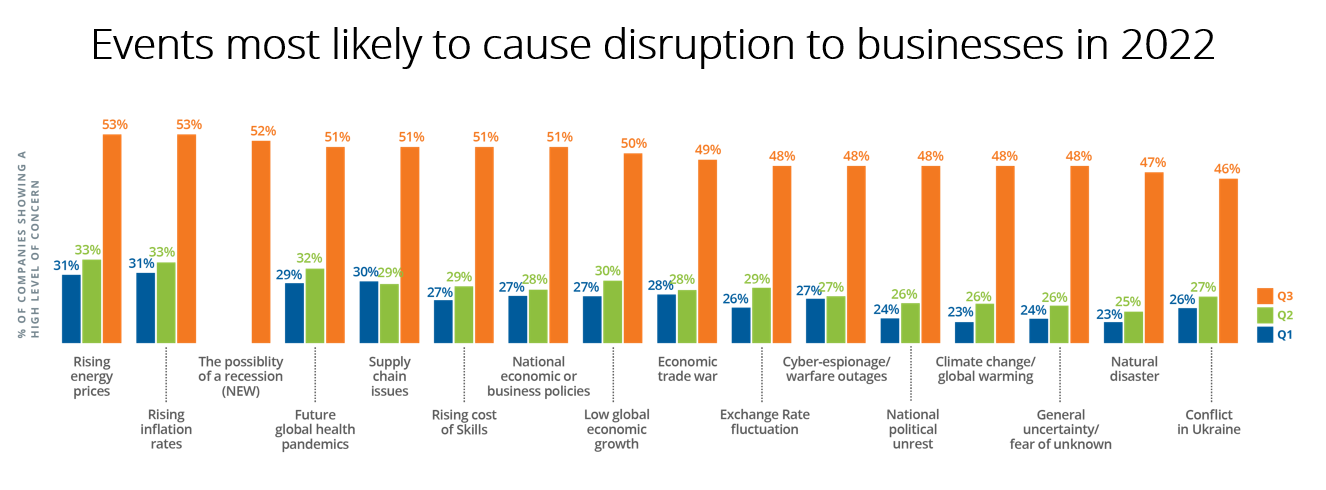
At IDC Cloud Pulse, a quarterly survey that takes in views from up to 1,700 cloud consumers, we have been tracking how companies are being impacted by, and how they are responding to, macroeconomic trends. We then consider how this relates to the consumption of cloud. Questions around Inflation and Energy Costs were added to our survey first in Q1, 2022. The Possibility of a Recession was new in Q3. And we will now be adding Recession into future surveys.

These new additions tell a story about the challenges businesses have had to endure over this last year. Not as much, however, as the responses we received when we asked about the likely impacts to businesses.Each quarter companies are asked what events are most likely to cause disruption to their business over the course of the year. They can respond using a sliding scale of 0-10 with 10 being the highest amount of disruption. The above results show only those responses between 8-10 (what we would consider as ‘high impact’).

During Q1 and Q2, not too many more than a third of companies said they felt they were experiencing major impacts from the macroeconomic trends we asked about. In Q3, this rose to around a half.  Inflationary costs were seen across more of the business, energy price rises became a reality, and national and global recessions became less likely to avoid. At the same time, markets still battled ongoing supply chain challenges, in part brought on by continued to reactions to the COVID pandemic. Many of these impacts are intertwined, making the current macroeconomic landscape even more difficult for companies to navigate.

Budgetary Impacts

During Q3, for the first time, we saw companies shift towards a more pessimistic view of the business environment. Early indications from our Q4 data suggest we will see even higher rates of pessimism moving forward.

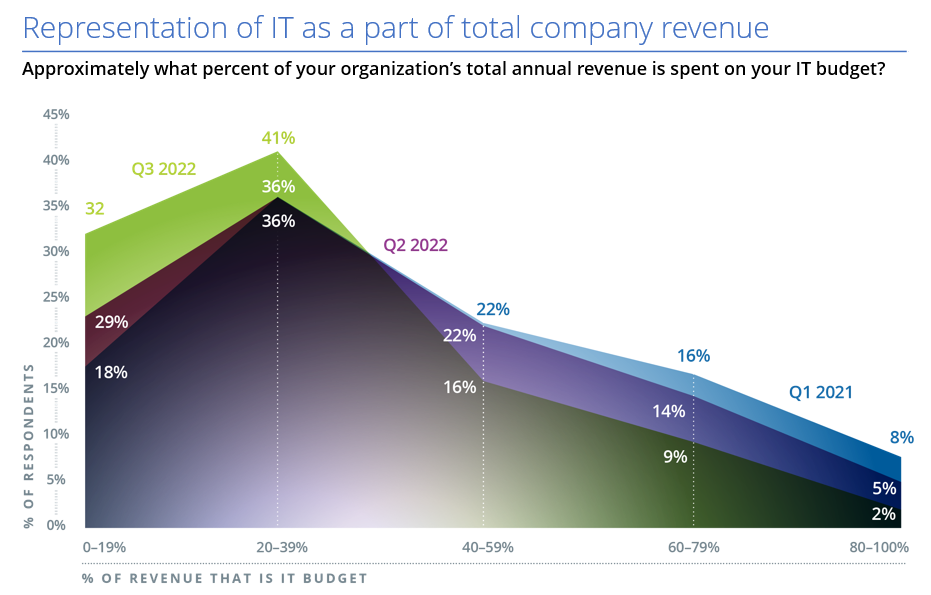
This pessimism impacts budgets. Cloud makes up around 31% of IT budgets – this is up only slightly from around 30% seen in Q4, 2021 despite previous years showing higher annual rates of growth in terms of cloud as part of IT budgets. The real challenge is, however, that IT budgets are decreasing when viewed as a proportion of overall company revenue. As we know, company revenue is also being challenged (and where it isn’t, margins are suffering from increased costs).If we focus on the area of inflation – where we see some of the earliest impacts on industry in terms of economic stress – we gain valuable insight into why we are seeing budgetary constraints across IT. Companies operating or consuming a cloud environment first felt inflationary pressure in the form of increased professional services costs, and then application software subscriptions. These are two areas where companies are more likley to operate with rolling monthly contracts.

During Q3, we started to see more companies (25%) saying they could now see increases across private cloud infrastructure (most likely brought about as a result of increased equipment and energy costs). Internal skills costs were also a major challenge.

Public Cloud as a Response

Responding to these challenges, a quarter of respondents said they will be looking to migrate more of their environments to public cloud/ Software-as-a-Service. Around the same amount again (23%) said they will be looking to find reductions for spend across their cloud estates.

With almost a fifth (18%) of respondents saying they are still waiting to assess the impact of inflationary pressures, these figures could grow.

Cloud Pulse findings also show that the number of companies that say they are ‘Public Cloud First’ when it comes to their cloud adoption strategy is more (32%) when companies say they are directly impacted by inflation compared to just 21% for those that are not.

Note, the rate of Public Cloud First companies has been decreasing annually. Q3 marks an increase overall in the number of companies relying on Public Cloud before taking a hybrid approach – though hybrid remains the number-one approach to adoption).

Qualities that Count

Another shift is in the qualities companies are now requiring of their cloud providers. In Q3, 2020, the most important Company Attribute sought by cloud consumers was a global/international footprint. What companies now seek are providers they can label ‘trustworthy’.

In this case, Trustworthy relates to a provider’s ability to be reliable and responsive, to meet contractual requirements, to be transparent about pricing and to keep promises made to the business (we did ask). During this time of macroeconomic uncertainty, customers also want to work with technical experts that can deliver services at speed with guarantees along the supply chain.

We also see shifts in what companies require in terms of cost and pricing. In 2020, the focus was on flexible payment terms and enterprise-wide agreements. Now it is more about flexbile licencing and credits that allow companies to move their applications and workloads across cloud and even non-cloud environments as they require.

Many companies know their business could have to alter the way they consume and gain access to IT over the coming year. Where rising costs – from inflation or energy increases – are already felt the requirement for flexibility gives way to predictable pricing,  with many IT departments focussing more on cost optimization and forecasting.

Many cloud vendors have already started to notice these shifts across their own businesses, from customer conversations they are now having to the budgtary bottom line. Those who will succeed will be those that can quickly pivot and reinvent solutions – in particular with the right financial models.

Companies want to continue to benefit from cloud as they navigate uncertain times but companies will be more selective about what they are deploying and how over the coming year. Many will be taking stock on current digital transformation agendas and application portfolios to create leaner, more efficient, IT responses to current business needs.

For more on these key cloud trends, including how individual providers aligned to current market sentiments and needs, ask further about IDC’s Cloud Pulse data. Cloud Pulse’s rich insights cover a range of cloud topics from deploynents to application landscapes, vendor selection, ROI and more.

A workplace management solution is a platform using advanced software and other integrated systems to optimise the use of space and energy, improve employee productivity and enhance overall employee experience by providing an enjoyable, modern, safe and practical workplace environment.

Organisations need a robust set of workplace management tools to give them the flexibility and resilience to work through and beyond the COVID-19 pandemic. Too many organisations, however, still do not have an integrated workplace management system and are using an assortment of applications.

There are plenty of good and increasingly urgent reasons for companies to invest in a workplace management solution. The top 6 are as follows:

  1. The future is hybrid. The world is changing, and hybrid working is here to stay. We predict that by 2023, digital transformation and business volatility will drive 70% of G2000 organisations to deploy remote or hybrid-first work models, redefining work processes and engaging diverse talent pools. The G2000 are just the tip of the iceberg, as the vast majority of companies are already dealing with hybrid working. This has clear implications on workplace space occupancy and this needs to be effectively managed. It’s important to note that almost three years since the start of the pandemic, many employees have still not come back to the office full time. Many of those don’t plan to come back any time soon, meaning a workplace management solution was needed yesterday. It’s clear from our research that remote and hybrid work models will be an embedded part of accepted work practices in the long term as a way to address both employee needs for flexibility and employer requirements for work that is done in more agile and productive ways.
  2. The pandemic isn’t over. Many employees haven’t fully returned to the office due to concerns they might catch COVID-19. By investing in workplace solutions that monitor the workplace in terms of air quality, ensuring proper ventilation and including other safety solutions such as touchless devices, companies will reassure employees that the workplace is safe and healthy. This in turn could encourage more employees to return full time or at least spend more days working from the office.
  3. High inflation and energy cost. A main priority for companies is to find ways to reduce the high costs related to energy and heating and make sure these costs are well monitored and under control. Such costs are very unlikely to come down significantly in the short and medium term, or return to previous levels in the long term. Investments in workplace management solutions that help control these costs are therefore a necessity.
  4. Meeting sustainability targets. Our end-user surveys over the past two years show that 60%–70% of all European organisations either have an established sustainability policy and clear targets or are planning to introduce them. This is another area where workplace management solutions can be deployed to measure, analyse and show proof of results. Environmental considerations are becoming increasingly crucial to win deals, so companies need to understand that investments in solutions that support sustainability targets are really investments in business development.
  5. Companies need to attract new talent while keeping current workers satisfied. Employees’ expectations of the workplace environment are changing and are becoming more sophisticated. At the same time, competition among employers is increasing. Companies are realising the importance of offering a whole package that includes an enjoyable workplace experience with the right “look and feel”, high health safety standards, sustainability, and digitally controlled workplace tools and space. These will not only attract new talent but will also keep current employees satisfied. The next five years will see a clear change in both the mechanics and social attitudes surrounding the future of work.
  6. Companies are likely to reduce their office floorspace in the next five years. At the start of the pandemic in 2020, one of our surveys showed that more than a third of companies said they will reduce office floorspace when things get back to normal. This means that managing space occupancy will become essential to maintain efficient use of the space and to improve employee productivity. Among other major changes, the pandemic has brought greater awareness of workspace utilisation. Many organisations have started to look closer at how spaces are used, and this has led to bold decisions on how to go about work and the workplace.

So, what should a good workplace management solution include?

  1. Booking management system for conference rooms and parking, for collaboration and efficient use of space
  2. Space management system based on data analytics of occupancy for the best use of space
  3. Environmental analytics system for a healthy and safe workplace
  4. Energy/heating/air conditioning management system to provide an efficient workplace operation and to cut unnecessary costs
  5. Asset management system to optimise maintenance of valuable items that require regular upkeep
  6. Integration and use of IoT for all deployed management systems to ensure maximum flexibility, accessibility and efficiency


Read More:

Top 10 Workplace Management Trends, 2022

IDC FutureScape: Worldwide Future of Work 2023 Predictions

Spaceti Announces Collaboration with Warner Music Spain to Create “The Music Station,” a Fully Integrated Space to Collaborate, Create, Entertain, and Relax

Future of Work Technology and Services Market Size and 2020–2025 Forecast

The Future Consumer Agenda: Mapping Out How Consumers Will Use Technologies That Drive Major Market Shifts

Last year we predicted that “70% of CEOs of large European organisations will be incentivised to generate at least 40% of their revenues from digital by 2025, driving more than €4 trillion of gross value added in Europe.”

As we approach 2023, do we expect this to change?

If anything, the trend has accelerated. According to IDC’s Digital Executive Sentiment Survey (October 2022), European organisations now expect more than 50% of their revenues to come from digital business models on average in the next three years.

Listening to C-level executive priorities for the coming year, it’s clear that despite the polycrisis macroeconomic scenario, the C-suite remains optimistic about future digital investments and is increasingly looking at technology as a critical business differentiator to better deliver business outcomes, increase resilience and accelerate revenue growth. According to the chief innovation officer of a transportation company: “For the next six months our priority will be to build capabilities, including bringing people onboard, to help us build digital products.”

This is the dawn of a new digital decade — the digital business era. But even if the “what” is clear, the “how” is somewhat less clear.

There is urgency, particularly in Europe, to connect technology investments and revenue generation. The majority — 61% of European organisations — take a very siloed and disconnected approach to software projects. This results in one-off or reactive software innovation efforts that only occur in response to urgent market or customer demands. More often than not these efforts do not have a positive impact on revenue generation.

To succeed as a digital business, we argue that companies need to leverage a digital business platform. IDC defines this platform as a multilayered enterprisewide technology architecture, integrating different systems and applications, to enable use cases that ensure business competitiveness and innovation. Only 13% of European organisations have such an architecture, according to IDC’s Digital Executive Sentiment Survey, October 2022.

The platform can be segmented into 3 main layers:

  • Foundational IT. These are the key tech building blocks forming the foundational tech layer required to deliver digital products and services. This includes 12 main elements: APIs, data systems, automation and orchestration capabilities, OT technologies, microservices, programmable infrastructure, multicloud services, security, AI/ML and other emerging technologies (blockchain, AR, VR, robotics, edge, etc.), integration tools, network and connectivity. Some digital design principles and practices should guide the CIO in implementing the right digital architecture.
  • Tech use cases to build business resilience. These are specific digital products that enable the company to remain competitive, responding to the key business challenge of building resilience. This includes use cases that future-proof business, organisational and operations models such as contingency planning for the supply chain and customer churn analysis.
  • Tech use cases to accelerate business growth. These use cases to accelerate growth and innovate include ecosystem data monetisation and intelligent M&A modelling.

As organisations build out their digital business platforms, this paves the way for business outcomes such as:

  • Expanded target markets through innovative partnerships
  • Extended digital use case road maps
  • Greater opportunity to diversify the business model
  • Greater loyalty/reduced churn with both customers and employees


If you want more information, reach out to Giulia Carosella, Neil Ward-Dutton, Jennifer Thomson, Mark Child, Andrew Buss, Archana Venkatraman or Tom Vavra.

Neil Ward-Dutton - VP AI, Automation, Data & Analytics Europe - IDC

Neil Ward-Dutton is vice president, AI, Automation, Data & Analytics at IDC Europe. In this role he guides IDC’s research agendas, and helps enterprise and technology vendor clients alike make sense of the opportunities and challenges across these very fast-moving and complicated technology markets. In a 28-year career as a technology industry analyst, Neil has researched a wide range of enterprise software technologies, authored hundreds of reports and regularly appeared on TV and in print media.