The realm of intelligent automation continues to expand as enterprises look to connect information systems and process automation to improve overall enterprise intelligence. Automating knowledge work and decision environments requires a breadth of technologies and addressing broader challenges across data, processes, and people.

Our research suggests using intelligent automation is going to be critical in meeting the demand for enterprise intelligence skills of the future and keeping up with the exponential growth of data and the increasing speed of business. IDC’s August 2021 Future of Intelligence Survey indicated that more than one-third of respondents rated automation as a critically important part of increasing enterprise intelligence. In October 2021, IDC predicted that 40% of the G2000 will double the use of intelligent automation in knowledge retention, dissemination, and information synthesis by 2026, filling the skills vacuum in the data-to-insights life cycle. A more recent survey, IDC’s Future Enterprise Resiliency and Spending Survey, Wave 11, conducted in December 2021, indicated that investment in AI/ML-based automation is a nascent but highly differentiating part of enterprise intelligence initiatives.

IDC research indicates intelligent automation solutions show great potential for not only reducing costs but improving outcomes for buyers in areas such as:

  • Operational efficiency
  • Increasing output with the same workforce
  • Resiliency and adaptability to business disruptions
  • Customer experience
  • Employee experience
  • Revenue and profit growth
  • Business model innovation

To reach these potential outcomes, organizations are investing in intelligent automation solutions that extend far beyond robotic process automation (RPA) to integrate technologies such as artificial intelligence (AI), machine learning (ML), optical character recognition (OCR), business process modeling (BPM), process and task mining, application programming interface (API) integration and management, event-driven monitoring, low-code development platforms, cloud, and enterprise applications.

Beyond constructing the foundational technology platform, our research shows organizations also need to overcome a variety of challenges to adopt intelligent automation solutions, including data quality and management issues, lack of support and maintenance resources, insufficient skills or willingness on the part of employees to use intelligent automation technologies, and unclear use cases or business benefits.

Services providers can play a key role in the success of intelligent automation initiatives by supplying technical skills and expertise in strategy, architecture, process optimization, and change management to ensure solutions deliver business value and ROI.

I recently completed an in-depth assessment of 18 vendors in the worldwide intelligent automation services market, evaluating each vendor across 52 distinct scored elements. The analysis looked at both what vendors plan to do (strategies) and their ability to deliver today (capabilities) across the full life cycle of intelligent automation services seen in the graphic below.

Intelligent Automation Services

Source: IDC MarketScape: Worldwide Intelligent Automation Services 2022 Vendor Assessment (IDC #US48061422, May 2022)

My assessment included the perception of intelligent automation services buyers of both the key characteristics and the capabilities of the vendors evaluated. Based on phone interviews and online surveys of more than 70 organizations across industries, ten key attributes emerged as most critical to a successful engagement with an intelligent automation services provider:

  • Achieving desired business outcomes
  • Quality of intelligent automation skills and knowledge
  • Value delivery for fee paid
  • Technical insights and competency
  • Proven methodologies and tools for solving customers’ issues
  • Employee engagement
  • Functional insights and competency
  • Data quality, management, governance, and security capabilities
  • ROI models and cost-benefit analysis
  • Innovation capabilities

As intelligent automation increasingly becomes an integral component of digital business and enterprise intelligence strategies, services providers have evolved their portfolios and expanded their capabilities in these dimensions and several others to meet a broader range of customer needs. Successful organizations partner with providers that understand their maturity, offer appropriate solutions, and provide insight to improve intelligent automation programs and deliver better business outcomes.

Jennifer Hamel - Sr. Research Director - IDC

Jennifer Hamel is a Senior Research Director for IDC's Worldwide Services team, responsible for the Enterprise Intelligence Services research program. In this research, Ms. Hamel covers the life cycle of project-oriented, managed, and support services related to the deployment of technologies, such as data management, analytics, artificial intelligence (AI), and automation, as part of enterprise intelligence initiatives. In particular, her research focuses on how services providers work with organizations to ensure investments in enterprise intelligence technologies result in improved business outcomes.

The pandemic forced enterprises in practically all sectors to use technology in new ways, including solving new problems related to supply chain delays and creating new sales channels to compensate for the closure of physical stores, due to social distancing requirements. Many organizations made an important discovery during this period – using digital technology to create innovative capabilities offers significant value. Innovators not only stayed afloat during the pandemic, they excelled.

IDC recently set out to discover if interest in pursuing digital innovation in the enterprise has changed since the height of the pandemic. We found that most organizations (69%) plan to deliver innovative digital products and service at the same or faster pace as the past two years. Only 27% said they’d slow down.

However, when we dug deeper into the data, we uncovered an interesting nuance. Larger companies are significantly more likely than smaller companies to speed up their development of digital innovation. Companies with fewer than 5,000 employees are less likely to say they will speed up the pace of digital innovation delivery than they are to say they plan to deliver at the same or slower pace.

The largest companies – those with at least 20,000 employees – are most likely (52%) to say that they’ll deliver innovative digital products or services at a faster pace than the past two years. They’re also the least likely to have plans to slow their pace of digital innovation (although the 6% in this cohort who said they had yet to deliver any digital innovation is higher than most of the other segments).

Some differences between the large and smaller organizations may be tied to funding availability. IDC research shows that budgets are a barrier to innovation and larger companies may be better positioned to outspend their smaller competitors.

In IDC’s view, the continued focus on digital innovation by larger organizations is part of a broader evolution – many of these enterprises are adopting digital-first strategies to support viable digital businesses. For the past five plus years, many enterprises have been making technology investments aimed at digitally transforming their businesses. These investments tended to have internal or technology-focused targets – accelerating the time it takes for employees to find answers to HR questions or reducing the time required to access new applications by shifting to the cloud.

However, many enterprises are undergoing a shift where they are building on the technology investments they made as they digitally transformed in order to run a viable digital business. Rather than setting technology goals, they are prioritizing business goals. Goals might include reaching revenue growth targets, improving customer net promoter scores, and entering new markets. Organizations that successfully execute this shift will derive a larger share of revenue from a digital business model.

Enterprises have also discovered that when they are able to deliver innovative digital capabilities – those that differentiate the company or disrupt a market – they are better able to achieve their business goals. This growing understanding of the role of innovation is driving the largest enterprises to continue to push for the delivery of innovative digital deliverables, even now that the more onerous restrictions of the pandemic have been lifted.

While these large enterprises may want to deliver continued innovation, many are discovering that doing so is a challenge. It requires invested C-suites, cultural changes, strong technology foundations, the right processes, and solid collaboration between the business and technology groups. IDC research indicates that the bulk of organizations are still immature when it comes to putting in place the practices and tools that support the ongoing delivery of innovative digital capabilities.

Interested in learning more about IDC’s Future of Digital Innovation research?

Nancy Gohring - Senior Research Director, AI - IDC

Nancy Gohring is a senior research director, co-leading IDC's GenAI and Agentic AI Strategies program. Nancy covers big picture trends related to enterprise adoption of AI, including GenAI and agentic AI. Key research themes include business, organizational, and technology architecture transformation, in the context of AI and GenAI. As part of the Worldwide AI, Automation, Data & Analytics Research practice, Nancy supports a range of clients across the technology stack including hyperscalers, developer tool providers, enterprise application vendors, professional services organizations, automation frameworks providers, and infrastructure suppliers.

IDC’s April 2022 Future Enterprise Resiliency survey showed continued focus on industry ecosystems to improve innovation, flexibility, and resiliency.  Business leaders in organizations surveyed realize that leveraging ecosystem partners in support of shared data & insights, shared applications, or shared operations and expertise, is an efficient and cost-effective way of running their business. 

In short, industry ecosystems provide the ability to shift and flex processes and models to meet whatever opportunity or disruption presents itself

For example, manufacturers leverage this approach for innovation and manufacturing capacity, healthcare organizations share data and knowledge to improve patient outcomes, energy companies team up and share applications to ensure quality and high performance, and retailers work with their ecosystem partners to deliver goods and services to consumers in a blended physical and digital way.

The April survey showed that 84% of respondents are beginning or already engaged in a digital first strategy, and over half expect that they will expand their industry ecosystems outside their core industry in 2023.  Indeed, much like a sports team that needs depth of talent, capability, and knowledge to optimally compete, organizations in every industry recognize the need to have an expansive, flexible, and trusted set of resources and capital accessible, when they need this, through their industry ecosystems.

Before conducting the April survey, IDC published the first Future of Industry Ecosystems PeerScape in December 2021, based on last year’s global survey data and conversations with end users in different industries. IDC found that working with industry ecosystems in an open, iterative way was a key digital initiative for executives. 

The best practices from 2021 uncovered were:

  • Institute an industry ecosystem control platform
  • Enable a bi-directional flow of data across your industry ecosystem
  • Share applications to empower industry ecosystems

In the next Future of Industry Ecosystems PeerScape, which will publish before the end of June 2022, case studies, respondent data, discussions in the field show a focus also on the following best practices:

  • Enable closer engagement of customers and consumers through industry ecosystems
  • Leverage ecosystem innovation hubs for more effective innovation
  • Enhance trust across industry ecosystems through privacy preserving computation technologies

Each of these focus areas are consistent with our Future of Industry Ecosystems global survey data: innovation is the top reason why companies expand the breadth of their industry ecosystem partners; organizations have shown a concerted interested in a focus on improving customer engagement in multiple IDC surveys, particularly since the start of the pandemic in 2020; cyber security is the top IT priority for CEOs, business line leadership, and IT in support of industry ecosystem collaboration, innovation, and joint ventures.

Achieving an open, shared approach with partners is not easy: data, applications, operations, and capital (human, assets, and financial) for every organization are disparate of course; business processes are disconnected; security protocols and systems are not unified. Therefore, having a control platform and business orchestration layer is the first step to broadening industry ecosystem collaboration. 

The future of industry ecosystems — an expansion of ecosystem partners that organizations must work with in support of any situation, whether innovation, product or service change, dynamic demand, or unexpected disruption — is rapidly progressing as the new way of working to ensure innovation, flexibility, and resiliency. 

As we saw in our recent June PeerScape, organizations are looking to innovation hubs as a way to engage with their ecosystem, as well as directly with the customer, consumer, citizen, or patient.  And they are also focused on establishing trusted business models through new technology approaches focused on security and privacy, one of the most critical enablers of ecosystem scale, fair value sharing, and ongoing innovation.

“Expanding ecosystems within and outside core industries is rapidly becoming the next evolution in digital transformation.  Where over the last five years, organizations focused on investing in digital technology, unifying data, and moving to an evidenced-based culture, the next five (and beyond) will be spent extending digital outside of the company to look for new sources of innovation, and meet customer, consumer, citizen, or patient needs in the most effective, profitable, trusted, and sustainable way,” said Jeffrey Hojlo, research vice president, Future of Industry Ecosystems.

Jeffrey Hojlo - Research Vice President - IDC

As Research Vice President, Future of Industry Ecosystems, Innovation Strategies, & Energy Insights at IDC, Jeff Hojlo leads one of IDC's Future Enterprise practices at IDC - the Future of Industry Ecosystems. This practice focuses on three areas that help create and optimize trusted industry ecosystems and next generation value chains in discrete and process manufacturing, construction, healthcare, retail, and other industries: shared data & insight, shared applications, and shared operations & expertise. Mr. Hojlo manages a group focused on the research and analysis of the design, simulation, innovation, Product Lifecycle Management (PLM), and Service Lifecycle Management (SLM) market, including emerging strategies across discrete and process manufacturing industry such as product innovation platforms and the closed loop digital thread of product design, development, digital manufacturing, supply chain, and SLM. He also manages IDC's North American Energy Insights group, with a focus on key topics such as energy transition & sustainability, distributed energy resource management, and digital transformation in the Oil & Gas and Utilities industries.

We have all become accustomed to rising prices in our everyday lives, whether it be at the petrol station, grocery store, or our favorite restaurant. Hardware, software, and IT services prices have also been increasing dramatically over the past year. Hardware prices started to increase earlier, with the logistics nightmares caused by COVID, and have continued their upward arc ever since. 

These developments stand in stark contrast to the usual tendency for hardware prices, which for decades have been marked by falling prices for equivalent computing power. According to IDC Chief Research Officer Meredith Whalen, “Over the past few years, we have seen a distinct departure from the secular trend of falling hardware prices, caused by COVID supply chain disruptions and shortages of certain raw materials, and now exacerbated by the war in Ukraine. The increase in software and services prices have now also picked up, adding to the challenges facing CIOs and IT buyers.”

The price rises in IT differ greatly depending on hardware and software category and vendor, the maturity of the technology, IT service supplier and geographic region, and of course the volume and leverage which the purchasing organization can bring to bear in negotiations.  “IDC tracks the prices and volumes of hundreds of categories of hardware, software, and services on a quarterly or semi-annual basis, and captures actual deal data on hundreds more IT contracts per quarter,” says Brian Clarke, Group VP for IDC’s pricing research. “Our data indicates an approximate 18-20% rise in enterprise client (laptops and PCs) pricing over the past two years, approximately 10-15% rise in server and storage pricing, and 5-7% increase in enterprise software pricing, including IaaS cloud prices (Azure, AWS, Google). In the same period, we have seen average consulting day rates go up by 5-7% globally.”

But how are these increases being reflected in actual prices paid by organizations? “My team and I work with large IT buyers on pricing issues on a daily basis and we see intense interest currently in how to anticipate and manage inflation,” says Teodora Lowenstein, of IDC’s Sourcing Advisory Service. One of the largest challenges senior sourcing professionals are facing is how to manage internal stakeholder expectations as upper management is still looking for sourcing/procurement to drive YoY savings. In many cases the conversation has to move from cost reduction to cost avoidance and the impact will differ widely from vendor to vendor.

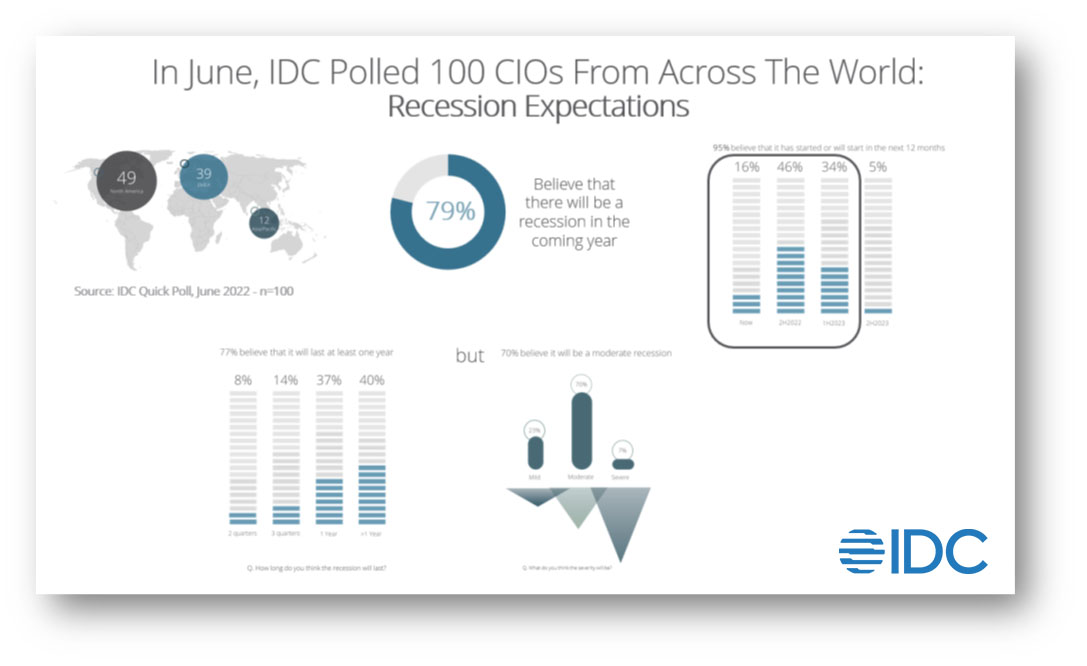
Many IT procurement professionals are wondering what to expect going forward, and CIOs are considering how to adjust business plans. According to IDC’s Stephen Minton, who is responsible for assessing the impact of global economic trends on IT, “It’s a tricky time, with upward pressure from logistical problems, the war in Ukraine, and the rise in the price of fuel.  However, some key central banks have started raising interest rates, which will have a damping effect on prices as they hit the broader economy. The trillion dollar questions are how long the supply side challenges will persist, and whether the monetary tightening will lead to a global recession. We at IDC expect 18 to 24 more months of elevated rates of IT inflation, in the range of 7-8% across all IT categories, followed by a moderation to slightly below average rates in the 2 to 3 years following that.”

What is to be done? How can organizations hedge or manage these increases? There are a number of steps which can be taken to keep opex and capex spending under control, despite the inflation. According to Joe Pucciarelli, who leads the group of analysts who produce research and guidance for CIOs, here are some of the most common approaches to control IT budget overruns:  extend the replacement cycles for end-user and data center hardware, within reason and while maintaining focus on security and upgradability.  These cycles have been getting longer over the past decade, and certainly in the wake of the 2008 downturn;  monitor hardware, software and services prices on a deal by deal basis to ensure that you are getting best in class discounts; rationalize your software estate to avert paying for licenses or maintaining software which is no longer in use or is redundant;  practice brutal prioritization of your IT and software dev projects, with direct input from senior management, to avoid spend on low value activities; evaluate your existing outsourcing agreements and internal service provision to check alignment with current market rates and quality levels; and finally, optimize your IaaS cloud deployments to avoid overspend with effective tools and an actionable roadmap.

And at the end of the day, after all these steps have been taken, and probably in parallel, consider unavoidable increases in the IT budget, and your plan to explain to senior management and the board the need for this increase. “One important element in gaining acceptance for increased spending is your ability to convey the overall value of IT to the organization,” says Marc Dowd, who advises CIOs and other digital leaders around Europe. “If you have laid the foundation by becoming a partner in the growth and success of the organization, and have led the charge as IT becomes integral to the delivery of goods and services to customers, chances are the budget will get approved, and the impact of IT inflation on your organization can be absorbed and offset by the increased value you are providing to customers.”

One thing is certain, while inflation is pumping up global IT Spending- it’s crucial to have a game plan in action. That’s exactly why IDC’s Sourcing Advisory Services provides guidance to CIOs and technology buyers on saving millions of dollars on IT investments. To learn more, click the button below.

Digital Transformation can be regardad as a buzzword. However, IDC research found that organizations able to close the digital gap returned to growth faster and were more agile than their peers who did not embrace digital transformation. Organizations are leaning on transformative technologies like cloud, artificial intelligence (AI), mobility, augmented and mixed reality, the internet of things (IoT), and machine learning (ML) to grow profits, increase innovation, enable employee productivity, drive operational efficiency, and improve the customer experience.

Cloud is an important driver behind digital transformation. Cloud technology offers organizations ease of use, flexibility, scalability, and a rich set of services for their digital transformation. But the cost to enable cloud technology is often more than expected, causing organizations to exceed their budgets.

Cloud Sprawl

In the old days, the life of an application development team was hard. First they worked out the specifics with the infrastructure department who designed the environment and ordered the equipment. Once the equipment was in, the infrastructure department built the environment. Only at that point could the application development team install, test and run their application. This entire workflow usually took several months.

More recently infrastructure has been virtualized which means a virtual infrastructure can be created within days (instead of months), making application development easier. But virtual infrastructure also has its limitations. It doesn’t allow for organizations to accurately forecast the amount of equipment to order. So, the datacenter is also not an efficient motion.

But the ball game became entirely different when Cloud rolled out. Instead of a data center with limited capacity, the Cloud offers virtual infinite capacity. And instead of designing infrastructure based cabinets, racks, equipment, and connections, there’s an easy-to-use portal where you can create your virtual infrastructure with some mouse clicks.

And the icing on the cake is you don’t have to do upfront investments and agree to a multiyear term; you can start and stop cloud infrastructure when you want, and get billed for the amout of time you have actually used the cloud infrastructure.

But the flexibility and scalability comes with a price. This example explains more.

Let’s compare a data center to a shed. You can put boxes into the shed until it it’s full. Once it’s at capacity, you’ll want to make room. You start doing this by sorting which boxes to keep and which boxes to throw away. Now a provider comes along with a tempting offer: a hangar. And there’s more, you don’t have to pay upfront as you did with the shed but only pay for what you use. You accept the offer to put boxes in and pay for those boxes. Even better, not only do you start paying as you put boxes in, you also stop paying at the moment you remove boxes. Can you guess what will happen? In most cases you’ll keep putting boxes in, because there is no physical barrier like the walls of the shed. And then the hangar provider comes with the bill…

What cloud cost tools do…

Cloud providers offer tools that visualize costs and give recommendations on possible savings. And if the tools provided by the cloud providers don’t meet your standards, there are a lot of third party providers offering alternatives. But visualizing costs and giving recommendations is only the first part of the long and complicated road to cost savings.

…what cloud cost tools don’t do

To draw the right conclusions from cost graphs, you’ll need a thorough knowledge of the price models used by cloud providers. Most cloud architects focus on cloud services and their possibilities rather than on the applied price models. The given recommendations by tools focus on rightsizing, reducing unused resources and applying discount schemes such as reservations. Other savings, such as applying on/off scenarios, optimizing licenses and cloud architecture has to be brought in by specialists, since these require knowledge on the context and usage of applications running in the cloud. The tools won’t do that for you.

Another thing the tools won’t do is actually achieve savings. Let me return to the previous example of the hangar containing boxes to illustrate this. Let’s add that you don’t rent the hangar space as an individual, but as a company, and that’s it not only your own boxes you pay for, but boxes from company employees too. Instead of being responsible with your own boxes, you first have to know who is having boxes in the hanger, second having to coordinate with them which boxes to keep and which to throw away, and third getting them to actually throw away boxes within a reasonable amount of time.

By removing or downsizing cloud resources, a similar situation exists. You have to find the application owners, align with them and have them take action. Existing tools just give information and recommendations; the hard work of actually taking action is something that you have to do yourself. In reality, a growing number of application owners are reluctant or, even hesitant, to optimizations.

They see changes as a risk, or do not want to give it priority. Making sure the application will continue to run properly requires analysis and test effort, which isn’t the first priority of application owners in most cases.

IDC’s Cloud Economics service supports your organization on the entire road from overspending to cost savings, making costs visible and providing recommendations while helping you overcome organizational issues.

This approach has worked for a number of enterprises. For an international Telecom operator, the cloud economics service has helped reduce the spend with over 30%, on both AWS and Azure spend, while setting up a framework to monitor the costs and make adjustment on a monthly basis.

For a Dutch logistics company, Cloud Economics has helped setting up the cost control processes for their Cloud Center of Excellence. By using the processes, they have a structured way of analyzing costs, generating recommendations on savings and tracking these savings while application teams are implementing them.

Managing Cloud cost is hard to do, and our Cloud Economics Infographic simplifies this complex topic for better management and control, communication to stakeholders, and most importantly, maximizes your success while moving to or operating in the Cloud.

Data Control vs Data Access, with Purpose

No one argues that collaboration and communication are keys to effective and efficient healthcare.

These concepts require data sharing across the fragmented healthcare ecosystem — with controls. Necessary controls on ethical and fluid data sharing are stressed when more players collaborate more often. Individuals have the responsibility to protect their privacy in the face of massive power and informational asymmetries between patients and the medical ecosystem serving as their service providers.

In general, consumers are in favor of electronic data sharing, but three elements of transparency are important: individual control, who has access, and the purpose for use of the data.

This process of giving up control is always in a context that can blur what is actually happening to a consumer. When answering consent questions, a consumer is attempting to do something else (e.g., enroll, get to an appointment, and be admitted to a hospital). An analogy can be made when signing up to a new app or service as one is engaged in a process of use rather than reflectively considering the implications of consent.

Legally, to be compliant with the CMS interoperability and patient access final rule, all CMS-regulated payers need to implement and maintain a standard-based application programming interface (API) to share member health data. The API should allow members to access their health data through third party applications of their choice and give physicians access to member information, if required, with an approval/consent from the member.

Concurrently, under the “payer-to-payer data exchange” policy, current payers are required to send member clinical data to new payers. Payers are liable to share this data till five years post the end of a member’s coverage or disenrollment. Payers are at the receiving end of this need to store member information in their data systems to ensure uniformity of the data.

Interoperability Drives Increased Need for Granular Privacy & Consent

Payers and members will quickly find that privacy and, its sister concept, consent have much more importance than in the past as data flies around the healthcare ecosystem. In response, consent technology will be reinvented over the next 18 months to provide payers and members with confidence that “their data” is not used inappropriately.

As we said in “Health Data Sharing Consent — What It Is and Why Payers Should Start Afresh” (IDC #US47671021, May 2021), this effort will use technology to capture and maintain patient consent preferences, identify which sensitive portions of member information are restricted from access, and communicate these restrictions electronically with others.

Current consent management solutions are limited to the opt-in/opt-out models of dedicated consent, either allowing or denying all of the content within the healthcare application only, and the purpose of the consent record is to be used locally for the application only. Conversely, patients do not have a mechanism to grant or restrict access to their information at their own discretion or even be aware of how their information is being accessed.

Simply put, a payer needs to build/buy a new agile consent infrastructure for compliance, trust, and control.

Advice for the Technology Buyer

  • Identity and access management
  • Data ingestion, curation, and cleansing of data via ETL or advanced engines
  • EMPI, an “enterprise” master patient index (a centralized, cross-platform solution designed to link/match and reconcile records in real time from diverse systems to assign records to a unique “person” correctly)
  • Longitudinal health records in an EHR, data warehouse, data lake, and/or FHIR server
  • Business rules engines
  • Data encryption
  • API management
  • Data use logging and audit

Consider that these technologies have evolved in a passive way over many years to meet low level requirements only around egregious use of personal health information (PHI) within the enterprise. Time to rethink in the context of interoperability.

Jeff Rivkin - Research Director - IDC

Jeff Rivkin is Research Director of Payer IT Strategies for IDC Health Insights. In that role responsible for research coverage on payer business and technology priorities, constituent and consumer engagement strategies, technology and business implications for consumer engagement, front, middle and back office functions, value-based reimbursement, risk, and quality-based payment and incentive programs, among other trends and technologies important to the payer community.

Data access, integration, analytics and automation provide the core insights that fuel digital business success. Whether the goal is to improve data-driven decision making or to predictively automate complex business processes, much of an enterprise’s digital business agility and operational effectiveness depends on the responsiveness, scalability, and resiliency of the digital infrastructure used to enable mission critical applications, data operations, and connectivity. Rapid access to accurate and timely data is fundamental to digital business resiliency and the ability of organizations to adapt to quickly changing business conditions.

Industry leaders continue to prioritize digital infrastructure spending in uncertain times

Digital infrastructure resiliency and agility are particularly crucial in periods of uncertainty and disruption, which many organizations are experiencing – the confluence of disrupted supply chains, rising inflation, geopolitical instability, energy price spikes, the ongoing global pandemic, and climate change. IDC’s global March 2022 Future Enterprise Resiliency and Spending (FERS) survey of 828 global decision makers found that 65% expect concerns about supply chain disruption, inflation, labor shortages, geopolitical tensions, and COVID variants will continue through much of 2022, restraining the pace of recovery in global economic activity through 2022 and into 2023.

These decision makers see IT supply chain disruption and inflation-driven price increases as having the most impact on their IT budgets. Despite these fears, 80% stated that they expect their IT spending to be the same or higher in 2022 compared to 2021. 

IDC's Future of Digital Infrastructure North American Awards Program Nominations are Open

Has your organization enabled outsized business results by making strategic digital infrastructure investments? Are you willing to share your insights and perspectives on best practices?

IDC's Future of Digital Infrastructure North American Awards program is currently accepting nominations for organizations that have achieved best in the industry digital business outcomes.

Click here to learn more.

Making the right decisions about where to invest in digital infrastructure modernization and integration will fundamentally impact an organization’s ability to execute its digital business agenda. Globally, many organizations have invested in hybrid and multi-cloud strategies to replace or augment traditional on-premises data centers. In general, the motivation for the move to hybrid and multi-cloud approaches has been to better align IT spending with business priorities and empower developers with on demand access to highly scalable infrastructure and advanced IT services.

In many cases, organizations prioritized speed, leading to dozens of disconnected infrastructure investment decisions being made independently by IT, cloud, DevOps, and data science teams – each focused on its own specific business priorities. Corporate mergers and acquisitions have added to the mix. 

Some enterprises now rely on a myriad of public cloud services and on-premises platforms supporting many generations of bare metal, virtualized and cloud native computing and storage. Many developers have built dependencies around specific public cloud APIs or service offerings and organizations often suffer from sticker shock related to the cost of public cloud storage, maintaining high-availability service levels, and/or network egress fees.

Beyond Hybrid and Multicloud – Planning for “Distributed by Design” Digital Infrastructures

Many organizations tell IDC they are drowning in technical debt and struggling to execute strategic digital business programs due to operational friction related to integrating and coordinating across so many data and application silos. Organizations struggle to take full advantage of AI/ML technologies as they try to apply them across diverse data sets created and maintained in a range of formats and physical locations. Cross-cloud control planes and monitoring and service request tools provide limited visibility across these resources but often the underlying operational tools and processes remain largely separate.

These challenges will only worsen unless IT decision makers, DevOps teams, data science and line of business teams can find better ways to design increasingly distributed environments. Some of the innovations poised to drive more complexity in the coming years include:

  • Specialized Silicon for High Performance Computing: The emergence of a new generation of high-performance computing silicon solutions optimized for AI/ML and related data intensive workloads will force organizations to make workload-specific infrastructure deployment choices.  As-a-service high performance computing options available from cloud providers and traditional storage and data management vendors will provide more affordable and democratized access to these resources than has historically been possible.
  • Public Cloud Extensions to Dedicated Data Centers: The rapid expansion of public cloud service provider interconnections with third party hosting and colocation provider locations combined with increased availability of private cloud as-a-service extensions to dedicated customer locations – all using the same control plane on the public cloud services. The resulting seamless operational control plane increases the strategic importance of the public cloud provider’s overall service delivery capabilities and architectural impact.
  • Edge Driven DataOps in an Interconnected Zero-Trust World: The rapid proliferation of data diversity in terms of where and how data is created, stored, and protected from edge to data center to public cloud is driving the transformation of the way that data is connected, migrated, accessed, and analyzed. The explosion of edge data forces organizations to rethink data retention, storage, and protection strategies. DataOps is becoming a critical new discipline.
  • Self-Driving Automation: Infrastructure as code automation was just the first step in what will prove to be a fundamental transformation of the way that digital infrastructure is deployed, scaled, optimized, and maintained. Coupled with AI/ML analytics and observability, self-driving code-based automation will allow internal IT teams to simplify and abstract away many time-consuming operational tasks while ensuring consistent security, compliance, performance, and cost management.  
  • Ubiquitous As-a-Service Sourcing: Cloud providers led the way in offering complex infrastructure-as-a-service solutions for a consumption-based fee. Increasingly, all things infrastructure from hardware to software to management, security and analytics are being offered via as-a-service models that permit consistent deployment and operations across on-premises and public cloud footprints. As-a-service options often include remote vendor-provided monitoring, support, and lifecycle management and provide an important option for off-loading internal operational staff responsibilities, which provide choice of when and where workloads are deployed and where data is processed and managed.

Collectively, these emerging platforms and operational innovations point the way towards the need for more modular, “distributed by design” approaches to digital infrastructure architectures that prioritize workload-optimized deployment choices, consistent AI/ML-driven software-defined automation, policy driven operations, API-enabled integrations, and SLAs tied to business outcomes and KPIs.  Successful digital businesses will work to move beyond ad hoc hybrid and multicloud silos and enable more modular, consistent and distributed by design architectures to take full advantage of the next generation of digital infrastructure technologies.

Interested in learning more about the Future of Digital Infrastructure? Download our latest guide, Investing in a Business Outcomes-Driven Digital Infrastructure: Lessons Learned from IDC’s 2021 North America Best in Future of Digital Infrastructure Awards Program.

Mary Johnston Turner - Research VP - IDC

Mary Johnston Turner is Research Vice President within IDC's worldwide infrastructure research organization and global research lead the Digital Infrastructure Strategies practice. Mary's coverage tracks enterprise tech buyer sentiment related to compute, storage, edge, operations and cloud platforms and deployment models. Current research priorities emphasize the impact of rising requirements for data-driven AI-Ready Infrastructure, Fit-for-Purpose Hybrid and Multicloud Architectures, Autonomous Operations, Edge Integration, and collaborative business and IT governance. Her practice emphasizes the voice of the enterprise customer, based on surveys and in-depth analysis of best practices and infrastructure investment priorities. Mary's research emphasizes consideration of topics related to AI-ready infrastructure, tech debt avoidance, data center modernization, mainframe modernization, infrastructure governance, staffing and skills priorities, and infrastructure operating models. Within the infrastructure research organization, Mary collaborates with other practice leads to ensure coherency and alignment of insights and published research.

The acceleration of technology has transformed the way we interact with each other and businesses, and how we conduct business. We have made enormous progress in digital transformation economically, socially and personally. Large budgets (in the hundreds of millions) are being allocated by big businesses, investing in their digital strategy as the leading way to achieve their growth goals. But what does this mean for you? How do you need to pivot and what technology opportunities exist that will help you change how you support your clients, for future sustainability?

It is important to understand the key parties that make up the digital-first world, and how they interact and conduct exchanges with each other.

  1. Enterprises: They will create the digital-first business models so they can effectively engage consumers and generate revenue from digital services.
  2. Government: As consumers spend more of their time online, Governments will recognize the need to reshape their economy to thrive.
  3. Consumers: They will fuel the digital first world with their digital-first habits.

How Enterprises Will Create Digital-First Business Models

According to our most recent global study, 95% of organizations report they are implementing a digital-first strategy to support new digital revenue streams. By 2027, the average enterprise will see 41% of their revenue come from digital products and services.

By 2027, 41% of an enterprise’s revenue will come from digital products and services. 

How Governments Will Digitalize their Economies

As citizens increasingly engage with technology, Governments will seek to influence how digital is used to shape their society and accelerate their own economies. We will see Government investing in creating a digital workforce, developing smart cities, and supporting digital currencies. We will also see Governments putting forth regulations to influence how technology is used in their society, most certainly regarding consumer privacy laws around data and responsible AI.

How Consumers will fuel the digital first world

By 2024, 80% of the world’s population will be online. To get there, we expect an additional 466 million people will come online in the next two years. In 2024, they will spend $10.5 Trillion online, an increase of $1.2 TRILLION in spending from today. While consumer electronics fueled the past two decades of spending, the next two years will be fueled by digital services such as online learning, peer to peer lending, and subscription-based services.

The Digital Tipping Point

As enterprises adopt digital business models, the tech industry will subsequently hit a digital tipping point as it relates to SaaS apps, spending on digital initiatives, and digital talent. Soon, digital will no longer be something for early adopters or even the early majority. Digital will move to the late majority. This will change the way you engage with your customer, what you sell them and how you demonstrate value.

“By the end of this year 52% of the spending on applications will go to SaaS versus 48% to software run on premise.”

There are three foundational elements we expect to occur:

  1. SaaS adoption. An increased allocation on SaaS, means that enterprises will have a significant portion of their enterprise data running on a cloud-based platform. They will benefit from easier flow of data from one system to another, and greater enterprise intelligence.
  2. Tech spending on digital initiatives. Tech spending for digital initiatives will soon outweigh spend on non-digital initiatives. This means that that majority of organizations will have achieved the digital transformation goals they planned 3-5 years ago, and will start to experience the agility, innovation and digital revenue that comes with achieving those goals.
  3. Digital technology skills outnumber non-digital technology skills. By 2024, organizations will begin to win the talent battle for digital technology skills. This means many of them will start to have the support they need for operational support of their digital business.

The result of the tipping point will be an emergence of new priorities for customers. They will be asking important questions including:

  • How can they cost-effectively scale their digital operations with tech such as cloud and IT automation tools?
  • How do they effectively manage data to establish themselves as a trustworthy organization?
  • How do they modify the practices of their software development teams to rapidly innovate around digital experiences and services?

Your role will be a critical one, and it is to help your customers attain scale, trust and impact in their digital business, at a time when organizations are worried about their over-expenditure on tech investments. The high costs to create and maintain technology systems will drive organizations to seek out ways to reduce those costs through autonomous operations.

“In our recent study, we found leading organizations in digital infrastructure operations lean heavily on autonomous operations. 84% of them told us they deploy full stack AIOps and AI/ML insights to drive continuous and automated optimization of their digital infrastructure.”

Your clients will be headed toward autonomous operations as they lean more into digital infrastructure, and it is an opportunity for you to provide them with the tools they need.

How to Help Your Customers Thrive in a Digital First World

Your clients need help continuing to create innovative digital experiences and services to fuel their revenue growth. We group these needs in terms of scale, trust and impact.

  1. Scale:  The primary goal for most organizations is cost-effective digital operations. In the past, overspend for the overprovisioning of their infrastructure may have been more common, but it isn’t any longer. Today, there is an opportunity for you to help them optimize cloud spending for architectural benefit and to support their business goals.
  2. Trust:  At the core, most organizations have a vision to be a trustworthy, purpose-driven organization. As your clients seek to be a trustworthy enterprise, they are prioritizing initiatives around cyber security threats, data sovereignty, AI ethics, D&I and environmental sustainability.
  3. Impact:  Organizations are focused on rapid innovation. Those who can quickly respond to changing customer and market dynamics, with digital innovations, attain a competitive advantage.

“43% of tech leaders plan to deliver innovative digital products and services at a faster pace than they have in the past two years.”

A digital-first world is underway, and a typical organization is looking at their role in it in terms of how they can achieve scale, establish trust and make an impact with their customers by driving engagement across product lines. Let this serve as a framework for thinking about the technology opportunities that exist and how you must support your clients as they pivot to being a digital first enterprise.

Related Reading

Technology Strategy, Research and Insights: Ms. Whalen’s international team of 1,100 analysts leverage research and advisory services to empower business transformation for the Global 2000, and counsel technology suppliers on creating effective offerings for the digital economy.

Podcast: The Future of Digital InfrastructureIn conversation with John Hill, Chief Digital and Information Officer at Carhartt, the podcast dives into the radical digital transformation this 132-year-old American apparel company embarked on.

Meredith Whalen - Chief Research Officer - IDC

As IDC's Chief Product, Research & Delivery Officer, Meredith Whalen leads the company's global product, research and data, and delivery organizations. Under her leadership, IDC delivers cutting-edge intelligence to the world's leading technology vendors, enterprises, and investors as they navigate the evolving AI economy. Meredith sets the strategic direction for IDC's global analyst community, shaping research methodologies and agendas that generate industry-leading data and actionable insights to drive high-impact business decisions. With more than 20 years at IDC, Meredith has been a catalyst for some of the company's most transformative initiatives. She founded IDC's Industry Insights and Tech Buyer business units and pioneered the industry's first comprehensive business use case taxonomy. She also led the creation of IDC's DecisionScape methodology-a strategic framework that empowers organizations to better plan, implement, and optimize their technology investments. A recognized thought leader and sought-after speaker, Meredith regularly delivers keynotes at major global technology events and advises senior executives on the trends shaping the future of business and technology. Meredith holds a B.A. with honors from Wellesley College and an MBA with honors from Babson College's F.W. Olin Graduate School of Business.

As we reflect on the many changes wrought over the past two years, one will be that we have transitioned from discussing “digital transformation” to the active embrace of digital-first business and technology strategies — technology underpins the business model of the future. Further, this new digital-first business model includes the Future CIO as a member of its leadership team as it strives to deliver the transformational capabilities, services, and products the business needs to meet this new imperative.

The Future CIO must go beyond their usual focus on operational efficiency – they need to help the business cope with macro challenges like geopolitical instability, new supply and energy disruptions, and significant economic uncertainty. They will also be critical execution leaders as lines of business and operational teams struggle with micro challenges like changing client expectations and significant price instability in raw materials and labor.

This Future CIO blog offers three actionable steps for digital leaders to consider as they tune their organizations for the balance of 2022 and into 2023 amidst the geopolitical, economic, and social volatility being experienced worldwide. 

Embody a Strategic IT Leadership Model

The first crucial step is to embody a leadership model that aligns with the business on priorities for transformation. Strategic connections support collaboration and organizational communication toward a unified sense of purpose for both IT priorities and overall business strategy. Strategic technology then supports the business’ ability to handle volatility. The new strategic partnerships include collaboration on IT financial management, supporting responsive strategies that address market factors and are holistic for the business rather than just focused on cost, and extend beyond the traditional budget and service measures that often govern IT spending.

Collaborative partnerships replace traditional support models by building business engagement and enabling commitment-based communication. Transformational success depends more than ever on effective CIO communication into and at all levels of the organization.

“Communication can’t be a PowerPoint or an email; it has to be a continuous and consistent push to communicate to the organization and to the company.”

Peter Weis, CIO, Matson

A strategic IT leadership model reaches beyond technology — it enables genuine communication and collaboration. Strategic leadership gives strength to others across the organization, so all stakeholders participate in the “what’s next” dialogue. Future CIOs must have their feet firmly planted on the ground to withstand the winds and deliver that “next” value.

Know and Embrace Your Highest Value to the Organization

More than ever, the CIO’s highest value will be their ability to look at the integrated business and IT portfolio and make the tough decisions. Digital leaders will continue to be asked to do more with less, but there is an unprecedented opportunity to give the business cause to pause. Post-pandemic business reassessments create the ideal inflection point for IT to successfully recalibrate their road map and bring forward difficult conversations.

Use this opportunity to do three things:

  1. Freeze low-value projects that are consuming resources and distracting the team. Lead with the business to assess every initiative and clearly prioritize projects that best accelerate business goals. Identify opportunities to leverage existing digital ecosystems to quickly acquire capabilities without having to build them. Have the difficult conversations about what is unique to the business model and only fund “special snowflakes” if they are truly critical and unique.
  2. Dig even deeper to make the hard decisions inside the technology road map to align technology investments with the “next” business priorities. Be ruthless to call out a zombie project if you find one and focus on shorter-term deliverables with the highest strategic value. Look for 90- to 120-day paybacks for opportunities to be more impactful to digital strategies.
  3. Recognize that IT will continue to be asked to do the impossible. Often the only way that can be done is by incurring technical debt. Make investment strategy and trade-offs an explicit conversation with IT and business colleagues.

The highest value the Future CIO will bring to their organization is to continuously recalibrate the investment road map to deliver the right things, in the right order, at the right time.

Recognize, Now More than Ever, the Human Element

As organizations adapt to these turbulent times, Future CIOs are challenged to deliver improved experiences for all stakeholders including customers, employees, and suppliers. Actively engage the team to gather and discuss perspectives from both inside and outside the organization, building the entrepreneurial skills that will ensure engagement and support retention of critical IT skills.

The Future CIO will extract every ounce of performance from their IT organization, and skilled entrepreneurial teams will be the Future CIO’s highest-leverage tool for the future.

We are in a digital-first age. The leadership opportunity for CIOs is to differentiate their contributions by channeling enough positive energy to power the whole team. It may require letting go of some things and embracing other things. Choose to focus on the art of the possible. To learn more about how digital leaders can step into the role of Future CIO and lead the transformation agenda, register for the upcoming webinar, live on June 22nd at 1 PM/ET. Click the button below to register.

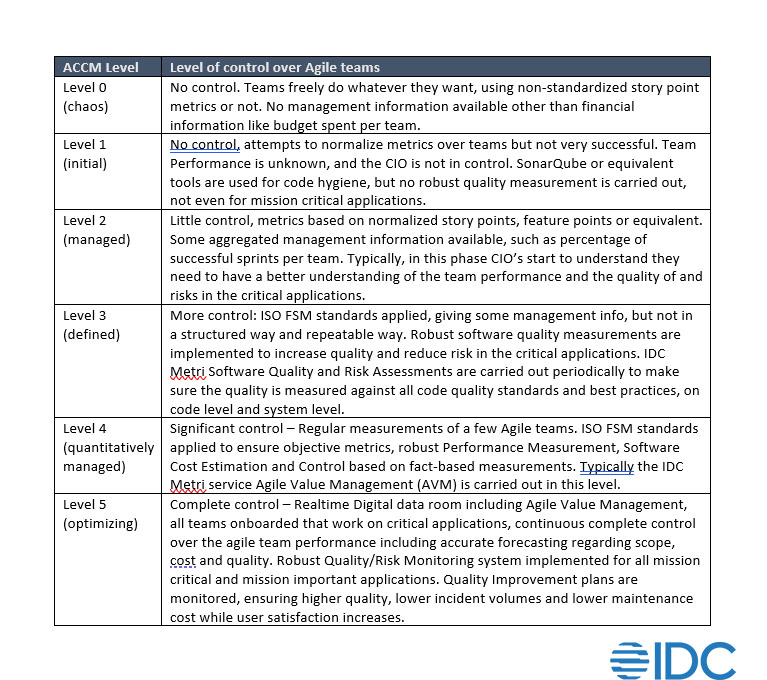
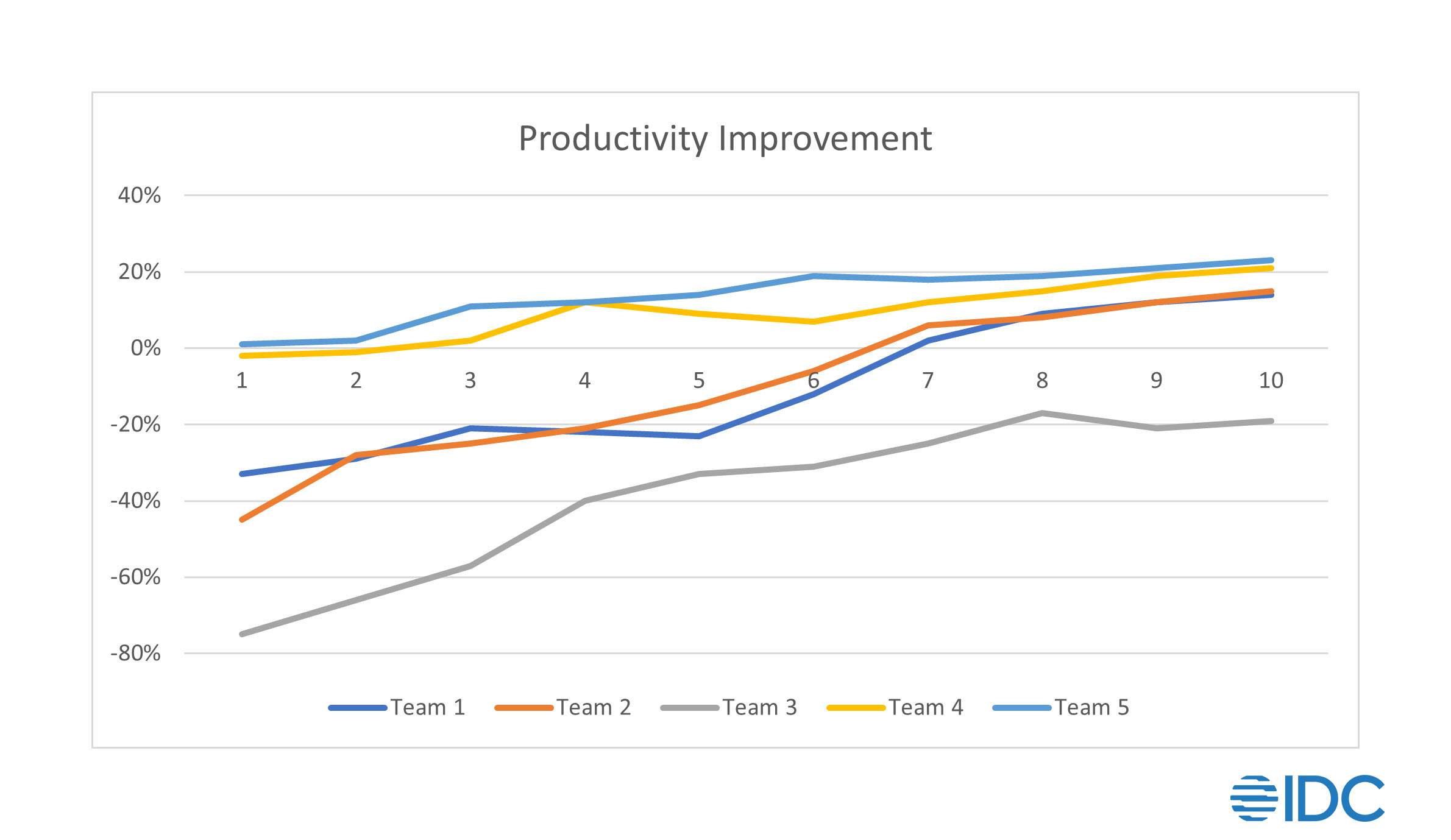
Agile development allows organizations to respond rapidly to changing competitive forces, address developing customer needs, and drive strategic changes. Agile’s benefits are sometimes at the expense of control and visibility into development, particularly predictability of delivery and costs, forecasting, and quality. These pitfalls can negatively impact the full value of Agile. Where the business once asked, ‘Why does IT take so long to do everything?’ they might say, ‘Why has development become unpredictable and difficult to budget and forecast?’

A summary of three pitfalls that can affect the value of Agile:

  1. Lack of visibility: Many organizations improve visibility by defining consistent reporting frameworks (dashboards) across development teams.
  2. Poor predictability: To address this challenge, development organizations can turn to automated source code analysis tools. 
  3. Challenging cost management: Structured approaches to measurement of productivity, efficiency, and cost must be introduced (that don’t impact the core value of Agile).

“Addressing story points will help teams extract more value from Agile development.”

Daniel Saroff, VP Consulting, IDC

Daniel Saroff - GVP, Consulting and Research Services - IDC

Daniel Saroff is Group Vice President of Consulting and Research at IDC, where he is a senior practitioner in the end-user consulting practice. This practice provides support to boards, business leaders, and technology executives in their efforts to architect, benchmark, and optimize their organization's information technology. IDC's end-user consulting practice utilizes our extensive international IT data library, robust research base, and tailored consulting solutions to deliver unique business value through IT acceleration, performance management, cost optimization, and contextualized benchmarking capabilities.