Salesforce在今年的开发者大会TDX上,正式发布了名为Headless 360的新举措,旨在使得Salesforce平台上的所有功能,均可通过API(应用程序接口)、MCP(模型上下文协议)服务器或CLI(命令行界面)命令的形式对外暴露,从而支持编程智能体或面向特定客户需求的自定义智能体进行调用。

Salesforce的这一动作,并不仅仅是一次产品能力开放,更反映出企业软件正在发生一个根本性变化:应用的核心对象,正在从转向“AI”。当越来越多系统开始以开放接口、连接器以及Agent相关协议而非UI作为主要交互方式时,企业软件的竞争逻辑、产品形态与商业模式,也正在被重新定义。

从应用到Agent竞争格局与商业模式重塑

企业软件市场正经历一场深刻变革。AI Agent不仅是技术升级,更是市场竞争、商业模式和生态体系的全面重置。IDC最新调研显示,2026年全球72%的企业已将AI Agent投入生产,51.6%已将Agent嵌入核心业务流程。Agent正成为企业软件的“新入口”,未来三年内,Agent接口将超过一半,传统接口将迅速降低接近至零。

传统软件厂商以功能和UI为核心竞争力,如今则被“结果导向、自动执行”的Agent所取代。Agent能够跨系统自动编排任务,推动业务流程从“人操作”转向“意图驱动、自动完成”。IDC预测,到2027年,Agent自动化将增强40%以上的企业应用能力,重塑三分之一的业务流程和工作流。

IDC的核心判断是:Agent并不是一次功能升级,而是在重构企业应用的形态。

应用正在退居后台Agent成为新的执行层

在传统模式下,企业应用的价值建立在“界面+流程”之上。用户进入系统、触发操作、完成任务,软件围绕“人如何使用系统”来设计。

但Agent改变了这个前提。

它可以基于上下文理解需求、跨系统调用能力,并直接完成任务。在越来越多场景中,用户不再需要进入某一个具体系统,任务已经在后台被执行。

这意味着一个关键变化:应用不再是工作的入口,Agent才是。

一旦入口发生变化,应用的角色也随之改变——从“交互界面”转向“能力提供者”,从前台走向后台。

应用边界开始消失:竞争从产品走向生态

当Agent可以跨系统完成任务时,原本清晰的应用边界开始变得模糊。

同一个业务流程,可能同时调用CRM、ERP和供应链系统;而对用户来说,这一切被封装在一次“请求”之中。应用不再以单独系统的形式被感知,而是作为能力被调用。

关键影响在于:竞争逻辑正在发生改变——除了谁的功能更强,还需要考虑谁更容易被调用和整合

这也是为什么当前市场中,开放接口、连接器以及Agent相关协议(如MCP、A2A)迅速升温。厂商不仅仅是构建产品,而需要争夺“进入Agent调用链”的位置。

如果无法进入这个链条,即使功能完整,也可能被绕过,逐渐边缘化。

定价体系被重写:从使用权结果价值

相比产品形态的变化,更深远的影响正在商业模式层面显现。

过去几十年,企业软件的定价建立在“使用权”之上——按用户数、按模块、按许可收费。但在Agent模式下,这种逻辑开始失效。

一个Agent可以替代多个用户执行任务,自动化程度越高,企业获得的价值越大,但座席数量反而可能下降。

这带来一个根本性问题:当使用量不再等于价值,软件应该如何收费?

目前市场已经出现一些过渡模式,例如在座席基础上叠加Agent调用量或自动化流程计费,形成混合定价结构。

但更关键的变化在于:

软件行业正在从为工具付费,转向为结果付费

而谁能够定义“结果”,并将其转化为可计量、可收费的单位,谁就有机会在这一轮变革中掌握价值分配权。Agent定价需简化,避免复杂结构成为创新和试点的障碍。

IDC观察:三条正在形成的主线

从当前市场演进来看,这一轮变化并不是单点突破,而是沿着几条清晰的主线展开。

首先,企业软件正在从“工具导向”走向“结果导向”。软件不再只是支持人完成工作,而是直接交付结果。

其次,集成逻辑正在从系统层上移到Agent层。过去复杂的系统集成,正在被Agent编排所替代。

更重要的是,竞争的核心正在从功能能力转向价值捕获能力。厂商之间的差距,不再只体现在“能做什么”,而在于“如何从结果中获得收入”。

谁会受益,谁面临风险?

在这一过程中,市场分化已经开始出现。

具备平台能力和生态控制力的厂商,更容易成为Agent的调度中心,从而掌握流量与价值入口。而那些依赖单点功能、定价僵化或生态封闭的厂商,则面临利润下滑和客户流失,被边缘化的风险——即使产品本身依然存在,Agent会绕过其产品,其不再处于用户路径之中。

换句话说,未来的竞争不只是有没有Agent”,而是是否在Agent体系中占据关键位置

结语:这不是一次技术升级,而是一次价值重构

Agent的快速普及,表面上看是AI能力在企业软件中的延伸,但其更深层的影响在于,它正在改变应用的形态、重塑竞争边界,并重新定义价值的获取方式。

这不是一次简单的技术升级,而是一场围绕执行权价值权的重构。

对于软件厂商而言,真正的挑战不在于是否引入Agent,而在于——在一个由Agent主导的体系中,自己的产品究竟处于什么位置。Agent不仅是自动化工具,更是业务流程、行业应用和迁移的“新软件”,厂商可通过Agent快速扩展市场份额和收入。

与此同时,企业用户也需要重新评估自身的应用架构、自动化路径以及供应商选择策略,为Agent驱动流程、数据准备和跨应用编排做好组织准备,以确保在这一轮变革中持续获得业务价值与竞争优势。

IDC更多相关研究

如果您希望进一步了解Agent在企业软件中的落地路径、市场演进趋势或对自身业务的具体影响,欢迎与IDC分析师团队联系。IDC将基于持续的市场跟踪与研究,提供更具针对性的洞察与建议,支持企业与厂商在这一轮变革中做出更有前瞻性的决策。

请点击此处与我们联系。

Lizzie Li

Lizzie Li - Associate Research Director

Lizzie Li is Associate Research Director of IDC China's Enterprise System and Software Research that focuses on research and analysis of the China Datacenter, Cloud Computing, and IT infrastructure markets. She also provides intelligence and consulting services in customized projects for…

2025年中国企业级MaaS市场经历了从试点到规模化应用的关键转折。无论是Token调用量还是实际营收,各个统计口径都呈现出倍数级的增长,同时Token消耗的快速攀升正在重新定义企业使用人工智能的方式。然而,在这一轮高速增长的背后,市场仍然面临性能、安全合规、回答质量等多重实际约束。IDC认为,MaaS厂商的竞争焦点正在从过去单纯的价格比拼,转向“价格、性能与工具链支持”的综合能力竞争。

市场总体规模:调用量增长16倍,但需理性看待基数效应

2024年,中国企业级MaaS市场按调用量统计的规模仅为114万亿Tokens,而到2025年,这一数字跃升至1944万亿Tokens,同比增长约16倍。在营收口径下,2025年中国公有云MaaS市场的规模达到30.7亿元人民币。与此同时,面向传统政企客户的大模型私有化部署市场也保持活跃,尤其在政务、金融、能源等领域形成了独立的采购与交付体系。

IDC预计2026年全年Token消耗量约为40,000万亿次,较2025年进一步增长约20倍。这一加速增长的主要驱动因素,是多模态大模型的逐步成熟以及Agent类应用的规模化落地。换句话说,市场正在从“文本生成”向“多模态理解与自动执行”扩展,每一次交互所消耗的Token量级也相应大幅提升。

Token消耗快速增长,但不同场景之间差异巨大

Token消耗的整体走势非常明确:2025年1月全市场日均消耗约为1.6万亿Tokens,到2025年12月底,这一数字已经攀升至9.6万亿Tokens。随着多模态大模型的进一步成熟,日均Token消耗的增长曲线将会变得更为陡峭。

不过,不同应用场景之间的Token消耗量级存在巨大差异,这一点往往被笼统的市场总量数字所掩盖。例如,一家投资机构在合同摘要场景中,一次处理几十个合同文档,单次消耗的Tokens可达200万。一家教育机构在其在线培训场景中,高峰使用期日均消耗高达2000亿Tokens。而使用多模态产品生成一个视频,也会消耗上千万Tokens。这些差异意味着,企业在评估MaaS服务时,不能只看单位Token的报价,还必须结合自身场景的实际消耗特征来判断总成本。

从应用场景的分布来看,当前公有云上MaaS的主要应用群体集中在泛互联网行业(游戏、娱乐、教育)、智能办公赛道、智能硬件赛道(智能汽车、手机、智能眼镜)以及大消费赛道。主要的应用场景包括角色扮演、短剧生成、市场营销、搜索、数据处理、数据分析和文档处理。而在传统政企的私有化部署项目中,应用场景相对收敛,主要集中在智能办公、数据处理与分析、市场营销等几个方向。

竞争格局:公有云头部集中,私有化部署市场更为分散

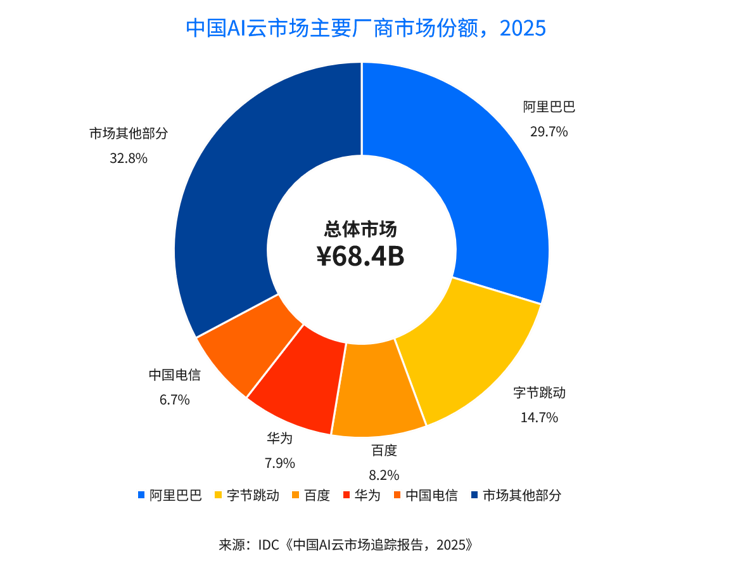
在公有云MaaS市场,按调用量计算,2025年火山引擎占据了接近一半的份额,其次是阿里云、百度智能云、硅基流动以及移动云。其他值得关注的厂商还包括腾讯云、商汤科技、华为云、天翼云等。

如果按营收口径来看,火山引擎仍然占据40%以上的市场份额,阿里云、百度智能云、智谱以及移动云位列前五。不同厂商在单位Token定价、折扣策略以及高价值场景的占比上存在显著差异。例如,某些厂商可能在低单价、高调用量的场景中占优,而另一些厂商则在高单价、专业场景中获得了更高的营收贡献。

在私有化部署市场上,格局则完全不同。传统政企客户出于数据安全、合规可控等考虑,仍然将私有化部署作为第一选择,也因此培育了众多的大模型平台私有化厂商。2025年IDC追踪到的头部厂商包括百度智能云、商汤科技、电信AI、中关村科金、创新奇智、星环科技以及中国电子云。相比公有云市场,私有化部署市场的集中度更低,这与政企采购的区域性、行业性特征有直接关系。

企业落地大模型时,性能、合规与质量优先于成本

高速增长的数字背后,企业在大模型落地过程中仍然面临一系列现实挑战。根据IDC的调研数据,影响大模型落地的Top5因素依次是:模型性能、安全合规要求、回答质量、在AI平台可用性以及成本效益。其中,性能指的是企业部署上线后的稳定性、并发数和可靠性;安全合规既要求模型在中国市场可以合规使用,也要求模型生成的内容本身合规;回答质量则直接决定了模型能否被大规模上线应用。

值得注意的是,成本效益在当前阶段排在第五位,并非企业最优先考虑的障碍。这一结果在一定程度上说明,企业当前更关注“模型是否能用、是否安全、是否稳定”,在这些前提条件满足之后,才会进入精细化的成本比较。然而,原文也明确提示了一种中长期风险:随着大模型应用场景的持续渗透,以及算力紧缺状况的延续,大模型的投资预算终将成为关键挑战。换句话说,成本问题目前还没有爆发,但它迟早会来。

MaaS市场的竞争要素正在发生结构性的变化

随着Token经济的兴起和市场参与者的迅速增加,MaaS市场的竞争规则也在发生变化。IDC认为,未来制胜的核心要素将集中在三个方面:价格与成本优化、性能、以及工具链与应用开发的支持。

在价格与成本方面,企业Token的日均消耗正在快速增长,尤其是各类Agent类产品的出现,进一步放大了Token的使用规模。随着规模化智能的到来,厂商需要关注的不是单纯降低单位Token的价格,而是帮助用户降低整体成本,同时确保输出的是高质量、有效用的Tokens。

在性能方面,大量行业场景对并发数和吞吐量有很高要求,与此同时算力紧缺的现状短期内难以根本缓解。能够通过底层算力优化来提升模型训练和推理效率的厂商,将在用户选型中获得明显的优势。

在工具链与应用开发支持方面,过去两年的MaaS市场中,买方选型的首要因素几乎都是价格,而且由于大模型迭代速度太快,买方通常选择直接调用大模型API,而不进行二次调优。但未来,企业将有更多垂直场景落地,这些场景离不开智能体的开发。因此,MaaS平台在工具链(如调试、评测、智能体编排)上的完备性,在用户选型中的重要性将不断提高。

展望:2026年预计20Token增长,但需注意情景依赖

基于现有数据和趋势,IDC对MaaS市场给出了明确的预测:2026年中国MaaS市场的Token消耗量将达到约40,000万亿次,按营收规模计算将达到约186亿元人民币。2024年至2030年的年复合增长率约为1154.9%,但这一数字是基于高增长情景得出的。

需要特别提示的是,如此高的复合增长率高度依赖于一系列前提条件:多模态模型的持续成熟、Agent类应用的大规模落地、算力供给不出现严重瓶颈,以及合规政策保持稳定。上述任何一个条件发生变化,实际增速都可能显著低于高增长情景。对于行业参与者和企业买方而言,在看到巨大市场机遇的同时,也有必要对风险保持清醒的认知。

对厂商与买方的建议

基于上述分析和IDC的调研数据,我们可以对MaaS厂商和企业买方分别提出几点建议。

对于MaaS厂商而言,在价格竞争的同时,应当优先解决高并发场景下的性能稳定性和合规推理能力。工具链能力(调试、评测、智能体编排)正在成为差异化竞争的关键,不可忽视。此外,可以考虑在垂直场景(如合同处理、视频生成、教育陪练)中建立深度优化能力,而不是在所有场景中采取同质化的竞争策略。

对于企业买方而言,在当前阶段应当优先验证模型的回答质量、安全合规性和并发稳定性,成本可以放在次优级的位置上。在选择MaaS厂商时,建议关注其工具链的成熟度,而不仅仅是API的单次调用价格。从长远来看,建议尽早建立Token成本的评估机制,避免业务规模扩张后出现成本失控的局面。

关于数据:本文所有数据和图表均来自IDC《中国AI软件市场半年度追踪,2025H2》。调用量口径统计企业通过公有云MaaS平台调用大模型API产生的Token数量;营收口径统计企业实际支付的公有云MaaS服务费用(不含私有化部署);私有化部署市场统计面向政企客户的大模型平台软件及相关授权收入。

进一步交流

MaaS市场的爆发才刚刚开始,IDC将持续追踪这一市场的格局变化与技术演进。如需获取完整报告、订阅后续研究,或针对特定厂商与行业进行定制化分析,欢迎与IDC中国人工智能研究团队联系。

请点击此处与我们联系。

Yanxia Lu

Yanxia Lu - Research Director

  Yanxia Lu is a research director, focusing on big data and artificial intelligence (AI). Her responsibilities include big data information management platform, and big data analytics and applications. She is also involved in research on AI technology and enterprise…

The foundational question for any vendor or service provider operating in Japan’s technology market today is no longer whether AI infrastructure will grow. That is settled. The question is how fast, in what form, and most importantly who will capture the value as Japan’s AI infrastructure market, consisting of servers and storage for AI, approaches and surpasses the ¥1 trillion threshold.

IDC’s latest data and forecasts provide a clear-eyed answer. What follows is the strategic view every vendor in this ecosystem needs to understand.

The road to ¥1 trillion: Three milestones that define the opportunity

IDC projects Japan’s AI infrastructure market will follow a clear and compelling trajectory over the next five years. Three milestones stand out:

These are not optimistic projections. They are grounded in structural forces – government policy, enterprise digitalization pressure, hyperscaler commitments, and the irreversible integration of AI into Japan’s economic fabric – that show no signs of reversing.

Where we are today: The foundation that makes this possible

To appreciate the scale of what lies ahead, it helps to understand how quickly Japan’s AI infrastructure market has already moved. In 2025, the domestic market reached ¥670 billion. For accelerator-equipped servers alone, the three-year CAGR from 2023 to 2025 approached 200%, significantly outpacing the global average.

This growth was not accidental. It was driven by a deliberate convergence of government economic security policy and domestic capital mobilization. Under cloud-related policy frameworks designed to advance Japan’s technological sovereignty, domestically capitalized service providers and telecommunications carriers launched large-scale AI infrastructure buildouts at a pace rarely seen in the Japanese market.

Physically, the transformation is equally striking. Rack-scale systems and multi-rack liquid-cooled configurations are becoming the new standard. What was once a 2U GPU server is evolving into an infrastructure architecture where entire data centers are purpose-designed around AI workloads. The ¥670 billion market of 2025 is built on this foundation, and the ¥1 trillion market of 2030 will be built on what comes next.

The structural dynamics vendors must understand

Japan’s AI infrastructure market in 2025 is heavily concentrated in service providers, who accounted for 90.6% of total market spend. With that figure, three dynamics will shape the competitive landscape through 2030:

  • Hyperscalers will continue to expand. Their investment share surged from 39.8% in 2022 to 58.9% in 2025, a 19-point gain in three years. Alignment with hyperscaler platforms and roadmaps will remain a prerequisite for relevance in this market.
  • Domestic service providers will remain strategically critical. Other service providers including policy-backed Japanese service providers and telcos held 31.6% share in 2025, essentially unchanged from 31.8% in 2022 despite the hyperscaler surge. This is a resilient customer segment that values local trust, regulatory compliance, and sustained partnership over pure price competition.
  • Enterprise direct investment is the next growth frontier. At 9.4% of the market today, enterprise direct AI infrastructure investment has more than doubled in absolute terms since 2022, yet it remains nascent. Most large enterprises currently consume AI through generative AI services and SaaS platforms. As enterprises deepen their AI ambitions and move from consumption to ownership, direct infrastructure investment will accelerate. Vendors who build enterprise relationships now will be best positioned to capture this wave.

The semi-sovereign AI model: Japan’s defining strategic architecture

In April 2026, Microsoft announced plans to invest approximately ¥1.6 trillion in Japan between 2026 and 2029. Alongside this commitment came a plan to make AI infrastructure operated domestically by two partner companies available through Microsoft Azure, domestically built and owned infrastructure, connected to a global hyperscaler’s service layer.

This is what IDC describes as “Semi-Sovereign AI” and it is rapidly emerging as the defining model for AI infrastructure strategy in Japan. It represents a pragmatic and politically viable middle path: neither complete dependency on foreign hyperscalers, nor the prohibitive cost of fully independent domestic AI capability.

For vendors, this model is not a constraint. It is a structural opportunity. Semi-Sovereign AI creates a rich and expanding set of market roles in infrastructure design, systems integration, managed services, compliance, and the development of Japan-specific AI platforms. The vendors and integrators who understand this model deeply, and position themselves within it deliberately, will define the competitive landscape of Japan’s AI infrastructure market through 2030 and beyond.

What this means for vendors: Act now, not later

The policy-driven supply wave that built Japan’s AI infrastructure base is transitioning into a demand-driven growth phase. The central question is no longer whether the infrastructure exists, it does. The question is who helps enterprises put it to work, at scale, in ways that generate measurable business value. Three imperatives stand out for vendors competing in this market:

  • Accelerate enterprise engagement. The 9.4% enterprise share of today is the growth story of tomorrow. Vendors who invest in enterprise relationships, Japan-specific use cases, and ROI demonstration frameworks now will be positioned to ride the most significant demand wave of the decade.
  • Align with the Semi-Sovereign AI model. Understanding the interplay between domestic infrastructure owners, hyperscaler service layers, and government policy frameworks is not optional background knowledge. It is the strategic map for winning in this market.
  • Build for depth, not just scale. Japan’s market rewards vendors who demonstrate sustained local commitment, deep technical expertise, and an understanding of Japanese enterprise culture. The ¥1 trillion opportunity will not be captured by volume alone.

Ongoing vendor share and demand analysis is available via the IDC Worldwide Quarterly AI Infrastructure Tracker. For more detailed insights and market trends, please contact our analysts by completing this form IDC | Identifying Market Opportunities – Contact Us.

Shinya Kato - Senior Research Manager, Enterprise Infrastructure, Data & Analytics, - IDC Japan

Shinya Kato is a Senior Research Manager at IDC Japan and is responsible for the data analysis and forecasting team of Japan enterprise infrastructure market. He analyzes the impact of product technology, service offerings, and marketing strategies on enterprise infrastructure market and provides market forecasts, focusing on the domestic enterprise storage systems market. Through understanding technology adoption trends, he also provides insight into emerging devices such as flash, accelerators, and quantum computing. In addition to researching the HPC and AI infrastructure markets, he is also investigating new consumption models such as Hardware-as-a-Service, to help stimulate the market. Prior to joining IDC, he spent more than 10 years at Silicon Graphics, which was later acquired by HPE, where he held various domestic positions in sales, marketing, and business development. He has covered a wide range of businesses, from infrastructure hardware and container-based data center facilities to digital asset management, industrial virtual reality, and software for media & entertainment. He also served as a product manager for enterprise internet security software and appliances at the emerging vendor. He holds a Bachelor of Economics degree from Rikkyo University.

The Middle East War is no longer just a regional risk for technology leaders. It is becoming a global economic stress test — affecting energy prices, supply chains, inflation, business confidence, and IT budget decisions across Asia Pacific.

For CIOs, CFOs, and technology suppliers, the question is not simply whether IT spending will continue to grow in 2026. The sharper question is: which investments will still earn approval when volatility hits the budget?

That is the central signal from IDC’s latest webinar, Asia Pacific IT Spending Outlook 2026: Where to Win Amid Market Volatility. The market is not freezing. It is filtering.

This matters because the disruption is emerging against a market with strong underlying momentum. The opportunity is still there. The rules for winning it are changing.

The Middle East War is the shock

IDC’s earlier point of view on the Middle East War’s impact on IT spending outlined the broader global pressure points, from energy price volatility to supply chain disruption and cloud resiliency.

In Asia Pacific, those pressures are showing up in practical ways. Higher oil and electricity costs can raise operating expenses. Supply chain disruption can increase hardware costs and delay availability. Currency and pricing pressure can make approvals harder. As uncertainty rises, organizations move faster into contingency planning.

The first effect is not always a budget cut. More often, it is hesitation. Organizations start asking which projects are necessary, which can be phased, and which need to prove value faster.

As I noted during the webinar: “IT spending is likely to remain more resilient than in previous downturns because AI investment continues to support both the IT industry and broader economic growth.”

Resilience matters. It keeps the outlook from becoming a slowdown story. But resilience does not remove risk. The longer energy prices and supply chain disruption remain elevated, the more likely selective delays become targeted cuts.

Budget rotation is the signal

The most important shift is not how much organizations spend, but what they are willing to defend.

In a more volatile environment, buyers are becoming more risk-averse. ROI thresholds are rising. Procurement cycles involve more stakeholders. Vendors are seeing longer deal cycles, greater pricing pressure, and less predictable pipelines.

The visual above captures the core market signal: APAC IT spend is rotating, not disappearing.

Large transformations, experimental initiatives, and hardware-heavy refreshes are more likely to be deferred or reduced unless they are directly tied to productivity gains. Enterprise platform upgrades, GenAI pilots, and data and analytics programs are still in play, but they face tighter scrutiny and phased rollouts.

What remains protected? Investments tied to measurable outcomes. AI with clear ROI. Cloud optimization that supports flexibility and cost control. Cybersecurity that reduces risk and supports regulatory compliance. Infrastructure resiliency that helps organizations absorb disruption.

My colleague Vinayaka Venkatesh, summarized the shift directly: “The deals are not disappearing, but they are taking longer and require more effort to close.”

For technology suppliers, that line is the market cue. In 2026, vendors will not win by selling transformation in broad terms. They will win by helping buyers make the case for action now.

AI remains resilient, but proof matters more

AI remains central to the Asia Pacific technology agenda. IDC’s Asia/Pacific AI and GenAI spending outlook shows continued growth momentum as organizations invest in automation, productivity, and new business models.

But resilience does not mean every AI project gets a free pass.

One of the more important nuances from the webinar is the gap between AI infrastructure investment and enterprise AI execution. Hyperscalers and service providers continue to invest aggressively in AI infrastructure. At the same time, some enterprise AI initiatives are being de-scoped, delayed, or challenged on measurable outcomes.

This is where the “year of reckoning” for AI becomes real. AI use cases tied to cost savings, automation, customer experience, risk reduction, and operational efficiency will be easier to defend. Weak GenAI pilots, unclear operating models, or projects without a credible path to production will face more scrutiny from CFOs and cross-functional decision-makers.

AI for AI’s sake will not win the next budget cycle. AI with measurable business impact will.

What to remember for H2 2026 planning

As technology leaders plan for the second half of 2026, three takeaways matter most:

1. APAC IT spending is being disrupted, not derailed
The Middle East War is creating real pressure through energy costs, inflation, supply chain disruption, and weaker business visibility. But priority investments continue to support the market, especially AI infrastructure, cybersecurity, resiliency, and cloud optimization.

2. Budgets are rotating toward measurable value
Lower-priority initiatives, long-payback projects, and unclear business cases are facing delays. Investments that reduce risk, improve efficiency, support compliance, or deliver near-term ROI are better positioned for approval.

3. AI remains resilient, but the proof bar is rising
AI investment remains strong, but enterprise projects need clearer outcomes, stronger business cases, and a faster path from pilot to production.

The path forward is not about spending more for the sake of momentum. It is about knowing where to spend, what to protect, and what to pause.

Register for the on-demand webinar

The Middle East War is the shock. Budget rotation is the signal. Measurable value is the next move.

Register for the on-demand webinar, Asia Pacific IT Spending Outlook 2026 to see IDC’s latest scenario analysis, buyer data, and guidance on where IT spending is holding, where it is slowing, and what it means for H2 2026 planning.

Stephen Minton - Group Vice President, Data & Analytics - IDC

Stephen Minton is a group vice president with the IDC Data & Analytics group, focusing on ICT spending and macroeconomics. Mr. Minton is responsible for Worldwide ICT Spending programs, including the Worldwide Black Book, Worldwide 3rd Platform Spending Guides, and Worldwide Telecom Services Tracker. Mr. Minton's research expertise includes global ICT and economic analysis, and he tracks market data across hardware, software, services, telecom and emerging technologies. He is the author of papers that focus on the economic impact of IT, and is a regular speaker on the subject of IT spending. In 2002 he addressed the United Nations in New York, speaking to UN ambassadors on the subject of the Information Society. Mr. Minton previously worked with Digital Equipment Corporation (DEC), before joining IDC in 1998. Originally from Hartlepool in the North of England, he graduated from the University of Salford in 1995. He has also worked in the field of consumer market research with Millward Brown International.
Vinayaka Venkatesh

Vinayaka Venkatesh - Senior Market Analyst

Vinayaka Venkatesh is a senior market analyst for the IDC Asia/Pacific IT Spending Team based in Bangalore, India. He currently works as a vertical analyst, covering multiple spending guides for Asia/Pacific (excluding Japan and China) (APEJC). He joined IDC in…

Key figures at a glance

  • ¥1,304B – IT modernization services market size, 2025
  • 10.2% – Projected average annual growth rate, 2025–2030
  • ¥2,123B – Forecast market size by 2030
  • ~80% – Large and mid-sized enterprises still running legacy systems

Why Japan is outpacing the world

Japan’s IT services market is forecast to grow at a CAGR of 6.6% from 2024 to 2029, nearly double the global average of 3.6%. The answer is structural. Japan carries a uniquely heavy legacy burden, decades of investment in proprietary mainframe environments, complex bespoke systems, and a workforce that has long maintained them. Now, three forces are converging to make modernization unavoidable:

  • Fujitsu Mainframe Sunset – In 2022, Fujitsu announced the end of sales and support for its mainframe and UNIX server products around 2030. This single announcement put more than 1,000 enterprises on an irreversible countdown, accelerating timelines across the entire Japanese market.
  • AI Readiness Imperative – AI adoption presupposes tightly integrated data pipelines and modern business process architectures, exactly what legacy systems make impossible. Modernization is no longer optional for companies that want to remain AI-competitive.
  • Demographic Pressure – The generation of engineers who built and maintained Japan’s legacy systems is retiring. Organizations face a narrowing window to migrate knowledge and infrastructure before institutional memory disappears entirely.

Three paths to modernization

IDC segments IT modernization services into three execution types, each with distinct implications for services firms:

  • Rehost – Lift-and-shift to non-legacy platforms. Preserves existing application assets. The near-term entry point for enterprises constrained by budget or migration timelines.
  • Rewrite – Convert legacy source code to modern languages without changing business logic. A middle path for controlled transformation.
  • Rebuild – Redefine processes, data models, and architecture from the ground up. The highest-value, highest-complexity path.

Near-term, rehost is the second-largest segment after rebuild, driven by enterprises responding urgently to mainframe end-of-life deadlines — though it has already reached maturity and is forecast to decline. The mid-to-long-term growth opportunity lies in application modernization, rewriting, refactoring, and the adoption of microservices and cloud-native architectures.

What enterprises need from services firms

IDC surveyed large and mid-sized Japanese enterprises and found that organizations with significant legacy exposure do not simply want technical execution, they want transformation partners. Security remains a baseline expectation, but top-ranked needs now include business process redesign and cloud architecture strategy.

Demand signals also diverge meaningfully by sector:

  • Financial Services – Prioritizes cloud-native application development capabilities, the ability to innovate rapidly on modern infrastructure.
  • Manufacturing and Distribution – Prioritizes business process transformation, embedding efficiency and intelligence into operations, not just upgrading the underlying technology.

Across all sectors, IDC observes a consistent shift in enterprise expectations: business outcomes are becoming the primary purchase criterion. Technical competence is assumed; value creation is the differentiator.

How to build a winning position now

For services firms, the competitive imperative is clear. The service providers best positioned to win this market will do three things:

1. Codify your legacy modernization track record

Past engagements are an underutilized asset. Service providers should build structured libraries of business outcomes achieved, cost reductions, cycle time improvements, AI readiness unlocked and make these the core of their go-to-market narrative.

2. Develop industry-specific reference architectures for the AI era

Generic modernization pitches are losing traction. Enterprises want system architectures and implementation roadmaps calibrated to their sector, their regulatory environment, and their AI ambitions.

3. Invest in application modernization capabilities ahead of demand

The rehost wave is already approaching its peak. The high-margin opportunity –  rewrite, refactor, rebuild – is building behind it. Service providers who develop deep cloud-native and microservices capabilities now will be the ones enterprises turn to in the second half of this decade.

About the IDC Report

IDC has published a comprehensive analysis of Japan’s IT modernization market: 2026 Japan IT Modernization Market Analysis. The report provides a medium-term market forecast for IT modernization of legacy systems — a primary growth driver in IDC’s Japan IT services market outlook. Legacy systems are characterized by aging and obsolescence, excessive complexity and scale, and a lack of transparency. It covers enterprises’ IT modernization trends and an analysis of the service vendors’ services trend. Market forecasts are segmented by service type, execution type (rehost, rewrite, rebuild), system type, and industry vertical. Together, these analyses offer a comprehensive view of shifting enterprise needs, emerging market opportunities, and the strategies and service offerings of leading vendors in Japan’s IT modernization landscape.

For more detailed insights and market trends, please contact our analysts by completing this form IDC | Identifying Market Opportunities – Contact Us.

Masaru Muramatsu - Senior Research Analyst, Software, Services, and IT Spending, IDC Japan - IDC Japan

Masaru Muramatsu is a senior research analyst, responsible for research and analysis of the Japanese IT services market, including IT consulting, systems integration, business services.

中国公有云市场正在经历一场由AI驱动的结构性转折。IDC最新发布的《中国公有云服务市场跟踪报告,2025 下半年》数据显示,2025年下半年公有云IaaS市场人民币同比增速恢复至20.0%,整体公有云市场(IaaS+PaaS+SaaS)半年总值首次突破2000亿元。这一增长并非简单的市场回暖,其背后是AI需求对云计算产业底层逻辑的重塑:市场认可度的提升正在从“资源规模”转向“全栈AI能力”,市场份额正加速向“算力+大模型”双强厂商收敛,出海成为增长第二曲线,而行业间的需求分化也将进一步拉大。IDC认为,未来三到五年,公有云市场的竞争将不再是价格战与规模战,而是算力、模型、行业方案、生态与全球化能力的综合较量。谁能在这一轮AI红利中真正从“云厂商”升级为“AI服务商”,谁就将主导下一轮市场格局。

AI 能力重构市场份额 大模型为云厂夺回定价权

在传统IaaS市场中,云主机租赁长期占据主导,价格战也因此成为竞争的主旋律。然而,随着生成式AI和大模型需求的爆发,客户在选择云服务商时的核心依据正在发生根本性变化。算力、大模型、芯片与平台的全栈能力,正取代过去的资源规模与价格优势,成为新的竞争焦点。相应地,定价逻辑也在从资源计费转向价值付费。

这一转变最直接的体现,是市场增长动力从存量博弈转向增量创新。传统IaaS价格战逐步退潮,取而代之的是智算需求驱动的新一轮扩张。大模型产品的定价模式正向按Token计费倾斜,云基础设施产品,尤其是高性能算力的需求大幅提升。在这一新竞争环境中,云服务商是否具备AI原生能力与高效的算力调度能力,将直接决定其能否占据有利位置。

全栈能力成为竞争壁垒,市场向算力+大模型双强厂商收敛

智算集群、液冷数据中心、自研芯片、大模型训练等领域均属于高投入赛道,只有具备完整闭环能力的厂商,才能实现算力规模化变现并穿越投入周期。根据IDC MarketScape评估,阿里云、百度智能云等具备全栈能力的云厂商,其市场份额正持续提升。这些厂商凭借硬件芯片、异构算力兼容、集群调度、MaaS平台及行业生态等综合优势,已在政企、互联网等多个行业中积累起丰富的落地案例。

相比之下,单纯依赖资源出租的厂商,由于缺乏技术与生态支撑,增速已开始放缓。未来市场将进一步向具备全栈AI能力、生态协同能力和行业深度适配能力的头部厂商集中。

行业分化加剧,高适配行业领跑

不同行业在公有云需求上的差异正在拉大。自动驾驶、电商、游戏、互联网金融、协同办公等与AI结合度高且资本红利充足的领域,公有云需求保持高速增长。IDC预测,2025年泛科技行业的AI公有云渗透率将持续提升,行业间的市场增速差距将进一步扩大。而政务、制造、传统金融等行业,则受合规要求和系统改造周期等因素限制,上云节奏相对缓慢。这些行业客户在选型时,更加关注模型的训练与推理性能、行业精调落地情况、数据主权与合规、成本治理等多维度能力,这也在推动云服务商加快行业化与场景化产品的布局。

海外资源加速布局,出海成为增长第二曲线

海外背景的云厂商,如AWS和微软Azure,在云算力出海领域依然保持强劲竞争力,持续服务于中资企业的全球化部署与跨境AI业务。与此同时,阿里云、腾讯云、华为云以及运营商阵营也在积极瞄准中资企业出海需求,在跨境电商、游戏发行、AI应用出海等领域加速落子。根据IDC跟踪数据显示,中过企业出海用云市场规模五年复合增长率超过30%,远高于国内市场增速。出海正成为中国云厂商寻找增长“第二曲线”的重要方向。

AI红利花落谁家:三类厂商各显其能

在这一轮AI驱动的市场重构中,不同类型的云服务商正走出截然不同的增长路径。

以阿里云和百度智能云为代表的全栈型厂商,凭借“模型+芯片+平台+公有云基础设施”形成的产品线闭环,构建起公有云竞争的护城河。其公有云IaaS同比增速已从2024年的个位数增长提升至2025年的25%以上,市场份额持续提升,并在大模型平台、MaaS、行业精调等领域不断加码。

以腾讯云和火山引擎为代表的场景驱动型厂商,则更加聚焦AI的商业化落地,推动将AI真正“用起来”。腾讯云在2025年首次实现规模化盈利,而火山引擎则凭借高性价比的智算方案与灵活计费模式,在2025年再次实现超100%的同比增速,市场份额快速提升。

以中国电信天翼云、移动云和华为云为代表的算力运营型厂商,依靠自建与跨平台调度能力的结合,灵活适配第三方方案,为政企、金融等高安全性行业的AI应用提供保障。凭借多年积累的机房资源、属地化服务和央企背景,这些厂商的企业级服务优势逐步显现,市场排名稳居前五。

从算力到模型:未来四阶段演进路径正在形成

展望未来,中国公有云市场的竞争将沿着清晰的阶段路径演进。

在2026年的第一阶段,算力投入依然是AI发展的核心方向。智算集群、自研芯片、数据中心建设推动资本开支持续攀升。IDC预测,到2027年,超过85%的中国组织将把传统云环境转型为适配AI工作负载的新型平台。

到2027年前的第二阶段,商业化将迎来突破。云服务商的营收模式将从单纯算力出租,转向“Token+算力”的双营收结构,收费模式从资源侧向场景侧迁移,云厂商的盈利格局将随之重塑。大模型驱动的AI云服务市场格局正在形成,MaaS、行业精调和Agent平台等新型商业模式加速落地。

进入2028年的第三阶段,竞争焦点将从算力底座转向大模型应用场景的的训练、微调和推理优化。“云上模型好用度”将成为企业客户选择云服务商的决定性因素。企业买家将优先评估多模态模型覆盖能力、推理准确性、行业适配能力以及生态工具链的完备性。

而纵观未来五年,行业分化将成为长期特征。泛科技行业将持续领跑,传统行业则在政策引导与国产化适配推动下逐步而坚定的推进上云进程。市场将向具备全球化能力、行业方案能力和生态协同能力的综合AI服务商集中,头部厂商将通过全栈能力与行业深耕构建起长期壁垒。

分析师结语:从云厂商“AI服务商的升级之战

2025年下半年中国公有云市场重回高增长,其本质是AI产业爆发所带来的公有云基础设施红利。IDC中国研究经理崔婷婷表示,IaaS增速重回20%以上,标志着中国公有云行业已从存量博弈转向增量创新。未来三到五年,AI能力的竞争将进入白热化阶段,市场不再是简单的价格与规模比拼,而是算力、模型、行业方案、生态与全球化能力的综合较量。云计算,尤其是公有云服务,作为AI竞争的核心载体,其资源铺设广度、能力韧性、安全性、营收增长与利润转换率的动态提升,也将直接反映出AI阵营的发展状态,成为AI竞争态势的晴雨表。在这场升级之战中,谁能更快将AI能力转化为客户可感知的业务价值,谁就有望在下一轮格局洗牌中占据先机,真正完成从“云厂商”到“AI服务商”的跃迁。

如需进一步了解IDC相关研究,或就中国公有云市场发展趋势进行深入交流,欢迎与IDC联系,获取更多洞察与数据支持。

请点击此处与我们联系。

中国PC市场进入调整与转型的交汇阶段

2026年第一季度,中国PC市场整体呈现出“弱增长”与“强分化”并存的特征。根据IDC最新数据,一季度中国PC市场整体销量达到819万台,同比增长0.8%。这一增幅虽实现由负转正,但从结构上看,市场仍处于深度调整阶段,需求恢复动力不足,行业正在从传统的周期性波动转向由结构性因素主导的发展阶段。

与以往由换机周期或宏观需求驱动的增长不同,本轮市场变化更多受到政策环境、供应链成本以及技术演进等多重因素影响。在此背景下,“是否增长”已不再是核心问题,增长来自何种结构、由何种动力驱动,成为判断市场走势的关键。

细分市场分化加剧,增长动能出现结构性转移

从细分市场表现来看,一季度中国PC市场呈现出明显的分化态势。消费市场同比下滑13.6%,在核心元器件价格上涨、补贴政策收紧以及终端需求疲软等多重压力下,整体恢复仍面临较大挑战。与此同时,中小企业市场同比下降9.6%,企业在宏观不确定性背景下趋于谨慎,IT预算收紧、设备更新周期延长,进一步抑制了采购需求。

相比之下,大客户市场实现38.8%的同比增长,在国产化替代持续推进以及政府、教育、大型企业采购需求释放的带动下,成为支撑整体市场的核心力量。

这一结构变化表明,中国PC市场正逐步从以消费驱动为主,转向由政企与结构性需求主导的发展模式,市场内部的增长动能正在发生明显转移。

AI笔记本加速渗透,推动产品结构升级

在本轮市场调整过程中,AI正逐步从技术概念走向实际应用,并成为推动PC市场结构升级的重要因素。随着端侧AI应用场景的不断丰富,具备本地算力能力的AI笔记本需求快速提升,带动整体产品形态和配置标准发生变化。

IDC数据显示,2026年1至2月,不含Apple在内的高算力AI笔记本销量占比已达到33.0%。与此同时,用户对高性能配置的需求显著提升,32GB内存搭配1TB固态硬盘的组合已成为主流配置,占比达到68.5%。

这一趋势反映出,用户对PC的需求正从“满足基础使用”转向“支持复杂应用与智能化体验”。在AI应用驱动下,PC正在从传统生产力工具演进为具备智能处理能力的终端设备,带动整个行业向高性能与智能化方向升级。

高端细分市场表现稳健,成为对冲周期波动的重要支撑

尽管整体市场承压,高端细分市场依然展现出较强韧性。以高性能游戏PC为代表,该领域在一季度保持稳健运行。尽管元器件价格上涨推动终端价格上行,但相关用户群体对性能更为敏感,对价格波动的承受能力较强,厂商也能够通过产品溢价与供应链管理对冲成本压力。

从市场竞争格局来看,头部厂商凭借产品矩阵、供应链能力以及品牌优势,持续巩固市场地位,同时部分厂商通过深耕细分领域实现稳定增长。这一趋势与AI PC的发展路径形成一定呼应,即通过提升性能与差异化能力,推动产品向中高端升级,从而在整体需求波动中保持相对稳定的发展节奏。

市场展望:结构升级与供应链因素将持续影响行业走势

展望2026年,中国PC市场仍将受到多重因素影响。上半年,元器件价格预计维持高位,供应链压力依然存在,叠加需求恢复节奏较为缓慢,市场整体仍将处于调整阶段。下半年,随着成本压力逐步缓解以及政策环境的进一步明朗,市场有望迎来温和改善。

从更长期来看,行业将持续向中高端与智能化方向演进,中低端市场空间逐步收缩,厂商竞争焦点将转向产品能力、技术整合以及供应链韧性。市场集中度有望进一步提升,头部厂商优势更加明显,而中小厂商则需要通过细分市场与差异化策略寻找发展空间。

IDC观点

总体而言,当前中国PC市场并非简单意义上的“复苏”或“下行”,而是处于结构重塑的关键阶段。AI技术的持续渗透、硬件配置的升级以及需求结构的变化,正在共同推动行业进入新的发展周期。

在这一过程中,厂商需要更加关注增长质量与结构变化,通过产品创新与能力升级,构建面向未来的竞争优势。

如需进一步了解IDC相关研究,或就中国PC市场发展趋势进行深入交流,欢迎与IDC联系,获取更多洞察与数据支持。请点击此处与我们联系。

企业看到了智能体但不知道如何落地

2026年初,OpenClaw(龙虾)这类开源智能体产品很快成为市场焦点,端到端任务执行能力对企业很有吸引力。但智能体(智能体)要在企业里真正用起来,在什么场景落地成了主要的卡点。企业认知到了智能体的能力,但回到自己的业务流中,不清楚哪些环节可以交给智能体去做,哪些场景最值得优先投入。IDC 2026年智能体企业用户的调研数据显示,仍有60%的中国企业处于了解评估和试点智能体的阶段,仅有18%的企业把智能体纳入了核心业务流(IDC Syndicated Survey 2026: China AI Agents Market 2026),企业仍然难以跨越从Copilot助理向Agentic AI转型的阶段。为了解决这一问题,IDC提出了一个从业务约束出发的智能体落地框架——COMPASS模型。

业务卡点是关键:从企业业务的三层效率约束入手

到底应该如何选择智能体在业务中的落地场景呢?我们可以参考企业价值链流程,通过观察业务场景中的效率约束,来寻找切入点。一项业务从外部信息进入企业、到内部处理完成、再到能力沉淀放大,效率约束主要集中在三个层面。

第一层,信息输入的约束。企业每天接收大量外部输入,包括邮件、扫描件、图片、语音、聊天记录和表单。很多信息不能直接进入业务系统,要先经过识别、提取、转换和归类,才能变成后续流程可用的数据。

第二层,信息处理的约束。信息进入业务流之后,要在多个系统、多个角色之间流转、分析、协调。数据需要跨系统汇总,状态需要同步,异常需要及时发现,决策需要结合多方信息判断,责任需要在不同角色之间衔接。

第三层,信息资产化的约束。这是容易被管理者忽略的深层约束,企业高价值的业务经验和决策逻辑通常固化在少数员工手里。而人的并发处理能力也存在刚性上限,业务波峰时很难敏捷弹性的应对,也很难规模化增长。这一环节的关键在于让知识经验沉淀和复用,确保企业规模化扩张时不再出现效率瓶颈。

COMPASS模型企业智能体落地的七维度指南

基于这三层约束,我们可以进一步拆解出企业智能体落地的七个关键能力维度,即IDC提出的COMPASS模型。

1.      感知与理解(Perception

外部输入格式各异,进入核心业务系统前往往要依赖人工识别文档类型、提取字段、比对票据,效率瓶颈集中在非标准信息怎样被理解提取、怎样转化为系统可用的结构化数据。

智能体借助多模态大模型能力可以直接读取手写单据、非标合同、会议录音和视频素材,提取关键实体,按要求输出JSON或其它结构化数据,让海量外部信息直接成为系统可用的结构化信息。

2.      分析与决策(Analysis

企业数据和业务规则分散在不同系统中,人工做综合分析效率往往很低,关联节点越多越容易疏漏,依赖经验的判断也缺乏清晰的决策记录,组织很难做系统性复盘。

智能体可以通过工具调用从多个系统实时拉取数据,结合预设业务规则和历史模式,输出结构化分析结论和决策建议。低风险或标准场景可以直接调用执行,非标和高风险场景则带着完整分析升级给人工处理。

3.      流程编排(Orchestration

单个系统内部流转通常比较顺畅,跨系统连通往往比较脆弱。过去依赖API解决跨系统流转,建立的是确定性规则,一旦出现条件分支、异常状态,或者需要根据实时反馈在ERP、CRM和财务系统之间切换判断,硬编码连接容易中断退回人工,构建这些自动化流程本身也要占用较多IT开发资源。

智能体在任务执行环节能够做到系统调用的动态规划,接收到像”给大客户安排加急发货”的指令后,会根据上下文自主决策,调用RPA或基于API接口依次调用ERP核对库存、向WMS确认排期、在CRM中更新状态;流程生成环节,智能体可以基于已有规则库和流程模板,自动组装出RPA或自动化流程并部署上线,构建和迭代周期都会明显缩短。

4.      监控与主动响应(Monitoring

供应链延误、财务偏差、客户行为异常、系统运维故障,任何一环的响应滞后都可能带来连锁影响。人无法7×24小时保持稳定判断,传统做法依靠阈值报警、定时巡检和轮班值守,覆盖范围有限。

智能体可以在持续监测的基础上结合上下文做智能判断,一笔异常大额退货可以同时关联该客户的近期订单模式、产品批次的质量数据、物流环节的异常记录,在告警的同时给出初步的归因分析和处理建议。

5.      协调沟通(Collaboration

跨部门协作中信息天然不对称,产品设计的背后逻辑、法务建议的依据、仓库的实时库存,散落在不同的人、系统和沟通记录里,需要时很难立刻拼出全貌。澄清、追踪、同步消耗的时间往往占据业务人员相当大的比例。

智能体可以作为跨部门协作的中枢,持续追踪任务各环节进展,在关键节点主动通知相关方,出现延误或阻塞时自动升级;需要多方对齐时,能够快速汇总散落在各系统和沟通记录中的上下文,生成结构化的决策议题。

6.      知识沉淀(Sedimentation

企业大量执行能力和决策能力绑定在个体员工身上,关键人员离职、调岗或休假,流程质量和决策水平都会受到影响,新人入职要经过较长周期才能积累足够的隐性知识。

智能体的运行过程本身就可以是知识显性化的过程,任务执行路径、分析框架、决策规则和异常处理方式均可以便捷的结构化地记录下来,并随着运行时间持续积累,可以复用到新的业务场景、新的分支机构和新的团队,同时也能反过来优化智能体自身的响应策略,形成持续迭代的数据飞轮。

7.      规模弹性(Scalability

人的产能是线性的,一个人一天处理100笔订单就是极限,高峰期临时加人未必能带来同比效率提升。《人月神话》里有一个经典观察,项目每增加一个人,沟通链路会延长,交接成本也会上升,整体效率的提升往往被初始化和协调的开销抵消。

智能体的处理能力则可以随算力弹性扩展,业务高峰期不需要临时招人培训,订单量翻倍时调度更多计算资源就能跟上,背后是运行沙箱、记忆存储、调度管理等基础能力模块在支撑智能体在生产环境中稳定可控的弹性伸缩。

这七个维度就是COMPASS(指南针)模型,由上面提到的Collaboration、Orchestration、Monitoring、Perception、Analysis、Sedimentation、Scalability七个首字母构成。COMPASS对应三层约束视角,Perception对应的是信息输入层,解决外部信息能否准确进入企业系统的问题;Analysis、Orchestration、Monitoring、Collaboration对应的是信息处理层,覆盖分析决策、跨系统流转推进、监控响应和跨角色协同;Sedimentation和Scalability对应的是信息资产化层,把个人经验转化为企业可复用的数字资产,同时支撑企业规模化增长。

分析师观点

COMPASS模型可以作为企业落地智能体的诊断和指导工具,企业可以对照七个维度盘点自身业务流的关键瓶颈,识别出需要优先交给智能体的环节。从业务瓶颈倒推切入点,更贴近企业实际的业务需求,也能够减少企业因为智能体技术或产品高速迭代带来的选择困难。

从做什么到用什么:IDC MarketGlance解决选型问题

COMPASS模型回答的是智能体怎么切入的问题,但企业在落地时仍然会面临怎么在市场上找到合适的产品和供应商这一问题。当下市场中宣称具备智能体产品和服务能力的厂商数量已经相当可观,但能力层次和落地经验的差异很大,企业难以抉择。IDC通过大量深度的厂商调研和观察,为企业提供了中国智能体市场概览这一报告(包含中国智能体行业应用与开发平台市场概览和企业级智能体应用市场概览),预先筛选出了覆盖不同行业和业务场景中,满足评估要求的可靠智能体产品及解决方案供应商,供企业参考选择。

配套工具与实践:从方法论走向落地(限时资料免费获取)

另外基于COMPASS模型,我们准备了两份配套的智能体落地指南材料,一份是面向人的,一份是面向智能体的skill。这个skill我们已经上传了Openclaw的官方skill商店clawhub中,可以直接把skill链接( https://clawhub.ai/seanlandtop/idc-enterprise-agent-compass )给智能体安装使用,让智能体可以基于IDC的COPASS模型帮助企业进行智能体落地指引。

限时资料免费下载:可扫描二维码下载详情:

案例征集:寻找可量化ROIAgent实践

为了进一步沉淀实践经验,IDC计划于2026年4月启动Agent最佳实践案例(ROI视角)研究,面向已经在真实业务场景中部署Agent并取得可量化效果的企业与技术供应商开展案例征集,以期为更多企业提供可参考的落地路径。

IDC进一步交

如果您的企业正在评估或推进Agent在业务中的落地,或希望基于COMPASS模型进一步梳理业务切入点与优先级,IDC可以提供相应的研究支持与分析服务,包括基于行业与业务场景的落地路径分析,以及结合IDC MarketGlance的供应商方向参考。

同时,对于已经进入实践阶段的企业,IDC也可以围绕Agent应用效果与ROI进行评估与复盘,帮助企业更系统地推进从试点到规模化落地的过程。

如需进一步了解相关研究内容或开展交流,欢迎与IDC联系。请点击此处与我们联系。

Zhenya Sun - Research Manager - IDC

Zhenya Sun is a research manager for the IDC team focused on exploring the application of technology and industrial development of AI and AI agents. He is also responsible for providing clients with consulting services on technologies, products, and markets related to large language models (LLMs) and AI agents, as well as delivering speeches at industry conferences and internal seminars. Before joining IDC, Zhenya served as a project management officer (PMO), responsible for internal and external strategic consulting, AI application research and advisory services, AI project framework standardization, management system construction, and technical training on AI applications. Prior to that, he also led initiatives in product development process optimization and user market analysis. Zhenya holds a Master's Degree in Engineering Management with a specialization in Information Systems Engineering from the University of the Chinese Academy of Sciences.

2026年4月24日,中国大模型厂商DeepSeek正式推出DeepSeek-V4预览版,同步开源并上线官网、官方App及API服务,标志着百万级超长上下文能力进入普惠阶段。DeepSeek-V4以100万token超长上下文为标配,通过架构创新实现性能与效率双重突破,开源版本在Agent能力、世界知识、数学推理、代码生成四大核心维度实现跨越式提升。DeepSeek-V4也将逐渐实现以华为昇腾为代表的全栈本土化算力适配,这将重塑企业级AI应用部署格局,推动大模型从”参数竞赛”转向”价值落地”。

核心观点:百万上下文成标配,全球用户准备好了吗?

DeepSeek-V4 依托稀疏注意力、升级 MoE 架构等全链路技术创新,实现高效长文本处理,全系免费标配百万级上下文,并优化 Agent 能力,降低企业落地成本。市场层面,其极致低价推动长文本服务普惠化,拓宽多行业 AI 应用场景,同时促使全球大模型形成海外高端闭源与中国普惠开源两大竞争阵营。IDC 建议,企业分阶段落地应用、抢抓智能化红利,同时兼顾技术稳定性、算力适配、合规安全等各类潜在风险。

技术影响:技术革新赋能超长文本与高效 AI 能力

DeepSeek-V4 跳出参数堆叠的研发模式,依托全链路技术创新,实现百万级上下文高效处理,核心亮点突出。

其一,自研 DSA 稀疏注意力机制,借助 token 智能压缩破解长文本算力困境,大幅减少推理运算与缓存消耗,压缩算力成本,降低企业落地难度。

其二,全面升级 MoE 架构,搭载 384 专家融合内核,以少量激活专家兼顾模型能力与推理效率,搭配 mHC 技术稳定训练效果,避免模型遗忘,适配复杂任务迭代。

其三,为个人用户、开发者和企业用户全系标配百万 token 超长上下文,赋能多类AI任务。此外,该版本还适配优化多款主流 Agent 产品,显著提升代码编写、文档生成等任务表现,为个人、企业智能化开发与办公提供更强动力。

其四,全链路本土算力支持,DeepSeek-V4 摆脱部分对英伟达 CUDA 生态的依赖,全面适配本土芯片,实现从训练到部署的全链路安全可控。

市场影响:重塑行业规则,加速全球 AI 应用分化

DeepSeek-V4 的落地,恰逢全球 AI 产业从 “模型竞争” 向 “应用落地” 转型的关键期,其技术特性与定价策略,正从价格体系、应用生态、竞争格局三大维度,深刻影响全球 AI 市场走向。

价格体系重构——开源 + 极致性价比:DeepSeek-V4定价延续 “普惠全球” 路线,V4-Flash 输入缓存命中0.2 元 / 百万 Token、未命中 1 元、输出 2 元;V4-Pro 输入缓存命中 1 元、未命中 12 元、输出 24 元,推理成本仅为 GPT-5.5 的 1/8 至 1/50,让全球中小企业与个人用户都能用上顶级 AI 能力。

应用生态爆发——解锁全场景价值,渗透核心业务:百万上下文 + 低成本 + 强 Agent 能力的组合,为企业打开全新智能体应用空间;代码能力、推理能力、世界知识能力提升也将提升相关应用的模型生成效果。

竞争格局重塑——中国与全球大模型阵营分化:全球大模型市场逐渐分化为两大阵营:以 OpenAI、Google、Anthropic 为代表的 “闭源高端+ 海外算力” 阵营,聚焦极致性能与生态壁垒, 以 DeepSeek 为代表的 “开源普惠 + 中国算力” 阵营,主打高性价比与安全可控。这种分化将为全球企业提供更多选择,同时推动 AI 产业全球化竞争进入新阶段。

行动指南:把握技术红利,分阶段落地适配

面对 DeepSeek-V4 等基础大模型带来的技术变革与市场机遇,IDC 建议企业摒弃观望心态,按照评估、试点、落地、优化四阶段稳步推进,充分挖掘其商业价值。前期需结合业务痛点,聚焦长文本处理、代码开发、智能体应用等核心场景,盘点现有算力资源,结合自身规模选择部署模式,并测算 AI 使用成本与收益。其次开展小范围试点,按需选用适配的大模型版本,在核心业务场景短期测试,核验任务运行效果,对比原有方案排查问题并优化使用策略。最后持续跟进模型迭代升级,不断拓展应用边界,持续深化 AI 落地成效,全面赋能企业内部发展。

理性拥抱变革,平衡红利与风险

用户需警惕技术稳定性、本土算力适配等风险,避免盲目落地导致损失:百万上下文在极限场景下易出现信息遗漏、逻辑断裂,MoE 架构规模化部署易负载不均、引发服务中断,Agent 适配不成熟也会导致复杂任务失败。另外用户也需警惕算力适配风险,需重视从 CUDA 向本土生态的迁移成本和性能波动。

IDC中国研究经理程荫表示,DeepSeek-V4的发布,标志着中国大模型行业正式从”参数竞赛”(1.0时代)、”能力竞赛”(2.0时代)进入”价值竞赛”(3.0时代)——以高效架构、普惠成本、场景落地为核心,解决企业实际问题。企业需密切关注大模型技术迭代,结合自身业务场景,布局百万上下文、高效推理、开源可控的AI解决方案,抢占智能化转型先机,同时也需警惕安全合规、技术稳定性、本土算力适配等风险。

IDC更多相关研究:

IDC在大模型与生成式AI领域已形成系统性研究积累,涵盖技术演进路线、行业应用成熟度、供应商竞争力及投资风向标等多个维度。我们不仅发布公开报告,也为企业级用户和投资机构提供定制化研究。

如您对IDC的相关研究感兴趣或有进一步需求,欢迎与我们联系,IDC的分析师团队期待与您进一步沟通。

请点击此处与我们联系。

Anne Cheng - Research Manager - IDC

Anne Cheng is a research manager in IDC China whose research focuses on the AI and big data markets. She collaborates with IDC's regional and global consulting teams and is involved in the business development of related markets. Prior to joining IDC, Anne had nearly four years of working experience in the IT/ecommerce and consulting industries, serving as consultant and business analyst. Her experiences made her familiar with industry data/customers and helped her gain deep insights into the business application scenarios. Anne holds a master's degree in Statistics from the University of Missouri Columbia.