Manufacturers across Asia/Pacific are navigating powerful crosscurrents: cost pressure, supply chain volatility, skills gaps, and intensifying competition. At the same time, AI is shifting from isolated pilots to systems that can plan, decide, and act. Agentic AI is moving from experimental tooling to bounded operational use cases. The shift is real, but uneven, and it will reward manufacturers that already have disciplined data, process ownership, and governance.

IDC’s FutureScape Worldwide Manufacturing 2026 Predictions for Asia/Pacific (excluding Japan) are more than forecasts. They are a planning input and a view of where investment and capability-building are likely to concentrate. Use them to pressure-test priorities and readiness, not as a certainty about what will happen or when. In the context of agentic AI, they help answer the question for leaders on whether agentic AI will matter, and how quickly they can translate these signals into measurable operating outcomes (eg. disruption recovery, cycle time, quality, OT risk).

What is Agentic AI in Manufacturing?

Agentic AI in manufacturing goes beyond analytics and copilots. It introduces AI agents that can sense conditions, evaluate options, and autonomously execute and orchestrate workflows across the organization, including planning, production, quality, engineering, IT, and cybersecurity, within defined guardrails. Humans remain accountable for strategy, oversight, and exception handling.

Most manufacturers in Asia/Pacific are not starting from this end state. As the differentiated use cases in the above IDC framework illustrate, many organizations remain concentrated in early stages:

  • Generic productivity use cases, providing task-level assistance such as document summarization or reporting.
  • Early functional or process-specific use cases where AI provides decision support within a single function but remains human-driven.

These capabilities are increasingly table stakes. They improve efficiency, but do not yet differentiate manufacturers or fundamentally change how factories, supply chains, or engineering organizations operate.

For manufacturers, the real value lies further up the curve, adopting advanced functional and industry-specific use cases, where AI agents are deeply integrated with operational data, engineering systems, and execution platforms. This is where AI begins to autonomously coordinate decisions across functions, close the loop between design and operations, and where value becomes measurable with fewer schedule resets, faster recovery, reduced security detection time, and fewer late-stage design remedies.

The following three predictions should be read through this lens. Each one highlights a step away from generic productivity toward higher-order, manufacturing-specific agentic capabilities.

Autonomous Production Scheduling

IDC Prediction: By 2027, over 40% of manufacturers with a production scheduling system in place will upgrade it with AI-driven capabilities to start enabling autonomous processes.

Autonomous production scheduling is the most pragmatic entry point into agentic AI for manufacturers because it sits at the intersection of demand, capacity, assets, labor, and supply. Most Asia/Pacific manufacturers already operate advanced planning and scheduling (APS) tools, but these systems are typically static, rule-based, and highly dependent on human planners to intervene when conditions change.

Agentic scheduling represents a step change. AI agents continuously ingest live signals from manufacturing execution systems (MES), maintenance systems, supplier updates, logistics data, and demand forecasts. They evaluate trade-offs in near real time, simulate multiple scenarios, and rebalance production plans dynamically. Over time, these agents do not just recommend changes, they begin to execute them autonomously within predefined constraints, escalating only when exceptions exceed risk thresholds.

This moves manufacturers beyond functional decision support into advanced functional autonomy. Planning is no longer a periodic activity; it becomes a continuously orchestrated process that coordinates decisions across production, maintenance, and supply chain functions.

What to do now:

  • Start where volatility is highest: a constrained line, plant, or product family with frequent schedule disruption.
  • Connect real-time shop floor, asset health, and supply signals directly into the scheduling layer.
  • Establish human-on-the-loop governance early, then expand agent decision rights as performance, trust, and accountability mature.

Predictive Industrial Data Security

IDC Prediction: To counter data model poisoning risks, 70% of large manufacturers will use AI-enabled OT cyberdefense by 2029, autonomously flagging low-level threats and cutting detection times by 60%.

As manufacturers scale advanced agentic AI use cases, cybersecurity becomes a foundational requirement, not a supporting function. Agentic AI systems depend on trusted data, models, and execution environments. If those inputs are compromised, autonomy magnifies risk at machine speed.

AI-enabled OT cybersecurity introduces agents that continuously monitor behavior across networks, devices, control systems, and AI models themselves. Instead of relying on signature-based detection, these agents identify subtle anomalies such as data poisoning, abnormal control logic, or coordinated low-level intrusions that traditional tools and human operators often miss.

For Asia/Pacific manufacturers operating complex brownfield environments, this capability is essential to safely scaling autonomy. Without it, organizations will be forced to cap agent decision authority, limiting the very value agentic AI is meant to unlock.

What to do now:

  • Map critical OT assets, data streams, and AI models that feed systems and agentic workflows.
  • Deploy AI-driven anomaly detection alongside existing SOC and OT security tooling, not as a replacement.
  • Define clear escalation and containment rules that balance autonomy with human accountability.

Agentic Product & Process Simulation

IDC Prediction: By 2028, 50% of A1000 manufacturers will use AI agents in conjunction with design and simulation tools to continuously validate design changes and configurations or variants against product requirements.

Continuous design validation is where agentic AI clearly enters the industry-specific tier. Today, engineering, simulation, manufacturing, and quality operate in loosely coupled stages with design validation occurring episodically, often disconnected from real-world production feedback, and issues surfacing late through defects, rework, or warranty issues.

Agentic AI changes this by embedding validation agents directly into the digital thread. These agents continuously test design changes against requirements, manufacturability constraints, historical defect data, and live production feedback. As materials, suppliers, processes, or operating conditions change, validation updates automatically, closing the loop between design intent and operational reality.

For manufacturers with high product complexity, configuration variability, or rapid innovation cycles, this capability transforms how risk, quality, and cost are managed. It shifts validation from a checkpoint activity to an always-on assurance mechanism.

What to do now:

  • Integrate PLM, simulation, quality, and manufacturing data into a shared, persistent validation workflow.
  • Use agents to automatically assess the downstream impact of engineering changes before release.
  • Move from milestone-based validation reviews to continuous, agent-driven validation embedded in daily operations.

Turning Predictions into Action

These predictions highlight a common truth: agentic AI is not a single technology investment. It is an operating model shift. Manufacturers that succeed will align four foundations:

  1. Strategy: Clear ownership of where autonomy creates value, where human judgment must remain in the loop, and how decision rights evolve over time as agents mature.
  2. Workforce: New roles focused on supervising, governing, training, and continuously improving AI agents, not just consuming AI outputs. This includes redefining accountability as work shifts from people executing tasks to people overseeing autonomous systems.
  3. Technology: Modernized data, security, and cloud foundations designed for continuous orchestration, resilience, and trust spanning IT and OT environments.
  4. Measurement: A clear baseline of current maturity and performance, with success defined not by one-time deployments but by metrics tied to targeted outcomes, such as reduced disruption, faster cycle times, improved quality, or increased autonomous decision coverage.

For Asia/Pacific manufacturers, near-term advantage will come from moving a few bounded workflows into governed production use. Leaders who default to a “wait for certainty” strategy, delaying action until technologies, standards, or competitors fully converge, risk locking themselves into lower positions on the agentic maturity curve and find themselves under increased competitive pressure. Those who treat these predictions as navigational beacons, not distant forecasts, will build factories that are more resilient, adaptive, and competitive.

Agentic AI will not replace manufacturing excellence. It will amplify it.

FAQs on Agentic AI in Manufacturing

  1. What real business problems does agentic AI actually solve in factories and supply chains?

Agentic AI excels in volatile and constraint-heavy operations with frequent disruptions, competing priorities, and too many variables for humans to continuously rebalance. In practice, it helps manufacturers shorten disruption recovery time, reduce manual coordination, and ensure more decisions follow defined guardrails. Examples include autonomous production scheduling, predictive maintenance, quality inspection and predictive quality, AI-enabled OT cyberdefense, and digital twins / simulation-driven design and operations.

  1. Where is the ROI—quality, throughput, inventory, OEE, labor, or something else?

ROI usually shows up first as reduced disruption cost (fewer expediting cycles, fewer schedule resets, less unplanned downtime) and then as improvements in throughput and service levels once planning and execution tighten.

  1. Is agentic AI really different from traditional automation, RPA, or rules-based systems?

Yes, the difference is adaptive decisioning across systems, notjust automation. Rules-based automation executes what you already know; agentic AI can evaluate trade-offs under changing conditions, run scenario logic, and act within constraints, then escalate exceptions when risk thresholds are exceeded.

  1. What data and integration requirements matter most?

Agentic AI depends on trusted signals and tight integration across planning, shopfloor execution, asset health, and supply inputs, otherwise it just automates bad decisions faster. Prioritize master/asset data quality, event-level timestamps, and clearly governed interfaces between IT and OT, with security controls that protect both data and models, and assign data owners to ensure continued data quality assurance.

  1. What workforce impacts and change management issues should be expected?

Expect work to shift from “doing the task” to supervising decision quality: defining guardrails, monitoring exceptions, tuning agents, and clarifying accountability when outcomes are wrong. The hard part is decision rights, escalation paths, and aligning planners/engineers/IT/OT/security around a shared operating model, and this will involve changed responsibility and job design.

Register now for the live webinar on 24 February 2025 at 1:30 pm SGT to join IDC in charting the agentic future with confidence

Stephanie Krishnan - Associate Vice President, Manufacturing and Energy Insights Programs - IDC

Stephanie Krishnan is an associate VP responsible for producing, developing, and growing the IDC Manufacturing and Energy Insights programs in Asia/Pacific. Within Manufacturing Insights, Stephanie conducts supply chain and Industry 4.0 research that supports clients with global sourcing (profitable proximity and sustainable outcomes), transportation, logistics, warehousing, and more. In addition, her contributions to subscription products and custom research span ecosystems, value chains, and the supply chains of industrial industries. In this role, she delivers a research agenda that supports technology buyers in their strategies and buying decisions as well as vendors in terms of market trends and intelligence.

一个正在被低估的变化已经不只是算力池

过去十多年,云计算的核心价值在于弹性、规模和成本效率。但 IDC 指出,随着生成式 AI 和智能体(Agentic AI)走向生产环境,云计算正在发生一次根本性转变——它不再只是承载应用的基础设施,而正在演进为 AI 运行、治理与协同的核心平台

在中国市场,这一变化尤为明显。一方面,AI 应用对算力、数据、网络和安全提出了更复杂、更高频的需求;另一方面,数据安全、数字主权和成本压力,使企业无法简单依赖单一公有云模式。云计算,正在被迫“进化”。

在《IDC FutureScape:全球云计算2026年预测——中国启示》(Doc# ,2026年,1月)中,IDC 系统性地刻画了未来五年云计算将如何围绕 AI 重构自身形态与价值。

十大预测:AI 如何重新定义云计算的形态与边界(原文引用)

预测 1|云基础架构现代化

2027 年,海量的计算和数据需求将强制超过 85% 的中国组织将传统云环境转型适配 AI 工作负载的新型平台。

这意味着,传统以 IaaS/PaaS 为中心的云架构已难以支撑 AI 应用规模化,云基础架构现代化将成为企业发展智能业务的前提条件。

预测 2|代理式 AI 云运营

2027 年,80% 的中国 500 强企业将会部署代理式 AI 平台,为自动化 IT 云运营提供大规模、持续性的监控、分析、故障修复能力,最小化人工干预。

云运维正从“人驱动”走向“智能体驱动”,IT 团队的角色将随之发生转变。

预测 3|专业的 AI 云服务提供商

2029 年,区别于 GPU 资源提供商,至少 30% 的高等级 GPU 将由 AI 云服务商的具备云特性、灵活计费、API、软件服务的资源覆盖。

企业将越来越倾向于选择“懂 AI 的云”,而不仅仅是提供算力的云。

预测 4|边缘 AI 智能体

2028 年,具身智能将迎来爆发式增长,云服务提供商将通过在企业边缘环境部署 AI 基础设施和智能体支撑其中 60% 的业务场景。

AI 正从中心云走向边缘,云计算的服务边界被显著拉长。

预测 5|基于私有云的企业级 AI 平台

2028 年,为了满足数据隐私需求以及降低公共大语言模型的数据泄露风险,60% 的中国组织将采用能够在数据治理方面提供更多控制能力的私有云平台方案。

私有云正在成为企业级 AI 的关键承载平台,而非“过渡选择”。

预测 6AI 成本治理

2028 年,没有把 AI 投入并入成本治理范围的企业 FinOps 团队将在 AI 相关项目方面面临 30% 的成本增长以及更低的总体回报。

AI 时代,成本治理能力将直接影响云与 AI 投资的可持续性。

预测 7|异构云基础设施

2028 年,超过 80% 的中国组织将采用异构云基础设施,用于平衡混合的 CPUGPU、存储技术以优化 AI 工作负载的性价比。

单一算力形态已无法满足 AI 需求,异构成为常态。

预测 8|云端风险管理

2029 年,基于地缘政治的不确定性,50% 的实施数字化自治的中国组织将迁移敏感的工作负载到新的云平台以降低风险和提高自主能力。

云计算正在被纳入更宏观的风险与主权考量。

预测 9AI 辅助工作负载替代

2029 年,60% 的中国组织将采用云端的 AI 融合工具用于评估成本和性能指标,通过部署 25% AI 智能体自动化工作负载的协同,以优化工作负载的替代。

AI 将参与云资源与工作负载的“自我优化”。

预测 10|智能体 SaaS 平台

2029 年,50% 的中国企业应用将采用 SaaS 平台模式进行实时工作流中的预定义 APP 功能和 AI 智能体的协同,构建模块化和共享交互的解决方案。

SaaS 正在向“应用 + 智能体”的平台形态演进。

这些预测共同说明了什么?

IDC FutureScape 2026 反复传递出一个清晰信号:AI 已经成为云计算发展的第一驱动力。

云不再只是支撑 IT,而是直接决定 AI 能否落地、能否规模化、能否在合规和成本可控的前提下持续运行。忽视云基础架构演进的企业,将很难在 AI 投资上获得长期回报。

分析师观点

IDC 中国高级研究经理张犁认为,中国云计算市场正从“规模增长期”迈入“能力重构期”。FutureScape 2026 显示,云计算正在围绕 AI 重塑自身的架构、服务形态与商业模式——从基础架构现代化、代理式 AI 运维,到私有云与异构云并行发展。那些能够将云战略与 AI 战略深度融合的企业,更有可能在复杂环境中实现业务韧性与持续创新;而仍将云视为单一基础设施选项的组织,将面临更高的成本、风险与转型阻力。

一个面向管理层的综合建议

IDC 并不建议企业孤立地“上云”或“上 AI”。更重要的是, AI 为核心,重新审视云基础架构、云运营模式、成本治理与风险管理能力
云计算,已经从“是否采用”的问题,转变为“是否足以支撑下一代智能业务”的问题。

如需进一步了解与研究相关内容或咨询 IDC其他相关研究,请点击此处与我们联系。

Lee Zhang - Senior Research Manager - IDC

Lee Zhang is a senior research manager for IDC Cloud Computing whose research theme focuses on cloud technology, namely hybrid cloud infrastructure, cloud-native infrastructure, big data infrastructure, microservice architecture, and deep learning (DL)/machine learning (ML) architecture, among others. Lee is also responsible for providing project consulting, market analysis for cloud service providers and end users, in collaboration with IDC local and regional consulting/research teams. Lee previously worked as a solution architect for Alibaba Cloud in the retail business, primarily focused on hybrid cloud solution design and delivery, and digital transformation project management. He assisted all types of clients, such as private enterprises, state enterprises, and government departments, designing digital transformation solutions with cloud technology such as hybrid cloud infrastructure including infrastructure as a service (IaaS)/platform as a service (PaaS)/desktop as a service (DaaS)/software as a service (SaaS), middle-stage infrastructure, big data platform, migration to cloud methodology, microservice architecture, and DL/ML, to name a few. Lee graduated from Beijing Institute of Technology with a master's degree in Business Administration (MBA). He obtained his bachelor's degree in Automation from the Huazhong University of Science and Technology.
Technology Trends 2026 Masaru Muramatsu

国内ITモダナイゼーションサービス市場予測を発表 ~大・中堅企業の約8割がレガシーシステムを保有、ITモダナイゼーションサービス市場は2030年にかけ年間平均成長率10%で拡大~

IDCでは、2025年の国内ITモダナイゼーションサービス市場(支出額ベース)を、1兆3,044億円、前年比成長率を10.1%と推定しています。また、2025年~2030年の年間平均成長率(CAGR:Compound Annual Growth Rate)を10.2%、2030年の国内ITモダナイゼーションサービス市場規模を2兆1,234億円と予測しています。

Read full release
Artificial Intelligence 2026 Go Suzuki

先進企業の取材から見えたデジタル変革を定着させる「企業風土/組織文化」の共通点 ~国内企業における組織文化変革の課題と実践~

IDC: 人工知能)の推進において必要となる企業風土/組織文化変革の取り組みに関する分析結果を発表しました。これによると、企業風土/組織文化の変革が前進している企業には共通して見られる考え方や取り組みが確認されました。

Read full release

Key Highlights:

  • By 2028, CIOs will increase spending on sovereign-ready cloud and data localization by 50% to stay compliant in Asia/Pacific.
  • By 2030, 15% of A1000 firms will face lawsuits, fines, or CIO dismissals tied to poor AI agent governance.
  • By 2027, AI infrastructure costs will run up to 30% higher than planned, forcing CIOs to expand FinOps practices.
  • Most organizations still struggle to demonstrate consistent, measurable AI business value.

What is changing for CIOs in Asia/Pacific as organizations scale agentic AI?

Between 2026 and 2030, CIOs will be judged less on AI experimentation and more on their ability to operationalize AI securely, affordably, and in compliance with local regulations. IDC FutureScape research shows that success will depend on sovereign-ready architectures, transformational AI leadership, formal AI value playbooks, stronger governance of AI agents, and disciplined FinOps practices.

AI has become a board-level priority across Asia/Pacific (excluding Japan). Enterprises are under pressure to use AI to improve productivity, resilience, and growth, while navigating fragmented regulations, uneven cloud maturity, and persistent skills shortages.

For CIOs, the margin for error is shrinking. Poorly governed or poorly justified AI initiatives can quickly lead to cost overruns, regulatory exposure, or operational disruption. As a result, the CIO role is evolving beyond technology delivery toward enterprise leadership, financial accountability, and risk stewardship.

Five Predictions Defining the Shift to Agentic AI

1. Digital sovereignty

By 2028, CIOs at multinationals will boost investments in modular, sovereign-ready cloud and data localization environments by 50% to future proof operations against rising sovereignty demands.

Digital sovereignty is now a structural constraint on IT and AI strategy in Asia/Pacific. Expanding data localization and AI regulations in markets such as India, China, and Australia are forcing CIOs to move away from highly centralized global cloud models. Modular, sovereign-ready architectures allow organizations to localize data, models, and controls while maintaining operational consistency. Although this raises costs through redundancy and regionalization, it reduces regulatory risk and protects long-term market access.

2. Transformational AI leadership

By 2028, 70% of A500 CIO roles will be held by transformational leaders who can implement new AI-fueled business models with enterprise-wide consistency while modernizing IT to meet AI business needs.

As AI reshapes business models, CIOs are increasingly expected to lead enterprise transformation, not just IT modernization. In Asia/Pacific, where CIOs are more likely to report directly to the CEO, this shift reflects rising expectations that AI investments deliver measurable business outcomes. Transformational CIOs distinguish themselves by aligning AI initiatives with corporate strategy while modernizing core systems to support scale and resilience.

3. AI business value playbooks

By 2027, 60% of A500 CIOs will be tasked to create enterprise AI value playbooks, featuring expanded ROI models to define, measure, and showcase AI impact across efficiency, growth, and innovation.

Despite growing AI investment, most organizations struggle to prove consistent business value. Traditional ROI metrics fail to capture indirect benefits such as faster decision-making, improved customer experience, and resilience. AI value playbooks provide CIOs with a standardized framework to compare use cases, prioritize investment, and communicate impact to executives and boards, helping prevent pilot sprawl and loss of confidence.

4. AI business disruption impact

By 2030, 15% of A1000 organizations will have faced lawsuits, substantial fines, and CIO dismissals because of high-profile disruptions stemming from inadequate controls and governance of AI agents.

Agentic AI introduces new operational and regulatory risks as autonomous systems move into mission-critical workflows. In Asia/Pacific, unified AI governance remains limited, increasing exposure to outages, compliance failures, and reputational damage. CIOs are under growing pressure to implement stronger controls, human-on-the-loop mechanisms, and cross-functional governance before agentic AI scales further.

5. FinOps practices for AI

By 2027, A1000 organizations will face up to 30% rise in underestimated AI infrastructure costs, driving CIOs to expand the scope of FinOps teams to optimize expenses and enhance business value.

AI introduces volatile cost structures across cloud consumption, model training, and AI-infused applications. These costs are often underestimated, particularly in Asia/Pacific’s fragmented hybrid and multicloud environments. Mature FinOps practices are becoming essential to improve cost transparency, align AI spending with business priorities, and prevent unexpected overruns that undermine executive trust.

What Comes Next for CIOs in Asia/Pacific

Over the next three to five years, Asia/Pacific organizations will move from AI experimentation to industrialized, agentic AI operations. Investment will shift toward platforms, governance frameworks, and financial discipline that support repeatability and control. CIOs who establish these foundations early will be better positioned to scale AI while maintaining trust with regulators, customers, and boards.

Key Questions CIOs are Being Asked

  • Why is digital sovereignty shaping CIO priorities now?
    Regulatory enforcement is increasing across Asia/Pacific, making it essential for organizations to localize data and AI controls without sacrificing operational efficiency.
  • Why do AI initiatives struggle to show ROI?
    Many organizations lack standardized methods to measure indirect and long-term AI benefits, resulting in fragmented pilots and weak executive confidence.
  • What is the biggest risk as agentic AI scales?
    Inadequate governance of autonomous systems, which can lead to operational disruption, compliance failures, and executive accountability.

Explore IDC Research on the Asia/Pacific CIO Agenda and Agentic AI

For CIOs and technology leaders navigating AI at scale, IDC’s FutureScape research provides data-driven insight into how sovereignty, governance, cost discipline, and leadership expectations are reshaping the CIO role across Asia/Pacific.

Linus Lai - Group Vice President, Research - IDC

Linus Lai is a distinguished member at IDC Asia/Pacific, in which he spearheads research in digital business, trust, infrastructure, and services. With over 25 years of industry experience, Linus is based in Sydney and serves as the chief analyst for Australia and New Zealand (ANZ). He is a founding member of IDC's Emerging Technology Advisory Council and a respected senior member of the region's CIO100, CSO, and Future Enterprise awards. In his role, Linus provides strategic insights for digital leaders and the technology sector, focusing on sourcing strategies and emerging technology across Asia/Pacific. His expertise has earned him numerous accolades for his contributions to country, regional, and quality research. Previously, as the head of research in Southeast Asia, Linus was instrumental in expanding IDC's presence and influence in the region. His thought leadership is frequently sought after through regular features in various publications and media outlets. He is also a prominent speaker at industry forums, keynote events, and strategy workshops. Before joining IDC, Linus worked with a leading outsourcing service provider with a digital banking focus. He holds a Master of Science degree from the University of Lincoln, United Kingdom.

Daniel-Zoe Jimenez - Vice President, Digital Innovation, CX & Software, DNB/Start-ups, SMBs, Consumer and Channels Research - IDC

Daniel provides strategic advisory services to the C-Suite (CIOs, CTOs, CFOs, CDOs, CMOs, and CHROs) on how to develop and leverage technologies (e.g., AI/Analytics, Cloud, RPA, AR/VR, ERP, CRM) and new business operating models to become more agile, resilient, and competitive. He delivers workshops and strategic engagements for customers across Asia/Pacific such as assessing maturity, identifying gaps, crafting strategies and technology roadmaps, determining ecosystem readiness, business value metrics (KPIs), and skills required to drive future growth and profitability. Also, he provides research and strategic advisory to tech buyers and suppliers into the most emerging technologies and market developments like the Metaverse.

当前,中国工业行业正处于由“数字化”向“智能化”跨越的关键拐点,“人工智能+工业”融合发展已成为产业转型升级的核心引擎。向国内市场看,随着需求加速升级、政策持续加码、技术不断演进,工业 AI 正从概念探索迈向规模化应用的新阶段;向全球市场看,各地区及国家对工业场景 AI 采用的重视程度空前高涨,但由于产业基础、IT/OT 架构与合规环境差异,不同区域在落地阶段与机会窗口上呈现明显分化。IDC 认为,中国工业厂商可依托自身技术积累与产业链优势,以多元化路径有针对性地推进海外市场拓展,实现“场景能力—交付体系—生态伙伴”的渐进式出海。

国内市场

工业 AI 规模化落地与智能体爆发式增长的双向共振

工业 AI 的需求已从早期头部企业的探索性投入,转向全行业“提质降本增效”的刚需。根据 IDC 预测,到 2028 年,中国工业企业 AI 支出规模将接近 900 亿元人民币,年复合增长率达到 38%。

到 2030 年,全球活跃智能体数量将突破 22.16 亿个,年复合增长率达到 139%,其中工业领域的活跃智能体是最重要组成部分之一。IDC 认为,智能体数量的快速增长将与工业 AI 的规模化需求形成共振:一方面,工业企业对跨系统协同与流程闭环的诉求更强;另一方面,智能体作为“任务编排与流程执行载体”,有助于将 AI 从“点状能力”升级为“可运营的生产力”,从而加速规模化落地。

国家布局加码,“人工智能+”专项行动锚定工业 AI 规模化落地

2026 年 1 月,工业和信息化部等八部门联合印发《“人工智能 + 制造”专项行动实施意见》,明确提出到 2027 年推出 1000 个高水平工业智能体的目标,标志着工业智能体已从企业自发探索上升为国家层面的系统性布局;同期,国家发展改革委、国家能源局发布《关于推进“人工智能 +”能源高质量发展的实施意见》,与前者形成政策合力,共同推动人工智能技术与制造、能源等工业领域的深度融合应用。

工业智能体正在向强专业属性/高专业适配度技术路线演进

工业本身具有强行业差异与强流程约束,无论制造还是能源行业,每个环节的业务语义、数据形态与约束条件都不同,难以依赖消费级通用智能体“一招通用”。因此,针对工业生产中的设计研发、仿真测试、工艺改进、质量检查、设备运维、能耗管理等不同细分环节,专门适配的工业智能体正在快速增多,并呈现出“更强专业、更深嵌入、更可控可管”的演进趋势。

全球市场

全球各区域工业企业需求多元,中国工业 AI 出海瞄准差异化缺口

根据 IDC 的预测,到 2028 年,全球工业企业 AI 支出规模将接近 2.2 万亿人民币,年复合增长率达到 63%。与中国市场对比可以看出,中国市场的 900 亿人民币工业 AI 支出占比仍有限,海外市场在需求体量、行业多样性与付费能力上,存在更大的市场空间。

同时,IDC 观察到,全球各区域工业 AI 需求呈现差异化:

  • 在欧洲、北美等发达市场,工业企业具备更成熟的数字化与工业软件体系,更偏好体系化、高端定制与长期服务续订,但整体成本高、交付周期长。中国工业 AI 厂商可从工业视觉、能耗优化、新能源场站运维等细分场景切入,以“轻量部署 + 快速见效 + 性价比”形成差异化补位;
  • 在东南亚等新兴市场,工业 AI 落地意愿强但适配性方案与本地化交付供给不足。中国厂商可输出成熟的场景化方案与一体化服务,重点强化本地生态伙伴、交付标准化与运维体系建设,以提升可复制性与持续收入能力。

IDC 也建议,出海不应仅理解为“卖产品/做项目”,更需要同步构建三层能力:合规与数据治理能力、本地交付与合作伙伴体系、以及行业场景的可复用产品化封装。

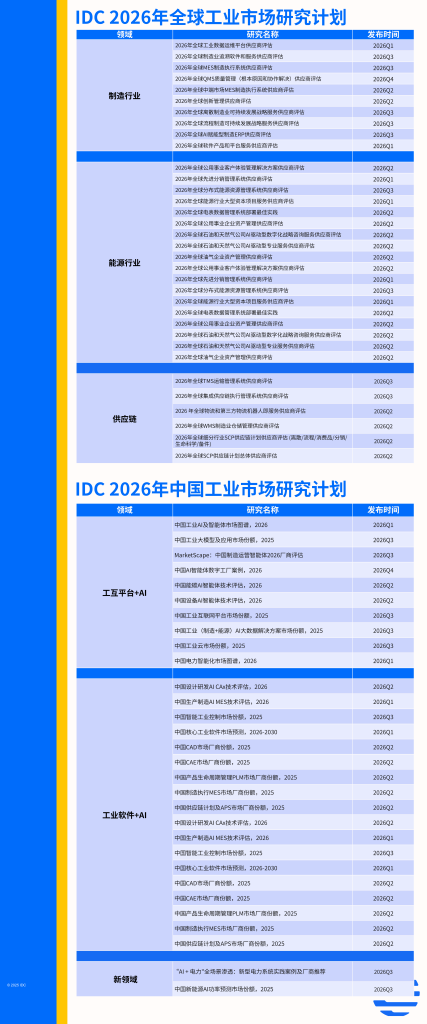
针对全球制造业、能源行业、供应链三大主题,IDC 全球工业研究在今年已启动一系列与工业智能化相关的研究议题,助力中国工业 AI 厂商进入国际工业企业视野,强化品牌可信度与市场触达效率。

IDC 2026年中国及全球工业研究计划:

更多推荐:

在全球工业 AI 政策护航、需求升级、技术迭代与出海进阶的发展背景下,IDC 同步启动工业 AI 领航者奖项征集,围绕行业先锋、出海先锋、创新先锋等多个维度展开评选,旨在发掘具有可复制价值的行业实践,推动工业智能化从“示范”走向“规模化”,并助力“中国方案”在全球工业智能价值分工中占据更重要的位置。

如需进一步了解与研究相关内容或咨询 IDC其他相关研究,请点击此处与我们联系。