Climate Week

From September 22-29, New York City hosts Climate Week, an annual event that brings together global leaders, policymakers, businesses, and civil society to tackle the pressing challenges of climate change. The week features a series of conferences, workshops, and exhibitions to promote sustainable practices, address climate justice, encourage international cooperation, and raise public awareness. Each year, we are reminded that the past 12 months have marked yet another “Top 10” high for global temperatures, emphasizing the urgent need for action—though the pace of change remains frustratingly slow.

The Data Center Dilemma

The data center industry has come under increasing scrutiny for its environmental impacts and rapid growth, driven partly by AI technologies’ energy demands. For example, in its sustainability report released in May, Microsoft said its emissions grew by 29% since 2020 due to the construction of more data centers designed and optimized to support AI workloads.  Likewise, Google reported increased electricity demand driven by artificial intelligence, and its growing fleet of data centers has caused the company’s greenhouse gas emissions to grow by 48% above its 2019 baseline, creating a challenge for the tech giant in meeting its carbon neutrality goals by 2030.

These companies should be applauded for their transparency and courage to tell the facts as they are.  It demonstrates leadership, promotes learning and improvement, encourages industry standards, and, most importantly, highlights the problem. This ever-increasing facility growth and electricity consumption poses a significant struggle as data centers strive to balance the need for increased computational power with the imperative to minimize their environmental footprint. IDC calculates worldwide data center energy consumption for 2023 to be 352TWh and projects a 19.5% CAGR, growing to 857TWh by 2028.
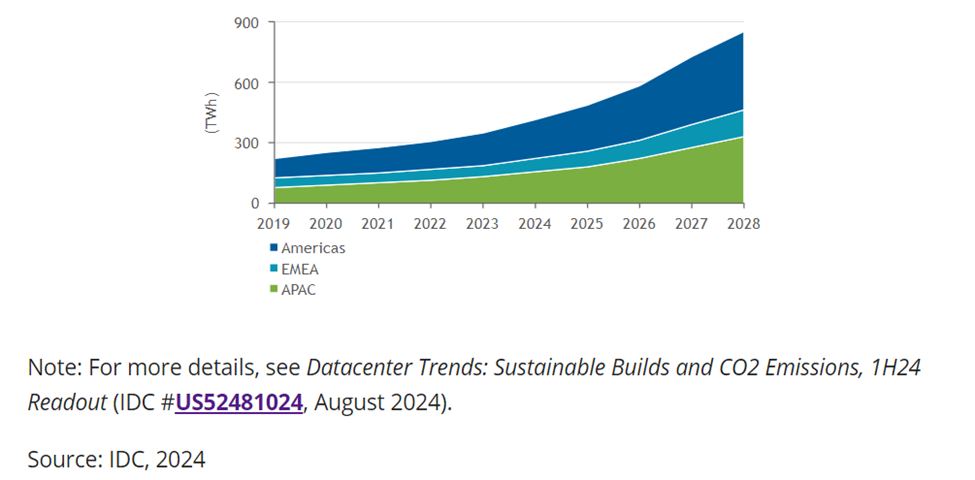
While harder to quantify due to of a lack of standards and available information, scope 3 emissions from constructing and outfitting data centers with IT equipment also contributes to industry emission growth.  

Why Aren’t We Seeing More Progress?                               

While AI garners most market attention, when surveyed, datacenter operators indicated that improved environmental sustainability was their second-highest initiative, ahead of AI, but behind business and financial management.

So, if the data center operators know and prioritize the problem, why isn’t more progress being made?

Like most complex problems, there are a multitude of factors that contribute to it. 

  • Demand – The first is the demand for digital services.   As enterprises pursue digital transformation and invest in artificial intelligence to create unique value, the demand for data centers and the associated electricity consumption is rising substantially.  Organizations are unwilling to sacrifice operational improvements and gains they expect from these efforts to meet sustainability goals.  
  • Global political cooperation and policy. It will take a combination of political agreements, like the Paris Agreement, and stricter local regulations on emissions to drive the change in behavior and investment in renewable energy infrastructure.
  • Transition to Renewable Energy. As governments and businesses set ambitious targets to reduce carbon emissions, the demand for renewable energy is outpacing supply, and globally, electric demand is outpacing new generation supply.  Many electricity grids were built for centralized, fossil-fuel-based power generation and are not yet fully optimized to handle the decentralized and intermittent nature of renewable sources like wind and solar.

Taking Immediate Steps on Energy Efficiency

The phrase “Think globally, act locally” has been part of our collective consciousness since the 1970s, resonating across various societal challenges due to its timeless relevance. Today, this principle particularly applies to datacenter operations. While most datacenter operators may not have the influence to shape global policies or invest directly in large-scale renewable energy initiatives, they can drive change by focusing on energy efficiency at a local level to reduce demand.

While some companies or individual executives prioritize sustainability metrics, viewing environmental responsibility as a critical driver of their decisions, others see these efforts as secondary or “soft” benefits. For this latter group, decision-making is anchored in hard financial metrics, focusing on return on investment (ROI). Energy efficiency initiatives appeal to both types and are aligned with top datacenter priorities.

Electricity costs account for the most significant portion of data center facility operating expenses—ranging from 45% to 60%—depending on location and data center type.  Simultaneously, growth in industrialization and electrification have led to higher electricity demand, outpacing generation, which is expected to cause electricity prices to increase. The combination of rising electricity prices and increased electricity consumption is poised to make data centers significantly more expensive to operate.

To assist organizations in understanding the potential impact, IDC published The Financial Impact of Increased Consumption and Rising Electricity Rates in Data Center Facilities.  The research includes scenario planning for a 1 MW data center in the United States, Germany, and Japan.   IDC projects that a typical 1 Megawatt data center consumed 6.6 Gigawatt hours (GWh) of electricity in 2023 and will grow to between 13 to 16 GWh by 2028 through capacity expansion, increased utilization, and higher density deployments. Simultaneously, IDC expects energy costs to continue to grow above historical levels.  The percentage growth in electricity spend will exceed a CAGR of 15% in all cases, with most scenarios showing growth of over 20%. When measured in absolute spending increase, it is expected to near or exceed $1,000,000 annually.
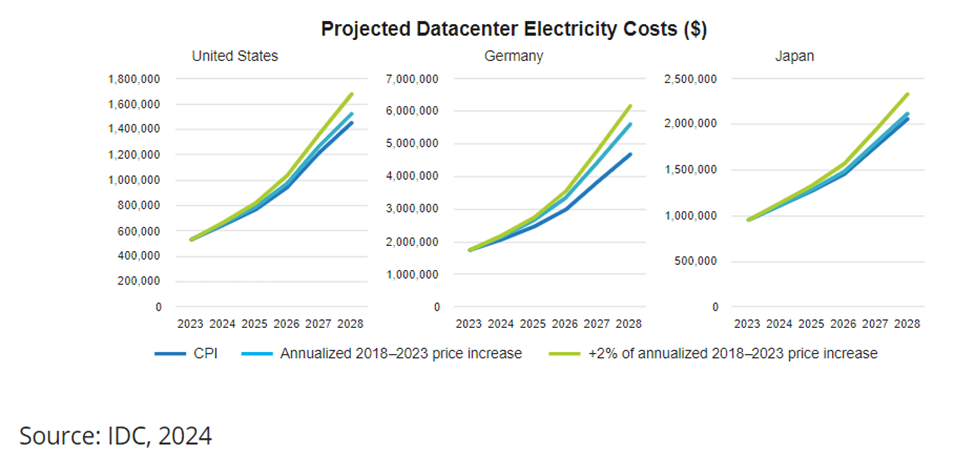
While the model assumes energy efficiency improvements, an organization can expect to save between $500K and $1,900K with energy efficiency improvements that are 10% greater than the industry average.

Conclusion

Prioritizing energy efficiency in data centers is no longer just a matter of environmental responsibility—it’s essential for sound datacenter financial management. As the demand for digital services, AI, and cloud computing continues to soar, the pressure on organizations to minimize their carbon footprint while managing rising electricity costs will only intensify. By taking action now—investing in more energy-efficient technologies and optimizing operations- organizations can reduce their environmental impact and significantly cut operating expenses, their top two priorities. The financial and environmental stakes are clear, and the time to act is now. Energy-efficient data centers are essential for the future of business and the planet.
The digital economy is frequently regarded as a beacon of innovation and growth, both influencing and being influenced by ICT spending. Today, there is increasingly more impact on the economy from the digital world. However, the digital economy itself is a complex ecosystem, influenced by countless macroeconomic factors that shape its development and trajectory. There are global economic trends in inflation and overall technology, “background” developments in raw material supply chains that influence technology hardware procurement, and ongoing, fast-paced advancements in emerging technology. Understanding these influences is crucial for uncovering the full picture of the digital economy’s potential and challenges.  

Understanding the economic impact of new technologies and quantifying it is not immediate. IDC’s Worldwide Digital Economy Strategies Program, in collaboration with IDC’s Data & Analytics team, developed a Digital Economic Impact model over the years and recently applied that to the key technology of the moment: artificial intelligence (AI). We chose AI, as it is not only on everyone’s mind, but is also a paradigm shift that’s reshaping industries, economies, and societies at an unprecedented pace. As we explore the macroeconomic factors influencing the digital economy it becomes clear that AI is both a product of these factors and a key driver of change within this dynamic landscape.  

According to our model we found that Business AI (consumer excluded) will contribute $19.9 trillion to the global economy and account for 3.5% of GDP by 2030. You can read the report or press-release for full details, but how did we calculate this? Our economic impact analysis leveraged data from our Spending Guide and other sources to help understand both the immediate impacts of AI spending and the interaction with broader economic forces at play which we explain below. 

Understanding How AI Impacts the Economy: Economic Impact Models 

As aforementioned, AI will account for 3.5% of GDP by 2030. To estimate the overall impact of a technology product or service, IDC developed an economic impact methodology that combines IDC’s knowledge of the market and internal data with a standard analytical framework that leverages the most updated countries input-output (I/O) tables.  

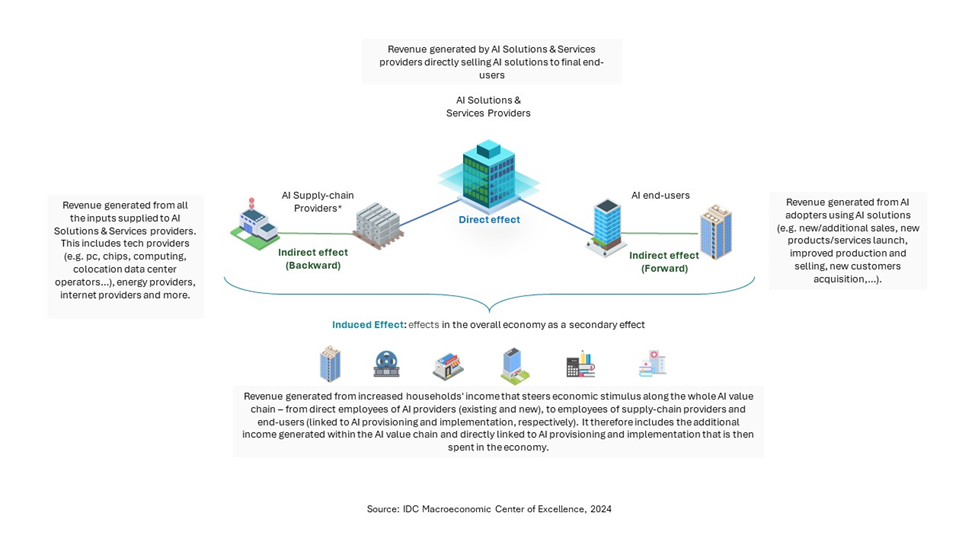
In brief, the economic impact of AI can be sub-categorized into direct, indirect, and induced effects. 

Direct Effects

Direct effects refer to the income generated by providers of artificial intelligence solutions or services from their direct sales to customers. In other words, it is the revenue of solutions/services providers when directly selling their products to end users. Essentially it is the revenue of an AI vendor when selling their solutions or services.

As a concrete example let’s take the case of a company that develops and sells AI-driven customer service chatbots. When this company successfully sells its chatbot solutions to online retailers, that revenue generated from these sales represents the direct economic impact of AI.

Indirect Effects

Indirect effects involve the economic impact related to the AI supply chain and the advantages gained by entities that adopt AI, such as enhancements in productivity and revenue growth. This category also includes the influence that organizations or technology providers exert on a regional or national level through their AI-related operations. Indirect effects are further divided into “backward” and “forward” categories. Backward indirect effects refer to the economic effects on supply chains and industries that provide inputs to AI-driven sectors, in other words, revenues generated in local industries impacted by AI. Forward indirect effects refer to effects on AI adopters that benefit from the adoption of AI technology in terms of productivity, revenue growth, and other business parameters.

More concretely, backwards indirect effects include all inputs supplied to AI solutions from the backend: including PCs, chips, computing, colocation datacenter operators, energy providers, internet providers, and more.

On the forward effects side, this includes concretely any increase in revenue coming from different factors such as the introduction of enhanced products or services, improvements in production and sales processes, or gains in customer acquisition that result from the implementation of AI.

Induced Effects

Induced effects stem from increased household income due to AI-related activities, leading to higher consumer spending and broader economic benefits. These are secondary effects, referring to economic stimulus coming from increased household income, including existing and new employees linked to the AI value chain across direct and indirect effects layers. People will spend part of their new wages in the economy, thus generating additional economic impact.

For example, let’s take a manufacturing company with an ambitious AI strategy that has installed a dedicated AI team, hired specialists, etc. This company may pay higher salaries to this AI team due to the increased demand and profitability of AI products. As these engineers receive higher incomes, they have more disposable income to spend on goods and services within their community, perhaps buying a car or dining out more frequently. These purchases inject additional money into the local economy, benefiting various sectors such as the automotive industry, restaurants, and construction businesses. It serves as a “ripple effect” of increased consumer spending stemming from AI-related economic activities.

Things To Watch Out For

These numbers, however, do not mean the journey from investment to monetization and economic impact is straightforward. In the case of AI, many companies are starting to question which use cases truly add value, and we are also seeing that regulation and questions about the ethical use of AI are increasingly important topics. From our Global Future Enterprise Resiliency & Spending Survey, tech decision makers (IT and LoB) reported an overage of 37 GenAI PoCs in the last 12 months, with only 5 making it into production, on average. Out of these 5, they reported a 68% success rate. That means a lot of PoCs failed, a testament to the long road ahead for AI’s real impact. While it is true that AI doesn’t necessarily guarantee immediate returns, AI’s economic impact will play out over time as the market matures. It is also crucial to keep this long-term perspective in sight while making executive decisions on implementation and deployment.

Going Forward

The interplay between AI and the broader macroeconomic factors is reshaping the digital economy in profound ways. Direct, indirect, and induced effects of AI all underscore AI’s role as a transformative force within the global economy. The model we applied here can also be applied to other kinds of transformative technologies.


Contributing Authors:

Elisabeth Clemmons - Research Analyst - IDC

Elisabeth Clemmons is a Research Analyst for IDC's Worldwide Small and Medium Business Markets program, where she covers the technology priorities, needs, challenges, and goals of small and medium businesses across the globe. Leveraging primary and secondary SMB research, she provides insights into technology trends and developments, buying patterns, market segmentation, and more. She additionally serves as an analyst for the Digital Economy Strategies research theme, covering the interrelationship between geopolitics, macroeconomics and the technology industry.

Digital business is just standard business in 2024.

Companies striving to participate in the digital economy are looking to invest in technology that fits the needs of their company size, employee personas and functions, industry verticals, and current level of technology maturity. Vendors hoping to sell and implement digital technologies need to consider all these factors when meeting with a potential customer. Segmenting and grouping customers by all these factors can help technology vendors provide the best messaging and service.

At IDC, we do research that considers the impacts of all these factors, and that gives us insight behind the tech buying curtain into the needs and wants of buyers at all stages of their digital journeys.

The Small and Medium Business Market

In the recent IDC Webcast, “Behind the Tech Buying Curtain: What Vendors Need to Know,” Katie Evans, IDC Senior Research Director for Worldwide Small and Medium Business Markets, said there are three key topics keeping SMB tech buyers up at night: AI/automation, macroeconomic woes, and heightened security concerns largely fueled by AI, remote work, and the moving to the Cloud.

The forward-looking investment priorities for SMBs are all automation and AI related—process automation, connectivity automation, AI (non-GenAI), and GenAI, according to IDC’s Worldwide Small and Medium Business Survey. Rising energy prices highlight SMB’s top macroeconomic woes in that survey, while implementing technology securely is the largest technology challenge.

Macro Factors Impacting Investment

IDC’s Digital Economy Strategies research, led by Research Analyst Elisabeth Clemmons, focuses in part on the macro landscape impacting businesses, even those focused in specific countries or localities. Impactful events and trends include skills shortages, inflation, supply-chain constraints, energy crises, tensions between countries and war, and elections around the world. These events impact technology buying patterns, causing companies to be more cautious with their investments.

AI is the technology most likely to persevere and be prioritized in the face of these macro impacts, with AI spending, the AI provider supply chain, and the economic stimulus among AI adopters is projected by IDC’s Macroeconomic Center of Excellence to be 3.5% of global GDP by 2030.

The heightened impact of and investment in AI is contributing to two more macro trends impacting businesses: digital regulation and potential raw materials shortages. Data and AI is a top regulatory target with governments taking diverse approaches, while the sheer amount of data in the world is expected to more than triple by 2028—necessitating over 50 times the current annual production levels of neodymium and other critical raw materials.

C-Suite Leaders Increase Focus on AI

Despite any concerns and challenges that AI my pose, CEOs are scaling AI initiatives, dedicating budgets to AI, and ensuring AI projects receive greater visibility, according to Nupur Singh-Adley, Research Manager leading IDC’s C-Suite Tech Agenda research.

As C-suite leaders focus on building digital businesses buoyed by AI technology, they are also mindful of managing risk, including heightened cybersecurity threats and regulations. This is leading to prioritized spending on security, risk, and compliance technologies and greater scrutiny of cybersecurity and risk management at the board level.

Along with considering risk, CEOs are also prioritizing responsible AI while building digital businesses that are focused on trust, critical evaluation of tech vendors, and sustainability.

Digital Capability Perception vs. Reality

While companies of all sizes are facing challenges both internally and externally and they digitize, it’s important for technology vendors to consider that many are also overestimating their digital capabilities. In IDC’s Digital Business and AI Transformation Strategies research, we conduct an annual Digital Business Scorecard that measures the digital capabilities of businesses in four areas: Digital Business Models, Data, Operational Processes, and Organization.

Overall, when asked to assess themselves, 41% of those surveyed in IDC’s Digital Executive Sentiment Survey believed they were a “mostly digital business.” However, when applying our Digital Business Scorecard methodology, which correlates investments and strategies to business outcomes, only 11% of that same survey sample were categorized as “Digital Business Leaders.”

Digital Business Leaders are taking holistic digital strategies and have implemented world-class technology. They view data as a top AI priority while also expanding its use in core operational processes. They have a digital technology architecture that is in lockstep with IT strategy and are focused on improving recruiting and employee engagement.

These are the standards that many of those companies that think they are digital aren’t quite achieving—often finding themselves bogged down by inferior technology, not focusing on capitalizing on the value of their data, not looking to automate and standardize processes, and not taking the view of technology as a competitive advantage.

The Important Role of Technology Vendors in the Digital Economy

Technology vendors are key to digital business and AI transformation strategies—and many companies need vendor expertise and guidance to help them become digital business leaders. Vendor messaging to these companies can be challenging—but it helps to know how company size, macroeconomic impacts, C-suite leadership, and digital capability and perception impacts buying conversations.

It’s helpful for vendors to segment their customers, and specialize their strategy and messaging to those individual segments. That’s beneficial for all parties and will help companies succeed in the digital economy.

Learn what matters most to your customers with IDC’s AI Use Case Discovery Tool—find out more.

When something breaks in your home, your office, or in a venue you frequent what is your expectation? Is it that you will just deal with having a broken product, offline printer, or down elevator? Most of us would expect a service technician will show up to the rescue to return the given product or asset to operations so we can get back to productivity.

In IDC’s recent Product Innovation and Aftermarket Services Survey, service leaders noted a priority to improve service (quality and speed) to customers. But too often, aftermarket service organizations have focused on just ensuring a warm body arrives on a customer site within the service level agreement (SLA) with little importance put on actually achieving resolution or enhancing the customer experience.

As customers explore options for the services they receive, aftermarket service providers will need to get better at delivering more than just the minimum to enable the field service team to become experts on engaging a customer in a special and personalized way. Field service and the aftermarket are too often driven by meeting a SLA. This minimum requirement of meeting a service window of 4-8 hours after a failure has been reported, or processing a warranty claim within 30 days, or ensuring an asset is available 80% of the time has long been the norm. Meeting minimal requirements is quite profitable for the service organization, but can be short-sighted as competitors enter the market and begin to offer service, support, and enhanced experiences of the same or better quality.

To address this pending disruption of competitive factions and heightened customer expectations, field service organizations will need to prioritize value and not just meeting an SLA. This will raise the cost to serve in the short term but in turn result in having the right to request more share of customer wallet as value delivered improves for the customer or operator. This shift to value and enhanced/personalized experiences will ultimately require better quality data, contextualized customer insights, and freed up time to focus on delivering value. Artificial intelligence (AI) provides an opportunity to close the gap between data and insights on the front line. IDC defines AI as the ability of computers to learn without being programmed, applied to large sets of data for business advantage. But how should field service organizations reconcile the hype around AI to usher in the era of intelligence at the point of service? Field service organizations should prioritize the following as they explore the potential of AI in the coming weeks, months, and years:

  • Understand the pulse of your employees and customers. Voice of customer and voice of employee activities often are established for the primary benefit of the organization (i.e., increase sales/margins, increase retention rates). In this new era of AI, field service organizations will need to listen to the needs and concerns of customers and employees. As AI becomes more pervasive across industries, field service organizations must tackle the elephant in the room around AI – privacy, and job displacement. Too much of the discussion around AI in the B2B world has been the fear that it will replace jobs or result in IP theft. This view of potential negatives neglects to amplify all of the potential positive outcomes of what AI can offer, Educating customers and service employees about the value of AI and how these technological capabilities can improve the service experience, customer outcomes, and employee productivity is crucial to adoption and comfort. Without understanding customer and service employees’ fears about AI, organizations will struggle to maximize the opportunities that will come with this innovative technological advancement.  
  • Shift the KPI that measure success in the field. The promise of AI in field service revolves around improved operational efficiency, predictive/prescriptive service outcomes, and improved productivity of the team. However, there is a bit of a gap between the current metrics that are being measured and what should be measured in the AI era. If AI is to improve the speed of service, technicians should be measured on the value they are providing to the customer and not on how many more jobs they can complete. The improved speed of issue resolution as a result of AI providing better answers to the reason for failure should allow the humans on the service team to focus on the customer. This shift in what role a field service technician can play in customer outcomes is profound, no longer is the technician solely in place to turn a wrench but to prioritize customer engagement. Therefore, the KPI that matter aren’t work orders closed in a given day but experiential and value based. These new metrics may be more difficult to measure but will tell a better story of customer impact, future revenue opportunities, and lifetime value.
  • Highlight the positive and address the (potential) negatives. Right now, there are too many field service technicians that can efficiently get on site in front of a customer or asset but fail to resolve the issue on a first visit. Issue resolution is becoming more and more complex as assets are smarter, supply chain networks struggle with resiliency, and the field force ages out. The ability to have the right part, right skills, right insights, at the right time is becoming a fairy tale for too many service organizations. On the front line is the field service engineer who has to advise a customer or operator in need that service cannot be completed resulting in assets, products, and equipment remaining down. Service leaders must communicate to the field service team both the in office planning/dispatching teams and the engineers in the field the ability for AI to drive insights and efficiency while reducing non-value added task work. The skepticism of technology from service teams has preceded the AI era, but the AI conversation brings with it the fear of machines taking over to the detriment of the humans. However, fear comes from a lack of communication, visibility, and buy-in around strategy and execution. AI can enable service workers to be the expert in a time of customer need and also free up their time from rote administrative tasks. AI must become an opportunity for the service team and not a murky monster.

Artificial intelligence will have a large impact on the field service organization and the customer experience. Service leaders need to understand the opportunity, embrace the challenge, and educate customers and employees to ensure the AI era is a net positive driving growth of the organization.

For more information on CX and AI, read our other blogs:

Learn what matters most to your customers with IDC’s AI Use Case Discovery Tool—find out more.

Aly Pinder - Research Vice President - IDC

As Research Vice President, Aftermarket Services Strategies, Aly Pinder Jr leads IDC research and analysis of the service and customer support market for the manufacturer, which includes topics such as field service, warranty operations, service parts management, and how these service areas impact the overall customer experience. Mr. Pinder Jr. establishes a roadmap for organizations to better understand how technology can transform service and support functions to drive exceptional customer experiences and customer value, profitable revenue growth, and improved efficiency in the field.

Faced with the need to staff up quickly to carry out a generative AI initiative, Sanjay Srivastava did the logical thing. “We brought in kindergarten teachers to do prompt engineering,” says the chief digital strategist at Genpact, a professional services firm. Although the decision might appear unorthodox, it’s consistent with Srivastava’s fundamental outlook. He is a strong believer in hiring people from a variety of backgrounds who possess a vital trait: the ability to learn.  

“My whole view of life is that we cannot know the skills we will need tomorrow. So we need curiosity, humility, and the desire to learn the answers, not to already know them,” he explains. “The people we hired from a very different walk of life worked out the best,” he adds.  

Srivastava has discovered what many IT leaders are learning: that in a time of rapid technological change, traditional hiring practices — posting job openings, sifting through reams of resumés for relevant experience, making offers, and waiting for counteroffers — are falling short.  

“To stay competitive in the midst of widening IT skills shortages, enterprises must ensure a culture of continuous learning. All employees from entry- to C-level must have the drive and capability to keep learning, to keep stretching,” says Gina Smith, IDC research director, IT skills for digital business.   

Melissa Swift, vice president for workforce and organizational change acceleration at Capgemini Invent agrees. “You’re on a conveyor belt. Things move. If you take six months to hire someone, you might only have six months to use those treasured skills,” says Swift,  who counsels clients on how to rebuild their workforces to reengineer transformation.  

Like Srivastava, Swift asserts that the ability to learn is more valuable than what a person already knows. But finding a “learn-it-all” rather than a “know-it-all” is not a simple matter.  

“You have to be willing to tolerate a bit of non-linearity. When you don’t understand how they went from there to here [in their work history], that might be an indicator of learning agility,” she suggests.  

Trust Your Gut?  

Where seeming intangibles, such as curiosity, are concerned, you might think that gut instinct would play a large role. But, according to Swift, that can lead to bias when hiring managers gravitate to an applicant because they appear outwardly similar to a previously successful hire. When traits are difficult to measure, objectivity becomes more important. Swift recommends carefully evaluating for learning agility. “Look for a test that has been psychologically and statistically validated. It needs to have research-driven rigor,” she advises. 

Because the ability to solve business problems is the most desirable trait, Srivastava says interviewers should ask applicants direct questions like, “Tell me about three problems you ran into and how you solved them.” He says interviewers should seek affirmative answers to these questions: “Are you seeking insights from others? Are you interrogating data? Are you testing your own hypotheses or assumptions? Are you fundamentally reexamining your point of view?”  

Hidden Passions, Overlooked Winners 

Swift says unusual passions outside of work can be a tip-off to learning agility. “Are they into reading about Teddy Roosevelt? Do they like crochet or horseback riding?” She adds that some jobs, like sales and teaching, inculcate traits such as the ability to think positively and communicate clearly that pay off in many different fields.   

She also advises looking closely at a company’s current employees, some of whom may have the requisite learning agility but remain undiscovered because of the penchant of hiring managers to look outside for talent. “It’s the shiny object syndrome. Internal talent pools are chronically neglected,” says Swift.  

And internal employees who don’t call attention to themselves could be overlooked difference-makers. “Look for introverts; there is something in our culture that does not value introversion,” she says. In her experience, one woman was very introverted in meetings, but afterward would come up with ideas that were clearly “better and smarter” than what other team members offered.  

It’s Not About the Money  

There are cases in which hiring for potential can generate significant savings. Data science, for example, is an area in which experts are demanding, and getting, inflated salaries. “People are asking seven figures; however, you might be able to upskill people into those roles,” says Swift.  

While some might think that hiring for potential would save money compared with hiring the person with the longest resumé, Srivastava says cost savings are beside the point. “What is the opportunity cost of having the wrong person on the job? If you’re not going to be part of the new economy, you have already lost the game. I would change the metrics of how we measure success from the cost of compensation to the opportunity cost of missing the next wave.”  

Srivastava has learned the lessons of outside-the-box hiring from first-hand experience — his own. “I never went to school to become a CDO,” he says. Born in India, he studied aerospace engineering, then moved to the U.S. to take a sales job. However, he decided to become a technology entrepreneur, building several startups that were acquired.  

GenAI is a perfect example of a technology that seemingly came out of nowhere, he says, a harbinger of future transformational waves that will make today’s expertise obsolete. “The skills we will need for the future, we don’t know what they are,” says Srivastava. “Look at prompt engineering. Who knew we would have to hire for it?”  

Learn how three IT organizations are modernizing their skills and talent development practices.

Stanley B. Gibson - Adjunct Research Advisor - IDC

Stanley B. Gibson is an adjunct research advisor with IDC's IT Executive Programs (IEP), focusing on digital transformation, IT leadership, IoT, cybersecurity, and data management. An award-winning technology journalist and an experienced speaker at worldwide industry events, Gibson has been executive editor at eWEEK and PC Week, news editor at Communications Week, and software and systems editor at Computerworld. Gibson writes regularly for CIO, Tech Target, HPE enterprise.nxt, and Broadcom Community. Recent articles cover the convergence of IT and OT in industry 4.0, the rapid rise of industry-specific clouds, how to create a corporate culture for digital transformation, the "death" of IT infrastructure, the impact of COVID-19 on enterprise networks, the surprising endurance of the mainframe, the emergence of 5G networks, zero-trust cybersecurity strategies, and the impact of Amazon's sustainability initiatives.

The way businesses transact with one another is transforming. This presents an opportunity for vendors to develop innovative solutions that meet the needs of the modern B2B landscape.

The Emergence of a New Transaction Ecosystem

After decades of paper-based dominance, business-to-business (B2B) transactions are digitalizing and digitally transforming. e-Invoices and digital networks are streamlining accounts payable and receivable processes, enhancing efficiency and accuracy. Transactions are becoming enriched with data, especially to display sustainability-related information.

Spurred by new regulation, digital-first thinking, and good corporate governance, these developments are changing how businesses collaborate and transact with one another. Vendors have the opportunity to seize the moment and develop innovative solutions that meet the needs and requirements of today’s B2B landscape.

Transformation Drivers

What’s driving the transformation of business transactions? What is the future of the transaction?

Some 70% of businesses regard e-invoicing as an opportunity that goes beyond compliance and can unlock benefits like greater efficiency and faster payments.

According to IDC, regulations, digitalization, and sustainability are the three primary drivers of B2B transformation.

  • Regulation: The introduction of e-invoicing regulations is accelerating the shift toward digital processes in B2B interactions. European and global businesses will need to adopt new technologies and workflows to ensure compliance with current and future regulations. The EU is already mandating the use of e-invoicing in business-to-government (B2G) transactions through Directive 2014/55/EU. The directive aims to streamline public procurement processes, reduce administrative loads, and improve transparency. Countries like Italy and Hungary already require e-invoicing for B2B transactions. Other member states like Germany are steadily advancing their frameworks for eventual legislation. 
  • Digitalization: Digitalization is the process of converting analogue data into digital formats. Automation and AI tools are helping organizations digitalize and transform the way they handle external transactions, increasing the accuracy, speed, and real-time visibility of transactions.
  • Sustainability: The environmental impact of delivering products and services accumulates along the value chain. For most European organizations, much of the environmental impact of their products occurs upstream in their supply chains. European organizations are now beginning to record ESG (environmental, social, and governance) data associated with their purchases. Invoices will start to feature financial and ESG data, with ESG metrics specific to individual products.


“New transaction ecosystems will make B2B transactions faster, more secure, and efficient while enhancing transparency and compliance.”

Tom Seal, Senior Research Manager, IDC


IDC’s Recommendations

The digital transformation journey, while indeed complex, unlocks a future of frictionless information sharing between businesses. The transition to business networks presents a prime opportunity for vendors.

The Future of B2B Transactions is Digital

  • Organizations that share an increasing amount of data with their customers will require a new array of data from vendors to track sustainability performance.
  • Much of the new data that will be shared among organizations will follow the existing transaction pathway. However, this pathway must be updated to meet new demands.

Transactions Will be Data-Rich

  • e-Invoicing and other pressures will compel organizations to move beyond “paper thinking” during the 2020s.
  • A new transaction ecosystem will evolve, enabling organizations to build a transaction workflow that meets the needs of their industries, operations, and legislative requirements.

Network-Enabled

  • Future transactions will rarely be point to point. Rather, they will typically occur over a platform or network.
  • The future will be a network of networks, rather than an array of competing networks.

What It Means for Vendors

  1. Beyond complying with legislation, application vendors must develop strategies that help them thrive within the new transaction ecosystem.
  2. Application vendors have an opportunity to win the race to be the conduit for new data flows, capitalizing on the growth opportunities they represent.
  3. Every application vendor must think about their networks or network connectivity. Network access will be critical but equally commoditized. 

Conclusion

The new transaction ecosystem offers significant benefits, and organizations will increasingly rely on vendors to provide the necessary expertise and solutions to unlock these advantages. For tech vendors, the future of e-invoicing and B2B transactions is not just about compliance — it’s about leading digital transformation and setting new standards of efficiency and sustainability in the industry.

Watch out for Part 2 of our Blog Series on e-Invoicing in the coming weeks.


Ready to elevate your solutions and empower your teams? Contact us for a deeper dive on how IDC can help.

In the five-year span between 2016 and 2021, the average amount of data that organizations managed grew by 10 times, from 1.45PB in 2016 to 14.6PB in 2021. 

We are extremely adept at generating data, not so much at extracting value from those data, and very challenged to destroy any data at all. Data hoarding, data sprawl, and data decay are all significant problems for contemporary companies, and these issues can create legal liability risk and operational inefficiencies. Yet data minimization efforts tend to be difficult from the start, mainly due to the fear of deleting something that may be of value at some point in the future. 

The Data Problem 

An academic doctoral study released in 2020 included several statistics highlighting the fact that data generation has increased exponentially in recent years, with no signs of this trend stopping. Among those metrics was the estimate that globally we are generating around 2.5 exabytes of new data per day, as well as the prediction by the U.S. Government Accountability Office that by 2025 there will be between 25 and 50 billion devices connected to the internet and actively generating data. That same study reported that organizations effectively use less than 5% of their available data. There are three potential problems that could cause this situation: Companies don’t know how to analyze the data they have, they don’t know what insights they could gain by analyzing the data, or they simply don’t know that they have the data in the first place. 

One study found that nearly 85% of Fortune 500 organizations are unable to use their data effectively. Yet companies continue to store data in the hope that one day they might be able to analyze it appropriately and somehow extract insights from the “gold mine” of hoarded data they have accumulated. In thinking this way, they disregard the fact that most data have a shelf life that will reduce its viability before the company is able to extract valuable information from it. 

When data is not properly curated or updated, it becomes outdated, inconsistent, and potentially unreliable. Data hoarding exacerbates each of these issues — resulting in lower data quality and accuracy — as it becomes exponentially more difficult to maintain, clean, and manage data as it constantly grows within the enterprise over time. Given the recent regulatory focus on data privacy, much of this data are not only pure tech debt but also increase liability for the company. 

Analyzing rogue (incomplete, inaccurate, irrelevant, corrupt, incorrectly formatted, or duplicative) data is so problematic that the data science community says that a “rule of 10” applies to it. The rule states that it will cost 10 times more for a data scientist to complete a unit of work when the data is unclean compared with when the data is perfect.  

Why Do We Need to Be Concerned About Data Minimization? 

An IBM survey found that poor data quality costs the U.S. economy approximately $3.1 trillion annually and that companies are losing up to 12% of their potential revenue due to rogue data within their business processes. 

Storing unnecessary data can expose an organization to security and compliance risks and lead to compliance violations, especially under regulations like GDPR or CCPA. This is why these privacy laws have requirements for data minimization. According to the Colorado Privacy Act, the processing of personal data “shall be solely to the extent that the processing is necessary, reasonable, and proportionate to the specific purpose or purposes.” Similar verbiage exists in all other privacy laws. Regardless of where you do business, it is highly likely that at least one, if not many, of these laws apply to your business. 

What Is Data Minimization and How Is It Accomplished? 

At its foundation, data minimization means adherence to two basic principles: Only collect the data that you actually need to provide your services, and don’t keep data any longer than you need. 

To minimize your data, you should do the following:  

  • Evaluate your data storage processes and align data retention policies and practices with the principles outlined in the various privacy laws that your company is subject to. 
  • Implement data destruction policies and follow them. 
  • Use data classification and data discovery tools to scour your current data sets.  
  • Remove data that hasn’t been accessed for years and that you are storing for no valid business reason. 

Adhering to data minimization principles will not only help you remain in compliance with privacy laws, but it will also reduce your attack surface; improve your operational ability to analyze the information you do have; and improve your ability to make data-driven decisions based on current, clean, minimal data. 

For IT vendors, understanding vertical markets’ dynamics and the associated risks and opportunities relating to their clients’ industries is fundamental for success. But in an economy shaken by wars, volatile political landscapes, and inflation, it may be challenging to pin the pockets of growth.

This blog explores recent developments and ICT spending trends of three key European industries — automotive, software and information services, and banking — to help IT vendors identify key areas where their products and services are essential for customers to achieve their strategic goals.

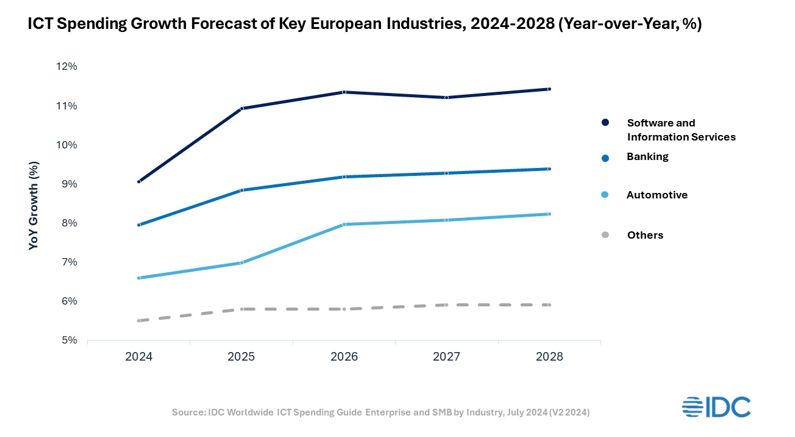
These three industries play a key role in shaping the European economy but are equally important in terms of their ICT spending. The automotive industry is the backbone of the European economy, representing over 7% of the European Union’s GDP. Software and information services, which includes cloud services providers, will continue to be a crucial industry in the years to come as it utilizes the most innovative and disruptive technologies. Banking, the industry with the largest ICT spending in Europe, continues to transform to meet the needs of an ever-changing and digital-savvy customer base.  

ICT Spending Retains Robust Growth amid Ailing Economy

Europe’s economy has been weakened by the developments of the last couple of years, and while many indicators are improving, industrial activity is lagging, investments are being reevaluated, and exports have declined, reflecting asluggish foreign demand. On top of this, the conflicts in the Middle East and in Ukraine, the upcoming U.S. presidential election, and the fear of a global recession are fueling business uncertainty.

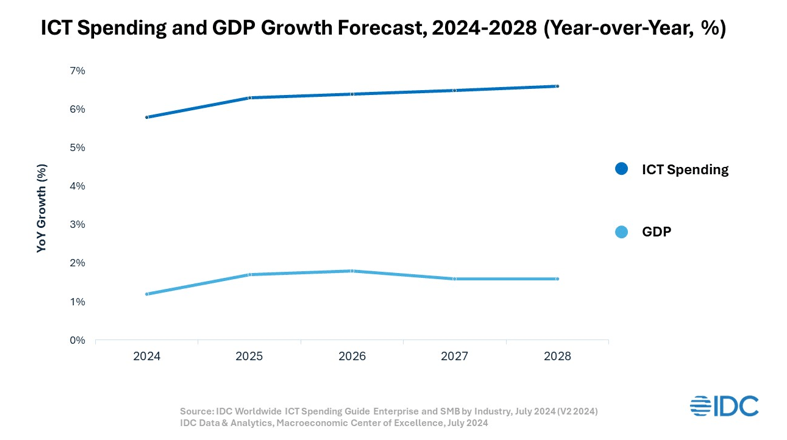
Yet, despite the ailing economy, the European ICT market is expected to reach $1.16 trillion this year, reflecting 5.8% growth compared with 2023, according to IDC’s Worldwide ICT Spending Guide: Enterprise and SMB by Industry. In contrast, the European GDP is expected to grow by 1.2% year on year in 2024.

ICT spending has historically been more resilient to disruptions than Europe’s overall economic performance. This is because organizational strategic priorities, such as efficiency, profitability, and sustainability, require companies to expand their digital capabilities, which cannot be done without investments in new technologies.

As a result, budgets allocated for some technologies, such as software, remain intact even during times of headwinds. Pharmaceutical companies focused on vaccine innovation have ramped up their investments in AI to accelerate drug development processes. Retailers are enhancing ecommerce platforms and in-store experiences as they respond to shoppers’ new behaviors. Central governments are stepping up physical and digital security, to avoid cyberattacks that could compromise the security of citizens’ data.

While IDC forecasts positive ICT spending growth for all European industries, the nature of the impacts and the level of resiliency will vary among them. In the following sections, we will dive into some of the technology spending trends of the key verticals in more detail.

Automotive: Legacy Carmakers Challenged by Lack of Software Capabilities

Automotive is among the European industries that were most impacted by recent headwinds. The Russia-Ukraine war and the Red Sea attacks have been causing supply chain disruptions, skyrocketing energy and material prices made production more expensive, and high inflation and the deterioration of consumer purchasing power slashed demand for both new and used cars. In addition, legacy automakers are dealing with slower-than-expected adoption of electric vehicles (EVs), fueling concerns about the return on their investments in EV development and production. At the same time, more advanced and cheaper products coming from Chinese manufacturers are challenging competitiveness of the European auto industry.

While the business conditions are far from favorable, automakers are still required to comply with the European Union’s sustainability and environmental regulations, which will result in large-scale investments along the entire value chain, leading to a profound transformation of the industry. Enterprise resource management (ERM), supply chain management (SCM), and engineering applications continue to be at the forefront of technology investments, as carmakers are working to reduce the cost, time, and complexity of production while developing safer, more intelligent, and more connected cars.

In parallel, organizations are seeking partners to reduce development costs and tackle the lack of expertise. Several recent announcements indicate that European legacy automakers are turning to technology companies or industry startups that have more experience with automotive software. For example, Volkswagen and Rivian intend to enter a joint venture to create next-generation software-defined vehicles (SDVs) with best-in-class software technology. BMW Group also announced collaboration with Tata Technologies, which will allow the Bavarian manufacturer to leverage its Indian partner’s talent pool and expertise in coding. BMW aims to strengthen its digital capabilities and improve its product portfolio with more advanced automotive software, including automated driving, infotainment, and digital services, which are gaining importance among customers.

Today’s vehicles are software-defined vehicles, often referred to as ‘computers on wheels’, and customers increasingly expect advanced driving assistance systems, in-car virtual assistants, broadband connectivity, over-the-air (OTA) software updates, and other digital functions. However, legacy automakers lack software development expertise and encounter software-related issues more frequently, resulting in postponed product launches. To avoid this, the industry needs to scale up its software capabilities, which will lead to growing investments and new partnerships.

Software and Information Services: Generative AI (GenAI) Remains in Focus to Deliver Increased Value to Clients

The software and information services industry, which includes software vendors, has a long history of bringing disruptive technologies to the market, as well as implementing innovative approaches within their internal processes. This will be the fastest-growing industry by 2028, posting a 10% five-year compound annual growth rate (CAGR). However, the recent crash of tech stocks not only indicates a growing concern about the future of the U.S. economy, but also a shaken confidence in AI projects, as their monetization is taking longer than expected. While some call this crash the long-awaited correction of the overpriced tech stocks, it is unlikely to stand in the way of the ongoing AI hype and technology investments aimed at innovation and bolstering the competitiveness of technology service providers.

GenAI remains the key driver of growth as technology giants aim to accelerate and simplify tasks while delivering extended customer experiences. Tech companies will continue to commit significant resources to refining GenAI deployment, and this will accelerate spending in AI solutions across all verticals. The list of GenAI use cases is extensive, but European businesses are largely using GenAI to generate sales and marketing content, optimize predictive asset operations, support planning and design, and streamline claim-handling processes.

Banking: Cloud Paves a Safe Way Forward

The IDC Worldwide ICT Spending Guide Enterprise and SMB by Industry forecasts that ICT spending in the banking sector will reach almost $120 billion in 2024, higher than in any other industry. In recent years, banks have rushed forward with their digitalizing efforts, prioritizing the optimization of existing systems to save costs and generate more value for clients. This paid off, with many European banks reporting strong H1 2024 and Q2 2024 results, while also catalyzing a surge in cloud spending and datacenter investments across Europe.  

One of the most prominent recent examples of cloud investments is Denmark’s Danske Bank, which signed a multi-year agreement with AWS in March. By applying AWS’ technology in the cloud environment, the bank expects to optimize and modernize its applications. UniCredit Group, based in Milan, Italy, announced the acquisition of Vodeno and Aion Bank, with the aim of using cloud platforms to strengthen its competitive advantage in the banking as a service (BaaS) space. According to IDC’s Worldwide Software and Public Cloud Services Spending Guide, the industry’s public cloud spending will record a CAGR exceeding 23% by 2028.

Banking has been implementing AI solutions to support strategic goals, including increased productivity, improved customer experience, enhanced security, and optimized pricing. AI-enabled customer service and self-service is among the top five AI use cases in the banking industry. Banks are also implementing advanced virtual assistants to revolutionize customer engagement and self-service banking. For instance, Romania’s Alpha Bank is now using Druid AI’s conversational AI technology that allows customers to perform various banking operations autonomously.

Conclusion

Rapidly evolving vertical markets and the overall European economy present both opportunities and challenges. More than ever, IT vendors must now fine-tune their go-to-market strategy by aligning to the customers’ vertical-specific needs and priorities. This requires understanding the dynamics, risks, and opportunities of each sector.

Essential Guidance for IT Vendors:

  • Adapt rapidly to new dynamics. In an economy dominated by market volatility, IT vendors must remain agile and responsive to market shifts. Understanding how geopolitical developments, economic uncertainty, and inflationary pressures affect industries will help vendors align their offering to their customers’ needs.
  • Leverage the power of emerging technologies. IT vendors should continue to drive innovation, investing in solutions such as GenAI to disrupt the market. New tools will allow businesses to unlock new use cases and keep pace with evolving business needs.
  • Align your vertical market strategy to customer needs. By focusing on vertical market dynamics and aligning product offerings to meet specific industry needs, IT vendors can position themselves as key partners, driving digital transformation and helping customers achieve their strategic goals even in challenging economic climates.

For a more detailed view of ICT and cloud spending forecasts by industry and company size segments, check out IDC’s Worldwide ICT Spending Guide: Enterprise and SMB by Industry, or Worldwide Software and Public Cloud Services Spending Guide.

Are legacy systems holding your company back? Do you have manual processes in place to fill the gaps from old technology that hasn’t been updated or maintained? Is your IT budget constrained by maintenance costs for old servers and operating systems within your ever-growing network? These are the various ways that technical debt is hampering innovation and progress within organizations. Tech debt is the hidden, back-office monster under the bed that everyone talks about but no one really knows how to attack it. 

What Is Tech Debt? 

At the height of the 2022 holiday travel season, Southwest Airlines experienced a massive outage of its scheduling system that affected 2 million customers and resulted in the cancellation of 16,900 flights. Southwest experienced an immediate 16% drop in its stock price and logged a loss of more than $800 million that fiscal year due to this outage.  

 Significant winter storms that year had disrupted air travel across the United States and forced most airlines to cancel flights and scramble to rebook their customers. While other airlines recovered in a matter of days, Southwest Airlines took weeks to return to normal activity. Its recovery from this event was significantly hampered because of its legacy IT systems. Its IT team and leadership had known for quite some time that their systems needed upgrades and critical maintenance, but this work was never given priority or funding. Southwest was assessed another $140 million fine a year after this event for its failure associated with the outage. The outage was pure tech debt, but the problem and the potential risk were never sufficiently addressed within the organization. 

Why would executives accept such high risk related to their legacy systems? One probable explanation is that while they recognized that tech debt was an issue, no one was able to sufficiently measure it, and the systemic risk was not sufficiently quantified. This is a problem for most organizations today; they know that they have challenges from their tech debt, but they don’t understand the depth of those challenges, nor do they recognize the extent to which they are accepting systemic risk related to that tech debt. 

The consequences of tech debt permeate the enterprise. They encompass hidden IT costs, increased operational risks, compromised security, hindered innovation, and challenges in adapting to change. Tech debt has evolved into a multifaceted challenge that demands the attention of leaders, from the CIOs responsible for technology strategy to the CEOs focused on the organization’s bottom line. Time-to-market decisions can cause tech debt to accumulate across the entire infrastructure in the same way that it does for custom code.

Enterprise tech debt is not always the result of poor decisions; it can easily accumulate within an enterprise as the result of a rapidly changing technology stack and extremely interconnected business-critical systems. The more tightly coupled enterprise systems are, the more prone they become to enterprise tech debt and the more challenging they become to update due to the interconnected interfaces, sharing of data, and intertwined data pathways. Thus, the maintenance, support, and improvement of these tightly coupled, critical business systems become much more challenging and expensive, and they often get deprioritized in favor of more revenue-generating activities. This lack of maintenance is one of the factors of accumulating tech debt and increasing the tech debt leverage (a measure of tech debt as a percentage of the entire enterprise tech stack) within an organization. 

How Do You Measure and Manage Tech Debt? 

As management expert Peter Drucker famously said, “If you can’t measure it, you can’t manage it.” Unless you track and measure your tech debt, how will you manage it? There are a number of steps to take to measure and manage tech debt. They are:  

  • Establish a clear definition for what your organization considers tech debt. Without a clear definition of tech debt, the term becomes a meaningless bucket into which everything that isn’t the new shiny technology can be dumped. 
  • Put in place mechanisms for measuring that debt across your enterprise. This involves:  
  • Evaluating how much time and effort is needed to maintain old systems 
  • Measuring the security vulnerabilities in those old systems 
  • Assessing the duplicative costs of similar but disparate technologies within your tech stack that exist in silos throughout the organization  
  • Bring all these measurements together into a single view so that you can present your tech debt leverage to the executive team and to the board and use this to clarify the systemic risk within the organization that you are accepting by not addressing the tech debt.  

The corollary of Drucker’s famous quote still holds true and applies directly to enterprise tech debt: Once you measure it, you can manage it. 

Ever since GenAI burst onto the scene, the CIOs on IDC’s CIO Executive Council have threaded through all gatherings and conversations.   CIOs are actively engaged in proofs-of-concept, exploring build versus buy options, and working on updated governance – standard fare for addressing emerging and new technologies.  AI and GenAI aren’t your grandfather’s emerging technology.  Everything from business models, customer behavior, employee productivity, and critical skills for the workforce is rapidly changing.  CIOs keep raising one key question:  “How does their company view the strategic role of IT in the age of AI?”

Executive Council CIOs are experiencing a spectrum of IT roles in the age of AI.  Some have benefited from a consolidation of scope & responsibility under their remit.  Other CIOs are experiencing their role being relegated to “running the utility” and aspects of technology leadership dispersed amongst other “C’s” including a new Chief AI Officer, Chief Digital Officer, and Chief Technology Officer.  Regardless of the current state, Executive Council CIOs along with IDC analysts agree that the current technology and risk environment is a gift to bolster making the case to the C-Suite and Board of Directors of the strategic importance of IT.   Here are the top 3 “gifts”:

  1. CEOs expect CIOs to drive digital transformation to create new revenue streams:  IDC’s Worldwide 2024 CEO Survey found that over the next two years, CEOs are increasingly looking to the CIO as a strategic business leader of technology to enable the business growth strategy.  While the AI leadership profile is still evolving, about half of the organizations surveyed are adding AI leadership responsibilities to an existing technology or functional leader.  AI has the strategic expectation arrow pointing squarely in the direction of the CIO.
  2. The Critical Ingredient to Fuel AI is Data:  The current state of a company’s corporate and customer data is fully revealed as more and more AI use cases are embraced.   Every functional line-of-business and technology leader is experiencing the angst of disconnected, missing, poor quality and inaccessible data to constantly train AI models.  Of IDC’s identified top 10 GenAI Use Cases for Business, 50% of the top use cases are in marketing. The C-Suite has identified a recession proof investment in AI to improve the digital customer experience, supporting business growth.  Marketing is facing data and technology barriers to move at the speed of the customer that CIOs are best positioned to resolve.   The data paradox is reshaping the CIO’s strategic collaboration and relationship with key functional leaders, such as the CMO.  The gift of necessity has been delivered to the CIOs doorstep. Check out more in the report The Data Paradox Reshaping the CIO and CMO Relationship.
  3. CrowdStrike and the Scare in the Boardroom:  During a recent IDC CIO Executive Council Connect, I hosted Frank Dickson, Group Vice President, Security & Trust, with the Council for a deep dive conversation on 3 big things CIOs Must Do because of the CrowdStrike Outage (read more in CrowdStrike Update Outage Exposes Four Critical Issues:  Next Steps for CIOs). Out of the conversation came the realization that while extremely painful for many in our community, it is the perfect gift for CIOs and CISOs to demonstrate the strategic importance of dealing with technical debt, modernizing IT infrastructure and getting back to the basics of robust systems management.   CIOs have a direct correlation to negative brand and revenue impact if the company lacks a strategic mindset about and investment in technology. 

Harnessing these 3 inflection points, CIO’s have the opportunity today to make a strong case about the strategic role that IT plays to enable business growth.  The following is the IDC CIO Executive Council’s Guidance to position IT as a Strategic Investment.  

  1. Speak the language of the business:  Put the words “IT” and “technology” to the side.  Focus on the business problem at hand and the investment that is required.   Start with defining what is the critical investment is to be successful and how you will measure business outcomes.  For example, “We need $15M to ensure that we are buffered from an outage such as CrowdStrike and mitigate risks including short-term revenue loss and longer-term revenue impact due to a poor customer brand experience. “
  2. Adopt an Investment Philosophy:  For some of IDC’s Council members, IT is still viewed as a utility.  Flip the way you speak about IT to change the paradigm.  Frame up IT spend just like an investment banker.  Tell the story based upon revenue, cash and operating income.  For example, the strategic investment in IT will generate $x in revenue.  Do not go for the pot of gold, rather define the right size of investment for the near-term and longer-term expected returns.  Breaking down your investment into bite size chunks allows you to truly prove the value of IT more immediately.
  3. Lay out the Investment Process for Business Acceleration:  Identify the steps to deliver value back to the business including how long it will take for the business to start to realize an initial return and expected timeframe for full results.  Council members highlighted the benefit of using the term “business acceleration” rather than “change management” to smooth out the typical user adoption challenges and align to language the CEO and Board of Directors understand.

Laurie Buczek - GVP, Research - IDC

Laurie Buczek is the Group Vice President of Executive Insights at IDC, where she spearheads the global research initiatives that shape the industry's understanding of digital business transformation, evolving buying behaviors, and technology investments. She leads IDC's premier research practices, including the CMO Advisory Practice, C-Suite Tech Agenda, and Digital to AI Business Transformation. As the principal analyst for the CMO Advisory Practice, Laurie advises senior marketing leaders on driving business growth through deeper customer connections and the strategic evolution of the marketing function, with a keen focus on AI's transformative impact. Her expertise and thought leadership empower executives to navigate the intersection of technology, business strategy, and customer engagement in today's dynamic digital landscape.