Our findings will be presented in greater detail in an IDC Webinar scheduled for March 17th at 11:00 A.M. U.S. Eastern time (16:00 GMT).

The current conflict between Russia and Ukraine has created a critical geopolitical turning point for Europe and the world, and the ITC market is not immune to its initial shock. While there is still uncertainty about the duration of the war, unforeseen development and new sanctions, the tech community must react to this evolving situation with short- and long-term planning, to minimize the spillover effects on their economies and digital markets.

The evolving geopolitical situation will affect global ICT demand in the coming months and years. According to our new IDC Global CIO Quick Pulse Survey, involving more than 60 technology leaders across the globe, 57% of respondents say they are reassessing their tech spending plans for 2022 in the aftermath of the uncertain geopolitical environment, with 10% expecting to make strong adjustments to their ICT investment plans.

“Given the fluid nature of the conflict, IDC recommends that companies identify weak links in their value chain ecosystem, develop agile supply chain strategies, and create action plans that enable them to anticipate and react to a range of disruptive market movements.”

Philip Carter, Group Vice President, Worldwide Thought Leadership Research

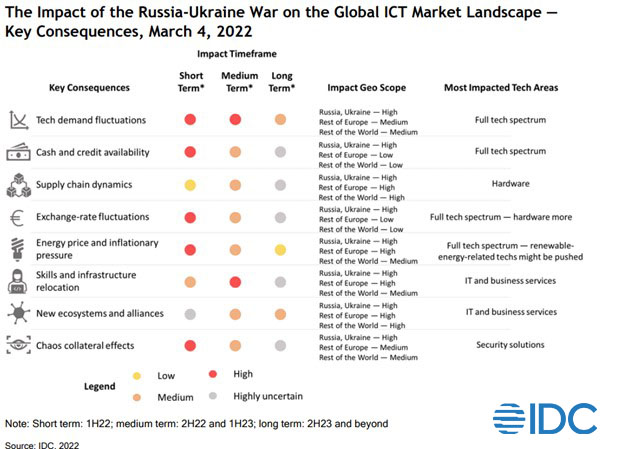
IDC is carefully evaluating the geopolitical situation and its impact on the ICT market, through its broad network of global, regional, and local analysts.  Given the characteristics of the conflict and the sanctions currently in place, we have identified the following key consequences for the global ICT market:

Chart showing short term, medium term and long term impact of Russia-Ukraine conflict on Global ICT market

Tech Demand Fluctuation: The conflict has halted business operations in Ukraine while the Russian economy is feeling the early impact of Western sanctions. This will strongly affect tech spending in both countries with double-digit contraction of local market demand expected in 2022. Meanwhile, tech spending among Western European countries may increase in part due to expanded defense and security allocations.

Energy Prices and Inflationary Pressure: Tensions over the conflict in Ukraine will have wide ranging consequences on both energy prices and security of supply, particularly for certain European countries where cascading effects on price indices are already being felt. Most countries will need to quickly reassess their near-term energy plans while accelerating efforts to reduce their dependence on carbon-based energy sources.

Skills and Infrastructure Relocation: More than 100 global companies have established subsidiaries in Ukraine and many more have operations in Russia. The conflict has already displaced tens of thousands of developers in Ukraine and led to the relocation of some services in both countries. These relationships, along with the physical assets and personnel associated with them as well as any future expansion plans, will need to be reevaluated in light of the conflict.

Cash & Credit Availability: The financial sanctions imposed to date are presenting serious challenges to foreign credit availability in Russia, while creating potential losses on loans issued by EU countries to Russia. Without access to credit, most organizations will be forced to suspend new technology investments in the near term. The country is also suffering from a severe shortage of cash, which is significantly impacting consumer spending.

Supply Chain Dynamics: Exports of finished products and technology components to Russia will be significantly affected by the sanctions, but the impact to Western companies will relatively small given the size of the market. Imports of tech materials from Russia and Ukraine will also be affected, particularly in the semiconductor sector where supplies of neon gas, palladium, and C4F6 used in chip manufacturing will be greatly reduced. The conflict is also expected to further disrupt global supply chains as cargo is rerouted around the two countries and costs increase.

Exchange Rate Fluctuations: Russia’s currency plunged in value in response to the initial sanctions, making imports of IT equipment and services significantly more expensive. As a result, many companies are refusing to ship orders to Russia even if payment is possible. This also means that Russia’s own manufacturers of PCs, servers, and communications equipment will be unable to operate. Geopolitical tensions are also impacting other currencies throughout the region, including the Euro.

Russia’s invasion of Ukraine on February 24, 2022, and the ensuing escalation of events, is evolving daily. IDC Market Perspective provides a first take on the war’s impact on and implications for the global ICT industry, while providing recommendations to tech providers and buyers to help them rapidly adapt and react to fast-changing market conditions.

“While Ukrainian and Russian ICT markets will be the most affected by the war in the short term, with considerable declines expected in the short term and likely slow future recovery, few countries will be spared. IDC expects other European countries to be hit first and other geographies around the globe to face spillover effects on their economies and digital markets, particularly given the war’s likely impact on trade, supply chains, capital flows, and energy prices.”

Andrea Siviero, Associate Research Director, IDC EMEA

The report’s findings will be presented in greater detail in an IDC Webinar scheduled for March 17th at 11:00 am U.S. Eastern time (16:00 GMT).

Further Reading:

This IDC report provides an initial assessment of the implications the crisis presents for the worldwide ICT market, while providing recommendations to tech providers and buyers to rapidly adapt and react to fast-changing market conditions.

Philip Carter - Group Vice President, General Manager, Research AI - IDC

Philip Carter is General Manager and Group Vice President for AI, Data, and Automation research at IDC. In this role, he leads a global team of analysts focused on delivering IDC's research and insights at the intersection of AI, data platforms, and intelligent automation - three foundational areas shaping the future of technology and business. His work is centered on helping C-Suite executives make sense of the rapid innovation in the AI space, and drive meaningful transformation through data- and intelligence-led strategies. BACKGROUND Carter has held multiple senior roles at IDC across regions. Prior to his current position, he served as GVP and GM of IDC TechMatch, where he led a global team tasked to build and commercialize IDC's first AI-powered digital platform - focused on helping CIOs and procurement executives evaluate and source technology vendors leveraging IDC trusted intelligence. Earlier in his IDC career, Carter was the lead for IDC's Global Thought Leadership research function and was also Chief Analyst for IDC Europe, where he drove innovation in research related to digital transformation, emerging business models, and technology strategy at the C-suite level. Before that, he worked in IDC's Asia/Pacific region, covering software, services, and sustainability. Prior to joining IDC, he held various leadership roles at SAS Institute across EMEA and APAC in marketing strategy, product management, and business development. He is a recognized industry voice, regularly featured on platforms such as CNBC and Bloomberg, and quoted in leading publications including the New York Times. EDUCATION/INDUSTRY ACCOMPLISHMENTS: - Honors degree in Business Science, majoring in Economics and Law, University of Cape Town, South Africa.

B2B marketers have been striving to become “modern marketers” for some time. At it’s core, however, modernization is continuously occurring. It doesn’t have an end. It isn’t a checkbox. Today’s marketing mindset embraces continual change as the new normal.

We are at an important inflection point in B2B marketing. The new playbook is predominately digital, customer centric, and data science driven. But, there are technical challenges posed by disconnected data and lack of marketing’s technical expertise in everything from sophisticated marketing automation to emerging technologies, such as artificial intelligence (AI). To create the ultimate marketing machine, a paradigm shift needs to occur. 

55% of marketing organizations are not ready yet for the future of marketing.

IDC’s 2021 Future of Marketing Barometer Survey

Marketing’s role is changing. Historically, marketing supported business strategy handed down from the C-suite, most commonly pursuing brand goals. Moving forward, high-performing marketing leaders will align their organizations’ activities to overall business strategy, and they will have a seat at the table to create it. Out of the marketing leaders surveyed, 88% stated the primary future responsibility of marketing is driving business growth. While marketing will still have accountability for generating demand, brand value, and pipeline health, the strategic focus on business growth is the most critical role that marketing will hold moving forward. How does marketing step up to the task?

A New Mindset

When the global credit crisis hit in 2008, the chaos spurred innovation in digital consumer experiences (see Figure 3). Since then, marketing’s digital program investment has gradually been increasing. The global pandemic spurred an even greater acceleration of digital transformation, and as of 2020, digital program investment has surpassed non-digital program spend. Buying behavior has also changed. Today, leading marketers are rethinking traditional digital marketing teams, instead choosing to form teams focused on audience-based experiences, of which digital is a part of.

74% of buyers are comfortable purchasing through ecommerce versus engaging with a human salesperson.

IDC’s 2020 Tech Buyer Survey

When the experience economy started to take off in 2008, marketers used a “digital first” mantra to ensure that digital aspects were considered in the marketing mix. Today, digitalization of engagement and experiences is no longer an option, nor a small percentage of marketing programming. According to IDC’s 2020 Tech Marketing Benchmark Survey, 65% of advertising and 57% of content marketing is digital. Marketing leaders are shifting their organizations’ paradigm into a new mantra for marketers — “digital always, digital everywhere.” Digital marketing is now what marketing just is.

Figure 3: Short History of Digital Acceleration

The shift from brand first to customer first requires a cultural shift. To be truly customer centric is to design marketing’s strategy and actions around the customer’s interests and needs. The mindset goes from an internal focus of establishing brand awareness or generating new leads to an external focus of correlating brand value creation with customer value creation.

IDC defines customer experience as a “customer’s perception and emotional response to the sum of the interactions and engagement with an enterprise.” In IDC’s 2020 Tech Buyer Survey, customer experience was the number 1 factor impacting buyers’ future purchasing. This is a glaring disconnect between what buyers expect and marketing’s accountability. A product marketing focus will not achieve marketing’s objectives moving forward. In fact, IDC’s 2020 Tech Buyer Survey found that 90% of tech buyers are willing to switch vendors if they are dissatisfied with marketing and sales.

The Funnel Is a Mirage — New Organizational Approach for Today’s Marketer

Buyers do not go through their buying journey in a linear fashion. In the era of digitalization, the funnel is merely a mirage. B2B marketing recognizes that the number of buyers continues to grow, currently at 14 different people in a buying cohort (source: IDC’s 2020 Tech Buyer Survey). Marketing’s role is extending beyond traditional boundaries, with marketing gradually increasing investment in post-sales programming to 18%. Buyers in IDC’s 2020 Tech Buyer Survey overwhelmingly identified marketing-led information sources as the top information source across the full buying journey.

B2B marketing in today’s constantly changing world requires a new framework to not only survive but thrive.

Laurie Buczek, Vice President, CMO Advisory Practice, IDC

It is now critical that marketers fully embrace their role as the orchestrator, working across organizational boundaries and supporting the buyers as they bounce around. To facilitate the orchestrator role, organizational silos must come down. Collaborating within the marketing organization has been challenging enough, let alone working outside of marketing teams. New departments created will focus on emerging capabilities such as digital, data, and new marketing technology (e.g., artificial intelligence, machine learning, sophisticated marketing automation).

Future marketing organizations will introduce science to art, with 87.5% of marketing leaders surveyed in IDC’s 2021 Future of Marketing Barometer Survey building at least a quarter of their organization with experts skilled at producing digital engagement and experiences. 72.5% plan to have 25% or more of their organization well versed in how to use data and enable marketing automation. Establishing a data operations team is imperative to properly address closing the looming challenges with disconnected customer data, however, data science skill sets are the most critical gap in marketing organizations today. Marketing leaders are also struggling to find marketing technologists, especially those skilled at sophisticated marketing automation and emerging technologies, along with content, digital, and audience marketing strategy.

Growth Marketing for The Win

For more than a decade, B2B marketing has been managing the funnel with product-led strategies. Marketers are now orchestrating whole journey marketing tactics to digitally serve the buyer, no matter where they are in the journey. As B2B buyers have grown more empowered and their desired experience mirrors consumers, they expect a mentor-marketing approach from brands. Buyers are looking for personalized storytelling about solutions that meet their objectives. Buyers want to easily digest and quickly consume information with less reliance on a human salesperson. Enter the importance of growth marketing, to focus on relationships and building loyalty with buyers. Marketing strategy is shifting toward emotive tactics and content marketing that grabs buyers’ attention in an attention-deficit economy. New digital formats are being tested and embraced to personalize the customer engagement and capture a rich set of customer behavioral and intent analytics.

On The Topic of Growth Marketing and Content Marketing Services

You may also find these links helpful:

An in-depth analysis on the evolution of content marketing; where it started, where it’s going and what Marketing’s new role will be.

How we help you create quality, engaging content that is research-driven, personalized and beneficial to your buyers.

Research that focuses on the transforming marketing function and helping companies achieve their business goals through better connection with today’s customer.

Male in wool coat reading on his mobile phone

Laurie Buczek - GVP, Research - IDC

Laurie Buczek is the Group Vice President of Executive Insights at IDC, where she spearheads the global research initiatives that shape the industry's understanding of digital business transformation, evolving buying behaviors, and technology investments. She leads IDC's premier research practices, including the CMO Advisory Practice, C-Suite Tech Agenda, and Digital to AI Business Transformation. As the principal analyst for the CMO Advisory Practice, Laurie advises senior marketing leaders on driving business growth through deeper customer connections and the strategic evolution of the marketing function, with a keen focus on AI's transformative impact. Her expertise and thought leadership empower executives to navigate the intersection of technology, business strategy, and customer engagement in today's dynamic digital landscape.

Supply chain is undergoing a series of seismic shifts. Post-pandemic (said with optimism rather than certainty) demand is surging, supply is stumbling, logistics is backing up, and prices are climbing. There are shortages everywhere and the root causes are varied. In some cases, it is historical capacity unable to keep up with demand growth; in other cases, it is supply disruptions from a lack of workers or shipping containers. As a consequence of both the scale and frequency of disruptions in the current supply chain/business environment, companies have zeroed in on two things to address risk and become more resilient.

70% of companies are focusing on improving supply chain visibility and 80% are looking for ways to be more agile.

Based on responses from IDC’s 2020 Global Supply Chain Survey.

Indeed, it has long been my view that a resilient supply chain must be able to see what is happening in real time, have the intelligence capabilities to quickly assess what is happening, and then do something about it. If the supply chain lacks agility, no amount of forewarning will help if you are not able to respond to what you see; conversely, agility will be much less useful if you lack the ability to know where and how to react.

Although supply chain resiliency is critical in today’s disruptive environment, companies have often found it difficult to detail the business case fully and justify its return on investment — and to build the necessary internal capabilities. However, as the global pandemic moves into its third year, it has revealed persistent “cracks” in the supply chain and presented organizations with an unique opportunity to transform their supply chain and be truly resilient.

Over the last 18 months, I have had this recurring conversation with manufacturers, to wit ‘we were investing in the right things, the right digital technologies, in our supply chain, we just weren’t doing it fast enough’. There are clear correlations with a business’ digital transformation maturity and market performance. In an ongoing IDC study, we have compared digital maturity with both revenue and profit growth and found that companies we assess to be more mature outperform those that we assess to be less mature, so the comment about not going fast enough appears to be rooted in measurable performance. We use the term ‘correlation’ intentionally and with purpose, as causation is much harder to prove, but the trend is unmistakable. Interestingly, in the aforementioned 2020 survey (to be redone this Spring), when asked about the key gaps in the supply chain, 50% of companies felt that ‘a lack of digital competencies limits the ability to transition their supply chain to new business models‘. I would expect that as disruptions in the supply chain persist, or even grow, the performance disparity between digitally mature and digitally immature companies will grow because they cannot easily adapt.

IDC has historically defined resiliency as the capability of a supply chain to ensure and preserve the continuity and consistency of product suppl,y and meet business obligations for product delivery and service to customers, in the face of a broad range of potential supply chain risks, both short-term operational and longer-term strategic disruptions. But what does this mean for the supply chain specifically? The answer, or at least ‘an’ answer, is that the manifestations of supply chain resiliency, as well as the drivers, will differ for different companies. For some, it may be about improving inventory performance (getting to a more “agile” inventory); for others, it may be about visibility into mixed factory networks; and for still others, it may be about supplier diversification.

In a recently published research report on the stages of resiliency I noted that companies run the range of maturity levels. There are those where the supply chain is focused on functional metrics and historical performance measures and KPIs, without consideration for the digital tools or key processes to identify, anticipate, or effectively respond to disruption. Then there are those that operate their supply chain as a digitally enabled, thinking organization, that can easily and comprehensively identify and anticipate disruptions and mitigate them ahead of time, or be prepared to react quickly when they occur (IDC MaturityScape: Digital Supply Chain Resiliency 1.0). These are the ‘end’ points, of course; most companies sit somewhere in between, but it highlights the variability that exists for supply chains on their resiliency journey.

Supply chain resiliency has emerged as a top, perhaps the top, goal for the supply chain post-pandemic. It is now crucial for executive leadership and IT and supply chain managers to assess their digital supply chain resiliency and define a path for improving business performance in the face of increasingly frequent supply chain disruptions. To learn more about supply chain resiliency, read IDC’s new eBook, “Progressing Supply Chain Resiliency”. Click the button below to download the eBook.

Simon Ellis - Program GVP - IDC

As Group Vice President, Simon Ellis currently leads the U.S. Manufacturing Insights, U.S. Energy Insights, and Global Supply Chain Strategies practices at IDC, specializing in advising clients on manufacturing/energy strategies, supply chain digital transformation, sustainability, cloud migration, network, and ecosystem design. Mr. Ellis works with end user companies, supply chain organizations and technology providers to develop best practices and strategies leveraging IDC quantitative and qualitative data sets. Within the Supply Chain practices, Mr. Ellis contributes extensively to the Supply Chain Planning and Multi-Enterprise Networks Strategies practice while also overseeing the Supply Chain Execution practices. These supply chain practices specialize in advising clients on supply chain network design, S&OP, global sourcing (Profitable Proximity and Low-Cost Sourcing), warehousing and inventory management, transportation, logistics, and more.

Borrowers can be an impatient bunch when it comes to initiating and waiting on loan applications. Time and user interface are key factors when seeking much-needed funds. Many financial institutions (FIs) have lagged their fintech competitors in the digitization of key banking business lines such as lending. Now FIs have a range of technology solutions as they play catch-up in the lending market to both consumers and businesses alike. Loan origination software is a key enablement for FIs to step up their digitization game not only to improve their lending operations, but also to enhance their customers’ experience.

Loan Origination Software Enhances Banking Modernization

As the pandemic subsides, digital lending modernization will become the new normal for FIs. They must adapt and develop their digital platforms accordingly to respond to customers who increasingly avoid in-person or phone contact and prefer to use mobile and online channels for loan services. Digital lending platforms align extremely well with IDC’s 3rd Platform model for business strategy and investment. Within this model, core technologies of cloud, big data/analytics, mobility, and social media enable FIs to manage relationships and conduct business transactions more successfully.

For example, cloud computing brings manageable costs, minimal set-up, and scalable growth for lending platforms. Big data and analytics use machine learning algorithms for credit decisioning as well as fraud management measure. Mobile device usage has grown into a ubiquitous way of doing business for both B2C and B2B segments. Finally, social media now serves as platforms for content marketing and digital advertising, which play key roles in attracting and onboarding new customers. In sum, 3rd platform technologies become table stakes for FIs that wish to compete in the digital lending market across global regions.

According to IDC’s Worldwide Banking IT Spending Guide, tech spending on loan origination was $7.3 billion, or 44%, of overall loan IT spending in 2021, growing to $9.7 billion in 2025. The IDC Industry Spending Guide also found that 3rd Platform technologies will be the largest area of technology investment by the banking industry in 2022. Cloud and mobility will account for at least 30% of spend intent. FIs will devote significant technology spending around digital lending in areas including credit decisioning, fraud management, process automation, and customer experience. FIs will find more revenue opportunities and expand customer engagement as they invest in technology solutions to modernize their loan origination process.

Consumer and Small Business Borrowers Expect Convenience and Immediacy

The ease of digital transactions for online commerce is now ingrained into the expectations that consumers and small businesses have when interfacing with lenders. While some loans are more complex, others such as personal and auto for consumers, and working capital for small business can be processed with technology solutions. Lenders can enhance the customer experience with a frictionless application process and fast-decision response time for borrowers. Streamlined lending processes drive customer loyalty and long-term relationships between banks and their customers.

Mobile apps are often channels of choice for consumers whose smartphones have become lifestyle commerce. FIs will gain more sustainable customer engagement as they invest in technology that enables borrowers to use their mobile devices for loan applications. Embedded lending within mobile apps is a growth opportunity for both tech developers and their tech buying clients.

The use of big data and analytics in handling loan applications also gives lenders the ability to personalize the borrower experience. Customers enjoy a more individualized experience with their FIs, and in return, will seek future banking services. Using loan application data and customer information, predictive analytics can indicate what services a customer may want or require next. For example, consumers that use BNPL installment lending for home furnishings, may also be interested in a home equity loan.

Financial Institutions Find a Lot to Like with LOS Options

Many steps in the loan origination process are highly labor intensive for financial institutions, as well as time consuming for loan applicants. These include data collection, borrower authentication and verification, credit decisioning, and regulatory compliance. FIs will find many benefits and gain competitive advantages when digitizing their loan origination process as outlined below:

Operational Cost Efficiencies

  • Cost savings given that loan processing is labor intensive and contains several manual steps
  • Enhanced quality and process improvement with more accurate data collection resulting in less errors that must later be corrected
  • More informed credit decisions leading to lower delinquent payments and reduced collections activity
  • Improved fraud detection and risk management through machine learning algorithms

Revenue Optimization

  • Increased loan throughput as production capacity is increased by digitizing repetitive tasks through robotic process automation
  • More concise loan pricing with better data collection on individual borrower profiles
  • Cross-selling opportunities for other financial services

Enhanced Customer Experience

  • Multi-channel interface so customers can choose online or mobile interface
  • Reduced application friction for consumers with less need for phone or email interaction
  • Faster loan decisions and funding that increase customer satisfaction and leads to longer-term relationships

Recommended Actions for Tech Buyers of Loan Origination Software

Understand the customer journey and the borrower’s path in seeking and obtaining a loan from beginning to end. Consumers are accustomed to streamlined processes for digital transactions and the user interface for lending applications is usually a differentiating factor.

Prioritize customer experience and sustainable engagement over transaction processing. Lending may be a borrower’s first experience with an FI and can open a range of cross selling opportunities that contribute to lifetime customer value.

Utilize technology applications such as: 1) cloud computing that brings agility, cost effectiveness, scalability, and optimal systems integration to a lender’s infrastructure; 2) big data and analytics that provide speed to decisioning and personalization to the customer; 3) mobility platforms that align well with how consumers prefer to conduct digital commerce.

Assess different technology procurement choices: build, buy, or partner. Size, resources, budget, existing tech systems, and required time-to-market for the lender organization will lead to the appropriate decision.

To learn more about the loan origination journey and the technology needed to modernize this process, Join us for the webinar, “Digitizing The Loan Origination Process With Technology“, live on March 9th at 11 AM/ET.

Raymond Pucci - Research Director, Intelligent Finance & Customer Care Business - IDC

Raymond Pucci is Research Director for IDC's Intelligent Finance and Customer Care Business Process Services (BPS) program. Raymond's research focuses on providing valuable insight at the worldwide level into the dynamics of business process services markets (also referred to as business process outsourcing services) and the competitive landscape serving these markets. These markets include coverage of customer care, finance and accounting, procurement, and logistics business functions. In developing research for this program, this practice also provides analysis on how technology solutions and capabilities such as AI (artificial intelligence), machine learning, cloud and analytics impact use and adoption of these business process services. Additionally, this program develops research that examines buyer adoption patterns in utilizing these services and in what areas vendors need to invest to help enterprises achieve critical objectives such as process improvement, workforce digitization, cost effectiveness, revenue optimization, and higher profitability..

Does external stress accelerate organizational innovation? Ask three colleagues and you might get five different answers. Ultimately, no matter how strongly held your individual opinions are, you will probably fall back on the conclusion that individual outcomes are situationally dependent; in other words, your mileage will vary.

When seeking to better model complex human outcomes like innovation, many of us have turned to biological analogs; that is, we might compare organizational innovation to biological evolution. As far as organizational innovation goes, the general consensus is that human innovation proceeds at a more or less even pace but that the adoption of innovative solutions has been uneven and driven by a variety of external factors. According to The Nobel Prize in Physiology or Medicine 1969, within the field of biological evolution, the debate has been even more intense with Salvador Luria and Max Delbrück being awarded a Nobel Prize in 1969, for work published in 1943, that found “organisms under stress have a higher mutation rate, even though they are not dividing.”

More recently, as mentioned in Does Stress Speed Up Evolution?, in 2018, after “more than two decades of experiments with the bacteria E. coli and most recently human cancer cells, Susan M. Rosenberg, a molecular biologist at Baylor College of Medicine, is challenging that central tenet of evolutionary theory. According to Rosenberg, and colleagues like Robert H. Austin, a physicist at Princeton University, organisms have evolved mechanisms that enable them to drive their own evolution in times of stress. Environmental pressure can boost mutation rates rapidly, even in cells that are not dividing, enabling them to adapt more quickly to new conditions. “Stop insisting that all mutations are random and evolution is slow is the entire story,” Austin says.’

So, in April 2020, Satya Nadella, the CEO of Microsoft, explains in his article, 2 years of digital transformation in 2 months, “We’ve seen two years’ worth of digital transformation in two months,” was that real or puffery? Well, some two years later, the stark value that digitization of organizational processes has brought is legion. Be it retail, medical, manufacturing, government, supply chain optimization, or customer service, many examples can be cited of how digital transformation has accelerated innovation and enabled organizational continuity in the face of the most significant disruptions witnessed, worldwide, in decades.

Increasingly, the conversation around digital transformation is expanding to embrace the concept of “digital first,” in which businesses assume digitization as the basis for any new opportunity or solution to a problem, and analog counterparts take a back seat, if they even exist at all.   

Against this backdrop, information technology, IT, is no longer a tool we use to “enable” employees; it is how we transact our daily activities with virtually everyone within an organization interacting with suppliers, customers, marketing, operations, etc. At IDC, we describe this phenomenon across a constellation of nine Future Enterprise practices detailing the C-Suite agenda for the major disciplines within an organization, from Operations to Trust to Digital Infrastructure.

And, as organizations worldwide strive to cope with the strains and opportunities our digital-first future presents, it’s evident these Future Enterprises require a digital competent, Future IT, organization.

For CIOs and IT leaders striving to deliver an enterprise-wide technology platform, one of the critical imperatives is to systematically deliver an objective and relevant suite of metrics and KPI performance dashboards, tuned not to operational IT department outcomes but tailored to the diverse constituencies across the organization because information technology is now the channel we use across the enterprise. After all, if we cannot measure what has happened across the enterprise we will struggle to agree on what happened across the enterprise!

Digital performance metrics and KPI dashboards are critical requirements powering our organizations as we are challenged to adapt more quickly to shifting circumstances. They are a necessary feature of our organization’s innovation and evolution – not an afterthought. By 2023, we will look back on those digitally enabled organizations that have thrived, and those Future CIOs heralded as instrumental in that success, and a common denominator will be that they instantiated a suite of metrics and KPI dashboards, tailored to different functions and roles, with the common purpose of providing tailored, practical, outcomes-oriented data to guide the day-to-day decisions that facilitated superior organizational outcomes. We dive deeper into the business-impact KPIs that drive digital transformation in IDC’s new eBook, “Forging Business-Impact KPIs for the Digital-First Enterprise”. Click the button below to download the eBook and discover how to set realistic milestones that are measured and successfully achieved is the foundation to build the next set of capabilities in a digital-first enterprise.

I think The Clash said it best: “Should I stay or should I go?” That was the question heard round the retail world leading up to NRF 2022, as the Omicron variant of Covid-19 spiked in New York City, home to the Javits Center and the NRF Big Show, leaving hospitals overwhelmed and potential attendees and exhibitors fearful of getting sick and stuck in quarantine in a city not their own. In the end, some selected the former and some the latter, which made for lower attendance and some wide-open vistas on the exhibit floor, but also created the opportunity for a less frenetic pace, with longer, more in-depth conversations and a place to sit down to have them. Surprisingly, Omicron did not keep all international visitors away. Many small groups traveled the show speaking Spanish, Portuguese, German, French. 

The show had a unique energy, and it was good. The past two years have been challenging for retailers but have also sharpened their focus, accelerating decision making around strategies and technologies to address specific problems that some might otherwise have let languish. As we saw starting in 2020, the pandemic was the final nail in the coffin for some retailers, but it also likely saved many others from the same fate. Retailers have become more vigilant when it comes to how they run their businesses — and even why ― and this blog will address just few of the most prominent themes and technologies that retailers are focusing on to address those issues, with more NRF takeaways coming soon from me and my IDC Retail Insights colleagues Leslie Hand, Dorothy Creamer, and Margot Juros.

Sustainability/ESG takes center stage. Ralph Lauren CEO Patrice Louvet may have tapped into the essence of sustainability best when he tied it to the Ralph Lauren ethos of timelessness. Just as the company’s garments are designed to be worn not for two years, but for two decades, so should companies take the long view in general, recognizing their responsibility to be good stewards of their organizations and the larger ecosystems in which they operate.

If you feared that rising focus on sustainability/ESG issues might have been a casualty of the pandemic, you thought wrong. The focus on sustainability was perhaps more prevalent than any other at NRF, which says a lot, given the steady drumbeat of conversation around topical concerns such as Covid, inflation, and labor shortages, as well as technology-driven goals including supply chain visibility and automation, customer engagement, digital store operations, omnichannel fulfillment, and data security and privacy. The thread of sustainability wound through each of these topics, and is clearly top of mind from the retail C-suite to all points beyond.

Driven by consumer as well as employee demands, by the investor community, and by clear and pressing need for change, companies want to know, “How do I create a more sustainable organization?” and “How do I ensure that those actions lead to meaningful outcomes?” There are many answers to these questions. Some come through direct efforts to mitigate carbon pollution and water use, to design and create product with the end in mind, to treat workers with respect, and to hire from a wide pool of people with diverse perspectives and backgrounds. Ralph Lauren, for example, recently partnered with Dow to develop a sustainable method of dyeing cotton on demand that dramatically reduces water use and eliminates waste. The company also has invested in sustainable material science startup Natural Fiber Welding, which treats cotton waste in such a way that it can be leveraged as a performance fabric — a feature not offered by cotton in its natural state.

Looking broadly at sustainability, as organizations must do, another solution is found in digital transformation, which, through the connectivity, visibility, agility and optimization it enables, contributes to sustainable operations around entire business ecosystems. This includes product planning and design, development and production, facility and asset management, and the end-to-end retail operations including transportation, cold chain, returns, and reverse logistics.

Digitalization, enabled and enhanced by cloud, AI, computer vision, IoT/RFID, AR/VR, and edge computing, also provides a means to see, measure, record, benchmark, and report environmental and social efforts, setting the stage for companies to understand what they are doing more holistically and improve upon it.

Welcome to the Metaverse. You’re already there. Today, the metaverse is an extension of our lives, enhanced by technology, that currently exists as a series of virtual worlds. Your teenage son buying skins for his avatar in Minecraft? Metaverse. In the future, the metaverse will be an interconnected, endless world where digital and physical lives fully converge. Imagine waiting for an appointment at a real booth on the NRF show floor while your avatar roams a fully fleshed-out digital NRF, meeting other attendees (who may or may not be there in person), stopping for coffee at the digital Starbucks, and paying for a coffee that an in-the-flesh Starbucks employee brings from the mezzanine of the Javits Center. Digital and physical selves merge seamlessly in the metaverse, as the worlds draw closer together.

What does the metaverse mean for retail? In the metaverse, brands have a digital presence, too. There are virtual possessions. And consumers. Nike filed seven trademarks late last year, including those for “Nike,” “Just Do It,” and its swoosh logo, and posted openings for virtual designer roles, indicating its intent to make and sell virtual branded sneakers and apparel. It subsequently purchased RTFKT Studios, a company that already makes and sells NFTS and digital sneakers. (In one collaboration with teenage artist FEWOCiOUS, the company sold 600 pair/NFTs of sneakers in just six minutes to the tune of more than $3.1 million.)

Further, outside of its role as a sales channel, the metaverse opens possibilities for gathering data about consumers and product demand. Imagine a sneaker drop in the virtual world, where certain styles of new kicks sell like gangbusters, giving the brand insight into what might sell IRL, thereby offering intelligence that leads to trend-right production and not a lot of inventory headed for markdown or landfills. In other words, the metaverse can be a vehicle for more sustainable operations.  

Either/Or Is Out. Hybrid Experiences Are In. It’s the era of ‘both/and.’Not only does the metaverse open up a huge world of selling opportunities for retailers, it further bridges the narrowing gap between digital and physical worlds. While most consumers may not be outfitting an avatar in the universe, they are nonetheless moving between online and offline at whim and expect retailers to accommodate those hybrid omnichannel journeys seamlessly. Today, those demands have accelerated around last mile, and include experiences such as shopping online and picking up in-store or curbside, or shopping in-store and returning merchandise online; they include endless journey varieties such as adding items to your BOPIS purchase when you arrive at the store, or communicating with the third-party delivery service that’s picking and delivering your groceries to approve a substitution.

Hybrid experiences open opportunities to please the consumer in new ways, but they also add expense and complexity, including the need for upgraded connectivity to enable secure experiences. The need to meet the demands of hybrid while also enabling profitability was a major theme behind many of the technologies discussed at NRF, including AI for recommending right product, return logistics software for defining and guiding product-specific reverse logistics workflows, order orchestration and fulfillment applications for omnichannel shopping, last-mile delivery visibility for optimizing customer experience and even autonomous, driverless cars for handling those deliveries quickly, efficiently and labor free. Task management applications help to improve and optimize in-store employee engagement, while touch-free applications allow for faster payments and customer self-service checkout. RFID is enabling improved inventory accuracy and inventory locating, on the shelf, throughout the store, and into the supply chain.

Across it all, retailers are seeking unified platforms that interoperate across omnichannel, microservices that enable them to easily swap modules in or out, visibility of data across the enterprise or ecosystem, the ability to integrate systems quickly, with all applications working together well regardless of cloud provider, and security and fraud protection across data and all systems and infrastructure.

It’s a tall order. Retailers and their technology partners are on it. While my IDC’s Retail Insights colleagues, Margot Juros, Dorothy Creamer and I were at NRF, we vlogged our experiences. In these videos we share our personal experiences and feedback in real-time, offer important findings and insights and hold interesting interviews. Click the button below to watch the vlog.

Jordan K. Speer - Research Director - IDC

Jordan Speer is Research Director for IDC Retail Insights, responsible for covering the global retail supply chain, with emphasis on product sourcing, fulfillment, and sustainability. Ms. Speer's core research examines how digital technology opens opportunities to better connect and optimize the execution of the end-to-end product lifecycle from the design and sourcing stages through order orchestration and fulfillment to the customer. Her research will cover product development and sourcing, demand forecasting, order orchestration and last-mile omni-channel fulfillment, returns and reverse logistics, and track and trace, with particular emphasis on how software applications and technology such as AI, RFID, IoT and robotics can enhance these processes to enable more sustainable products and enterprises. Ms. Speer works with retailers and technology providers to help all parties understand where industry is headed and which best practices will align with their strategies to take them there.

“Digital” is everywhere. Where once there was digital transformation, now there’s the “digital enterprise,” “digital first,” “chief digital officers” and “digital innovation.” It’s even used as a noun, as in “an enterprise’s spend on digital.”

What’s the distinction? I won’t attempt to describe all of the “digital” terms currently relevant to enterprises, but I will, based on my discussions with enterprises and research over the past year or so, touch on topics that have emerged as important factors that define digital innovation.

Digital innovation is a subset of many of the other “digital” topics. An organization may add a new digital channel, like an e-commerce site, or modernize a back-office process, such as through digital document management. While impactful, those examples aren’t necessarily innovative. An innovative digital product or service is disruptive, differentiating, or unique. It’s also difficult to deliver, especially for the many enterprises that have traditionally bought software but have not developed software in any significant fashion.

Disruptive, differentiating, and unique are lofty terms that aren’t defined easily. As we’ve dug deeper into the topic of digital innovation, we’ve teased out some questions that help determine whether a digital deliverable is innovative:

Is it a value engine? One commonality we’ve discovered across many innovative digital products and services is that they often create more value beyond the initial intention. We think of this type of digital product or service as a software value engine.

Here’s an example: Damen, a shipbuilder, offers a service that collects and analyses data about a ship’s operations, providing insight to owners and operators that can improve maintenance and ship performance. Once Damen rolled out its service, it began receiving requests for data analytics from companies in sectors it had never served before, such as financial services and insurance. The original digital offering became a value engine on which Damen can now build new products and services that create new revenue streams.

While it may sound like chance that allowed Damen to spin off additional products, it wasn’t. An innovative digital product or service can be iterated on. And, a company capable of digital innovation is open to feedback from third parties and willing and able to put in motion an effort to deliver an additional product or service.

Does it have a significant impact on profit? A digital product or service that isn’t innovative can, in many cases, generate significant revenue. But if a unique digital product or service doesn’t have a significant positive impact on the bottom line it’s hard to consider it innovative in the context of the enterprise.   

Increasingly, we’re hearing enterprises quantify revenue or expected revenue generated from digital deliverables. For instance, digital sales at Kroger are growing in triple-digit percentages, reaching more than $10 billion in 2020 (the company’s last full year report). GM has set a goal of growing software-enabled services revenue to $20 billion to $25 billion annually by 2030. In its Q3 2021 earnings report, McDonald’s reported that 20% of sales – about $13 billion – came through digital channels. While in some cases these companies are using digital products and services to play catch up to competitors, their abilities to deliver innovation will determine whether they can deliver important business outcomes over the long term.

Does a company’s innovative digital product or service have a notable impact on its sector? For instance, does delivering the digital product or service allow the company to steal customers from the competition? Does it set off a round of M&A activity? Is the sector being redefined? Here, there are many well-known examples: think of Lyft and Uber’s impact on the taxi industry, AirBnB’s effect on hospitality, and Nextflix’s impact on cable television. In each of those examples, a digital product or service sent entrenched players scrambling to follow the lead of the disruptor and redefined the types of companies competing in the sector.

While the above may help describe digital innovation, it doesn’t begin to touch on the topic of how to deliver and drive digital innovation. Herein lies the challenge because there’s no “top 10” practices that will work for every organization. That said, there is one thing that’s certain: doing nothing won’t produce innovation.

Last year, our Future of Digital Innovation survey helped us discover how digital natives approach digital innovation differently from enterprises. We found a dramatic difference in terms of the digital innovation practices employed by enterprises and digital natives. Nearly 41% of enterprises said they hadn’t implemented any of the innovation initiatives or programs, compared to 1% of their digital native counterparts.

The exact set of initiatives that will successfully spur innovation in your organization will be different from those used in other companies. But learning about what some companies are doing should help you think about the types of practices that are likely to be successful for your organization.

My colleague, Phil Carter, recently detailed a number of processes adopted by Toyota Financial Services, an organization that makes an excellent example of thinking of an innovative digital service as a value engine and adopting intentional practices. McDonald’s offers other good examples: its CIO told Villanova University professor Noah Barsky (in his Forbes article) about running hackathons and inviting startups to pitch new ideas.

My recommendation to enterprises that recognize the imperative of delivering innovative digital products and services is to be intentional. Look to leading enterprises for mechanisms that you can put in place that will enable digital innovation. And, recognize that doing nothing won’t pave the way to innovation.

Interested in learning more about driving digital innovation in your organization. Download our guide, Best Enterprise Practices: Developing Digital Offerings.

Nancy Gohring - Senior Research Director, AI - IDC

Nancy Gohring is a senior research director, co-leading IDC's GenAI and Agentic AI Strategies program. Nancy covers big picture trends related to enterprise adoption of AI, including GenAI and agentic AI. Key research themes include business, organizational, and technology architecture transformation, in the context of AI and GenAI. As part of the Worldwide AI, Automation, Data & Analytics Research practice, Nancy supports a range of clients across the technology stack including hyperscalers, developer tool providers, enterprise application vendors, professional services organizations, automation frameworks providers, and infrastructure suppliers.

Many enterprises were on a cloud transformation journey long before COVID-19 interrupted, fast-tracked, and altered the way they would consume IT services. While the focus did shift for some companies to ‘keeping the lights on’ during the height of the pandemic, it appears many organizations are now getting pre-pandemic cloud initiatives back on track, albeit with some very different requirements of vendors, technologies, and architectures.

Q3 has set the scene for post-pandemic recovery initiatives that, for the first time since the pandemic began, take on a much more strategic, longer-term focus. This is highlighted in IDC’s Q3 Cloud Pulse BuyerView survey, released this quarter. Almost 70% of more than 1,300 respondents in Q3 said they expect to return to pre-pandemic levels, in terms of business operations and functions, within a year. There is, however, a twist. Over the last two years many of these companies have not only been impacted by COVID-19, but they have been influenced by discussions around climate change, diversity and data protection and sovereignty.

So now, as workforces move back into the office and companies look for new ways to approach their own diversified and changing business markets, vendors are starting to see huge shifts in cloud provider selection criteria. There are clear technology directives – from availability of a choice of applications and best-in-breed vendors, to more flexible delivery models, contracts and solutions. There are also more ‘softer’, but equally important, attributes such as ‘trust’ that are influencing cloud buyer decisions, removing some of the emphasis on qualities such as ‘market leadership’ and ‘management vision’ that cloud vendors once tag-lined and measured excellence upon.

Industry Opportunities

The trends identified in IDC’s Q3 BuyerView Cloud Pulse survey are equally relevant to technology developers as they are to cloud vendors. IDC predicts that by 2025, the cloud industry will be valued at around $1.3 trillion with growth across the PaaS, SaaS and IaaS segments. Increasingly, much of this value chain will be driven by a channel of partners and suppliers offering best-in-breed products and services for end users. Instead of focusing on a single vendor’s cloud application stack and delivery models, vendor perception is increasingly being linked to the whole ecosystem of providers that bring value to the customer.

IDC’s Cloud Pulse survey respondents in Q3 told us that the leading attribute for any single cloud platform (containing this ecosystem) is ‘trust’. Trust has historically been linked to service satisfaction levels, but in 2021 it also includes elements such as reputational risk, environmental, social, and corporate governance (ESCG) profiles. This does not come as a huge surprise when you consider the shift in emphasis on cloud services in the organization. In IDC’s FutureScape: Worldwide IT Industry review, it was stated that over the next three years the primary role of the IT organization will be to govern the effective use of cloud resources by their companies. As cloud continues to dominate companies’ IT mix (today only 16% of the total IT mix of our respondents is non-cloud) its whole service supply chain will gain attention for environmental footprint and other factors including risk.

Products: Easy to manage, highly secure and easy to migrate

Customers in Q3 are focusing on vendor choice and are showing a preference towards cloud solutions that offer access to best-in-breed applications and services that can be delivered through the channel and through partnerships. Customers want flexibility in the way these applications are deployed and consumed, with access to public and private clouds as well as on-premises and hosted private cloud. In terms of new applications, AI is increasingly in demand as part of the cloud solution set, with more than 60% of data analytics being used for real-time processing and response to business challenges. IDC’s Futurescape research highlights this trend, predicting that by 2023, 40% of the G2000 will focus their cloud selection process on business outcomes rather than IT requirements, placing even more emphasis on the ecosystem of best-in-breed solutions providers. To put a slightly different take on this, one of the main reasons cloud consumers in our Q3 Cloud Pulse chose to leave a vendor was due to a limited mix of products and services.

Data sovereignty

A lack of data sovereignty options was another reason cloud consumers chose to leave cloud providers. From GDPR in Europe to a raft of new in-country requirements globally that direct that data reside in country, data sovereignty is an increasing concern. This is especially the case where companies are expanding global operations and technology reach.  IDC predicts that by 2025, regional divergences in data privacy, security and government mandates will force 80% of enterprises to restructure their data governance processes.

An issue of trust

Trust was the ‘number one’ attribute customers valued, more so than any other vendor requirement, when choosing a cloud provider in Q3. Trust encompasses the above areas, from data governance and protection to contractual arrangements and service delivery and choice. The issue of ‘trust’ is addressed across other IDC research disciplines such as the IDC Market Glance Q3, 2021, where the explosion of vertical industry clouds is approached. These are clouds molded to industry-specific regulations and requirements. The cloud market saw 30 new industry clouds launched in the last year.

Trust is also seen in the growing interest in predictable pricing, security solutions and performance/ resiliency, as well as the ability to be clear and open about business and service shifts and compliance with ESCG goals. Trust is even more closely linked with ‘satisfaction’ and will vary depending upon the customer. At the close of 2021, being a ‘trusted partner’ is looking to also be a leading attribute cloud customers are going in search of when selecting preferred supplier/s of cloud services (above the ability to provide technical expertise, experience and innovation even – though these are still important characteristics).

The biggest challenge is, in IDC’s Cloud Pulse cloud buyer scores, many cloud vendors performed below customer expectations when it came to trust. IDC’s Cloud Pulse provides much more insight into these shifting trends, from customer experience to vendor perception. To find out more, visit the IDC BuyerView website. BuyerView also covers areas such as Edge, AI and Service Providers with a series of quarterly or annual surveys.

Over the course of the COVID-19 pandemic, we have seen a “digital divide” emerge, where companies that invested in digital before 2020 were able to progress through the stages of disruption (business continuity, cost containment, etc.) to the next phase of growth. Digital transformation was accelerated by the need for remote work and collaboration with internal and external constituents, and those companies that had previously implemented DX initiatives prior to the pandemic were, and continue to be, able to respond more flexibly.

Another component of digital transformation that evolved rapidly during the pandemic is the evolution of industry ecosystems from a static list of partners to a diverse, flexible, and scalable mix of technology vendors, industry organizations, industry consortia, supply chains, service providers, service and expert networks, and end customers.

Organizations from every industry, including manufacturing, healthcare, retail, financial services, government, and construction, continue to expand and evolve the way that they work with industry ecosystem partners. Traditional value chains are now open, iterative closed loops between a varied set of partners from inside and outside these organizations — and within and outside their industry.

As our 2021 Global Future of Industry Ecosystems Survey shows, working more closely with industry ecosystem partners is necessary to spark innovation; augment skills, capacity, and knowledge; and enable resiliency. Examples exist today of companies – friend and foe – working in tandem to share data and insights, share applications, and share operations and expertise, and deliver products, services, and experiences in a blended physical and digital way to end patients, citizens, customers, or consumers.

There are multiple use cases supporting each of these initiatives that we think will only grow and expand. Industry ecosystems will play a critical role in the months and years ahead, for companies that realize they need to have a supporting cast of ecosystem participants that function as a scalable extension of organizations, as well as a source of data and insight, codeveloper of applications, and/or provider of shared operations. CEOs, board of directors, and business line leadership realize that a flexible industry ecosystem is necessary to move quickly to meet the end customer’s changing needs, assure product and service safety and quality, adapt to any disruption, and evolve like a biological ecosystem.

Recent IDC research on the future of industry ecosystems explores this digital divide. We expect that organizations that focus on industry ecosystems will begin to derive a large percentage of their revenue from these new business models. A big part of this transformation will be achieved by taking an open approach with industry ecosystems and utilizing tools such as digital twins, blockchain, and innovation communities to accelerate, monetize, and derive value from data, application, and operation initiatives and opportunities.

Capital and foundational support of assets, operations, and finances will come from funding (ecosystem “venture capital”) within industry ecosystems, as well as from governments. Organizations in every industry will continue to mandate that their industry ecosystem partners follow an aligned environmental social governance approach so that their industry ecosystem mission remains consistent, and they can meet patient, citizen, customer, or consumer expectations.

Manufacturers leverage this approach for innovation and manufacturing capacity; healthcare organizations share data and knowledge to improve patient outcomes; energy companies team up and share applications to ensure quality and high performance; and retailers work with their ecosystem partners to deliver goods and services to consumers in a blended physical and digital way. Often these are not only traditional partners but also competitors and organizations from other industries — in fact, IDC’s Future of Industry Ecosystems Global Survey shows that within 12 months most new partners for organizations will come from outside their core industry.

Suffice it to say, the future of industry ecosystems — an expansion of ecosystem participants that organizations must work with in support of any situation, whether innovation, product or service change, dynamic demand, or unexpected disruption — is rapidly progressing as the new way of working to ensure innovation, flexibility, and resiliency.

Please join me on February 8, when I will host a complimentary webinar, Industry Ecosystems Reorient for Purpose, Profit, and Digital Transformation, that looks at how a greater proportion of an organization’s ability to generate value will be tied to its participation in a new economy and new ecosystems.

Jeffrey Hojlo - Research Vice President - IDC

As Research Vice President, Future of Industry Ecosystems, Innovation Strategies, & Energy Insights at IDC, Jeff Hojlo leads one of IDC's Future Enterprise practices at IDC - the Future of Industry Ecosystems. This practice focuses on three areas that help create and optimize trusted industry ecosystems and next generation value chains in discrete and process manufacturing, construction, healthcare, retail, and other industries: shared data & insight, shared applications, and shared operations & expertise. Mr. Hojlo manages a group focused on the research and analysis of the design, simulation, innovation, Product Lifecycle Management (PLM), and Service Lifecycle Management (SLM) market, including emerging strategies across discrete and process manufacturing industry such as product innovation platforms and the closed loop digital thread of product design, development, digital manufacturing, supply chain, and SLM. He also manages IDC's North American Energy Insights group, with a focus on key topics such as energy transition & sustainability, distributed energy resource management, and digital transformation in the Oil & Gas and Utilities industries.

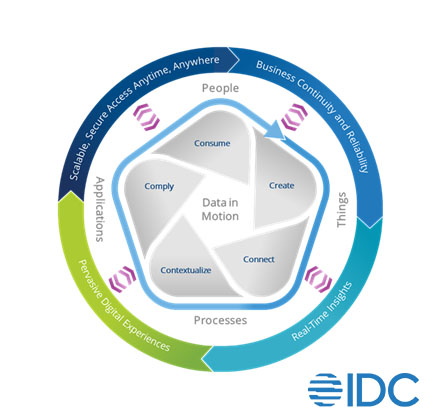
IT organizations are under tremendous pressure to deliver on the promise of the digital business model. As organizations become increasingly digital, guaranteeing a reliable digital connection for both internal and external parties is now critical to business continuity. Any connectivity disruption can have a dramatic impact on revenues, partner engagement and customer experience and satisfaction.

Forced to pivot and adapt in 2020, organizations quickly learned that they must now deliver and execute on a resilient connectivity strategy that provides uninterrupted bandwidth to keep business operations running smoothly. Organizations must be able to respond, adapt and evolve based on real-time and future connectivity demands – and this adaptation should extend beyond the network.

In IDC’s recent report, IDC Future Scape: Worldwide Future of Connectedness 2022 Predictions, we predict that more than 30% of organizations will prioritize connectivity resiliency to ensure business continuity, resulting in uninterrupted digital engagement for customers, employees and partners in 2022. Based on recent survey data from IDC’s Future of Connectedness survey, connectivity resiliency is aligned to state of connectedness across the enterprise. Currently, almost half of enterprises are still mid-stage or younger in their overall maturity strategy.

Even as we hopefully watch the world return to some newer state of normal this year, this prediction percentage should be higher. It should in fact be a wake-up call to any enterprise that looks to effectively manage its distributed workforce effectively as they further adopt digital-first principles. The business outcomes will be the faster ability to adapt to business and market conditions, adopt new technologies to improve business agility, and adapt to market changes.

Connectivity resiliency isn’t a one-time transformation. It requires the continuous alignment of people, processes, and technology around a common goal of guaranteed uptime. It also requires investment and integration of complementary connectivity technologies that empower users and customers to remain connected to key applications and services regardless of location or issue. The business outcomes will be the faster ability to adapt to changing business and market conditions and the adoption of new technologies to improve agility. 

The Roadmap to Connectivity Resiliency

Enterprises must first assess their current network, IT, cloud and application footprint to get a full understanding of how people, processes, systems, and “things” interact, and the actions needed to address potential technology related issues. Here, enterprises should perform an internal gap analysis to assess existing connectivity capabilities, strengths, weaknesses, and priorities for the entire organization. This should include:

  • Network access capabilities and needs
  • Usage patterns of on-premises and hosted applications
  •  Determining acceptable service level assurances associated with the disruption of business operations.

Second, organizations should prioritize investment and integration of complementary connectivity technologies that allow users and customers to remain connected to key applications and services regardless of location or issue. This could be via a complementary network, or through cloud solution adoption that allow access/usage anywhere and that eliminate risk of siloed data.

Thirdly, organizations should focus on building automation and analytics into all critical connectivity processes. As organizations use complementary technologies like 5G and WiFi 6 to ensure seamless connectivity, it will be just as critical to leverage data intelligence and performance metrics to track customer engagement, provide notification of issues, remove manual intervention of any hand off, and automate migration requirements between networks or systems.

As organizations evaluate both short and longer term business goals, addressing the resiliency challenge today will help drive opportunities to become more innovative, efficient and creative tomorrow. The end result will be increased agility for the Future Enterprise, with a connectedness outcome that improves network and IT efficiency, keeps employees, customers and partners engaged, helps ensure business continuity, and accelerates time to revenue.

Interested in learning more about IDC’s Future of Connectedness research practice? Download our latest eBook, Value Chain Agility: Connecting Partner Ecosystems to Shared Data and Intelligence

Paul Hughes - Research Director, Future of Connectedness - IDC

Paul Hughes is a Research Director leading IDC's Future of Connectedness Agenda program. He is also a key member of IDC's larger Worldwide Telecom Research Team. In this role, Paul is responsible for research related to the future innovation and transformation of how data and connectivity impact people, things, applications, and processes used by enterprises and end users. Within the Future of Connectedness practice, he also publishes thought leadership on how the Connectedness ecosystem – including communications service providers, cloud providers network equipment vendors, IT hardware vendors, software vendors and systems integrators – must develop solutions to meet future technology needs of businesses and consumers.