Virtual care is at a critical juncture in its development. The rapid rise of virtual care during the pandemic sparked discussions about its ongoing significance. While numerous studies have highlighted its advantages, the future of virtual care is now under scrutiny.

As the novelty effect fades, both healthcare professionals and patients are redefining their expectations and preferences, leading to valid questions about the path ahead for virtual care.

What is Virtual Care?

Definition in this space abounds, but from a general perspective, virtual care encompasses all the remote interactions between healthcare organizations and patients, enabled by digital tools to deliver health services, promote engagement and enhance health and well-being. It includes services and organizations focused on patient education and advice but also services that entail diagnosis, monitoring and treatment.

There is a broad spectrum of technologies enabling virtual care, covering connectivity, collaboration, clinical information systems, consumer technologies, MedTech, etc. These components enable communication, data exchange and analysis, transforming how healthcare is delivered and experienced.

 Main Benefits and Limitations of Virtual Care

The adoption of virtual care in European healthcare systems has triggered profound shifts and delivered benefits across multiple dimensions It has brought about notable improvements at the system level, as well as advancements within healthcare organizations. Virtual care has had a positive impact on patient outcomes and experiences, underscoring its significance in shaping the future of healthcare.

According to IDC’s December 2022 Consumer Pulse Survey, healthcare consumers reported comparable satisfaction levels with virtual visits as they did with traditional in-person appointments. When focusing on some macro-level benefits, virtual care has shown its pivotal role in healthcare by relieving ER pressure, freeing beds for patients with more critical needs, and improving operational efficiency.

For example, the English NHS recently surpassed its goal’s target of 10,000 virtual ward beds by September 2023. These beds cater to patients with conditions like COPD, heart failure, and frailty. Over 240,000 patients have been treated through virtual wards, with research suggesting comparable or faster recovery compared to traditional hospital care.

However, it is crucial for healthcare providers to acknowledge that virtual care is not without limitations and challenges, which must be carefully addressed. Without these considerations, healthcare organizations will struggle to realize the anticipated benefits, and, in some cases, they could even compromise care quality.

  • Transforming Essential Care – If We Connect the Dots: Virtual care offers convenience by allowing patients to access non-urgent medical services from home. It can alleviate strain on emergency rooms, address primary care shortages, and extend services to underserved areas. However, integration into patient records is essential for continuity of care. Technical obstacles, especially in underserved regions, require further investments in infrastructures, health information data integration and management.
  • Empowering Chronic Disease Management – If We Use the Right Tools: Virtual care positively impacts chronic disease management, but it requires appropriate engagement tools. Choosing ergonomic device design, automated real-time data collection, performance criteria (speed, accuracy, response times), and diverse functionalities (like medication reminders, predictive alerts) significantly impact the outcomes for virtual care. Striking a balance between virtual care benefits and the need for in-person assessments is vital. Understanding which aspects of disease management can be handled remotely, and which require in-person attention due to physical exams and specialized tests, is essential for comprehensive care.
  • Tackling Health Inequalities – If We Mind the Digital Gap: Virtual care aims to bridge healthcare access gaps, but the digital divide and limited digital literacy pose barriers. Health inequalities persist, with evidence of disparities in digital technology utilization. IDC research shows that the primary user demographic of virtual visits are young, urban, higher-income individuals, typically facing fewer access barriers. To tackle these disparities, virtual care solutions need to be intentionally designed to address specific barriers faced by different patient groups.

How to Future-Proof Virtual Care

Virtual care holds the potential to improve healthcare accessibility and delivery by providing care to individuals regardless of their location or the time of day. To fully harness this potential, it is crucial to thoughtfully address the challenges and shortcomings it currently faces and implement long-term strategies that facilitate transformative changes.

  • Assess Population Needs: Understand diverse patient requirements, including digital literacy and social determinants of health (SDoH). Embrace “hybrid care” models that offer both virtual and in-person options, catering to individual needs.
  • Choose Appropriate Technology: Select medical-grade remote patient monitoring devices and platforms that integrate seamlessly with healthcare professionals’ workflows. Ensure active patient engagement.
  • Establish a Virtual Care Ecosystem: Foster collaborations among healthcare authorities, provider organizations, and life science companies. Implement suitable reimbursement schemes to incentivize healthcare providers for round-the-clock virtual care availability.

At IDC we have just published a report “ IDC Innovators: Remote Patient Engagement and Virtual Care Solutions, 2023”  exploring how emerging technology vendors are supporting the evolution of  virtual care working with healthcare organizations and the broader health ecosystem.

Virtual care should not be seen just as a legacy of the pandemic-era; instead, it stands as a transformative force shaping the future of healthcare. By aligning with population needs, leveraging technology sensibly, and fostering collaboration in the healthcare ecosystem, virtual care can advance even further. Its role in delivering high-quality, accessible, and convenient healthcare services tailored to individuals worldwide will remain pivotal.

As we transitioned into a post-pandemic era, it’s crucial to fine-tune virtual care programs to fit population-specific needs and integrate them seamlessly into the broader healthcare ecosystem, solidifying their significance.

If you’re curious and want to dive deeper into this subject, consider reaching out to our IDC Health Insights team. Also be sure to check the latest research on virtual care from Nino Giguashvili, Federico Mayr and Silvia Piai

Silvia Piai - Research Director, IDC Health Insights - IDC

Silvia leads the team of analysts covering the European healthcare market and the Worldwide Medical Devices Industry. Her research provides strategic advice to end users and vendors in healthcare and life sciences, assisting organizations in understanding how technologies are disrupting and transforming traditional business models. Silvia Piai's research offers a comprehensive perspective on the foundational elements shaping the health industry's evolution. Her analysis delves into the implication of key industry trends like evidence-based medicine, personalization and integration of care services and the transformation of health industry ecosystems. Through these overarching themes, Silvia Piai offers in-depth analysis of ongoing innovations and best practices in pivotal technological domains such as AI, IoT, Cloud and industry-specific solutions.

Fall traditionally means Predictions time for the entire IDC community. That point of the year where we gather across different research domains to reflect on those trends steering organizations’ digital agendas and predict what will characterize the digital landscape in the months and years to come.

This year, this is happening at the dawn of a new chapter in the Digital Business Era: the chapter of AI Everywhere.

Generative AI triggered the opening of this chapter because it holds the potential to drastically reduce the time and long-term costs associated with developing solutions across a wide range of use cases associated with automation and intelligence. It is completely changing our relationship with data and how we extract value from both structured and unstructured data.

This era is about how we use data as input and as a business outcome:

  • 18% of EMEA organizations believe that GenAI is already disrupting their business, and 70% of all organizations believe it will do so in the next 18 months.
  • 44% of EMEA organizations are already investing in GenAI or doing initial model testing and proofs of concepts.
  • Customer-facing applications, financial and operational decision support applications, and employee experience applications are sweet spots for GenAI integration.
  • GenAI is expected to capture 15% of EMEA organizations’ new IT projects budgets in 2024, representing a must-have chevron in technology vendors capabilities and portfolios (IDC GenAI ARC Survey, August 2023 — GenAI Awareness, Readiness, and Commitment: A First Look at IT Leaders’ Expectations and Concerns for Generative AI).

For organizations to gain a competitive edge in this new era, a full reimagination is needed.

Creating an intelligent architecture that is supported by a cost-effective digital infrastructure and relevant capabilities is a priority. At the same time, this journey raises ethical and trust-related questions that purpose-driven organizations must prepare for.

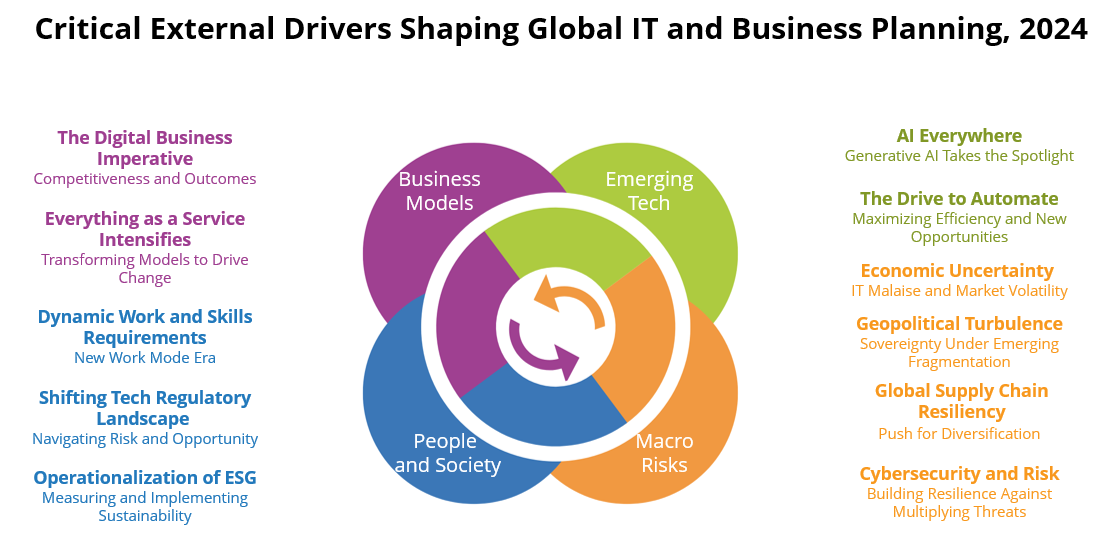
AI Everywhere is certainly the key factor altering the global business and digital ecosystem for the next 12-24 months and beyond, but other critical external drivers will also shake 2024:

  1. The Drive to Automate
  2. Economic Uncertainty 
  3. Geopolitical Turbulence
  4. Global Supply Chain Resiliency
  5. Cybersecurity and Risk
  6. The Digital Business Imperative
  7. Everything as a Service Intensification
  8. Dynamic Work and Skills
  9. Shifting Tech Regulatory Landscape 
  10. Operationalization of ESG 

This year’s unveiling of IDC’s EMEA Predictions for 2024 and will take place on December 11. In the weeks leading up to the reveal, we will release a series of thought leaderships assets that will double-click on these key drivers, analyzing their digital impact and highlighting actions that organizations will have to take to be Digital Future ready (the partial list of upcoming webcasts with registration links can be found below).

In the meantime, if you want to remain updated on the upcoming releases, please visit our IDC European FutureScape page, and register to join us for the IDC EMEA Futurescape 2024 webcast.


Upcoming October and November IDC EMEA webcasts you can register for:


Andrea Siviero - Senior Research Director, MacroTech, Digital Business, and Future of Work - IDC

Andrea Siviero leads IDC's European Digital Business and Future of Work Research group. The group provides market research insights to foster a purposeful and fair adoption of technologies supporting digital societies, businesses and workforce and empower tech providers in strategic decision making, planning and go-to-market activities. Siviero also co-leads the IDC Worldwide MacroTech Research program, focused on the intertwined connection between the Economical and Digital worlds - analyzing the impact key MacroEconomic factors have on the digital landscape and viceversa, how technologies are impacting economies around the world.

The internal combustion engine was one of the most disruptive technologies of the past 150 years. It had long-term ripple effects not only on how fast and conveniently people and goods move, but also on our shopping and leisure habits, urban planning, and individual health and well-being. Some of these impacts were arguably negative; such as time wasted in congestion, pollution, and traffic accidents. To address those externalities policymakers, government traffic and transportation departments, car OEMs, and mobility ecosystems are reinventing vehicles and business models to reduce those externalities and eventually deliver on the promise of convenient, affordable, accessible, safe, and environmentally sustainable mobility.

The transition to next-generation mobility will depend on a new generation of vehicles that are connected, autonomous, and electric on shared and public mobility, and on rethinking urban planning to make it convenient and safe for people to switch to less impactful ways of moving such as cycling and walking. These new mobility models can deliver the expected benefits only if the way roads are designed, built, operated, maintained, used, and upgraded is transformed to make them possible.

Growing Investments in Smart and Sustainable Roads

Investments in smart and sustainable roads are flourishing in Europe and beyond. Examples include:

  • The UK National Highway and Connected Places Catapult’s £1.7 million joint financing to fund innovative ideas and proofs of concept (POCs) for net-zero carbon road maintenance and construction materials and processes
  • The city of Gothenburg is working with Volvo and other partners to test dynamic low-emission zones
  • Italy’s highway and road authority Anas’ €1 billion plan to equip 3,000km of interurban roads with intelligent road systems and e-charging infrastructure
  • Cities around the globe nudging logistics service providers to use smart pick-up and drop-off zones for delivery trucks, such as Barcelona which plans to impose a yearly tax on transport companies fulfilling home deliveries for using public spaces, to eventually nudge consumers to venture out to collect their own parcels (companies with a turnover of more than €1 million would have to pay an annual income-based tax of 1.25%)

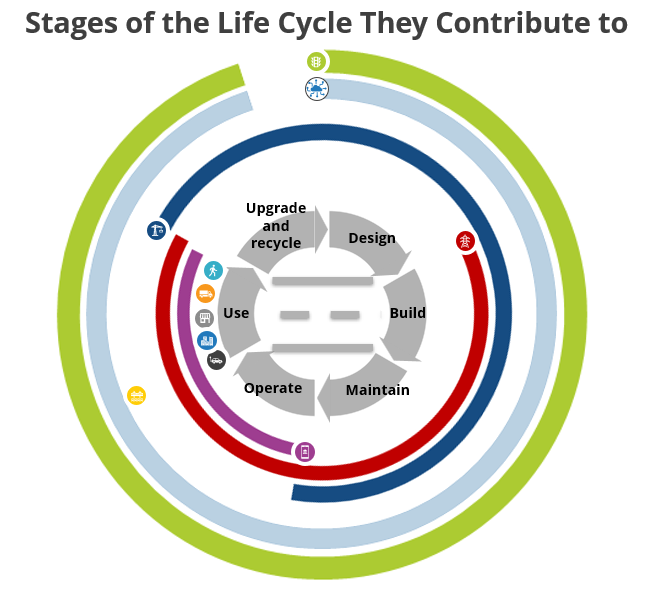
Smart, sustainable roads are not to be intended merely as the instrumentation of roads with sensors and actuators to enable intelligent traffic management use cases, but it should be considered from a wider perspective. We define smart, sustainable roads as the intelligent use of technology across road design, construction, operation, maintenance, usage, and upgrade and recycle of materials to:

  • Reduce cost of ownership and increase environmental sustainability across the design, construction, operation, and maintenance life cycle of physical road elements
  • Enhance convenience, affordability, accessibility, safety, and environmental sustainability for the movement of people and goods
  • Increase prosperity by enabling businesses to profit from new and existing economic activities related to designing, building, operating, maintaining, using, and decommissioning roads.

Next-Generation Use Cases Emerging at the Intersection of Multiple Industries

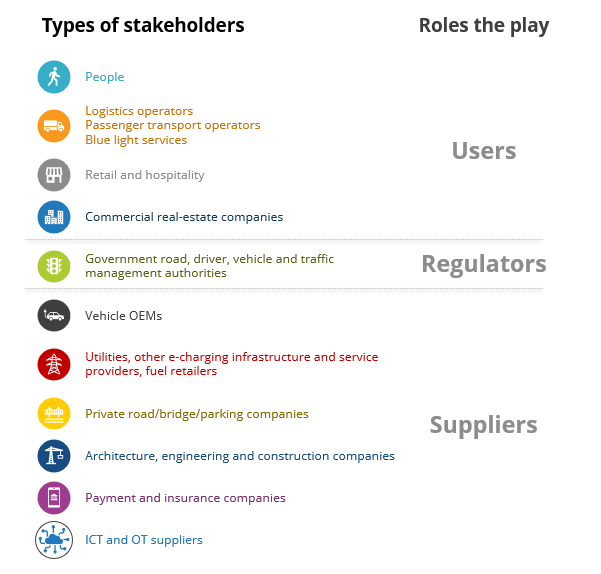
Smart roads are systems of systems. The value of technology innovation, such as IoT, AI, satellite imaging, lidar and electric mobility, is realized at the intersection of a network of stakeholders, the outcomes they aim to achieve, and the capabilities they need to implement to deliver those outcomes.

The Smart and Sustainable Roads Stakeholder Ecosystem

For example, to realize the benefits of:

  • Electric mobility. Utilities, engineering and construction contractors, and road authorities need to work together to establish an accessible and affordable charging infrastructure; vehicle OEMs need to expand the number and battery range of electric and hybrid vehicles that they offer; payment providers must enable seamless settlement across different electric charging service providers; technology suppliers need to work with OEMs to embed connected vehicle capabilities for vehicle-driver interaction (e.g., trip planning, charging locations, pricing options) and vehicle-grid interaction (e.g., for smart charging and V2G applications).
  • Low-emission or low-speed zones. Road authorities must work with technology suppliers to embed sensors in the infrastructure to count and monitor the number and type of vehicles, and they must share data with traffic departments to ensure enforcement of low-emission and low-speed regulations. Vehicle OEMs must embed connected and autonomous driving capabilities in their cars and trucks to make it easier for drivers to comply with regulations.
  • Multimodal mobility as a service. Public transit operators must work with micromobility and shared mobility operators to enable integrated journey planning and payments, while road and traffic authorities must set up incentives, such as dynamic road pricing, to nudge people to explore options, beyond driving their own cars, while insurance providers need to offer plans that cover multimodal trips, rather than vehicle ownership.

To accelerate the convergence towards smart and sustainable roads ecosystem:

  • Governments should evolve regulations and standards and monitor the impact of safety, accessibility, environmental sustainability and road service pricing policies.
  • Transport operators, utilities and OEMs should connect their products and services to road infrastructure, such as traffic systems and e-charging systems to expand service offerings.
  • Financial services should invest in smart road payment and insurance offerings.
  • Retailers should scale on-the-move targeted advertising and shopping.
  • AEC companies should invest in digital twin to increase the effectiveness and efficiency of designing, building, maintaining, and upgrading smart roads.


If you want to know more, please reach out to Massimiliano Claps


Massimiliano Claps - Research Director - IDC

Massimiliano (Max) Claps is the research director for the Worldwide National Government Platforms and Technologies research in IDC's Government Insights practice. In this role, Max provides research and advisory services to technology suppliers and national civilian government senior leaders in the US and globally. Specific areas of research include improving government digital experiences, data and data sharing, AI and automation, cloud-enabled system modernization, the future of government work, and data protection and digital sovereignty to drive social, economic, and environmental outcomes for agencies and the public.

Did you know that Sustainability is the top business risk for CEOs in Europe, even above cybersecurity? (IDC EMEA, CEO Survey, January 2023, n=108). This is the first time sustainability has been at the top of the board’s agenda, and it is likely to stay for some time. But why is it a risk and not an opportunity? Why saving the planet is seen as a threat to business?

For many, climate change and the new sustainability regulations are a disruption to their operations. After all, today’s economy was built on the premise that Nature had given us a cheque in blank, with a limitless use of resources. How wrong it was.

Therefore, having Mother Nature behaving in the most unpredictable ways (e.g., heatwaves, floods, droughts) and government policies shaping business operations (e.g., taxes, quotas, disclosures) can be painful.  

These are some examples: if you’re a semiconductor company with factories in South Asia, severe droughts can be material to your manufacturing processes as governments can prioritize water for local people. Or, if you’re a mobile phone manufacturer, the use of plastic packaging can be material to your business because of taxes or a complete ban by governments.

Sustainability is a moral, regulatory, and ultimately business mandate. There’s no opt-out: stakeholders are watching closely, e.g., customers, investors, business partners, regulators. As the executive of one of the world’s largest insurers shared in an interview recently “We don’t work anymore with customers that are not improving their sustainability. They are uninsurable for us“.    

Therefore, if sustainability is indeed a risk, can companies turn it into a business opportunity? The answer is “yes”, according to most European companies (IDC EMEA, Future Enterprise Resilience, May 2023, n = 220).


Sustainability: Evolving from Risk to Opportunity

Sustainability can be a business opportunity if there’s a clear vision and commitment from leadership. Only then, “doing good” is embedded in every facet of work, across all business units, from procurement and production to logistics and customer service.

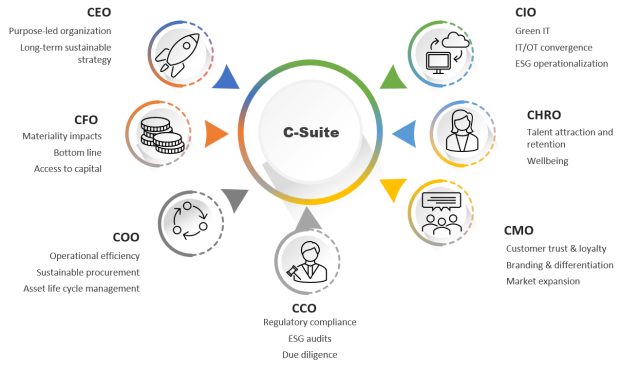
To make this happen, sustainability targets need to be fully aligned with the agenda and goals of each executive in the C-Suite. This is an illustrative example:

Benefits of Sustainability for Business

By addressing the agenda of the C-Suite, we can identify 7 reasons why sustainability is good for business:

  1. Chief Operations Officer (COO): Sustainability can drive operational efficiencies (IDC Global Sustainability Readiness Index, IDC, August 2023) across all business functions (e.g., supply chain, logistics, facilities). A sustainable firm is a fit and lean organization where “less is more”, e.g., frugality in resourcing water and energy.
  2. Chief Financial Officer (CFO): Investing in sustainable practices might not always deliver short term returns but can pay off in the form of resiliency and business longevity. CFOs have realized that the cost of “not acting” is greater than the cost of acting – for example, in their ability to access capital or insurance.
  3. Chief Marketing Officer (CMO): Sustainability is addressing the needs of a growing customer base. Buyers are looking for more transparency, honesty, and trust from suppliers. As such, brands with strong green credentials, integrity and social responsibility bring competitive differentiation.
  4. Chief Human Resources Officer (CHRO): Sustainability is a magnet in an organization, attracting and retaining talent. People are looking for purpose in their job and their companies (IDC EMEA Employee Future of Work Survey, March 2023). When work has direction is powerful and energizing: employees can work hard for goals they understand and feel connected to.
  5. Chief Information Officer (CIO): Sustainability, in an aim to reduce carbon emissions, can accelerate cloud migration, automation and optimization of IT processes (IDC Global Sustainability Readiness Index, IDC, August 2023). Moreover, based on the principle of frugality, IT assets can be rationalized based on usage and their lifecycle expanded as appropriate.
  6. Chief Compliance Officer (CCO): Sustainability can outshine a company against competitors in matters of corporate reputation and governance. The CCO can put in place strong stakeholder protections and build market trust.   
  7. Chief Executive Officer (CEO): Sustainability can be a bold strategy for long-term business value. Leading with purpose can be inspiring, ignite passion amongst employees and create a culture of high-performance. B-Corps (e.g., Allbirds, Patagonia, Teapigs and Aesop) are testimony of it.  


Sustainability can be a force for good business and meet the C-Suite goals, but it needs execution for business impact (Global Sustainability Readiness Index, IDC, August 2023): it has to be internalized across the enterprise and become the “modus operandi” of getting work done, and for everyone, from the top to the bottom of the organization. But this is easier said than done. IDC research shows this is a roadblock for many enterprises: how to move from strategy to execution? Here is where the role of the Chief Sustainability Officer (CSO) comes into the picture.

Successful CSOs are executives with strong business acumen and digital skills, on the top of their sustainability expertise. Their role is not limited to appeasing the needs of different stakeholders, chiefly regulators and investors, but also a catalyst for business value creation through sustainability. Their reporting line should be direct to their CEO to give them stature in their organization.  

CSOs are tech-savvy because technology is fundamentally the enabler to turn sustainability strategy into action and derive business value. For example, IoT and automation can optimize resource consumption in buildings and bring costs down; blockchain and AI can support resiliency in the supply chain.

In summary, sustainability can be an opportunity for business value when it meets the C-Suite goals. It needs a strategy that everyone in the organization understands and is passionate about – nothing is more fulfilling than knowing at the end of the working day you did something good for the planet and society. But, remember, it needs a CSO-led action plan and great technology to turn it into business value.


If you want to know more, please reach out to Angela Salmeron


In today’s rapidly evolving digital landscape, where technological advancements are reshaping industries at an unprecedented pace, the cloud has emerged as a beacon of innovation and efficiency. European businesses and governments have keenly embraced cloud technologies, harnessing their transformative potential to optimize operations, drive collaboration, and stay ahead of a dynamic digital market.

At the forefront of this cloud revolution is the concept of Industry Clouds – specialized platforms, applications, and services that offer industry-specific capabilities and operational prowess, revolutionizing how businesses across diverse sectors operate and excel.

A Shift in Cloud Dynamics: The Rise of Industry Clouds in Europe

The maturity of the cloud market in Europe has been steadily progressing, and forward-thinking organizations are strategically leveraging the unique advantages offered by different cloud platforms, applications, and services. The region’s robust infrastructure, bolstered by data protection regulations like the General Data Protection Regulation (GDPR), combined with the presence of established local cloud service providers, has expedited the adoption of cloud solutions across various industries.

Innovation, collaboration, and operational efficiency have become the driving forces behind European businesses’ embrace of cloud technology. Notably, the emergence of multi-cloud and hybrid cloud strategies has allowed organizations to tailor their cloud environments to their specific industry needs, adhere to local regulations, and fuel complex digital businesses that thrive on flexible infrastructure.

This holistic approach goes beyond mere migration, and moving out of legacy environments, looking for cost-efficiency, but marks a pivotal shift toward industry-specific solutions.

Empowering the Leadership: CTOs and CIOs in the Cloud Era

As cloud maturity advances, the roles of Chief Technology Officers (CTOs) and Chief Information Officers (CIOs) are undergoing a transformation. These decision-makers are no longer concerned solely with operational efficiency and scalability; they are now focused on strategic cloud implementation that drives tangible business outcomes.

The modern CTO and CIO are in search of solutions that not only streamline operations but also cater to the unique demands of their industries, thereby enhancing value for money and competitive advantage.

This shift in focus has paved the way for Industry Clouds to take center stage. As cloud providers, enterprise software vendors, and industry organizations fine-tune their offerings to align with specific sectors, CTOs and CIOs are empowered to harness cloud technologies that are tailor-made for their industries, sub-sectors and even use cases.

Deciphering Industry Clouds: Defining the Landscape

Industry Clouds, as distinguished from their conventional counterparts, are cloud-based platforms, applications, or services designed to offer industry-specific insights, technology, and operational capabilities. The hallmark of Industry Clouds lies in their vertical integration, modularity, collaboration features, and the potential to foster network effects. These specialized clouds encompass a range of services, including SaaS, IaaS, PaaS, DaaS, and various business operations-as-a-service.

What sets Industry Clouds apart are their unique characteristics. These clouds provide a suite of tools that agnostic cloud platforms and enterprise SaaS solutions simply cannot replicate. The focal technology capabilities encompass:

  1. Industry-specific data models
  2. Industry-tailored business process capabilities
  3. Pre-built blueprints and configuration templates
  4. Governance capabilities, including compliance and regulatory alignment
  5. Cross-industry collaboration options for seamless data sharing
  6. Specialized AI and analytics capabilities, including Gen AI
  7. Marketplace functionalities for optimized sourcing
  8. A PaaS platform for customized extensions and add-ons

These capabilities underpin the value proposition of Industry Clouds, allowing organizations to tap into solutions that are purpose-built for their sectors.

Navigating the Landscape: European Industry Clouds Research

The European Industry Clouds Research is a comprehensive exploration of industry-specific solutions. This research delves into the offerings of Cloud Service Providers (CSPs), competitive landscapes, adoption best practices across industries, and other critical aspects of these specialized platforms, applications, and services.

While the focus is primarily on CSP offerings, it also encompasses insights from industry players such as Siemens and Dassault, albeit in a more limited scope. Notably, the research excludes non-business solutions ecosystems, like government shared/community cloud platforms or collective standard-promoting platforms.

The research also extends into the realm of Cross-Industry approach, comparing and contrasting adoption rates across different sectors, evaluating offerings per industry, and dissecting the strategies of Cloud Service Providers, consulting organizations, and enterprise software vendors. This comprehensive exploration ensures a holistic understanding of Industry Clouds’ impact on various industries.

Industry Clouds vs. Industry Ecosystems: Navigating Complexity

Industry Clouds and Industry Ecosystems, while interconnected, are distinct concepts that play unique roles in driving innovation and business efficiency. An Industry Cloud Platform is a specialized, industry-tailored digital service offering data, blueprints, and industry knowledge to optimize operations within a specific sector.

In contrast, Industry Ecosystems encompass a broader network of businesses, partners, and stakeholders, promoting collaboration, innovation, and value creation on a larger scale. While Industry Clouds offer targeted solutions, Industry Ecosystems foster a collaborative environment that transcends organizational boundaries, nurturing multi-way value generation flows.

Embracing the Future: Leveraging Industry Clouds for European Business Acceleration and Resiliency

As European businesses continue to navigate the ever-changing digital landscape, Industry Clouds have emerged as a powerful tool to drive operational excellence, innovation, and competitive advantage. By tailoring cloud solutions to meet industry-specific needs, organizations are harnessing the full potential of cloud technology to create a transformative impact.

As we move forward, it is imperative for businesses to recognize and leverage the unparalleled benefits of Industry Clouds and Industry Ecosystems, ensuring sustainable growth and staying at the forefront of digital evolution.

To know more, please reach out to Anielle Guedes.

September through December are busy months for IDC analysts. Industry and tech vendor conferences and events are happening every week. Only over the next couple of weeks, I’ll be traveling first to Rome and then to Portugal and, every time I travel, I try to think of my carbon footprint.

Going to Rome is a no brainer, I’ll drive my hybrid car to the train station, then ride a commuter train to Milan, then a high-speed train to Rome, and eventually the subway to the hotel; I’ll ride electric end-to-end. Going to Lisbon, there’s no choice, I need to fly, unless I fancy spending two days on a bus. So, my carbon footprint will be much higher. True, Lisbon is much farther away than Rome, but still the average carbon emissions of a flight are much higher than those of a train.

Air travel executives know that policymakers, investors and passengers are expecting them to be more ambitious in terms of their environmental sustainability targets and are taking actions.


Download eBook: Sustainability in EMEA: Opportunities for Tech Vendors, Challenges for Tech Buyers


The Three Horizons of Sustainable Air Travel

In the immediate aftermath of COVID, somebody thought that doing more work, learning, getting entertained remotely would replace a lot of air travel, hence reduce emissions. But air travel came back with a vengeance.

Therefore, air travel executives need to rely on other levers to increase sustainability. One of the most critical is technology innovation. Technology innovation will play a strategic role to make air travel more sustainable through three waves.

  • In the long-term, electric and hybrid electric propulsion aircraft will drastically reduce both carbon emission and noise pollution. But although air taxis are already technically possible, long-haul electric flight is at the research stage.
  • In the medium-term, alternative fuels will reduce, but not eliminate emissions, and by 2030, they will not represent only about 10% of all consumption, according to the International Energy Agency.

Information and communication technologies (ICT) will help – for instance, AI is being applied to accelerate the discovery of alternative fuels, digital twins are used to design and develop electric engines for aircrafts – but they won’t be the critical enablers. These medium-to-long term changes will be dependent on biochemical, mechanical, and electrical engineering developments.

  • In the short-term, it will be a whole different story. ICT will be strategic to make air travel more sustainable. From designing and operating more fuel-efficient routes, by integrating traffic control systems, such as the Single European Sky, which is expected to cut carbon emissions by around 10% per year, to applying AI and machine learning to reduce taxi time – American airlines intelligent gating program is providing the capability to save more than a minute of taxi time per flight. From implementing more sophisticated data collection and analytics to report scope one, two and three emissions more accurately and then offset them, to reducing airports’ energy consumption. From sharing data among airlines, global distribution systems, online travel agencies and brick-and-more travel agencies to nudge passengers to buy environmental sustainability products and packages, to partnering with railways to replace short-haul flights or better connect airports.


Register for the webcast: Sustainability in EMEA: The Challenge of Moving from Ambition to Action


I consider myself a quite environmentally conscious person, but then when I look back at my twenty plus years career in the ICT industry, I took so many flights that make my environmental conscience feel guilty. I hope that I’ll be able to travel on an electric powered airplane, someday.

In the meantime, there are plenty of opportunities to embrace ICT innovations to make air travel more sustainable. To learn more about airlines’ sustainability and other strategic and operational innovations enabled technology, take a look at IDC’s global research on the industry.

Massimiliano Claps - Research Director - IDC

Massimiliano (Max) Claps is the research director for the Worldwide National Government Platforms and Technologies research in IDC's Government Insights practice. In this role, Max provides research and advisory services to technology suppliers and national civilian government senior leaders in the US and globally. Specific areas of research include improving government digital experiences, data and data sharing, AI and automation, cloud-enabled system modernization, the future of government work, and data protection and digital sovereignty to drive social, economic, and environmental outcomes for agencies and the public.